10 J. Agrobiotech. Vol. 10(1), 2019, p. 10–16.
© Universiti Sultan Zainal Abidin eISSN 2180-1983 (Online)
Syafiqah Nabilah (et al.) Evaluation of Difference Leaf Cutting Shape and Pruning Techniques on Root and Shoot Production of Labisia pumila
Evaluation of Difference Leaf Cutting Shape and Pruning Techniques on Root and Shoot
Production of Labisia pumila
Syafiqah Nabilah Samsul Bahari*, Farah Fazwa Md Ariff and Norhayati Saffie
Plant Improvement Program, Forestry Biotechnology Division, Forest Research Institute Malaysia (FRIM), 52109 Kepong, Selangor, Malaysia
*Corresponding author: [email protected]
Received: 15/01/2019, Accepted: 21/03/2019, Available Online: 15/05/2019
ABSTRACT
Labisia pumila or locally known as kacip fatimah, belongs to the family of Primulaceae. It possesses several medicinal properties such as pre and post-partum medication, anti-obesity, anti-aging and anti-microbial. In this paper, an attempt was made to discover the suitable leaf cutting shape and pruning technique to increase the yield and improve the quality of root and shoot production of L. pumila. Three different leaves cutting shape were tested (shape A, shape B and shape C) to study their effect on root production. The cuttings were distinguished by the shape of leaf midrib at the basal part. Whereas for pruning experiment, two pruning techniques were identified namely half cut and full cut. In half cut, the leaves petiole remained on the stem while in full cut, all leaves and petiole was removed from the stem. Leaf cutting from shape C rooted earlier (at week 5) than the others (at week 6). However, leaves cutting from shape A performed better in the number of root and root length. For pruning experiment, no significant difference was observed in the growth performance of L. pumila within the 12 weeks of observation. However, the full cut pruning technique produced new shoot earlier than half cut within the observation period. An extended observation period is required to measure the growth and yield of this herbal plant. The output of this study will benefit the industries for a quick and effective method in order to produce mass planting materials for the species. Keywords: Herb, cutting, plant biomass, plantation management, plant health differentiate
INTRODUCTION
Labisia pumila is synonymous with the title ‘queen of herbs’ due to its medicinal value for women’s health. It has been listed as one of the high-value herbal product that has a bright future in the herbal industry. Recent study has found that the plant contains bioactive antioxidant compounds such as resorcinol, flavonoid and phenolic (Karimi et al., 2011). L. pumila has been discovered in various fields of applications, particularly in pharmaceutical and cosmeceutical purposes. As the application of L. pumila continuously being explored, many newly developed products will be invented and consequently increase the demand for raw material supply. A high quality raw material will be the added value in the product developed. Therefore, it is important to propagate this species in large scale to ensure a sustainable supply of the raw materials in the future.
11
A recent study conducted by Rohana et al. (2015) has presented a list of farmers who planted L. pumila in their own land either for nursery purposes or raw materials supply. It shows that the awareness among the public has increased as they can reduce the dependence on forest supply. Realizing the importance of the species, Forest Research Institute Malaysia (FRIM) is also committed in ensuring the sustainable supply of L. pumila raw materials. Thus, a series of studies were conducted to establish the standard operating procedure for plantation of this herbal plant. Previous studies were conducted on determination of the suitable technique for acclimatization of L. pumila plantlets (Syafiqah Nabilah et al., 2017), identification of the best planting media for growing L. pumila (Farah Fazwa et al., 2017) and evaluation on the optimum harvesting period for L. pumila (Norhayati et al., 2018). Findings from the studies were disseminated to the farmers, villagers and organizations to encourage them on a commercial plantation and increase their source of income.
This current study discussed the propagation through leaf cutting and maintenance technique of L. pumila specifically on the pruning technique. Propagation of plants by cuttings is the most widely used technique and simple way to produce clones in many herbaceous, ornamentals and woody plants. The detached plant parts of roots, stems, leaves or buds have the ability to grow into a complete whole plant provided with suitable environment (John, 2015). Pruning is a silvicultural practice involving the selective removal of certain parts of a plant, such as branches, leaves, buds or roots to increase the quality of crops and fruit trees (Jin et al., 2018). The best pruning technique is important for the purpose of to prepare nursery specimens for propagation activities and harvesting process. This is to ensure that high yield and quality L. pumila planting materials can be obtained.
MATERIALS AND METHODS Leaf cutting
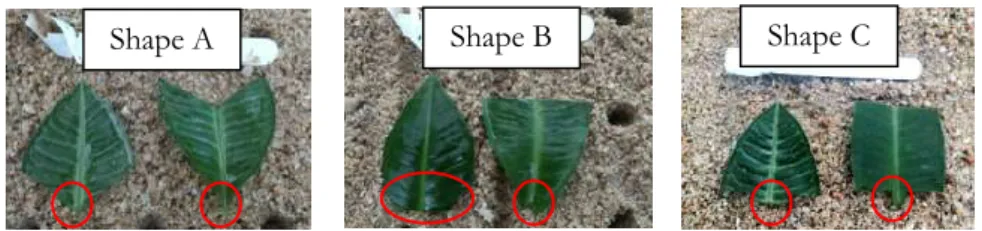
Fully grown, healthy looking leaves were excised from the mother plants of L. pumila. The leaves were cut into three different shapes (shape A, shape B and shape C, Figure 1) by maintaining the size of 30 cm2. The leaf cuttings were treated immediately with Seradix 1 (0.1 % IBA) before being inserted into the rooting media. The cuttings were kept moist by an automatic mist sprinkler system set for one minute of misting every one hour. About 180 cuttings were produced in Completely Randomized Design (CRD) within three replications. The observation on rooted cuttings was made during 3 to 12 weeks of cuttings.
Fig. 1: Three different leaf cutting shapes of Labisia pumila
Pruning
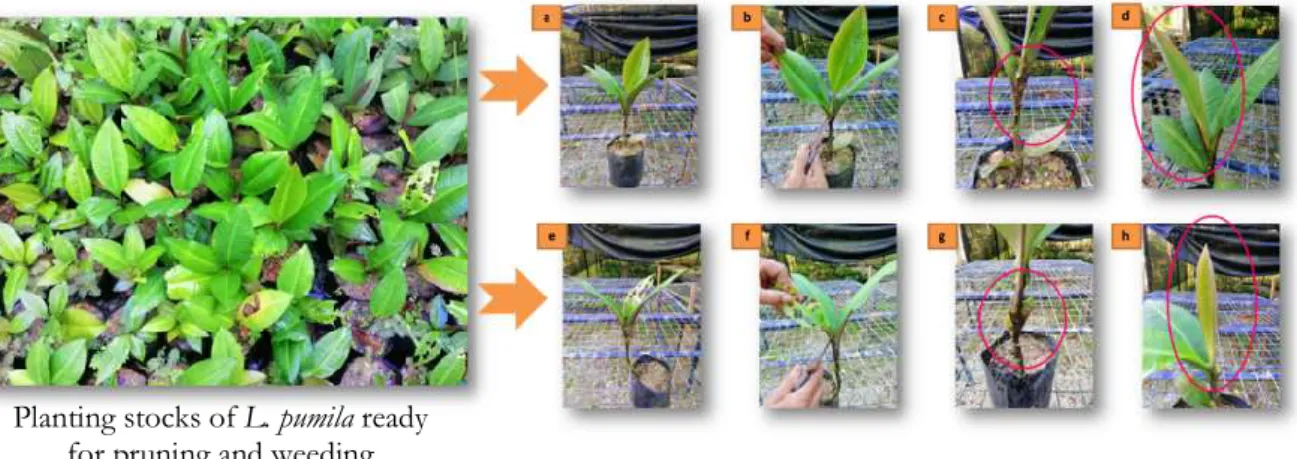
A total of 60 plants of L. pumila were prepared for pruning. Thirty plants were pruned by removing the leaves and petiole (full cut, Figure 2a-d) while other thirty plants were pruned by removing the leaves only (half cut, Figure 2e-h). About two leaves were cut from each plant. The growths parameters such as plant height, no. of leaves, leaf length and leaf width were measured once per month until 12 weeks. Analysis of Variance (ANOVA) using IBM SPSS Statistics version 22 was used to analyze the data.
12
Fig. 2: Step involved in leaves pruning; full cut pruning technique, (a) planting stocks of L. pumila, (b) the damaged leaves was removed until the petiole part, (c) petiole scar, (d) new shoot developed; half cut pruning
technique, (e) planting stocks of L. pumila, (f) the damaged leaves was removed but the petiole was remained about 2 cm, (g) the remaining petiole, (h) new shoot emerged.
RESULTS AND DISCUSSION
Effects of different leaf cuttings shape on rooting performances of
Labisia pumila
a) Root developmentRoot development of Labisia pumila in this study occurred between week 4 to week 12 of cutting period. The result showed that cutting from shape C rooted earlier than shape A and shape B (Figure 4).
Fig. 3: Number of rooted cuttings in 12 weeks of cutting period Planting stocks of L. pumila ready
for pruning and weeding
0
10
20
30
40
50
60
1
2
3
4
5
6
7
8
9
10
11
12
N
u
m
b
er
o
f
le
a
f
ro
o
te
d
Week
Shape A Shape B Shape C13 b) Rooting percentage
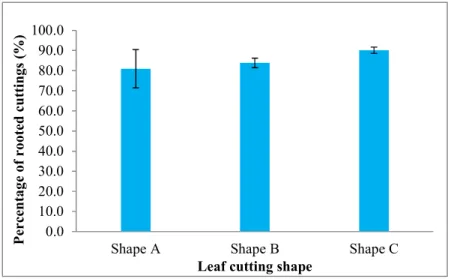
The analysis of variance (ANOVA) showed no significant effect on rooting percentage of the cuttings. Cutting from shape C produced the highest rooting percentage (90.00 ± 0.04 %) followed by shape B (86.67 ± 0.04 %) and shape A (81.67 ± 0.05 %).
Fig. 4:Percentage of rooted cuttings in different leaf cutting shapes c) Total number of primary roots and root length
Table 1 showed the root performance of L. pumila in terms of primary root number and root length in three different leaf cuttings shapes. The analysis of variance (ANOVA) showed a statistically significant difference at p≤0.05 between the primary root number and root length with the cutting shape. Cutting from shape A produced a greater number of primary roots and root length compared to others.
Table 1: Root performance of clone KF08 in different leaf cutting shapes
Leaf part Number of primary roots Root length (cm)
Shape A 3.50 ± 0.14a 3.71 ± 0.36a
Shape B 2.48 ± 0.16b 2.84 ± 0.40b
Shape C 2.50 ± 0.16b 2.94 ± 0.35b
Means with the same letter are not significantly different at 0.05 level of confidence
Rooting performances of three different leaf cutting shapes were evaluated during 12 weeks of cutting period. In this study, root development of L. pumila can be observed at week 4 (shape C) and week 5 (shape A and shape B, Figure 4) of cutting period which one to two-week delay from the findings by Aminah et al. (2008); Rozihawati et al. (2008) and Farah Fazwa et al. (2013). Different quality of planting material used for cutting might give vary results in terms of rooting performance.
The rooting percentage, total number of primary roots and root length of L. pumila were evaluated after 12 weeks of cutting period. More than 80% rooting percentage was obtained from the overall leaf cutting shapes (Figure 4). In other studies, Rozihawati (2008) obtained a comparable result which the leaf cuttings of L. pumila var. alata recorded 84% rooting percentage. Whereas Aminah et al. (2008) and Syafiqah Nabilah et al. (2013) obtained more than 90% rooting percentage of L. pumila var. alata from30 cm2 leaf areas. This finding showed L. pumila species can be propagated easily using leaf cutting technique.
0.0 10.0 20.0 30.0 40.0 50.0 60.0 70.0 80.0 90.0 100.0
Shape A Shape B Shape C
P e rc e n ta g e o f r o o te d c u tt in g s (% )
Leaf cutting shape
14
For number of primary roots, the average roots develop from L. pumila was in the range of 2.48 ± 0.16 to 3.50 ± 0.14 with root length of 2.84 ± 0.40 cm to 3.71 ± 0.36 cm. In general, the root growth in terms of number and length depends on the amount of auxin present in the rooted leaf cuttings as well as the hormone treatment (Hartmann and Kester, 1983). Other than that, the shape of cuttings might also influence the rooting performance of L. pumila as revealed in this study. As shown in Figure 1, the midrib area of cuttings from shape A is smaller than the other shapes which made it easier for rooting hormone absorption as well as rooting production. Therefore, shape A is suggested to be used in propagation of L. pumila for a better rooting performance.
Effects of different pruning technique on shoot production of
L. pumila
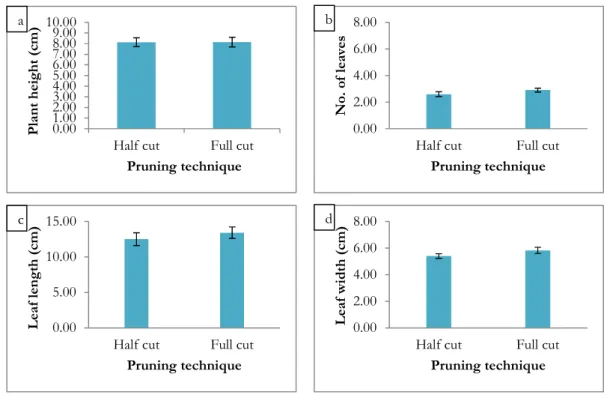
Analysis of Variance (ANOVA) was conducted to study the effects of different pruning techniques on the growth performance of L. pumila. Results showed that there was no significant difference (p<0.05) in the growth performance of L. pumila after 12 weeks of pruning either used the half cut or full cut technique. However, from the observation the full cut pruning technique produced new shoots earlier (± 1 week) than half cut pruning technique (data not shown). The growth comparison between half cut and full cut were presented in Figure 5: (a) - (d).
Fig. 5: Growth performances of L. pumila a) plant height; b) number of leaves; c) leaf length and d) leaf width resulted from two pruning techniques.
No significant difference was observed in the growth performance of L. pumila based on the pruning technique, which might be due to the short study period (12 week). The observation should be extended up to 24 week as this species is a slow growing plant (Sunarno, 2005).
0.00 1.00 2.00 3.00 4.00 5.00 6.00 7.00 8.00 9.00 10.00
Half cut Full cut
P la n t h e ig h t (c m ) Pruning technique a 0.00 2.00 4.00 6.00 8.00
Half cut Full cut
N o . o f le a ve s Pruning technique b 0.00 5.00 10.00 15.00
Half cut Full cut
L e a f le n g th ( c m ) Pruning technique c 0.00 2.00 4.00 6.00 8.00
Half cut Full cut
L e a f w id th ( c m ) Pruning technique d
15 CONCLUSION
There are many factors influence the success of leaf cuttings. The shape of leaf cutting could be one of the criteria that should be look into for production of quality root and later a plant. Shape A is preferred to be apply in leaf cuttings of L. pumila as it produce vigorous root number and root length. On the other hand, pruning is another important aspect in nursery management. It should be conducted regularly to remove the unhealthy parts of plants and to help the plants grow well. As a conclusion, the output of this study will benefit the industries for a quick and effective method in order to produce mass planting materials for the species.
REFERENCES
Aminah, H. Naimah, C.L. Mohd Zaki, A. & Lokmal, N. (2008). Rooted leaf cuttings of Labisia pumila. Journal of Tropical Medicinal Plants, 9(1), 101-104.
Farah Fazwa, M. A., Norhayati, S., Syafiqah Nabilah, S. B., & Mohd Adi Faiz, A. F. (2013). Evaluation of rooting ability of five superior genotypes of Labisia pumila var. alata on sand media. In Proceedings of Soils Science Conference of Malaysia. p. 329-333.
Farah Fazwa, M. A., Norhayati, S., Syafiqah Nabilah, S.B., Noraliza, A., Nor Hasnida, H., Siti Suhaila, A.R. & Mohd Zaki, A. (2017). Propagation of Labisia pumila var. pumila (Kacip Fatimah) using seeds, leaf cuttings and tissue culture. International Journal of Agriculture, Environment and Bioresearch 2(5), 337-345.
Hartmann, H. T., & Kester, D. E. (1983). Plant propagation. Principles and practices (No. Ed. 4). Prentice-Hall, Inc. ISBN 978-0-13-501449-3. 869 pp.
Jin, S., Wang, Y., Shi, L., Guo, X., & Zhang, J. (2018). Effects of pruning and mulching measures on annual soil moisture, yield, and water use efficiency in jujube (Ziziphus jujube Mill.) plantations. Global Ecology and Conservation, 15, e00406.
John M. R. (2015). Cloning plants by rooting stem cuttings. p. 219–230. In Plant propagation concepts and laboratory exercises. Beyl, C. A. & Trigiano, R. N.(eds.), Boca Raton: Florida. 482 pp.
Karimi, E., Hawa, Z.E.J. and Sahida, A. (2011). Phytochemical analysis and antimicrobial activities of methanolic extracts of leaf, stem and root from different varieties of Labisia pumila Benth, Molecules, 16, 4438-50.
Norhayati, S., Farah Fazwa, M.A., Syafiqah Nabilah, S.B., Siti Suhaila, A.R. 2018. Sustainable supply of high quality raw material Labisia pumila (Kacip Fatimah) at Kampung Sagil, Ledang, Johor. International Journal of Agriculture, Forestry and Plantation (IJAFP) 6, 79-84.
Rohana, A.R., Nur Fazreen, Z., Ariff Fahmi, A.B., Nur Syazni, A., Siti Zubaidah, S., Lim, H.F., Mohd Shahidan, M.A., Rosniza, R., Marzalina, M. & Abd Latif, M. (2015). Directory of Herbal Cultivators in Peninsular Malaysia, Forest Research Insitute Malaysia.
Rozihawati, Z. (2008). Production of Planting Stock From Kacip Fatimah (Labisia pumila (Bi.) F. Vill & Neves) Through Cuttings. PhD thesis, Universiti Putra Malaysia (UPM), Malaysia.
Sunarno, B. (2005). Revision of the genus Labisia (Myrsinaceae). Blumea-Biodiversity, Evolution and
16
Syafiqah Nabilah, S. B., Farah Fazwa, M. A., Norhayati, S., & Mohd Zaki, A. (2013). Production of quality planting stocks from five selected clones of Labisia pumila var. alata through leaf cuttings. In Proceeding of the International Symposium on Tropical Forest Ecosystem Science and Management 2013. p. 276-280.
Syafiqah Nabilah, S.B., Farah Fazwa, M.A., Siti Suhaila, A.R., Norhayati, S., Mohd Zaki, A., Masitah, M.T. (2017). Acclimatization of KFeFRIM01: A Superior Clone of Labisia pumila var. alata. International Journal of Environmental and Agriculture Research3(11),9-13.
How to cite this paper:
Syafiqah Nabilah, S.B., Farah Fazwa, M.A. & Norhayati, S. (2019). Evaluation of difference leaf cutting shape and pruning techniques on root and shoot production of Labisia pumila. Journal of Agrobiotechnology, 10(1), 10-16