A Dataset for Movie Description
Anna Rohrbach
1Marcus Rohrbach
2Niket Tandon
1Bernt Schiele
1 1Max Planck Institute for Informatics, Saarbr¨ucken, Germany
2
UC Berkeley EECS and ICSI, Berkeley, CA, United States
Abstract
Descriptive video service (DVS) provides linguistic de-scriptions of movies and allows visually impaired people to follow a movie along with their peers. Such descriptions are by design mainly visual and thus naturally form an inter-esting data source for computer vision and computational linguistics. In this work we propose a novel dataset which contains transcribed DVS, which is temporally aligned to full length HD movies. In addition we also collected the aligned movie scripts which have been used in prior work and compare the two different sources of descriptions. In total theMovie Descriptiondataset contains a parallel cor-pus of over 54,000 sentences and video snippets from 72 HD movies. We characterize the dataset by benchmark-ing different approaches for generatbenchmark-ing video descriptions. Comparing DVS to scripts, we find that DVS is far more visual and describes precisely what is shown rather than whatshould happenaccording to the scripts created prior to movie production.
1. Introduction
Audio descriptions (DVS - descriptive video service) make movies accessible to millions of blind or visually im-paired people1. DVS provides an audio narrative of the
“most important aspects of the visual information” [58], namely actions, gestures, scenes, and character appearance as can be seen in Figures 1 and2. DVS is prepared by trained describers and read by professional narrators. More and more movies are audio transcribed, but it may take up to 60 person-hours to describe a 2-hour movie [42], resulting in the fact that only a small subset of movies and TV pro-grams are available for the blind. Consequently, automating this would be a noble task.
In addition to the benefits for the blind, generating de-scriptions for video is an interesting task in itself requiring to understand and combine core techniques of computer
vi-1In this work we refer for simplicity to “the blind” to account for all blind and visually impaired people which benefit from DVS, knowing of the variety of visually impaired and that DVS is not accessible to all.
DVS: Abby gets in the basket.
Mike leans over and sees how high they are.
Abby clasps her hands
around his face and
kisses him passionately.
Script: After a moment a
frazzled Abby pops up in his place.
Mike looks down to see – they are now fifteen feet above the ground.
For the first time in her life, she stops think-ing and grabs Mike and kisses the hell out of him.
Figure 1: Audio descriptions (DVS - descriptive video ser-vice), movie scripts (scripts) from the movie “Ugly Truth”.
sion and computational linguistics. To understand the visual input one has to reliably recognize scenes, human activities, and participating objects. To generate a good description one has to decide what part of the visual information to ver-balize, i.e. recognize what is salient.
Large datasets of objects [18] and scenes [68,70] had an important impact in the field and significantly improved our ability to recognize objects and scenes in combination with CNNs [38]. To be able to learn how to generate descrip-tions of visual content, parallel datasets of visual content paired with descriptions are indispensable [56]. While re-cently several large datasets have been released which pro-vide images with descriptions [51,29,47], video descrip-tion datasets focus on short video snippets only and are limited in size [12] or not publicly available [52]. TACoS Multi-Level [55] and YouCook [16] are exceptions by pro-viding multiple sentence descriptions and longer videos, however they are restricted to the cooking scenario. In con-trast, the data available with DVS provides realistic, open domain video paired with multiple sentence descriptions. It even goes beyond this by telling a story which means it al-lows to study how to extract plots and understand long term semantic dependencies and human interactions from the vi-sual and textual data.
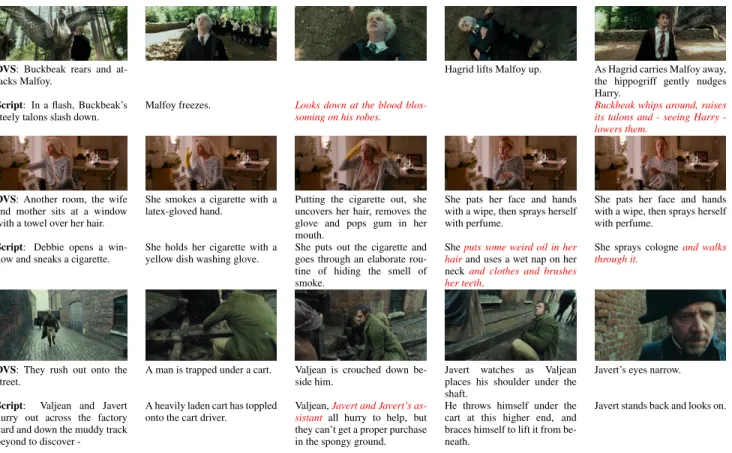
Figures 1 and 2 show examples of DVS and compare them to movie scripts. Scripts have been used for various
DVS: Buckbeak rears and at-tacks Malfoy.
Hagrid lifts Malfoy up. As Hagrid carries Malfoy away, the hippogriff gently nudges Harry.
Script: In a flash, Buckbeak’s
steely talons slash down.
Malfoy freezes. Looks down at the blood
blos-soming on his robes.
Buckbeak whips around, raises its talons and seeing Harry -lowers them.
DVS: Another room, the wife and mother sits at a window with a towel over her hair.
She smokes a cigarette with a latex-gloved hand.
Putting the cigarette out, she uncovers her hair, removes the glove and pops gum in her mouth.
She pats her face and hands with a wipe, then sprays herself with perfume.
She pats her face and hands with a wipe, then sprays herself with perfume.
Script: Debbie opens a
win-dow and sneaks a cigarette.
She holds her cigarette with a yellow dish washing glove.
She puts out the cigarette and goes through an elaborate rou-tine of hiding the smell of smoke.
Sheputs some weird oil in her hairand uses a wet nap on her neckand clothes and brushes her teeth.
She sprays cologneand walks through it.
DVS: They rush out onto the street.
A man is trapped under a cart. Valjean is crouched down be-side him.
Javert watches as Valjean places his shoulder under the shaft.
Javert’s eyes narrow.
Script: Valjean and Javert
hurry out across the factory yard and down the muddy track beyond to discover
-A heavily laden cart has toppled onto the cart driver.
Valjean,Javert and Javert’s as-sistant all hurry to help, but they can’t get a proper purchase in the spongy ground.
He throws himself under the cart at this higher end, and braces himself to lift it from be-neath.
Javert stands back and looks on.
Figure 2: Audio descriptions (DVS - descriptive video service), movie scripts (scripts) from the movies “Harry Potter and the prisoner of azkaban”, “This is 40”, “Les Miserables”. Typical mistakes contained in scripts marked withred italic.
tasks [43,14,49,20,46], but so far not for the video de-scription. The main reason for this is that automatic align-ment frequently fails due to the discrepancy between the movie and the script. Even when perfectly aligned to the movie it frequently is not as precise as the DVS because it is typically produced prior to the shooting of the movie. E.g. in Figure2see the mistakes marked with red. A typi-cal case is that part of the sentence is correct, while another part contains irrelevant information.
In this work we present a novel dataset which provides transcribed DVS, which is aligned to full length HD movies. For this we retrieve audio streams from blu-ray HD disks, segment out the sections of the DVS audio and transcribe them via a crowd-sourced transcription service [2]. As the audio descriptions are not fully aligned to the activities in the video, we manually align each sentence to the movie. Therefore, in contrast to the (non public) corpus used in [59,58], our dataset provides alignment to the actions in the video, rather than just to the audio track of the description. In addition we also mine existing movie scripts, pre-align them automatically, similar to [43,14] and then manually align the sentences to the movie.
We benchmark different approaches to generate
descrip-tions. First are nearest neighbour retrieval using state-of-the-art visual features [67, 70, 30] which do not require any additional labels, but retrieve sentences form the train-ing data. Second, we propose to use semantic parstrain-ing of the sentence to extract training labels for recently proposed translation approach [56] for video description.
The main contribution of this work is a novel movie description dataset which provides transcribed and aligned DVS and script data sentences. We will release sentences, alignments, video snippets, and intermediate computed fea-tures to foster research in different areas including video description, activity recognition, visual grounding, and un-derstanding of plots.
As a first study on this dataset we benchmark several ap-proaches for movie description. Besides sentence retrieval, we adapt the approach of [56] by automatically extracting the semantic representation from the sentences using se-mantic parsing. This approach achieves competitive perfor-mance on TACoS Multi-Level corpus [55] without using the annotations and outperforms the retrieval approaches on our novel movie description dataset. Additionally we present an approach to semi-automatically collect and align DVS data and analyse the differences between DVS and movie scripts.
2. Related Work
We first discuss recent approaches to video description and then the existing works using movie scripts and DVS.
In recent years there has been an increased interest in automatically describing images [23,39,40,50,45,40,41, 34,61,22] and videos [37,27,8,28,32,62,16,26,64,55] with natural language. While recent works on image de-scription show impressive results bylearningthe relations between images and sentences and generating novel sen-tences [41,19,48,56,35,31,65,13], the video description works typically rely on retrieval or templates [16,63,26,27, 37,39,62] and frequently use a separate language corpus to model the linguistic statistics. A few exceptions exist: [64] uses a pre-trained model for image-description and adapts it to video description. [56,19] learn a translation model, however, the approaches rely on a strongly annotated corpus with aligned videos, annotations, and sentences. The main reason for video description lacking behind image descrip-tion seems to be a missing corpus to learn and understand the problem of video description. We try to address this lim-itation by collecting a large, aligned corpus of video snip-pets and descriptions. To handle the setting of having only videos and sentences without annotations for each video snippet, we propose an approach which adapts [56], by ex-tracting annotations from the sentences. Our extraction of annotations has similarities to [63], but we try to extract the senses of the words automatically by using semantic parsing as discussed in Section5.
Movie scripts have been used for automatic discovery and annotation of scenes and human actions in videos [43, 49,20]. We rely on the approach presented in [43] to align movie scripts using the subtitles. [10] attacks the problem of learning a joint model of actors and actions in movies using weak supervision provided by scripts. They also rely on a semantic parser (SEMAFOR [15]) trained on FrameNet database [7], however they limit the recognition only to two frames. [11] aims to localize individual short actions in longer clips by exploiting the ordering constrains as weak supervision.
DVS has so far mainly been studied from a linguistic prospective. [58] analyses the language properties on a non-public corpus of DVS from 91 films. Their corpus is based on the original sources to create the DVS and contains dif-ferent kinds of artifacts not present in actual description, such as dialogs and production notes. In contrast our text corpus is much cleaner as it consists only of the actual DVS. With respect to word frequency they identify that especially actions, objects, and scenes, as well as the characters are mentioned. The analysis of our corpus reveals similar statis-tics to theirs.
The only work we are aware of, which uses DVS in con-nection with computer vision is [59]. The authors try to understand which characters interact with each other. For
this they first segment the video into events by detecting di-alogue, exciting, and musical events using audio and visual features. Then they rely on the dialogue transcription and DVS to identify when characters occur together in the same event which allows them to defer interaction patterns. In contrast to our dataset their DVS is not aligned and they try to resolve this by a heuristic to move the event which is not quantitatively evaluated. Our dataset will allow to study the quality of automatic alignment approaches, given annotated ground truth alignment.
There are some initial works to support DVS productions using scripts as source [42] and automatically finding scene boundaries [25]. However, we believe that our dataset will allow learning much more advanced multi-modal models, using recent techniques in visual recognition and natural language processing.
Semantic parsing has received much attention in com-putational linguistics recently, see, for example, the tutorial [6] and references given there. Although aiming at general-purpose applicability, it has so far been successful rather for specific use-cases such as natural-language question an-swering [9,21] or understanding temporal expressions [44].
3. The Movie Description dataset
Despite the potential benefit of DVS for computer vision, it has not been used so far apart from [25,42] who study how to automate DVS production. We believe the main rea-son for this is that it is not available in the text format, i.e. transcribed. We tried to get access to DVS transcripts from description services as well as movie and TV production companies, but they were not ready to provide or sell them. While script data is easier to obtain, large parts of it do not match the movie, and they have to be “cleaned up”. In the following we describe our semi-automatic approach to ob-tain DVS and scripts and align them to the video.
3.1. Collection of DVS
We search for the blu-ray movies with DVS in the “Au-dio Description” section of the British Amazon [1] and se-lect a set of 46 movies of diverse genres2. As DVS is only
available in audio format, we first retrieve audio stream
22012, Bad Santa, Body Of Lies, Confessions Of A Shopaholic, Crazy Stupid Love, 27 Dresses, Flight, Gran Torino, Harry Potter and the deathly hallows Disk One, Harry Potter and the Half-Blood Prince, Harry Potter and the order of phoenix, Harry Potter and the philosophers stone, Harry Potter and the prisoner of azkaban, Horrible Bosses, How to Lose Friends and Alienate People, Identity Thief, Juno, Legion, Les Miserables, Mar-ley and me, No Reservations, Pride And Prejudice Disk One, Pride And Prejudice Disk Two, Public Enemies, Quantum of Solace, Rambo, Seven pounds, Sherlock Holmes A Game of Shadows, Signs, Slumdog Million-aire, Spider-Man1, Spider-Man3, Super 8, The Adjustment Bureau, The Curious Case Of Benjamin Button, The Damned united, The devil wears prada, The Great Gatsby, The Help, The Queen, The Ugly Truth, This is 40, TITANIC, Unbreakable, Up In The Air, Yes man.
Before alignment After alignment
Movies Words Words Sentences Avg. length Total length
DVS 46 284,401 276,676 30,680 4.1 sec. 34.7 h.
Movie script 31 262,155 238,889 23,396 3.4 sec. 21.7 h.
Total 72 546,556 515,565 54,076 3.8 sec. 56.5 h.
Table 1: Movie Description dataset statistics. Discussion see Section3.3.
from blu-ray HD disk3. Then we semi-automatically seg-ment out the sections of the DVS audio (which is mixed with the original audio stream) with the approach described below. The audio segments are then transcribed by a crowd-sourced transcription service [2] that also provides us the time-stamps for each spoken sentence. As the DVS is added to the original audio stream between the dialogs, there might be a small misalignment between the time of speech and the corresponding visual content. Therefore, we manually align each sentence to the movie in-house.
Semi-Automatic segmentation of DVS. We first
esti-mate the temporal alignment difference between the DVS and the original audio (which is part of the DVS), as they might be off a few time frames. The precise alignment is important to compute the similarity of both streams. Both steps (alignment and similarity) are computed using the spectograms of the audio stream, which is computed us-ing Fast Fourier Transform (FFT). If the difference between both audio streams is larger than a given threshold we as-sume the DVS contains audio description at that point in time. We smooth this decision over time using a minimum segment length of 1 second. The threshold was picked on a few sample movies, but has to be adjusted for each movie due to different mixing of the audio description stream, dif-ferent narrator voice level, and movie sound.
3.2. Collection of script data
In addition we mine the script web resources4and select
26 movie scripts5As starting point we use the movies
fea-turing in [49] that have highest alignment scores. We are also interested in comparing the two sources (movie scripts and DVS), so we are looking for the scripts labeled as “Fi-nal”, “Shooting”, or “Production Draft” where DVS is also available. We found that the “overlap” is quite narrow, so
3We use [3] to extract a blu-ray in the .mkv file, then [5] to select and extract the audio streams from it.
4http://www.weeklyscript.com, http://www.simplyscripts.com, http://www.dailyscript.com, http://www.imsdb.com
5Amadeus, American Beauty, As Good As It Gets, Casablanca, Charade, Chinatown, Clerks, Double Indemnity, Fargo, Forrest Gump, Gandhi, Get Shorty, Halloween, It is a Wonderful Life, O Brother Where Art Thou, Pianist, Raising Arizona, Rear Window, The Crying Game, The Graduate, The Hustler, The Lord Of The Rings The Fellowship Of The Ring, The Lord Of The Rings The Return Of The King, The Lost Weekend, The Night of the Hunter, The Princess Bride.
we analyze 5 such movies6in our dataset. This way we end up with 31 movie scripts in total. We follow existing ap-proaches [43,14] to automatically align scripts to movies. First we parse the scripts, extending the method of [43] to handle scripts which deviate from the default format. Sec-ond, we extract the subtitles from the blu-ray disks7. Then
we use the dynamic programming method of [43] to align scripts to subtitles and infer the time-stamps for the de-scription sentences. We select the sentences with a reliable alignment score (the ratio of matched words in the near-by monologues) of at least 0.5. The obtained sentences are then manually aligned to video in-house.
3.3. Statistics and comparison to other datasets
During the manual alignment we filter out: a) sentences describing the movie introduction/ending (production logo, cast etc); b) texts read from the screen; c) irrelevant sen-tences describing something not present in the video; d) sentences related to audio/sounds/music. Table1 presents statistics on the number of words before and after the alig-ment to video. One can see that for the movie scripts the re-duction in number of words is about 8.9%, while for DVS it is 2.7%. In case of DVS the filtering mainly happens due to inital/ending movie intervals and transcribed dialogs (when shown as text). For the scripts it is mainly attributed to ir-relevant sentences. Note, that in cases when the sentences are “alignable” but have minor mistakes we still keep them. We end up with the parallel corpus of over 50K video-sentence pairs and a total length over 56 hours. We com-pare our corpus to other existing parallel corpora in Table2. The main limitations of existing datasets are single domain [16,54,55] or limited number of video clips [26]. We fill in the gap with a large dataset featuring realistic open domain videos, which also provides high quality (professional) sen-tences and allows for multi-sentence description.
3.4. Visual features
We extract video snippets from the full movie based on the aligned sentence intervals. We also uniformly extract 10 frames from each video snippet. As discussed above DVS and scripts describe activities, object, and scenes (as
6Harry Potter and the prisoner of azkaban, Les Miserables, Signs, The Ugly Truth, This is 40.
7We extract .srt from .mkv with [4]. It also allows for subtitle alignment and spellchecking.
Dataset multi-sentence domain sentence source clips videos sentences
YouCook [26] x cooking crowd 88 2,668
TACoS [54,56] x cooking crowd 7,206 127 18,227
TACoS Multi-Level [55] x cooking crowd 14,105 273 52,593
MSVD [12] open crowd 1,970 70,028
Movie Description (ours) x open professional 54,076 72 54,076
Table 2: Comparison of video description datasets. Discussion see Section3.3.
well as emotions which we do not explicitly handle with these features, but they might still be captured, e.g. by the context or activities). In the following we briefly introduce the visual features computed on our data which we will also make publicly available.
DTWe extract the improved dense trajectories compen-sated for camera motion [67]. For each feature (Trajectory, HOG, HOF, MBH) we create a codebook with 4000 clus-ters and compute the corresponding histograms. We apply L1 normalization to the obtained histograms and use them as features.
LSDA We use the recent large scale object detection CNN [30] which distinguishes 7604 ImageNet [18] classes. We run the detector on every second extracted frame (due to computational constraints). Within each frame we max-pool the network responses for all classes, then do mean-pooling over the frames within a video snippet and use the result as a feature.
PLACES and HYBRIDFinally, we use the recent scene classification CNNs [70] featuring 205 scene classes. We use both available networks: Places-CNN and Hybrid-CNN, where the first is trained on the Places dataset [70] only, while the second is additionally trained on the 1.2 mil-lion images of ImageNet (ILSVRC 2012) [57]. We run the classifiers on all the extracted frames of our dataset. We mean-pool over the frames of each video snippet, using the result as a feature.
4. Approaches to video description
In this section we describe the approaches to video de-scription that we benchmark on our proposed dataset.
Nearest neighborWe retrieve the closest sentence from the training corpus using the L1-normalized visual features introduced in Section3.4and the intersection distance.
SMTWe adapt the two-step translation approach of [56] which uses an intermediate semantic representation (SR), modeled as a tuple, e.g.hcut, knive, tomatoi. As the first step it learns a mapping from the visual input to the seman-tic representation (SR), modeling pairwise dependencies in a CRF using visual classifiers as unaries. The unaries are trained using an SVM on dense trajectories [66]. In the sec-ond step [56] translates the SR to a sentence using
Statisti-cal Machine Translation (SMT) [36]. For this the approach concatenates SR as input language, e.g. cut knife tomato, and the natural sentence pairs as output language, e.g.The person slices the tomato. While we cannot rely on an an-notated SR as in [56], we automatically mine the SR from sentences using semantic parsing which we introduce in the next section. In addition to dense trajectories we use the features described in Section3.4.
SMT Visual words As an alternative on potentially noisy labels extracted from the sentences, we try to directly translate visual classifiers and visual words to a sentence. We model the essential components by relying on activity, object, and scene recognition. For objects and scenes we rely on the pre-trained models LSDA and PLACES. For activities we rely on the state-of-the-art activity recognition feature DT. We cluster the DT histograms to 300 visual words using k-means. The index of the closest cluster center from our activity category is chosen as label. To build our tuple we obtain the highest scoring class labels of the object detector and scene classifier. More specifically for the object detector we consider two highest scoring classes: for subject and object. Thus we obtain the tuple hSU BJ ECT, ACT IV IT Y, OBJ ECT, SCEN Ei = hargmax(LSDA), DTi, argmax2(LSDA),
argmax(P LACES)i, for which we learn translation to a natural sentence using the SMT approach discussed above.
5. Semantic parsing
Learning from a parallel corpus of videos and sentences without having annotations is challenging. In this section we introduce our approach to exploit the sentences using semantic parsing. The proposed method aims to extract an-notations from the natural sentences and make it possible to avoid the tedious annotation task. Later in the section we perform the evaluation of our method on a corpus where annotations are available in context of a video description task.
5.1. Semantic parsing approach
We lift the words in a sentence to a semantic space of roles and WordNet [53,24] senses by performing SRL
(Se-Phrase WordNet VerbNet Expected
Mapping Mapping Frame
the man man#1 Agent.animate Agent: man#1
begin to shoot shoot#2 shoot#vn#2 Action: shoot#2
a video video#1 Patient.solid Patient: video#1
in in PP.in the moving bus bus#1 NP.Location. solid Location: mov-ing bus#1
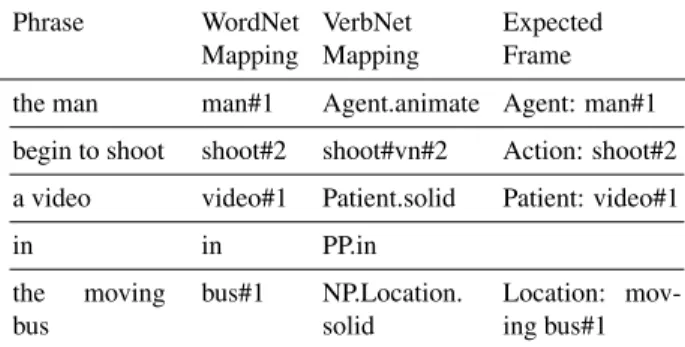
Table 3: Semantic parse for “He began to shoot a video in the moving bus”. Discussion see Section5.1
mantic Role Labeling) and WSD (Word Sense Disambigua-tion). For an example, refer to Table 3, the expected out-come of semantic parsing on the input sentence “He shot a video in the moving bus” is “Agent: man, Action: shoot, Patient: video, Location: bus”. Ad-ditionally, the role fillers are disambiguated.
We use the ClausIE tool [17] to decompose sentences into their respective clauses. For example, “he shot and modified the video” is split into two phrases “he shot the video” and “the modified the video”). We then use the OpenNLP tool suite8for chunking the text of each clause. In order to provide the linking of words in the sentence to their WordNet sense mappings, we rely on a state-of-the-art WSD system, IMS [69]. The WSD system, however, works at a word level. We enable it to work at a phrase level. For every noun phrase, we identify and disambiguate its head word (e.g. the moving bus to “bus#1”, where “bus#1” refers to the first sense of the word bus). We link verb phrases to the proper sense of its head word in WordNet (e.g.begin to shootto “shoot#2”).
In order to obtain word role labels, we link verbs to VerbNet [60,33], a manually curated high-quality linguis-tic resource for English verbs. VerbNet is already mapped to WordNet, thus we map to VerbNet via WordNet. We perform two levels of matches in order to obtain role la-bels. First is the syntactic match. Every VerbNet verb sense comes with a syntactic frame e.g. for shoot, the syntactic frame isNP V NP. We first match the sentence’s verb against the VerbNet frames. These become candi-dates for the next step. Second we perform the seman-tic match: VerbNet also provides a role restriction on the arguments of the roles e.g. for shoot (sense killing), the role restriction isAgent.animate V Patient.animate
PP Instrument.solid. The other sense for shoot (sense snap), the semantic restriction is Agent.animate V Patient.solid. We only accept candidates from the syntactic match that satisfy the semantic restriction.
8http://opennlp.sourceforge.net/
Seman&c(parsing(
((Input:((Someone&puts&the&tools&back&in&the&shed.(
((Output:(
text$ role$ sense$ WordNet$synset$
someone( SUBJECT( 100007846( {person,(individual,(someone,…}( putHback( VERB( 201308381( {replace,(put(back}(
theHtool( OBJECT( 104451818( {tool}( theHshed( LOCATION( 104187547( {shed}(
(a) Semantic representation extracted from a sentence.
Examples:(same(verb,(different(senses( • The&van&pulls&into&the&forecourt.(
– sense(of({pull}:(move(into(a(certain(direc&on(
• Someone&pulls&the&purse&impercep9bly&closer&to&himself.( – sense(of({pull,draw,force}:(cause(to(move(by(pulling(
• People&play&a&fast&and&furious&game. (( – sense(of({play}:(par&cipate(in(games(or(sport( • At&one&end&of&the&room&an&orchestra&is(playing.(
– sense(of({play}:(play(on(an(instrument(
(b) Same verb, different senses.
• Someone leaps onto a bench by a couple hugging.
• Someone drops to his knee to embrace his son.
– sense of {hug, embrace}: squeeze (someone) /ghtly in your arms,
usually with fondness
• Someone spins and grabs his car-‐door handle.
• And someone takes hold of her hand.
– sense of {grab, take hold of}: take hold of so as to seize or
restrain or stop the mo/on of
(c) Different verbs, same sense.
Figure 3: Semantic parsing example, see Section5.1
VerbNet contains over 20 roles and not all of them are general or can be recognized reliably. Therefore, we fur-ther group them to get the SUBJECT, VERB, OBJECT and LOCATION roles. We explore two approaches to obtaining the labels based on the output of the semantic parser. First is to use the extracted text chunks directly as labels. Second is to use the corresponding senses as a labels (and there-fore group multiple text labels). In the following we refer to these astext-andsense-labels. Thus from each sentence we extract a semantic representation in a form of (SUBJECT, VERB, OBJECT, LOCATION), see Figure3afor example. Using the WSD allows to identify different senses (Word-Net synsets) for the same verb (Figure 3b) and the same sense for different verbs (Figure3c).
5.2. Applying parsing to TACoS Multi-Level corpus
We apply the proposed semantic parsing to the TACoS Multi-Level [55] parallel corpus. We extract the SR from the sentences as described above and use those as anno-tations. Note, that this corpus is annotated with the
tu-Approach BLEU
SMT [56] 24.9
SMT [55] 26.9
SMT with our text-labels 22.3 SMT with our sense-labels 24.0
Table 4: BLEU@4 in % on sentences of Detailed Descrip-tions of the TACoS Multi-Level [55] corpus, see Section 5.2.
Annotations activity tool object source target
Manual [55] 78 53 138 69 49
verb object location
Our text-labels 145 260 85
Our sense-labels 158 215 85
Table 5: Label statistics from our semantic parser on TACoS Multi-Level [55] corpus, see Section5.2.
ples (ACTIVITY, OBJECT, TOOL, SOURCE, TARGET) and the subject is always the person. Therefore we drop the SUBJECT role and only use (VERB, OBJECT, LOCA-TION) as our SR. Then, similar to [55], we train the visual classifiers for our labels (proposed by the parser), we only use the ones that appear at least 30 times. Next we train a CRF with 3 nodes for verbs, objects and locations, using the visual classifier responses as unaries. We follow the trans-lation approach of [56] and train the SMT on the Detailed Descriptions part of the corpus using our labels. Finally, we translate the SR predicted by our CRF to generate the sentences. Table4shows the results comparing our method to [56] and [55] who use manual annotations to train their models. As we can see the sense-labels perform better than the text-labels as they provide better grouping of the labels. Our method produces competitive result which is only 0.9% below the result of [56]. At the same time [55] uses more training data, additional color Sift features and recognizes the dish prepared in the video. All these points, if added to our approach, would also improve the performance.
We analyze the labels selected by our method in Table 5. It is clear that our labels are still imperfect, i.e. different labels might be assigned to similar concepts. However the number of extracted labels is quite close to the number of manual labels. Note, that the annotations were created prior to the sentence collection, so some verbs used by humans in sentences might not be present in the annotations.
From this experiment we conclude that the output of our automatic parsing approach can serve as a replacement of manual annotations and allows to achieve competitive re-sults. In the following we apply this approach to our movie description dataset.
Correctness Relevance
DVS 63.0 60.7
Movie scripts 37.0 39.3
Table 6: Human evaluation of DVS and movie scripts: which sentence is more correct/relevant with respect to the video, in %. Discussion in Section6.1.
Corpus Clause NLP Labels WSD
TACoS Multi-Level [55] 0.96 0.86 0.91 0.75 Movie Description (ours) 0.89 0.62 0.86 0.7 Table 7: Semantic parser accuracy for TACoS Multi-Level and our new corpus. Discussion in Section6.2.
6. Evaluation
In this section we provide more insights about our movie description dataset. First we compare DVS to movie script and then we benchmark the approaches to video description introduced in Section4.
6.1. Comparison DVS vs script data
We compare the DVS and script data using 5 movies from our dataset where both are available (see Section3.2). For these movies we select the overlapping time intervals with the intersection over union overlap of at least 75%, which results in 126 sentence pairs. We ask humans via Amazon Mechanical Turk (AMT) to compare the sentences with respect to their correctness and relevance to the video, using both video intervals as a reference (one at a time, re-sulting in 252 tasks). Each task was completed by 3 dif-ferent human subjects. Table6presents the results of this evaluation. DVS is ranked as more correct and relevant in over 60% of the cases, which supports our intuition that scrips contain mistakes and irrelevant content even after be-ing cleaned up and manually aligned.
6.2. Semantic parser evaluation
Table 7 reports the accuracy of the different compo-nents of the semantic parsing pipeline. The compocompo-nents are clause splitting (Clause), POS tagging and chunking (NLP), semantic role labeling (Labels) and word sense disambigua-tion (WSD). We manually evaluate the correctness on a ran-domly sampled set of sentences using human judges. It is evident that the poorest performing parts are the NLP and the WSD components. Some of the NLP mistakes arise due to incorrect POS tagging. WSD is considered a hard prob-lem and when the dataset contains less frequent words, the performance is severely affected. Overall we see that the movie description corpus is more challanging than TACoS
Correctness Grammar Relevance Nearest neighbor DT 7.6 5.1 7.5 LSDA 7.2 4.9 7.0 PLACES 7.0 5.0 7.1 HYBRID 6.8 4.6 7.1 SMT Visual words: 7.6 8.1 7.5
SMT with our text-labels
DT 30 6.9 8.1 6.7
DT 100 5.8 6.8 5.5
All 100 4.6 5.0 4.9
SMT with our sense-labels
DT 30 6.3 6.3 5.8
DT 100 4.9 5.7 5.1
All 100 5.5 5.7 5.5
Movie script/DVS 2.9 4.2 3.2
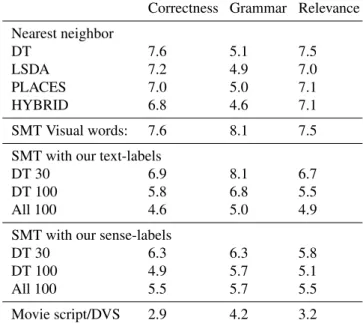
Table 8: Comparison of approaches. Mean Ranking (1-12). Lower is better. Discussion in Section6.3.
Multi-Level but the drop in performance is reasonable com-pared to the siginificantly larger variability.
6.3. Video description
As the collected text data comes from the movie context, it contains a lot of information specific to the plot, such as names of the characters. We pre-process each sentence in the corpus, transforming the names and other person related information (such as “a young woman”) to “someone” or “people”. The transformed version of the corpus is used in all the experiments below. We will release the transformed and the original corpus.
We use the 5 movies mentioned before (see Section3.2) as a test set for the video description task, while all the oth-ers (67) are used for training. Human judges were asked to rank multiple sentence outputs with respect to their correct-ness, grammar and relevance to the video.
Table8summarizes results of the human evaluation from 250 randomly selected test video snippets, showing the mean rank, where lower is better. In the top part of the ta-ble we show the nearest neighbor results based on multiple visual features. When comparing the different features, we notice that the pre-trained features (LSDA, PLACES, HY-BRID) perform better than DT, where HYBRID perform-ing best. Next is the translation approach with the visual words as labels, performing overall worst of all approaches. The next two blocks correspond to the translation approach when using the labels from our semantic parser. After ex-tracting the labels we select the ones which appear at least 30 or 100 times as our visual attributes. As 30 results in a
Annotations subject verb object location
text-labels 30 24 380 137 71
sense-labels 30 47 440 244 110
text-labels 100 8 121 26 8
sense-labels 100 8 143 51 37
Table 9: Label statistics from our semantic parser on the movie description corpus. 30 and 100 indicate the minimum number of label occurrences in the corpus, see Section6.3. much higher number of attributes (see Table 9) predicting the SR turns into a more difficult recognition task, result-ing in worse mean rankresult-ings. “All 100” refers to combinresult-ing all the visual features as unaries in the CRF. Finally, the last “Movie script/DVS” block refers to the actual test sentences from the corpus and not surprisingly ranks best.
Overall we can observe three main tendencies: (1) Using our parsing with SMT outperforms nearest neighbor base-lines and SMT Visual words. (2) In contrast to the kitchen dataset, the sense labels perform slightly worse than the text labels, which we attribute to the errors made in the WSD. (3) The actual movie script/DVS are ranked on average significantly better than any of the automatic approaches. These tendencies are also reflected in Figure4, showing ex-ample outputs of all the evaluated approaches for a single movie snippet. Examining more qualitative examples which we provide on our web page indicates that it is possible to learn relevant information from this corpus.
7. Conclusions
In this work we presented a novel dataset of movies with aligned descriptions sourced from movie scripts and DVS (audio descriptions for the blind). We present first experi-ments on this dataset using state-of-the art visual features, combined with a recent movie description approach from [56]. We adapt the approach for this dataset to work with-out annotations, but rely on semantic parsing of labels. We show competitive performance on the TACoS Multi-Level dataset and promising results on our movie description data. We compare DVS with previously used script data and find that DVS tends to be more correct and relevant to the movie than script sentences. Beyond our first study on single sen-tences, the dataset opens new possibilities to understand sto-ries and plots across multiple sentences in an open domain scenario on large scale. Something no other video nor im-age description dataset can offer as of now.
8. Acknowledgements
Marcus Rohrbach was supported by a fellowship within the FITweltweit-Program of the German Academic Ex-change Service (DAAD).
Nearest neighbor
DT People stand with a happy group, including someone. LSDA The hovering Dementors chase the group into the lift.
HYBRID Close by, a burly fair-haired someone in an orange jumpsuit runs down a dark street. PLACES Someone is on his way to look down the passage way between the houses.
SMT Visual words Someone in the middle of the car pulls up ahead SMT with our text-labels
DT 30 Someone opens the door to someone
DT 100 Someone, the someone, and someone enters the room
All 100 Someone opens the door and shuts the door, someone and his someone SMT with our sense-labels
DT 30 Someone, the someone, and someone enters the room DT 100 Someone goes over to the door
All 100 Someone enters the room
Movie script/DVS Someone follows someone into the leaky cauldron
Figure 4: Qualitative comparison of different video description methods. Discussion in Section6.3. More examples on our web page.
References
[1] British amazon. http://www.amazon.co.uk/, 2014.
3
[2] Castingwords transcription service. http:
//castingwords.com/, 2014.2,4
[3] Makemkv.http://www.makemkv.com/, 2014.4
[4] Subtitle edit. http://www.nikse.dk/
SubtitleEdit/, 2014.4
[5] Xmedia recode. http://www.xmedia-recode.de/,
2014.4
[6] Y. Artzi, N. FitzGerald, and L. S. Zettlemoyer. Semantic
parsing with combinatory categorial grammars. InACL
(Tu-torial Abstracts), 2013.3
[7] C. F. Baker, C. J. Fillmore, and J. B. Lowe. The berkeley
framenet project. InProceedings of the 36th Annual
Meet-ing of the Association for Computational LMeet-inguistics and 17th International Conference on Computational Linguistics - Volume 1, ACL ’98, pages 86–90, Stroudsburg, PA, USA,
1998. Association for Computational Linguistics.3
[8] A. Barbu, A. Bridge, Z. Burchill, D. Coroian, S. Dickin-son, S. Fidler, A. Michaux, S. Mussman, S. Narayanaswamy, D. Salvi, L. Schmidt, J. Shangguan, J. M. Siskind, J. Wag-goner, S. Wang, J. Wei, Y. Yin, and Z. Zhang. Video in
sen-tences out. InUAI, 2012.3
[9] J. Berant, A. Chou, R. Frostig, and P. Liang. Semantic
pars-ing on freebase from question-answer pairs. In EMNLP,
pages 1533–1544, 2013. 3
[10] P. Bojanowski, F. Bach, I. Laptev, J. Ponce, C. Schmid, and
J. Sivic. Finding actors and actions in movies. In
Communi-cations of the ACM, 2013.3
[11] P. Bojanowski, R. Lajugie, F. Bach, I. Laptev, J. Ponce, C. Schmid, and J. Sivic. Weakly supervised action labeling
in videos under ordering constraints. InProc. ECCV, 2014.
3
[12] D. Chen and W. Dolan. Collecting highly parallel data for
paraphrase evaluation. InProceedings of the Annual
Meet-ing of the Association for Computational LMeet-inguistics (ACL),
2011.1,5
[13] X. Chen and C. L. Zitnick. Learning a recurrent visual
rep-resentation for image caption generation. arXiv:1411.5654,
2014.3
[14] T. Cour, C. Jordan, E. Miltsakaki, and B. Taskar.
Movie/script: Alignment and parsing of video and text
tran-scription. In Proceedings of the European Conference on
Computer Vision (ECCV), 2008.2,4
[15] D. Das, A. F. Martins, and N. A. Smith. An exact dual
decomposition algorithm for shallow semantic parsing with
constraints. InProceedings of the First Joint Conference on
Lexical and Computational Semantics-Volume 1: Proceed-ings of the main conference and the shared task, and Volume
2: Proceedings of the Sixth International Workshop on Se-mantic Evaluation, pages 209–217. Association for
Compu-tational Linguistics, 2012.3
[16] P. Das, C. Xu, R. Doell, and J. Corso. Thousand frames in just a few words: Lingual description of videos through
la-tent topics and sparse object stitching. InProceedings of the
IEEE Conference on Computer Vision and Pattern Recogni-tion (CVPR), 2013.1,3,4
[17] L. Del Corro and R. Gemulla. Clausie: Clause-based open
information extraction. InProc. WWW 2013, WWW ’13,
pages 355–366, 2013.6
[18] J. Deng, W. Dong, R. Socher, L.-J. Li, K. Li, and L. Fei-Fei. Imagenet: A large-scale hierarchical image database. InProceedings of the IEEE Conference on Computer Vision and Pattern Recognition (CVPR), 2009.1,5
[19] J. Donahue, L. A. Hendricks, S. Guadarrama, M. Rohrbach, S. Venugopalan, K. Saenko, and T. Darrell. Long-term recur-rent convolutional networks for visual recognition and
de-scription.arXiv:1411.4389, 2014.3
[20] O. Duchenne, I. Laptev, J. Sivic, F. Bach, and J. Ponce.
Auto-matic annotation of human actions in video. InProceedings
of the IEEE International Conference on Computer Vision (ICCV), 2009.2,3
[21] A. Fader, L. Zettlemoyer, and O. Etzioni. Open question an-swering over curated and extracted knowledge bases. KDD
’14, pages 1156–1165, New York, NY, USA, 2014. ACM.3
[22] H. Fang, S. Gupta, F. N. Iandola, R. Srivastava, L. Deng, P. Doll´ar, J. Gao, X. He, M. Mitchell, J. C. Platt, C. L. Zit-nick, and G. Zweig. From captions to visual concepts and
back.arXiv:1411.4952, 2014.3
[23] A. Farhadi, M. Hejrati, M. Sadeghi, P. Young, C. Rashtchian, J. Hockenmaier, and D. Forsyth. Every picture tells a story:
Generating sentences from images. InProceedings of the
European Conference on Computer Vision (ECCV), 2010.3
[24] C. Fellbaum, editor. WordNet: An Electronic Lexical
Database. The MIT Press, 1998.5
[25] L. Gagnon, C. Chapdelaine, D. Byrns, S. Foucher, M. Her-itier, and V. Gupta. A computer-vision-assisted system for
videodescription scripting. 2010.3
[26] S. Guadarrama, N. Krishnamoorthy, G. Malkarnenkar, S. Venugopalan, R. Mooney, T. Darrell, and K. Saenko. Youtube2text: Recognizing and describing arbitrary activi-ties using semantic hierarchies and zero-shoot recognition. In Proceedings of the IEEE International Conference on Computer Vision (ICCV), 2013.3,4,5
[27] A. Gupta, P. Srinivasan, J. Shi, and L. Davis. Understanding videos, constructing plots learning a visually grounded
sto-ryline model from annotated videos. InProceedings of the
IEEE Conference on Computer Vision and Pattern Recogni-tion (CVPR), 2009.3
[28] P. Hanckmann, K. Schutte, and G. J. Burghouts. Automated textual descriptions for a wide range of video events with 48
human actions. 2012.3
[29] P. Hodosh, A. Young, M. Lai, and J. Hockenmaier. From im-age descriptions to visual denotations: New similarity
met-rics for semantic inference over event descriptions.1
[30] J. Hoffman, S. Guadarrama, E. Tzeng, J. Donahue, R. Gir-shick, T. Darrell, and K. Saenko. LSDA: Large scale
detec-tion through adaptadetec-tion. InAdvances in Neural Information
Processing Systems (NIPS), 2014.2,5
[31] A. Karpathy and L. Fei-Fei. Deep visual-semantic
align-ments for generating image descriptions. arXiv:1412.2306,
2014.3
[32] M. U. G. Khan, L. Zhang, and Y. Gotoh. Human focused
video description. InProceedings of the IEEE International
Conference on Computer Vision Workshops (ICCV Work-shops), 2011.3
[33] K. Kipper, A. Korhonen, N. Ryant, and M. Palmer.
Extending verbnet with novel verb classes. In
Pro-ceedings of the Fifth International Conference on
Language Resources and Evaluation – LREC’06
(http://verbs.colorado.edu/ mpalmer/projects/verbnet.html),
2006.6
[34] R. Kiros, R. Salakhutdinov, and R. Zemel. Multimodal
neu-ral language models. In Proceedings of the International
Conference on Machine Learning (ICML), 2014.3
[35] R. Kiros, R. Salakhutdinov, and R. S. Zemel. Unifying
visual-semantic embeddings with multimodal neural
lan-guage models.arXiv:1411.2539, 2014.3
[36] P. Koehn, H. Hoang, A. Birch, C. Callison-Burch, M. Fed-erico, N. Bertoldi, B. Cowan, W. Shen, C. Moran, R. Zens, C. Dyer, O. Bojar, A. Constantin, and E. Herbst. Moses: Open source toolkit for statistical machine translation. In
Proceedings of the Annual Meeting of the Association for Computational Linguistics (ACL), 2007.5
[37] A. Kojima, T. Tamura, and K. Fukunaga. Natural language description of human activities from video images based on
concept hierarchy of actions.International Journal of
Com-puter Vision (IJCV), 2002.3
[38] A. Krizhevsky, I. Sutskever, and G. E. Hinton. Imagenet classification with deep convolutional neural networks. In P. L. Bartlett, F. C. N. Pereira, C. J. C. Burges, L. Bottou, and
K. Q. Weinberger, editors,Advances in Neural Information
Processing Systems (NIPS), pages 1106–1114, 2012.1
[39] G. Kulkarni, V. Premraj, S. Dhar, S. Li, Y. Choi, A. C. Berg, and T. L. Berg. Baby talk: Understanding and
gen-erating simple image descriptions. In Proceedings of the
IEEE Conference on Computer Vision and Pattern Recog-nition (CVPR), 2011.3
[40] P. Kuznetsova, V. Ordonez, A. C. Berg, T. L. Berg, and Y. Choi. Collective generation of natural image descriptions. InProceedings of the 50th Annual Meeting of the Associa-tion for ComputaAssocia-tional Linguistics: Long Papers-Volume 1, pages 359–368. Association for Computational Linguistics,
2012.3
[41] P. Kuznetsova, V. Ordonez, T. L. Berg, U. C. Hill, and Y. Choi. Treetalk: Composition and compression of trees
for image descriptions. Transactions of the Association for
Computational Linguistics, 2(10):351–362, 2014.3
[42] Lakritz and Salway. The semi-automatic generation of au-dio description from screenplays. Technical report, Dept. of
Computing Technical Report, University of Surrey, 2006. 1,
[43] I. Laptev, M. Marszalek, C. Schmid, and B. Rozenfeld.
Learning realistic human actions from movies. In
Proceed-ings of the IEEE Conference on Computer Vision and Pattern Recognition (CVPR), 2008.2,3,4
[44] K. Lee, Y. Artzi, J. Dodge, and L. Zettlemoyer.
Context-dependent semantic parsing for time expressions. In
Pro-ceedings of the 52nd Annual Meeting of the Association for Computational Linguistics (Volume 1: Long Papers), pages
1437–1447, Baltimore, Maryland, June 2014. ACL.3
[45] S. Li, G. Kulkarni, T. Berg, A. Berg, and Y. Choi. Compos-ing simple image descriptions usCompos-ing web-scale N-grams. In
Proceedings of the Fifteenth Conference on Computational Natural Language Learning (CoNLL), pages 220–228.
As-sociation for Computational Linguistics, 2011.3
[46] C. Liang, C. Xu, J. Cheng, and H. Lu. Tvparser: An
auto-matic tv video parsing method. InCVPR, 2011.2
[47] T.-Y. Lin, M. Maire, S. Belongie, J. Hays, P. Perona, D. Ra-manan, P. Doll´ar, and C. L. Zitnick. Microsoft coco:
Com-mon objects in context. arXiv preprint arXiv:1405.0312,
2014.1
[48] J. Mao, W. Xu, Y. Yang, J. Wang, and A. L. Yuille. Deep captioning with multimodal recurrent neural networks
(m-rnn).arXiv:1412.6632, 2014.3
[49] M. Marszalek, I. Laptev, and C. Schmid. Actions in context. InProceedings of the IEEE Conference on Computer Vision and Pattern Recognition (CVPR), june 2009.2,3,4
[50] M. Mitchell, J. Dodge, A. Goyal, K. Yamaguchi, K. Stratos, X. Han, A. Mensch, A. C. Berg, T. L. Berg, and H. D. III. Midge: Generating image descriptions from computer vision
detections. InProceedings of the Conference of the
Euro-pean Chapter of the Association for Computational Linguis-tics (EACL), 2012.3
[51] V. Ordonez, G. Kulkarni, and T. L. Berg. Im2text:
De-scribing images using 1 million captioned photographs. In
Advances in Neural Information Processing Systems (NIPS),
2011.1
[52] P. Over, G. Awad, M. Michel, J. Fiscus, G. Sanders, B. Shaw, A. F. Smeaton, and G. Qu´eenot. Trecvid 2012 – an overview of the goals, tasks, data, evaluation mechanisms and metrics. InProceedings of TRECVID 2012. NIST, USA, 2012.1
[53] T. Pedersen, S. Patwardhan, and J. Michelizzi.
Word-net:: Similarity: measuring the relatedness of concepts. In
Demonstration Papers at HLT-NAACL 2004, pages 38–41.
Association for Computational Linguistics, 2004.5
[54] M. Regneri, M. Rohrbach, D. Wetzel, S. Thater, B. Schiele, and M. Pinkal. Grounding Action Descriptions in Videos. 1,
2013.4,5
[55] A. Rohrbach, M. Rohrbach, W. Qiu, A. Friedrich, M. Pinkal, and B. Schiele. Coherent multi-sentence video description
with variable level of detail. September 2014. 1,2,3,4,5,
6,7
[56] M. Rohrbach, W. Qiu, I. Titov, S. Thater, M. Pinkal, and B. Schiele. Translating video content to natural language
descriptions. InProceedings of the IEEE International
Con-ference on Computer Vision (ICCV), 2013.1,2,3,5,7,8
[57] O. Russakovsky, J. Deng, H. Su, J. Krause, S. Satheesh, S. Ma, Z. Huang, A. Karpathy, A. Khosla, M. Bernstein,
A. C. Berg, and L. Fei-Fei. ImageNet Large Scale Visual
Recognition Challenge, 2014.5
[58] A. Salway. A corpus-based analysis of audio description.
Media for all: Subtitling for the deaf, audio description and sign language, pages 151–174, 2007.1,2,3
[59] A. Salway, B. Lehane, and N. E. O’Connor. Associating characters with events in films. pages 510–517. ACM, 2007.
2,3
[60] K. K. Schuler, A. Korhonen, and S. W. Brown. Verbnet
overview, extensions, mappings and applications. In
HLT-NAACL (Tutorial Abstracts), pages 13–14, 2009.6
[61] R. Socher, A. Karpathy, Q. V. Le, C. D. Manning, and A. Y. Ng. Grounded compositional semantics for finding and
de-scribing images with sentences. 2:207–218, 2014.3
[62] C. C. Tan, Y.-G. Jiang, and C.-W. Ngo. Towards textually describing complex video contents with audio-visual concept
classifiers. InMM, 2011.3
[63] J. Thomason, S. Venugopalan, S. Guadarrama, K. Saenko, and R. J. Mooney. Integrating language and vision to gen-erate natural language descriptions of videos in the wild. In
COLING 2014, 25th International Conference on Computa-tional Linguistics, Proceedings of the Conference: Technical Papers, August 23-29, 2014, Dublin, Ireland, 2014.3
[64] S. Venugopalan, H. Xu, J. Donahue, M. Rohrbach,
R. Mooney, and K. Saenko. Translating videos to
natural language using deep recurrent neural networks.
arXiv:1412.4729, 2014.3
[65] O. Vinyals, A. Toshev, S. Bengio, and D. Erhan. Show and
tell: A neural image caption generator. arXiv:1411.4555,
2014.3
[66] H. Wang, A. Kl¨aser, C. Schmid, and C. Liu. Dense trajecto-ries and motion boundary descriptors for action recognition.
International Journal of Computer Vision (IJCV), 2013.5
[67] H. Wang and C. Schmid. Action recognition with
im-proved trajectories. InProceedings of the IEEE International
Conference on Computer Vision (ICCV), Sydney, Australia,
2013.2,5
[68] J. Xiao, J. Hays, K. A. Ehinger, A. Oliva, and A. Torralba. Sun database: Large-scale scene recognition from abbey to zoo. Proceedings of the IEEE Conference on Computer Vi-sion and Pattern Recognition (CVPR), 0:3485–3492, 2010.
1
[69] Z. Zhong and H. T. Ng. It makes sense: A wide-coverage
word sense disambiguation system for free text. In
Proceed-ings of the ACL 2010 System Demonstrations, pages 78–83.
Association for Computational Linguistics, 2010.6
[70] B. Zhou, A. Lapedriza, J. Xiao, A. Torralba, and A. Oliva. Learning Deep Features for Scene Recognition using Places
Database. Advances in Neural Information Processing


![Table 4: BLEU@4 in % on sentences of Detailed Descrip- Descrip-tions of the TACoS Multi-Level [55] corpus, see Section 5.2.](https://thumb-us.123doks.com/thumbv2/123dok_us/1410434.2688768/7.918.140.370.109.210/table-sentences-detailed-descrip-descrip-tacos-multi-section.webp)