Group Scheduling in Systems Software
Michael Frisbie and Douglas Niehaus
Venkita Subramonian and Christopher Gill
frizz,niehaus @eecs.ku.edu
venkita,cdgill @cse.wustl.edu
EECS Department, ITTC CSE Department, DOC Center
University of Kansas, Lawrence Washington University, St.Louis
Abstract
Previous system scheduling approaches have focused primarily on system-level abstractions for scheduling de-cision functions and the mechanisms used to implement them. This paper introduces a new abstraction called
group schedulingthat focuses primarily on the progress of
application-level computations and on organizing system-level scheduling abstractions to ensure that progress.
This paper makes three contributions to system schedul-ing research. First, it defines a model for group schedulschedul-ing that augments and complements hierarchical scheduling models. Second, it describes how a computation’s progress semantics can be mapped to scheduling mechanisms at the operating system and middleware levels. Third, it presents preliminary empirical studies of the performance of group scheduling in a realistic system environment.
1 Introduction
Computer system schedulers organize when and how computations sharing the system resources exe-cute. Scheduling policy goals can vary with the nature of the system. General purpose systems emphasize computation progress and response time, batch tems often emphasize throughput, and real-time sys-tems often emphasize timeliness and predictability.
Mechanisms used to achieve scheduling policy goals typically vary less widely than the policies
themselves, i.e., relying on common services like
POSIX thread priorities. The scheduling decision is thus reduced to selecting a highest priority thread from those ready to run. The idea is appealingly
simple: integer priority valuesencodeinformation the
scheduling decision function uses to select the thread that should access the CPU at any given moment.
This work was supported in part by DARPA PCES contract F33615-03-C-4111 and by NSF EHS contract CCR-0311599.
However, experience has shown that this simple model cannot describe the full range of execution constraints which computer systems need to enforce. One problem is that several threads may have equal priority values, so a secondary scheduling decision function (SDF) is needed to determine how the CPU should be shared among threads of equal priority.
Scheduling has been the focus of much theoretical and implementation effort over many years, produc-ing a wide range of (1) different SDFs and (2) differ-ent ways to use them to implemdiffer-ent an equally wide range of scheduling policies. The majority of these
ef-forts have, however, beenthread centricin that they
fo-cused on SDFs that view the computational load on a system as a set of individual threads. Furthermore, most platforms available today have selected particu-lar SDF semantics, without allowing system designers to influence how scheduling decisions affecting their applications are made, apart from specifying parame-ters used by the underlying system SDF.
This paper presents an approach to system SDF de-sign and usage that addresses the limitations we be-lieve are imposed by these typically thread centric and monolithic system SDFs. We call our approach
group schedulingbecause it explicitly addresses an portant trend in system design: computations are
im-plemented asrelated threads, and the most
appropri-ate scheduling semantics for those threads depends on the semantics of the computation. Group schedul-ing addresses these issues by permittschedul-ing threads to be grouped according to the computations they support, and by permitting each group to have an associated SDF. The system SDF is then formed by hierarchically composing group SDFs into a decision tree that con-trols the execution of all threads on the system.
This approach provides explicit support for a num-ber of important design and implementation
capabil-ities. First, it explicitly representscomputational
struc-ture, so that the progress of a computation can be
system customizability by permitting developers to select or implement the SDF that is most appropriate for each application computation and the system SDF that composes group SDFs. Third, it increases system
transparency because logs from the system SDF offer a narrative of the scheduling decisions. Finally, group scheduling can be applied to concurrency abstractions
other than operating system threads,e.g., events,
dis-tributable threads, or CORBA GIOP messages. This paper is structured as follows. Section 2 de-scribes related work. Section 3 presents the group scheduling model and gives examples of how it can be used. Section 4 describes our implementation of group scheduling in the KURT-Linux kernel and in middleware. Section 5 presents preliminary experi-ments. Last, Section 6 makes concluding remarks.
2 Related Work
Three main abstractions make up the group scheduling model presented in Section 3: the
seman-tics for progress of eachcomputation, theexecution
en-vironmentwithin which the computation is run, and the scheduling decision function used to schedule ac-cess to resources within each execution environment. Two areas of previous work are most relevant to group scheduling, and are the focus of this section: (1) mak-ing the execution environment flexible so that alter-native SDFs can be expressed in it, and (2) compos-ing SDFs for analytical assurance of real-time perfor-mance across multiple interacting execution environ-ments. The main distinction between the work pre-sented in this paper and the related work is that our
work on group scheduling offers ageneralmodel for
mapping computation semanticsexplicitlyinto the
ex-ecution environments and SDFs, as a third dimension for design, measurement, and optimization.
A key theme in comparing our group scheduling
abstraction to other related work is that of the
domi-nant decomposition[14] that is used in each approach,
i.e., the fundamental paradigm along which
schedul-ing abstractions are defined. In Kokyu [3], the dom-inant decomposition was along the mechanisms for re-ordering the execution of schedulable entities. In the Scout operating system [6] and in TAO’s Real-Time CORBA 2.0 [8] (RTC2) implementation, the dom-inant decomposition is still along the execution envi-ronments, albeit those environments are customized
for particular computation activities: paths in Scout,
and distributable threadsin RTC2. In the hierarchical scheduling frameworks [10, 4] and the BERT schedul-ing algorithm [2], the dominant decomposition is along the decision functions themselves. With group
scheduling, the dominant decomposition is along the semantics of progress for the computation itself, as represented by the group structure. In group
schedul-ing, SDFs are thencomposedalong sets of paths
consti-tuting the execution environments within which parts of the computation are run. We view SDFs, execution environments, and scheduling mechanisms, as funda-mental abstractions upon which our group schedul-ing abstraction builds. While functionally equivalent scheduling representations can be realized in each of these approaches in many cases, we view the domi-nant decomposition as a crucial issue for how these
representations can beprogrammedin practice.
Execution Environments: The Kokyu scheduling framework [3] was designed to support flexible com-position of middleware scheduling mechanisms for a range of SDFs. Kokyu maps the ordering policy of a given SDF into thread, queue, and task parameter con-figurations to enforce that policy.
The prototype implementation of TAO’s RTC2 im-plementation [5] introduced execution control mech-anisms based on (1) thread priorities and (2) con-dition variables. Our group scheduling framework also includes condition variable and dynamic thread scheduling mechanisms, with detection of thread blocking and unblocking.
The Scout operating system [6] introduced thepath
abstraction, which made explicit the notion of the computation’s execution environment cross-cutting system layers. In Scout, paths compose segments of the computation with mechanisms that manage their progress. Our group scheduling approach gen-eralizes the notion of path composition to a wider range of platforms, and also shifts the path abstraction from the execution environment model to the schedul-ing model: with flexible execution environments like KURT-Linux or Kokyu in which group schedul-ing mechanisms can be expressed, group schedulschedul-ing raises the level of abstraction at which computation progress is modeled and enforced.
Scheduling Decision Functions: The work on flex-ible scheduling mechanisms in Kokyu was originally motivated by earlier work by Steward and Khosla [13]
that introduced themaximum urgency first(MUF) SDF
and showed that MUF could emulate several other well-known SDFs through different bindings for its parameters and those of the scheduled task set. Goyal, Guo, and Vin [4] and Regehr and Stankovic [10] extended the notion of a scheduling decision
func-tion to include composition of SDFs within a
hier-archical scheduling framework. Regehr, et al., have extended hierarchical scheduling to cross-cut
alter-native execution environments so that analysis of both concurrency and schedulability can be done to-gether [9]. The hierarchical scehduling model by Regehr and Stankovic also allows a directed acyclic graph (DAG) of SDFs - our current implementation of group scheduling assumes a tree structure, but we plan to extend our approach to SDF DAGs.
In the Scout operating system, other compositions of scheduling decision functions have been realized, such as the Best-Effort Real-Time (BERT) [2] algo-rithm. Both the hierarchical scheduling and BERT ap-proaches achieve composition of SDFs across system layers. The BERT algorithm for slack stealing in fair-queuing SDFs can be realized in the more general hi-erarchical scheduling model. Since group scheduling complements and augments the hierarchical schedul-ing model, it also extends the BERT approach.
3 Group Scheduling Model
The group scheduling model presented here has a simple structure, but addresses several important is-sues related to the semantics and structure of com-puter system scheduling. The components of the group scheduling model are: (1) scheduling deci-sion functions, (2) group membership specifications, and (3) scheduling information for each member of a group. Furthermore, it is important to note that when more than one group is defined for the system, they are organized as a scheduling decision tree (SDT) for the system; the hierarchical organization of all sched-ulers in an end-system results in the system schedul-ing decision tree (SSDT). Each schedulschedul-ing decision be-gins at the root of the SSDT and recursively descends through a series of SDF invocations until a decision is made. There are two ways to view the SSDT; as a first-refusal scheduling decision that calls the default sys-tem scheduler if no thread is identified, or as the sole system scheduling method. As Section 3.3 discusses, the latter view can be used to implement the former.
3.1
Scheduling Decision Functions
Each group has a (possibly unique) SDF associated with it. Any number of SDFs may be implemented, but most systems can be implemented using selections from a standard set. We have implemented a num-ber of SDFs, including: static priority, dynamic prior-ity, explicit plan, cyclic, processor share, round robin, EDF, and sequential. The interface for a scheduling decision function is quite simple: it takes the schedul-ing information describschedul-ing the members of the group with which it is associated as input, and it returns a
decision, which can take one of three forms: a thread
ID, PassorOS. The group and SDF API includes the
ability to modify the scheduling parameters associ-ated with each member of the group. For example, if the SDF of a particular group is priority based, then the group API gives access to the SDF API that makes it possible to change the priority of group members.
It is worth noting that the simple interface for the SDF has made it easy to provide implementations within which developers can select from a set of ex-isting SDFs, or can choose to implement customized SDFs. This significantly adds to the flexibility and con-figurability of the systems using the group scheduling approach, compared to systems with a single default OS scheduler of any single type.
The SDF returns a thread ID when it has has iden-tified a specific thread as the one that should run next. If the current SDF is associated with the root group of the decision tree, then the system dispatcher switches context to the specified thread. If the SDF is associated with a group below the root of the scheduling deci-sion tree. then the calling SDF recognizes the thread ID and returns it to its calling context until the root of the scheduling decision tree is reached.
The Pass return value identifies when the current
SDF, and any SDFs below it in the SSDT were unable to identify a thread that should run. The most obvious reason for this to happen is that no threads managed by that portion of the SSDT were ready to run, but any given SDF might return this value for reasons of
its own. When the called SDF returnsPass, the calling
SDF is then free to chose another group member. If the
SDF at the root of the SSDT returnsPass, then there is
no thread managed by the SSDT that is ready to run.
The OS return value is a special token used to
explicitly identify the choice of invoking the default scheduler of the underlying OS. This is useful when a set of processes controlled by a specialized SSDT should coexist gracefully with the normal set of com-putations on a workstation. For example, an explicit plan based SSDT might be used to control a set of real-time processes under group scheduling, but the schedule might include specific periods during which the set of computations controlled by the default OS scheduler should be given a chance to run. In this case, the explicit plan SDF would return a thread ID when the clock reached the planned execution time for
each thread, and would returnOSat the beginning of
a period designated for the general OS operations. If the SDF selects a member of the group that is itself a group, then the current SDF invokes the SDF of the selected group recursively. The recursive invo-cations of SDFs will terminate because the SSDT is a
tree. Further development of the group scheduling may relax the single-parent-group requirement, per-mitting the hierarchy of the set of groups to be a DAG instead of a tree, but the recursive invocation of SDFs will be limited in either case.
3.2
Computations, Groups, and Decision Trees
The group scheduling model permits threads to join and leave groups at their own request, or at the request of threads running at an adequate authority level. Groups can be made members of higher level groups. This is how a SDT for a computation and the SSDT for the system as a whole can be constructed.
An interesting aspect of our group scheduling ap-proach is that it makes it possible to separate the scheduling semantics for computation components from those controlling how system resources are shared among computations. Each computation is im-plemented using one or more threads, which can be organized onto one or more groups, forming the SDT for the computation. The higher level organization of the SSDT, above the level for the SDTs of the individ-ual computations, can then be viewed as the SDT con-trolling how computations share the system.
This is not the only possible organizing principle for the SSDT, however, nor is is appropriate for all computations. For example, many computations have components with a variety of execution behavior con-straints. Some components must meet strict timing re-quirements, while others can execute under less strin-gent requirements, or even on a best effort basis. In such a system, the SSDT might best be organized to group computation components with similar execu-tion constraints together.
Not all interesting SSDT structures neatly partition the set of computation threads. While the simplest scheduling semantics limit each thread to member-ship in only one group, there are situations in which thread membership in multiple groups is helpful. One of the earliest motivations for group scheduling was the problem of how to ensure timely display of graph-ical data computed by a real-time process. We were able to ensure that the thread computing the change in the display ran according to its real-time constraints, while the display itself was updated much less pdictably. After some measurement and thought we re-alized that this was because the display of the graphi-cal data was under the control of the X server thread, whose scheduling was not being handled according to the real-time semantics. Making the X server thread a member of the real-time group has helped by ensuring that the X server is promptly given an opportunity to
run. It is not a complete solution because as yet we have no way to ensure that the X server acts on the events generated by the real-time computation.
While we are still investigating the expressive lim-its of the the group scheduling model, it is already clear that scheduling decision trees can be used to de-scribe a wide range of scheduling semantics for both individual computations and the set of computations in the system as a whole. We illustrate this expressive range with several examples in the next section.
3.3
Examples
This section illustrates some of the expressive power and range of the group scheduling model with two examples. The first is presented in Figure 1(a), and illustrates how the first-refusal group scheduling behavior mentioned earlier can be implemented. This
SSDT uses the sequential SDF (Seq) as the root node to
give (1) the group scheduling decision tree for the sys-tem a chance to choose a thread to run. If it fails to do
so, returning eitherPassorOS, then the (2) Linux SDF
is called to select a thread. Figure 1(b) shows the SDT
Figure 1. (a) First-Refusal Group Scheduling; (b) Multi-Level Feedback Queue
structure for a multi-level feedback priority queue. In the figure, the root of the SDT is a group using a pri-ority based SDF, and whose members are groups con-taining threads that are in the same priority equiva-lence classes. Within each class, a round-robin SDF is used to evenly share the CPU among members of a class. The subtle aspect of this model is that the prior-ity SDF must know about the priorprior-ity of each thread, so that as the priority changes and a thread needs to shift from one equivalence class to another, the Prior-ity SDF can cause it to do so.
4 Group Scheduling Implementation
The group scheduling model can be implemented either in the operating system or at the middleware level. The operating system level is attractive be-cause it can support an implementation that is both
cleanly designed from the start, and efficient. Mid-dleware implementations of group scheduling are at-tractive because they require less explicit cooperation from the operating system. Specifically, moving the group scheduling technique up to middleware makes it available for use with operating systems that do not already provide group scheduling services, and for which interested users do not have source access to the kernel. Realizing group scheduling mecha-nisms in middleware also leads to increased porta-bility while still maintaining acceptable performance. In particular, middleware implementations of group scheduling can help to mask variations in the set of scheduling features available across operating sys-tems, by using the available features to support mid-dleware group scheduling mechanisms that provide more uniform behavior than the individual system’s scheduling model. However, since the efficiency of middleware group scheduling mechanisms depends on (1) the scheduling mechanisms that are available from the OS, (2) the structure of the middleware itself, and (3) the nature of the scheduled entities, several implementation approaches are reasonable.
We currently have multiple implementations of the group scheduling model: one at the operating system level in KURT-Linux [12], discussed in Section 4.1, and several at the middleware level, though for brevity we only discuss one in depth in Section 4.2. The mid-dleware approaches use the standard SCHED FIFO scheduling class, thread priority scheduling, and con-dition variable mechanisms offered by Linux and other operating systems to manage the execution of threads under control of the group scheduling model. It is worth noting that in the implementations de-scribed in this section the majority of the code imple-menting the group scheduling model can be shared between the kernel and middleware implementations. The shared code uses the same data structures to rep-resent group membership, support scheduling deci-sion functions, track scheduling parameters for each member of each group, and implement the SSDT.
The only necessary differences between these ker-nel and middleware versions lie in how the group scheduling API is made accessible, how the system scheduling decision tree is invoked to identify the next thread to run, and how that decision is enforced. The two implementations we describe here therefore offer an opportunity to examine the fundamental costs of moving group scheduling from the kernel to the mid-dleware layer. We describe results of our preliminary evaluation of these two implementations in Section 5. After presenting the current kernel and middle-ware implementations, we consider briefly how to
ex-tend group scheduling to other schedulableentitiesat
both the OS and middleware levels. It is important to note that not all entities will necessarily be visible at both levels. At the OS level, threads are often the only schedulable entities absent specialized OS support. A
schedulableentityat the middleware layer, however,
could be an OS thread, a publishedeventin an Event
Channel, a GIOP message, or a distributable thread.
4.1
KURT-Linux Implementation
The KURT-Linux implementation of the group scheduling model is quite simple, using the shared group scheduling code, except for specific adaptations to make the API available, invoke the SSDT, and en-force the scheduling decision. Group scheduling is implemented as a Linux kernel module, and provides access by threads running under the OS to the stan-dard group scheduling API through a stanstan-dard mod-ule interface. An application thread wishing to inter-act with the group scheduling API opens a file de-scriptor to the group scheduling module, and then
ex-ecutes variousioctlcalls. Using this interface, groups
can be created, threads made members of groups, and
the group scheduling SSDTconstructed.
The SSDT is invoked by small section of code
in-serted at the beginning of the Linux scheduler, which calls the SDF associated with the root node of the SSDT. The SSDT then returns a pointer to a thread
structure, aPassorOSvalue. If a specific thread is
cho-sen by the SSDT, control is transferred directly to the context switch portion of the Linux scheduler, other-wise the standard Linux code selecting the next thread to run is executed. This approach is both simple and efficient. It requires a change to the Linux kernel code, but only of the smallest and least intrusive kind.
4.2
Middleware Implementation
The middleware implementation of the group scheduling model is more complex for two main rea-sons: first, because utility threads must be used to support the scheduling and group API functions; sec-ond, because indirect methods must be used to dis-patch a thread, to control what threads can be run, and to arrange for the SSDT to be invoked. The group scheduling API is supported by a server thread listening for connection requests from threads wish-ing to interact with the group schedulwish-ing API. This is the middleware analog of the group scheduling
module and the set of ioctl calls implementing the
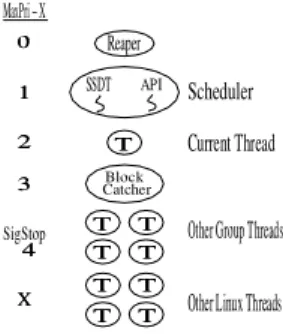
group scheduling API in the kernel implementation. Figure 2 shows the set of threads we use to implement
Figure 2. Middleware Group Thread Priorities group scheduling in middleware. This approach de-pends on the semantics of the FIFO scheduling class under Linux, and on the fact that all Linux threads that are not in the FIFO class are members of the same equivalence class, from the FIFO scheduler’s point of view. The left side of each line shows the number of priority levels below maximum at which a thread
exe-cutes. TheReapertask runs at the highest priority, but
exists mainly to create theSSDT and theAPIthreads
at the next level down. The existence of theReaperalso
helps to detect and handle problems.
Group Scheduling Implementation Threads: The
SSDTandAPIare concurrent threads in the same
pro-cess. They run at the same priority, one less than max-imum, because all changes to thread state that come through the API should be done before the schedul-ing decision is made by the SSDT. These operations could conceivably be implemented by a single thread, but we found using two more convenient. These are the operational threads that run at the highest prior-ity, and thus are granted the CPU whenever they are ready to run. The API thread thus runs when a request for a group API operation is made, and the sched-uler thread runs at times it selects according to the se-mantics of the SSDT it is running. In the experiments discussed in Section 5, we used a single level round-robin scheduler because our goal was to measure the overhead of thread management under the kernel and middleware implementations.
The controlled thread which is currently supposed to be running uses a priority two less than maximum, so it runs whenever the group API or SSDT threads are
blocked, which is most of the time. TheBlock Catcher
thread runs at three less than maximum so that it will be selected if the current thread becomes unable to run, which is most often when it is blocked. It can also run when the current thread exits. All other threads under the control of the group scheduling middleware are sent the SIGSTOP signal, and are given a priority of four less than maximum. This is somewhat redun-dant but we chose to do it for safety.
Choosing a thread to run is fairly simple. When
the SSDT thread runs it invokes the system scheduling decision tree which decides what thread to run as de-scribed in Section 3. Assume for the purposes of this discussion that this is one of the threads under group scheduling control. The SSDT thread then decreases the priority of the current process to match that of other non-running threads under group scheduling control and sends it SIGSTOP. It increases the priority of the chosen thread to one less than maximum, and then blocks in a way that is determined by the SDF semantics. In the case of the experiments described
here, it blocks innanosleepbecause the SSDT thread is
awaiting the end of the RR quantum.
If the current task uses the entire quantum, then the
SSDT thread receives a signal for the nanosleeptimer
expiration and runs the SSDT to select the thread that
should run. If the current thread blocks, then theBlock
Catcherthread is selected by the Linux FIFO
schedul-ing policy and runs. The Block Catcherexists only to
send a SIGUSR1 signal to the SSDT thread to cause it
to return from thenanosleep early. The SSDT thread
sends the now blocked thread SIGSTOP to ensure that it will stay stopped until selected by the SSDT.
Middleware Implementation Extensions: We have implemented two main extensions to the core mid-dleware group scheduling implementation. The first of these addresses the problem of detecting when a blocked thread becomes unblocked. With open-source middleware frameworks like ACE [11], it is possible to intercept blocking system calls and alert the SSDT be-fore and after each such call is made. This capability is particularly useful for correct scheduling of remote invocations in which scheduling parameters may be changed on the remote endsystem to which the call was made, and the changed values returned in the re-sult, context, or output parameters of the call.
For applications that do not have an open layer at which blocking calls can be intercepted reliably, other alternatives are possible. In particular, we are
inves-tigating how to build mechanisms based onscheduler
activations[1] to detect when a thread unblocks in such systems. For example, VxWorks [15] provides the ca-pability for a thread to receive a signal when another thread blocks or begins running. This show promise as a basis for implementing a simple scheduler activa-tion funcactiva-tion, as long as the overhead imposed by this mechanism is reasonable. Therefore, we plan to fol-low implementation of those features with additional experiments similar to those described in Section 5 to assess that overhead.
The second main extension we have made is gener-alizing the set of schedulable entities to which group scheduling can be applied. In particular we are
us-ing the Kokyu framework to provide group schedul-ing capabilities for events, CORBA messages, and dis-tributable threads. We are currently conducting stud-ies to determine how the different semantics of these schedulable entities influence how group scheduling policies and mechanisms are applied.
5 Evaluation
The experimental results presented here give an ini-tial evaluation of the thread management overhead under the kernel and middleware implementations. Several performance metrics are of interest, but this section only presents the one we consider most fun-damental: the controlled thread to controlled thread switching delay, as illustrated in Figure 3 for the CPU
Figure 3. Middleware Task Control Events
bound tasks where theBlock Catchingthread does not
run. This is defined as the delay between stopping a controlled task and starting another controlled task. As measured, it begins with the context switch away from the current controlled task (Context Switch A to SSDT) and ends with the context switch to the selected controlled task (Context Switch SSDT to B).
It is interesting to note that for the middleware im-plementation this delay could only be calculated by using data gathered from both the application and kernel levels via the Data Streams [7] method. The rea-son for this is that the context switch events come from the kernel, but the event announcing which thread was selected (Selection) by the SSDT comes from the SSDT thread at the user level. The post processing of the event stream thus had to look for the event an-nouncing which task had been selected in order to look for the proper context switch event.
In the kernel implementation measuring the time between one context switch and another would not be fair, because it would not include the SSDT exe-cution time. So, in the a kernel implementation we measured the interval between when the SSDT is in-voked and when the system switches context to the selected task. It is worth noting that the invocation of the SSDT follows the blocking of the first controlled task by only a few machine cycles. Figure 4 shows
1 10 100 1000 10000 1.504 1.627 1.751 1.874 1.997 2.12 2.243 2.367 2.49 2.613
Number of intervals <log scale>
Interval length in us; speed of machine = 1399 Mhz DELAY_SWITCH_BETWEEN_CONTROLLED_TASKS
DELAY_SWITCH_BETWEEN_CONTROLLED_TASKS Total number of values : 1786
Figure 4. Kernel Group Scheduling Task Switch Delay Distribution - Blocking Threads the distribution of delay values for the kernel group scheduling implementation controlling a set of block-ing tasks. Note that the task to task switch delays vary between roughly 1.5 microseconds and slightly more than 2.6 microseconds. Also note that the verti-cal sverti-cale of all the histograms is exponential, so more than 1000 of the thread switch delays are classified in the first equivalence class of the histogram. The test was run on a 1.4 GHz Pentium machine, and shows a set of slightly less than 1800 context switch delay val-ues. Clearly the simple RR SSDT evaluation imposes very little overhead, and the efficient context switch of the Linux platform is not compromised. It is im-portant to note that the distribution for delay between non-blocking CPU bound tasks is essentially identical for the kernel implementation because the path taken through the kernel code is essentially identical.
1 10 100 1000 10000 109.921 114.29 118.659 123.028 127.397 131.766 136.135 140.503 144.872 149.241
Number of intervals <log scale>
Interval length in us; speed of machine = 1399 Mhz DELAY_SWITCH_BETWEEN_CONTROLLED_TASKS
DELAY_SWITCH_BETWEEN_CONTROLLED_TASKS Total number of values : 7096
Figure 5. Middleware Group Scheduling Task Switch Delay Distribution - Blocking Threads In significant contrast to this, the middleware im-plementation controlling the same scenario with the same SSDT code experienced task switch delays, illus-trated in Figure 5, ranging from slightly more than 110 microseconds to roughly 150 microseconds. It is inter-esting to note that there are significantly more larger values in this distribution. This is due, at least in part,
to interrupts occurring during essentially all of the longer task switch intervals, which we have been able to detect with fairly straightforward post-processing of the Data Stream output from the kernel.
1 10 100 1000 10000 84.994 89.223 93.452 97.681 101.91 106.139 110.369 114.598 118.827 123.056
Number of intervals <log scale>
Interval length in us; speed of machine = 1399 Mhz DELAY_SWITCH_BETWEEN_CONTROLLED_TASKS
DELAY_SWITCH_BETWEEN_CONTROLLED_TASKS Total number of values : 9602
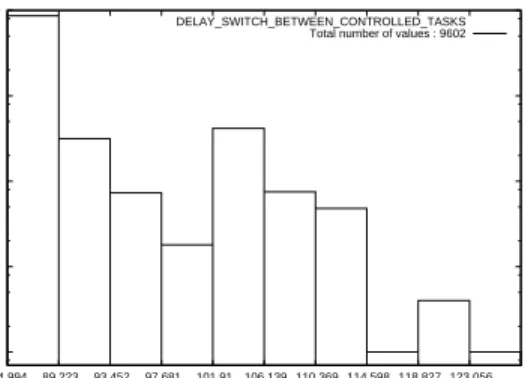
Figure 6. Middleware Group Scheduling Task Switch Delay Distribution - CPU Bound
Figure 6 shows the delay distribution for the mid-dleware group scheduling implementation when con-trolling a set of CPU bound tasks. The distribution of thread switch delays covers roughly the same range as those for the set of blocking tasks; the lowest and highest values differ by roughly 40 microseconds. The range is, however, shifted lower by roughly 25 mi-croseconds because with CPU bound threads context
switching between tasks does not require the Block
Catchingtask to run, a significant time savings.
6 Concluding Remarks
This paper has presented our group scheduling model and has described how it can be used in dif-ferent situations. We have demonstrated that a mid-dleware implementation is possible, with significant but not unsupportable task switching delay overhead. It has also shown that a kernel based implementa-tion enjoys significant advantages over the middle-ware method, and is thus clearly desirable in systems where it is possible.
We plan to investigate how scheduler activations can be used to increase the efficiency of the implemen-tation for blocking tasks. We also plan to show how additional semantics needed to complement common priority scheduling approaches, such as protocols to prevent unbounded priority inversions, can be inte-grated readily within a group scheduling SSDT. Mov-ing from a notion of priority to more general SDFs al-lows the semantics of resource access and computa-tion progress to be racomputa-tionalized within an integrated group scheduling model.
References
[1] Anderson, Bershad, Lazowska, and Levy. Scheduler activations: effective kernel support for the user-level management of parallelism.ACM Trans. Comput. Syst., 10(1):53–79, 1992.
[2] Bavier, Peterson, and Mosberger. BERT: A Scheduler for Best Effort and Realtime Tasks. Technical Report TR-602-99, Princeton University, 1999.
[3] Gill, Schmidt, and Cytron. Multi-Paradigm Scheduling for Distributed Real-Time Embedded Computing.IEEE Proceedings, Special Issue on Modeling and Design of Em-bedded Software, 91(1), Jan. 2003.
[4] Goyal, Guo, and Vin. A Hierarchical CPU Scheduler for Multimedia Operating Systems. In Symposium on
Operating Systems Design and Implementation. USENIX, Oct. 1996.
[5] Krishnamurthy, Pyarali, Gill, and Wolfe. Design and Implementation of the Dynamic Scheduling Real-Time CORBA 2.0 Specification in TAO. InOMG Workshop on Real-time and Embedded Distributed Object Computing, Alexandria, VA., July 2003. OMG.
[6] Mosberger and Peterson. Making Paths Explicit in the Scout Operating System. In Symposium on Operat-ing Systems Design and Implementation. USENIX Associ-ation, Oct. 1996.
[7] Niehaus. Improving support for multimedia system ex-perimentation and deployment. InWorkshop on Parallel and Distributed Real-Time Systems, San Juan, Puerto Rico, Apr. 1999. Also appears in Springer Lecture Notes in Computer Science 1586, Parallel and Distributed Pro-cessing, ISBN 3–540–65831–9, pp 454–465.
[8] Object Management Group. Dynamic Scheduling Real-Time CORBA 2.0 Joint Final Submission, OMG Document orbos/2001-06-09 edition, June 2001.
[9] Regehr, Reid, Webb, Parker, and Lepreau. Evolving real-time systems using hierarchical scheduling and concurrency analysis. In IEEE Real-Time Systems
Symposium, Cancun, Mexico, Dec. 2003.
[10] Regehr and Stankovic. HLS: A Framework for Com-posing Soft Real-Time Schedulers. In IEEE
Real-Time Systems Symposium, London, UK, Dec. 2001. [11] Schmidt. The ADAPTIVE Communication
Environ-ment (ACE). www.cs.wustl.edu/ schmidt/ACE.html.
[12] Srinivasan, Pather, Hill, Ansari, and Niehaus. A firm real-time system implementation using commercial off-the shelf hardware and free software. In Real-Time
Technology and Applications Symposium, Denver, June 1998.
[13] Stewart and Khosla. Real-Time Scheduling of Sensor-Based Control Systems. In W. Halang and K. Ra-mamritham, editors,Real-Time Programming. Pergamon Press, Tarrytown, NY, 1992.
[14] Tarr, Harrison, Ossher, Finkelstein, Nuseibeh, and Perry. Mdscse workshop description. In ICSE 2000 Workshop on Multi-Dimensional Separation of Concerns in Software Engineering, Limerick, Ireland, June 2000. [15] Wind River Systems. VxWorks 5.3.