Incremental Dynamic Impact Analysis for Evolving Software Systems
James Law
Computer Science Dept.
Oregon State University
Corvallis, OR
[email protected]
Gregg Rothermel
Computer Science Dept.
Oregon State University
Corvallis, OR
[email protected]
Abstract
Impact analysis – determining the potential effects of changes on a software system – plays an important role in helping engineers re-validate modified software. In previ-ous work we presented a new impact analysis technique,
PathImpact, for performing dynamic impact analysis at the level of procedures, and we showed empirically that the technique can be cost-effective in comparison to promi-nent prior techniques. A drawback of that approach as pre-sented, however, is that when attempting to apply the tech-nique to a new version of a system as that system and its test suite evolves, the process of recomputing the data re-quired by the technique for that version can be excessively expensive. In this paper, therefore, we present algorithms that allow the data needed byPathImpactto be collected incrementally. We present the results of a controlled experi-ment investigating the costs and benefits of this increexperi-mental approach relative to the approach of completely recomput-ing prerequisite data.
1. Introduction
Successful software systems evolve, and as they evolve, the changes made to those systems can have unintended, expensive, or even disastrous effects [13], Software change impact analysis is a technique for predicting the potential effects of changes before they are made, or measuring the potential effects of changes after they are made, with the goal of reducing the costs and risks associated with releas-ing the changed software into the field, and helpreleas-ing ensure that the system remains dependable and reliable. In particu-lar, change impact analysis can be used to predict or identify portions of a system that will need to be retested as a result of changes. The results of this analysis can be used to deter-mine whether the potential impact of changes on re-testing effort is low enough to allow the changes to be made, or to guide test engineers in determining how to allocate their regression testing efforts on the modified system.
The importance of the impact analysis problem has led many researchers to propose specific impact analysis tech-niques [2, 3, 14, 16, 21]. In [8] we present a new impact analysis technique,PathImpact, that differs from these previous impact analysis techniques in its reliance on dy-namic program behavior information gathered for a specific set of executions (e.g, relative to operational profiles and/or specific test suites), coupled with its reliance on relatively high-level, low-cost (e.g., the level of procedure invoca-tions and returns) system execution information. Empirical comparisons ofPathImpactto two other prominent tech-niques (transitive closure on call graphs and static slicing) [8], show that it can obtain significantly greater recall than the former, and significantly greater precision, with greater efficiency, than the latter.
Impact analysis can be expensive in terms of time and computational effort. PathImpact is lower-cost than many other impact analysis techniques due to its focus on relatively high-level execution information. For the pur-poses of this investigation we focus on procedure calls and returns. Even so, following system modifications — includ-ing both code modifications and changes made to test suites in response to those modifications — time constraints may make it difficult to re-collect the data needed by the algo-rithm. This can be the case even after only small modi-fications to code and test suites have been made. To em-ploy PathImpact cost-effectively across entire system lifetimes, techniques are needed to efficiently update the data required by the algorithm as those systems and their test suites evolve.
In this paper we present such techniques. Our ap-proaches take the form of recursive graph algorithms, which together handle the various types of program and test suite modifications that need to be accommodated to keep the data required for the application of PathImpact up-to-date and available without resorting to complete recompu-tation from scratch. Specifically, these algorithms respond to the addition, modification, or deletion of system compo-nents, or to the addition, modification, or deletion of test
cases from the system’s test suite. (We use the term “com-ponents” here generically to refer to parts of a software sys-tem, such as procedures, methods, or classes, rather than specifically in the sense of reusable code or COTS com-ponents.) We present the results of a controlled experiment investigating the costs and benefits of using this incremental approach, relative to the alternative approach of completely recomputing prerequisite data, that illustrates the tradeoffs between the approaches.
2. Background
In this section we review related work on impact analy-sis, and describe ourPathImpactapproach.
2.1
Impact Analysis and Related Work
Impact analysis techniques can be partitioned into two classes: those based on traceability analysis and those based on dependence analysis [3]. Our work focuses on the latter. Dependence-analysis-based impact analysis techniques [9, 10, 11, 19] attempt to assess the effects of change on semantic dependencies between program entities, typically by identifying the syntactic dependencies that may signal the presence of such semantic dependencies [17]. The tech-niques used to identify these syntactic dependencies typ-ically include static (e.g., [4, 22]) and/or dynamic (e.g., [1, 6]) slicing techniques. (For an overview of slicing techniques see [5, 20]). Other techniques using transitive closure on call graphs [3] attempt to approximate slicing-based techniques, while avoiding the costs of the depen-dence analyses that underlie those techniques.
Other common attempts to approximate dependence-based impact analysis approaches have involved expert judgement and code inspection; however, these are not eas-ily automated. Moreover, expert predictions of the extent of change impact have been shown to be frequently incorrect [12], and performing impact analysis by inspecting source code can be prohibitively expensive [16].
2.2
The PathImpact Approach
Existing, dependence-based approaches to impact anal-ysis have both advantages and disadvantages. These advan-tages and disadvanadvan-tages are discussed in detail in [8], we summarize them here:
Transitive closure on call graphs is relatively inexpen-sive, but it can also be inaccurate, claiming impact where none exists and failing to claim impact where it does exist.
Static slicing can predict change impact conservatively (safely); however, by focusing on all possible program
behaviors, it may return impact sets that are too large, or too imprecise relative to the expected operational profiles of a system, to be useful for maintainers. Dynamic slicing can predict impact relative to specific
program executions or operational profiles, which may be useful for many maintenance tasks, but it sacrifices safety in the resulting impact assessment.
Static and dynamic slicing techniques are relatively computationally expensive, requiring data depen-dence, control dependepen-dence, and alias analysis, whereas call graph based analysis is comparatively inexpensive. Finally, all three approaches rely on access to source code to determine the static calling structure or depen-dencies in that code, and require a relatively large ef-fort to recompute the information needed to assess im-pact on subsequent releases of a software system. These advantages and disadvantages motivated the cre-ation of our impact analysis technique, PathImpact, which uses relatively low-cost instrumentation to obtain dy-namic information about system execution, and from this information builds a representation of the system’s behav-ior which it uses to estimate impact.
2.2.1 Summary of the Approach
The PathImpactapproach relies on lightweight instru-mentation to collect information from a running software system. The information is collected in the form of multi-ple execution traces in the form shown in Figure 1. Each trace lists each method encountered, and each return taken (symbol ‘r’), and the system exit (symbol ‘x’), in the order in which they occur during execution. These traces are pro-cessed by a compression algorithm calledSEQUITUR[7] into a space-efficient whole-path directed acyclic graph, or whole-path DAG, such as the one shown in Figure 2. SE-QUITUR, however, is an “online” algorithm: the sequence of traces can be processed as they are collected, obviating the need to store large amounts of trace data. The resulting whole-path DAG has been shown to achieve compression by a factor of approximately 20 (a 2GB trace reduced to a 100MB whole-path DAG[7]).
PathImpactwalks the DAG to determine an impact set given a set of changes. The complete algorithm for per-forming this DAG walk is presented in [8], together with examples of its operation and empirical results on its use, and due to space limitations we cannot present it in detail here. One way to visualize its operation, however, is to con-sider beginning at a changed component’s node in the DAG, and ascending through the DAG performing recursive for-ward and backfor-ward in-order traversals at each node, and stopping when any trace termination symbol is found. By
M B r A C D r E r r r r x M B G r r r x M B C F r r r r x
Figure 1.Multiple execution traces. Upper case letters denote component names, “r” denotes a return, and “x” denotes a system exit.
2 r T−> ACDrE113G43CF4 rx 4 −> 1 r 3 −> x 2 2 −> M B 1 −> r r M A B C D E F G r x
Figure 2.Whole-path DAG created from the execution traces in Figure 1.
traversing forward in the DAG we can find all program com-ponents which execute after the change and therefore could be affected by the change. By traversing backward in the DAG we can determine by examination which components execution returns into.
In the case of our example, when component A is changed, the resulting impact set is fM, A, C, D, Eg: these are all the components into which execution is deter-mined, through the DAG walk, to have encountered, or re-encountered subsequent to the changed component A. Note that B is not included in the impact set because it returns before A is called, and therefore could not be affected by any change in A. This can be determined by examining the sequence of nodes during the backwards traveral. Since B is immediately preceeded by a return, B cannot be returned into, and is excluded from the impact set. This also can be seen by examining the original trace in Figure 1.
2.2.2 Cost-Benefits Tradeoffs for Path-Impact
PathImpact provides a different set of cost-benefits tradeoffs than impact analysis techniques based on transi-tive closure, static slicing, or dynamic slicing – a set which can potentially be beneficial for an important class of im-pact analysis tasks not accommodated by those techniques. In particular:
PathImpact is fully dynamic, requiring no static analysis of the system. The resulting impact estimate is thus not safe — it cannot predict all possible impacts
that can occur under all possible inputs. However, be-cause this estimate is drawn on operational behavior, it can be used in cases where safety is not required to provide more precise information relative to a specific operational profile or set of test executions than static analysis can provide.
PathImpactis call-based, and thus identifies impact at a coarser level than that provided by fine-grained analyses, but it is much more precise than call graph based analysis, and requires no dependence analysis. The instrumentation on whichPathImpactis based
has a relatively low overhead, and can be performed on binaries, so the technique does not require access to source code.
3. Incremental, Dynamic Whole Program
Path-Based Impact Analysis
When a software system is modified, the execution traces collected for the previous version of the system, and any impact-analysis-facilitating representation built from those traces, may become incorrect. Even with lightweight instru-mentation, the effort to regenerate dynamic information, in cases where this means reexecuting all the tests and building a completely new impact representation, can exceed avail-able resources. In such cases it may be preferavail-able to identify the outdated or incorrect information, remove it, and incre-mentally generate new information where required.
To create such an incremental approach for our PathImpacttechnique, we need to consider two possi-ble sources of modifications that can be made to the soft-ware system and its related information: changes to the test suite, and changes to system components. In the remainder of this section, we overview our approach to handling these types of changes, and then in the next section we provide the algorithms that comprise this approach.
Where changes to the test suite are concerned, when maintainers remove a test case, the whole-path DAG then contains an invalid trace, which must be removed from the DAG. Likewise, if a test case is modified, the existing trace must be removed from the DAG, the test case must be reex-ecuted, and its new trace must be added to the DAG. Finally, traces for any new test cases must also be added to the DAG. Next, consider changes to system components. Changes to components may involve code changes, configuration changes, environmental changes, or other changes that af-fect the runtime behavior of the component. If a component is removed from the system, each trace that includes that component must be removed from the DAG. If a compo-nent is modified, or the conditions that may affect a com-ponent’s behavior are changed, each trace that could be af-fected by that modification (as a conservative
approxima-tion, each test case that executes the component) must be removed. In both of these cases, test cases must be reexe-cuted and their new traces added to the DAG. Finally, addi-tion of new components must also be accommodated.
Two of the foregoing cases can be handled relatively eas-ily. First, addition of new traces, or traces gotten from re-executing test cases, to an existing DAG is easily performed using theSEQUITURalgorithm described in 2.2.1, by sim-ply concatenating the new traces to the end of the exist-ing whole-path DAG. Note further that these existexist-ing algo-rithms ensure that this process works even when the new trace contains procedures not previously listed in the DAG. Second, addition of new system components affects only traces that reach calls to added procedures. Such traces can be identified by the handling of code modifications and through identification of new invocations of those compo-nents (these may be invocations of new compocompo-nents, as well as invocations of components that themselves, transitively, invoke other new components).
Our approach to incremental updating requires tagging individual test executions with unique keys. These keys ap-pear at the beginning of each execution trace, while each execution trace ends with a system exit symbol. Any num-ber of such traces can be concatenated and processed by ModSEQUITUR, a modified version of theSEQUITUR al-gorithm, which we present in Section 4.1.
Given these unique execution keys, individual traces for deleted or modified test cases can be removed from the whole-path DAG using the algorithm we present in Section 4.2. Test cases that have simply been modified are then re-executed and their traces added to the DAG using the pro-cess for handling new test cases.
The remaining problem is how to accommodate dele-tions or modificadele-tions of system components. If a compo-nent is removed from the system, each execution trace con-taining that component must be removed from the DAG. If a component is modified, each trace containing that compo-nent must be removed, each test corresponding to a removed trace must be reexecuted, and the new traces must then be added to the DAG.
In [8] we outlined an algorithm for removing traces con-taining a given component from a whole-path DAG. We an-ticipated that it would be easy to ascend into the middle of a trace in the DAG and perform delete operations both forwards and backwards to remove a trace. However, the introduction of unique execution keys that index the end of traces complicates the removal of traces from the middle by requiring extensive DAG traversal to maintain the test keys needed to support test-level incremental updating. Fortu-nately, given a component in the system, it is relatively sim-ple to determine which test cases contain that component, and then remove these test cases. In this manner, a change to a component in the system can be reduced to a
collec-tion of test case delecollec-tions and addicollec-tions. In Seccollec-tion 4.3 we present the algorithm for determining the appropriate exe-cution keys related to a system change.
An important aspect of our algorithms for handling changes is that, although the DAG resulting from a com-plete rebuild and the DAG resulting from updating may not have equivalent structures, the results of impact analyses performed on these DAGs will be equivalent. The truth of this statement rests with the fact that both the rebuilt and up-dated DAGs contain exactly the same execution traces, only the order of the traces may change. The traversal that deter-mines the impact set is insensitive to the order of the traces since the search stops at any execution boundary. Since the same traces are searched, the impact sets are equivalent.
4. Algorithms
We now present our new algorithms, which we refer to collectively by the nameEvolveImpact, to distinguish them from our earlierPathImpactalgorithms which did not accommodate updates to the DAG.
First, we use a modification of theSEQUITURdata com-pression algorithm [15], which we callModSEQUITUR, to reduce the size of the traces that are collected and store the required execution keys that allow updating of the DAG.
Our technique requires programs to be instrumented at component entry and exit (generally, this means procedure or method entry). Unique execution keys are added to the trace before each execution begins. This produces a se-quence of traces, each of which is composed of a sese-quence of tokens containing a unique execution key, a sequence of procedure names and function returns, and a program exit, in the order in which they occurred.
In the following Sections we presentModSEQUITUR, followed by our algorithms for handling test case removal and procedure removal from the whole-path DAG.
4.1. The
ModSEQUITURalgorithm
TheModSEQUITURalgorithm examines a trace gener-ated by a program and removes redundancies in the ob-served sequence of events by creating a grammar that can
exactly regenerate the original trace. The trace may contain
loops and backedges. As stated earlier,ModSEQUITURis an online algorithm – this means it can process traces as they are generated, rather than requiring the entire trace to be available. To facilitate re-use of the collected trace, only the resultingModSEQUITURgrammar need be stored.
ModSEQUITUR(see Figure 3), uses two hash tables for each grammar rule to store the end point of each trace. The end of each trace is marked by a unique test key en-countered at the beginning of each trace. One hash table (TEnd) stores the link in the rule’s production where a test
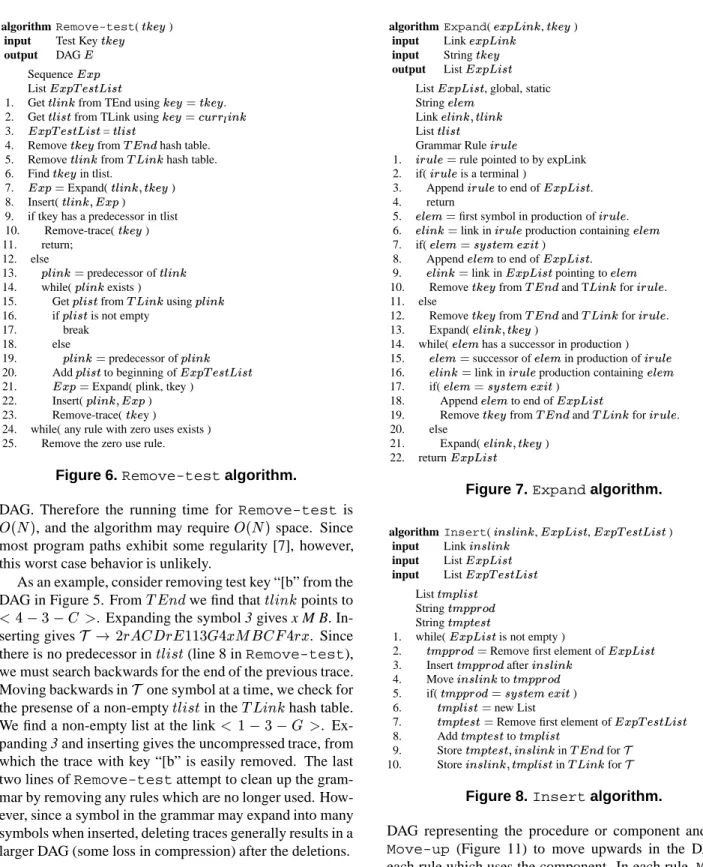
algorithmModSEQUITUR(S) input Execution TraceS output GrammarG
GrammarG RuleT
Hash TableTEnd, key=testkey, value=tl ink Hash TableTLink, key=l ink, value=l ist Test Keytkey
1. for eachtokeninS 2. if(tokenis a Test Key ) 3. tkey=token 4. continue
5. appendtokento end of production forT 6. if(token=systemexit)
7. Storetkey;currl inkin TEnd.
8. Gettl istfrom TLink usingkey=currl ink 9. Appendtkeyto end oftl ist
10. Storecurrl ink;tl istin TLink. 11. if duplicate digram appears 12. if other occurrence is a ruleginG
13. replace new digram with non-terminal ofg. 14. else
15. form a new rule and replace duplicate 16. digrams with the new non-terminal. 17. if any rule inGis used only once
18. remove the rule by substituting the production. 19. returnG
Figure 3.ModSEQUITURalgorithm.
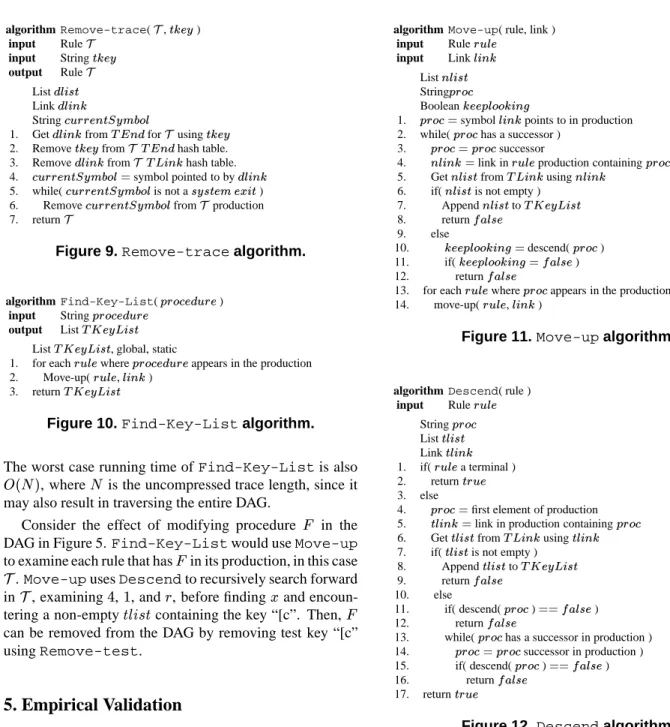
[a M B r A C D r E r r r r x [b M B G r r r x [c M B C F r r r r x
Figure 4.Multiple execution traces with test keys.
ends, using the test identifier as a key. The other hash table (TLink)stores a list of test identifiers, using the link in the production where the test ends as the key. A list must be stored inTLinkbecause compression may cause multiple test cases to map to the same link in a production rule. Both hashes are necessary, since our algorithms must be able to both efficiently look up where a test ends and check whether a given link has any tests ending at that link. The test key tokens must be unique and must be easily distinguishable from the trace tokens that follow it.
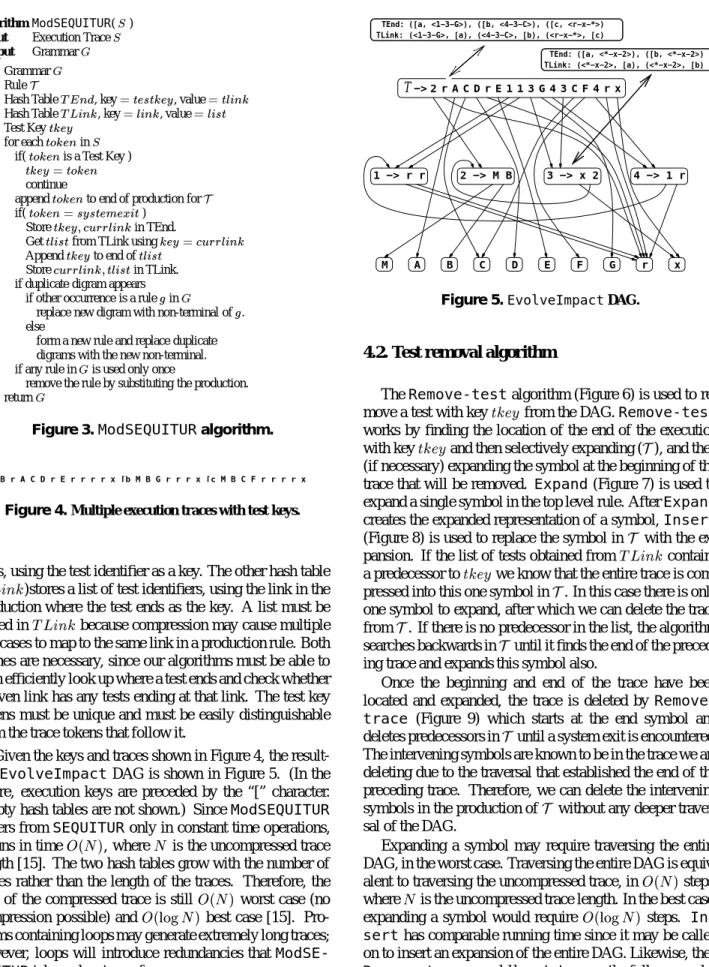
Given the keys and traces shown in Figure 4, the result-ingEvolveImpactDAG is shown in Figure 5. (In the figure, execution keys are preceded by the “[” character. Empty hash tables are not shown.) SinceModSEQUITUR differs fromSEQUITURonly in constant time operations, it runs in timeO(N), whereN is the uncompressed trace length [15]. The two hash tables grow with the number of traces rather than the length of the traces. Therefore, the size of the compressed trace is stillO(N)worst case (no compression possible) andO(logN)best case [15]. Pro-grams containing loops may generate extremely long traces; however, loops will introduce redundancies that ModSE-QUITURtakes advantage of.
4 G 3 1 1 E r D C A r 2 3 M A B C D E F G r x 4 −> 1 r 3 −> x 2 2 −> M B 1 −> r r T−> CF4 rx (<*−x−2>, [a), (<*−x−2>, [b) TLink: ([a, <*−x−2>), ([b, <*−x−2>) TEnd: (<1−3−G>, [a), (<4−3−C>, [b), (<r−x−*>, [c) ([a, <1−3−G>), ([b, <4−3−C>), ([c, <r−x−*>) TLink: TEnd:
Figure 5.EvolveImpactDAG.
4.2. Test removal algorithm
TheRemove-testalgorithm (Figure 6) is used to re-move a test with keytkeyfrom the DAG.Remove-test works by finding the location of the end of the execution with keytkeyand then selectively expanding (T), and then (if necessary) expanding the symbol at the beginning of the trace that will be removed. Expand(Figure 7) is used to expand a single symbol in the top level rule. AfterExpand creates the expanded representation of a symbol,Insert (Figure 8) is used to replace the symbol inT with the ex-pansion. If the list of tests obtained fromTLinkcontains a predecessor totkeywe know that the entire trace is com-pressed into this one symbol inT. In this case there is only one symbol to expand, after which we can delete the trace fromT. If there is no predecessor in the list, the algorithm searches backwards inT until it finds the end of the preced-ing trace and expands this symbol also.
Once the beginning and end of the trace have been located and expanded, the trace is deleted by Remove-trace (Figure 9) which starts at the end symbol and deletes predecessors inT until a system exit is encountered. The intervening symbols are known to be in the trace we are deleting due to the traversal that established the end of the preceding trace. Therefore, we can delete the intervening symbols in the production ofT without any deeper traver-sal of the DAG.
Expanding a symbol may require traversing the entire DAG, in the worst case. Traversing the entire DAG is equiv-alent to traversing the uncompressed trace, inO(N)steps, whereNis the uncompressed trace length. In the best case, expanding a symbol would require O(logN)steps. In-serthas comparable running time since it may be called on to insert an expansion of the entire DAG. Likewise, then Remove-tracewould have to traverse the fully expanded
algorithmRemove-test(tkey) input Test Keytkey output DAGE
SequenceExp ListExpTestList
1. Gettl inkfrom TEnd usingkey=tkey. 2. Gettl istfrom TLink usingkey=curr
l ink 3. ExpTestList=tl ist
4. RemovetkeyfromTEndhash table. 5. Removetl inkfromTLinkhash table. 6. Findtkeyin tlist.
7. Exp=Expand(tl ink;tkey) 8. Insert(tl ink;Exp)
9. if tkey has a predecessor in tlist 10. Remove-trace(tkey) 11. return;
12. else
13. pl ink=predecessor oftl ink 14. while(pl inkexists )
15. Getpl istfromTLinkusingpl ink 16. ifpl istis not empty
17. break
18. else
19. pl ink=predecessor ofpl ink 20. Addpl istto beginning ofExpTestList 21. Exp=Expand( plink, tkey )
22. Insert(pl ink;Exp) 23. Remove-trace(tkey )
24. while( any rule with zero uses exists ) 25. Remove the zero use rule.
Figure 6.Remove-testalgorithm.
DAG. Therefore the running time for Remove-testis O(N), and the algorithm may requireO(N)space. Since most program paths exhibit some regularity [7], however, this worst case behavior is unlikely.
As an example, consider removing test key “[b” from the DAG in Figure 5. FromTEndwe find thattlinkpoints to <4 3 C >. Expanding the symbol 3 gives x M B. In-serting givesT !2rACDrE113G4xMBCF4rx. Since there is no predecessor intlist(line 8 inRemove-test), we must search backwards for the end of the previous trace. Moving backwards inT one symbol at a time, we check for the presense of a non-emptytlistin theTLinkhash table. We find a non-empty list at the link< 1 3 G>. Ex-panding 3 and inserting gives the uncompressed trace, from which the trace with key “[b” is easily removed. The last two lines ofRemove-testattempt to clean up the gram-mar by removing any rules which are no longer used. How-ever, since a symbol in the grammar may expand into many symbols when inserted, deleting traces generally results in a larger DAG (some loss in compression) after the deletions.
4.3. Procedure removal algorithm
When a procedure is changed or removed from the pro-gram we useFind-Key-List(Figure 10) to find the test keys corresponding to the traces in which this procedure occurs. Find-Key-List begins at the terminal in the
algorithmExpand(expLink,tkey) input LinkexpLink
input Stringtkey output ListExpList
ListExpList, global, static Stringel em
Linkel ink;tl ink Listtl ist
Grammar Ruleirul e
1. irul e=rule pointed to by expLink 2. if(irul eis a terminal )
3. Appendirul eto end ofExpList. 4. return
5. el em=first symbol in production ofirul e. 6. el ink=link inirul eproduction containingel em 7. if(el em=systemexit)
8. Appendel emto end ofExpList. 9. el ink=link inExpListpointing toel em 10. RemovetkeyfromTEndand TLinkforirul e. 11. else
12. RemovetkeyfromTEndandTLinkforirul e. 13. Expand(el ink;tkey)
14. while(el emhas a successor in production ) 15. el em=successor ofel emin production ofirul e 16. el ink=link inirul eproduction containingel em 17. if(el em=systemexit)
18. Appendel emto end ofExpList
19. RemovetkeyfromTEndandTLinkforirul e. 20. else
21. Expand(el ink;tkey) 22. returnExpList
Figure 7.Expandalgorithm. algorithmInsert(insl ink,ExpList,ExpTestList)
input Linkinsl ink input ListExpList input ListExpTestList
Listtmpl ist Stringtmpprod Stringtmptest
1. while(ExpListis not empty )
2. tmpprod=Remove first element ofExpList 3. Inserttmpprodafterinsl ink
4. Moveinsl inktotmpprod 5. if(tmpprod=systemexit) 6. tmpl ist=new List
7. tmptest=Remove first element ofExpTestList 8. Addtmptesttotmpl ist
9. Storetmptest;insl inkinTEndforT 10. Storeinsl ink;tmpl istinTLinkforT
Figure 8.Insertalgorithm.
DAG representing the procedure or component and calls Move-up (Figure 11) to move upwards in the DAG to each rule which uses the component. In each rule, Move-upsearches forward in each production rule for test keys and adds them to TKeyList. If no keys are found in the production, Move-up uses Descend(Figure 12) to re-cursively search subtrees in the DAG for test keys. After the keys are found the corresponding traces are removed using Remove-test, described in the previous section.
algorithmRemove-trace(T,tkey) input RuleT
input Stringtkey output RuleT
Listdl ist Linkdl ink
StringcurrentSymbol
1. Getdl inkfromTEndforT usingtkey 2. RemovetkeyfromT TEndhash table. 3. Removedl inkfromT TLinkhash table. 4. currentSymbol=symbol pointed to bydl ink 5. while(currentSymbolis not asystemexit) 6. RemovecurrentSymbolfromT production 7. returnT
Figure 9.Remove-tracealgorithm.
algorithmFind-Key-List(procedure) input Stringprocedure
output ListTKeyList ListTKeyList, global, static
1. for eachrul ewhereprocedureappears in the production 2. Move-up(rul e,l ink)
3. returnTKeyList
Figure 10.Find-Key-Listalgorithm. The worst case running time ofFind-Key-Listis also O(N), whereN is the uncompressed trace length, since it may also result in traversing the entire DAG.
Consider the effect of modifying procedure F in the DAG in Figure 5.Find-Key-Listwould useMove-up to examine each rule that hasFin its production, in this case T.Move-upusesDescendto recursively search forward inT, examining4,1, andr, before findingxand encoun-tering a non-emptytlistcontaining the key “[c”. Then,F can be removed from the DAG by removing test key “[c” usingRemove-test.
5. Empirical Validation
The primary research question we wish to investigate is whether incrementally computing impact analysis informa-tion with theEvolveImpactalgorithms is more efficient than recomputing that information from scratch. We also wish to determine whether this relationship changes with numbers of changes.
We thus performed a controlled experiment comparing the time required to update an initial EvolveImpact DAG using our algorithms to remove and add traces to the time required to completely rebuild an EvolveIm-pactDAG, after various numbers of test suite or program changes. We also compared the sizes of the resulting DAGs and traces.
algorithmMove-up( rule, link )
input Rulerul e input Linkl ink
Listnl ist Stringproc
Booleankeepl ooking
1. proc=symboll inkpoints to in production 2. while(prochas a successor )
3. proc=procsuccessor
4. nl ink=link inrul eproduction containingproc) 5. Getnl istfromTLinkusingnl ink
6. if(nl istis not empty ) 7. Appendnl isttoTKeyList 8. returnfal se
9. else
10. keepl ooking=descend(proc) 11. if(keepl ooking=fal se) 12. returnfal se
13. for eachrul ewhereprocappears in the production 14. move-up(rul e,l ink)
Figure 11.Move-upalgorithm.
algorithmDescend( rule )
input Rulerul e Stringproc Listtl ist Linktl ink 1. if(rul ea terminal ) 2. returntrue 3. else
4. proc=first element of production 5. tl ink=link in production containingproc 6. Gettl istfromTLinkusingtl ink 7. if(tl istis not empty )
8. Appendtl isttoTKeyList 9. returnfal se
10. else
11. if( descend(proc)==fal se) 12. returnfal se
13. while(prochas a successor in production ) 14. proc=procsuccessor in production ) 15. if( descend(proc)==fal se) 16. returnfal se
17. returntrue
Figure 12.Descendalgorithm.
5.1. Experiment materials
As a subject we used a program developed for the Eu-ropean Space Agency; we refer to this program asspace. Spaceis an interpreter for an antenna array definition lan-guage (ADL).Spacehas approximately 6200 non-blank, non-comment lines of C code and 136 functions.
To provide input sets for use in determining dynamic be-havior, we used test cases and suites created for space for earlier experiments [18]. The test cases consisted of a pool of 10,000 randomly generated test cases, plus 3,585 test cases generated by hand to ensure coverage of every
branch in the program by at least 30 test cases. This pool of test cases was used to generate 1000 branch coverage adequate test suites containing on average approximately 150 test cases each. We randomly selected 50 of these test suites. The selected test suites in aggregate contained 7,773 test cases including 2,886 duplicates.
We implemented theEvolveImpactalgorithms in the Java language, using the earlierPathImpact implemen-tation as a starting point. TheEvolveImpact implemen-tation consists of 35 classes and approximately 9700 lines of non-comment code.
5.2. Experiment methodology
5.2.1 Measures
To measure the efficiency of the various algorithms, we col-lected measures of (1) the time required to collect an ini-tial set of traces and build an iniini-tial DAG, (2) the time quired to reexecute the changed program or test suite and re-build another DAG from scratch, and (3) the time required to incrementally update the initial DAG by removing and adding traces using our new algorithms. When testing the EvolveImpact algorithms with program modification, we recorded how many test keys were removed and sub-sequently added when updating the initial DAG. We also collected the size in bytes of each trace and each resulting DAG.
All measures were collected on five identical Sun Ultra 5 workstations. Each workstation had a 360MHz SPARC processor, 256 MBytes of main memory, 1 GByte of swap space, and used 100 MBit ethernet attached storage. There were no other users on the machines during the course of gathering information for this experiment.
Elapsed time information was collected using the stan-dard Java library system function which returns the current system time in milliseconds. The sizes of the traces and the DAGs was measured after the trace or the DAG had been stored in a disk file.
5.2.2 Design
In this experiment, the three measures of time in millisec-onds and six measures of size in bytes are our independent variables. Our dependent variables are the technique ap-plied (rebuild from scratch versus incremental), and either the number of changes in the test suite or the number of procedures in the program that were modified.
We ran the experiment in two stages. The first stage ex-amined the effect of changes in test suites. For each test suite T in our set of fifty test suites, we built the initial DAG forT. We then chose a random number,k, between one and the number of test cases inT, and then,ktimes, chose randomly whether to add or delete a test case to or
fromT. Added test cases were randomly drawn from the pool of available test cases, and deleted test cases were ran-domly extracted from the test cases currently remaining in T, excluding any of the test cases just added. The result-ing modified test suite was then used to rebuild a DAG from scratch. The updated DAG was created by deleting the test cases that were removed from the test suite from the ini-tial DAG, executing the added test cases to create a trace file, and then adding this trace to the updated DAG. We per-formed this sequence of operations 15 times for each of our 50 test suites.
In the second stage of the experiment we examined the effect of making changes to procedures inspace. For each of our test suites T, after building the initial DAG forT, we selected a random number of procedures inspace (be-tween one and four), found the list of test cases in the DAG containing these procedures usingFind-Key-List, re-moved the listed test cases from the DAG, reexecuted the test cases, and added the new traces to the DAG. We also rebuilt the DAG from scratch, as in the previous stage. Note that in this case, since the test suite was unchanged, and there were no actual modifications made to space, the rebuilt DAG exactly recreated the initial DAG. While this would not always be the case in practice (changes to pro-cedures may or may not alter test traces) when propro-cedures have been modified, this process provided a necessary ex-perimental control, allowing us to avoid conflating the ef-fects of procedure changes with the associated test case change effects. We also used the rebuilt DAG to provide a comparison and consistency check against the initial DAG. As in the first stage, we repeated this sequence 15 times for each test suite.
5.2.3 Threats to validity
Like any controlled experiment, this experiment faces threats to validity, and these must be controlled for, or ac-counted for when interpreting results.
Threats to internal validity concern our ability to prop-erly draw conclusions about the connections between our independent and dependent variables. In this experiment, our primary concern involves instrumentation effects, such as errors in our algorithm implementations or measurement tools, which could affect outcomes. To control for these threats we carefully validated these implementations and tools on known examples.
Threats to external validity concern our ability to gen-eralize our results to larger classes of subjects. In this ex-periment we have studied only one program, and although it is a “real” program we cannot claim it is representative of programs generally. Also, the test suites we use repre-sent only one type of suite that could be found in practice. Finally, the program and test suite modifications were simu-lated, not actual, modifications. Additional studies of other
0 200000 400000 600000 800000 1e+06 1.2e+06 1.4e+06 0 20 40 60 80 100 120 140 Update Time (ms)
Test Suite Modifications
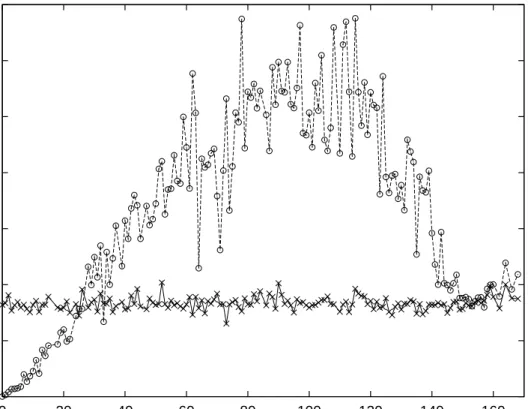
Figure 13. Rebuild times and Update times in milliseconds for test suite modifications. The average time required to rebuild the DAG for each number of modifications is represented using an “x”. The average update time is shown as a circle.
programs and types of inputs are needed to address such threats to external validity.
Threats to construct validity concern the appropriateness of our measures for capturing our dependent variables. Our measures of time and space capture one aspect of these vari-ables, but other factors (e.g. the amount of memory rather than disk consumed) may be important in particular situ-ations. Also, Space executes very quickly, and its execu-tion time contributes little to the initial, rebuild, and update times. This causes algorithm run time to play a more im-portant role in comparisons of techniques than it would for a program requiring longer execution times. Longer exe-cution times, however, would be expected in general to in-crease the benefit gained by the incremental algorithms.
5.3. Analysis and results
We now present our results, beginning by presenting and discussing data. Section 5.4 discusses implications. 5.3.1 Data
In the first stage of our experiment, over each of the 50 test suites, we measured three times in milliseconds, six sizes
in bytes, and the number of changes made to the test suite. The time required to build the initial DAG was collected as an experimental control and consistency check. (Since the initial DAG would be created in practice regardless of the decision to rebuild or update the DAG after changes, its creation time and size has no effect on the research question we are investigating.)
The graph in Figure 13 provides a view of the rebuild and update time measurements collected during the test suite modification stage. Each data point represents the average time in milliseconds for 15 trials for each number of random test suite modifications.
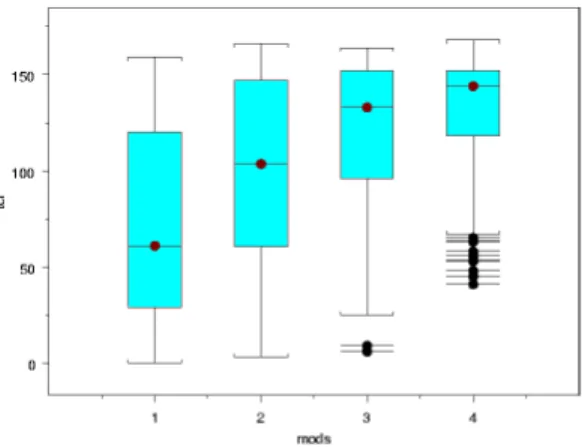
Stage two of our experiment simulated changes to proce-dures inspace. The number of program modifications was randomly chosen between one and four, inclusive. How-ever, since the number of modifications is transformed into a list of test cases to remove, we reasoned that the number of test cases removed from the DAG was a more reliable indi-cator of the extent of changes made for each trial. We refer to the number of test cases that were removed as the “Test Change Factor”, or TCF. Figure 14 shows a box plot of the number of modifications made to the program compared to the observed TCF for 750 trials. In general, the more
pro-Figure 14. Number of program modifications versus Test Change Factor (TCF).
cedures that were modified, the more test cases in the test suite were affected. However, it was not uncommon for a modification of a single procedure to affect the majority of the test cases in a test suite.
Finally, Figure 15 shows TCF versus the rebuild and up-date times for the procedure modification stage of the ex-periment.
5.3.2 Analysis of time differences
When responding to test suite modifications, the average time required to update the DAG is less than the average time required to rebuild the DAG across the entire range of test suite modification sizes. The average rebuild time was 958,156 milliseconds with a standard deviation of 172,616 milliseconds. The computational effort required to update the DAG after test suite modifications appears to be linear in the number of test cases added to or removed from the DAG under the circumstances in which we collected our data. Rebuild time grows closer to update time as test suite size increases, but never reaches it, even as maximum test suite size is reached.
The time required to update the DAG after procedure modifications shows a more complex relationship in rela-tion to rebuild times. The average rebuild time was 830,417 milliseconds with a standard deviation of 95,340 millisec-onds. For program modifications that affect fewer than ap-proximately 25 test cases in the DAG, updating the DAG required less time than recomputing the DAG. For large TCF values, the computational effort required by the two approaches appears relatively equal. Between a TCF of 25 and approximately 145, however, updating the DAG was consistently (with one outlier, a TCF of 33 having an aver-age update time of 668,389 milliseconds versus an averaver-age rebuild time of 830,653 milliseconds) less efficient than
re-computation. Update times were also relatively variable in this range, most likely due to variation in the internal com-pression of the traces in the DAG. In areas of high compres-sion, less graph traversal is required when searching for the appropriate test keys.
5.3.3 Analysis of size differences
We present the size measurements for the test suite modi-fication stage of our experiment first, followed by the size measurements for the program modification stage.
The average size of the initial traces generated by the test suites during the first stage of the experiment was 982,460 bytes, with a standard deviation of 49,221 bytes. The aver-age size of the initial DAG was 80,685, with a standard de-viation of 3,967 bytes. The average size of the initial DAG relative to the initial trace was 7.78%. The standard devia-tion was 0.57%.
The recomputed DAGs in the first stage had an average size of 81,906 bytes, and standard deviation of 5,197 bytes. The traces used to rebuild the DAGs had an average size of 1,039,282 bytes with a standard deviation of 90,874 bytes. The relative size of the DAG compared to its corresponding trace was 7.74%, with a standard deviation of 0.56%.
Updated DAGs had an average size of 92,832 bytes with a standard deviation of 8,220 bytes. The updated DAG was on average 1.13 times the size of the rebuilt DAG, with a standard deviation of 0.085. Since the size of the corre-sponding trace reflects only test cases that were added, a better relative comparison of the compression obtained can be obtained by observing the size of the updated DAG in relation to the size of the traces used to rebuild the DAG. In this case the updated DAG was 8.44% the size of the traces used to rebuild the DAG, and had a standard deviation of 0.72%.
For our experiments with program modifications, the av-erage size of the initial DAG was 80,651 bytes, and had a standard deviation of 4,407 bytes. The average size of the initial traces was 982,461 bytes with a deviation of 49,221 bytes. On average the size of the DAG was 7.80% the size of the trace, with a standard deviation of 0.57%.
The traces used to recompute DAGs, and the recomputed DAGs, exactly matched the size and variation of the initial traces and DAGs, since they were based on the same test suite and the run-time behavior ofspacedid not change.
The updated DAGs had an average size of 103,623 bytes and a standard deviation of 23,833 bytes. In comparison to the recomputed DAGs, the updated DAGs were 1.28 times larger, with a standard deviation of 0.290. The updated DAGs were 10.0% the size of the traces used to create the recomputed DAGs, with a standard deviation of 2.4%.
0 500000 1e+06 1.5e+06 2e+06 2.5e+06 3e+06 3.5e+06 0 20 40 60 80 100 120 140 160 Update Time (ms)
Test Change Factor
Figure 15.Rebuild times versus Update times in milliseconds by TCF. The average time required to rebuild the DAG for each TCF is represented using an “x”. The average update time is shown as a circle.
5.4. Discussion
Our primary goal was to compare the time required to update the DAG to the time required to recalculate the DAG. In all observed cases, it was more efficient to update a DAG than to regenerate it when the program’s test suite was mod-ified. The computational effort measured by elapsed time grows slowly with the number of changes made to the test suite, never becoming equivalent to the recomputation ef-fort even when all test cases in the suite are modified.
When a procedure or procedures in the program were modified, results varied with the number of test cases con-taining the modified procedures. Inspacewe found it is not uncommon for one procedure to be hit in a majority of the test cases. The computational effort required to up-date the DAG was less than the effort of recomputation only for program modifications that affect approximately 25 test cases or fewer. One possible explanation for this result is thatFind-Key-Listmay perform more graph traversal operations than expected, or that the traversal may be more computationally expensive than was apparent, above a cer-tain modification threshold.
An additional goal of our experiments was to measure the absolute and relative sizes of the traces space gen-erated and the EvolveImpact DAGs constructed from them. The sizes of the traces and DAGs was consistent and showed little variation. A compression factor of approxi-mately 10 was consistently observed. Updating the whole-path DAGs caused only minor loss of compression.
6
Conclusions and Future Work
In this paper, we have presented algorithms that allow ourPathImpactapproach to dynamic impact analysis to be applied incrementally as a system evolves, processing the set of test case or procedure modifications made to a program, and avoiding the overhead of completely recom-puting the information needed for impact analysis.
Our empirical study of these algorithms suggest that changes in a test suite can be accommodated more effi-ciently usingEvolveImpactthan by rebuilding the DAG from scratch. The results also suggest that when proce-dures are changed, the cost-effectiveness of the approach will vary depending on the number of test cases which reach
those procedures. After a system change inspace, it be-comes more efficient to rebuilt the DAG than to use the EvolveImpactalgorithms for a relatively small number of affected tests. This may be due to the behavior ofspace and the particular test cases we used in our experiment, but could be expected to hold for other workloads too. An im-mediate point of investigation is to find a practical metric with which to determine when this threshold is reached, both by extended experimentation withspaceand by ex-amining the behavior of other programs. We will also inves-tigate the possibility of creating a more efficient algorithm for removing components from the DAG, one that removes components directly rather than usingFind-Key-List and then removing each test.
Future work includes experimentation with a wider range of programs, an examination of the sensitivity of our techniques to test input data, and consideration of object-oriented and distributed programs. While this research has investigated the application of an approach at the level of a procedure, we intend to apply this model to other levels, such as components. We intend to investigate scalability to large systems by adapting the local level of modeling ac-cording to various criteria, such as local usage or complex-ity measures.
We also plan additional empirical comparisons with conventional dynamic slicing techniques. While typical dynamic slicing techniques operate at a different level (statement-level versus procedure-level) than our tech-niques, the behavior of impact analyses based on dynamic slicing may be more directly comparable to our techniques than analyses based on other approaches such as static slic-ing, and the techniques may offer different cost-benefits tradeoffs.
Acknowledgements
This work was supported in part by the NSF Infor-mation Technology Research program under Award CCR-0080900 to Oregon State University. Phyllis Frankl, Al-berto Pasquini, and Filip Vokolos provided thespace pro-gram and randomly generated tests. A special thanks to Chengyun Chu for creating the additional tests forspace.
References
[1] H. Agrawal and J. Horgan. Dynamic program slicing. In Proceedings: SIGPLAN ’90 Conference on Programming Language Design and Implementation. SIGPLAN Notices., pages 246–56, White Plains, June 1990. ACM.
[2] R. S. Arnold and S. A. Bohner. Impact analysis - towards a framework for comparison. In Proceedings of the Inter-national Conference on Software Maintenance, pages 292– 301, Montreal, Que, Can, Sept. 1993. IEEE.
[3] S. Bohner and R. Arnold. Software Change Impact Analy-sis. IEEE Computer Society Press, Los Alamitos, CA, USA, 1996.
[4] S. Horwitz, T. Reps, and D. Binkley. Interprocedural Slicing Using Dependence Graphs. ACM Trans. Prog. Lang. Syst., 12(1):27–60, Jan. 1990.
[5] M. Kamkar. An Overview and Comparative Classification of Program Slicing Techniques. Journal of Systems Software, 31(3):197–214, 1995.
[6] B. Korel and J. Laski. Dynamic slicing in computer pro-grams. Journal of Systems Software, 13(3):187–95, 1990. [7] J. Larus. Whole Program Paths. In Proc. SIGPLAN PLDI
99, pages 1–11, Atlanta, GA, May 1999. ACM.
[8] J. Law and G. Rothermel. Whole Program Path-Based Dy-namic Impact Analysis. In ICSE 2003, Portland, Oregon, May 2003. IEEE.
[9] M. Lee. Change Impact Analysis of Object-Oriented Soft-ware. Ph.D. dissertation, George Mason University, Feb. 1999.
[10] M. Lee, A. J. Offutt, and R. T. Alexander. Algorithmic Anal-ysis of the Impacts of Changes to Object-oriented Software. In TOOLS-34 ’00, 2000.
[11] L. Li and A. J. Offutt. Algorithmic analysis of the impact of changes to object-oriented software. In Proceedings of the International Conference on Software Maintenance, pages 171–184, Monterey, CA, USA, Nov. 1996. IEEE.
[12] M. Lindvall and K. Sandahl. How well do experienced soft-ware developers predict softsoft-ware change? Journal of Sys-tems and Software, 43(1):19–27, Oct. 1998.
[13] J. L. Lions. ARIANE 5, Flight 501 Failure, Report by the Inquiry Board. European Space Agency, July 1996. [14] J. P. Loyall, S. A. Mathisen, and C. P. Satterthwaite. Impact
analysis and change management for avionics software. In Proceedings of IEEE National Aerospace and Electronics Conference, Part 2, pages 740–747, Dayton, OH, July 1997. [15] C. Nevill-Manning and I. Witten. Linear-time, incremental hierarchy inference for compression. In Proc Data Com-pression Conference (DDC 97), pages 3–11. IEEE, 1997. [16] S. L. Pfleeger. Software Engineering: Theory and Practice.
Prentice Hall, Englewood Cliffs, NJ, 1998.
[17] A. Podgurski and L. Clarke. A formal model of program de-pendences and its implications for software testing, debug-ging, and maintenance. IEEE Trans. Softw. Eng., 16(9):965– 79, Sept. 1990.
[18] G. Rothermel, R. H. Untch, C. Chu, and M. J. Harrold. Test Case Prioritization: An Empirical Study. In Proceedings of the International Conference on Software Maintenance, pages 179–188, Oxford, UK, Sept. 1999.
[19] B. G. Ryder and F. Tip. Change impact analysis for object-oriented programs. In ACM SIGPLAN – SIGSOFT workshop on on Program analysis for software tools and engineering, pages 46–53. ACM Press, 2001.
[20] F. Tip. A survey of program slicing techniques. Journal of Programming Languages, 3:121–189, 1995.
[21] R. J. Turver and M. Munro. Early impact analysis tech-nique for software maintenance. Journal of Software Main-tenance: Research and Practice, 6(1):35–52, Jan. 1994. [22] M. Weiser. Program slicing. In 5th International Conference
on Software Engineering, pages 439–49, San Diego, CA, Mar. 1981. IEEE.