2009
Cross-validation in model-assisted estimation
Lifeng You
Iowa State University
Follow this and additional works at:
https://lib.dr.iastate.edu/etd
Part of the
Statistics and Probability Commons
This Dissertation is brought to you for free and open access by the Iowa State University Capstones, Theses and Dissertations at Iowa State University Digital Repository. It has been accepted for inclusion in Graduate Theses and Dissertations by an authorized administrator of Iowa State University Digital Repository. For more information, please [email protected].
Recommended Citation
You, Lifeng, "Cross-validation in model-assisted estimation" (2009).
Graduate Theses and Dissertations
. 10457.
by
Lifeng You
A dissertation submitted to the graduate faculty
in partial fulfillment of the requirements for the degree of
DOCTOR OF PHILOSOPHY
Major: Statistics
Program of Study Committee:
Jean D. Opsomer, Major Professor
Michael Larsen
Huaiqing Wu
Cindy L. Yu
Helen H. Jensen
Iowa State University
Ames, Iowa
2009
DEDICATION
I would like to dedicate this thesis to my husband Lei without whose support I would
not have been able to complete this work. I would also like to thank my friends and family
for their loving guidance and financial assistance during the writing of this work.
TABLE OF CONTENTS
LIST OF TABLES . . . .
v
ACKNOWLEDGEMENTS . . . .
ix
ABSTRACT . . . .
x
CHAPTER 1. Cross-Validation in Penalized Spline Model-Assisted
Esti-mation . . . .
1
1.1
Introduction . . . .
1
1.2
Definition of the Estimator and Smoothing Parameter Selection . . . .
4
1.2.1
Definition of the Estimator . . . .
4
1.2.2
Smoothing Parameter Selection . . . .
6
1.3
Theoretical Properties . . . .
7
1.4
Simulation Results . . . .
20
1.5
Conclusion . . . .
26
CHAPTER 2. CV as Improved Variance Estimation for Model-Assisted
Estimators . . . .
28
2.1
Introduction . . . .
28
2.2
Definition of the Estimator . . . .
29
2.3
Theoretical Properties . . . .
33
2.4
Simulation Results . . . .
46
2.5
Conclusion . . . .
53
CHAPTER 3. Shrinking for Linear Regression Estimation . . . .
55
3.1
Definition of the Estimator . . . .
55
3.3
Simulation Results . . . .
73
3.4
Conclusion . . . .
78
CHAPTER 4. Model Selection for Regression Estimators . . . .
79
4.1
Definition of the Estimator . . . .
79
4.2
Theoretical Properties . . . .
80
4.3
Simulation Results . . . .
81
4.4
Conclusion . . . .
90
APPENDIX A. Technical Lemmas
. . . .
91
A.1 Lemmas I . . . .
91
A.2 Lemmas II . . . .
97
APPENDIX B. Additional Simulation Results . . . .
100
B.1 More Simulation Results in Chapter 1 . . . 100
B.2 More Simulation Results in Chapter 2 . . . 107
B.3 More Simulation Results in Chapter 3 . . . 118
B.4 More Simulation Results in Chapter 4 . . . 122
ACKNOWLEDGEMENTS
I would like to take this opportunity to express my thanks to my major professor, Dr.
Opsomer, for his guidance, patience and support throughout this research and the writing
of this thesis. I would also like to thank my committee members for their efforts and
contributions to this work: Dr. Larsen, Dr. Wu, Dr. Yu and Dr. Jensen. I would additionally
like to thank Dr. Hofmann for her guidance throughout the initial stages of my graduate
study. Finally I would like to thank Dr. Kling and Dr. Maiti for their valuable comments
and suggestions to my research study.
ABSTRACT
Variance estimation for survey estimators that include modeling relies on approximations
that ignore the effect of fitting the models. Cross-validation (CV) criterion provides a way
to incorporate this effect. We will show 4 ways in which we explore this in this dissertation.
Penalized spline regression, as a main type of nonparametric model assisted methods, is
a common technique to improve the precision of finite population estimators. In Chapter 1,
we propose a CV based criterion to select the smoothing parameter for the penalized spline
regression estimator. The design-based asymptotic properties of the method are derived,
and simulation studies show how well it works in practice.
Regression estimator is a common technique to improve the precision of finite population
estimators by using the available auxiliary information of the population. In Chapter 2, we
propose a CV based variance estimator and compare it to other two variance estimators.
The design-based asymptotic properties of the estimator are derived, and simulation studies
show how well it works in practice.
Regression estimator works well for the cases where there is a strong linear relationship
between regressor and regressands. On the contrary, when the relationship is weak,
π
esti-mator is a good choice. In Chapter 3, a new estiesti-mator as a linear combination of those two
estimators is proposed to select between them. We introduce a CV based variance estimator
for the new proposed estimator. The design-based asymptotic properties of the estimator
are explored, and simulation studies show how well it works in practice.
In linear regression estimation, how to choose the set of control variables
x
is a difficult
practical problem. In Chapter 4, a CV criterion is introduced for choosing between
combina-tions of the
x
variables to be included in the model. The design-based asymptotic properties
of the estimator are explored, and simulation studies show how well it works in practice.
CHAPTER 1.
Cross-Validation in Penalized Spline
Model-Assisted Estimation
1.1
Introduction
In many surveys, the available auxiliary information for the population can be used to
improve the precision of design-based estimators. Thereinto ratio and regression estimators
have been used for a long time in survey estimation, e.g., Cochran (1977).
Breidt and Opsomer (2000) proposed a nonparametric model-assisted regression
esti-mator with the relationship between the variables to be any smooth function. They used
kernel-based local polynomial regression and showed that the nonparametric estimator has
the same asymptotic design properties of the parametric model-assisted estimators.
The practical properties of the estimator depend on the choice of a smoothness
tun-ing parameter, i.e., the bandwidth in local polynomial regression. In Breidt and Opsomer
(2000), the bandwidth is treated as a fixed quantity and the issue of how to best select a
bandwidth value is not addressed. In Opsomer and Miller (2005), the issue of smoothing
parameter selection for nonparametric model-assisted estimation was explored and a
sample-based criterion that could be used for this purpose was proposed. The proposed smoothing
parameter selection method was based on minimizing a type of cross-validation criterion,
suitably adjusted for the effect of the finite population setting and the survey design.
Penalized spline regression, often called P-splines, is a main type of nonparametric
model-assisted methods introduced by Eilers and Marx (1996). P-splines are flexible and can be
incorporated into a wide range of modelling contexts. Ruppert et al. (2003) gave an overview
of applications of P-splines to different settings. P-splines are also a natural candidate for
constructing nonparametric small area estimators in terms of their close connections with
linear mixed models discussed in Wand (2003).
The ability of combing nonparametric regression and mixed model regression with
P-splines was used in different contexts, e.g., Parise et al. (2001) and Coull et al. (2001). They
all provided examples of using penalized splines in the construction of mixed effect regression
models to analyze the data with random effects. In the survey context, Zheng and Little
(2003) proposed a model-based estimator for cluster sampling, where the regression model
combines a spline model with a random effect for the clusters. Opsomer et al. (2008)
pro-posed a new small area estimation approach, which combines small area random effects with
a smooth nonparametrically specified trend. The small area estimation problem could be
expressed as a mixed effect model regression by using penalized splines as the representation
for the nonparametric trend. They showed consistency of the estimator, computed its mean
squared error and provided tests for small area effects and non-linearities.
Breidt et al. (2005) proposed a class of estimators based on penalized spline regression.
Those estimators are weighted linear combinations of sample observations, and weights are
calibrated to known control totals. The estimators are design consistent and asymptotically
normal under the conditions of standard design, and they admit consistent variance
estima-tion by using design-based methods. Breidt et al. (2005) considered data-driven penalty
selection in the context of unequal probability sampling designs and showed that the
esti-mators are more efficient than parametric regression estiesti-mators when the parametric model
is incorrectly specified, while being approximately same efficient when the parametric model
specification is correct.
Modelling a regression function as a piecewise polynomial with a large number of pieces
relative to the sample size is involved in regression spline smoothing. Since the number
of possible models is so large, efficient strategies are required for choosing among them.
Wand (2000) reviewed some approaches to this problem and compared them through a
simulation study. For simplicity, Wand (2000) considered the univariate smoothing setting
with Gaussian noise and the truncated polynomial regression spline basis. Several other
approaches for knot selection exist, e.g., the TURBO algorithm in Friedman and Silverman
(1989) and its subsequent generalization, the MARS algorithm in Friedman (1991).
vari-able, and the only parameters that can be chosen to adjust are the number of knots and
the penalty parameter. Ruppert (2002) studied the effects of number of knots on the
per-formance of penalized splines. Two algorithms for the automatic selection of the number
of knots, myopic algorithm and full search algorithm, were proposed. Ruppert (2002) also
described a Demmler-Reinsch type diagonalization for computing univariate and additive
penalized spline, which is very useful for super-fast generalized cross-validation, while being
not effective for smoothing splines since large number of knots.
The choices for the number and positioning of the knots are much less crucial than the
smoothing parameter. Ruppert et al. (2003) introduced some model selection approaches,
e.g., cross-validation (CV), generalized cross-validation (GCV), Mallows’s
C
pcriterion. The
optimal amount of smoothing in penalized spline regression was investigated in Wand (1999).
In this article, a simple closed form approximation to the optimal smoothing parameter was
derived. This approach was based on the mean average squared error (MASE), which is a
mathematically measure of the global discrepancy between
m
b
and
m
. It was shown to be
a useful starting point for measuring the optimal amount of smoothing in penalized spline
regression.
In nonparametric regression one can select the smoothing parameter by minimizing a
Mean Squared Error (MSE) based criterion. For spline smoothing, the smooth estimation
can be rewritten as a Linear Mixed Model. Then Maximum Likelihood (ML) theory can
be applied to estimate the smoothing parameter as variance component. The relationship
between spline smoothing and Mixed Models was discussed in Green and Silverman (1994),
Brumback and Rice (1998) and Verbyla et al. (1999).
In Kauermann (2005), smoothing parameter selections for P-spline smoothing based on
MSE minimization and REML estimation were compared. The results for MSE minimization
method are similar to the results provided in Wand (1999). It was shown that REML-based
smoothing parameter selection is asymptotically biased towards undersmoothing, i.e., this
approach chooses a more complex model compared to the MSE method. The result accords
with classical spline smoothing, however the asymptotic arguments are different.
Different smoother is rapidly becoming more popular, which is much easier to prove
theoretical results. In this chapter, we will propose a new CV-based criterion for smoothing
parameter selection, which has almost exact expression as the criterion (9) in Opsomer and
Miller (2005) except that a penalized spline estimator is used to estimate the smooth function
instead of a local polynomial estimator in Opsomer and Miller (2005).
Section 1.2.1 will give the definition of the spline estimator. Section 1.2.2 introduces
the smoothing parameter selection method. In section 1.3 we state assumptions used in the
theoretical derivations and our main theoretical results are described. In section 1.4, we
report simulation results, which show how well the CV-based criterion works in practice.
1.2
Definition of the Estimator and Smoothing Parameter
Selection
1.2.1
Definition of the Estimator
In survey sampling, the estimation of a finite population total,
t
y=
X
i∈U
y
iis a problem in common. Where
U
=
{
1
,
2
, . . . , N
}
is a finite population with
N
identifiable
elements and
y
iis a response variable for the
i
th element. A sample of population elements
s
⊂
U
is selected with probability
p
(
s
). Let
π
i= Pr (
i
∈
s
) =
P
s:i∈sp
(
s
)
>
0 denote
the inclusion probability for element
i
, then the Horvitz-Thompson estimator (Horvitz and
Thompson 1952) for
t
yis
b
t
y,HT=
X
sy
iπ
i.
(1.1)
The variance of the Horvitz-Thompson estimator under the sampling design is
Var
b
t
y,HT=
X
i∈UX
j∈U(
π
ij−
π
iπ
j)
y
iπ
iy
jπ
j,
(1.2)
where
π
ij= Pr (
i
∈
s, j
∈
s
), the joint inclusion probability for elements
i, j
∈
U
.
Suppose there is auxiliary information
x
iavailable for all of
U
. Then we hope to
im-prove estimation of
t
yby using the auxiliary information. One approach to incorporate the
auxiliary information is postulating a superpopulation model, say
ξ
, which describes the
relationship between the response variable
y
and the auxiliary variable
x
.
Consider the superpopulation regression model
y
i=
m
(
x
i) +
ε
i,
(1.3)
where
ε
iare independent random variables with mean zero and variance
v
(
x
i),
m
(
x
i) is
a smooth function of
x
i, and
v
(
x
i) is smooth and strictly positive. In order to introduce
the estimator, we treat
{
(
x
i, y
i) :
i
∈
U
}
as a realization from the superpopulation model
(1.3). If the entire realization were observed, we could define a P-spline estimator for
m
(
·
)
as follows:
m
(
x
;
β
) =
β
0+
β
1x
+
. . .
+
β
qx
q+
KX
k=1β
q+k(
x
−
κ
k)
q+,
(1.4)
where (
t
)
q+=
t
qif
t >
0 and 0 otherwise,
q
is the degree of the spline,
κ
1
<
· · ·
. . . < κ
Kis a
set of fixed knots and
β
= (
β
0, . . . , β
q+K)
Tis the coefficient vector. Typically,
q
is kept fixed
and low. If the number of knots
K
is sufficiently large, the class of functions
m
(
x
;
β
) is very
large and can approximate most smooth functions with a high degree of accuracy.
The population estimator for
β
is defined as the minimizer of
X
i∈U(
y
i−
m
(
x
i;
β
))
2+
α
KX
k=1β
q2+k(1.5)
for some fixed constant
α
≥
0. The smoothness of the resulting fit depends on the value of
α
, with larger values corresponding to smoother fits.
Let
X
represent the matrix with rows
x
Ti=
1
, x
i, . . . , x
qi,
(
x
i−
κ
1)
q+, . . . ,
(
x
i−
κ
K)
q+for
i
∈
U
, and let
Y
denote the column vector of response values
y
ifor
i
∈
U
. Define a
diagonal matrix
A
α= diag
{
0
, . . . ,
0
, α, . . . , α
}
, which has
q
+ 1 zeros followed by
K
penalty
constant
α
. If the population
U
is fully observed, the penalized least squares estimator for
the coefficient vector of (1.4) has the ridge-regression representation:
β
U=
X
TX
+
A
α−1X
TY
.
(1.6)
Let
m
i=
m
(
x
i;
β
U)
≡
x
Tiβ
U,
i
∈
U
denote the P-spline fit obtained from this hypothetical
population fit at
x
i. If these fitted values are known, they can be incorporated into the
survey estimation by constructing the difference estimator (S¨arndal et al. 1992, p. 221)
b
t
y,diff=
X
Um
i+
X
sy
i−
m
iπ
i.
(1.7)
The difference estimator is design unbiased and its design variance is
Var
b
t
y,diff=
X
UX
U(
π
ij−
π
iπ
j)
y
i−
m
iπ
iy
j−
m
jπ
j.
(1.8)
Obviously, the efficiency of
b
t
y,diffdepends on how well the
m
iapproximates the variable
y
i.
The estimator (1.7) is infeasible because the
m
icannot be calculated. However, given
a sample
s
, the
m
iin (1.7) can be replaced by sample-based estimators, denoted by
m
b
iand constructed as follows. Define the diagonal matrix of inverse inclusion probabilities
W
= diag
j∈U{
1
/π
j}
and its sample submatrix
W
s= diag
j∈s{
1
/π
j}
. Similarly, let
X
sbe
the submatrix of
X
consisting of those rows for which
j
∈
s
and
Y
sdenote the column
vector of response values
y
jfor
j
∈
s
. For fixed
α
and under suitable regularity conditions,
the
π
-weighted estimator
b
β
=
X
TsW
sX
s+
A
α −1X
TsW
sY
s=
G
αY
s(1.9)
is a design-consistent estimator of
β
Uin (1.6).
Define
m
b
i=
m
x
i,
β
b
≡
x
Ti
β
b
. Then the model-assisted P-spline estimator is defined as
b
t
y,spl=
X
Ub
m
i+
X
sy
i−
m
b
iπ
i.
(1.10)
1.2.2
Smoothing Parameter Selection
Introducing the indicator function
I
i= 1 if
i
∈
s
and 0 otherwise, and the indicator
vector
e
iwhich is a zero vector except for an entry of one at position
i
, we can rewrite (1.10)
as
b
t
y,spl=
X
i∈s(
π
−i 1+
X
j∈U(1
−
I
j/π
j)
x
TjG
αe
i)
y
i≡
X
sw
i(s)y
i,
which shows that
b
t
y,splis a linear estimator.
In Breidt et al. (2005), it was shown that this estimator is design consistent and
asymp-totically design unbiased. Asympasymp-totically, the design mean squared error of
b
t
y,splis equivalent
to the variance of the generalized difference estimator, given in (1.8),
MSE
pb
t
y,spl= E
pb
t
y,spl−
t
y2
≈
X
i,j∈U(
π
ij−
π
iπ
j)
y
i−
m
iπ
iy
j−
m
jπ
j.
(1.11)
Finally, Breidt et al. (2005) provides a design consistent and asymptotically design unbiased
estimator of MSE
pb
t
y,spl, as
b
V
b
t
y,spl=
X
i,j∈sπ
ij−
π
iπ
jπ
ijy
i−
m
b
iπ
iy
j−
m
b
jπ
j.
(1.12)
The problem is that minimizing
V
b
b
t
y,spldoes not lead to the minimizer of the MSE, since
b
m
ican be made to be close to
y
iby letting
α
→
0.
In Opsomer and Miller (2005),
V
b
b
t
y,splis modified so that it provides a more suitable
criterion. Specifically, each estimator
m
b
iis replaced by the “leave-one-out” estimator
m
b
(i−).
This estimator is readily derived by defining a modified smoothing vector
w
′siwith elements
w
′sij=
wsij 1−wsiiif
j
6
=
i
0
if
i
=
j
,
where
w
sijdenotes the
j
th element of the vector
w
si=
x
TiG
α T, and set
m
b
(i−):=
P
j∈sw
′sij
y
j.
The modification of
V
b
b
t
y,splproposed to use is defined as
b
V
CVb
t
y,spl:=
X
i,j∈sπ
ij−
π
iπ
jπ
ijy
i−
m
b
(i−)π
iy
j−
m
b
(j−)π
j.
(1.13)
We will refer to
V
b
CVb
t
y,spl, denoted by
V
b
CV(
α
), as the CV criterion for smoothing
parameter selection in function estimation. We will write
α
b
CVfor the minimizer of
V
b
CV(
α
),
and use it as an estimator of
α
opt, the minimizer of MSEpb
t
y,spl.
1.3
Theoretical Properties
In order to prove our theoretical results, we make the following technical assumptions
(see Breidt and Opsomer (2000) and Breidt et al. (2005)). For simplicity, we will only
consider the case with the sample size, denoted by
n
N, fixed for each
N
, and also assume
that
n
N→ ∞
. As above,
q
,
K
and
{
κ
k}
are fixed.
A1. (Sampling rate
n
NN
−1). As
N
→ ∞
,
n
NN
−1→
π
∈
(0
,
1).
A2. (Inclusion probabilities
π
iand
π
j). For all
N
, min
i∈Uπ
i≥
λ >
0, min
i,j∈Uπ
ij≥
λ
∗>
0,
A3. Let
D
b
s=
nNN2X
T sW
sX
s+
A
α, and
D
U=
nNN2X
T UX
U+
A
α= E
pb
D
s. Assume
b
D
−s1,
D
−U1exist for all
α
∈
H
α, where
H
αis an interval fixed between 0 and some
constant
C
αwith 0
< C
α<
∞
.
A4. max
i∈U|
y
i|
< C
y, and max
i∈U,j∈{1,...,p}|
x
ij|
< C
x, where
p
= 1 +
q
+
K
is the dimension
of
x
i,
C
yand
C
xare some positive constants.
A5. Additional assumptions involving higher-order inclusion probabilities:
lim
N→∞(i,j,kmax
)∈D3,N|
E
p[(
I
i−
π
i) (
I
jI
k−
π
jk)]
|
= 0
lim
N→∞(i,j,k,lmax
)∈D4,N|
E
p[(
I
iI
j−
π
ij) (
I
kI
l−
π
kl)]
|
= 0
lim
N→∞n
N(i,j,kmax
)∈D3,NE
p(
I
i−
π
i)
2(
I
j−
π
j) (
I
k−
π
k)
<
∞
lim
N→∞n
2 Nmax
(i,j,k,l)∈D4,N|
E
p[(
I
i−
π
i) (
I
j−
π
j) (
I
k−
π
k) (
I
l−
π
l)]
|
<
∞
where
D
t,Ndenotes the set of all distinct
t
-tuples from
U
.
The assumption 3 ensures that
β
b
and
β
Uexist for all
α
∈
H
α. The assumption depends
on the knots, the penalty constant
α
, and the distribution of the
x
i.
The following results establish design consistency of variance estimator of
b
t
y,spl.Theorem 1.3.1.
Let
w
sii=
nNN2x
TiD
b
−1
s
x
i/π
i, and assumptions A1-A5 hold. Then, the
aux-iliary population
{
x
j}j
∈U, error population
{
ε
j}j
∈U, and sample
s
are such that
sup
α∈Hαb
V
CVb
t
y,spl−
Var
b
t
y,diff=
o
pN
2n
N,
where
Var
b
t
y,diff=
P P
U∆
ijyi−πimiyj−πjmj.
Proof of Theorem
1.3.1: We write the expression as follows
b
V
CVb
t
y,spl=
X
i∈sX
j∈s∆
ijπ
ijy
i−
m
b
iπ
iy
j−
m
b
jπ
j1
1
−
w
sii1
1
−
w
sjj=
X
i∈sX
j∈s∆
ijπ
ijy
i−
m
iπ
iy
j−
m
jπ
j1
1
−
w
sii1
1
−
w
sjj+
X
i∈sX
j∈s∆
ijπ
ijm
i−
m
b
iπ
im
j−
m
b
jπ
j1
1
−
w
sii1
1
−
w
sjj+2
X
i∈sX
j∈s∆
ijπ
ijy
i−
m
iπ
im
j−
m
b
jπ
j1
1
−
w
sii1
1
−
w
sjj=
V
1+
V
2+ 2
V
3.
In this expression,
V
1=
X
i∈UX
j∈U∆
ijy
i−
m
iπ
iy
j−
m
jπ
j1
1
−
w
sii1
1
−
w
sjj+
X
i∈UX
j∈U∆
ijy
i−
m
iπ
iy
j−
m
jπ
j1
1
−
w
sii1
1
−
w
sjjI
iI
jπ
ij−
1
=
V
11+
V
12.
And,
V
11=
X
i∈UX
j∈U∆
ijy
i−
m
iπ
iy
j−
m
jπ
j+
X
i∈UX
j∈U∆
ijy
i−
m
iπ
iy
j−
m
jπ
j1
1
−
w
sii1
1
−
w
sjj−
1
= Var
b
t
y,diff+
V
11∗.
Suppose assumptions A1, A2 hold, from Lemma A.1.3 and A.1.5, we can show that
sup
α∈Hα|
V
11∗| ≤
sup
α∈HαX
i∈U|
π
i(1
−
π
i)
|
(
y
i−
m
i)
2π
2 ig
iib
D
s+
sup
α∈HαX
(i,j)∈D2,N|
∆
ij|
y
i−
m
iπ
iy
j−
m
jπ
jg
ijb
D
s≤
λ
1
2X
i∈Usup
α∈Hαmax
i∈U|
y
i−
m
i|
2
sup
α∈Hαmax
i,j∈Ug
ijb
D
s+
1
λ
2X
(i,j)∈D2,Nmax
(i,j)∈D2,N|
∆
ij|
sup
α∈Hαmax
i∈U|
y
i−
m
i|
2
sup
α∈Hαmax
i,j∈Ug
ijb
D
s=
O
(1) +
O
N
n
N=
O
N
n
N,
as the fact that max
i∈U|
∆
ii|
= max
i∈U|
π
i(1
−
π
i)
| ≤
1. Rewrite
V
12as follows,
V
12=
X
i∈UX
j∈U∆
ijy
i−
m
iπ
iy
j−
m
jπ
jI
iI
jπ
ij−
1
+
X
i∈UX
j∈U∆
ijy
i−
m
iπ
iy
j−
m
jπ
j1
1
−
w
sii1
1
−
w
sjj−
1
I
iI
jπ
ij−
1
=
V
121+
V
122.
Where, E
p[
V
121] = 0, andVar
p[
V
121] =E
pV
1212=
X
i,j,k,l∈U∆
ij∆
kly
i−
m
iπ
iy
j−
m
jπ
jy
k−
m
kπ
ky
l−
m
lπ
lE
pI
iI
jπ
ij−
1
I
kI
lπ
kl−
1
Then, by assumptions A1, A2, A5 and Lemma A.1.3,
sup
α∈Hα|
Var
p[
V
121]| ≤
1
λ
4X
i,j,k,l∈Umax
i,j∈U|
∆
ij|
max
k,l∈U|
∆
kl|
sup
α∈Hαmax
i∈U|
y
i−
m
i|
4
×
max
i,j,k,l∈UE
pI
iI
jπ
ij−
1
I
kI
lπ
kl−
1
=
2
λ
5λ
∗X
(i,j,k)∈D3,NO
1
n
Nmax
(i,j,k)∈D3,N|
E
p[(
I
iI
j−
π
ij) (
I
k−
π
k)]
|
+
4
λ
4λ
∗2X
(i,j,k)∈D3,NO
1
n
2 Nmax
(i,j,k)∈D3,N|
E
p[(
I
iI
j−
π
ij) (
I
iI
k−
π
ik)]
|
+
4
λ
5λ
∗X
(i,j)∈D2,NO
1
n
Nmax
(i,j)∈D2,N|
E
p[(
I
iI
j−
π
ij) (
I
i−
π
i)]
|
+
1
λ
6X
i∈UO
(1) max
i∈UE
p(
I
i−
π
i)
2+
1
λ
4λ
∗2X
(i,j,k,l)∈D4,NO
1
n
2 Nmax
(i,j,k,l)∈D4,N|
E
p[(
I
iI
j−
π
ij) (
I
kI
l−
π
kl)]
|
=
o
N
3n
N+
O
N
3n
2 N+
O
N
2n
N+
O
(
N
) +
o
N
4n
2 N=
o
N
4n
2 N,
which implies that sup
α∈Hα|
V
121|
=
o
p N2 nN.
By assumption A2,
max
i∈UI
iπ
i−
1
= max
i∈U1
,
1
π
i−
1
≤
1
λ
,
(1.14)
and,
max
(i,j)∈D2,NI
iI
jπ
ij−
1
= max
i∈U1
,
1
π
ij−
1
≤
λ
1
∗,
(1.15)
then
V
122should have the same order as
V
11∗. Therefore, by assumptions A1, A2, Lemma
A.1.3 and A.1.5, it can be shown that
sup
α∈Hα|
V
122| ≤
X
i∈U1
λ
3sup
α∈Hαmax
i∈U|
y
i−
m
i|
2
sup
α∈Hαmax
i,j∈Ug
ijb
D
s+
X
(i,j)∈D2,N1
λ
2λ
∗ (i,jmax
)∈D 2,N|
∆
ij|
sup
α∈Hαmax
i∈U|
y
i−
m
i|
2
sup
α∈Hαmax
i,j∈Ug
ijb
D
s=
O
(1) +
O
N
n
N=
O
N
n
N,
as the fact that max
i∈U|
∆
ii|
= max
i∈U|
π
i(1
−
π
i)
| ≤
1. Thus, it follows that
sup
α∈Hα|
V
12| ≤
sup
α∈Hα|
V
121|
+ sup
α∈Hα|
V
122|
=
o
pN
2n
N+
O
N
n
N=
o
pN
2n
N.
Next, we will show that
sup
α∈Hα|
V
2|
=
o
pN
2n
N.
Note
V
2=
X
i∈UX
j∈U∆
ijm
i−
m
b
iπ
im
j−
m
b
jπ
j1
1
−
w
sii1
1
−
w
sjj+
X
i∈UX
j∈U∆
ijm
i−
m
b
iπ
im
j−
m
b
jπ
j1
1
−
w
sii1
1
−
w
sjjI
iI
jπ
ij−
1
=
V
21+
V
22.
And,
V
21=
X
i∈UX
j∈U∆
ijm
i−
m
b
iπ
im
j−
m
b
jπ
j+
X
i∈UX
j∈U∆
ijm
i−
m
b
iπ
im
j−
m
b
jπ
j1
1
−
w
sii1
1
−
w
sjj−
1
=
β
b
−
β
UTX
i∈UX
j∈U∆
ijx
iπ
ix
Tjπ
jb
β
−
β
U+
β
b
−
β
UTX
i∈UX
j∈U∆
ijx
iπ
ix
Tjπ
jg
ijb
D
sβ
b
−
β
U=
V
211+
V
212.
Suppose assumptions A1, A2 and A4 hold for all
α
∈
H
α, by Lemma A.1.1, it can be shown
that
sup
α∈Hα|
V
211| ≤
1
λ
2sup
α∈Hαb
β
−
β
U TX
i∈Uπ
i(1
−
π
i)
x
ix
Tisup
α∈Hαb
β
−
β
U+
1
λ
2sup
α∈Hαb
β
−
β
U TX
(i,j)∈D2,Nmax
(i,j)∈D2,N|
∆
ij|
x
ix
Tjsup
α∈Hαb
β
−
β
U=
o
p(1)
O
(
N
)
o
p(1) +
o
p(1)
O
N
2n
No
p(1)
=
o
pN
2n
N,
and by Lemma A.1.5
sup
α∈Hα|
V
212| ≤
1
λ
2sup
α∈Hαb
β
−
β
U TX
i∈Uπ
i(1
−
π
i)
x
ix
Tisup
α∈Hαmax
i,j∈Ug
ijb
D
ssup
α∈Hαb
β
−
β
U+
1
λ
2sup
α∈Hαb
β
−
β
U TX
(i,j)∈D2,Nmax
(i,j)∈D2,N|
∆
ij|
x
ix
Tj×
sup
α∈Hαmax
i,j∈Ug
ijb
D
ssup
α∈Hαb
β
−
β
U=
o
p(1)
O
(1)
o
p(1) +
o
p(1)
O
N
n
No
p(1)
=
o
pN
n
N,
as the fact that max
i∈U|
∆
ii|
= max
i∈U|
π
i(1
−
π
i)
| ≤
1. Then, it follows that
sup
α∈Hα|
V
21| ≤
sup
α∈Hα|
V
211|
+ sup
α∈Hα|
V
212|
=
o
pN
2n
N+
o
pN
n
N=
o
pN
2n
N.
Rewrite
V
22as
V
22=
X
i∈UX
j∈U∆
ijm
i−
m
b
iπ
im
j−
m
b
jπ
jI
iI
jπ
ij−
1
+
X
i∈UX
j∈U∆
ijm
i−
m
b
iπ
im
j−
m
b
jπ
j1
1
−
w
sii1
1
−
w
sjj−
1
I
iI
jπ
ij−
1
=
β
b
−
β
U TX
i∈UX
j∈U∆
ijx
iπ
ix
Tjπ
jI
iI
jπ
ij−
1
β
b
−
β
U+
β
b
−
β
UTX
i∈UX
j∈U∆
ijx
iπ
ix
Tjπ
jg
ijb
D
sI
iI
jπ
ij−
1
β
b
−
β
U=
V
221+
V
222.
By (1.14) and (1.15),
V
22should have the same order as
V
21. It follows thatsup
α∈Hα|
V
22|
=
o
pN
2n
N.
Therefore, it can be shown that
sup
α∈Hα|
V
2| ≤
sup
α∈Hα|
V
21|
+ sup
α∈Hα|
V
22|
=
o
pN
2n
N+
o
pN
2n
N=
o
pN
2n
N.
Finally, we will show that
sup
α∈Hα|
V
3|
=
o
pN
2n
N.
Note
V
3=
X
i∈UX
j∈U∆
ijy
i−
m
iπ
im
j−
m
b
jπ
j1
1
−
w
sii1
1
−
w
sjj+
X
i∈UX
j∈U∆
ijy
i−
m
iπ
im
j−
m
b
jπ
j1
1
−
w
sii1
1
−
w
sjjI
iI
jπ
ij−
1
=
V
31+
V
32,
where
V
31=
X
i∈UX
j∈U∆
ijy
i−
m
iπ
im
j−
m
b
jπ
j+
X
i∈UX
j∈U∆
ijy
i−
m
iπ
im
j−
m
b
jπ
j1
1
−
w
sii1
1
−
w
sjj−
1
=
X
i∈UX
j∈U∆
ijy
i−
m
iπ
ix
Tjπ
jβ
U−
β
b
+
X
i∈UX
j∈U∆
ijy
i−
m
iπ
ix
Tjπ
jg
ijb
D
sβ
U−
β
b
=
V
311+
V
312.
Suppose assumptions A1, A2 and A4 hold, from Lemma A.1.1, A.1.3 and A.1.5 we can show
that
sup
α∈Hα|
V
311|
=
sup
α∈HαX
i∈UX
j∈U∆
ijy
i−
m
iπ
ix
T jπ
jβ
U−
β
b
≤
λ
1
2X
i∈Usup
α∈Hαmax
i∈U|
y
i−
m
i|
max
i∈U|
x
i|
Tsup
α∈Hαb
β
−
β
U+
1
λ
2X
(i,j)∈D2,Nmax
(i,j)∈D2,N|
∆
ij|
sup
α∈Hαmax
i∈U|
y
i−
m
i|max
j∈U|
x
j| Tsup
α∈Hαb
β
−
β
U=
O
(
N
)
o
p(1) +
O
N
2n
No
p(1)
=
o
pN
2n
N,
and,
sup
α∈Hα|
V
312|
=
sup
α∈HαX
i∈UX
j∈U∆
ijy
i−
m
iπ
ix
Tjπ
jg
ijb
D
sβ
U−
β
b
≤
λ
1
2X
i∈Usup
α∈Hαmax
i∈U|
y
i−
m
i|
max
i∈U|
x
i|
Tsup
α∈Hαmax
i,j∈Ug
ijb
D
ssup
α∈Hαb
β
−
β
U+
1
λ
2X
(i,j)∈D2,Nmax
(i,j)∈D2,N|
∆
ij|
sup
α∈Hαmax
i∈U|
y
i−
m
i|
max
j∈U|
x
j|
T×
sup
α∈Hαmax
i,j∈Ug
ijb
D
ssup
α∈Hαb
β
−
β
U=
O
(1)
o
p(1) +
O
N
n
No
p(1)
=
o
pN
n
N,
as the fact that max
i∈U|
∆
ii|
= max
i∈U|
π
i(1
−
π
i)
| ≤
1. Thereby,
sup
α∈Hα|
V
31| ≤
sup
α∈Hα|
V
311|
+ sup
α∈Hα|
V
312|
=
o
pN
2n
N+
o
pN
n
N=
o
pN
2n
N.
Write
V
32as follows
V
32=
X
i∈UX
j∈U∆
ijy
i−
m
iπ
im
j−
m
b
jπ
jI
iI
jπ
ij−
1
+
X
i∈UX
j∈U∆
ijy
i−
m
iπ
im
j−
m
b
jπ
j1
1
−
w
sii1
1
−
w
sjj−
1
I
iI
jπ
ij−
1
=
X
i∈UX
j∈U∆
ijy
i−
m
iπ
ix
Tjπ
jI
iI
jπ
ij−
1
β
U−
β
b
+
X
i∈UX
j∈U∆
ijy
i−
m
iπ
ix
T jπ
jg
ijb
D
sI
iI
jπ
ij−
1
β
U−
β
b
=
V
321+
V
322.
Similarly, from (1.14) and (1.15),
V
32should have the same order as
V
31. It follows thatsup
α∈Hα|
V
3| ≤
sup
α∈Hα|
V
31|
+ sup
α∈Hα|
V
32|
=
o
pN
2n
N+
o
pN
2n
N=
o
pN
2n
N.
Therefore,
sup
α∈Hαb
V
CVb
t
y,spl−
Var
b
t
y,diff≤
sup
α∈Hα
|
V
11∗|
+ sup
α∈Hα|
V
12|
+ sup
α∈Hα|
V
2|
+ 2 sup
α∈Hα|
V
3|
=
O
N
n
N+
o
pN
2n
N+
o
pN
2n
N+ 2
o
pN
2n
N=
o
pN
2n
N.
Thus, the result follows.
Theorem 1.3.2.
Let assumptions A1-A5 hold. Then, the auxiliary population
{
x
j}j
∈U,
error population
{
ε
j}j
∈U, and sample
s
are such that
lim
N→∞αsup
∈Hα1
N
MSE
pb
t
y,spl−
Var
b
t
y,diff= 0
,
where
Var
b
t
y,diff=
P P
U∆
ijyi−πmii
yj−mj
πj
.
Proof of Theorem
1.3.2: Let
a
N=
P
U(
y
i−
m
i)
Ii πi−
1
,
b
N=
P
U(
m
i−
m
b
i)
Ii πi−
1
.
Then,
E
pa
2N=
X
i∈UX
j∈U∆
ijy
i−
m
iπ
iy
j−
m
jπ
j= Var
b
t
y,diff.
And under assumptions A1, A2, by Lemma A.1.3,
E
pa
2N≤
1
λ
2X
i∈Umax
i∈U|
π
i(1
−
π
i)
|
sup
α∈Hαmax
i∈U|
y
i−
m
i|
2
+
1
λ
2X
(i,j)∈D2,Nmax
(i,j)∈D2,N|
∆
ij|
sup
α∈Hαmax
i∈U|
y
i−
m
i|
2
=
O
(
N
) +
O
N
2n
N=
O
N
2n
N,
as the fact that max
i∈U|
∆
ii|
= max
i∈U|
π
i(1
−
π
i)
| ≤
1. Then it follows that
sup
α∈Hα1
N
E
pa
2N=
O
N
n
N.
Let
b
kdenote the
k
th element of
β
b
−
β
U, from assumptions A1, A2, A4 and A5, by
Lemma A.1.2 we can show that
E
pb
2N=
E
p
X
(i,j)∈UX
k,l∈{1,...,p}x
ikx
jlb
kb
lI
iπ
i−
1
I
jπ
j−
1
≤
X
k,l∈{1,...,p}q
E
p[
b
2kb
2l]
v
u
u
u
u
t
E
p
X
(i,j)∈Ux
ikx
jlI
iπ
i−
1
I
jπ
j−
1
2
≤
X
k,l∈{1,...,p}1
λ
2r
sup
α∈Hαmax
k∈{1,...,p}E
p[
b
4 k]
v
u
u
t
X
i∈Umax
i∈U,k∈{1,...,p}|
x
ik|
4max
i∈UE
ph
(
I
i−
π
i)
4i
+
v
u
u
t
X
(i,j)∈D2,Nmax
i∈U,k∈{1,...,p}|
x
ik|
4max
(i,j)∈D2,NE
ph
(
I
i−
π
i)
2(
I
j−
π
j)
2i
+
v
u
u
t
X
(i,j)∈D2,Nmax
i∈U,k∈{1,...,p}|
x
ik|
4max
(i,j)∈D2,NE
ph
(
I
i−
π
i)
3(
I
j−
π
j)
i
+
v
u
u
t
X
(i,j,i′)∈D3,Nmax
i∈U,k∈{1,...,p}|
x
ik|
4max
(i,j,i′)∈D3,NE
ph
(
I
i−
π
i)
2(
I
j−
π
j) (
I
i′−
π
i′)
i
+
v
u
u
t
X
(i,j,i′,j′)∈D4,Nmax
i∈U,k∈{1,...,p}|
x
ik|
4×
r
max
(i,j,i′,j′)∈D4,N|
E
p[(
I
i−
π
i) (
I
j−
π
j) (
I
i′−
π
i′) (
I
j′−
π
j′)]
|
)
=
O
1
n
NO
√
N
+
O
1
n
NO
(
N
) +
O
1
n
NO
(
N
) +
O
1
n
NO
N
3/2√
n
N+
O
1
n
NO
N
2n
N=
o
N
2n
N,
which implies that
sup
α∈Hα1
N
E
pb
2N=
o
N
n
N,
and,
sup
α∈Hα1
N
E
p[
|
a
Nb
N|
]
≤
s
sup
α∈Hα1
N
E
p[
a
2 N] sup
α∈Hα1
N
E
p[
b
2 N]
=
s
O
N
n
No
N
n
N=
o
N
n
N.
Rewrite MSE
pb
t
y,splas follows,
MSE
pb
t
y,spl= E
ph
b
t
y,spl−
t
y2
i
= E
p
X
i∈Ub
m
i+
X
i∈sy
i−
m
b
iπ
i−
X
i∈Uy
i!2
= E
p
X
i∈U(
y
i−
m
b
i)
I
iπ
i−
1
!
2
= E
p
X
i∈U(
y
i−
m
i+
m
i−
m
b
i)
I
iπ
i−
1
!
2
= E
p(
a
N+
b
N)
2= E
pa
2N+ E
pb
2N+ 2E
p[
a
Nb
N]
.
Then,
sup
α∈Hα1
N
MSE
pb
t
y,spl−
Var
b
t
y,diff=
sup
α∈Hα1
N
MSE
pb
t
y,spl−
E
pa
2N≤
sup
α∈Hα1
N
E
pb
2N+ 2 sup
α∈Hα1
N
|
E
p[
a
Nb
N]
|
≤
sup
α∈Hα1
N
E
pb
2N+ 2 sup
α∈Hα1
N
E
p[
|
a
Nb
N|
]
=
o
N
n
N+
o
N
n
N=
o
N
n
N.
Therefore the result follows.
Corollary 1.3.1.
Let assumptions A1-A5 hold. Then, the auxiliary population
{
x
j}j
∈U,
error population
{
ε
j}j
∈U, and sample
s
are such that
sup
α∈Hαb
V
CVb
t
y,spl−
MSE
pb
t
y,spl=
o
pN
2n
N.
Thereby the theory derived above for the P-spline estimator shows that it is possible to use
b
V
CVb
t
y,spl, denoted by
V
b
CV(
α
), as an asymptotically equivalent criterion to MSE
pb
t
y,spl,
denoted by MSE
p(
α
), for selecting an optimal smoothing parameter
α
opt. In section 1.4, we
will evaluate how well this selection criterion works.
1.4
Simulation Results
In this section, we follow Opsomer and Miller (2005) in the design of a simulation study.
A random population of
N
= 1000 values of
x
is generated from the uniform distribution on
[0
,
1], and 1000 values for the errors
ε
are drawn from
N
(0
,
1). This one error population is
used for all simulations, up to multiplication by
σ
. Eight populations of
y
are generated as
follows:
y
il=
m
l(
x
i) +
ε
i1
≤
i
≤
1000
,
1
≤
l
≤
8
,
where
{
m
l}
8l=1are predefined functions given in the Table 1.1. The finite population
quan-tities of interest are
t
y=
P1000
i=1y
ilfor each
l
.
Population
Expression
1.Linear
m
1(
x
) = 2
x
2.Quadratic
m
2(
x
) = 1 + 2 (
x
−
0
.
5)
23.Bump
m
3(
x
) = 2
x
+ exp
−
200 (
x
−
0
.
5)
24.Jump
m
4(
x
) = 2
xI
{x≤0.65}+ 0
.
65
I
{x>0.65}5.Normal CDF
m
5(
x
) = Φ (1
.
5
−
2
x
), where Φ is the standard normal cdf
6.Exponential
m
6(
x
) = exp (
−
8
x
)
7.Slow sine
m
7(
x
) = 2 + sin (2
πx
)
8.Fast sine
m
8(
x
) = 2 + sin (8
πx
)
Table 1.1 Eight population mean functions.
The samples are drawn by one of two designs, simple random sampling without
re-placement (SI) or stratified simple random sampling without rere-placement (STSI). For each
simulation run,
M
= 1000 samples are drawn from
{
(
x
i, y
i)
}
. For each sample, we compute
the estimator
b
t
y,splin equation (1.10) for
α
optand
α
b
CV. Referring to Opsomer and Miller(2005), the optimal smoothing parameters
α
optfor each population are not sample-based. We
compute them by minimizing a simulation-based approximation to the function MSE
p(
α
),
which is constructed by simulating repeated samples from these populations for a grid of
smoothing parameters over the interval [0
.
0001
,
10], and finding the functions MSE
p(
α
) by
averaging over these simulations.
implemented in R, which uses expression:
b
V
CV(
α
) :=
X
i,j∈sπ
ij−
π
iπ
jπ
ijy
i−
m
b
(i−)π
iy
j−
m
b
(j−)π
j,
the same expression as (1.13). A simulation run is determined by sample size
n
, error variance
σ
2, and degree of the spline regression
q
. For the design of simple random sampling without
replacement, simulations are done for
n
∈ {
100
,
200
,
500
}
,
σ
2∈ {
0
.
01
,
0
.
16
}
,
q
∈ {
1
}
. The
design of stratified simple random sampling without replacement uses 4 strata with each
stratum containing 250 elements, and the stratification of the strata is based on a random
variable
z
iand ratio
r
. First, we generate
v
ifrom a standard normal distribution
N
(0
, σ
v2)
with
σ
2v
satisfying
r
=
σ2
σ2+σ2
v
. Then
z
i’s are derived as follows:
z
i=
v
i+
ε
iif 0
< r <
1
v
iif
r
= 0, where
σ
v2= 1
ε
iif
r
= 1
.
After sorting by
z
i(
i
= 1
, . . . , N
), the population is separated into 4 strata with boundaries
given by equally-spaced quantiles of
z
. Then, simulations are conducted with the stratum
sample sizes
{
(15
,
20
,
30
,
35)
,
(30
,
40
,
60
,
70)
,
(75
,
100
,
150
,
175)
}
,
r
∈ {
0
,
0
.
25
,
0
.
5
,
0
.
75
,
1
}
,
σ
2∈ {
0
.
01
,
0
.
16
}
, and
q
= 1. Thus, the strata have different sampling rates with the
inclusion probability correlated with the model error.
As mentioned in Breidt et al. (2005), for
m
1and
m
2, the models are polynomial; theremaining mean functions are representatives with various departures from the polynomial
model. The mean function
m
3is mostly linear over its range, except that there is a ‘bump’
for a small portion of the range of
x
k. Function
m
4is not a smooth function. The sigmoidal
function
m
5is the cumulative distribution function, and
m
6is an exponential curve. The
function
m
7is a sinusoid completing one full cycle on [0
,
1], while
m
8completes four full
cycles.
Since the true
α
optin the case with model correctly specified increases to infinity, for
simplicity, we restrict the range for searching the minimums of
α
optand
α
b
CVwithin (0
,
10].
Population
σ
n
α
b
CVMSE
αbCVα
optMSE
αopt1.Linear
0.1
100
8.864
90.890
10.000
89.994
0.1
200
9.121
33.828
10.000
33.800
0.1
500
9.499
9.748
10.000
9.734
0.4
100
8.864
1454.234
10.000
1439.899
0.4
200
9.121
541.251
10.000
540.804
0.4
500
9.499
155.972
10.000
155.738
2.Quadratic
0.1
100
1.668
92.636
1.385
91.601
0.1
200
1.697
34.125
1.385
33.981
0.1
500
1.102
9.749
0.774
9.742
0.4
100
7.534
1464.405
7.925
1446.792
0.4
200
7.956
543.012
4.977
541.553
0.4
500
6.030
156.101
2.783
155.799
3.Bump
0.1
100
0.004
107.197
0.003
105.423
0.1
200
0.004
37.898
0.003
37.739
0.1
500
0.003
10.044
0.003
10.022
0.4
100
0.173
1603.633
0.027
1547.149
0.4
200
0.037
582.408
0.027
581.066
0.4
500
0.016
159.168
0.015
158.539
4.Jump
0.1
100
0.005
124.059
0.003
120.596
0.1
200
0.001
43.385
0.002
42.829
0.1
500
0.000
10.987
0.001
10.921
0.4
100
1.698
1555.201
0.085
1525.090
0.4
200
0.368
578.733
0.171
567.463
0.4
500
0.023
158.539
0.048
156.861
5.Normal CDF
0.1
100
8.290
90.999
10.000
90.057
0.1
200
8.503
33.892
10.000
33.784
0.1
500
7.753
9.723
10.000
9.691
0.4
100
8.858
1455.499
10.000
1439.309
0.4
200
9.161
541.070
10.000
540.494
0.4
500
9.528
155.744
10.000
155.516
6.Exponential
0.1
100
0.158
95.709
0.048
94.708
0.1
200
0.111
35.334
0.152
34.845
0.1
500
0.043
9.914
0.027
9.889
0.4
100
4.306
1486.481
1.963
1472.820
0.4
200
2.908
549.327
1.556
544.119
0.4
500
1.069
157.463
0.215
156.945
7.Slow sine
0.1
100
0.094
94.886
0.076
93.751
0.1
200
0.103
35.249
0.121
35.026
0.1
500
0.068
9.735
0.171
9.674
0.4
100
0.408
1492.331
0.343
1475.090
0.4
200
0.436
551.640
0.546
549.310
0.4
500
0.293
155.513
0.689
154.893
Continued. . .
Population
σ
n
α
b
CVMSE
αbCVα
optMSE
αopt8.Fast sine
0.1
100
0.001
160.854
0.001
155.795
0.1
200
0.001
42.423
0.001
41.988
0.1
500
0.001
10.692
0.001
10.654
0.4
100
0.004
1717.777
0.003
1690.978
0.4
200
0.004
611.102
0.003
607.835
0.4
500
0.003
160.394
0.005
159.522
Table 1.2:
CV smoothing parameters
α
b
CVand optimal
smoothing parameters
α
optwith their corresponding MSEs
based on 1000 replications of simple random sampling from
all populations of size
N
= 1000.
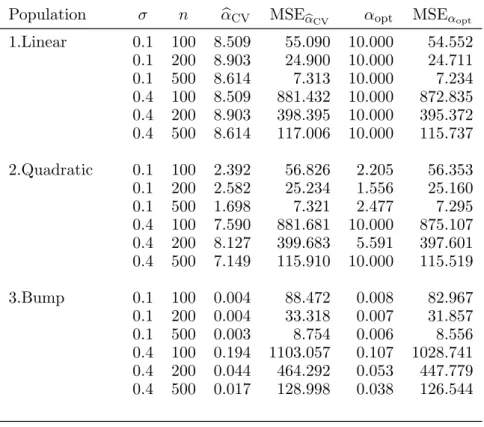
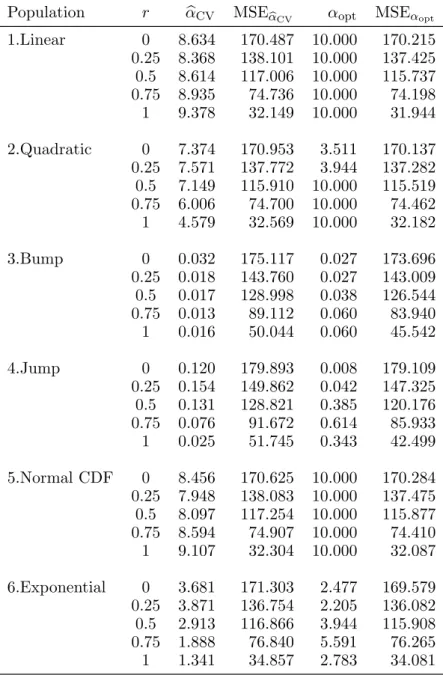
Table 1.2 shows the cross-validation smoothing parameters
α
b
CVand the optimal
smooth-ing parameters
α
optfor linear spline regression under SI simulation runs. Apparently, in
agreement with
α
opt,α
b
CVvaries widely across functions. CV and optimal smoothing
param-eters are generally an increasing function of the closeness of the relationship between
y
and
x
(as measured by
σ
2). The difference between CV and optimal smoothing parameters is
generally a decreasing function of the sample size.
Population
σ
n
α
b
CVMSE
αbCVα
optMSE
αopt1.Linear
0.1
100
8.509
55.090
10.000
54.552
0.1
200
8.903
24.900
10.000
24.711
0.1
500
8.614
7.313
10.000
7.234
0.4
100
8.509
881.432
10.000
872.835
0.4
<