Management of Technology Master Thesis
The Role of IT networks in Mergers and Acquisitions
Designing a support tool for the decision making process of IT network integration preparation
Master Thesis for: Management of Technology
Title: The Role of IT Networks in Mergers and Acquisitions
Author: Hans van der Marel TU Delft Student Number: 1541625
Contact: [email protected]
Accenture
Technical Consulting Network Enabled Solutions External supervisor: Ir. Javier Leonor Vicente
Manager
Delft University of Technology
Faculty of Technology, Policy and Management Section Information and Communication Technology First supervisor: Dr. Victor Scholten
Assistant Professor at section TSE [email protected]
Second supervisor: Jacco Schonewille MITM
External PhD researcher at section ICT [email protected]
Chairman: Dr. Ir. Harry Bouwman
Associate Professor at section ICT [email protected]
Acknowledgments
First of all I would like to thank my graduation committee, Dr. Ir. Harry Bouwman, Jacco Schonewille, Dr. Victor Scholten and Ir. Javier Leonor, for their guidance and support during the project. Harry’s critical comments helped me to carefully think about my research project. I chose Harry as the chairman of my committee, because I knew I could learn a lot from him. Looking back at the project, I feel that he helped me accomplish this objective. Jacco’s remarks and insights about my research kept me sharp throughout the project. The constructive feedback I received from him is greatly appreciated. The assistance of Victor greatly helped me in my project. He really supported me with keeping focus on the core of the research and provided me with excellent feedback. The support and input from Javier is greatly appreciated. Without his input and connections within and outside Accenture, I would not have been able to complete my thesis.
Next, I would like to thank my colleagues at Accenture at the department of Network Enabled Solutions. Their input has been of great help in obtaining information about important topics in network integration projects. Not only did they help me with information that was relevant for the project, they also provided me with a learning experience that will be useful for my future career.
Moreover, I would like to thank all the experts that have participated in this research. This thesis would not have been possible without their crucial input.
Furthermore, I would like to thank my fellow interns at Accenture. The way that we were able to mutually support each other with critical views and constructive feedback has helped us all to achieve our goals. In random order, Hillebrant Idsinga, Wouter Wester, Martijn Smeitink, Tim Reijnders and Patrick Lam, you have made this experience worthwhile and fun.
I would also like to thank my parents for their patience and support throughout my studies and graduation project. Special thanks go to my sister, for proof reading my thesis.
Last, but certainly not least, I would like to thank my girlfriend for her endless support, patience and love during this stressful time. If it was not for her help, I do not know if I would have finished my studies.
Preface
This thesis is submitted in partial fulfillment of the requirements for the Master of Science degree in Management of Technology at Delft University of Technology. This thesis is the result of a research project carried out at Accenture in The Netherlands, at the department of Network Enabled Solutions. Looking back at the project, I would like to make a few remarks and provide a reflection on the process. Because I completed my studies with relative ease, I wanted to maximize the learning experience from my graduation project. For that reason I chose to perform my graduation project at a company and perform research into a subject that I was relatively unfamiliar with. This gave me the opportunity to work in a business environment and perform a research that could contribute to both science and practice. Moreover, it gave me the opportunity to learn more about the business in which I aspired a job. This research aimed to create a design for a support tool that assists network experts in the preparation of network integration in M&A, by providing integration strategies for network integration problems in M&A. To gain an understanding of the subject and the problems involved, I had to conduct a preliminary literature study. The project turned out to be quite a learning experience. It was challenging to connect the original assignment of the company to the scientific literature. Multiple attempts at a research proposal were necessary to start the project. The literature search into the varying subjects of this research consumed a lot of time. Literature about mergers and acquisitions was abundant and resulted in being drowned in the many different aspects of mergers and acquisitions, such as cultural and organizational fit. Much time and research into this area was invested, only to find out that this was of lesser importance to the research questions. Scientific literature about network integration in the context of mergers and acquisitions seemed to be lacking. However, professional literature and educational material provided the starting point for preparing network integration and the problems faced in this process. Moreover, it provided me with knowledge that could be useful for my future career.
It was difficult to determine in advance the form of the decision making model that would be used in the support tool. During the literature study, I selected a decision making model. This model was chosen, because I felt it could apply to the decision making process in network integration preparation. The company wanted me to further elaborate this model to enable practical applicability. On the other hand, scientific interest is more aimed towards the comparison of different decision making models, instead of elaborating on a single model. A big challenge was finding a compromise between the interests of the business and science.
To approach the design, a design process from scientific literature was used. This method provided me with a process to perform the design of a tool, of which the purpose and requirements were not fully clear beforehand. The steps of the process provided grip on the design. Each subsequent step of the design process provided more clarity about the final tool, but also resulted in feedback loops to previous stages of the process. This forced me to rethink parts of the design as the project progressed. Gradually, the requirements for components of the design became clear, further shaping the design. The design that is provided in this thesis can help future discussions about the requirements for the support tool become less abstract.
In most research, desk research is followed by field research. In this research, these steps were performed twice – desk, field, desk, field – to better evaluate the design process. The first combination of desk and field research was aimed at exploring the subject. The second combination of desk and field research was aimed at processing the previously found results into a design and subsequently verifying them. However, this method caused some delays because each phase needed to be finished before the next could commence. Additionally, finding a sufficient number of experts for the field research was difficult, because there are not many experts with relevant and adequate experience in the field. Moreover, discoveries during the project caused changes to the setup of the research itself. Combined with the previously mentioned approach, these advancing insights have caused some delays.
In the end, I am satisfied with the current results, even though I had greater plans in mind at the start of the project. If I had to do this project again, I would have done things differently. However, this is mostly the case when looking retrospectively. The results presented in this thesis could provide an exploratory insight for the future discussion about the design of the tool. Hopefully, the reader will enjoy reading this thesis.
Table of Contents
Acknowledgments... 3 Preface ... 4 Table of Contents ... 6 Management summary ... 8 Definitions of concepts ... 9 1. Introduction ... 10 1.1. Problem statement ... 111.2. Research objectives and research questions ... 12
1.3. Relevance ... 13
1.4. Scope ... 14
1.5. Research approach ... 15
1.6. Thesis outline ... 18
2. Literature review ... 20
2.1. Mergers and Acquisitions ... 20
2.1.1. What are Mergers and Acquisitions? ... 21
2.1.2. Types of mergers and acquisitions... 22
2.1.3. M&A strategic objectives ... 23
2.1.4. M&A integration approaches ... 26
2.2. IT networks and network integration ... 27
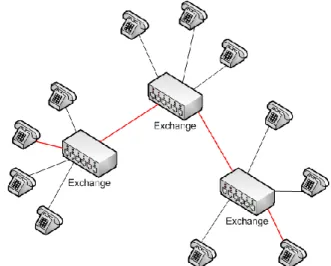
2.2.1. What is an IT network? ... 27
2.2.2. Network integration ... 32
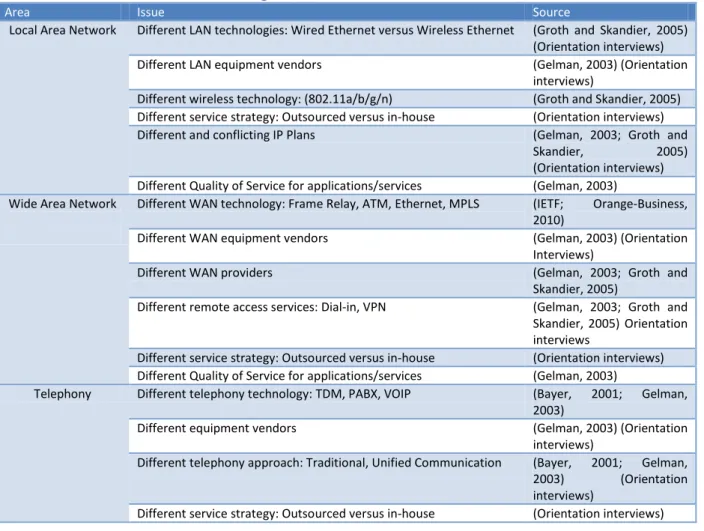
2.2.3. Common issues in IT network integration ... 38
2.2.4. IT Network integration strategies in M&A ... 39
2.3. Network integration support tool ... 41
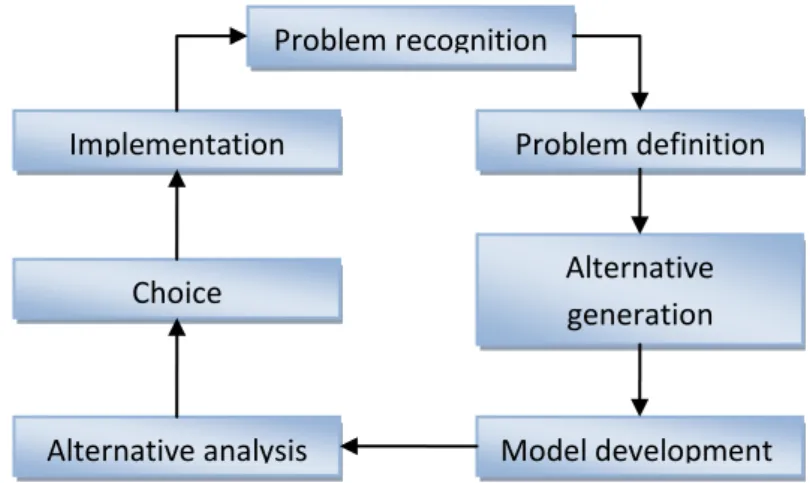
2.3.1. Decision support systems ... 41
2.3.2. IT Network integration support tool design ... 43
2.3.3. Alternative selection decision tree ... 45
2.4. Conclusion ... 47
3. Gathering requirements for the design ... 50
3.1. Overview of requirements found in literature ... 50
3.1.1. Functional requirements ... 50
3.1.2. Contextual requirements ... 51
3.1.3. User requirements ... 52
3.2. Methodology for validating and supplementing requirements ... 52
3.2.1. Data gathering method: interviews ... 52
3.2.2. Formulating interview questions ... 53
3.2.4. Data analysis ... 55
3.3. Interview results ... 56
3.3.1. Functional requirements per building block ... 56
3.3.2. Contextual requirements ... 60
3.3.3. Additional considerations ... 64
3.4. Conclusion ... 65
4. Network integration support tool design ... 68
4.1. IT Network integration preparation tool for mergers and acquisitions ... 68
4.1.1. Main process ... 69 4.1.2. Stage 1 ... 70 4.1.3. Stage 2 ... 71 4.1.4. Stage 3 ... 72 4.1.5. Stage 4 ... 78 4.2. Design validation ... 80
4.2.1. Data gathering method: interviews ... 80
4.2.2. Formulating interview questions... 81
4.2.3. Selecting interviewees and making contact ... 82
4.2.4. Data analysis ... 83 4.3. Results ... 83 4.3.1. General response... 84 4.3.2. Decision trees ... 86 4.3.3. Additional considerations ... 87 4.4. Conclusion ... 88
5. Conclusions & recommendations... 89
5.1. Conclusions ... 89
5.2. Discussion ... 92
5.3. Recommendations for network integration in M&A ... 94
5.4. Limitations ... 95
5.5. Recommendations for future research ... 96
References ... 98
Appendix A: Interview slides of the first round of interviews ... 100
Appendix B: Expert responses for the first round of interviews ... 102
Appendix C: Decision trees for common integration issues in M&A ... 107
Management summary
The situation of two companies in a merger presents unique challenges to IT network integration, because both companies have an existing IT network. These networks might not be compatible and would need to be changed to be able to support the combined business process after the merger has taken place. Research on mergers and acquisitions has been mainly focused on organizational and cultural aspects and many mergers seem to fail to achieve their expected goals. Moreover, no systematic research has been performed into the role of IT networks in M&A. As modern companies seem to be dependent on their IT assets and IT networks, failure to integrate those assets could also contribute to M&A failures. The literature suggests that proper preparation of IT integration could decrease the chance of M&A failure. Therefore, the focus of this research is to determine how to support the preparation process of IT network integration in a merger. Therefore, the main research question is defined as: “How can companies prepare and manage the integration of IT networks in M&A to enable the combined business process and achieve the expected M&A goals?”
A design approach is performed in this research to design a tool that supports network experts in the preparation process of network integration. The methods that have been used in this research include a literature review of the relevant subjects, namely mergers and acquisitions, IT networks, IT network integration, decision support systems and decision support tools. Gathering qualitative data for this research has been done through interviews with network experts. In total 14 interviews were conducted with experts from within and outside Accenture, spread over two rounds of interviews. The results of the literature study and the interviews will be used to design the support tool that satisfies the goal of this research.
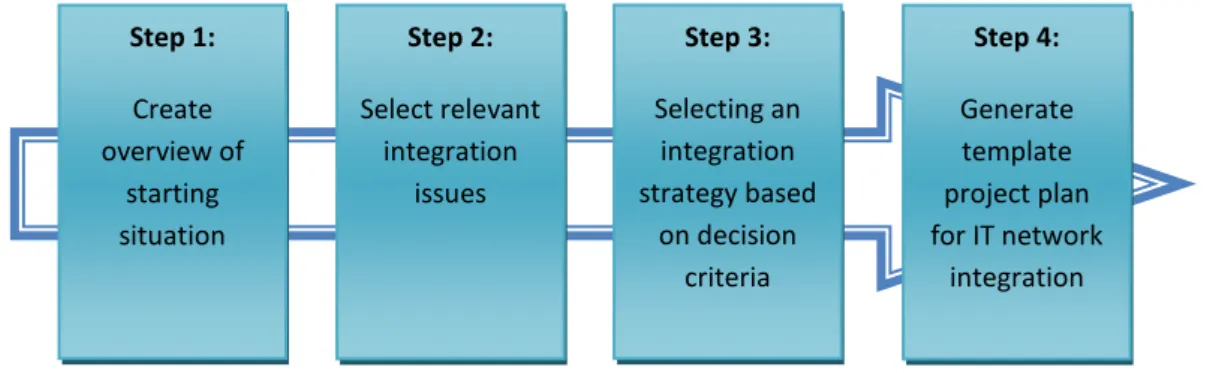
This thesis report covers information about what mergers and acquisitions are; what the IT networks of companies are; what is important for the integration of those networks; and how decision support systems and decision support tools can be used to design a tool that assists with IT network integration in M&A. This thesis also provides a process model that describes the steps for preparing network integration in M&A. Moreover, the decision making process that is the most important part of those steps is provided in decision trees. For each of the common problems in IT network integration, the decision tree helps the decision maker to evaluate the most important decision criteria and subsequently results in an appropriate integration strategy. The process model and the decision trees have been combined in a design: the Network Integration Support Tool (NIST).
In conclusion, merging companies can prepare for the integration of their networks by following several steps as described in the process model. The first step begins with thoroughly analyzing the starting configuration of the networks. From this analysis, it will become clear which parts of those networks are in conflict and need to be combined into an integrated whole, defined in step two. The third step is to determine the integration strategy for each of those conflicts. Determining the integration strategy is supported by a model in the form of decision trees that provide insight in the decision making process. The final step is the creation of an integration plan that can be used to execute the IT network integration in M&A. The network expert can be assisted in these tasks, by using the Network Integration Support Tool.
Definitions of concepts
This section contains an overview of the most commonly used abbreviations and definitions used throughout this thesis.
Name Explanation
IT Network The data and telephony network of a company. Throughout this thesis referred to as network or IT network, unless specifically indicated otherwise. The IT network is defined as the Local Area Network, the Wide Area Network and the Telephony network of a company. These components are part of the physical infrastructure of the information technology infrastructure of a company. IT Network Integration The process in which two previously independent IT networks are combined into an integral
whole, while aiming to achieve synergies by harmonizing IT network components. Network Integration
Support Tool (NIST)
A tool that helps network experts during the preparation process of IT network integration in mergers and acquisitions. Throughout this thesis referred to as “the tool” or NIST, unless specifically indicated otherwise. The network integration support tool contains a process model that provides the steps for preparing IT network integration. Moreover, it contains several decision support models (in the form of decision trees) to assist the user of the tool in the decision making process of IT network integration preparation.
IT Network Integration Issues
Possible problems that are faced in IT network integration in mergers and acquisitions. The possible problems are differences or conflicts between the different components of the IT networks of companies. Throughout this thesis referred to as integration issues, unless specifically indicated otherwise.
Integration Strategy A strategy that specifies the approach to solve a given integration issue. In this thesis, the integration strategy defines the level of integration or harmonization of the various components of an IT network.
Decision tree A decision tree is a method to present various options and their potential outcomes. Outcomes can be quantifiable, but others might be less concrete. In this thesis, the decision tree is a model that facilitates the decision making process with the evaluation of several decision criteria, to select an integration strategy for an integration issue. The decision trees presented in this thesis provide insight into various decision making processes for several IT network integration issues. Mergers and acquisitions
(M&A)
Mergers and acquisitions. Mergers and acquisitions are combinations of two or more companies into a single company.
Decision Support System (DSS)
A decision support system is a system which assists decision makers in the decision making process by providing information and decision making support. Decision support systems are characterized as interactive computer based systems or applications designed to assist decision makers by utilizing models and data to solve problems. Decision support systems contain decision support tools (models) to facilitate the decision making process. The design presented in this thesis could be implemented in software to create a decision support system.
Decision Support Tool (DST)
A decision support tool is a method that helps decision makers visually represent the cause-and-effect relationships of various decisions. It provides a distillation of the thinking process that decision-making involves and can be used to help narrow down choices. In this thesis, the decision support tool that is used to visually represent the decision making process is a decision tree.
Process Model A process model is a series of actions taking place in a definite manner. In this thesis the process model describes the steps that are taken to prepare the integration of IT networks. The process model is part of the design for the decision support system.
1.
Introduction
Mergers and acquisitions are very common in modern business and companies see this activity as the way to increase their market share and grow faster than organic growth. A company seeking to buy another company has to have the financial resources to do so. The financial resources involved in mergers and acquisitions (M&A) have been increasing exponentially since early 1980, reaching to record breaking volumes between 1985 and 1989 (McKiernan and Merali, 1995).The sheer number of M&As today even exceeds the records of the merger wave of the 1980s, with a total worth of 2.4 trillion dollars in 1998 which was a 50% increase over the previous year. Towards the year 2000 this figure even rose to 3.5 trillion dollars (Ghaury and Buckley, 2003), showing ever increasing amounts of financial resources involved in M&A activity.
Even though the amount of financial resources involved in M&A has been increasing all the time, research indicates that many mergers and acquisitions fail to reach the desired benefits for their shareholders (Cording et al., 2002; Cartwright and Schoenberg, 2006). The reasons for M&A failure are diverse and are often attributed to problems with cultural fit (Cartwright and Cooper, 1993) and organizational fit (Datta, 1991).
An under investigated part of merger and acquisition success is the role of information technology (IT). As a consequence of the increase number of M&As worldwide, more and more firms are facing the challenge of integrating their operations, finances, personnel, cultures, but also their information technology assets (Alaranta and Henningsson, 2007). This suggests that poor information technology integration can also be a cause of merger and acquisition failure. The problem of poor information technology integration has been recognized in literature and by the business. One of the most critical challenges companies face during a merger is the integration of their information systems resulting in delays, lost opportunities and decreased revenues (Harrell and Higgins, 2002). A research by Bloor Research, among IT-managers and CIOs, claims that only one in five mergers and acquisitions pay attention to IT infrastructure integration. This results in a failure of integrating the most important systems within three months (Toet, 2008). Accenture’s research among 150 CIOs shows that in 36% of the cases merger and acquisition failure could be attributed to poor IT integration (Accenture, 2008). Part of the information technology integration is the integration of the IT network infrastructure, from here on referred to as IT network. The IT network is the basis on which all information technology services operate, such as email, voice communications and file exchange. Therefore, before an integration of services can be done the IT network must be carefully integrated.
In modern companies, the IT networks are very important to the operation of the business. A merger may not be successful if IT network integration is inadequately planned and not well aligned with the overall integration strategy (Giacomazzi et al., 1997; Alaranta and Henningsson, 2007). Problems that originate from integrating two previously independent IT networks are mainly caused by choices about changes to the company’s IT network structure after the merger. First, technical difficulties are caused by physical integration of IT networks and issues with data compatibility. Second, there are organizational problems. The technical difficulties could be solved with investment in equipment, but need to be carefully considered and planned. Organizational problems are more difficult to solve and are often underestimated, but can be tackled with good planning, sufficient time and a strong management (Giacomazzi et al., 1997; Alaranta and Kautz, 2007).
This research is about the role of IT networks in mergers and acquisitions, more specifically: how to aid the integration of these IT networks. As mentioned before, the focus is on the infrastructure aspect of the network. When two companies merge, the IT networks can be consolidated but in some cases the networks are kept separate. When IT networks are integrated between merging companies, some parts of their networks will change, be replaced, or disappear. This suggests that there are a number of integration strategies for IT networks. Obviously, the integration of IT networks is dependent on factors of technical nature, but can also depend on factors of M&A, amongst others differences in scale or political influences. For instance, decision making on IT network configuration has been found to be subject to political influences in which the buyer often dominates the negotiations (Mehta and Hirschheim, 2004).
The required actions for the integration of IT networks are often overlooked in the planning phase of an M&A, resulting in a delayed integration which leads to operational problems. Examples of problems are:
The transition takes too long, resulting in operating processes coming to a halt;
Overlap in systems and data, e.g. similar information is stored in two different locations;
Sources of information are not companywide, e.g. the online phone directory only holds information about a part of the company;
Communication systems turn out to be incompatible, e.g. email systems cannot be integrated or phone networks are not interoperable.
Therefore, when the integration of the IT networks are not well planned and prepared, the expected gains of mergers and acquisitions are less likely to be obtained (McKiernan and Merali, 1995). Improved integration preparation and management could solve problems with the integration of IT networks (Mehta and Hirschheim, 2004). Improved preparation for IT network integration could be done through the aid of computerized systems, more specifically in the form of a decision support system. Accenture, an IT consultancy firm, assists companies to prepare for IT network integration and has an interest in a system or tool that supports them to accomplish this task.
A scientific literature search into IT network integration, and in particular preparation and management strategies, has proven to be unsuccessful. Scientific literature is lacking models and tools that describe the necessary steps to prepare for the integration of the IT networks of companies in M&A and achieve synergies. Additionally, the decision making process that is involved in the preparation process of IT network integration is unclear. However, a model for integrating information systems (different from information technology) was found that could be useful for this study. In this model the researchers link decision criteria such as growth objectives, company structure, situation variables and information system requirements to integration strategies for information systems (Giacomazzi et al., 1997). These factors show similarities to the important factors that could be involved in IT network integration in M&A. Therefore this model could be the foundation for the decision making model for the preparation of IT network integration.
1.1.
Problem statement
To obtain benefits from an M&A, companies need to create synergies between the merging companies and find a way to exploit them. As companies are becoming more and more dependent on IT for their operation, companies in M&A find themselves confronted with the integration of their IT networks. To remove one of the obstacles in M&A activity, companies need to carefully consider their IT network. The merging companies can have very different and even incompatible IT network configurations and strategies, which need to be integrated into a combined IT network. Moreover, the IT networks must
remain operational during the M&A process to allow the business to keep functioning. Therefore, companies in M&A need to prepare and manage the integration of their IT networks to be able to support the business. The required actions for the integration of IT networks are often overlooked in the preparation phase of an M&A, which leads to operational problems. Quick solutions can offer relief in the short term, but can cause new problems at a later time. Therefore, it is important that the integration of IT networks is well prepared and thoroughly planned, before or soon after the M&A takes place. Before any integration actions can be taken, the strategic direction of the integration must be determined. The research is performed at Accenture in the Netherlands. Accenture is the principal of the assignment and is interested in improving the integration preparation process of IT networks of merging companies. Accenture is specifically interested in a tool that helps them to determine the strategic approach to integration problems, which they encounter when integrating the IT networks of merging companies. To facilitate in determining the strategic approach for various IT network integration problems, this research focuses on the general decision making process of IT network integration preparation. To a lesser extent it focuses on the specific content of the decisions, because the content can be dependent on the type of network and type of company.
1.2.
Research objectives and research questions
Given the problem statement, the research objective is formulated as follows:
The research project aims to propose a design for a tool that can assist network experts with the decision making process for the preparation of IT network integration in mergers and acquisitions.
The end result of this research is the design of a support tool or program that can assist network experts to determine the integration strategy for integration problems, supporting the preparation of IT network integration in M&A. The support tool design describes the steps to prepare for network integration and provides a model to support the decision making process.
The objective as stated above, addresses the preparation process and decision making process of IT network integration in M&A by using a tool. Based on the objective, the following main research question is formulated:
How can companies prepare and manage the integration of IT networks in M&A to enable the combined business process and achieve the expected M&A goals?
To research how companies can prepare and manage the integration of IT networks in M&A, the main question is divided into four sub questions.
Sub questions
1) What is the current scientific knowledge about mergers and acquisitions, IT networks and network integration, and the relation between them?
The first research sub question is a literature review, focused on mergers and acquisitions and IT networks and network integration, and the relation between them. A description of a merger/acquisition is given together with IT network integration knowledge to create a clear understanding of the concepts and definitions used in this thesis.
2) Can the concept of decision support systems be used to design a tool that can be used to support the preparation of the integration of IT networks in M&A?
The second research sub question is a literature study into decision support systems and decision support tools. This question is aimed at developing a tool for the preparation of IT network integration in M&A. This is done by looking at the concept of decision support systems and tools that could be adapted to be used for the preparation of IT network integration in mergers and acquisitions.
3) What are the requirements for the design of a support tool for the preparation of IT network integration in M&A?
The third research sub question is aimed at finding the requirements for the design of a decision support system based on findings in literature and empirical data. The requirements are divided into functional, contextual and user requirements. Moreover, the requirements and design of the decision support tool are validated and complemented by industry experts.
4) What support tool can be designed for the preparation of IT network integration in M&A?
The requirements found in sub question 3 should indicate how to design the decision support tool. The fourth question is aimed at designing a tool which assists network experts integrate IT networks in M&A and achieve the goals of the integration. Answering all four sub questions will answer the main research question, because the sub questions provide a tool that helps network experts prepare for IT network integration in M&A.
1.3.
Relevance
Managerial relevance
The results of this thesis will be applicable to the company where this study takes place. Accenture, as the principal of this research, is interested in improving the IT network integration preparation process. The result of this research can assist IT network experts at Accenture to prepare for IT network integration in mergers and acquisitions by providing a structure for the preparation process. Moreover, the result will assist network experts in the decision making process of determining an integration strategy, for common IT network integration problems encountered in IT network integration projects. Care will be taken to obtain a more general result, therefore opening opportunities for the result to be applicable for network experts at other companies.
The result will be accompanied by a design for a support tool. This design of the tool could be used to implement it in software. The design will describe the functions of the tool that allows it to assist network experts in the preparation process. Additionally, the design will contain models that assist the network experts in the decision making process for selecting integration strategies for common integration problems.
The results of this study could provide network experts with a better way to prepare for IT network integration in mergers and acquisitions. Improved IT network integration could help the acquiring and acquired company to enable the combined business process at an earlier stage after the M&A transaction has taken place.
Scientific relevance
Much research has been done into M&A, however with little specific focus on IT network integration. M&A literature mainly deals with cultures, organizational structures and business processes (Jemison and Sitkin, 1986; DiGeorgio, 2002). Lack of information about IT network integration could have consequences for the success of an M&A. It has been noted in the literature that one of the reasons for poor post acquisition performance has been caused by companies failing to consider all implications of consolidating IT systems (McKiernan and Merali, 1995). However the theories proposed are not directly applicable to this research, because it does not include both technical and managerial challenges of IT network integration. This research aims to find factors that contribute to IT network integration and combine these in a decision making support tool. Improved IT network integration could lead to a reduction in M&A failure. Therefore this research into IT network integration adds value to M&A literature.
1.4.
Scope
The focus of this research is on the integration of IT networks in M&A and how this can aid in achieving the M&A goals. To place the IT network into perspective, it is important to understand that the IT network is part of a company’s IT infrastructure. Ward and Peppard (2002b) claim that defining the IT infrastructure and its components is becoming more difficult as technology evolves and becomes increasingly a business utility. Some authors argue for a definition of IT infrastructure as “the enabling base of shared IT capabilities which provide the foundation for other business systems” (McKay and Brockway, 1989). Ward and Peppard (2002b) state that the physical infrastructure is part of the IT infrastructure. The physical infrastructure, which consists of a range of network, hardware and base software products and services, deployed to enable applications and the general use of technology to function successfully. A component is considered as being part of the physical infrastructure if it is being used by more than one application or by a wide range of people (Ward and Peppard, 2002b). Therefore the enabling base of network capabilities that provide the foundation for other systems to function is the focus of this research: Local Area Networks, Wide Area Networks and Telephony networks.
One can argue whether telephony networks should be part of the network, because they do not provide a foundation for other systems to function. However, telephony networks used to be separated from the local and wide area network. Recent technological developments have caused the integration of telephony into the network. Moreover, this topic is of interest to Accenture and has therefore been added to the scope.
It could be argued as well that some software applications can also be part of the physical infrastructure, because they provide a foundation for other systems to function. However, this research does not focus on the integration of software applications. The integration process of the companies in M&A is also not part of the scope.
To design a tool for the integration of IT networks in M&A, the design process of Verschuren & Hartog (2005) will be followed. The scope of the research includes the first four steps in this design process and excludes the last two steps in the design process. The design process will be explained in the next paragraph.
1.5.
Research approach
The research is aimed at designing a tool for a specific purpose. To approach this research project, four of the six stages of the design cycle by Verschuren & Hartog (2005) are used. The authors describe the steps that are taken to develop and evaluate an artifact (in this case a support tool) that provides a solution to a given problem (in this case the preparation of IT network integration in M&A). The six stages are as follows:
1. First hunch
2. Requirements and assumptions 3. Structural specifications 4. Prototype
5. Implementation (out of scope) 6. Evaluation (out of scope)
The scope of this research ends at the prototype phase, because of time limitations. To get a clear picture of the approach of the research, an explanation of the performed stages is given below. For each stage of the design cycle, an elaboration is given of the required steps of doing research to obtain the necessary information for the design (Verschuren and Doorewaard, 2007). The entire research process is displayed in Figure 1, which can be found at the end of this paragraph.
1. First hunch
In this stage, the goals of the tool will be specified. By analyzing the goals a first hunch for a solution can be defined. In this stage the question of “what should network experts be able to do with this tool?” will is answered. Pre-data gathering interviews with network experts at Accenture have revealed that the solution should be in the form of a decision support tool that should assist network experts in the preparation of the integration process of IT networks. This preparationcould be done by determining an integration strategy for common problems in IT network integration in mergers and acquisitions. This process can be specified as the process of going from one situation, in which:
there are two separate companies; no M&A has taken place;
the IT networks of both companies are not integrated. To a situation in which:
there is one merged company; the M&A has taken place;
the IT networks of both companies have been integrated into a single network.
It is important to note that the support tool only assists in the preparation of the integration of the IT networks, not the M&A itself. Moreover, the goals of the tool and the objective and scope of the research have been defined in cooperation with Accenture, because Accenture has knowledge and overview of the field. This guarantees practical applicability and feasibility.
2. Requirements and assumptions
To achieve the goals set for the tool, the requirements and assumptions are established in this stage. To be able to design the tool, it is essential to find the requirements and assumptions defined for the tool. In this stage the requirements and assumptions of the tool are defined that fulfill the framework of goals which have been defined in the previous stage. There is a distinction between functional requirements
and assumptions, user requirements and assumptions, and contextual requirements and assumptions (Verschuren and Hartog, 2005).
Functional requirements define the functions that the tool should be able to fulfill. The functional requirements will be obtained through a literature study into M&A, IT networks, network integration and decision support tools. An example: which functions should the tool provide to aid the user in the preparation process? The user requirements define the requirements set by the users of the tool. The user requirements are defined based on the profile of the user that will be using the tool. An example: who is the intended user and when will he be using the tool? The contextual requirements define the political, economical, legal and social environment. The contextual requirements define the contents of the tool, the problems that need to be tackled, the possible solutions for those problems and the decision criteria that are used to make decisions about solutions. These requirements will be obtained through a literature study into M&A, IT networks and from pre data gathering interviews with network experts. An example: what are the common problems that are encountered when integrating two previously independent IT networks?
The assumptions are the presumptions which the designer has to make for the functional, contextual and user requirements for the design of the tool. These assumptions will be validated during the validation of the design of the tool. An example: a set of integration strategies for IT networks or the course of the network integration preparation process.
In this stage, the requirements which have been found in the literature study will be validated in six interviews with IT network integration experts. Since the research is performed at Accenture, experts from within Accenture will be used. A criticism to this approach could be that this could result in a biased outcome of the research. Therefore, to try to obtain a more accurate and complete result, also experts from outside Accenture will be used. In the first round of interviews, three experts from Accenture will be consulted and three from outside Accenture. These experts are able to validate the requirements, because of their experience in network integration projects. Therefore the information they provide is considered relevant. The focus of these interviews is on the completion of the set of functional requirements. In addition, these interviews are aimed at finding contextual requirements, which will be used in a later stage of the research. In these interviews, the network experts will also be asked for missing requirements to be able to complete the overview. The validated and supplemented list of requirements is used in the next stage to make the first design of the tool.
3. Structural specifications
In this stage of the design cycle, the structural specifications will be defined based on the validated and supplemented requirements and assumptions from the previous stage. The structural specifications are broken down in the functional and contextual design.
The functional design of the tool will be defined in this stage. The tool follows the steps that have to be taken in preparing the integration of IT networks. These steps, which consist of a sequence of process descriptions of the IT network integration preparation process, will be defined and elaborated in this research.
The contextual design of the tool will be based on the contextual requirements found in the previous stage. In this research, the contextual design is framed in a model that facilitates a structured decision making process, to link possible solutions/strategies to network integration problems. This is achieved by evaluating a set of decision criteria. The contextual design is considered the core of the tool.
4. Prototype
The fourth step in the design cycle is the creation of a design for the tool. In this stage, some “mock-ups” of the tool will be designed, to show the users what the tool will look like. In this case, it is about the schematic display of the steps of the integration preparation process and the corresponding sub processes (functional design). Additionally, the decision making core of the tool will be designed (contextual design). This will result in the support model that will be used to assist the users (network experts) in the preparation process of network integration.
A second round of validation will be executed in this stage. The contextual design will be validated by interviews with network experts. The core of the tool is a model that allows the user to select an integration strategy for the components of the IT network. Therefore, the focus of the second round of interviews is on the contextual requirements that will be used in a decision support model that is the core of the tool. Similar to the first round of interviews, experts from both inside and outside Accenture will be used. In total, eight interviews will be held and again half of the experts will be from Accenture. The support model will be validated in these interviews, by asking them if the designed processes can be recognized in, or can be applicable to practice. Suggestions and remarks from the validation will be processed into a refined version of the tool. The refined design is the “final” version of the tool and completes the research project.
5. Implementation
In this stage of the design cycle the tool is implemented, based on the design. As stated before, this is not part of this research.
6. Evaluation
In this stage of the design cycle the tool is used for what it was designed for: assisting network experts prepare the integration of IT networks. The implemented tool can then be evaluated in practice, but is considered to take more time than is available in this project. Therefore, this is not part of the research. The entire research approach has been illustrated in Figure 1.
Chapter 3 Chapter 4 Chapter 4 (continued) Chapter 2 Academic literature search Professional literature search Background, definitions and requirements for tool design Orientation interviews
Functional, contextual and user req.
Interview structure Validation interviews Pilot interview Functional & contextual requirements
Functional design & contextual design Validation interviews Interview structure Refined tool design Focus on func. requirements Focus on context requirements
1.6.
Thesis outline
This thesis is written in five chapters. The chapters follow the design process which has been described in the previous paragraph. The chapters in this report are as follows:
1. Introduction 2. Literature review
3. Gathering requirements for the design 4. Decision support tool design
5. Conclusions and recommendations
The first chapter contains the introduction to the research theme, the problem statement, the goals and scope, the research questions and the project approach.
The second chapter contains the results of the literature study into mergers and acquisitions, IT networks and the integration of those networks, and decision support tools. It provides the necessary background, definitions and conceptual framework that will be used in this report. This chapter will result in a list of preliminary list of requirements for the design of the tool. This chapter is concluded with an overview of the relevant concepts for the design of the tool and addresses research questions one and two.
The third chapter starts with a summary of the functional, contextual and user requirements for the design of the tool. These have been discovered through the literature study and orientation interviews. The chapter continues with the validation and supplementing of these requirements through (the first round of) interviews with experts. In this round of interviews, the focus is on the completion of the functional requirements for the design of the tool. In addition, it is aimed at creating an overview of the contextual requirements for the design. The contextual requirements are used and validated in the fourth chapter. The methodology – the operationalization of concepts, the interview approach and data analysis – is given. The chapter is concluded with a list of requirements for the design of a decision support tool for the preparation of IT network integration in M&A and answers research question three. The fourth chapter starts with a first design for the decision support tool, based on the requirements that have been found in the chapter three. This chapter contains the validation that is used for refining the tool. The methodology for the (second round of) interviews is described in this chapter, after which the results are analyzed. The focus of this round of interviews is on the validation of the contextual requirements and how they have been applied in the tool. The results of the interviews are then processed into a refined design of the tool. The endpoint for this chapter is the design of the decision support tool and answers the fourth research question.
The fifth and last chapter contains the conclusions and recommendations of the research and answers the main research question. This chapter will also contain the reflection and discussion of the research results.
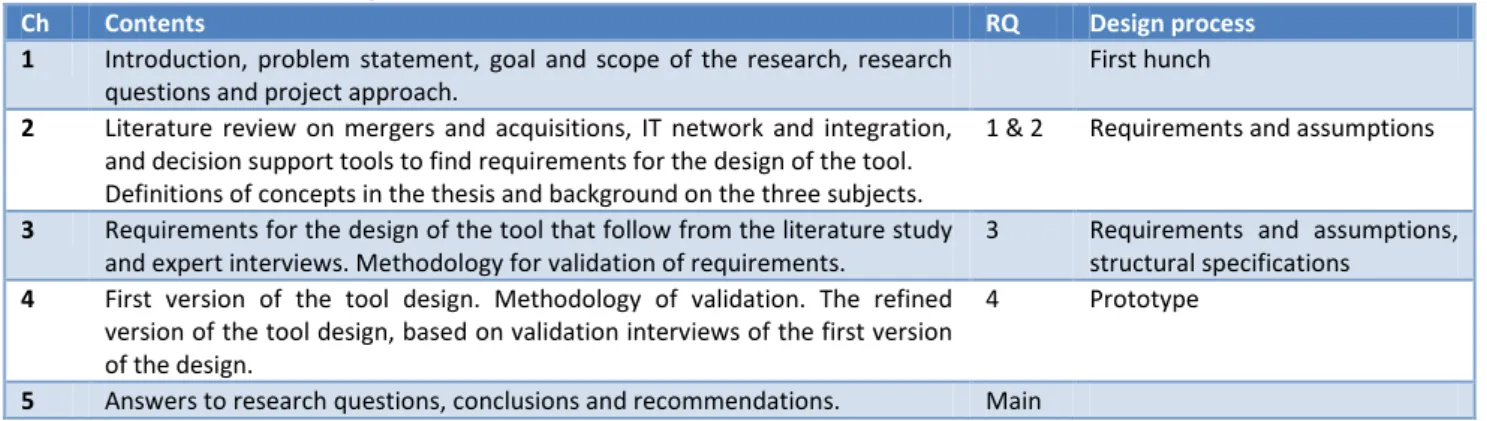
Table 1 shows an overview of the chapters and their contents. The research question that is answered in a chapter is shown in the “RQ”-column. The “design process”-column indicates which step of the design process (Verschuren and Hartog, 2005) is treated in that chapter.
Table 1: Overview of thesis chapters
Ch Contents RQ Design process
1 Introduction, problem statement, goal and scope of the research, research questions and project approach.
First hunch
2 Literature review on mergers and acquisitions, IT network and integration, and decision support tools to find requirements for the design of the tool. Definitions of concepts in the thesis and background on the three subjects.
1 & 2 Requirements and assumptions
3 Requirements for the design of the tool that follow from the literature study and expert interviews. Methodology for validation of requirements.
3 Requirements and assumptions, structural specifications
4 First version of the tool design. Methodology of validation. The refined version of the tool design, based on validation interviews of the first version of the design.
4 Prototype
2.
Literature review
In this chapter, the theoretical background of the subjects which are related to the topic of this thesis is presented. This is done to provide the reader with a fundamental understanding of the subjects involved in this research and to clarify the definitions of the terms used in this thesis. This chapter starts with a general explanation of mergers and acquisitions (M&A) and provides a basic understanding of the subject. After dealing with M&A, this chapter continues with an explanation of IT networks and the network integration preparation process. The third and last part of this chapter is about decision support systems and is aimed at finding or creating a suitable support tool to assist the preparation of network integration.
The aim of this research is the designing of a tool that helps network experts prepare for network integration in mergers and acquisitions. The topics which are relevant for achieving this goal will be discussed as they form the building blocks of the design and shape the conceptual framework of this thesis. These building blocks are part of the functional, contextual and user requirements for the design of the tool (Verschuren and Hartog, 2005). To be able to design the tool, four things are needed. (1) insight into the preparation process of integrating two networks. What steps are taken in this process to achieve the goal of integration two networks? (2) insight into the common problems of network integration. What are the possible conflicts between the networks of two merging companies? (3) insight into possible integration strategies to solve integration problems. (4) insight into the decision criteria for selecting an integration strategy.
Literature research results in a preliminary overview of the relevant concepts, which will be validated and complemented through expert interviews. This will be described in chapter 3.
Last but not least, this chapter is aimed at answering the first two research sub questions:
1) What is the current scientific knowledge about mergers and acquisitions, IT network integration and the relation between them?
2) Can the concept of decision support systems be used to design a tool that can be used to support the preparation of the integration of IT networks in M&A?
This chapter is created by searching the available academic literature through journal databases such as Emerald Insight, ScienceDirect, JSTOR, Springerlink, EBSCO, Wiley and Google Scholar. Forward and backward searching techniques have also been applied to gain an overview of specific areas of knowledge. The literature review is based on a review of recent and well-cited articles published in international journals. In areas where academic literature is lacking, professional literature has been used to obtain the information necessary for this research.
2.1.
Mergers and Acquisitions
Before going into the topic of integrating IT networks in mergers and acquisitions, it is important to get a clear view of what an M&A is, and its relation with IT network integration. Therefore this section starts with a general explanation of mergers and acquisitions and elaborates on the M&A process and steps that this process follows. This is followed by the different reasons why companies pursue M&A activity and the explanation of different types of mergers and acquisitions. This section is concluded by reviewing some integration strategies for M&As, which could provide the context of IT network integration in M&A.
The keywords that have been used to search for relevant topics include: mergers and acquisitions, merger and acquisition process, M&A critical success, merger and acquisition synergies, merger and acquisition integration and merger and acquisition types.
2.1.1. What are Mergers and Acquisitions?
In the review article of Cartwright and Schoenberg (2006) it can be concluded that mergers and acquisitions have been widely documented in literature. The authors argue that three streams of research exist: strategic fit, organizational fit and the acquisition process itself. They also conclude that the failure rates of mergers and acquisitions have remained fairly high over the years, despite the research into this subject (Cartwright and Schoenberg, 2006). Mergers and acquisitions are an economic activity which involves the buying and selling of entire companies. Even though mergers and acquisitions are often mentioned in one breath, there is a difference between them. Mergers are defined as the combination of the assets of two previously separate firms into a single entity. In an acquisition (also known as takeover or buyout) the control of the assets of the acquired company (target) is transferred to the acquirer (bidder) and the target disappears. Mergers are supposedly between equal partners, however many mergers have one dominant party whereby these mergers obtain characteristics of an acquisition. Moreover, the number of ‘mergers’ in ‘mergers and acquisitions’ is very small (Ghaury and Buckley, 2003). Literature recognizes the difference between mergers and acquisitions, but often the term merger is used to describe both activities (Granlund, 2003; Mehta and Hirschheim, 2004; Wijnhoven et al., 2006). Similarly, in this thesis the term merger or acquisition will also be used to describe both mergers and acquisitions.
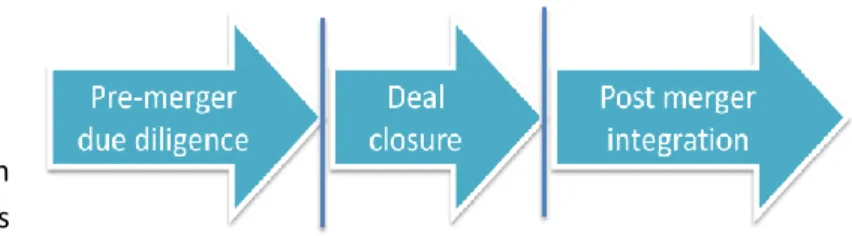
Mergers and acquisitions are processes that occur in stages, with a start and an end at certain points in time. However, the literature does not formally deal with the question of the starting point of an M&A. Some authors argue that an M&A starts as early as the selection of the target, after which the process continues with the due diligence, negotiations, closing of the deal and post-closure (Very and Schweiger, 2001). The stages of M&A can also be defined as transaction, transition and integration (Schweiger, 1999) or as pre-combination, combination and post-combination respectively (Marks and Marvis, 1998). Although the differences in definitions of the stages of the M&A process exist, the overall meaning of the stages is very similar. Therefore, in this thesis the different stages of M&A are defined as:
1. Pre-merger due diligence; 2. Deal closure, and
3. Post-merger integration.
Figure 2 shows the M&A integration process and the stages defined in this process. Each stage contains a different
set of activities, which will be explained briefly. (1) The pre-merger due diligence stage is aimed at finding a limited number of suitable candidates with a strong strategic fit. This is followed by the target analysis in which the target company is valued, making contact with the target board and finding out if a deal can be made. During this phase the target company is evaluated for organizational fit and cultural fit, but seldom IT fit. In addition, the assets of the target company are investigated to get a clear view of what the bidder is buying. This includes tangible assets such as machines and facilities, but also intangibles such as the available knowledge inside the target. (2) The deal closing stage is the stage in which the negotiations with different stakeholders take place. During these negotiations, different topics are discussed such as: price negotiation, obtaining warranties for the stakeholders, discussing ethical problems and negotiations about employment contracts. (3) In the post merger integration phase, all previously discussed actions are set in motion. The focus of this research lies on the early preparation and planning phase of M&A, which is the pre-merger due diligence phase.
The post merger integration process is composed of multiple integration areas. Stahl and Voigt (2005) recognize several areas of M&A integration. Two important areas of integration in M&A are socio-cultural integration and task integration. Social-socio-cultural integration is about the integration of employee attitudes, behavior and performance measures. Task integration is about knowledge and capability transfer between both companies and the extent of resource sharing (Stahl and Voigt, 2005). Part of the resource sharing is the physical resource sharing which includes the IT networks of both companies. Mergers tend to be dominated by financial and managerial issues. An under investigated part of M&A is the growing importance of (information) technology to the operations of companies. M&A deals are becoming more complex. Technology and the people supporting it are becoming key factors in the merger and acquisition process (James et al., 1998). The planning of the integration of information technology and communication technology within the early stages of M&A is therefore important for the achievement of the expected benefits of the M&A (Mehta and Hirschheim, 2004; Holm-Larsen, 2005). Therefore, in the activity of M&A, potential gains are to be made by acquiring firms when paying attention to the integration of information technology as part of the merger. This may help to avoid high cost mistakes and lengthy integration processes, and results in a reduction of M&A failures. By also focusing on information technology integration in mergers and acquisitions, acquirers may obtain more value from synergies (James et al., 1998).
As stated before: many merging companies run into problems when integrating their information technology assets, which cause delays in the integration process of M&A (Harrell and Higgins, 2002). Therefore, it is important to make the distinction between the stages of the M&A process to be able to effectively prepare and plan for the integration of the IT networks. As applies to any activity, early preparation and planning usually increases the chances of success of that activity. Hence, the integration process of IT networks could follow the same stages of the M&A integration process. The preparation of IT network integration could be done in the pre-merger due diligence phase, before the deal will be closed. When the deal has been closed and the merger moves into the post-merger integration phase, this plan can be executed.
Now that is it clear what M&A is and how the M&A process works, it is important to know why companies pursue M&A activity and to understand that not all M&As are alike. Different mergers could lead to different integration strategies. M&As can be grouped into different categories, which are explained in the next paragraph.
2.1.2. Types of mergers and acquisitions
In general, there are four types of mergers. Each type of merger focuses on a different direction of integration in the value chain. The four types of mergers that will be discussed in this paragraph are: (1) horizontal integration, (2) vertical integration, (3) diversification and (4) divestment.
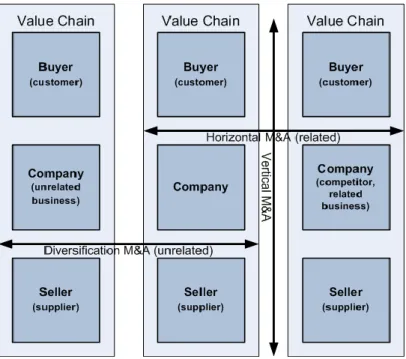
Figure 3 shows the different directions of integration of the different M&A types. (1) In a horizontal merger, competing firms in the same industry which are in the same part of the production process are integrated (Ghaury and Buckley, 2003). An example of a horizontal merger is a merger between banks. Horizontal mergers generally create value through cost-based synergies, such as cost-reduction, and revenue-based synergies (Capron, 1999). (2) In vertical integration, firms that handle subsequent parts of the production process (from raw material to finished end-product) are merged. Vertical integration occurs at the border between buyer-seller or supplier-client relations in the same value chain, which are then consolidated (Ghaury and Buckley, 2003). An example of a vertical merger is a merger between a
producer of sheet metal and a company that uses the sheet metal to build car parts. Vertical mergers create value through the elimination of transaction costs and supplier or buyer profit margins. (3) In diversification mergers, companies in unrelated businesses are consolidated (Ghaury and Buckley, 2003). An example of a diversification merger is when a company that produces telephones buys a company that is active in the audio equipment business. One last category of mergers is the divestment “merger”. (4) In a divestment merger, parts of the company are split from the main company. This occurs when a part of a company is sold to another company, part
of the production chain is separated into an uncoupled company, or when part of a company is sold that is no longer considered core business (Bergh, 1997). It should be clear that this type of merger leads to the division of a company, instead of integration. As this thesis is focused on (network) integration, divestment mergers are out of scope.
To further understand why companies pursue M&A and to refine the focus of this research, the next paragraph will elaborate on the reasons why M&As occur.
2.1.3. M&A strategic objectives
One of the important reasons for companies to pursue M&A, is the creation of value through synergies, next to higher revenues and profits. Synergies are achieved when the sum of the output from the merged company exceeds the sum of the output of the separate companies. In theory, one plus one equals three. The literature about synergies for M&A is broad and specifies many sources of synergies. However, after analyzing the literature the sources of synergies can be narrowed down to a few important ones. According to Bower (2001) and Schweiger and Very (2003) common synergies that create value in M&A are: (1) economies of scale, (2) economies of scope, (3) revenue synergies, (4) cost reduction synergies and (5) operational synergies. It is important to understand these synergies, to be able to determine which synergies could be achieved with the integration of IT networks.
(1) Economies of scale provide synergies through a reduction of cost per unit of produced product, because as production increases, the cost of each additionally produced unit falls (Schweiger and Very, 2003). (2) Synergies from economies of scope are achieved by reducing the costs per unit through the production of a wider variety of products by using the same production facilities and technologies (Schweiger and Very, 2003). (3) Revenue synergies create value through the opportunity of the merged company to sell both companies’ products to a greater (combined) customer base (Schweiger and Very, 2003). (4) Cost reduction synergies are created through the opportunity of a merged company to reduce or eliminate costs that are associated with running the business. This means removing duplicate entities from the merged company (Schweiger and Very, 2003). Cost reduction synergies are closely related to economies of scale, but differ from each other because economies of scale are obtained in the production process and cost reduction synergies are obtained in the process of running the business.
(5) Operational synergies are achieved through the collaboration of e.g. development teams that can benefit from each other’s knowledge and skills (Schweiger and Very, 2003). Operational synergies are closely related to economies of scope, but differ from each other because economies of scope are related to the use of single assets for more than one product. Merging companies could also achieve synergies by merging their IT networks. By integrating two different IT networks into one, cost-reduction synergies could be realized by the removal of excess equipment or a reduction of the operating cost of running the network.
Different kinds of synergy are the result of different strategic objectives of M&A. To investigate on which type(s) of mergers the “to-be designed” tool should focus, it should be made clear in which types of M&A network integration could be beneficial. A brief overview of the strategic reasons of M&A is given below and can be grouped into: market consolidation (horizontal merger), consolidating inside the value chain (vertical merger), and consolidation into unrelated business (diversification merger). Merging companies can have varying reasons and objectives for pursuing M&A activity. A classification between mergers can be made based on their objectives and can be grouped into three different categories, as previously described, namely horizontal mergers, vertical mergers and diversification mergers respectively. It is important to see the different strategic reasons for M&A to get a firm understanding of the concept of why M&As occur. The most important strategic objectives and the potential synergies resulting from those objectives are explained below.
Market consolidation (horizontal merger)
When a certain market is confronted with overcapacity between many firms, one company may decide to buy another company in the same industry and remove less efficient production facilities. For instance, by closing underperforming facilities, removing excess management and rationalizing administrative processes. The acquiring company ends up with a larger market share while the total production capacity is reduced, pushing prices up. The main goal is to reduce costs and increase efficiency (cost reduction synergy and economies of scale) (Bower, 2001). Consolidation of the market within a certain geographical area is aimed at increasing a company’s market share. The consolidation can take place within the geographical area of that market, e.g. a region of a country (Bower, 2001). However, this consolidation can also take place over borders, e.g. outside country borders (Schweiger and Very, 2003). Extending the business into geographic areas where the company was previously absent, by acquiring fragmented or liberalized industries, is utilized as a way to quickly increase market share. The goals of market consolidation are to obtain lower fixed costs through higher asset utilization (economies of scale) (Bower, 2001), economies of scope by sharing products and services, and cost reduction synergies by the removal of excess staff and assets (Schweiger and Very, 2003). One last important strategic objective of (market consolidation) M&A is the addition of products, services, skills, distribution channels and technologies to the company’s portfolio. This increases the competitive capabilities of the company. The chances of success of this kind of M&A vary from deal to deal. Overall, a merger between a large company and a small company have a higher chance of success than two large merging firms (Bower, 2001). The potential synergies of this type of merger are diverse. Lower variable costs from increased buyer power, lower fixed costs through increased asset utilization, extended capabilities from acquired technologies, and lower fixed costs by removing excess staff and assets (Schweiger and Very, 2003). Together with overcapacity M&A, this type of M&A is the most common in large M&A’s (Bower, 2001).
Consolidate inside the value chain (vertical merger)
This strategic objective is about consolidating suppliers or distribution channels. Companies try to increase the added value of their firms to the product or service of the value chain and gain more control over the business. To achieve vertical integration, only low levels of organizational integration and standardization are needed, but high levels of coordination. Potential sources of synergy are among others: lower overall costs from improved product development and manufacturing, lower fixed costs by removal of excess staff functions. Costs of managing the purchasing function are replaced by costs of managing the relation internally. Therefore, only cash management and financial statements are consolidated. Consolidation or standardization of operations is often not employed, because the operating processes of each firm differ (Schweiger and Very, 2003).
Consolidate into unrelated business (diversification merger)
Companies seeking to extend their business outside their current markets can choose to acquire unrelated business. By using these unrelated businesses, the acquiring company can create revenue synergies by e.g. combining products from the two companies and use them to create new product market combinations. Bower (2001) calls this “industry convergence”, which is about inventing an industry and a business model in which certain resources are removed from industries whose boundaries are changing. Potential synergies are usually aimed at revenue synergies, for instance by using the brand name of company A to create a strong selling position for the products of company B.
Synergies and IT network integration
Realizing cost-reduction synergies from network integration could be achieved by removing parts of the IT staff, excess network equipment and duplicate services. Economies of sc