Lecture 37
Competent Cells
Introduction: The delivery of DNA into the host is required for generation of genetically modified organism. DNA delivery to host is a 3 stage process, DNA sticking to the host cell, internalization and release into the host cell. As a result, it depends on 2 parameters-
Surface chemistry of host cell-Host cell surface charges either will attract or repell DNA as a result of opposite or similar charges. Presence of cell wall (in the case of bacteria, fungus and plant) causes additional physical barrier to the up-take and entry of DNA.
Charges on DNA-Negative charge on DNA modulates interaction with the host cell especially cell surface.
Modulation of these two properties is achieved in different methods to deliver DNA into the host cell and it is the topic of the discussion of today’s lecture.
Lab experiment 37.1: Preparation of chemically (CaCl2) treated E.coli competent
cells.
Background Information: Natural ability of a cell (either bacterium/yeast or mammalian cell) to take up cell free DNA present in extracellular environment is low and only 1% cells are capable to take DNA. Hence, a number of (chemical/physical) treatments make the bacteria competent to take DNA through transformation. A list of agent used for different organism is given in Table 37.1.
TABLE 37.1: LIST OF SELECTED AGENT AS POTENTIAL TO MAKE CELL COMPETENT
Bacterial Strains Competent agents
Streptococcus pneumoniae
mitomycin C, fluoroquinolone
In B. subtilis UV light
Helicobacter pylori ciprofloxacin Legionella
pneumophila
mitomycin C, norfloxacin, ofloxacin, nalidixic acid, bicyclomycin, hydroxyurea, UV light
E.Coli Calcium chloride, Rubidium Chloride
Material Required:
1. DH5α Host cells stock
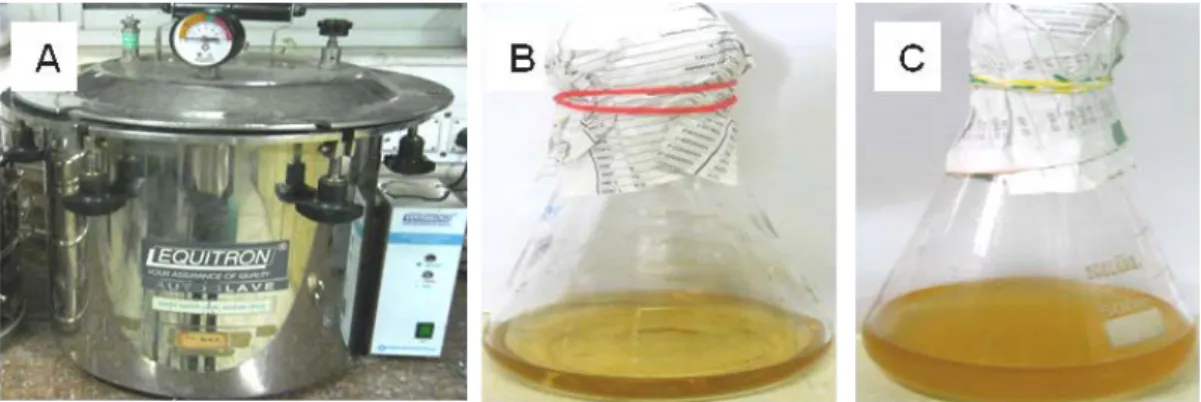
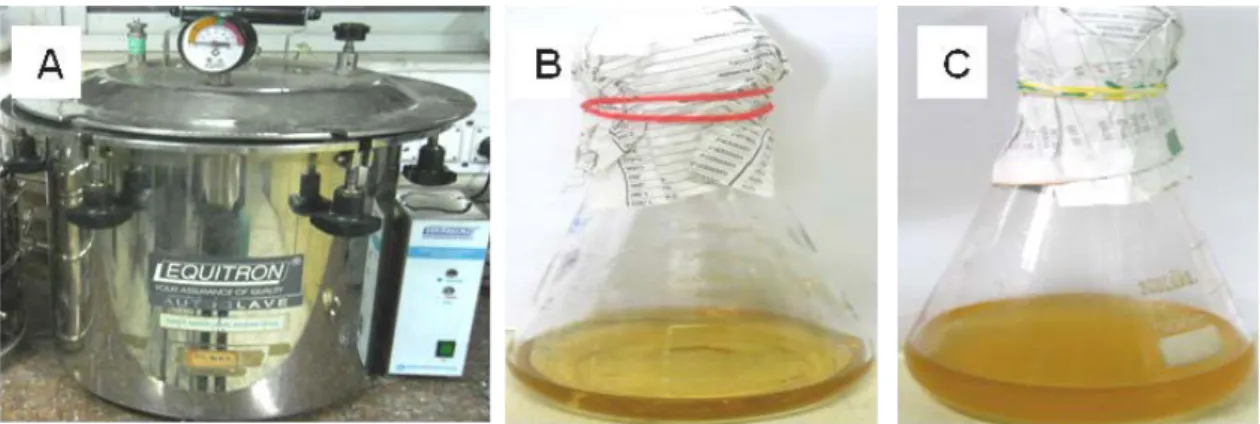
2. Luria Bertani medium: The composition of the luria Bertani and other bacterial expression media is given in Table 37.2. For preparation of media dissolve the components in 1 liter of distilled water. Cover the top of the flask with cotton plug or aluminium foil and autoclave the solution at 121°C for 20 minutes. The various antibiotics or nutrient supplement should be added to the media when the temperature is less than 50°C (Figure 37.1 ).
3. 0.1 M Sterile MgCl2, 0.1M sterile CaCl2
TABLE 37.2: COMPOSITION OF SELECTED MEDIA FOR BACTERIAL GROWTH
Growth media Compositions Applications
M9 minimal media 0.6% disodium hydrogen phosphate 0.3% potassium dihydrogen
phosphate,
0.05%, Sodium chloride 0.1% ammonium chloride
For cultivation and maintenance of Escherichia coli (E. coli) strains.
M63 minimal media 0.2% ammonium sulfate 1.36% potassium dihydrogen phosphate monobasic
0.00005% ferrous sulfate.7H2O
For cultivation and maintenance of E. coli strains. LB (Luria Bertani) Miller broth 1% peptone 0.5% yeast extract 1% NaCl
For E.coli growth; plasmid DNA isolation and protein production LB (Luria Bertani)
Lennox Broth
1% peptone
0.5% yeast extract 0.5% NaCl
For E.coli growth; plasmid DNA isolation and protein production SOB medium 2% peptone
0.5% Yeast extract 10mM NaCl
2.5mM KCl, 20mM MgCl2
To make high efficiency competent cells.
SOC medium SOB + 20mM glucose growth of competent cells. 2x YT broth (2x Yeast
extract and Tryptone)
1.6% peptone 1% yeast extract 0.5% NaCl
Phage DNA production
Terrific Broth) medium
1.2% peptone, 2.4% yeast extract 72 mM K2HPO4
17 mM KH2PO4
0.4% glycerol
For protein expression and plasmid production.
Super Broth) medium 3.2% peptone, 2% yeast extract 0.5% NaCl
High yield plasmid DNA and protein production
TYGPN media 2% Tryptone, 1% Yeast extract, 1ml 80% Glycerol, 1%Potassium
0.5% Sodium Phosphate dibasic
Figure 37.1:Equipments and media required for sterilization and growth of bacterial expression system. (A)autoclave (B)autoclaved LB broth (C) E.coli grown in LB broth.
Methods :
1. Bacterial Culture- The growth stage of the bacteria has a significant impact for its ability to take up foreign DNA. The bacterium at log phase is more active and efficient to perform DNA damage and repair than stationery phase. As a result, it is preferred to use a bacteria of log phase for making competent cells for transformation.
2. Preparation of Competent Cell-Bacteria is incubated with divalent cation (Calcium chloride,Manganese chrloride or Rubidium chloride) for 30mins at 40C. During this process, cell wall of treated bacteria is swell and it gather factors required for intake of DNA docked on the plasma membrane. The whole process of E.coli competent cells preparation is as follows:
1. Inoculate single colony into the 100ml LB media and allow the cells to grow at 370C, 180rpm until
OD600 nm reaches to the 0.4-0.6.
2. Centrifuge the bacterial culture at 4000 rpm, at 4°C 10 min. Discard the supernatant.
3. Resuspend the cell pellet gently first in 1-2 ml and then in 10 ml of ice-cold 0.1 M MgCl2.
4. Centrifuge the bacterial suspension at 4000 rpm, at 4°C 10 min. Discard the supernatant.
5. Resuspend cells gently in 3.0 ml of ice-cold 0.1 M CaCl2.
7. Centrifuge the bacterial suspension at 4000 rpm, at 4°C 10 min. Discard the supernatant.
8. Resuspend cells gently in 3.0 ml of ice-cold 0.1 M CaCl2 containing 10% glycerol
and store in small aliquot (100µl) at -800C. The cells can be used for transformation (discussed in later lectures).
Lab Experiment 37.2 : Preparation of E.coli competent cells for Electroporation.
Background Information: The permeability of the cell membrane can be increased in the presence of high external electric field. This approach is used to deliver the molecular probe, drugs or DNA into the different types of cells. Several hundred volts across plasma membrane is applied in this process. The deliver process is ~10 times more efficient than calcium chloride mediated transformation. Electroporation is performed with the help of electroporator, which can create very high electric field in a specialized cuvette (Figure 37.2).
Figure 37.2:Equipments required for electroporation. (A) electroporator (B) Cuvette.
Material:
1. DH5α Host cells stock 2. Triple distilled water.
Preparation of Competent Cell- The whole process of E.coli competent cells preparation is as follows:
1. Inoculate single colony into the 100ml LB media and allow the cells to grow at 370C, 180rpm until
2. Centrifuge the bacterial culture at 4000 rpm, at 4°C 10 min. Discard the supernatant.
3. Resuspend the cell pellet gently in 5-10ml triple distilled water (multiple times). 4. Centrifuge the bacterial suspension at 4000 rpm, at 4°C 10 min. Discard the supernatant.
5. Resuspend cells gently in 3.0 ml of ice-cold distilled water.
6. Centrifuge the bacterial suspension at 4000 rpm, at 4°C 10 min. Discard the supernatant.
7. Resuspend cells gently in 3.0 ml of ice-cold triple distilled water containing 10% glycerol and store in small aliquot (100µl) at -800C. The cells can be used for transformation (discussed in later lectures).
Lecture 38
Transformation
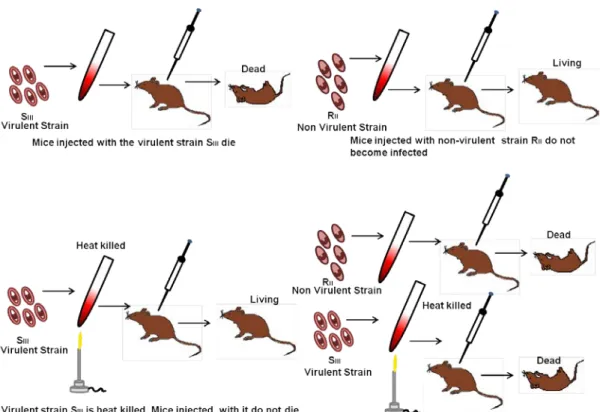
Transformation- it is the natural process, through which bacterial population transfer the genetic material to acquire phenotypic features. The event of transformation was first time demonstrated by Frederick Griffith in 1928. The schematic presentation of the experiment is given in Figure 38.1. Griffith has used two different Streptococcus pneumonia strains, virulent (S, causes disease and death of mice) and avirulent (R, incapable of causing disease or death of mice). In a simple experiment he injected 4 different combination of bacterial mixture, (1) live S, (2) heat killed S, (3) live R, (4) mixture of live R and heat killed S in to the mice. The observation indicates that live S has killed the mice where as mice were healthy with heat killed S or live R. Surprisingly, mice injected with mixture of live R with heat killed S were found dead, and bacteria isolated from these dead mice were virulent. Based on these observations, Griffith hypothesized the existence of a transforming agent (Protein, DNA) being transferred from heat killed virulent strain to the avirulent strain and proposed the concept of transformation. Later, Oswald has proved that the transforming factor is DNA rather than protein.
Lab Experiment 38.1 : Transformation PET23a into the E.coli and calculate transformation efficiency.
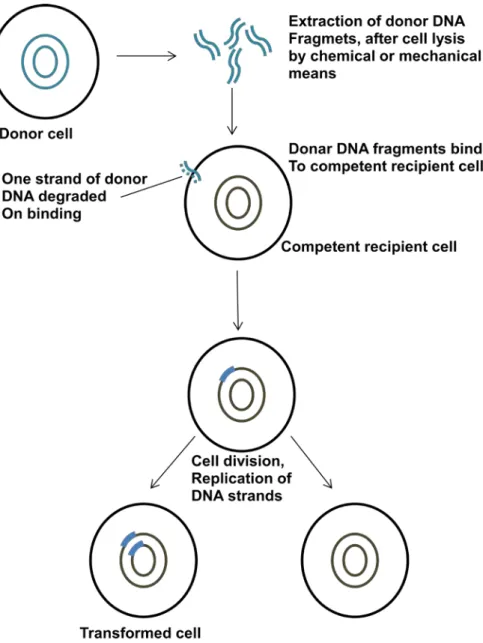
Background Information: Transformation is the process by which cell free DNA is taken up by another bacteria. The principle steps of transformation are given in Figure 38.2.The DNA from donor bacteria binds to the competent recipient cell and DNA enters into the cell. The DNA enters into the recipient cell through a uncharacterized mechanism. The DNA is integrated into the chromosomal DNA through a homologous recombination. Naturally transformation is common between closely related species only.
Material and Equipments:
1. E.Coli Competent Cells 2. Water Bath
3. Luria Bertani Media 4. LB-Agar Plate 5. Incubator
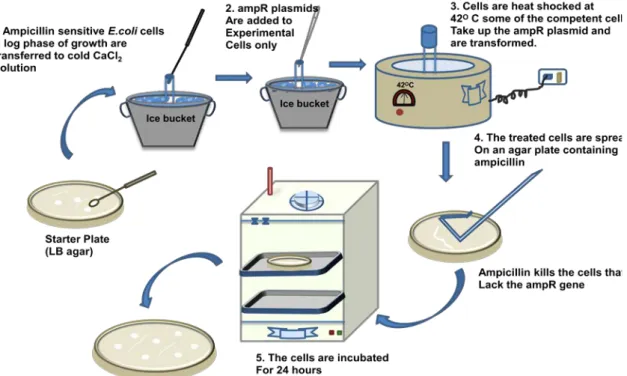
Procedure : The outline of the procedure involved in calcium chloride mediated transformation is given in the Figure 38.3.
1. On the day of transformation, competent cells are incubated with DNA or circular plasmid containing appropriate resistance gene such as ampicillin resistance gene for 30mins on ice.
2. Heat Shock-Competent cells are given a brief heat shock (420C for 90 sec) to relax the cell wall and high temperature stress causes upregulation of the factor responsible for DNA recombination and repair.
3. A chilled bacterial media is added for faster recovery of transformed cells.
4. it is plated on the solid media with appropriate antibiotics such as ampicillin and allowed to grow for another 18-24 hrs.
5. Transformed cells with appropriate resistance will grow and give colony (Figure 38.4).
Observation: The transformed LB agar plate in Figure 38.4 has 1488 colonies.
Calculation of the transformation efficiency:
If 10ng of plasmid gives ~1488 colonies.
Then 1µg of plasmid transform 1488 x102=1.488x 10⁵ colonies
Therefore the transformation efficiency was found to be -1.4 x 10⁶ colonies.
Figure 38.3: Steps in bacterial transformation by CaCl2 method.
Figure 38.4: Transformation by CaCl2 method.
Lab Experiment 38.2 : Transformation the vector into the yeast.
Background Information: The surface chemistry of yeast cells are different from the E.coli and as a result different methods to deliver DNA.
1. Lithium Acetate/ssDNA/PEG Method: In this method, yeast cells are incubated with a transformation mixture of lithium acetate, PEG 3500, single stranded carrier
DNA and foreign plasmid at 420C for 40mins. The purpose of adding carrier DNA is to block the non-specific sites on cell wall and made plasmid available for uptake. Post-transformation, cells are pelleted to remove transformation mixture and re-suspended in 1ml water. It is plated on a solid media with an appropriate selection pressure such as antibiotics.
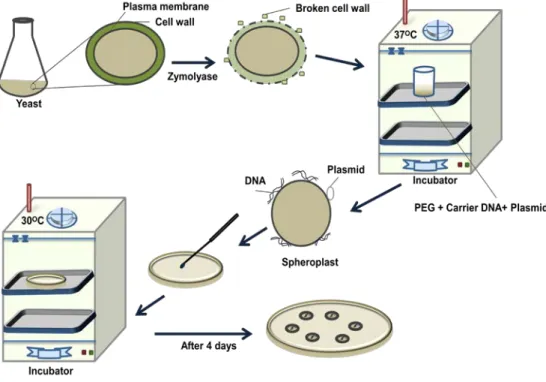
2. Spheroplast Transformation Method: In this method, yeast cell wall is removed partially to produce spheroplast. Spheroplasts are very fragile for osmotic shock but are competent to takes up free DNA at high rate. In addition, polyethyl glycol (PEG) is used to facilitate deposition of plasmid and carrier DNA on cell wall for easier uptake. The mechanism of DNA uptake in yeast is not very clear. A schematic of spheroplast method is given in Figure 38.5. (1) In the spheroplast method, yeast cells are incubated with zymolyase to partially remove cell wall to produce spheroplast. (2) They are collected by centrifugation and incubated with carrier DNA and plasmid DNA for 10mins at room temperature. (3) It is now treated with PEG and calcium for 10mins with gentle shaking. (4) Transformed spheroplast are plated on selective solid media and incubated on 300C for 4 days.
Lab Experiment 38.3 : Transfect GFP into the COS-7 Cells using ion for Mammalian cells.
Background Information: mammalian cell membrane surface chemistry, intracellular comparatmentization and uptake mechanism is different from the prokaryotic cells or yeast. Hence specialized methods have been developed to suit mammalian cells. There are 4 major strategies to deliver the DNA in mammalian cells:
1. Chemical transfection techniques-The principle behind the chemical transfection technique is to coat or complex the DNA with a polymeric compound to a reasonable size precipitate (Figure 38.6). It facilitates the interaction of the precipitate with the plasma membrane and uptake through endocytosis. There are multiple chemical compounds have been discovered which can be able to make complex and deliver DNA into the mammalian cell.
Figure 38.6: Mechanism of chemical method mediated DNA delivery in animal cells.
Calcium Phosphate method-In this method, DNA is mixed with calcium chloride in phosphate buffer and incubated for 20mins. Afterwards, transfection mixture is added to the plate in dropwise fashion. DNA-calcium phosphate complex forms a precipitate and deposit on the cells as a uniform layer. The particulate matter is taken up by endocytosis into the internal storage of the cell. The DNA is then escapes from the precipitate and reach to nucleus through a unknown mechanism. This method suited
to the cell growing in monolayer or in suspension but not for cells growing in clumps. But the technique is inconsistent and the successful transfection depends on DNA-phosphate complex particle size and which is very difficult to control.
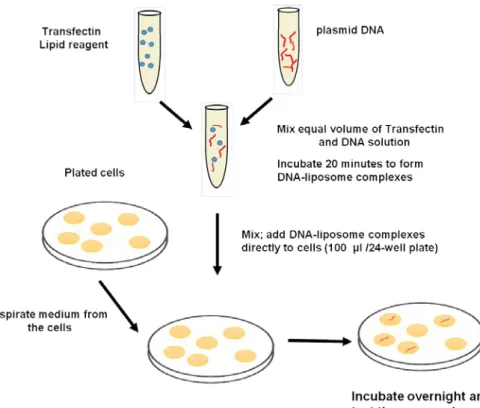
Polyplexes method- The disadvantage of calcium phosphate method is severe physical damage to the cellular integrity due to particulate matter settling on the cell. It results in reduced cellular viability and cyto-toxicity to the cell. An alternate method was evolved where DNA was complexed with chemical agent to form soluble precipitate (polyplexes) through electrostatic interaction with DNA (Figure 38.7). A number of polycationic carbohydrate (DEAE-Dextran), positively charged cationic lipids (transfectin), polyamines (polyethylenimines) etc are used for this purpose. The soluble aggregates of DNA with polycationic complex is readily been taken up by the cell and it reaches to the nucleus for expression (Figure 21.3).
Liposome and lipoplex method-Another approach of DNA transfection in animal cell is to pack the DNA in a lipid vesicle or liposome. In this approach, DNA containing vesicle will be fused with the cell membrane and deliver the DNA to the target cell. Preparation of liposome and encapsulating DNA was a crucial step to achieve good transfection efficiency. Liposome prepared with the cationic or neutral lipid facilitates DNA binding to form complex (lipoplex) and allow uptake of these complexes by endocytosis. The lipoplex method was applicable to a wide variety of cells, and found to transfect large size DNA as well. Another advantage of liposome/lipoplexes is that with the addition of ligand in the lipid bilayer, it can be used to target specific organ in the animal or a site within an organ.
3. Transduction (Virus mediated)- Viral particle has a natural tendency to attack and deliver the DNA into the eukaryotic cells. As discussed previously, cloning gene of interest in to the viral vectors is a innovative way to deliver the DNA into the host cell. If the recombination sequences are available, the delivered DNA is integrated into the host and replicate. Virus has essential components for expression of proteins required for DNA replication, RNA polymerase and other ligand for attachment onto the host cell. In addition, it has additional structural components to regulate infection cycle. The virus vector contains cassettes to perform all these functions then it is fully sufficient to propagate independently. Few virus strains may cause disease if their propagation will be uncontrolled. A mechanism has been devised to keep a check on the uncontrolled propagation of virus in cell. Few crucial structural blocks are placed on another helper plasmid, in this case virus propagate only if helper plasmid has been supplied along with the viral vector. This particular arrangement is made with the virus strains which can cause disease after integrating into the genome such as lentivirus.
Lecture 39
Isolation of recombinant clones.
Lab Experiment 39.1 : Isolation of plasmid DNABackground Information: Plasmid are widely been used for cloning of foreign DNA into the bacteria as host strain. Before getting into the details of discussing isolation of bacterial plasmid we will discuss the basic properties of plasmids.
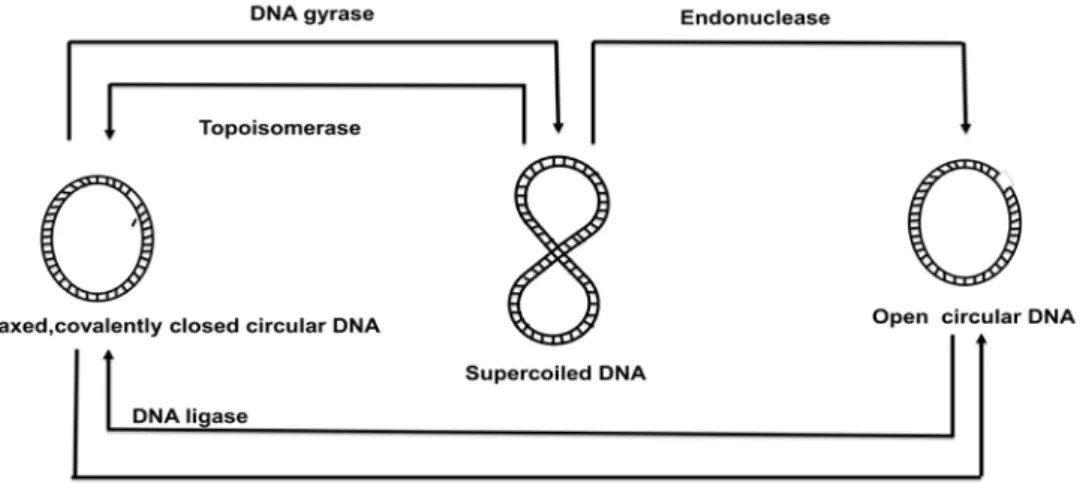
Different forms of plasmids: Bacterial plasmid is a double stranded circular DNA exists in 3 different forms (Figure 39.1). If the both strands of circular double strands are intact then it is called as covalently closed circles (CCC) where as if one of the strand has nick, then it acquire the conformation of open circle DNA (OC, DNA). During the isolation of plasmid DNA from bacteria, covalently closed circular DNA losses few number of turns and as a result it acquire supercoiled configuration. The interchange between these different forms are possible under the in-vitro or in-vivo conditions, such as DNA gyrase produces additional turn into the circular DNA to adopt supercoiled conformation.
Figure 39.1: Different forms of plasmids
Features of different plasmids: There are minimum molecular components to assemble bacterial plasmid to perform the function of vector are as follows-
1. Origin of replication-Like any other replicating DNA, plasmid DNA needs its own independent origin of replication to provide replication start site to make more copies. It decides the range of bacterial host strain can be use with the particular plasmid vector. The plasmids containing ori region from Col E1 can be able to grow in limited bacterial species such as E.Coli etc. In contrast, plasmid containing ori from
2. Selection marker- Selection marker in the form of either antibiotic resistance gene or enzymatic gene is essential to give phenotypic changes in host after entry of the plasmid.
3. Promoter- Plasmid replication in host is performed by the host provided proteins such as DNA gyrase, helicase, polymerase and DNA ligase. But proteins required for conferring antibiotic resistance or enzyme use for selecting transformed host cells is present on plasmid and a promoter adjacent is required to express genes present on plasmid DNA. In addition, promoter is also needed to express gene present on foreign DNA.
Material and Instrument:
1. E. coli cells culture (~1.5ml) containing plasmid of interest.
2. Solution I (50 mM glucose, 25 mM TrisHCl pH 8.0, 10 mM EDTA pH 8.0):
Prepare the solution of 50 mM TrisHCl pH 8.0, 50 mM EDTA pH 8.0 and sterile by autoclave. Prepare the 100mM Glucose and sterile by filter through 0.2µm. Solution-I is prepared by mixing both solution to prepare solution-I.
3. Solution II (0.2 N NaOH and 1% SDS): This solution has to prepare fresh by mixing stock solution of 2N NaOH and 10% SDS in sterile molecular biolog grade water. Don’t vortex this solution and discard any left-over solution.
4. Solution III (potassium acetate, glacial acetic acid.):
5. Phenol : Chloroform: Isoamyl alchol: Mix Phenol (equliberated at pH 8.0), chloroform and Isoamyl alchol in the ratio of 25:24:1,mix by vortexing.
6. Absolute Ethanol:
7. Luria Bertani medium: The composition of the luria Bertani and other bacterial expression media is given in Table 37.2. For preparation of media dissolve the components in 1 liter of distilled water. Cover the top of the flask with cotton plug or aluminium foil and autoclave the solution at 121°C for 20 minutes. The various antibiotics or nutrient supplement should be added to the media when the temperature is less than 50°C (Figure 37.1 ).
9. Agarose and Buffers for Electrophoresis
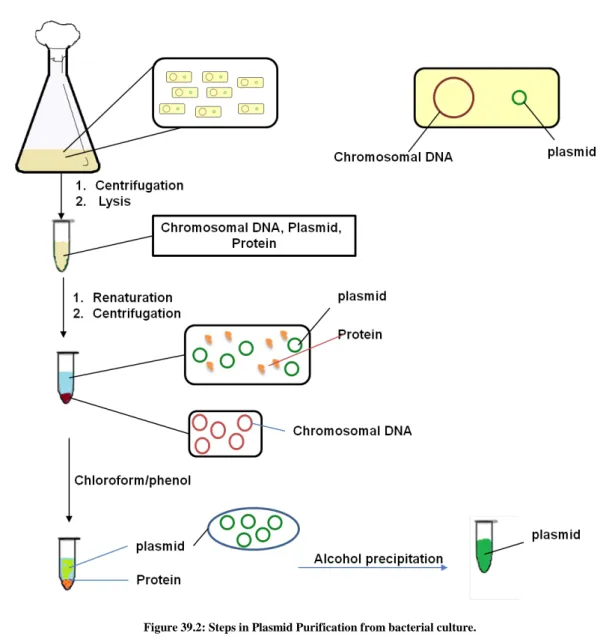
Methods: The different steps in isolation in bacterial plasmid is given in Figure 39.2.
STEP 1 (resuspension and lysis of bacterial cells): The bacteria containing plasmid was grown in suitable culture media in high density (~0.8 optical density). Each Bacterial cell contains chromosomal DNA, plasmid DNA and cellular proteins.
1. 1.5 ml bacterial culture is collected by centrifugation at the bottom and discard the supernatant and invert the tube on a dry paper towel to dry the pellet.
2. Resuspended the bacterial pellet in 0.1 ml solution I containing 50 mM glucose, 25 mM TrisHCl pH 8.0, 10 mM EDTA pH 8.0. Break the cell pellet by vortexing for 2mins.
3. Incubate the Bacterial pellet on ice for 5mins. This step will partially lyse the bacteria by hypotonic osmosis and releases cellular content.
STEP 2 (Alkaline Lysis):
4. Bacterial cells are treated with 0.2ml solution II containing 0.2 N NaOH and 1% SDS. Don’t vortex but mix by inversion. Incubate the tube on ice for 5mins. This step will completely lyse the cells and denature DNA (both chromosomal and plasmid DNA) and protein.
STEP 3: Renaturation:
5. Add 0.15ml ice cold Solution III. Mix by inversion and incubate on ice for 5mins. In this step, denatured DNA is renatured with solution III containing potassium acetate, glacial acetic acid. In this step small DNA (plasmid) renature back quickly whereas chromosomal DNA remained denatured.
6. Centrifuge at 12000g for 5mins and transfer the clear supernatant to fresh tube. Avoid contamination of white precipitate, even if you needs to leave 10-20µl supernatant.
7. Add RNase A to the supernatant at a final concentration of 20µg/ml. Incubate the tube at 370C for 30min. This step will degrades RNA present in the sample.
Figure 39.2: Steps in Plasmid Purification from bacterial culture.
STEP 4: Deproteination:
8. Resulting supernatant containing plasmid DNA and protein is treated with equal volume of phenol: chloroform: isoamyl alchol mixture and mix by vortexing for 1mins. This step removes protein from the solution in the precipitate where as plasmid remained in solution.
9. Centrifuge at 12000g for 5mins and transfer the upper clear supernatant to fresh tube.
10. Add equal volume of chloroform:isoamyl (24:1) and mix by vortexing.
11. Centrifuge at 12000g for 5mins and transfer the upper clear supernatant to fresh tube.
STEP 5: Precipitation :
12. Add 2 volume of absolute alchol and mix by vortexing to precipitate the plasmid DNA.
13. Centrifuge at 12000g for 5mins and discard the supernatant. Wash the DNA pellet with the 70% ethanol.
14. Centrifuge at 12000g for 5mins and discard the supernatant.
15. Air dry the pellet and dissolve the pellet in the sterile molecular biology grade water or TE Buffer (Tris pH 8.0 containing 10mM EDTA).
16. Analyze the DNA on the 0.8% agarose gel.
Observation: Analysis of plasmid DNA on the agarose gel gives 3 bands corresponding to the 3 different forms of DNA (Figure 39.3).
Plasmid DNA
RNA
Lecture 40
Screening of Recombinant Clone
Lab Experiment 40.3 : Verification of recombinant DNA (Colony PCR)Principle of the technique: The whole process of PCR involves three main events, Denaturation, Annealing and Elongation (Figure 40.1). A DNA fragment of interest is used as a template and a pair of primers which are short oligonucleotides complimentary to the both strands of the template DNA. The purpose of primer is to initiate the DNA synthesis in the direction of 5’ to 3’. The number of amplified DNA or the amplicons increases exponentially per cycle thus one molecule of DNA give rise to 2,4,8,16 and so forth. This continuous doubling is carried out by a specific enzyme called DNA polymerase which sits at the unfinished double stranded DNA created by template DNA and primer. For further extension of the DNA, the polymerase enzyme require supply of other DNA-building blocks such as the nucleotides consisting of four bases Adenine (A), Thymine (T), Cytosine (C) and Guanine (G). The template, primer, polymerase and four bases are the main components for polymerase chain reaction.
Figure 40.1: Basic Principle of polymerase chain reaction (PCR).
Instrumentation: Thermal cycler is the instrument that carries out the amplification via polymerase chain reaction (Figure 40.2). Usually the three main events are repeated for 30-40 cycles to obtain detectable amount of product at the end of the cycles. The automated system performs the cyclic temperature changes required for
enzymatic amplification of specific DNA segments in vitro using this PCR. The device has a thermal block with holes where tubes containing reaction mixtures can be inserted. The cycler varies the temperature of the block in discrete, pre-programmed steps using peltier effect.
Figure 40.2. Representation of thermal cycler instrument showing the position of sample and schematic diagram of 30 cycle PCR.
Reagents: • PCR thermal cycler • DNA template • Forward primer • Reverse primer • 2X PCR master mix
• Nuclease free water
• PCR tubes
• Agarose gel electrophoresis apparatus
The reagents required for a complete PCR reaction volume is given in the table.
Reagents Amount required
Template DNA 1pg-1ng for viral or short templates 1ng-1µg for genomic DNA
Primers (forward and reverse primers)
0.1-0.5µM of each primer
Magnesium chloride 1.5-2.0 mM is optimal for Taq DNA polymerase
Deoxynucleotides (dNTPs) Typical concentration is 200 µM of each dNTP
Primers: A primer is a short oligonucleotide that serves as a starting point for DNA synthesis. In PCR, two primers are required to bind to each of the single stranded DNA (obtained after denaturation) flanking the target sequence. These are called Forward and Reverse primers. They primers are designed in such a way that they have a sequence complimentary to the sequence in the template DNA. Two restriction enzymes sites are added at the 5’ end of each of the primer to facilitate cloning. The chosen restriction enzymes will not cut DNA fragment (non-cutters). Typically 3 to 4 nucleotides are added at the end of the restriction sites to allow efficient cutting by restriction enzymes.
Methodology: Colony PCR has three major events (Denaturation, Annealing and Elongation) to complete the amplification process (Figure 40.1). The complete process of colony PCR is as follows-
1. Inoculate single colony into the 100ml LB media and allow the cells to grow at 370C, 180rpm until
OD600 nm reaches to the 0.4-0.6.
2. Isolate plasmid by alkalike lysis method. Alternatively 2-3 µl of bacterial culture can be added.
3. Perform the PCR reaction as outlined.
1. Initial denaturation: Heating the PCR mixture at 94°C to 96°C for 10min to ensure complete denaturation of template DNA. This step wil lyse bacteria in the culture and released plasmid DNA. It is followed by the cyclic events which has different steps as described below:
A. Denaturation: This is the first step in which the double stranded DNA template is denatured to form two single strand by heating at 95°C for 15-30 secs.
B. Annealing: This is the annealing step where at lower temperature (usually 50-650C) primers are allowed to bind to template DNA, annealing time is 15-30 secs and it depends on the length and bases of the primers. Generally annealing temperature is about 3-5°C below the melting temperature (Tm) of the pair of the primers is used. C. Elongation: This is the synthesis step where the polymerase perform synthesis of new strand in the 5’ to 3’ direction using primer and deoxyribonucleoside triphosphates (dNTPs). An average DNA polymerase adds about 1,000 bp/minute. Step 1,2,3 makes one cycle and in general 35-40 such cycles are performed in a typical PCR amplification.
2. After the cycles are completed, the reaction is held at 70-74°C for several minutes to allow final extension of the remaining DNA to be fully extended.
3. The reaction is complete and the resulting amplified nucleic acids are held at a low temperature (~4°C) until analysis.
Observation: The Analysis of PCR from different colonies on the agarose gel (Figure 40.3). colony 1 and 3 contains the plasmid containing insert of interest.
Well Sample
1 PCR product of clone 1 (25µl)
3 PCR product of clone 2 (25µl)
5 PCR product of clone 3 (25µl)
7 PCR product of pET23a (25µl)
Figure 40.3. Analysis of different colonies on the agarose gel.
Experiment 40.2 : Verification of recombinant DNA (restriction digestion)
Screening by Restriction Digestion
Principle
Screening by Restriction Digestion is the classical method to determine the recombinant colonies, by performing a plasmid miniprep followed by restriction digestion. This technique is based on the principle that if the transformed colony contains the insert of interest, it can be digested from vector with the help of restriction enzyme and can be analysed by agarose gel electrophoresis.
Materials Required
• Transformed DH5α-clone E. coli culture plate
• LB broth
• Ampicillin (100mg/ml stock)
• Restriction digestion reagents (as per section 2)
Methodology
• All the 10 transformed DH5α-clond E. coli colonies were picked up from the culture plate and inoculated in LB amp+ broth.
• Plasmid was isolated by TELT method from all grown culture.
• Restriction digestion was setup for the plasmid isolated by one colony of 50µl reaction volume.
• 50µl of restriction digested sample was loaded on 0.8% agarose gel and electrophoresed for analysis.
Restriction digestion done for clone and plasmid pET23a. The digested products were run on agarose gel. After electrophoresis the result is as below.
Well Sample
1 1kb DNA marker (5µl)
2 RD product of clone plasmid (50µl)
4 RD product of pET23a (50µl)
Figure 40.4. Analysis of restriction digestion of different colonies on the agarose gel.
Conclusion: Insert is present in lane 2 and digested vector (pET23a) is present in lane 4.