Federated Cloud Platforms
Erik Berdonces BoneloSchool of Science
Thesis submitted for examination for the degree of Master of Science in Technology.
Berlin 28.12.2016
Thesis supervisor:
Assoc. Prof. Keijo Heljanko Thesis advisors:
Prof. Dr. Axel Küpper
Author: Erik Berdonces Bonelo
Title: OpenID Connect Client Registration API for Federated Cloud Platforms
Date: 28.12.2016 Language: English Number of pages: 5+63
Department of Computer Science
Professorship: Distributed Systems and Services Supervisor: Assoc. Prof. Keijo Heljanko
Advisors: Prof. Dr. Axel Küpper, M.Sc. Mathias Slawik
Nowadays, information technology is a key driver in our world. Big cloud federations are aiming to increase their computing power and achieve better results while being
scalable. This huge IT systems are managed by multiple users having different
roles and at the same time, new services deployment automation is needed to be able to cope with the rising need of resources.
This flexibility in deployment has created concerns on the security and the main-tainability of these extensive systems. These requisites have led to start CYCLONE platform, a project focused to provide authentication and authorization services towards services running under control of federated unions of users. CYCLONE, at the moment working as a proof of concept, now allows to authenticate and authorize access to users using one-click-deployment applications against their federation’s credentials. However, actual SSO systems require registration of the services against their Identity Providers in order to provide user validation. In this master thesis, we present two the components of CYCLONE.
The first one is a service registration for clients of the OpenID Connect Single Sign-On protocol that allows newly deployed services to be registered automatically against CYCLONE’s SSO component, using RedHat’s Keycloak authentication solution. Based on the real world scenarios that defined the CYCLONE platform, we have designed and implemented a solution alternative to the ones provided by Keycloak, and to evaluate it we have compared it to Keycloak’s alternatives. As a result we have created a simple API implementation from where it’s possible to track who is executing this registrations of new clients, in comparison to the anonymous ones provided by other solutions.
The second one is a module that allows easy SSH authorization through the use of CYCLONE’s SSO backend as identity provider and that has been evaluated and tested by one of CYCLONE’s use cases.
Contents
Abstract ii
Contents iii
Abbreviations v
1 Introduction 1
1.1 Background and Motivation . . . 1
1.2 Research Objectives . . . 2
1.3 Structure of the Thesis . . . 3
2 Application environment 4 2.1 CYCLONE platform . . . 4
2.1.1 eduGAIN Federation . . . 4
2.1.2 CYCLONE Components . . . 5
2.2 Use Cases . . . 6
2.2.1 Bioinformatics Use Case . . . 6
2.2.2 Energy Use Case . . . 8
2.3 User requirements . . . 9
2.4 Stakeholders . . . 9
3 Background 11 3.1 Authentication and Authorization . . . 11
3.2 Single Sign-On . . . 11
3.2.1 SSO generic architecture . . . 12
3.3 OpenID Connect 1.0 and OAuth 2.0. . . 13
3.3.1 OAuth 2.0: Authentication . . . 14
3.3.2 OIDC Specifications . . . 14
3.3.3 Scopes and Claims . . . 15
3.3.4 Authentication Flows . . . 16
3.4 SAML 2.0 . . . 16
3.5 Keycloak . . . 17
3.6 SimpleSAMLphp . . . 19
4 The service registration API 20 4.1 State of the Art . . . 20
4.2 Initial Plan . . . 21
4.3 Architecture . . . 23
4.3.1 Authentication . . . 24
4.4 SPI implementation . . . 26
4.4.1 REST API. . . 26
4.4.2 JPA Database Entity . . . 30
4.4.3 SPI Logic . . . 31
4.6 Deployment . . . 33
5 SSH login integration 35 5.1 Motivation . . . 35
5.2 Architecture . . . 36
5.3 Implementation . . . 38
5.3.1 PAM Module Implementation . . . 38
5.3.2 Authenticating Against OIDC and Fetching User’s Data . . . 41
5.3.3 Local authentication and authorization logic . . . 42
5.4 Deployment . . . 44
5.5 Results of the Implementation . . . 45
5.6 Future Work. . . 48
5.6.1 Electron Based Desktop Client. . . 48
6 Evaluation 50 6.1 Dynamic Client Registration . . . 50
6.1.1 Use Cases requirements Validation . . . 50
6.1.2 Comparison with Keycloak’s Version 2.3.0 Registration API . 51 6.2 SSH Login Integration . . . 55
6.3 Client Registration and SSH Integration . . . 56
7 Conclusion 57 7.1 Limitations and Future Research . . . 57
Abbreviations
SSO Single Sign-On
IdP Identity Provider
SP Service Provider
UA User Agent
JWT JSON Web Token
OIDC OpenID Connect
SAML Security Assertion Markup Language
JPA Java Persistence API
SPI Service Provider Interfaces
VPP Virtual Power Plant
DER Distributed Energy Resource
UI User Interface
DAO Data Access Object
API Application Program Interface
CLI Command Line Interface
1 Introduction
This thesis presents and implements a solution to authenticate dynamically deployed services in a federated network of users into an SSO provider. This authentication solution is divided into two components: one server implementation which allows to register the clients automatically in the SSO provider and a client that provides authentication in the distributed services of the federation. Both of them together provide a solution of authentication and authorization in cloud systems based on
distributed federations. This topic is studied through the different use cases provided
by the CYCLONE platform which this work is built on.
In this introductory section, first the background and motivation of the study are presented. Second, the research objectives are defined followed with an overview on the structure of this thesis.
1.1 Background and Motivation
Nowadays, information technology is a key driver in our world. This explosion in web development has been integrated for example into the Internet of the Things (IoT).
This trend of connecting everything physical has not only affected our homes but
is also starting to affect private systems and existing structures. The development
of these new technologies is impacting on how new systems are being developed and how old ones are getting obsolete. Thus, older traditional systems need to be updated to adapt to new paradigms that exist in the present and didn’t exist in the past and that actual technologies can solve.
This introduces us to new challenges when creating our systems to manage complex infrastructures. These new paradigms include among others the location
agnostic cooperation between different entities, where different users can cooperate in
a common objective regardless to their location. However, this online interconnection has also increased the amount of attacks to steal information from secure services. Just as an example, it has been revealed that Yahoo got stolen 1 billion accounts in 2013 and Snowden uncovered NSA’s tracking and gathering of personal data. These are not the only cases in security that have been relevant to people, but all together, people’s awareness on data security has risen and governments have started to regulate data privacy through laws. For example, in the European Union, a new data protection regulation has been approved since April 2016 (Regulation (EU) 2016/679). This becomes critical in highly distributed systems where security is essential and that a misuse of the secured resources can enable grave legal implications and where multiple users can access to these resources.
CYCLONE platform, as one of Europe’s Horizon 2020 projects aims to develop new systems that will cover our future necessities in terms of security. CYCLONE’s aim is to provide secure one click deployments of applications and services. These deployments, usually controlled by an orchestration platform, need to process critical data such as sequenced genomic data or control or manage high available systems such as distributed power plants. At the same time, they need to be created easily to provide scalability for the system. Also, the access to this secure resources needs to
be handled by a community of users organized as a federation, which increases the chances that information can be leaked or hacked. As a result, there is a need to find
a fair trade-off between security and deployment simplicity where user interaction is
minimally needed.
This dynamic deployment of resources and services needs to be integrated with CYCLONE’s Single Sign-On (SSO) service which provides authentication and autho-rization protocols. SSO technologies are a must in CYCLONE platform, as it helps to centralize all the user credential and permission management in a single service, essential when working with distributed services so we can avoid having to update all the individual services when any user’s credentials get updated. CYCLONE’s SSO technology is based on RedHat’s Keycloak open source identity and access management solution. Keycloak implements OpenID Connect 1.0 and SAML 2.0 SSO technologies, actual industry standards in SSO technologies. SSO technologies require to register all the services using them to control the usage of user credentials and access to resources.
1.2 Research Objectives
As this solution is compounded by a server and its client, in this thesis we want to provide a solution for both cases. Thus, we want to propose two implementations that integrate together to provide a solution to the stated problem.
First, we want to analyze, propose and implement an OpenID Connect Client registration API for CYCLONE, a federated cloud platform. With it, we want to provide a system to register services against CYCLONE’s SSO provider, so dynamically deployed services can use secure centralized authentication. Not only we need to create a system to register the clients automatically, but we also need to provide a service that may allow users to use this SSO technologies in their environments.
Second, we want to implement an integration of this SSO authentication into the actual existing environments provided by CYCLONE’s use cases. Actual existing environments depend on SSH and X11 technologies to provide user interfaces. With our implementation, we aim to make this usually locally designed technologies capable of authenticating federated users in a distributed architecture such as CYCLONE.
The main aim of this thesis is to create a set of tools that can be deployed dynamically and can secure authenticate any federation’s user into secure servers.
As CYCLONE is a project already in development, we need to study its structure.
CYCLONE depends on eduGAIN federation to gather user credentials from different
sources and proxies them towards the services requesting authentication. CYCLONE, in turn is also based in a set of use cases, providing real life production scenarios where the project should solve their given challenges. This use cases provided a set of user requirements, that define the direction towards our registration solution needs to evolve. However, CYCLONE’s use cases are not the only ones relevant when implementing a solution in a federated system. Thus we also analyzed the requirements of other stakeholders so our platform can be deployed in locations under regulation. These stakeholders include Technische Universität Berlin, SURFnet
national research and education network of the Netherlands and eduGAIN, as we are using their credentials in our platform. The analysis of the already created structure of CYCLONE will be the base of our implementation.
Also, we need to understand the technologies being used in CYCLONE and what are SSO strategies for user verification. For this, we need to analyze the structure of the platform and how it interacts with the eduGAIN federation to authenticate users in the deployed services. Furthermore, we need to list the features of Keycloak, and
the different automation and configuration opportunities that the solution provides.
As Keycloak includes two different SSO technologies, OpenID Connect (OIDC)
and Security Assertion Markup Language 2.0 (SAML2.0), we need also to compare them and define their usage in our implementation. Bot technologies are similar because both provide authentication and authorization strategies but at the same
time integrate different features and implementations. Thus, we must describe the
different workflows they provide to verify users and compare the characteristics of
each technology to allow access to the user’s sensitive data. After an exhaustive background research, we can take a proper decision on how to create a dynamic registration system. To evaluate our results in the registration API, we compare our implementation with the one provided by Keycloak, as by now, at the end of the implementation, Keycloak has updated their registration API with new features. We contrast and discuss the security aspects that both provide and the advantages and disadvantages of each solution.
In parallel, we study and implement the different possibilities to allow a SSH
pro-tocol login to use CYCLONE’s SSO service as authentication backend. To do so, we analyze the options we have to customize SSH, such as Keyboard-Interactive sessions and PAM modules, and how we can integrate the API calls and authentication against the OpenID Connect endpoint. The main objective of this implementation is to avoid using SSH RSA keys in favour of SSO authentication. Then, we use the feedback provided by IFB, one of CYCLONE’s use cases, to evaluate our implementation in comparison to their requirements.
Finally, we provide an overview on how both component integrate together plus insights on the future implementations that we can do to improve this project.
1.3 Structure of the Thesis
This thesis is structured as follows. Chapter 2 presents a background review on the structure of CYCLONE project, which this thesis is based on and that is used to frame the study. In Chapter 3, we provide a study of the single sign on technologies used to implement our system that is then used in Chapters 4 and 5 to design the implementation. The process of development and implementation of the registration client API is explained in Chapter 4 and the client to use the SSO login from already existing environments is defined in Chapter 5. Lastly, the evaluations and conclusions of the study are presented in Chapters 6 and 7.
2 Application environment
This chapter describes the environment and use cases in which this thesis has been based on. First we explain what is the CYCLONE platform and which is its current
status. Then, we outline the different use cases that inspired this project. Finally, we
illustrate the requirements required for this thesis because of related parties needs.
2.1 CYCLONE platform
CYCLONE platform [1][2] is a project part of the Horizon 2020 Programme of the European Union. Its objective is to create a simple platform that will allow scientists
from different research institutions to share resources in a secure way. Authentication
in the system is done through the validation of the scientists’ credentials provided by the research institutions. These credentials are obtained through the eduGAIN federation [3] and proxied through CYCLONE towards the internal cloud services of the research institution.
The CYCLONE platform depends on a set of previously developed components which interact together: SlipStream, StratusLab, TCTP, OpenNAAS. These compo-nents help to deploy and orchestrate the web and authentication services that make CYCLONE work in each individual private cloud.
2.1.1 eduGAIN Federation
CYCLONE depends on the eduGAIN federation to provide a list of education institutions and federations Identity Providers. eduGAIN [4] stands for "EDUcation Global Authentication INfrastructure" and consists of a federation of federations of education and research institutions. eduGAIN enables an updated list of Identity Providers metadata of all the members of the federation and allows a trustworthy exchange of identity, authentication and authorization of the federation’s users to any of the registered Service Providers. It consists on more than 1,500 Identity Providers,
1,000 Service Providers found through over 40 different federations [5].
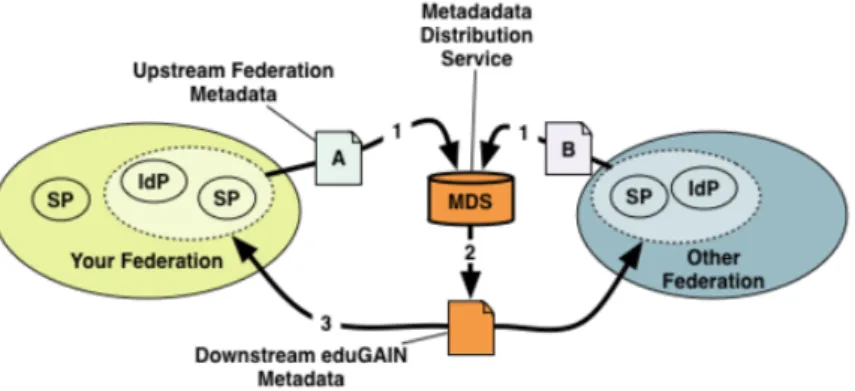
Figure 1: Diagram representing the metadata workflow in eduGAIN federation
eduGAIN uses the SAML 2.0 protocol to grant the authentication and
authoriza-tion to the different Identity Providers of the federation. eduGAIN requires some
procedure to join the federation, including fulfilling declarations of privacy, providing a Federation Policy and selecting two members as delegates inside the federation. Also, each of the federations which are part of eduGAIN need to provide an updated metadata configuration describing how to connect to their SAML 2.0 endpoints, and need to conform some tests to determine if the federation’s configuration is valid.
Just for a single node in the eduGAIN federation, this can be a feasible set of requirements [5]. However, in case any institution wants to provide access to the federation’s data to any of its services, it needs to create a new SAML 2.0 endpoint and accept the previously fulfilled data. In case of simple services, this means a lot of time and bureaucracy in order to setup a new service inside the federation.
This is why CYCLONE, tries to become a proxy from where services can interact with
eduGAIN. Through the use of CYCLONE, we can have multiple services using eduGAIN’s features while only having to maintain a single registration towards the eduGAIN federation. This simplifies the deployment of authenticated services in terms of fastness and complexity.
2.1.2 CYCLONE Components
CYCLONE, in turn, consists on some web services deployed by the previously described orchestrators:
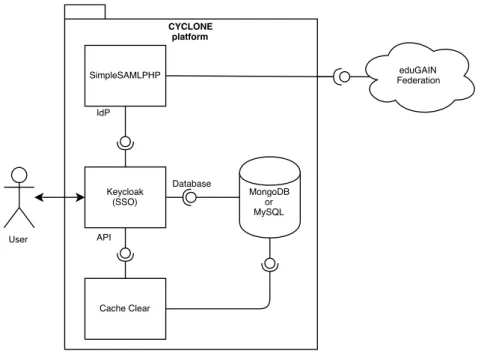
• Keycloak: provides the authentication and authorization via OpenID Connect
and SAML 2.0to the platform and allows the configuration and management of users and resources via a web interface. The major characteristics and features
of this software are described in Section 3.5.
• SimpleSAMLphp: proxies SAML requests from Keycloak towards Identity
Providers of the eduGAIN federation. It allows to synchronize the Identity Providers metadata list via eduGAIN’s JSON API, so CYCLONE is updated with the latest list of members. The major characteristics and features of this
software are described in Section3.6.
• Cache Clear: clears the user data from CYCLONE after the user session ends.
This increases the data privacy and avoids storing user data when is not being used by any other services. Thanks to this CYCLONE can conform to some strict data privacy regulations.
These services are deployed using the CYCLONE platform orchestrators inside a VM located in the private cloud of the institutions part of the CYCLONE federation. Inside the Virtual Machine, Docker is used in order to control this web components and update them with newer versions. Docker provides a simple way to setup the interconnections between the services and also to deployment. Through the use of
docker compose, Docker can setup the whole environment needed with minimal configuration and just a couple of commands.
Figure 2: UML component diagram representing the different components in CY-CLONE and the dependencies they have.
2.2 Use Cases
This thesis bases its implementation in a set of use cases provided by CYCLONE partners. This section describes the background and characteristics of each of the use cases and how CYCLONE could be a solution for their troubles. Here we summarize part of CYCLONE use cases, described in [6] and [7]. Note that this whole section contains extracts and is heavily based on the work done by Domenico Gallico et al. in [7].
2.2.1 Bioinformatics Use Case
Bioinformatics are concerned with the problem of having huge amounts of data, usually proceeding from DNA sequencers or laboratory metrics. Actual modern sequencers can generate terabytes of data; and together with their relative low price, bioinformatic research teams can easily end with huge amounts of data.
According to CYCLONE’s use cases paper, "Bioinformatics community
charac-terizes on using many different software programs to process and analyze the data.
It is a common practice to use custom environments with their own dependencies to setup this software and as a result there is a huge fragmentation in the software field, otherwise incompatibility between dependencies and resources might be a problem. Because of this issue, the best approach for bioinformatics scientists has been to use
cloud computing, which provides isolation between the different applications and
environments and covers the described needs" [6].
The French Institute of Bioinformatics (IFB) consists of 32 bioinformatics plat-forms (PF) grouped into 6 regional centers found throughout the entire French
territory. The IFB shares a national hub, the "UMS 3601–IFB-core" (also called IFB-core), which is the representative of CNRS in this project. The IFB maintains a shared cloud infrastructure in the IFB-core though the future aim is to design a
federated cloud throughout the different nodes of the research network.
The IFB has deployed a cloud infrastructure on its own premises at IFB-core and aims to deploy a federated cloud infrastructure over the regional PFs. This cloud infrastructure is devoted to the French life science community, research and industry, with services for the management and analysis of life science data.
CYCLONE is based on two bioinformatics use cases:
1. UC1 - Secured Human Genome data sequencing: Thanks to the decrease in the pricing of genome processing, this kind of analysis has become a common diagnostic practice. Today, according to the CYCLONE use case, "genome analysis is usually realized in the exome, which represents a 5% of the whole genome. With this amount of data, we can’t really have problems with revealing private or unique data of a specific human, because there is still a 95% of the human genome without processing, where most of the data is ‘stored‘" [6]. However, in the future the objective is to process a full genome sequencing, which in turn would then needed to be handled by drastic data privacy regulations. Through this data, we could envoy all the details of a unique person and as a result the environment where this data is stored and how this data is shared should be ensured to be as reliable as possible in terms of security.
2. UC2 - Automatizing Microbial Genomes Analysis: Thanks to advancements in genetics analysis, such as Next Generation Sequencing (NGS), genome sequencing costs have decreased. As a result, scientists now perform analysis in large collections of related genomes (strains), rather than in individual genomes. Even though the cost has decreased, the analysis still take a long time to be finished, and scientists spend more time in sequencing the data rather than analyzing it.
Thus, there is a need on automatizing the process so scientists can focus in the most important step: the post analysis of the sequenced genomes. IF-MIGALE, one of the bioinformatics platforms in IFB, created an environment to analyze the synteny (conservation of the gene order along the genomes) and to store the results into a database. This environment includes a web interface allows interacting with the analysis and to setup the configuration settings of the environment.
To set up this environment, create the required database and scale up the resources (this process has high computing resources consumptions), it is needed advanced system administration knowledge. In this context, bioinformatics scientists would have a steep learning curve just to deploy a commonly used cluster of servers. CYCLONE cloud federation aims to simplify the setup of this kind environment into something as easy as just one click deployment with the ability to choose the preferred cloud to where to deploy it.
2.2.2 Energy Use Case
Recently, Germany has approved a new law, the "Energiewende", which consists in a set of climate change mitigation goals that aim to replace the usage of fossil resources with sustainable, green energy sources. This set of changes in law are focused to omply with the European Union’s new "202020" legislation.
This means that most of the energy has to come from distributed origins such as solar panels and wind turbines rather than from centralized systems such as thermal or nuclear plants. This new grid of Distributed Energy Resources (DER) need to be monitored and controlled so there are no changes in the energy supply even if the amount of wind and sun variate. For this to happen, this grid needs to become smarter and needs integration with the latest ICT and Big Data technologies,
otherwise the system’s efficiency might decrease without any warning.
Another concern, is that this DER have different characteristics in power
genera-tion, location and amount, which eventually redefines the grid into more complex
heterogeneous system. Thus, for easier management, different parts of the grid are
aggregated in groups of distributed energy resources called Virtual Power Plants (VPP). This provides s single management point for this group of resources. A VPP and generates raw data on the usage and generation values and thanks to the fact
that the grid’s global governor system can coordinate different VPPs to cover the
needs of the grid.
The data generated by the system, will be available for applications in the energy economy field such as energy brokering or dynamic pricing setting based on the energy usage.
Because of the complexity of the system, it is needed different people with different
roles to take responsibility and to manage the different parts of the grid.
• DER Owner: the owner of the resource. He holds the contract with the energy
grid, thus personal data of the DER Owner is stored in a secure database in order to contact him in case of problems or incidences. He can authorize other services to access his data for other matters. Also he can see an overview of basic usage of his DER.
• DER Operator: the manager of the resource in terms of configuration, and
review of its status. It can be as well the DER Owner. He has access to the status, and historical data of the DER, plus identification data of the resource, so it can provide maintenance in case of technical failure.
• VPP Operator: the manager of a Virtual Power Plant. He can see the different
details of the DER resources contained inside the VPP. His task is to manage, control and overview the energy generation and consumption under an specific VPP.
All three roles should have a web interface to access the data both from a computer or a mobile phone.
1. UC3 - Virtual Power Plant: As described previously, a VPP integrates different distributed energy resources (DER) and combines them into one power plant. Given the sensitivity of the data managed by a VPP, the platform managing the energy grid needs to be properly secured in both data storage and data transmission cases. Also, the platform needs to be deployed into a distributed
cloud environment, in order to support the different applications making use of
the platform. All together access to the different resources need to be secured
via authentication and authorization access control.
2.3 User requirements
Through the different use cases previously exposed, we can detect that there are
common requirements:
• R1: Need to be secure as they contain sensitive data from both the users
accessing the system and data being processed (sequenced genomes and energy usage and generation data)
• R2: Needs to have multiple interfaces that must be secured via authentication
and authorization: a web interface, an SSH interface and possibly a remote desktop interface via X11.
• R3: Needs to run in an internal isolated network.
• R4: May need to be deployed across multiple clouds. The difficulty to deploy
a clone of the platform should, thus, be simple and run in any configuration of the cloud or VM.
• R4: Environment and VPP deployments need to be done dynamically and in
an accessible fashion. The procedure to deploy new nodes in the network has to be as simple as a button click if possible.
• R5: Needs to support a federation of different entities and individuals. Both use
cases rely on a user federation where different groups of people and resources
associate together. This results on a need to regulate the free access to data and accept some agreed rules when using the sensitive data.
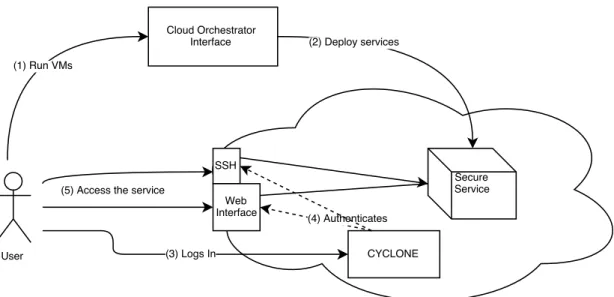
We can see a diagram depicting the generic usage which defines most of this
requirements in Figure 3.
2.4 Stakeholders
In the previous section, we described the needs of the users, which are the scientists and energy network managers. However, there are 3rd parties which are also involved in the requirements of CYCLONE. They can be for example national legislation, rules imposed by the national or local education and research network or any other entity that is related to the privacy and user data usage legislation.
Figure 3: Diagram representing a generic structure defined by the use cases. 1. From TU Berlin: following the data protection rules of the university,
infor-mation that we gather from the authentication service such as mails, names and similar cannot be stored in any server. It is only allowed to store data meanwhile the user has a session open in CYCLONE. This was the main reason to create the cache cleaner component, which clears the data of users who’s session is expired.
2. From SURFnet, in The Netherlands: their requirement to use CYCLONE is that CYCLONE identity provider needs to have a minimum of A rating when validating the connection security with SSLLabs SSL test tool. Otherwise, they treat the service as insecure.
3. eduGAIN: CYCLONE needs to fulfill the different requirements of the eduGAIN
federation in order to be part of it make use if its services. This requires having a SAML endpoint and approving a set of contracts proofing that you will not misuse the data of the federation.
Thus, in order for CYCLONE to be used by most of potential users, we need to cover this requirements required by them.
3 Background
This chapter explains the basic knowledge needed on Single Sign-On and related technologies such as SAML 2.0 and OpenID Connect needed to implement this project. First we define the terms ’authentication’ and ’authorization’ and compare their meanings and their usages. Then we explain what are Single Sign-On systems and finally we describe two SSO systems which are being used by the Keycloak
platform (described in below subsection3.5) in this thesis’ implementation.
3.1 Authentication and Authorization
In any secured system there are two processes that are used in order to determine if a protected resource is allowed to be accessed: authentication and authorization.
Authentication is the process to determine if a user claiming to be himself is really saying the truth.
In the other hand, authorization is the process of granting someone or something to access protected information, resources, data or services. The one requesting the access does not have to be the owner of the protected information, and can request access in behalf of the owner of the data. In order to determine the positive or negative authorization, the services may need access to attributes of the user credentials so the privileges of the user can be determined and thus process the authorization.
Authorization heavily depends on authentication in order to provide a proper authorization. If we have not properly validated the credentials of the service requesting the authorization, we may be allowing access to restricted data to undesired users, and thus rendering the whole security system useless.
Both terms meanings are usually confused between each other, even if they define
different concepts.
Authentication and authorization are usually processed per domain to protect the user against CORS attacks [8], this means that for each web service or resource that the user wants to access, the user needs to be both authenticated and authorized. Of course, this would make the user to enter their credentials several times, which would provide a bad user experience. In order to mitigate this problem, there are the Single Sign-On technologies.
3.2 Single Sign-On
Single Sign-On [9] is a set of methods which model systems that allow to authenticate users in multiple environments in a secure and easy way. Their aim is to allow the user access to multiple computing domains while authenticating himself only once. These systems do not only provide a friendly access to the user, but also allow administrators to update authentication and access information for multiple web services at once. As a result, it avoids users having to authenticate themselves in each page, and simplifies the management for the domain administrators as the credentials management is not distributed between multiple sites.
3.2.1 SSO generic architecture
SSO systems scenarios usually consist on three main components [10]: a trusted third party called Identity Provider (IdP), a user agent (UA) who is trying to authenticate himself and a web service provider (SP) that is requiring authentication.
UA and SP will not share any private information as UA will not authenticate towards SP but to the IdP instead. IdP is trusted by both UA and SP, which means that UA has a mean to authenticate himself towards the IdP and the SP trust validated data issued by the IdP.
Web services act as Clients of the IdP. This Clients usually need to have credentials against the IdP to demonstrate that they are authorized to receive the user’s verified sensitive and private data. With this validated data, clients can take a final decision in authorization to decide if a user can access or not the protected resource for which they need the authentication.
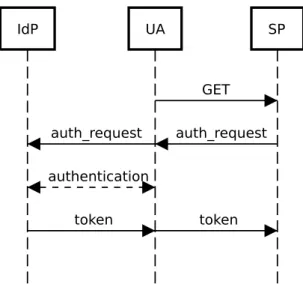
IdP UA SP GET auth_request auth_request authentication token token
Figure 4: Diagram representing a generic overview of an SSO authentication workflow Each SSO system has its own authentication workflow, however, most of them
share a generic protocol described in Figure 4:
1. The UA requests to access the SP.
2. The SP redirects the UA to the IdP to start the authentication. This redirection
contains anAuthentication Request, which includes characteristics from the SP,
such as who is he, which encryption does he accept and similar. This data will help IdP determine to return the needed validated data and its format that SP needs.
3. With the redirection, UA starts a strong secured connection with the IdP. A secure connection is needed as the UA will have to share private credentials to authenticate with the IdP.
4. UA starts the authentication with IdP. It can be done via username and password, but it can also be done through other kind of data such as One-Time Passwords, redirecting to another IdP, or using a cookie from UA’s browser to recall a previous authentication.
5. After authentication, IdP issues a token to UA and redirects him back to the SP who originally did the request. This token should contain some information of the UA, and needs to be integrity protected.
6. UA delivers to SP the token, who can validate its integrity using public keys available from the SP. Also, he can use UA’s data included in the token in order to take a decision on allowing or not UA to access the protected resource. This is an example of generic workflow, however, SSOs can have more than one
workflow, allowing different authentication methods which can provide more or less
restrictions depending on the trust relationship with the user and/or the client. In order to extend the authentication with authorization, there are a couple of extra steps to be done:
• When authenticating, depending on the trust relationship between the IdP and
the SP, UA might to accept an authorization with which it allows the SP to access some of its data and private resources.
• The token becomes a set of tokens. It has and Access Token, which is really
short lived and allows to request access in behalf of UA, and aRefresh Token,
which has longer TTL and allows to request new Access Tokens. This tokens need to be stored securely as it they are the keys that allow access to the private data of UA.
• With this tokens, IdP can request to SP extra UA’s identity data not included
in the Access Token, such as the address, birth date or any other attributes that IdP might have from the UA.
There are many SSO frameworks which provide this kind of solutions and are widely used, for example CAS [3], OpenID [11], OAuth [12], Facebook Connect [13] or the Security Assertion Markup Language (SAML) [14]. Some of them are SSOs which only provide authentication OR authorization, they don’t provide both processes. It’s important to take this in account when deciding which framework to be used.
In this thesis we will focus in two of this SSO architectures: OpenID Connect 1.0 and
SAML 2.0.
3.3 OpenID Connect 1.0 and OAuth 2.0
OpenID Connect (OIDC) [3] is the third generation of the OpenID technology. OpenID Connect is an evolution of the OpenID 1.0 and 2.0 standards. These last two protocols provide both provide authentication but no authorization. Nowadays we also need authorization to take a decision on giving access or not. OIDC implements
an evolution of the previous OpenID standards into a new version that includes both authentication and authorization.
OpenID Connect 1.0 is in general an extension of the extensively used OAuth2.0 protocol, which provides authentication on top of OAuth2.0 authorization thanks to an inspired validation technology based on the OpenID 2.0 protocol. It allows to SP to verify the credentials of UA and then perform authorization using this validated credentials, as well as to obtain user attributes through a REST-like API. With this, OIDC is fully compatible with the OAuth2.0 standard. However, it is not compatible with OpenID 2.0 or other previous versions of the OpenID protocol.
3.3.1 OAuth 2.0: Authentication
OAuth2.0 [15] is one of the most extensively used authorization frameworks today. OAuth2.0 consists on next evolution of the OAuth 1.0 protocol specified by the IETF in RFCs 6749 and 6750 (published in 2012) which allows multiple workflows of authorization depending on the trust relationship between the IdP and the SP (called Clients in OAuth terms). However, people have been mistaking this technology as an authorization service rather than authentication service. Some implementations of OAuth2.0, like the one created by Facebook and rebranded as Facebook Connect, include an Identification Token on top of the OAuth2.0 protocol, in order to provide an authentication layer for OAuth2.0.
Other options to fix the authentication not included in OAuth problem are
using the different SSO technologies that provide authentication in conjunction with
OAuth2.0. Example of possible authentication frameworks would be OpenID 1.0, JASIG CAS. The objective is to provide a token, with which OAuth2.0 can validate the credentials of the people requesting the authentication.
Through the use of OAuth2.0 as a base, OIDC has compatibility with most of the implementations of OAuth2.0 and thus simplifies an upgrade from OAuth2.0 to OIDC.
3.3.2 OIDC Specifications
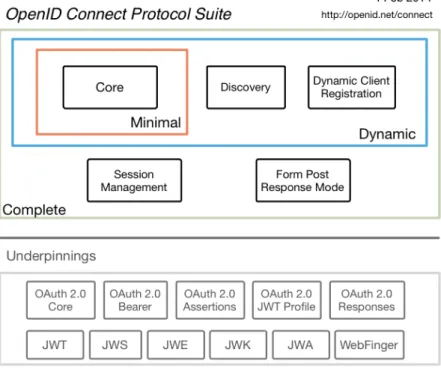
The OpenID Connect 1.0 specification consists of many components [16]. The most relevant ones from all the specifications are:
• Core [17] – Defines the core OpenID Connect functionality: authentication
built on top of OAuth 2.0 and the use of Claims to communicate information about the End-User.
• Discovery – (Optional) Defines endpoints from where clients can dynamically
fetch configuration from OpenID Providers.
• Dynamic Registration [18] – (Optional) Defines how clients can register
dy-namically to use an OpenID Provider.
• OAuth 2.0 Multiple Response Types – Defines several specific new OAuth 2.0
• OAuth 2.0 Form Post Response Mode – (Optional) Defines how to return
OAuth 2.0 Authorization Response parameters using HTML form values that are auto-submitted by the User Agent using HTTP POST.
Figure 5: Diagram representing the different specifications conforming the OIDC
suite (from http://openid.net/connect/
One of the optional specifications of OIDC is Dynamic Client Registration [18], which allows to register a new client into the IdP automatically. This registration can be done through the interaction with OIDC’s API and the use of JSON Web Tokens (JWT) signature keys [19] or via other means to verify the authenticity of the new client registrant.
Final OpenID Connect specifications were launched on February 26, 2014. So OIDC is a quite recent protocol and is not really extensively used. However, it has high support from big IT companies such as Google, Microsoft, and Deutsche Telekom between others. For example Google uses OIDC in their SSO systems, in parallel to SAML 2.0.
A certification program for OpenID Connect was launched on April 22, 2015. This certification provides assurance that the implementation of the OIDC server has been created according to the specifications of the protocol.
3.3.3 Scopes and Claims
OAuth2.0 defines the claims as the different attributes of the user that the Relying
Party can request. They can be, for example the email, phone, address of the user. OIDC provides a set of default claims that should be included in all the OIDC
implementations [17]. Other custom claims can be included to extend the user attributes.
This claims are sorted in scopes. A scope is a group of related claims that can be requested access to by the Relying Party. When the authorization is requested, the request includes a scope. The User Agent needs to approve the access to this claims to allow the Relying Party to access the user attributes.
OIDC contains an specific scope openid, which allows the clients to request
authorization to access to the user’s attributes. This is a feature not included in OAuth2.0 and provided by OIDC allows to manage and authorize the access to the user’s data via 3rd party clients.
3.3.4 Authentication Flows
OIDC has multiple authentication and authorization [20][17] inspired in OAuth.
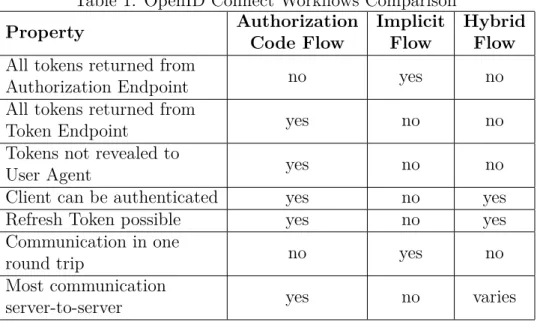
• Authorization Code Flow: According to OpenID specifications, "the
Autho-rization Code Flow returns an AuthoAutho-rization Code to the Client, which can then exchange it for an ID Token and an Access Token directly. This provides the benefit of not exposing any tokens to the User Agent and possibly other malicious applications with access to the User Agent. The Authorization Server can also authenticate the Client before exchanging the Authorization Code for an Access Token. The Authorization Code flow is suitable for Clients that can securely maintain a Client Secret between themselves and the Authorization Server." [17]
• Implicit Flow: According to OpenID specifications, "the Implicit Flow is mainly
used by Clients implemented in a browser using a scripting language. The Access Token and ID Token are returned directly to the Client, which may expose them to the End-User and applications that have access to the End-User’s User Agent. The Authorization Server does not perform Client Authentication." [17]
• Hybrid Flow: The hybrid flow is a combination of the above two. It allows to
request a combination of identity token, access token and code via the front channel using either a fragment encoded redirect or a form post.
3.4 SAML 2.0
According to its specification [14], "The Security Assertion Markup Language (SAML) standard defines a framework for exchanging security information between online business partners. It was developed by the Security Services Technical Committee (SSTC) of the standards organization OASIS (the Organization for the Advancement
of Structured Information Standards)".
SAML 2.0 is based on XML and uses security tokens with assertions to share information about a principal (usually a user), between a SAML authority and a consumer of this data. Its architecture allows web based authentication. It was
Table 1: OpenID Connect Workflows Comparison
Property AuthorizationCode Flow ImplicitFlow HybridFlow
All tokens returned from
Authorization Endpoint no yes no
All tokens returned from
Token Endpoint yes no no
Tokens not revealed to
User Agent yes no no
Client can be authenticated yes no yes
Refresh Token possible yes no yes
Communication in one
round trip no yes no
Most communication
server-to-server yes no varies
approved as standard in March 2005 and replaced SAML 1.1. SAML 2.0 is the merge
of three different technologies: SAML 1.1, Liberty ID-FF 1.2 and Shibboleth 1.3.
SAML is extensively used by many companies and institutions and is a dominant SSO technology through many internet web services. This allows interoperability
between different different companies SSO systems as they are using the same SAML
protocol. As an example, eduGAIN defines as a requirement having a SAML 2.0 endpoint in order to be part of the federation.
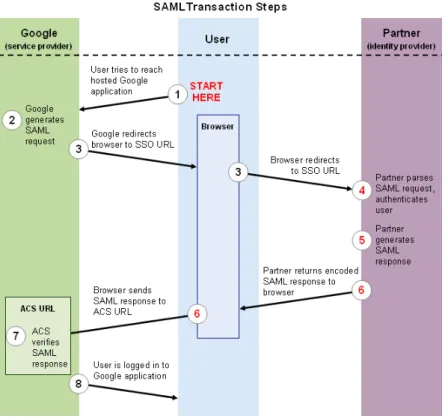
SAML 2.0 is pretty similar to OIDC in terms on how it works [21]. It uses the redirection of the user between the Service Provider and the Identity Provider in order to transfer tokens and validated and signed XML assertions.
3.5 Keycloak
Keycloak [22] is an open source Identity and Access Management solution created by RedHat. Its aim is to provide a simple platform to secure and protect web services with just basic configuration. It runs on top of Jboss EAP application server (now known as WildFly), and uses Java as programming language. As a database backend it can work with MySQL, MongoDB and PostgreSQL databases.
Administration in Keycloak works through a web control panel where all the settings can be changed. This avoids setting configuration through code and allows a short learning curve. The interface provides an easy overview of users, clients and permissions and explanations and tooltips for each of the settings.
Keycloak works with realms, which manage a sets of users, clients, roles, groups and its own configuration. Each realm is isolated from each other, and can only
manage authenticate users under their control. There is also a master realm which
provides full control over all the other realms and allows advanced operation settings of the other realms. Users are managed via roles and groups. Roles provide individual
Figure 6: Diagram representing a SAML 2.0 transaction workflow (from : https: //developers.google.com/google-apps/sso/saml_workflow_vertical.gif
permissions to each user, and groups organize users in a hierarchy structure. Each group has a set of roles which get assigned to the users inside of the group. Users inherit as well all the roles of the parent groups to which they belong to.
Keycloak provides authentication and authorization through two SSO protocols:
OpenID Connect 1.0 and SAML 2.0 [23], described in previous subsections 3.3 and
3.4. For each client created in a realm, you can choose to use either OIDC or SAML
as the SSO protocol. Keycloak also allows client templates, to use as a base to create new clients. For each individual client we can setup fine grained authorization to resources, client specific roles and the scope of claims we want to allow the client to access.
3rd party Identity Providers can be configured easily, so new users can register or identify with social networks accounts such as Facebook, Google, Twitter, etc. As an alternative it also allows to use generic SAML or OIDC providers providing the custom configuration for the Identity Provider.
Though Keycloak is designed to cover most use-cases without the need of coidng, Keycloak can be extended and customized via Service Provider Interfaces (SPI)
modules. SPIs provide different functions to Keycloak and extend its functionality.
Keycloak provides in its core two kinds of SPIs: private and public ones. Private SPIs are part of the core and can’t be extended. Public SPIs can be extended and used by other SPIs.
con-figuration changes that are stored usually in the database and to share concon-figurations with other instances.
Currently, Keycloak is in version 2.5.0 and in full development. In their website there isn’t a clear roadmap of the future features that will be implemented, though discussions and decisions are taken in their developers mailing list.
Also, Keycloak has been certified as a valid OpenID Connect implementation, which means that this platform conforms all the requirements of the OIDC protocol.
3.6 SimpleSAMLphp
SimpleSAMLphp [24] is a native implementation of SAML 2.0 written in PHP which can work both as a Identity Provider or Service Provider. The choice to use SimpleSAMLphp for CYCLONE comes from the need to synchronize the platform’s data with eduGAIN’s metadata services. Keycloak, even if you can use a SAML 2.0 endpoint as Identity Provider, per itself it doesn not provide a simple way to synchronize SAML metadata with a service such as the one provided by eduGAIN. In order to Keycloak support, a custom SPI extension would be needed to be developed. This is a rather tedious implementation.
Instead, a simpler solution is to use SimpleSAMLphp as an aggregation proxy of the IdPs towards Keycloak. SimpleSAMLphp supports the dynamic updates of metadatada provided from eduGAIN, and allows users to select with which of eduGAIN’s members he wants to authenticate. Then, the authentication information is relayed towards Keycloak and can be authenticated in the underlying services. This means that the endpoint to be registered in eduGAIN’s metadata directory needs to be SimpleSAMLphp’s one as it will be the one consuming the users data provided by the federation.
Though SimpleSAMLphp may look a different site than Keycloak, using a common
4 The service registration API
In subsection2.3 we described the different requirements that need to be covered so
CYCLONE can provide a complete solution. Specifically requirements R3 andR4
define that users should be able to deploy dynamically their services. This services need client credentials so they can authenticate users against the SSO server and fetch their credentials and private data.
In this chapter we first analyze the state of the art and the different options that
Keycloak provides out-of-the-box. Using this as a basis, we defend creating our own solution as these ready made ones do not cover the needs described by our use cases.
Next, we compare the different options to create our own Keycloak extension, and
finally we provide a detailed description on how we have implemented a Keycloak SPI module to extend the platform with the required registration functions.
4.1 State of the Art
In Keycloak clients are usually created in a manual fashion via the web interface where an admin will create the credentials and forward them to the requesting person. This procedure, though, is quite slow and requires user interaction, something not fitting when using automatic deployments through a deployment orchestrator. For CYCLONE to work, there is a need of an automatized system to create clients.
In actual existing use cases of SSO implementations, such as the ones provided by Facebook Connect or Google Accounts, this kind of credentials can be requested via a web interface and even using an API. The credentials are then tied not only to a client but also to the person requesting them and allowing thus to identify who has the ownership and rights on the dynamically created client credentials.
Keycloak, the SSO platform used by Cyclone, integrates some mechanisms to create the clients and its credentials:
• Using Keycloak API: Through the API that Keycloak exposes, new clients can
be created. Access to the API can be obtained requesting an access token in the admin API’s token endpoint using user’s credentials as authentication This access token can then be used to interact against the API itself.
In order to create a client in the API, the requesting user has to have a "create-clients" role in the specific realm. However, to edit any of the client settings a user then needs a "manage-clients" role. The combination of having this two roles created by Keycloak grants permissions not only to create but also edit and update any client in the realm. Giving these roles to many people would result in an easily exposed client management, and users with these roles would not only be able to edit their own configuration but also configuration relevant to other clients and services. A user with this rights would be able to give all the admin roles to the client’s user and then from a client escalate to have superadmin rights. Thus this system should only be allowed to be used to sysadmins or people with similar privileges. Another option would be to allow only creation access to users, but that means that any change that needs to
be done to the client (set a consent, scope of users, etc.) needs to be changed manually by someone who has the proper rights, usually an administrator.
• Using OpenID Connect Client Registration: When planning the implementation
of this thesis, Keycloak in version 2.0 provided an API endpoint implementing the OpenID Connect Registration specifications defined by the protocol. The OIDC registration endpoint works using shared registration tokens, which anonymous people can use in order to register clients by themselves. This registration tokens have a limited amount of uses and defined lifetime – usually long – and anyone who has this registration token can register a new client. The use of this tokens is focused to anonymous non authenticated users. As a result, there is no way to track who exactly used the token and who is creating clients. At most the only possibility would be tracking from which IP has the registration been done. Also, even if the token has long expiration time, it can still end under ownership of a malicious attacker, who could abuse it to fetch private data from users.
With this registration token, a new client can be created, and after the successful request a new token is received. This second token is a "client manager token" which can be used to update settings of the client. However, as per Keycloak 2.0 specifications it also allows to edit any other client aside of the created one. This means that any one who can create a client can eventually edit any other client in the same realm. Not only that, but this "client manager token" needs to be kept safe somewhere by the client creator in case it is needed to update the client. Also, after each of the usages of this token to update the client settings a new "client manager token" will be given replacing the previous one. So the creator of the client needs to keep safe a token that will get updated from time to time and that has excessive privileges.
This structure is as it is because as explained previously there is no way to track who is the people who is using the tokens and thus all this tokens need to be also anonymously used.
Summarizing, there are two existing solutions to create clients but both of them provide or require excessive permissions to the users using them. This excess of permission could eventually cause security issues and possible user data leaking. According to Keycloak’s developer mailing list there is a plan to implement more granular permissions in the platform, but there is no final decision on when this feature will be implemented. Thus, a new solution needs to be implemented that includes fine grained permissions when creating and managing clients and that tracks who is creating or using this rights.
4.2 Initial Plan
A new solution that allows fine grained permission and that allows us to track who is registering the clients needs to be implemented as the existing solutions that
Keycloak provides do not suit the user needs. The objective of our implementation is to have two main characteristics:
• The client registration API should allow us to authenticate ourselves using our
SSO credentials. As it is needed to know who is registering clients.
• Only people with the required privileges should be authorized to create and
edit clients, disallowing to take control of any other client. As we would have a proper authenticated user, we can define per-user authorization for each client. In the end we would create owner and resource relationship between a user and client respectively.
Following this two objectives, there are two main different approaches that we
could use to implement our requirements into Keycloak: 1. Create a wrapper for the existing Keycloak APIs
The first approach would be create a new API that uses the existing APIs as a backend and that extends them to provide the requirements we need. For example, we could create a micro service compoenent that would allow us to authenticate using our SSO credentials, and then it would relay the creation of the client against the OIDC client registration endpoint. This kind of implementation is less invasive and as it relies on web APIs it is easier that in the future there are no breaking changes between Keycloak and the extension. The main drawback of this approach is that we are creating new relationships and we would need to store this data somewhere, preferably in a database, not the same as the one being used by Keycloak, which would add a new component into the platform. This increments the number of components of the CYCLONE platform, and also decentralizes the authentication and SSO data between databases and services, which in turn rises the complexity and the maintainability of the the whole set of components.
2. Create a new API that fulfills all the requirements using Keycloak’s SPI extensions
This second approach would consist in implementing a whole new API endpoint, integrated directly into Keycloak’s using its SPI module system [25]. As a result we have to interact with Keycloak’s core SPI modules to manage the clients. This makes this implementation more fragile, as internal APIs are more likely to be changed. However, it also centralized and unifies all the new logic inside of Keycloak’s container, and thus simplifying the deployment and
maintainability of the system. Also, it is a more efficient approach in terms
of resources as DB queries can be tailored to the needs of the logic. Other benefits would be that there are more methods exposed internally that allow more flexibility when interacting with the client and user entities.
Another parallel discussion is about a possible interface that could be created to manage the API. Creating a the API using a wrapper, would mean creating a new
external component, outside of Keycloak and thus its UI. This results on having two
different UIs where inputting the data, and also increasing the complexity of the
system. In the case of integrating the solution as an SPI inside Keycloak, this allows us to (if needed) integrate the UI into Keycloak’s UI. This can be achieved through extending Keycloak’s theme in a plugin and exposing the API internally into the web interface. This, of course would also increase the security as we are relying in the secure implementation of Keycloak’s UI and we do not have to proof the security of a new website from scratch as it would hapeen in the first case.
Out of this two options, our decision was to implement a new SPI in Keycloak. The main driver was the maintainability of the system, and avoiding to increase the complexity with more components. Also, integrating the system directly into Keycloak would allow us to use similar authentication and security systems as the other API endpoints are using.
4.3 Architecture
To create our own extension module for Keycloak we have inspired ourselves in
Keycloak’s "domain-extension"1 example. This example contains guidelines to create
an authenticated endpoint and how to integrate calls to the database from within it. SPI extensions can contain multiple providers inside themselves and use already existing providers that are part of Keycloak’s core. Service Providers Interfaces (SPIs) in Keycloak are written in Java and make use of the factory method pattern to create new providers. This factory pattern "provides an interface with which a client can obtain instances of classes conforming to a particular interface or protocol without having to know precisely what class they are obtaining" [26]. Thus, through the use of this pattern, Keycloak can instantiate the new classes that extend their own functions.
To implement this pattern in Keycloak, we need to make use of theProviderFactory
and Provider interfaces. The ProviderFactory interface defines the factory class and includes the logic to create a new object of an specific class, which implements the Provider interface. In the other hand, the Provider interface defines a Provider object, which when extended, contains all the possible methods that we can use to interact with the provider. This interface also exposes inner methods from where we can request and intereact with other SPIs.
Also, a Keycloak SPI extension requires a class extending theSpi interface, where
we can define the basic parameters and name of our SPI.
In our SPI we need to at least implement three different Providers, that will cover
the different needs we have. This providers are located in their own sub-packages
inside of the org.cyclone.clientowner package:
• REST API (org.cyclone.clientowner.rest): defines all the API endpoints,
exe-cutes authentication and authorization and forwards the requests to the proper methods of the resource logic.
1https://github.com/keycloak/keycloak/tree/master/examples/providers/
• Resource logic (org.cyclone.clientowner.spi): defines all the main logic of the
SPI, and calls the methods in JPA entities to update them and update the database values. It also interacts with other SPIs such as the user, clients and realms SPI to take decisions in the logic.
• JPA Database Entity (org.cyclone.clientowner.jpa): defines a JPA database
entity interface and how the objects are stored into the database. Principally it defines the model and the relationship with other items in the database. The base of our extension is to create an ownership link between the a client and a user entities. Also, we need to include the realm entity so a relationship cannot be used outside of a specific realm. In this relationship we can save the information which indicates which user owns an specific client in a per realm basis. To create this design we need to use the client, users and realm SPIs, so we can access the respective database entities of each provider.
Finally, the JSON models used in our implementation are the same as the ones
used by Keycloak Admin REST API2. The reason is that doing so we keep the same
object formats for all the different requests towards Keycloak. This also simplifies
later on the translation from JSON object towards internal database entity object.
4.3.1 Authentication
To authenticate, using the ’domain-extension’ example as a reference, we can use the same authentication system as we have in Keycloak’s administration API. This can be done through the AppAuthManager class, which provides us functions to validate a bearer token given a context. The bearer token can be obtained through authentication using JWT or client credentials against Keycloak’s OIDC token endpoint, which its path is
/auth/realms/master/protocol/openid-connect/token. In general the workflow to authenticate against our endpoints is based on the Authorization Code Flow
described in subsection 3.3.4:
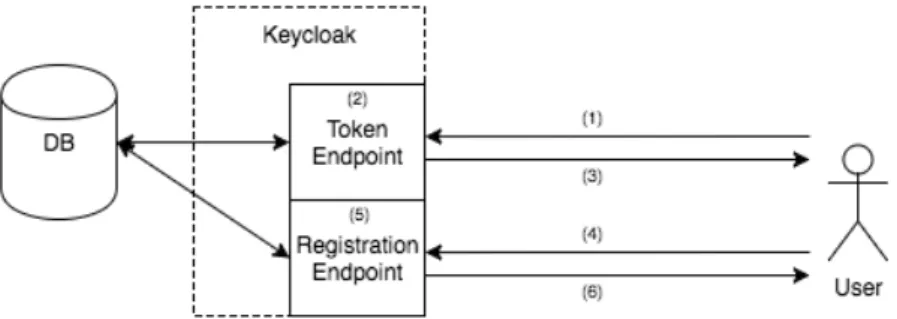
Figure 7: Represents the workflow required by the registration API implementation to register or modify a client
1. The user authenticates with its credentials against the OIDC Token End-point. Authentication can be done through JWT or client_id and client_secret credentials.
2. Keycloak generates OIDC tokens (access and refresh tokens), which allows the user to authenticate in other endpoints.
3. User gets these access and refresh JWTtokens.
4. User sends the registration data together with a Bearer token (access token) to authenticate. Registration data is a JSON with format ClientRepresentation. 5. Extension logic.
6. The user gets redirected to the new created resource (with all the information of the new client), or returns the proper code depending of the REST action. Then, an example cURL POST call to create a new set of tokens would consist in a request with the following header and body:
1 c u r l ≠X POST
2 ≠H " Accept≠Language : a p p l i c a t i o n / json "
3 ≠H " Content≠Type : a p p l i c a t i o n /x≠www≠form≠urlencoded "
4 ≠H " Cache≠Control : no≠cache "
5 ≠d ’ grant_type=password&username=admin&password=admin&
c l i e n t _ i d=admin≠c l i ’ " http :// l o c a l h o s t :8080/ auth/
realms / master / p r o t o c o l / openid≠connect / token "
Listing 1: cUrl command to generate a new set of OIDC tokens
In this case we are doing a password authentication, using the client_id and the client_secret. However, we could also authenticate ourselves using JWT authentica-tion. As the generated access tokens contain encoded data from the user, we later figure out who is who when requesting access to our implemented endpoints.
Then, afterwards, we can do a call with the provided access token to the wanted endpoint. This access token will last usually around 60 seconds. This is a configurable setting in Keycloak’s admin interface. In case of expiration, a new token can be requested through the token endpoint using the refresh token also obtained when authenticating against the OIDC token endpoint the first time.
1 c u r l ≠X POST ≠H " Authorization : bearer <a c c e s s token
here >"
2 ≠H " Content≠Type : a p p l i c a t i o n / json "
3 ≠H " Cache≠Control : no≠cache "
4 ≠d ’{
5 \\ body of the c a l l
6 } ’ " http :// l o c a l h o s t :8080/ auth/ realms / master / c l i e n t≠
r e g i s t r a t i o n /"
Listing 2: cUrl command to create a new client authenticating with an access token recived from the OIDC token endpoint.
4.4 SPI implementation
In this subsection we describe each of the different packages that conform our
implementation – REST API, JPA adapter and SPI logic – and we explain how we implement each of them. Each of the providers that conform the SPI have a FactoryProvider and Provider classes that interface with Keycloak so we can extend
with our custom code. A general overview of all the different classes that conform
the whole extension can be found in Figure 8.
4.4.1 REST API
To create the REST API for our registration system we use Java API for RESTful Web Services (JAX-RS), which is the framework that Keycloak uses to create its REST endpoints. To do so, first we create a a ResourceProviderFactory and we use
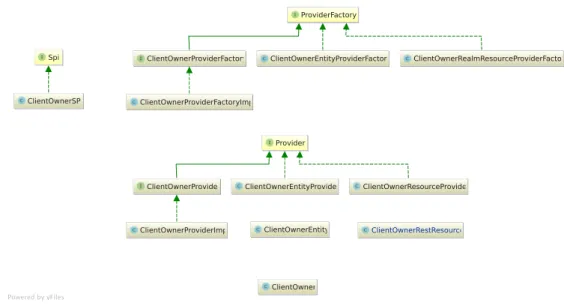
ClientOwnerEntityProvider ClientOwnerEntityProvider ClientOwnerProviderFactoryImpl ClientOwnerProviderFactoryImpl ClientOwnerProviderImpl ClientOwnerProviderImpl ClientOwnerResourceProvider ClientOwnerResourceProvider ClientOwnerProviderFactory ClientOwnerProviderFactory ClientOwner ClientOwner ClientOwnerRealmResourceProviderFactory ClientOwnerRealmResourceProviderFactory ClientOwnerRestResource ClientOwnerRestResource ClientOwnerSPI ClientOwnerSPI Provider Provider ClientOwnerProvider ClientOwnerProvider ClientOwnerEntityProviderFactory ClientOwnerEntityProviderFactory Spi Spi ProviderFactory ProviderFactory ClientOwnerEntity ClientOwnerEntity
Figure 8: Class relationship diagram depicting the relationship between the different
classes that conform the whole registration API extension.
it to create a ResourceProvider object. In the Factory object we define the identifier
of our provider, in our case client-registration. With this set of classes we indicate
to Keyclak, using the factory pattern, that our REST provider is defined in our ClientOwnerResourceProvider class. In turn, the ClientOwnerResource Provider class initializes all the API settings and instantiates a ClientOwnerRestResource
object that contains the API. We can see the relationship of these classes in Figure9.
ClientOwnerRealmResourceProviderFactory ClientOwnerRealmResourceProviderFactory ClientOwnerRestResource ClientOwnerRestResource ClientOwnerResourceProvider ClientOwnerResourceProvider ProviderFactory ProviderFactory RealmResourceProviderFactory RealmResourceProviderFactory Provider Provider RealmResourceProvider RealmResourceProvider «create» «create»
Figure 9: Class relationship diagram depicting the relationship between the different
classes that conform the API in the registration API.
Then, we can create the different endpoints using annotations in functions. With
the annotations (see lines 7 to 11 in Listing3), we can tell Java which kind of data
answer, which in our case we have set it to JSON. We can also define the path
variables in the function’s arguments. The name of the function does not affect at
all the endpoint. From inside the function we have access to the session information
and we can call the different functions that we implement in the SPI logic, which are
1 /úú
2 ú Endpoint to update c l i e n t s
3 ú auth /realm /{ realm }/ c l i e n t≠r e g i s t r a t i o n /{ c l i e n t I d }
4 ú
5 ú @return ClientRepresentation of the new c l i e n t
6 ú/
7 @PUT
8 @Path( " { c l i e n t I d } " )
9 @Consumes( MediaType .APPLICATION_JSON)
10 @NoCache
11 @Produces ( MediaType .APPLICATION_JSON)
12 public Response updateClientOwnerResource (@PathParam( " c l i e n t I d " ) String c l i e n t I d , ClientRepresentation c l i e n t R e p r e s e n t a t i o n ) { 13 checkRealmAdmin ( ) ; 14 checkClientOwnership ( c l i e n t I d ) ; 15 16 // Logic here 17 }
Listing 3: Example of annotation defining the settings of an endpoint
In all the different endpoints we are executing at first the logic to check the
authentication of the user. With it, first we make sure that the user has the needed role, which should be fetched thanks to the included bearer token. Then in cases of edition and deletion, we make sure that a user has ownership over the resource before giving access to manipulate it. To do so, we use the context information provided by Keycloak and we use the AppAuthManager class to authenticate the bearer token. Also, at the end of each endpoint’s logic we handle any possible error and we construct the requited HTTP errors to inform properly the user. All the
endpoints we have created are under the base path <domain>/auth/realm/{realm}/
which is set by Keycloak. This path allows us to process the calls individually per
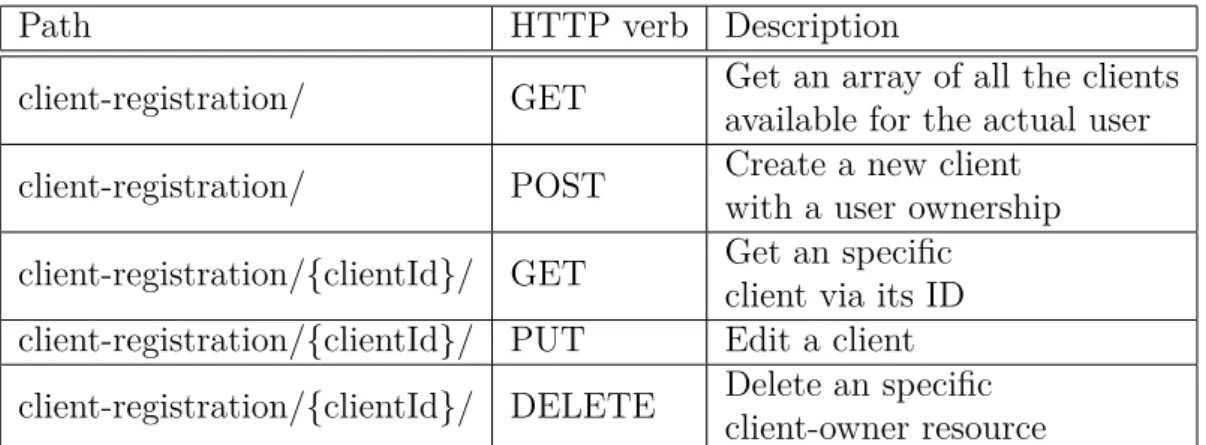
realm. We have created 5 different endpoints (see Table2) to manage all the different
CRUD operations that we might need in our extension.
All this endpoints either return or receive an object with structure of
ClientRep-resenation3 or an array of this kind of items. None of the attributes is required when
creating a new client as and otherwise it will use the default value or randomize it.
However we suggest to at least set the clientId value for easier management of clients.
We have chosen to use this representation because Keycloak exposes methods in other SPIs to convert JSON objects to Keycloak models and vice versa in an easy fashion, which simplifies the implementation. Note that the conversion is to models and not to entities used in the database.