DigitalCommons@University of Nebraska - Lincoln
Faculty Publications from the Department of
Electrical and Computer Engineering
Electrical & Computer Engineering, Department of
2018
Optimal Computational Power Allocation in
Multi-Access Mobile Edge Computing for
Blockchain
Yuan Wu
Zhejiang University of Technology, [email protected]
Xiangxu Chen
Zhejiang University of Technology, [email protected]
Jiajun Shi
Zhejiang University of Technology, [email protected]
Kejie Ni
Zhejiang University of Technology, [email protected]
Liping Qian
Zhejiang University of Technology, [email protected] See next page for additional authors
Follow this and additional works at:
http://digitalcommons.unl.edu/electricalengineeringfacpub
Part of the
Computer Engineering Commons, and the
Electrical and Computer Engineering
Commons
This Article is brought to you for free and open access by the Electrical & Computer Engineering, Department of at DigitalCommons@University of Nebraska - Lincoln. It has been accepted for inclusion in Faculty Publications from the Department of Electrical and Computer Engineering by an authorized administrator of DigitalCommons@University of Nebraska - Lincoln.
Wu, Yuan; Chen, Xiangxu; Shi, Jiajun; Ni, Kejie; Qian, Liping; Huang, Liang; and Zhang, Kuan, "Optimal Computational Power Allocation in Multi-Access Mobile Edge Computing for Blockchain" (2018).Faculty Publications from the Department of Electrical and Computer Engineering. 463.
This article is available at DigitalCommons@University of Nebraska - Lincoln:http://digitalcommons.unl.edu/ electricalengineeringfacpub/463
Article
Optimal Computational Power Allocation in
Multi-Access Mobile Edge Computing
for Blockchain
Yuan Wu1,2,* , Xiangxu Chen1, Jiajun Shi1, Kejie Ni1, Liping Qian1 , Liang Huang1
and Kuan Zhang3
1 College of Information Engineering, Zhejiang University of Technology, Hangzhou 310023, China;
[email protected] (X.C.); [email protected] (J.S.); [email protected] (K.N.); [email protected] (L.Q.); [email protected] (L.H.)
2 State Key Laboratory of Integrated Services Networks, Xidian University, Xi’an 710071, China 3 Department of Electrical and Computer Engineering, University of Nebraska-Lincoln, Omaha,
NE 68182-0572, USA; [email protected]
* Correspondence: [email protected]
Received: 7 September 2018; Accepted: 12 October 2018; Published: 15 October 2018
Abstract:Blockchain has emerged as a decentralized and trustable ledger for recording and storing digital transactions. The mining process of Blockchain, however, incurs a heavy computational workload for miners to solve the proof-of-work puzzle (i.e., a series of the hashing computation), which is prohibitive from the perspective of the mobile terminals (MTs). The advanced multi-access mobile edge computing (MEC), which enables the MTs to offload part of the computational workloads (for solving the proof-of-work) to the nearby edge-servers (ESs), provides a promising approach to address this issue. By offloading the computational workloads via multi-access MEC, the MTs can effectively increase their successful probabilities when participating in the mining game and gain the consequent reward (i.e., winning the bitcoin). However, as a compensation to the ESs which provide the computational resources to the MTs, the MTs need to pay the ESs for the corresponding resource-acquisition costs. Thus, to investigate the trade-off between obtaining the computational resources from the ESs (for solving the proof-of-work) and paying for the consequent cost, we formulate an optimization problem in which the MTs determine their acquired computational resources from different ESs, with the objective of maximizing the MTs’ social net-reward in the mining process while keeping the fairness among the MTs. In spite of the non-convexity of the formulated problem, we exploit its layered structure and propose efficient distributed algorithms for the MTs to individually determine their optimal computational resources acquired from different ESs. Numerical results are provided to validate the effectiveness of our proposed algorithms and the performance of our proposed multi-access MEC for Blockchain.
Keywords: multi-access; mobile edge computing; computational power allocation; optimization; Blockchain
1. Introduction
Blockchain, a distributed and trustable architecture for recording and storing digital transactions, has been considered as one the promising mechanisms for enabling the secure cyber-physical systems [1]. In the framework of Blockchain, the miners participate in a mining game [2], and all miners compete with each other to be the first winner to solve the proof-of-work puzzle (which corresponds to executing a series of hashing computation). After solving the proof-of-work puzzle and broadcasting the mined block to other miners to reach the consensus, the winner can claim the consequent reward.
Nowadays, there exist several different mining pools (e.g., Slush Pool and AntPool), in which the miners can select to join and participate in the mining game/process [3]. Thanks to the nature of distributed management and independence from the central authorities, Blockchain has been expected to play a crucial role as a distributed and trustable ledger for recording and storing a variety of transactions and resource exchange, e.g., the crypto-currency and peer-to-peer electronic payment system [4], energy trading in smart grid [5,6], computation offloading in vehicular networks [7], radio resource exchange in wireless networks [8], and Internet of Things (IoTs) [9–12].
However, solving the proof-of-work puzzle requires consuming a significant amount of computational resources, which are prohibitive from the perspective of the mobile terminals (MTs). To address this difficulty, the MTs can exploit the recent advanced mobile edge computing (MEC) to enhance their computational capability [13,14]. In particular, the MEC enables the MTs to offload their computational workloads to the edge servers (ESs) equipped with sufficient computational resources and deployed at the edge of the radio access networks (e.g., the cellular base stations, BSs), which thus reduces the computation time and improves the resource utilization efficiency. As a result, MEC has been considered as one of the enabling technologies for realizing the future IoTs and the fifth generation (5G) visions which aim at providing massive connectivity, high access speed, and low latency [15]. The recent multi-access MEC, which can be enabled by the advanced Non-orthogonal multiple access (NOMA) [16–18], further allows the MTs to acquire computational resources from several ESs simultaneously, and thus yields a flexible exploitation of the computational resources from multiple ESs [19–21]. Therefore, by integrating MEC into the framework of Blockchain, the computational capability of the MTs can be effectively enhanced, which thus facilitates solving the proof-of-work puzzle and increases the successful probability in winning the mining game [22,23].
Thanks to its advantage, MEC has been exploited in many different paradigms, e.g., green IoT and vehicular networks [24–26]. In the following, we mainly review the studies about the resource management for MEC. Focusing on the single user’s binary task-offloading, Melendez et al. proposed the offloading decisions for reducing the completion time [27]. Further taking into account the radio resource utilization in MEC, many studies have been devoted for the joint optimization of task offloading and radio resource allocation [28–30]. Optimal offloading strategies for partial computation offloading (in which the MTs are allowed to offload partial of their computational workloads) have been investigated in [31,32]. The scenario of multi-user MEC is close to our study here. Focusing on minimizing the delay in completing the computation tasks, there have been many studies investigating the proper multi-user computational resource allocation [33,34]. In [35], a multi-user computational resource allocation (i.e., the CPU cycle) scheme has been proposed to save the users’ energy consumption. In [36], Jin et al. proposed an auction-based scheme for sharing the computational resource at the mobile edge. In [37], a revenue-maximization oriented computational resource allocation scheme has been proposed. In particular, some recent work investigated the exploitation of MEC for Blockchain. In [22], Xiong et al. exploited the MEC for Blockchain and investigated the resource management and pricing strategy. In particular, the paper formulated a two-stage Stackelberg game to maximize the profit of the edge service provider and the utilities of the miners. In [23], Liu et al. studied the computation offloading and content caching in wireless Blockchain networks with MEC. In particular, the economics based mechanisms have been envisioned as the promising approaches for enabling efficient yet distributed resource allocations in wired or wireless networks [38–40], in which the pricing mechanism and game theoretic modelling have been widely exploited. For instance, in [41], Ha et al. proposed time dependent pricing scheme for mobile data management. In [42], Tsiropoulou et al. proposed a novel joint customized price and power control for optimizing the energy-efficiency in multi-service wireless networks. In recent work [43], by taking into account the competitive wireless Internet service market, Vamvakas et al. proposed an efficient pricing strategy for the joint dynamic provider selection and the associated power allocation. In this work, we exploit the mechanism of the dual price (which is also referred as the shadow price)
to achieve an efficient allocation of the edge servers’ computational resources to different mobile users/miners.
In this work, we investigate the optimal allocation of the computational resource/power in multi-access MEC enabled Blockchain. As described before, the multi-access MEC enables each MT to obtain the computational power from multiple ESs simultaneously (in the following, we use the term of computational power and the term of computational resource interchangeably). As a result, the MT can increase its successful probability when participating in the mining game and gain the consequent reward (i.e., winning the bitcoin). However, as a compensation to the ESs, the MT needs to pay for the consequent cost for acquiring the computational resources. Our contributions in this work can be summarized as follows:
• To investigate the trade-off between obtaining the computational resources from the ESs (for solving the proof-of-work) and paying for the consequent cost, we focus on a scenario in which a group of the MTs acquire the computational powers from a set of nearby ESs and pay for the consequent costs for acquiring the computational powers. Mathematically, we formulate an optimization problem in the MTs to determine their acquired computational powers from different ESs, with the objective of maximizing the MTs’ total net-reward while keeping the fairness among the MTs.
• Despite the non-convexity of the formulated optimization problem, we exploit its layered structure and design two algorithms (one for the one-ES scenario and the other for the multi-ES scenario) to find the optimal solution efficiently. We also provide extensive numerical results to validate the effectiveness of our proposed algorithms and show the performance of our proposed multi-access MEC for Blockchain.
The reminder of this paper is organized as follows. We present the system model and problem formulation in Section2. We first focus on the one-ES scenario and propose a distributed algorithm to compute the optimal solution in Section3. We then consider the multi-ES scenario and propose a corresponding distributed algorithm to achieve the optimal solution in Section4. We conclude this work in Section5and discuss the future directions.
2. System Model and Problem Formulation System Model
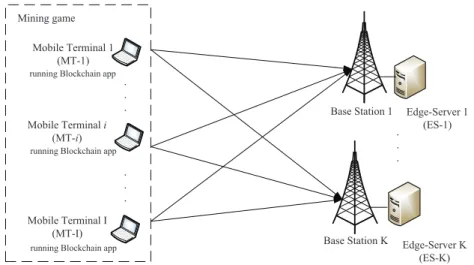
We consider a system model as shown in Figure1. Specifically, a group of the ESs denoted byK = {1, 2, ...,K}provide the computing services to a group of the MTs which are denoted by
I = {1, 2, ...,I}. Enabled by the multi-access MEC, each MTi ∈ I can acquire the computational power from the ESs simultaneously. Specifically, we usexki to denote MTi’s computational power from ESkand usexloci to denote MTi’s local computational power. Thus, each MTi’s total computational powerθican be expressed as:
θi =xloci +
∑
k∈Kxki,∀i∈ I. (1)
In this work,θi,xloci , andxki are all measured in the unit of GHash/sec. Furthermore, we introduce
αito denote MTi’s total computational power with respect to the overall computational power of all
MTs, i.e., αi = θi ∑i∈Iθi = x loc i +∑k∈Kxki ∑i∈Ixloci +∑i∈I∑k∈Kxik
!"#$%&'%()#*+$&, - '.,/ !"#$%&'%()#*+$&i !"#i !"#$%&'(&)*$+,%'-.!(/- )0++$+1'2%"3435,$+',66 )0++$+1'2%"3435,$+',66 )0++$+1'2%"3435,$+',66 !$+$+1'1,*& 2,7&'89,9$"+': ;<1&/8&)=&)': .;8/: 2,7&'89,9$"+'> ;<1&/8&)=&)'> .;8/>
Figure 1. System model: a group of mobile terminals offload computational workloads to the edge servers.
In the mining game, the MTs compete against each other to be the first one to solve the proof-of-work puzzle and receive the reward accordingly. Similar to [22], we model the successful probability that MTiwins the mining game (including that MTisuccessfully mines the block and its solution reaches the consensus) as a random variable as follows:
Pi(αi,ti) =αi
1− Porphan(ti)
, (3)
wheretidenotes MTi’s block-size, and functionPorphan(ti)denotes the orphaning probability [22]
as follows:
Porphan(ti) =1−e−λti. (4)
The use of the abovePorphan(ti)can be explained as follows. After solving the proof-of-work
puzzle, MT i needs to broadcast its result to other MTs for reaching the consensus. Since the broadcasting of the computation-result among the MTs suffers from a certain delay, it is possible that MTifails to be the first one whose computation-result reaches the consensus among all MTs (even though that MTiis the first one who solves the proof-of-work puzzle). The orphaning probability
Porphan(ti)in (4) quantifies such a probability. In particular, the same as [22,44], we expressP(ti)as
the Poisson distribution with parameterλ, in which parameterλdenotes the inter-arrival rate of the Poisson distribution. Based on (3), we can express MTi’s net-reward function in winning the mining game as follows:
mi= (R+rti)Pi(αi,ti)−
∑
k∈K
pkxik, (5)
whereRdenotes the fixed reward, andrtidenotes the variable reward which linearly grows with MT
i’s block-sizeti(parameterris a fixed constant). Parameterpkdenotes the marginal price of ESkfor
In this work, we consider that the MTs acquire the computational power from the group of the ESs with the objective of maximizing the total net-reward, while keeping the fairness among them. To this end, we formulate the following total net-reward optimization (TRO) problem:
(TRO): max
∑
i∈I
ln(mi),
subject to: constraints(1),(2),(3), and(5), 0≤
∑
i∈I
xik≤Ck,tot,∀k∈ K, (6)
variables: xki ≥0,∀i∈ I,k∈ K.
Constraint (6) ensures that all MTs’ total computational power acquired from ESkcannot exceed ESk’s maximum computational powerCk,tot. Notice that since bothθ
i andαidepend on{xki}k∈K,
we just treat{xki}i∈I,k∈Kas the decision variables in Problem (TRO). However, Problem (TRO) is a
complicated non-convex optimization problem, and there exists no general algorithm that can solve it efficiently [45]. We will propose a distributed algorithm to compute the optimal solution in the next two sections. Specifically, in our proposed algorithm, each MT individually determines the acquired computational powers from different ESs. Then, viewing the aggregate demands from all MTs, the ESs further update their respective computational powers allocated to all MTs for maximizing the total net-reward. Thus, our algorithm does not require a central entity to collect the global information in the considered network. Nevertheless, the downside of our proposed algorithm is that it requires the message exchange between the MTs and the ESs, meaning that the MTs and ESs need to take the additional burdens on sending and receiving the required messages for reaching the optimal solution.
3. One-ES Scenario and Proposed Distributed Algorithm 3.1. Problem Formulation and Its Decomposition
We first consider one-ES scenario and aim at finding the optimal allocation of the computational resource for the MTs. For the sake of easy presentation, we use ESk=1 as an example in the following. In particular, with one ES, Problem (TRO) turns into :
(TRO-ES): max
∑
i∈I ln(R+rti) xloci +x1i ∑ i∈Ix loc i + ∑ i∈Ix 1 i e−λti−p1x1 i , subject to: 0≤∑
i∈I x1i ≤C1,tot, variables: x1i ≥0,∀i∈ I.However, Problem (TRO-ES) is still a non-convex optimization problem, which is difficult to solve in general. To efficiently solve Problem (TRO-ES), we adopt a vertical decomposition as follows. We firstly introduce an auxiliary variableµto denote all MTs’ total computational power obtained from ES 1, i.e.,
∑
i∈I
x1i =µ, (7)
Suppose that the value ofµis given in advance. We thus aim at solving the following subproblem: (TRO-ES-Sub): Vµsub=max
∑
i∈I ln(Aix1i +Bi), subject to:
∑
i∈I x1i =µ, (8) Aix1i +Bi ≥0,∀i∈ I, (9) variables: x1i ≥0,∀i∈ I, with parametersAiandBigiven by:Ai = (R +rti)e−λti ∑i∈Ixiloc+µ −p1, (10) Bi = (R +rti)e−λti ∑i∈Ixiloc+µx loc i . (11)
Notice that, in Subproblem (TRO-ES-Sub), we useVsub
µ to denote the optimal value of Subproblem
(TRO-ES-Sub), which depends on the given value ofµ(i.e., the total computational power obtained from ES 1).
After solving Problem (TRO-ES-Sub) and obtainingVµsub(for each givenµ), we continue to find the optimal value ofµ(denoted byµ∗) for maximizingVµsub, i.e., solving the following top-problem:
(TRO-ES-Top): maxVµsub, variable: 0≤µ≤C1,tot.
The reason for us to adopt the above proposed vertical decomposition is as follows. Given the value ofµ, Subproblem (TRO-ES-Sub) is a strictly convex optimization (i.e., Proposition1provided below), which enables us to solve it efficiently. In the next subsection, we propose a distributed algorithm to solve Subproblem (TRO-ES-Sub) and Top-problem (TRO-ES-Top).
3.2. Proposed Algorithm to Solve Subproblem (TRO-ES-Sub)
To efficiently solve Subproblem (TRO-ES-Sub), we firstly identify the following property.
Proposition 1. Givenµ, Subproblem (TRO-ES-Sub) is a strictly convex optimization.
Proof. Given the value ofµ, the values of{Ai,Bi}i∈I are all fixed. Thus, according to the convex
optimization theory [45], Problem (TRO-ES-Sub) is a strictly convex optimization problem.
The convexity of Subproblem (TRO-ES-Sub) enables us to use the Karush–Kuhn–Tucker (KKT) conditions [45] to compute the optimal solution. In particular, to solve Subproblem (TRO-ES-Sub), we identify the following three possible cases.
Case Iin which we haveAi<0,∀i∈ I, and ∑
i∈I −Bi Ai ≥µ.
In Case I, we define Ci = −Ai,∀i ∈ I. With {Bi,Ci}i∈I, Problem (TRO-ES-Sub) can be
equivalently changed into Problem (TRO-ES-Sub-I):
(TRO-ES-Sub-I): Vµsub=max
∑
i∈I ln(Bi−Cix1i), subject to:
∑
i∈I x1i ≥µ, (12) variables: 0≤x1i ≤ Bi Ci ,∀i∈ I.Problem (TRO-ES-Sub-I) is again a strictly convex optimization problem. Moreover, it can be observed that constraint (12) is strictly binding at the optimum. Thus, we introduce the dual variable λto relax (12) and obtain the Lagrangian function as (where the subscript “I” stands for Case I):
LI({x1i}i∈I,λ) =
∑
i∈I
ln(Bi−Cix1i) +λ(
∑
i∈Ix1i −µ). (13)
With the KKT condition and (13), we can derive the optimal solution for Problem (TRO-ES-Sub-I) as follows:
x1i∗ =max Bi Ci − 1 λ∗, 0 ,∀i∈ I, (14)
whereλ∗is determined according to the following condition:
∑
i∈I
x1i∗=µ. (15)
Based on (14) and (15), we can propose the following distributed algorithm (i.e., Algorithm1) to solve Problem (TRO-ES-Sub-I). Notice that, in Algorithm1, exploiting the monotonic property of (14), we use the bisection-search (i.e., from Step3to Step11) to findλ∗until condition (15) is satisfied.
Algorithm 1:To solve Problem (TRO-ES-Sub-I) and determine{x1i}∗andVsub
µ Input: Each MTi’sAiandBi.
Initialization: ES 1 setsλas a sufficiently large number andλ=0. Set the tolerance for the
computational errorεas a small number. while|λ−λ|>εdo
ES 1 setsλcur=λ+2λand broadcastsλcurto all MTs.
Each MTi∈ Isetsx1 i =max n Bi Ci− 1 λcur, 0 o and reportsx1 i to ES 1. if ∑ i∈I x1i >µthen ES 1 updatesλ=λcur. else ES 1 updatesλ=λcur. end if end while
ES 1 setsλ∗=λcurand broadcastsλ∗to all MTs inI.
Each MTi∈ Isetsx1∗ i =max n Bi Ci − 1 λ∗, 0 o
and reports the value of ln(Aix1i∗+Bi)to ES 1. Output: ES 1 outputsVµsub=∑i∈Iln(Bi−Cix1i∗)based on all MTs’ reports.
Case IIin which there exists a subset of MTi∈ IwithAi >0. In particular, we denote this subset as
Isub={i∈ I |Ai>0}.
In Case II, we can derive the optimal solution of Problem (TRO-ES-Sub) as follows. For each MTi
withAi <0, we setx∗i =0 directly. For the MTs inIsub, we can express Problem (TRO-ES-Sub) as:
(TRO-ES-Sub-II): Vµsub=max
∑
i∈Isub ln(Aix1i +Bi), subject to:
∑
i∈Isub x1i ≤µ, (16) variables: x1i ≥0,∀i∈ Isub.It can be observed that Subproblem (TRO-ES-Sub-II) is a strictly convex optimization problem, and the optimal solution occurs when constraint (16) is binding. We thus introduce the dual variableλ to relax (16) and obtain the following Lagrangian function:
LII({x1i}i∈I,λ) =
∑
i∈Isub
ln(Aix1i +Bi) +λ(µ−
∑
i∈Isub
x1i). (17)
With the KKT condition and (17), we can derive the optimal solution for Subproblem (TRO-ES-Sub-II) as follows: x1i∗=max 1 λ∗ − Bi Ai , 0 ,∀i∈ Isub, (18)
withλ∗determined according to the following condition
∑
i∈Isub
x1i∗=µ. (19)
Based on (18) and (19), we can propose the following distributed algorithm (i.e., Algorithm2) to solve Problem (TRO-ES-SubII). Notice that, in Algorithm2, exploiting the monotonic property of (18), we use the bisection-search (i.e., from Step4to Step12) to findλ∗until condition (19) is satisfied.
Algorithm 2:To solve Problem (TRO-ES-Sub-II) and determine{x1i∗}andVµsub Input: Each MTi’sAiandBi.
Initialization: ES 1 setsλas a sufficiently large number andλ=0. Set the tolerance for the
computational errorεas a small number.
MTi∈ Isetsx1i∗ =0 if itsAi≤0 and reports to ES 1. while|λ−λ|>εdo
ES 1 setsλcur=λ+2λand broadcastsλcurto the MTs inIsub.
Each MTi∈ Isubsetsx1i =maxnλ1cur −BAi
i, 0 o and reportsx1i to ES 1. if ∑ i∈I x1 i >µthen ES 1 updatesλ=λcur. else ES 1 updatesλ=λcur. end if end while
ESisetsλ∗ =λcurand sendsλ∗to all MTs inIsub.
Each MTi∈ Isubsetsx1i∗=maxnλ1cur−ABii, 0 o
and reports the value of ln(Aix1i∗+Bi)to ES 1. Output: ES 1 outputsVµsub=∑i∈I
subln(Aix
1∗
i +Bi) +∑i∈I,i∈I/ subln(Bi)based on all MTs’ reports.
Case IIIin which we have Ai <0,∀i ∈ I and moreover, ∑
i∈I
−Bi
Ai
< µ. Case III is a trivial case in which Problem (TRO-ES-Sub) is infeasible.
As a summary of the above Case I, Case II, and Case III, we propose the following Algorithm3to solve Problem (TRO-ES-Sub) and determine{x1i∗}i∈IandVµsub. In Algorithm3, we use Algorithm1
(in Step7) and Algorithm2(in Step10) as the subroutines. Until now, we have completed solving Problem (TRO-ES-Sub) for the given value ofµ.
Algorithm 3:To solve Problem (TRO-ES-Sub) and determine{x1i}∗andVµsub Input: The value ofµ.
Each MTi∈ Ireports itsxloci to ES 1. ES 1 computesXloc=∑
i∈Ixloci and sendsXlocto all MTs.
Each MTiuses (10) to computeAi= (R+rti)e −λti
Xloc+µ −p1, and uses (11) to computeBi= (R+rti)e −λti
Xloc+µ xiloc.
Each MT reports its(Ai,Bi)to ES 1. ifCase I holdsthen
Use Algorithm1to output{x1i∗}i∈IandVµsub. else
ifCase II holdsthen
Use Algorithm2to output{x1i∗}i∈IandVµsub. else
Output that Problem (TRO-ES-Sub) is infeasible under the currentµ. end if
end if
3.3. Proposed Algorithm to Solve Top-Problem (TRO-ES-Top)
We continue to solve Top-problem (TRO-ES-Top) in this subsection. Notice that, for each givenµ, we can use Algorithm3to obtain the value ofVµsub. However, the difficulty in solving Top-problem (TRO-ES-Top) lies in that we cannot deriveVµsubanalytically. As a result, Top-problem (TRO-ES-Top) is an optimization problem in which the objective function cannot be analytically given, which thus prevents us from using the conventional gradient based approach to solve it. Fortunately, the viable interval of theµis fixed, namely,µ∈[0,C1,tot]. Exploiting this property, we can use a linear-search (LS) with a very small step-size to numerically find the best value ofµ(which is denoted byµ∗) that can maximizeVsub
µ . The details are shown in the following Algorithm4. Notice that, in Step3, we use
Algorithm3as the subroutine to determine the value ofVsub
µ (and the corresponding optimal{x1 ∗ i }i∈I)
under the currently enumeratedµ.
Algorithm 4:To solve Top-problem (TRO-ES-top) and determineµ∗
Initialize: CBV=0 and CBS=∅. Set∆as a very small step-size.
forµ=∆:∆:C1,tot do
Use Algorithm3to determineVµsuband{x1i∗}i∈I.
ifVsub
µ >CBVthen Set CBS={x1∗
i }i∈Iand CBV=Vµsub. end if
end for
Output: Set the optimal solution according to CBS.
The computational complexity of our Algorithm4can be analyzed as follows. First, as the internal subroutines of Algorithm4, both Algorithms1and2require executing a bisection search with the complexity of log2 λ−λe
. In addition, the linear search in Algorithm4requires consumingCtot1
∆ rounds of the iterations (notice that only one of the two subroutines, i.e., Algorithms1and2, will be invoked in each round of the iterations). As a result, the total complexity of our proposed Algorithm4is given byC1tot ∆ log2 λ−λ e .
3.4. Numerical Results for One-ES Scenario
We present the numerical results to validate the effectiveness of our proposed algorithms to solve Problem (TRO-ES). We set the parameter-settings according to the data provided in [46] (Table1 lists the detailed settings). Specifically, we setλ = 6001 (i.e., the average generating-time for each block is 10 min) and each block-sizeti = 1 Mbit. Meanwhile, according to [46], we setR = 7000$
for each block and setr = 1000 $/Mbit. In addition, for MTi, the local computational powerxki
is randomly generated according to a uniform distribution within [1,2] GHash/sec. Finally, we set
p1=10 $/GHash according to the ES’s unit cost for providing the computational power.
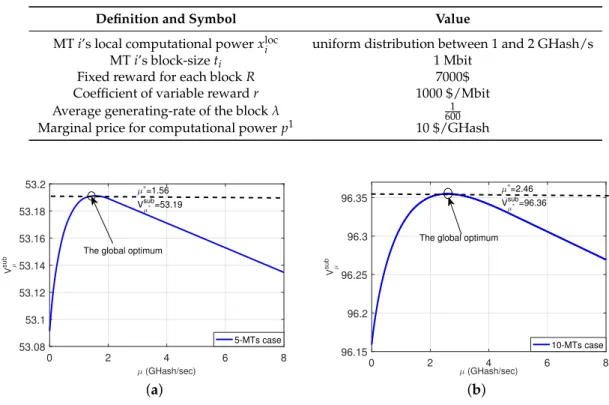
To illustrate the rationale of our proposed decomposition, we provide Figure2to show howVµsub
varies with differentµ. We test a 5-MT case (in the left subplot) and a 10-MT case (in the right subplot). Figure2shows thatVµsubfirstly increases whenµincreases, and then gradually decreases whenµ is beyond a certain threshold. Such a phenomenon ofVµsubmatches the intuition very well, namely, neither a too smallµnor too smallµwill be beneficial to the computation offloading. On the one hand, whenµis too small, the MTs can only obtain a small amount of computational power from the ES, which results in a small total net-reward. On the other hand, whenµis too large, a large cost is incurred for obtaining the computational power, which again degrades the total net-reward. This phenomenon is the motivation of our work, i.e., to find the optimal trade-off between exploiting the computational power provided by the ES and the consequent cost.
Table 1.Important parameter settings.
Definition and Symbol Value
MTi’s local computational powerxloci uniform distribution between 1 and 2 GHash/s
MTi’s block-sizeti 1 Mbit
Fixed reward for each blockR 7000$
Coefficient of variable rewardr 1000 $/Mbit
Average generating-rate of the blockλ 6001
Marginal price for computational powerp1 10 $/GHash
0 2 4 6 8 µ (GHash/sec) 53.08 53.1 53.12 53.14 53.16 53.18 53.2 Vµ sub 5-MTs case The global optimum
µ∗=1.56 V µ∗ sub=53.19 (a) 0 2 4 6 8 µ (GHash/sec) 96.15 96.2 96.25 96.3 96.35 Vµ sub 10-MTs case The global optimum
µ∗=2.46 V µ∗ sub =96.36 (b)
Figure 2.Vµsubversus differentµ. (a): a 5-MT case; (b): a 10-MT case.
Table2validates the effectiveness of our Algorithm4for solving Top-problem (TRO-ES-Top). For the purpose of comparison, we use a benchmark scheme that exploits the convexity of Problem (TRO-ES-Sub). Specifically, we use CVX [45] (which is a commercial solver for convex optimization) to solve Problem (TRO-ES-Sub) directly for each givenµand then execute a linear search ofµ∈[0,C1,tot] to solve Top-problem (TRO-ES-Top). Table2shows the optimal value achieved by different schemes and the corresponding computation-time. Notice that all the results are obtained on a PC with Intel Core i5-4590 [email protected]. As shown in Table 2, our Algorithm4 can achieve the global
optimum solution as the benchmark scheme, and, moreover, our Algorithm4consumes a significantly less computation-time than the benchmark scheme, which thus validates the effectiveness of our proposed algorithm.
Table 2.Performance of our proposed algorithm.
5-MT Case ti= 0.2 Mbit ti= 0.4 Mbit ti= 0.6 Mbit ti= 0.8 Mbit ti= 1 Mbit
LS Proposed 52.4482 52.6437 52.8338 53.0190 53.1994
Computing Time 0.314 s 0.278 s 0.249 s 0.212 s 0.261 s
Benchmark 52.4482 52.6437 52.8338 53.0190 53.1994
Computing Time 148.5 s 154.4 s 140.39 s 143.2 s 146.2 s
10-MT Case ti= 0.2 Mbit ti= 0.4 Mbit ti= 0.6 Mbit ti= 0.8 Mbit ti= 1 Mbit
LS Proposed 94.8489 95.2408 95.6220 95.9932 96.3549
Computing Time 0.346 s 0.352 s 0.344 s 0.331 s 0.322 s
Benchmark 94.8489 95.2408 95.6220 95.9932 96.3549
Computing Time 197.4 s 197.6 s 198.4 s 199.5 s 210.2 s
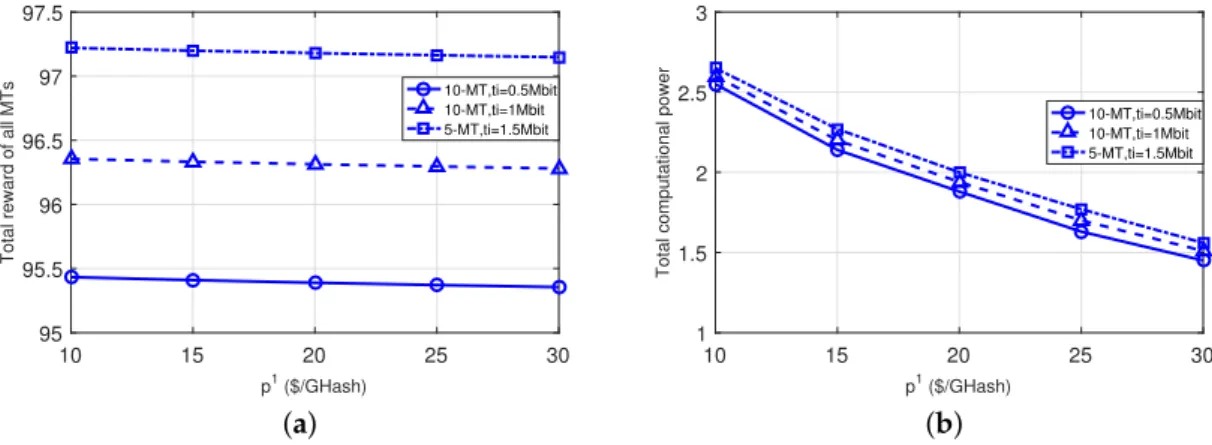
Figure3evaluates the impact of the ES’s price for providing the computational power to the MTs. When the price increases, the MTs become conservative in using the computational power from the ES, and thus the total computational power acquired from ES 1 decreases (as shown in the right subplot). Accordingly, all MTs’ total net-reward gradually decreases when the price increases (as shown in the left subplot). 10 15 20 25 30 p1 ($/GHash) 95 95.5 96 96.5 97 97.5
Total reward of all MTs
10-MT,ti=0.5Mbit 10-MT,ti=1Mbit 5-MT,ti=1.5Mbit (a) 10 15 20 25 30 p1 ($/GHash) 1 1.5 2 2.5 3
Total computational power
10-MT,ti=0.5Mbit 10-MT,ti=1Mbit 5-MT,ti=1.5Mbit
(b)
Figure 3.Impact of different ES prices. (a): total net-reward; (b): total computational power.
4. Multi-ES Scenario and Proposed Distributed Algorithm 4.1. Problem Decomposition
We next consider the multi-ES scenario and focus on solving Subproblem (TRO-Sub) and Top-problem (TRO-Top). As we have described before, Problem (TRO-ES) is a non-convex optimization problem which is difficult to solve in general. To this end, we again adopt a vertical decomposition, by introducing an auxiliary variableνiwhich denotes MTi’s totally acquired computational power
from all ESs, namely,
νi =
∑
k∈KFirstly, we assume that the values of{νi}i∈I are given in advance, and we aim at solving the
subproblem as follows:
(TRO-Sub): H{subνi}
i∈I =max
∑
i∈I ln (R+rti) xloci +νi ∑i∈I xloci +νi e−λti−∑
k∈K pkxki ! , (21) subject to: 0≤∑
i∈I xki ≤Ck,tot,∀k∈ K, (22)∑
k∈K xki =νi,∀i∈ I, (23) variables: xik≥0,∀i∈ I,k∈ K.After solving Subproblem (TRO-Sub) and obtainingHsub{ν
i}i∈I (for the given{νi}i∈I), we continue
to solve the top-problem as:
(TRO-Top): maxHsub{νi}
i∈I,
variables: 0≤νi≤Qmax,∀i∈ I, (24)
where we setQmax=∑k∈KCk,tot.
4.2. Distributed Algorithm to Solve Subproblem (TRO-Sub)
The reason for us to adopt the above decomposition is that we can propose a distributed algorithm to solve Subproblem (TRO-Sub). Specifically, given {νi}i∈I, Subproblem (TRO-Sub) is a convex
optimization problem. Thus, we again introduce the dual variableλkto relax constraint (22) with respect to ESk, and obtain the corresponding Lagrangian function as:
L{xik},{λk} =
∑
i∈I ln (R+rti)M−∑
k∈K pkxki ! +∑
k∈K λk Ck,tot−∑
i∈I xki ! , (25) where the fixed parameterM(under the given{νi}i∈i∈I) is:M= x loc i +νi ∑i∈I xloci +νi e −λti. (26)
An observation on (25) shows that it can be separated as follows:
L{xki},{λk} =
∑
i∈I Li({xki}∀k∈K,{λk}∀k∈K) +∑
k∈K λkCk,tot, (27)where, for each MTi, its associated Lagrangian function is:
Li({xki}∀k∈K,{λk}∀k∈K) = ln (R+rti)M−
∑
k∈K pkxik ! −∑
k∈K xkiλk,∀i∈ I. (28)Based on (28), we formulate each MTi’s local optimization problem as follows:
(TRO-Sub-MTi): {x˜ki}=arg max ln (R+rti)M−
∑
k∈K pkxki ! −∑
k∈K xkiλk, (29) subject to:∑
k∈K xki =νi,∀i∈ I, (30) variables: xki ≥0,∀i∈ I,k∈ K.To further determine the optimal values of{λk}k∈K(i.e., the optimal solution of the dual problem),
we use the following subgradient method:
λk=max ( λk−ε Ck,tot−
∑
i∈I ˜ xki ! , 0 ) ,∀k∈ K, (31)whereεis the step-size for the dual-updating. Notice that (31) means that each ESkcan individually update itsλkbased on all MTs’ reported{x˜ik}i∈I. Based on the above, each MTi’s local optimization
problem (TRO-Sub-MTi) and each MTk’s dual-updating in (31), we propose the following distributed algorithm to solve Problem (TRO-Top) and Problem (TRO-Sub).
In particular, according to [45], using the diminishing step-size (in Step 7) enables us to reach the dual optimality. Thus, Algorithm5is guaranteed to converge to the optimal solution of Subproblem (TRO-Sub) and determineHsub{νi}
i∈I.
Algorithm 5:To solve Subproblem (TRO-Sub) and determineH{νisub}
i∈I
Input:{νi}i∈I.
Initialization: Set the iteration-indexl=1. Each ESk∈ Kinitializesλk(l). whilemaxk∈K|λk(l)−λk(l−1)|>εdo
Each ESkbroadcastsλk(l)to all MTs.
Given{λk(l)}k∈K, each MTisolves its local Problem (TRO-Sub-MTi) and obtain its{x˜ki}k∈K.
Each MTireports its ˜xk
i to each ESk.
After collecting{x˜ki}i∈I from all MTs, each ESkupdates λk(l) =max ( λk(l−1)−ε(l) Ck,tot−
∑
i∈I ˜ xik ! , 0 ) ,∀k∈ K, whereε(l) = b+al. Parametersaandbare the given values.Setl=l+1. end while Each MTisets ln(R+rti)M−∑k∈Kpkx˜ki and reports to ES 1. ES 1 setsHsub{ νi}i∈I =∑i∈Iln (R+rti)M−∑k∈Kpkx˜ik . Output:Hsub{ νi}i∈I.
4.3. Proposed Algorithm to Solve Top-Problem (TRO-Top)
We then continue to solve Problem (TRO-Top). The difficulty in solving Problem (TRO-Top) lies in the fact that we cannot express Hsub
{νi}i∈I analytically for each MTi. To tackle this difficulty,
we adopt the idea of simulated annealing (SA) [47] to determine the optimal values of{νi}i∈I (which
are denoted by{νi∗}i∈I). The details are shown in the following Algorithm6. Based on the idea of SA,
our Algorithm6executes a randomized search for finding{νi∗}i∈I:
• If the newly generated {νi}i∈I (which is randomly generated within the range of the
previously located{νi}i∈I) can improve the current best value (CBV), we then accept the newly
generated{νi}i∈I.
• If the newly generated{νi}i∈Ifails to improve the CBV, we then accept it according to a certain
probability, such that we can avoid being trapped by a local optimum. In particular, the probability for us to accept a non-improvement{νi}i∈Igradually decreases according to an annealing process
in which the annealing temperature decreases gradually. As a result, it is more likely that we will refuse to accept a non-improved{νi}i∈I.
Notice that, in Step7, given the newly generated{ν
0
i}i∈I, we use Algorithm5to compute the
value ofHsub
{ν0i}i∈I. However, regarding our proposed Algorithm6, we notice that it is very challenging
to analytically derive its computational complexity. The key reason is due to the difficulty in deriving the complexity of the subroutine, i.e., Algorithm5which relies on the sub-gradient method to reach the convergence.
Algorithm 6:To solve Top-problem (TRO-top)
Initialization: Initialize the temperatureT1=9.9, the decaying-rated=0.9, the lowest temperature Tfinal=0.001,Ncount=0, and the time indext=1.
Randomly generate{νi}i∈I. Set CS={νi}i∈I.
Use Algorithm5to computeHsub{
νi}i∈I. Set CV=H sub {νi}i∈I. whileTt >Tfinaldo Sett=t+1. Randomly generate{ν 0
i}i∈I a plane whose central is{νi}i∈I.
Use CVX to computeHsub {νi0}i∈I. ifHsub {ν0i}i∈I >CVthen Set CV=Hsub {ν0i}i∈I . Set CS={ν 0 i}i∈I. SetNcount=0. else
Generate a number$according to the uniform distribution within[0, 1]. if$<exp( Hsub {νi0}i∈I −CV Tt )then CV=Hsub {ν0i}i∈I. Set CS={ν 0 i}i∈I. SetNcount=0. else
UpdateNcount=Ncount+1. end if end if ifNcount≥30then Break. end if UpdateTt=Tt−1∗d. end while
Output:{νi∗}=CS and CV as the maximum value of the objective function of Problem (TRO). 4.4. Numerical Results for Multi-ES Scenario
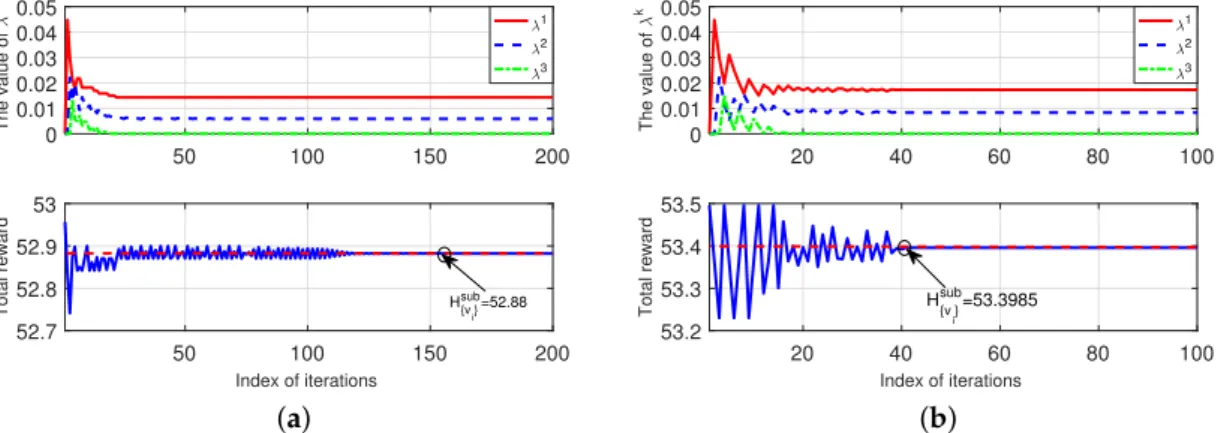
In this subsection, we show the performance of our proposed algorithms for the multi-ES scenario. Figure4shows the convergence of Algorithm 5(under the given {νi}i∈I). We use a 5-MT
and 3-ES case, with the three ESs having{p1,p2,p3}= {10, 20, 30}$/GHash. In Figure4a, we set
{νi}={1, 2, 3, 4, 5}for the five MTs. The top-subplot in Figure4a shows the convergence of the dual
variables{λ1,λ2,λ3}, and the bottom-subplot in Figure4a shows the convergence ofH{νsub
dual optimum (which is denoted by the red-dash line). In Figure4b, we set{νi}={1, 2, 3, 4, 5}for the
five MTs, and the results show the same convergence property as Figure4a.
Figure 5 shows the convergence of our Algorithm 6 for solving Top-problem (TRO-top). The left-subplot shows the case of 5-MT and 3-ES (which is used in Figure 4 before), and the right-subplot shows the case of 10-MT and 3-ES. The results show that our algorithm can quickly converge to the optimal solution (i.e.,{νi∗}i∈I) and reach the global optimum of the total net-reward of
all MTs. 50 100 150 200 0 0.01 0.02 0.03 0.04 0.05 The value of λ k λ1 λ2 λ3 50 100 150 200 Index of iterations 52.7 52.8 52.9 53 Total reward H{vi} sub=52.88 (a) 20 40 60 80 100 0 0.01 0.02 0.03 0.04 0.05 The value of λ k λ1 λ2 λ3 20 40 60 80 100 Index of iterations 53.2 53.3 53.4 53.5 Total reward H{v i} sub =53.3985 (b)
Figure 4.Convergence of our proposed Algorithm5. (a):{νi}={1, 2, 3, 4, 5}. (b):{νi}={3, 3, 3, 3, 3}.
50 100 150 200 250 300 Index of iterations 52.95 53 53.05 53.1 53.15 53.2 Total reward 5-MT 3-ES case The global optimum
(a) 0 50 100 150 200 250 Index of iterations 96.6 96.7 96.8 96.9 97 97.1 97.2 Total reward 10-MT 3-ES case The global optimum
(b)
Figure 5.Convergence of our Algorithm6. (a): a 5-MT and 3-ES case; (b): a 10-MT and 3-ES case. Table3evaluates the accuracy and efficiency of our proposed Algorithm6for solving Top-problem (TRO-Top), in comparison with the exhaustive-search method. In the exhaustive-search method, we enumerate all possible{νi}i∈I. However, the exhaustive-search method consumes a significant
computation complexity. We thus consider two cases, namely, a 5-MT and 2-ES case and a 3-MT and 2-ES case. We set{p1,p2}={10, 20}$/GHash for the two ESs, and vary each MT’s block-sizet
ifrom
0.2 Mbit to 1 Mbit. For each tested case, we show the total net-reward (i.e., the top-value) in each cell, and the corresponding computation time (i.e., the bottom-value) in each cell. The results in Table3 show that our Algorithm6achieves the optimal solution exactly the same as the exhaustive-search method, but consuming significantly less computation-time.
To show the advantage of our proposed algorithms, we further compare the performance of our proposed algorithms with that of a heuristic equal-allocation scheme in which each ES equally divides its total computational power to be shared by all MTs. Figure6a below shows the results under the scenario of 10 MTs and one ES, and Figure6b shows the results under the scenario of five MTs and two
ESs. Both figures validate that our proposed algorithms can outperform the equal-allocation scheme. This advantage essentially comes from that we properly allocate the computational powers at different ESs for the MTs.
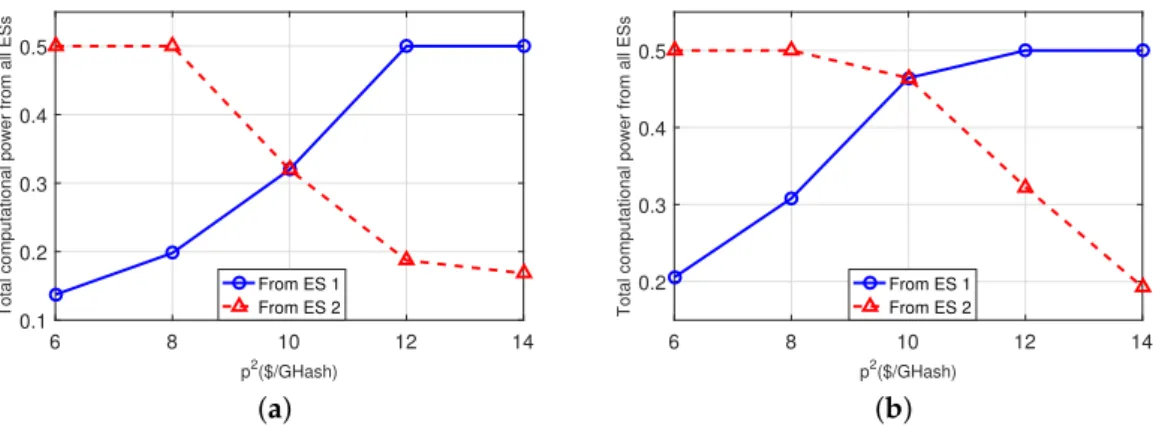
Finally, in Figure7, we evaluate the impact of the ESs’ prices for providing the computational power to the MTs. We use the same parameter-settings as Table3, but fixp1=10$/GHash and vary
p2from 6 $/GHash to 14 $/GHash. Both subplots show that all MTs’ totally acquired computational
power from ES-2 gradually decreases due to the increasing price. As a result, the MTs are encouraged to acquire more computational power from ES-1.
Table 3.Accuracy and efficiency of our Algorithm6.
3-MT 2-ES Case ti= 0.2 Mbit ti= 0.4 Mbit ti= 0.6 Mbit ti= 0.8 Mbit ti= 1 Mbit
Exhaustive Meth. 33.6742 33.7930 33.9124 34.0287 34.1356
Computing Time 889.9 s 896.2 s 913.2 s 926.2 s 917.8 s
MultiTop-Algo. 33.6742 33.7930 33.9124 34.0287 34.1356
Computing Time 93.10 s 74.93 s 108.8 s 87.29s 59.83 s
5-MT 2-ES Case ti= 0.2 Mbit ti= 0.4 Mbit ti= 0.6 Mbit ti= 0.8 Mbit ti= 1 Mbit
Exhaustive Meth. 52.4315 52.6387 52.8214 53.0064 53.1970 Computing Time 1547 s 1847 s 1648 s 1788 s 1980 s MultiTop-Algo. 52.4315 52.6387 52.8214 53.0064 53.1970 Computing Time 63.78 s 73.05 s 53.85 s 57.67 s 83.51 s 0.2 0.4 0.6 0.8 1 t i (Mbit) 94.5 95 95.5 96 96.5
Total reward of all MTs
10-MT&1-ES Proposed Algo. 10-MT&1-ES Equal Allo.
(a) 0.2 0.4 0.6 0.8 1 t i (Mbit) 52.2 52.4 52.6 52.8 53 53.2
Total reward of all MTs
5-MT&2-ES Proposed Algo. 5-MT&2-ES Equal Allo.
(b)
Figure 6. Advantage of our proposed algorithms in comparison with an Equal-Allocation scheme. (a): 10-MT and 1-ES case; (b): 5-MT and 2-ES case
6 8 10 12 14 p2($/GHash) 0.1 0.2 0.3 0.4 0.5
Total computational power from all ESs
From ES 1 From ES 2 (a) 6 8 10 12 14 p2($/GHash) 0.2 0.3 0.4 0.5
Total computational power from all ESs
From ES 1 From ES 2
(b)
5. Conclusions
In this work, we have investigated the optimal computational power allocation for the multi-access MEC enabled Blockchain. In particular, we focused on the scenario in which the group of the MTs acquire the computational power from the ESs, with the objective of maximizing all MTs’ total net-reward in the mining process while keeping the fairness among the MTs. By exploiting the layered structure of the formulated optimization problem, we have proposed two distributed algorithms, namely, one for the single-ES scenario and another for the multi-ES scenario, to efficiently compute the MTs’ optimal computational power allocations. Extensive numerical results have been provided to validate the effectiveness of our proposed algorithms. In this work, we mainly focused on the reward optimization from the MTs’ perspective. For our future work, we will further consider the revenue of the ESs in providing the multi-access MEC service and investigate how different ESs adjust their prices for optimizing their revenues.
Author Contributions:Conceptualization, all co-authors; Methodology, all co-authors; Software, not applicable; Validation, all co-authors; Formal Analysis, all co-authors; Investigation, all co-authors; Resources, all co-authors; Data Curation, all co-authors; Writing-Original Draft Preparation, Y.W., X.C., J.S. and K.N.; Writing-Review and Editing, all co-authors; Visualization, all co-authors; Supervision, not applicable; Project Administration, Y.W., L.Q., L.H. and K.Z.; Funding Acquisition, Y.W., L.Q., L.H. and K.Z.
Funding:This work was supported in part by the National Natural Science Foundation of China under Grant 61572440, in part by the Zhejiang Provincial Natural Science Foundation of China under Grants LR17F010002 and LR16F010003. This work is also supported in part by the National Natural Science Foundation of China under Grant 61872293.
Conflicts of Interest:The authors declare no conflict of interest.
References
1. Tschorsch, F.; Scheuermann, B. Bitcoin and Beyond: A Technical Survey on Decentralized Digital Currencies.
IEEE Commun. Surv. Tutor.2016,18, 2084–2123. [CrossRef]
2. Houy, N. The Bitcoin Mining Game. Available online: https://ssrn.com/abstract=2407834
(accessed on 1 August 2018).
3. Mining Pool Hub. Available online:https://miningpoolhub.com/(accessed on 1 August 2018). 4. Hurlburt, G. Might the Blockchain Outlive Bitcoin?IT Prof.2016,18, 12–16. [CrossRef]
5. Li, Z.; Kang, J.; Yu, R.; Ye, D.; Deng, Q.; Zhang, Y. Consortium Blockchain for Secure Energy Trading in Industrial Internet of Things.IEEE Trans. Ind. Inf.2018,14, 3690–3700. [CrossRef]
6. Kang, J.; Yu, R.; Huang, X.; Maharjan, S.; Zhang, Y.; Hossain, E. Enabling Localized Peer-to-Peer Electricity Trading Among Plug-in Hybrid Electric Vehicles Using Consortium Blockchains.IEEE Trans. Ind. Inf.2017, 13, 3154–3164. [CrossRef]
7. Liu, H.; Zhang, Y.; Yang, T. Blockchain Enabled Security in Electric Vehicles Cloud and Edge Computing.
IEEE Netw. Mag.2018, 32, 78–83. [CrossRef]
8. Kotobi, K.; Bilen, S. Blockchain-enabled Spectrum Access in Cognitive Radio Networks. In Proceedings of the 2017 Wireless Telecommunications Symposium (WTS’2017), Chicago, IL, USA, 26–28 April 2017; pp. 1–6. 9. Christidis, K.; Devetsikiotis, M. Blockchains and Smart Contracts for the Internet of Things.IEEE Access.
2016,4, 2292–2303. [CrossRef]
10. Novo, O. Blockchain Meets IoT: An Architecture for Scalable Access Management in IoT.IEEE Int. Things J.
2018,5, 1184–1195. [CrossRef]
11. Yang, X.; Wang, X.; Wu, Y.; Qian, L.; Lu, W.; Zhou, H. Small-Cell Assisted Secure Traffic Offloading for Narrow-Band Internet of Thing (NB-IoT) Systems.IEEE Int. Things J.2018,5, 1516–1526. [CrossRef] 12. Zhang, K.; Ni, J.; Yang, K.; Liang, X.; Ren, J.; Shen, X. Security and Privacy for Smart City Applications:
Challenges and Solutions.IEEE Commun. Mag.2017,55, 122–129. [CrossRef]
13. Mao, Y.; You, C.; Zhang, J.; Huang, K.; Letaief, K. A Survey on Mobile Edge Computing: The Communication Perspective.IEEE Commun. Surv. Tutor.2017,19, 2322–2358. [CrossRef]
14. Abbas, N.; Zhang, Y.; Taherkordi, A.; Skeie, T. Mobile Edge Computing: A Survey.IEEE Int. Things J.2018,
15. Tran, T.; Hajisami, A.; Pandey, P.; Pompili, D. Collaborative Mobile Edge Computing in 5G Networks: New Paradigms, Scenarios, and Challenges.IEEE Commun. Mag.2017,55, 54–61. [CrossRef]
16. Liu, Y.; Qin, Z.; Elkashlan, M.; Ding, Z.; Nallanathan, A.; Hanzo, L. Non-orthogonal Multiple Access for 5G and Beyond.Proc. IEEE2017,105, 2347–2381. [CrossRef]
17. Qian, L.; Wu, Y.; Zhou, H.; Shen, X. Dynamic Cell Association for Non-orthogonal Multiple-access V2S networks.IEEE J. Sel. Areas Commun.2017,35, 2342–2356. [CrossRef]
18. Wu, Y.; Qian, L.; Mao, H.; Yang, X.; Shen, X. Optimal Power Allocation and Scheduling for Non-Orthogonal Multiple Access Relay-Assisted Networks.IEEE Trans. Mob. Comput.2018, 17, 2591–2606. [CrossRef] 19. Guo, H.; Liu, J. Collaborative Computation Offloading for Multi-access Edge Computing Over Fiber-Wireless
Networks.IEEE Trans. Veh. Technol.2018,67, 4514–4526. [CrossRef]
20. Qian, L.; Feng, A.; Huang, Y.; Wu, Y.; Ji, B.; Shi, Z. Optimal SIC Ordering and Computation Resource Allocation in MEC-aware NOMA NB-IoT Networks.IEEE Internet Things J.2018. [CrossRef]
21. Wu, Y.; Ni, K.; Zhang, C.; Qian, L.; Tsang, D. NOMA Assisted Multi-Access Mobile Edge Computing: A Joint Optimization of Computation Offloading and Time Allocation.IEEE Trans. Veh. Technol.2018. [CrossRef] 22. Xiong, Z.; Feng, S.; Niyato, D.; Wang, P.; Han, Z. Edge Computing Resource Management and Pricing for
Mobile Blockchain. Available online:https://arxiv.org/pdf/1710.01567.pdf(accessed on 1 August 2018). 23. Liu, M.; Yu, F.; Teng, Y.; Leung, V.; Song, M. Joint Computation Offloading and Content Caching for Wireless
Blockchain Networks. In Proceedings of the IEEE Conference on Computer Communications Workshops (INFOCOM WKSHPS), Honolulu, HI, USA, 15–19 April 2018; pp. 517–522.
24. Zhang, K.; Leng, S.; He, Y.; Maharjan, S.; Zhang, Y. Mobile Edge Computing and Networking for Green and Low-latency Internet of Things.IEEE Commun. Mag.2018,56, 36–44. [CrossRef]
25. Wu, Y.; Qian, L.; Zheng, J.; Zhou, H.; Shen, X. Green-Oriented Traffic Offloading through Dual-Connectivity in Future Heterogeneous Small-Cell Networks.IEEE Commun. Mag.2018,56, 140–147. [CrossRef]
26. Guo, H.; Liu, J.; Zhang, J.; Sun, W.; Kato, N. Mobile-Edge Computation Offloading for Ultra-Dense IoT Networks,IEEE Int. Things J.2018. [CrossRef]
27. Melendez, S.; McGarry, M. Computation Offloading Decisions for Reducing Completion Time. In Proceedings of the IEEE Consumer Communications and Networking Conference (CCNC), Las Vegas, NV, USA, 8–11 January 2017; pp. 160–164.
28. Chen, X.; Jiao, L.; Li, W.; Fu, X. Efficient Multi-User Computation Offloading for Mobile-Edge Cloud Computing.IEEE/ACM Trans. Netw.2016,24, 2795–2808. [CrossRef]
29. Chen, X.; Zhang, H.; Wu, C.; Mao, S.; Ji, Y.; Bennis, M. Optimized Computation Offloading Performance in Virtual Edge Computing Systems via Deep Reinforcement Learning. Available online:https://arxiv.org/
abs/1805.06146v1(accessed on 1 August 2018).
30. Liu, J.; Mao, Y.; Zhang, J.; Letaief, K. Delay-Optimal Computation Task Scheduling for Mobile-Edge Computing Systems. In Proceedings of the 2016 IEEE International Symposium on Information Theory (ISIT), Barcelona, Spain, 10–15 July 2016; pp. 1451–1455.
31. Wang, Y.; Sheng, M.; Wang, X.; Wang, L.; Li, J. Mobile-Edge Computing: Partial Computation Offloading Using Dynamic Voltage Scaling.IEEE Trans. Commun.2016,64, 4268–4282. [CrossRef]
32. Kao, Y.; Krishnamachari, B.; Ra, M.; Bai, F. Hermes: Latency Optimal Task Assignment for Resource-Constrained Mobile Computing. In Proceedings of the 2015 IEEE Conference on Computer Communications (INFOCOM), Kowloon, Hong Kong, China, 26 April–1 May 2015; pp. 1894–1902. 33. Chen, M.; Liang, B.; Ming, D. Joint Offloading and Resource Allocation for Computation and Communication
in Mobile Cloud with Computing Access Point. In Proceedings of the 2017 IEEE Conference on Computer Communications (INFOCOM), Atlanta, GA, USA, 1–4 May 2017; pp. 1–9.
34. Wu, Y.; Shi, J.; Ni, K.; Qian, L.; Zhu, W.; Shi, Z.; Meng, L. Secrecy-based Delay-aware Computation Offloading via Mobile Edge Computing for Internet of Things.IEEE Internet Things J.2018. [CrossRef]
35. Barbarossa, S. Joint Allocation of Computation and Communication Resources in Multiuser Mobile Cloud Computing. In Proceedings of the 2013 IEEE 14th Workshop on Signal Processing Advances in Wireless Communications (SPAWC), Darmstadt, Germany, 16–19 June 2013; pp. 26–30.
36. Jin, A.; Song, W.; Zhuang, W. Auction-based Resource Allocation for Sharing Cloudlets in Mobile Cloud Computing.IEEE Trans. Emerg. Top. Comput.2018,6, 45–57. [CrossRef]
37. Hoang, D.; Niyato, D.; Wang, P. Optimal Admission Control Policy for Mobile Cloud Computing Hotspot With Cloudlet. In Proceedings of the 2012 IEEE Wireless Communications and Networking Conference (WCNC), Shanghai, China, 1–4 April 2012; pp. 3145–3149.
38. MacKie-Mason, J.; Murphy, L.; Murphy, J. Responsive Pricing in the Internet. InChapter of Internet Economics; The MIT Press: Cambridge, UK, 1998; pp. 279–303.
39. Tsiropoulou, E.; Vamvakas, P.; Papavassiliou, S. Energy Efficient Uplink Joint Resource Allocation Non-cooperative Game with Pricing. In Proceedings of the 2012 IEEE Wireless Communications and Networking Conference (WCNC), Shanghai, China, 1–4 April 2012; pp. 2352–2356.
40. Loiseau, P.; Schwartz, G.; Musacchio, J.; Amin, S. Incentive Schemes for Internet Congestion Management: Raffles versus Time-of-Day Pricing. In Proceedings of the IEEE Allerton Conference, Monticello, IL, USA, 28–30 September 2011; pp. 103–110.
41. Ha, S.; Sen, S.; Wong, C.; Im, Y.; Chiang, M. TUBE: Time Dependent Pricing for Mobile Data. In Proceedings of the ACM SIGCOMM, Helsinki, Finland, 13–17 August 2012; pp. 247–258.
42. Tsiropoulou, E.; Vamvakas, P.; Papavassiliou, S. Joint Customized Price and Power Control for Energy-Efficient Multi-Service Wireless Networks via S-Modular Theory. IEEE Trans. Green Commun.
Netw.2017,1, 17–28. [CrossRef]
43. Vamvakas, P.; Tsiropoulou, E.; Papavassiliou, S. Dynamic Provider Selection and Power Resource Management in Competitive Wireless Communication Markets.Mob. Netw. Appl.2018,23, 86–99. [CrossRef] 44. Peter, R. A Transaction Fee Market Exists Without a Block Size Limit. Available online: https://www.
bitcoinunlimited.info/downloads/feemarket.pdf(accessed on 1 August 2018).
45. Boyd, S.; Vandenberghe, L. Convex Optimization. InConvex Optimization; Cambridge University Press: England, UK, 2004.
46. Blockchain. Available online:https://data.bitcoinity.org(accessed on 1 August 2018).
47. Talbi, E.Metaheuristics: From Design to Implementation. In Metaheuristics: From Design to Implementation; Wiley Press: Manhattan, NY, USA, 2009.
c
2018 by the authors. Licensee MDPI, Basel, Switzerland. This article is an open access article distributed under the terms and conditions of the Creative Commons Attribution (CC BY) license (http://creativecommons.org/licenses/by/4.0/).