RLG EAD ADVISORY GROUP
Dennis Meissner (chair)
Minnesota Historical Society
Greg Kinney
Bentley Library, University of Michigan
Mary Lacy
Manuscript Division, Library of Congress
Naomi Nelson
Special Collections Digital Archive, Emory University
Merrilee Proffitt
RLG
Richard Rinehart
Berkeley Art Museum/Pacific Film Archive
David Ruddy
Cornell University Library
Bill Stockting
Access to Archives (A2A), Public Record Office
Michael Webb
Western Manuscripts, Bodleian Library
Timothy Young
Beinecke Rare Book and Manuscript Library, Yale University
ã
Copyright 2002 Research Libraries Group
All rights reserved
First published August 2002
RLG, Inc.
Mountain View, California 94041 USA
www.rlg.org
INTRODUCTION
This set of guidelines, the second version promulgated by RLG, was developed between
October 2001 and August 2002 by the RLG EAD Advisory Group. This group consisted
of ten archivists and digital content managers experienced in creating and managing
EAD-encoded finding aids at repositories in the United States and the United Kingdom
(see
www.rlg.org/primary/eadac.html
).
The objectives of the guidelines are:
1.
To facilitate interoperability of resource discovery by imposing a basic degree of
uniformity on the creation of valid EAD-encoded documents and to encourage the
inclusion of elements most useful for retrieval in a union index and for display in an
integrated (cross-institutional) setting.
2.
To offer researchers the full benefits of XML in retrieval and display by developing a
set of core data elements to improve resource discovery. It is hoped that by
identifying core elements and by specifying “best practice” for those elements, these
guidelines will be valuable to those who create finding aids, as well as to vendors and
tool builders.
3.
To contribute to the evolution of the EAD standard by articulating a set of best
practice guidelines suitable for interinstitutional and international use.
These guidelines can be applied to both retrospective conversion of legacy finding aids
and the creation of new finding aids.
I. General Notes
Focus and Companion Documents. This document does not attempt to repeat the
information in the EAD (version 2002) DTD, the EAD Tag Library, Version 2002, and
SAA’s EAD Application Guidelines, nor does it attempt to recommend local
administrative practice. This document focuses on general issues that cross institutional
boundaries. The absence of discussion of particular elements or attributes does not imply
that they are unimportant. (The SAA Guidelines address all EAD elements and provide
advice about their use.)
Nomenclature.
“Required” means that the EAD DTD requires an element or attribute in order to produce
a valid EAD instance.
“Mandatory” means we regard an element or attribute as essential to achieving the goals
of powerful access to distributed information and predictable behavior in a union
environment.
“Mandatory if applicable” means we regard an element or attribute as mandatory if the
value is known, discernable, or appropriate for the particular situation. (Otherwise the
element is not included.)
“Recommended” means that inclusion of data found in an element represents best
practice when the data exists or is applicable.
“Optional” means that the repository may apply an element or attribute according to local
practice. Elements and attributes deemed optional appear in these guidelines only when
we believe that a comment or application guideline regarding their use is necessary. The
assignment of optional status does not mean that an element or attribute represents bad
practice. It suggests only that we recommend no specific application for these elements.
Status
Abbreviation
Definition
Required
Req
DTD requires for valid XML
Mandatory
M
The RLG EAD Advisory Group
mandates for consistent search and
display
Mandatory
if applicable
MA
The RLG EAD Advisory Group
mandates if the situation applies
Recommended
Rec
Recommended best practice
Optional
Opt
Optional
“Tag” refers to the markers that enclose the content of an element, such as
<p>[content]</p>.
“Element” refers to the textual concept represented by a tag.
“Content” refers to data enclosed between tags.
“Attribute value” refers to attribute options.
In this document, attribute names are presented in bold. Bracketed text describes the
content information that the repository will supply.
The ID Attribute. Throughout the EAD element structure, the ID attribute is a unique
identifier used to name a specific element for linking purposes. Since repositories
develop linking methods locally, no particular ID naming scheme is prescribed here.
1See
the EAD Cookbook (
jefferson.village.virginia.edu/ead/cookbookhelp.html
) for one such
application of the ID attribute.
Encoding Analogs. To make the metadata
2in the EAD instance as robust as possible,
and to allow for crosswalks to other encoding schemes, we mandate the inclusion of the
relatedencoding and encodinganalog attributes in both the <eadheader> and <archdesc>
segments. <eadheader> elements describe the finding aid, itself, while the <archdesc>
elements refer to the materials being described by the finding aid. <eadheader> elements
will commonly map to a related encoding standard such as Dublin Core, while
<archdesc> elements commonly map to content standards such as MARC 21 or
1 For a brief discussion of the importance of naming schemes, see www.dlib.org/naming/overview.html. 2 Metadata is data about data. The term refers to any data used to aid the identification, description, and
descriptive frameworks such as ISAD(G)v2. However, this simple distinction is not
prescriptive. Possible content for encodinganalog attributes has been provided at all
levels in the DTD, with the proviso that they may not always be applicable.
Where there is no direct correspondence between the related encoding standard and EAD,
use can be made of <note> tags in <notestmt>, as in this example of encoding analogs for
Dublin Core elements:
<notestmt>
<note encodinganalog="format"><p>text/plain charset=ISO-8859-1 size=23100 bytes</P></note>
<note encodinganalog="coverage"><p>South West</p></note>
<note encodinganalog="rights"><p>© The contents of this catalogue are the copyright of the place of deposit; Rights in the Access to Archives database are the property of the Crown</p></note>
</notestmt>
While crosswalks for EAD elements to Dublin Core, MARC 21, and to the second
edition of ISAD(G)v2 can be found in the EAD Tag Library, Version 2002 and in the
EAD Application Guidelines, this document also includes encodinganalogs where
appropriate. This was done for convenience and to provide more options. For ISAD(G)v2
encodinganalogs, the content of the attribute should be expressed in numerical fashion
(e.g., “3.2.1” rather than “3.2.1 Name of Creator” or “Name of Creator”).
Normalization of Dates. Normalize all dates according to the ISO 8601 standard where
possible (see
xml.coverpages.org/ISO-FDIS-8601.pdf
). We recommend that the
W3C-DTF profile of ISO 8601 be used (see
www.w3.org/TR/NOTE-datetime
).
Normalize approximate dates using ISO 8601 by indicating an interval that encompasses
the outer bounds of the approximate date (see “Approximate dates,” below). Remember
that normalized dates are not displayed. They are used to support information retrieval
queries based on dates. Only the element content is displayed.
Since ISO 8601 does not express uncertain or unknown dates per se, we recommend
normalizing uncertain dates as approximate dates.
Examples:
·
Date spans:
o <unitdate normal="1956-01/1956-07">Jan 1956 - July 1956</unitdate>
[use ISO 8601 date intervals]
o <unitdate normal="1900/1950">1900-1950</unitdate>
·
Broken date spans (e.g., “1924, 1956-1975”):
o <unitdate normal=1924>1924</unitdate>, <unitdate normal="1956/1975">1956-1975</unitdate>
·
Open date spans:
o <unitdate normal="1911/9999">1911-[ongoing]</unitdate>
[use an interval and set the end date to 9999]
·
Approximate dates (e.g., “ca. 1950”):
o <unitdate normal="1945/1955">ca. 1950</unitdate>
[normalize as an interval to express an appropriate date range]
o <unitdate normal="1980/1989">1980s</unitdate>
[use an interval to indicate every year of the decade]
o <unitdate normal="1801/1900">19th century</unitdate>
·
Undated material:
o <unitdate normal="1920/1957">undated</unitdate>
[normalize as an interval (as with approximate dates), perhaps using the collection
dates, or life of creator, etc.]
·
Undated material:
o <unitdate normal="1935/1965">undated: ca. mid 20th
century</unitdate>
[if a document is undated this can be stated but provide an estimate if possible;
normalize as an interval, perhaps using the collection dates, or life of creator, etc.]
o <unitdate>undated</unitdate>
[if it is really not possible to estimate then use “undated” alone with no
normalization]
Item-Level Description. This section represents a particular use of the <dsc>
components not typically used in current archival practice. When describing linked,
digitized objects at the item level, a repository should consider strategies for retrieval and
usability, both in the repository’s own search interface as well as in a shared
environment, if appropriate. Item-level description can be handled in many ways: in
EAD, in a database, and/or as part of a digital object itself using a standard such as
METS (
www.loc.gov/standards/mets
). There is no single correct method, so
consideration should be given to understanding the pros and cons of each method.
Digital Objects and Linking Elements. Use the <daogrp> element exclusively for
references/links to digital representations of collections being described in the finding
aid. Use <daogrp> for links to born-digital objects if they are the focus of the finding aid.
For digital objects that are included but are not part of the collections being described,
use another EAD linking mechanism. Use <daogrp> to link to any digitally formatted
direct representation of some aspect of the original item being described (e.g.,
transcriptions, video, or images of the original item). For indirect description (e.g., video
of commentary), do not use <daogrp>; instead use another EAD linking mechanism, such
as <exptr>. Technical metadata about linked digital surrogates (not born digital) should
be contained in the DAO attributes, to enable machine discovery of and manipulation of
the digital object.
There are a variety of cases where digitized items can be handled outside of a finding aid
(via a database or other mechanisms), so we do not want to imply that <daogrp> is the
only legitimate way to handle digitized objects or item-level description.
Rich descriptive metadata, or other metadata that may be associated with a digital object
(technical, administrative, structural, etc.), cannot be easily encoded in EAD. Metadata
not well dealt with by EAD might be better handled by the METS standard or stored in
the digital object itself (e.g., using TIFF headers) externally from the EAD instance.
We recommend using <daogrp> rather than <dao>. <dao> allows for one digital
representation, while <daogrp> allows for one or more digital representations. Using
<daogrp> assures the ability to have multiple digital representations and to maintain
consistency in using a single tag, an approach that aids union systems as well as some
markup software and tool development.
System Entities. Repositories following these guidelines should refrain from relying
solely on system identifiers (as opposed to public identifiers) to identify external entities.
System identifiers can cause problems in shared environments, since maintenance of
external addresses and resolution of the URIs are vexing issues. Repositories that expect
to submit finding aids to a shared environment should give some thought to resolving
entities identified via system identifiers before submitting their files. For an in-depth
discussion of this topic, see the EAD Application Guidelines.
Punctuation and Use of White Space. Use of punctuation and white space is a matter of
local practice. The main goal is consistency and documentation, so that local practice can
be accommodated within a union environment.
Character Encoding. We recommend that EAD documents encoded in XML use the
UTF-8 Unicode character encoding format. When using XML, characters used as markup
delimiters must be replaced by character entities, as in the following table:
Character
Name
Entity
&
ampersand
&
<
left angle bracket
<
>
right angle bracket
>
No other special characters need to be replaced with character entities if an instance is
saved as UTF-8. For more detailed information on XML, UTF-8, and special character
encoding, see the W3C/Unicode Consortium document “Unicode in XML and other
Markup Languages” (
www.w3.org/TR/unicode-xml/
).
Use of <head>, Label Attribute. Content of headers and labels are a matter of local
practice. Decisions regarding when to use these tags and when to let a style sheet carry
content should be recorded. The main goal is consistency and documentation, so that
local practice can be accommodated within a union environment.
Overview of the EAD Structure. An EAD instance is made up of three parts:
·
<eadheader> contains information describing the finding aid itself.
·
<frontmatter> contains prefatory matter incorporating information useful for the
display or publication of the finding aid.
·
<archdesc> contains description of archival materials and associated administrative
and contextual information.
II. Archival Levels
EAD uses a system of nested components to describe the hierarchical structure in which
archival material is intellectually organized. The position of each component in an
intellectual structure can be specified using the level attribute.
There is no explicit correspondence between a component number or the position of a
component in a hierarchy and the intellectual level of the material being described. The
intellectual level of a component number may vary within and between finding aids (e.g.,
<c03> may be a “subseries” in one part of a finding aid and an “item” in another).
However, there is logic to the nesting of levels. A series, for example, may contain
subseries, files, or items, but not another series. For examples see:
·
Possible EAD <C0x> structures for Bentley finding aids
(
www.umich.edu/~bhl/EAD/bhltags2.htm#examples
)
·
ISAD(G)v2: General International Standard Archival Description ISAD(G),
Appendix A1, page 36 (
www.ica.org/biblio/com/cds/isad_g_2e.pdf
)
To clarify the level of each component part, we regard as mandatory the use of the level
attribute at all component levels, whether numbered or unnumbered components are
used. Standard archival units of fonds, series, file, and item are used. See:
·
Statement of Principles for the CUSTARD Project, section 2.1
(
www.archivists.org/news/custardproject.asp
)
·
ISAD(G)v2: General International Standard Archival Description ISAD(G),
Appendix A1, page 36 (
www.ica.org/biblio/com/cds/isad_g_2e.pdf
)
The level attribute value can be used to define searches, to generate navigators, to insert
headings, and for other processing and display purposes.
The fonds may be divided into subfonds. The series level may be divided into subseries.
EAD provides for further subdivision of subfonds and subseries through setting the level
attribute to “otherlevel” and the otherlevel attribute to designate a succession of
“sub-sub” levels as needed. Alternately, a subfonds may be nested within another subfonds or
a subseries may be nested inside another subseries. With this usage, a style sheet will
have to use the component structure to distinguish one type of subseries from another.
Similarly, file-level components may be subdivided with additional levels of hierarchy
before reaching the item level. This may be done through setting the level attribute to
“otherlevel” and the otherlevel attribute to “subfile” or another local term. Alternatively,
since there are not generally accepted terms for subdivisions of a file, a file may be
nested within another file. With this usage, a style sheet will have to use the component
structure to distinguish one type of file from another.
TABLE 1: <ead>, <eadheader>, and <frontmatter>
Elements and Attributes Status Comments/Application Notes Encoding Analogs ISAD(G)v2 MARC 21 DC
<ead> Req
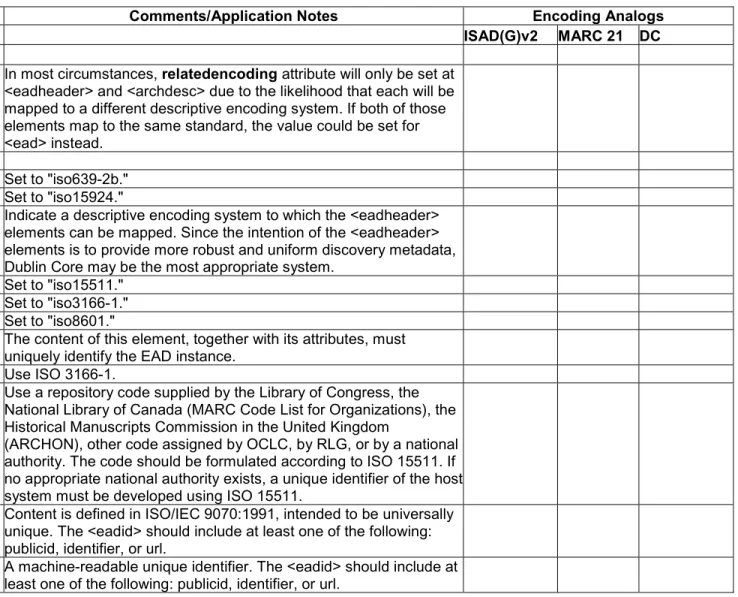
relatedencoding= Opt In most circumstances, relatedencoding attribute will only be set at
<eadheader> and <archdesc> due to the likelihood that each will be mapped to a different descriptive encoding system. If both of those elements map to the same standard, the value could be set for <ead> instead.
<eadheader> Req
langencoding= M Set to "iso639-2b."
scriptencoding= MA Set to "iso15924."
relatedencoding= M Indicate a descriptive encoding system to which the <eadheader>
elements can be mapped. Since the intention of the <eadheader> elements is to provide more robust and uniform discovery metadata, Dublin Core may be the most appropriate system.
repositoryencoding= M Set to "iso15511."
countryencoding= M Set to "iso3166-1."
dateencoding= M Set to "iso8601."
<eadid> Req The content of this element, together with its attributes, must
uniquely identify the EAD instance.
countrycode= M Use ISO 3166-1.
mainagencycode= M Use a repository code supplied by the Library of Congress, the
National Library of Canada (MARC Code List for Organizations), the Historical Manuscripts Commission in the United Kingdom
(ARCHON), other code assigned by OCLC, by RLG, or by a national authority. The code should be formulated according to ISO 15511. If no appropriate national authority exists, a unique identifier of the host system must be developed using ISO 15511.
publicid= MA Content is defined in ISO/IEC 9070:1991, intended to be universally
unique. The <eadid> should include at least one of the following: publicid, identifier, or url.
identifier= MA A machine-readable unique identifier. The <eadid> should include at
Elements and Attributes Status Comments/Application Notes Encoding Analogs ISAD(G)v2 MARC 21 DC
url= MA Should be expressed in absolute terms (e.g.,
http://www.loc.gov/ead/ms99999.xml). The <eadid> should include at least one of the following: publicid, identifier, or url.
encodinganalog= MA Maps to URL. 856$u Identifier
<filedesc> Req
<titlestmt> Req
<titleproper> Req Use for formal title of the finding aid itself and not the title of the
fonds or record group being described.
encodinganalog= M 245$a Title
<author> MA Record the name of the person or institution responsible for the
intellectual content of the encoded finding aid.
encodinganalog= M 245$c Creator; Contributor <publicationstmt> M <publisher> M encodinganalog= M 260$b Publisher <date> M encodinganalog= M 260$c Date
normal= M Use ISO 8601.
<address> Rec System entities must be resolved in a union environment.
encodinganalog= M 260$a
<notestmt> Opt May be used, per local conventions, for a variety of textual notes,
especially to enrich available discovery metadata (see example in the Introduction, page 3).
encodinganalog= M 500; 653 Description;
Subject
<profiledesc> M
<creation> M Statement recording facts about the encoding of the finding aid.
encodinganalog= M 500
<date> Rec Date of initial encoding into EAD.
normal= MA Use ISO 8601.
<langusage> M
<language> M
Elements and Attributes Status Comments/Application Notes Encoding Analogs ISAD(G)v2 MARC 21 DC
langcode= M Use ISO 639-2b. 041
scriptcode= MA Use ISO 15924.
<descrules> Opt encodinganalog= Rec 3.7.2 Rules or conventions <revisiondesc> Rec <change> Rec encodinganalog= M 583 <item> Rec <date> Rec
normal= MA Use ISO 8601.
<frontmatter> Opt <eadheader> is preferred as the source for title page information in
TABLE 2: <archdesc>
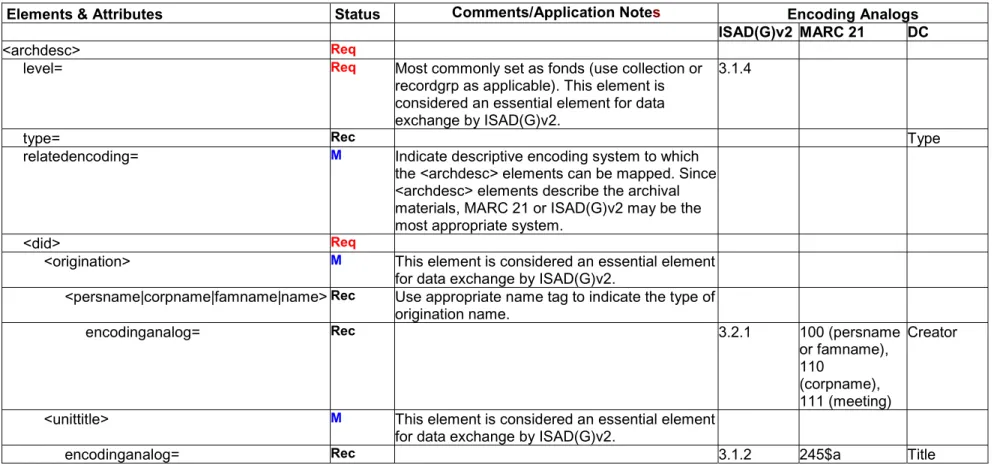
Elements & Attributes Status Comments/Application Notes Encoding Analogs ISAD(G)v2 MARC 21 DC
<archdesc> Req
level= Req Most commonly set as fonds (use collection or
recordgrp as applicable). This element is considered an essential element for data exchange by ISAD(G)v2.
3.1.4
type= Rec Type
relatedencoding= M Indicate descriptive encoding system to which
the <archdesc> elements can be mapped. Since <archdesc> elements describe the archival materials, MARC 21 or ISAD(G)v2 may be the most appropriate system.
<did> Req
<origination> M This element is considered an essential element
for data exchange by ISAD(G)v2.
<persname|corpname|famname|name>Rec Use appropriate name tag to indicate the type of
origination name.
encodinganalog= Rec 3.2.1 100 (persname
or famname), 110
(corpname), 111 (meeting)
Creator
<unittitle> M This element is considered an essential element
for data exchange by ISAD(G)v2.
Elements & Attributes Status Comments/Application Notes Encoding Analogs ISAD(G)v2 MARC 21 DC
<unitdate> M US repositories following APPM practice
normally include <unitdate> as part of <unittitle>, whereas British and Canadian practice, following ISAD(G)v2 use <unitdate> at the same level as <unittitle>. Given the
likelihood of further international standardization, separate title and date is preferred but both practices are permitted. Repeat <unitdate> if both inclusive and bulk dates are given. This element is considered an essential element for data exchange by ISAD(G)v2.
type= M
normal= M Use ISO 8601 to normalize dates to the extent
they are known (see the Introduction, page 3-4 for examples).
encodinganalog= Rec Use if materials are manuscripts (MARC "u"
format); MARC encodinganalog depends on whether inclusive, single, or bulk dates are appropriate. 3.1.3 245$f (inclusive or single); 245$g (bulk) Coverage (Temporal); Date
encodinganalog= Rec Use if the materials are other than archives and
personal papers collections (MARC "g" format). 3.1.3 260$c Coverage(Temporal);
Date
datechar= MA Set value to indicate whether dates given are of
creation or accumulation when ISAD(G)v2
encodinganalog set to 3.1.3.
<physdesc> M
<extent> M Use multiple <extent> tags for multiple views,
items, linear feet, etc. Units of measure should be expressed either as part of the content or this tag or in a unit attribute. This element is
considered an essential element for data exchange by ISAD(G)v2.
encodinganalog= Rec 3.1.5 300
Elements & Attributes Status Comments/Application Notes Encoding Analogs ISAD(G)v2 MARC 21 DC
encodinganalog= Rec 3.4.4 340 and 538
<abstract> Rec Use for brief summary of collection contents at
highest level, in addition to <scopecontent> for fuller discussion. At component level, use <scopecontent> rather than <abstract>.
encodinganalog= Rec 520 Description
<physloc> Opt
encodinganalog= Rec 852$z, 090
<originalsloc> Opt
encodinganalog= Rec 3.5.1 355
<repository> M
encodinganalog= Rec 852 Publisher
<corpname|name> Rec
<subarea> Rec
<address><addressline> Rec
<unitid> M This element is considered an essential element
for data exchange by ISAD(G)v2. 3.1.1 050, 090, 099 Identifier
countrycode= M Use ISO 3166-1.
repositorycode= M Use ISO 1551.
<langmaterial> M 3.4.3 546 Language
<language> M
langcode= M Use ISO 639-2b. 041
<note> Opt
encodinganalog= Rec 500
<bioghist> M
encodinganalog= Rec 3.2.2 545
<scopecontent> M If organization/arrangement cannot readily be
separated from the scope note, give as part of <scopecontent>. If separable, use
<arrangement> and do not nest within <scopecontent>.
Elements & Attributes Status Comments/Application Notes Encoding Analogs ISAD(G)v2 MARC 21 DC
<arrangement> Rec Use to encode the filing sequence of the
material (e.g., alphabetical or chronological) and/or the manner in which the collection has been ordered (e.g., organized into series).
encodinganalog= Rec 3.3.4 351
<controlaccess> Rec Subelements are repeatable and should be
used if applicable. <corpname> Rec encodinganalog= Rec 110, 111, 610, 611, 710, 711 source= Rec rules= Opt <persname> Rec encodinganalog= Rec 100, 600, 700 source= Rec rules= Opt <geogname> Rec
encodinganalog= Rec 651 Coverage
(Spatial) source= Rec rules= Opt <famname> Rec encodinganalog= Rec 100, 600 source= Rec rules= Opt <subject> Rec
encodinganalog= Rec 650 Subject
source= Rec rules= Opt <genreform> Rec encodinganalog= Rec 655 source= Rec rules= Opt <occupation> Rec
Elements & Attributes Status Comments/Application Notes Encoding Analogs ISAD(G)v2 MARC 21 DC encodinganalog= Rec 656 source= Rec rules= Opt <function> Rec encodinganalog= Rec 657 source= Rec rules= Opt <title> Rec encodinganalog= Rec 130, 630, 730 source= Rec rules= Opt
<controlaccess> Rec Access terms may grouped by nesting
<controlaccess> within itself.
<corpname | persname | ….> Rec
encodinganalog= Rec see above see above
source= Rec
<accessrestrict> MA Use for conditions governing access.
encodinganalog= Rec 3.4.1 506 <accruals> Rec encodinganalog= Rec 3.3.3 584 <acqinfo> Rec encodinganalog= Rec 3.2.4 541 <altformavail> Rec encodinganalog= Rec 3.5.2 530 <appraisal> Rec
encodinganalog= Rec 3.3.2 583$a
<custodhist> Rec encodinganalog= Rec 3.2.3 561 <prefercite> Rec encodinganalog= Rec 524 <processinfo> Rec encodinganalog= Rec 583, 500
Elements & Attributes Status Comments/Application Notes Encoding Analogs ISAD(G)v2 MARC 21 DC encodinganalog= Rec 3.4.2 540 <relatedmaterial> Rec encodinganalog= Rec 3.5.3 544 1 <separatedmaterial> Rec encodinganalog= Rec 3.5.3 544 0 <otherfindaid> Opt encodinganalog= Rec 3.4.5 555 <bibliography> Opt encodinganalog= Rec 3.5.4 <odd> Opt encodinganalog= Rec 3.6.1 500
TABLE 3: <dsc>
Elements & Attributes Status Comments/Application Notes Encoding Analogs ISAD(G)v2 MARC 21 DC
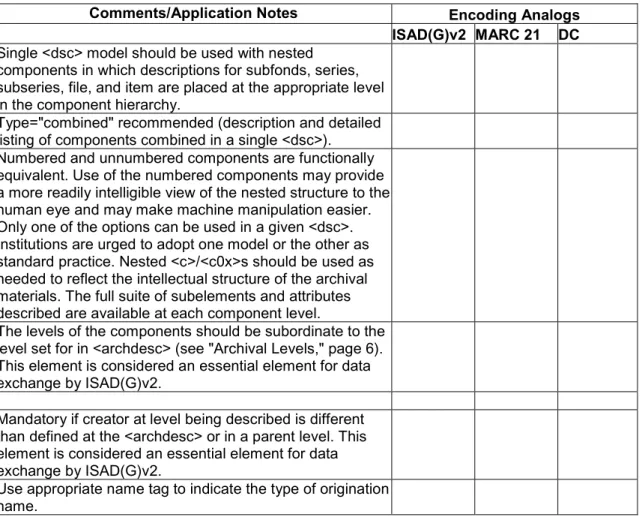
<dsc> MA Single <dsc> model should be used with nested
components in which descriptions for subfonds, series, subseries, file, and item are placed at the appropriate level in the component hierarchy.
type= Req Type="combined" recommended (description and detailed
listing of components combined in a single <dsc>).
<c>/<c0x> M Numbered and unnumbered components are functionally
equivalent. Use of the numbered components may provide a more readily intelligible view of the nested structure to the human eye and may make machine manipulation easier. Only one of the options can be used in a given <dsc>. Institutions are urged to adopt one model or the other as standard practice. Nested <c>/<c0x>s should be used as needed to reflect the intellectual structure of the archival materials. The full suite of subelements and attributes described are available at each component level.
level="subfonds/series/file" M The levels of the components should be subordinate to the
level set for in <archdesc> (see "Archival Levels," page 6). This element is considered an essential element for data exchange by ISAD(G)v2.
<did> Req
<origination> MA Mandatory if creator at level being described is different
than defined at the <archdesc> or in a parent level. This element is considered an essential element for data exchange by ISAD(G)v2.
<persname|corpname|famname|name>Rec Use appropriate name tag to indicate the type of origination
Elements & Attributes Status Comments/Application Notes Encoding Analogs ISAD(G)v2 MARC 21 DC encodinganalog= Rec 3.2.1 100 (persname or famname), 110 (corpname), 111 (meeting) Creator
<unitid> MA All units of a description should be given a unique identifier.
While optional, it is recommended that, if a unique identifying number or filing code is present, it should be encoded as <unitid> rather than <container> or <unittitle>. This element is considered an essential element for data exchange by ISAD(G)v2.
encodinganalog= Rec 3.1.1 050, 090,
099 Identifier
countrycode= MA The value of this attribute is considered to be inherited from
the equivalent mandatory entry at the uppermost level (<archdesc>). In the unlikely circumstance that the records in a component are not held in the same country as their parent, the value should be set for the component’s country using ISO 3166.
repositorycode= MA The value of this attribute is considered to be inherited from
the equivalent mandatory entry at the uppermost level (<archdesc>). If the records in a component are not held in the same repository as their parent, the value should be set using ISO 15511.
<unittitle> M Considered the minimum for description at component
levels because some description is needed for users to decide if documents are worthy of further investigation. This element is considered an essential element for data exchange by ISAD(G)v2.
Elements & Attributes Status Comments/Application Notes Encoding Analogs ISAD(G)v2 MARC 21 DC
<unitdate> Rec Recommended if a more specific creation date can be
provided for a component than given in its parent. Such entries provide for fuller description of a unit for users and facilitate more effective searching by date. If multiple single dates or date ranges are present, each should be encoded in its own <unitdate>. Where no <unittitle> content exists, <unitdate> may be placed within <unittitle> so that there is some title-related content. This element is considered an essential element for data exchange by ISAD(G)v2.
encodinganalog= Rec 3.1.3 245$f, 245$g, 260$c Coverage (Temporal); Date
type= Opt Use to distinguish inclusive and bulk dates.
normal= Rec To aid in searching by date; use ISO 8601 (see the
Introduction, page 3-4, for examples).
<physdesc> Rec
<extent> Rec If extent data is present, it should be encoded here rather
than being incorporated into <unittitle> or another element. Units of measure should be expressed either as part of the content or this tag or in a unit attribute. This element is considered an essential element for data exchange by ISAD(G)v2.
encodinganalog= Rec 3.1.5 300
<phystech> Opt
encodinganalog= Rec 3.4.4 340 and
538
<langmaterial> MA If the material being described is in a language different
from that specified in the langmaterial attribute in <archdesc>, use at the component level.
3.4.3 546 Language
<language> MA
Elements & Attributes Status Comments/Application Notes Encoding Analogs ISAD(G)v2 MARC 21 DC
<scopecontent> Rec At appropriate component levels
(subgroup/subfonds/series), components should include scope and content information. Other levels may include scope and content notes as needed. Use of
<scopecontent> is preferred over <abstract>.
encodinganalog= Rec 3.3.1 520
<accessrestrict> MA Mandatory if particular conditions govern access.
encodinganalog= Rec 3.4.1 506
<userestrict> MA Mandatory if there are particular conditions, such as
copyright, governing use.
TABLE 4: Item Level, Linking
Elements & Attributes Status Comments/Application Notes Encoding Analogs ISAD(G)v2 MARC 21 DC
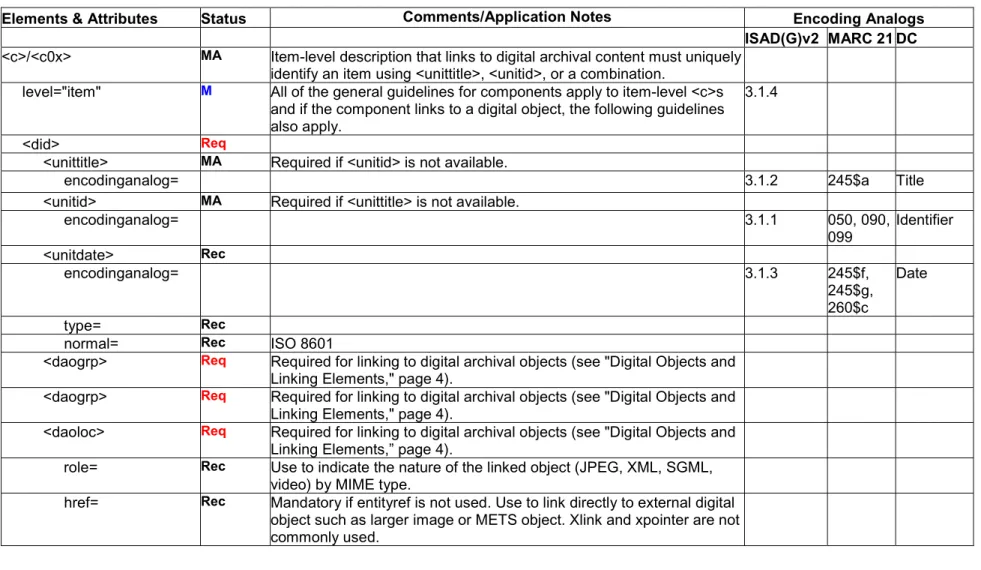
<c>/<c0x> MA Item-level description that links to digital archival content must uniquely
identify an item using <unittitle>, <unitid>, or a combination.
level="item" M All of the general guidelines for components apply to item-level <c>s
and if the component links to a digital object, the following guidelines also apply.
3.1.4
<did> Req
<unittitle> MA Required if <unitid> is not available.
encodinganalog= 3.1.2 245$a Title
<unitid> MA Required if <unittitle> is not available.
encodinganalog= 3.1.1 050, 090, 099 Identifier <unitdate> Rec encodinganalog= 3.1.3 245$f, 245$g, 260$c Date type= Rec
normal= Rec ISO 8601
<daogrp> Req Required for linking to digital archival objects (see "Digital Objects and
Linking Elements," page 4).
<daogrp> Req Required for linking to digital archival objects (see "Digital Objects and
Linking Elements," page 4).
<daoloc> Req Required for linking to digital archival objects (see "Digital Objects and
Linking Elements,” page 4).
role= Rec Use to indicate the nature of the linked object (JPEG, XML, SGML,
video) by MIME type.
href= Rec Mandatory if entityref is not used. Use to link directly to external digital
object such as larger image or METS object. Xlink and xpointer are not commonly used.
Elements & Attributes Status Comments/Application Notes Encoding Analogs ISAD(G)v2 MARC 21 DC
entityref= Rec Mandatory if href is not used. Use to link to an entity that contains the
actual link to an external digital object. Xlink and xpointer are not commonly used.
<daodesc> Rec Use if human-readable description of complex digital object is required
and not provided by <unittitle>.