A Case Study of Knowledge Management Implementation for
Information Consulting Company
Chih-Hung Tsai, Ching-Liang Chang, and Lieh Chen Department of Industrial Engineering and Management
Ta-Hwa Institute of Technology 1 Ta-Hwa Road, Chung-Lin
Hsin-Chu, Taiwan, ROC E-mail: [email protected]
Abstract
Information consulting companies (i.e. Enterprise Resources Planning) are a kind of knowledge intensive enterprise. When facing customers with different businesses, situations, and problems, they usually solve each problem based on customization. Since currently there is not any effective method to manage, transfer, and accumulate the knowledge, there is an urgent need to develop an integrated method to fulfill customer demand. The purpose of this study is to combine theory with practice, and discuss the importance of knowledge management (KM) to information consulting companies. Then, we will conduct a case study for a T information consulting company. Through this example, it is easy to understand how to establish a fundamental knowledge management model, i.e. to form a basis for knowledge accumulation and transfer. As a result of this case study, the structure of knowledge management must at least include four main functions (such as knowledge garden, questions and answers, library, and recent activities) and three supplemented functions (such as description, information modification, and system management). Using these functions, the experience and knowledge of any consulting
companies can be effectively stored. In addition, the system uses browser as search and retrieve interface so that each member can utilize this system even at far distance. Finally, the overall efficiency of knowledge accumulation and transfer are rapidly increased. As a consequence, information-consulting engineers can provide their best services to customers for continuous increasing competitiveness.
Keywords: Knowledge Management, Enterprise Resources Planning (ERP)
1. Introduction
The world has moved to a new economy era. In this changing environment, it is more difficult for enterprise to respond market fluctuation, and keep increasing his competitiveness. Confronting with this challenging, all enterprises are now seeking solutions to increase their competitive advantage. In the past, each department in an organization is doing his job without effective linking to each other. Since they use different computer software and lacking integrated structure, they cannot share the information with others. As to the late of 20th century, in cope with the rapid and fluctuated
market demand, short delivery time, and order with varieties, enterprises decided to implement Enterprise Resources Planning System (ERPs) to integrate all resources to increase their competitiveness.
It is very complicating for either ERP implementation or other information system implementation. The whole process includes initial planning, communication, system establishment, work through, and system diagnosis. Due to the complexity, all processes must rely on specialized consultants. For example, the actual ERP implementation must start with operation analysis, business requirement mapping, gap analysis, setup/testing, walk through, SOP building, conference room, end-user training, pilot run, setup/production run, data conversion and production run. These involve much enterprise knowledge and complicate parameters of domain knowledge. Hence, the success of ERP implementation is much dependent on the properness of consultants. Furthermore, the appropriate consultant will determine the success of implementation of any new management technology system. To the specialized consultants, they use management application software that is the accumulation of the knowledge as powerful tool to accomplish their consulting job. This knowledge is shapeless, and cannot be described by a few words. So how to adopt and be familiar with knowledge is an important issue for consulting companies.
As discussed above, to introduce knowledge management into enterprise is the only way to success. But knowledge management is still a new theory for Taiwanese enterprises; there is no standard method can be followed. This study will aim at knowledge management to discuss the screw process to retrieve, classify, store, accumulate, and reuse knowledge. We also interviewed the key persons in T information
consulting company to find his management method and each individual system in every specialized area. We believe the result will benefit to the enterprises.
2. Discussion of knowledge management implication
2.1 Definitions
What is knowledge? Davenport and Prusak [1] mentioned at their book entitled “Working Knowledge” that knowledge locates at the apex of three-story pyramid (as shown in Figure 1). At the first level of pyramid is data, which expresses objective statement in terms of transaction record. For example, the collection of transaction fee and service quality is the typical examples. The second level of pyramid is information called as message. To transmit a message, it must contain a sender, receiver, and a package of information created by sender. For example, the comparison of monthly sales can be converted into information by so-called 5C methods [2], which are
1. Categorized: To category information to form a message.
2. Calculated: To use mathematical or statistical method to form message. 3. Corrected: To delete uncorrected data
to form information.
4. Condensed: To condense the information into a more concise message.
5. Contexualized: To collect data as purpose and description to form message.
Knowledge locates at the third level of the pyramid. Obviously, it is more general and convincible than data or information, but still needs these two as a foundation. The knowledge includes structured experience, value, judgment, vision, intuition, expert’s
comment, and other values. Knowledge stems from information just as the information is originated from data. To convert information into knowledge, a so-called 4C method must be adopted:
1. Comparison: To compare information at various conditions.
2. Consequences: What does the information imply to decision and action?
3. Connections: What is the connection between knowledge generated by information and other parts of knowledge?
4. Conversations: By direct communication with others to get their comment to the information.
Figure1: The structure of knowledge
2.2 Knowledge classifications and its transformation model
In general, knowledge can be divided into two divisions. One is explicit knowledge; the other is tacit knowledge [3]. It is more objective and concrete when explicit knowledge is present at a group of society. So it can be expressed by definite language, and disperse and propagate into surroundings. In the other side, tacit knowledge presents at each individual. It is more related to personal emotion and experience. Hence, it is subjective and unique, and cannot be solidified and unified. That shapeless
knowledge is most valuable for enterprise, but it is easily disappear when some employees quit their jobs. After understanding the characteristics and classification of knowledge, we must proceed to manage with a knowledge transformation model proposed by Nonaka and Takeuchi [4] as shown in Figure 2. From figure 2, we understand the creation of organizational knowledge is the interaction of tacit and explicit knowledge. There are four-transformation models, which can provide us with the direction of knowledge management.
1. Unification
Tacit knowledge can be converted from tacit knowledge by sharing each individual experience. In order words, through exchanging our own experience and acknowledgement with others, a mutual agreement can be achieved. This process notes as person to person.
2. Externalization
Explicit knowledge can be converted from tacit knowledge by using implication, analogy, concept, assumption, and model to sufficiently express tacit knowledge. In other words, through communication of our experience and acknowledgement with organization, a solid organization concept can be established. This process notes as person to organization.
3. Combination
Converting explicit knowledge into explicit knowledge does this process. In other words, by effective and systematic management, it can make a significant contribution to organization.
4. Internalization
Converting explicit knowledge into tacit knowledge does this process. When the experience is internalized into individual tacit knowledge through unification,
Knowledge
Information Data
externalization, and combination, it becomes a valuable asset. In other words, information from books, Internet, and other resources can
become individual tacit knowledge through reading. This process notes as explicit knowledge to increase person’s knowledge.
Figure 2: The knowledge transformation model
It is noted that in order to become a useful tool for enterprise, the effectiveness of knowledge management must constantly rely on the four steps of screw-type management method, which is unification, externalization, internalization, and combination.
2.3 Definition of knowledge management
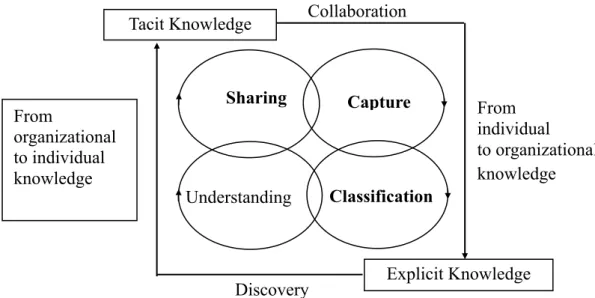
What is Knowledge Management? In the LOTUS 1998 Development Report, they defined knowledge management is a systematic approach to utilize the expert’s comments to improve innovation, responsiveness, productivity, and capability of an organization [2]. This study will treat knowledge management as knowledge sharing or an asset. No matter what the information, experience, operation procedure, or systematized document are, they can be structured and effectively used to form a powerful tool for the enterprise. The objective of knowledge management is to build an integration environment for knowledge exchange, and to link the knowledge created by each employee. OVUM [5] proposed an environmental model for knowledge exchanging as shown
in Figure 3. It is obvious that the tacit knowledge can be converted into explicit knowledge by intense coordination process. In other words, organizational explicit knowledge can be converted from each individual’s tacit knowledge. With same analogy, the tacit knowledge can be generated from explicit by exploring the tacit knowledge inside it. All processes include (1) Sharing: To share personal tacit knowledge with others; (2) Capture: Extract the essence from the tacit knowledge to become organizational explicit knowledge; (3) Classification: By proper classifying, the capturing knowledge and being stored at the placed where it is easy to access for all employees, i.e. at Website; (4) Understanding: By fully understanding, the actual meaning of explicit knowledge can be extended; then the corresponding innovated knowledge can be shared with others.
Explicit knowledge Unification Externalization Internalization Combination Tacit knowledge To Tacit knowledge From Explicit knowledge
Figure 3: OVUM Structures of Knowledge Exchange and Integration By combining all above, the purpose of
knowledge management is to create valuable Enterprise Intelligent Quotient (EIQ) for enterprise. According to intelligence capital expert Stewart’s definition, any knowledge, information, intelligence property, and experience can be regarded as intelligence capital. It is a collection of brainstorming, but is hard to identify. Moreover, It is also difficult to develop its benefits [6]. At the constant cycling process of inversion from tacit knowledge to explicit knowledge, the knowledge can be maintained and innovated. When understanding the screw cycling inversion of knowledge management, this study will modify Anderson’s formula [7, 8] as Equation (1). It treats human being as a propagator or information carrier. By way of learning, handling, and unlimited sharing, it can create a positive and beneficial knowledge for the enterprise. A so-called intelligence asset is formed, which transforms the materiality into immateriality so as to become the competitiveness of an enterprise. s H L P KM = ( + + ) (1) KM: Knowledge Management; P: People; L: Learning; H: Handling; S: Sharing; + : Connection (ex: Internet).
This study regards that handling is the most important contributing factors among the four. To handle the information is to distinguish the data and information effectively. Only effective information and data can transform into useful knowledge, which is beneficial to an organization. The key point is not at the structure of information technology, but relies on the active learning and effective information distinguishing. By the unlimited sharing such as learning-type organization, a very useful intelligence of the enterprise can be generated to form an effective weapon, which is knowledge management.
Sharing
Understanding
Capture
Classification
Explicit Knowledge Tacit Knowledge Collaboration
Discovery From individual to organizational knowledge From organizational to individual knowledge
The strategy of knowledge management can be divided into two groups [9]. The first one is systematic strategy, in which the knowledge is carefully classified and encoded. The encoded knowledge is then stored in the database so that every member in the organization can be easily accessed. The second one is personalized strategy, which is present at each employee. Sharing and exchanging information is done by interpersonal contact. By using various performance evaluation methods to ensure knowledge sharing and flowing in the organization, this belongs to personalized strategy. In the other hand, by careful matching with information technology, this
makes the knowledge present at the organization be properly saved so that it can be retrieved by other employees. It can also be regarded as systematic strategy. Based on the above discussion, creating learning-type organization is much dependent on not only to reform the system but also to match the information technology so as to form a totally different atmosphere for the enterprise.
2.4 Structure of knowledge management
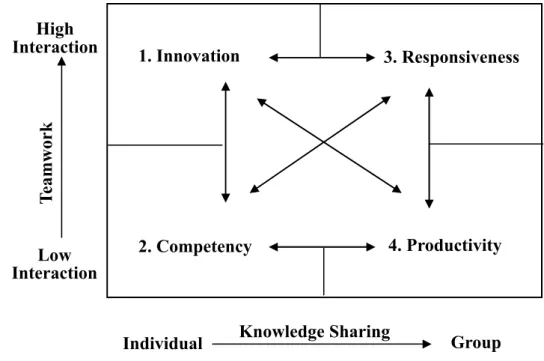
Koenig (1998) proposed a structure of knowledge management in his report [10]. The structure is shown in Figure 4.
Figure 4: The structure of Knowledge Management The abscissa in the Figure 4 represents
the degree of knowledge sharing, which is divided into the individual and group. The ordinate represents the degree of teamwork, which is divided into high and low interaction. Thus, such the two dimensions can generate four kinds of models, which are innovation, competency, responsiveness, and
productivity. It is obvious that the interrelation among them, but it is difficult to understand their real meaning behind them. Hence, it is better to start our personal competency, which belongs to personal knowledge. Then by passing through the system of knowledge sharing, the organization’s productivity can be generated.
1. Innovation 2. Competency 3. Responsiveness 4. Productivity T eamwork Low Interaction High Interaction
In the other dimension, the cooperation of personal competency and group’s teamwork can lead to intense interaction. This results in creating new knowledge. Moreover, if personal innovation shares with groups, the organization can receive more advanced knowledge, and achieve overall responsive capability.
2.5 Knowledge Management and Learning-Type Organization
The objective of knowledge management is to effectively utilize the knowledge, and promote the knowledge sharing in order to achieve organization’s overall innovation and continuous competitiveness. The learning-type organization is to request each member in the organization making his effort to learn continuously. These two are cross-linked, and learning-type organization is the necessary condition for knowledge management leading to success. It is not sufficient condition, but if we want to establish a complete knowledge management mechanism, the learning-type organization must be established simultaneously. One scholar proposed [11] that the process in knowledge management implementation must include at least human resources, training, and information technology. This implies that the establishment of knowledge management must rely on increasing training, topics of human resource, and information technology. By the human resource planning, the content of personal learning is much clearer such as e-Learning, e-Training, and other teaching methods. That makes each member learn effectively. Finally, the foundation of information technology can be utilized to pursue the classification, accumulation, sharing, and propagating in order to achieve the objective of knowledge management.
Therefore, this study will persist that in
order to form learning-type organization, the culture of enterprise must be changed. Moreover, under the willingness of sharing knowledge with others, this transformation can create a valuable intelligence for an enterprise to generate persistent competitiveness. It is very important to establish the foundation of learning-type organization such as knowledge, experience, and know-how, before they can be interacted with each other. Furthermore, through the system of knowledge management, the knowledge can be classified, stored, and shared to achieve the purpose of recycling.
3. Discussion of Knowledge Management Implementation to Consulting Company
3.1 Definition of consultant
The source of business management consultant is not sure, probably due to the effort of F. Taylor, R.W. Emerson, and H.L. Gantt. But the consultants at that time were mainly dealing with the problems of time-motion study. The prosperity of U.S. consulting business is about at the end of World War II. Taiwanese business consultant starts from the Chinese Productivity Center (CPC) on November 1995, which are several decades later than other countries. According to the service scope defined by Taiwanese Department of Economy, the consultant provides any of the following business [12, 13] such as (1) managing, analyzing, diagnosis, and advising the business management; (2) investment analysis and market investigation; (3) establishment, design, planning, advising, executing of management system; (4) enterprise computerized; (5) purchasing and propagating the new management technology.
business management must possess the following conditions such as (1) having the overall professional knowledge of organization management; (2) can pursue an investigation and analysis aiming at the organization status; (3) can propose corrective actions and suggestions for
business owner; (4) having idea and concept of increasing productivity, and strong ambition to improve organization. In other words, JPC treat business consultant must have both overall capability in business management and practical handling capability, which arranges as in Table 1.
Table1: The definition of consultant
Dept. of Economy JPC Possess the capability of analysis, diagnosis ● ●
Propose solution ● ●
Possess the overall professional knowledge and capability
○ ●
Increase the idea of productivity and ambition ○ ● It is obviously that the main difference
in definition between JPC and DOE is the consultant must possess the overall professional knowledge and capability, and have the strong ambition to increase productivity. This exactly corresponds to Taiwanese scholar’s statement that management consultant belongs to knowledge intensive enterprise or professional service business. This places the emphasis on the necessity of professional knowledge that a consultant must have. Combining the above discussions, this paper defines a consultant that he/she possesses a certain professional knowledge, and can provide customers with accurate analysis, diagnosis, and comments. In addition, he/she must propose an effective solution to the problems, and provides necessary assistance to support customer achieving his goal.
3.2 Service Scope Of
Management-Consulting Company
Despite the previous definition of consultant, we can describe the scope and content of consultants by the two factors named as profession dimension and function dimension [15]. Profession dimension
indicates the scope of service to be broadness, familiarity, and specialty. Broadness means the overall service. For example, a hospital includes all medication teams like clinic and medication. Familiarity indicates more concentrated on a certain functional diagnosis service. For example, the things include the establishment of management information system or advisory consulting of professional investment and credit. Specialty indicates the service provide for a certain enterprise. For example, an enterprise provides customers with his specialty like department of obstetrics and gynecology, and department of dermatology of private clinic.
Other examples are the management-consulting company provides manufacturers and sales with his services. The functional dimension indicates the service models of the management-consulting company. Most enterprises are distinguished based on this description, and define their service scope. If the management functions are broken down, the management-consulting companies almost cover all business management implementation as shown in Table 2.
Table 2: The service scope of management-consulting company [15] Functions Specific management-consulting activities
General Management Organization research, enterprise diagnosis, long-term planning, public relationship, performance evaluation of top-management, strategy planning, etc.
Production Plant layout, production method, time-motion study, production scheduling, inventory control, field improvement, preventative maintenance, shop floor safety, etc.
Marketing Market analysis, distribution channel, promotion activities, sale planning, etc.
Finance Accounting system, cost accounting system, budget system, cash forecasting, finance feasibility study, etc.
Personnel Work evaluation, salary management, human resource planning, personnel training program, labor-management relation improvement, etc.
EDP Feasibility study, model selection, system analysis, computer programming design, etc.
In addition, Alan [16] thought the key point of management consulting is to provide the customer with value-added element. It also creates the wisdom, which meets the customer’s requirement. The content of service includes collection of information, conversion of information, and then applies to the customer leading to producing positive beneficial wisdom. This process corresponds
to the conclusion of this study that the purpose of knowledge management is to create the valuable enterprise intelligence. The final contribution made by consultant is also intelligence as shown in Figure 5. Hence, the consultant combines all related knowledge, and provides customers with suggestions.
Figure 5: The advanced knowledge architecture [16]
Data Data Data Data
Information Information
Knowledge
3.3 Importance of Knowledge Management to Consulting Company
The objective of consulting service is to provide customer with his experience, knowledge, and solutions to customer’s problems. It is obviously that the source of knowledge and experience of consulting company is the task assigned by customer. When the consultant is performing his service, the related knowledge and experience can be accumulated through knowledge and experience exchanging. Since the consultants play a very important role in this process, they must collect and compile all useful professional knowledge. Then, substantial and beneficial knowledge can be deduced through a reviewing and refining process. The most suitable professional service to customer can be finally provided. This is one of the critical factors for most typical knowledge-intensive enterprise. It reveals the importance of knowledge for consulting company.
Jeremy and Hope [17] predicted that knowledge-based economy age would replace the second industrial economy in the near run. The President of Microsoft, Bill Gates [18], also proposed that the success of digital nervous system (DNS) much depends on the three cross-link functions, which are knowledge management, business operation, and e-commerce. To do this, it must utilize DNS to control the flow of enterprise knowledge so as to get the accurate knowledge and make fastest response in the short time. This is why Microsoft announces to actively involve in the R&D in the field of knowledge management information in 1998. Moreover, today we see that Exchange Server and Outlook are combined to form the implementation tool of knowledge management. This trend is quite predictable.
Dr. Druck, a well-known scholar in business management, had pointed out that
knowledge would replace machine, equipment, raw material, or labor, and became the key element for running business. The Southeast Asian economic crisis already proved these words. Most industries in Asian countries are OEMs based are influenced by this crisis. In the other hands, the U.S.A. becomes super power in economy in the short time due to their innovation and R&D. According to the statistical data of London Financial Times, U.S.A. shared 31% the total value of stock market of the world in 1990, and Japan was 41.5%. But the situation was changed in 1998, U.S.A. and Japan shared 53% and 10.4% respectively. The intangible property (i.e. knowledge) made U.S.A. surpassed Japan, and became the leadership in the world. In addition, the consulting market of knowledge management was developed starting from 1997. According to the statistic report of IDC, there were already 0.9 billion-market shares in this sector, and predicted the market scale of knowledge market would reach 8 billion US dollars in 2004. Thus, the knowledge management will follow Enterprise Resources Planning (ERP) to be a brilliant star tomorrow [19].
3.4 Characteristics of Information Consulting Company
Along with the world’s tide, we must recognize the age of knowledge economy is coming. On particular, the key point for consultants implementing knowledge management is knowledge and experience. The main business is divided into two groups. One is regarding to the information technology department for system developing. The other is information consulting company. A question raised is what are the statuses of information consulting company, and its necessity for implementation. This study discovers the professional knowledge is not only obtained from outside but also from the interaction of organization’s members. This makes the
intelligence can be propagated and accumulated to create substantial wisdom. This wisdom is constructed by a group of irreplaceable professional knowledge, which forms the key elements of information consulting company. Therefore, information consulting company belongs to knowledge-intense enterprise, and need to master knowledge and wisdom to increase enterprise’s competitiveness.
3.5 Key Success Factors for Consulting Company
There are five key success factors (KSF) for managing a consulting company, which was proposed by Ron [20]. These factors include (1) Knowledge of the profession you want to enter; (2) The ability to listen, observe, and analyze; (3) Time for some research; (4) Some common sense; (5) A
vision of the future. Mike Green proposed other key success factors such as experience, knowledge, competence, and a good sense of humor [20]. Ho pointed out in his verification research [21] that key success factors for consultants can be categorized in the following: (1) Professional knowledge of the consultant; (2) Quality of consultant service; (3) Reputation of a company; (4) Mastering of human relationship; (5) Suitability of computerized system; (6) Successful cases. Chang also proposed key success factors in her research [22] for Taiwanese consulting company’s managing characteristics, which are know-how, reputation, service quality, innovation, human relationship, sale skill, leading enterprise trends, scale of consulting company, and support of Internet. All above scholars’ statements are summarized in Table 3.
Table 3: Key success factors for consulting company
Ron [20] Mike Green [20] Ho [21] Chang [22] Knowledge of
consulting field Experience
Professional knowledge of consultant
Know-how and experience Time for research and
investigation Knowledge Quality of consulting service Control of service quality Ability of listening, surveying, and analyzing
Capability Company reputation Good public relation Feeling Sense of humor Mastering of public
relation Innovation capability
4. Case Study
4.1 Research Method
Since the theory and practical application of knowledge management are very extensive, this study will aim at the enterprise that possess some basic concept of knowledge management. Thus, a T
information consulting company will be utilized as our case example. Due to the
business secret, we will only discuss the flow process of knowledge management of the consultant, and the basic software structure for knowledge management. The performance evaluation for the knowledge management implementation will not be pursued due to the difficulties of some qualitative factors involved. The T
information consulting company provides the customer with information and professional service. In collecting data and
information, we conduct interview, examining written reports, and field and question survey. The person we interview includes the high management level, division supervisor, and personnel of task force. Those people have very extensive experience, and all them are very kind to provide their assistance.
4.2 Problem description
The organization of T information consulting company is divided as sales,
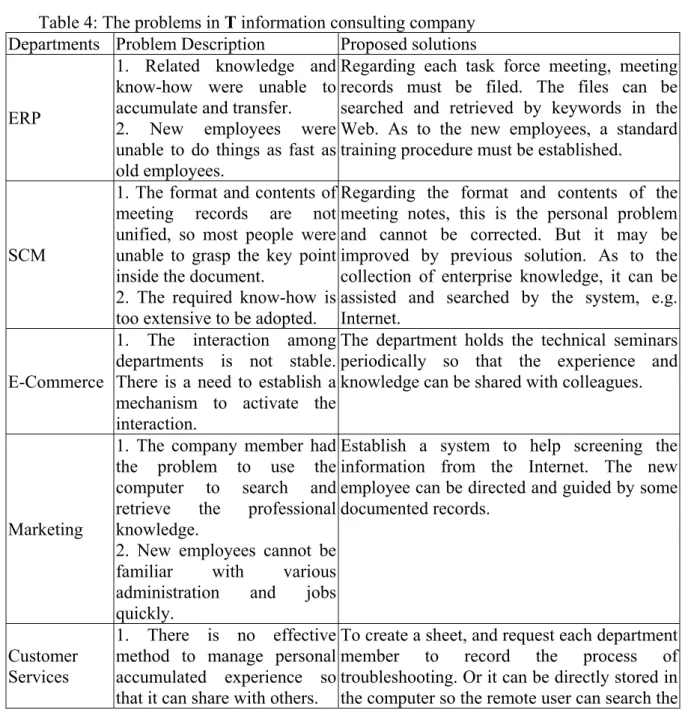
customer service, enterprise resources planning (ERP), e-commerce, and supply chain management (SCM) department. The department of administration and finance are not included in this study. Table 4 summaries the problems in T information consulting company, which were obtained by interviewing all operation personnel. Fully studying the source, accumulation, and transferring of the knowledge within the organization also show the corresponding solutions to each problem (as shown in Table 4).
Table 4: The problems in T information consulting company Departments Problem Description Proposed solutions
ERP
1. Related knowledge and know-how were unable to accumulate and transfer.
2. New employees were unable to do things as fast as old employees.
Regarding each task force meeting, meeting records must be filed. The files can be searched and retrieved by keywords in the Web. As to the new employees, a standard training procedure must be established.
SCM
1. The format and contents of meeting records are not unified, so most people were unable to grasp the key point inside the document.
2. The required know-how is too extensive to be adopted.
Regarding the format and contents of the meeting notes, this is the personal problem and cannot be corrected. But it may be improved by previous solution. As to the collection of enterprise knowledge, it can be assisted and searched by the system, e.g. Internet.
E-Commerce
1. The interaction among departments is not stable. There is a need to establish a mechanism to activate the interaction.
The department holds the technical seminars periodically so that the experience and knowledge can be shared with colleagues.
Marketing
1. The company member had the problem to use the computer to search and retrieve the professional knowledge.
2. New employees cannot be familiar with various administration and jobs quickly.
Establish a system to help screening the information from the Internet. The new employee can be directed and guided by some documented records.
Customer Services
1. There is no effective method to manage personal accumulated experience so that it can share with others.
To create a sheet, and request each department member to record the process of troubleshooting. Or it can be directly stored in the computer so the remote user can search the
2. There is no formal document to record the professional knowledge of products.
information by keywords. As to the professional knowledge of products, sharing mechanism within the company should be established.
4.3 Implementation Procedure and System Architecture
Under the assistance and support of the top management, the process of the T
information consulting company adopted knowledge management is obtained in the following: (1) Setting objectives; (2) Work preparation; (3) Data collection; (4) Knowledge management method. This is
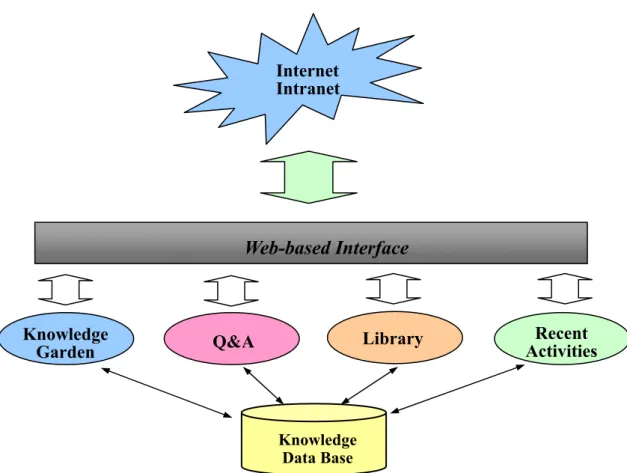
exactly the same that Wing [23, 24] proposed knowledge investigation, environment analysis, key knowledge function, and knowledge analysis and evaluation. The tacit knowledge is converted to be explicit knowledge. Then, the explicit concept forms the system of project management of consulting company. The system structure of knowledge management is shown in Figure 6.
Figure 6: The structure of KMC (Knowledge Management for Consultant)
Internet Intranet
Knowledge
Garden Q&A Library Activities Recent
Web-based Interface
Knowledge Data Base
The main functions include knowledge garden, Q&A, library, and recent activities. All data files in those functions are stored in knowledge database. Each function is discussed in the following:
(1) Knowledge garden
This function is to construct a convenient interface for knowledge input as a basis of knowledge sharing. There is requirement by ERP member, which requires knowledge input as easy as possible and shall not cause any burden to the user. Category of enterprise, name of company, and implementation steps can search the knowledge stored in the garden. In addition, from interviewing the staff of T information consulting company, there are large amounts of information obtained from Internet. Thus, those information can be integrated into knowledge garden, and shall linked with the Website. The Website can be screened and ranked by the company member. An update e-paper is added so the consultant can understand the dynamic status.
(2) Q&A
Construct a plane view for company person locations. This drawing includes each member’s extension number, name, and expertise. By means of this drawing, a channel can be setup to solve the problems. The user can submit his/her question, and choose his/her desired expert in the specific field. The system then expedites the assigned expert to answer those questions. After answering the questions, the user will be notified to make sure the solution is sent. A search function to list all Q&A that had ever
asked is attached so that it can avoid repeating any questions. As a result, it reduces the burdening of the expert, and increases the knowledge sharing.
(3) Library
Here is to solve the new employee’s problems. According to department classification, all basic knowledge required by consultant is stored at the library. The new employee can read this information without taking other persons’ time. If there are still more problems, Q&A can be used to solve the problems. The second thing is to apply the administration process, which is developed by the system, e.g., the purchase of equipment and personal leave application are typical examples.
(4) Recent activities
This area provides all members with most update dynamic information. For example, periodic seminar can help the employees to understand company’s intention. In addition, educational training and the information concerning certification examination are provided to all members as their references.
4.4 Construction of System Prototype
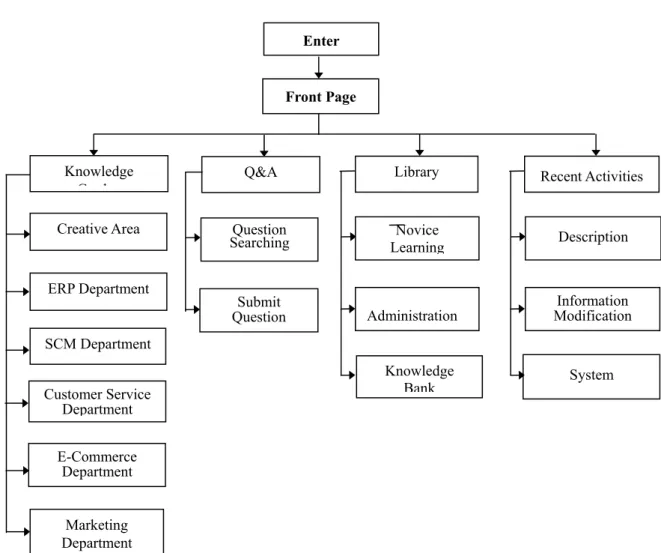
The main system includes four functions and three attached functions such as information modification, system management, and description. There are several functional blocks under each function. The whole system functional diagram is shown in Figure 7.
Figure 7: The functional diagram of knowledge management system For the purpose of achieving endless
utilization, this system uses the browser as an interface for storing and retrieving. By the company’s Web-server, the company member can access the system no matter where he/she is. This facilitates the use of knowledge. When the user is entering the system, the system will request the user to input user’s name and password in order to prevent any unauthorized persons entering
the system. After inputting the user name and password, the system prompts the user to select the language that he/her prefers to use. The system includes seven main functional blocks, which are knowledge garden, Q&A, library, recent activities, information modification, system management, and description. The whole system is shown in Figure 8. Enter Front Page Knowledge G d Creative Area ERP Department SCM Department Customer Service Department E-Commerce Department Marketing Department Q&A Question Searching Submit Question Library Novice Learning Administration Recent Activities Description Information Modification Knowledge Bank System
Figure 8: The schema of knowledge management system In order to increase user-friendlyness,
the system will give a few words of greeting after completing identification. The knowledge garden includes all inputs and outputs of consultant, which are classified by each department, but are not a general collection. The appended creative knowledge zone can provide all employees with knowledge sharing. The Q&A provides additional assistance to the employee in order to solve his problems. The Library includes three functions, which are new employee learning zone, administration process, and knowledge bank. We will discuss this in detail later. Recent activities involves the latest activities, e.g. technical seminar, educational training, certification test, etc.
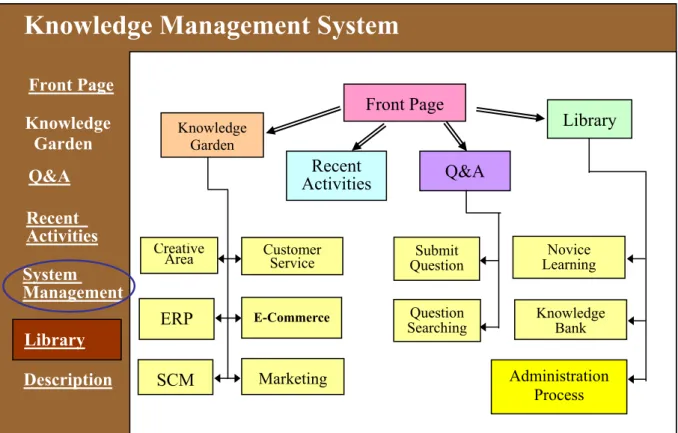
The subsystem of the main system can be accessed directly by picking. That makes even the novice can do it very easily. For example, knowledge garden contains information provided by all departments in the company such as ERP, sales, e-commerce, customer services, and creative area. The Q&A offers asking questions and checking the answers. The Library includes novice learning, knowledge bank, and administration process. The last system function is system management. Since system management belongs to the responsibility of system manager, other employees should keep away from this function. When system manager tries to enter the system, the system will recognize and identify the system manager by his/her user name and password. Then the information
Knowledge Management System
Front Page Knowledge Garden Q&A Recent Activities System Management Description Front Page Knowledge Garden Recent Activities Q&A Library Creative Area ERP SCM Customer Service E-Commerce Marketing Submit Question Question Searching Novice Learning Knowledge Bank Administration Process Library
modification becomes system management in the page of express function. The system manager is now in the system.
4.5 Expected Benefits
This paper aims at preparing and arranging the required knowledge for T
information consulting company to perform his consulting services. Some solutions to knowledge management system are proposed to achieve the goal of knowledge management of the enterprise. The expected benefits are following:
1. Increasing the value and amount of an organization overall knowledge
The system will precisely record all knowledge stored by each department. For example, the documents generated by enterprise resource planning department, e-commerce department, and supply chain management department, contain a lot of expert’s decisions and experience under various circumstances, which cannot be done by the new employees. In addition, the knowledge for effective control and management are also added. For example, customer service department and sales department own their specialized knowledge respectively, but they work independently. Hence, the knowledge never transfers from one department to another. Instead, by means of this system, the precious knowledge can be successfully stored, and achieve the increase of basic organizational knowledge.
2. Elevating the service skill of consulting and advising, customer satisfaction, and transferring of knowledge
The consultant can use browser to adopt previous experts’ experience and know-how to provide better service. This not only intensifies his consulting service but also increase customer’s satisfaction. Besides, the constant knowledge accumulation can accelerate the new employees to adapt them
to this new environment.
3. Enhancing the interior exchanging within an organization and the efficiency of obtaining the knowledge
In the past the consultant must consult the book in order to get necessary knowledge. Here we can use such a simple and powerful system to grasp the knowledge no matter where we are. This greatly increases the efficiency of obtaining the knowledge.
4. Increasing the knowledge learning ability for groups and individuals
We have mentioned early that the knowledge learning is quite important for consultants. The presence of appropriate organization structure with the assistance of the system will intensify the learning ability for both individuals and organization.
5. Conclusions
The structure of knowledge management system and its implementation benefits proposed in this paper are surely helpful for each enterprise. Some points are reminded in the following:
1. The forming and establishing of any knowledge management project is much dependent on top management support.
2. The organization status and staff's physiological conditions must be considered for implementing knowledge management. Other management technologies like ERP and SCM are more concentrated in matching up with the flow within the organization with less considering the physiological factor.
3. To form a learning-type organization is highly dependent on the sharing for each member to exchange his/her knowledge and experience with
others. As a consequence, the
knowledge management implementation leads to increase
competitiveness.
Since the knowledge management for consulting companies requiring high degree of customization, the management of what-knowledge becomes a very important hot issue. This paper proposed a modified formula as KM =(P+L+H)s , which represents the knowledge management that can readily be implemented by connecting Internet, learning previous processed information, and unlimited sharing. Therefore, the processed information is the essence of knowledge, and must be put into effective management.
References
[1] Davenport, T. and Prusak, L. (1998),
Working Knowledge: How organizations manage what they know?,
Harvard Business School Press,.
[2] Davenport, T. and Prusak, L. (1999), ”Knowledge management,” translated by Chinese Productivity Center, ROC, 1999/11.
[3] Liu, C. Y., “Library for management
and learning,” URL: http://cm.nsysu.edu.tw/~cyliu/.
[4] Nonaka Ikujiro and Hirotaka Takeuchi (1995), The Knowledge-Creating Company, Oxford University Press, New York,.
[5] URL: http://www.ovum.com/.
[6] Thomas Stewart (1999), “The enterprise niche for information age,”. [7] Ma, S. Y. (2000), “The practical
implementation of knowledge management,” Hwatsai Software, ROC,.
[8] Liu, C.W. (2000), Increasing enterprise competence by knowledge management, Sunchow Publishing Co., ROC.
[9] “Harvard teach you knowledge management,” Journal of Vision, Vision Publishing Co., ROC, pp.84-98, 1999. [10] Koenig, M. (1998), “The 1998
Conference Board Conference,”
Information Today, July/August,
pp.13~51.
[11] Liao, J.H. (2000), “Creating business wisdom,” Journal of Management, ROC, Vol. 310, pp.38-40.
[12] Shaw, P.R. (1998), “Verification of business consultant,” Master’s Thesis, National Taiwan University, ROC. [13] Department of Commerce, Ministry of
Economic Affairs, “The fluctuation trend analysis of consulting business,” Service Business Report, ROC, Vol. 43, pp.19~27, 1994.
[14] Chien, S.H. (1989), “The visiting report of Japanese consulting business,” Small and Medium Enterprise Administration, ROC.
[15] Chien, S.H. (1989), “The development and strategy of support of Taiwanese consulting business,” Small and Medium Enterprise Administration, ROC,.
[16] Alan, W. (1992), Million Dollar Consulting, McGraw-Hill, Inc.
[17] Jeremy and Tony Hope (1997), “Competing In The Third Wave,”.
[18] Ler, W.L. (1999), “Business@ The Speed of Though: Using a Digital Nervous System,” Business Journal, ROC.
[19] Liu, C.Y. (1999), “The study of knowledge management of service business for information– A case study of Taiwan HP and IBM,” Master’s Thesis, National Chen-Chi University, ROC.
[20] Ron, T. (1997), “Become A Top Consultant- How the Experts Do It,” John Wiley & Sons, Inc.
[21] Ho, J.C. (1993), “The characteristics of
operation management of management-consulting company,”
Master’s Thesis, National Chen-Chi University, ROC.
[22] Chang, H.J. (1995), “The characteristics and internationalization of Taiwanese consulting business,” Master’s Thesis, National Taiwan University, ROC,. [23] Wing, K.M. (1995), Knowledge
management method, practical approaches knowledge, Schema Press, Texas.
[24] Wing, K.M. (1995), Knowledge management: the central management focus for Intelligent-Acting Organizations, Schema Press, Texas.
![Figure 5: The advanced knowledge architecture [16]](https://thumb-us.123doks.com/thumbv2/123dok_us/1564436.2709985/9.892.227.720.730.1035/figure-the-advanced-knowledge-architecture.webp)