AND DEVELOPMENT
The
UNIDO
Approach
A staff working paper
UNITED NATIONS
UNITED NATIONS INDUSTRIAL DEVELOPMENT ORGANIZATION
Vienna, 2009
The
UNIDO
Approach
expression of any opinion whatsoever on the part of the Secretariat of the United Nations Industrial Development Organization (UNIDO) concerning the legal status of any country, territory, city or area, or of its authorities, or concerning the delimitation of its frontiers or boundaries. Designations such as “industrialized,” “developed” or “developing” countries are used for statistical convenience and do not necessarily express a judgment about the stage reached by a particular country or area in the development process. The mention of firm names or commercial products does not imply endorsement by UNIDO.
This technical report has been prepared by the Agri-Business Development Branch of UNIDO. The team that carried out this work is grateful for the contributions and comments made by colleagues from other UNIDO Branches and Units, especially the Industrial Policy and Private Sector Development Branch, the Trade Capacity Building Branch, the Investment and Technology Promotion Branch, the Research and Statistics Branch, and the International Financial Institutions Partnership Unit. Ms. Gerda Garcia Nieto’s help with graphics is greatly appreciated.
What are value chains? Why value chain analysis?
The relevance of agro-value chains for pro-poor growth The purpose of the present publication
Selection and prioritization of value chains Basic considerations
Preliminary market analysis
Case profile: Commodity value chain prioritization in Ethiopia Mapping the value chain
Analyzing value chain technical capacities
Analyzing economic performance and benchmarking competitiveness Basic objectives
Analysis of external sources of competitiveness Analysis of economic parameters Formulation of an upgrading strategy for selected value chains Basic principles
Setting the objectives: The value chain vision Identifying constraints to chain performance The value chain upgrading strategy
Definition of roles and responsibilities Implementation of upgrading strategies Monitoring and impact assessment
Business environment and industrial policy assistance
Case profile: Support to SME development in Viet Nam Enhancing institutional support
Improving access to business development services
Strengthening the role and capacities of business membership organizations Compliance with safety, health, quality and environmental requirements Specific direct interventions and programmes Cluster and network development
1 4 5 7 11 11 13 15 16 20 22 22 22 24 30 30 31 33 35 36 38 39 41 42 43 43 43 43 45 45 1.1 1.2 1.3 1.4 2.1 2.1.1 2.1.2 2.1.3 2.2 2.3 2.4 2.4.1 2.4.2 2.4.3 2.5 2.5.1 2.5.2 2.5.3 2.5.4 2.5.5 2.6 2.7 3.1 3.1.1 3.2 3.2.1 3.2.2 3.2.3 3.3 3.3.1
Contents
Executive summary VPart I. Value chains: Concept and issues 1
Part II. Main aspects of UNIDO agro-value chain analysis 8
Case profile: The 13-year milestone – cluster development in Nicaragua Entrepreneurship development
Support to small and medium agro-enterprises Case profile: Integrated support to Ethiopia’s leather industry Case profile: Adding tasteful value to Ecuador’s top-grade cocoa Supplier development
Promoting export consortia
Case profile: Boosting Morocco’s exports Industrial upgrading
Investment promotion
Case profile: The Agri-Fund in Upper Egypt
Appendix A: Examples of points of entry for value chain analysis Appendix B: Checklist for analyzing market structure and characteristics Appendix C: Selected UNIDO guidelines and tools
Appendix D: Value chain mapping conventions
Appendix E: Outline of a UNIDO upgrading programme Appendix F: Agro-value chain analysis: Generic terms of reference 3.3.2 3.3.3 3.3.4 3.3.5 3.3.6 3.3.7 3.3.8 3.3.9 3.3.10 3.3.11 3.3.12 46 47 47 48 49 50 52 52 53 56 57 59 59 60 63 67 68 70 73 Bibliography Appendices
Policy-makers focus increasingly on the development of agro-industries with emphasis on promoting effective agro-value chains as a means of further expanding the leading role played by agriculture in economic growth and poverty reduction. Such chains uniquely integrate natural sources of supply with the dynamics of food and fiber demand. Their development has a positive impact on employment in both rural and urban areas (off-farm processing and income diversification), offers market access to smallholders, and creates business linkages to small and medium enterprises (SMEs). It also builds up responsible and sustainable relationships among chain actors and enhances food security by reducing post-harvest losses and by extending the shelf life of food and fibers for rapidly growing urban populations. With their combined effects of employment gains and food security, efficient agro-value chains can play a key role in reducing poverty in the developing world. However, to participate successfully in sustainable agro-value chains, developing countries must cope with the numerous challenges and constraints posed by a continuously changing marketplace. Most noteworthy among these challenges are the intense competition due to the globalization of economies and the liberalization of markets; the impact that the governance of international supermarkets, retailers and buyers has on access to markets; the growing demand for high-quality, organic, minimally processed products and the emphasis on traceability and social responsibility; and the increasing risk of marginalization faced by areas with poor infrastructure and small farms.
The United Nations Industrial Development Organization (UNIDO) has developed, tested and refined a set of tools that it uses to support its programmes for the promotion of the agro-industrial sector. Such tools are “How to Start Manufacturing Industries,” “Methodological Guide: Restructuring, Upgrading, and Industrial Competitiveness,” “Principles for Promoting Clusters and Networks of SMEs,” and “Export Consortia Tool to Increase SME Exports,” all of which address both technical and business subjects specific to the sector. This publication describes UNIDO’s approach to agro-value chain analysis and development. Its purpose is to promote a pragmatic scrutiny of value chain realities and opportunities in order to single out areas of possible performance improvement and consequently design custom-tailored projects to be supported jointly by donors and develop-ment partners. The publication also describes the services that the Organization provides to improve the performance of agro-value chains and outlines selected UNIDO case studies regarding various agro-commodities and regions of the world.
The conceptual framework of UNIDO’s strategy acknowledges that value addition and trade are largely structured and governed by leading firms. While the analysis and promo-tion of value chains is not a brand-new alternative to tradipromo-tional approaches such as cluster development, local economic development or export promotion, it is a very useful tool in the endeavour to understand overall trends of industrial reorganization and to identify change agents and leverage points for policy and technical interventions.
Given the complexities of agro-value chains and the fact that they are embedded in broader relationships (regulatory and policy framework, chain governance, social and cultural environments, market globalization, rapid progress and application of technologies, etc.), their analysis is an indispensable task prior to any intervention. It provides a deeper understanding of chain structure and functioning by portraying the various chain actors and elements on the canvas of their intricate relationships. It goes beyond looking at agro-industrial production in isolation to analyze interactions and synergies among actors and between them and the business and policy environment. It shows that power relations are crucial to understanding how entry barriers are created and how gain and risks are distributed. It treats competitiveness in a global perspective and draws atten-tion to the role of actors and factors external to clusters, including such issues as knowledge flows and learning.
By revealing strengths and weaknesses, value chain analysis helps participating actors to develop a shared vision of how the chain should perform and to identify collaborative relationships which can lead to improvements in chain performance. For policy-makers, value chain analysis is a means of identifying corrective measures, investment priorities and development opportunities. For UNIDO and other development assistance agencies, it is a reliable way to ensure that their support to agro-industries is precisely tailored to the specifics of each value chain and thereby becomes more effective.
A value chain describes the entire range of activities undertaken to bring a product from the initial input-supply stage, through various phases of processing, to its final market destination, and it includes its disposal after use. For instance, agro-food value chains encompass activities that take place at the farm or rural level, including input supply, and continue through handling, processing, storage, packaging, and distribution. As products move successively through the various stages, transactions take place between multiple chain stakeholders, money changes hands, information is exchanged and value is progres-sively added. Macroeconomic conditions, policies, laws, standards, regulations and institutional support services (communications, research, innovation, finance, etc.) – which form the chain environment – are also important elements affecting the perfor-mance of value chains.
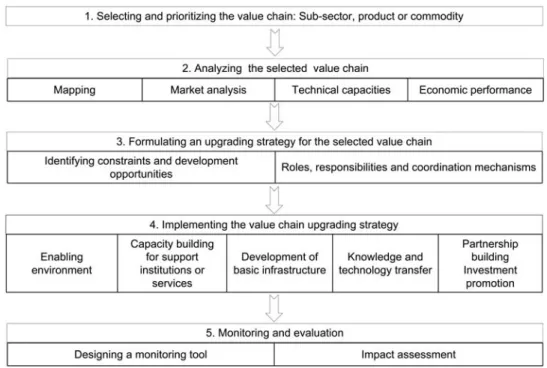
Taking into consideration these broader relationships, UNIDO’s systematic approach to value chain analysis and promotion focuses on the relevance of agro-value chains for pro-poor growth while bearing in mind pragmatic economic parameters to ensure their sustainable development. The Organization’s aim is to focus on those areas which lead to improvements in value chain performance in terms of: (i) increasing the quantity and improving the regularity and continuity of production; (ii) improving the quality and safety of products; (iii) reducing the time needed to reach the customer; (iv) minimizing transactional costs; and (v) improving the capacity of chain actors to follow and assimilate technology and market developments. To achieve these objectives, UNIDO’s approach entails the following stages:
identify the value chains that offer the most promising prospects for economic growth and poverty reduction. It is based on a review of key issues that have an impact on industrial development and the capacity of a given country to produce and export manufactured products competitively. The choice of value chains can be further refined by applying priority criteria, weighting their relative importance and establishing ranking score sheets.
• Mapping value chains to obtain a clear understanding of the sequence of activities and the key actors and relationships involved in the value chain. This exercise is carried out in qualitative and quantitative terms through graphics presenting the various actors of the chain, their linkages and all operations of the chain from pre-production (supply of inputs) to industrial processing and marketing. Depending on the level of detail needed, this exercise may focus also on factors such as the size and scale of main actors; produc-tion volume; number of jobs; sales and export destinaproduc-tions and concentraproduc-tion; etc. • Analyzing the value chain technological capacities. This analysis is made in order to assess the value chain production system and tools; evaluate their technical perfor-mance; and determine the principal technical actions that need to be carried out to upgrade individual enterprises within the chain and to enhance their competitiveness. Among the elements that are assessed are the utilization of inputs, human resources and technical capacities; the technology and processes used; the production manage-ment methods; and the environmanage-mental aspects.
• Analyzing the value chain economic performance and competitiveness. This analysis entails the measuring of economic factors (production costs, margins, added-value, etc.) as well as benchmarking in order to position the chain vis-à-vis alternatives or competitors. It is an effective means of identifying strategic and non-strategic activities and of raising awareness among chain actors concerning cost drivers, margins for price negotia-tion and value addinegotia-tion possibilities. It also reveals leverage points for acnegotia-tion at policy, institutional and enterprise level.
• Formulating an upgrading strategy for the selected value chain. At this stage, upgrading plans are drawn up which describe the interventions required in the agro-value chain, including policy and institutional recommendations. Specific interventions at enterprise level are also outlined, and so is the advocacy necessary to implement them. Roles and responsibilities are assigned to all actors and agencies involved.
• Implementing the upgrading strategy, monitoring and impact assessment.
Given the extensive scope of the interventions that may be required for value chain develop-ment (policy issues, infrastructure improvedevelop-ments, compliance and certification systems,
technology and knowledge transfer, etc.), UNIDO can: (i) facilitate and lead the brokering of relationships and partnerships at the national level and involving chain actors and deve-lopment partners (AfDB, IFAD, WB, FAO, etc.); (ii) identify and prioritize agro-value chains; (iii) undertake holistic agro-value chain analyses in cooperation with its partners; and (iv) design strategies for the implementation of interventions and support.
UNIDO focuses on private sector development solutions to promote selected agro-value chains. Specific interventions capitalize on the Organization’s wide range of programmes and services in order to provide the many-sided assistance required to improve the perfor-mance of targeted value chains.
At policy and institutional level, the initial focus is on removing constraints identified as obstacles to the effective performance of value chains. UNIDO services in this area include: (i) creating an enabling environment for private sector development; (ii) developing business services including the collection and dissemination of market information and the promotion of knowledge flow, and assistance in such areas as technology upgrading, quality management, and training; and (iii) establishing the necessary infrastructure for compliance with accreditation systems – food quality, hygiene and safety standards as well as social and environmental standards that may be demanded by specific markets or buyers.
To improve the productive capabilities of enterprises, techno-economic assessments are conducted. Together with information on the interactions among chain actors, these assessments highlight specific areas where UNIDO interventions can improve the per-formance of individual firms as well as the relationships among firms in the chain. The outcome is a blueprint for: (i) skill and technology upgrading and the introduction of quality standards; (ii) networking programmes for SMEs to support collective efficiency in local clusters and help linking them to buyers; (iii) business partnership programmes with emphasis on multi-stakeholder partnerships with transnational corporations (TNCs) for supplier development; (iv) support to SMEs in rural areas (in particular women entrepreneurs) to facilitate market access and thereby promote local informal value chains; (v) promotion of enterprise development where opportunities for new enterprises or producer associations have been identified; and (vi) support to corporate social responsibility (CSR) in SMEs.
Finally, in the area of investment promotion, the Organization pursues its long tradi-tion of providing matchmaking services for subcontracting and, more recently, is increasingly involved in supplier development and industrial upgrading to improve the productive capacity of agro-input suppliers in developing countries.
For a large part of the world’s growing population, the increasing integration of the global economy has provided the opportunity to achieve significant prosperity gains. For developing countries, the globalization of manufacturing has opened up new prospects of upgrading their industrial and service sectors. It also holds the promise of higher incomes, increasingly differentiated final products and a greater availability of quality goods. Most notably, free trade agreements and other accords have created new export opportunities – mainly for food products – as the demand for variety continues to grow in developed countries. These market changes have encouraged governments and investors, including farmers, to expand agro-industrial activities and linkages to export markets as a means of increasing local food production, employment, business development and international trade. This has led to competition among producers to meet export market demands in terms of cost, quality and delivery times. Consequently, a wide range of companies have evolved to provide goods and services to help agro-industries meet those demands. At the same time, policies, regulations, support services, tax and trade instruments and their associated actors and institutions have also developed to become intrinsic parts of so-called “value chains.”
However, while the increasing integration of the global economy offers many opportunities for growth, value chain promotion in developing countries is a complex task that faces many daunting challenges. Among these challenges are flaws in the business environment; intense competitive pressures for higher productivity and efficiency to maintain market share or at least survive; governance by international supermarkets, retailers and buyers affecting access to markets; international consumers demanding high quality, organic, minimally processed products, traceability and social responsibility; and a higher risk of marginalization faced by areas with poor infrastructure and small farms. Hence, there is an urgent need for a comprehensive approach to value chain development. This technical report describes UNIDO’s contribution to this endeavour and focuses on agro-based value chains (food, leather, wood and non-wood forestry products, and textiles).
1.1 What are value chains?
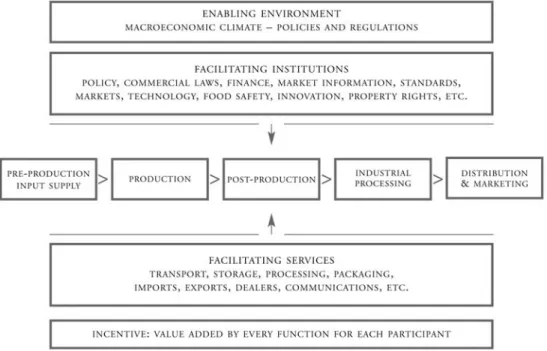
The value chain is a concept which can be simply described as the entire range of activities required to bring a product from the initial input-supply stage, through various phases of production, to its final market destination. The production stages entail a combination of physical transformation and the participation of various producers and services, and the chain includes the product’s disposal after use. As opposed to the traditional exclusive focus on production, the concept stresses the importance of value addition at each stage, thereby treating production as just one of several value-adding components of the chain.
The macroeconomic landscape, policies, laws, regulations, standards and institutional elements such as research and innovation, human resource development and other sup-port services form the environment in which all activities take place and therefore are also important actors and activities in the value chain. Figure 1 below illustrates these relationships within a generic value chain.
In reality, value chains tend to be more complex, to involve numerous interlinked activities and industries with multiple types of firms operating in different regions of one country or in different countries around the globe. For instance, agro-food value chains encompass activities that take place at the farm as well as in rural settlements and urban areas. They require input supplies (seeds, fertilizers, pesticides, etc.), agricultural machinery, irrigation equipment and manufacturing facilities, and continue with handling, storage, processing, packaging and distribution activities (Figure 2). Other elements, such as power generation, logistics, etc., which form the chain environment, are also important factors affecting the performance of value chains.
Figure 2. Links in the food value chain.
Furthermore, both industrial and commercial firms have been promoting globalization by establishing two types of value chains (Gereffi, 1994 &1999). One is “producer-driven,” the other “buyer-driven.” In producer-driven value chains, large, usually trans-national, manufacturers play the central roles in coordinating production networks (including their backward and forward linkages). This is typical of capital- and technology-intensive industries such as the automotive, aircraft, computer, semiconductors and heavy machinery industries. Buyer-driven value chains are those in which large retailers, marketers and brand manufacturers play the pivotal roles in setting up decentralized production net-works in a variety of exporting countries, typically developing countries. This pattern of trade-led industrialization has become common in labour-intensive industries that produce consumer goods such as garments, footwear, toys and consumer electronics. Tiered net-works of contractors in developing countries produce finished goods for foreign buyers. Large retailers or marketers that order the goods supply the specifications.
Unlike producer-driven chains, where profits come from scale, volume and technological advances, buyer-driven chains yield profits from combinations of high-value research, design, marketing and financial services. By controlling these elements, retailers, designers and marketers are able to act as strategic brokers that link overseas factories and traders with product niches in their main consumer markets. Profitability is greatest in the consolidated parts of global value chains that have high entry barriers for new firms.
1.2 Why value chain analysis?
In producer-driven chains, manufacturers of advanced products like automobiles and computers are the key economic agents in terms of their earnings as well as of their ability to exert control over backward linkages (with suppliers of raw materials and components) and forward linkages (with distributors and retailers). The lead firms usually belong to international oligopolies. By contrast, buyer-driven value chains are characterized by highly competitive and globally decentralized factory systems with low entry barriers. The firms that develop and sell brand products have considerable control over how, when and where manufacturing will take place and how much profit accrues at each stage. Thus, large manufacturers control producer-driven value chains at the point of production, whereas in buyer-driven value chains, marketers and merchandisers exercise the main leverage at the design and retail stages (Gereffi &Memedovic, 2003).
A major hypothesis of the global value chain approach is that national development requires linking up with the most significant lead firms in an industry. These lead firms are not neces-sarily traditional vertically integrated manufacturers, nor are they necesneces-sarily involved in making finished products. Lead firms such as fashion designers or private-label retailers can be located upstream or downstream from manufacturing, or they can be suppliers of critical components (e.g., microprocessor manufacturers like Intel or software firms like Microsoft in the computer industry). What distinguishes lead firms from non-lead firms is that they control access to major resources (such as product design, new technologies, brand names or consumer demand) that generate the highest returns (Gereffi &Memedovic, 2003).
Value chain analysis is a useful analytical tool that helps understand overall trends of industrial reorganization and identify change agents and leverage points for policy and technical interven-tions. It is increasingly used by donors and development assistance agencies, including UNIDO, to better target their support and investments in various areas such as trade capacity, enterprise competitiveness, income distribution and equity among value chain participants. Value chain analysis is the process of breaking a chain into its constituent parts in order to better understand its structure and functioning. The analysis consists of identifying chain actors at each stage and discerning their functions and relationships; determining the chain governance, or leadership, to facilitate chain formation and strengthening; and identifying value adding activities in the chain and assigning costs and added value to each of those activities. The flows of goods, information and finance through the various stages of the chain are evaluated in order to detect problems or identify opportunities to improve the contribution of specific actors and the overall performance of the chain.
By going beyond the traditional narrow focus on production, value chain analysis scrutinizes interactions and synergies among actors and between them and the business and policy environment. Thus, it overcomes several important limitations of traditional sector
activities that occur outside the particular sector under assessment or involve informal operations.
Value chain analysis also reveals the dynamic flow of economic, organizational and coercive activities involving actors within different sectors. It shows that power relations are crucial to understanding how entry barriers are created, and how gain and risks are distributed. It analyses competitiveness in a global perspective. By revealing strengths and weaknesses, value chain analysis helps participating actors to develop a shared vision of how the chain should perform and to identify collaborative relationships which will allow them to keep improving chain performance. The latter outcome is especially rele-vant in the case of new manufacturers – including poor producers and poor countries – that are seeking to enter global markets in ways that can ensure sustainable income growth.
1.3 The relevance of agro-value chains for pro-poor growth
In many parts of the world, agriculture continues to play a central role in economic development and to be a key contributor to poverty reduction. However, agriculture alone will not be sufficient to address the poverty and inequality that are so pervasive in today’s world. It is becoming increasingly crucial for policy makers to focus immediate attention on agro-industries. Such industries, established along efficient value chains, can increase significantly the rate and scope of industrial growth. Agro-industrial products offer much better prospects of growth than primary commodities. In addition, the marked trend to break down production processes into specific tasks opens up new opportunities for developing countries to specialize and take a more profitable part in global trade provided they meet increasingly stringent market requirements.
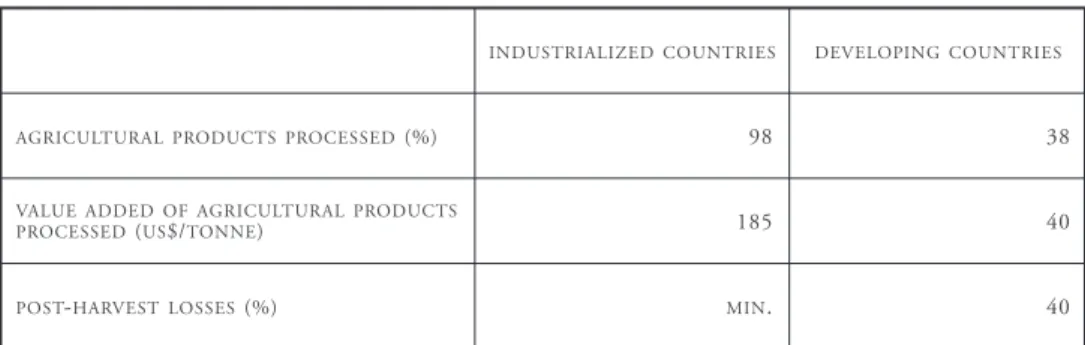
In developing countries, a significant proportion of national funds are used to support agricultural production inputs – primarily seeds, fertilizers and irrigation systems. Traditionally, little attention has been paid to the value chains by which agricultural products reach final consumers and to the intrinsic potential of such chains to generate value added and employment opportunities. While high-income countries add nearly US$185 of value by processing one tonne of agricultural products, developing coun-tries add approximately US$40. Furthermore, while 98 percent of agricultural produc-tion in high-income countries undergoes industrial processing, barely 38 percent is processed in developing countries (Table 1). These data indicate that well developed agro-value chains can utilize the full potential of the agricultural sector.
However, participation in value chains implies both opportunities and pitfalls for developing countries. The prospect that lead firms such as brand owners, innovators and system integrators may appropriate increasing shares of rent and therefore further widen the gap is very real (Altenburg, 2006). Another danger is that SMEs (including farmers) will face
insurmountable difficulties as international supermarkets, retailers and buyers govern the access to markets by setting up food safety and quality standards that impose a substantial cost of compliance. Since subordinate firms are standard-takers, their bargaining power is reduced and so are their shares of rent. Furthermore, value chains may increase the risk of marginalization faced by areas with poor infrastructure and small farms since chain development may favour larger farms and processing plants which can invest in infra-structure and increase their production capacity.
One opportunity resides in the fact that, in pursuit of lower transport and transaction costs, TNCs increasingly subdivide and relocate production processes in developing countries. In addition, modern chains require smooth product flows, high standards and error-free production. Consequently, lead firms are willing to invest in knowledge transfer to the benefit of local industries, institutions and service providers. Finally, consumer pressures and CSR provide incentives for responsible lead firm behaviour.
Other opportunities exist in niche markets, both domestic and foreign, particularly for specialized and natural products found only in developing countries, such as cacao and other tropical fruit as well as numerous spices and oils. Small farmers can also participate in these chains that yield higher incomes.
Value chains are likely to produce both winners and losers, and the net effects may not always be positive (Altenburg, 2006). For example, shifting from in-house production to external suppliers may reduce well-paid wage labour in the lead firm and increase the number of lower-pay jobs in supplier firms; inducing foreign companies to resort to local small-scale suppliers may favour technology transfers but reduce the efficiency of the supply chain; holding back concentration and internationalization in the retailing business may protect small enterprises but lead to higher consumer prices; higher social or environmental standards may reduce competitiveness vis-à-vis competitors with lower standards and may also lead to the exclusion of poor informal suppliers. The conclusion is that SMEs in developing
AGRICULTURAL PRODUCTS PROCESSED(%)
VALUE ADDED OF AGRICULTURAL PRODUCTS PROCESSED(US$/TONNE)
POST-HARVEST LOSSES(%)
INDUSTRIALIZED COUNTRIES 98 38 40 40 185 MIN. DEVELOPING COUNTRIES
Table 1. Comparative data on processing of agricultural products in industrialized and developing countries (UNIDO industrial statistics).
chains. This raises the questions of how policy makers and development assistance agencies should deal with these trade-offs and how the long-term effects of engagement can be assessed.
1.4 The purpose of the present publication
In line with its mandate to “reduce poverty through sustainable industrial growth,” UNIDO plays a leading role in agro-industrial development in developing countries. This publication describes the Organization’s approach to agro-value chain analysis, which is used as a methodological tool in order to gain a full understanding of chain structure and functioning and thereby to better identify and design project interventions in agro-industrial development. In addition, it provides readers with selected examples of UNIDO’s experience in supporting the development of sustainable agro-value chains. However, the publication is not meant to be used or read as a thorough step-by-step methodology for value chain analysis and development. It is rather intended to contribute to the body of useful value chain knowledge accumulated both within and outside the Organization. The publication draws upon various working papers, technical guidelines and sector studies prepared by the Organization’s Strategic Research and Economics Branch and its Programme Technical Cooperation Division; it also reviews opinions expressed in papers published by FAO, GTZ, IRDC, the World Bank Group and others. All sources are listed in the bibliography section.
The global agro-industry business is increasingly dominated by value chain relationships in which lead firms exercise vertical coordination (Humphrey & Memedovic, 2006). For instance, in various food industry operations, lead firms have taken on the attributes associated with modern manufacturing, including driving product differentiation and innovation, a shift from quality control, based on inspection and testing, towards quality assurance, based on risk management and process control, and just-in-time delivery. These changing environments associated with evolving markets highlight a number of challenges and opportunities for various actors involved in value chain development. Most important is the need for a careful review of policy issues that may have an impact on the structure and development of value chains, especially policies that support pro-poor value chains. This is particularly relevant for agro-value chains in developing countries, often characterized by the prevalence of traditional social norms and ties in which the poor may be negatively affected by chain actors and/or promoted activities. In addition, value chain structures can be used to draw conclusions on the participation of the poor and the potential impact that value chain promotion can have on poverty reduction. Humphrey and Memedovic (2006) grouped such promotion policies in three broad areas of focus: (i) ensuring the continued access of agro-producers to global markets and supporting the competitiveness of the sector; (ii) increasing revenues from the agro-industrial sector, particularly through adding value both for local and export markets; and (iii) enhancing the poverty alleviation impact of export-oriented businesses. Agro-value chains encompass activities that take place at various levels (farm, rural and urban), starting with input supply and continuing through product handling, proces-sing, distribution and recycling. As products move successively through the various stages, transactions take place between multiple chain actors, money and information are exchanged and value is progressively added (Da Silva and De Suza Filho, 2007). The analysis of such value chains highlights the need for enterprise development, enhance-ment of product quality and safety, quantitative measureenhance-ment of value addition along the chain, promotion of coordinated linkages among producers, processors and retailers, and improvement of the competitive position of individual enterprises in the marketplace. This approach goes beyond looking at agro-industrial production in isolation to scrutinize interactions and synergies with other actors and the business and policy environment. By revealing strengths and weaknesses, value chain analysis helps identify possible corrective measures. Stakeholders and policy-makers develop a shared vision of how the value chain should develop and forge collaborative relationships which will improve coordination and performance in the future. In addition, this approach brings together the various levels and components of potentially upgrading chain interventions.
While there are a number of published handbooks on value chain research, Kaplinsky and Morris (2001) stress that there is no “definite” method to carry out a value chain analysis. Basically, the methodology to be applied relies on the research questions that are to be answered. This fact is due to the complexity of value chains, especially in the middle tiers. Moreover, individual enterprises may feed into numerous chains; hence, which chain (or chains) is/are to be targeted depends largely on the point of entry for the research inquiry. Appendix A presents examples of entry points for value chain analysis.
Nonetheless, the following four steps of value chain analysis, summarized by M4P (2008), are essential when applied to the agricultural/agro-industrial sector:
1. Mapping the value chain to understand the characteristics of the chain actors and the relationships among them, including the study of all actors in the chain, of the flow of goods through the chain, of employment features, and of the destination and volumes of domestic and foreign sales. This information can be obtained by conducting surveys, inter-views and participatory workshops as well as by collecting secondary data from various sources. 2. Identifying the distribution of actors’ benefits in the chain. This involves analyzing the mar-gins and profits within the chain and therefore determining who benefits from participating in the chain and who would need support to improve performance and gains. In the prevailing context of market liberalization, this step is particularly important, since the poor involved in value chain promotion projects are the most vulnerable. 3. Defining upgrading needs within the chain. By assessing profitability within the chain and identifying chain constraints, upgrading solutions can be defined. These may include interventions to: (i) improve product design and quality and move into more sophisticated product lines to gain higher value and/or diversify production; (ii) reorganize the produc-tion system or invest in new technology to upgrade the process and enhance chain effi-ciencies; (iii) introduce new functions in the chain to increase the overall skill content of acti-vities, for instance, moving from OEM (original equipment manufacture) to ODM (own-design manufacture) and then to OBM (own-brand manufacture); and (iv) adapt the knowledge gained in particular chain functions in order to redeploy it in other sectors. 4. Emphasizing the governance role. Within the concept of value chain, governance defines the structure of relationships and coordination mechanisms that exist among chain actors. By focusing on governance, the analysis identifies institutional actors that may require sup-port to improve capabilities in the value chain, increase value added in the sector and cor-rect distributional distortions. Thus, governance constitutes a key factor in defining how the upgrading objectives can be achieved.
Figure 3. Basic steps of UNIDO’s approach to agro-value chain analysis and development. Taking into consideration the above, UNIDO’s systematic approach to agro-value chain analysis and development focuses on the relevance of agro-value chains for pro-poor growth while bearing in mind pragmatic economic parameters to ensure sustainable development. The Organization’s aim is to focus on those areas which lead to improve-ments in value chain performance in terms of:
• increasing the quantity and improving the regularity and continuity of production; • improving the quality and safety of products;
• reducing the time needed to reach the customer; • minimizing transactional costs;
• improving chain actors’ capacity to follow/assimilate technology and market developments. By promoting agro-value chains, UNIDO pursues three development goals that can benefit the poor as well as all other actors in the chain: (i) increases in productivity and value added; (ii) improved employment opportunities; and (iii) market access and higher export levels. The next sections present the main aspects of agro-value chain analysis and development as undertaken by UNIDO. Figure 3 below describes the basic steps of such interventions:
2.1 Selection and prioritization of value chains 2.1.1 Basic considerations
The selection and prioritization of value chains to be analysed are the first steps and they certainly entail some of the most important decisions to be taken in any value chain development project. The selection of sectors, sub-sectors, products or commodities determines to a large extent the prospects for a value chain’s impact on socio-economic indicators. An important aspect of the selection and prioritization process is to see if basic measures are in place for the participation of the poor in business-related markets. If these are missing, the formulation of a development programme may involve additional components to facilitate and support a value chain promotion project.
In general, requests for value chain analysis are submitted for the Organization’s consideration by its member states, partner institutions and/or donor agencies. Usually, these requests specify the sectors (or sub-sectors, products, commodities) to be targeted. In this respect, UNIDO conducts a rapid appraisal on suggested agro-value chains to identify those that offer the most promising prospects for economic growth. This appraisal is based on a desk review of key issues that have an impact on industrial development and the capacity of a given country to produce and export manufactured products competitively. A quick comparative analysis of the main manufacturing sub-sectors is carried out with emphasis on agro-industrial ones, such as food, textiles, wearing apparel, etc. This exercise leads to the preliminary identification of a set of priority agro-industrial activities and, by extension, the agro-value chains they are part of or the ones in which they could be integrated if the appropriate conditions were in place. The identification of priority chains is based on such factors as their current and potential contributions to GDP, manufacturing value-added, price factors (labour costs, the cost of inputs, exchange rates), investments (both national and FDI), domestic and/or international demand for a product (market potential), and spill-over effects on other economic activities. The main business environment and policy framework factors driving or constraining industrial performance are also considered when selecting value chains.
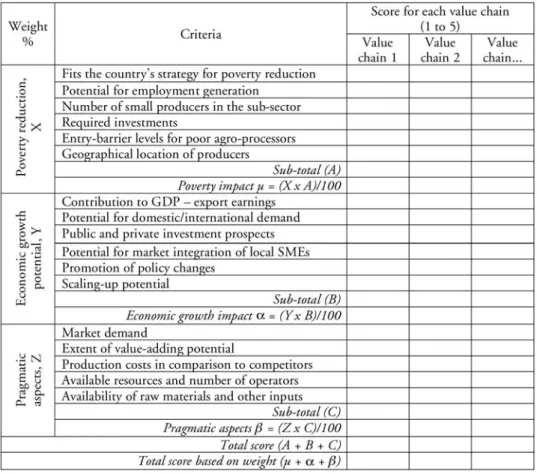
After the rapid appraisal, the choice of value chains to be targeted is refined by applying priority criteria, weighting their relative importance and establishing ranking score sheets. This exercise is conducted with the participation of a broad range of stakeholders (government, private sector, service providers, sector associations, etc.) to ensure owner-ship for future value chain upgrading activities, and also to assess the sector’s willingness to reorganize and change.
Since one of the main objectives is to support pro-poor value chains, the established priority criteria will reflect this dimension by providing answers to questions such as: • How does the sector fit within the country’s overall strategy for poverty reduction? • Is the incidence of poverty in the project geographic area high and/or is the target region marginalized?
• What is the value chain potential for employment generation, for example, through participation in product markets and/or labour-intensive manufacturing industries? • What would be the required start-up costs – are there value chains not requiring high investments and able to employ low-tech skills?
• To what extent higher environmental and social standards may affect costs and competitive-ness and thereby raise entry barriers for poor agro-processors?
• What would be the impact of the value chain on the rural economy – diversification of incomes; jobs for women; local processing of raw materials, etc.?
• What would be the risks and threats of promoting the selected chain, including the replacement of unskilled work force and the environmental sustainability aspect? Other criteria that relate to economic growth and reflect a pragmatic approach to a sustained development of value chains will include:
• What is the potential domestic and/or international demand for a particular product? • What are the production costs in comparison to those of competitors – benchmarking and competitiveness factors?
• What are the prospects for attracting public and/or private investments?
• Are the available resources in line with the number of operators involved in the value chain? • What is the potential for local SMEs (including informal suppliers) to be integrated in regional/international markets?
• What is the situation with regard to existing infrastructure, financial and non-financial business services, availability and accessibility of raw materials and other inputs?
• What is the level of skills of the labour force and management in the sector?
• How may the selected chain affect/promote policy changes – creating an enabling envi-ronment for private sector development?
• Are there complementarities with other projects in the region/country and is there potential for scaling-up?
This list of criteria is not exhaustive; it can be expanded or modified depending on the situation and environment of the targeted region/sector. Also, the weight to be assigned to any criterion will depend on its relative importance. Table 2 (opposite) provides a sample weighted score sheet which can be used (as such or modified) to prioritize value chains. It is worth noting that, while the objective of this exercise is to eventually prioritize a sub-sector, a product or a commodity for analysis, it is important to keep the focus on the entire
sector in order to not oversee pertinent issues related, for instance, to trade and investment policies, tax and financial incentives, market potential, etc.
2.1.2 Preliminary market analysis
It should be emphasized that the existence of a demand potential (market) for a product (or commodity) is a sine qua noncondition and the fundamental factor in selecting and prioritizing a value chain. While a detailed market analysis is not justified at this stage, it is important to gain a sound understanding of elements and variables such as (see Appendix B): • The specifics of the existing market and the opportunities for marketing identified products (or commodities) in the short, medium and long term. The main factors of interest in this connection are: market size and dynamics over time, both in terms of value and volume; type of products in demand, their price fluctuations and demand peaks; access
to raw and intermediate inputs to the product and their global price fluctuations; possible existence of a market niche and its growth potential.
• The competitors operating in the market and their performance. This involves collecting data on: key producers and suppliers competing in the market, their products and linkages with global value chains; the existence of one or several dominant firms; the performance of these competitors in terms of market shares and product prices and quality; and their competitive advantages (level of industry integration, distance to markets, etc.).
• The prevailing conditions regarding market access. Some of the factors to be investigated here are: the existing physical infrastructure (communications and roads, storage facilities, logistics and distribution channels, etc.) and its impact on the productivity of the sector; specific applicable product standards (technical and quality) and the costs of compliance (ISO, HACCP, organic products, labour and environmental standards, etc.); the market structure of the industry (monopoly, transparent and fair competition, entry barriers, etc.); and the facilities for licensing and issuing of permits.
This initial market study can be supplemented by an assessment of the product strategic positioning so as to measure the commercial performance of the value chain and of each of its areas of strategic activity. Also, one can gauge the strategies implemented to achieve the commercial objectives set by the various chain actors. The results of the assessment would allow to: (i) identify and classify the principal external and internal strategic difficulties related to the product markets and to deduce the main opportunities and constraints; and (ii) evaluate the market for products at the national and international level based on a retrospective analysis of the market and the projected development of macroeconomic indicators influencing the consumption of the products in question. The UNIDO training manual “Module 2: Market Analysis and Marketing” provides the main tools for conducting a market analysis and determining and forecasting demand. The Organization also publishes several specialty publications which provide a range of useful information on economic and market trends. Such publications are the industrial develop-ment reports, the investdevelop-ment survey reports, comparative analyses of industrial perfor-mance, and the Industrial Statistics Databases (INDSTAT) at the 4-digit level of the International Standard Industrial Classification of all economic activities (ISIC). See the tools and guidelines developed by UNIDO and listed in Appendix C.
2.1.3 Case profile: Commodity value chain prioritization in Ethiopia
In the process of preparing an agro-industrial master plan for Ethiopia, a prioritization process was conducted for several commodities to identify those offering the highest
prospects for growth (UNIDO and FAO, 2009). The prioritization process emphasized the potential for agricultural commercialization and agro-industrial development by using the following main criteria:
• Commodities of importance to the economy on the basis of: (i) the population involved in production, marketing, processing and related services especially from income generation and employment perspectives; (ii) relevance in terms of national food security; and (iii) contribution as a source of foreign exchange.
• Competitive advantage with respect to production and agro-processing in comparison to other countries and especially neighbouring countries. The factors considered included productivity, cost of production, existing support infrastructure and facilities (roads, logistics, marketing, etc.), and the business environment.
• Attractiveness of industry to investors – policy environment and incentives available to investors, including FDI.
• Access to the requisite technology, infrastructure, services and facilities.
• Potential for short-term impact – sectors and commodities that can achieve significant improvements along the value chain without requiring major infrastructure investments. Twenty-two commodities were assessed through reviews of secondary data and interviews with key sources including government departments and the private sector (producers, traders, agro-processors, etc). Several validation and planning workshops were also held. Based on the criteria mentioned above, twelve commodities were initially selected and classified in three groups as follows:
Group 1: Commodities that are highly important to the economy due to the large population involved in their production and to their contribution to national food security. They are also important as a source of foreign exchange and have good potential for short-term impact with relatively low investments. This group includes: (i) cereals (wheat, maize, teff and barley); (ii) oilseeds (sesame, Niger seed, linseed and rapeseed); (iii) coffee; and (iv) sugar.
Group 2: Commodities that are of importance to the economy due to the number of people involved in production, processing and marketing as well as to their contribution to food security. They are also important in terms of income and employment generation and as a source of foreign exchange. However, this group would need significant invest-ments, especially in infrastructure, and would also require a concerted effort to enhance competitiveness in the global arena. This group includes: (i) dairy products; (ii) meat; (iii) tea; and (iv) fruit and vegetables.
Group 3: Commodities that entail a competitive advantage for Ethiopia. They are attractive to investors and have potential for short-term impact. However, they have relatively low national economic importance and are more relevant for niche or specialized markets. This group includes: (i) honey; (ii) pulses; (iii) spices; and (iv) grapes/wine.
In addition to this selection and classification process, a prioritization exercise involving all stakeholders was conducted and yielded the priority commodities illustrated in Figure 4 below. These were (i) cereals (wheat, maize, teff and barley); (ii) oilseeds (sesame, Niger seed, linseed and rapeseed); (iii) coffee; and (iv) sugar. The value chains for these commodities were analyzed and strategies to support commercialization and agro-industrial development were proposed (with the exception of the sugar sub-sector which already had an industrial development strategy).
2.2 Mapping the value chain
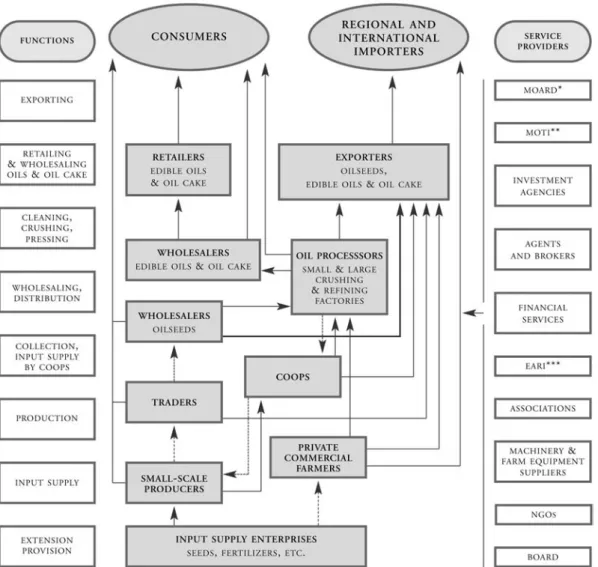
Mapping a value chain facilitates a clear understanding of the sequence of activities and the key actors and relationships involved in the value chain. This exercise is carried out in qualitative and quantitative terms through graphs presenting the various actors of the chain, their linkages and all operations of the chain from pre-production (supply of inputs) to industrial processing and marketing. When dealing with value chains where benefits are sought for the poor and the marginalized, it is also important to give special consideration to poverty, gender and environmental factors.
The mapping diagrams are prepared through an iterative process which can be divided into two stages:
activities at other domestic or foreign locations, the supporting services and their inter-actions, the links to the final market, and some initial indications of size and importance. The second stage is quantifying the value chain. This involves adding detail to the basic maps drawn initially (structure and flow). Depending on the level of detail needed for the research entry point, this exercise may focus on elements such as size and scale of main actors; production volume; number of jobs; sales and export destinations and concentration. However, it may be erroneous to speak of one final map. In general, the outcome is several maps (to avoid information overload), providing different (but interlinked) chain information. The resulting maps will depend on the scope and objectives of the type of research conducted and its entry point or dimension. Sample mapping questions are given below (adapted from M4P, 2008):
• What are the main activities carried out in the value chain to manufacture the final product (or category of products)? These activities will vary depending on the type of chain being analyzed (agricultural commodities, industrial products or services). However, it is advisable to identify not more than six or seven main activities between the start of the production process and sale to the final customer.
• Who are the operators involved in these activities and what are their roles? It is important to differentiate the actual owners of the products. If they source out or sub-contract processes to other businesses, the latter should be categorized as operational service providers. Other factors to map out at this stage are the poverty ranking, the locations of the various actors (commune, district, province, country, etc.) and their legal status. • What are the flows of products, information and knowledge in the value chain? These flows can be both tangible and intangible, for instance, products, money, information and services. • What are the production volumes, the number of actors, the number of jobs? This infor-mation helps picture the size of the various channels within the value chain. The dimension of the vulnerable segment of the population in the chain (including gender differentiation) and employment opportunities can also be portrayed.
• Where does the product (or service) originate from and where does it go? This map captures the physical flow of the product or service and illustrates regional variations, such as the transaction costs related to transport.
• How does value change through the value chain? This factor is useful in measuring the competitiveness of each operator within the chain (and of the chain as a whole). The simplest method of picturing this element is by computing value addition at each stage of the chain – the value of output at market price minus the value of all intermediate inputs (materials or services) purchased from other firms.
• What types of relationships and linkages exist among the various chain actors? These may include a market relationship, a persistent network relationship between independent firms, a vertical integration, etc. Appendix D provides basic conventions for mapping these relationships and linkages.
• What types of business services are feeding into the chain, including the regulatory and policy framework in which the sector is operating? This map will illustrate the external sources of competitiveness and highlight the need for potential interventions outside the value chain. • What is the market share of the value chain? This variable can be defined as the percentage of the sales value in the overall market.
• What are the main strengths and weaknesses of the chain? These factors can be identified by carrying out a SWOT analysis which can then be integrated in the mapping exercise. Figure 5 below provides a sample SWOT analysis for the oilseeds value chain in Ethiopia.
>
>
>
>
PRODUCTION TRADERS PROCESSORSOIL RETAILERS EXPORTERS
Suitable climate and land; competitive sesame yields; low-cost labour. World leader in sesame seed; Ethiopian commodity exchange. Competitive wages; large internal market for oil and oil cake; all-year industry.
Growing oilseeds market; increasing demand for organic products and healthy oils. Existing
structure.
Unreliable supply; large fluctuations of raw material cost; technology with low extraction efficiency; unorganized small operators; non-compliance with quality norms; lack of skilled manpower; infrastructure deficiencies. Non-regulated imports of edible oils. Lack of vision and policy; high transport costs. Lack of organized market information; prices of raw material not based on quality; too many middlemen adding little value and increasing transaction costs. Fragmented small holdings and supply base; few commercial farms; import of most inputs; high pre- and post-harvest losses; poor technical knowledge; limited access to finance. Market organization; quality standards. Potential to increase oil production and improve quality. Market
organization. Large market;organic certification. Climate change; continuing fragmentation of farms. Increasing transaction costs. Non-availability
andhigh cost of funds; unreliable supply. Inconsistent government policies. Lack of competitiveness in international markets. Farmer organizations; reduction of post-harvest losses.
Figure 5. Sample SWOT analysis of the oilseeds value chain in Ethiopia.
WEAKNESSES
THREATS
OPPORTUNITIES STRENGTHS
*Ministry of Agriculture and Rural Development ** Ministry of Trade and Industry
*** Ethiopian Agricultural Research Institute
casual relationship network relationship vertical integration
Value chain mapping is preferably conducted by an interdisciplinary team of experts using observation of chain activities, interviews with chain actors, and participatory workshops to develop and obtain feedback on the chain maps. Apart from its contribution to the mapping exercise, the participation of the key chain actors is important as it helps them build a shared vision of the problems to be overcome, develop a collaborative upgrading strategy and take joint decisions regarding future interventions.
Humphrey, J. (2005) in his report on shaping value chains for development provides some basic conventions for chain mapping. These are outlined in Appendix D and were used for mapping the main structure and actors within the oilseeds value chain in Ethiopia (overleaf ).
2.3 Analyzing value chain technical capacities
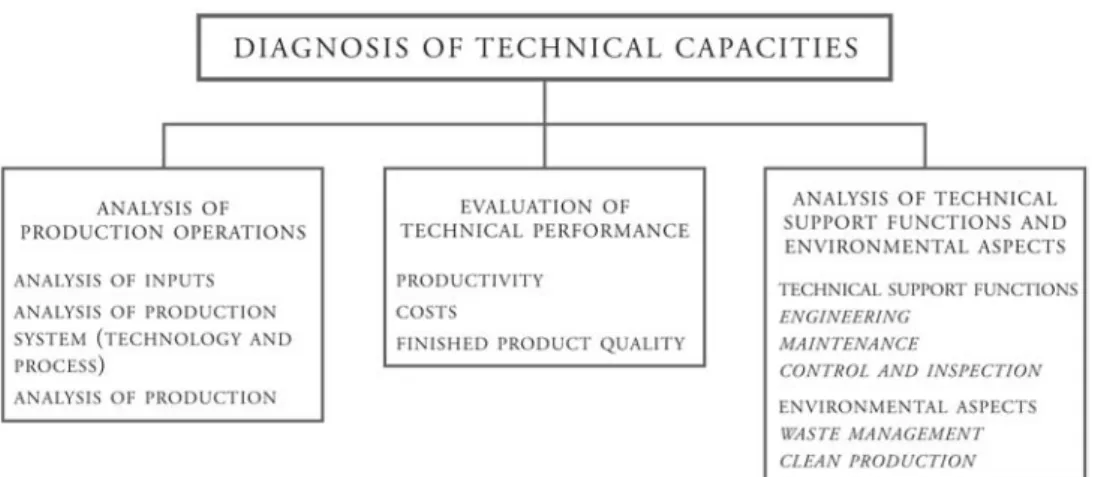
In an economic environment characterized by intense competition and increasingly rapid industrial changes, the analysis of value chain technical capacities is made in order to: (i) assess the production system and tools; (ii) evaluate technical performance; and (iii) determine the principal technical actions that need to be carried out to upgrade individual enterprises and enhance their competitiveness. UNIDO’s methodological guide for restructuring and upgrading and industrial competitiveness outlines the para-meters which are important for such analyses as shown in Figure 7 below.
management of agro-value industrial operations. Three aspects of production are to be assessed:
1. Utilization of inputs (raw materials and supplies, labour, water and energy, production materials, equipment, etc.). Raw materials and supplies are examined in terms of characteristics, compliance with technical specifications, patterns of consumption by manufactured unit, and losses and waste. Human resources are assessed with respect to skills and technical capabilities, staff training and occupational safety.
2. The production system (technology and process). This is compared with systems used in the sector by the main competitors in terms of the utilization of raw materials, labour, etc., the flexibility to produce a range of products and to adapt to fluctuations in volume, and the capacity of the staff to assimilate technology change and to innovate. The capacity of the enterprise to provide finished products that meet the needs of customers in terms of quality, delivery time and cost is also assessed. Production management methods, particularly research, planning and scheduling, maintenance management, and quality control and assurance are evaluated.
3. The products manufactured by value chain enterprises. Products are analysed in terms of characteristics (such as nature, quality, price, delivery times, distribution, after-sale services, compliance with standards) and in relation to those of the competition and those demanded by customers.
With regard to technical performance, the products of an enterprise are evaluated in terms of productivity, costs, and quality levels. Productivity is measured by analyzing records of production volume by product line, type and production time. The productivity of the main processing lines is compared with data for main competitors where possible. Measurement of performance in terms of costs is based on an analysis of cost patterns for raw materials, energy, maintenance, subcontracting and personnel as well as of the cost of tying up of stocks. Finally, data on quality levels are reviewed in terms of levels of defects or percentages of output meeting quality standards.
The last stage assesses technical support functions and environmental aspects. The former are examined to determine the engineering, maintenance, and inspection and control conditions required so that the chain enterprises operate with minimal breakdowns and within local occupational health and safety and legal standards for agro-processing plants. The capacity of an enterprise to minimize environmental problems and comply with relevant legislation is assessed in terms of waste management and the opportunities to utilize cleaner production methods. These may need to be documented in order to comply with private standards demanded by buyers.
On completion of this assessment, UNIDO technical experts are in a position to identify, structure and classify fundamental problems and bottlenecks hindering proper technical functioning of individual enterprises and, in particular, to recommend a detailed plan of action to improve production performance, especially in the case of enterprises linking into new markets with more demanding requirements.
2.4 Analyzing economic performance and benchmarking competitiveness 2.4.1 Basic objectives
After having developed the general conceptual map (or maps) of the value chain, the next step is to analyze the chain’s economic performance and competitiveness (including a review of external sources of competition). Production costs, margins, price markups, productive capacity and productivity are among the possible measures of chain perfor-mance. The calculation of these variables makes it possible to:
• position the chain vis-à-vis alternatives or competitors – benchmarking; • identify strategic and non-strategic activities;
• raise awareness among chain actors concerning cost drivers, margins for price negotiation, and possibilities for value addition;
• recommend leverage points for action at policy and institutional levels as well as at enter-prise level.
The measured economic and competitiveness variables can also be used as the baseline for monitoring the potential impact of upgrading interventions in the value chain – for instance, poverty reduction through increased margins/incomes for poor stakeholders; productivity gains through the introduction of more efficient technologies or processes; increased exports as a result of improvements in product design and quality; a friendlier business environment achieved by removing institutional bottlenecks. Most of these aspects of chain performance can be influenced by the collective action of enterprises and support services.
2.4.2 Analysis of external sources of competitiveness
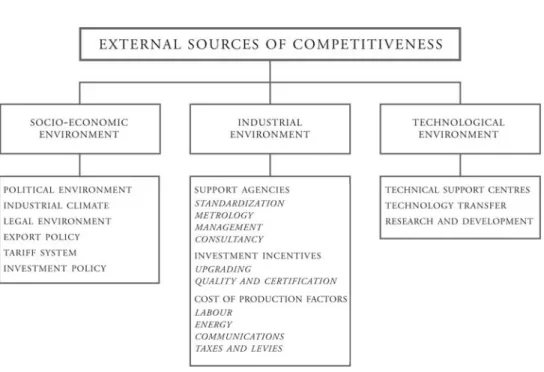
The economic environment in which a value chain operates can have a positive or negative impact on its performance. Therefore it is important to analyze the principal components of this environment and to identify its limitations and opportunities with respect to any value chain promotion project. UNIDO’s “Methodological Guide: Restructuring, Upgrading and Industrial Competitiveness” specifies the main elements to be investigated. These are summarized in Figure 8 (opposite).
a. Economic and social environment
The analysis of this environment provides a significant pointer to the origins of opportunities for upgrading the target value chain as well as to the sources of existing constraints. It may include:
• The trends in the basic economic data of a country, such as: (i) average per capita income, gross national product, consumption, investments, economic growth rate, exchange rate; (ii) exports and/or imports by the country, sector and industry, and of products manufactured by the value chain under consideration; (iii) economic policy: development objectives, economic orientation, programmes and strategies of the country, sector and industry.
• The principal economic measures adopted by the state to promote and finance industry and associated services and to support the restructuring and upgrading of enterprises. • The impact on the performance of industry of various economic and political variables, such as currency devaluation, increase in the cost of particular factor inputs, average cost of capital, labour and severance.
b. Industrial environment
The industrial environment of a value chain is made up of all the actors (individuals, enterprises and organizations) and factors (economic and technical) that exert influence on its own results and also on those of its direct competitors. The assessment of this environ-ment consists therefore of an analysis of the various institutional and support agencies (standardization, certification, accreditation, metrology, financing, management, main-tenance and consultancy services, etc.) so as to identify the constraints and opportunities related to upgrading and developing the value chain in an open and competitive market. c. Technological environment
This analysis investigates the technical support systems that enable the value chain operators to use and access technical information, to select and acquire technologies, equipment and manufacturing procedures, to adapt and control technology transfer and, finally, to capitalize on technological know-how.
2.4.3 Analysis of economic parameters
The indicators of major interest for such an analysis are the production costs, value added and productivity. Frequently, the calculation of these variables is complex due to the multifaceted elements of value chains. Various problems may be encountered in the analysis, particularly in small and medium-size enterprises, regarding the reliability, availability, regularity and homogeneity of the accounting data and the conversion of the latter into required economic data. Thus, economic analyses of value chains often have to be based on cost estimates. Such estimates should however be carefully checked, for instance, against data of similar projects when available. When faced with questionable estimates, it may be necessary to verify such costs by using other data sources. In any case, the economic analysis should provide useful indications to guide choices and support decision making for future strategic chain upgrading interventions. Final investment decisions will have to be based on an in-depth and thorough analysis of technical and financial data.
a. Production costs
The production costs in value chains can be calculated by aggregating costs incurred by enterprises in each segment of the chain. The Analytic Analysis by Product Table (AAPT) – Table 3 (opposite) – can be used as a basis for the computation of these factors. The review of the AAPT data will help identify the operations that account for the largest shares of the overall production costs at enterprise level. A more detailed analysis of these
1. Production capacity 2. Actual production
3. Value of production sold
4. Raw materials consumed at cost price (RM) RM 1
RM 2 RM 3
5. Consumable materials at cost price (CM) CM 1
CM 2 CM 3 6. Rent
7. External work and services 8. Other production costs 9. Personnel costs 10.Technical assistance 11. Manufacturing cost (4+5+6+7+8+9+10) 12. Packaging 13. Distribution costs 14. Cost of distribution (12+13)
15. Production cost before amortization and financing costs (11+14)
16. Amortization in financial year 17. Financing costs
18. Production cost before general costs (15+16+17)
19. General costs
20. Total production cost (18+19)
21. Pre-tax profit (3-20) Unit tonnes tonnes Year (n-4) Costs
(%) Costs(%) Costs(%) Costs(%) Costs(%)
Year
(n-3) (n-Year2) (n-Year1) Year(n) Designation
operations may point to cost reduction prospects and/or upgrading strategies. Pre-tax profit can also be derived from the AAPT data.
A further step in calculating production costs relates to each function within the chain. As an example, in the case of the textile and apparel value chain, these costs will be broken down to account separately for all activities required to manufacture and market a product: (i) yarn – spinning; (ii) fabric – weaving, knitting and finishing; (iii) garment production – designing, cutting, sewing, buttonholing and ironing; and (iv) marketing and distribu-tion operadistribu-tions. Such informadistribu-tion does not illustrate the enterprise accounting details, but rather the costs along the sequence of production and marketing operations within a value chain. The cost of each activity can be combined with the measurement of productivity and converted into a production cost per unit of output (i.e., USD per kg of yarn or fabric). Here again, the unit costs that are high can be analyzed for potential reduction. Figure 9 below illustrates the case of men’s T-shirt production in Bangladesh.
Value added ideally represents the value created during the manufacturing process conducted by each industrial establishment. It is measured as the difference between the value of all goods and services produced and the value of those purchased non-labour inputs which have been used in the production process. This type of measure avoids double counting, since what each establishment has purchased from other establishments is deducted from the value of its own production. Inputs to be considered may include materials and sup-plies, fuel, electricity, contract work, repairs, maintenance and transportation as well as other industrial services. The value at which these inputs were purchased is deducted from total revenue from production in order to obtain the establishment’s value added. Revenue from production can be reported at basic or producer prices. The difference is that the lat-ter includes indirect taxes and excludes subsidies.
The above principle is applied at each stage of the selected value chain. It is also important to distinguish, along these stages, those goods and services that are provided by the chain members from those provided by external entities. The measurement of value added created throughout the chain provides a sound basis for formulating possible upgrading strategies by highlighting where value is added and by whom. Such an analysis has direct implications for pro-poor growth.
Figure 10 illustrates the distribution of value addition in the textile sector expressed by a Value Index (Gherzi research, 2005). The latter shows the incremental increases in value addition for each stage along the textile chain (i.e., the production sequence), from raw cotton to ready-made garments, for example, shirts and trousers. The cost of raw cotton is taken to have an index of 100; the increase to lint cotton stage is 15, and so on to reach