Master Thesis
Computer Science
Thesis no: MCS-2011-03
January 2011
School of Computing
Blekinge Institute of Technology
Box 520
Enhancing Information Security in Cloud
Computing Services using SLA Based
Metrics
Nia Ramadianti Putri
Medard Charles Mganga
School of Computing
Blekinge Institute of Technology
SE – 371 79 Karlskrona
Contact Information:
Author(s):
Nia, (Ramadianti), Putri
E-mail:
[email protected]
Medard, (Charles), MgangaE-mail: [email protected]
University advisor(s):
Prof. Rune Gustavsson
School of Computing
This thesis is submitted to the School of Computing at Blekinge Institute of Technology in
partial fulfillment of the requirements for the degree of Master of Science in Computer Science.
The thesis is equivalent to 20 weeks of full time studies.
A
BSTRACT
Context: Cloud computing is a prospering technology that most organizations are considering for adoption as a cost effective strategy for managing IT. However, organizations also still consider the technology to be associated with many business risks that are not yet resolved. Such issues include security, privacy as well as legal and regulatory risks. As an initiative to address such risks, organizations can develop and implement SLA to establish common expectations and goals between the cloud provider and customer. Organizations can base on the SLA to measure the achievement of the outsourced service. However, many SLAs tend to focus on cloud computing performance whilst neglecting information security issues.
Objective: We identify threats and security attributes applicable in cloud computing. We also select a framework suitable for identifying information security metrics. Moreover, we identify SLA based information security metrics in the cloud in line with the COBIT framework.
Methods: We conducted a systematic literature review (SLR) to identify studies focusing on information security threats in the cloud computing. We also used SLR to select frameworks available for identification of security metrics. We used Engineering Village and Scopus online citation databases as primary sources of data for SLR. Studies were selected based on the inclusion/exclusion criteria we defined. A suitable framework was selected based on defined framework selection criteria. Based on the selected framework and conceptual review of the COBIT framework we identified SLA based information security metrics in the cloud.
Results: Based on the SLR we identified security threats and attributes in the cloud. The Goal Question Metric (GQM) framework was selected as a framework suitable for identification of security metrics. Following the GQM approach and the COBIT framework we identified ten areas that are essential and related with information security in the cloud computing. In addition, covering the ten essential areas we identified 41 SLA based information security metrics that are relevant for measuring and monitoring security performance of cloud computing services.
Conclusions: Cloud computing faces similar threats as traditional computing. Depending on the service and deployment model adopted, addressing security risks in the cloud may become a more challenging and complex undertaking. This situation therefore appeals to the cloud providers the need to execute their key responsibilities of creating not only a cost effective but also a secure cloud computing service. In this study, we assist both cloud provider and customers on the security issues that are to be considered for inclusion in their SLA. We have identified 41 SLA based information security metrics to aid both cloud providers and customers obtain common security performance expectations and goals. We anticipate that adoption of these metrics can help cloud providers in enhancing security in the cloud environment. The metrics will also assist cloud customers in evaluating security performance of the cloud for improvements.
Keywords: cloud computing, security metrics, security
ACKNOWLEDGEMENTS
We would like to express our gratitude to our thesis supervisor, Prof. Rune Gustavsson, whose expertise, guidance and support enabled us to develop understanding of the study. We would like to thank our families and friends who provided us with support and encouragement throughout this study. Without them we would not have been able to complete this thesis.
C
ONTENTS
ABSTRACT ... 3 ACKNOWLEDGEMENTS ... 4 CONTENTS ... 5 1 INTRODUCTION ... 9 1.1 AIMS ... 9 1.2 OBJECTIVES ... 9 1.3 TERMINOLOGIES ... 10 2 BACKGROUND ... 11 2.1 CLOUD COMPUTING ... 112.2 SERVICE LEVEL AGREEMENT (SLA) ... 14
2.3 CONTROL OBJECTIVES FOR INFORMATION AND RELATED TECHNOLOGY (COBIT) ... 14
2.4 GOAL QUESTION METRIC (GQM) FRAMEWORK ... 15
2.5 INFORMATION SECURITY ... 16
2.6 SECURITY METRICS ... 17
3 RELATED WORK ... 19
4 METHODOLOGY ... 20
4.1 RESEARCH QUESTIONS ... 20
4.2 RESEARCH METHODS AND RATIONALE ... 20
4.3 RESEARCH PLAN ... 21
4.4 SOURCES OF DATA ... 24
4.5 DATA ANALYSIS ... 25
5 RESULTS ... 27
5.1 STUDY SELECTION FOR SLR1 ... 27
5.2 STUDY SELECTION FOR SLR2 ... 29
5.3 IDENTIFIED RELEVANT SECURITY ATTRIBUTES ... 31
5.4 IDENTIFIED SECURITY METRIC FRAMEWORKS ... 31
5.5 IDENTIFIED INFORMATION SECURITY METRICS ... 33
6 ANALYSIS ... 36
6.1 INFORMATION SECURITYATTRIBUTESIN CLOUD COMPUTING (RQ1) ... 36
6.2 INFORMATION SECURITY THREATS IN CLOUD COMPUTING (RQ1.1) ... 36
6.3 FRAMEWORKS FOR DEVELOPING SECURITY METRICS (RQ2) ... 38
6.4 SLA BASED INFORMATION SECURITY METRICS IN CLOUD COMPUTING (RQ3) ... 39
7 DISCUSSION ... 42
7.1 INFORMATION SECURITY ATTRIBUTES AND THREATS IN CLOUD COMPUTING ... 42
7.2 SELECTION OF GQM FRAMEWORK ... 42
7.3 SLA BASED INFORMATION SECURITY METRICS ... 43
8 VALIDITY RISKS ... 45
9 CONCLUSION AND FUTURE WORK ... 46
10 REFERENCES ... 47
APPENDIX A ... 56
LISTOFTHREATSANDSECURITYATTRIBUTESAPPLICABLEINCLOUDCOMPUTING ... 56
APPENDIX B ... 58
LISTOFIDENTFIEDFRAMEWORKSFORDEVELOPINGSECURITYMETRICSAND THEIRAPPROPRIATESCORES ... 58
APPENDIX C1 ... 63
COBITITPROCESSESTHATMETOBJECTSELECTIONCRITERIA ... 63
APPENDIX C2 ... 64
IDENTIFICATIONOFSECURITYOBJECTS ... 64
APPENDIX D ... 66
LISTOFIDENTIFIEDSLABASEDINFORMATIONSECURITYMETRICSINCLOUD COMPUTING ... 66
APPENDIX E ... 70
PILOTDATAUSEDTOCOMPUTECOHEN’SKAPPAFORSLR1 ... 70
APPENDIX F ... 71
PILOTDATAUSEDTOCOMPUTECOHEN’SKAPPAFORSLR2 ... 71
APPENDIX G ... 72
LIST OF FIGURES
FIGURE 1:CLOUD SERVICES ARCHITECTURE [9] ... 13
FIGURE 2:BASIC PRINCIPLE OF COBIT[10]. ... 15
FIGURE 3:GQM FRAMEWORK [28] ... 16
FIGURE 4:SECURITY ATTRIBUTES (INSPIRED BY [30]) ... 17
FIGURE 5:RESEARCH PLAN ... 21
FIGURE 6:STUDY COLLECTION FOR SLR1 ... 28
FIGURE 7:DISTRIBUTION OF STUDIES BASED ON YEAR OF PUBLICATION FOR SLR1 ... 29
FIGURE 8:DATA COLLECTION OF SLR2 ... 30
FIGURE 9:IDENTIFIED SECURITY ATTRIBUTES IN CLOUD COMPUTING ... 31
FIGURE 10:INDIVIDUAL CRITERIA SCORE PER FRAMEWORK ... 32
FIGURE 11:OVERALL SCORE DISTRIBUTION FOR EACH IDENTIFIED FRAMEWORKS ... 32
FIGURE 12:SUMMARY OF IDENTIFIED SLA BASED INFORMATION SECURITY METRICS ... 34
FIGURE 13:DISTRIBUTION OF TYPES OF METRICS PER SECURITY MEASUREMENT GOALS ... 35
FIGURE 14:METRICS DISTRIBUTION BY TYPES ... 35
FIGURE 15:THREATS FREQUENCIES IN THE STUDIES ... 38
LIST OF TABLES
TABLE 1:TERMS AND DEFINITIONS USED IN THE STUDY ... 10
TABLE 2:STUDY INCLUSION/EXCLUSION CRITERIA FOR SLR1 ... 21
TABLE 3:STUDY QUALITY ASSESSMENT FOR SLR1 ... 22
TABLE 4:STUDY INCLUSION/EXCLUSION CRITERIA FOR SLR2 ... 22
TABLE 5:CRITERIA FOR SELECTING A SUITABLE SECURITY METRIC FRAMEWORK ... 22
TABLE 6:STUDY QUALITY ASSESSMENT CRITERIA FOR SLR2 ... 23
TABLE 7:GQM APPROACH TEMPLATE [28] ... 24
TABLE 8:CRITERIA FOR SELECTING SLA BASED INFORMATION SECURITY METRICS IN CLOUD COMPUTING ... 24
TABLE 9:DATA EXTRACTION FORM FOR INFORMATION SECURITY THREATS AND ATTRIBUTES IN CLOUD COMPUTING ... 25
TABLE 10:DATA EXTRACTION FORM FOR SECURITY METRICS FRAMEWORKS ... 26
TABLE 11:CRITERIA FOR SELECTING OBJECTS ... 26
TABLE 12:SUMMARY OF STUDIES BASED ON QUALITY ASSESSMENT CRITERIA FOR SLR1 ... 28
TABLE 13:SUMMARY OF STUDIES BASED ON QUALITY ASSESSMENT CRITERIA FOR SLR2 ... 30
1
I
NTRODUCTION
As more and more demands for Information Technology (IT) services rise, there are also increasing needs to expand IT architecture and infrastructures to provide more services. As a consequence, IT service providers are faced with challenges of expanding the structures and infrastructures with small expenditure and minimum time in order to provide rising demands from their customers. To address these business challenges and commercial interests, cloud computing architecture was developed. Cloud computing architecture is an environment of IT resources for particular services which is outsourced to customers [1]. In the context of cloud computing, the cloud service provider is known as cloud provider which is an organization that provides cloud computing service. On the other hand the organization that receives the cloud computing service is known as the cloud customer. Cloud computing is not a novel concept, however it is rising now and it will have major role in the next 10 years or more [1]. It is an increasing concept because of several reasons including reduction in cost and energy consumption of the shared computing resources (servers, software, storage, and networking)[2]. It also enables effective IT resources usage and increases flexibility for expanding new infrastructures in instant time [2].
Like traditional computing environments, cloud computing brings risks and security concerns to the business that need to be considered appropriately.Such risks and security concerns include challenges in handling privileged user access, ensuring legal and regulatory compliance, ensuring data segregation, maintaining data recovery, difficulty in investigating illegal activities, and lack of assurance of long-term viability of the cloud provider [3] . Due to these challenges cloud customers therefore need to institute mechanisms to measure and improve security of their information assets operating in the cloud. Among the alternatives available to the cloud customer for monitoring, measuring and hence improving information security of the assets managed in the cloud is to develop information security metrics.
Since cloud computing resources are delivered as a service, cloud customer therefore can implement the information security metrics through a Service Level Agreement (SLA). SLA is a legal agreement between a service provider and the customer [4] and is the main basis for managing and controlling the rendered services. SLA metrics are therefore used to assess service level between cloud provider and its customers and serve as basis for service improvement [4]. However, the trend among existing cloud SLAs focuses more on performance measurement than on security measurement. Example of these SLA include a the GoGrid SLA [5]. Among the issues that hinder the organization from adopting the cloud computing is information security risks [6] [7]. However, we still experience cloud providers not addressing it [6] [7].
We recognize that several studies have been conducted on security metrics, cloud computing as well as SLA. However, none of these studies focused on SLA based information security metrics particularly for cloud computing.
In this study, we therefore select a framework that is suitable to identify information security metrics. We then review the COBIT document and follow the selected framework to identify SLA based information security metrics in cloud computing.
1.1
Aims
The overall aim of this study is to identify SLA based information security metrics in cloud computing using the COBIT framework.
1.2
Objectives
The set objectives of the study which will direct towards achieving our aim are to: i) Identify relevant information security attributes for cloud computing
ii) Identify information security threats for cloud computing iii) Select a framework suitable for developing security metrics
iv) Identify SLA based information security metrics in cloud computing aligned with the COBIT framework
1.3
Terminologies
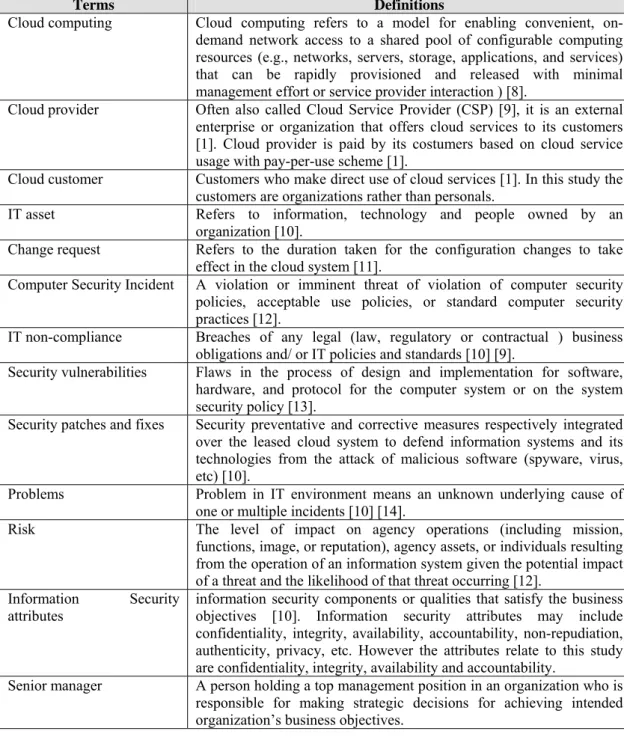
This subsection provides a better understanding of terminologies used in the study as presented in table 1.
Table 1: Terms and definitions used in the study
Terms Definitions
Cloud computing Cloud computing refers to a model for enabling convenient,
on-demand network access to a shared pool of configurable computing resources (e.g., networks, servers, storage, applications, and services) that can be rapidly provisioned and released with minimal management effort or service provider interaction ) [8].
Cloud provider Often also called Cloud Service Provider (CSP) [9], it is an external
enterprise or organization that offers cloud services to its customers [1]. Cloud provider is paid by its costumers based on cloud service usage with pay-per-use scheme [1].
Cloud customer Customers who make direct use of cloud services [1]. In this study the
customers are organizations rather than personals.
IT asset Refers to information, technology and people owned by an
organization [10].
Change request Refers to the duration taken for the configuration changes to take
effect in the cloud system [11].
Computer Security Incident A violation or imminent threat of violation of computer security
policies, acceptable use policies, or standard computer security practices [12].
IT non-compliance Breaches of any legal (law, regulatory or contractual ) business
obligations and/ or IT policies and standards [10] [9].
Security vulnerabilities Flaws in the process of design and implementation for software,
hardware, and protocol for the computer system or on the system security policy [13].
Security patches and fixes Security preventative and corrective measures respectively integrated
over the leased cloud system to defend information systems and its technologies from the attack of malicious software (spyware, virus, etc) [10].
Problems Problem in IT environment means an unknown underlying cause of
one or multiple incidents [10] [14].
Risk The level of impact on agency operations (including mission,
functions, image, or reputation), agency assets, or individuals resulting from the operation of an information system given the potential impact of a threat and the likelihood of that threat occurring [12].
Information Security attributes
information security components or qualities that satisfy the business objectives [10]. Information security attributes may include confidentiality, integrity, availability, accountability, non-repudiation, authenticity, privacy, etc. However the attributes relate to this study are confidentiality, integrity, availability and accountability.
Senior manager A person holding a top management position in an organization who is
responsible for making strategic decisions for achieving intended organization’s business objectives.
2
B
ACKGROUND
This section is dedicated to provide an overview concerning concepts used in this study. Section 2.1 discusses about cloud computing and 2.2 presents information about Service Level Agreement (SLA). Section 2.3 discusses about Control Objectives for Information and related Technology (COBIT). Goal Question Metric (QGM) framework is presented in section 2.4 followed by information security in section 2.5. Lastly, brief information about security metrics is presented in section 2.6.
2.1
Cloud computing
Cloud computing is considered a new method of distributing computer resources [15].These resources are usually distributed as services [16]. The cloud computing service architecture falls under three categories of services and there exist four deployment models [8]. The services posses own unique fundamental characteristics that distinguish them from the traditional computing environment. Therefore, in this section we present cloud computing characteristics, services and deployment models.
2.1.1
Cloud computing characteristics
Cloud computing has five fundamental characteristics as follows [8]: i. On-demand self-service.
Cloud customers can demand computing capabilities such as network storage [8]. ii. Broad network access.
The cloud capabilities are available over the network and are accessed by customers using platforms (e.g.: laptop, PDA) [8].
iii. Resource pooling.
Cloud provider’s computing resources are pooled to support multiple users or multi-tenancy model [8].
iv. Rapid elasticity.
The capabilities can be rapidly and elastically demanded [8]. The capabilities are appeared to be infinitely available to the customers and can be purchased at any time [8].
v. Measured service.
Cloud system automatically controls and optimizes the resources usage by leveraging metering capability to the specific type of service. (e.g. Bandwidth, storage) [8]. Resource usage is controlled, monitored and reported providing transparency for both cloud provider and customer [8].
2.1.2
Cloud computing services
Cloud computing services or cloud services are typically categorized into three types namely Software as a Service (SaaS), Platforms as a Service (PaaS) and Infrastructure as a Service (IaaS) [9]. These three categories offer different services to cloud customers. Usually, cloud customers can demand on the type of services they require [9] [17]. Brief description of the three services will be presented in the subsequent sections. An illustration of cloud services architecture is as presented in figure 1.
i. Software as a Service (SaaS).
In SaaS, customers are renting complete applications instead of purchasing and installing the applications or software on their computers [9] [17] [18]. SaaS
provider hosts the applications and makes the applications available over the network [17]. SaaS applications are multi-tenant applications which means that the applications are shared to multiple customers [9]. However the applications are logically unique for each customer [9].
It is the responsibilities of the provider to secure customers information in SaaS [9]. Several examples of SaaS applications are online word processing tools and web content delivery services [15]. Companies that offer SaaS services include Google and Salesforce.com
ii. Platforms as a Service (PaaS).
In PaaS service, cloud provider offers a platform for development environment to the customers to run their applications [9] [19]. The development platform is Application Programming Interface (API) and is configurable remotely [15]. The platform service includes configuration management, deployment platform and development tools [9] [15]. Therefore, customers can run their applications without having specialized administration skills [9]. Further, the customers can build and deploy their web applications without having to install any tools on their computers [9].
Similar to SaaS, PaaS provider is responsible for securing the leased services [9]. PaaS security spans between two software layers [9]:
• Security of PaaS platform itself. For instance: runtime engine that is integrated in PaaS service.
• Security of client applications which are running on PaaS platform. Therefore, the PaaS provider is responsible for securing the platform and the customer's applications. Companies that offer PaaS service include Microsoft Azure and Google App Engine [9].
iii. Infrastructure as a Service (IaaS).
IaaS service offers virtual machines as well as other abstracted hardware and operating system over the network [1] [9] [15] [20]. By renting IaaS service, the customers can use the latest infrastructure technology and they do not have to concern with updating the technology [20]. Contrast to SaaS and PaaS, customers of IaaS are mainly responsible for securing the leased infrastructure [9]. Companies that offer this service include GoGrid, Flexiscale, and Amazon.
Figure 1: Cloud services architecture [9]
2.1.3
Cloud Deployment Model
Similar to type of service, cloud may be hosted and deployed in different fashions depending on the use case [1]. Cloud deployment models are as follows:
i. Private cloud
In private cloud model, the cloud infrastructure is deployed merely for single organization [8].
ii. Community cloud
In community cloud model, the cloud infrastructure is shared by several organizations and supports a specific community that has shared concerns [8].
iii. Public cloud
In public cloud model, the cloud infrastructure is made available to public or a large industry group [8]. The cloud is owned by an organization that sells service [8]. iv. Hybrid cloud
In hybrid model, the cloud infrastructure is a composition of two or more clouds (private, community, or public) [8].
2.2
Service Level Agreement (SLA)
SLA is a written agreement about service levels offered by providers to customers [19]. In the context of this study, SLA is an agreement between cloud providers and cloud customers. Main advantage of SLA is to gain common understanding of various issues including service levels and responsibilities of provider and customer [19]. The stated issues and service levels in SLA depend on negotiation between provider and customer.
According to Chaves et al. [19] SLA defines the “what” and not the “how”. It means in regards to information security, SLA states what type of service levels customer should receive. However it does not state how the service levels are achieved [19]. SLA also provides information about responsibilities of both cloud provider and customer towards unexpected events that happen to the service [19].
In cloud computing, customers delegate their information to cloud provider and they are not aware of where their information are stored and processed [3]. Hence, cloud provider needs to use SLA to convince customers to use their services and to assure the security of their information. SLA for cloud computing should embrace wide range of issues starting from performance to security issues [3]. In this study the SLA considered is service levels related to information security in cloud computing environment.
2.3
Control Objectives for Information and related
Technology (COBIT)
One framework that proposes SLA metrics is COBIT framework. COBIT [10] framework is a set of comprehensive open documents to assure sound IT governance in an organization[21]. COBIT covers complete governance, control and assurance over IT. It is a business-focused, process-oriented, controls-based and measurement-driven framework [10]. IT governance concerns with integration and incorporation of good practices to ensure that IT resources support the business objectives [10]. Effective IT governance ensures that IT functions can sustain business strategies and objectives of an organization and appropriately manages IT-related risks [10] [22]. Since IT governance is the responsibility of IT managerial level [10] therefore COBIT helps them in executing their duties of managing IT. It also aids IT professionals in auditing/assessing internal controls in an organization [23].
COBIT is developed within a basic principle that is intended to provide organizations with information required in achieving their business objectives while managing IT investment and resources [10]. This principle is as illustrated in figure 2. In general, an organization needs to control and manage its IT resources to achieve its objectives.
Figure 2: Basic Principle of COBIT [10].
COBIT framework is globally recognized mainly because it aligns IT functions with business goals of an organization [21]. COBIT is increasingly used to control and assure information system operations [23]. It is referred as one of the successful security management framework implemented in big enterprise [24]. In addition COBIT has long history of being used as an auditing reference by IT professionals [23] [25]. COBIT can be used by itself or in conjunction with other IT- related frameworks and standards [21] such as ISO/IEC 27001 (ISO 27001), IT Infrastructure Library (ITIL), and National Institute of Standards and Technology (NIST) Special Publication (SP) 800 series.
COBIT framework presents guidelines to derive metrics for IT governance processes that align with business goals. In this study we follow COBIT framework to derive SLA based information security metrics in cloud computing.
2.4
Goal Question Metric (GQM) framework
To complete this study particularly phase 3 (developing security metrics from COBIT), GQM framework is followed to aid in identifying SLA based information security metrics. GQM framework is a structured and widely accepted method to answer questions of what to measure [26]. It is a goal-oriented measurement framework which means the measurement starts with goals [27]. To measure an object, organization needs to define the measurement goals which are based upon the organization goals [27]. Then each goal is refined into several questions which breaks down the issue found in the object into several components [27] [28]. These questions also characterize the way the measurement is performed [26] [28]. Thereafter, each question is refined into several metrics which provide information to answer each question [27]. The end result of conducting GQM is specification of measurement system targeting particular issues and rules for the interpretation of the measurement data [28]. The GQM framework consists of three main levels namely conceptual (goal), operational (question) and quantitative (metric) [28]:
2.4.1
Conceptual level (goal)
The goal needs to be specified for the targeted object [28]. Goal comprises purpose of measurement, object to be measured, issue to be measured and viewpoint of which the measurement is taken from [28]. The goal then is refined into several questions in operational level.
Object of measurement may be [28]:
• Products: Artifacts, deliverables and documents in which the outcomes of during the system life cycle. E.g.: designs, programs, specifications.
• Processes: Software activities which are typically associated with time. E.g.: Designing, interview, specifying.
• Resources: Items used by process to produce their outputs. E.g.: hardware, software, employee, office space.
2.4.2
Operational level (question)
This level comprises a set of questions used to characterize the way the measurement of a specific goal is taken [28]. These questions try to characterize the object of measurement (products/processes/resources) with the particular issue and viewpoint [28].
2.4.3
Quantitative level (metric)
The quantitative level involves refining the questions into a set of metrics/measurements [28]. A set of metrics intended to answer specific question in quantitative way [28]. The same metrics can be used to answer different questions under the same goal [28].
The metrics can be [28]:
• Objective: If the metrics base only on the object of measurement and not from viewpoint of measurement
• Subjective: If the metrics base on both object of measurement and the viewpoint of measurement.
The illustration of GQM framework is presented below in figure 3.
Figure 3: GQM framework[28]
2.5
Information security
SysAdmin, Audit, Network, Security (SANS) [29] defines information security as processes and methodologies which are intended to protect sensitive information or data from unauthorized access, disclosure, modification, or use. The form of the protected data or information can be electronic, printed, or other forms [29].
Information security encompasses three fundamental security attributes namely confidentiality, availability and integrity [30]. The presence of these attributes characterizes a secured information [30]. Besides these three fundamental attributes, non-repudiation and accountability complement the characteristic of secured information [30]. The five attributes of information security are shown in figure 4.
Figure 4: Security attributes (inspired by [30]) The five attributes described as follows:
i. Confidentiality.
This attribute concerns with protecting the sensitive information from the unauthorized disclosure [10].
ii. Integrity.
This attribute concerns with accuracy, completeness and validity of information in regards with business requirement and expectations [10].
iii. Availability.
This attribute concerns with information being operational and accessible whenever it is required by the business process now as well as in the future [10] [30]. Further, the information must be inaccessible to unauthorized users [30].
iv. Accountability.
This attribute concerns with keeping track of actions that are related to security actions and responsibilities [30].
v. Non-repudiation.
This attribute concerns with the ability to prevent users from denying the responsibility of the actions performed [30].
2.6
Security metrics
Security metrics are quantitative measurements to assess security operations in organization environment [31]. They aid the organization to make decisions about various aspects of security which include security architectures and controls to the effectiveness and efficiency of security operations [32]. Moreover, security metrics are valuable to IT managerial level and stakeholders who are questioning the security impacts towards business process and activities [33]. Further, security operations frequently demand high expenditures and with security metric it provides comprehensible reasons of the security high expenditures to the managerial level and stakeholders [33].
NIST [34] characterizes security metrics into three types as follows: i. Implementation metrics.
These metrics are intended to demonstrate progress in implementing information security programs, security controls, and related policies and procedures [34].
ii. Effectiveness/efficiency metrics.
These metrics are intended to monitor if the program-level processes and system-level security controls are implemented correctly, operating as intended as well as meeting the desired outcomes [34].
iii. Impact metrics.
These metrics are intended to articulate the impact of information security on an organization’s mission [34].
Security metrics may be divided also based on their uses. The uses of security metrics are categorized into strategic support, quality assurance and tactical oversight [32] [33]. In this study, we follow the three types of metrics defined by NIST [34].
3
R
ELATED
W
ORK
Several studies have been conducted in the area of SLA metrics, security metrics and cloud computing. Several SLA metrics have been proposed. For instance, Skita et al. [35] propose SLA metric for real-time application on grid architecture. Jain et al. [36] propose SLA management system over IP networks.
In the area of cloud computing several researches have also been conducted. For example, Stantchev [37] proposes an approach of performance evaluation of cloud computing configurations. Rimal and Choi [20] surveyed on architectural approaches of cloud computing system and identified potential further research in cloud computing area.
Moreover, different approaches have been followed in developing security metrics. For instance, Tash and Ghernaouti [38] propose a framework that uses risk assessment to derive efficient metrics for measuring information security. Tanna et al. [39] propose a model for identifying metrics based on threat model. Another approach is the one described by SANS [40] which presents seven steps for generating security metrics.
In addition, different taxonomies for security metrics have been proposed. For instance, the well known NIST [34] presents three broader categories of security metrics namely implementation, effectiveness/efficiency and impact. A more comprehensive taxonomy of security metrics is presented by Savola [41] . Savola [41] performed a literature survey on existing security metrics taxonomy and proposes another taxonomy. Among the taxonomy presented by Savola [41] includes assurance metrics consisting of organization security metrics and metrics for Technical Target of Assessment.
Although there are several different approaches for developing security metrics not all approaches have been successful and accepted in the industry. This argument is supported by Tash and Ghernaouti [38] who argue that security practitioners often develop technical security metrics which cannot be used to measure organization security. The authors further suggest that security frameworks such as ISO 17799:2005, ISO 27001 and COBIT may be used to derive security measures for evaluation of overall organization security [38].
Despite existence of several researches on SLA metrics and cloud computing areas, to the best of our knowledge there is no research conducted to determine SLA based information security metrics in cloud computing which is our main contribution. Another contribution of the study is on the identification of a framework suitable for developing information security metrics.
4
M
ETHODOLOGY
Research questions, research methodologies and research plan are presented in this section.
4.1
Research questions
To achieve aims and objectives stated in sections 1.1 and 1.2 respectively, these following research questions are addressed:
RQ1. What information security attributes are relevant in cloud computing?
This research question is formulated in order to identify information security attributes relevant in cloud computing. The answers to this question also assist us to identify information security metrics in cloud computing as required in RQ3. The RQ1 is indirectly answered through RQ 1.1.
RQ1.1 What information security threats are relevant in cloud computing?
The main objective of this research question is to understand information security threats relevant in cloud computing. In addition, the answers to this question will enable us to be focused on cloud computing issues when identifying information security metrics rather than the traditional computing environment.
RQ2. Which framework is suitable for developing security metrics?
This research question aims at selecting a framework that will be followed in identifying information security metrics. This is important because several frameworks might be found in literature some of which may not be effective in identifying security metrics. This is also important because in the absence of a suitable framework numerous information security metrics might be found in the study hence becoming unmanageable.
RQ3. What are SLA based information security metrics in cloud computing?
This research question is the main focus of the study. We use the framework selected in RQ2 together with the results from RQ1 to identify SLA based information security metrics in cloud computing. The identified metrics will be useful to those organizations operating in the cloud which intend to measure information security stand of their computing environments.
4.2
Research methods and rationale
We conduct two methods in this study, systematic literature review (SLR) and thorough analysis of COBIT framework. The rationales for conducting these methods are as follows:
4.2.1
Rationale for systematic literature review
According to Jeffery and B. Neidecker-Lutz [1] cloud computing is emerging in Europe at this moment. Hence there is less information to collect from industry practitioners. For this reason we only rely on information from literature to attain some of the objectives of this study. We therefore collect data required in this study through SLR. We adopt SLR as proposed by Kitchenham [42]. We adopt SLR as it is a systematic, comprehensive, structured and repeatable process that is used to identify and analyze published studies [42]. In this study we use SLR to gather information regarding security threats and information security attributes in cloud computing as well as selecting a framework suitable for identifying information security metrics
.
4.2.2
Rationale for thorough analysis of the COBIT framework
In this study, we follow the COBIT framework besides other existing security framework such as ISO 27001. This is because the COBIT framework is more focused on business and it aims at ensuring that IT functions enables organizations in meeting strategic and business objectives while reasonably managing IT risks [10]. Since cloud computing is business architecture, we therefore consider the COBIT framework to be more appropriate in the study than other existing security frameworks. Moreover, the COBIT is a measurement-driven framework which provides several metrics to measure IT processes including metrics for measuring SLA and security performance. We will therefore identify metrics from COBIT that can be applicable in cloud computing.
4.3
Research plan
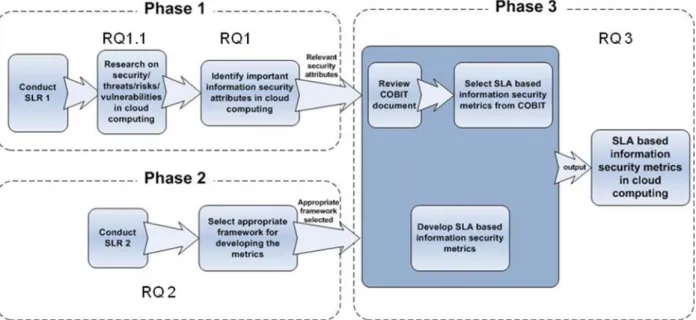
To achieve the objectives, we divide the study into three main phases as described in following subsections and presented in figure 5.
Figure 5: Research plan
4.3.1
Phase 1: Identification of information security threats in cloud
computing
Phase 1 corresponds to RQ1 and RQ1.1. The phase aims at collecting data to answer RQ1.1 which is about information security issues, threats or risks in cloud computing. Accordingly, the data for answering RQ1 which is concerned with information security attributes are collected. This is done through SLR in published studies. As suggested by Kitchenham, we set the inclusion/exclusion [42] criteria for the study to be considered in this research work. The defined inclusion/exclusion criteria are presented in table 2.
Table 2: Study inclusion/exclusion criteria for SLR1 Initial filter criteria
The study is peer reviewed, written in English and without duplicates Second filter criteria
Select study based on relevancy of title, abstract and keyword Final filter criteria
Availability of full text, related with cloud computing security, threats or vulnerabilities
By identifying information security threats or risks in cloud computing we identify relevant information security attributes that would be affected by the threats.
4.3.2
Study quality assessment for SLR1
To ensure that we only include studies with high quality for SLR1 we develop a study quality assessment criteria presented in Table 3. Each criterion is scored with a “Yes”, “Partially” or “No” depending on whether the study meets, partly meets or does not meet the criterion respectively. We perform a study quality assessment to all studies that pass the inclusion/exclusion criteria as presented in Table 2 above.
Table 3: Study quality assessment for SLR1
S/N Quality Criteria Yes Partially No
1 Whether the study focus on security threats or risks in
cloud computing.
2 Whether security threats are clearly presented.
3 Whether limitations to the study are clearly mentioned.
4.3.3
Phase 2: Selection of a suitable security metrics framework
Phase 2 corresponds to RQ2. The phase aims at selecting a suitable security metrics framework. We conduct SLR to collect information on available security measurement frameworks. We also follow the inclusion/exclusion criteria as presented in Table 4. Then from several frameworks found in SLR, we select one appropriate framework for identifying the metrics. Selection of the framework is done to assist us in identifying the metrics suitable in cloud computing. The selection is based on four criteria presented in Table 5:
Table 4: Study inclusion/exclusion criteria for SLR2 Initial filter criteria
The study is peer reviewed, written in English and without duplicates Second filter criteria
Select study based on relevancy of title, abstract and keywords Final filter criteria
Availability of full text, related with security measurement frameworks Table 5: Criteria for selecting a suitable security metric framework S/N Criteria
1 Simplicity of the framework
2 Acceptability of the framework (Internationally accepted framework and industry
validated framework)
3 Universality of the framework i.e the framework may be applied in several different
industries.
4 Intended audience of the resulting metrics ( in this case the target audience is
the management level )
Each criterion above applies a score from 1 to 5, with a 1 representing the lowest and 5 the highest score. We analyze each identified framework and assign appropriate scores. We then select the framework with the highest accumulated score among all frameworks found.
We rely on our own scoring criteria to select suitable framework because we focus on cloud computing area in which the subject itself is not established. In addition, there are not many organizations that have adopted cloud computing technology.
4.3.4
Study quality assessment for SLR2
We develop study quality assessment criteria to ensure that we only include studies with high qualities. Each criterion is scored with a “Yes”, “Partially” or “No” depending on whether the study meets, partly meets or does not meet the criterion respectively. The quality assessment criteria are presented in Table 6. The study quality assessment is performed to all studies that pass the inclusion/exclusion criteria for SLR2 as presented in Table 4.
Table 6: Study quality assessment criteria for SLR2
S/N Criteria Yes Partially No
1 Whether the study focus on security measurement framework
2 Whether the framework is clearly presented.
3 Whether limitations to the study are clearly mentioned
4.3.5
Study pilot selection
We conduct two pilots on study selection for each phase. The aim of the pilots is to ensure both of us have common understanding on the scope and procedures for selecting appropriate studies. The first twenty (20) studies with full text are selected in each phase. Each of us is required to identify studies that are included/excluded based on our criteria and scope. In order to test the level of agreement between us, we perform a Cohen’s Kappa statistical analysis as suggested by Kitchenham [42].
The Cohen’s Kappa is defined as follows [43]:
(
)
(
e)
e 1 ) P P P Kappa − − =P as seen in the formula above is proportion of units where there is agreement and
P
e is the proportion of units which would be expected to agree by chance [43]. When there is a perfect agreement between the researchers the value of Kappa is 1 [43].The computed Cohen’s Kappa for SLR1 was 0.6875. The observed value of Kappa 0.687 was interpreted that there were good agreement between us based on Kappa interpretation presented by Blan [43]. Blan [43] presents that values of Kappa in the range of 0.61-0.80 are interpreted that there are good agreement between raters. However, based on brainstorming, we established the source of disagreement to be associated with non strict adherence to agreed procedures. We therefore, agreed to strictly adhere to the defined procedures for inclusion/exclusion of the studies. The pilot data which were used in computing the Cohen’s Kappa is presented in appendix E.
For SLR2 the computed Cohen’s Kappa was 0.4666. Based on interpretation presented by Blan [43], the value is considered moderate. We established that a high level of disagreement was due to unclear scope between us and not following the steps defined in the inclusion/exclusion criteria. We therefore repeated the pilot exercise on other selected 20 papers. The recomputed Cohen’s Koppa was 0.8571 which implied that there was very good agreement between us. The pilot data which was used to recompute the Cohen’s Kappa is presented in appendix F.
4.3.6
Phase 3: Data collection for identification of information security
metrics
Phase 3 corresponds to RQ3. The phase aims at identifying SLA based information security metrics relevant in cloud computing. This is done through thorough analysis of COBIT framework. Thorough analysis is conducted to gain in-depth knowledge of COBIT framework and be able to identify SLA based information security metrics in cloud computing. Based on the results of phase 2, the selected framework GQM approach is followed to identify SLA based information security metrics in the cloud computing. We
adopt a GQM approach template proposed by Basili et al. [28] as presented in Table 7 to help in identifying the metrics.
Table 7: GQM approach template [28] Goal Purpose Issue Object (process) Viewpoint Question Metric
The GQM approach is structured into three main sections namely Goal, Question and Metrics [28]. The key parts of the templates are the goal section that comprises purpose of measurement, issue to be measured, object to be measured, and viewpoint from which the measurement is taken. The goal is thereafter refined into several questions and each question is further refined into several metrics [27] [28].
Therefore, we first identify the objects (processes) from COBIT that are related with information security and which are to be measured in cloud computing. For each object we then define purpose, issue, viewpoint, questions and metrics. Based on the COBIT framework alone a massive number of metrics could have been identified. However, to identify only those metrics that are relevant to this study, we apply the criteria as presented in Table 8.
Table 8: Criteria for selecting SLA based information security metrics in cloud computing S/N Criteria
1 Related with information security
2 Applicable in the SLA for cloud computing
3 Within the cloud provider’s control
4 Useful to a certain targeted audience , in this case the targeted audience was the senior
managers
This approach helps us to identify a manageable number of metrics that are related with information security and which can be included in the SLA when measuring security issues in the cloud computing environment.
4.4
Sources of data
We conduct SLR on two main electronic reference databases namely Engineering Village and Scopus. We select these databases because they are among the largest abstract and citation databases containing high quality scientific literatures including peer reviewed conference papers, journals as well as web sources. The Engineering Village provided by BTH comprises Inspect and Compendex which are two main comprehensive citation and abstract databases.On the other hand, the Scopus database is also among the largest citation and abstract databases. Scopus has interoperability functionality with other reputable and large electronic databases including SciVerse ScienceDirect, Scirus [44]. Additionally, Scopus contains citation and abstract information of peer reviewed scientific conference papers from proceedings and journals including those published by Cambridge University Press, Elsevier, Springer/Kluwer, the Institute Electronics Engineers (IEEE) [44].
To avoid missing other important studies we also gather information from other security reputable online publications including NIST, SANS, European Network and Information Security Agency (ENISA) and Information Systems Audit and Control Association (ISACA). We also include published studies from these organizations in order to get information that is close to what is happening in the industry. This is because very often these organizations conduct scientific studies that involve industry practitioners.
We consider the selected databases to be sufficiently good to provide us with satisfactory knowledge of literatures on cloud computing. Despite cloud computing being a fairly new and evolving subject, we are able to derive our aim and objectives of this study based on the selected databases.
4.5
Data analysis
We analyze the data gathered in this study as presented hereunder:
4.5.1
SLR1 and identification of information security threats
During SLR1 we collect information on possible security threats in cloud computing. Based on the threats identified we establish relevant information security attributes which are affected by each threat in cloud computing. To maintain consistency and completeness of the collected data, we develop a data extraction form that is used by both of us.
We conduct a pilot data extraction exercise on random ten (10) studies obtained from SLR. The pilot exercise aims at detecting defects in the data extraction form as well as to obtain common understandings of the form between us. The data extraction form is then revised to address observed shortcomings. The final data extraction form is as presented in Table 9.
Table 9: Data extraction form for information security threats and attributes in cloud computing S/N Threats Threat Description Source Security Attribute Affected
To minimize biasness and avoid influencing each other, each of us identifies relevant security attributes in cloud computing first. Thereafter, both of us review the individual results together to identify and agree on security attributes relevant in cloud computing.
4.5.2
SLR2 and identification of security metrics frameworks
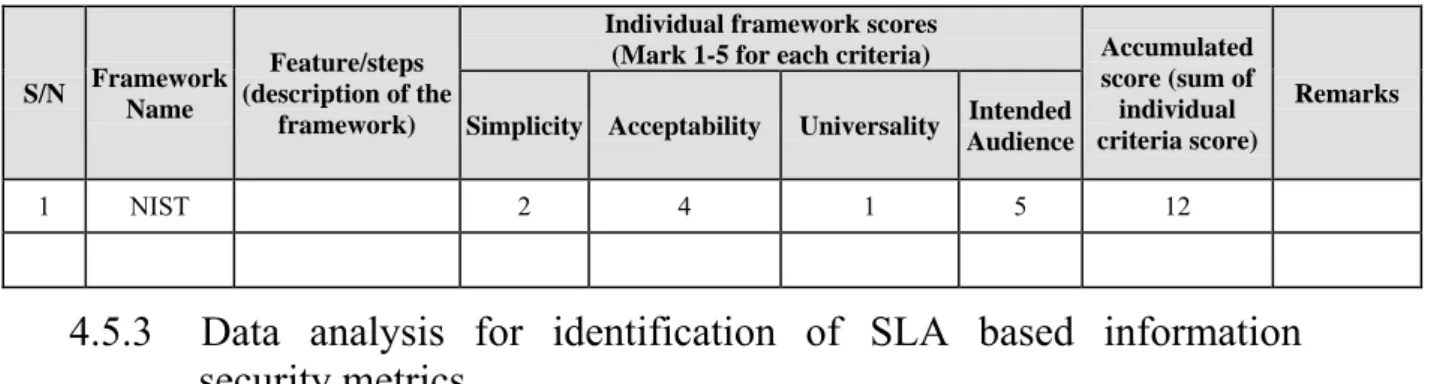
We conduct a second SLR to collect data on frameworks available for developing security metrics. The collected data include name of framework and its key features/steps. We also collect data on its objectives and area/industry the framework is intended to be used. Similar to SLR1, we conduct a pilot data extraction exercise on random three (3) studies to ascertain completeness of and detect defects in the data extraction form. We use the frameworks data extraction form as presented in Table 10 .
We brainstorm and assign scoring to each security metric framework identified based on framework selection criteria as defined in research plan section (See 4.3). The individual framework scores are recorded in a framework data extraction form presented in Table 10. A framework with the highest accumulated score is selected and used in the following stages of study. Table 10 also presents an example of how the framework data extraction form is used.
Table 10: Data extraction form for security metrics frameworks S/N Framework Name Feature/steps (description of the framework)
Individual framework scores
(Mark 1-5 for each criteria) Accumulated score (sum of individual criteria score)
Remarks Simplicity Acceptability Universality Intended
Audience
1 NIST 2 4 1 5 12
4.5.3
Data analysis for identification of SLA based information
security metrics
Based on security attributes identified in cloud computing and the selected framework, we follow the GQM approach template [28] to identify SLA based information security metrics from the COBIT framework. The process of identifying the SLA information security metrics is driven by the goals and the questions that are defined by us following the GQM approach. In case, of those information security metrics that cannot be obtained in COBIT, we identify the metrics based on other sources including the Center for Internet Security (CIS). Based on the adopted GQM metric template [28] we identify the SLA based information security metrics in cloud computing.
We recognize the facts that the COBIT framework is organized into four (4) IT domains which further extends into thirty four (34) IT processes [10]. However, not all of the 34 IT processes are closely related with information security. For instance, the COBIT process PO10 mainly focuses on managing IT projects and the PO5 focuses on managing IT investments. At times these objects maybe useful and relevant in information security, however in this study they are considered not relevant. In identifying the information security metrics we therefore focus on those objects that are related with information security and relevant in the cloud computing. We follow the criteria presented in Table 11. We evaluate the COBIT IT processes based on the simple “Yes” or “No” answers. The “Yes” indicates that the process meets a criterion whereas “No” indicates that the process does not meet a criterion. Only those objects that meet all three criteria are selected and considered for developing information security metrics.
Table 11: Criteria for selecting objects
S/N Criteria Yes/No
1 The object is related with information security
2 The object is relevant in the cloud computing environment
5
R
ESULTS
In this section, the results of the study are presented. Section 5.1 presents study selection for SLR1, and 5.2 presents study selection for SLR2. The identified relevant security attributes and security metrics framework are presented in section 5.3 and 5.4 respectively. Lastly, section 5.5 presents results of the identified information security metrics.
5.1
Study selection for SLR1
5.1.1
Results for study selection and inclusion/exclusion process for
SLR1
To collect relevant data for the study, we conducted SLR in the Engineering Village, Scopus and other electronic databases. We used the following search strings:
• Engineering Village: ((($cloud $computing) WN KY) AND (($security OR $threats
OR $risk* OR $vulnerabilit ) WN KY))
• Scopus: TITLE-ABS-KEY(((cloud computing) AND ($security OR $threat* OR $risk* OR $vulnerabilit*))) AND PUBYEAR AFT 1969
• Other databases (ISACA, NIST, SANS, ENISA): We used simple search string
for the keywords cloud computing, security, risks, vulnerabilities.
We did not restrict the publication year of literatures as we did not have background when exactly cloud computing concept started. We therefore intended to discover as much researches in the area as possible. However, publication year 1969 as seen in search string above is the earliest records of year found in Scopus database.
We applied the initial and second selection criteria as stated in table 2 using the built-in features of databases we used. A total of 1058 studies were identified from those electronic databases as presented in figure 6. By using Endnote [45] the studies were merged and duplicates removed. Since Endnote could not remove all duplicate studies, we manually removed remaining duplicates after which 625 studies remained for further analysis. Detailed results of phase 1 study collection are as presented in figure 6:
Figure 6: Study collection for SLR1
The 625 studies were distributed between us to identify those studies that are relevant based on the study second filter criteria as stated in table 2. After we applied second filter criteria, it was established that 252 studies were relevant to our study. We then identified that 82 studies are relevant to the study after eliminating 61 non-full text studies and 109 studies that we could not derive the information from.
5.1.2
Results for study quality assessment for SLR1
Table 12 presents results for study quality assessment. Each criterion was scored a “Yes”, “Partially” or “No”. The result indicates that many studies could not meet second and third criteria as they both recorded 48 and 50 “No” respectively. However, we observe a good number of studies that partially mentioned threats and risks in cloud computing.
Table 12: Summary of studies based on quality assessment criteria for SLR1 S/N Quality Assessment Criteria Yes Partially No
1
Whether the study focus on security threats or risks incloud computing. 23 32 27
2
Whether security threats are clearly presented. 13 21 485.1.3
Distribution of studies per year of publication
It is observed that out of 82 studies identified, many studies were published in the year of 2000 and later with 2009 recording the highest number of studies as presented in figure 7. The details of the 82 studies together with the year of publications are presented in the appendix G.
Figure 7: Distribution of studies based on year of publication for SLR 1
5.2
Study selection for SLR2
5.2.1.
Results for study selection and inclusion/exclusion process for
SLR2
For phase 2, we searched in Engineering Village, Scopus, SANS and NIST electronic databases by using the following search strings:
• Engineering Village: ((develop* security metric*) AND((methodolog*) OR (framework*) OR (guideline*)))
• Scopus: TITLE-ABS-KEY((develop* security metric*) AND((methodolog*) OR (framework*) OR (guideline*)))
• Other databases (NIST and SANS): We used simple search string for the
keywords security metric, framework, guidelines and methodology.
We applied the initial and second selection criteria as presented in Table 4 by utilizing the built-in features of the reference database we used. In total, 408 studies were found as presented in figure 8. Likewise, we also used Endnote [45] to merge and remove duplicate studies. We further manually removed duplicates as Endnote could not remove all duplicate studies. 215 papers remained for further analysis after removing duplicates and non-English studies. The detailed results of our search are contained in figure 8.
Figure 8: Data collection of SLR2
The 215 studies were distributed between us to determine relevant studies based on final filter criteria defined in Table 4. Nine (9) studies were identified to be relevant to this study after we eliminated 17 non-full text studies and 109 studies that we could not derive the information from. We reviewed the individual analysis results together and reached consensus on the assigned score for each identified framework. The results of the frameworks selection are presented in the result section 5.4.
5.2.2.
Results for study quality assessment for SLR2
The relevant studies were assessed to determine if they meet the three assessment criteria we defined. Table 13 presents the results of the quality assessment exercise. The results shows that many studies did not meet the third criterion since 6 studies out of 9 recorded “No”. Most probably this is because these studies were industry papers. However, most of the studies were found to meet both the second and third criteria.
Table 13: Summary of studies based on quality assessment criteria for SLR2
S/N Quality Assessment Criteria Yes Partially No
1 Whether the study focus on security measurement framework 9 0 0
2 Whether the framework is clearly presented. 9 0 0
5.3
Identified relevant security attributes
Through analysis twenty two (22) threats were identified in cloud computing as summarized in figure 15 with detailed results presented in appendix A. These threats include unclear ownership and responsibility of data protection, identity theft, data theft, unauthorized modification, malware attacks, denial of service (DOS), lack of data segregation, data inconsistency, inadequate authentication and authorization, unauthorized access, eavesdropping, service disruption, phishing attack, audit difficulty, Insecure Interfaces and APIs, regulatory and legal issues, difficult bugs detection, and difficult intruder (malicious user) detection.
Through brainstorming, we reached consensus on security attributes applicable in cloud computing. These attributes are confidentiality, integrity, availability and accountability. The summary of the results is presented in figure 9 and the details can be found in appendix A. In figure 9, the percentages indicate how each attribute is affected by the threats we identified. For instance, 36% of the identified threats affect confidentiality. These results show that all identified information security attributes are almost of relevancy to the cloud computing.
C onfidentiality 36% Integrity 22% A vailability 25% A c c ountability 17%
Figure 9: Identified security attributes in cloud computing
5.4
Identified security metric frameworks
In total, eight frameworks were identified. These frameworks are Goal Question Metric (GQM) approach, Framework for policy based metrics, Security Metric Identification Framework, NIST SP800-55, Risk based proactive security COnfiguration manager (ROCONA), Metrics for Electronic bill presentment and payment (EBPP) system, SANS Security metrics guidelines and Security Performance framework. We reviewed the individual data collected together and reached consensus on the assigned score for each identified framework as presented in appendix B. Results summary of the individual criteria score for each framework is presented in figure 10. We summed the individual criteria score to obtain the overall score of each framework which is also detailed in appendix B. The summary of overall score results of each framework is indicated in figure 11. The GQM approach recorded the highest overall score (18 out of 20) of all frameworks identified. We therefore selected the GQM approach to be used in developing the security metrics.
5.5
Identified information security metrics
We applied criteria for selecting objects as presented in Table 11. We found that fourteen (14) out of 34 COBIT IT processes met the criteria. The COBIT IT processes that met the criteria are as presented in appendix C1. Details of results for the selection of the objects are presented in appendix C2.
We observed that some COBIT IT processes are closely related to each other. Therefore, we combined some IT COBIT processes and renamed them accordingly. After combining and renaming the COBIT IT process that met the criteria, we came out with ten (10) objects as presented in Table 14.
Table 14: Objects relevant in cloud computing S/N Object Name
1. Configuration management
2. Change management
3. Problems and incident management
4. Risk management
5. Compliance issues
6. Operations management
7. Performance and capacity management
8. Continuity of IT services
9. IT security management
10. Software management
We formulated some metric goals for each of the identified objects. We also formulated questions to be answered so that assurance on the achievement of the set goals is obtained. Moreover, some metrics were identified for each redefined questions as presented in appendix D. We formulated a total of 19 questions and identified 41 metrics that are relevant in cloud computing in the viewpoint of senior managers. Results summary of the identified SLA based information security metrics is presented in figure 12.
Figure 12: Summary of identified SLA based information security metrics
Figure 13 presents a distribution of metrics in each security measurement goals grouped in accordance to the three types of metrics namely implementation, impact, and effectiveness/efficiency [34]. The highest number of metrics is recorded in the types of impact within the security goal of effectiveness in handling compliance issues. This is followed by metrics in the types of implementation also falling within the security goal of effectiveness in handling compliance issues. The security goal of effectiveness of problems and incident management is the second goal which recorded large number of metrics in the types of impact and effectiveness/efficiency. These results suggest that handling problems, incidents and compliance is critical in cloud computing. However, other objects should also be given appropriate attention depending on the nature of business operations deployed in the cloud and the cloud services adopted.
Figure 13: Distribution of types of metrics per security measurement goals
Result summary of the identified metrics per types of metrics is presented in figure 14. The metric type of impact recorded 36% of all the metrics identified. Implementation and effectiveness/efficiency types each recorded 32% whereas implementation type recorded 32%. The results presented in figure 14 suggest that organizations should equally consider the different types of metrics in order to effectively measure information security performance in the cloud.
6
A
NALYSIS
This study intends to answer three main research questions and one sub research question. The three research questions are RQ1 (What information security attributes are relevant in cloud computing?), RQ2 (Which framework is suitable for developing security metrics?) and RQ3 (What are SLA based information security metrics in cloud computing?). One sub research question answered is RQ1.1 (What information security threats are relevant in cloud computing?). In this section we describe how the research questions were answered in the study.
6.1
Information security attributes in cloud computing
(RQ1)
In traditional computing environment the commonly referred to be information security attributes are confidentiality, integrity and availability [30] [46]. In addition to the three principal security attributes accountability and non-repudiation are also considered [30]. This research question aims at establishing whether the same information security attributes are still applicable in cloud computing which is an emerging technology. As it was difficult to directly obtain these attributes from the literature, we therefore derived them through obtaining answers of RQ1.1. Thus based on information security threats we were able to deduce the security attributes relevant in cloud computing. As presented under the result section 5.3, the study identified confidentiality, integrity, availability and accountability to be the information security attributes in cloud computing.
Among the four attributes, confidentiality appeared to be mostly affected by the threats listed in section 6.2. The details of the threats can be found in appendix A. The results presented in figure 9 indicate that 36% of the identified threats appeared to affect confidentiality. However, it is clear that one threat might affect more than one security attributes as presented in detail in appendix A. For instance, an unauthorized access may lead to compromise of confidentiality, integrity and availability depending on attacker motives and capabilities. Generally, one threat might affect more than one security attributes as presented in detail in appendix A.
6.2
Information security threats in cloud computing
(RQ1.1)
Information security threat has been defined by Pfleeger and Pfleeger [46] as anything that can cause harm or loss to a computing environment. Usually threats exploit security weaknesses existing in the computing environment [46]. The authors [46] categorize threats into four classes namely interception, interruption, modification and fabrication [46]. If these threats become actualized the result is a compromise of one or more security attributes which are confidentiality, integrity, availability and accountability. Cloud computing being an emerging technology, we intended to identify threats in such a computing environment through obtaining answers to RQ 1.1.
We observed lack of common vocabulary for the threats among the studies we found. As a result, we avoided listing threats with different names but which in principal meant the same thing. Therefore a threat name of more preference to us was considered. For instance, Cloud Security Alliance (CSA) [47] defines “account or service hijacking” threat in cloud computing to include phishing threat. However, we define phishing as its own threat and differentiate it from account or service hijacking (in this study is referred as unauthorized access).
![Figure 1: Cloud services architecture [9]](https://thumb-us.123doks.com/thumbv2/123dok_us/1591950.2714506/13.892.141.759.91.724/figure-cloud-services-architecture.webp)
![Figure 2: Basic Principle of COBIT [10].](https://thumb-us.123doks.com/thumbv2/123dok_us/1591950.2714506/15.892.201.703.102.499/figure-basic-principle-of-cobit.webp)
![Figure 3: GQM framework [28]](https://thumb-us.123doks.com/thumbv2/123dok_us/1591950.2714506/16.892.158.807.623.846/figure-gqm-framework.webp)
![Figure 4: Security attributes (inspired by [30]) The five attributes described as follows:](https://thumb-us.123doks.com/thumbv2/123dok_us/1591950.2714506/17.892.310.585.107.390/figure-security-attributes-inspired-attributes-described-follows.webp)

![Table 7: GQM approach template [28]](https://thumb-us.123doks.com/thumbv2/123dok_us/1591950.2714506/24.892.264.630.173.343/table-gqm-approach-template.webp)