A DISSERTATION BEFORE A USER-FRIENDLY GUIDE FOR THE PREPARATION OF THE
DISSERTATION PROPOSAL AND DISSERTATION
For dissertations submitted to the faculty of the School of Professional Studies
of Gonzaga University
in partial fulfillment of the requirements for the degree of
Doctor of Philosophy
by
Doctoral Program in Leadership Studies November 2008
ii
© Copyright, Doctoral Program in Leadership Studies, 2007 All rights reserved
iii OVERVIEW
This guide is designed to assist you, a student in the Doctoral Program in Leadership Studies, in the writing of your dissertation. The guide focuses primarily on the development of the dissertation proposal, which includes the first three chapters of the dissertation. However, the guide also includes suggestions for how the final chapters of the dissertation might be structured and what is essential as to their content. We
anticipate this guide will be helpful to you throughout the various phases of the research process, from designing the study to reporting data results.
The guide, originally written in 1993, was revised 1998, 2001, and again in 2004. It will continue to be modified when necessary. Any comments you may have regarding the content and design of the guide will be welcomed and greatly appreciated.
Note: A copy of the guide can be found on the Doctoral Homepage (www.gonzaga.edu/doctoral).
Also on the Doctoral Homepage, you are encouraged to download the template for formatting the dissertation. This Guide is based on DPLSdiss61.dot.
iv
TABLE OF CONTENTS
Overview ... iii
Table of Contents ... iv
List of Figures ... vi
Chapter I Selecting the Topic ... 1
Topics for Quantitative Studies ... 3
Topics for Qualitative Studies ... 4
Comparing Qualitative and Quantitative Studies ... 5
A Few Cautions about Selecting a Topic ... 6
Chapter II Selecting the Dissertation Committee ... 9
Selecting a Dissertation Committee Chair ... 9
Selecting the Remainder of the Committee ... 11
Selecting a Committee Member Outside of the Department ... 12
Role of the Dissertation Committee Chair ... 14
A Few Hints about Working with the Committee ... 16
Chapter III The Dissertation Proposal ... 19
Content of the Proposal Chapters ... 20
Chapter I of the Proposal ... 20
Chapter II of the Proposal ... 23
Chapter III of the Proposal ... 35
Defending the Proposal and the IRB ... 43
Chapter IV The Dissertation ... 47
Preliminary Pages of the Dissertation ... 47
Text of the Dissertation ... 61
Chapters I through III of the Dissertation ... 61
Chapter IV ... 63
Contents of Chapter V ... 68
References ... 71
Appendix(es) ... 73
v
Chapter V Conclusion, Completion, and Commencement ... 75
What Happens after the Dissertation is Finished? ... 75
Items to Be Submitted for Graduation ... 75
Binding the Dissertation ... 77
Commencement ... 78
References ... 79
Appendix A. Dissertation Timeline ... 80
vi
LIST OF FIGURES
Figure 1. Dissertation committee selection form. ... 13
Figure 2. Sample outline of Chapter I for ethical decision making in the health care system. ... 24
Figure 3. Outline for quantitative research design. ... 36
Figure 4. Outline for qualitative research design. ... 37
Figure 5. Dissertation proposal approval form. ... 46
Figure 6. Sample outline of Chapter I for ethical decision making in the health care system. ... 52
Figure 7. Sample copyright page (reduced). ... 53
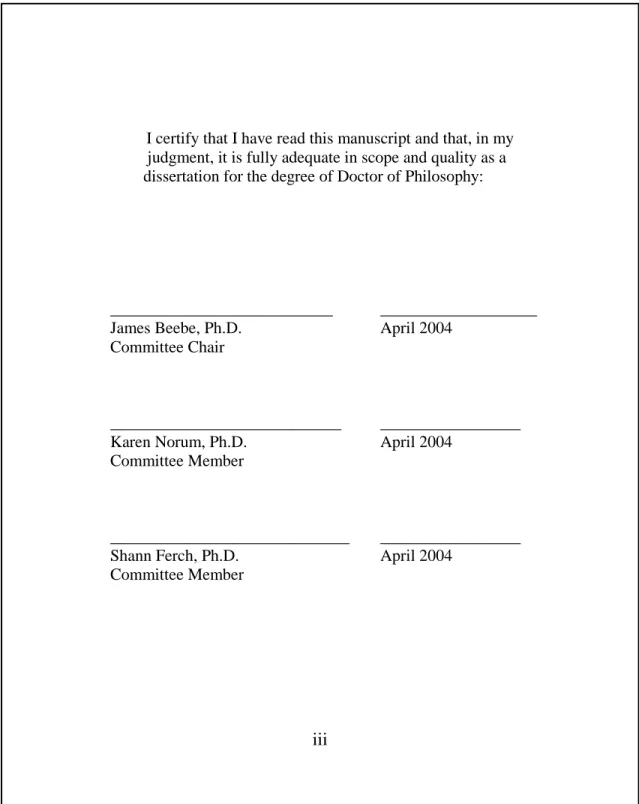
Figure 8. Sample signature page (reduced)... 54
Figure 9. Sample dedication page (reduced). ... 55
Figure 10. Sample acknowledgments format (reduced). ... 56
Figure 11. Sample abstract page, in dissertation (reduced). ... 57
Figure 12. Sample abstract page, separate document (reduced). ... 58
Figure 13. Sample table of contents (reduced). ... 59
Figure 14. Sample list of tables (reduced). ... 60
Figure 15. Sample portion of reference page (reduced). ... 72
CHAPTER I
SELECTING THE TOPIC
The doctorate symbolizes the ability of an individual to plan and conduct research and scholarly work at the highest levels. The finished product should demonstrate a comprehensive knowledge and exceptional attainment of scholarship pertinent to a specialized field of study.
Admittedly, the concept of planning and conducting original research can be both exhilarating and intimidating to many students. Anderson (1990) helped to put this challenge in perspective:
There are more than 20,000 articles published in educational journals each year and there have been over half a million masters and doctoral theses written in North America alone. The next thesis will add one more small contribution to a vast and expanding universe of knowledge. Thousands of studies add up to very little in the way of concrete knowledge. Rather, there tends to be modest
advances which together, over time, add up to a better understanding. (p. 29)
In selecting a topic and in making decisions on quality throughout the dissertation process, you should maintain a balance between the recognition that: (a) your dissertation will probably not be the definitive work in an area, but rather your first major research study in the area, hopefully followed by long careers as an inquiring professional; and (b) your dissertation will be published and accessible to professionals and other doctoral
students, internationally, hence its quality represents both the student and Gonzaga University.
Selecting a topic is often the most difficult and anxiety-producing task associated with the dissertation. Locke, Spirduso, and Silverman (2000) defined this process as the quest for a situation that is sufficiently unsatisfactory that it may be experienced as a problem. Anderson (1990) suggested that there are three basic approaches to identifying this problem; although all-too-common, there appears to be little to recommend the third approach:
1. Prescriptive Approach. Assumes a “building block” notion of knowledge, in which the student builds upon previous work by other researchers. 2. Individualized Approach. Student selects a problem and works back to the
literature to find studies which support the topic of interest, an approach which lends itself to explanatory research and descriptive studies. 3. Muddling Through. Student takes a general topic, begins doing research
and collecting data, and probably does not define the problem sharply until after the study is almost complete. Then it must be rewritten and recast in terms that relate to the problem which has now been defined. It is
recommended only for those who have unlimited time and resources and who thrive on inductive solutions to life's problems. (p. 30)
Locke, Spirduso, and Silverman (1987) provided additional guidance in the process of selecting a dissertation topic:
Regardless of whether the student follows a prescriptive or individualized approach to selecting a topic, the importance of knowing, thoroughly, the professional literature related to that topic cannot be underestimated. In the prescriptive approach, research questions emerge from three broad sources:
logical, practical, and accidental. In some cases, the investigator’s curiosity is directed to a gap in the logical structure of what is already known in the area. In other cases, the investigator responds to the demand for information about the application of knowledge to some practical service. In yet other cases, serendipity operates and the investigator is stimulated by an unexpected observation, often in the context of another study. (p. 40)
In some cases, the researcher may choose a topic because of the desire to replicate or cross-validate a previous study under new conditions, such as a different population, different instrumentation for data collection, or improved analysis techniques. Again, the importance of a thorough knowledge of the literature base is obvious; without this, the student runs a serious risk of repeating an existing work in ignorance of its existence, or of failing to account for defects or limitations of previous studies, perhaps even flaws that have already been critiqued in the literature base.
Topics for Quantitative Studies
Rudestam and Newton (1992) provided a useful paradigm for students attempting to identify a topic to be addressed through a quantitative research approach. They note that research questions almost invariably involve the relationship between two or more variables, phenomena, concepts, or ideas. The nature of that relationship may vary. However, the authors note that even the presence of two variables is apt to be limiting, and oftentimes it is only when a third “connecting” variable is invoked that an idea becomes researchable. The precise function of this third variable will depend on the logic of the conceptual model underlying the study. A moderator variable pinpoints the
conditions under which an independent (predictor) variable exerts its effects on a dependent variable (criterion). A mediating variable tries to ascribe “how” rather than “when” effects will occur by accounting for the relationship between the independent variable and the dependent variable. The expectation for quantitative studies, then, is that prior to conducting the study, the research topic will be refined into research questions, and possibly into research hypotheses to be tested.
Topics for Qualitative Studies
Unlike their quantitative counterparts, qualitative research designs do not
typically intend to prove or test a theory deductively, but rather they attempt, inductively, to collect data from which a theoretical model can be inferred. As Marshall and Rossman (1989) suggested:
The researcher begins with interesting, curious, or anomalous phenomena, which he observes, discovers, or stumbles across. Qualitative research usually begins with observations in the real world that raise such questions as (1) Why don't the everyday experiences I am hearing about fit with extant theory? (2) Why haven't policy and practice led to the predicted results? (3) How do the existing theories, models, and concepts apply to this new and different population or setting? (pp. 21-22)
As such, although the topic is defined and researched in the literature base prior to data collection, the specific research questions may often emerge or be refined or
reformulated during the course of the data collection or analysis. In essence, research hypotheses developed prior to the study would artificially limit the researcher's work and be antithetical to naturalistic inquiry. As Marshall and Rossman (1989) stated:
The role of intuition in the research process cannot be underestimated. By allowing ideas to incubate, and through maintaining respect for the mind's capacity for reorganization and reconstruction, the researcher finds that richer research questions evolve. (p. 29)
These same authors also posited:
Qualitative researchers pursuing questions should creatively relate them to
tentative, intuitive hypotheses. Initial hunches begin the process of bounding and framing the research, of establishing the parameters and developing a perspective through the conceptual framework. (p. 30)
Comparing Qualitative and Quantitative Studies
As noted, the process of defining the problem differs somewhat between qualitative and quantitative studies. For quantitative studies, it is appropriate, if not necessary, to define the problem precisely even before considering research
methodology, or data collection techniques. This level of precision may extend beyond the identification of research questions to the definition of research hypotheses.
For qualitative studies, research problems are generally wider in scope, and attempts at precise definition and limitation of the study prior to data collection may actually be counter-intuitive and damagingly restrictive. Instead, you may find that a more appropriate approach to stating the research problem is tracing its conceptual
development throughout the research process. For example, it would be possible to begin this discussion (to be incorporated into Chapter I) with a clarification of the observations of real-world situations that led the researcher to consider the study, or with references to specific previous studies that suggested the area as worthy of study. While reserving the specific literature review for Chapter II, you then might highlight key references from the literature base and the influence they had on the formulation of the research questions. This would, in essence, define your perception of the problem at the time of establishing the data collection techniques, and initiating the data collection itself. Finally, you might explain any refinements or revisions to the research questions, which were occasioned by the data collection or data analysis processes. These revisions, and their genesis, might be noted retroactively in Chapter I, or interwoven into the chapters on collection or analysis of the data, depending on the specific writing style and preferences of the student (and with the consent of the committee chair).
A Few Cautions about Selecting a Topic
The most common frustration faced in selecting a topic seems to stem from the tendency to select a very meaningful issue, such as, “What makes an administrator effective,” but one which is far too broad to be manageable in a single research study. It is a frustrating necessity to reduce the scope of the dissertation to one aspect of the larger question, such as the interplay of several variables as they relate to administrative
Less common, but admittedly problematic, is the selection of a topic of great personal interest to you, yet of such limited scope or relevance beyond the immediate situation of the research environment that its investigation will be of limited interest and contribution to others.
To assist you in determining the appropriateness of a prospective topic, Rudestam and Newton (1992) offered the following advice:
1. A topic needs to sustain your interest over a long period of time.
2. It is wise to avoid a topic that is overly ambitious and overly challenging. 3. Avoid topics that may be linked too closely with emotional issues in your
own life.
4. Select a topic that has the potential for you to make an original
contribution to the field and allow you to demonstrate your independent mastery of subject and method.
5. The study must generate or help validate theoretical understanding in an area or contribute to the development of professional practice.
6. Contradictions or puzzling results found through the literature review represent opportunities to resolve a mystery.
In other words, the topic must be worth pursuing! (pp. 9-11)
A further caution that should be considered is the extent to which the proposed topic can be investigated sufficiently within the constraints of available time and budget. The final caution is that topics of intense personal emotional impact may not be the wisest choice for dissertation research. Deep emotional involvement with the topic may interfere with the objectivity necessary to be an effective researcher, or may limit the researcher’s efficiency in other ways. Finding a genuine question that is worthy of
conducting a research study and writing a dissertation will provide you just cause for celebration!
CHAPTER II
SELECTING THE DISSERTATION COMMITTEE
Following admission to candidacy, one of the first steps in the dissertation process is for you to select your dissertation committee. Departmental policy requires that the chair of that committee, and at least one other member, be faculty members in the
Doctoral Program in Leadership Studies. The third member of the committee need not be a faculty member in that department, but must (a) hold the terminal degree in their field, issued by a regionally accredited institution of higher education; (b) possess recognized expertise in the student's proposed area of study; and (c) be formally approved for committee membership by the chair of the Doctoral Program in Leadership.
Selecting a Dissertation Committee Chair
The first step in selecting a committee is to select a chair for the dissertation committee. This decision is perhaps the single most important decision you will make, in that the primary orientation and interaction you will have throughout the dissertation process will be with the chair, not with the full committee. In selecting a chair, you should consider three major factors: (a) the quality of interpersonal communication previously experienced between you and the prospective chair, (b) the interest and expertise of the chair in your area of research interest, and (c) the availability and willingness of the chair to commit to serving as advisor for your particular proposed study.
Having identified a departmental faculty member based on these three criteria, you should schedule an appointment with that faculty member. At this meeting you should discuss your general ideas about the proposed research, even if the precise topic, research questions, or proposed methodology have not yet been identified. You should present the projected time frames for the development of the proposal and of the dissertation (see Appendix A). You should request frank responses from the faculty member about that faculty member’s interest in the proposed topic, the types of assistance which the faculty member may feel comfortable in offering regarding that specific proposed topic or research methodology, and the faculty member’s availability and willingness to serve as chair.
The dissertation is a demanding process for both student and chair, so it is
essential that both feel comfortable that the circumstances are right for them to work as a team. You should not feel disappointed if a faculty member declines to serve as the chair of a given dissertation. This may well be an indication that the faculty member respects you too highly to accept this important role when the faculty member does not feel that he or she has the needed expertise in the area to provide content assistance, or would not have the necessary time in his or her schedule to provide you with quality guidance in a timely manner. Similarly, as a result of this opening professional dialogue, you may recognize the need to approach a different faculty member to serve as chair; this is a legitimate professional decision that should be readily acceptable to the faculty member originally approached. In many such cases the original faculty member may agree to
serve as a committee member, recognizing that this role is far less demanding of time and expertise than that of dissertation committee chair.
You should recognize, and prepare for, a research project and writing task that is often lengthier and more frustrating than originally anticipated. As Marshall and
Rossman (1989) pointed out: "Quite unlike its pristine and logical representation in journal articles . . . real research is often confusing, messy, intensely frustrating, and fundamentally nonlinear” (p. 21). In addition, things happen in our lives that do not permit us to progress at the rate we had initially intended. Therefore, you may not be able to meet your planned timeline. If this happens to you and you have not able to make any progress on your dissertation proposal for three consecutive semesters (including summer), you may need to negotiate with your chair a new timeline for graduation that is realistic for both you and the faculty member (considering his or her dissertation load at that time). If it is not possible for the faculty member to provide you the assistance needed to assure the completion of your dissertation proposal in a timely manner, or if your altered timeline for graduation puts the faculty member on “overload,” then you may need to select a new chair. You are advised to keep in contact with your chair to let him or her know of any changes in your dissertation timeframe.
Selecting the Remainder of the Committee
Once you have selected the chair, you and the chair should discuss the remaining composition of the committee. Again, this should be a dialogue, with you and chair offering suggestions and discussing the relative merits of those ideas. In some cases, it
may be recommended that you proceed further with the identification of a specific research question or methodology before identifying committee members whose expertise and interest would be most suitable.
You are required to formally identify the committee, well before the defense of your dissertation proposal. The form, “Dissertation Committee Selection” (see Figure 1), should be utilized. It is available from the department. After obtaining the required signatures, you should file the form with the department, which will be placed in your student file. As with all documents, you should also maintain a copy of the signed form in your personal files.
Selecting a Committee Member Outside of the Department
As discussed previously, should you desire, the third member of the dissertation committee need not be a faculty member of the Doctoral Program in Leadership Studies, or even a member of the Gonzaga University faculty. After discussing the qualifications of the proposed committee member with the dissertation committee chair and obtaining the committee chair’s preliminary and informal consent as to the proposed individual’s suitability for committee membership, you are responsible for providing the department chair with up-to-date curriculum vitae of the proposed external faculty member. This document will be utilized as the basis of the formal decision regarding the external member’s qualifications to serve on the dissertation committee.
GONZAGA UNIVERSITY Doctoral Program in Leadership Studies DISSERTATION COMMITTEE SELECTION
NAME:_____________________________________________DATE:______________
I have selected the following persons as members of my dissertation committee. Their signatures indicate their willingness to serve on the committee.
_____________________________________________ _______________________
Chair Date
_____________________________________________ _______________________
Committee Member Date
_____________________________________________ _______________________
Committee Member Date
_____________________________________________ _______________________ Committee Member (4th member optional) Date
Please return this form to the Doctoral Program in Leadership Studies, School of Professional Studies.
No financial compensation is available for dissertation committee members. Furthermore, you, not the doctoral program, are responsible for all expenses incurred by committee members not on the Gonzaga University faculty, such as travel expenses to attend the proposal defense, mailing, and telephone expenses.
Role of the Dissertation Committee Chair
Upon selection of the dissertation committee chair, that faculty member also assumes the role of academic advisor for the student. Most significantly, it is the
dissertation committee chair who determines such decisions as: (a) when your proposal is ready for distribution to the remaining committee members, (b) when you are ready to defend the proposal, and (c) when you are ready to distribute a “final draft” of the dissertation. Throughout the development of the proposal and dissertation, the chair assumes the primary role in critiquing your work. Although you may contact other committee members to benefit from their specific expertise, you should not distribute drafts of the proposal or dissertation to them without the prior consent of the committee chair. This policy reflects the chair’s responsibility for quality control throughout the dissertation and proposal processes.
You should keep in close communication with your committee chair and should not wait for him or her to check your progress. You should set meetings in advance whenever possible, and obtain advice throughout the process, rather than submitting extensive drafts without prior discussion and feedback.
Obviously, individual committee members may be contacted regarding specific questions within their areas of professional interest and expertise, such as clarification of a specific statistical tool under consideration, or interpretation of a given theorist’s position on a content area issue. However, the primary role these committee members can serve is that of interested, knowledgeable readers of the completed draft. Often, both the researcher and committee chair will have become so involved in the details of the research and its presentation, generally in a piecemeal fashion, that this less-involved, global review reveals gaps, inconsistencies, and areas that would benefit from further clarification or explanation. This role is served by the committee members.
At any time during the process, the committee chair may elect to convene the committee for an informal discussion of the proposed research. Such a meeting would typically be held if the chair experienced reservations about a proposed approach or if unanticipated circumstances occasioned a significant change from what had been agreed upon at the proposal defense.
Locke, Spirduso, and Silverman (2000) offered the following advice for working with the committee:
Many proposals evolve through a series of steps. Preliminary discussion with colleagues and faculty members may lead to a series of drafts that evolve toward a final document presented at a formal meeting [proposal defense] of the full
dissertation or thesis committee, or to a proposal submitted through the university hierarchy to a funding source. This process of progressive revision can be
1. Prepare clean, updated copies of the evolving draft and submit them to committee members in advance of scheduled consultations.
2. Prepare an agenda of questions and problems to be discussed and submit them in advance of scheduled consultations.
3. Keep a carefully written and dated record of all discussion decisions that occur with regard to each item on the consultation agenda. (p. 7)
In summary, choose your chair with great care and then rely upon that person’s judgment throughout the proposal and dissertation process.
A Few Hints about Working with the Committee
Although committees typically defer considerable responsibility and authority to the committee chair, committee membership is generally regarded as a significant professional commitment to the student, to the University, and to the profession. Consequently, committee members approach the commitment seriously.
To respect this commitment and to facilitate the committee’s tasks, you are well-advised to heed the following advice, easily overlooked in the face of time pressures and frustrations often associated with dissertations and proposals:
1. Always give committee members a minimum of several weeks to read the “final” draft of a proposal; and even more, if possible, for the “final” draft of a
dissertation. This is very time-consuming work that demands total concentration. 2. Always provide the committee chair high-quality reproductions of any working
drafts, carefully edited and word-processed. It not only reflects badly on you to present the chair with a draft containing spelling, typographical, grammatical, or
structural errors, but also imposes unnecessarily and improperly on the chair’s time. The committee chair will undoubtedly make editorial recommendations on the proposal or dissertation; however, you should ensure that only the highest-quality work possible is ever submitted to the chair, even in draft form. Similarly, the chair should never approve circulation of a draft to other committee members unless that draft has been carefully edited, proofread, and well presented.
3. You should be familiar with the doctoral program calendar and submit drafts accordingly. For example, it is unreasonable to expect that a committee chair or committee members will read a draft (or schedule a defense) during a vacation or break period, or during the initial or final weeks of a semester. The summer semester is extremely intensive, allowing committee members’ far less available time to work on dissertations or proposals. Depending on their contracts, faculty members may not be available between April 30 and June 20, or between July 30 and August 31. Although these may be excellent time periods for you to work independently on your research, the utilization of peer support networks is encouraged for time periods when faculty are unavailable. Finally, you are responsible for verifying all University deadlines. With careful planning, you can allow committee the chair and members ample time to perform their roles.
4. You are encouraged to develop support systems (family, friends, colleagues, and peers) beyond the committee. Although the committee chair, and to a lesser extent the committee members, may also provide support, the dissertation process is typically so demanding that they cannot provide all of the support desirable.
5. You may wish to join the doctoral listserve. To do so: From your receiving e-mail address, send an e-e-mail to [email protected] without noting a subject heading. In the message, type subscribe doctoral and then send the message. This will generate a response message once your subscription has been received. You will then automatically receive messages posted to the list. If you respond to a message it will be posted to everyone on the list unless you
purposefully direct your e-mail to send it only to specific people.
6. To obtain maximum support from the committee chair, you should discuss with your chair how best to work together. For example: Does the chair prefer to look at material in an early draft form, or after substantial editing has been done? Do you prefer frequent interaction, or substantial independence?
CHAPTER III
THE DISSERTATION PROPOSAL
Having selected a topic and your committee, your next task is to prepare the dissertation proposal. The dissertation proposal, in essence, represents substantial progress toward the initial three chapters of the dissertation: Introduction to the Problem, Review of the Literature, and Research Methods (or Methodology). It is anticipated that you will continue to make additions and clarifications to each of these three chapters throughout the research process; however, each chapter must be sufficiently well thought-out, justified, and clarified in the proposal to allow you and the committee to reach consensus on the worthiness and validity of the problem and proposed approach. Furthermore, the proposal should be of such quality as to convince the committee of the researcher’s capability to conduct the study successfully and within a reasonable, agreed-upon time frame.
Once completed and successfully defended, the research proposal becomes a contract between you and the committee (or the department in the event there is a change in committee membership) that establishes the parameters of the dissertation. Although circumstances may later recommend modifications to this contract, this should only be done with the permission of the dissertation chair. Substantial changes may require a re-convening of the committee, a decision that will be determined by the committee chair.
Content of the Proposal Chapters
The three chapters of your dissertation proposal are to educate your committee as to what your study is about, why it is important to study, and how you plan to carry out the study. As the writer, you are to lead the reader through the study proposal in a way that is informative and interesting. You need to keep in mind that the readers of your proposal (and subsequently your dissertation) may not have a strong background on your topic, so you need to teach them what your topic means and what is being said about your topic by “authorities” in the field. What is to be covered in each of the three proposal chapters is described below.
Chapter I of the Proposal
The purpose of Chapter I is to present the research question. This is the first chapter of your proposal (and dissertation) readers are likely to read, and it is to inform them of:
1. What your study is about;
2. Why your study is important and needs to be done at this point in time (in light of previous research completed on the topic);
3. The conceptual framework you will use for your study; and 4. How you will be carrying out the study (research design).
Before attempting to write Chapter I of your proposal, it is essential you have a good grasp of the literature related to you topic. In fact, you should have Chapter II pretty well developed before writing this first chapter, for in Chapter I you need to use multiple
references to support your ideas and to help you articulate the meaning of your research problem. More specifically, you will be synthesizing some of Chapter II content into Chapter I in order to: (a) inform the reader about what the research question means, and (b) build an argument for the study. In your writing of Chapter I, you want to capture the passion you have for the topic; at the same time convince readers you know what you are talking about. You convince readers of this by substantiating your thinking, to the extent possible, with well-known, respected voices that resound in the literature concerning your topic.
It may be helpful if you think of structuring Chapter I in a “funnel-like” manner. This means introducing your topic to readers with general, more global thoughts about the topic and then narrowing down to the purpose of the study. For example if you were studying ethical decision making as it applies to the healthcare system (as viewed from a business perspective) you could organize this chapter according to the following flow of thought:
1. You could start the chapter by talking about the importance of making ethical decisions in business i.e., what is the social significance of ethical decision making?
2. You would need to articulate what ethical decision making means as you are defining it for your study.
3. From here you could narrow down the focus of ethical decision making to the healthcare system. To do this, you could relate healthcare systems to the business sector. How is healthcare like a business in today’s world?
4. At the end of this description you could inform the reader of the general focus of your study, this is not the purpose statement; rather it is merely to let the reader know what the topic of your study is about. What your study is about should appear somewhere within the first three pages of Chapter I. Sometimes students begin with this information.
5. From here you can provide readers with a summary of the theoretical or conceptual framework for the study (oftentimes headings of either the
Background to the Study or the Conceptual Framework are used at this point). This framework includes the theory bases that will guide your thinking about this topic. For the ethical decision-making topic, a theoretical framework for thinking about ethical decision making would need to be summarized (this framework would be elaborated upon in Chapter II). There also would need to be a description of the healthcare system as you are looking at it in your study. This framework would be elaborated on in Chapter II as well.
6. At the end of the section above, or in a separate section which may be titled The Need for Further Study, you would briefly describe research that has been done on this topic. What research has been done on ethical decision making in the business sector? What research has been done on ethical decision making in the healthcare system? What is missing from the existing knowledge base? The hole you identify will be what it is you are planning to study. Why does this gap need to be filled? How will it add to understanding of ethical decision making? How
will it add to understanding the healthcare system? This is the significance of your study, a critical element of Chapter I.
7. At this point, you would be ready to present readers with the Purpose Statement. You will need to make sure the section(s) presented prior to the purpose statement has addressed all variables inherent in the statement. For example, if you were going to study ethical decision making in the healthcare system as it relates to various leadership positions, you would need to discuss these various leadership positions and explain why this is important to your study prior to the purpose statement.
Also included in Chapter I is an overview of the research methods, definition of terms for quantitative research, and an overview of the dissertation/proposal. A possible outline of the topic described above can be seen in Figure 2. Note the APA, version 5, heading format.
There are different ways to organize Chapter I there is no one right way, however, it is important to include all information needed to set the stage for the study (see above. Typically, Chapter I is from 15 to 20 pages in length. Chapter I for some dissertation topics, however, may need to be longer due to their complexity.
Chapter II of the Proposal
The purpose of Chapter II is to provide well-documented support for the selection of the topic, determination of the research questions, and choice of research
CHAPTER I INTRODUCTION
You could start by stating that the focus of the study is on ethical decision making as it applies to the healthcare system. Then add two or three paragraphs that articulate in a succinct manner, the
importance of ethical decision making, what it means, and why it is important to apply it to the healthcare system. (Note: you need to use references to support your thinking and to help describe your thoughts whenever possible.) At this point you could introduce the first main heading which may be called Background to the Problem or Conceptual Framework.
Background to the Problem
This main section would include a more inclusive description of the problem (most likely a summary of what will be covered in Chapter Two). The purpose of this section is to inform the reader about the nature of the problem you are studying and underlying issues of concern. You could divide this main section into three subsections: ethical decision making, healthcare system, and the need for further research.
Ethical Decision Making
The Health Care System
The Need for Further Research Other main headings could include:
Purpose Statement
Included in this section would be your research questions, which more specifically delineate your purpose statement.
Overview of Research Methods
This section provides a brief overview of the form of research that will be applied and how the data will be collected (Sometimes this information is incorporated under the purpose statement, rather than having a main heading by itself.)
Definition of Terms (for quantitative research design)
Overview of the Dissertation
Figure 2. Sample outline of Chapter I for ethical decision making in the health care system.
in determining the research questions and the methodology by which to address them cannot be overestimated; for this reason, many advisors recommend that the literature review be conducted, and Chapter II written, prior to Chapters I or III.
All sound research requires reviewing what has been written about the topic, including theories and empirical research findings. Literature about the topic needs to be reviewed to establish a theoretical framework for the study. This theoretical or
conceptual framework will guide your thinking and help you make decisions about how you will design your study, and will be helpful in discussing the results of your study. Without such a framework, you will flounder and remain unfocused. Developing the theoretical framework will provide you, and subsequently your readers, with the following:
1. A definition of your topic. What does it mean? For example, if the purpose of your study was to determine how language in the workplace impedes the change process, you would need to review the literature to define language as it will be used for the study. As well, you would need to define change process within the organizational setting.
2. A deeper understanding of the topic, theoretical, philosophical, and/or historical, such that you are able to explain clearly not only what your topic is about, but why it is important. What is the social significance of your topic?
3. An awareness of research that has been done on your topic and how your study will add to the existing knowledge base.
You must develop a framework that is conceptually clear; links the proposed research to significant work previously conducted in the field; and justifies the choices of topic, question(s), variables, population, setting, and methodology for the present study. Locke, Spirduso, and Silverman (1987) elevated the importance of this task to the point of stating, “Creating an organized conceptual framework represents the most important single opportunity for the application of original thought” (p. 30).
It is important to dispel a common, erroneous conception about Chapter II. The literature review is not expected to be an exhaustive (or perhaps more appropriately, exhausting) summary of everything previously written about the research topic or of every study ever conducted on related research questions. Instead, it is a critical analysis of what is known about the topic, structured as an argument supporting the selection of topic, questions, methodology, environment, and other factors of the present study. The value, or necessity, of this critical analysis, as contrasted with mere review, is well presented by Anderson (1990), who noted that research indicates that 30-40% of educational studies are of poor quality. Therefore, Anderson suggested the reader must look for inappropriate methodologies and overall bias in order to evaluate the studies and categorize the significant from the insignificant.
In addition to supporting your choices for the dissertation study, the review of literature serves at least two other vital functions. First, it helps to establish your credibility as a researcher and a scholar in the field. Second, it facilitates the work of other scholars in identifying the key works written on specific topics. To serve either of these functions, it is therefore essential that you be certain to have considered, though not
necessarily included, all available material of significance. It is not the volume of
material cited as much as the comprehensiveness of the search that determines the quality of the literature review. Also, it is not the extensiveness of the summary as much as the accuracy of analysis and coherence of argument to which this analysis is put that
determines the effectiveness of Chapter II.
Stages of Literature Review
Typically, the first stage of the literature review involves a wide scan of the literature on a topic of interest. This global search allows you to become familiar with the topic: what it means, what current issues are, and what research has been completed. At this stage, the literature review can seem overwhelming because you have gathered so many journal articles and books on the topic. Your work room may contain multiple piles in which you are organizing or categorizing the various writings about your topic.
Once you have narrowed down the topic for your particular research and the purpose of your study has been clarified, the literature review enters a stage of
eliminating some of the materials you have already read as they no longer fit, and adding new materials as there may be additional variables inherent in your purpose statement that require you to gain (and share with the reader) additional knowledge and
understanding.
In the literature on most any topic, a variety of writings exist. Some are high quality and greatly inform you about the topic. Others are high quality but only partly relate to your topic. And still others lack depth and critical analysis. After you have read
many articles and books on your topic, you will be able to distinguish between those that are solid and those that are lacking in depth and critical thought. You need to be selective and include only those pieces of the literature that are of high quality and that assist you in your thinking about the topic. Some questions to ask yourself regarding whether or not to include a piece of literature in your literature review follow:
1. Does it address your topic or some aspect of your topic?
2. Does it clearly inform you about the meaning of the topic and why it is socially important?
3. Does the author include other references upon which he or she builds knowledge and understanding?
4. Does it provide new, creative, perhaps divergent thoughts?
5. Does the author have some expertise and deep understanding of the topic? 6. Does the work inform through empirical research?
If your answer to any one of the above questions is yes then that piece of literature is likely to be appropriate to incorporate into your literature review.
Writing Chapter II
Typically Chapter II is organized according the main sections that apply to the variables or constructs being studied. For example, if the general focus of your study was on organizational learning in higher education, your Chapter II would likely include two main sections: one on organizational learning and the other on higher education. If the purpose of your study addressed other variables, these variables would need to be
addressed as well. Included in each main section would be an analysis of research. The average number of pages for a literature review is around 60. Any literature review over 75 pages may be questionable as to whether the dissertation topic is too broad or you have included too much information. Granted, there are some topics, because of their complexity, require more pages in the literature review than do others.
Chapter II is to be written in a coherent manner that helps pull thoughts and ideas together for the reader. You need to remember that this chapter is a review of literature and is not an opportunity for you to present your personal feelings per se; however, your voice is heard through how you decide to construct the chapter, how you present the models inherent in the literature, how you frame competing thoughts, etc.
In Chapter II, when you are explaining an author’s point and this author is critical to your understanding of the topic and is considered to be an expert in the field, you should reference this author in a direct fashion. You want to include direct quotes
throughout Chapter II. However, you need to be modest in the number of quotes you use. Too many appear as though you have nothing to say, or you have not synthesized the material enough. Rudestam and Newton (1992) presented the interesting argument that the overuse of direct quotes signals that the student recognizes an external locus of authority in the field, rather than seeing him or her self as a scholar in the field as well. To avoid this syndrome, and to enhance readability, the student should limit the use of quotes to two major purposes: (a) to demonstrate that a particularly important conclusion or recommendation comes from a leading, recognized authority in the field; or (b) to capitalize on a particularly adroit means of phrasing an important issue. In other
circumstances, it is recommended that the student paraphrase the author’s positions or define the student’s own positions and cite authors whose work directly supports those positions.
Often, a thorough review of the literature reveals polarized opinions or findings of theorists or researchers. In such cases, it is proper to state the two (or more) opinions and then list, parenthetically and in alphabetical order, the primary authorities subscribing to each; for example, “Proponents of the theory of creationism” (Jones, 1991; Roberts, 1990; Santiago, 1992). Similar formats may be used for classifying specific approaches to research design or methodology, such as consistent patterns of research findings. This approach assumes and demonstrates careful analysis of the literature, provides evidence of the extent of research or agreement which exists on the issue, and provides the reader with easy access to the existing work in the field.
Your credibility as a researcher and a scholar is enhanced by including references that might contradict or question the approaches selected for the dissertation study. By demonstrating awareness and critical evaluation of these contrary opinions, and by providing a pithy, analytical justification for choosing alternative approaches, you assert your position as an independent scholar and show both objectivity and the ability to determine the existing weight of evidence. Should the results of the dissertation fail to support your original choices, it may be appropriate in Chapter V, Conclusions and Recommendations to “revisit” these contrary or minority positions. You should be extremely careful to avoid citing opposing opinions out of context or presenting your own arguments in a less-than-objective manner.
The second function of the literature review, as previously mentioned, is that of facilitating other scholars’ access to the literature in the field. To this end, several cautions are appropriate. First, whenever possible, you should cite primary sources. For example, it is far less effective to cite an author’s work as reported in another author’s work, if the original work has been published in a reasonably accessible source.
Secondary sources should only be cited in the event that the original work is unpublished or generally inaccessible. Similarly, whenever possible, students should avoid using items such as unpublished manuscripts, papers presented at conferences for which proceedings are not published, and so forth, unless seminal works on a topic are not available in readily-accessible published form.
As it is not possible to predetermine the range of scholars who may have interest in the dissertation topic, the APA (2001) recommended that the review of the literature be developed “with enough breadth and clarity to make it generally understood by as wide a professional audience possible. Do not let the goal of brevity mislead you into writing a statement intelligible only to the specialist” (p. 16).
APA style also dictates that you limit the References section to those works specifically mentioned in the text. This imposes two responsibilities on you, the writer. First, you must identify the primary, most-respected authorities in the field and give due consideration to their contributions. Admittedly, new or lesser-known researchers and theorists should also be considered, but review of their work should be framed in consonance or contrast to the “recognized” positions in the field. Also, you must cite a sufficient number of studies to provide the reader with an accurate dimension of previous
work in the field. For example, it should be readily apparent from Chapter II whether or not there have been a multitude of previous studies on the topic, by various researchers and in various settings, or if the topic has been relatively unexplored to date. Previously, only narrative presentations of the literature were permitted; however, more recent practice has established that tabular presentation of previous studies by various
researchers or of related theorists’ models may provide an effective analytical summary. Whatever framework you may consider, it is highly recommended that this be developed first in outline format with ever-increasing levels of detail. In writing the text, then, students should devote extreme care to the development of smooth, logical, and lucid transitions from section to section and paragraph to paragraph. The outline should facilitate the refinement of your conceptualization of how the various components of the literature review interrelate, and the flow of logic used to support the primary arguments. These arguments should be traced through the literature review to culminate in one of several forms of conclusions. One form of conclusion is a summary of the state of the art of research and theory related to the topic. Another possibility is the formulation of new research questions that logically arise from the literature reviewed. Yet another
possibility is an analysis of the major gaps in the existing theoretical or research base; for example, inconclusive results, limitations or flaws in the previous studies, or potential areas for reinterpretation of previous results or conclusions. However, the student should be certain to analyze these apparent gaps with great caution; inconclusive results in repeated studies are not always the product of poor design or instrumentation, but may
actually reflect the nature of the problem and signify an area in which further replication, even with minor modification, may not be warranted.
If you experience extreme difficulty in designing an outline or format for Chapter II, Locke, Spirduso, and Silverman (2000) provided the following 15-step process for approaching the review of literature:
1. Determine the major concepts (no more than two or three) that are pertinent to the proposed research question.
2. List concepts either in descending order of importance or in terms of logical presentation.
3. Prepare an outline with these major concepts as the major headings. 4. Under each major heading, list the articles that are most directly related by
listing authors and dates only.
5. If the articles under such major headings cluster themselves and suggest a subheading, then arrange the clusters (and their subheadings) under each major heading in logical order.
6. Without referring to the details in the articles, summarize in one paragraph the combined findings of each cluster of studies.
7. Read the paragraphs and evaluate them for inclusion.
8. Write an introductory paragraph explaining what the two or three major areas are and in what order they will be discussed.
9. Write a statement at the end of each section summarizing the findings within each cluster of studies. Show how this summary of findings relates to those of the cluster of studies described in the following paragraphs. 10. Write a paragraph at the end of each major topic that summarizes the
major points, supports the cohesiveness of the subtopics, and establishes the relevance of these concepts to the proposed research question.
11. Write a paragraph at the conclusion that draws together all of the major summarizing paragraphs.
12. After all of these concepts and subtopics have been carefully introduced, described, and summarized, return to the beginning and insert the
documentation for each of the concepts in the proper location. That is, document the statements made in each of the paragraphs by describing the studies leading to them or verifying them.
13. Each time a reference is inserted, place the complete citation in a special file for eventual compilation of a reference list.
14. After a week has passed, re-read the related literature section and revise as necessary.
15. Read the entire related literature section for coherence, continuity, and smoothness of transition from one concept to another. Check carefully for accuracy of all citations and edit for mechanics. (pp. 76-77)
In the end, you will know you have a solid theoretical framework for your study when:
1. Each main section (main heading) of your literature review centers on a specific aspect or variable inherent in your purpose statement.
2. Each main section references authors who are considered to be experts in the field.
3. The central issues you have discussed in each main section are those addressed frequently in the literature.
4. There is depth to each main section, which includes a critical analysis of consistent and divergent thoughts.
Remember, the literature review is meant to be exhaustive, not exhausting! Rather than a report on every study every conducted on your topic, it should tell the reader how this literature is related to your specific research question.
Chapter III of the Proposal
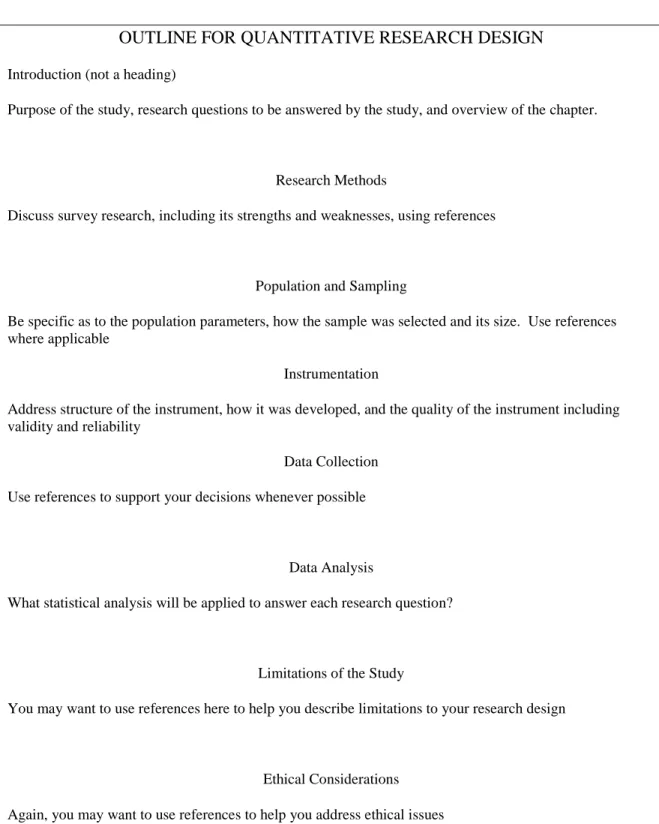
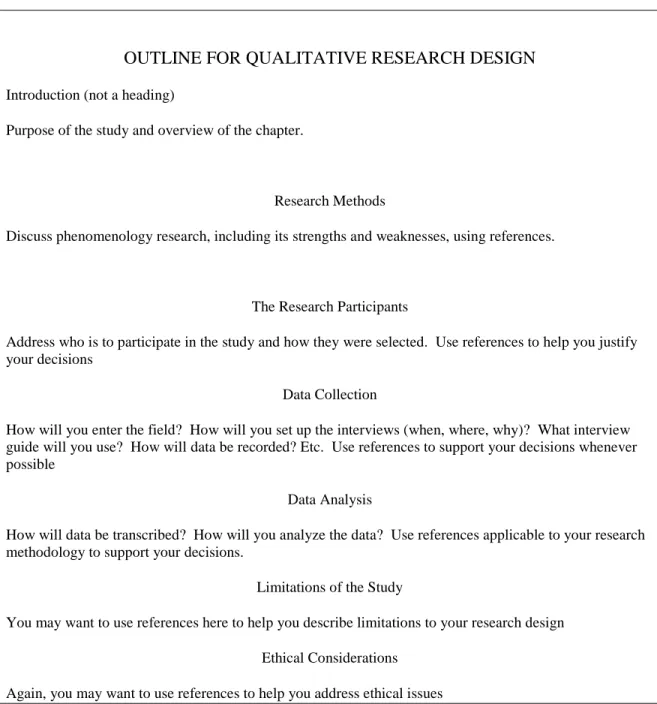
Chapter III is critical to your dissertation proposal as it specifies, clearly and fully, how it is you intend to carry out your study. As you develop this chapter you will need to imagine yourself actually doing the study and describe, step-by-step, what you will be doing. This level of specificity is helpful not only to yourself but to your committee members as well. Your committee needs to feel confident in you as a researcher - confident that you will be able to collect and analyze data for your study, confident that you know what you are doing. Figure 3 for quantitative research and Figure 4 for qualitative research provide an outline of the main sections that need to be addressed in this chapter. Below is a delineation of these main sections.
Beginning the Chapter
Typically this chapter begins with a paragraph that includes a restatement of the purpose of your study. You can change the wording slightly from how you have stated the purpose of the study in Chapter I. However, be careful that you are not including words that change the meaning of that purpose. You need to look at the two statement versions and ask yourself if they are saying the same thing. Also included in this
paragraph is an overview of how the chapter is organized (what are the main headings for the chapter).
OUTLINE FOR QUANTITATIVE RESEARCH DESIGN Introduction (not a heading)
Purpose of the study, research questions to be answered by the study, and overview of the chapter.
Research Methods
Discuss survey research, including its strengths and weaknesses, using references
Population and Sampling
Be specific as to the population parameters, how the sample was selected and its size. Use references where applicable
Instrumentation
Address structure of the instrument, how it was developed, and the quality of the instrument including validity and reliability
Data Collection
Use references to support your decisions whenever possible
Data Analysis
What statistical analysis will be applied to answer each research question?
Limitations of the Study
You may want to use references here to help you describe limitations to your research design
Ethical Considerations
Again, you may want to use references to help you address ethical issues
OUTLINE FOR QUALITATIVE RESEARCH DESIGN Introduction (not a heading)
Purpose of the study and overview of the chapter.
Research Methods
Discuss phenomenology research, including its strengths and weaknesses, using references.
The Research Participants
Address who is to participate in the study and how they were selected. Use references to help you justify your decisions
Data Collection
How will you enter the field? How will you set up the interviews (when, where, why)? What interview guide will you use? How will data be recorded? Etc. Use references to support your decisions whenever possible
Data Analysis
How will data be transcribed? How will you analyze the data? Use references applicable to your research methodology to support your decisions.
Limitations of the Study
You may want to use references here to help you describe limitations to your research design
Ethical Considerations
Again, you may want to use references to help you address ethical issues
Discussion of Research Methods
Research Methods could be the first MAIN heading for this chapter. There is not much latitude for far-out, creative thinking in this chapter because of the need to include important information pertaining to research methods. The research methods you choose to use for your study will need to be grounded in methodologies apparent in research literature.
Most likely, you will not be creating a new research method for your study; rather you will be using methods that have already been accepted by a greater scientific
community of scholars and applying these methods to your study. Subsequently, you will need to describe, using literature to assist you, the main research methodology you intend to follow.
For example, if you choose to use qualitative research methods, then you need to explain which qualitative method you are going to use (phenomenology, case study, ethnography, heuristic, interpretive biography, etc.) and why this method fits your study. If you choose to use quantitative research methods, then you would need to explain which method (survey, unobtrusive, content analysis, experimental, etc.) and why this method fits your study. You then need to describe (in full) this research method. What does it mean, what does it entail, what are its strengths and weaknesses? Note, this information tends to be substantially longer and more involved for qualitative research methods than for quantitative (unless you are using an experimental design).
Selection and Description of Research Participant OR Population and Sampling
Selection and Description of Research Participant OR Population and Sampling could be a main heading for this chapter. For quantitative research designs, this section of Chapter III needs to include a description of the population parameters for your study. For example, will you be studying nurses in a particular hospital, hospital nurses in a given city, in the northwest (which states?), in the nation? Information about the population would be helpful, such as how large the population is and any other known demographic characteristics of the population you may have. If you are collecting data at one particular setting, you will need to describe this setting.
You then would need to explain how you plan to select a sample from this population. Will the sample be randomly selected? How will this selection be made (e.g., computerized random selection, selected using a random numbers table)? Or will you include the entire population? The use of references to help you make decisions about sampling procedures is required.
If you are using qualitative research design, you will need to describe the research setting, if appropriate, and how participants will be selected from this setting. What technique or criteria will you use to decide on who would be the best participants for your study. You will need to refer to literature concerning qualitative research design to help you make sound decisions about the purposeful selection of participants. How do you select and how many participants are needed are questions that need to be answered.
Instrumentation for Quantitative Research
This could be a main heading for quantitative research design. For quantitative research, you need to describe the measure(s) you will be using for your study. If you are developing your own research instrument, you need to explain why you are doing so. Is it because an instrument is not available that measures the variable you are focusing on for your study; or is it because the measures that are available have limited definitions at the variable? In describing the instrument, or measure, you will be using, you need to include the following information:
1. What is the purpose of the instrument?
2. How is the variable defined (i.e., what is actually being measured)?
3. How is the measure structured? (For each section of the instrument, how many questions (or items) are included? What scale of measure is used? subsections to the instrument?)
4. What is the validity of the instrument? How do you know it is measuring what it says it measures?
5. What is the reliability of the instrument?
Note: If you are developing your own research instrument, you will not have information available about reliability until after you have collected your data. However, information about validity of the instrument can be addressed in your proposal by
speaking about how the instrument was developed and reviewed for quality, such as by an outside panel. You will need to pilot test the instrument prior to your proposal defense to assure that the items are stated clearly and can be read and understood by potential
respondents. References are required for this section to substantiate your thoughts about instrument development and attributes of a quality data collection instrument.
Data Collection
This could be a main heading. For quantitative research, you need to describe how the instrument will be administered. Will it be mailed out? Will the instrument be administered in a particular setting? What is that setting? What special precautions are you taking to assure that the instrument will be administered in ways that will yield “true” data where participants are not feeling pressure to NOT tell their individual truths? If you are mailing a survey, how can you maximize the response rate? Will you do a second mailing? Will you make phone calls? When will you be collecting the data? References are required to help you explain your intentions.
For qualitative research that involves research participants, you will need to describe how you will be entering the field. How will you be making your initial contact with the setting or with potential research participants? You need to remember that your first impression can make a difference in whether someone is willing to be a participant. You need to begin to build trust at the very beginning, so you need to be thoughtful in your approach. How, when, and where data collection will take place needs to be described. If you are doing interviews, you will need to reference in the appendix the guideline you will use for data collection and you will need to make sure this guideline will provide data to answer your research questions specified in Chapter I. The data collection process needs to be grounded in literature concerning qualitative methods.
Data Analysis
This could be a main heading. For quantitative research designs, often times it is helpful to identify for each research question the data analysis technique you will be using, for example: descriptive statistics, t-test for independent samples. Your committee needs to be able to see that you have matched the data analysis technique to the kind of data and level of measure you will be using, and that the analysis technique will
adequately answer your research question. For qualitative research, again you will need to use the literature to help you describe how the data will be analyzed (i.e. Will you use bracketing? How will themes be established? Will you triangulate the data?).
Limitations
This could be a MAIN heading. There are limitations for both quantitative and qualitative research methods. You need to explain such limitations for your particular design as you have described it above. References may be used to help you describe limitations to a certain extent. However, you also need to think critically about your particular design and how you are applying it for your study and then identify limitations. References are recommended for this section as there are limitations inherent in any research design; many of these limitations are discussed in the literature.
Ethical Considerations
This could be a MAIN heading. You need to address how the research participants in your study will be protected from harm from both data collection and
analysis of your data. References are needed to substantiate and enrich your thoughts on this very important aspect of your research design. Gonzaga University’s Institution Review Board (IRB), from which you must gain approval prior to data collection, is most interested in whether participants in your study will have free choice, whether it will be made clear to them as to the purpose of your study, and whether you will be truthful in data reporting in meeting the intended purpose of your study. Be sure to make mention in the text of Chapter 3 that you have fulfilled the Gonzaga University IRB requirements, and include in an appendix the letter from the IRB director verifying the above.
Defending the Proposal and the IRB
Having prepared a draft of the proposal that the committee chair approves for distribution to the committee and the committee members have had time to read, you may then concentrate on preparing for the defense itself. Your committee chair will schedule a room, unless he or she requests you to contact the department administrative assistant to do so. The room is to be scheduled for a two-hour time block.
In the formal defense of your proposal you will begin with a brief, approximately 10 minutes, oral presentation of the proposed research project. You can assume that the committee has read the proposal previous to the defense. This brief summary should: 1. Highlight the research problem.
2. Provide a brief review of the student's past experiences that may have led to the selection of that topic and problem.
3. Explain the ultimate purpose or benefit from the study.
4. Synthesize the major theoretical models and primary research studies that provide justification and theoretical bases for the study.
5. Discuss the research methodology to be utilized, including a description of the participants, instrumentation, design, and proposed methods for analyzing data. 6. Illuminate anticipated limitations or potential problems that may occur.
Following this brief presentation, the committee chair will facilitate an open discussion of the proposal, which will probe the extent and depth of your knowledge in the area, familiarity and skills with the proposed research methodology and data analysis techniques, and so forth. It is anticipated that each committee member will express his or her individual concerns, and that you and the committee will attempt to reach consensus on how the research study and dissertation may best address these concerns. This critical analysis should help you to identify areas in which a lack of clarity is evidenced in the proposal, research design flaws, or inappropriate proposals for data analysis. The consequence of this discussion may be:
1. The committee directs you to make specific revisions to the proposal and submit them to the committee chair. Upon acceptance of these revisions by the
committee chair, and having obtained committee signatures on the signature page, the proposal is officially considered “accepted.”