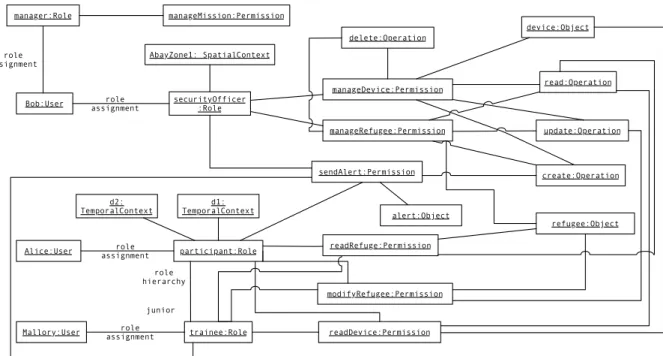
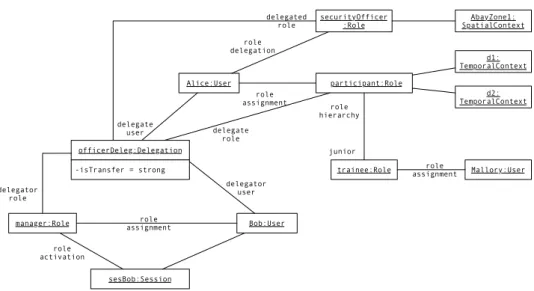
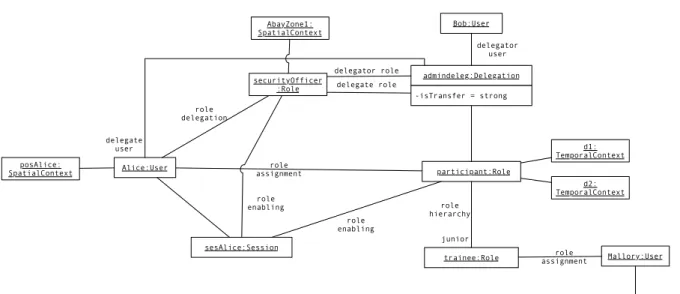
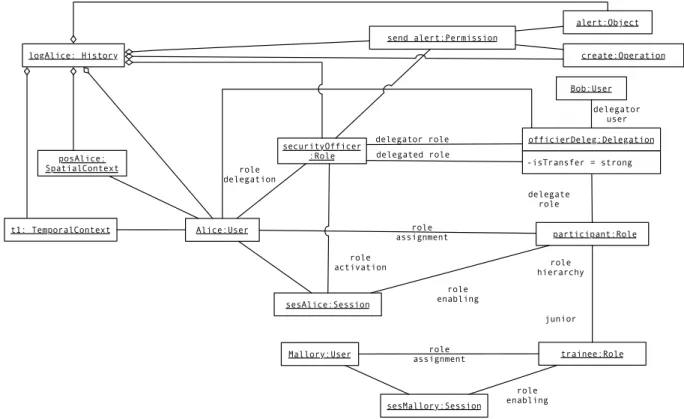
A Comprehensive Modeling Framework for Role-based Access Control Policies
Ameni Ben Fadhela,b,∗, Domenico Biancullib, Lionel Brianda,b
aFaculty of Science, Technology and Communication - University of Luxembourg, 6, rue Coudenhove-Kalergi, L-1359 Luxembourg, Luxembourg
bSnT Centre - University of Luxembourg, 4 rue Alphonse Weicker, L-2721, Luxembourg, Luxembourg
Abstract
Prohibiting unauthorized access to critical resources and data has become a major requirement for enter-prises; access control (AC) mechanisms manage requests from users to access system resources. One of the most used AC paradigms is role-based access control (RBAC), in which access rights are determined based on the user’s role.
Many different types of RBAC policies have been proposed in the literature, each one accompanied by the corresponding extension of the original RBAC model. However, there is no unified framework that can be used to define all these types of policies in a coherent way, using a common model.
In this paper we propose a model-driven engineering approach, based on UML and the Object Constraint Language (OCL), to enable the precise specification and verification of such policies. More specifically, we first present a taxonomy of the various types of RBAC policies proposed in the literature. We also propose theGemRBACmodel, a generalized model for RBAC that includes all the entities required to define the classified policies. This model is a conceptual model that can also serve as data model to operationalize data collection and verification. Lastly, we formalize the classified policies as OCL constraints on theGemRBAC
model.
Keywords: role-based access control, modeling, authorization constraints, survey
1. Introduction
Prohibiting unauthorized access to critical resources and data has become a major requirement for enterprises. Access control (AC) mechanisms manage requests from users to access system resources; the access is granted or denied based on the authorization policies defined within the enterprise. Access control systems can be grouped into three categories [37]: discretionary (DAC), mandatory(MAC), androle-based (RBAC). In DAC, access rights are directly assigned to each user; moreover, a user is the only entity that can control the access to her own object(s), by assigning access rights to other users. In the second category, MAC, the access rights are determined according to mandated regulations stated by a central authority. In RBAC, access rights are determined based on the user’s role, e.g., her job or function, as well as on the permissions assigned to each role. By decoupling users from permissions, RBAC simplifies the administration and the deployment of access control policies in large enterprises. In the rest of this paper, we focus on RBAC, since it has become the de facto standard for access control in enterprise systems [29].
The concept of role-based access control was initially proposed by Sandhu et al. in 1996 [38]; later on, the various initial proposals of RBAC models were consolidated into a unified standard model for RBAC, proposed by the NIST [36]. The basic RBAC model is composed of: 1) entities, corresponding to users, roles, sessions, and permissions; 2) relations among these entities. A user is allowed to execute a set of
∗Corresponding author
Email addresses: [email protected](Ameni Ben Fadhel),[email protected](Domenico Bianculli),
permissions that corresponds to the role(s) assigned to her; in other words, a role maps each user to a set of permissions. A session maps each user to the set of her active role(s).
RBAC supports three securityprinciples: least privilege, data abstraction, and separation of duty. The least privilege principle requires a user to be authorized to execute only the minimal set of permissions needed for a given task, as determined by her role. The data abstraction principle is satisfied by abstracting low-level operations (e.g., thereadandwriteoperations provided by the operating system) with high-level operations defined for each business object in the system (e.g., updating the list of employees). The separation of duty principle states that no user should be given sufficient permissions to misuse the system. Although these principles are supported by RBAC, they are not automatically enforced by a system implementing RBAC: additional authorization constraints, called alsopolicies1, have to be defined to restrict the user’s access.
Various types of authorization constraints have been proposed in the literature. For instance, cardinality constraints represent a bound on the number of roles and sessions to which a user can be assigned. Prereq-uisite constraints are a precondition on user-role assignment, stating that a user can be assigned to a role only if the user is already a member of another role. Separation of duty constraints (SoD) define a mutual exclusion relation among roles, permissions, or users. Dually, binding of duty (BoD) constraints define a correlation among a set of operations that must be performed by the same user. Delegation constraints allow a user to temporarily transfer a set of permissions associated to her role to another user. Context constraints restrict a user from performing an action depending on her current location or on the time at which the action should happen.
Various extensions of the original RBAC96 model have been proposed to support these different types of constraints. However, there is no unified framework that can be used to define all these types of authorization constraints in a coherent way, using a common model. The lack of a unified framework makes difficult for practitioners to understand, select among, and implement the different types of policies proposed in the literature.
In this paper we survey and classify the various types of RBAC authorization constraints proposed in the literature, and describe the different facets that characterize each type of constraint. We also review the different extensions of the original RBAC model that have been proposed in the literature to support the various types of constraints. The main result of this review is that none of the proposed models can support all the constraints included in our classification. To address this limitation, we propose the
GemRBAC model, a Generalized Model for RBAC that includes all the conceptual entities required to
define the classified constraints. We then specify in an unambiguous manner all types of constraints to enable their operationalization. The specification follows a model-driven approach, based on UML and the Object Constraint Language (OCL): the classified constraints are formalized as constraints expressed with OCL on the GemRBAC model. This formalization brings three benefits: 1) it enables practitioners to select and make use of the various policies in a precise manner, based on theGemRBACmodel; 2) it lays the ground for the practical verification of such policies, both at design time and at run time, based on UML modeling tools and OCL checkers (such as Eclipse OCL [15]); 3) it shows the expressiveness of the
GemRBACmodel, since it can accommodate all types of constraints included in our classification.
More specifically, the main contributions of this paper are: 1) a taxonomy, classifying the main RBAC policies proposed in the literature; 2) theGemRBACmodel, which is a generalized model for RBAC that includes all the entities required to define the policies classified in the taxonomy; 3) the formalization, as OCL constraints on the GemRBAC model, of the RBAC policies included in the taxonomy; these constraints have been made publicly available, together with an Ecore [14] version of theGemRBACmodel, athttps://github.com/AmeniBF/GemRBAC-model.
The rest of the paper is organized as follows. Section 2 discusses the motivations of this work. Section 3 describes the original RBAC conceptual model. Section 4 presents a taxonomy of the various types of RBAC constraints proposed in the literature. Section 5 illustrates the various extensions to the original RBAC model. Section 6 introduces theGemRBAC model. Section 7 presents the specification of RBAC policies using OCL constraints defined on theGemRBAC model. Section 8 discusses, with an example,
the application of the proposed model for the verification of RBAC policies. Section 9 discusses the related work while section 10 concludes the paper and provides directions for future work.
2. Motivations
RBAC is an access control mechanism that defines rules for authorizations and access restrictions for each role within an organization. Such a policy is required to specify access rights according to an individual’s job or function (i.e., her role); unlike traditional access control, rights are not assigned to a user according to her identity. RBAC is available in some, security-oriented variants of Unix-like operating systems, as well as in modern database management systems. These systems implement a subset of the NIST RBAC model [36], based on the initial proposal of Sandhu et al. [37].
As we will see in the next sections, the original RBAC model supports a limited number of different types of authorization constraints, which cannot fulfill the expressiveness requirements that have emerged in the recent years in modern organizations. Examples of these new requirements are supporting delegation and revocation of permissions, and enabling access control policies based on the spatio-temporal context of users.
To fill this gap, researchers have proposed several extensions of the original RBAC model, to support the definition of new types of constraints (see sections 4 and 5). Though this work opens new possibilities for applying RBAC in modern enterprise systems, it is not easy to exploit in its current form. Indeed, these types of constraints and their corresponding models are scattered across multiple sources, are defined using different formalisms, and sometimes the concepts are expressed in an ambiguous manner.
This situation is very impractical for practitioners who want to select the relevant types of policies to be implemented in their systems. Moreover, they are faced with several models, often partially overlapping with each other, but with slightly different semantic variations. Furthermore, to the best of our knowledge, there is no model that can expressall the type of constraints that we have identified in our survey. Last, scattered and heterogenous models make it difficult for researchers to understand the state of the art in a coherent manner.
We contend there is clearly a need for organizing the various types of RBAC authorization constraints systematically, based on a unified framework. The goal would be to formalize these constraints in such a way as to enable and facilitate their operationalization. This is the reason for which we propose the
Gem-RBACmodel, as a unified RBAC model that capturesall the types of constraints found in the literature. Furthermore, for each type of authorization constraint, we define its formalization using OCL. By using such a common, standardized, and well-supported language, we not only facilitate the precise understanding of such constraints but we also facilitate their operationalization through industry-strength tools.
3. The original RBAC conceptual model
The original RBAC conceptual model, proposed in 1996 by Sandhu et al. [38], is composed of users, roles,sessions, andpermissions; figure 1 illustrates the different components of this model and the relations between them. According to Sandhu et al., a role can be seen, at the same time, both as a collection of permissions and as a collection of users. A role can be assigned to one or more users via a user-role assignment relation. A role-permission assignment relation maps each role to one or more permissions. A session is a mapping of one user to a subset of the roles that have been assigned to her; this mapping activates the role(s) for a certain user. A permission allows a user to perform some operation(s) on some resource(s) of the system.
A role can be inherited using arole hierarchy relation, as shown in figure 2. A role can have one or more juniors (sub-roles) denoted by an arrow. For instance, r2, r3 and r4 are juniors of r1. In addition to its
assigned permissions,r2inherits all permissions from its ancestor r1. Moreover, a junior role can have one
or more ancestors (senior roles). As shown in figure 2,r5 inherits not only the permissions of r2 but also
role user session permission role-permission assignment user-role assignment role activation role hierarchy * * * * * * * 1 administrative
role administrative permission
administrative role activation * * administrative role-permission assignment administrative user-role assignment 1 * * *
administrative role hierarchy
Figure 1: The original RBAC model [38]; the dashed line encloses the administrative model for RBAC
r1
r2 r3 r4
r5
Figure 2: Role hierarchy example
A set of authorization constraints is defined and applied to different relations to describe which permis-sion(s) are granted to a user based on the role(s) assigned to her. The different types of constraints will be discussed in detail in section 4.
RBAC administrative model
An instance of an RBAC model can include a large number of objects: the complexity and the size of such model instance represent a challenge to manage and maintain it. To ease its management, the RBAC model can be extended with anadministrativepart [38]; this part is shown in figure 1, enclosed with a dashed line. The administrative extension contains the concepts of administrative role and administrative permission. Examples of the latter are assigning a user to a role or adding a new permission or constraint. An admin-istrative role can acquire onlyadministrative permissions via anadministrative role-permission assignment. In addition,administrative user-role assignments map administrative roles to users. An administrative role hierarchy defines inheritance relations between administrative roles.
4. RBAC policies taxonomy
In this section we present our classification of the existing types of RBAC constraints found in the literature. The taxonomy shown in figure 3, contains at the top level eight types of access control constraints; these are described in detail in the next sub-sections.
4.1. Prerequisite constraint
A prerequisite constraint is a precondition on a role assignment; it can be evaluated either at the role level or at the permission level [38, 4]. A constraint at the role level states that a user can be assigned to a
RBAC policies Prerequisite constraint Cardinality constraint Precedence and dependency constraint Role hierarchy constraint Separation of duty constraint (SoD) Binding of duty constraint (BoD) Role delegation and revocation constraint Context constraint Prerequisite role Prerequisite permission Static SoD (SSoD) Dynamic SoD (DSoD) SSoD conflicting users SSoD conflicting roles SSoD conflicting permissions Simple DSoD Object-based DSoD Operational-based DSoD Operational object-based DSoD DSoD conflicting users DSoD conflicting roles DSoD conflicting permissions Location-based context constraint Time-based context constraint Delegation Revocation Single/multi-step delegation Total/partial delegation Strong/weak revocation Cascading/non cascading revocation Grant-dependent/ grant-independent revocation Grant/transfer Role-based BoD Subject-based BoD Strong/weak transfer Static/dynamic weak transfer
role only if the user has been already assigned to another role. For instance, to acquire the roledeveloper in a company,Bobmust be already anemployeein the company. A constraint at the permission level indicates that a permissionp1can be assigned to a roleronly if this role already has permissionp2. For example, an
employee cannot have the permissionwrite document if she does not have the permissionread document. 4.2. Cardinality constraint
A cardinality constraint can represent a bound on the cardinality of either the role activation relation or the user-role assignment one [2]. An example of the first is a constraint like: “a user cannot activate more than three roles in a session”; an example of the second is “a user cannot be assigned to more than four roles”.
4.3. Precedence and dependency constraint
In some systems, assigning a role to a user does not entail that the user can activate it at anytime. A role that can be activated is called enabled. Role enabling and role activation can be controlled by specific constraints that determine precedence/dependency relationships [39] between two or more roles. For example, a policy like “the resident physician role can be enabled only if the attending physician role has been already activated” defines a precedence constraint between the enabling of a role and the activation of another one. A precedence constraint can be complemented with the corresponding dependency constraint on the deactivation of a role; to continue the example above, the corresponding dependency constraint would look like “the attending physician role cannot be deactivated if there is an activated resident physician role”. 4.4. Role hierarchy constraint
This type of constraint specifies the assignments of roles through a hierarchy. As explained in section 3, assigning roler to useruimplies assigning uall junior roles of r. A role hierarchy constraint can also be applied at the permission level: if a role acquires a permissionp, all its sub-roles will also acquire it [38]. For instance, considering figure 2, roler5 will inherit the permissions of roles r2 andr3. The default behavior
of this constraint can be overridden by denoting that a role or permission cannot be inherited. 4.5. Separation of duty (SoD) constraint
Separation of duty (SoD) constraints [27] are used to define mutual exclusion relations among rules, permissions, or users. Mutually-exclusive entities are also calledconflicting. In the literature, there are two types of SoD: static (SSoD) and dynamic (DSoD).
4.5.1. Static separation of duty (SSoD) constraint
This type of separation of duty is also known as strong exclusion [40]. It can refer to users, roles, and permissions [2, 3]. A user-centric static separation, also called SSoD conflicting users, states that two conflicting users cannot be assigned to the same role. A role-centric separation, also called SSoD conflicting roles, specifies that the same user cannot be assigned to mutually-exclusive roles. SSoD can also be permission-centric: this means that a user is not allowed to acquire two conflicting permissions and, symmetrically, that two conflicting permissions cannot be assigned to the same role.
4.5.2. Dynamic Separation of duty (DSoD) constraint
Dynamic separation of duty deals with user-role activation through a session. In this case, a user is allowed to acquire conflicting roles; however, she cannot activate them at the same time. There are different types of DSoD [40]:
• Simple DSoDspecifies that conflicting roles cannot be activated in the same session. As in SSoD, simple DSoD can also be user-, role- or permission-centric [4].
• Object-based DSoD allows a user to activate two conflicting roles at the same time, as long as she does not operate on the same object. For instance, a user can be an author or a reviewer; an author can submit a paper but cannot be a reviewer for it. This type of constraint is also called Resource-based Dynamic Separation of Duty in [26].
• Operational-based DSoD aims to prevent a user from performing all the operations in the same business task (e.g., a sequence of operations defined in a workflow). This means that a user can activate two conflicting roles at the same time, as long as the union of the operations allowed by the roles assignment does not correspond to the entire sequence of operations defined in the business task.
• Operational Object-based DSoDis a combination of the two previous types of constraint. During the execution of a certain business task, a user can activate two conflicting roles at the same time, even if the union of the operations allowed by the roles assignment correspond to the entire sequence of operations defined in the business task. The only constraint is that no user can perform all the operations on the same object. This type of constraint is also called History-based SoD [40] because the history of the operations performed by a user determines what she is allowed to do. Reference [40] also introduces the concepts oforder-dependent andorder-independent history-based SoD. The former requires that a role performs its operations in a particular order; the latter does not take into account the order of operations.
4.6. Binding of duty constraint (BoD)
Unlike SoD constraints, binding of duty constraints define a correlation between a set of permissions; the permissions being correlated and the corresponding operations are also calledbounded. BoD constraints are usually defined in the context of workflow systems, whose activities can be performed by different subjects with different roles. Reference [42] classifies this type of constraint asrole-based andsubject-based. In role-based BoD, the operations allowed by two or more permissions have to be performed by the same role. In subject-based2 BoD, the same user must perform the operations allowed by the bounded permissions; moreover, the user has to maintain the same role while performing all these operations.
4.7. Role delegation and revocation constraint
A delegation allows a user (called the delegator) to transfer the permissions associated with her role (called thedelegated role) to another user (called thedelegate). A delegation takes place only if the delegate has not already been assigned to the delegated role or has already received it by means of another delegation. Furthermore, when a hierarchy has been defined for roles, the delegate receives not only the delegated role but also all its sub-roles. A delegation is put to an end through a revocation action. In this section, we present the different types of role delegation and revocation constraints which can be set within an RBAC system.
4.7.1. Role delegation constraint
A user can delegate her role or permission to another user. A delegation can be single- or multi-step, total or partial [44], and can be either of type “grant” or “transfer” [11].
A user can acquire a role through a standard user-role assignment (in which case the role is called original), or through a delegation (in which case the role is called delegated). A single-step delegation forbids a user to delegate a delegated role. On the other hand, a multi-step delegation allows a user to delegate a delegated (i.e., non-original) role; however, the number of delegation steps is bounded and should not exceed a maximum delegation depth, predefined for the system.
With atotal delegation, a user delegates all the permissions belonging to a certain role; with a partial delegation, a user delegates only a subset of the role permissions.
When a delegation is of type “grant”, the delegator can continue to use the role that has been delegated. On the other hand, when the delegation is of type “transfer”, right after the delegation the delegator is no longer assigned to the role that has been just delegated.
As mentioned above, when a hierarchy has been defined for roles, the delegate receives not only the delegated role but also all its sub-roles. Delegations of type “transfer” can bestrong orweak depending on the assignment of the juniors of the delegated role to the delegator. With astrong transfer, the delegator
is not assigned to the delegated role and to all its sub-roles anymore. Aweak transfer can be classified as static or dynamic. With a static weak transfer, the delegator keeps using a subrole r of the delegated role only if she is a member of another senior of roler. In case of a dynamic weak transfer, the delegator keeps using a subrolerof the delegated role only if she activates a senior of roler. As an example, consider the role hierarchy in figure 2 and assume that useru1 is assigned tor2 and tor3. If useru1 delegates her role
r2to useru2, the latter will acquire roler2 and its junior roler5. If the delegation is a static weak transfer,
after the delegation u1 will still be a member of role r5, since she is still a member of role r3, which is a
senior of roler5. On the other hand, if the delegation by user u1 of roler2 to user u2 is of type dynamic
weak transfer, the delegator will be still a member of roler5 after the delegation only if roler3 is active.
4.7.2. Role revocation constraint
A delegation is often followed by a revocation; in the following we refer to the revocation model proposed in [44].
A role can be revoked either by any user who acquired the role via a user-role assignment, or by the user who delegated the role. In the former case, the revocation is calledgrant-independent; in the latter it is calledgrant-dependent.
Thedominance of a revocation refers to its effects on the user-role assignment relation, as determined by role hierarchy; it can be eitherweak or strong. Consider the case in which a user may be directly assigned to a role or may be assigned to a role by inheriting it through a role hierarchy. Aweak role revocation only removes the user from the delegated role and does not impact on the other roles acquired through the role hierarchy. A strong revocation removes the user from the delegated role and also from the ones inherited through the role hierarchy. For instance, if user u1 delegates her roler1 to user u2, u2 will acquirer1 and
its juniorsr2,r3,r4and,r5 as shown in figure 2. With a strong revocation,u2will be revoked from r1 and
all its junior roles.
A revocation can affect not only the user who received the role being revoked, but also the other delegate users determined by a multi-step delegation. Acascading revocation removes the delegated role assignment and the assignment(s) resulting from a multi-step delegation. Anon-cascading revocation removes only the requested delegation and does not affect the delegation(s) of the delegated role.
If a delegation has a certain duration, a revocation can be triggered automatically after the duration expires. If a duration is not specified, a delegation remains active until a user revokes it explicitly.
4.8. Context constraint
Context constraints allow a user to perform an action depending on her current location (location-based context constraints) [8] or on the time (time-based context constraints) at which the action should happen [20]. Contextual information can be assigned to users, roles and/or permissions. A user context refers to her current position and time. A role (respectively, a permission) context refers to the location from and the time at which the corresponding role (respectively, permission) can be activated.
A location can be physical or logical. A physical location corresponds to some specific geographic co-ordinates; a logical location corresponds to a bounded space like a specific room in a building. With a location-based context constraint, roles can be enabled and activated when the user’s position matches the location specified in the constraint. A role is automatically disabled when the user leaves the geofence determined by the location specified with the constraint.
Time-based context constraints specify the periodicity and/or the duration of role activation [7]. For example, one can constraint a role to be activated only on working days within a predefined range of hours. Moreover, a constraint can limit the cumulative time during which a role is active, e.g., “for three hours per day”.
A context-based constraint can be specified at the permission level to prohibit a user to perform a permission assigned to heractive role, when her contextual information is not valid.
These constraints can also be used to manage conflicting roles that a user can acquire through a role hierarchy. Each of the conflicting roles can have a time-based context constraint that restricts its activation to a certain period of time. If the time windows of the activation of conflicting roles do not overlap with
each other, the SoD constraint will not be violated. More in general, context constraints can be applied to a hierarchy constraint to restrict role inheritance and activation depending on location and/or time [34].
5. RBAC model extensions
The original RBAC model, introduced in section 3, was proposed by Sandhu et al. in [38] and is com-monly referred to as RBAC96. It is actually defined as a family of reference models: RBAC0, RBAC1, and RBAC2. The basic model, RBAC0, is composed of users, permissions, sessions, and assignment and activation relations. The other two models are defined incrementally over RBAC0 by adding concepts to it: RBAC1 adds the concept of role hierarchy while RBAC2 adds constraints.
Several researchers extended RBAC96 to support additional type of constraints such as delegation and context. In the rest of this section, we review some of these works.
RDM2000 [44] extends RBAC96 to support role delegation. It includes two types of user-role assignment: in addition to the original user assignment defined in RBAC96, RDM2000 proposes the delegated user assignment, which maps a user to a delegated role. A limitation of this work is that it only supports total delegation; this means that a user is not allowed to delegate a subset of her assigned permissions. Another extension related to the concept of delegation is PDM, permission-based delegation authorization model, proposed in [45]. In this model, if a user wants to delegate a set of permissions, she has to create a new role with the required permissions; this role can inherit from any original role. A limitation shared both by RBDM2000 and by PDM is that they only support grant delegation; a complete delegation model supporting both grant and transfer operations has been proposed by Crampton et al. [11]. However, the models provided by RBDM2000, by PDM, and by Crampton et al. do not support the various types of revocation policies presented in section 4. Sohr et al. [22] extends their previous model introduced in [26] to support the role delegation properties of RDM2000; this extension supports the various types of revocation.
Regarding temporal constraints, the first temporal RBAC model, TRBAC, was proposed by Bertino et al. in [7]. TRBAC introduces periodic constraints on role enabling and disabling, which define the period of time (delimited by two time points) during which a role can be enabled/disabled. TRBAC also supports the definition of dependencies among the enable/disable actions of roles; for instance one can require that role r1 must be enabled whenever role r2 is disabled. While TRBAC supports temporal constraints only
for role enabling/disabling, there is a more general version called GTRBAC [20, 21] that supports temporal constraints also on role activation and assignment. Moreover, GTRBAC adds support for temporal aspects in role hierarchy, cardinality, dependency, and SoD constraints. The GTRBAC was extended in [19] to support delegation by adding the delegation properties supported in PDM.
The first model to support location-based constraint has been GEO-RBAC [8]. It introduces the concept ofspatial role, which consists of a role and its corresponding region, i.e., the area or the place in which the role can be enabled. In this model, each user is associated to a real position, obtained by a positioning device, and a logical position, which is the mapping of the user’s real position into a region of the system. Role enabling is conditioned by the logical position of a user, which should match the one specified in the spatial role definition. This means that the list of enabled roles evolves according to the user’s position. An administrative model for GEO-RBAC, called GEO-RBAC Admin was proposed in [12]; in this model an administrative role is defined as a spatial role. While GEO-RBAC supports location-based constraints only for role enabling (and consequently for role activation), the LRBAC model [32] extends these constraints also to user-role and role-permission assignments.
Other works support full context-based constraints by combining spatial and temporal information. The LoTRBAC model [9] extends GTRBAC by assigning a location to each user, role and permission. In this model, location and temporal information control role enabling and activation. Another model, STRBAC [34], allows for defining location- and time-based constraints related to user and role-to-permission assignments. This may result in a limited subset of role-to-permissions allowed for a certain role, at a given time in a given place. Furthermore, STRBAC supports location- and/or time-based constraints also for role hierarchy and separation of duty. STRBAC was extended in [35] to support delegation constraints based on contextual information. In STRBAC, a change in a spatio-temporal constraint may lead to the
-idUser: String
User -idRole: String
-isStrong: Boolean -isCascading: Boolean -isDependent: Boolean Role -idPermission: String Permission -idObject: String Object -idOperation: String Operation -idDelegation: String -isRevoked: Boolean -isTransfer: DelegationType -isTotal: Boolean -startDate: Date -endDate: Date -maxDepth: Integer Delegation -idSession: String Session +checkAccess(RBACContext): Boolean RBACContext -time: RBACtime
TemporalContext -idLog: String
History -maxPermission: Integer -maxActiveRole: Integer -maxRole: Integer -location: RBAClocation SpatialContext +assignRole(Role) +accessHistory: Set(History) +assignPermission() +logBOCurrentProcessInstance(): Set(History) +accessHistory: Set(History) +getAllJuniors: Set(Role) +performOperation (Operation,Permission,Role) +enableRole(Role) +disableRole(Role) +activate(Role) +deactivate(Role) +delegateRole(Role) +accessHistory: Set(History) +accessHistory: Set(History) +getBoundedPermissions(): Set(Permission) +getBusinessTaskList(): Set(Operation) +getCurrentDate(): Date +revoke() +getAbsoluteDelegationPath() +accessHistory: Set(History) revoking User 0..1 delegate User 1 delegator User 1 Permissionsdelegated 1..* roleHierarchy juniors 0..* seniors 0..* delegatedDelegation 0..* delegated Role 1 RBACUtility delegatedRoles 0..* users 1..* receivedDelegation 0..* 0..* 0..* users
1..* assignmentuser-role roles1..* user-role
delegation permission role- assignment roles 1..* permissions1..* 0..* role activation role enabling activeRoles 0..* enabledRoles 0..* 0..* 0..* 0..* 1 userContext * 1 roleContext * 0..* 0..* permissionContext * log Operation logUser logRole log Permission log Object logContext 1..* 1..* 1..* 1 0..* delegate Role 1 -grant -strong -weakStatic -weakDynamic DelegationType <enumeration>
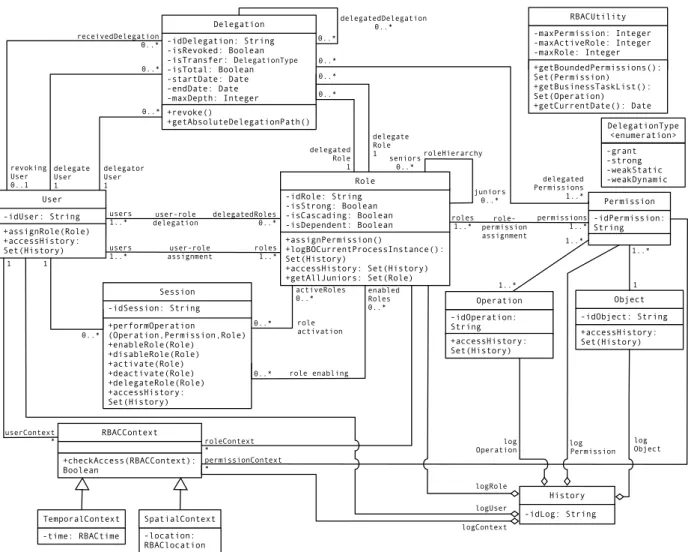
Figure 4: TheGemRBACconceptual model
addition of a new role. The GSTRBAC model [31, 1] lifts this requirement by introducing the concept of spatio-temporal zone (st-zone). An st-zone is an RBAC entity abstracting a location and a time, and is assigned to other entities like users, roles, permissions, and resources. In this mode, a role is enabled if its st-zone matches the one of the user; similarly, a permission is enabled if itsst-zone matches the one of the corresponding resource.
Table 1 shows to which extent the various models discussed in this section support the RBAC constraints included in the taxonomy presented in section 4. As one can notice, there is no extension of the original RBAC model that supportsall the constraints included in the taxonomy. To overcome this limitation, in the next section we propose a new generalized model for RBAC, which supports all these constraints. This generalized model will constitute the basis for the subsequent formalization with OCL of all the types of constraint identified in the taxonomy.
6. The GemRBACmodel
In this section we present our GemRBAC model (shown in figure 4 as a UML class diagram), which extends the original RBAC96 model with additional concepts. The components of the original model are modeled as classes (User, Session, Role, Permission) and associations (between User and Role, User and
Table 1: Support for RBAC constraints in the various RBAC models RBAC96 [38] RDM2000 [44] PDM [45] Crampton et al. [11] Sohr et al. [26, 22] TRBAC [7]
Prerequisite role + + N/A N/A + N/A
permission + + N/A N/A + N/A
Role hierarchy + + + + +
-Cardinality + + N/A + + +
BoD role - - -
-subject - - -
-Precedence & dependency - - - +
SoD SSoD + + + + + -simple DSod + + + + + -object DSod - - - - + -operational DSod - - - - + -history-based DSod - - - - + -Context location - - - -time - - - +
Delegation grant/transfer - grant grant + grant
-single/multiple - + + + +
-total/partial - total + + total
-Revocation dominance - - - - + -propagation - - - - + -dependency - - - - + -GTRBAC [19] GEO-RBAC [8] LRBAC [32] LoTRBAC [9] STRBAC [34, 35] GSTRBAC [31, 1]
Prerequisite role N/A N/A N/A N/A N/A +
permission N/A N/A N/A N/A N/A +
Role hierarchy
time-based + - + time and location-based time and location-based
Cardinality + N/A + + N/A +
BoD role - - -
-subject - - -
-Precedence & dependency + - - - -
-SoD SSoD
time-based + - + time and location-based time and location-based simple DSod
time-based + - + time and location-based time and location-based object DSod - - - -operational DSod - - - -history-based DSod - - - -Context location - + + + + + time + - - + + +
Delegation grant/transfer grant - - - grant
-single/multiple + - - - -
-total/partial + - - - +
-Revocation dominance - - -
-propagation - - -
-object: we model this by associating the classPermissionwith the classesObjectandOperation. The class
Object can be extended to include additional information as required by the application needs, e.g., state information for a stateful object.
Role activation is modeled as an association between theSession andRoleclasses. We also model role enabling with another association between these two classes.
In GemRBAC the concept of delegation is represented by the class Delegation. This class contains various attributes: startDateandendDaterepresent the bounds of a delegation period; the boolean attributes
isTotal andisRevoked represent, respectively, whether the delegation is total and whether the delegation has been revoked or not. The attributeisTransferindicates whether the delegation is of type “transfer” or “grant”. The concepts of delegator, delegate and revoking users are represented as associations between the
UserandDelegationclasses. Similarly, the concepts of the role of the delegator, the role of the delegate, and the delegated role are represented as an association between classRoleand classDelegation. We also model the set of delegated roles as an association between classesUserand Role. The specific type of revocation is represented by specific boolean attributes of theRoleclass: isDependent,isStrong, andisCascading.
The context is modeled with the class RBACContext, which has two subclasses, TemporalContext and
SpatialContext. TheRBACContext class represents spatial and temporal information, which are associated with each instance of theUser,RoleandPermissionclasses. The temporal context refers to the current time or the time on which a given role, respectively permission, can be enabled/assigned. The spatial context refers to a specific bounded area or geographical location. It can be assigned to a user, role or permission. A role, respectively permission, is enabled/assigned if its location matches the user’s position.
Since policies such asHistory-based SoDrequire a record of operations performed over time, we introduce theHistory class. An instance of this class records that a user performed a certain operation on a given object according to a given permission, in a certain location, at a certain time, while having a certain role; these data are gathered through the associations with (respectively)User, Operation, Object, Permission,
TemporalContext,SpatialContext, andRole.
7. OCL specification of RBAC policies
In this section we show how the RBAC policies described in section 4 can be formalized as OCL con-straints on theGemRBACmodel. This formalization aims to precisely specify the semantics of such policies in such a way that they can be operationalized, for example through an OCL constraint checker. For the purpose of the formalization, we enrich the model with some helper classes and operations, also included in figure 4.
The Ecore version of theGemRBACmodel, the OCL constraints defined in this section, and the model instances that violate/satisfy them are available athttps://github.com/AmeniBF/GemRBAC-model.
7.1. Prerequisite constraint
The prerequisite constraint can specify a pre-condition either for user-role assignment or for role-permission assignment. In the first case, the constraint states that to acquire roler1, the user must have been already
assigned to roler2. This constraint can be written in OCL as a pre-condition of the operationassignRole:
1 context User::assignRole(r:Role):
2 pre PreqRole:
3 let r2:Role = Role.allInstances() -> select (r:Role | r.idRole =’r2’) -> any(true),
4 roleSet: Set(Role) = self.roles -> union(self.delegatedRoles) -> asSet()
5 in r.idRole = ’r1’ implies roleSet -> includes(r2)
In this constraint we first select (line 3) the instance3of roler
2from all the instances of classRole. In line 5,
the implication states that if the role being assigned (parameterrof the operationassignRole) isr1thenr2
3Although the operationallInstances()returns all the instances of a class, we assume that each role in the system corre-sponds to exactly one specific instance of classRole.
must be among the roles already assigned or delegated to the user; these roles are derived from navigating therolesand delegatedRolesassociations.
The prerequisite constraint on role-permission assignment has a similar structure: context Role:: assignPermission(p:Permission):
pre PreqPermisssion:
let p2:Permission = Permission.allInstances() -> select (p:Permission | p.idPermission = ’p2’) -> any(true)
in p.idPermission = ’p1’ implies self.permission -> includes(p2)
7.2. Cardinality constraint
A cardinality constraint on the role activation relation is expressed in OCL as an invariant of the class
Session:
context Session inv Cardinality:
let u: RBACUtility = RBACUtility.allInstances() -> any(true)
in self.activeRoles -> size() <= u.maxActiveRole
In this expression, the number of roles activated for the current session is determined by the cardinality of theactiveRoles association between classesSession and Role; maxActiveRoleis a constant defined in the classRBACUtility.
The constraints for the number of roles assigned to a user and for the number of permissions assigned to a role are defined in a similar way for classesUserandRole:
context User inv Cardinality:
let u: RBACUtility = RBACUtility.allInstances() -> any(true),
roleSet : Set(Role) = self.roles -> union(self.delegatedRoles)-> asSet()
in self.roleSet -> size() <= u.maxRole
context Role inv Cardinality:
let u: RBACUtility = RBACUtility.allInstances() -> any(true)
in self.permissions -> size() <= u.maxPermission
Notice that when expressing the constraint on the number of roles assigned to a user, we consider both assigned and delegated roles.
7.3. Precedence and dependency constraint
Precedence and dependency constraints control the enabling and the deactivation of roles. A precedence constraint on the enabling of a role with respect to the activation of another one can be expressed as a pre-condition of the operationenableRole:
1 context Session::enableRole(r:Role):
2 pre RoleEnablingPrecedence:
3 let r2: Role = Role.allInstances() -> select (a: Role | a.idRole = ’r2’) -> any(true)
4 in r.idRole = ’r1’ implies Session.allInstances() ->
5 exists (s: Session | s.activeRoles -> includes(r2))
In the OCL expression above, we first select the instance corresponding to role r2 (line 3), and then the
implication at line 4 states that if the role being enabled (parameter r of the operationenableRole) is r1
thenr2must be among the activated roles; the list of these roles is derived from theactiveRolesassociation.
context Session::deactivateRole(r:Role):
pre RoleActivationDependency:
let r2:Role = Role.allInstances() -> forAll(a: Role | a.idRole = ’r2’) -> any(true)
in r.idRole = ’r1’ implies (Session.allInstances() ->
exists (s:Session | s.activeRoles -> excludes(r2)))
7.4. Role hierarchy constraint
A role hierarchy constraint can be expressed on user-role and permission-role assignment relations. In the first case, it states that if a user acquires a role, she will also acquire all its juniors. This can be expressed in OCL as a post-condition of the operationassignRoleas follows:
context User::assignRole(r:Role):
post RoleHierarchy:
self.roles -> includesAll(r.juniors)
In this expression the roles assigned to the user, derived from therolesassociation, should include all junior roles of the role being assigned (parameterrof operationassignRole); the junior roles are derived from the
r.juniorsassociation.
A role hierarchy constraint on the role-permission assignment states that if a role acquires a permission, all its sub-roles will acquire it. This constraint is defined as a post-condition of the operationassignPermission: context Role::assignPermission(p:Permission):
post RoleHierarchy:
self.juniors -> forAll (r: Role | r.permissions -> includes(p))
In this expression, we check if each sub-role is associated to the permission being assigned (parameterpof the operationassignPermission).
7.5. Separation of duty constraint (SoD) 7.5.1. Static SoD
The static SoD (SSoD) can be user-, role- or permission-centric. The user-centric SoS specifies that role
r1 can be assigned either touser1 or to user2, but not to both. This constraint can be expressed in OCL
as an invariant of the classRole: 1 context Role inv SSoDCU:
2 if self.idRole =’r1’ then
3 let u1:User = User.allInstances() -> select (u:User | u.idUser=’u1’) -> any(true),
4 u2:User = User.allInstances() -> select (u:User | u.idUser=’u2’) -> any(true)
5 in if self.users -> includes(u2) or self.users -> includes(u1) then 6 self.users -> includes(u2) xor self.users -> includes(u1)
7 endif
8 endif
In the OCL expression above, we first select the instances of usersuser1(line 3) anduser2(line 4). In line 5,
we state that the users assigned to the role should contain either user1 or user2, but not both (exclusive
OR); these users are derived from theusersassociation.
The role-centric and permission-centric SoD are defined in a similar way as invariants of the Userand
Permissionclasses, respectively: context User inv SSoDCR:
let r1:Role = Role.allInstances() -> select (r:Role | r.idRole=’r1’) -> any(true), r2:Role = Role.allInstances() -> select (r:Role | r.idRole=’r2’) -> any(true),
roleSet : Set(Role) = self.roles -> union(self.delegatedRoles) -> asSet()
in if roleSet -> includes(r2) or self.roles -> includes(r1) then
roleSet -> includes(r2) xor self.roles -> includes(r1)
endif
context Role inv SSoDCP1:
let p1:Permission = Permission.allInstances()-> select (p:Permission | p.idPermission=’p1’) -> any(true),
p2:Permission = Permission.allInstances()-> select (p:Permission | p.idPermission=’p2’) -> any(true)
in if self.permissions -> includes(p2) or self.permissions -> includes(p1) then
self.permissions -> includes(p2) xor self.permissions -> includes(p1)
endif
context Permission inv SSoDCP2:
if self.idPermission =’p1’ then
let r1:Role = Role.allInstances() -> select (r:Role | r.idRole=’r1’) -> any(true), r2:Role = Role.allInstances() -> select (r:Role | r.idRole=’r2’) -> any(true)
in if self.roles -> includes(r2) or self.roles -> includes(r1) then
self.roles -> includes(r2) xor self.roles -> includes(r1)
endif endif
7.5.2. Dynamic SoD
Unlike static SoD, dynamic SoD (DSoD) allows a user to acquire two conflicting roles but she cannot activate them at the same time. To express that rolesr1 and r2 should not be active in the same session,
we can write the following OCL constraint as an invariant of the classSession: context Session inv DSoD:
let r1:Role = Role.allInstances() -> select (r:Role | r.idRole=’r1’) -> any(true), r2:Role = Role.allInstances() -> select (r:Role | r.idRole=’r2’) -> any(true)
in if self.activeRoles -> includes(r2) or self.activeRoles -> includes(r1) then
self.activeRoles -> includes(r2) xor self.activeRoles -> includes(r1)
endif
Object-based SoD is another variation of DSoD which allows a user to activate two conflicting roles at the same time, as long as she does not operate on the same object. It can be expressed in OCL as a pre-condition of the operationperformOperation of theSession class:
1 context Session::performOperation(op:Operation, p:Permission, r:Role):
2 pre ObjectDSOD:
3 let r2:Role = Role.allInstances() -> select (r:Role | r.idRole=’r2’) -> any(true),
4 r1:Role = Role.allInstances() -> select (r:Role | r.idRole=’r1’) -> any(true),
5 logr2: Set (History) = self.user.accessHistory() -> select (a: History | a.role= r2),
6 logr1: Set (History) = self.user.accessHistory() -> select (a: History | a.role= r1)
7 in if r = r1 then
8 (logr2 -> select (a: History| a.object= p.object)) -> isEmpty()
9 else if r = r2 then
10 (logr1 -> select (a: History| a.object= p.object)) -> isEmpty()
11 endif
In this constraint we refer to instances of theHistoryclass, which keeps track of each operation performed in the system, recording the user who performed it, the role she had, the object on which the operation was performed, the time and the location. We use the operationaccessHistoryof the class Userto retrieve the instances of History filtered on the two conflicting roles (lines 5 and 6). For each role that the input parameter rcan assume (in this caser1or r2, lines 7 and 9), we check (lines 8 and 10) whether the history
of the conflicting role(s) does not contain any operation performed on the same object as the one specified in the input parameterp.
With an Operational-based DSoD constraint, a user can activate two conflicting roles at the same time, as long as the union of the operations allowed by the roles assignment does not correspond to the entire sequence of operations defined in a business task. This can be expressed in OCL as an invariant of the class
Session:
1 context Session inv OperationalDSoD:
2 let r1:Role = Role.allInstances() -> select (r:Role | r.idRole=’r1’) -> any(true),
3 r2:Role = Role.allInstances() -> select (r:Role | r.idRole=’r2’) -> any(true),
4 u: RBACUtility = RBACUtility.allInstances() -> any(true),
5 opBT: Set(Operation) = u.getBusinessTaskList(),
6 op:Set(Operation) = r1.permissions.operations -> asSet() ->
7 union(r2.permissions.operations -> asSet())
8 in (self.activeRoles -> includes (r1) and self.activeRoles -> includes (r2))
9 implies (opBT - op) -> notEmpty()
On line 5 we retrieve the list of operations defined in the business task by calling thegetBusinessTaskList
operation of the classRBACUtility. We have to check that the union of the operations allowed by the two conflicting roles is a proper subset of the business task operations. This is equivalent to stating that the difference between the two sets is not empty (line 9). This check is done if both roles are active.
The History-based DSoD constraint combines both the Object-based one and the Operational-based one. Differently from these two, History-based DSoD allows a user to activate two conflicting roles at the same time, as long as the user does not perform all the operations on the same object. This can be specified as a pre-condition of the operationperformOperationof theSessionclass:
1 context Session::performOperation(op:Operation, p:Permission, r:Role):
2 pre HistoryDSOD:
3 let u: RBACUtility = RBACUtility.allInstances() -> any(true),
4 opBT: Set(Operation) = u.getBusinessTaskList(),
5 r1:Role = Role.allInstances()-> select (r:Role | r.idRole=’r1’) -> any(true),
6 r2:Role = Role.allInstances()-> select (r:Role | r.idRole=’r2’) -> any(true),
7 perm1: Set (Permission)= r1.permissions-> select (a | a.object = p.object),
8 perm2: Set (Permission)= r2.permissions-> select (a | a.object = p.object),
9 opObjBT: Set(Operation) = (perm1.operations -> union(perm2.operations)) ->
10 select (op:Operation | opBT -> includes (op)) ->asSet(),
11 logr2: Set (History)= self.user.accessHistory() ->
12 select (a: History | a.role = r2
13 and perm2 -> includes (a.permission)),
14 logr1: Set (History)= self.user.accessHistory() ->
15 select (a: History | a.role = r1
16 and perm1-> includes (a.permission)),
17 log: Set (History) = logr1 -> union(logr2),
18 opLog: Set (Operation)= log -> collect (l | l.operation) -> asSet(),
19 newopLog:Set (Operation) = opLog -> including (op)
In the OCL expression above, we first retrieve the list of operations defined in the business task. Then, we select the conflicting rolesr1 andr2 (lines 5 and 6), and then we compute (line 10) the list of operations
opObjBTbelonging to the business task and that can be performed on the input object (p.object) according to the permissions of the two roles. Afterwards, we compute the listopLogof operations performed by the user (either under roler1 or r2) on the input object (line 17). The pre-condition then checks whether the
set resulting from adding the input parameteropto opLogis still a proper subset of opObjBT. 7.6. Binding of duty constraint (BoD)
Binding of duty constraints define a correlation between a set of permissions. A role-based BoD constraint requires that bounded operations must be executed by the same role. This constraint can be specified in OCL as a pre-condition of the operationperformOperationof theSessionclass:
1 context Session::performOperation(op:Operation, p:Permission, r:Role)
2 pre RoleBoD:
3 let u: RBACUtility = RBACUtility.allInstances() -> any(true),
4 boundedPermissions: Set (Permission)= u.getBoundedPermissions(),
5 roles: Set (Role)= Role.allInstances() ->
6 select (r:Role | r.permissions -> includesAll(boundedPermissions)),
7 roleLog: Set (History)= r.logBOCurrentProcessInstance()
8 in if boundedPermissions -> includes(p) and roleLog -> isEmpty() then 9 roles -> forAll (r:Role |r.logBOCurrentProcessInstance() -> isEmpty())
10 endif
In the OCL expression above, we first retrieve the set of bounded permissions and their assigned roles (lines 4 and 6). Then, we determine which bounded operations have been performed by rolerin the current process instance4 by calling the operationlogBOCurrentProcessInstance()of theRoleclass (line 7). If the operation being performed corresponds to a bounded operation and none of the bounded operations have been performed in the current process instance by roler(line 8), then the pre-condition is satisfied if none of the bounded operations have been previously performed byany other role different from r (line 9). In other words, if a user with roler has already performed a bounded operation (corresponding to the case in which the conditionroleLog->isEmpty()is false), any other user with the same role is allowed to perform another bounded operation in the current process instance.
The subject-based BoD constraint requires that bounded operations must be executed by the same subject (user and role). This constraint can be expressed in OCL as:
context Session::performOperation(op:Operation, p:Permission, r:Role)
pre SubjectBoD:
let u: RBACUtility = RBACUtility.allInstances() -> any(true), boundedPermissions: Set (Permission)= u.getBoundedPermission(), roles: Set (Role)= Role.allInstances() ->
select (r:Role | r.permissions-> includesAll(boundedPermissions)), subjectLog: Set (History)= r.logBOCurrentProcessInstance() ->
select (a: History | a.user= self.user)
in if boundedPermissions -> includes (p) and subjectLog -> isEmpty() then
roles -> forAll (r:Role | r.logBOCurrentProcessInstance() -> isEmpty()
endif
This OCL constraint is similar to the one defined for role-based BoD. However, the logsubjectLog corre-sponds to the bounded operations that have been performed by the user user with role r in the current process instance.
7.7. Role revocation and delegation constraints 7.7.1. Role delegation constraint
A delegation is characterized by a delegated role, a delegator, a delegate and their corresponding roles. In a multi-step delegation, a user is allowed to delegate a delegated role according to a maximum delegation depth (hereafter calledmaxDepth). This type of delegation can be specified in OCL as an invariant of the classDelegation
context Delegation inv MultiStepDelegation:
self.getAbsoluteDelegationPath() -> size() <= self.maxDepth
In the OCL expression shown above, the operationgetAbsoluteDelegationPath returns the list of dele-gation steps starting from the original (non-delegated role). The size of this list is then compared with the attributemaxDepth. The single-step delegation constraint can be defined as a multi-step delegation with a maximum delegation depth equal to 1.
A delegation can be total or partial depending on the number of permissions being delegated. A total delegation delegates all the permissions belonging to a certain role; it can be specified in OCL as an invariant of theDelegationclass:
context Delegation inv TotalDelegation: self.isTotal implies
self.delegatedPermissions = self.delegatedRole.permissions
This expression states that if the delegation is total (represented by the attributeisTotal) then the list of delegated permissions (derived from the association delegatedPermissions) should be equal to the list of permissions associated to the delegated role.
A partial delegation (characterized by the attributeisTotal being false) is defined in a similar way: context delegation inv PartialDelegation:
not (self.isTotal) implies
(self.delegatedRole.permissions - self.delegatedPermissions) -> notEmpty()
A delegation can be either of type “grant” or “transfer”. While a “grant” type delegation does not affect the permissions of the delegator, in case of a delegation of type “transfer”, the delegator cannot use the delegated role after the delegation. A delegation of type “transfer” can be eitherstrong or weak. In case of strong transfer, in addition to the delegated role, the delegator is no longer assigned to any of its juniors. This constraint can be expressed in OCL as an invariant of theDelegationclass:
1 context Delegation inv StrongTransfer:
2 let roles: Set(Role) = self.delegatedRole.getAlljuniors() -> including (self.delegatedRole)
3 in self.isTransfer = delegationType::strong implies 4 self.delegatorUser.roles -> excludesAll(roles)
5 and self.delegateUser.delegatedRoles -> includes(self.delegatedRole)
In the OCL expression shown above, we first retrieve the list of roles from theDelegation object, includ-ing the delegated role and its juniors (line 2). The operation getAlljuniors returns the juniors of the delegated role, walking through the transitive closure of the hierarchy relation. For instance, the opera-tion getAlljuniors applied to role r1 in figure 2 returns the list of roles: r2, r3, r4 and r5. The OCL
expression at line 3 states that if the delegation is of type strong transfer (represented by the expression
self.isTransfer = delegationType::strong) then the list of roles assigned to the delegator (derived from thedelegatorUser.rolesassociation) should include neither the delegated role nor any of its juniors. Be-sides, the list of roles delegated to the delegate should include the delegated role; these roles are derived by navigating thedelegateUser.delegatedRolesassociation.
A delegation of type weak transfer can be either static or dynamic. In case ofstatic weak transfer, the delegator keeps using a subroler of the delegated role only if she is a member of another senior of role r. This constraint can be expressed in OCL as an invariant of theDelegationclass:
1 context Delegation inv StaticWeakTransfer:
2 let acquiredRoles: Set(Role) = self.delegatorUser.roles
3 -> union(self.delegatorUser.delegatedRoles),
4 allowedRoles: Set(Role) = self.delegatedRole.getAllJuniors() -> select (r : Role |
5 (r.seniors -> excluding(delegatedRole))
6 -> exists (r1 : Role | acquiredRoles ->includes(r1))),
7 roles: Set(Role) = (self.delegatedRole.getAllJuniors()
8 -> including(self.delegatedRole)) - allowedRoles
9 in self.isTransfer = delegationType:: weakStatic implies 10 self.delegatorUser.roles -> excludesAll(roles)
11 and self.delegatorUser.roles -> includesAll(allowedRoles)
12 and self.delegateUser.delegatedRoles -> includes(self.delegatedRole)
In the OCL expression shown above, we first retrieve the list (acquiredRoles) of roles available to the delegator, defined as the union of the roles assigned to and delegated to the delegator (lines 2 and 3). Then, we select among the subroles of the delegated role, the roles (allowedRoles) that the delegator is allowed to acquire. We check if one of the juniors of the delegated role has another senior in the listacquiredRoles
(lines 4–6). We compute the list of roles that the delegator cannot use after the transfer, keeping into account theallowedRoles(lines 7 and 8). If the transfer is of typestatic weak (condition checked at line 9) the list of roles assigned to the delegator should include neither the delegated role nor any of its juniors (except for those allowed by the hierarchy relation). Finally, the list of roles delegated to the delegate should include the delegated role (line 12).
The constraint for the delegation of typedynamic weak transfer has a similar structure: 1 context Delegation inv DynamicWeakTransfer:
2 let acquiredRoles : Set(Role) = self.delegatorUser.roles
3 -> union(self.delegatorUser.delegatedRoles),
4 allowedRoles : Set(Role) = self.delegatedRole.getAllJuniors() -> select (r : Role |
5 (r.seniors -> excluding(delegatedRole))
6 -> exists(r1 : Role |
7 self.delegatorUser.sessions -> exists (s:Session|
8 s.activeRoles -> includes(r1)))),
9 roles : Set(Role) = (self.delegatedRole.getAllJuniors()
10 -> including(self.delegatedRole)) - allowedRoles
11 in self.isTransfer = delegationType:: weakDynamic implies
12 self.delegatorUser.roles -> excludesAll(roles)
13 and self.delegatorUser.roles -> includesAll(allowedRoles)
14 and self.delegateUser.delegatedRoles -> includes(self.delegatedRole)
Notice that in this case the listallowedRoles(lines 4–8) includes the subroles having an active senior in the delegator session.
7.7.2. Role revocation constraints
A delegation is revoked by setting the attributeisRevokedto true. The delegation is revoked automat-ically when its duration expires; this constraint can be specified as an invariant of theDelegationclass as follows:
context Delegation inv AutomaticRevocation:
let u: RBACUtility = RBACUtility.allInstances() -> any(true),
in u.currentDate >= self.endDate implies self.isRevoked
A revocation is called grant-dependent if only the delegator is allowed to revoke the delegation. On the other hand, a grant-independent revocation allows not only the delegator but also anyoriginal user to
revoke the delegation. This constraint can be expressed in OCL as a pre-condition of the operationrevoke
of theDelegationclass: 1 context Delegation::revoke()
2 pre RevacationDependency:
3 if self.delegatedRole.isDependent then 4 self.revokingUser = self.delegatorUser
5 else
6 self.revokingUser = self.delegatorUser or self.delegatedRole.users ->
7 includes(self.revokingUser)
8 endif
In the OCL expression above, we first check if the revocation is grant-dependent, by checking the attribute
isDependent of the association delegatedRole(line 3). If this is the case, only the delegator is allowed to revoke the delegation (line 4). Otherwise, the delegation can be revoked either by the delegator or by any userassigned to the delegated role (lines 6 and 7).
A revocation can be classified as strong or weak according to its dominance. A strong revocation removes from a user not only the delegated role but also its junior roles. A strong revocation can be expressed in OCL as a post-condition of the operationrevokeof theRoleclass:
context Delegation::revoke()
post StrongRevocation:
self.delegatedRole.isStrong implies
self.delegateUser.delegatedRoles -> excludesAll(self.delegatedRole.getAllJuniors())
In the constraint above, the implication states that if the revocation is strong (as determined by the attribute
isStrong), the set of roles received by the delegation (delegateUser.delegatedRoles) should not include juniors of the delegated role.
A revocation can be classified as cascading or non-cascading according to its propagation. A cascading revocation removes all delegations resulting from a multi-step delegation. It can be specified in OCL as a post-condition of the operationrevokeof theDelegationclass:
context Delegation::revoke():
post CascadingRevocation:
self.delegatedRole.isCascading implies
self.delegatedDelegation -> forAll (d: Delegation | d.isRevoked = true)
In the constraint above, the implication states that in case of a cascading revocation (as determined by the attribute isCascading), all the delegated delegations should be revoked; this list of delegations is derived from the associationdelegatedDelegation.
7.8. Context constraint
A location-based constraint states that the role should be enabled (or assigned) if the user is located in the location assigned to the role itself. Moreover, the role should be disabled (or unassigned) when the user is not located anymore in the location assigned to the role. The location-based constraint on role enabling can be specified in OCL as an invariant of the classSession as follows:
1 context Session inv locationbased:
2 let userLocation: SpatialContext = self.user.userContext.oclAsType(SpatialContext),
3 disabled: Set (Role) = self.user.roles -> select (r:Role |
4 r.roleContext.oclAsType(SpatialContext) ->
5 forAll (loc: SpatialContext | not(loc.checkAccess(userLocation)))) ,
6 enabled: Set (Role) = self.user.roles -> select (r:Role |
8 exists (loc: SpatialContext | loc.checkAccess(userLocation) = true))
9 in self.enabledRoles -> excludesAll(disabled) and self.enabledRoles -> includesAll(enabled)
In the OCL expression above, we first select among the set of roles assigned to the user in the current session the roles that should be disabled. For each role, we check (by means of thecheckAccessoperation of the classRBACContext) whether the role’s spatial context matches the user’s location; if this is not the case, the role should be disabled (lines 3–5). In a similar way, we retrieve the list of roles that should be enabled. If any location in the role’s spatial context matches the user’s location, the role is enabled (lines 6–8). Then we check whether the roles in the two lists belong or not to the list of roles enabled in the current session (line 9).
A time-based constraint can be expressed in a similar way by replacing the instances of SpatialContext
with instances of TemporalContext. More in general, a context-based constraint, combining both time and location, can be expressed in OCL as an invariant of the classSession:
context Session inv RoleContext:
let userContext: RBACContext = self.user.userContext,
disabled: Set (Role) = self.user.roles -> select (r:Role |
r.roleContext -> forAll (c: RBACContext |
not(c.checkAccess(userContext)))), enabled: Set (Role) = self.user.roles -> select (r:Role |
r.roleContext -> exists (c: RBACContext | c.checkAccess(userContext) = true))
in self.enabledRoles -> excludesAll(disabled) and self.enabledRoles -> includesAll(enabled)
A context-based constraint defined at the permission level can be specified in OCL as a pre-condition of theperformOperation of the classSession:
context Session::performOperation (op: Operation, p:Permission, r:Role)
pre PermissionContext:
let userContext: RBACContext = self.user.userContext
in p.permissionContext -> select(c:RBACContext | c.checkAccess(userContext)) -> notEmpty()
In the OCL expression above, we check whether there is at least one instance of the contextual information assigned to the permissionp that matches the user’s context.
8. Application
TheGemRBACmodel and the OCL formalization of the various types of RBAC constraints presented in the previous sections represent our main contribution towards an integrated framework for the definition of the RBAC constraints identified in our taxonomy (see section 4). Our goal is to enable the specifica-tion of policies that make use of the concepts previously proposed in the literature, using a unified model (GemRBAC) and a standardized language (OCL) for their definition. With respect to the state of the art, not only we consider all types of RBAC policies proposed in the literature, but we also use a common model and notation to define them, improving their understanding.
In terms of application, from the point of view of the definition of RBAC policies, we believe that this work can represent a one stop source for security engineers, who can access the taxonomy of the various types of RBAC constraints, determine their exact meaning by referring to their formalization as OCL constraints on theGemRBACmodel, select the constraints that suit the needs of their organization, and operationalize them based on readily-available OCL checkers.
We also maintain that our framework can be a basis on which to further develop a model-driven approach for the verification of RBAC policies. Verification should be intended here in its broadest scope, including design-time verification (e.g., consistency checking of policies [17, 18]) and run-time enforcement (e.g., allow-ing access to resources only if an instance of theGemRBACmodel satisfies the constraints associated with
![Figure 1: The original RBAC model [38]; the dashed line encloses the administrative model for RBAC](https://thumb-us.123doks.com/thumbv2/123dok_us/1567030.2710369/4.892.111.791.178.436/figure-original-rbac-model-dashed-encloses-administrative-model.webp)

![Table 1: Support for RBAC constraints in the various RBAC models RBAC96 [38] RDM2000 [44] PDM [45] Crampton et al](https://thumb-us.123doks.com/thumbv2/123dok_us/1567030.2710369/11.892.101.827.231.1069/table-support-rbac-constraints-various-rbac-models-crampton.webp)