A randomized controlled trial of an internet-based
intervention for alcohol abusers
add_27262023..2032John A. Cunningham
1,2, T. Cameron Wild
3, Joanne Cordingley
1, Trevor van Mierlo
4&
Keith Humphreys
5Centre for Addiction and Mental Health1University of Toronto, Toronto, Ontario, Canada,2University of Alberta, Edmonton, Alberta, Canada,3Evolution Health
Systems Inc., Toronto, Ontario, Canada4and Veterans Affairs and Stanford University Medical Centers, Stanford, CA, USA5
ABSTRACT
Objective Misuse of alcohol imposes a major public health cost, yet few problem drinkers are willing to access in-person services for alcohol abuse. The development of brief, easily accessible ways to help problem drinkers who are unwilling or unable to seek traditional treatment services could therefore have significant public health benefit. The objective of this project is to conduct a randomized controlled evaluation of the internet-based Check Your Drinking (CYD) screener (http://www.CheckYourDrinking.net).Method Participants (n=185) recruited through a general telephone population survey were assigned randomly to receive access to the CYD, or to a no-intervention control group.Results Follow-up rates were excellent (92%). Problem drinkers provided access to the CYD displayed a six to seven drinks reduction in their weekly alcohol consumption (a 30% reduction in typical weekly drinking) at both the 3- and 6-month follow-ups compared to a one drink per week reduction among control group respondents. Conclusions The CYD is one of a growing number of internet-based interventions with research evidence supporting its efficacy to reduce alcohol consumption. The internet could increase the range of help-seeking options available because it takes treatment to the problem drinker rather than making the problem drinker come to treatment. Keywords Alcohol, brief intervention, internet, problem drinking, randomized controlled trial.
Correspondence to: John A. Cunningham, Centre for Addiction and Mental Health, 33 Russell Street, Toronto, Ontario, Canada M5S 2S1. E-mail: [email protected]
Submitted 4 February 2009; initial review completed 21 April 2009; final version accepted 29 June 2009
Re-use of this article is permitted in accordance with the Terms and Conditions set out at http://www3.interscience.wiley.com/authorresources/ onlineopen.html
INTRODUCTION
Problem drinking is one of the three leading contributors to preventable death [1] and increases significantly the likelihood of experiencing morbidity, trauma, casualties and violence [2–4]. The ratio of problem drinkers to those seriously dependent on alcohol is about 4 : 1 [4]. As Cahalan has noted, ‘clinically defined alcoholics consti-tute only a relatively small proportion of those whose drinking creates significant problems for themselves and society’ (p. 363) [5]. The challenge in attempting to help problem drinkers is that most will never seek traditional alcohol treatment [6,7]. Consequently, efforts are under way to take treatment to problem drinkers if they will not come to treatment. One option is to have primary care physicians administer a brief intervention to problem drinkers [8–10]. This method has met with some success;
however, there are concerns about time, competing priorities and patient interest that may preclude the wide-spread adoption of this intervention option [11,12].
What other means of helping problem drinkers exist? An ideal option would involve delivery of alcohol inter-ventions so that they could be accessed freely, 24 hours a day, in the comfort of the person’s home and free of geographic restrictions regarding treatment availability. If such an option were available, problem drinkers could access it on their own initiative or upon their physician’s recommendation. New technologies may make such interventions possible. Primarily, the internet is becoming a common feature of everyday life, and within the next decade will probably be used as widely as the telephone or television [13]. Already, many problem drinkers— primarily young people—have access to the internet. In a recent general population survey, 81% of problem
drinkers in Ontario, Canada, had home access to the internet [14]. Many problem drinkers also express an interest in receiving help over the internet, making this medium an opportunity to help problem drinkers who will not seek traditional face-to-face treatment [15]. Although internet-based interventions (IBIs) may never be as effective as a face-to-face encounter with a skilled clinician, the reality is that most problem drinkers will never receive a face-to-face intervention, in particular with a skilled clinician [6,7]. The challenge then is to design interventions that can be accessed by problem drinkers and then to demonstrate their efficacy. As problem drinking is prevalent, validated IBIs, made freely available to all those in need, could greatly broaden the base of treatment for alcohol problems and may prove to be a useful tool for primary care.
IBIs for problem drinkers have been in existence for more than a decade [16]. The majority were developed and evaluated in college settings [17–19], but others have been designed for general population use [20–23]. Many other IBIs exist with little or no research evaluation [24]. An earlier version of the IBI used in this trial, the Check Your Drinking screener (CYD) [16], has been sub-jected to three small randomized controlled trials. One was with young adults in the work-place [25], and two were with college students (intercollegiate athletes [26] and students mandated for drinking infractions [27]). In these trials, the CYD intervention was administered in a face-to-face setting and short-term impact on drinking was measured (1–3 months). In all three trials, problem drinkers who received the CYD intervention displayed sig-nificant reductions in alcohol consumption compared to those in the control conditions. Only one randomized controlled trial has been published to date in which the intervention was administered over the internet and whose participants were adult problem drinkers from the general population [22]. In this study, respondents in the intervention condition were provided access to a Dutch language website containing a multi-component cog-nitive behavioural intervention. Respondents provided access to the intervention website displayed significant reductions in drinking compared to controls at a 6-month follow-up. The present study will add to this literature by assessing the impact of a brief personalized feedback intervention, delivered over the internet, in an adult population.
There are several challenging aspects to consider in evaluating an IBI—the population, the setting and the internal validity of the research trial [28]. The target population of interest is the general population of problem drinkers who are not treatment seekers. Most research trials evaluating the efficacy of IBIs were con-ducted with college students [24]. These studies have pro-vided support for the effectiveness of IBIs with college
students, but the results cannot be assumed to generalize to the entire population of problem drinkers. The chal-lenge of setting refers to the fact that most research trials are conducted in face-to-face settings, but IBIs are designed for use over the internet and in the person’s home. Given that many people tend to move quickly from one internet page to another, it is important to design an IBI so that it is engaging and brief. Further, when evalu-ating the efficacy of an IBI, it cannot be assumed that an IBI that is effective when administered in a face-to-face setting will also work when it is accessed remotely (e.g. in the person’s home or other location of his or her choice; will the participant even engage with the IBI if nobody is there with them?) [21]. Finally, the primary concern with internal validity in research trials of IBIs is poor follow-up rates, with many trials following-follow-up less than 40% of participants [29]. Thus, the challenge of this trial was to recruit a sample of non-treatment-seeking problem drinkers from the general population, administer the intervention in a naturalistic setting (i.e. not face-to-face in a laboratory) and then obtain a good follow-up rate to evaluate its efficacy. It was predicted that problem drink-ers who were provided access to the CYD would display improved drinking outcomes compared to those in a no-intervention control group at 3- and 6-month follow-ups. Further, based on earlier work with the CYD intervention [25–27], it was predicted that drinking reductions would be observed among problem drinkers, but not with low-risk drinking recipients.
METHODS Summary of design
Recruitment for this study took advantage of an ongoing general population telephone survey that collected socio-demographic and drinking baseline data from a large, randomly selected probability sample of Ontario adults. Drinkers who met minimal criteria for risky alcohol consumption [score of 4 or more on the 3 consumption items from the Alcohol use Disorders Identification Test (AUDIT-C)] [30] were identified and were asked: ‘The next question asks about self-help materials for drinkers that the Centre for Addiction and Mental Health may provide in the future. Would you be interested in a confidential program that you could access on the internet, free-of-charge, that would allow you to check your drinking and compare it to other Canadians?’. At the end of the survey, all drinkers who said they were interested in a computer-ized summary and who reported having home access to the internet were told: ‘Researchers at the Centre for Addiction and Mental Health are currently developing self-help materials for drinkers. They are looking for regular drinkers to participate in a study to help revise
and evaluate an internet program that would compare your drinking to other Canadians. The study would involve looking at some materials and then filling out brief surveys in 3, 6, and 12 months’ time. You would be paid $60 for your participation. Would you be interested in receiving a description of this study to see if you would like to participate?’. Interested respondents (n=397) pro-vided their name, address and telephone number. They were then sent a cover letter and consent form explaining the study, along with a supplementary baseline question-naire. Those respondents agreeing to participate (n=185, 47% of those indicating interest) signed and returned a copy of the consent form along with the base-line questionnaire (i.e. after complete description of the study to the respondents, written informed consent was obtained). Respondents were then randomized into one of two conditions: (i) an internet personalized alcohol feed-back condition (intervention condition); or (ii) a no-intervention control condition. Randomization was conducted using a random numbers list (odd numbers for condition one and even numbers for condition two) with no stratification. All respondents were followed-up in 3 and 6 months’ time to determine changes in drinking status (respondents were sent a $20 cheque along with each of the follow-up surveys). The conduct of this study was approved by the standing ethics review committee of the Centre for Addiction and Mental Health.
Experimental groups
Intervention condition: internet personalized alcohol feedback A letter was sent to respondents in the intervention con-dition thanking them for agreeing to participate in the study and containing the internet address (URL) for the CYD and a password to allow access. Respondents were asked to review the CYD and were informed that they would be asked their impressions of the CYD on the 3-month follow-up. If respondents had not accessed the website within a month of receiving the initial invitation letter, they were sent a reminder letter asking them to log on.
The materials employed for the CYD have been mod-elled after the Drinker’s Check-up [31–33] and the Fos-tering Self-Change intervention [34]. After completing a brief online assessment, participants receive a ‘Personal-ized Drinking Profile’. The core elements of the CYD are: (i) normative feedback pie charts that compare the par-ticipant’s drinking to others of the same age, sex and country of origin (for Canada, the United States and the United Kingdom; more country data to be added; see Fig. 1 for an example of this feedback); and (ii) a summary of the participant’s severity of alcohol prob-lems. The contents of the CYD intervention are described in more detail elsewhere [35]. The CYD is brief, taking less than 10 minutes to complete. In response to feedback from the original version of the CYD, this trial employed a modified version so that participants who reported drinking less than once per week were not asked about their drinking during a typical week and did not receive feedback charts discussing drinking during a typical week (version 2.0 of the Check Your Drinking program). To gain a clearer picture of the IBI, the reader is invited to access the public copy of the program (http://www. CheckYourDrinking.net).
No intervention control group
Respondents in the control group did not receive any feedback materials. Instead they were sent a list of the informational components that could be included in a computerized summary for drinkers (this request made sense, as respondents were informed that the purpose of the study was to help ‘revise and evaluate self-help mate-rials’). A letter accompanied this list thanking them for agreeing to participate in the study, asking them to con-sider how useful they might find the different components that could be included in a computerized summary for drinkers, and telling them that they would be asked for their opinions on the 3-month follow-up. The listed com-ponents were the same as those included in the CYD inter-vention (e.g. a chart that compares the user’s drinking to other Canadians of the same age and sex).
Average drinks per week for males aged 21–24 from United States
22 or more drinks (9%)
15–21 drinks (5%) nondrinker (20%)
less than one (20%)
1–2 drinks (16%) 8–14 drinks (13%)
3–7 drinks (17%)
Figure 1 Example feedback from the Check Your Drinking screener
Baseline assessment
Demographic characteristics including age, sex, marital status, education, gross family income and employment status were collected on the initial random digit dialling telephone survey (this survey also contained the three AUDIT-C items to identify risky drinkers). All other items were collected on the paper survey mailed out with the consent form. These items included the AUDIT [36,37]. Respondents’ drinking was also assessed using the period-specific normal week approach [38]. This method asks respondents for their alcohol consumption during a typical week (i.e. usual number of drinks on each day of a typical week).
Data analysis
Before conducting the outcome analyses, drinking data at baseline, 3-month and 6-month follow-up were exam-ined for their distributional characteristics. Missing data were replaced with the corresponding baseline data (note that, of 185 respondents, 10 had missing data at 3 months and 12 had missing data at 6 months; analyses were also conducted without replacement of missing data with similar results to those reported here). Drinking variables were also trimmed by replacing any outliers beyond three standard deviations with the next highest value (this resulted in drinking variables that approached normal distributional characteristics). Two composite outcome measures were chosen that incorporated most of the essential components as outcome measures for a brief intervention. The primary outcome measure was number of drinks in a typical week (sum of number of drinks reported on each day of a typical week) [38,39]. The second measure was the AUDIT-C (a composite measure of the first three items on the AUDIT—typical frequency of consumption, drinks per drinking day and frequency of five or more drinks per occasion). The AUDIT-C has a possible score range of 0–12, with higher scores reflecting more severe drinking problems [30].
Analyses were conducted using 2¥2¥3 repeated-measures analyses of variance (ANOVAs). The within-subjects variable was time of follow-up (baseline, 3-month and 6-month follow-up). Intervention condi-tion (received internet address or control group) and baseline problem drinking status (problem drinkers: score on the full AUDIT of 11 or more versus low-risk drinkers: AUDIT score of 4–10) were the between-subjects vari-ables. Baseline problem drinking status was included in the analyses because previous research employing the CYD has found that this intervention only had an impact with problem drinkers [25–27]. A score of 11 or more is one of the suggested cut-off scores for the AUDIT to indicate problem drinking [36]. We adopted the cut-off of 11 on the AUDIT (rather than the lower one of 8 or more)
because this produced a median weekly drinking pattern in our respondents that exceeded the recommended level of drinking recommended by the National Institute on Alcohol Abuse and Alcoholism (NIAAA) as the point at which a brief intervention should be administered [40]. It should also be noted that, in addition to the analy-ses presented here, we also conducted the same analyanaly-ses with sex included as one of the factors. These analyses were conducted because of concern that our cut-off points in recruitment and our definition of problem drinking did not use differential criteria for males versus females. However, as there were no significant (P>0.05) effects of sex of the respondent in these analyses, they are not presented here. Finally, we chose a conservative intent-to-treat analysis in which respondents in the inter-vention condition were included in the analysis even if they never accessed the CYD intervention (35 of 92 possible participants did not access the website).
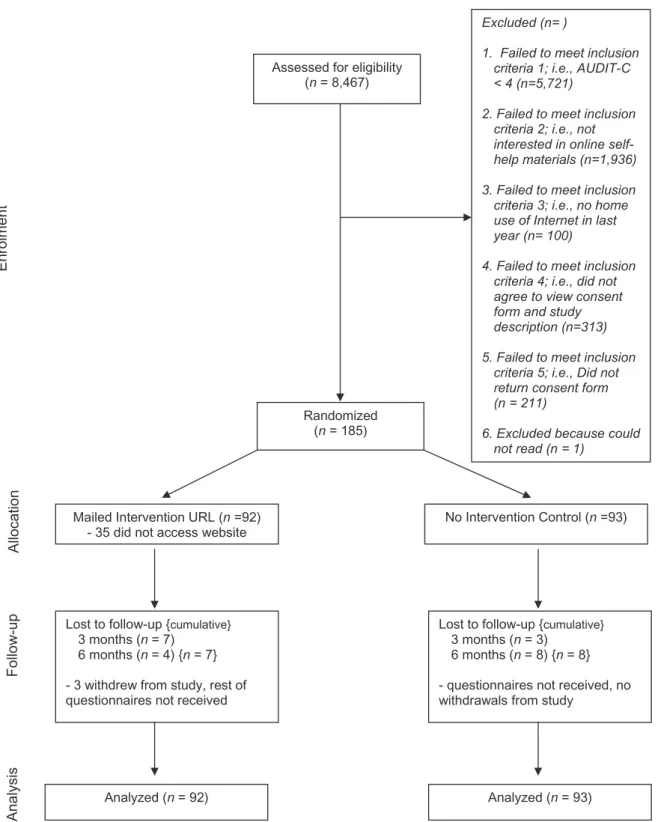
Power analysis and changes from original recruitment plans The original plans for this study called for recruiting respondents who had AUDIT scores of 8 or more. A power analysis was conducted based on previous research with similar paper-and-pencil versions of this intervention [41] and a total sample size of 170 respondents after attrition was estimated to have a power of 80% to test the hypothesis at theP<0.05 level of significance. However, we were able to include only the three AUDIT-C items in the telephone recruitment survey, as the telephone survey was being conducted for another purpose. There-fore, the senior author of this paper decided to try to recruit as many potential participants as possible using a minimal indicator of risky drinking, i.e. an AUDIT-C score of 4 or more. This decision appears merited in retrospect, as many potential participants who voiced an interest in the study never returned their consent form (this was not anticipated in the initial recruitment plan; see Fig. 2 for recruitment numbers). Nevertheless, sufficient numbers were recruited for the study and having a wider range of severity of drinking problems at baseline allowed us to adopt problem severity as a potential moderator of change based on the research that had emerged since the time of grant submission [25,26].
RESULTS
Figure 2 provides a chart outlining the recruitment and retention of the 185 respondents in this study using the Consolidated Standards of Reporting Trials (CONSORT) guidelines for reporting randomized trials. Participant retention was excellent, with a 95% follow-up rate at 3 months and a 93% follow-up rate at 6 months. A total of 170 respondents (92%) had complete data at baseline, 3-month and 6-month follow-ups.
For the 2746 respondents who met minimal criteria for risky drinking (i.e. an AUDIT-C score of 4 or more), attrition analyses were conducted to compare the char-acteristics of potential respondents who screened out at each phase of the telephone recruitment survey (see Table 1). In general, while there were significant differ-ences between groups on most variables due to the large
sample sizes involved, the groups did not display large differences in demographic characteristics or on their AUDIT-C scores. The most striking differences were that those who agreed to take part in the study were some-what younger and more educated than those in the other groups,F(4, 2689)=33.6,P<0.001 andc2=47.9, 4 df,
P<0.001). Finally, for the 185 respondents enrolled in Assessed for eligibility
(n = 8,467)
Excluded (n= )
1. Failed to meet inclusion criteria 1; i.e., AUDIT-C < 4 (n=5,721)
2. Failed to meet inclusion criteria 2; i.e., not interested in online self-help materials (n=1,936) 3. Failed to meet inclusion criteria 3; i.e., no home use of Internet in last year (n= 100)
4. Failed to meet inclusion criteria 4; i.e., did not agree to view consent form and study description (n=313) 5. Failed to meet inclusion
criteria 5; i.e., Did not return consent form (n = 211)
6. Excluded because could not read (n = 1)
Randomized (n= 185)
Mailed Intervention URL (n =92) - 35 did not access website
Lost to follow-up {cumulative} 3 months (n = 7)
6 months (n = 4) {n = 7} - 3 withdrew from study, rest of questionnaires not received
Analyzed (n = 92) Enrolment Analysis Follow -up Allocat ion
Lost to follow-up {cumulative} 3 months (n = 3)
6 months (n = 8) {n = 8} - questionnaires not received, no withdrawals from study
Analyzed (n = 93) No Intervention Control (n =93)
the trial, attrition analyses were conducted comparing those with complete follow-up data (n=170) to those with at least partial missing follow-up data (n=15). There were no significant differences (P>0.05) in demo-graphic or drinking characteristics between these groups (analyses not shown here).
Bivariate comparisons were conducted to compare demographic and drinking characteristics between the experimental and the control conditions at baseline (note that bivariate comparisons between experimental and control conditions were also conducted for problem drinker groups and low-risk drinker groups separately). None of these comparisons were significantly different (P>0.05; see Table 2 for a summary of demographic characteristics).
Outcome analysis
Means for typical weekly drinking and AUDIT-C scores at baseline, 3 and 6 months by intervention condition and problem drinking status are displayed in Table 3. A 2¥2¥3 repeated-measures ANOVA compared typical weekly drinking at baseline, 3-month and 6-month follow-ups between intervention condition (received URL for CYD website versus control condition) and problem drinking status at baseline. There was a main effect of time (F(2,180)=13.8,P<0.001, partial eta squared=
0.13), which was qualified by a significant time¥
intervention interaction (F(2,180)=7.5,P=0.001, partial
eta squared=0.077), and a significant time¥baseline problem drinking status interaction (F(2,180)=9.7, P<
0.001, partial eta squared=0.098). These two-way interactions were qualified further by a significant time¥
intervention ¥ baseline problem drinking status inter-action (F(2,180)=7.9, P=0.001, partial eta squared=
0.081). Post-hoc analyses revealed that, for problem drinkers, there was a significant reduction in typical weekly drinking (P<0.05) from baseline to 3-month follow-up (average of seven drinks per week reduction) and from baseline to 6-month follow-up (average of six drinks per week reduction) for respondents who were in the intervention condition, but no significant reduction (P>0.05) in drinking from baseline to either time-point for respondents in the control condition (average of one drink per week reduction). Low-risk drinkers did not reveal a significant reduction (P>0.05) in their drinking in either the intervention or the control conditions.
A separate 2¥2¥3 repeated-measures ANOVA compared AUDIT-C scores at baseline, 3-month and 6-month follow-ups between intervention condition (received URL for CYD website versus control condition) and problem drinking status at baseline. There was a main effect of time (F(2,180)=8.7,P<0.001, partial eta
Ta b le 1 Attrition anal ysis for potential respondents screened out prior to consent ( n = 2746). V aria bl e Not inter ested in online pr ogr am (n = 1936) No home access to inter net (n = 100) Did not ag re e to vie w consent fo rm (n = 313) Did n ot retur n consent fo rm (n = 212) Consented to participate in stud y (n = 185) P Mean (SD) a g e 46.8 (16.2) 44.9 (14.8) 39.2 (13.8) 37.6 (12.5) 40.1 (13.4) 0.001 % M ale 62.1 65.0 64.5 57.5 53.0 N S % Some post-secondar y educa tion 62.4 51.0 72.0 76.9 77.8 0 .001 % M ar ried/common la w 60.2 49.0 58.7 53.6 51.4 0 .05 % Full/par t-time emplo y ed 64.4 71.0 69.3 71.2 62.5 N S % F amil y income < $30 000 10.1 24.0 8 .9 7.5 10.3 $30 000 or more 71.3 64.0 75.7 85.8 83.2 Don’t kno w/refused 18.6 12.0 15.3 6 .6 6.5 0 .001 A UDIT -C score a 5.5 (1.7) 5.8 (1.7) 5.3 (1.5) 5.9 (1.8) 5.6 (1.7) 0.001 NS: not significant, P > 0.05. Each column contains just those potential par ticipants w ho screened out a t each question o n telephone recr uitment sur v ey (e .g . the 100 potenti al par ticipants w ho had no home access to the inter net had alread y indica ted tha t the y w ere interested in a n online p ro g ram, etc). aAlcohol Use Disorder s Identifica tion T est (A UDIT -C) is a composite measure tha t consists of respondents scores on frequenc y o f drinking ,d rinks per d rinking da y and frequenc y o f fi v e or more d rinks on one occasion. Scores rang e from 0 to 12. SD: standard devia tion.
squared=0.088) and significant interaction effects for time¥intervention (F(2,180)=5.8,P=0.004, partial
eta squared=0.06), time¥problem drinking status (F(2,180)=4.5, P=0.013, partial eta squared=0.047)
and time¥intervention¥problem drinking status (F(2,180)=5.8, P=0.004, partial eta squared=0.060).
As with typical weekly drinking, post-hoc analyses revealed that, for problem drinkers, there was a signifi-cant reduction in AUDIT-C scores (P<0.05) from base-line to 3-month follow-up and from basebase-line to 6-month follow-up for respondents who were in the intervention condition, but no significant reduction (P>0.05) in AUDIT-C scores from baseline to either time-point for respondents in the control condition. Low-risk drinkers did not reveal a significant reduction (P>0.05) in their AUDIT-C scores in either the intervention or the control conditions.
DISCUSSION
The primary goal of this project was to evaluate the effi-cacy of the Check Your Drinking screener, an internet-based self-help intervention for non-treatment-seeking problem drinkers in the general population. One strength of the study was that it merged population-based methods with a randomized controlled trial. Thus, a general population survey was employed using a random digit dialling method in order to recruit a good cross-section of problem drinkers from the Ontario population (although almost certainly not a representative one). Respondents were then assigned randomly to condition, allowing for causal inference about any differences observed. Results from the trial are promising, with problem drinkers who were provided access to the CYD displaying a six to seven drinks per week reduction in drinking compared to controls (a 30% reduction in typical weekly drinking). The size of this reduction is of
the same magnitude as has been observed in face-to-face brief interventions for problem drinking in primary health care settings [42].
The primary limitation of this study is that about one-third of those in the intervention condition never accessed the CYD. Thus, with its conservative intent-to-treat analysis (i.e. respondents assigned to the interven-tion were included in the analyses whether or not they actually used the intervention), this trial is a comparison between those provided access to the CYD versus those who were not. The fact that many people did not access the CYD intervention (despite having said they would be interested in such a service on the baseline telephone survey) emphasizes the point that providing access to IBIs, or any other intervention, does not guarantee that problem drinkers will use them. Indeed, no one interven-tion is an ideal soluinterven-tion and a sensible opinterven-tion for promot-ing access to care is to increase the variety of research-based interventions available so that problem drinkers can choose one (or several) that is suitable to them.
Other limitations of this study include the large number of potential participants who could have agreed to take part in the research but chose not to. This loss of potential participants could, in part, reflect that the current study did not recruit problem drinkers seeking help but rather proactively recruited from the general population [43]. In addition, the current report is limited by a lack of content exploring mechanisms of change (i.e. why does the intervention work?). There is a fairly exten-sive literature on this topic with college students [26,44], but little or no research exploring these same mecha-nisms in general population samples.
Nevertheless, we are encouraged by the results of this trial given the methodological rigor of this research. Mainly, the study demonstrated the possibility of attain-ing an excellent follow-up rate, somethattain-ing that is rare in evaluations of internet-based interventions in a general
Table 2 Demographic characteristics.
Variable Invervention (n=92) Control (n=93) Total sample (n=185)
Mean (SD) age 39.5 (13.5) 40.8 (13.4) 40.1 (13.4)
% Male 57.6 48.4 53.0
% Some post-secondary education 78.3 77.4 77.8
% Married/common law 54.3 48.4 51.4 % Full/part-time employed 62.6 62.4 62.5 % Family income <$30 000 6.5 14.0 10.3 $30 000–$49 000 16.3 12.9 14.6 $50 000–$79 000 18.5 21.5 20.0 $80 000 or more 48.9 48.4 48.6 Don’t know/refused 9.8 3.2 6.5
population context [29]. We speculate that this high follow-up rate reflects at least two elements (beyond the incentive provided to respondents): (i) respondents were not recruited (or followed-up) directly over the internet where the perceived social obligation of following up on a commitment (e.g. to complete a follow-up survey) may not be as obvious as in a telephone conversation (or after signing a paper consent form); and (ii) by the time respon-dents had agreed to take part in the study, they were probably self-selected to be compliant as they had already gone through so many steps before actually taking part in the trial. Another strength was that the design of the trial allowed the administration of the intervention in a real-life setting (i.e. in their own home or other location of their choice). This procedure increases confidence regard-ing the generalizability of the results [28]. As problem drinking is common, research evaluated internet-based interventions made freely available to all those in need could greatly broaden the base of treatment for alcohol problems and may prove to be useful tools for primary care.
Acknowledgements
Funding for this study was provided by the National Insti-tute on Alcohol Abuse and Alcoholism, Research Grant no. 1 R01 AA015056-01A2. In addition, support to CAMH for salary of scientists and infrastructure has been provided by the Ontario Ministry of Health and Long Term Care. The views expressed in this article do not necessarily reflect those of the Ministry of Health and LongTerm Care.
Clinical trial registration
ClinicalTrials.gov registration #NCT00367575.
Declarations of interest
John Cunningham has acted as a paid consultant for Evolution Health Systems Inc. in the development of the Check Your Drinking screener. Trevor van Mierlo is the CEO of Evolution Health Systems Inc. Cameron Wild, Joanne Cordingley and Keith Humphreys have no con-flicts of interest to declare.
References
1. Rehm J., Taylor B., Room R. Global burden of disease from
alcohol, illicit drugs and tobacco.Drug Alcohol Rev2006;
25: 503–13.
2. English D., Holman D., Milne E., Winter M., Hulse G., Codde
G.et al. The Quantification of Drug Caused Morbidity and
Mor-tality in Australia. Canberra: Commonwealth Department
of Human Services and Health; 1995.
3. McGinnis J. M., Foege W. H. Actual causes of death in the
United States.JAMA1993;270: 2207–12.
Ta b le 3 Mean [standard devia tion (SD)] drinking v aria bles a t baseline , 3-and 6 -month follo w-up b y stud y condition (Check Y o ur Drinking Inter v ention v er su s control) and problem drinking sta tus ( n = 185). Time Pr ob lem drink er s a Lo w-risk drink er s b Full sample Interv ention (n = 35) Contr ol (n = 37) Interv ention (n = 57) Contr ol (n = 56) Interv ention (n = 92) C ontr ol (n = 93) T y pical w eekl y drinking [mean (SD) drinks per w eek] Baseline 22.5 (12.6) 19.1 (12.0) 8.7 (4.8) 7.2 (4.0) 13.9 (10.9) 11.9 (10.1) 3-month 15.1 (11.2) 18.4 (12.3) 8.4 (6.4) 6.7 (4.8) 11.0 (9.1) 11.4 (10.3) 6-month 16.0 (11.9) 17.9 (12.5) 8.1 (4.2) 7.3 (5.4) 11.1 (8.9) 11.5 (10.3) A UDIT -C score c[mean (SD)] Baseline 8 .9 (1.9) 8 .1 (2.2) 5 .8 (1.2) 5 .3 (1.2) 7 .0 (2.1) 6 .4 (2.1) 3-month 7 .5 (2.3) 8 .1 (2.3) 5 .7 (1.6) 5 .1 (1.5) 6 .3 (2.1) 6 .3 (2.4) 6-month 7 .3 (2.6) 7 .9 (2.3) 5 .6 (1.6) 5 .2 (1.6) 6 .2 (2.2) 6 .3 (2.3) aProblem drink er s defined as those ha ving an Alcohol Use D isorder s Identifica tion T est (A UDIT) score o f 1 1 o r more a t baseline . bLo w-risk d rink er s defined as those ha ving an A UDIT score o f 4–10 a t baseline . cA UDIT -C is a composite measure tha t consists o f respondents’ scores on frequenc y o f d rinking , drinks per drinking da y and frequenc y o f fi v e or more d rinks on one occasion. Sco res rang e from 0 to 12.
4. Institute of Medicine. Broadening the Base of Treatment
for Alcohol Problems. Washington, DC: National Academy
Press; 1990.
5. Cahalan D. Studying drinking problems rather than
alcoholism. In: Galanter M., editor. Recent Developments
in Alcoholism, vol. 5. New York: Plenum; 1987, p. 363–
72.
6. Cunningham J. A., Breslin F. C. Only one in three people with alcohol abuse or dependence ever seek treatment.
Addict Behav2004;29: 221–3.
7. Dawson D. A., Grant B. F., Stinson F. S., Chou P. S., Huang B., Ruan W. J. Recovery from DSM-IV alcohol dependence:
United States, 2001–2002. Addiction 2005; 100: 281–
92.
8. Room R., Babor T., Rehm J. Alcohol and public health.
Lancet2005;365: 519–30.
9. National Institute on Alcohol Abuse and Alcoholism.
Helping Patients Who Drink Too Much: A Clinician’s Guide.
Rockville, MD: National Institute on Alcohol Abuse and Alcoholism; 2005.
10. Saitz R. Screening and brief intervention enter their 5th
decade.Subst Abuse2007;28: 3–6.
11. Denny C. H., Serdula M. K., Holtzman D., Nelson D. E. Phy-sician advice about smoking and drinking: are U.S. adults
being informed?Am J Prev Med2003;24: 71–4.
12. Friedman P. D., McCullough D., Chin M. H., Saitz R. Screen-ing and intervention for alcohol problems. A national
survey of primary care physicians and psychiatrists.J Gen
Intern Med2000;15: 84–91.
13. United States Department of Commerce.A Nation Online:
How Americans are Expanding Their Use of the Internet.
Wash-ington, DC: Economics and Statistics Administration, National Telecommunications and Information Adminis-tration, 2002.
14. Cunningham J. A., Selby P. L., Kypri K., Humphreys K. N. Access to the Internet among drinkers, smokers and illicit drug users: is it a barrier to the provision of interventions on
the World Wide Web?Med Inform Internet Med2006;31:
53–8.
15. Koski-Jännes A., Cunningham J. A. Interest in different forms of self-help in a general population sample of
drink-ers.Addict Behav2001;26: 91–9.
16. Cunningham J. A., Humphreys K., Koski-Jännes A. Provid-ing personalized assessment feedback for problem drinkProvid-ing
on the Internet: a pilot project.J Stud Alcohol2000;61:
794–8.
17. Kypri K., Langley J. D., Saunders J. B., Cashell-Smith M. L., Herbison P. Randomized controlled trial of web-based alcohol screening and brief intervention in primary care.
Arch Intern Med2008;168: 530–6.
18. Saitz R., Palfai T. P., Freedner N., Winter M. R., Macdonald
A., Lu J.et al.Screening and brief intervention online for
college students: the ihealth study.Alcohol Alcohol2007;
42: 28–36.
19. Walters S. T., Miller E., Chiauzzi E. Wired for wellness:
e-Interventions for addressing college drinking. J Subst
Abuse Treat2005;29: 139–45.
20. Linke S., Brown A., Wallace P. Down your drink: a web-based intervention for people with excessive alcohol
con-sumption.Alcohol Alcohol2004;39: 29–32.
21. Hester R. K., Squires D. D., Delaney H. D. The Drinker’s Check-up: 12-month outcomes of a controlled clinical trial of a stand-alone software program for problem drinkers.
J Subst Abuse Treat2005;28: 159–69.
22. Riper H., Kramer J., Smit F., Conijn B., Schippers G., Cuijpers P. Web-based self-help for problem drinkers: a pragmatic
randomized trial.Addiction2008;103: 218–27.
23. Saitz R., Helmuth E. D., Aromaa S. E., Guard A., Belanger M., Rosenbloom D. L. Web-based screening and brief
inter-vention for the spectrum of alcohol problems.Prev Med
2004;39: 969–75.
24. Bewick B. M., Trusler K., Barkham M., Hill A. J., Cahill J., Mulhern B. The effectiveness of web-based interventions designed to decrease alcohol consumption—a systematic
review.Prev Med2008;47: 17–26.
25. Doumas D. M., Hannah E. Preventing high-risk drinking in youth in the workplace: a web-based normative feedback
program.J Subst Abuse Treat2008;34: 263–71.
26. Doumas D. M., Haustveit T. Reducing heavy drinking in intercollegiate athletes: evaluation of a web-based
per-sonalized feedback program.The Sport Psychologist2008;
22: 213–29.
27. Doumas D. M., McKinley L. L., Book P. Evaluation of two Web-based alcohol interventions for mandated college
students.J Subst Abuse Treat2009;36: 65–74.
28. Cunningham J. A., Van Mierlo T. Methodological issues in the evaluation of Internet-based intervention for problem
drinkers.Drug Alcohol Rev2009;28: 12–7.
29. Eysenbach G. The law of attrition.J Med Internet Res2005;
7: e11.
30. Dawson D. A., Grant B. F., Stinson F. S., Zhou Y. Effectiveness of the derived Alcohol Use Disorders Identification Test (AUDIT-C) in screening for alcohol use disorders and risk
drinking in the US general population.Alcohol Clin Exp Res
2005;29: 844–54.
31. Miller W. R., Sovereign R. G., Krege B. Motivational inter-viewing with problem drinkers: II. The Drinker’s Check-up
as a preventive intervention.Behav Psychother1988;16:
251–68.
32. Brown J. M., Miller W. R. Impact of motivational interview-ing on participation and outcome in residential alcoholism
treatment.Psychol Addict Behav1993;7: 211–8.
33. Agostinelli G., Brown J. M., Miller W. R. Effects of normative feedback on consumption among heavy drinking college
students.J Drug Educ1995;25: 31–41.
34. Sobell L. C., Cunningham J. A., Sobell M. B., Agrawal S.,
Gavin D. R., Leo G. I.et al.Fostering self-change among
problem drinkers: a proactive community intervention.
Addict Behav1996;21: 817–33.
35. Cunningham J. A., Humpheys K., Kypri K., van Mierlo T. Formative evaluation and three-month follow-up of an online personalized assessment feedback intervention for
problem drinkers.J Med Internet Res2006;8: e5.
36. Babor T. F., De La Fuente M. F., Saunders J. B., Grant M. AUDIT—The Alcohol Use Disorders Identification Test:
Guide-lines for Use in Primary Health Care. Geneva: World Health
Organization; 1989.
37. Saunders J. B., Conigrave K. M. Early identification of
alcohol problems. Can Med Assoc J 1990; 143: 1060–
9.
38. Kühlhorn E., Leifman H. Alcohol surveys with high and low coverage rate: a comparative analysis of survey
strategies in the alcohol field.J Stud Alcohol 1993; 54:
542–4.
39. Romelsjö A., Leifman H., Nyström S. A comparative study of two methods for the measurement of alcohol
consump-tion in the general populaconsump-tion.Int J Epidemiol 1995;24:
40. US Department of Health and Human Services (USDHHS). The Physicians’ Guide to Helping Patients with Alcohol
Prob-lems, vol. 95-3769. Rockville, MD: National Institute on
Alcohol Abuse and Alcoholism, 1995.
41. Cunningham J. A., Koski-Jännes A., Wild T. C., Cordingley J. Treating alcohol problems with self-help materials: a
popu-lation study.J Stud Alcohol2002;63: 649–54.
42. Kaner E. F., Beyer F., Dickinson H. O., Pienaar E., Campbell
F., Schlesinger C. et al. Effectiveness of brief alcohol
interventions in primary care populations.Cochrane
Data-base Syst Rev2007;2: CD004148.
43. Wild T. C., Cunningham J. A., Adlaf E. Nonresponse in a follow-up to a representative telephone survey of adult
drinkers.J Stud Alcohol2001;62: 257–61.
44. Neighbors C., Dillard A. J., Lewis M. A., Bergstrom R. L., Neil T. A. Normative misperceptions and temporal precedence
of perceived norms and drinking.Addict Behav2006;67: