Malpractice claims for endoscopy
Lyndon V Hernandez, Dominic Klyve, Scott E RegenbogenLyndon V Hernandez, Department of Gastroenterology, Aurora Medical Center and GI Associates, LLC, Kenosha, WI 53142, United States
Dominic Klyve, Department of Mathematics, Central Washing-ton University, Ellensburg, WA 98926, United States
Scott E Regenbogen, Division of Colorectal Surgery, University of Michigan Health System, Ann Arbor, MI 48103, United States
Author contributions: Hernandez LV study design; Hernandez LV and Regenbogen SE data analysis; Hernandez LV wrote the manuscript; Regenbogen SE edited manuscript; Klyve D per-formed statistical analysis.
Correspondence to:Lyndon V Hernandez, MD, MPH, De-partment of Gastroenterology, Aurora Medical Center and GI As-sociates, LLC, 10400 75th, Suite 208, Kenosha, WI 53142, United States. [email protected]
Telephone: +1-414-9086624 Fax: +1-414-7611829
Received: October 20, 2012 Revised: December 20, 2012
Accepted: January 23, 2013
Published online: April 16, 2013
Abstract
AIM: To summarize the magnitude and time trends of endoscopy-related claims and to compare total mal-practice indemnity according to specialty and proce-dure.
METHODS: We obtained data from a comprehensive database of closed claims from a trade association of professional liability insurance carriers, representing over 60% of practicing United States physicians. Total payments by procedure and year were calculated, and were adjusted for inflation (using the Consumer Price Index) to 2008 dollars. Time series analysis was per-formed to assess changes in the total value of claims for each type of procedure over time.
RESULTS: There were 1901 endoscopy-related closed claims against all providers from 1985 to 2008. The specialties include: internal medicine (n = 766), gastro-enterology (n = 562), general surgery (n = 231), gen-eral and family practice (n = 101), colorectal surgery (n = 87), other specialties (n = 132), and unknown (n = 22). Colonoscopy represented the highest
frequen-cies of closed claims (n = 788) and the highest total indemnities ($54 093 000). In terms of mean claims payment, endoscopic retrograde cholangiopancreatog-raphy (ERCP) ranked the highest ($374 794) per claim. Internists had the highest number of total claims (n = 766) and total claim payment ($70 730 101). Only total claim payments for colonoscopy and ERCP seem to have increased over time. Indeed, there was an av-erage increase of 15.5% per year for colonoscopy and 21.9% per year for ERCP after adjusting for inflation. CONCLUSION: There appear to be differences in mal-practice coverage costs among specialties and the type of endoscopic procedure. There is also evidence for secular trend in total claim payments, with colonoscopy and ERCP costs rising yearly even after adjusting for inflation.
© 2013 Baishideng. All rights reserved.
Key words: Complications; Endoscopy; Colonoscopy; Endoscopic retrograde cholangiopancreatogram; Medi-cal malpractice
Hernandez LV, Klyve D, Regenbogen SE. Malpractice claims for endoscopy. World J Gastrointest Endosc2013; 5(4): 169-173 Available from: URL: http://www.wjgnet.com/1948-5190/full/ v5/i4/169.htm DOI: http://dx.doi.org/10.4253/wjge.v5.i4.169
INTRODUCTION
Endoscopies are being performed at an increasing rate for the last decade[1]. Endoscopic procedures are also
becoming more complicated as interventional techniques are used more widely. Despite increasing national aware-ness of medical errors, and the high costs of associated malpractice, there is a lack of data sources from which to understand the incidence and trends of errors resulting in major injuries during endoscopic procedures.
Traditionally, the main source of information on endoscopy-related errors comes from institutional mor-bidity and mortality conferences. However, this and other
BRIEF ARTICLE © 2013 Baishideng. All rights reserved. doi:10.4253/wjge.v5.i4.169
self-reporting methods are known to underestimate the true incidence of complications[2].In general and vascular
surgery, the National Surgical Quality Improvement Pro-gram has become a platform for validated, risk-adjusted outcome comparisons between institutions, however, only a select minority of hospitals have implemented the program, and similar registries have not been as widely accepted in other interventional subspecialties.
Aligned with value-based purchasing by the Centers for Medicare and Medicaid Services, the American Col-lege of Gastroenterology and the American Society of Gastrointestinal Endoscopy have advocated for measur-ing endoscopy quality indicators. As preventmeasur-ing errors is linked to quality, endoscopists increasingly are recogniz-ing the importance of understandrecogniz-ing and benchmarkrecogniz-ing endoscopic errors at a national level.
Claims in malpractice litigation offer an opportunity to study major iatrogenic injuries. In a study by Studdert
et al[3], trained reviewers examined 1500 closed claims of
alleged medical injuries from negligence and found that 97% of closed claims involved injury, of which 63% re-sulted from error. In another study of surgical claims[4],
technical errors accounted for about half of the cases. A study by Conklin et al[5] focusing on gastroenterologists
showed that 25% of claims were due to improper per-formance of an endoscopic procedure, but further infor-mation such as type of endoscopies were not described. In addition, endoscopies in the United States are also performed by non-gastroenterologists, and there have been no studies to our knowledge that have looked into malpractice information in this population.
Our aim is to provide a synopsis of the magnitude and time trends of endoscopy-related claims and to com-pare total malpractice indemnity according to specialty and procedure.
MATERIALS AND METHODS
We obtained summary-level data from a comprehen-sive database of closed claims against physicians who are members of the Physicians Insurers Association of America (PIAA), which is a trade association of profes-sional liability companies owned by physicians, hospitals, and other health care providers. PIAA, which has the largest database of malpractice claims in the nation, in-sures over 300 000 doctors and 1300 hospitals, represent-ing over 60% of United States doctors and underwrites 46% or $5.2 billion of the total medical liability industry premium. The closed claims represented data from all 50 states from January 1985 up to December 2008.
Due to confidentiality agreements with member com
-panies, the PIAA is unable to provide specific geographic
information. The de-identified data is therefore not traceable to the provider. PIAA collects data based on information provided by the member liability insurance company which covered the physician. The professional coder from the liability insurance company codes the condition, care rendered, and outcome by complying with PIAA guidelines. Inclusion criteria were all endoscopic
procedures (esophagogastroduodenoscopy, EGD;
colo-noscopy, flexible sigmoidoscopy; rigid proctosigmoidos -copy; endoscopic retrograde cholangiopancreatography, ERCP; and percutaneous endoscopic gastrostomy, PEG) that resulted in closed claims during the study period.
There was no identifiable code available for endoscopic
ultrasound at the time of the study.
Etiologies of claims were categorized by PIAA coders
according to a priori definition of errors. Improper per
-formance is defined as an endoscopic procedure that was
done incorrectly. An example is an ERCP with improper-ly placed stent that led to a fatal complication. Diagnosis error is resulted from failure to diagnose or providing an incorrect diagnosis. Data on total and average payment to plaintiffs for claims were provided according to specialty but not to type of procedure.
A claim is a written demand for compensation for medical injury within the statute of limitations of a ju-risdiction. A claim can be closed in one of four possible
ways: (1) at the end of a trial by final judgment; (2) at any
point before the end of the trial when the case is settled with a payment; (3) when the case is voluntarily dropped
by the plaintiff; or (4) if the defendant successfully files
a motion to dismiss the case when there is a valid legal basis to do so. Thus, a claim may be closed with or
with-out indemnity payment, which is defined as the sum of
money paid in compensation for injury.
Statistical analysis
Total payments by procedure and year were calculated,
and were adjusted for inflation (using the consumer price
index) to 2008 dollars. We then focused on time series analysis to see how the total value of claims for each type of procedure changed over time. Two models were used: a linear least-squares regression model, which will show the average absolute growth in total claims (in adjusted dollars) per year; and an exponential least-squares regres-sion model, which will derive the average percent growth. The ability of these models to describe the data is cap-tured in the value of R2. A value of zero means that the
model has no explanatory power, while a value of one in-dicates that the total claim value can be perfectly deduced from the year.
RESULTS
There were 1901 endoscopy-related closed claims against all providers from 1985 to 2008. The specialties include: internal medicine (n = 766), gastroenterology (n = 562), general surgery (n = 231), general and family practice (n
= 101), colorectal surgery (n = 87), other specialties (n = 132), and unknown (n = 22). Over 98% resulted in physi-cal injury, which was generally severe (25.8% resulted in deaths and 40.7% resulted in significant or major dis-ability). Close to 70% of all cases were dropped by the plaintiff or dismissed by the court before the trial was concluded. An additional 5% of cases were won by the defendant at trial.
to 2006 that involve endoscopies are shown in Table 1. The majority resulted from improper performance of an endoscopic procedure, followed by diagnosis error. Right and left-sided colon cancers were almost equally repre-sented. Closed claims involving colon cancer according to location were as follows: cecum (n = 3), hepatic flexure (n
= 2), transverse colon (n = 2), rectosigmoid junction (n = 6), rectum (n = 3), and unspecified location (n = 5).
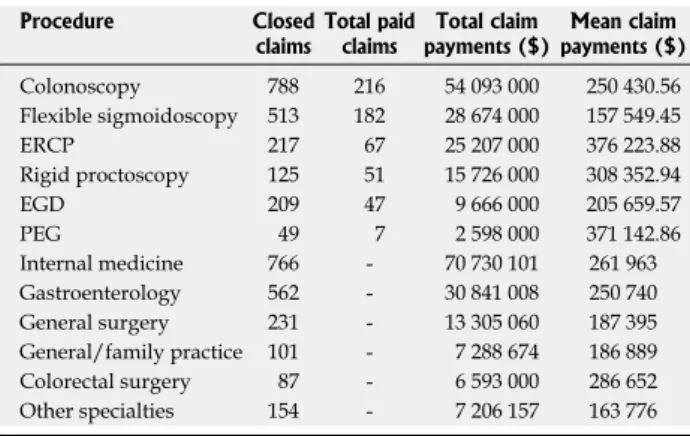
Colonoscopy, followed by sigmoidoscopy (flexible and rigid) represented the highest frequencies of closed claims and the highest total indemnities (Table 2). In terms of average cost per claim, ERCP ranked the high-est.
Table 2 shows the average and total indemnity com-paring the various specialties that perform endoscopies. Internists had the highest number of total claims and total claim payment. Figure 1 shows the total claim pay-ments over time according to procedure. For procedures such as EGD which sometimes have only one or two closed claims per year, one very large payment can skew these averages. Colonoscopy and ERCP have had many more paid claims, and for these procedures there is a clear increase in average claim payment. Indeed, there appears to have been an average increase of 15.5% per year for colonoscopy and 21.9% per year for ERCP after
adjusting for inflation.
In the time period covered, closed claims for PEG procedures were recorded during only six of the years
studied, thus there was insufficient data for analysis. For the other procedures, an exponential model fit the data
better than a linear model in three of the four cases. Table 3 shows both the absolute and percentage increase (in real dollars) of the average value of claims. Of note, the total sigmoidoscopy claims have been declining on average since 1985. The data from which these regression
figures were calculated is shown in Figure 1.
DISCUSSION
Our study shows that from the standpoint of insurers, internists who perform endoscopies had the highest total claim payment, costing over twice than gastroenterolo-gists in terms of compensation for negligence. The larg-est total indemnities resulted from colonoscopies and sigmoidoscopies, but only colonoscopy and ERCP have
been increasing over time. This could reflect the increas -ing number of colonoscopies performed per year and the increasing number of endoscopists who perform ERCPs.
The annual cost of the United States medical liability system is estimated to be $55.6 billion[6]. According to
the United States Government Accountability Office, the primary driver in medical liability insurance industry economics is the rising average cost of indemnity, which leads to rising premiums that has affected gastroenter-ologists and non-gastroentergastroenter-ologists alike. Although the specialty of gastroenterology has always been viewed as low-risk for medical malpractice lawsuit, a recent seminal study[7] has shown that gastroenterology ranks six out of
25, before obstetrics and gynecology, in terms of propor-tion of physicians facing malpractice claims.
Our data have several limitations. PIAA produces summary data making us unable to cross-reference variables and to assess inter-relationships between any predictors. There is no information on individuals who do not sue. However, these claims represent the most significant injuries that merit attention. Also, no chart validation studies were performed to confirm
robust-ness of findings. The denominator, or the total number
of physicians per specialty who perform endoscopies is
unknown, so our data reflect frequencies and not propor -tions. Internists had higher cost per claim, but we do not know if there is higher cost per insured internist because the denominator is not available. It is possible that
gas-troenterologists were misclassified as internists, but sued
doctors self-classified themselves, of which the PIAA coders used in data collecting. Thus, we believe a gastro-enterologist would have no incentive to classify him or herself as an internist.
There are also several factors other than legal merit that determines whether claims are paid in litigation, such
as severity of injury. Thus, we realize that the legal defi -nition of negligence (or failure to use reasonable care) is not necessarily synonymous with genuine error in all instances. Typically, there is a hierarchy as to what people
Table 1 Endoscopy claims against gastroenterologists (1985 to 2006) n (%)
Etiology of claims Frequency (n = 341)
Improper performance 175 (51.3) Diagnosis error (failure, incorrect) 59 (17.3) Meritless (no clear evidence) 35 (10.3) Failure to supervise or monitor 17 (4.9) Not indicated/contraindicated 14 (4.1) Failure to recognize complication 12 (3.5) Failure to communicate with patient 6 (1.8) Delay in performance 4 (1.2)
Others 19 (5.6)
Table 2 Endoscopy claims by specialty against all providers according to procedure, ranked according to total claims payment to plaintiffs (1985-2008) (n = 1901)
Procedure Closed
claims Total paid claims payments ($)Total claim payments ($)Mean claim
Colonoscopy 788 216 54 093 000 250 430.56 Flexible sigmoidoscopy 513 182 28 674 000 157 549.45 ERCP 217 67 25 207 000 376 223.88 Rigid proctoscopy 125 51 15 726 000 308 352.94 EGD 209 47 9 666 000 205 659.57 PEG 49 7 2 598 000 371 142.86 Internal medicine 766 - 70 730 101 261 963 Gastroenterology 562 - 30 841 008 250 740 General surgery 231 - 13 305 060 187 395 General/family practice 101 - 7 288 674 186 889 Colorectal surgery 87 - 6 593 000 286 652 Other specialties 154 - 7 206 157 163 776 ERCP: Endoscopic retrograde cholangiopancreatography; EGD: Esophago gastroduodenoscopy; PEG: Percutaneous endoscopic gastrostomy.
with colonoscopy and ERCP costs rising yearly after
ad-justing for inflation.
Malpractice insurers might use this information to scale their premiums according to both specialty and type of endoscopy performed, allowing a risk differential payment structure. They may also incentivize simulation training, credentialing, or other regulatory strategies, and to sponsor safety improvement efforts to reduce their exposure. Gastroenterologists are to be held accountable for managing risks of errors[8] in endoscopy by
adher-ing to standards of practice, especially when performadher-ing ERCP[9,10] (adequate training and yearly volume) or
colo-noscopy[11] (minimize colon cancer miss rates and ensure
proper documentation). The limitations of our retrospec-tive data highlight the need for a comprehensive, perhaps even a prospective, nationwide database at an individual level to capture the incidence rates of major adverse events and errors, and to design interventions that can reduce iatrogenic injuries resulting from substandard en-doscopy.
ACKNOWLEDGMENTS
The authors wish to thank Dr. Atul Gawande of the Harvard School of Public Health (HSPH) in Boston, MA who facilitated our collaboration at HSPH. We also thank consider preventable injury-there are those caused by
er-ror, of which some involved negligence, but usually all negligence involves error.
However despite our limited data resource, our study provides useful, unprecedented information on litigations related to endoscopy. All closed claims are likely captured by the collaborative PIAA database. Because of the eco-nomics of litigation, these cases typically represent those involving serious injuries.
In summary, closed malpractice claims data yielded important information on alleged injuries resulting from endoscopy. We found discrepancies in malpractice costs among specialties and the type of procedure. There is also evidence for secular trend in total claim payments,
9 8 7 6 5 4 3 2 1 0 × 10 6 1985 1990 1995 2000 2005 2010 Colonoscopy 3.5 3 2.5 2 1.5 1 0.5 0 × 10 6 1985 1990 1995 2000 2005 2010 ERCP 3.5 3 2.5 2 1.5 1 0.5 0 × 10 6 1985 1990 1995 2000 2005 2010 8 7 6 5 4 3 2 1 0 × 10 6 1985 1990 1995 2000 2005 2010 EGD Sigmoidoscopy
Figure 1 Total claim payments by procedure type, adjusted to 2008 dollars, together with 5-year moving averages (y-axis, total claim payments in dollars; X-axis, years), showing an increasing temporal trend for colonoscopy and endoscopic retrograde cholangiopancreatography. EGD:
Esophagogastroduode-noscopy; ERCP: Endoscopic retrograde cholangiopancreatography.
Table 3 Absolute percentage increase of average closed claims
Linear increase/
yr ($) Model R2 Expon increase/yr, % Model R2
Colonoscopy 229 000 0.3976 12.59 0.4874 ERCP 122 000 0.5098 19.06 0.4076 EGD 23 000 0.0567 7.53 0.1697 Sigmoidoscopy -93 000 0.1873 -4.6 0.1938 ERCP: Endoscopic retrograde cholangiopancreatography; EGD: Esophago gastroduodenoscopy.
Ms. Jacque Dresen for assisting in the manuscript.
COMMENTS
BackgroundLittle is known about major endoscopy-related errors categorized by procedure and specialty, and time trends.
Research frontiers
In general and vascular surgery, the National Surgical Quality Improvement Program has become a platform for validated, risk-adjusted outcome compari-sons between institutions, however only a select minority of hospitals have implemented the program, and it has not been highly developed for other fields that involve procedures.
Innovations and breakthroughs
Authors obtained summary-level data from a comprehensive database of closed claims against physicians who are members of the Physicians Insurers Association of America (PIAA), which is a trade association of professional li-ability companies owned by physicians, hospitals, and other health care provid-ers.
Applications
Their study provides useful, unprecedented information on litigations related to endoscopy. All closed claims are likely captured by the collaborative PIAA da-tabase. Because of the economics of litigation, these cases typically represent those involving serious injuries.
Peer review
In this study the investigators compare and contrast major endoscopy-related errors for which insurance claims were filed, categorized by procedure and cialty, and time trends. They also compared total malpractice indemnity by spe-cialty and procedure. The data was acquired from a database of closed claims from a trade association of professional liability insurance carriers, and covers approximately 60% of United States physicians in all 50 states. A total of 1901 endoscopy-related closed claims were found against all providers from 1985 to 2008. Colonoscopy and endoscopic retrograde cholangiopancreatography (ERCP) had highest dollar value per claim. Internists had the highest number of total claims and total claim payment. Corrected for inflation, only total claim payments for colonoscopy and ERCP seem to have increased over time. The study was retrospective and showed rates, not proportions.
REFERENCES
1 National Center for Health Statistics. Available from: URL:
http://www.cdc.gov/nchs/data/databriefs/db32.htm
2 Hutter MM, Rowell KS, Devaney LA, Sokal SM, Warshaw
AL, Abbott WM, Hodin RA. Identification of surgical com-plications and deaths: an assessment of the traditional surgi-cal morbidity and mortality conference compared with the American College of Surgeons-National Surgical Quality Im-provement Program. J Am Coll Surg 2006; 203: 618-624 [PMID: 17084322 DOI: 10.1016/j.jamcollsurg.2006.07.010]
3 Studdert DM, Mello MM, Gawande AA, Gandhi TK,
Kachalia A, Yoon C, Puopolo AL, Brennan TA. Claims, er-rors, and compensation payments in medical malpractice litigation. N Engl J Med 2006; 354: 2024-2033 [PMID: 16687715 DOI: 10.1056/NEJMsa054479]
4 Regenbogen SE, Greenberg CC, Studdert DM, Lipsitz SR,
Zinner MJ, Gawande AA. Patterns of technical error among surgical malpractice claims: an analysis of strategies to pre-vent injury to surgical patients. Ann Surg 2007; 246: 705-711 [PMID: 17968158 DOI: 10.1097/SLA.0b013e31815865f8]
5 Conklin LS, Bernstein C, Bartholomew L, Oliva-Hemker M.
Medical malpractice in gastroenterology. Clin Gastroenterol
Hepatol 2008; 6: 677-681 [PMID: 18456572 DOI: 10.1016/
j.cgh.2008.02.047]
6 Mello MM, Chandra A, Gawande AA, Studdert DM.
Na-tional costs of the medical liability system. Health Aff
(Mill-wood) 2010; 29: 1569-1577 [PMID: 20820010 DOI: 10.1377/
hlthaff.2009.0807]
7 Jena AB, Seabury S, Lakdawalla D, Chandra A. Malpractice
risk according to physician specialty. N Engl J Med 2011; 365: 629-636 [PMID: 21848463 DOI: 10.1056/NEJMsa1012370]
8 Floyd TK. Medical malpractice: trends in litigation.
Gastroen-terology 2008; 134: 1822-1825, 1825.e1 [PMID: 18482584 DOI:
10.1053/j.gastro.2008.05.001]
9 Baron TH, Petersen BT, Mergener K, Chak A, Cohen J, Deal
SE, Hoffinan B, Jacobson BC, Petrini JL, Safdi MA, Faigel DO, Pike IM. Quality indicators for endoscopic retrograde chol-angiopancreatography. Am J Gastroenterol 2006; 101: 892-897 [PMID: 16635233 DOI: 10.1111/j.1572-0241.2006.00675.x]
10 Cotton PB. Analysis of 59 ERCP lawsuits; mainly about
indi-cations. Gastrointest Endosc 2006; 63: 378-382; quiz 464 [PMID: 16500382 DOI: 10.1016/j.gie.2005.06.046]
11 Rex DK, Petrini JL, Baron TH, Chak A, Cohen J, Deal SE,
Hoffman B, Jacobson BC, Mergener K, Petersen BT, Safdi MA, Faigel DO, Pike IM. Quality indicators for colonoscopy.
Am J Gastroenterol 2006; 101: 873-885 [PMID: 16635231]
P- Reviewers Vivas S, Ciaccio EJ S- Editor Gou SX
L- Editor A E- Editor Zhang DN