Improving Adjunct Faculty Experiences:
Implementing a Topics-Based Learning Community at a Community College A Dissertation
Submitted to the Faculty of
Drexel University by
Haleh Azimi in partial fulfillment of the requirements for the degree
of
Doctor of Education May 2016
© Copyright 2016
Table of Contents
Chapter 1: Introduction to the Research ...9
Introduction to the Problem ... 9
Research Problem ... 10
Purpose and Significance ... 10
Research Questions ... 13
Conceptual Framework ... 14
Teaching Literacy as Social Practice ... 16
Barriers to Fostering Social Capital for Adjunct Faculty ... 16
Adjunct Faculty Professional Development Needs ... 17
Definition of Terms ...18
Assumptions, Limitations, and Delimitations ...19
Summary ...21
Chapter 2: Literature Review ...22
Introduction ... 22
Teaching Literacy as Social Practice ... 23
Barriers for Fostering Social Capital for Adjunct Faculty ... 27
Adjunct Faculty Professional Development Needs ... 33
Summary ...39
Chapter 3: Research Methodology ...40
Introduction ... 40
Research Design and Rationale ... 42
Study Site and Participants ... 44
Procedure for Site and Population Selection ... 51
Researcher Access... 51
Research Methods ... 52
Data Collection ... 53
Data Analysis ... 55
Data Collection Timeline ... 57
Ethical Considerations...57
Chapter 4: Findings, Results, and Interpretations ...61
Introduction ... 61
Findings ... 62
Results and Interpretations ... 100
Summary ... 116
Chapter 5: Conclusions and Recommendations ...118
List of Tables
1. Participant Descriptions ... 47
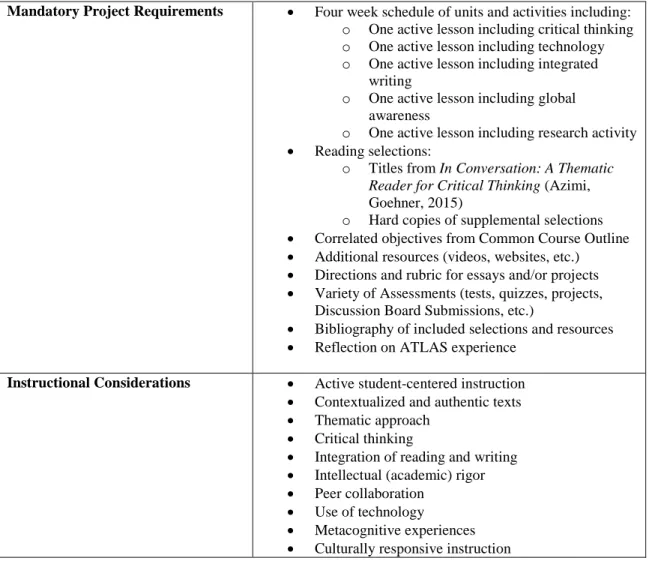
2. Topics-Based Learning Community Project Requirements ... 49
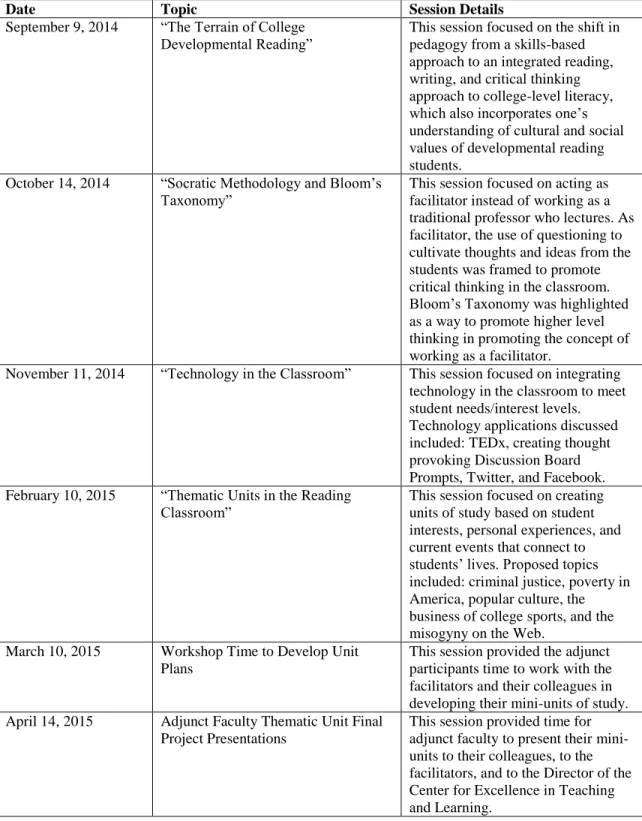
3. Topics-Based Learning Community Dates and Details ... 50
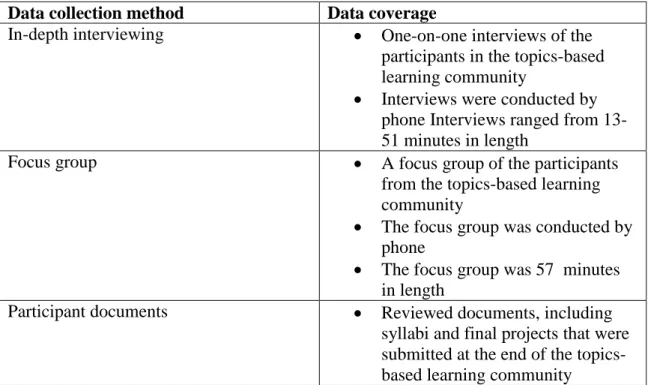
4. Multiple Sources of Data for Triangulation ... 53
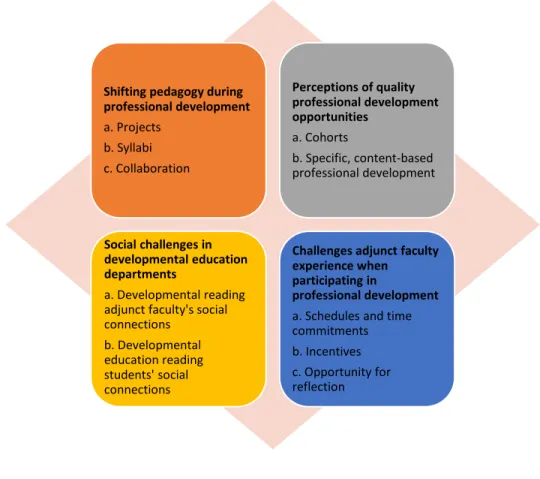
5: Explanation of themes and sub-themes of the study ... 63
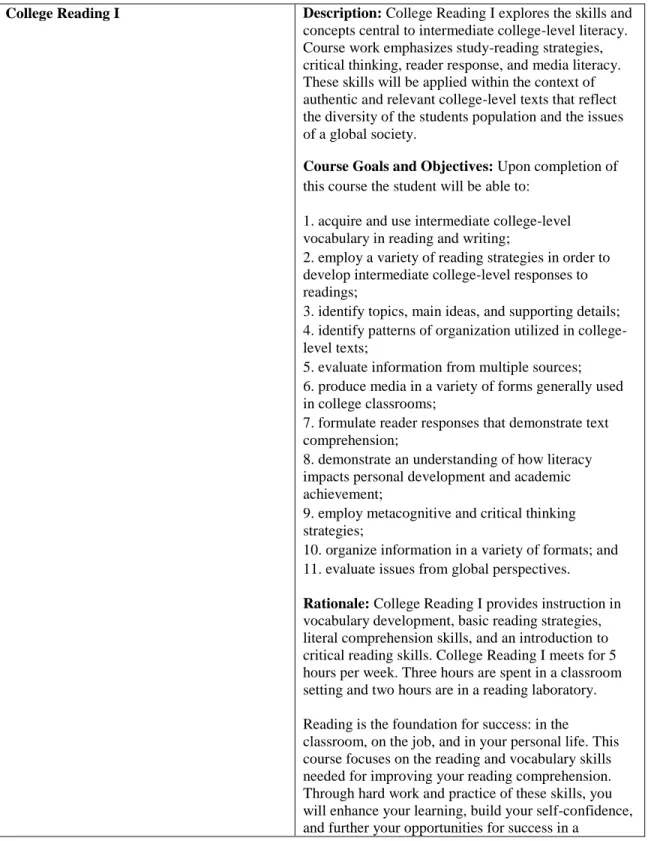
6: College Reading I and College Reading II Descriptions, Course Goals/Objectives and Course Rationales ... 73
List of Figures
1. Conceptual Framework and Intersections ... 15 2. Data Collection Plan ... 57 3. Identified Themes and sub-themes of the study ... 65
Abstract
Improving Adjunct Faculty Experiences:
Implementing a Topics-Based Learning Community at a Community College Haleh Harris
Vera Lee, Ed.D.
This study was conducted to explore how a yearlong topics-based faculty learning community targeted for developmental reading adjunct faculty affected faculty
experiences, while helping developmental reading adjunct faculty shift their pedagogy from a skills- to a holistic-based approach to college-level literacy. This qualitative study collected data from adjunct faculty participants who engaged in a year-long topics-based learning community, with an emphasis on the shift in pedagogy within the field of developmental college-level reading classes. This qualitative study collected data from a focus group of the participants, individual interviews from each of the participants, and document reviews of participant syllabi and projects that focused on a single unit to demonstrate their understanding of the shift in pedagogy. The data demonstrate that topics-based learning community experiences provide significant support for adjunct faculty when shifting pedagogy from a skills-based approach to a holistic approach to college-level literacy in a developmental reading department. Additional findings include adjunct perceptions of marginalization within an institution, which can be ameliorated by professional development opportunities that are executed and implemented with thought and care.
Acknowledgements
Though only my name appears on the cover of this dissertation, a number of people have contributed to its successful completion. I owe my gratitude to these people, and thank them for their support.
My deepest gratitude to my Chair, Dr. Vera Lee, who provided thoughtful and productive feedback. You pushed me all along to help me produce a thought provoking dissertation.
My co-Chairs, Dr. Kathleen Provinzano and Dr. Jodi Holschuh both guided me throughout the process with a critical eye to help improve the quality of this body of research, as well. Dr. Provinzano, you helped me anchor my ideas back to the field of education leadership. Dr. Holschuh, your expertise in the field of developmental
education was invaluable, and I thank you for sharing so openly your ideas about the field and its connections to my body of research.
I am also thankful for all of the support from my colleagues in Philadelphia Cohort 4. We worked together throughout our experience during our studies, and I hope to continue to build upon my relationships with each and every one of you. Further, I thank my colleagues in the community college. I have many who have helped to support me along the way.
Many family and friends have helped me stay on track through this rigorous journey. Their support and care helped me remain focused even when I experienced some set-backs throughout my time during my studies.
Most importantly, none of this would have been made possible without the love and support of my family. I have to give a special mention for the support given by my mom and dad, my sisters, and brothers-in law, even my baby niece, along with David. Finally, and most importantly, I thank my kids, Jackson and Brennan, for all of their patience and understanding as I worked through this program.
Chapter 1: Introduction to the Research Introduction to the Problem
The national surge in adjunct faculty employment in community colleges across America has implications for individual institutions. Nearly 68% of community college faculties in 2007 were categorized as part-time members (Charlier & Williams, 2011). This high percentage demonstrates that community colleges rely heavily on adjunct faculty to teach the large majority of credit-bearing courses.
Green (2007) asserts that American institutions hire adjuncts to teach as a cost-saving measure. The author suggests that adjunct faculty need ongoing professional development to keep them abreast of college policies and pedagogical practices. Community colleges must support their adjunct faculty if they are interested in student success and retention (Williams-June, 2014). Both adjunct faculty and students are negatively affected by the lack of professional developmental offered to adjuncts by their colleges. According to Datray, Saxon, and Martirosyan (2014), “[P]art-time faculty are often left to fend for themselves when it comes to professional development
opportunities…[P]ositive results have been seen with some structured attempts to provide professional development”(p. 40). Such evidence shows the importance professional development opportunities to meet the needs of adjunct faculty and student body stakeholders in the field of developmental education. Adjunct faculty are also marginalized by being left out of college-wide decisions, by being cut off from information about their promotions, and by having little employment protection (Schmidt, 2013).
Research Problem
Growing populations of adjunct faculty feel disenfranchised, disengaged, and unsupported within their institutions (Flanders, 2014). This study aims to promote an understanding of whether offering a yearlong topics-based learning community during the 2014-2015 academic year for developmental reading adjunct faculty improve
participant experience and perception of the use value of learning communities and their feelings of belonging to the department. A topics-based learning community is one of many approaches to professional development. Developmental reading adjunct faculty at a Mid-Atlantic community college engaged in a topics-based learning community during the 2014-2015 academic year; this study will follow up on the participant experience and perception of the topics-based learning community.
Purpose and Significance
This study, intended for adjunct and tenured faculty members, college deans, and other senior staff leaders within institutions of higher education, specifically at
community colleges, will explore how faculty experience was affected by a topics-based faculty learning community (FLC) targeted for developmental reading adjunct faculty. The purpose of this study is to understand how a topics-based learning community supports adjunct faculty experiences within a reading department that is shifting from a skills-based to a holistic approach. Based on adjuncts’ expression of their dissatisfaction with their professional status, this study seeks to understand which elements of a learning community will motivate participants’ overall self-efficacy within their positions as adjunct faculty in the developmental reading department, while supporting adjunct faculty through a department-wide pedagogical shift in teaching literacy.
Adjunct faculty, specifically in the field of developmental education, are not exposed to enough professional development opportunities (Datray et al., 2014). According to Datray et al. (2014), the lack of professional development “may be
considered neglect on the part of administration as professional development is cited as a best practice that is essential for program success” (p. 40). Although Datray et al. (2014) cite the importance of professional development among developmental education adjunct faculty, little is written about the integration of learning communities as an opportunity to expose adjunct faculty to opportunities of professional development. Glowachi-Dundka and Brown (2007) substantiate the practice of faculty learning communities at the college level, as the authors elaborate that research has examined and substantiated how “FLC promote professional development through collaboration and reflective practice; how they strengthen collegial relationships; and how they develop faculty into better educators through deeper understandings of pedagogy” (p. 30). If in fact the use of faculty learning communities proves to be an effective model for professional development, this study can help situate conversations about reforming higher education policy to support adjunct faculty.
According to Cox (2003), there are either cohort-based or topics-based FLC. Cohort-based FLCs “…address the teaching, learning, and developmental needs of an important cohort of faculty that has been particularly affected by the isolation,
fragmentation, stress, neglect or chilly climate in the academy…” (Cox, 2003, p. 1). A topics-based FLC has “…curricula designed to address a special campus teaching and learning need, issue, or opportunity…with focus on a particular theme…” (Cox, 2003, p. 1). Both FLC models are yearlong commitments that include a wide range of topics of
interest to them, and Cox (2003) asserts that there is evidence that FLCs increase faculty interest in teaching and learning, while providing support to participants as they adopt new methods (Cox, 2003, p. 1). This study seeks to better understand faculty experiences in a topics-based learning community specifically aimed towards adjunct faculty within the field of developmental reading at a two-year institution in the Mid-Atlantic region, henceforth referred to as the Mid-Atlantic Community College.
Additionally, while those in the field of professional development have made much greater effort to validate the importance of FLCs, very little research has been conducted on whether or not FLCs help to build adjunct self-efficacy. As such, this current study is needed by the field because it presents both the negative and positive implications of implementing a topics-based learning community. This study is
specifically significant for adjunct faculty who participate in a FLC with a focus on the pedagogical shift from a skills-based to a literacy-based approach within the
developmental reading field.
Supervisory classroom observations conducted in College Reading I, which focuses on intermediate college-level literacy, and College Reading II, which focuses on advanced college-level literacy, suggest that a the Mid-Atlantic Community College has adjunct faculty who do not teach the developmental reading curriculum in a manner that aligns with the course goals and objectives, which were recently updated and
implemented during the 2013-2014 academic year. Such a gap in instruction ultimately affects student learning in a negative manner. Student pass rates at the national level in developmental education reading courses are extremely low. Approximately one quarter of the students enrolled in developmental education reading courses completed the first
relevant college-level course within three years (Bailey & Cho, 2009, p.47). Currently, the reading department provides only one fall and one spring PD opportunity for its adjuncts. Because of this, reading adjuncts are not exposed to current research and
pedagogical practices to update their teaching. This research explores faculty experiences within this learning community.
Research Questions
This study is designed to explore the experiences of developmental education reading adjunct faculty who would have participated in a yearlong topics-based learning community experience during the 2014-2015 academic year. The following questions will guide this study:
1. How does a topics-based learning community help improve the experiences of adjunct faculty?
a. How does a topics-based learning community help foster adjunct social capital within the culture of a community college?
b. How does a topics-based learning community help with teaching experiences within the reading department?
2. What do adjunct faculty perceive as some of the issues around social capital for their students and for themselves?
3. How can adjunct faculty professional development needs be met through their involvement in a topics-based learning community?
a. How does a topics-based learning community support adjunct reading faculty in shifting from a skills-based approach to literacy to a thematic-based, holistic approach to college-level literacy?
b. What are the perceived barriers to professional development that adjunct faculty members experience?
Conceptual Framework
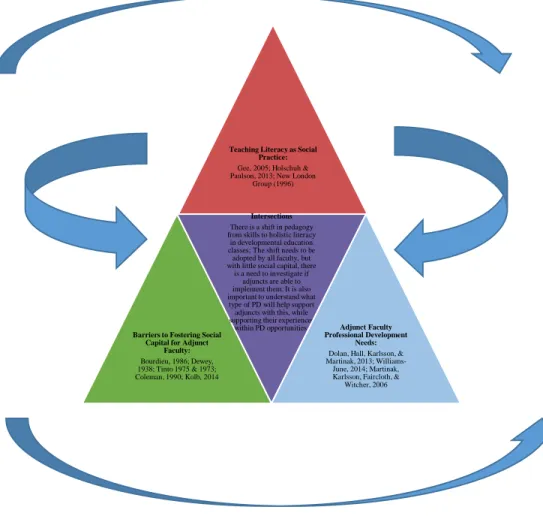
This study is grounded in intersecting literature about adjunct faculty roles, adjunct faculty barriers, and adjunct faculty professional development needs. The intersections between each of the three streams are discreet; however, the theories and literature, along with the research questions, show that there are intersections from one stream to the next. Teaching literacy as social practice helps create a concrete
understanding of literacy teaching practices that are pedagogically sound for college-level work. The second stream, barriers to fostering social capital for adjunct faculty, outlines through the literature review the barriers that adjunct faculty face regarding their ability to increase social capital within their institutions. Finally, adjunct faculty professional development needs is the third stream that explores the idea that adjunct faculty require on-going, targeted professional development in order to teach their courses effectively within a community college setting. The following graphic provides a visual of the experiential knowledge that already exists; the graphic of the conceptual framework extends to a secondary visual to show the connections between each of the three streams:
Figure 1: Conceptual Framework and Intersections
Teaching Literacy as Social Practice:
Gee, 2005; Holschuh & Paulson, 2013; New London
Group (1996)
Barriers to Fostering Social Capital for Adjunct
Faculty:
Bourdieu, 1986; Dewey, 1938; Tinto 1975 & 1973; Coleman, 1990; Kolb, 2014
Intersections
There is a shift in pedagogy from skills to holistic literacy
in developmental education classes; The shift needs to be
adopted by all faculty, but with little social capital, there
is a need to investigate if adjuncts are able to implement them. It is also important to understand what type of PD will help support adjuncts with this, while supporting their experiences
within PD opportunities. Adjunct Faculty Professional Development
Needs:
Dolan, Hall, Karlsson, & Martinak, 2013; Williams-June, 2014; Martinak, Karlsson, Faircloth, &
Intersections
The shift in pedagogy from skills to holistic literacy in developmental education needs to be implemented by all faculty. Whether adjuncts, lacking in social capital, are able to implement such changes needs to be investigated. Furthermore, what type of PD will support adjuncts with the transition and take their experiences into consideration within PD opportunities needs to be explored.
Teaching Literacy as Social Practice
Nationally, students continue to enter college requiring additional preparation for college-level coursework; therefore, developmental education remains a major charge— especially for community colleges (Levine-Brown, 2013). Levine-Brown (2013)
explains, “[A]bout 60% of community college students are referred to one or several developmental education courses. In some community colleges, more than 90% of entering students are deemed insufficiently prepared to start college-level work” (p. 23). Thus, the need for developmental education is indisputable. However, the increasing costs, with coupled high retention rates, necessitate developmental education reform— particularly in developmental reading. As outlined in The Terrain of College Reading
(Holschuh & Paulson, 2013), developmental reading coursework would greatly benefit from a movement toward a multidimensional view that incorporates the social,
metacognitive, and affective aspects of reading and learning. Barriers to Fostering Social Capital for Adjunct Faculty
Adjunct faculty face social and economic barriers in their work settings. Social capital is important for individuals to feel accepted by their group(s). Social capital provides a lens to understand how one’s status of ‘adjunct faculty’ dictates one’s
experiences at a community college institution. The concepts grounded in the theory of social capital from the perspectives of Coleman (1990) and Bourdieu (1986) help to promote this study. The rank and label of adjunct faculty predetermines the low status in terms of social capital for this group (Coleman, 1990 & Bourdieu, 1986).
Adjunct Faculty Professional Development Needs
Finally, there are a number of professional development platforms for adjunct faculty including faculty learning communities, preliminary, and ongoing professional development. The initial stage of adjunct professional development should include a mandatory high quality, flexible induction to the college to orient new adjunct faculty (Pearch et al., 2005, p. 36). Within the realm of staff development, adjunct faculties should have professional development opportunities that fall under the categories of professional, personal, curricular, and organizational (Pearch et al., 2005, p. 36). An example of professional and curricular development includes faculty learning communities, per Milton Cox’s (1995) model, that guides considerations about the support offered through adjunct faculty learning communities. Cox’s (1995) inquiry grounds the need to further investigate topics-based adjunct faculty learning communities to help support them in remaining current in discipline-related pedagogical approaches to teaching and learning. Professional development, is grounded in Dewey’s (1938) idea that one’s ongoing experience “…influences the formation of attitudes of desire and purpose” (p. 39).
These three streams of literature that inform the conceptual framework add to the field of educational leadership. Institutional leaders within community colleges must move forward in addressing organizational needs by focusing on an “agenda for change”
(Bolman et al., 2008, p. 337). The process of change regarding the curriculum for the field of developmental reading is critical in ensuring faculty are offered professional development opportunities to make the shift in pedagogy to meet student needs. When addressing change, senior level leadership teams will need to meet the challenges and demands of improving the culture of the community college by offering ongoing professional development to adjunct faculty teaching developmental reading classes (Bolman et al., 2008, p. 253). Such efforts made by the organizational leaders will create and support communities that are bases for sustainable change and develop the abilities to sustain their own leadership growth, which will in turn benefit the adjunct faculty,
students, and other stakeholders at large.
Definition of Terms Cohort-Based Faculty Learning Community
A group of professionals who partake in a faculty learning community for a year (Cox, 2011).
College Reading I
A course that focuses on intermediate college-level literacy College Reading II
A course that focuses on advanced college-level literacy Cultural Capital
The foundation of social life, dictated by one’s position within the social order (Bourdieu, 1986).
Isolated and continued training for faculty relating to institutional policies, content, and/or teaching pedagogy.
Social Integration
An individual process of integrating into one’s society (Gosh, 2010). Topics-Based Faculty Learning Community
A group of faculty who partake in a faculty learning community for a year centering on a specific topic within one’s institution or discipline (Cox, 2011).
Assumptions, Limitations, and Delimitations
The assumptions underlying the research study are that community colleges consistently hire adjunct faculty. Yet, professional development opportunities often exclude adjunct faculty. Professional learning communities promote a structured approach where “community, scholarly teaching, and the scholarship of teaching”
actively engage and connect professionals by emphasizing teaching and learning pursuits through the extension of building a community atmosphere” (Cox, 2011, para. 2).
Although learning communities help build upon scholarly teaching and learning, the integration of such opportunities are few and far between; budgets at institutions of higher education infrequently allow for such opportunities for their adjunct faculty.
The research limitations relate to the fact that the researcher conducting this study hires adjunct faculty at the institution where the study takes place. Although this can be considered a limitation, it can also be considered positive, since the researcher has a breadth of institutional knowledge. Additionally, the researcher was an adjunct faculty member for the reading department at the Mid-Atlantic Community College in the 2009-2010 academic year. This can also be considered limiting; however, the researcher has a
first-hand view of what it is like to be an adjunct faculty member for the reading department at this institution. She was able to use her experience to evaluate the participant responses.
It is important to note that the following considerations should be made when interpreting the results. The research took place at one institution. Therefore, it is possible that many of the responses reported by adjunct faculty relate to factors only associated to the Mid-Atlantic Community College. Further investigation should examine if other community colleges that offer topics-based learning communities and professional development opportunities for their adjunct faculty to see if adjunct faculty have similar experiences as the participants in this study. In addition, the focus of this study is on those teaching developmental reading courses in a face-to-face format. Because of this, generalizations cannot necessarily be made to online adjunct faculty or adjunct faculty who teach outside of the developmental reading department. It is important to not generalize the findings of this study to online adjunct faculty and adjunct faculty who do not teach developmental reading students.
Delimitations relate to the fact that the research only covers issues of adjunct faculty marginalization, pedagogy within the field of developmental reading, and
professional development opportunities, specifically topics-based learning communities. It is important to point out that other areas may be worthy of exploration and
examination, but within the time restraints of the researcher’s academic program, this is not possible.
Summary
The overview provided in chapter one substantiates the problems that adjunct faculty face within community college settings. They are underrepresented and
disenfranchised, they are provided with very little professional development opportunities due to the fact that budgetary decisions are made by institutional leaders who, along with other college stakeholders, often look down on adjunct faculty. The chapter also presents the major research questions that investigate the experiences of developmental reading adjunct faculty who participated in a topics-based yearlong learning community, and the implications for offering professional development opportunities of this kind to adjunct faculty.
Chapter 2: Literature Review Introduction
This literature review is organized to provide an overview of how this study is situated within current conceptions of the professional development opportunities available to adjunct faculty in the community college setting. First, the conceptual framework provides an overview of the bodies of knowledge that form the substance of this research study, along with the connections from one stream to the next. Those bodies are (1) teaching literacy as social practice, (2) overcoming barriers for fostering social capital for adjunct faculty, and (3) meeting PD needs of faculty. The second section of this chapter includes a brief synopsis of the various forms of professional development opportunities engaging adjunct faculty in community college settings. An examination of the differences between college-wide adjunct faculty professional development
opportunities will be compared to discipline-specific professional development offerings for adjunct faculty. Third, the exploration of cohort-based FLCs may be used as a means of bolstering adjunct faculty experiences within the department and the community college setting. Finally, contemporary understandings of professional development engagement are examined, specifically with community college adjuncts in mind, to better understand how to capitalize upon such engagement within the context of the developmental reading discipline.
The structure informing the proposed dissertation study reflects the integration of several complementary concepts and theories. The research study is framed on teaching literacy as social practice, overcoming barriers for fostering social capital for adjunct
faculty, and meeting adjunct faculty professional development needs. This list of three should have clearer parallelism each time it is repeated.
Teaching Literacy as Social Practice
According to the National Center for Education Statistics (2008), the need for remediation in reading is the most serious barrier to degree completion because literacy difficulties inhibit content mastery in subject areas. Furthermore, 51%of all students who took developmental education reading courses enrolled in four or more developmental courses, compared with 31% of students who took developmental mathematics (National Center of Education Statistics, 2008). National data on attrition shows that about twenty-nine percent of students who enroll in reading courses do not complete them (Attwell, Lavin, Domina & Levey, 2006; Bailey, 2009). The attrition rate is even more drastic for students who require multiple levels of developmental reading coursework. Thus, the need to provide students with an effective, literacy-based approach to developmental reading is essential due to low student success rates; therefore; therefore, providing effective professional development opportunities to train faculty in such teaching practices is critical.
Within the construct of developmental reading, Gee (2005) views literacy as a social practice, where the user applies discourse through written and oral speech, along with arrangement of syntax. Additionally, discourse refers to the ability to speak and write in an authentic and appropriate manner depending on one’s audience. Gee (1990) further articulates the construct of discourse through his paradigm of “big D” and “little d.” “Big Ds,” according to Gee (1990), are “…forms of life which integrate words, acts, value, beliefs, attitudes, social identities, as well as gestures, glances, body positions and
clothes” (p. 142). In other words, “Big D” is the discourse that surrounds one’s identity, and, without acknowledgement of “Big D” discourse, understanding is lost, as it is not connected to experience. The discourse of “little d” is the extension to “Big D,” which includes “…connected stretches of language that make sense, like conversations, stories, reports, arguments, essays…” (Gee, 1990, p. 142). Both “Big D” and “little d” are two forms of discourse that work hand-in-hand with one another to create knowledge and literacy.
Further, the New London Group (1996) extends Gee’s (1990) idea of discourse by theorizing that one’s social environment provides connections to multiple or
“multiliteracies,” These “multiliteracies” provide a context for the way in which the idea of literacy can and should be viewed. Instead of viewing literacy as the practice or reading and writing, the theory of “multiliteracy” provides a broad context in which one can view and accept traditional language. The implementation and adoption of
“multiliteracy” opens up conversations on shifting the pedagogy of literacy from the reading and writing perspective to a multiple linguistic and cultural understanding to forming literacies (pgs. 60-92).
The work from Gee (1990, 2005) and the New London Group (1996) relate to Martinak et al. (2006)) because these bodies of literature support the reason and importance for providing relevant professional development opportunities for adjuncts relating to shifts in pedagogy within the field of literacy. Gee (2005) emphasizes the importance of situating literacy within a contextualized, holistic approach, as the context of skills-based literacy is negated. Many reading adjunct faculty need support in
learning at the developmental level. This is a seminal work relating to twenty-first century literacy practices, specifically for community college students. The professional development opportunities for adjuncts within community college reading disciplines need to focus on trainings that relate to Gee’s (2005) approach in order to meet their students’ needs.
Holschuh and Paulson (2013) introduced four terrains of college reading instruction—foundational, theoretical, instructional, and potential—intended to go beyond traditional views of the field (p. 3-6). The foundational terrain provides a rationale for continued literacy instruction at the post-secondary level because K-12 literacy instruction does not necessarily prepare for college-level texts (Holschuh et al., 2013, p. 4). The theoretical terrain presents literacy as a social practice, though current textbooks too often emphasize a generic approach with practices that are characterized by discrete skill-building (Lea and Street, 2006). The instructional terrain posits that if literacy is a social practice, instruction must involve helping students make the transition to college. Again, research states that skills-based instruction shows little-to-no
improvement in students’ ability (Merisotis and Phipps, 2000). Because concentrating on isolated skills such as main idea or distinguishing fact from opinion and other sub-skills has been proven ineffective, reading instruction must be multidimensional Unprecedented levels of discussion of developmental education generate issues that must be addressed as an entire field. Implementing the four terrains of instruction can help support the issues that developmental reading students face in their college classes (Holschuh et al., 2013). The majority of community college students enter as developmental education students, but most end up failing their remedial sequences (Withers, 2015). People in the field must
connect and relate to access and success, so that developmental reading provides a bridge to college. College reading should be seen as one route to leveling the playing field for academic success, and there has not been enough rigorous discussion about
developmental education pass rates.
Engstrom (2008) points out that, in most cases, high attrition rates among developmental students are not due to a lack of instructor dedication and resources for these courses. Instead, she questions the traditional, non-engaging, decontextualized curriculum and instructional techniques that are used in these courses. She urges
developmental educators to be more attentive to “restructuring how courses are taught to meet students’ diverse learning needs; engage them in an integrated rather than
fragmented, disconnected curriculum; and build foundational skills for college student success” (p. 7). Similarly, Paulson and Armstrong (2010) support developmental literacy instruction where “learners’ cultural and social backgrounds are represented,” instruction that “considers the social, cognitive, and affective aspects of learning” (p. 3). To do so, they suggest a “theoretical framework that foregrounds sociocultural models of literacy (p. 3). Specifically, Gee (2001) advocates “models in natural meaningful, and functional settings” so that students become exposed to literacy through the social lines of discourse (p. 542). This sociocultural model to literacy emphasizes a holistic approach whereby students develop their literacy through meaningful and relevant reading, writing, and thinking activities (Gee, 2011; Holschuh & Paulson, 2013, Lankshear & Knobel, 2006; New London Group, 1996; Paulson & Armstrong, 2012; Street, 2003).
The literature and theories in this strand inform this particular study. According to the literature, a skills-based approach to college-level literacy is antiquated and
ineffective. Therefore, this strand of literature and the theories within this strand justify the significance in providing targeted professional development opportunities to prepare faculty to teach college-level literacy with a holistic, integrated model.
Barriers for Fostering Social Capital for Adjunct Faculty
Community college adjunct faculty are historically treated poorly, they are disparaged, and they are marginalized (Williams-June, 2014). This study seeks to understand if adjunct faculty are the “excluded majority” who are traditionally disenfranchised from the collegium (Pearch and Marutz, 2005, p. 34). Again, from a numbers standpoint, adjunct faculties are the majority; however, from their status within the educational setting, they are the minority. Further research discussing the implications of this exclusion within the workplace is necessary in responding to the impact on adjunct faculty.
Securing a full-time faculty position in higher education has become more difficult than ever, and Berrett (2012) points out that the competition for such jobs resembles the stratification seen in the larger society. Patton (2012) elaborates that:
…an often overlooked, and growing, subgroup of Ph.D. recipients, adjunct professors…with advanced degrees have to apply for food stamps or some other form of government aid since late 2007…many bounce on and off unemployment or welfare during semester breaks (Berrett, 2012).
Government programs are assisting adjunct faculty to make ends meet now more than ever, but this ever-growing problem of unsustainable income is somewhat of a hidden fact, as organizational leaders contend that the numbers are inaccurately represented by
the government (Berrett, 2012). Nevertheless, adjunct faculties feel undignified by this phenomenon (Berrett, 2012).
As seen, adjuncts are economically vulnerable, and the consistent stratification continues to place stress on adjunct faculty who are trying to make a living within their fields of study. Through this lens, adjunct faculty barriers are broadened from lacking a voice to lacking economic stability in their positions. This study aims to better understand the context and implications of workplace and economic barriers faced by community college developmental education adjunct faculty.
Dweck’s (2009) primary area of research is connected with negative attitudes among adolescents. Dweck (2009) analyzes such attitudes where she cultivates critical conversations on how these negative attitudes can become “undone.” She writes, “[W]e are beginning to understand how to undermine prejudice and foster more positive and productive intergroup relations” (Dweck, 2009, p. 375). The author believes that there are two mindsets: the “fixed” mindset is where people have different levels of intelligence that cannot be changed, and the “growth” mindset is where one’s mental capacity and construct can grow through effort (Dweck, 2009). Through her experiments, Dweck (2009) found that children with a fixed mindset give up once they reach a frustration level when facing questions in their schooling, and they connect such failure “much more intimately with their sense of identity, seeing failure as a consequence of that identity” (Bennett, 2013, p. 22). On the flip side, students associated with a growth mindset look at achievement as a reflective effort, and such students were “more resilient to setbacks and saw failures as something that could be overcome with renewed effort” (Bennett, 2013, p. 22).
With this being said, the growth and fixed mindsets from Dweck (2009) relate to adjunct faculty who theoretically struggle with the negative implications of working as adjunct faculty. Adjunct faculty who teach developmental reading are underprepared, as they have little training with the pedagogical practices of developmental education (Farakish, 2008). Additionally, adjunct faculties make up the majority of instructors at two-year institutions in the Mid-Atlantic region (Maryland Association of Community Colleges [MACC], 2014). Therefore, adjunct faculty who come in with a fixed mindset about their faculty status, along with their formal training with the field of developmental education, are individuals who tentatively fall into the pattern of devaluing their own work. Adjuncts with a growth mindset can learn to overcome presuppositions relating to their pedagogical training and their title as adjunct faculty.
Dweck’s (2009) research focus is on student experiences. Despite the nominal research relating to faculty groups with this author’s previous studies, Dweck (2009) allows for a springboard to evaluate if similar connections can be linked to adjunct faculty in the field of developmental reading. The construct and connection between social integration and student retention originated from Tinto’s work (1975, 1993). Students interact with formal and informal areas of the college or university campus, and, as such, their comfort levels with an individual institution improve. Tinto (1993) explains that there are two forms of integration: academic integration, where the student believes he or she is meeting the academic expectations of the institution; and, social integration, where there is a mutual correspondence between a student and the social system of a college or university. “Social integration is the catalyst where students assimilate within the collective group by forming social support from peers and faculty” (Tinto, 1993). The
author suggests that if a student has high levels of both academic and social integration, the student will have a higher likelihood of college persistence.
Tierney (1999), on the other hand, suggests that Tinto’s (1975, 1993) premise of social integration is based on assumptions that “students must assimilate into the cultural mainstream and abandon their ethnic identities to succeed” (p. 80). Tierney (1999) maintains that it is essential that one incorporate both “social and cultural forces” when applying the context of social integration. He postulates this construct based on
Bourdieu’s (1986) body of research relating to “cultural capital” (p. 83). The application of Bourdieu’s (1986) model of cultural capital supports Tierney’s (1999) assumption that “micro-practices are linked to broader social and cultural forces to reproduce
inequalities” (Tierney, 1999, p. 84).
According to Ghosh (2000), “integration into society is not only a personal and individual process; it is also a dialectical one. It involves contradictions (conflicts) in individual self-construction (identify), in the construction and re-construction of social relationships, and in the experiences defined by their location in terms of gender, race, culture and class” (p. 294). In other words, integration is an individual process, but people are categorized within their groups, where stereotypes are attached to individuals through this process. Ghosh (2000) qualifies the idea that identity plays a significant role in the process of social integration among female student populations.
Although Ghosh (2000) views social integration in an individualistic manner, Pearch et al. (2005) discuss the importance of creating policies to integrate adjunct faculty, as a whole, into the culture of community college institutions. Pearch et al. (2005) refer to McGuire (1993), who discusses that “the biggest problem appears to be
institutional neglect of part-time faculty, who are routinely treated as second class citizens” (p. 34). The need for adjunct faculty integration within the life of the
organization is essential to maintain the mission and vision of the community college (Pearch et al., 2005). Therefore, Perch et al. (2005) consider the positive implications for developing social integration among the group of adjunct faculty in community colleges. Ghosh (2000), on the other hand, implies that the idea of social integration impedes individual belonging through the association of stereotypes to individuals belonging to certain groups. Seemingly, Perch et al. would find value in a faculty learning community targeted toward developmental reading adjunct faculty who are mainly comprised of women in an effort to cultivate the group’s membership to the culture of the institution. However, Ghosh’s (2000) research points to the idea that such a learning community would potentially impart stereotypic perspectives on the adjuncts partaking in the learning community.
According to Dedman and Pearch (2004), adjuncts who are assimilated into the culture of the department through “departmental orientations, meetings, and social events… would do a great deal to decrease thoughtless—or intentional—slights by full-time faculty” in reference to adjunct faculty (p.30). While it is up to adjunct faculty to participate in institutional offerings, it is also the institution’s responsibility to offer such opportunities to adjunct faculty. With such participation, the negative attitude associated with adjunct faculty may decrease when opportunities of assimilation are integrated within the culture of the institution. However, Dedman et al. (2004) further contend that it is essential that such exposure and opportunities for organizational assimilation are provided within the context of times when full-time faculties are also present. In other
words, “it does little to integrate them with the ‘regulars’ beyond those who must attend as department heads or other delegates” (Dedman et al., 2004, p. 30).
The application of social integration implicitly relates to Bourdieu’s (1986) theory of cultural capital and Coleman’s ideas about social capital:
… compared to Bourdieu, Coleman influenced the concept of social capital extensively and proved that social capital is not limited to rulers and can be useful for the poor and marginal communities. For Coleman, social organization makes social capital. Like physical capital and human capital, social capital would not be replaced or exchanged completely. But it may belong to certain activities and represent a source since it is involved the networks of common values and trust (Tonkaboni, Yousefy, & Keshtiaray, 2013, p. 41).
In other words, social capital predetermines opportunity for individuals within higher education, and institutions of higher education have to take into account the bilateral relationship between social capital and community needs, specifically when looking at stakeholders such as adjunct faculty (Tonkaboni et al., 2013, p. 40). This shows the importance of building adjunct faculty social capital through cultural exposures within an institutional setting, such as faculty learning communities (Tonkaboni et al., 2013).
Although adjunct faculty include the majority population in community colleges, specifically within developmental education departments, it is clear that adjuncts lack social capital within the college communities. The literature and theories embedded within this stream are helpful to this research, showing the importance of providing a
topics-based learning community to support adjunct faculty experiences at a community college.
Adjunct Faculty Professional Development Needs
Martinak, Karlsson, Faircloth, and Witcher (2006), members of the Maryland Consortium for Adjunct Faculty Professional Development (MCAPD), conducted a survey aimed at adjunct faculty. This survey asked questions relating to what the adjunct faculty within the state of Maryland wanted from their professional development
opportunities. The results of the study were collected from 810 adjuncts throughout the state. The survey questions focused on three areas: personal demographics, faculty experiences, and faculty development. The authors implemented the survey to determine what was needed to design the statewide annual adjunct faculty professional development conference (Martinak et al., 2006). The information from the survey allowed the
members of MCAPD to select popular topics that are relevant to the needs of adjunct faculty. Individual institutions within the state can analyze the data trends reported by Martinak et al. (2006) to determine how adjunct FLCs can affect organizations on a localized level by addressing the needs of the adjuncts, as identified in the survey.
According to Dolan, Hall, Karlsson, and Martinak (2013), adjunct faculty make up approximately 50% of the faculty at community colleges in Maryland. Dolan et al. (2013) discuss results of a survey conducted in 2009 that focused on opinions and demographic information relating to 1645 adjunct faculty members at two and four-year institutions in Maryland. Dolan et al. (2013) concur that an organization’s efficiency is contingent upon offering professional development that is targeted to help train and retrain adjuncts. Dolan et al.’s (2013) article is based on findings from the survey results
of Martinak et al. (2006). The article written by Dolan et al. (2013) is directly related to the research of Martinak et al. (2006) because these authors conducted a survey of adjunct faculty in Maryland asking questions about what these educators wanted regarding professional development opportunities. The need for and depth of adjunct faculty professional development opportunities are ignored. It is important that leaders persist to create opportunities of professional development for adjunct faculty
stakeholders. The research conducted by Dolan et al. (2013) supports the idea that professional development is a necessity in providing support to adjunct faculty. In the study, the researchers found that 83% of the respondents participated in orientation when they were first hired by the college, and 69% of the respondents participated in
professional development beyond the orientation provided (Dolan et al., 2013, p. 41). Finally, the professional development was most valuable to adjunct faculty when the focused on teaching methods and increasing student motivation, which 76% of the respondents noted as the most interesting.
Morton (2012) provides a practical view of the ways an institution can support its adjunct faculty members who earn little money with no benefits. Morton’s (2012)
premise has five steps: 1. A comprehensive orientation to the institution’s culture and practices; 2. Classroom management and teaching training sessions; 3. A feeling of belonging to the institution; 4. Preliminary and ongoing professional development; and 5. Recognition of quality of work (Morton, 2012). The recommendations by Morton are clear and direct, and the five areas can translate from the private institution he works for to a public two year institution. The article clearly delineates how and why continued adjunct faculty support can improve the quality of the institution, while building
community among the adjuncts and improving adjunct faculty aptitudes; however, Morton (2012) does not discuss an improved quality of adjunct faculty experiences.
Learning communities targeted toward student populations have helped to
increase student engagement in and outside of the classroom, and they also increase study time for students, as well (Tinto, 1997). Ramirez (2008) asserts that this collaborative peer-to-peer relationship promotes an enriched learning experience for students. Likewise, a similar positive experience is expected by offering faculty learning communities in order to nurture adjunct faculty experiences, as this cultural exposure within the institution will build upon adjunct faculty social capital.
Faculty Learning Communities (FLCs), as described by Cox (2012), promote a community of engagement to learn with others in a continuous manner. This concept of congealing the areas of learning and community set FLCs apart from more traditional constructs of professional development (Hord, 2009). Cox (2014) asserts that FLCs:
…have voluntary membership; meet at a designated time and in an environment conducive to learning; treat individual projects in the same way; employ the Kolb (1986) experiential learning cycle; develop empathy among members; operate by consensus, not majority; develop their own culture, openness, and trust; engage complex problems; energize and empower participants; have the potential of transforming institutions into learning organizations; and are holistic in approach. (What is a faculty and professional learning community section, para, 2). In short, this view of a FLC employs the idea that knowledge is constructed by the context of a learner, which encompasses the ideas of constructivist theorists, where knowledge is fabricated by humans within the framework of an environment or culture (Milbrandt, Felts, Richards, & Abghari, 2004). To further
substantiate, this constructivist viewpoint helps to maintain an authentic teaching-learning opportunity necessary for adjunct faculty within an institutional setting.
Next, institutions utilize adjunct faculty now more than ever because of the national economic situation. However, despite being heavily utilized in academia, adjuncts are deeply disconnected from the institutions they work for. Dailey-Hebert, Mandernach, Donnelli-Sallee, and Norris (2014) attempt to investigate the motivations, preferences, and barriers that adjuncts face in relation to opportunities of professional growth. The authors feel that it is essential to help initiate a paradigm shift to create professional institutionalized support for adjunct faculty stakeholders. The authors
conducted research and collected survey data from 600 online adjunct faculty members to learn how to meet adjunct needs through professional development opportunities. Dailey-Hebert et al. (2014) claim that adjunct faculties not only want professional development exposures, but their study reveals that, like full-time faculty, adjunct faculty want opportunities that are professional in nature and worth their time.
Professional development targeted toward adjuncts help nurture the teaching practices of adjunct faculty, while carving out a sense of belonging for adjuncts (Dailey-Hebert et al., 2014). Further, learning communities targeted toward adjunct faculty create a pathway for adjuncts to receive ongoing training in order to cultivate their
understandings of topics grounded in research (Cox, 2014). Finally, developmental faculty typically lack training in the field, and developmental reading has moved from a skills-to literacy-based approach (Gee, 2005). This recent shift in teaching developmental reading with a more progressive approach creates opportunity for the placement of faculty learning communities within developmental reading disciplines. Datray et al.
(2014) recommend that community colleges follow certain steps in retaining their developmental education adjunct faculty, and three of their recommendations include providing training to new adjunct faculty, providing professional development to developmental education adjunct faculty, and providing institutional resources for these faculty members (p. 43). The recommendation regarding professional development is supported by Boylan and Saxon (2006), who described that professional development opportunities for developmental education adjunct faculty should be in the forms of funding adjuncts for graduate level coursework, funding adjunct attendance at conferences and workshops, providing regular meetings discussing topics related to instruction and pedagogy, and finally, asking adjuncts who attend such professional development sessions to share their experiences with those who were unable to attend (p. 43).
Past and current research validates the idea that institutional leaders must maintain a focus on professional development opportunities aimed at adjunct
engagement, while involving full-time faculty members, as well (Dolan et al, 2013). This bridge will help to create a community of partnership to foster relationships between adjuncts and full-time faculty members (Dolan et al., 2013). Further, adjunct faculty who engage in faculty learning communities become a part of an institution through relevant, community-driven dialogue to enhance the teaching-learning experience (Cox, 2014).
Many popular modes of professional development have been researched
extensively (Green, 2007). These studies emphasize the importance of exposing adjunct faculty members to professional development (Martinak et al., 2006). Because of this, additional research is needed to understand how topics-based FLCs impact the specific
engagement of adjuncts within the field of developmental reading, specifically when the FLC focuses on the shifting pedagogy within the field.
According to Datray et al. (2014), “Adjunct and part-time faculty are an important resource for developmental education programs…[A]pproximately 65% of the faculty teaching developmental education courses at community colleges are adjunct status. In other words, most developmental students are likely to be taught at some point by an adjunct faculty member” (p. 35) Datray et al. (2014) considers steps administrators must take to cultivate a professional setting for its adjunct faculty to meet student needs. Research suggests that adjunct faculty rely upon various types of professional development opportunities to help support their needs within the professional setting (Morton, 2012). According to existing bodies of knowledge in the fields of sociology, literacy, and professional development suggest that adjunct faculty who engage in professional development opportunities relevant to their professional experiences within a community college help to facilitate a vested interest in the organization (Cox, 2014, Morton, 2012). Those conceptions are influenced by the way in which an institution supports its adjuncts, and the forms of professional development opportunities available for adjunct faculty within the institution; however, the adjuncts report that most
professional development exposure lacks relevance to their teaching experiences (Dailey-Hebert et al., 2014).
It is clear that adjunct faculty want and need opportunities for professional development in order to remain successful in their academic careers. This final literature stream grounds an understanding of the importance of providing support to adjunct faculty through opportunities of professional development.
Summary
In summary, the findings framed in this literature review show the connections between the streams constructed in the conceptual framework: teaching literature as social practice, barriers to fostering social capital for adjunct faculty, and adjunct faculty professional development needs. This literature review provides the framework for this study through these three streams of the conceptual framework.
Chapter 3: Research Methodology Introduction
The purpose of this study is to understand how a topics-based discipline-related faculty learning community that ran during the 2014-2015 academic year affects adjunct faculty barriers and addresses adjunct faculty needs in a community college work setting. This study is a follow-up to the participant experiences in the learning community. The researcher was the co-facilitator of the year-long topics-based learning community. The research questions addressed how the reading discipline-specific topics-based learning community may help adjunct faculty characterize their growth through participation in the learning community. Chapter 3 details information relating to this study’s research design, rationale, site, and population.
This study seeks to better understand faculty experiences in a topics-based learning community specifically aimed towards adjunct faculty in the field of
developmental reading at a two-year institution in the Mid-Atlantic region. Richardson (1992) asserts that professional development aimed towards adjunct faculty should be a priority that could result in cost effective and time-saving benefits for the institutions. Richardson (1992) contends that a structured system needs to be put in place at the institutional level in order to provide continued adjunct support through practical professional development opportunities. The implications from Richardson’s (1992) research points to the importance of fostering adjunct faculty support at the college level, along with department and discipline specific opportunities for continued training and
support. Milton Cox’s (1995) research validates that faculty learning communities heighten faculty interest levels in teaching and learning in a supportive context.
Supervisory classroom observations at the current research site, the Mid-Atlantic Community College, suggest that adjunct faculty do not teach the developmental reading curriculum in a manner that aligns with the course goals and objectives which were recently updated and implemented during the 2013-2014 academic year. Such a gap in instruction negatively affects student learning. Currently, the reading department only provides one fall and one spring meeting for adjunct faculty teaching in the program. Although professional development is provided, these sessions are a one-stop shop professional development opportunity instead of fully immersive opportunities for individuals to engage in extended professional development. Because of this, reading adjuncts are not exposed to current research and pedagogical practices to update their teaching on an ongoing basis. The context of this research is to explore faculty
experiences in this topics-based learning community. The questions that guided this study are below:
1. How does a topics-based learning community help improve the experiences of adjunct faculty?
a. How does a topics-based learning community help foster adjunct social capital in the culture of a community college?
b. How does a topics-based learning community help with teaching experiences in the reading department?
2. What do adjunct faculty perceive as some of the issues social capital for their students and for themselves?
3. How can adjunct faculty professional development needs be met through their involvement in a topics-based learning community?
a. How does a topics-based learning community support adjunct reading faculty in shifting from a skills-based approach to literacy to a thematic-based, holistic approach to college-level literacy?
b. What are the perceived barriers to professional development that adjunct faculty members experience?
In order to answer the research questions that guide this study, a qualitative case study design was used. This chapter further discusses the research design and rationale, the study context and participants, and the proposed research methods in three sections. The first section, Research Design and Rationale, will discuss and justify the research design for this study. Section two will describe the study context including procedures for selection and characteristics of the site and the participants, and a comprehensive
discussion of how the site will be accessed by the researcher. The third and final section, research methods, outlines the procedure for carrying out the study and the phases of data collection. The goal of the study is to add to previous research relating to topics-based learning communities for adjunct faculties who teach developmental reading courses.
Research Design and Rationale
In order to gain an understanding of adjunct faculty experiences as participants in a topics-based learning community, a qualitative methodology will ground this research. This qualitative study will extrapolate understandings about the experiences of adjunct faculty engaged in the topics-based learning community by substantiating its research through a case study approach. A qualitative case study approach will guide this study.
The specific approach of qualitative research was chosen because it is best suited to address research problems in which little is known about the variables and more needs to be learned through exploration (Creswell, 2011). The limited information present in the literature about topics-based learning communities for developmental reading adjunct faculty validates a case study approach. The rationalization for using a case study method allows for exploring the context of the case in a descriptive manner.
Seminal literature defines the case study as an empirical inquiry that investigates a contemporary problem within its real-life environment, typically when the boundaries between the research phenomenon and context is not clearly evident (Yin, 1984). Given that a community college is the study context, this study meets the requirement of the real-life context. Further, since it is not clear what impact the context, a community college setting, has on the phenomenon, the experiences of participants in a topics-based learning community, therefore a case study approach would be useful. Yin (1984) suggests that phenomena that require explanatory and descriptive solutions often lead to researchers implementing case studies as their preferred research strategy. The research will be able to examine the inner workings of the studied environment and discover successes in this environment. As a result of utilizing this method, major themes can be explored and future recommendations can be made in terms topics-based learning communities for developmental reading adjunct faculty. Themes new and unique to the adjunct faculty experiences in a topics-based learning community will emerge through conducting a case study.
Although a generally accepted pedagogical model for researching adjunct faculty engaged in a topics-based learning community does not exist, the case study approach
allowed the researcher to understand this unique scenario in the context of the larger population, and produce explanatory and thematic findings. In addition, Yin (1984) supports the use of case studies when researchers are asking “how” a contemporary phenomenon occurs and are using a purposive sampling, as this study does. The sampling is purposive because the researcher is most interested in learning about adjunct
experiences from the adjuncts who participated in the year-long topics-based learning community. The researcher chose in a deliberate manner, the individuals based on their involvement in the topics-based learning community (Yin, 2011, p. 88).
Study Site and Participants
The research site, The Mid-Atlantic Community College (MACC), is a multi-campus community college with 3 main multi-campus locations and 3 extension centers, which are located in a suburb of a major city in the Mid-Atlantic region. The institution serves students primarily within the communities of each respective campus location. The learning community gatherings were held at one of the main campus locations. The particular campus location that was selected because the adjunct faculty participants in the learning community mainly teach on the campus selected for the learning community gatherings.
MACC educates approximately 65,000 students annually, and more than half of those enrolled live in the county in which the college is located. In fall 2012, this institution employed 427 full-time faculty members and 952 adjunct faculty (Maryland Higher Education Commission [MHEC], 2014). The developmental reading department employed 15 full-time faculty and approximately 35 adjunct faculty in fall 2012. The professors in the reading discipline teach College Reading I and/or College Reading II.
College Reading I is open for 18 students per class per semester, while College Reading II is capped at 20 students per class per semester. College Reading I curriculum
emphasizes skills and concepts relating to intermediate college-level literacy. The course is outlined to promote critical thinking, study-reading strategies, reader response, and media literacy, and the skills taught are applied in an authentic context relevant to college-level texts. College Reading II curriculum addresses advanced college-level literacy skills through study-reading strategies, critical reading and thinking, reader response, and media and information literacies. The skills in this course are applied to authentic and relevant college-level texts that reflect the diversity of the student population through global issues.
The institution has a mandatory professional development opportunity at the start of the fall semester for all full-time faculty, and adjunct faculty members are invited to this event. The departments each have mandatory meetings at the start of the fall
semester, as does the School of Liberal Arts, which comprises the Reading Department. Adjuncts are not invited to either of these meetings, since they cover information that pertains mainly to full-time faculty. The institution offers three adjunct faculty sessions, which adjuncts are highly encouraged to attend: one at the start of the fall semester, targeted towards reviewing college policies for newly hired adjunct faculty; an evening adjunct faculty meeting and dinner; and, finally, an adjunct faculty meeting in the
department. Each of these meetings offer broad discussions about college and department policies. The department meeting is more specific, covering one particular pedagogical practice each year. In January, at the start of the spring semester, the adjunct faculty meeting and dinner provides professional development sessions for adjunct faculty to
choose from. Sessions are provided in break-out formats, where adjuncts can select the session(s) that most meets their needs. At the end of the break-out sessions, each discipline has a break-out meeting for their particular adjunct faculty to go over discipline-related policies and updates.
For the research study, a group of 8 adjunct faculty could potentially have been recruited for this study because of their participation in the topics-based learning community during the 2014-2015 academic year; however, a sample size of 3-8
participants was sufficient for this study. Of the 8 who were contacted for recruitment, 3 who participated in the 2014-2015 topics-based learning community volunteered to be a part of this study. The criteria for selecting a primary candidate included adjunct
participants who engaged in the topics-based learning community during the 2014-2015 academic year and who completed the entire topics-based learning community and their final projects.
The 3 individuals who participated in the study have been given pseudonyms to protect their identity. One current adjunct faculty, one full-time faculty, and one previous employee of this community college participated in the study. All of the participants had taught as adjunct faculty for the community college while they were involved with the yearlong topics-based learning community. Table 1 provides an overview of the
participant descriptions, including the participant pseudonym, the participant’s title while immersed in the year-long topics-based learning community, the participant’s title during the research, and whether or not the adjunct faculty member is a current employee of the Mid-Atlantic Community College.
Table 1: Participant Descriptions
Participant Degree Title During Learning
Community
Title During Research Participation
Cathy M.A.T., Secondary Education
Reading Adjunct Reading Adjunct
Lauren M.Ed, Reading Instruction Reading Adjunct Instructor Elaine M.A.T., Secondary
Education
Reading Adjunct Teacher
Cathy has worked as an adjunct faculty member for the developmental reading department for 6.5 years. Lauren worked as an adjunct for 5 years at the institution, where she taught both developmental reading and English classes, among them English composition. She is now a full-time employee at this institution, where she is currently teaching developmental reading and writing. Elaine taught for the Mid-Atlantic
Community College for 3 years as an adjunct in the developmental reading department, and she is now employed full-time at another institution. Additionally, all three
participants have had experience working in the K-12 system as English and reading teachers.
The 3 participants were recruited to better understand the experiences of adjunct faculty within a developmental reading discipline who participated in a year-long topics-based learning community opportunity. The reason for this is because the participants within the learning community all came from the same department, they were all women and all adjunct faculty. The learning community brought these adjunct faculty together, who came from similar backgrounds and experiences in the context of the work setting (Creswell, 2003). The application for the learning community went out to all 35 adjunct