Information
Systems
Education
Volume 29
Issue 3
Summer 2018
Aligning IS Master’s Programs with Industry
Yin L. Tan, Keiichi Nakata, and Debra Paul
Recommended Citation: Tan, Y. L., Nakata, K., & Paul, D. (2018). Aligning IS Master’s
Programs with Industry.
Journal of Information Systems Education,
29(3), 169-182.
Article Link:
http://jise.org/Volume29/n3/JISEv29n3p169.html
Initial Submission:
14 November 2016
Accepted:
23 January 2018
Abstract Posted Online:
13 June 2018
Published:
18 September 2018
Full terms and conditions of access and use, archived papers, submission instructions, a search tool,
and much more can be found on the JISE website:
http://jise.org
Aligning IS Master’s Programs with Industry
Yin L. Tan
Keiichi Nakata
Henley Business School
University of Reading
Reading, RG6 6UD, United Kingdom
[email protected], [email protected]
Debra Paul
AssistKD
The Sanderum Centre, 30A Upper High Street
Thame, OX9 3EX, United Kingdom
[email protected]
ABSTRACT
Information Systems (IS) programs in Higher Education (HE) institutions have a long tradition of enabling graduates to develop the appropriate skills needed for their future careers. Nevertheless, previous studies suggest that IS curricula are not always well-aligned with industry/business needs. At the same time, universities increasingly have to deal with issues concerning the quality of their degrees and whether students earning the degrees obtain high-quality employment with good employers. This study thus sets out to achieve two objectives: 1) to better re-align the IS programs with business needs/standard work practice and 2) to provide students with an opportunity to earn a professional practitioner certification prior to their graduation. We present an approach to, and an example of, aligning a Master’s Business Analysis curriculum with practitioner certification of a key professional body for the IS industry. The approach to alignment was grounded by theory in teaching and learning in HE. We provide a detailed description of the process of embedding and aligning the business analysis certification objectives within the course curriculum, which can be replicated by IS educators in other universities. Our results show a positive outcome for the HE institution and professional body partnership. We conclude the paper with a discussion of the wider implications for IS curricula design.
Keywords: Curriculum design & development, Business relevance, Accreditation, Requirements analysis & specification
1. INTRODUCTION
Information Systems (IS) programs in Higher Education (HE) institutions have trained graduates over many years to develop the appropriate knowledge and skills needed for their future careers. Nevertheless, prior studies (Lee and Han, 2008; Lee, Trauth and Farwell, 1995) have suggested that IS curricula are often out of touch with industry/business needs. Lee, Trauth and Farwell (1995) stressed that IS curricula design must be tailored to meet business needs and also the needs of different IS careers, offering multi-disciplinary approaches to provide breadth, depth, and relevance. Lee and Han (2008) also indicated that IS skills requirements research should be conducted periodically so as to assist IS educators in curriculum re-design that better prepares IS graduates for their future careers. Nevertheless, organizations are still having difficulty in finding IS graduates who possess both the knowledge and skills that are best suited to their specific needs. Williams (2011a, 2011b) reported a continued business
analyst skills shortage and business skills gap in the IT workforce as the IT job market grows. Groom (2014) also reported that employers struggle to find suitably skilled staff in business development as well as in IT and engineering, which has led to a sharp rise in U.K. starting salaries.
At the same time, globally, governments, parents, and students are increasingly viewing university degrees as an investment, expecting value for money not only through tangible benefits such as career opportunity and employability, but also intangible benefits such as student experience. Furthermore, universities in the U.K. and the U.S. increasingly have to deal with issues about the quality of their degrees and whether students earning the degrees obtain high-quality employment with good employers. The increasing cost of attending university and the rise of apprenticeship schemes (which are industry-relevant by their nature) are leading to greater pressure on universities to provide courses that are both academically and workplace relevant. University ranking and satisfaction surveys (e.g., The Complete University Guide
League Table, The Guardian University League Table) often include employability as a key factor. The university programs are more likely to pass muster on accountability when they align courses with the industry/professional body, as 1) their students are more likely to graduate with relevant professional certification and 2) the professional certification they possess is more likely to translate into employment in quality jobs with good employers. As such, it is more crucial than ever for universities to demonstrate that they can offer students curricula that encompass both academic and professional criteria. For example, in the U.K., conversion Master of Science (MSc) degrees have often helped those who originally studied a different subject (e.g., linguistics, law) to redirect their focus to another discipline with a more practical focus, such as Computer Science, Information Systems, or Information Technology.
This study thus sets out to address these challenges with the following two objectives: 1) to better re-align the IS graduate programs with business needs/standard work practice and 2) to provide real added value to students by giving them an opportunity to earn professional certification prior to their graduation. The research questions we address are: How can IS educators in HE institutions better re-align their graduate degree programs with the needs of business and industry? How can universities provide courses that are both academically and workplace relevant?
We first present the theoretical approach to alignment which is grounded in teaching and learning (T&L) theory in HE. We then give an example of aligning the curriculum of an IS graduate degree course Business Domain and Requirements Analysis (the official course title, hereafter referred to as Business Analysis) in a U.K. HE institution – Henley Business School at the University of Reading – with a professional certification. Henley Business School was founded in 1945 and is a triple accredited (AACSB, EQUIS, and AMBA) business school. This example includes an overview of business analysis in the IS discipline and the role of the Business Analyst (BA), a review of current business analysis curricula in Master’s IS programs, and also business analysis from the perspective of professional bodies, with a focus on the BCS, the Chartered Institute for IT. Taking into consideration theories of T&L in HE, we present the re-designed course aligned with the requirements of the professional body. We then present an evaluation of the approach through three key stakeholders, and we conclude the paper with a discussion of the wider implications for IS curricula design.
The specific certification is the Business Analysis Practice (BAP) certificate from the BCS. The objectives and syllabus of the BAP certification are presented in Appendix 1. We believe that BCS accreditation and the criteria for professional certification can provide guidance to IS curriculum designers about the content that could/should be included in courses, because they collectively represent IT professional best practice across the industry. BCS accredits training organizations to deliver courses leading to BCS certification; there are over 100 accredited training organizations offering courses in over 200 countries (BCS, 2018). The majority of customers who offer training in BCS certification are employers who wish to invest in their employees’ professional development. These may be employers who incorporate BCS
certification within graduate training schemes or those concerned to offer certificated training to improve the internal capability within their organizations. For example, Deloitte states that they provide graduate entrants with BCS certification training and highlight its relevance on their website (Deloitte, n.d.). All BCS certificates are mapped to the Skills Framework for the Information Age (SFIA – https://www.sfia-online.org/en), and job advertisements for IT roles regularly require BCS certification relevant to the particular discipline. IBM has also stated that mapping degrees to BCS certification and SFIA gives employers the confidence to send staff on degree courses where the mapping exists, as they will deliver discernible and immediate returns on investment (Williams, 2011a). Given the relevance of BCS certification to IS professions, the BCS is an appropriate proxy, setting out the needs of employers in terms of IT knowledge and skills.
2. APPROACH TO ALIGNMENT: THE CONCEPTUAL MODEL
While alignment of the course with the practitioners’ viewpoints is important, the re-design also needs to take into consideration teaching and learning theory in HE, so as to ensure that all the teaching and learning elements are constructively aligned.
Scholars such as Light and Cox (2001), Ramsden (2003), Stefani (2009), and Biggs and Tang (2011) have examined planning, teaching, and learning in HE. Most emphasize the importance of outcome-based T&L, that is, the outcomes of the total university experience, referred to as “graduate outcome” or “graduate attributes,” such as problem-solving skills, teamwork, communication skills, creativity, critical thinking, and lifelong learning. The focus is on the outcomes which students should achieve rather than on the topics to teach, and these should be contextualized in the course and programs undertaken by students.
Furthermore, many universities are now being mandated through regulatory bodies, such as the Australian Qualifications Framework (AQF – https://www.aqf.edu.au/) and the Tertiary Education Quality and Standard Agency (TEQSA – https://www.teqsa.gov.au/) in Australia, to ensure that the learning outcomes of an academic program are being met in a staged approach across first-year, second-year, and third-year courses. In England, the qualifications are regulated by the Regulated Qualification Framework (RQF) managed by Ofqual (https://www.gov.uk/government/publications/ qualification-and-component-levels), and subject-based standards are specified by the Quality Assurance Agency for Higher Education (QAA – http://www.qaa.ac.uk/assuring- standards-and-quality/the-quality-code/subject-benchmark-statements/masters-degree-subjects). Master of Science (MSc) is a Level 7 qualification in RQF that comes with level descriptors for knowledge and skills for each level; subject benchmarks for Information Management programs should follow those of Business and Management. In response to these HE regulatory bodies, universities are ensuring that their academic programs, through well-considered and defined objectives and learning outcomes, are meeting the needs of their students and employers.
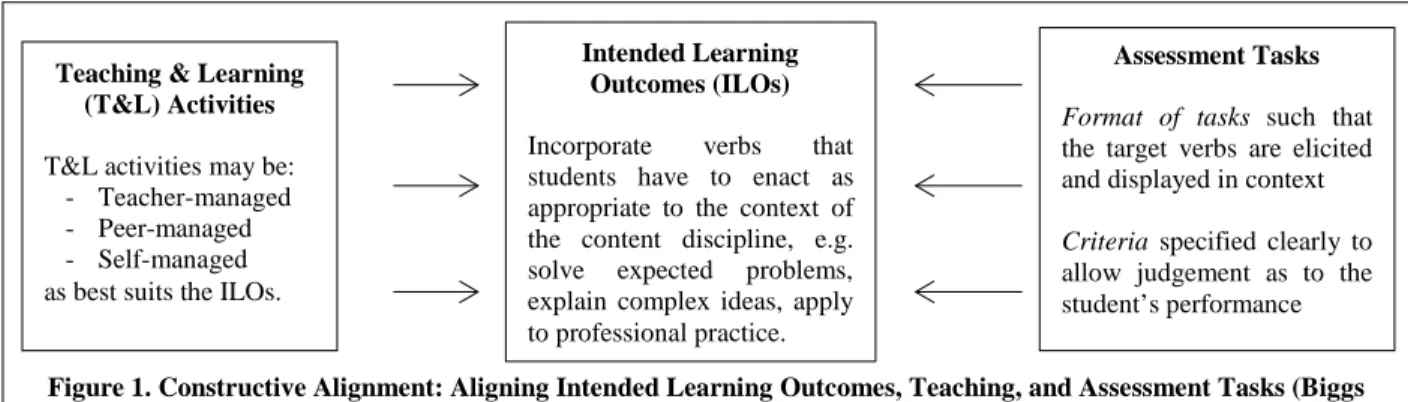
In this context, Biggs and Tang’s (2011) Constructive Alignment Framework is well-regarded by academics in HE pedagogy design as it provides a conceptual framework for reflecting on key questions (e.g., What do I want my students to learn? What are the available resources for getting them to learn? How do I know how well they have learned?) which need to be answered at all crucial stages of T&L.
As depicted in Figure 1, the contextualization of the course re-design considers not merely the assessment tasks but also the accompanying T&L activities to achieve the intended learning outcomes (ILOs). The conceptual framework is thus useful in guiding the re-design of the business analysis curriculum so as to align it with certification criteria of the professional body.
3. BUSINESS ANALYSIS IN THE INFORMATION SYSTEMS DISCIPLINE
In this section, we first give definitions of business analysis and the role of the BA within IS. We then review the business analysis courses offered in IS graduate degree programs and compare them to the MSIS (Master of Science in Information Systems) 2006 curriculum model (Gorgone et al., 2006). This is followed by a review of business analysis courses offered by IS professional bodies, with a focus on BCS.
3.1 Business Analysis and the Role of the Business Analyst
The notion of business analysis in the IS discipline developed from the late 1980s and early 1990s. Jakob (1986, p. 312) defines business analysis as
a methodology that provides a clear structure and rigorous approach to the understanding of the business by involving the users during the lifetime of the project – both in the provision of the information and in the validation of the analyst’s understanding, and in the use of a set of tools which provide a common language for the users, analysts and designers to communicate their understanding.
He stresses that users are the only people who know what business functions they perform and what this entails in terms of information. However, users are not generally trained in systems analysis or the design of information/computer systems. The analyst thus plays a key role “in drawing out the
information and conveying this to the designers/developers in terms that both sides can understand and agree.” Jakob’s definition emphasizes the importance of business analysis and methodology used in IS development and the role the BA plays in the process. However, the phrase “understanding the business” appears to be general and does not truly reflect the socio-technical aspects of IS systems.
The International Institute of Business Analysis (IIBA) defines business analysis as “the practice of enabling change in an organizational context, by defining needs and recommending solutions that deliver value to stakeholders” (IIBA, 2017). However, their focus is on the broad discipline of business analysis; that is, the scope of business analysis goes beyond IS projects.
The BCS recognizes business analysis as a distinct IS discipline, and awards business analysis certification at different levels. It states that “business analysts provide the bridge between the business and IT systems, and are pivotal to organizational success” (BCS, 2011, p. 3).
Similarly, the Australian Computer Society (ACS) proposes that the role of the BA is “to assess the overall business and information needs of an organization. BA co-ordinates the design of new IT solutions to improve business efficiency and productivity” (Richards, Marrone and Vatanasakdakul, 2011, p. 1).
The Project Management Institute (PMI) also offers business analysis certification (PMI, 2018). They are late entrants but are a significant force in the U.S. and globally. The PMI’s efforts, however, are most significant in the Project Management arena.
In this study, we have adapted Jakob’s (1986) definition and define business analysis as: a methodology that provides a clear structure and rigorous approach to the understanding of the social and technical aspects of a business/work system in IS development by involving the key stakeholders during the lifetime of the project – both in the provision of the information and in the validation of the business analyst’s understanding, and in the use of a set of tools which provide a common language for the users, analysts, and designers to communicate their understanding.
As discussed in Section 4, this contrasts business analysis with systems analysis; the latter focuses on software solution analysis and design with an emphasis on systems design and specification methods such as UML and object-oriented modeling.
Figure 1. Constructive Alignment: Aligning Intended Learning Outcomes, Teaching, and Assessment Tasks (Biggs and Tang, 2011, p. 105)
Assessment Tasks
Format of tasks such that the target verbs are elicited and displayed in context Criteria specified clearly to allow judgement as to the student’s performance
Teaching & Learning (T&L) Activities
T&L activities may be: - Teacher-managed - Peer-managed - Self-managed as best suits the ILOs.
Intended Learning Outcomes (ILOs)
Incorporate verbs that students have to enact as appropriate to the context of the content discipline, e.g. solve expected problems, explain complex ideas, apply to professional practice.
3.2 Business Analysis in IS Master’s Programs
Apigian and Gambill (2014) conducted a review of courses currently offered in IS graduate programs across Colleges of Business in the U.S. and compared the courses offered with the MSIS 2006 model curriculum. Of the top 15 required courses that they identified, we found none related to business analysis as such, although systems analysis and design was among the top three identified. Similarly, of the top 15 elective courses, although business analysis was not on the list, one could argue that some aspects could be covered in systems analysis and design and business process reengineering.
The MSIS 2006 model curriculum (Gorgone et al., 2006) and subsequent curriculum recommendations for Master’s-level degree programs in IS (Topi, 2014; Topi et al., 2014) highlight the importance of incorporating business skills/knowledge and social aspects of business systems in IS curricula design, e.g., change management (albeit under project management), strategy policy, human computer interaction, and integrated capstone projects, as required courses. However, according to the findings of Apigian and Gambill (2014), these were not taught as full courses at any university they reviewed. Having said that, the Kelley School of Business’s MSIS program provides an exemplar of how technical and managerial aspects of IS could be incorporated into MSIS curriculum design (see Topi et al., 2014). The Association of Information Systems also offers a number of business analysis-related courses through EDUglopedia.org, an open and free global encyclopedia for HE. Furthermore, “analysis, modeling, design” is listed in the MSIS model (although this could be interpreted as business or systems analysis or business systems analysis); however, the majority of the courses offered are on systems analysis and design rather than business (requirements) analysis/modeling.
A study by Vongsavanh and Campbell (2008) shows that there are distinctions between the roles performed by BA and systems analysts (SA), and in the knowledge/skill sets that they possess. BA are concerned with business and how to use IT/IS to achieve business goals, whilst SA are more concerned with software development and implementation. The BA’s tasks as identified by these authors include business problem analysis, IS strategy evaluation, requirements elicitation, business systems/processes modeling, and solution design. The SA’s tasks include requirements elicitation, system function/process modeling, systems implementation, systems maintenance, and IS standards maintenance. As such, the role of the BA is more a mediator than a technical specialist.
Interestingly, “business analyst” and “liaison between IT and business functions” are listed as typical job objectives of MSIS graduates (see Gorgone et al., 2006).
3.3 Business Analysis in IS Professional Bodies
The IIBA, BCS, ACS, and PMI all award professional certification in business analysis; they accredit/endorse training organizations which can deliver training. In this paper, we focus only on those offered by BCS.
As stated earlier, BCS recognizes business analysis as a distinct IS discipline and awards certification at different levels, namely foundation, practitioner, professional, consultant, and expert levels. Each certificate is mapped to the internationally applied SFIA or SFIA Plus. The BCS
certification scheme was launched in 1999, developed with industry experts to ensure relevance to today’s IT professionals, and is internationally recognized. Thus, we believe that aligning courses to professional accreditation/certification criteria will enhance the accountability of the program where 1) students are more likely to graduate with relevant professional certification and 2) the professional certification(s) they possess are more likely to translate into being employed in quality jobs by high-quality employers. The positive impact on curriculum development of closer collaboration with industry stakeholders is also highlighted in Topi et al. (2014).
Among all the different levels of certification, we believe that Business Analysis Practice (BAP – part of the BCS International Diploma in Business Analysis) is the most appropriate and will provide added value to IS graduates, as 1) it is concerned with the fundamental aspects of business analysis and 2) the focus is on using a holistic approach to the investigation and improvement of business situations with a view to developing effective, feasible business/IS solutions. The objectives and syllabus of BCS BAP are shown in Appendix 1.
The Henley IS graduate students come from a wide range of backgrounds, e.g., linguistics, law, economics, and electrical engineering; the majority do not have IT/IS as a first degree. Hence, the fundamental aspects – knowledge and understanding of the business analysis principles and techniques – offered by the BAP certification are appropriate. As the students have already acquired a specialization in their first degree, this certificate can enhance their employability and credibility, especially for those with little or no work experience. The BAP certification would also help those who want to change their career paths to a more business-oriented role, rather than a technical one. The certification would also provide the graduates with exposure to industry/experts in the profession, and students awarded the certificate will gain a year’s free membership of BCS.
4. TRANSLATION OF THE CONCEPTUAL MODEL TO THE BUSINESS ANALYSIS CURRICULUM
RE-DESIGN
This section first introduces the Business Analysis course, followed by the re-design of the curriculum to align it with the professional certification criteria.
4.1 The Business Analysis Course
The course was first offered in 2008-09, and the re-design for BCS accreditation took place in late 2012. The course is mandatory for both MSc programs within the informatics area: MSc Information Management and MSc Business Technology Consulting. The former has three pathways, namely, Business Service Design, Systems Analysis and Design, and Big Data in Business. The course is also mandatory for Doctor of Engineering (EngD) students at the Centre for Technologies for Sustainable Built Environments in the School of Construction Management and Engineering. It thus plays an important role in curriculum design and development in the taught graduate informatics programs and the practice-oriented engineering research program.
The course was initially designed by focusing on the upper part of the V-model of the Software Systems Development
Figure 3. Translation of the Conceptual Model to the Curriculum Re-Design
How do I know how well they have learned? (Assessment Criteria)
- Pass rates: 60% and above
- Quality employment with good employers
What are the available resources for enabling them to learn? (T&L
Activities)
Lectures, workshops, group work, independent support learning, and seminar – speakers from BCS
What do I want my students to learn? (ILOs)
The BCS Business Analysis Practice syllabus as shown in Appendix 1, together with the intended learning objectives (ILOs) presented in Table 1.
aaiFigure 2. Extended “V” Model (Paul and Cadle, 2014)
Life Cycle, as illustrated in Figure 2 (the lower part is covered in Systems analysis and design which is also offered in the IS graduate programs), and identifying the necessary knowledge and skills for its execution. The content identified for the learning outcomes of the course appeared to align well with the BCS syllabus, so we adopted a similar structure and applied for accreditation in late 2012. Accreditation in this context means that the business analysis course offered by the Henley Business School is aligned with the certification criteria of the BCS Business Analysis Practice syllabus, and therefore students who achieve a grade of B or above (i.e., 60% or above) in this course will automatically be eligible for the certification.
4.2 Translation of the Conceptual Model to the Curriculum Re-Design
Figure 3 translates the conceptual model presented in Figure 1 into the business curriculum re-design.
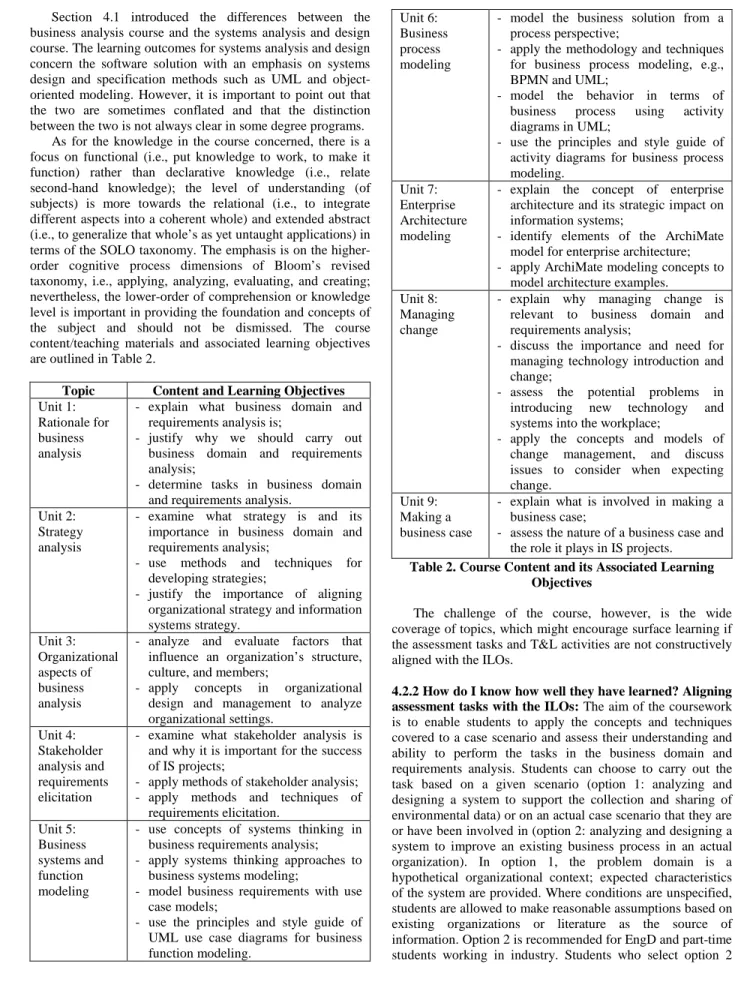
4.2.1 What do I want my students to learn? The Intended Learning Outcomes (ILOs): Biggs and Tang (2011) stress that three key points need to be considered when designing learning outcomes:
1) Decide what kind of knowledge is to be involved. The two widely used knowledge dimensions are Biggs and Tang’s (2011) declarative and functional knowledge and Bloom et al.’s (1956) factual, conceptual, procedural, and metacognitive knowledge.
2) Select the topics to teach, considering breadth (wide coverage and surface learning giving disjointed multi-structural outcomes) vs depth of understanding (few topics and deep learning giving relational and extended abstract outcomes).
3) Decide the levels of understanding intended. The two most commonly used frameworks are Biggs and Collis’ (1982) SOLO (Structure of Observed Learning Outcomes) and Bloom’s revised taxonomy (Anderson and Krathwohl, 2001; Krathwohl, 2002).
In this context, we want the students to follow the BCS BAP syllabus as presented in Appendix 1. As mentioned earlier, the content identified for the learning outcome of the course appeared to align well with the BCS syllabus. Nevertheless, “make a business case” (i.e., identifying and shortlisting options for business change, identifying costs and benefits, risk and impacts), which is considered an important aspect of business analysis, was not included as part of the ILOs in the initial course delivery. A new ILO-6 was thus added, as shown in Table 1:
ILO-1 apply the key concepts of organizational context, business strategy, stakeholder analysis and management, business systems thinking, process analysis, and change management
ILO-2 articulate holistic information systems solutions for the business area based on business practices and management at operational and strategic levels, and formally represent the analysis results in terms of the business needs and requirements ILO-3 examine the role of information systems in
achieving corporate objectives, supporting operations, and managing business intelligence and knowledge
ILO-4 facilitate a transformation of the business requirements for both IT project management and IS analysis and design
ILO-5 use suitable methods and techniques to conduct an analysis of the business domain and define business needs and requirements
ILO-6 analyze a business situation to define the issues to be addressed, identify and evaluate options, and develop a case for business change.
Table 1. Intended Learning Outcomes (ILOs) for the Business Analysis Course
Section 4.1 introduced the differences between the business analysis course and the systems analysis and design course. The learning outcomes for systems analysis and design concern the software solution with an emphasis on systems design and specification methods such as UML and object-oriented modeling. However, it is important to point out that the two are sometimes conflated and that the distinction between the two is not always clear in some degree programs.
As for the knowledge in the course concerned, there is a focus on functional (i.e., put knowledge to work, to make it function) rather than declarative knowledge (i.e., relate second-hand knowledge); the level of understanding (of subjects) is more towards the relational (i.e., to integrate different aspects into a coherent whole) and extended abstract (i.e., to generalize that whole’s as yet untaught applications) in terms of the SOLO taxonomy. The emphasis is on the higher-order cognitive process dimensions of Bloom’s revised taxonomy, i.e., applying, analyzing, evaluating, and creating; nevertheless, the lower-order of comprehension or knowledge level is important in providing the foundation and concepts of the subject and should not be dismissed. The course content/teaching materials and associated learning objectives are outlined in Table 2.
Topic Content and Learning Objectives
Unit 1: Rationale for business analysis
- explain what business domain and requirements analysis is;
- justify why we should carry out business domain and requirements analysis;
- determine tasks in business domain and requirements analysis.
Unit 2: Strategy analysis
- examine what strategy is and its importance in business domain and requirements analysis;
- use methods and techniques for developing strategies;
- justify the importance of aligning organizational strategy and information systems strategy. Unit 3: Organizational aspects of business analysis
- analyze and evaluate factors that influence an organization’s structure, culture, and members;
- apply concepts in organizational design and management to analyze organizational settings. Unit 4: Stakeholder analysis and requirements elicitation
- examine what stakeholder analysis is and why it is important for the success of IS projects;
- apply methods of stakeholder analysis; - apply methods and techniques of
requirements elicitation. Unit 5: Business systems and function modeling
- use concepts of systems thinking in business requirements analysis; - apply systems thinking approaches to
business systems modeling;
- model business requirements with use case models;
- use the principles and style guide of UML use case diagrams for business function modeling.
Unit 6: Business process modeling
- model the business solution from a process perspective;
- apply the methodology and techniques for business process modeling, e.g., BPMN and UML;
- model the behavior in terms of business process using activity diagrams in UML;
- use the principles and style guide of activity diagrams for business process modeling.
Unit 7: Enterprise Architecture modeling
- explain the concept of enterprise architecture and its strategic impact on information systems;
- identify elements of the ArchiMate model for enterprise architecture; - apply ArchiMate modeling concepts to
model architecture examples. Unit 8:
Managing change
- explain why managing change is relevant to business domain and requirements analysis;
- discuss the importance and need for managing technology introduction and change;
- assess the potential problems in introducing new technology and systems into the workplace;
- apply the concepts and models of change management, and discuss issues to consider when expecting change.
Unit 9: Making a business case
- explain what is involved in making a business case;
- assess the nature of a business case and the role it plays in IS projects.
Table 2. Course Content and its Associated Learning Objectives
The challenge of the course, however, is the wide coverage of topics, which might encourage surface learning if the assessment tasks and T&L activities are not constructively aligned with the ILOs.
4.2.2 How do I know how well they have learned? Aligning assessment tasks with the ILOs: The aim of the coursework is to enable students to apply the concepts and techniques covered to a case scenario and assess their understanding and ability to perform the tasks in the business domain and requirements analysis. Students can choose to carry out the task based on a given scenario (option 1: analyzing and designing a system to support the collection and sharing of environmental data) or on an actual case scenario that they are or have been involved in (option 2: analyzing and designing a system to improve an existing business process in an actual organization). In option 1, the problem domain is a hypothetical organizational context; expected characteristics of the system are provided. Where conditions are unspecified, students are allowed to make reasonable assumptions based on existing organizations or literature as the source of information. Option 2 is recommended for EngD and part-time students working in industry. Students who select option 2
must submit a title and a 500-word summary of the problem domain/scenario to the course convener and obtain agreement prior to the start of the work. For both options, students are expected to carry out the process of business domain and requirements analysis to the scenario in order to provide a systematic analysis of the problem domain that facilitates the project initiation, management, and execution at a later stage (the project initiation, management, and execution themselves are outside the scope of the coursework). The learning objectives also include the acquisition of critical thinking analysis and writing skills.
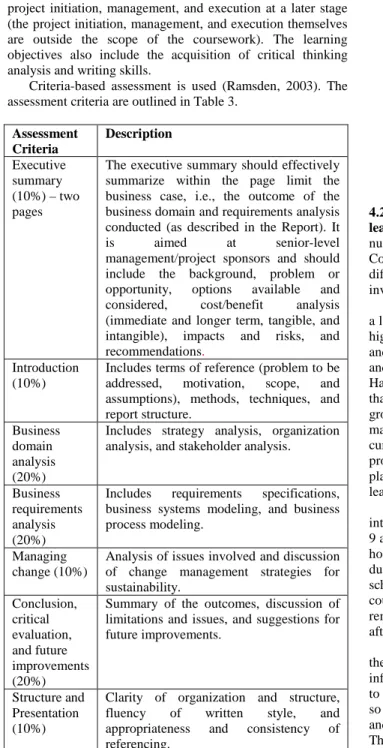
Criteria-based assessment is used (Ramsden, 2003). The assessment criteria are outlined in Table 3.
Assessment Criteria Description Executive summary (10%) – two pages
The executive summary should effectively summarize within the page limit the business case, i.e., the outcome of the business domain and requirements analysis conducted (as described in the Report). It is aimed at senior-level management/project sponsors and should include the background, problem or opportunity, options available and considered, cost/benefit analysis (immediate and longer term, tangible, and intangible), impacts and risks, and recommendations.
Introduction (10%)
Includes terms of reference (problem to be addressed, motivation, scope, and assumptions), methods, techniques, and report structure.
Business domain analysis (20%)
Includes strategy analysis, organization analysis, and stakeholder analysis.
Business requirements analysis (20%)
Includes requirements specifications, business systems modeling, and business process modeling.
Managing change (10%)
Analysis of issues involved and discussion of change management strategies for sustainability. Conclusion, critical evaluation, and future improvements (20%)
Summary of the outcomes, discussion of limitations and issues, and suggestions for future improvements.
Structure and Presentation (10%)
Clarity of organization and structure, fluency of written style, and appropriateness and consistency of referencing.
Table 3. Coursework Assessment Criteria
Students are required to submit a written report of approximately 5,000 words or not more than 25 pages, including all diagrams/figures but excluding references and appendices. The report contains two parts: an executive
summary (10 marks), i.e., the business case as a result of the business analysis conducted and the detailed business analysis report (80 marks). A total of 10 marks is allocated to the overall structure and presentation of the report. The ILOs of the module were presented in Table 1. The assessment criteria are aligned with the ILOs as follows:
• ILO-6 – making a business case which, as stated earlier, is a new learning outcome as a result of the BCS accreditation requirements. The ILO is addressed by providing an executive summary, i.e., an elevator pitch, based on the analysis conducted as in the business analysis report.
• ILOs-1 to 5 are jointly assessed by the business analysis report, where the students demonstrate their ability to apply business analysis concepts, techniques, and methods for business process and system modeling to a business case scenario.
4.2.3 What are the available resources for enabling them to learn? Teaching and learning activities for the ILOs: A number of scholars (e.g., Biggs and Tang, 2011; Light and Cox, 2001; Race, 1999) have emphasized that T&L activities differ in terms of class size and the type of knowledge involved.
The focus of this project is on the implications of teaching a larger class size, in an intensive mode of delivery, and at the higher-order level of understanding (e.g., analyzing, applying, and evaluating) in line with Bloom et al.’s (1956) taxonomy and a relational extended abstract of the SOLO taxonomy. Harden and Crosby (2000) stress that a good teacher is more than just a lecturer, identifying 12 roles of the teacher, grouped into 6 categories: resource developer (e.g., resource material creator, study guide producer); planner (e.g., curriculum planner, module/course organizer); information provider; assessor; facilitator; and role model. All these roles played by the lecturer are important in supporting students’ learning.
The business analysis course was held in a one-week intensive teaching delivery mode (i.e., Monday to Friday from 9 am to 5pm). The mode of teaching delivery changed to three hours a week for a semester delivery starting from 2016-17 due to the re-structuring of the programs within the wider school area. Nonetheless, the ILOs, T&L activities, coursework assessment criteria, and arrangement with BCS all remain the same. The T&L activities, including before and after the intensive week, are outlined in Table 4.
It is our belief that learning takes at least two forms: both the learners’ and lecturers’ experiences are impacted and influenced by the effort and input that both parties are willing to make. It is a knowledge co-creation process via stimulation, so that classroom activities have to be relevant, interesting, and challenging at the same time, so as to engage learning. The emphasis is thus on active learning (Benware and Deci, 1984; Michael, 2006; Niemi, 2002), learning-by-doing (Gibbs, 1988), and enquiry/problem-based learning (Lee, 2004), as well as offering greater opportunities for group work and co-creation of knowledge between various parties.
Teaching & Learning Activities
Description – What are the available resources for enabling them to learn?
Teaching & learning methods
Focus largely on lectures, tutorials and group discussions, seminars, and independent supported learning. Pre-intensive week preparation tasks
A one-week teaching mode is always a challenge. To help students prepare for the one-week course delivery, a list of tasks was given prior to the in-class sessions. This includes reading for each unit and also a case study to be used for the in-class group discussions.
During the one-week teaching delivery
Learning content/teaching materials: all lectures cover the core material with an introduction to the topics (as outlined in Table 2). Each unit is supplemented with one or two real-life business cases gathered from, for example, the Financial Times, Computer Weekly, IEEE Spectrum, and CIO Magazine, so as to introduce students to the subject topic and to better relate concept/theory and practice. The cases are used in tutorial/group discussion sessions. Feedback is provided at the end of each session. Suggestions for further reading (articles, textbooks) are also provided at the end of each unit for independent study.
Seminars / external speakers: to balance the
academic view, external practitioners/speakers from BCS and industry
are invited to give seminars/talks and real-life case studies.
Group discussion and arrangement: a survey of students’ education and work experience was carried out on the first day. The data help identify students who are technically competent and those who are more management/business focused, so as to mix students with different subject backgrounds for the group activities.
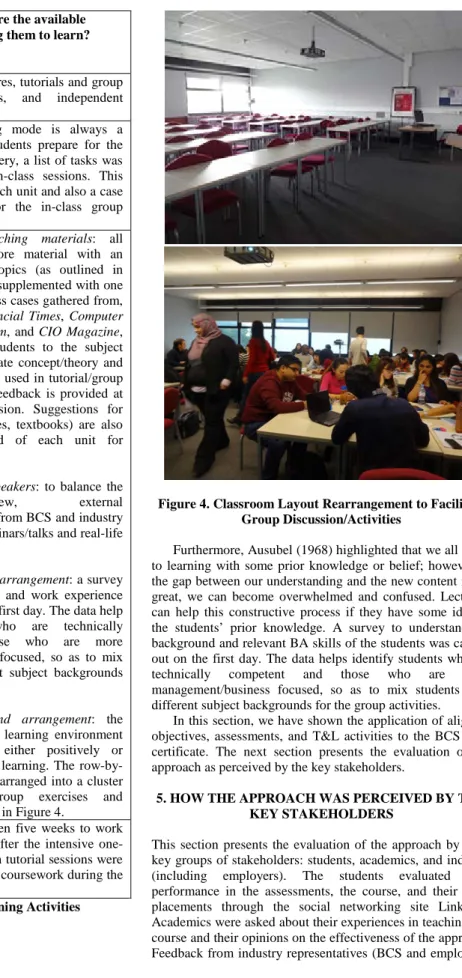
Classroom layout and arrangement: the classroom setting and learning environment have some impact, either positively or negatively, on student learning. The row-by-row classroom was re-arranged into a cluster style to enable group exercises and discussion, as depicted in Figure 4.
Post-teaching activities
The students were given five weeks to work on their assignments after the intensive one-week delivery. Drop-in tutorial sessions were arranged to assist with coursework during the five-week period.
Table 4. Teaching and Learning Activities
Figure 4. Classroom Layout Rearrangement to Facilitate Group Discussion/Activities
Furthermore, Ausubel (1968) highlighted that we all come to learning with some prior knowledge or belief; however, if the gap between our understanding and the new content is too great, we can become overwhelmed and confused. Lecturers can help this constructive process if they have some idea of the students’ prior knowledge. A survey to understand the background and relevant BA skills of the students was carried out on the first day. The data helps identify students who are technically competent and those who are more management/business focused, so as to mix students with different subject backgrounds for the group activities.
In this section, we have shown the application of aligning objectives, assessments, and T&L activities to the BCS BAP certificate. The next section presents the evaluation of the approach as perceived by the key stakeholders.
5. HOW THE APPROACH WAS PERCEIVED BY THE KEY STAKEHOLDERS
This section presents the evaluation of the approach by three key groups of stakeholders: students, academics, and industry (including employers). The students evaluated their performance in the assessments, the course, and their work placements through the social networking site LinkedIn. Academics were asked about their experiences in teaching this course and their opinions on the effectiveness of the approach. Feedback from industry representatives (BCS and employers)
was collected through individual and focus group interviews on the course curriculum and its alignment with what they expect from IS graduates.
5.1 Student Evaluation
It was observed that students were motivated to obtain the BCS BAP certificate. From 2012, the beginning of the HE institution/professional partnership, to 2016, a total of 165 out of 259 students (63.5%) gained the BCS Business Analysis Practice certification (i.e., those achieving grades A and B – 60% and above). Table 5 shows the grade distributions for the Business Analysis course following the re-design to align it with BCS requirements. The first year of BCS accreditation was in 2012-13, meaning 2015-16 was the fourth year of BCS accreditation. Year / Grade 2012-13 2013-14 2014-15 2015-16 A (> 70%) 11 (15%) 11 (19%) 16 (23%) 7 (12%) B (60-69%) 31 (44%) 27 (46%) 33 (47%) 29 (49%) C (50-59%) 23 (32%) 14 (24%) 17 (24%) 16 (27%) F (< 50%) 6 (9%) 7 (12%) 4 (6%) 7 (12%) No. of students 71 59 70 59
Table 5. Grade Distributions for the Business Analysis Course following BCS Accreditation
A number of graduates are now working as business analysts according to evidence from their LinkedIn profiles. The use of LinkedIn profiles to address program accountability questions such as quality jobs with quality employers was used as evidence by Case, Han, and Rimes (2016). Some students moved to BA roles shortly after completion of the course. Others who were initially unsure about their career paths considered BA as a professional career after taking the course. As for the course evaluation:
• For the 2012-13 cohort, 97% of the responses expressed satisfaction with the quality of the course, with a response rate of 65%.
• For the 2013-14 cohort, 71% of the responses felt that the course had been worthwhile, and 19% neither agreed nor disagreed. The total response rate was 35%, which is considered low.
• For the 2014-15 cohort, 94% of the responses indicated that the course had been worthwhile, with a response rate of 81%.
• With regard to the cohort of 2015-16, 95% of the respondents expressed overall satisfaction with the course and believed that their knowledge of the subject had increased. The total response rate was 58%.
5.2 Academic Evaluation
The academics’ evaluation was based on their experiences in teaching this course and their opinions of the effectiveness of
the approach. The feedback from two of the academics involved in the course is given below:
This approach effectively combines knowledge and skills in applying knowledge that enforces learning. The practical aspect of the approach ensures relevance to practice through the use of case studies. The emphasis on the overall picture reminds students of the role each aspect of analysis and modeling plays in the overall narrative of business analysis which helps students to string together the outcomes of each component for developing a coherent business case. Some students struggle to grasp the big picture and focus too much on each analysis, i.e., unable to see the wood for the trees, but the prescriptive structure of the report tends to make them realize the importance of the overall narrative. On a number of occasions alumni commented that this course was the most useful one in the program as they could apply what they learned in the course immediately to real-world cases on their first day of employment. – Head of Department, Program Area Director for Graduate Informatics Programs 2008-09 to 2015-16, Lecturer, and BCS BAP Examination Officer
My experiences in teaching this course were positive. Students enjoyed the process and enterprise architecture elements as they were key elements necessary for the effectiveness of business analysis and developing business analysts. A number of students mentioned that they now saw the need for process understanding in everyday as well as business activities. Also enterprise architecture models enable both technical and social business systems interactions to be mapped and identified. From my extensive experience of teaching, training and leading business analysts in industry, the course offered the key elements in a structured form necessary for BA skills development. – Program Director for the MSc Business Technology Consulting Program and Lecturer for the Enterprise Architecture and Business Process Modelling units.
5.3 Industry Evaluation
As for industry evaluation, an interview with a BCS Senior Examiner was conducted as well as a focus group with employers on what they thought of the course curriculum and its alignment with what they expected from IS graduates. The feedback from the BCS Senior Examiner is as follows:
Business analysis has become an increasingly recognized discipline over the last twenty years. However, the increasing use of business analysts has resulted in a skills shortage and employers find it difficult to recruit experienced business analysts. Therefore, they are keen to develop staff internally and many organizations now run graduate entrant business analyst programs. The launch of the BCS Diploma in Business Analysis in 1999 offered employers an opportunity to utilize a defined curriculum based on industry best practice, increase
standardization of business analysis practice and ease communication with both internal and external stakeholders. This initiative corresponded with efforts to formalize business analysis work and improve outcomes. The inclusion of the BCS BAP curriculum within the information systems program discussed in this paper offers two advantages to employers, as follows: 1) it provides a pool of graduates with prior understanding of business analysis that is well-founded and is integrated with knowledge of the broader IS context; and 2) it ensures that the IS skills held by the graduates are grounded in recognized professional practice. The result is that graduate entrants can be effective more quickly when performing business analysis in the workplace. Further, BAP certificate holders are aware of the BCS BA Diploma program and are partially-qualified towards achieving this qualification.
The focus group consisted of two experts: a technical director with extensive experience in IS projects and the company director of a consultancy and training company working within the IS industry. The comments are summarized as follows:
• Experience has shown that IS graduates do not have a good understanding of business analysis principles and techniques. This lack of understanding is not helpful as it is important that IS employees understand the business context and can work with business stakeholders.
• Conversely, if recruiting for a role that involved business analysis, the curriculum would be very helpful and would offer the graduates an advantage over other IS graduates. If recruiting for a more general IS role, the curriculum would offer a grounding in the business context for IS projects which would also be valuable. It should also enable graduates to discuss IS within a business context during an interview which could be beneficial for them.
• While new IS graduates (and most BAs) aren’t actually involved in developing business strategies, it is helpful if they understand them, and how they are developed, in order to give their work context.
• UML techniques are very helpful as this is an industry standard that is applied across different IS disciplines and enables communication with different stakeholders.
• BPMN is useful in that the ability to model processes and workflows is important for IS roles; however, BPMN is a very detailed standard so a detailed understanding would not be very useful unless it was for a specific process re-design role where BPMN was applied.
• Explaining why we need a business case is very important for anyone wanting to work in IS. This is really critical for IS employees so it is extremely useful if a graduate understands the basis for IS projects and aspects such as scope, objectives, and financial case.
5.4 Discussion
The overall results and evaluation of the approach from the key stakeholders showed a positive outcome. As presented earlier, the business analysis course was designed to develop each student’s analytical/critical/logical thinking and business problem-solving skills. It also aimed to develop each student’s business skills by incorporating organizational and cultural aspects of business analysis and strategies for stakeholder management and change management. Where the technical skills were concerned, techniques/methods for requirements elicitation, documenting business requirements, business systems and process modeling, and making a business case were introduced, as these skills were considered important for business analysts.
The majority of the skill set covered was consistent with the MSIS Model of 2006 and the findings of Richards et al. (2011) from their investigation of the knowledge and skills needed by a BA who is an IS graduate. Using the SFIA framework, their results show that soft skills/knowledge were perceived to be the most important, followed by business skills/knowledge, technical skills/knowledge, and green skills/knowledge (e.g., sustainability strategy, sustainability assessment). Within the soft skills categories, analytical/critical/logical and business problem-solving were considered to be of great importance; requirements specification/elicitation and applying IT to business were ranked the most important in technical skills categories; and stakeholder relationship management, organization skills, and business process implementation were ranked high in the business categories. However, making a business case is not addressed in Richard et al.’s study, although it is regarded as important from a practitioner’s point of view. One of the key roles of the BA is to be able to evaluate business solutions/options relevant to the problem domain and to make recommendations based on the assessment of cost and benefits, risks, and impacts. So, this element should be covered in the business analysis curriculum design.
6. CONCLUSION AND IMPLICATIONS
This study was set up to achieve two aims: 1) to better re-align the IS programs with business needs/standard work practice and 2) to provide students with an opportunity to earn a professional practitioner certification prior to their graduation. To this end, we have provided a theoretical contribution to the approach to alignment which is grounded in T&L theory in HE. We also make a practical contribution to how an IS curriculum could be better re-designed and re-aligned with industry needs by linking it with certification offered by an IS professional body, and at the same time fulfilling the T&L requirements of HE. The approach can be replicated by IS educators in other similar settings.
We focused on the Master’s IS curriculum design in business analysis. Business analysis is an IS discipline that applies socio-technical principles and methodology to the understanding of business problems, defining requirements, and evaluating relevant IS solutions for business needs. It has been suggested that business analysts play a crucial role in bridging the gap between business needs and technical solutions (Luftman and Brier, 1999; Richards et al., 2011; Williams, 2011a, 2011b). There is an increasing number of
business analysts, with professional bodies such as BCS, ACS, and IIBA awarding certificates in business analysis. However, this is not the case in HE Master’s IS programs. Most emphasis is on system design and analysis, with little focus on business analysis. Given the long-standing concern about business-IS alignment and the poor communication between technical and business staff on IS projects (Lochan and Shah, 2010; Mance, 2013), it is important for IS educators to produce graduates who are able to take a holistic view, encompassing both the social and technical aspects of a business system in IS development (Doherty and King, 2005).
We have addressed the gap by introducing a course called Business Domain and Requirements Analysis (the official title). It aims to develop IS graduates/professionals who are able to take a holistic view and encompass both social and technical aspects of a business/work system on IS developments. We have provided a detailed description of a process for mapping course content to professional certification criteria that can be replicated by IS educators at other universities. The process also helps ensure that course content is aligned with desired practitioner knowledge and skills and adds value to students by helping them to earn professional certification prior to graduating.
It is important to note that agile software development has, in the main, failed to recognize the BA role, although Amber and Lines (2012) noted that business analysis “is important to the success of an agile team;” they identified BAs as good candidates to take on the product-owner role in an agile project. Future study could therefore focus on agile software development and the role of business analysis.
7. ACKNOWLEDGEMENTS
We are grateful to the anonymous reviewers for their constructive feedback and comments on our earlier submissions.
8. REFERENCES
Amber, S. W. & Lines, M. (2012). Disciplined Agile Delivery. A Practitioner’s Guide to Agile Software Delivery in the Enterprise. IBM Press.
Anderson, L. W. & Krathwohl, D. R. (2001). A Taxonomy for Learning, Teaching, and Assessing: A Revision of Bloom’s Taxonomy of Educational Objectives. New York: Addison Wesley Longman.
Apigian, C. H. & Gambill, S. (2014). A Descriptive Study of Graduate Information Systems Curriculums. Review of Business Information Systems, 18(2), 47-52.
Ausubel, D. P. (1968). Educational Psychology. A Cognitive View. New York: Holt, Rinehart and Winston.
BCS. (2018). Why BCS Certifications? Retrieved January 2, 2018, from https://certifications.bcs.org/category/18190. BCS. (2011). Business Analysis Career Path. Retrieved
September 26, 2017, from http://www.bcs.org/upload/pdf/business_analysis_careerpat h.pdf.
Benware, C. L. & Deci, E. L. (1984). Quality of Learning with an Active versus Passive Motivational Set. American Educational Research Journal, 21(4), 755-765.
Biggs, J. B. & Collis, K. F. (1982). Evaluating the Quality of Learning: The SOLO Taxonomy (Structure of the Observed Learning Outcome). New York: Academic Press.
Biggs, J. B. & Tang, C. (2011). Teaching for Quality Learning at University (4th ed.). Milton Keynes: Open University Press.
Bloom, B., Englehart, M., Furst, E., Hill, W., & Krathwohl, D. (1956). Taxonomy of Educational Objectives: The Classification of Educational Goals (Handbook I: Cognitive Domain). New York: Longmans, Green.
Case, T. L., Han, J., & Rimes, E. (2016). Career Paths of Computing Program Graduates: A LinkedIn Analysis. Presented at the 19th Southern Association for Information Systems Conference (SAIS 2016), St. Augustine, FL. Deloitte. (n.d.). Life at Deloitte: Lifelong Learning and
Development. Retrieved September 26, 2017, from https://www2.deloitte.com/uk/en/pages/careers/articles/brig htstart-business-apprenticeship.html.
Doherty, W. H. & King, M. (2005). From Technical to Socio-Technical Change: Tackling the Human and Organizational Aspects of Systems Development Projects. European Journal of Information Systems, 14(1), 1-5.
Gibbs, G. (1988). Learning by Doing: A Guide to Teaching and Learning Methods. London: FEU.
Gorgone, J. T., Gray, P., Stohr, E. A., Valaich, J. S., & Wigand, R. T. (2006). MSIS 2006: Model Curriculum and Guidelines for Graduate Degree Programs in Information Systems. Communication of the Association for Information Systems, 17(1), 121-196.
Groom, B. (2014, July 8). Skills Shortage Leads to Sharp Rise in UK Starting Salaries. Financial Times. Retrieved
October 11, 2017, from
http://www.ft.com/cms/s/0/f2fdc55e-05f5-11e4-89a5-00144feab7de.html#axzz41fKpgdwI.
Harden, R. M. & Crosby, J. (2000). The Good Teacher is More Than a Lecturer – The Twelve Roles of the Teacher (AMEE Guide, 20). Medical Teacher, 22(4), 334-347. IIBA. (2017). What is Business Analysis? Retrieved
September 26, 2017, from
http://www.iiba.org/Careers/What-is-Business-Analysis .aspx.
Jakob, D. (1986). The Design of Integrated Information Systems using Business Analysis: Case Study 4. Journal of Information Science, 12(6), 311-315.
Krathwohl, D. R. (2002). A Revision of Bloom’s Taxonomy: An Overview. Theory into Practice, 41(4), 212-264.
Lee, C. K. & Han, H. J. (2008). Analysis of Skills Requirement for Entry-Level Programmer/Analysts in Fortune 500 Corporations. Journal of Information Systems Education, 19(1), 17-27.
Lee, D. M. S., Trauth, E. M., & Farwell, D. (1995). Critical Skills and Knowledge Requirements of IS Professionals: A Joint Academic/Industry Investigation. MIS Quarterly, 19(3), 313-340.
Lee, V. S. (Ed.) (2004). Teaching and Learning through Enquiry: A Guidebook for Institutions and Instructors. Sterling, VA: Stylus Publishing.
Light, G. & Cox, R. (2001). Learning and Teaching in Higher Education: The Reflective Professional. London: Paul Chapman Publishing.
Lochan, D. and Shah, S. (2010, November 4). How to Bridge the IT Alignment Gap. Financial Times, Retrieved May 26, 2017, from https://www.ft.com/content/60089a24-e5f3-11df-af15-00144feabdc0.
Luftman, J. & Brier, T. (1999). Achieving and Sustaining Business-IT Alignment. California Management Review, 42(1), 109-122.
Mance, H. (2013, September 18). Why Big IT Projects Crash. Financial Times, Retrieved August 13, 2017, from https://www.ft.com/content/794bbb56-1f8e-11e3-8861-00144feab7de.
Michael, J. (2006). Where’s the Evidence that Active Learning Works? Advances in Physiology Education, 30, 159-167. Niemi, H. (2002). Active Learning: A Cultural Change
Needed in Teacher Education and Schools. Teaching and Teacher Education, 18(7), 763-780.
Paul, D. & Cadle, J. (2014). Delivering the Requirements. In D. Paul, J. Cadle, & D. Yeates (Eds), Business Analysis (3rd ed.). London: BCS Learning & Development.
PMI. (2018). PMI Professional in Business Analysis (PMI-PBA)®. Retrieved January 31, 2018, from
http://www.pmi.org/certifications/types/business-analysis-pba.
Race, P. (Ed.) (1999). 2000 Tips for Lecturers. London: Routledge.
Ramsden, P. (2003). Learning to Teach in Higher Education. (2nd ed.). London: RoutledgeFalmer.
Richards, D., Marrone, M., & Vatanasakdakul, S. (2011). What Does an Information Systems Graduate Need to Know? A Focus on Business Analysts and Their Role in Sustainability. Presented at the 22nd Australasian Conference on Information Systems (ACIS 2011), Sydney, Australia. (Paper 15).
Stefani, L. (2009). Planning Teaching and Learning: Curriculum Design and Development. In H. Fry, S. Ketteridge, & S. Marshall (Eds), A Handbook for Teaching and Learning in Higher Education (3rd ed.). UK: Routledge.
Topi, H. (2014). Program Directors’ Perspectives on MSIS Outcome Expectations and Future Directions. Presented at the AIS SIGED IAIM 2014 Conference. (Paper 9).
Topi, H., Conboy, K., Donnellan, B., Ramesh, V., van Toom, C., & Wright, R. T. (2014). Moving Toward the Next Generation of Graduate Degree Programs in Information Systems. Communication of the Association for Information Systems, 34, 693-710.
Vongsavanh, A. & Campbell, B. (2008). The Roles and Skill Sets of Systems vs. Business Analysts. Presented at the 19th Australasian Conference on Information Systems (ACIS 2008), Christchurch, New Zealand.
Williams, J. (2011a, Jun 10). Open University Launches Computing BSc to Plug Business Skills Gap in IT Workforce. Computer Weekly. Retrieved January 11, 2017, from
http://www.computerweekly.com/news/2240104734/Open- University-launches-computing-BSc-to-plug-business-skills-gap-in-IT-workforce.
Williams, J. (2011b, July 7). Business Analysts Skills Shortage Continues as IT Job Market Grows. Computer Weekly. Retrieved January 11, 2017, from http://www.computerweekly.com/news/2240104980/Busine ss-analyst-skills-shortage-continues-as-IT-job-market-grows.
AUTHOR BIOGRAPHIES
Yin Leng Tan is a lecturer in Business Informatics and Program Area Director for Informatics and Program Director for MSc Information Management and Digital Business at Henley Business School, University of Reading, U.K. She earned her Ph.D. in Informatics from the University of Manchester, U.K., in 2011. Her main research interests are in service innovation and digital ecosystems, service systems design, digital business, and Information Systems education. She has published papers and co-edited a book and workshop proceedings in the related areas. She was an active member of the http://www.ssmenetuk.org – a UK network of Service Science Management and Engineering which she helped set up. She has also been working as a freelance IT consultant since 2005, her clients including both private and public sectors.
Keiichi Nakata is Professor of Social Informatics and Head of Business Informatics, Systems, and Accounting at Henley Business School at the University of Reading, U.K. His main research interests lie at the interface between technology and people, in the areas of computer-supported collaborative work, cognitive systems engineering, and information systems. Recently he has been engaged in research into acceptance of pervasive systems, social media, and participatory systems. Prior to the current appointment, he was Dean of the School of Information Technology at the International University in Germany. His past appointments include Associate Professor at the Institute of Environmental Studies at the University of Tokyo and Research Scientist at the German National Research Centre for Information Technology. He obtained his Ph.D. in Artificial Intelligence from the University of Edinburgh, U.K., and MEng and BEng in Nuclear Engineering from the University of Tokyo.
Debra Paul is the Managing Director of Assist Knowledge Development Ltd. She jointly edited and authored the publication, Business Analysis, and is also the co-author of Agile and Business Analysis, Business Analysis Techniques and The Human Touch. She is a regular speaker at business seminars and IS industry events. She has been a keynote presenter at business analysis conferences, delivering presentations such as ‘Business Analysis: The Third Wave’ and ‘Business Analysis: Relevance and recognition’. Debra is a founding member of the BA Manager Forum, a networking organization for senior BAs and BA managers.
APPENDIX 1
BCS Business Analysis Practice: Objectives and Syllabus
The objectives of BCS Business Analysis Practice are as follows:
• Describe how a business strategy is developed
• Apply strategic analysis techniques
• Explain the need for project discipline
• Explain techniques to investigate an organization’s business systems
• Describe an approach to improving business systems
• Explain the importance of stakeholder management and use of stakeholder analysis techniques
• Use techniques for the analysis and conceptual modelling of business systems
• Describe how recommendations for business improvements may be identified
• Describe the contents of a rigorous business case for the development and implementation of business changes
• Identify costs, benefits, impacts and risks for an option in a business case. The syllabus covers eight topics:
1) Rationale: lifecycle for business change, the role of the business analyst and others (e.g., project manager, developer, and tester) within the lifecycle for business change, and the framework for business analysis activities (including relation of business analysis to strategic analysis and to systems analysis, and the holistic approach to business analysis).
2) Understanding the strategic context: internal and external environment analysis, and SWOT analysis; critical success factors and key performance indicators and performance targets; the Balanced Business Scorecard as a framework for identifying Critical Success Factors and Key Performance Indicators.
3) Project discipline for business analysis studies: terms of reference/project initiation, business objectives (define what the business wishes to achieve as a result of the project) and project objectives (define what the project is required to deliver). 4) Understanding the situation/issues: stakeholder identification, techniques to investigate the current business situation
(e.g., interviews, observation, workshops, document analysis, focus groups, and questionnaires/surveys), and representing a holistic view of the business situation (e.g., rich pictures, mind maps, fishbone diagrams).
5) Analyzing stakeholder perspectives: stakeholder analysis and management, identifying different perspectives, and contrasting different perspectives.
6) Analyzing and modelling business activities: developing a conceptual business activity model, identifying business events, analyzing business rules, and building the consensus activity model.
7) Identifying potential solutions: comparing the ideal and existing systems, identifying IS/IT requirements to support the new business model.
8) Making the business case: identifying and shortlisting options for business change, identifying costs and benefits, risk and impacts.
Information Systems & Computing
Academic Professionals
STATEMENT OF PEER REVIEW INTEGRITY
All papers published in the Journal of Information Systems Education have undergone rigorous peer review. This includes an initial editor screening and double-blind refereeing by three or more expert referees.
Copyright ©2018 by the Information Systems & Computing Academic Professionals, Inc. (ISCAP). Permission to make digital or hard copies of all or part of this journal for personal or classroom use is granted without fee provided that copies are not made or distributed for profit or commercial use. All copies must bear this notice and full citation. Permission from the Editor is required to post to servers, redistribute to lists, or utilize in a for-profit or commercial use. Permission requests should be sent to the Editor-in-Chief, Journal of Information Systems Education, [email protected].