MURDOCH RESEARCH REPOSITORY http://researchrepository.murdoch.edu.au
This is the author's final version of the work, as accepted for publication following peer review but without the publisher's layout or pagination.
Donato, D.C., Fontaine, J.B. , Robinson, W.D., Kauffman, J.B. and Law, B.E. (2009) Vegetation response to a short interval between high-severity wildfires in a mixed-evergreen forest. Journal of Ecology, 97 (1). pp.
142-154.
http://researchrepository.murdoch.edu.au/2578
Copyright © The Authors
Vegetation response to a short interval between high-severity wildfires
in a mixed-evergreen forest
Running Head: Vegetation following short-interval severe fire
Daniel C. Donato* Department of Forest Science
Oregon State University Corvallis, OR, USA 97331 [email protected]
541.231.7273 ph 541.737.1393 fx Joseph B. Fontaine
Department of Fisheries and Wildlife Oregon State University
Corvallis, OR 97331 W. Douglas Robinson
Department of Fisheries and Wildlife Oregon State University
Corvallis, OR 97331 J. Boone Kauffman
Institute of Pacific Islands Forestry USDA Forest Service
60 Nowelo St. Hilo, HI 96720 Beverly E. Law
Department of Forest Science Oregon State University
Corvallis, OR 97331
SUMMARY
1 Variations in disturbance regime strongly influence ecosystem structure and function. A prominent form of such variation is when multiple high-severity wildfires occur in rapid succession (i.e. short-interval severe fires, or ‘reburns’). These events have been proposed as key mechanisms altering successional rates and pathways.
2 We utilized a natural experiment afforded by two overlapping wildfires of differing age in forests of the Klamath-Siskiyou Mountains, Oregon (USA). We tested for unique effects of a short-interval fire (15-yr interval prior to 2002 fire) by comparing vegetation communities two years postfire to those following a long-interval fire (>100-yr interval prior to 2002 fire) and in mature/old-growth stands (no high-severity fire in >100-yr).
3 Nearly all species found in mature/old-growth stands were present at similar relative abundance in both the long-interval and short-interval burns, indicating high community persistence
through multiple high-severity fires. However, the short-interval burn had the highest species richness and total plant cover with additions of disturbance-associated forbs and low shrubs, likely due to a propagule bank of early seral species that developed between fires. Persistence of flora was driven by vegetative sprouting, on-site seed banks, and dispersal from off-site seed sources. Several broadly generalizable plant functional traits (e.g., rapid maturation, long-lived seed banks) were strongly associated with the short-interval burn.
4 Sprouting capacity of hardwoods and shrubs was unaltered by recurrent fire, but
hardwood/shrub biomass was lower in the short-interval burn because individuals were smaller prior to the second fire. Conifer regeneration densities were high in both the short-interval and long-interval burns (range= 298-6086 and 406-2349 trees ha-1, respectively), reflecting similar availability of seed source and germination substrates.
5 Synthesis. Short-interval severe fires are typically expected to be deleterious to forest flora and development; however, these results indicate that in systems characterized by highly variable natural disturbances (e.g. mixed-severity fire regime), native biota possess functional traits lending resilience to recurrent severe fire. Compound disturbance resulted in a distinct early seral assemblage, thus contributing to the landscape heterogeneity inherent to mixed-severity fire regimes. Process-oriented ecosystem management incorporating variable natural
disturbances, including 'extreme' events such as short-interval severe fires, would likely perpetuate a diversity of habitats and successional pathways on the landscape.
Keywords:
Biscuit Fire, compound disturbance, conifer regeneration, fire interval, functional traits, mixed severity fire regime, plant diversity, reburn, Silver Fire, shrub sprouting
INTRODUCTION
Variations in disturbance frequency and severity strongly influence ecosystem structure and function (Agee, 2005; Bond & van Wilgen, 1996). For disturbances such as fire, frequency and severity are typically negatively correlated, such that frequent disturbances are of lower severity (Agee 1993 and references therein). However, in many ecosystems high-severity events
occasionally occur in rapid succession, resulting in a compound disturbance (Paine et al., 1998), with lasting influence on ecosystem pattern and process (e.g., Johnstone & Chapin, 2006; Zedler et al., 1983).
In forests with mixed- and high-severity fire regimes, such as in the Pacific Northwest, USA, intervals between stand-replacing fires are typically several decades to several centuries (Agee, 1993). Occasionally these fires are followed closely by recurrent fires during early
succession (i.e., 're-burns'--Agee, 1991; Agee, 1993; Franklin & Hemstrom, 1981; Gray & Franklin, 1997; Thompson et al., 2007). Retrospective (dendrochronological) studies in mature Pacific
Northwest forests suggest these short-interval fires may exert large influence on successional rates and pathways (Agee, 1991; Franklin & Hemstrom, 1981; Gray & Franklin, 1997). In the present study, we report vegetation responses immediately following recurrent high-severity fire to clarify the potential mechanisms underlying such influences.
A key tenet of many successional theories is how the interval length between disturbances influences outcomes of succession ('interval-dependent fire effects'; Bond & van Wilgen, 1996). Short-interval (SI) fires occur in early seral vegetation and may differ qualitatively from long-interval (LI) fires, which generally occur in mature forests. Young stands contain distinct fuel conditions (and thus potential fire behavior) that are legacies of recent disturbance including low-stature continuous vegetation, open microclimates, and woody fuels derived from fire-killed trees (Agee & Huff, 1987). Short-interval fires also affect plant species at earlier life history stages,
potentially influencing postfire reproduction capacity (Bond & van Wilgen, 1996; Noble & Slatyer, 1980). In boreal forests, for example, recruitment of serotinous conifers (Pinus and Picea spp.) was significantly reduced following SI fires since the fire interval was shorter than the time to
reproductive maturity (Johnstone & Chapin, 2006). However, interactions between fire interval and life history will vary widely among species depending on their method and timing of reproduction, dispersal, and growth—with some species favored by short intervals. As such, SI fires may lead to distinct postfire assemblages and alternative successional pathways (Bond & van Wilgen, 1996; Noble & Slatyer, 1980).
Ecosystem response to recurrent severe fire varies among regions, from declines in plant productivity or diversity (e.g., Delitti et al., 2005; Eugenio et al., 2006; Isaac & Meagher, 1936; Zedler et al., 1983) to high resilience or even increases (e.g., Beck & Vogl, 1972; Delitti et al., 2005; Wittenberg et al., 2007). Generalities across ecosystems, or mechanisms underlying
differences, have remained elusive. However, one promising tool is the analysis of plant functional traits (or 'vital attributes')—autecological qualities with common response to the environment across taxa. Noble and Slatyer (1980) described a qualitative scheme for predicting shifts in plant
communities subject to recurrent disturbance, using functional traits relating to regenerative strategy (e.g., seed longevity, dispersal capacity, sprouting ability) and competitive relations (e.g., growth rate, shade tolerance). By assessing logically determined interactions between functional groups and fire interval, this approach provides a broadly applicable framework for understanding the role of disturbance frequencies in the origin of different successional pathways (Noble & Slatyer, 1980).
In this study, we examined the effects of recurrent high-severity disturbance in the Klamath-Siskiyou ecoregion, USA, utilizing two overlapping wildfires as a natural experiment on fire interval variation. The region provides an exceptional opportunity to study responses of vegetation, particularly functional traits, to short-interval fire. First, the region comprises the most diverse
forest flora of western North America, both in terms of species and physiognomy (Whittaker, 1960); thus a broad range of functional traits are represented. Second, a complex fire regime
prevails, with frequent but variable fire intervals (~5-75 yr) and mixed severity over time and space (Agee, 1991; Agee, 1993; Stuart & Salazar, 2000; Taylor & Skinner, 1998). When
stand-replacement occurs, rapid recovery of vegetation and fuel continuity, coupled with dry summers and frequent lightning, create the potential for recurrent high-severity fires over decadal time scales (Thompson et al., 2007). Thus, short-interval severe fires have likely been a component of the complex fire regime and a factor structuring vegetation in the region (Agee, 1991; Agee, 1993).
Response to SI stand-replacing fire can be evaluated against LI fire responses within a framework of three alternative models, based on previous studies: [1] cyclical dynamics, whereby postfire regeneration is similar regardless of fire interval (Wittenberg et al., 2007). Under this model, response to a SI fire event would be no different than after a single fire having a long previous interval. [2] interval-dependent dynamics with abrupt, potentially long-lasting differences in the SI burn due to declines in vegetation abundance/diversity, soil productivity, or tree
establishment (Eugenio et al., 2006; Isaac & Meagher, 1936; Zedler et al., 1983). Expectations of this model often underlie postfire management actions aimed at avoiding re-burns (e.g., USDA, 1988). [3] interval-dependent dynamics in which SI fire retains most/all species as part of the postfire assemblage, but leads to reduced dominance of woody forest components, generating gaps in which ruderal species may persist (Delitti et al., 2005). Under this model, repeated SI fires would maintain distinct seral communities, but given a sufficient fire-free interval, succession would trend toward mature forest condition. We explored this framework with the following specific questions: a) How does vegetation response following a SI fire compare to a LI fire in terms of initial
vegetation cover, diversity, and species composition? We hypothesized an interval-dependent response, with an increase in disturbance-associated components, but a decrease in overall
diversity and cover due to the effects of two severe fires on fire-sensitive/late-seral associated components, soil propagule banks and productivity.
b) Is regeneration of major structural components—hardwoods, shrubs, and conifers—reduced in the SI burn relative to the LI burn? For sprouting hardwoods and shrubs, a brief fire interval may be shorter than the recovery time of belowground carbohydrate reserves (Bond & van Wilgen, 1996). Also, combustion of woody fuel accumulations derived from trees killed in the first fire may result in higher soil heat flux and mortality of belowground meristematic tissues. Based on these expectations and results of previous works (Bond & van Wilgen, 1996; Delitti et al., 2005), we hypothesized that repeated fires reduce sprouting probability and biomass. For conifers, retrospective studies in Pacific Northwest forests have pointed to sparse or altered regeneration following SI fires (e.g., Agee, 1991; Gray & Franklin, 1997), but the mechanisms behind this pattern have not been identified (i.e. seed source limitations, unfavorable
germination substrates, or subsequent survival). In this study we quantified early conifer establishment to test whether initial establishment conditions (seed source, substrate) limited regeneration in the SI burn.
c) To elucidate mechanisms and improve predictive capability across ecosystems, we explored the question: What plant functional traits are associated with the different fire histories (SI fire, LI fire, mature/old-growth stands with no recent fire)? We focused on broadly applicable traits (related to those in Noble & Slatyer, 1980) including regenerative strategy, life form, and dispersal strategy. We hypothesized that disturbance-associated traits (e.g., rapid growth to reproduction, highly dispersive propagules, and in situ seedbanks) would be positively associated with SI fire, while traits typical of late-seral associated components (e.g., fire-sensitivity, shade tolerance, slow maturation) would be negatively associated with SI fire.
METHODS
Study Area and Recent Fire History
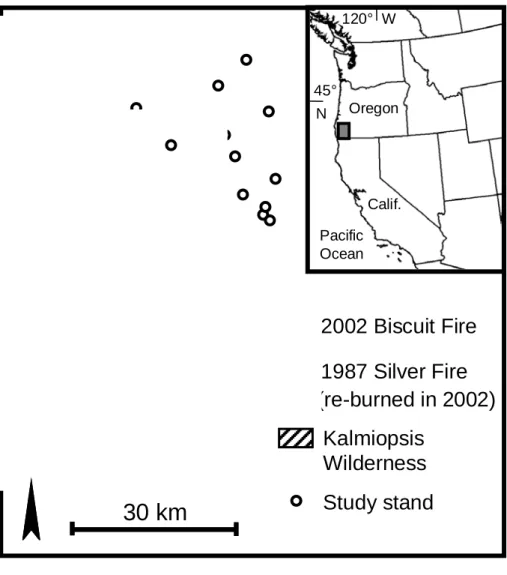
The study was conducted in the Illinois River drainage of the Klamath-Siskiyou Mountains, a Pacific coastal range in southwestern Oregon, USA (Fig. 1). A mixed-severity fire regime,
complex geology, and steep topographic and climatic gradients support a diverse mosaic of plant communities in the region (Whittaker, 1960). Climate regime is wet Mediterranean-type with warm, dry summers and cool, moist winters. Annual precipitation ranges from 150-300 cm over the study area (Daly et al., 2002, www.prismclimate.org), with <15% falling from May-September.Soils were derived from metasedimentary, metavolcanic, and coarse-grained igneous parent materials. Ultramafic (serpentine) substrates (Whittaker, 1960) were avoided in this study.
Study sites were in the upper mixed-evergreen zone, where it begins to intergrade with white fir (Abies concolor) (Franklin & Dyrness, 1973). All sites supported—currently or prior to recent fires—Douglas-fir (Pseudotsuga menziesii) dominated mature or old-growth forest (>100 yr old; see Agee, 1993; Bingham & Sawyer, 1991 for developmental/structural descriptions). Mature/old-growth (M/OG) stands are typically dominated by conifers Douglas-fir, white fir, sugar pine (Pinus lambertiana), and incense cedar (Calocedrus decurrens); evergreen hardwoods tanoak (Lithocarpus densiflorus), canyon live oak (Quercus chrysolepis), Pacific madrone (Arbutus menziesii), and chinquapin (Chrysolepis chrysophylla); and woody shrubs greenleaf manzanita (Arctostaphylos patula), snowbrush (Ceanothus velutinus), and Sadler oak (Quercus sadleriana). (Nomenclature followed Hickman (1993); see Appendix S1 in Supplementary Material for species list.)
In 1987, the 38 000-hectare Silver Fire burned with mixed severity, including patches of stand replacement with subsequent establishment of early seral stands. Fifteen years later, in 2002, the 200 000-hectare Biscuit Fire reburned the entire Silver Fire area, with most early seral stands again experiencing stand replacement (Thompson et al., 2007). In the interim, postfire logging
occurred over much of the high-severity portions of the Silver Fire; unlogged stands were left primarily due to remoteness or socio-political factors during the planning effort (USDA, 1988) rather than any systematic ecological differences. (Note that the Kalmiopsis Wilderness interior [Fig. 1] was excluded from study due to inaccessible terrain with generally steeper slopes, thinner soils and differing forest structure.) In this study of the effects of repeated severe disturbance, sampling of both burns was restricted to high-severity patches only (defined here as ≥90% overstory mortality, top-kill of all understory and surface layer vegetation, and combustion of most ground layer organic matter). Thus, sampled disturbance histories were: 2x stand-replacement fire, 1x stand-replacement fire, and unburned (no recent fire).
Our approach was to sample all the unmanaged twice-burned stands we could find that met the above criteria for stand type/age present before the first fire (M/OG conifer-dominated forest), plus an equal number of once-burned and unburned stands well matched in terms of stand type/age, plant association (Atzet et al., 1996), and topoedaphic character. No stands had experienced prior timber harvest. All study areas were assessed for similar ca. 1986 overstory and understory composition/structure via detailed stem surveys, agency data layers, and aerial photographs. The abiotic/biotic character of all study sites was thus defined by the available twice-burned stands, which had biophysical characteristics common to the area. Study sites were on 35-80% slopes on westerly, northerly and easterly aspects; mid- to upper slope positions; and elevations of 700-1150 m. High-severity burn patches were >100 hectares in size. Patch edges (<80 m) were avoided; distances to adjacent intact forest were <400 m due to complex patch shapes.
This study took advantage of an existing arrangement of two superimposed wildfires (i.e., a natural experiment). Like most natural experiments, detailed prefire data were unavailable, and interspersion of sample groups was not possible (see Fulé et al., 2004; Johnstone, 2006).
(with respect to, e.g., abiotic characteristics, plant associations, and prefire stand type/age) but some pre-existing differences likely existed. Also, because the arrangement of fires was preexisting and not implemented randomly, statistical inference from our results is limited to our study area. We interpret our results in this context. For brevity, in this paper sites of differing recent fire history are referred to as ‘treatments.’
Field Measurements
Field data were collected from late June-August 2004, two growing seasons after the Biscuit Fire. A one-hectare plot was randomly placed in each of 18 stands: six twice-burned (Silver-Biscuit, SI fire), six once-burned (Biscuit only, LI fire), and six unburned (immediately outside the Biscuit Fire perimeter, M/OG with no recent fire). Cover (%) of all hardwoods, shrubs, forbs, and low (suffrutescent) shrubs was quantified, by species, in each hectare plot in four non-overlapping, regularly spaced circular subplots (35 m apart; see USDA, 2003 for layout) with a minimum area of 20 m2. To ensure adequate sampling when shrubs occurred at low density, subplots were increased in size to capture ~70 hardwood/shrub individuals across the hectare plot, up to 79 m2 (one low-density stand had subplots of 314 m2--no results were significantly changed by excluding this plot so we retained it in analyses). Variable radius was accounted for in all analyses where relevant. We also recorded substrate in each subplot as percent cover of mineral soil, rock >1 cm diameter, moss/lichen, woody detritus >1 cm diameter, and litter.
Individual hardwood trees and shrubs were also measured for height, width and breadth of live crown; basal diameter of live stems; number of dead stems tallied by 2-cm diameter classes; and categorized as resprout/seedling/dead. We calculated live biomass of hardwoods and shrubs by entering basal diameter and crown dimensions into species-specific allometric equations (see
Appendix S2). For top-killed portions of hardwoods and shrubs, dead stem basal area was computed based upon stem counts by diameter class. Conifer seedlings were sampled in four 75x0.5 m
subplots radiating from plot center in subcardinal directions. Long narrow subplots were chosen for small seedlings to more effectively capture variability in heterogeneous microsites across each sampled stand, and to obtain more precise estimates of stand-level density than that afforded by circular subplots (Elzinga et al., 1998). Species, rooting substrate, and plot quadrant were recorded for each seedling.
Environmental parameters recorded for each plot included elevation, slope, aspect, soil parent material (USDA, 1995), plant association group (Atzet et al., 1996), and estimated mean annual precipitation (Daly et al., 2002). Aspect was mathematically folded about the SW-NE axis so that SW slopes were assigned the highest (warmest) value and NE slopes the lowest (coolest) value, then combined with slope measurements to create one continuous variable estimating potential annual solar heat load in each stand (McCune & Keon, 2002). Because slopes were similarly steep throughout the study area (mean ± SD: 59% ± 15%), heat load primarily reflected aspect influence and encompassed most of the topographical variation aside from elevation.
Data Analysis
We used a combination of univariate and multivariate analytical techniques to compare vegetation among treatments (SI burn, LI burn, M/OG). For univariate responses, we computed 95% confidence intervals (CIs) obtained by a t-multiplier and standard errors (Ramsey & Schafer, 2002). Lack of overlap of CIs with means of other groups was interpreted as strong evidence for differences. Conifer regeneration was analyzed separately from broadleaf vegetation due to quantification by density rather than cover (density being a more meaningful and commonly used metric for conifer seedlings; e.g., Shatford et al., 2007).
Community composition. To test the hypothesis of no compositional difference between treatments, we used the nonparametric Multi-Response Permutation Procedure (MRPP) using relative Sørensen distance (McCune & Grace, 2002). An A-statistic from MRPP provides an
estimate of within-group homogeneity in species composition relative to that expected by randomly partitioning the data; a P-value estimates the probability of the A-statistic due to chance.
To identify which species drove any community differences among treatments, we
conducted Indicator Species Analysis (ISA; Dufrene & Legendre, 1997) using PC-ORD software version 5.04 (McCune & Mefford, 2006). ISA combines relative frequency and abundance information to assign an indicator value for strength of association between each species and a priori groups (treatment) (range 0-100, 0= no association, 100= complete association; see Table 1). An accompanying Monte Carlo randomization with 1000 runs provides a P-value for whether the indicator value is stronger than that expected by chance.
Vegetation abundance and diversity. Differences in vegetation cover and diversity among treatments were assessed by comparing 95% CIs. For abundance metrics, hardwood and woody shrub data were grouped due to similar early growth forms (primarily coppiced sprouts). Diversity metrics included alpha diversity (mean number of species detected at the hectare-plot scale), gamma diversity (total number of species detected in each treatment), and Shannon evenness (index of even species proportions vs. dominance by a few species; range 0-1, 1=perfectly even; Magurran, 1988). Alpha, gamma, and evenness are influenced by area sampled and vegetation abundance (Gotelli & Colwell, 2001). Abundance effects were accounted for in part by defining subplot size in
accordance with shrub density, which normalizes the number of individuals sampled across plots and reduces the need for rarefaction-based analysis (Gotelli & Colwell, 2001), though this does not necessarily account for forb/low-shrub abundance that can also influence richness. Area effects were minimal in this study since total area sampled was roughly equivalent for each treatment, and because we found little relationship between subplot size and richness for the scale sampled (Donato, 2008).
Hardwood, shrub and conifer responses. For top-killed hardwoods and shrubs, sprout biomass is known to increase with size of the prefire individual (Harrington & Tappeiner, 1997). We tested for unique effects of a short-interval fire within the context of this known relationship: if two closely-spaced fires reduce sprouting biomass for shrubs of a given size, then the intercept of this relationship should shift downward. To test for differences in sprouting probability for the 745 individuals present in the plots at the time of the 2002 fire, we used a mixed effects logistic regression model (GLME) for the binary sprouting response as a function of prefire size (basal area), a plot random effect, and treatment as the predictor of interest. To test for differences in sprout mass for the 554 individuals that sprouted, we used a hierarchical linear model (HLM) of aboveground biomass as a function of prefire size, a plot random effect, and treatment as the predictor of interest. Regressions were performed using S-Plus 7.0 software (www.insightful.com) with loge-transformed data where necessary to better meet model assumptions of linearity/constant
variance (Ramsey & Schafer, 2002); model fits were assessed with residual-vs.-fit plots. Proportion of seeding, sprouting, and killed individuals was compared among treatments via 95% CIs.
Differences in conifer density among treatments were assessed by comparing 95% CIs. Densities were loge-transformed to reduce positive skewness and disproportionate influence of
extremely high values (Ramsey & Schafer, 2002). To evaluate substrate preference of conifers, abundance was also separated by proportion of seedlings on the various substrates and compared to available substrate proportions by treatment. Available substrate proportions were compared
between treatments using multivariate analysis of variance (MANOVA; Ramsey & Schafer, 2002).
Trait analyses. To quantify associations between plant functional traits and recent fire history, we conducted Indicator Species Analysis and Nonmetric Multidimensional Scaling (NMS)
ordination on the abundance of traits in each plot (McCune & Grace, 2002). We computed trait abundance by multiplying the species abundance matrix by a binary matrix of traits for each
species. Selection of traits for analysis was guided by the U.S. Fire Effects Information System (www.fs.fed.us/database/feis), which summarizes functional traits relevant to postfire regeneration and development for each species. These traits overlap broadly with the vital attributes described by Noble and Slatyer (1980). Categories of traits included fire regenerative strategy, seed dispersal vector, general life form, Raunkiær life form, structural/functional attributes, and
successional/community association (Table 2). Trait NMS and ISA were conducted using PC-ORD 5.04 (McCune & Mefford, 2006) following data preparation and ordination procedures outlined by McCune and Grace (2002). For NMS, relative Sørensen distance was used as the dissimilarity metric to relativize abundances by sample unit totals, account for variable subplot radius, and allocate proportional influence to small and large distances (McCune & Grace, 2002). We used PC-ORD's autopilot mode with random starting configurations and 250 runs of real data, obtaining a two-dimensional solution with final instability <0.0001.
RESULTS
Vegetation abundance, diversity and composition
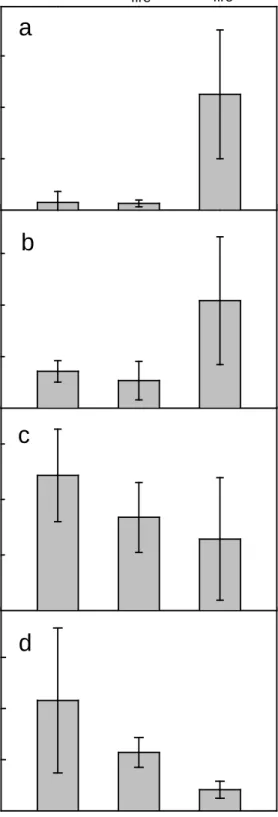
Total vegetation cover two years after fire was markedly higher in the SI burn (mean 117%, range 55-176%) than in the LI burn (mean 39%, range 27-60%). The higher cover in SI burn stands was composed largely of forbs and low shrubs (Fig. 2a,b). 95% CIs for differences indicated that, compared to LI burn stands, SI burn stands had higher forb cover by 26-80% and higher cover of low shrubs by 9-54%. Hardwood/shrub cover showed the opposite trend, decreasing with number of recent burns, although confidence intervals overlapped substantially among treatments (Fig. 2c). There were no strong differences in forb, low shrub, or hardwood/shrub cover between the LI burn and M/OG stands (Fig. 2a-c). Comparisons between the SI burn and M/OG stands were thus similar to comparisons between the SI and LI burns (Fig. 2).
Species richness increased with the number of recent fires and was highest in the SI burn (Table 1). This trend was similar when assessed at either the sample-wide (gamma) or plot (alpha) level. Fifty-nine species were detected in the SI burn sample compared to 42 in the LI burn sample. The SI burn had 4.2-19.8 (95% CI) more species per plot than the LI burn. Some portion of the richness in the SI burn was likely associated with comparatively high forb/low-shrub abundance. There were no strong differences in species richness between the LI burn and M/OG stands (Table 1). The higher richness in the SI burn was not dominated by a few species; Shannon evenness was fairly high (0.75, 95% CI 0.67-0.83) and not different from the LI burn (0.73, 95% CI 0.66-0.79).
Species composition differed little between the LI burn and M/OG stands (MRPP:
A=0.0095, P=0.33), but was strongly different in the SI burn compared to both the LI burn (A=0.13,
P=0.001) and M/OG stands (A=0.12, P=0.002). Consistent with the patterns of increased abundance and diversity, the difference was due primarily to additions or increases in the
abundance/frequency of several species in the SI burn, rather than species loss (Table 1). Most of the increases were of forb and low stature shrub species. Composition of hardwoods and shrubs showed a decreasing trend with number of recent burns in mean cover of Lithocarpus densiflorus
and Quercus chrysolepis, the dominant hardwoods of these plant associations (Table 1). Arbutus menziesii and Quercus sadleriana were mostly absent in the SI burn (Table 1). In contrast,
Arctostaphylos patula occurred in greatest abundance in the SI burn (Table 1). The increase in low vegetation components, coupled with reduced cover of major hardwood species, resulted in overall lower-stature communities in the SI burn (Fig. 2d).
Indicator Species Analysis results were also consistent with an additive effect of the SI fire (Table 1). Only two species, the fire-sensitive forbs Goodyera oblongifolia and Chimaphila
menziesii, were uniquely associated with M/OG conditions and only one species, Arbutus menziesii, was strongly associated with the LI fire. In contrast, seven species were strongly associated with the
SI fire (Table 1). Thus, overall, most species found in M/OG forests occurred with similar
abundance/frequency when subject to one or even two high-severity fires, with increases/additions of several disturbance-associated species in the SI burn.
Hardwood, shrub and conifer responses
Sprouting was the dominant mode of regeneration for hardwoods and woody shrubs in both the SI and LI burn (Fig. 3). On average, a greater proportion of prefire individuals were killed by the SI fire (did not sprout), but responses were highly variable (Fig. 3). At the individual level, sprouting probability was strongly positively associated with prefire size (GLME: F1,732=24.9, P<0.0001), and there was no strong shift in this relationship between the SI and LI burns (F1,10=1.78, P=0.21). Similarly, for individuals that sprouted, sprout biomass was strongly
positively associated with prefire size (HLM: F1,540=338.2, P<0.0001), and there was also no strong
shift in this relationship between the SI and LI burns (F1,10=1.12, P=0.32). However, relative to the
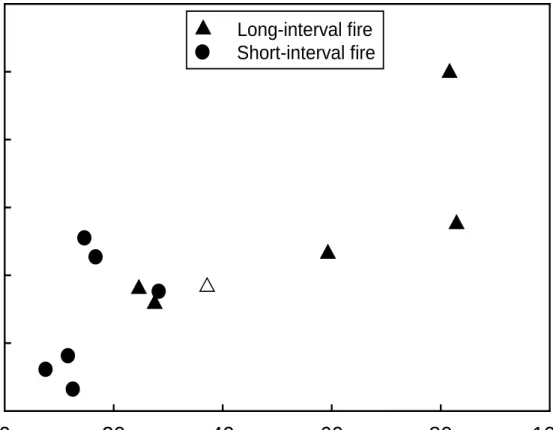
LI burn, individuals in the SI burn were smaller at the time of the second fire (mean prefire basal area = 15.3 cm2 shrub-1 in SI burn, 52.2 cm2 shrub-1 in LI burn), which was associated with smaller postfire size (mean sprout mass = 690.7 g shrub-1 in SI burn, 1271.8 g shrub-1 in LI burn) (Fig. 4). This trend was driven largely by Q. chrysolepis, followed by C. chrysophylla, A. menziesii, and A. patula (but notably not by L. densiflorus, which had similar prefire basal area between treatments). Thus, individuals of a given size had the same sprouting probability and biomass in both treatments, but plot-averaged biomass was lower in the SI burn since individuals were smaller prior to the second fire (Fig. 4).
Conifer establishment roughly spanned an order of magnitude in both burn areas, ranging from 298-6086 ha-1 (median 1495 ha-1) in the SI burn and 406-2349 ha-1 (median 1002 ha-1) in the LI burn. There was no significant difference in conifer regeneration density between the SI and LI burns (95% CI for SI:LI ratio = 0.4-5.8). Conifer seedling composition in SI burn plots was 99%
Pseudotsuga menziesii with incidental amounts of Pinus attenuata and Pinus lambertiana, whereas LI burn plots contained 66% Pseudotsuga menziesii, 20% Pinus attenuata, and 11% Pinus
lambertiana. Nearly all seedlings became established in 2004, two years postfire, except for
knobcone pine (primarily 2003). Seedlings occupied most plot quadrants in both the SI and LI burn (mean of 80% and 93% occupancy, respectively). We detected no strong difference in available substrate proportions between the SI and LI burn (MANOVA F5,6=1.45, P =0.33), with mean values
of 24-32% mineral soil, 47-56% rock, 10-15% litter, 5-10% wood, and <1% moss/lichen. Substrates utilized by conifer seedlings largely reflected the pattern of availability in both the SI and LI fires.
Trait analysis
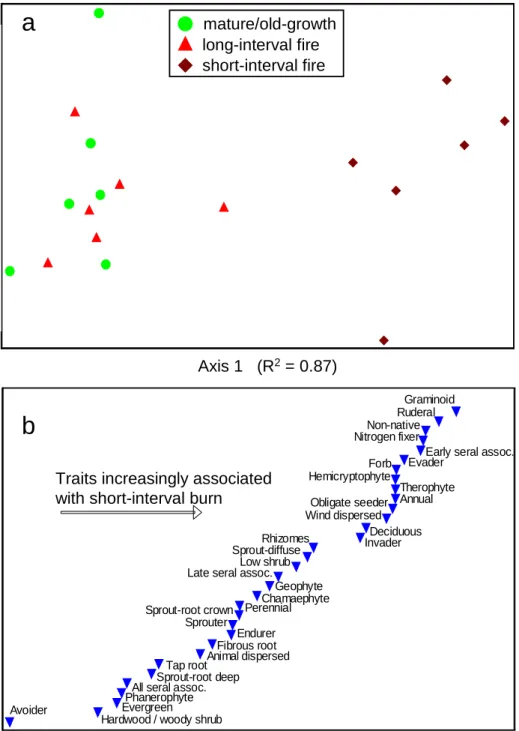
Trait analysis showed little difference between communities in M/OG stands and the LI burn, while the SI burn differed markedly from the other two treatments (Fig. 5a). The ordination of plant functional traits had an R2 with the original trait distance matrix of 0.98; ranks of scores along ordination Axis 1 (burn axis) show increasing associations of functional traits with the SI burn (Fig. 5b). Similar to species patterns, the difference of the SI burn was primarily due to increases in the abundance/frequency of several disturbance-associated traits, rather than reductions in late-seral type traits (Table 2). The SI burn was associated with increases in ruderal, small-stature, high turnover community components including native annual forbs, low shrubs and deciduous species (Fig. 5, Table 2). Obligate seeders, especially species with soil seed banks (evader strategy) or wind-dispersed seeds (invader strategy), responded positively to the SI burn. Sprouters (endurer strategy) exhibited a gradient in response, with those that sprout diffusely from rhizomes better represented in the SI burn than those that sprout from root crowns/burls, which include evergreen hardwoods and shrubs. Fire-sensitive species (avoiders) were strongly negatively associated with number of recent burns. Nitrogen (N) fixers were most abundant in the SI burn, primarily due to forbs of the Fabacae family (e.g., Lotus crassifolius, Lupinus spp., Thermopsis macrophyllum).
Species typically associated with late seral forests were located in the middle of the burn axis, reflecting their general presence across all treatments.
Within the trait ordination, number of recent burns had a stronger Pearson correlation coefficient (r=0.87 with Axis 1) than any of the environmental parameters (0.14< |r| <0.36) (Fig. 5) regardless of axis rotation, suggesting that disturbance drove much of the community gradient within this range of environmental conditions. Correlations were generally low between
environmental variables and both ordination axes. Categorical variables for plant association and soil type (not shown) were well distributed across axes, suggesting these factors were not major drivers of compositional gradients relative to disturbance history.
DISCUSSION
The early postfire data were most consistent with model 3: interval-dependent dynamics with no decline in diversity or abundance after SI fire (or ‘re-burn’). The SI burn resulted in unique postfire communities containing nearly all species found in mature/old-growth stands and in the long-interval burn, plus additions or increases in several disturbance-associated species (Table 1). This shift to higher richness and abundance, coupled with lower dominance by woody broadleaf components (Fig. 2), lends comparatively little support for model 1 (cyclical dynamics independent of fire interval) or model 2 (interval-dependent dynamics with major reductions in
diversity/abundance). Regeneration of major structural species (e.g., conifers, hardwoods) in the SI burn suggested that, in the absence of repeated severe fires, these stands retained the potential to develop toward mature forest condition.
Vegetation abundance, diversity and composition
The consistent presence of a core assemblage including nearly all species found in mature forests suggests high community resilience following one and even two stand-replacing fires. The
unanticipated increase in species richness in the SI fire was largely composed of ruderal or
disturbance-associated flora such as Rubus spp. and bracken fern (Pteridium aquilinum), the latter also noted by Isaac (1940) following recurrent burning of cutover areas in the Douglas-fir region. The pattern we observed—SI fire leading to lesser dominance by woody broadleaf components, generating gaps in which additions of ruderal/low-stature species lead to higher species richness and cover—is similar to that observed by Delitti et al. (2005) in a Spanish Mediterranean ecosystem.
The mechanisms for increases in early seral species and total richness in the SI burn could be abiotic, such as changes to soil properties that favor such species, or biotic, as in the
development of a propagule bank for early seral species during the 15 years between fires (Noble & Slatyer, 1980). Based on the abundance in the SI burn of short-lived, rapidly maturing species (ruderal, annual), and those with long-lived seed banks (evaders) (Table 2, Fig. 5), we infer that increases in early seral species were driven primarily by the biotic mechanism of propagule availability. This mechanism represents a positive feedback legacy effect, whereby small
compositional changes following a single fire (minor increases in early seral species and associated seed banks) lead to greater modifications following a second fire (major increases in these species).
Pre-existing variability among treatments could explain the differences we observed, particularly because of the lack of spatial interspersion of treatments. However, a nearly identical core set of species was found in all three treatments which provides supporting evidence that the sample groups were comparable prior to recent disturbance. Moreover, the primary difference observed in the SI burn—addition of disturbance-associated components—is logically consistent with a fire response.
Hardwood, shrub and conifer responses
Hardwood and shrub regeneration. Hardwood and shrub individuals of a given size had similar sprouting probability and biomass in the SI and LI burns. A 15-year interval between fires
appears sufficient for belowground carbohydrate reserves to support sprouting following top-kill for the species examined in this study. Similarity of sprouting between treatments also suggests there was no difference in heat-related damage to below-ground tissues; thus fire severity was apparently similar across treatments in this respect. Nevertheless, it is possible that a shorter interval fire, or further repeated fires, could reduce the sprouting response relative to what we observed (Delitti et al., 2005).
Because the relationship between postfire sprouting biomass and prefire size was the same across treatments, the lower postfire hardwood/shrub cover and biomass in the SI treatment may be due to the smaller size of individuals at the time of the second fire (Fig. 4). This may be associated with: a) the conversion by the first fire of large hardwood trees to smaller, multi-stemmed sprouts with lower leaf/basal area (see Bond & van Wilgen, 1996); b) a compositional shift toward smaller species that colonized the site over time following the first burn (e.g. A. patula) (Table 1); or c) pre-existing differences in hardwood/shrub sizes. The conversion by the first fire of tree forms to sprout-shrub forms, and its feedback to re-burn response (smaller subsequent sprouts), is a possible mechanism by which recurrent burning could reduce dominance by hardwoods and shrubs during early succession, creating growing space for other vegetation (model 3, see Fig. 2).
Conifer establishment. Initial postfire conditions were apparently not limiting to total conifer establishment in the Silver-Biscuit SI burn. Thus, if differences emerge later between conifer regeneration in the SI vs. LI fires (sensu Gray & Franklin, 1997), it could be inferred that latent differences (e.g. competition, herbivory, soil properties) drove the difference. Dense early conifer establishment in the SI burn likely reflected dispersal of seed from nearby contiguous sources (patches of surviving trees) and suitable germination substrates, similar to the LI burn. Distance to contiguous seed source ranged from 85-300 m for SI burn plots compared to 80-370 m for LI burn plots, a range applicable to 70-90% of the stand-replacement portions of the Biscuit Fire
excluding serpentine areas (based on U.S. Forest Service GIS data; see Donato, 2008). (Note that precipitation during postfire growing seasons, an important factor for regeneration and one that may vary widely among years, likely did not contribute abnormally to regeneration, as it was generally within one S.D. of 30-yr mean, and if anything was generally below average [Donato 2008].)
Mixed severity fire typically produces complex patterns of tree mortality on the landscape (Agee, 1993; Agee, 2005). These patterns result in much of a burned area being close to live-tree seed sources, even in large fires with substantial stand replacement (Turner et al., 1994). In the Silver-Biscuit SI burn, areas that burned with low severity in the initial fire tended to reburn with low severity (Thompson et al., 2007), such that the mosaic of available seed sources largely
persisted through the second fire. This persistence of the mosaic over certain time scales may result in well dispersed seed sources following repeated mixed severity fires. This dynamic differs from observations of sparse regeneration following SI fires in ecosystems reliant on in situ re-seeding from serotinous conifers (fire interval < reproductive age) (Eugenio et al., 2006; Johnstone & Chapin, 2006) or on off-site seed sources as in this system, but with seed sources reduced by the second fire (Isaac & Meagher, 1936). Our inference of off-site source in this study is based on nearly all seedlings establishing two years postfire, too late for a dead-tree canopy seed bank source.
Trait analysis
Analysis of plant functional traits showed several strong associations with recent fire history, providing support for the use of functional traits in predicting vegetation response to short-interval severe fires (Table 2, Fig. 5). Some associations were intuitive while others were
unanticipated. As we hypothesized, several disturbance-associated traits and functional types were highly associated with the SI burn. Broadly applicable examples included invader and evader regenerative strategies, ruderal/early seral associates, and wind-dispersed seeds.
Several different regenerative mechanisms were important in the SI fire, including
vegetative sprouting, in situ seed banks, and dispersal from ex situ seed sources. Assessing Noble and Slatyer’s (1980) vital attributes against the 15-year fire interval, forbs and low shrubs were ‘G’ types having rapid maturation time and stored soil seed banks; hardwoods and shrubs were ‘S’ and/or ‘V’ types, having vegetative sprouting ability and/or long-lived soil seed banks; and conifers were ‘D’ types, having well-dispersed propagules from surrounding live tree sources. This diversity of available mechanisms likely in part underlies the robust vegetation response to SI fire.
Rapid time to reproduction was a major factor in species that increased following SI fire. Ruderal and low-stature community components including many low shrubs and forbs (mainly hemicryptophytes and therophytes)—particularly those with rapid maturation and shorter-lived tissues such as annuals and deciduous species—responded positively to the SI burn (Table 2). Delitti et al. (2005) also observed increases in low shrubs and forbs, especially hemicryptophytes, following recurrent fires in a Spanish Mediterranean ecosystem. For broadleaf evergreen woody vegetation, however, there was little association with any fire history, although these tended to have lower mass/cover in the SI burn—also similar to Delitti et al. (2005). Thus, species investing more resources in early reproduction, and less in long-lived leaves and secondary tissues (wood), may be expected to be relatively dominant immediately following recurrent stand-replacing fires (Table 2; Noble & Slatyer, 1980).
Consistent with observations made by Lloret et al. (2005) in a Spanish Mediterranean ecosystem, seeder species were associated with recurrent fires while sprouter species (particularly those that sprout from central root crowns or burls) did not show strong associations with recent fire history (Table 2). The exception in our study was that species that sprout from diffuse rhizomatous structures responded positively to the SI fire. Diffuse sprouters may have increased due to a legacy
effect associated with establishment of these species after the first fire, or due to increased lateral growth associated with repeated top (apical) kill (Riba, 1998).
Surprisingly, very few traits were strongly negatively associated with the SI burn (Table 2). Avoiders were the primary negative responders, but the community we studied only included four such species—the forbs and low shrubs Goodyera oblongifolia, Chimaphila menziesii, Chimaphila umbellata, and Pachystima myrcinites. However, most species typically associated with late seral conditions (in, e.g., the FEIS database) were present with similar relative abundance/frequency in M/OG, LI burn, and SI burn stands. This response, coupled with the low number of species classified as avoiders, likely reflects a flora well-suited to the variable fire regime of the Klamath-Siskiyou region.
The functional trait patterns we quantified may provide insight into differing responses to recurrent fires among ecosystems. Regions in which negative overall responses have been reported (e.g., Diaz-Delgado et al., 2002; Kutiel, 1997) may be drier and/or less productive than the
Klamath-Siskiyou, with greater proportional representation of sprouting woody species with slower maturation, and fewer low-stature herbaceous components (e.g., hemicryptophytes, therophytes), ruderal species, or invader/evader regenerative strategies. Also, interactions with recent
management history are important (Paine et al., 1998) and vary widely by region; our study areas were relatively uninfluenced by recent forest management activities such as timber harvest. Perhaps most importantly, the Silver-Biscuit SI burn occurred in a mixed-severity fire regime context, in which wide variations in fire interval and severity have likely occurred for millennia.
Short-interval fire, succession, and mixed-severity fire regimes
Postfire succession can be divided into two phases (Noble & Slatyer, 1980): the first, immediately postfire, when competition for resources is low and species’ abundance are driven primarily by regenerative processes (the focus of this study); and the second, after this initial pulse,
when resource competition becomes progressively important. Variations in the first phase may strongly influence the second. Results of this study suggest that SI fires produce unique postfire communities relative to a single long-interval fire, but the degree to which this affects long-term trajectories remains an interesting hypothesis to test. Moreover, it remains possible that elements of models 1 and 2 could manifest as these stands develop. For example, the presence in the SI burn of regenerating conifers and hardwoods (the major structural species of these forest types) suggests that, in the absence of continued stand-replacing fires, succession may converge with that following a LI fire, trending toward mature forest condition—i.e., elements of model 1. Alternatively, if for example, soil chemistry is dramatically altered by two fires (beyond the scope of this study), tree growth and thus canopy development may eventually differ in the SI burn—i.e., model 2.
The abundance, character, and landscape distribution of short-interval burns have likely varied widely over time. Important factors in this variability may include long-term climatic variability (Whitlock et al., 2003) as well as recent fire exclusion which may have influenced prefire vegetation conditions (Agee, 1991; Taylor & Skinner, 1998). Also, stand-scale variation in fire interval may be important since feedbacks between multiple fires may exhibit threshold
behavior, with increased probability of high-severity reburning over short time scales (Thompson et al., 2007), but decreased probability over longer time scales that allow for canopy closure and large stature trees (Odion et al., 2004). Where positive feedbacks exist, continual short-interval fires could lead to further shifts and altered successional trajectories. Lastly, differences in fire severity among short-interval events would likely produce very different outcomes to what we observed.
Postfire management activities are often focused, in part, on reducing anticipated adverse effects of repeat high-severity fires (expectation of model 2; USDA, 1988). For certain objectives, such as the rapid attainment of late-successional condition, recurrent stand-replacement fires are clearly counterproductive in the short term. However, these events may be consistent with
objectives for maintaining characteristic disturbance processes and regional vascular plant diversity (see Landres et al., 1999). These results indicate that much of the native biota is resilient to
‘extreme’ events such as recurrent severe fire. Given the Klamath-Siskiyou region's characteristic patterns of fire severity, productivity, and ignition source, there is good reason to believe that short-interval severe fires have been a component of the fire regime historically. These events contribute to the landscape heterogeneity inherent to mixed-severity fire regimes, in which variability in fire frequency, severity, and pattern can be more important than central tendencies (Agee, 2005). Where consistent with land-use objectives, process-based disturbance management could include this variation, perpetuating a diversity of conditions across the landscape.
ACKNOWLEDGMENTS
We thank B. McCune, C. Eisenberg, D. Hibbs, D. Peterson, G. Meigs, G. Riegel, J. Campbell, J. Halofsky, J. Jones, J. Tappeiner, J. Thompson, L. Kayes, and T. Atzet for helpful reviews and/or discussions. Two anonymous reviewers greatly improved the manuscript. M. Huso and A. Gitelman provided statistical assistance and reviews. A. Pfleeger, D. Clay, J. Boerner, L. Reidlinger, R. Linden, and S. Hamilton braved brush and poison oak with us to collect these data. The views and conclusions contained in this document are those of the authors and should not be interpreted as representing the opinions or policies of the U.S. Government. Mention of trade names or
commercial products does not constitute their endorsement by the U.S. Government. This work was facilitated by the Siskiyou National Forest and Medford BLM. Funding was provided by the U.S. Joint Fire Science Program and Department of Energy (DF-FG02-04ER63917).
SUPPLEMENTARY MATERIAL
The following supplementary material is available for this article: Appendix S1Complete species list
Appendix S2Hardwood and shrub mass allometry
LITERATURE CITED
Agee, J.K. (1991) Fire history along an elevational gradient in the Siskiyou Mountains, Oregon.
Northwest Science, 65, 188-199.
Agee, J.K. (1993) Fire ecology of Pacific Northwest forests Island Press, Washington, D.C. Agee, J.K. (2005) The complex nature of mixed severity fire regimes. In Mixed Severity Fire
Regimes: Ecology and Management (eds L. Taylor, J. Zelnik, S. Cadwallader & B. Hughes). Association for Fire Ecology, Spokane, WA.
Agee, J.K. & Huff, M.H. (1987) Fuel succession in a western hemlock/Douglas-fir forest. Canadian Journal of Forest Research, 17, 697-704.
Atzet, T., White, D.E., McCrimmon, L.A., Martinez, P.A., Fong, P.R., & Randall, V.D. (1996). Field guide to the forested plant associations of southwestern Oregon. USDA Forest Service, Pacific Northwest Region.
Beck, A.M. & Vogl, R.J. (1972) The effects of spring burning on rodent populations in a brush prairie savanna. Journal of Mammalogy, 53, 336-346.
Bingham, B.B. & Sawyer, J.O. (1991). Distinctive features and definitions of young, mature, and old-growth Douglas-fir/hardwood forests. In Wildlife and Vegetation of Unmanaged
Douglas-fir Forests (eds L.F. Ruggiero, K.B. Aubry, A.B. Carey & M.H. Huff), Vol. PNW-GTR-285, pp. 362-377. USDA Forest Service, PNW Research Station, Portland.
Bond, W.J. & van Wilgen, B.W. (1996) Fire and Plants Chapman & Hall, London.
Daly, C., Gibson, W.P., Taylor, G.H., Johnson, G.L., & Pasteris, P. (2002) A knowledge-based approach to the statistical mapping of climate. Climate Research, 22, 99-113.
Delitti, W., Ferran, A., Trabaud, L., & Vallejo, V.R. (2005) Effects of fire recurrence in Quercus coccifera L. shrublands of the Valencia Region (Spain): I. plant composition and
productivity. Plant Ecology, 177, 57-70.
Diaz-Delgado, R., Lloret, F., Pons, X., & Terradas, J. (2002) Satellite evidence of decreasing resilience in Mediterranean plant communities after recurrent wildfires. Ecology, 83, 2293-2303.
Donato, D.C. (2008) Forest vegetation and fuel dynamics following high-severity fire, re-burn, and postfire management in the Siskiyou Mountains, OR. Dissertation, Oregon State University, Corvallis, OR.
Dufrene, M. & Legendre, P. (1997) Species assemblages and indicator species: The need for a flexible asymmetrical approach. Ecological Monographs, 67, 345-366.
Elzinga, C.L., Salzer, D.W., & Willoughby, J.W. (1998). Measuring and monitoring plant populations, Rep. No. 1730-1. USDI Bureau of Land Management, Denver.
Eugenio, M., Verkaik, I., Lloret, F., & Espelta, J.M. (2006) Recruitment and growth decline in
Pinus halepensis populations after recurrent wildfires in Catalonia (NE Iberian Peninsula).
Forest Ecology and Management, 231, 47-54.
Franklin, J.F. & Dyrness, C.T. (1973) Natural vegetation of Oregon and Washington Pacific Northwest Forest and Range Experiment Station, USDA Forest Service, Portland, OR. Franklin, J.F. & Hemstrom, M.A. (1981). Aspects of succession in the coniferous forests of the
Pacific Northwest. In Forest succession (eds D.C. West, H.H. Shugart & D.B. Botkin). Springer-Verlag, New York.
Fulé, P.Z., Cocke, A.E., Heinlein, T.A., & Covington, W.W. (2004) Effects of an intense prescribed forest fire: Is it ecological restoration? Restoration Ecology, 12, 220-230.
Gotelli, N.J. & Colwell, R.K. (2001) Quantifying biodiversity: Procedures and pitfalls in the measurement and comparison of species richness. Ecology Letters, 4, 379-391. Gray, A.N. & Franklin, J.F. (1997) Effects of multiple fires on the structure of southwestern
Washington forests. Northwest Science, 71, 174-185.
Harrington, T.B. & Tappeiner, J.C. (1997) Growth responses of young Douglas-fir and tanoak 11 years after various levels of hardwood removal and understory suppression in southwestern Oregon, USA. Forest Ecology and Management, 96, 1-11.
Hickman, J.C. (1993) The Jepson manual : higher plants of California University of California Press, Berkeley.
Isaac, L.A. (1940) Vegetation succession following logging in the Douglas-fir region with special reference to fire. Journal of Forestry, 38, 716-721.
Isaac, L.A. & Meagher, G.S. (1936). Natural reproduction on the Tillamook Burn two years after the fire. Pacific Northwest Forest Experiment Station, USDA Forest Service, Portland, OR. Johnstone, J.F. (2006) Response of boreal plant communities to variations in previous fire-free
interval. International Journal of Wildland Fire, 15, 497-508.
Johnstone, J.F. & Chapin, F.S. (2006) Fire interval effects on successional trajectory in boreal forests of northwest Canada. Ecosystems, 9, 268-277.
Kutiel, P. (1997) Spatial and temporal heterogeneity of species diversity in a Mediterranean ecosystem following fire. International Journal of Wildland Fire, 7, 307-315.
Landres, P.B., Morgan, P., & Swanson, F.J. (1999) Overview of the use of natural variability concepts in managing ecological systems. Ecological Applications, 9, 1179-1188. Lloret, F., Estevan, H., Vayreda, J., & Terradas, J. (2005) Fire regenerative syndromes of forest
woody species across fire and climatic gradients. Oecologia, 146, 461-468.
Magurran, A.E. (1988) Ecological diversity and its measurement Princeton University Press, Princeton, NJ.
McCune, B. & Grace, J.B. (2002) Analysis of ecological communities MjM Software Design, Gleneden Beach, OR.
McCune, B. & Keon, D. (2002) Equations for potential annual direct incident radiation and heat load. Journal of Vegetation Science, 13, 603-606.
McCune, B. & Mefford, M.J. (2006) PC-ORD. Multivariate Analysis of Ecological Data. Version 5.04. MjM Software, Gleneden Beach, Oregon, U.S.A.
Noble, I.R. & Slatyer, R.O. (1980) The use of vital attributes to predict successional changes in plant communities subject to recurrent disturbances. Vegetatio, 43, 5-21.
Odion, D.C., Frost, E.J., Strittholt, J.R., Jiang, H., Dellasala, D.A., & Moritz, M.A. (2004) Patterns of fire severity and forest conditions in the western Klamath Mountains, California.
Conservation Biology, 18, 927-936.
Paine, R.T., Tegner, M.J., & Johnson, E.A. (1998) Compounded perturbations yield ecological surprises. Ecosystems, 1, 535-545.
Ramsey, F.L. & Schafer, D.W. (2002) The statistical sleuth, 2nd edition, Duxbury, Pacific Grove, CA.
Raunkiær, C. (1934) The life forms of plants and statistical plant geography Clarendon Press, Oxford.
Riba, M. (1998) Effects of intensity and frequency of crown damage on resprouting of Erica arborea L. (Ericaceae). Acta Oecologica, 19, 9-16.
Rowe, J.S. (1983). Concepts of fire effects on plant individuals and species. In The role of fire in northern circumpolar ecosystems (eds R.W. Wein & D.A. Maclean), pp. 135-154. John Wiley and Sons, New York, NY.
Shatford, J.P.A., Hibbs, D.E., & Puettmann, K.J. (2007) Conifer regeneration after forest fire in the Klamath-Siskiyous: How much, how soon? Journal of Forestry, 105, 139-146.
Stuart, J.D. & Salazar, L.A. (2000) Fire history of white fir forests in the coastal mountains of northwestern California. Northwest Science, 74, 280-285.
Taylor, A.H. & Skinner, C.N. (1998) Fire history and landscape dynamics in a late-successional reserve, Klamath Mountains, California, USA. Forest Ecology and Management, 111, 285-301.
Thompson, J.R., Spies, T.A., & Ganio, L.M. (2007) Re-burn severity in managed and unmanaged vegetation in a large wildfire. Proceedings of the National Academy of Science, 104, 10743-10748.
Turner, M.G., Hargrove, W.W., Gardner, R.H., & Romme, W.H. (1994) Effects of fire on landscape heterogeneity in Yellowstone National Park, Wyoming. Journal of Vegetation Science, 5, 731-742.
USDA (1988). Silver Fire Recovery Project Final Environmental Impact Statement. USDA Forest Service, Pacific Northwest Region.
USDA (1995). Soil survey geographic (SSURGO) database, Rep. No. Misc. Pub. 1527. USDA Natural Resource Conservation Service, Fort Worth, TX.
USDA (2003) Field instructions for the annual inventory of Washington, Oregon and California
Forest Inventory and Analysis Program, USDA Forest Service, PNW Research Station, Portland.
Whitlock, C., Shafer, S.L., & Marlon, J. (2003) The role of climate and vegetation change in shaping past and future fire regimes in the northwestern US and the implications for ecosystem management. Forest Ecology and Management, 178, 5-21.
Whittaker, R.H. (1960) Vegetation of the Siskiyou mountains, Oregon and California. Ecological Monographs, 30, 279-338.
Wittenberg, L., Malkinson, D., Beeri, O., Halutzy, A., & Tesler, N. (2007) Spatial and temporal patterns of vegetation recovery following sequences of forest fires in a Mediterranean landscape, Mt. Carmel Israel. CATENA, 71, 76-83.
Zedler, P.H., Gautier, C.R., & McMaster, G.S. (1983) Vegetation change in response to extreme events: the effect of a short interval between fires in California chaparral and coastal scrub.
Table 1. Indicator values, diversity statistics, and mean abundance for eight of the most common hardwoods/shrubs, low shrubs, and forbs by recent burn history.
Species Indicator value* —group Mature/ old-growth [M/OG] Long-interval fire [LI] Short-interval fire [SI] % cover x (S.E.) % freq. % cover x (S.E.) % freq. % cover x (S.E.) % freq. Forbs
Chimaphila menziesii 85.7 – M/OG 0.5 (0.2) 100 0.0 (0.0) 0 0.1 (0.1) 17
Goodyera oblongifolia 66.7 – M/OG 0.3 (0.2) 67 0.0 (0.0) 0 0.0 (0.0) 0
Achlys triphylla 44.7 – SI 1.1 (0.7) 50 0.3 (0.1) 67 2.7 (1.4) 67 Graminoid species 88.2 – SI 0.1 (0.1) 17 0.0 (0.0) 0 0.6 (0.3) 100 Lotus crassifolius 64.7 – SI 0.0 (0.0) 0 0.3 (0.3) 17 9.5 (6.7) 67 Pteridium aquilinum 95.4 – SI 0.0 (0.0) 17 0.9 (0.6) 50 18.7 (9.8) 100 Trientalis latifolia 93.3 – SI 0.0 (0.0) 0 0.2 (0.1) 67 2.0 (1.0) 100 Vancouveria hexandra 66.3 – SI 0.0 (0.0) 0 0.0 (0.0) 17 4.3 (2.3) 67 Low shrubs
Polystichum munitum 21.0 – M/OG 0.7 (0.6) 33 0.0 (0.0) 17 0.4 (0.2) 50
Berberis nervosa 44.1 – SI 4.2 (1.5) 100 3.6 (1.1) 100 6.1 (2.0) 100 Rosa gymnocarpa 55.9 – SI 0.7 (0.3) 67 1.2 (0.4) 83 2.3 (0.5) 100 Rubus ursinus 97.5 – SI 0.0 (0.0) 17 0.5 (0.3) 50 19.0 (7.8) 100 Rubus leucodermis 65.0 – SI 0.0 (0.0) 0 0.0 (0.0) 17 0.8 (0.4) 67 Symphoricarpus mollis 94.4 – SI 0.1 (0.1) 17 0.1 (0.0) 33 3.2 (1.2) 100 Whipplea modesta 20.0 – SI 0.5 (0.2) 50 0.4 (0.2) 67 1.3 (1.1) 33 Xerophyllum tenax 36.2 – SI 1.9 (1.9) 50 0.4 (0.4) 17 2.7 (1.1) 67
Hardwoods and woody shrubs
Lithocarpus densiflorus 39.6 – M/OG 13.6 (4.4) 83 8.4 (2.1) 100 6.6 (2.5) 100
Quercus chrysolepis 34.3 – M/OG 11.0 (4.2) 67 6.9 (2.0) 100 3.5 (3.1) 50
Quercus sadleriana 25.4 – M/OG 9.1 (8.6) 33 2.8 (2.2) 33 0.0 (0.0) 0
Arbutus menziesii 75.3 – LI 0.2 (0.2) 17 4.7 (1.3) 83 0.3 (0.2) 33
Ceanothus velutinus 12.5 – LI 0.0 (0.0) 0 0.4 (0.2) 50 1.1 (1.1) 17
Garrya species 18.5 – LI 1.7 (1.7) 17 2.4 (2.3) 33 0.2 (0.2) 33
Arctostaphylos patula 46.8 – SI 1.8 (1.3) 33 0.7 (0.6) 50 5.8 (3.1) 67
Chrysolepis chrysophylla 23.5 – SI 0.8 (0.8) 17 1.3 (1.3) 17 1.9 (1.4) 50
Mean # of species detected in ha plot (95% CI) 14.0 (9.1 – 18.9) 19.2 (11.5 – 26.8) 31.2 (26.5 – 35.8)
Total # of species detected in sample 39 42 59
# of significant indicator species 2 1 7
Notes: n=6 per group.
* Metric combining relative abundance and frequency for most strongly associated group (burn history) (Dufrene and Legendre 1997). Range 0-100, 100=always and only occurs in given group. Values are bolded for strong (≥65) affinities, which have P≤0.01 by randomization test.
Table 2. Results of indicator analysis of plant traits by recent burn history.
Trait Description Indicator
value*
Group† of maximum association General life form
Forb little or no wood above ground; aboveground parts of <1 yr duration 88.9 SI
Graminoid monocotyledonous plant of the family Poaceae 95.7 SI
Low shrub low-stature shrubs, generally with little secondary growth 66.7 SI
Hardwood/shrub broadleaf woody spp., often multi-stemmed, hardwoods can be trees 43.8 M/OG Raunkiær life form
Phanerophyte perennating tissue >25 cm above soil surface (trees, lg. woody shrubs) 40.7 M/OG
Chamaephyte perennating tissue within ~25 cm of soil surface (typically low shrubs) 60.3 SI
Hemicryptophyte perennating tissue at the soil surface (forbs and trailing shrubs) 88.0 SI
Therophyte perennating tissue contained in seed (annual forbs) 87.0 SI
Geophyte perennating tissue below the soil surface (rhizomatous perennials) 61.6 SI Fire regenerative strategy
Avoider fire-sensitive; usually shade-tolerant, late-successional 77.4 M/OG
Invader highly dispersive, pioneering fugitives with short-lived disseminules 78.9 SI
Evader long-lived propagules stored in soil/canopy that germinate after fire 90.3 SI
Endurer sprouts from above- or belowground structures when top-killed 52.7 SI General structure and function
Rhizomes having underground, often elongate, more or less horizontal stems 71.7 SI
Fibrous root root system composed of many roots similar in length and thickness 45.9 LI
Tap root main, tapered root that generally grows straight down into soil 36.6 SI
Obligate Seeder incapable of sprouting after top-kill; relies on regeneration by seed 92.0 SI
Sprout-root crown sprouting occurs primarily from root crown (surface) 54.0 SI
Sprout-root deep sprouting occurs primarily from central belowground burl/lignotuber 34.6 SI
Sprout-diffuse sprouting occurs from >1 location, generally from spreading rhizomes 69.8 SI
Nitrogen fixer association with microbes that fix atmospheric N to usable forms 96.3 SI
Deciduous leaves not persistent >1 yr 81.4 SI
Evergreen leaves persistent >1 yr 41.6 M/OG
Annual completing life cycle within one year or growing season 87.0 SI
Perennial living more than two years or growing seasons 54.9 SI Seed dispersal vector
Wind dispersed seeds primarily dispersed by wind 83.8 SI
Animal dispersed seeds primarily dispersed by animals 45.4 SI Successional/community association
Late seral assoc. most associated w/ closed late seral forest (not exclusively); shade tolerant 64.3 SI
Early seral assoc. most associated w/ open early seral forest (not exclusively); shade intolerant 92.4 SI
All seral assoc. typically found in both early and late seral forests 40.6 M/OG
Non-native not native to Pacific Northwest region 45.8 SI
Notes: Sources for trait definition/assignment were Raunkiær (1934), Rowe (1983), Agee (1993), Hickman (1993), www.plants.usda.gov, fs.fed.us/database/feis. Conifer seedlings were analyzed separately due to quantification by density rather than cover.
* Metric combining relative abundance and frequency for most strongly associated group (treatment) by Indicator Species Analysis (Dufrene and Legendre 1997). Range 0-100, 100=always and only occurs in given group. Values are bolded for strong (≥65) affinities, which have significance level P≤0.01 by randomization
test.
† M/OG = unburned mature/old-growth, LI = long-interval fire (single burn), SI = short-interval fire (re-burn); n=6 per group.
30 km
2002 Biscuit Fire
(re-burned in 2002)
N
Study stand
1987 Silver Fire
Kalmiopsis
Wilderness
Oregon Pacific Ocean 120° W 45° N Calif.Figure 1. The 1987 Silver Fire was re-burned by the 2002 Biscuit Fire; both fires were mixed-severity. In this study of repeated severe disturbance, sampling of both burns was restricted to stand-replacement patches only. We sampled all large, unmanaged twice-burned forest stands we could find (n=6), plus an equivalent number of once-burned and unburned stands well-matched in terms of abiotic and biotic site characteristics (see text).
B roadl eaf v eg . hei g ht ( dm ) H ar dw ood & s hr ub c ov er ( % ) 0 15 30 45 Low s hr ub c ov er ( % ) 0 20 40 60 F or b c ov er ( % ) 0 25 50 75
a
b
c
d
Mature/ old-growth Long-interval fire Short-interval fire 5 10 15 Mature/ old-growth Long-interval fire Short-interval fireFigure 2. Mean (±95% CI): (a) forb cover, (b) low shrub cover, (c) hardwood/shrub cover, and (d) broadleaf vegetation height, for mature/old growth stands, long-interval burn stands, and short-interval burn stands (0, 1, and 2 recent burns, respectively). Heights were calculated as a weighted average based on cover x height of each species.
0
20
40
60
80
100
%
of
har
dw
ood and s
hr
ub i
ndi
v
idual
s
Seeding
Sprouting
Killed
Long-interval fire Short-interval fire
Figure 3. Hardwood and shrub reproductive modes by percent of individuals in each plot (mean ±95% CI). No strong shift in dominant regenerative mode in the SI burn was apparent; sprouting dominates over seeding in both treatments. There is suggestive evidence of higher mortality of prefire individuals in SI burn plots; however, variability was high. See Appendix S3 for species composition of seeding and sprouting individuals.
Mean prefire size of top-killed
hardwood and shrub individuals (cm
2basal area)
0
20
40
60
80
100
M
ean pos
tf
ir
e s
iz
e of
har
dw
ood and
s
hr
ub i
ndi
v
idual
s
(
g abov
egr
ound bi
om
as
s
)
0
500
1000
1500
2000
2500
3000
Long-interval fire Short-interval fireFigure 4. Mean postfire biomass of hardwoods and shrubs as a function of mean prefire size of hardwoods and shrubs. Data are shown aggregated by plot for clearer visual display of trend; regression analysis was performed on 554 individual shrubs, with plot as a random effect. There was no strong evidence for differences between burn histories in the relationship between pre- and postfire size (HLM: F1,10=1.12, P=0.32), but individuals were smaller prior to the