Sentence-level grammatical
error identification as
sequence-to-sequence correction
The Harvard community has made this
article openly available.
Please share
how
this access benefits you. Your story matters
Citation
Schmaltz, Allen, Yoon Kim, Alexander M. Rush, Stuart M. Shieber.
2016. Sentence-level grammatical error identification as
sequence-to-sequence correction. Proceedings of the Eleventh Workshop on
Innovative Use of NLP for Building Educational Applications, NAACL
HLT, San Diego, California, June 16, 2016.
Citable link
http://nrs.harvard.edu/urn-3:HUL.InstRepos:27266472
Terms of Use
This article was downloaded from Harvard University’s DASH
repository, and is made available under the terms and conditions
applicable to Open Access Policy Articles, as set forth at
http://
nrs.harvard.edu/urn-3:HUL.InstRepos:dash.current.terms-of-use#OAP
Sentence-Level Grammatical Error Identification
as Sequence-to-Sequence Correction
Allen Schmaltz Yoon Kim Alexander M. Rush Stuart M. Shieber
Harvard University
{schmaltz@fas,yoonkim@seas,srush@seas,shieber@seas}.harvard.edu
Abstract
We demonstrate that an attention-based encoder-decoder model can be used for sentence-level grammatical error identi-fication for the Automated Evaluation of Scientific Writing (AESW) Shared Task 2016. The attention-based encoder-decoder models can be used for the generation of corrections, in addition to error identification, which is of interest for certain end-user applications. We show that a character-based encoder-decoder model is particularly effective, outperforming other results on the AESW Shared Task on its own, and showing gains over a word-based counterpart. Our final model—a combination of three character-based encoder-decoder models, one word-based encoder-decoder model, and a sentence-level CNN—is the highest performing system on the AESW 2016 binary prediction Shared Task.
1 Introduction
The recent confluence of data availability and strong sequence-to-sequence learning algorithms has the potential to lead to practical tools for writing sup-port. Grammatical error identification is one such application of potential utility as a component of a writing support tool. Much of the recent work in grammatical error identification and correction has made use of hand-tuned rules and features that aug-ment data-driven approaches, or individual classi-fiers for human-designated subsets of errors. Given a large, annotated dataset of scientific journal arti-cles, we propose a fully data-driven approach for
this problem, inspired by recent work in neural ma-chine translation and more generally, sequence-to-sequence learning (Sutskever et al., 2014; Bahdanau et al., 2014; Cho et al., 2014).
The Automated Evaluation of Scientific Writ-ing (AESW) 2016 dataset is a collection of nearly 10,000 scientific journal articles (over 1 million sentences) published between 2006 and 2013 and annotated with corrections by professional, native English-speaking editors. The goal of the associated AESW Shared Task is to identify whether or not a given unedited source sentence was corrected by the editor (that is, whether a given source sentence has one or more grammatical errors, broadly construed). This system report describes our approach and submission to the AESW 2016 Shared Task, which establishes the current highest-performing public baseline for the binary prediction task. Our pri-mary contribution is to demonstrate the utility of an attention-based encoder-decoder model for the bi-nary prediction task. We also provide evidence of tangible performance gains using a character-aware version of the model, building on the character-aware language modeling work of Kim et al. (2016). In addition to sentence-level classification, the mod-els are capable of intra-sentence error identification and the generation of possible corrections. We also obtain additional gains by using an ensemble of a generative encoder-decoder and a discriminative CNN classifier.
2 Background
Recent work in natural language processing has shown strong results in sequence-to-sequence
trans-formations using recurrent neural network models (Cho et al., 2014; Sutskever et al., 2014). Grammar correction and error identification can be cast as a sequence-to-sequence translation problem, in which an unedited (source) sentence is “translated” into a corrected (target) sentence in the same language. Using this framework, sentence-level error identifi-cation then simply reduces to an equality check be-tween the source and target sentences.
The goal of the AESW shared task is to iden-tify whether a particular sentence needs to be edited (contains a “grammatical” error, broadly con-strued1). The dataset consists of sentences taken from academic articles annotated with corrections by professional editors. Annotations are described via insertions and deletions, which are marked with start and end tags. Tokens to be deleted are sur-rounded with the deletion start tag <del> and the deletion end tag </del>and tokens to be inserted are surrounded with the insertion start tag <ins> and the insertion end tag </ins>. Replacements (as shown in Figure 1) are represented as deletion-insertion pairs. Unlike the related CoNLL-2014 Shared Task (Ng et al., 2014) data, errors are not la-beled with fine-grained types (article or determiner error, verb tense error, etc.).
More formally, we assume a vocabulary V of natural language word types (some of which have orthographic errors) and a set Q =
{<ins>, </ins>, <del>, </del>} of annotation tags. Given a sentence s = [s1, . . . , sI], where
si ∈ V is thei-th token of the sentence of lengthI,
we seek to predict whether or not the gold, annotated target sentencet = [t1, . . . , tJ], wheretj ∈ Q ∪ V
is thej-th token of the annotated sentence of length J, is identical tos. We are given boths andt for supervised training. At test time, we are only given access to sequences. We learn to predict sequence t.
Evaluation of this binary prediction task is via the F1-score, where the positive class is that indicating an error is present in the sentence (that is, wheres6=
t)2.
1
Some insertions and deletions in the shared task data rep-resent stylistic choices, not all of which are necessarily recover-able given the sentence or paragraph context. For the purposes here, we refer to all such edits as “grammatical” errors.
2
The 2016 Shared Task also included a probabilistic
esti-Evaluation is at the sentence level, but the paragraph-level context for each sentence is also provided. The paragraphs, themselves, are shuf-fled so that full article context is not available. A coarse academic field category is also provided for each paragraph. Our models described below do not make use of the paragraph context nor the field cat-egory, and they treat each sentence independently.
Further information about the task is available in the Shared Task report (Daudaravicius et al., 2016).
3 Related Work
While this is the first year for a shared task focusing on sentence-level binary error identification, previ-ous work and shared tasks have focused on the re-lated tasks of intra-sentence identification and cor-rection of errors. Until recently, standard hand-annotated grammatical error datasets were not avail-able, complicating comparisons and limiting the choice of methods used. Given the lack of a large hand-annotated corpus at the time, Park and Levy (2011) demonstrated the use of the EM algorithm for parameter learning of a noise model using error data without corrections, performing evaluation on a much smaller set of sentences hand-corrected by Amazon Mechanical Turk workers.
More recent work has emerged as a result of a series of shared tasks, starting with the Helping Our Own (HOO) Pilot Shared Task run in 2011, which focused on a diverse set of errors in a small dataset (Dale and Kilgarriff, 2011), and the subse-quent HOO 2012 Shared Task, which focused on the automated detection and correction of preposi-tion and determiner errors (Dale et al., 2012). The CoNLL-2013 Shared Task (Ng et al., 2013)3focused on the correction of a limited set of five error types in essays by second-language learners of English at the National University of Singapore. The follow-up CoNLL-2014 Shared Task (Ng et al., 2014)4focused on the full generation task of correcting all errors in essays by second-language learners.
As with machine translation (MT), evaluation of
mation track. We leave for future work the adaptation of our approach to that task.
3 http://www.comp.nus.edu.sg/˜nlp/ conll13st.html 4 http://www.comp.nus.edu.sg/˜nlp/ conll14st.html
the full generation task is still an open research area, but a subsequent human evaluation ranked the output from the CoNLL-2014 Shared Task systems (Napoles et al., 2015). The system of Felice et al. (2014) ranked highest, utilizing a combination of a rule-based system and phrase-based MT, with re-ranking via a large web-scale language model. Of the non-MT based approaches, the Illinois-Columbia system was a strong performer, combin-ing several classifiers trained for specific types of errors (Rozovskaya et al., 2014).
4 Models
We use an end-to-end approach that does not have separate components for candidate generation or re-ranking that make use of hand-tuned rules or explicit syntax, nor do we employ separate classifiers for human-differentiated subsets of errors, unlike some previous work for the related task of grammatical er-ror correction.
We next introduce two approaches for the task of sentence-level grammatical error identification: A binary classifier and a sequence-to-sequence model that is trained for correction but can also be used for identification as a side-effect.
4.1 Baseline Convolutional Neural Net
To establish a baseline, we follow past work that has shown strong performance with convolutional neural nets (CNNs) across various domains for sentence-level classification (Kim, 2014; Zhang and Wallace, 2015). We utilize the one-layer CNN archi-tecture of Kim (2014) with the publicly available5 word vectors trained on the Google News dataset, which contains about 100 billion words (Mikolov et al., 2013). We experiment with keeping the word vectors static (CNN-STATIC) and fine-tuning the vectors (CNN-NONSTATIC). The CNN models only have access to sentence-level labels and are not given correction-level annotations.
4.2 Encoder-Decoder
While it may seem more natural to utilize models trained for binary prediction, such as the aforemen-tioned CNN, or for example, the recurrent network
5https://code.google.com/archive/p/
word2vec/
approach of Dai and Le (2015), we hypothesize that training at the lowest granularity of annotations may be useful for the task. We also suspect that the gen-eration of corrections is of sufficient utility for end-users to further justify exploring models that pro-duce corrections in addition to identification. We thus use the Shared Task as a means of assessing the utility of a full generation model for the binary prediction task.
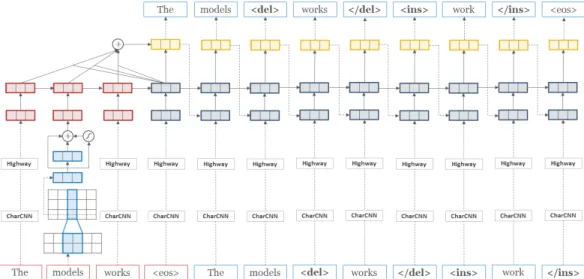
We propose two encoder-decoder architectures for this task. Our word-based architecture (WORD) is similar to that of Luong et al. (2015). Our character-based models (CHAR) still make predic-tions at the word-level, but use a CNN and a high-way network over characters instead of word embed-dings as the input to the encoder and decoder, as de-picted in Figure 1. We follow past work (Sutskever et al., 2014; Luong et al., 2015) in stacking multi-ple recurrent neural networks (RNNs), specifically Long Short-Term Memory (LSTM) (Hochreiter and Schmidhuber, 1997) networks, in both the encoder and decoder.
Here, we model the probability of the target given the source,p(t|s), with anencoderneural network that summarizes the source sequence and adecoder
neural network that generates a distribution over the target words and tags at each step given the source.
We start by describing the basic encoder and de-coder architectures in terms of the WORD model,
and then we describe the CHAR model departures from WORD.
Encoder The encoder reads the source sentence and outputs a sequence of vectors, associated with each word in the sentence, which will be selec-tively accessed during decoding via a soft attentional mechanism. We use a LSTM network to obtain the hidden stateshsi ∈Rnfor each time stepi,
hsi = LSTM(hsi−1,xsi).
For the WORD models, xsi ∈ Rm is the word
em-bedding forsi, thei-th word in the source sentence.
(The analogue for the CHARmodels is discussed be-low.) The output of the encoder is the sequence of hidden state vectors[hs1, . . . ,hsI]. The initial hidden state of the encoder is set to zero (i.e.hs0 ←0).
Decoder The decoder is another LSTM that pro-duces a distribution over the next target word/tag
Figure 1: An illustration of the CHARmodel architecture translating an example source sentence into the corrected target with a single word replacement. A CNN (here, with three filters of width two) is applied over character embeddings to obtain a fixed dimensional representation of a word, which is given to a highway network (in light blue, above). Output from the highway network is used as input to a LSTM encoder/decoder. At each step of the decoder, its hidden state is interacted with the hidden states of the encoder to produce attention weights (for each word in the encoder), which are used to obtain the context vector via a convex combination. The context vector is combined with the decoder hidden state through a one layer MLP (yellow), after which an affine transformation followed by a softmax is applied to obtain a distribution over the next word/tag. The MLP layer (yellow) is used as additional input (via concatenation) for the next time step. Generation continues until the<eos>symbol is generated.
given the source vectors[hs1, . . . ,hsI]and the previ-ously generated target words/tagst<j = [t1, . . . tj].
Let
htj = LSTM(htj−1,xtj)
be the summary of the target sentence up to thej-th word, wherext
j is the word embedding fortj in the
WORD models. The current target hidden statehtj is combined with each of the memory vectors in the source to produce attention weights as follows,
uj,i =htj ·Wαhsi
αj,i =
expuj,i
P
k∈[1,I]expuj,k
The source vectors are multiplied with the respec-tive attention weights, summed, and interacted with the current decoder hidden statehtjto produce a con-textvectorcj, vj = X i∈[1,I] αj,ihsi cj = tanh(W[vj;htj])
The probability distribution over the next
word/tag is given by applying an affine transforma-tion tocjfollowed by a softmax,
p(tj+1|s,t<j) = softmax(Ucj+b)
Finally, as in Luong et al. (2015), we feedcj as
ad-ditional input to the decoder for the next time step by concatenating it withxtj, so the decoder equation is modified to,
htj = LSTM(htj−1,[xtj;cj−1])
This allows the decoder to have knowledge of previ-ous (soft) alignments at each time step. The decoder hidden state is initialized with the final hidden state of the encoder (i.e.ht0 ←hsI).
Character Convolutional Neural Network For the CHARmodels, instead of a word embedding, our
input for each word in the source/target sentence is an output from a character-level convolutional neu-ral network (CharCNN) (depicted in Figure 1). Our character model closely follows that of Kim et al. (2016).
Suppose word si is composed of characters
[p1, . . . , pl]. We concatenate the character
column corresponds to the character embedding for pk(of dimensionc).
We then apply a convolution between Pi and a
filterH ∈ Rc×w of widthw, after which we add a
bias and apply a nonlinearity to obtain afeature map
fi∈Rl−w+1. Thek-th element offiis given by,
fi[k] = tanh(hPi[∗, k:k+w−1],Hi+b)
where hA,Bi = Tr(ABT) is the Frobenius inner product andPi[∗, k : k+w−1]is the k-to-(k+
w−1)-th column ofPi. Finally, we take the
max-over-time
zi = max k fi[k]
as the feature corresponding to filterH. We use mul-tiple filtersH1, . . .Hhto obtain a vectorzi∈Rhas the representation for a given source/target word or tag. We have separate CharCNNs for the encoder and decoder.
Highway Network Instead of replacing the word embeddingxiwithzi, we feedzithrough ahighway
network(Srivastava et al., 2015). Whereas a multi-layer perceptron produces a new set of features via the following transformation (given inputz),
ˆ
z=f(Wz+b)
a highway network instead computes,
ˆ
z=rf(Wz+b) + (1−r)z
wherefis a non-linearity (in our models,ReLU), is the element-wise multiplication operator, andr=
σ(Wrz+br)and1−rare called thetransformand
carrygates. We feedziinto the highway network to
obtain ˆzi, which is used to replace the input word
embeddings in both the encoder and the decoder.
Inference Exact inference is computationally in-feasible for the encoder-decoder models given the combinatorial explosion of possible output se-quences, but we follow past work in NMT using beam search. We do not constrain the generation process of words outside insertion tags to words in the source, and each low-frequency holder token generated in the target sentence is replaced with the source token associated with the maximum attention weight. We use a beam size of 10 for all models,
with the exception of one of the models in the fi-nal system combination, for which we use a beam of size 5, as noted in Section 6.
Note that this model generates corrections, but we are only interested in determining the existence of any error at the sentence-level. As such, after beam decoding, we simply check for whether there were any corrections in the target. However, we found that decoding in this way under-predicts sentence-level errors. It is therefore important to calibrate the weights associated with corrections, which we dis-cuss in Section 5.3.
5 Experiments 5.1 Data
The AESW task data differs from previous gram-matical error datasets in terms of scale and genre. To the best of our knowledge, the AESW dataset is the first large-scale, publicly available profession-ally edited dataset of academic, scientific writing. The training set consists of 466,672 sentences with edits and 722,742 sentences without edits, and the development set contains 57,340 sentences with ed-its and 90,106 sentences without. The raw training and development datasets are provided as annotated sentences,t, from which thessequences may be de-terministically derived. There are 143,802 sentences in the Shared Task test set with hidden gold labels, which serve directly asssequences.
As part of pre-processing, we treat each sentence independently, discarding paragraph context (which sentences, if any, were present in the same para-graph) and domain information, which is a coarse grouping by the field of the original journal (En-gineering, Computer Science, Mathematics, Chem-istry, Physics, etc.). We generate Penn Treebank style tokenizations of the input. Case is maintained and digits are not replaced with holder symbols. The vocabulary is restricted to the 50,000 most com-mon tokens, with remaining low frequency tokens replaced with a special<unk>token. The CHAR
model can encode but not decode over open vocab-ularies and hence we do not have any <unk> to-kens on the source side of those models. For all of the encoder-decoder models, we replace the low-frequency target symbols during inference as dis-cussed above in Section 4.2.
For development against the provided data with labels, we set aside a 10,000 sentence sample from the original development set for tuning, and use the remaining 137,446 sentences for validation6. The encoder-decoder models are given all 466,672 pairs of s and t sequences with edits, augmented with varying numbers of pairs without edits. The
CHAR+SAMPLE and WORD+SAMPLE models are
given a random sample of 200,000 pairs without ed-its for a total of 666,672 pairs ofsandtsequences. The CHAR+ALLand WORD+ALLmodels are given all 722,742 sentences without edits for a total of 1,189,414 pairs ofs andtsequences. For some of the final testing models, we also train with the devel-opment sentences. In these latter cases, all sequence pairs are used. In training all of the encoder-decoder models, as indicated in Section 5.2, we drop sen-tences exceeding 50 tokens in length.
We also experimented with creating corrected ver-sions of sentences for the CNN. The binary CNN classifiers are given 1,656,086 single-sentence train-ing examples, of which 722,742 are error-free ex-amples (in which s = t), and the remaining ex-amples are constructed by removing the tags from the annotated sentences,t, to create tag-free exam-ples that contain errors (466,672 instances) and ad-ditional error-free examples (466,672 instances).
5.2 Training
Training (along with testing) of all models was con-ducted on GPUs. Our models were implemented with the Torch7framework.
CNN Architecture and training approaches were informed by past work in sentence-level classifica-tion using CNNs (Kim, 2014; Zhang and Wallace, 2015). A limited grid search on the development set determined our use of filter windows of width 3, 4, and 5 and 1000 feature maps. We trained for 10 epochs. Training otherwise followed the ap-proach of the correspondingly named CNN-STATIC
and CNN-NONSTATICmodels of Kim (2014).
6
Note that the number of sentences in the final development set without labels posted on CodaLab (http://codalab. org) differed from that originally posted on the AESW 2016 Shared Task website with labels.
7
http://torch.ch
encoder-decoder Initial parameter settings (in-cluding architecture decisions such as the number of layers and embedding and hidden state sizes) were informed by concurrent work in neural ma-chine translation and existing work such as that of Sutskever et al. (2014) and Luong et al. (2015). We used4-layer LSTMs with1000hidden units in each layer. We trained for 14 epochs with a batch size of 64 and a maximum sequence length of 50. The pa-rameters for the WORD model were uniformly ini-tialized in[−0.1,0.1], and those of the CHARmodel were uniformly initialized in[−0.05,0.05]. TheL2 -normalized gradients were constrained to be ≤ 5. Our learning rate schedule started the learning rate at 1 and halved the learning rate after each epoch beyond epoch 10, or once the validation set perplex-ity no longer improved. The WORD model used
1000-dimensional word embeddings. For CHAR, the character embeddings were25-dimensional, the filter width was6, the number of feature maps was
1000, and2 highway layers were used. The max-imum word length was 35 characters for training CHAR. Note that we do not reverse the source (s)
se-quences, unlike some previous NMT work. Follow-ing the work of Zaremba et al. (2014), we employed dropout with a probability of0.3between the LSTM layers.
Training both WORD and CHAR on the training
set took on the order of a few days using GPUs, with the former being more efficient than the latter. In practice, we used two GPUs for training CHARdue to memory requirements.
5.3 Tuning
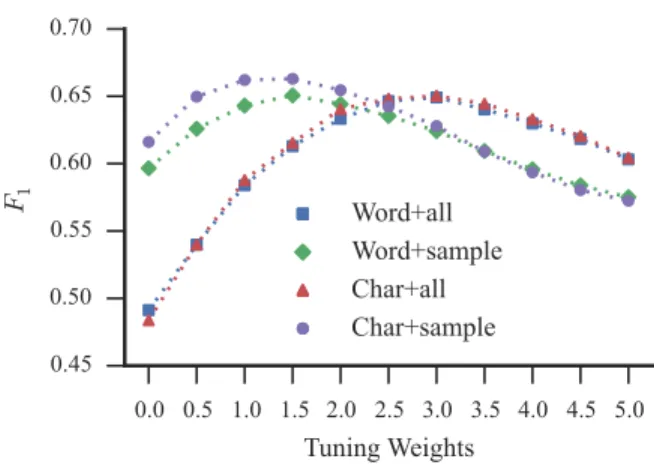
Post-hoc tuning was performed on the 10k held-out portion of the development set. In terms of maximiz-ing theF1-score, this post-hoc tuning was important for these models, without which precision was high and recall was low. We leave to future work alterna-tive approaches to this type of post-hoc tuning.
For the CNN models, after training, we tuned the decision boundary to maximize theF1-score on the held-out tuning set. Analogously, for the encoder-decoder models, after training the models, we tuned the bias weights (given as input to the final softmax layer generating the words/tags distribution) associ-ated with the four annotation tags via a simple grid search by iteratively running beam search on the
tun-0.0 0.5 1.0 1.5 2.0 2.5 3.0 3.5 4.0 4.5 5.0 Tuning Weights 0.45 0.50 0.55 0.60 0.65 0.70 F1 Word+all Word+sample Char+all Char+sample
Figure 2: F1 scores for varying values applied additively to the bias weights of the four annotation tags on the held-out 10k tuning subset. 0.3 0.4 0.5 0.6 0.7 0.8 0.9 1.0 Recall 0.35 0.45 0.55 0.65 0.75 Pre cis ion Word+all Word+sample Char+all Char+sample
Figure 3:Precision vs. recall trade-off as the bias weights as-sociated with the four annotation tags are varied on the held-out 10k tuning subset. The points yielding maximumF1scores are highlighted with black circles.
ing set. Due to the relatively high expense of decod-ing, we employed a coarse grid search in which the bias weights of the four annotation tags were uni-formly varied.
6 Results
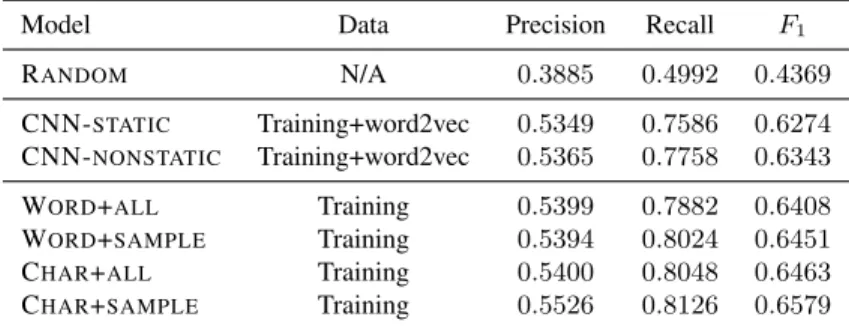
Results on the development set, excluding the 10k tuning set, appear in Table 1. Here (and elsewhere)
RANDOMis the result of randomly assigning a
sen-tence to one of the binary classes. For the CNN clas-sifiers, fine-tuning the word2vec embeddings im-proves performance. The encoder-decoder mod-els improve over the CNN classifiers, even though
the latter are provided with additional data (via word2vec). The character-based models yield tan-gible improvements over the word-based models.
For consistency here, we kept the beam size at 10 across models, but subsequent analysis revealed that increasing the beam from 5 to 10 had a negligible effect on overall performance.
Tuning results appear in Figures 2 and 3, illus-trating the importance of adjusting the bias weights associated with the annotation tags in balancing pre-cision and recall to maximize the F1 score. The models trained on all sequence pairs without ed-its, CHAR+ALLand WORD+ALL, perform particu-larly poorly without tuning these bias weights, yield-ingF1 scores near that of RANDOMbefore tuning, which corresponds to a weight of 0.0 in Figure 2.
The official development set posted on CodaLab differed slightly from the original development set provided with labels, so we include those results in Table 2 for the encoder-decoder models. Here, eval-uation is performed on the CodaLab server, as with the final test submission. The overall relative perfor-mance pattern is similar to that of the original devel-opment set.
A comparison of our results with other shared task submissions appears in Table 3. (Teams were al-lowed to submit up to two results.) Our submis-sion, COMBINATIONwas a simple majority vote at the system level (for each test sentence) of 5 mod-els8: (1) a CNN-NONSTATICmodel trained with the concatenation of the training and development sets (and using word2vec); (2) a WORD model trained
on all sequence pairs in the training and develop-ment sets with a beam size of 10 for decoding; (3,4)
a CHAR+SAMPLEmodel trained on the training set,
decoding the test set twice, each time with differ-ent weight biases (the two highest performing via the grid search over the tuning set) with a beam size of 10; and (5) a CHAR model trained on all se-quence pairs in the training and development sets, with training suspended at epoch 9 (out of 14) and a beam size of 5 to meet the Shared Task deadline. For reference, we also include the CodaLab evalu-ation for just the CHAR+SAMPLEmodel trained on
the training set with a beam size of 10, with the bias
8The choice of models was limited to those that were trained
Model Data Precision Recall F1 RANDOM N/A 0.3885 0.4992 0.4369 CNN-STATIC Training+word2vec 0.5349 0.7586 0.6274 CNN-NONSTATIC Training+word2vec 0.5365 0.7758 0.6343
WORD+ALL Training 0.5399 0.7882 0.6408
WORD+SAMPLE Training 0.5394 0.8024 0.6451
CHAR+ALL Training 0.5400 0.8048 0.6463
CHAR+SAMPLE Training 0.5526 0.8126 0.6579
Table 1:Experimental results on the development set excluding the held-out 10k tuning subset.
Model Data Precision Recall F1
RANDOM N/A 0.3921 0.5981 0.4736
WORD+ALL Training 0.5343 0.7577 0.6267
WORD+SAMPLE Training 0.5335 0.7699 0.6303
CHAR+ALL Training 0.5351 0.7749 0.6330
CHAR+SAMPLE Training 0.5469 0.7803 0.6431
Table 2:Results on the official development set. Here, RANDOMwas provided by the Shared Task organizers.
Model Data Precision Recall F1
RANDOM N/A 0.3607 0.6004 0.4507 KNOWLET – 0.6241 0.3685 0.4634 NTNU-YZU – 0.6717 0.3805 0.4858 HITS – 0.3765 0.948 0.5389 UW-SU – 0.4145 0.8201 0.5507 NTNU-YZU – 0.5025 0.7785 0.6108
CHAR+SAMPLE Training 0.5112 0.7841 0.6189 COMBINATION Training+Dev+word2vec 0.5444 0.7413 0.6278
Table 3: Final submitted results on the Shared Task test set. COMBINATIONwas our final submitted system. RANDOMwas provided by the Shared Task organizers. For comparison, we have included the other team submissions from National Taiwan Normal University and Yuan Ze University (NTNU-YZU), the University of Washington and Stanford University (UW-SU), HITS (HITS), and Knowlet (KNOWLET). Teams were allowed to designate up to two final submissions. (The CHARmodel trained on the combined training and development set had not finished training by the Shared Task deadline. As such, it was not submitted, but the partially trained model was included in COMBINATION.)
weights being those that generated the highest F 1-score on the 10k tuning set.
7 Discussion
Of particular interest, the CHAR+SAMPLE model performs well, both in terms of performance on the test set relative to other submissions, as well as on the development set relative to the WORD models and the CNN classifiers. It is possible this is due to the ability of the CHAR models to capture some types of orthographic errors.
The empirical results suggest that simply adding additional already correct source-target pairs when training the encoder-decoder models may not boost
performance, ceteris paribus, as seen in com-paring the performance of CHAR+SAMPLE vs
WORD+SAMPLE, and CHAR+ALLvs WORD+ALL.
We leave to future work alternative approaches for introducing additional correct (target) sentences, as has been examined for neural machine translation models (Sennrich et al., 2015; G¨ulc¸ehre et al., 2015). Our results provide initial evidence to support the hypothesis that training at the lowest granularity of annotation is a more efficient use of data than train-ing against the binary label. In future work, we plan to compare against sentence classification us-ing LSTMs (Dai and Le, 2015) and convolutional models that use correction-level annotations.
Another benefit of the encoder-decoder models is that they can be used to generate corrections (and identify locations of intra-sentence errors) for end-users. However, the added generation capabilities of the encoder-decoder models comes at the expense of considerably longer training and testing times com-pared to the CNN classifiers.
We found that post-hoc tuning provides a straight-forward means of tuning the precision-recall trade-off for these models, and we speculate (but leave to future work for investigation) that in practice, end-users might prefer greater emphasis placed on preci-sion over recall.
8 Conclusion
We have presented our submission to the AESW 2016 Shared Task, suggesting, in particular, the util-ity of a neural attention-based model for sentence-level grammatical error identification. Our models do not make use of hand-tuned rules, are not trained with explicit syntactic annotations, and do not make use of individuals classifiers designed for human-designated subsets of errors.
For the encoder-decoder models, modeling at the sub-word level was beneficial, even though predic-tions were still made at the word level. It would be of interest to push this further to eliminate the need for an initial tokenization step, in order to general-ize the approach to other languages, such as Chinese and Japanese.
We plan to examine alternative approaches for training with additional correct (target) sentences. Inducing artificial errors to generate more incorrect (source) sentences is also a direction we intend to pursue.
We leave for future work an analysis of the gener-ation quality of our encoder-decoder models on the AESW dataset and the CoNLL-2014 Shared Task data, as well as user studies to assess whether perfor-mance is sufficient in practice to be useful, including the utility of correction vs. identification.
We consider this to be just the beginning of the development of data-driven support tools for writers, and many areas remain to be explored.
Acknowledgments
We would like to thank the organizers of the Shared Task for coordinating the task and making the unique AESW dataset available for research pur-poses. The Institute for Quantitative Social Science (IQSS) and the Harvard Initiative for Learning and Teaching (HILT) supported earlier, related research that led to our participation in the Shared Task. Jef-frey Ling graciously contributed a torch-based CNN implementation of Kim (2014).
References
Dzmitry Bahdanau, Kyunghyun Cho, and Yoshua Ben-gio. 2014. Neural machine translation by jointly learning to align and translate. CoRR, abs/1409.0473. Kyunghyun Cho, Bart Van Merri¨enboer, C¸ a˘glar G¨ulc¸ehre, Dzmitry Bahdanau, Fethi Bougares, Holger Schwenk, and Yoshua Bengio. 2014. Learning phrase representations using rnn encoder–decoder for statistical machine translation. InProceedings of the 2014 Conference on Empirical Methods in Natural
Language Processing (EMNLP), pages 1724–1734,
Doha, Qatar, October. Association for Computational Linguistics.
Andrew M. Dai and Quoc V. Le. 2015. Semi-supervised sequence learning. CoRR, abs/1511.01432.
Robert Dale and Adam Kilgarriff. 2011. Helping our own: The hoo 2011 pilot shared task. InProceedings of the 13th European Workshop on Natural Language
Generation, ENLG ’11, pages 242–249, Stroudsburg,
PA, USA. Association for Computational Linguistics. Robert Dale, Ilya Anisimoff, and George Narroway.
2012. Hoo 2012: A report on the preposition and de-terminer error correction shared task. InProceedings of the Seventh Workshop on Building Educational
Ap-plications Using NLP, pages 54–62, Stroudsburg, PA,
USA. Association for Computational Linguistics. Vidas Daudaravicius, Rafael E. Banchs, Elena Volodina,
and Courtney Napoles. 2016. A report on the auto-matic evaluation of scientific writing shared task. In
Proceedings of the Eleventh Workshop on Innovative
Use of NLP for Building Educational Applications,
San Diego, CA, USA, June. Association for Compu-tational Linguistics.
Mariano Felice, Zheng Yuan, Øistein E. Andersen, He-len Yannakoudakis, and Ekaterina Kochmar. 2014. Grammatical error correction using hybrid systems and type filtering. In Proceedings of the Eigh-teenth Conference on Computational Natural
Balti-more, Maryland, June. Association for Computational Linguistics.
C¸ aglar G¨ulc¸ehre, Orhan Firat, Kelvin Xu, Kyunghyun Cho, Lo¨ıc Barrault, Huei-Chi Lin, Fethi Bougares, Holger Schwenk, and Yoshua Bengio. 2015. On us-ing monolus-ingual corpora in neural machine translation.
CoRR, abs/1503.03535.
Sepp Hochreiter and J¨urgen Schmidhuber. 1997. Long short-term memory. Neural Comput., 9(8):1735– 1780, November.
Yoon Kim, Yacine Jernite, David Sontag, and Alexan-der M. Rush. 2016. Character-Aware Neural Lan-guage Models. InProceedings of AAAI.
Yoon Kim. 2014. Convolutional neural networks for sen-tence classification. InProceedings of the 2014 Con-ference on Empirical Methods in Natural Language
Processing (EMNLP), pages 1746–1751, Doha, Qatar,
October. Association for Computational Linguistics. Minh-Thang Luong, Hieu Pham, and Christopher D.
Manning. 2015. Effective approaches to attention-based neural machine translation. InEmpirical
Meth-ods in Natural Language Processing (EMNLP), pages
1412–1421, Lisbon, Portugal, September. Association for Computational Linguistics.
Tomas Mikolov, Ilya Sutskever, Kai Chen, Greg S Cor-rado, and Jeff Dean. 2013. Distributed representa-tions of words and phrases and their compositionality. In C. J. C. Burges, L. Bottou, M. Welling, Z. Ghahra-mani, and K. Q. Weinberger, editors,Advances in
Neu-ral Information Processing Systems 26, pages 3111–
3119. Curran Associates, Inc.
Courtney Napoles, Keisuke Sakaguchi, Matt Post, and Joel Tetreault. 2015. Ground truth for grammatical error correction metrics. In Proceedings of the 53rd Annual Meeting of the Association for Computational Linguistics and the 7th International Joint Conference on Natural Language Processing (Volume 2: Short
Pa-pers), pages 588–593, Beijing, China, July.
Associa-tion for ComputaAssocia-tional Linguistics.
Hwee Tou Ng, Siew Mei Wu, Yuanbin Wu, Christian Hadiwinoto, and Joel Tetreault. 2013. The CoNLL-2013 shared task on grammatical error correction. In
Proceedings of the Seventeenth Conference on
Com-putational Natural Language Learning: Shared Task,
pages 1–12, Sofia, Bulgaria, August. Association for Computational Linguistics.
Hwee Tou Ng, Siew Mei Wu, Ted Briscoe, Christian Hadiwinoto, Raymond Hendy Susanto, and Christo-pher Bryant. 2014. The CoNLL-2014 shared task on grammatical error correction. In Proceedings of the Eighteenth Conference on Computational Natural
Language Learning: Shared Task, pages 1–14,
Balti-more, Maryland, June. Association for Computational Linguistics.
Y. Albert Park and Roger Levy. 2011. Automated whole sentence grammar correction using a noisy channel model. In Proceedings of the 49th Annual Meeting of the Association for Computational Linguistics:
Hu-man Language Technologies - Volume 1, HLT ’11,
pages 934–944, Stroudsburg, PA, USA. Association for Computational Linguistics.
Alla Rozovskaya, Kai-Wei Chang, Mark Sammons, Dan Roth, and Nizar Habash. 2014. The Illinois-Columbia system in the CoNLL-2014 shared task. In Proceed-ings of the Eighteenth Conference on Computational
Natural Language Learning: Shared Task, pages 34–
42, Baltimore, Maryland, June. Association for Com-putational Linguistics.
Rico Sennrich, Barry Haddow, and Alexandra Birch. 2015. Improving neural machine translation models with monolingual data. CoRR, abs/1511.06709. Rupesh Kumar Srivastava, Klaus Greff, and J¨urgen
Schmidhuber. 2015. Training very deep networks.
CoRR, abs/1507.06228.
Ilya Sutskever, Oriol Vinyals, and Quoc VV Le. 2014. Sequence to sequence learning with neural networks.
In Advances in Neural Information Processing
Sys-tems, pages 3104–3112.
Wojciech Zaremba, Ilya Sutskever, and Oriol Vinyals. 2014. Recurrent neural network regularization.
CoRR, abs/1409.2329.
Ye Zhang and Byron Wallace. 2015. A sensitivity analysis of (and practitioners’ guide to) convolutional neural networks for sentence classification. CoRR, abs/1510.03820.