Energy saving in smart homes based on
consumer behaviour data
Author:
Michael Zehnder
January 31, 2015
Master of Science in Business Information Systems
Supervisors:
Prof. Dr. H. Wache
Prof. Dr. F. Witschel
inhabitants, based on consumer behaviour data only. A recommender system was designed, that suggests actions for inhabitants without the necessity for installing additional devices, executing manual configuration or having any other interaction with the system.
As a consequence of the devastating earthquake and the resulting nuclear disaster that struck Fukushima in March 2011, concerned members of the public and the government agreed on a major reconsideration of the energy policy. However, such a radical rethinking can only be achieved if private households increase their efforts to save energy. Nevertheless, most research approaches conducted in smart homes in the past years, dealt with convenience rather than with sustainability. The aim of this master thesis is to find a way to save energy without causing significant inconveniences for the consumer. Therefore, the following hypothesis was formulated: “It is possible to design a recommender system that can suggest actions in smart homes based on consumer behaviour, which will lower energy usage but not decrease comfort levels”.
The approach followed in this paper, is to mine frequent (and/or periodic) patterns in the event data of the inhabitants electricity usages, recorded by a smart home automation system. These patterns are converted into association rules, prioritized and compared with the current behaviour of the inhabitants. If the system detects opportunities to save energy without decreasing the comfort level, it will send a recommendation to the residents.
Because the most appropriate research design to prove this hypothesis is design science research, the project follows the methodology to design and implement a functional prototype of a recommender system. At the end of the project, the prototype is evaluated in smart homes under real conditions. The main findings of the project and the concluding field-test of the prototype were:
The project succeeded in identifying possible actions, which can be recommended in smart homes to lower energy usage in smart homes.
Investigations showed how patterns in the behaviour data of the inhabitants can be used to trigger these actions at the right moment, to not lower comfort levels for the inhabitants. A design has evolved for a recommender system that uses association rules and deterministic
finite state machines.
It was identified, that the confidence and the length of a pattern are significant measures to predict if a suggestion does lower comfort or not.
Overall, it can be said that this master thesis could verify part of its statement: The prototype demonstrated that it is possible to suggest actions that lower energy usage, but do not decrease comfort levels, while using consumer behaviour data as single source. However, besides the useful recommendations, the system did still recommend actions that did not just lower energy usage, but also the comfort level of the inhabitants. The ratio of useful recommendations, which reached little over 11% during the final test of the prototype, must be increased before broader adaption of the system is possible. Nevertheless, the proof of concept provided by the prototype is the first important step for further research in this field.
ADKNOWLEDGEMENTS
The author of this paper would like to acknowledge and thank the following persons for their valuable insights and contributions to this project. Without them, it would not have been possible to bring this project to a successful conclusion.
Supervisors from FHNW: Prof. Dr. Holger Wache
Prof. Dr. Hans Friedrich Witschel Contacts from Aizo:
Miguel Rodriguez from Aizo Danilo Zanatta from Aizo Andrea Helfenstein from Aizo
Everybody who contributed to the evaluation of the system: Carla Janzen
Christian Hitz Christoph Hofmann Erik Van Dort Irmy Hofmann Jerome Zuercher Paul Buchmeier Samuele Di Lernia Volker Deckers
specifically acknowledged wherever adapted from other sources.
I understand that if at any time it is shown that I have significantly misrepresented material presented here, any degree or credits awarded to me based on that material may be revoked.
I declare that all statements and information contained herein are true, correct and accurate to the best of my knowledge and belief.
Name: Michael Zehnder Date: January 31, 2015
I
Contents
Abstract ... 2 Adknowledgements ... 3 Declaration of authenticity ... 4 CHAPTER 1 - Introduction ... 7 1.1 Introduction of chapter 1 ... 7 1.2 Background information ... 7 1.3 Problem identification ... 7 1.4 Thesis statement ... 81.5 Research question and objectives ... 9
1.6 Research objectives ... 9
1.7 Delineation and limitations... 9
1.8 Structure and chapter overivew ... 10
1.9 Summary of chapter 1 ... 10
CHAPTER 2 - Literature review ... 11
2.1 Introduction of chapter 2 ... 11
2.2 Smart homes in general ... 11
2.3 Saving energy in smart homes ... 12
2.4 Suppervised and unsuppervised learning ... 13
2.5 Mining sequential data in smart homes ... 14
2.6 Clustering sequences ... 15
2.7 Self-adapting systems ... 16
2.8 Multiple residents ... 16
2.9 Action prediction for sequential data in smart homes ... 16
2.10 Summary of chapter 2 ... 16
CHAPTER 3 - Research Design ... 20
3.1 Introduction of chapter 3 ... 20
3.2 Research strategies ... 20
3.3 The research design of this master thesis ... 20
3.4 Summary of chapter 3 ... 23
CHAPTER 4 - Data Analysis ... 25
4.1 Introduction of chapter 4 ... 25
4.2 Structure of data ... 25
4.3 Evaluation of the variables of analysis ... 26
II
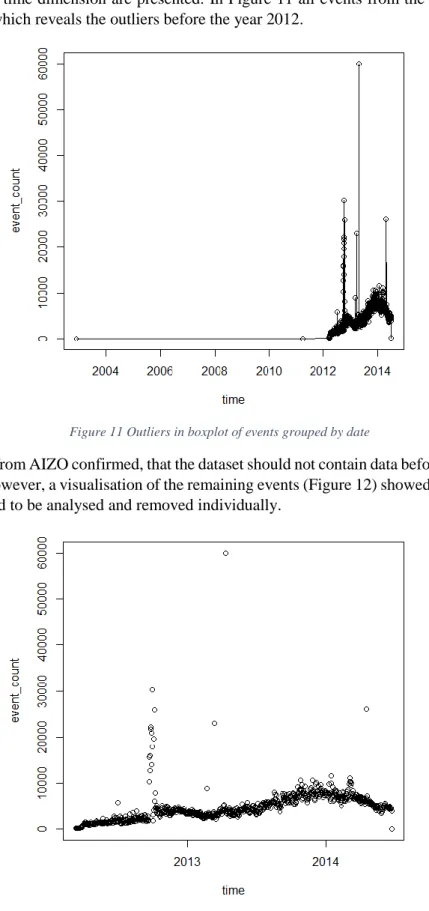
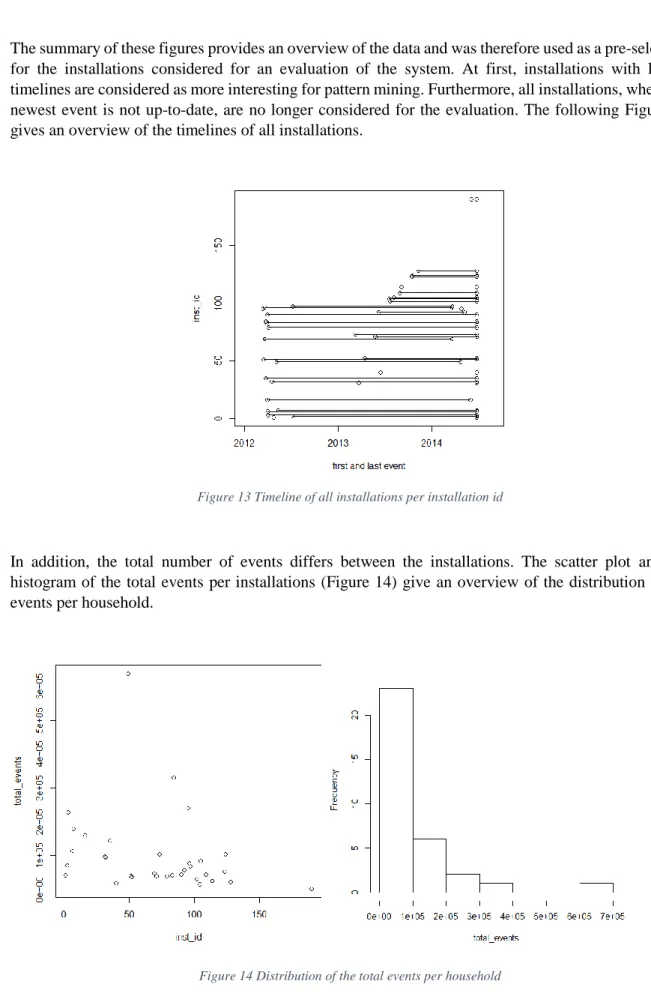
4.5 Analysis and visualisation of the data ... 29
4.6 Possible actions to lower energy usage ... 33
4.7 Summary of chapter 4 ... 36
CHAPTER 5 - Relevant behaviour pattern filtering ... 38
5.1 Introduction of chapter 5 ... 38
5.2 Definition of behaviour patterns ... 38
5.3 Relevant types of behaviour patterns ... 39
5.4 Summary of chapter 5 ... 41
CHAPTER 6 - Algorithms to find relevant patterns ... 42
6.1 Introduction of chapter 5 ... 42
6.2 Evaluation of algorithms ... 42
6.3 Sample patterns ... 44
6.4 Summary of chatper 6 ... 46
CHAPTER 7 - Design of the recommender system ... 47
7.1 Introduction of chapter 6 ... 47 7.2 Architecture ... 47 7.3 Prioritization ... 49 7.4 Specific implementation ... 51 7.5 Summary of chapter 6 ... 53 CHAPTER 8 - Evaluation ... 54 8.1 Introduction of chapter 8 ... 54 8.2 Setup ... 54 8.3 Phase 1 ... 55 8.4 Phase 2 ... 59 8.5 Summary of chapter 8 ... 61 CHAPTER 9 - Conclusion ... 62 9.1 Introduction of chapter 8 ... 62
9.2 Summary of findings and contribution ... 62
9.3 Outlook and next steps ... 64
Bibliography ... 65
Figures & Tables ... 70
Glossary ... 72
Appendix ... 73
Smart home log file extract ... 73
Guidance for evaluation participants ... 75
Introduction
CHAPTER 1 -
INTRODUCTION
1.1
INTRODUCTION OF CHAPTER 1
A smart home is defined as a “dwelling incorporating a communications network that connects the key electrical appliances and services” which can be “remotely controlled, monitored or accessed” (King 2003). This definition is correct for most smart homes, containing interacting and connected devices for automation and control purposes, but it does not establish a direct connection to the term “smart”. A home which does act in a smart way, is a system which is autonomously operating, based on artificial intelligence (Blumendorf 2013). However, this definition creates a problem resulting from the difficulty to measure the smartness of such a home. There exists no standardized or common way to evaluate how smart a system is. The recommender system designed in this research project is such an autonomously operating system, but its smartness is evaluated by the energy savings created without loss in comfort. The purpose of this master thesis is to find a way, to save energy without accepting significant inconveniences to the consumer. Therefore, it uses the data from the key electrical appliances recorded by an existing smart home automation system, to analyse the behaviour in the household. Based on this data, the recommender system will give recommendations how to save energy in the smart home. The recommendations are based exclusively on the existing event data, no motion detection devices have to be installed. Furthermore, no manual settings must be configured by the user; the system will act completely independent. Besides the recommendations, how to save energy, no interaction between the consumer and the system occurs. Furthermore, the recommender should only decide to make an energy saving suggestion to the inhabitant, if no lack in comfort is expected.
The following chapters are going to elaborate, how such a recommender system can be designed and will evaluate, based on a thesis statement, if the recommender will perform the expected results.
1.2
BACKGROUND INFORMATION
The “Energy Strategy 2050” aims to turn over the energy production from big nuclear power plants to many but small renewable energy sources like solar collectors (Swiss Federal Office of Energy 2014). This ambitious goal can only be achieved if private households reinforce their efforts to save energy, which could be achieved by the means of smart home technology.
Home automation technology is becoming as synonymous with sustainability as it is with convenience. However, most research approaches published in the past years dealt more with convenience than with sustainability (Brush et al. 2011). However, there exist several publications about approaches to make smart homes more sustainable, either by improving the sustainability of the technology itself or by using smart home technology to make the home more sustainable (Blumendorf 2013). In this document, the second approach will be discussed. As the title might suggest, a recommender is designed, to make suggestions to improve the smart home’s sustainability but do not lower its convenience.
1.3
PROBLEM IDENTIFICATION
Saving energy in sustainable homes is often linked to high costs, which might not be amortized. Another problem for inhabitants is the amount of time they have to spend for initial configuration and further maintenance of an automation system, which saves energy. A study of long-term use of home automation conducted by Microsoft Research at University of Washington in 2011 revealed the top four barriers that need to be solved, before home automation becomes amenable for broader adoption. The barriers were high cost of ownership, inflexibility, poor manageability and difficulties achieving security. (Brush et al. 2011). While the difficulty of achieving security is not addressed in this master thesis, the project elaborates possible solutions for the three other barriers. Because not only monetary aspects succeed in high costs of ownership but also the time spent for managing the system, the interaction between the consumer and the system must be limited to a minimum. Furthermore, the costs of acquisition are kept low, because the system operates on low-level sensor data, which already exist in most smart homes. Therefore, no further hardware has to be acquired.
Nevertheless, a design for such a system, which gives effective suggestions to save energy, is still to discover. Augusto & Nugent mentioned in their publication “Designing smart homes: the role of artificial intelligence” (2006) that “the relation between the actions performed [...] and the resulting states is a fundamental part of an automated diagnosis system, however [...] is not clear, what system will be most effective in predicting possible outcomes given a trend of behaviour.” This problem “poses a real challenge for a diagnostic system to give useful advice whilst minimizing the chances of raising false alarms”.
Most smart home systems dealing with artificial intelligence (AI), use motion sensors and person tagging for location prediction of the inhabitants, to solve the problems mentioned. The system designed in this master thesis, deals with the challenge of operating without such enhanced sensors for location prediction. Furthermore, the recommender has no information about the floor plan of the house and the location of the devices. For example if the cooker in the kitchen is on, but the person just has left the room, the recommender will not receive this information. Even if all lights in the kitchen were turned off, the sensor data provided to the recommender do not reveal that the cooker and the lights are in the same room.
However, the assumed independency between the data from the sensors and the metadata about the sensors (e.g. location), will increase the applicability and make the recommender more flexible to use in different locations. The system should adapt over time to the behaviour of the inhabitant and therefore be applicable for a general smart home, where the recommender system can access low-level sensor data.
Another common problem for smart home automation system are multi inhabitant households, because “most of these techniques have been applied in the context of a single resident” (Crandall & Cook 2008). The system developed in this project should also work in smart homes with more than one inhabitant. The approach followed in this paper, is to mine frequent usage patterns detected in the behaviour data of the consumer and compare it with what is happening in the house currently. In the kitchen example provided above, this would mean, that the recommender should still be able to detect the unattended cooker and suggest turning it off, because this situation represents a chance to save energy. The recommender should detect in the historical data provided, that when the cooker is on, usually also the light sources in the kitchen are activated. Due to the fact, that the current state is very abnormal, the recommender could detect this anomaly and suggest the inhabitant to turn off the cooker.
1.4
THESIS STATEMENT
The problem identified in the previous chapter led to the following thesis statement:
It is possible to design a recommender system that can suggest actions in smart homes based on consumer behaviour, which will lower energy usage but not decrease comfort levels.
1.4.1
Definition of terms
A recommender system is a software tool or a technique providing suggestions which are useful to its user (Ricci, Rokach & Shapira 2011). In this thesis statement, the term refers to a software system that is providing recommendations related to a decision-making process, such as how to save energy for its consumer.
A suggested action is a targeted activity contributed by the system, which can be (manually) performed by the consumer.
The reasoning is based on consumer behaviour only, no further interaction between the consumer and the system can occur. The exclusive source of input data for the recommender system is event data, caused by the consumer and recorded by smart home sensors.
Introduction
To lower energy usage, stands for reducing the power consumption in the smart home. The savings are not measured in a monetary way, but only by the fact that a lower amount of energy is consumed by the smart home.
No decrease in comfort levels denotes that the energy savings do not go along with negative side effects for the consumer. The savings must not result in any change of behaviour for the inhabitant.
1.5
RESEARCH QUESTION AND OBJECTIVES
To prove or reject the thesis statement, research questions are answered. The research questions were derived from the statement and defined for this study as follows:
RQ1: What are possible actions, which can be suggested in smart homes to lower energy usage?
RQ2: Which types of behaviour patterns are needed to suggest actions?
RQ3: What algorithms can be used to find relevant patterns in the behaviour data?
RQ4: How can such a recommender system be designed?
RQ5: How can be evaluated, if a suggested action does not decrease comfort levels?
RQ6: Do the suggested actions decrease comfort levels?
1.6
RESEARCH OBJECTIVES
In order to answer the research questions, the following research objectives have been formulated: 1. To identify possible actions, which can be suggested in smart homes to lower energy usage. 2. To define which types of behaviour patterns are needed to suggest actions.
3. To find algorithms which can be used to find relevant patterns in the behaviour data. 4. To design a recommender system.
5. To evaluate if the suggested actions do decrease comfort levels.
1.7
DELINEATION AND LIMITATIONS
The recommender system designed in this master thesis is different from other smart home automation systems, which can be found in literature, in terms of goals, reasoning, technology and evaluation. The recommender is designed that it deliberately operates without the need for enhanced sensors, providing visual signals. Neither motion and occupancy sensors nor tagged gloves and RFID-tags are used to determine the location of the inhabitants, since the installation of such devices is expensive and could affect the wellbeing of the inhabitants. Furthermore, the reasoning to provide the energy saving suggestions will not depend on user interaction, but only of the data provided by the sensors. Moreover, the aims of the system do contrast to similar systems: It is not desired to increase the comfort or the quality of life for the inhabitants, the primary goal is to build an autonomously acting recommender system that can help to save energy. In contrast to most other home automation concepts, the evaluation of the system is based on a functional prototype of the recommender, which is implemented and tested in the field to generate hard evidence.
The recommender system developed in this research project is not the sole solution to resolve this problem; other techniques may lead to similar results.
1.8
STRUCTURE AND CHAPTER OVERIVEW
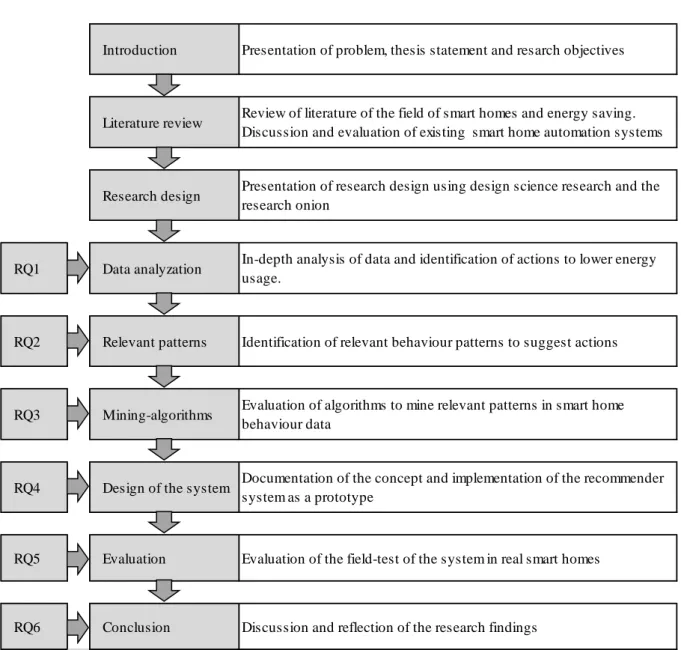
This master thesis comprises seven chapters. Figure 1 outlines the structure of this document and in which chapters the research questions will be raised and answered.
Figure 1 Structure of this document
1.9
SUMMARY OF CHAPTER 1
In this first chapter, the general aspects of this master thesis are addressed. This includes the thesis statement and the research questions. In the last chapter of the introduction, a chapter overview is presented to provide insight in the structure of the document and to give information about the content of the following chapters.
The problem to solve in this master thesis is to find a possibility to save energy by using only the data available, without investing time or money into the manual configuration of the system or the installation of additional sensors. To prove or reject the thesis statement, the system is evaluated in a field-test using real data.
Introduction Presentation of problem, thesis statement and resarch objectives
Literature review Review of literature of the field of smart homes and energy saving. Discussion and evaluation of existing smart home automation systems
Research design Presentation of research design using design science research and the research onion
RQ1 Data analyzation In-depth analysis of data and identification of actions to lower energy usage.
RQ2 Relevant patterns Identification of relevant behaviour patterns to suggest actions
RQ3 Mining-algorithms Evaluation of algorithms to mine relevant patterns in smart home behaviour data
RQ4 Design of the system Documentation of the concept and implementation of the recommender system as a prototype
RQ5 Evaluation Evaluation of the field-test of the system in real smart homes
Literature review
CHAPTER 2 -
LITERATURE REVIEW
2.1
INTRODUCTION OF CHAPTER 2
The second chapter is looking at literature, regarding different topics covered by this research project. Concepts and methods from the field of smart home automation systems are discussed and existing approaches are analysed. The goal is to extract proven ideas of such systems and combine, enhance and reuse them in a way that will allow to make recommendations for energy saving. To assess the existing smart home automation systems found in literature, criteria were defined. These criteria resulted (in most cases) directly from the thesis statement and describe the requirements for the recommender system defined by the statement. Because the thesis statement does not set specific limits for all aspects, further criteria were exposed in interviews with experts from the field of smart home automation systems. The criteria for the recommender system were defined as follows:
Because an evaluation under real conditions is required to prove that no losses in comfort occur for the consumer, the system must be optimized for the use in smart homes. This includes:
o Being able to deal with a continuous sequence of sensor data o Being able to deal with a large amount of sensor data
To meet the requirement of reducing the power consumption, the system must provide energy saving features.
To recognize the behaviour of the inhabitants, the system provides detection for the following patterns:
o Frequent patterns o Periodic patterns
Since recommendations are time critical and only useful in a certain period, the system must provide real time behaviour reasoning.
Because the behaviour of the consumer(s) can change over time, the system must be able to adopt to changing inhabitant patterns.
The system does not depend on labelled input data (unsupervised learning).
The system can operate without any form of presence sensors (motion, occupancy, person tagging, etc.) because this would make additional installations necessary and therefore lower the comfort of the inhabitants.
To compete successfully with the conditions provided, it must provide multiple resident capability. The system is evaluated in average Swiss households, where the average number of inhabitants per household is above two. One-person households represent less than 35% of all private households (Federal Administration 2012).
The system can operate without feedback of the inhabitants, because any interaction required would lower the comfort of the inhabitants.
To evaluate the criteria mentioned, the following subchapters will address the main concepts of smart home automation systems. In the final subchapter, the findings are summarized.
2.2
SMART HOMES IN GENERAL
Because smart homes have become a very active and firmly established research topic, many publications about the subject can be found. The area is fast developing and attracting synergies of several areas of science, for improving human’s quality of living. To address the needs within a smart home environment effectively, multidisciplinary collaboration among different research topics is necessary.
Richard Harper, who examined the field of smart technologies for private homes, wrote that the way a house was built or the environment friendly features it contains will not make it a “smart home”. But “what makes it smart, is the interactive technologies that it contains” which could help to realize “the dream of a home, which can proactively help its inhabitants” (Harper 2003). Although the term “smart home” was officially mentioned the first time in 1984 by the American Association of House Builders,
the first “wired homes” were actually built years before and were essential, to develop what is meant by smart homes today. The expectations at smart homes back then were to increase productivity in domestic work, with little involvement of the user into the technology. (Harper 2003)
For a long time, research conducted about smart homes has been largely focused on hardware solutions. Nowadays, the term mainly addresses the integration of information technology into domestic buildings. Security, health care, energy efficiency and increasing the comfort of the inhabitants are the main research topics in the field of smart homes. Interconnections between devices and advanced control over lights, entertainment and multimedia devices for increasing comfort are proposed in several publications (Jakkula et al. 2006; Björkskog 2007; Nowak & Urbaniak 2011). Furthermore, in the area of security, remote information and intervention systems are developed, to increase the control inside the house while the inhabitant is not present. Another application of security systems mentioned in literature is presence simulation (Clinckx 2013). Because a presence simulator will not depend on complex rules to pretend attendance based on historical data, there is not much space for further research in this area and similarities between such systems and the recommender system developed in this research project are difficult to find. However, in other areas, there are still opportunities for more research to be conducted. In support for dependent people and home care, there are two different problems to be solved. At first, such a support system should notice when an emergency occurs inside a house and its second task is to increase the comfort for the person in need of care. However, an increase of convenience is not only interesting for elderly people; it is also a desire of average inhabitants.
2.3
SAVING ENERGY IN SMART HOMES
Already in 2003, Harper acknowledged, that “smart house technologies that most people are pleased with, are connected with saving energy or money” (Harper 2003). But especially since the Swiss Federal Institute pictured the environmental vision, to reduce the continuous overall average energy usage per person to not more than 2000 watts by the year of 2050, without lowering the standard of living, the idea of saving energy became more than just a monetary aspect (Energie Schweiz für Gemeinden et al. 2012).
In literature, many approaches for energy saving in buildings using smart technology can be found. Recently a publication “Building sustainable smart homes” (Blumendorf 2013) summarized, that the increasing usage of information technology in our homes and the increasing demand for sustainable life style are two contradictory concepts and raises the question, of how to combine these two trends. One of the proposed challenges, to “make users aware of the hidden details of their current behaviour” is addressed in the research project at hand.
Most approaches for energy saving in smart buildings found in literature, are focused to lower the energy consumption of heating, ventilation and air conditioning (HVAC) devices, such as the domestic heating system (Villar et al. 2009), air-conditioning (He 2010) or both of them (Nowak & Urbaniak 2011; Inji et al. 2011). Others do not directly address to lower the consumption of such devices, but provide enhanced monitoring and controlling (Jahn et al. 2010). Most of these projects use a broad variety of sensors to measure humidity and temperature and process the data by a fuzzy controller (Villar et al. 2009; Nowak & Urbaniak 2011) to distribute the energy. The project at hand aims to disclaim enhanced temperature and humidity sensors and consequently there are insufficient similarities between these projects and the current problem. Others who were also anxious to “minimize the domestic energy waste” and identified two more areas to incorporate energy management features: “lighting and home appliances” (Inji et al. 2011). In simulations over different scenarios in synthetic data, they discovered that potential for energy savings in private households is nearly 30 percent. To trigger lighting devices, they examined occupancy sensors, which would capture the individual by infrared heat detection. Because the thesis at hand does not make use of such sensors too, it will be difficult to reproduce savings of this magnitude.
Literature review
Another interesting project, which occurs in several publications, is the MavHome (Managing an Adaptive and Versatile Home) project, a multi-disciplinary research project at Washington State University and the University of Texas. The MavHome is an extensive project, where many researchers from different topics contributed. Its goal, to maximize the comfort, while minimizing the operational cost is very similar to the one at hand. Many publications contributing to this project can be found on the corresponding website (MavHome 2003). Since some of the project examine systems to predict the actions of the inhabitants of the house, they will be scanned more closely in the impending chapters.
2.4
SUPPERVISED AND UNSUPPERVISED LEARNING
Learning about the behaviour of an inhabitant is essential for a recommender in a smart home, in order to self-tune the system and to support its independence and personalization. The system should be acquainted with the habits of the inhabitant and continuously learn and improve them. With the intention to achieve that, the system must find reoccurring patterns in the smart home event data and learn these frequent “activities”.
In machine learning, there can distinguished between two fundamentally different learning paradigms: supervised and unsupervised or self-organized learning (Augusto & Nugent 2006). In supervised learning, the algorithm is given samples of the different types of classes, which can be found in the data. The algorithm uses this information to segment the unseen data into the appropriate classes. In unsupervised learning, no labelled examples are provided. Many supervised activity recognition methods for smart homes have been published in the literature in the last years (Rashidi & Cook 2013). Supervised learning is used in methods like decision trees (Augusto & Nugent 2006) Markov models (Gopalratnam & Cook 2007) and dynamic Bayes networks (Du et al. 2006). Bayes classifiers can detect the activities that correspond to the sensor values, observed with the highest probability. Although these classifiers rely on conditional independence of the events, the classifiers achieve good accuracy with large amounts of training data (Rashidi et al. 2011).
However, these methods have the major disadvantage that labelled data is required to train the algorithm. The manual annotation of human behaviour data, based on low-level event sensor data is a very tedious and time-consuming task and can additionally limit the scalability of the system. Moreover, the authors of “A Method for Mining and Monitoring Human Activity Patterns in Home-based Health Monitoring Systems” examined, that a postulation for consistent predefined activities does not work in reality, because not every inhabitant will perform the same. Therefore, labelled training data can only be used for the household they were made for. (Rashidi & Cook 2010).
The following diagram Figure 2 illustrates the differences between supervised and unsupervised methods for smart home automation systems.
Figure 2 Activity recognition models (by Rashidi & Cook 2010)
Since the goal of this research project is to save energy without negatively influencing the comfort level of the inhabitants, the unsupervised approach seems to be more suitable. In contrast to supervised methods, it requires no training, examples or labelled data. The user is not obliged to scan his data for activities because this would decrease the comfort, the system should find the patterns autonomously.
2.5
MINING SEQUENTIAL DATA IN SMART HOMES
Sequential pattern mining has been studied for almost two decades (Manilla et al. 1995; Srikant & Agrawal 1996) and various approaches have been published for finding sequential patterns in data (Manilla et al. 1995; Srikant & Agrawal 1996; Chen et al. 2012). These methods presuppose that the input is given as transactional data. However, in a smart home environment, this is usually not the case. Sensor data has no boundaries, which separate the different events into activities; they provide just a stream of data. Techniques such as the Apriori algorithm (Srikant & Agrawal 1996) were successfully proposed to group such event data together into activities. In the publication of Achar, Laxman and Sastray, a unified view of Apriori-based algorithms is drawn (Achar et al. 2011).
Finding frequent and periodic patterns in sensor event data, is a data-mining subfield usually referred to as “discovering frequent episodes in sequences” (Manilla et al. 1995; Mannila et al. 1997), “sequence mining” (Youngblood & Heierman 2005; Jain et al. 2006; Rashidi et al. 2009; Achar et al. 2011; Rashidi & Cook 2013) or “activity recognition” (Du et al. 2006; Crandall & Cook 2008; Nazerfard et al. 2011; Chen et al. 2012; Krishnan et al. 2013; Rohini & RajKumar 2014).The starting point for this research was the pioneer work of the Apriori algorithm, which was later implemented and enhanced by other projects. In most of these publications, the differentiation between frequent and periodic patterns is made, because both are desired for later automation.
2.5.1
Frequent patterns
The core functionality of a pattern-mining algorithm is to find frequent pattern. In literature, many approaches for frequent pattern mining in sequential smart home data can be found. Most of them are similar to the Apriori algorithm and take a bottom-up approach using a sliding window (Youngblood et al. 2005; Rashidi et al. 2009; Rohini & RajKumar 2014).
By pruning the infrequent patterns, only the most relevant variations of a pattern will be returned. Through reducing the number of irrelevant variations, also the need to manually configure properties for the mining is lowered (Rashidi & Cook 2013). The percentage of the most frequent sensor events, the support threshold used to mine frequent events or the number of activities that should be returned, are examples for such properties.
2.5.2
Periodic patterns
In smart home automation systems, it is not only important to find frequent activities, but also those patterns that occur the most regularly in predictable periods. If such a system would ignore periodicity and only rely on frequency to discover patterns, many periodic events might be discarded.
The Apriori algorithm in its original form is not able to mine periodic patterns in sequential data and was therefore improved by different people for the use in smart home automation systems, for example for the CASAS System (Rashidi et al. 2009). In this approach, the algorithm starts by mining patterns with a minimum length of two activities, which is extended until the algorithm is not able to find frequent patterns anymore (Figure 3). For every pattern, a tentative periodicity is calculated and then compared to the other instances found in the event data, to check if the average periodicity does apply or not. If not, the pattern is not considered as an instance of the same pattern and stored separately. A threshold (grace period) can be defined, that distinguishes if a periodicity is still within tolerance or not. All patterns with one or more periodicities can be considered as periodic.
Literature review
Figure 3 Finding periodic patterns (example of the CASAS System by Rashidi et al. 2009)
Not in all publications, the detailed procedure, how periodic patterns are mined is explained. However this approach can be considered as a model, how most systems mine periodic patterns (Li et al. 2010; Chen et al. 2012; Rohini & RajKumar 2014).
2.6
CLUSTERING SEQUENCES
An approach often mentioned in literature is to identify pattern clusters that represent a set of activities. The resulting clusters represent activities that can be stored and tracked in real time data. Clustering is executed after the sequence mining and results in a compressed representation of the activities. Even though the patterns were already grouped by the mining algorithm in sense of structural similarities, the clustering can improve the grouping by also concerning start time, duration and other similarities. Clustering also addresses the problem of discovering too many similar patterns, when the large number of patterns make it difficult to analyse the underlying ideas. (Rashidi & Cook 2013)
Standard k-means clustering is one method to group the set of discovered patterns into clusters. It is a clustering method using vector quantization, adopted from signal processing, that is popular for cluster analysis in data mining and therefore often used in smart home automation systems (Augusto & Nugent 2006; Ricci, Rokach & Shapira 2011; Rohini & RajKumar 2014). It aims to partition n observations into k clusters by defining a method for determining cluster centroids. In literature, several methods have been reported, such as the ROCK algorithm by Noh et al. (2009) and the CLUSEQ algorithm by Yang et al. (2009), which do only consider symbolic sequences, with no features attached to them. In contrast, sequential smart home data does not only consist of strings, it has also additional information, such as time, associated.
A refined clustering algorithm for smart home automation systems was published by Rashidi & Cook (2011). It combines several activities together to form a new activity, which is called “extended state”. For example, if a sensor in the living room is triggered several times in a row without another sensor event interrupting the sequence, the events are combined into one event with a longer duration. Due to this clustering functionality, a more compact representation of activities is created and as a result, it is simpler to compare similar activities. Two other methods that are used to compare similarities of sequences are edit distance (Manilla et al. 1995; Rohini & RajKumar 2014) and longest common subsequence (LCS) (Sequeira & Zaki 2002) for simple sequences. However, these methods are not sufficient to address the clustering problem in sequential data, because they do not use the temporal information, which would give information about the order of the events.
2.7
SELF-ADAPTING SYSTEMS
Rashidi wrote in one of her publications about smart home systems, that “considering the fact that humans usually change their habits and activities over time, adaptation is a crucial part of a smart- environment solution.” (Rashidi et al. 2009). She proposed a system for automation of sequential complex activities, which adapts to the user’s preferences by using contextual information, such as temporal data and start-up triggers. In contrast to most other systems in literature, where the inhabitant must guide the system by providing explicit feedback, their automation system (CASAS) can automatically discover and adapt to changes in the patterns of the resident.
In the algorithm of the CASAS system, for every successfully mined pattern, an attribute is maintained, which reflects the degree to which it can be considered for automation. The value can be increased or decreased through a compensation or a decay effect. If the value drops below a certain threshold, the pattern is discarded from the model. “The decay effect allows for those activity patterns that have not been perceived over a long period to descend toward a vanishing value over time or, in an intuitive sense, to be forgotten.” (Rashidi et al. 2009). At that time, this feature was pioneering and it was adapted for other smart home automation systems over time (Nazerfard et al. 2011; Alam et al. 2012).
2.8
MULTIPLE RESIDENTS
For most approaches of smart home automation systems, the problem of multiple residents has been completely ignored; they have been applied in the context of a single resident. However in few publications, the problem of multiple residents is identified (Rashidi et al. 2009; Krishnan et al. 2013) but not considered for problem solving, but referred to others, who proposed a solution for this problem (Crandall & Cook 2008). Crandall and Cook found a way of attributing events to individuals in multi- inhabitant environments. Unfortunately, the solution proposed is using a supervised approach (naïve Bayesian classifier), which requires labelled training data to identify the resident responsible for a unique sensor event. Therefore, this approach cannot be adopted in the research project at hand.
2.9
ACTION PREDICTION FOR SEQUENTIAL DATA IN SMART HOMES
Another approach used to prefigure the behaviour of smart home inhabitants, found in literature is action prediction. Instead of using reoccurring patterns to assume upcoming activities, action prediction uses the possibilities for the next occurring events for event forecasts. Prediction is a heavily researched topic in artificial intelligence (AI). To predict events in smart homes, other areas where events in sequential data were anticipated, serve as example. For instance ONSI, a system to predict Unix command lines (Korvemaker & Greiner 2000) and IDHYS, an environment which offers to complete repetitive tasks (Ruvini & Dony 2000), were mentioned to pioneer in prediction for sequential data.
Two Markov based approaches that can be found in literature are the Active LeZi (ALZ) algorithm (Gopalratnam & Cook 2007) and the SHIP (Smart home inhabitant prediction) algorithm (Das et al. 2002). Because the interaction between the inhabitant and the devices is regarded as a Markov chain of events, these algorithms employ this stochastic model to predict the next action optimally. The algorithm identifies all sequences ending with the most recent event and weight them according to number of occurrences and length of the sequence. Both algorithms were tested either on data collected in a real smart home (ALZ) or synthetic data (SHIP) and scored 47% respectively 53,4% accuracy for predicting the next event. However, the limitation of this algorithm is, that it does not consider the time, when such an event happened. Since the algorithm can only predict the next event in a sequence and not the time it occurs, the application in a smart home is only possible within a limited basis.
2.10
SUMMARY OF CHAPTER 2
In this chapter the literature regarding smart home automation systems, their techniques and their potential to suggest recommendations for energy saving was discussed. To achieve energy saving without a lack in comfort for the inhabitant, the system must be able to predict the inhabitants’ behaviour. Therefore, the smart home system has to recognize the usage patterns of the inhabitants depending various appliances. It was recognized, that manually specified preferences, usage patterns is no
Literature review
acceptable approach, and that therefore unsupervised machine learning is needed. Furthermore, working concepts for frequent and periodic pattern mining were found, which can be adopted. Also an existing idea to make such a system self-adapting was explained and the challenge of systems dealing with multiple residents analysed.
Different systems and algorithms where examined and evaluated according to the criteria defined in the introduction (chap. 2.1) of the literature review chapter. The results of the evaluation are presented in a summarized way in the following table, Table 1.
+ = criteria fulfilled, * = criteria partially fulfilled, - = criteria not fulfilled, ? = not assessable / unknown
Abbreviation Name Author Additional Information
ALZ Active LeZi Gopalratnam & Cook (2007) 1 the original ALZ algorithm was not
designed for smart homes, but adapted by the MavHome project for this purpose.
BAS Building Automation Systems LeMay et al. (2009)
CASAS Continuous Adaptive Smart home Access System Rashidi et al. (2009) COM Continuous varied-Order Multi Threshold activity discovery Rashidi & Cook (2013) DVSM Discontinuous Varied-Order Sequential Miner Rohini & RajKumar (2014)
IntelliDomo Intelligent System using a domotic database Boton-Fern´ndez & Lozano-Tello (2011) PUBS Patterns of user behaviour system Aztiria et al. (2011)
SPEED Sequence prediction via enhanced episode discovery Alam et al. (2012) TEREDA Temporal Relation Discovery of Daily Activities Nazerfard et al. (2011)
WSDD Window Sliding with De-Duplication Schweizer (2014)
Table 2 Abbreviations for the systems evaluated in Table 1
ALZ BAS CASAS COM DVSM IntelliDomo PUBS SPEED TEREDA WSDD
Optimized for sequential smart home data *1 + + + + + + + + +
Tested (successfully) with real smart home data - - + + - + + + + +
Provides energy saving features - + - - - -
Frequent behaviour pattern detection + - + + + + + + - +
Periodic behaviour pattern detection - - + + + - - + - +
Real time reasoning + + - - + - + - - -
Adapting over time + - + + + - - + + -
Unsupervised approach - - + + - - + + - +
Operating without motion sensors + + - - - + - + + +
Multiple resident capability ? - - ? ? ? ? ? + ?
No user interaction necessary - - + + - - - + - +
Literature review
Even though the literature review showed that a lot of research was and is still being done in the field of smart homes, energy saving and automation systems, there are unsolved problems remaining. The most important aspects, which must be solved, are:
A recommender system, that provides concrete suggestions to the inhabitant, how energy can be saved. No other system was found in literature that could serve this purpose.
A system that uses data, which is exclusively collected from the usage of real appliances. Most projects reviewed, accessed additional sensor data such as motion, occupancy, temperature and humidity sensors. It remains to be examined, if a home automation system without access to such additional sensors can still provide useful suggestions for energy saving.
A system that is acting autonomously, where besides the recommendation sent to the user, no direct interaction between the system and the inhabitant occurs.
A system which is using real time event data from real smart homes and which was also evaluated in (a) real smart home(s). Consequently, such a system can achieve a higher significance regarding real-world applicability.
CHAPTER 3 -
RESEARCH DESIGN
3.1
INTRODUCTION OF CHAPTER 3
The purpose of this chapter is to describe the particular research plan and design used for this research project. The choice of the suited research design is important for the success of the research project and has to be considered carefully.
3.2
RESEARCH STRATEGIES
Johnson & Clark (2006) emphasized the importance of the choice of the research strategy, because it has not only a significant impact on what the research project will consist of, but it will also help to understand what exactly is investigated. Saunders et al. (2009) described seven possible research strategies: experiment survey case study action research grounded theory ethnography archival research
They mentioned that what is most important is not the name of a particular strategy, but whether it will allow answering the research questions or not. Thus, the choice of the research strategy will be guided mostly by the research objectives. Subsequently the research strategy defines the collection of techniques and analysis procedures, which are applied during the research project. Finally, it is important to mention that these strategies are not exclusive; it is possible to use one as part of another.
In addition to these research strategies, there is design research. Design research is a set of analytical techniques and perspectives and was described by Vaishnavi & Kuechler Jr. (2007). It is often used for performing research in “Information Systems”, because it is the most suited approach to develop a solution for a problem by designing an artefact, which can be evaluated.
3.3
THE RESEARCH DESIGN OF THIS MASTER THESIS
Because the goal of this research project is to design and implement a functional prototype of a recommender system, which is able to make suggestions to save energy in smart homes and to evaluate the prototype in a real smart home, the most appropriate research design for this master thesis is design science research.
Design science research is structured in five phases called process steps. These steps are illustrated in the Design Science Research Model (Figure 4). The model is an adaption of a design process model developed by Takeda et al. (1990) and attaches significance to the activities carried out in the different phases.
Research Design
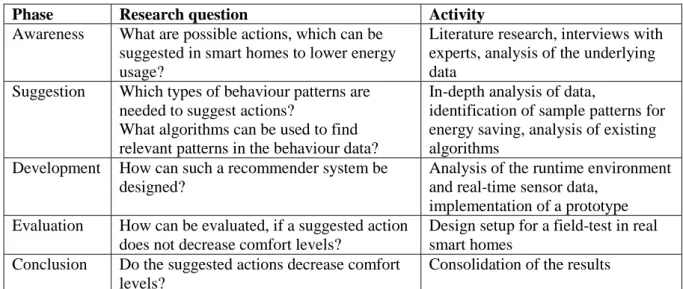
To process design science research according to Vaishnavi & Kuechler (2007) the steps of the “Design Science Research Model” and the research goals defined for the project should be harmonized. The following table (Table 3) will link the phases to the goals and explain which activities inside a phase will help to answer the corresponding research question.
Phase Research question Activity
Awareness What are possible actions, which can be suggested in smart homes to lower energy usage?
Literature research, interviews with experts, analysis of the underlying data
Suggestion Which types of behaviour patterns are needed to suggest actions?
What algorithms can be used to find relevant patterns in the behaviour data?
In-depth analysis of data,
identification of sample patterns for energy saving, analysis of existing algorithms
Development How can such a recommender system be designed?
Analysis of the runtime environment and real-time sensor data,
implementation of a prototype Evaluation How can be evaluated, if a suggested action
does not decrease comfort levels?
Design setup for a field-test in real smart homes
Conclusion Do the suggested actions decrease comfort levels?
Consolidation of the results Table 3 Research strategy according to the phases of the Design Science Research Model
3.3.1
Awareness of Problem
The goal of the awareness phase is to collect as much information as possible about the problem explained in “Problem identification” (chap. 1.3). In order to bring together the information needed to get aware of the problem, different techniques will be applied: review of related literature, interviews with experts and the structural analysis of the historical smart home event data provided. To cover all the important areas of literature, the literature review (chap. 2) will be structured as follows:
The first part should provide general information about smart homes and summarize the initial but also the most recent research, conducted in this area (chap. 2.2).
The second part will concentrate on recent publications about energy saving in smart homes (chap. 2.3).
In the last and most specific part, similar smart home automation systems will be examined. The goal of this part is to create a catalogue of requirements (Table 1) that a smart home automation system should satisfy, to solve the problem identified in this master thesis (chap 2.4 ff.). By means of interviewing experts in the field of smart home automation systems (digitalSTROM), innovation for problem solving can be accomplished. It is expected that the experts can deliver valuable information to the following subjects:
Possible actions to lower energy in smart homes (research goal 1).
Details about technical environment where such a recommender system could run. Precise information about sensors (types, measurements, latency, output values, etc.).
The analysis of the historical data collected in real smart homes, provides the last part of information collected for the awareness phase. The concrete smart home event data is provided by Aizo, a Swiss company that develops and sells the smart home automation system “digitalSTROM”. The data is available as secondary data for this project. It was chosen, because it satisfies all of the following criteria:
The data offers hard evidence collected in real-life smart homes.
There is enough data for a detailed analysis (several years of data for 34 smart homes). The data is very recent and can be updated on request.
3.3.2
Suggestion
The suggestion phase follows immediately after the proposal and should develop an idea for the solution of the problem identified in the proposal. This is a creative step, where new functionality is envisioned, based on existing elements.
The first part of this phase will consist of a detailed and accurate data analysis. Thequantitative data is provided as an export of a relational database. It consists of about one gigabyte of numerical data. The data analysis is a fundamental step to suggest a tentative design, because it will not only provide information about what can be achieved with the data, it will also set the limits and provide clarity what is not possible. The data analysis will contain the following steps:
Understand the structural relations between the tables. Initial analysis and visualization of the data.
In-depth analysis for event data.
Find samples for patterns where energy could be saved.
Based on the data analysis and the sample patterns identified, the second step is to define the types of behaviour patterns, which could be used to suggest actions to save energy (research goal 2). Since the data provided will contain several years of data of more than 30 smart homes, it is pointless to define patterns, which do not occure within the historical data. The sample patterns should match as many as possible of the following criteria:
They occur frequently (significantly more often than other patterns or single events). They occur in periodic manner (reoccur in frequent periods).
They represent a considerable potential for energy saving (defined by research goal 1).
The last step of the suggestion phase is to suggest a design of a recommender system (a completely new approach or a modified version of an existing automation system) that can be used to mine relevant patterns (defined by research goal 2) in the behaviour data, to suggest actions for energy saving (research goal 3). The selection will be based on the following facts:
Evaluation criteria table for the suitability of existing automation systems (Table 1)
Suitability to detect relevant patterns (with energy saving potential) defined by research goal 2 The output of this phase will be a suggestion for a tentative design.
3.3.3
Development
In the development phase, the tentative design is developed further and implemented to a functional prototype, which can be applied to the available data (research goal 4). The implementation itself can be ordinary; the novelty lies in the design and not in the way of construction. It is crucial to develop the prototype according to the specifications in the previous phase, to satisfy the research goals 1-3. In addition, it is important to consider the following points, to prepare the artefact for the evaluation phase:
The prototype must run in an environment specified by the experts from Aizo in the awareness phase in order to make a field test possible (Table 3).
For a successful evaluation, the prototype must be able to process the real-time data from the sensors in the smart homes, specified by the experts in the awareness phase (Table 3).
The output of this phase will be an artefact, represented by a functional prototype of the recommender system which can be evaluated in a field-test.
3.3.4
Evaluation
In this phase, the artefact will be evaluated according to thesis statement and the criteria defined in the research questions.
Research Design
In order to prove or reject the thesis statement, the artefact will be evaluated in a field test. Because of research goal 5, it is not possible to evaluate the prototype just on a basis of historical sample data. To examine, if the comfort of the inhabitant is lowered due to the recommendations made by the system, immediate user feedback to each suggestion is necessary. For this reason, Aizo agreed to provide real smart homes for a field test. The smart homes for the field test are a subset of the households, in which the historical data was collected and will therefore operate with the same sensors. The prototype will be installed in 5-10 smart homes with volunteer inhabitants. It is likely, that the test homes are habited with different quantities of people, in order that the system can be evaluated for single as well as for multi-habitant functionalities.
During the evaluation phase, no interaction between the inhabitants and the system should occur (except the recommendations provided). It is proposed that the suggestions will reach the inhabitants on a mobile device. After a recommendation was made, the inhabitant can evaluate if the suggestion was “useful” and would not negatively influence his comfort level or if the suggestion was inappropriate. This data will be used to answer the research questions and to prove or reject the hypothesis.
In design science research, the initial hypothesis is rarely proven by the first prototype. Often the evaluation results and the information gained during the tests are brought together and fed back to improve the artefact, starting with a new suggestion. (Vaishnavi & Kuechler 2007). Therefore, two evaluation phases are planned. During the first phase, the goal is to make a large quantity of suggestions in order to gain as much experience about the system as possible. These experiences are analysed and considered for the second phase where the goal is to increase the ratio of useful recommendations. The output of this phase will be concrete performance measurements of the recommender system.
3.3.5
Conclusion
The conclusion is the final phase of the cycle, where the results are consolidated and communicated. Since communication is very important in research, the contribution of knowledge is essential for future work (Vaishnavi & Kuechler 2007).
3.4
SUMMARY OF CHAPTER 3
A summary of the research design of this master thesis, will be drawn by using the research onion from Saunders et al. (2009).
Figure 5 The research onion from Saunders et al (2011)
3.4.1
Research Philosophy
The goal of this master thesis is to gain information that justifies the belief, that it is possible to save energy in smart homes under given circumstances. This belief can only be justified by empirical
evidence gained by observation in a field test. Because of this, the research philosophy of this master thesis can clearly be defined as positivism.
3.4.2
Research Approach
The classification of this research project in an inductive or a deductive approach is rather difficult, because both are applied in different stages. In the awareness phase, this research project is following a bottom-up approach: To get an understanding of the problem at hand, the sample data is analysed to derive a theory. The foundation for this problem solving process is existing knowledge and theories from literature and experts. This approach is called abduction. Whereas induction tries to find an argument to explain the data analysed, a solution drawn abductively is only supplying a warrant that enables to express a theory from the data (Douven 2011).
However, this research project is not following the abductive approach exclusively. The derived theory, which is made substantial in form of a recommender system, is benchmarked in a deductive approach in the second part of the project. These two phases are shown as cognitive processes in the following Figure 6.
Figure 6 Cognition in the Design Science Research Cycle by Vaishnavi & Kuechler (2007)
3.4.3
Research Strategy
The research strategy of this project can be assigned to design science research.
3.4.4
Time horizon
The sample dataset for the training of the recommender system provided by Aizo contains almost two years of data. For the discovery of frequent and periodic activity patterns, it is anticipated that the more training data is provided, the better results can be expected. However, user behaviour can change over time and there could be historical outliers or noise, which will mislead the mining algorithms. To find the best time spans for the mining process will be an essential challenge during the research process. However it is given, that the spans will comprise rather months then days. This will allow making a meaningful statement regarding the possibility of finding the activity patterns in an autonomous way.
Data Analysis
CHAPTER 4 -
DATA ANALYSIS
4.1
INTRODUCTION OF CHAPTER 4
The following chapter takes place in the awareness phase of the project and addresses the need for an in-depth analysis of the smart home behaviour data provided by Aizo. An analysis of the data is necessary to find possible restrictions made due to the data in an early stage of the project. Because only people who have expert knowledge in the underlying data can answer questions, the data must be analysed in an early stage of the project to address the questions to the experts.
The goal of this analysis is to get to know the available secondary data for this research project and to answer the first research question:
What are possible actions, which can be suggested in smart homes to lower energy usage? This question could be answered in a very general way, without any consideration of the underlying data for this project. Actions, which can be suggested to lower energy consumption in a household, could reach from changing traditional light bulbs to more energy efficient products, to suggestions to close the windows when the room temperature drops too much during ventilation. However, since the aim of the project is to make recommendations based on consumer behaviour data, the actions are derived from the smart home event data provided by Aizo.
The secondary data provided for this project was collected in alpha and beta test houses using the proprietary system digitalSTROM from Aizo. Since the approach developed in this project was designed to work for home automation systems, which record user behaviour data, in general, the digitalSTROM system will be referred to as “smart home system” in the further course of this document.
4.2
STRUCTURE OF DATA
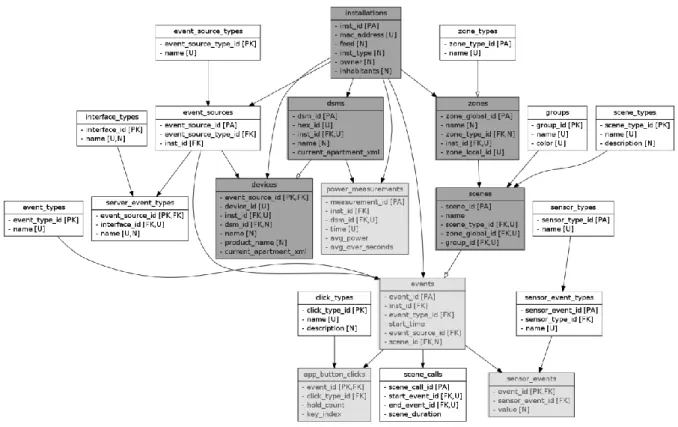
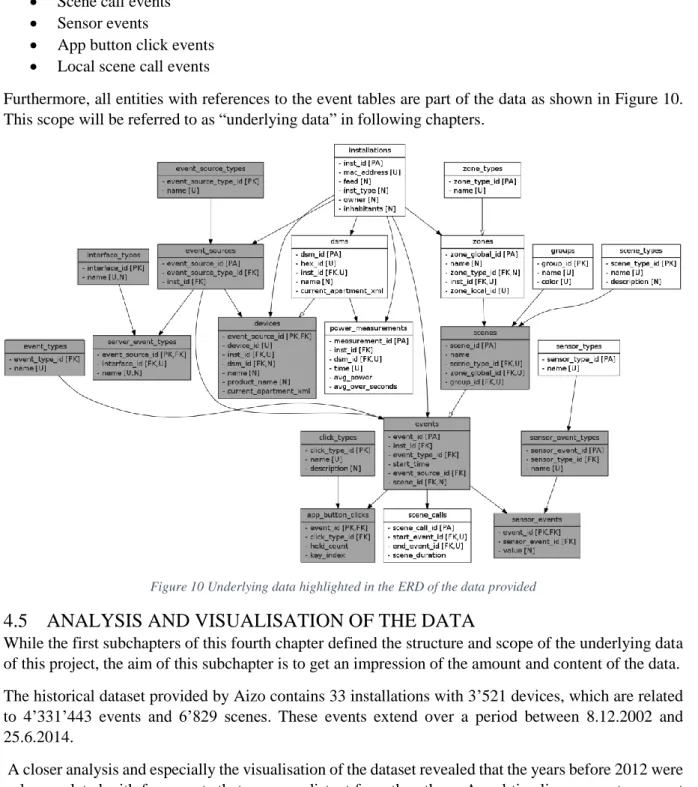
The data provided from the smart homes is parsed from the log files of the system and is structured according to the entity relationship diagram in Figure 7.
The basic structure of the core entities (dark grey) can be explained hierarchically. The root node is represented by an installation, which describes one household (or in exceptional cases one house unit). An installation has several DSMs (abbr. for “DigitalSTROM Meter”), which represents one electric circuit in a smart home, and several zones (rooms). These zones are categorized in zone types and are related to one or many scenes, which again can be clustered again in groups and scene_types. The DSM is subdivided in the devices that are connected to the circuit. The dynamic entities (light grey) contain timelines for the core entities. Power_measurements are recorded per DMS and events are related to devices (event_sources) and depending on its type scenes to app_button_clicks or sensor_events. Event sources are again categorized in event_type_sources and server_event_types. In addition, app_button_clicks and sensor_events are characterized by type (click_type respectively sensor_type). Because the data provided is parsed from log files, its structure is not fully normalized. The current dataset is just an intermediate step to enable further research on the data. The data points, which are relevant for the system developed in this project, will be covered in detail later.
4.3
EVALUATION OF THE VARIABLES OF ANALYSIS
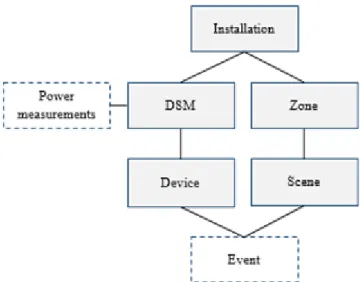
The two variables of measurement, which are important for this research project, are “power measurements” and “events”. While the other entities rather represent static information about the smart home system installed in the house, the two entities contain dynamic timelines, which can be used to deduce human behaviour patterns. A simplified version of the structure of the data is shown in Figure 8.
Figure 8 Power measurements and events in the structure of smart home data
To find possible actions to lower energy usage in smart homes, it is important to identify figures, which explain the energy usage in a smart home as detailed as possible. The most important attributes for a sequential smart home data event were defined as followed.
Which device was triggered? When was the device triggered? What was the source of the event? How much power was consumed before? How much power was consumed after?
However, the data provided does not allow evaluating all these attributes, neither by the use of power measurements nor by events. The problem of the power measurement data lies in its structure. Power measurements can only be evaluated per DSM, but not per single device. Due to this fact, the power measurement data captured is only a summary of the energy consumed in the overall electric circuit
Data Analysis
from all devices together in this DMS, which makes it impossible to calculate the consumption of a single device.
Furthermore, the matching between the timestamps of the event and power measurement data resulted in no quantifiable results. The timestamps of the power measurements are stored in milliseconds, whereas the accuracy of the event data is only seconds. In addition, both values can introduce latency, which makes a reliable matching of the two entities impossible.
However, the attributes from the event data are well suited for identifying the attributes proposed. Since they are referenced to the device and to the scene table, both, the triggering device and the action triggered by the event can be identified. Nevertheless, there is no attribute to quantify the power usage, to measure the increase or decrease of the electric energy consumption by the given event. However, to answer the hypothesis defined for this project, the amount of energy saved is no critical factor, it is just important to identify if an event did increase or decrease the power usage (on or off event) which can be identified for the event data (see chap. 4.6).
Because of the arguments presented in this subchapter, the variable of analysis for this project will be defined as the smart home events.
4.4
DEFINITION OF AN EVENT
Based on the structure of the data and the variable of analysis, an event in the context of this research project can be defined as follows.
A single action caused by an inhabitant, which was recorded by the smart home system. Obviously, there are more actions caused by an inhabitant, which are not recorded by the system. They cannot be considered as events, because they do not exist in the dataset provided. Events recorded by the smart home system can be divided in five different types: Scene calls, Sensor events, App button clicks, Local scene calls and Undo scenes, ordered descending by the number of occurrences in the data (Figure 9).
Figure 9 Percentage of events per event type
Because of their different characteristics, each event type has different attributes. Therefore, the relevant information for each event type is stored in separate tables in the database. However, to mine patterns in these events and apply the data for the recommender system, the events must be unified to one single timeline with identical attributes. The relevant attributes for the system are:
event_id: Unique identifier for each event
start_time: The exact timestamp, when the event occurred in the given smart home event_source: Which device of the smart home system did record the event event_name: What is the purpose of the event
These attributes lay the basis for the following steps and are important for the pattern mining process. The event_id will serve as unique identifier for each instance of an event and the start time allows ordering the events correctly in the event stream. To identify the relevant patterns, the source and the name will be important (see chap. 5.3).
The characteristics and the relevance for the research project for each event type is elaborated in the following subchapters.
4.4.1
Scene call events
A scene or also called “ambience” is a predefined configuration for one or more devices controlled by the smart home system. A simple example for a scene call is to turn on a spotlight in the living room whereas a more complex example is a “good morning scene” that includes several lamps and other devices like the cafe machine, which are turned on by calling this scene.
The data provided does not reveal which exact devices are called by a scene. However, the device referenced to a scene call is the event source (e.g. the switch, which was pressed by the inhabitant to call this scene). Therefore, one scene call is reported as one event in the database independent from the fact, how many exact devices where operated.
The system offers predefined scenes, but inhabitants can create new scenes and name them individually. For most of the scenes, the name attribute gives more information about its purpose. A scene call is always a direct interaction of the user with the system. The scene call properties are mapped as followed:
event_source: The switch, which was the origin of the scene call (device.name) event_name: The name of the scene called (scene.name)
4.4.2
Sensor events
Sensor events are indirect interactions of the user with the system. The inhabitant is not actively using a device of the smart home system, but a sensor recorded that the state inside the smart home changed. Examples for sensor events are motion-detection events or the detection that the coffee machine was turned off. A sensor event consists of two major properties, which can be mapped as followed:
event_source: The sensor, which reported the event (device.name) event_name: The value reported by the sensor (sensor_event_type.name)
4.4.3
App button click event
Besides the traditional functionalities, this smart home system offers also the possibility to control certain functions by using a mobile device. These interactions from the inhabitants with the system are represented by app button click events. The events can be mapped to the other events as followed:
event_source: Which device was triggered from the mobile device (device.name) click Type: Type of click executed (click_type.descripition)
4.4.4
Local scene call
Besides the possibility of calling a device together with other devices in a scene, a device can also be called locally. These event types are especially used for devices with built in on/off switches, such as floor lamps, which is not directly connected to the system. If the state of such a local device has changed, the smart home system records this event as local scene call.
Event_source: Name of the local device which was triggered (device.name) Event_name: The name of de scene called (scene.name)
4.4.5
Undo scene
A very small p