DICTA2002: Digital Image Computing Techniques and Applications, 21–22 January 2002, Melbourne, Australia 1
Brushlet Features for Texture Image Retrieval
Chibiao Chen and Kap Luk Chan
Information System Research Lab, School of EEE
Nanyang Technological University, Singapore
Email:
{P146702456 & eklchan}@ntu.edu.sg
Chi-Fa Chen
Dept. of Electrical Engineering
I-Shou University, Taiwan
Email: [email protected]
Abstract
In this paper, we employ a new adaptive basis of func-tions — brushlets for extracting texture properties. Brush-lets are functions which are well localized with only one peak in the frequency domain. Hence, a representation of texture in terms of spatial frequency distributions can be constructed. The Brushlet features are used in texture im-age retrieval experiments to assess its effectiveness by com-paring with retrieval results obtained using other commonly used wavelet and Gabor based representations. Experi-ments using the Brodatz texture database indicates that the brushlet features achieve a very good retrieval compara-ble to and slightly better than that using Gabor features and better than the wavelet features. The advantage of the brushlet features is that they require far less computation to extract than the Gabor features for achieving comparable performance.
1. Introduction
Texture can be found on many types of objects, such as woods, fabrics, and in natural scene. In a digital image li-brary, images containing various types of textures are also often found. Texture is also one of the key descriptors for representing image content in the proposed MPEG-7 stan-dards. The ability to efficiently describe and analyze tex-tured pattern is then of fundamental importance to image analysis as well as to general image retrieval.
Many tools can be used to describe textures. In im-age retrieval, wavelet basis and Gabor basis functions have been used to represent textures. Wavelets provide an oc-tave based decomposition of the Fourier plane with a poor angular resolution. Wavelet packets make it possible to adaptively construct an optimal tiling of the Fourier plane and have been used in texture classification [5]. However the tensor product of two real valued wavelet packets is al-ways associated with four symmetric peaks in the frequency plane. It is therefore not possible to selectively tune and
lo-calize a unique frequency. It is also not orientation selective. Gabor filters are very popular in image analysis [3][4][7] and they show excellent texture analysis ability. Comparing to wavelet basis, Gabor basis is both frequency tunable and orientation selective. However, a filter bank consisting of many Gabor filters are often constructed to cover the entire frequency spectrum and the original image must convolve with all these filters to extract texture features. Obviously, the computation load is high.
In order to obtain a better angular resolution than the standard wavelet packets we can expand the Fourier plane into a set of bruslets. Brushlets were proposed by F. G. Meyer and R. R. Coifman and have been applied in image compression [8]. A brushlet is a function reasonably well localized with only one peak in frequency. Furthermore, the brushlet is a complex valued function with a phase. The phase of the 2D brushlet provides valuable information about the orientation. These properties make the brushlets suitable for texture and directional image analysis.
The objective of this paper is to study the use of this new adaptive basis of functions — brushlets for extracting texture properties. This paper is organized as follows. In section 2, we review the construction of brushlet bases. In section 3 we describe the image retrieval algorithm based on a brushlet decomposition of the image. Results of exper-iments are presented in section 4. Conclusions are given in section 5.
2. The Brushlet Bases
In signal processing, a local analysis of the Fourier spec-trum of a signal is often interested. In order to analyze the local frequency content of a signal, a smooth window func-tion is used to cut the support of the signal into adjacent intervals. Then a local Fourier analysis is performed inside each interval.
LetG={g(t−m) exp(2iπnt) :m, n∈Z}be a collec-tion of funccollec-tions inL2(R), wheregis some fixed
square-integrable bump. The Balian-Low theorem [1] states that if
must be infinite! In order to circumvent this obstacle raised by the Balian-Low theorem, various Wilson bases [2][6] have been constructed that use sines and cosines rather than exponentials. Such a mechanism results in basis functions that contain equal energy at both positive and negative fre-quencies. However, using exponentials is much preferred because the phase of the exponentials will provide informa-tion about the direcinforma-tion of the pattern when describing im-ages in two dimensions. With the smooth local
periodiza-tion technique introduced in [9], we can avoid the
Balian-Low phenomenon while using exponential functions that have all but an arbitrarily small amount of energy localized in just the positive part of the frequency spectrum.
2.1. Brushlet Fundamentals
Consider a coverR = Snn=+=−∞∞[αn, αn+1). Letpn =
αn+1−αn, andcn= αn+2αn+1. Around eachαnwe define
a neighborhood of radius². Letrbe a ramp function such that
r(t) =
½
0 ift≤ −1 1 ift≥1 ,
andr2(t) + r2(−t) = 1, ∀t ∈ R. Let b be the bump
function supported on[−², ²],b(t) =r¡t²¢r¡−t²¢. Letwn
be the windowing function supported on[−pn
2 −²,p2n+²] wn(t) = r2³t+pn2 ² ´ ift∈[−pn 2 −²,− pn 2 +²) 1 ift∈[−pn 2 +², pn 2 −²). r2³−t+pn2 ² ´ ift∈[pn 2 −², pn 2 +²] Letem,n(t) = √1pnexp ³ −2iπmt−αn pn ´ the collection of exponential functions.
By using the FFT and smooth local periodization tech-nique [9], the 1D brushlet basis{vm,n}can be constructed
[8]
vm,n= √
pnexp(2iπαnt) exp(iπpnt)[(−1)mpnwˆσ ·(pnt−m)−2isin(πpnt)pnˆbσ(pnt+m)], (1)
whereσ= p²
nis defined as a steepness factor of the window wnandwσ(t) =wn(pnt)is supported on[−12−σ,12+σ].
Bump functionbσ(t) = bn(pnt) is supported on[−σ, σ].
ˆ
wσ andˆbσ are the inverse FFT ofwσ andbσ, repectively.
Note that, in (1),pn appears as a scaling factor of the
anal-ysis, andmis the translation index of the brushlet. vm,n
has an expression similar to a wavelet. However, as op-posed to a real valued wavelet,vm,n is a complex valued
function with a phase. The phase encodes the orientation of the brushlet pattern in the two-dimensional case. The functionvm,nis composed of two terms, localized around
m
pn and around−
m
pn, that are oscillating with the frequency
cn = αn+2αn+1. The first term is an exponential multiplied
by the windowwˆσ. Since|ˆbσ≤σ|, the second term can be
made as small as possible.
2.2. The 2D Brushlets
In the two dimensional case we define two partitions of
R, Sjj==+−∞∞[αj, αj+1) and
Sk=+∞
k=−∞[βk, βk+1). Letpj =
αj+1−αj, qk = βk+1−βk,cj = αj+2αj+1, anddk = βk+βk+1
2 . Consider the tiling obtained by the lattice
rectan-gles[αj, αj+1) N
[βk, βk+1). The tensor product of bases vm,jandvn,ksequence,vm,j⊗vn,k, is an orthonormal basis
forL2(R2).
The tensor productvm,j(x)⊗vn,k(y)is an oriented
pat-tern oscillating with the frequency(cj, dk)and localized at
(m pj,
n qk).
To illustrate the orientation selective property of the 2D brushlet, we have calculated the brushlet expansion of the Brodatz image D047 (see Figure 1). A first expansion was performed with a partitioning of the Fourier plane into four quadrants. The four sets of brushlets have the orientation
π
4 +kπ2, k = 0,1,2,3. A second expansion has been
per-formed using a finer grid. Each quadrant was further di-vided into four sub-quadrants. The sixteen set of brushlets have twelve different orientations. The orientationsπ4+kπ 2
are associated with two different frequencies. The four lat-tice squares around the origin characterize the DC terms of the expansion. The other squares correspond to higher fre-quency textures.
3. Image Retrieval with Brushlet Features
In this section we introduce the feature definitionsbased on the brushlet decomposition of textured images, and their use in image retrieval experiments.3.1. Texture Feature Extraction and Representation
For a given retrieval image sampleI, we extract its tex-ture featex-ture using a level 2 brushlet decomposition. The decomposition divides the spectrum into 16 blocks with 12 distinct directions as shown in the bottom right part of Fig-ure 1. Denote the brushlet coefficients in each blockIi(j, k)(i= 1, . . . ,16,j = 1, . . . , R, andk = 1, . . . , C, whereR andCare the number of rows and columns in each block, respectively.), then we use the meanµi and the standard
deviationσi (i = 1, . . . ,16) of the brushlet coefficients to
represent the blocks for retrieval purpose:
µi= 1 RC R X j C X k |Ii(j, k)|, (2)
Original D047 1 2 3 4 1 2 3 4 5 6 7 8 9 10 11 12
Level 1 decomposition Level 2 decomposition
Figure 1. Brushlet decompositions (imaginal parts) of Brodatz texture D047 and their asso-ciated directions and σi= v u u t 1 RC−1 R X j C X k (|Ii(j, k)| −µi)2. (3)
A feature vector is now constructed usingµiandσias
fea-ture components
F = [µ1σ1µ2σ2 . . . µ16σ16]. (4)
3.2. Distance Measure
Consider two image patternsmandn, and letF(m)and
F(n)represent the corresponding feature vectors. Then the
distance between the two patterns in the feature space is defined to be d(m, n) = 16 X i di(m, n), (5) where di(m, n) = ¯ ¯ ¯ ¯ ¯ µ(im)−µ(in) α(µi) ¯ ¯ ¯ ¯ ¯+ ¯ ¯ ¯ ¯ ¯ σ(im)−σ(in) α(σi) ¯ ¯ ¯ ¯ ¯. (6)
α(µi)andα(σi)are the standard deviations of the
respec-tive features over the entire image database, and are used to normalize the individual feature components.
3.3. Texture Retrieval Algorithm
Upon presentation of a query pattern, the pattern is pro-cessed to compute the feature vector as in Equation 4. The distanced(m, n), wheremis the query pattern andnis a pattern from the database for all images in the database, is computed. The distances are then sorted in ascending order and the closest set ofNpatterns are then retrieved.
4. Experimental Results
In this section, we present our experimental results. The texture database used in the experiments consists of the 112 texture classes from the Brodatz album. Each of the512×
512images is divided into 16 non-overlapping sub-images of size128×128, thus creating a database of 1792 texture images. All 1792 images are used as query. When an image is used as a query, it is removed from the database. The performance is measured in terms of the average retrieval rate which is defined as the average percentage number of patterns belonging to the same image as the query pattern in the topN = 45most similar images.
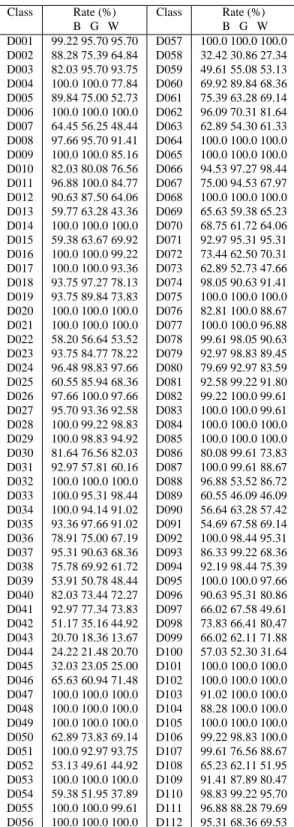
To assess the usefulness of brushlets, we compare the retrieval results obtained by brushlet features with those ob-tained by Gabor and wavelet packet features. For the sake of fairness, the decomposition levels performed in brush-let and wavebrush-let packet expansions are set to 2 and number of scales in the Gabor filtering is also set to 2. In our tex-ture retrieval application, a pair of two distinct directions, which have a difference ofπ, have the same effect on the experimental results. Therefore, the number of directions of the Gabor filters are set to 6. The wavelet packets used in the experiments are 4-tag Daubechies wavelet functions. The texture feature extraction and representation, and dis-tance measure used in wavelet packet and Gabor based re-trieval algorithms are same as those used in brushlet based retrieval algorithm. The average retrieval rates for the 112 texture image classes in the database are shown in Table 1. The overall retrieval rates and standard deviations for the entire image database are shown in Table 2. From Table 2, we can see the overall retrieval of brushlet based algorithm is the best because that the distribution of the retrieval rates of brushlet based algorithm is also the most compact one as well as the marginally higher averages than the Gabor based
algorithm. The computation times for extracting features of one texture on a PENTIUM533 CPU using MATLAB5.3.1 are shown in Table 3. From Table 3, we can see the brushlet feature extraction is significantly faster than the Gabor fea-tures. Hence, the brushlet features can be considered better than the compared features for this texture image retrieval.
However we also note that there are several individual image classes bear very low retrieval rate. For example, the rate of D043 is 20.70% and the rate of D044 is 24.22%. This is due the big variation in the original images, i.e the texture is non-homogenous. We divided a big image into 16 small images and consider these images formed an image class in the image database. Therefore, the images in one of these 2 image class do not resemble each other.
5. Conclusion
In this paper, a new texture analysis tool, the brushlet, is used to decompose a texture and represent the texture. Ex-perimental results show that these brushlet features are quite effective. Comparisons show the brushlets based features perform better than Gabor based features and much better than wavelet packets features in the terms of retrieval rates and their distributions. This can be explained as follows: The Gabor filters used in our experiments are complex func-tions. They also provide excellent frequency localization ability. Besides, in a Gabor based system, arbitrary number of directions and scales can be used. This indicates that the analysis ability of Gabor can be infinite. However, all these come at the expense of computation burden; wavelet pack-ets of real functions cannot localize a unique frequency in the Fourier spectrum. The angular resolution of brushlets is better than that of wavelet packets too. The main advan-tage of brushlets is less computation required for achieving comparable retrieval performance as using Gabor features.
References
[1] I. Daubechies. Ten lectures on wavelets. CBMS-NSF
Confer-ence Series in Applied Mathematics, SIAM Ed. 1992.
[2] I. Daubechies, S. Jaffard, and J. L. Journ´e. A simple Wil-son orthnormal basis with exponential decay. SIAM J. Math.
Anal., 22:554–572, 1991.
[3] J. G. Daugman. Complete dicrete 2D gabor transforms by neural networks for image analysis and compression. IEEE
Trans. Acoust., Speech, Signal Processing, 36:1169–1179,
1988.
[4] A. K. Jain and F. Farrokhnia. Unsupervised texture segmen-tation using Gabor filters. Pattern Recognition, 24(12):1167– 1186, 1991.
[5] A. Laine and J. Fan. Texture classification by wavelet packet signatures. IEEE Trans. Pattern Anal. Machine Intell., 15:1186–1191, 1993.
[6] H. Malvar. Lapped transform for efficient transform/subband coding. IEEE Trans. Acoust. Sign. Speech Process. Machine, 38:969–978, 1990.
[7] B. S. Manjunath and W. Y. Ma. Texture features for brows-ing and retrieval of image data. IEEE Trans. Pattern Anal.
Machine Intell., 18(8):837–842, 1996.
[8] F. G. Meyer and R. R. Coifman. Brushlet: A tool for direc-tional image analysis and image compression. Applied and
Computational Harmonic Analysis, 4:147–187, 1997.
[9] M. V. Wickerhauser. Adapted Wavelet Analysis from Theory
to Software. A K Peters, Ltd., A K Peters, Ltd., 289 Linden
Table 1. Average retrieval rate for the 112 texture image classes in the database (B: Brushlet features, G: Gabor features, and W: Wavelet packet features)
Class Rate (%) Class Rate (%) B G W B G W D001 99.22 95.70 95.70 D057 100.0 100.0 100.0 D002 88.28 75.39 64.84 D058 32.42 30.86 27.34 D003 82.03 95.70 93.75 D059 49.61 55.08 53.13 D004 100.0 100.0 77.84 D060 69.92 89.84 68.36 D005 89.84 75.00 52.73 D061 75.39 63.28 69.14 D006 100.0 100.0 100.0 D062 96.09 70.31 81.64 D007 64.45 56.25 48.44 D063 62.89 54.30 61.33 D008 97.66 95.70 91.41 D064 100.0 100.0 100.0 D009 100.0 100.0 85.16 D065 100.0 100.0 100.0 D010 82.03 80.08 76.56 D066 94.53 97.27 98.44 D011 96.88 100.0 84.77 D067 75.00 94.53 67.97 D012 90.63 87.50 64.06 D068 100.0 100.0 100.0 D013 59.77 63.28 43.36 D069 65.63 59.38 65.23 D014 100.0 100.0 100.0 D070 68.75 61.72 64.06 D015 59.38 63.67 69.92 D071 92.97 95.31 95.31 D016 100.0 100.0 99.22 D072 73.44 62.50 70.31 D017 100.0 100.0 93.36 D073 62.89 52.73 47.66 D018 93.75 97.27 78.13 D074 98.05 90.63 91.41 D019 93.75 89.84 73.83 D075 100.0 100.0 100.0 D020 100.0 100.0 100.0 D076 82.81 100.0 88.67 D021 100.0 100.0 100.0 D077 100.0 100.0 96.88 D022 58.20 56.64 53.52 D078 99.61 98.05 90.63 D023 93.75 84.77 78.22 D079 92.97 98.83 89.45 D024 96.48 98.83 97.66 D080 79.69 92.97 83.59 D025 60.55 85.94 68.36 D081 92.58 99.22 91.80 D026 97.66 100.0 97.66 D082 99.22 100.0 99.61 D027 95.70 93.36 92.58 D083 100.0 100.0 99.61 D028 100.0 99.22 98.83 D084 100.0 100.0 100.0 D029 100.0 98.83 94.92 D085 100.0 100.0 100.0 D030 81.64 76.56 82.03 D086 80.08 99.61 73.83 D031 92.97 57.81 60.16 D087 100.0 99.61 88.67 D032 100.0 100.0 100.0 D088 96.88 53.52 86.72 D033 100.0 95.31 98.44 D089 60.55 46.09 46.09 D034 100.0 94.14 91.02 D090 56.64 63.28 57.42 D035 93.36 97.66 91.02 D091 54.69 67.58 69.14 D036 78.91 75.00 67.19 D092 100.0 98.44 95.31 D037 95.31 90.63 68.36 D093 86.33 99.22 68.36 D038 75.78 69.92 61.72 D094 92.19 98.44 75.39 D039 53.91 50.78 48.44 D095 100.0 100.0 97.66 D040 82.03 73.44 72.27 D096 90.63 95.31 80.86 D041 92.97 77.34 73.83 D097 66.02 67.58 49.61 D042 51.17 35.16 44.92 D098 73.83 66.41 80.47 D043 20.70 18.36 13.67 D099 66.02 62.11 71.88 D044 24.22 21.48 20.70 D100 57.03 52.30 31.64 D045 32.03 23.05 25.00 D101 100.0 100.0 100.0 D046 65.63 60.94 71.48 D102 100.0 100.0 100.0 D047 100.0 100.0 100.0 D103 91.02 100.0 100.0 D048 100.0 100.0 100.0 D104 88.28 100.0 100.0 D049 100.0 100.0 100.0 D105 100.0 100.0 100.0 D050 62.89 73.83 69.14 D106 99.22 98.83 100.0 D051 100.0 92.97 93.75 D107 99.61 76.56 88.67 D052 53.13 49.61 44.92 D108 65.23 62.11 51.95 D053 100.0 100.0 100.0 D109 91.41 87.89 80.47 D054 59.38 51.95 37.89 D110 98.83 99.22 95.70 D055 100.0 100.0 99.61 D111 96.88 88.28 79.69 D056 100.0 100.0 100.0 D112 95.31 68.36 69.53
Table 2. Overall retrieval rates and standard deviations for the entire database
Brushlet Gabor WP Overall Retrieval Rate (%) 84.76 83.02 78.97
Standard Deviation (%) 18.52 21.00 21.24
Table 3. Average computation time for extract-ing features of one texture
Brushlet Gabor WP Computation Time (Sec) 0.439 0.600 0.276