Empirical Studies of Test Case Prioritization in a JUnit Testing Environment
Hyunsook Do
[email protected]
Gregg Rothermel
y[email protected]
Alex Kinneer
z[email protected]
Abstract
Test case prioritization provides a way to run test cases with the highest priority earliest. Numerous empirical stud-ies have shown that prioritization can improve a test suite’s rate of fault detection, but whether the results of these stud-ies generalize to other language paradigms is an open ques-tion because the studies have all focused on a single proce-dural language, C, and on only a few specific types of test suites. In particular, Java and the JUnit testing framework are being used extensively in practice, and the effectiveness of prioritization techniques on Java systems tested under JUnit has not been investigated. We have therefore designed and performed a controlled experiment examining whether test case prioritization can be effective on Java programs tested under JUnit, and comparing results to those achieved in earlier studies. Our analyses show that test case priori-tization can significantly improve the rate of fault detection of JUnit test suites, but also reveal differences with respect to previous studies that can be related to the language and testing paradigm.
1
Introduction
As a software system evolves, software engineers re-gression test it to detect whether new faults have been in-troduced into previously tested code. The simplest regres-sion testing technique is to re-run all existing test cases, but this can require a lot of effort, depending on the size and complexity of the system under test. For this reason, re-searchers have studied various techniques for improving the cost-effectiveness of regression testing, such as regression test selection [10, 26], test suite minimization [9, 18, 22], and test case prioritization [15, 28, 31].
Test case prioritization provides a way to run test cases that have the highest priority -according to some criterion-earliest, and can yield meaningful benefits, such as provid-ing earlier feedback to testers and earlier detection of faults. Numerous prioritization techniques have been described in the research literature and they have been evaluated through
Department of Computer Science, Oregon State University y
Department of Computer Science, Oregon State University z
Department of Computer Science, Oregon State University
various empirical studies [11, 14, 15, 27, 28, 29, 31]. These studies have shown that several prioritization techniques can improve a test suite’s rate of fault detection. All of these studies, however, have focused on a single procedural lan-guage, C, and on only a few specific types of test suites, so whether these results generalize to other programming and testing paradigms is an open question. Replication of these studies with populations other than those previously exam-ined is needed, to support a more complete understanding of test case prioritization.
In this work, we set out to perform a replicated study, fo-cusing on an object-oriented language, Java, that is rapidly gaining usage in the software industry, and thus is practi-cally important in its own right. We focus further on the JUnit testing framework, which is increasingly being used by developers to implement test cases for Java programs [1]. In fact, with the introduction of the JUnit testing framework, many software development organizations are building JU-nit test cases into their code bases, as is evident through the examination of Open Source Software hosts such as Source-Forge and Apache Jakarta [2, 3].
The JUnit framework encourages developers to write test cases, and then to rerun all of these test cases whenever they modify their code. As mentioned previously, however, as the size of a system grows, rerun-all regression testing strategies can be excessively expensive. JUnit users will need methodologies with which to remedy this problem1
. We have therefore designed and performed a controlled experiment examining whether test case prioritization can be effective on object-oriented systems, specifically those written in Java and tested with JUnit test cases. We examine prioritization effectiveness in terms of rate of fault detec-tion, and we also consider whether empirical results show similarity (or dissimilarity) with respect to the results of pre-vious studies. As objects of study we consider four open source Java programs that have JUnit test suites, and we
1
This may not be the case with respect to extreme programming, an-other development methodology making use of JUnit test cases, because extreme programming is intended for development of modest size projects using between 2 and 12 programmers [30]. However, JUnit is also being used extensively in the testing of Java systems constructed by more tra-ditional methodologies, resulting in large banks of integration and system tests. It is in this context that prioritization can potentially be useful.
examine the ability of several test case prioritization tech-niques to improve the rate of fault detection of these test suites, while also varying other factors such as the gran-ularity of the prioritization technique and test suite. Our results indicate that test case prioritization can significantly improve the rate of fault detection of JUnit test suites, but also reveal differences with respect to previous studies that can be related to the Java and JUnit paradigms.
In the next section of this paper, we describe the test case prioritization problem and related work. Section 3 de-scribes the JUnit testing framework, and extensions to that framework that allow it to support prioritization. Section 4 presents our experiment design, results, and analysis, de-scribing what we have done in terms of experiment setup to manipulate JUnit test cases. Section 5 discusses our results, and Section 6 presents conclusions and future work.
2
Background and Related Work
2.1
Test Case Prioritization
Test case prioritization techniques [15, 28, 31] schedule test cases in an execution order according to some criterion. The purpose of this prioritization is to increase the likeli-hood that if the test cases are used for regression testing in the given order, they will more closely meet some objective than they would if they were executed in some other order. For example, testers might schedule test cases in an order that achieves code coverage at the fastest rate possible, ex-ercises features in order of expected frequency of use, or increases the likelihood of detecting faults early in testing.
Depending on the types of information available for pro-grams and test cases, and the way in which those types of information are used, various test case prioritization tech-niques can be utilized. One way in which techtech-niques can be distinguished involves the type of code coverage infor-mation they utilize. Test cases can be prioritized in terms of the number of code statements, basic blocks, or methods they executed on a previous version of the software. For ex-ample, a total block coverage prioritization technique sim-ply sorts test cases in the order of the number of blocks they covered, resolving ties randomly.
A second way in which techniques can be distinguished involves the use of “feedback”. When prioritizing test cases, if a particular test case has been selected as “next best”, information about that test case can be used to re-evaluate the value of test cases not yet chosen, prior to picking the next best test case. For example, additional block cover-age prioritization iteratively selects a test case that yields the greatest block coverage, then adjusts the coverage in-formation for the remaining test cases to indicate coverage of blocks not yet covered, and repeats this process until all blocks coverable by at least one test case have been covered. This process is then repeated on remaining test cases.
A third way in which prioritization techniques can be distinguished involves their use of information on code modifications. For example, the amount of change in a code element can be factored into prioritization, by weighting the elements covered using a measure of change.
Other dimensions along which prioritization techniques can be distinguished, and that have been suggested in the literature [14, 15], include test cost estimates, fault sever-ity estimates, estimates of fault propagation probabilsever-ity, and usage statistics obtained through operational profiles.
2.2
Previous Empirical Work
Studies of cost-effectiveness
Early studies of test case prioritization focused on the cost-effectiveness of individual techniques, the estimation of a technique’s performance, or comparisons of techniques [15, 27, 28, 29, 31]. These studies showed that various techniques could be cost-effective, and suggested tradeoffs among them. However, the studies also revealed wide vari-ances in performance, and attributed these to factors involv-ing the programs under test, test suites used to test them, and types of modifications made to the programs.
Studies of factors and generalization
Recent studies of prioritization have begun to examine the factors affecting prioritization effectiveness [11, 21, 24]. Rothermel et al. [24] studied the effects of test suite gran-ularity on regression testing techniques, varying the com-position of test suites and examining the effects on cost-effectiveness of test selection and prioritization. While this study did not consider correlating attributes of change with technique performance, Elbaum et al. [11] performed ex-periments exploring characteristics of program structure, test suite composition, and changes on prioritization, and identified several metrics characterizing these attributes that correlate with prioritization effectiveness.
More recent studies have examined how some of these factors affect the effectiveness and efficiency of test case prioritization, and have considered the generalization of findings through several controlled experiments [12, 16, 25]. These studies exposed tradeoffs and constraints that affect the success of techniques, and provide guidelines for designing and managing prioritization and testing pro-cesses.
All of the empirical work just described has concerned C programs and system-level test suites constructed for code coverage, or for partition-based coverage of requirements. In contrast, the study we describe here examines whether prior results generalize, by replicating previous experiments on a new population of programs and test suites (Java and JUnit), and examining whether the results are consistent with those of the previous studies.
3
JUnit Testing and Prioritization
JUnit test cases are Java classes that contain one or more test methods and that are grouped into test suites, as shown in Figure 1. The figure presents a simple hierarchy having only a single test-class level, but the tree can extend deeper using additional nesting of Test Suites. The leaf nodes in such a hierarchy, however, always consist of test-methods, where a test-method is a minimal unit of test code.
. . . test−method . . . test−class level test−method level test−class test−class test−method test−class test−method Test Suite
Figure 1.JUnit test suite structure
JUnit test classes that contain one or more test methods can be run individually, or a collection of JUnit test cases (a test suite) can be run as a unit. Running individual test cases is reasonable for small programs, but when the number of test cases increases, it can become prohibitively expensive, because each independent execution of a test incurs startup costs. Thus in practice, developers design JUnit tests to run as sequences of tests invoked through test suites that invoke test classes.
Clearly, choices in test suite granularity (the number of test cases making up a test suite) can affect the cost of run-ning JUnit tests, and we want to investigate the relationship between this factor and prioritization results. To do this, we focus on two levels of test suite granularity: test-class level, a collection of test-classes that represents a coarse test suite granularity, and test-method level, a collection of test-methods that represents a fine test suite granularity. To support this focus we needed to ensure that the JUnit frame-work allowed us to achieve the following four objectives:
1. treat each TestCase class as a single test case for pur-poses of prioritization (test-class level);
2. reorder TestCase classes to produce a prioritized order; 3. treat individual test methods within TestCase classes
as test cases for prioritization (test-method level); 4. reorder test methods to produce a prioritized order.
Objectives 1 and 2 were trivially achieved as a conse-quence of the fact that the default unit of test code that can be specified for execution in the JUnit framework is a Test-Case class. Thus it was necessary only to extract the names of all TestCase classes invoked by the top level TestSuite for the object program2
(a simple task) and then execute them 2
This process may need to be repeated iteratively if Test Suites are nested in other Test Suites.
individually with the JUnit test runner in a desired order. Objective 3 was more difficult to achieve, due to the fact that a TestCase class is also the minimal unit of test code that can be specified for execution in the normal JUnit framework. Since a TestCase class can define multiple test methods, all of which will be executed when the TestCase is specified for execution, providing the ability to treat indi-vidual methods as test cases required us to extend the JUnit framework to support this finer granularity. Thus the prin-cipal challenge we faced was how to design and implement our JUnit extensions so as to provide a means for speci-fying individual test methods for execution, out of a total set of methods potentially spread across multiple TestCase classes.
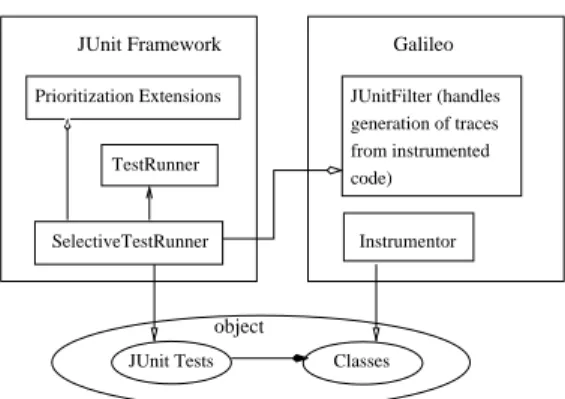
Given that the fundamental purpose of the JUnit frame-work is to discover and execute test methods defined in Test-Case classes, the problem of providing test-method level testing reduces to the problem of uniquely identifying each test method discovered by the framework and making them available for individual execution by the tester. We acplished this task by extending (subclassing) various com-ponents of the framework and inserting mechanisms for as-signing numeric test IDs to each test method discovered. We then created a SelectiveTestRunner that uses the new extension components. The relationship between our exten-sions and and the existing JUnit framework is shown in Fig-ure 2, which also shows how the JUnit framework is related to the Galileo system for analyzing Java bytecode (which we used to obtain coverage information for use in prioritiza-tion). Our new SelectiveTestRunner checks the numeric ID assigned to each test case against the test numbers provided as input to determine whether a test case should be run, thus achieving the objective of allowing individual subsets of the test methods to be specified for execution.
To achieve objective 4, prioritization at the test-method level, we also needed to provide a way for the test meth-ods to be executed in a tester-specified order. Because the JUnit framework must discover the test methods, and our extensions assign numeric IDs in the order of discovery, to
Classes
JUnit Framework Galileo
JUnitFilter (handles generation of traces from instrumented code) TestRunner SelectiveTestRunner Prioritization Extensions JUnit Tests object Instrumentor
execute the tests in an order other than that in which they are provided requires that all tests must be discovered prior to execution. We accomplished this objective by using a sim-ple two-pass technique. In the first pass, all the test methods relevant to the system are discovered and assigned numbers. The second pass then uses a specified ordering to retrieve and execute each method by its assigned ID. The tester (or testing tool) is provided a means, via the SelectiveTestRun-ner, of retrieving the IDs assigned to test methods by the framework for use with prioritization.
4
Experiments
Our experiments address the following research questions: RQ1: Can test case prioritization improve the rate of fault
detection of JUnit test suites?
RQ2: How do the three types of information and informa-tion use that distinguish prioritizainforma-tion techniques (type of coverage information, use of feedback, use of modi-fication information) impact the effectiveness of prior-itization techniques?
RQ3: Can test suite granularity (the choice of running test-class level JUnit tests versus test-method level tests) impact the cost-effectiveness of prioritization tech-niques?
In addition to these research questions, we examine whether test case prioritization results obtained from sys-tems written in an object-oriented language (Java) and using JUnit test cases show different trends than those obtained from systems written in a procedural language (C) using tra-ditional coverage- or requirements-based system test cases. To address our questions we designed several controlled experiments. The following subsections present, for these experiments, our objects of analysis, independent variables, dependent variables and measures, experiment setup and design, threats to validity, and data and analysis.
4.1
Objects of Analysis
We used four Java programs as objects of analysis: Ant, XML-security, JMeter, and JTopas. Ant is a Java-based build tool [4]; it is similar to make, but instead of being extended with shell-based commands it is extended using Java classes. JMeter is a Java desktop application designed to load test functional behavior and measure performance [5]. XML-security implements security standards for XML [6]. JTopas is a Java library used for parsing text data [7]. Several sequential versions of each of these systems were available and were selected for these experiments.
Table 1 lists, for each of our objects, “Versions” (the number of versions),“Size” (the number of classes), “Test Classes” (the number of JUnit test-class level tests), “Test
Methods” (the number of JUnit test-method level tests), and “Faults” (the number of faults). The number of classes cor-responds to the total number of class files in the final ver-sion. The numbers for test-class (test-method) list the num-ber of test classes (test methods) in the most recent version. The number of faults indicates the total number of faults available for each of the objects (see Section 4.3.3).
Table 1.Experiment objects
Subjects Versions Size Test Test Faults Classes Methods
Ant 9 627 150 877 21
XML-security 4 143 14 83 6
JMeter 6 389 28 78 9
JTopas 4 50 11 128 5
4.2
Variables and Measures
4.2.1 Independent Variables
Our experiments manipulated two independent variables: prioritization technique and test suite granularity.
Variable 1: Prioritization Technique
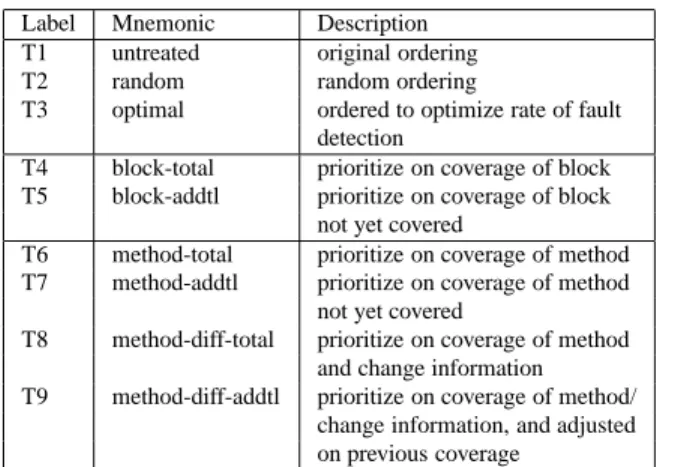
We consider nine different test case prioritization tech-niques, which we classify into three groups to match an earlier study on prioritization for C programs [15]. Table 2 summarizes these groups and techniques. The first group is the control group, containing three “techniques” that serve as experimental controls. (We use the term “technique” here as a convenience; in actuality, the control group does not involve any practical prioritization heuristics; rather, it in-volves various orderings against which practical heuristics should be be compared.) The second group is the block level group, containing two fine granularity prioritization techniques. The third group is the method level group, con-taining four coarse granularity prioritization techniques.
Control techniques
No prioritization (untreated): One control that we con-sider is simply the application of no technique; this lets us consider “untreated” JUnit test suites.
Random prioritization (random): As a second control we use random prioritization, in which we randomly order the tests in a JUnit test suite.
Optimal prioritization (optimal): To measure the ef-fects of prioritization techniques on rate of fault detec-tion, our empirical study utilizes programs that con-tain known faults. For the purposes of experimenta-tion, we can determine, for any test suite, which test cases expose which faults, and thus we can determine
Table 2.Test case prioritization techniques. Label Mnemonic Description
T1 untreated original ordering T2 random random ordering
T3 optimal ordered to optimize rate of fault detection
T4 block-total prioritize on coverage of block T5 block-addtl prioritize on coverage of block
not yet covered
T6 method-total prioritize on coverage of method T7 method-addtl prioritize on coverage of method
not yet covered
T8 method-diff-total prioritize on coverage of method and change information T9 method-diff-addtl prioritize on coverage of method/
change information, and adjusted on previous coverage
an optimal ordering of test cases in a JUnit test suite for maximizing that suite’s rate of fault detection. In practice, of course, this is not a practical technique, but it provides an upper bound on the effectiveness of our heuristics.
Block level techniques
Total block coverage prioritization (block-total): By instrumenting a program we can determine, for any test case, the number of basic blocks (entry, single-exit sequences of statements) in that program that are exercised by that test case. We can prioritize these test cases according to the total number of blocks they cover simply by sorting them in terms of that number. Additional block coverage prioritization (block-addtl):
Additional block coverage prioritization combines feedback with coverage information. It iteratively se-lects a test case that yields the greatest block cover-age, adjusts the coverage information on subsequent test cases to indicate their coverage of blocks not yet covered, and repeats this process until all blocks cov-ered by at least one test case have been covcov-ered. If multiple test cases cover the same number of blocks not yet covered, they are ordered randomly. When all blocks have been covered, this process is repeated on the remaining test cases, until all have been ordered.
Method level techniques
Total method coverage prioritization (method-total): Total method coverage prioritization is the same as to-tal block coverage prioritization, except that it relies on coverage measured in terms of methods.
Additional method coverage prioritization (method-addtl): Additional method coverage prioritization is the same as additional block coverage prioritization, except that it relies on coverage in terms of methods.
Total diff method prioritization (method-diff-total): Total diff method coverage prioritization uses modi-fication information; it sorts test cases in the order of their coverage of methods that differ textually (as mea-sured by a Java parser that parses pairs of individual Java methods through the Unix “diff” function). If multiple test cases cover the same number of differing methods, they are ordered randomly.
Additional diff method prioritization (method-diff-addtl): Additional diff method prioritization uses both feedback and modification information. It iteratively selects a test case that yields the greatest coverage of methods that differ, adjusts the coverage information on subsequent test cases to indicate their coverage of methods not yet covered, and then repeats this process until all methods that differ and that have been covered by at least one test case have been covered. If multiple test cases cover the same number of differing methods not yet covered, they are ordered randomly. This pro-cess is repeated on remaining test cases, until all test cases that execute methods that differ have been used; additional method coverage prioritization is applied to remaining test cases.
The foregoing set of techniques matches the set exam-ined in [15] in all but two respects. First, we use three control techniques, considering an “untreated” technique in which test cases are run in the order in which they are given in the original JUnit tests. This is a sensible control tech-nique for our study since in practice developers would run JUnit tests in their original ordering.
Second, the studies with C programs used statement and function level prioritization techniques, where coverage is based on source code, whereas our study uses coverage based on Java bytecode. Analysis at the bytecode level is appropriate for Java environments. Since Java is a plat-form independent language, vendors or programmers might choose to provide just class files to keep the source pro-tected. If many such class files are part of a system under test, we want to be able to analyze even those class files that are provided without source; bytecode analysis allows this.
The choice to use bytecode level analysis does affect our choice of prioritization techniques. As an equivalent to C “function level” coverage, a method level granularity was an obvious choice. As a statement level equivalent, we could use either individual bytecode instructions, or basic blocks of instructions, but we cannot infer a one-to-one correspon-dence between Java source statements and either bytecode instructions or blocks.3
We chose the basic block because the basic block representation is a more cost-effective unit of analysis for bytecode. Since basic blocks of bytecode and
3
A Java source statement typically compiles to several bytecode in-structions, and a basic block from bytecode often corresponds to more than one Java source code statement.
source code statements represent different levels of granu-larity, results obtained on the two are not directly compa-rable, but we can still study the effect that an increase in granularity has on prioritization in Java, as compared to in C.
Variable 2: Test Suite Granularity
To investigate the impact of test suite granularity on the ef-fectiveness of test case prioritization techniques we consid-ered two test suite granularity levels for JUnit tests: test-class level and test-method level as described in Section 3.
At the test-class level, JUnit tests are of relatively coarse granularity; each test suite and test-class that is invoked by a TestSuite is considered to be one test case, consisting of one or more test-methods. At the test-method level, JUnit tests are relatively fine granularity; each test-method is con-sidered to be one test case.
4.2.2 Dependent Variables and Measures
Rate of Fault Detection
To investigate our research questions we need to measure the benefits of the various prioritization techniques in terms of rate of fault detection. To measure rate of fault detec-tion, we use a metric, APFD (Average Percentage Faults Detected), introduced for this purpose in [15], that mea-sures the weighted average of the percentage of faults de-tected over the life of a test suite. APFD values range from 0 to 100; higher numbers imply faster (better) fault detec-tion rates. More formally, let T be a test suite containingn test cases, and let F be a set ofmfaults revealed by T. Let TFibe the first test case in ordering T
0
of T which reveals fault i. The APFD for test suite T0
is given by the equation:
APFD=1 TF 1 +TF 2 +:::+TF m nm + 1 2n Examples and empirical results illustrating the use of this metric are provided in [15].
4.3
Experiment Setup
To perform test case prioritization we required several types of data. Since the process used to collect this data is complicated and requires significant time and effort, we automated a large part of the experiment.
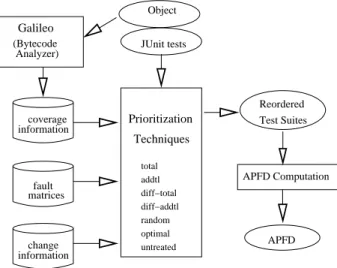
Figure 3 illustrates our experiment process. There were three types of data to be collected prior to applying prior-itization techniques: coverage information, fault-matrices, and change information. We obtained coverage information by running tests over instrumented objects using the Galileo system for analysis of Java bytecode in conjunction with a special JUnit adaptor. This information lists which test
informationcoverage Prioritization
Galileo (Bytecode Analyzer) Reordered Test Suites Techniques matricesfault untreated diff−total diff−addtl random optimal APFD Computation informationchange addtl total APFD JUnit tests Object
Figure 3.Overview of experiment process
cases exercised which blocks and methods; a previous ver-sion’s coverage information is used to prioritize the current set of test cases. Fault-matrices list which test cases detect which faults, and are used to measure the rate of fault de-tection for each prioritization technique. Change informa-tion lists which methods differ from those in the preceding version, and how many lines of each such method changed (deleted and added methods are also listed.).
Each prioritization technique utilizes some or all of this data to prioritize JUnit test suites based on its analysis. Then APFD scores are obtained from the reordered test suites, and the collected scores are analyzed to determine whether the techniques improved the rate of fault detection.
4.3.1 Object Instrumentation
To perform our experiment, we required objects to be in-strumented to support the techniques described in Section 4.2.1. We instrumented object class files in two ways: all basic blocks, and all method entry blocks, using the Galileo bytecode analysis system (see Figure 2).
4.3.2 Test Cases and Test Automation
As described previously, test cases were obtained from each object’s distribution, and we considered test suites at the two levels of granularity previously described. To execute and validate test cases automatically, we created test scripts that invoke test cases, save all outputs from test execution, and compare outputs with those for the previous version. As shown in Figure 2, JUnit test cases are run through JU-nitFilter and TestRunner (SelectiveTestRunner) over the in-strumented classes.
4.3.3 Faults
We wished to evaluate the performance of prioritization techniques with respect to detection of regression faults. The object programs we obtained were not supplied with any such faults or fault data; thus, following the procedure described in [19], and also utilized for the study in [15], we seeded faults. Two graduate students performed this fault seeding; they were instructed to insert faults that were as realistic as possible based on their experience with real pro-grams, and that involved code inserted into, or modified in each of the versions. We excluded any faults that were de-tected by more than 20% of the test cases for both granular-ity levels; our assumption is that such easily detected faults represent coding errors that competent programmers would not be expected to make in practice.
4.4
Threats to Validity
In this section we describe the internal, external, and construct threats to the validity of our experiments, and the approaches we used to limit the effects that these threats might have on the validity of our conclusions.
Internal Validity
The inferences we made about the effectiveness of prioriti-zation techniques could have been affected by two factors. The first factor involves the potential faults in our experi-ment tools. To control for this threat, we validated tools through testing on various sizes of Java programs. The sec-ond factor involves the faults seeded in our objects. Our pro-cedure for seeding faults followed a set process as described in Section 4.3.3, which reduced the chances of obtaining bi-ased faults. However some of our objects (XML-security and JTopas) ultimately contained a relatively small number of faults, and larger numbers of faults would be preferable.
External Validity
Two issues limit the generalization of our results. The first issue involves object program representativeness. Our ob-jects are of small and medium size. Complex industrial pro-grams with different characteristics may be subject to differ-ent cost-benefit tradeoffs. The second issue involves testing process representativeness. If the testing process we used is not representative of industrial processes, our results might not generalize. Control for these threats can be achieved only through additional studies with a wider population.
Construct Validity
The dependent measure that we have considered, APFD, is not the only possible measure of rate of fault detection and it has some limitations. First, APFD assigns no value to
subsequent test cases that detect a fault already detected; such inputs may, however, help debuggers isolate the fault, and for that reason might worth measuring. Second, APFD does not account for the possibility that faults and test cases may have different costs. Third, APFD only partially cap-tures the aspects of the effectiveness of prioritization. Fu-ture studies will need to consider other measures for pur-poses of assessing effectiveness.
4.5
Data and Analysis
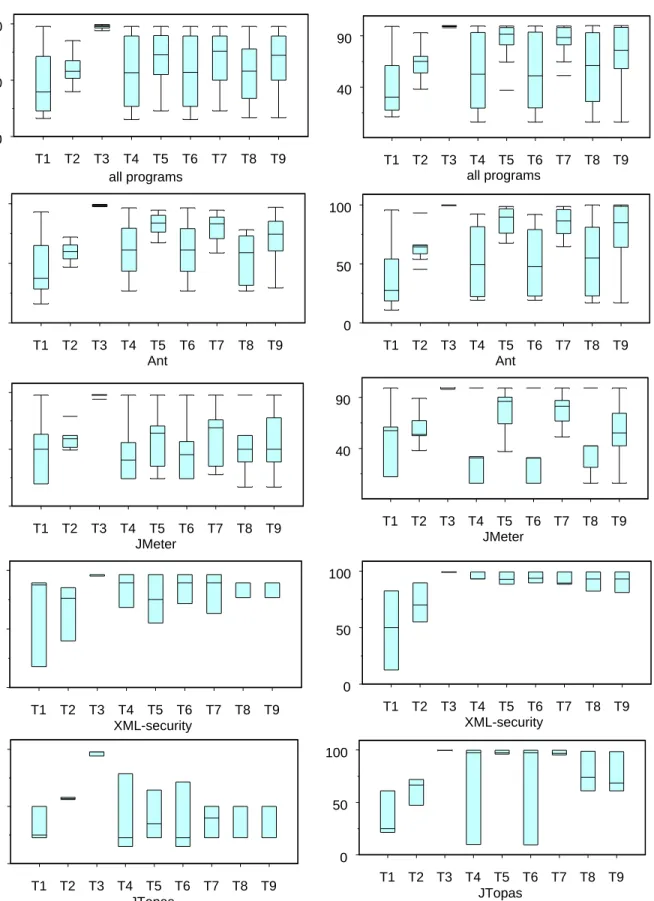
To provide an overview of all the collected data we present boxplots in Figure 4. The left side of the figure presents results from test case prioritization applied to test-class level tests, and the right side presents results from test case prioritization applied to test-method level tests. The top row presents results for an all programs total, and other rows present results per object program. Each plot contains a box showing the distribution of APFD scores for each of the nine techniques, across each of the versions of the object program. See Table 2 for a legend of the techniques.
The data sets depicted in Figure 4 served as the basis for our formal analyses of results. The following sections de-scribe, for each of our research questions in turn, the exper-iments relevant to that question, presenting those analyses.
4.5.1 RQ1: Prioritization effectiveness
Our first research question considers whether test case pri-oritization can improve the rate of fault detection for JUnit test cases applied to our Java objects.
An initial indication of how each prioritization technique affected a JUnit test suite’s rate of fault detection in this study can be determined from Figure 4. Comparing the box-plots of optimal (T3) to those for untreated (T1) and random (T2), it is readily apparent that an optimal prioritization or-der could provide substantial improvements in rates of fault detection. Comparing results for untreated (T1) to results for actual, non-control techniques (T4 through T9) for both test suite levels, it appears that all techniques yield improve-ment. However, the comparison of the results of random or-derings (T2) with those produced by non-control techniques shows different results: some techniques yield improvement with respect to random while others do not.
To determine whether the differences observed in the boxplots are statistically significant we performed two sets of analyses, considering test-class and test-method levels independently for all programs. The analyses were:
1. UNTREATED vs NON-CONTROL: We consider untreated and non-control techniques to determine whether there is a difference between techniques (us-ing ANOVA), and whether there is a difference be-tween untreated orders and the orders produced by
T1 T2 T3 T4 T5 T6 T7 T8 T9 all programs 0 50 100 T1 T2 T3 T4 T5 T6 T7 T8 T9 all programs 40 90 T1 T2 T3 T4 T5 T6 T7 T8 T9 Ant 0 50 100 T1 T2 T3 T4 T5 T6 T7 T8 T9 Ant 0 50 100 T1 T2 T3 T4 T5 T6 T7 T8 T9 JMeter 0 50 100 T1 T2 T3 T4 T5 T6 T7 T8 T9 JMeter 40 90 T1 T2 T3 T4 T5 T6 T7 T8 T9 XML-security 0 50 100 T1 T2 T3 T4 T5 T6 T7 T8 T9 XML-security 0 50 100 T1 T2 T3 T4 T5 T6 T7 T8 T9 JTopas 0 50 100 T1 T2 T3 T4 T5 T6 T7 T8 T9 JTopas 0 50 100
test-class level
test-method level
Figure 4. APFD boxplots, all programs. The horizontal axes list techniques, and the vertical axes list APFD scores. The left column presents results for test-class level tests and the right column presents results for test-method level tests.8
each non-control technique (using Dunnett’s method for multiple comparison with a control [8]).
2. RANDOM vs NON-CONTROL: The same analyses as in (1) are performed, against a different control tech-nique, random.
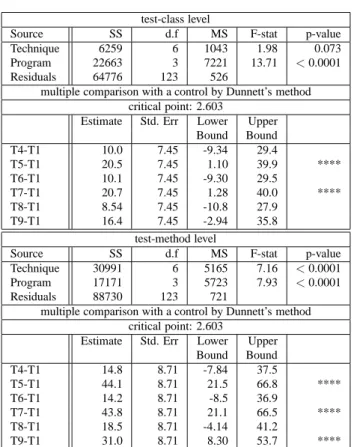
Table 3 presents the results of analysis (1), for signifi-cance level of 0.05. The ANOVA results indicate that there is no difference between the techniques at test-class level (p-value = 0.0733), but there is a significant difference at test-method level (p-value<0.0001). Dunnett’s method re-ports that block-addtl and method-addtl are different from untreated at test-class level, and block-addtl, method-addtl, and method-diff-addtl are different from untreated at test-method level. Cases that were statistically significant are marked by “****” (which indicates confidence intervals that do not include zero).
test-class level
Source SS d.f MS F-stat p-value Technique 6259 6 1043 1.98 0.073 Program 22663 3 7221 13.71 <0.0001 Residuals 64776 123 526
multiple comparison with a control by Dunnett’s method critical point: 2.603
Estimate Std. Err Lower Upper Bound Bound T4-T1 10.0 7.45 -9.34 29.4 T5-T1 20.5 7.45 1.10 39.9 **** T6-T1 10.1 7.45 -9.30 29.5 T7-T1 20.7 7.45 1.28 40.0 **** T8-T1 8.54 7.45 -10.8 27.9 T9-T1 16.4 7.45 -2.94 35.8 test-method level
Source SS d.f MS F-stat p-value Technique 30991 6 5165 7.16 <0.0001 Program 17171 3 5723 7.93 <0.0001 Residuals 88730 123 721
multiple comparison with a control by Dunnett’s method critical point: 2.603
Estimate Std. Err Lower Upper Bound Bound T4-T1 14.8 8.71 -7.84 37.5 T5-T1 44.1 8.71 21.5 66.8 **** T6-T1 14.2 8.71 -8.5 36.9 T7-T1 43.8 8.71 21.1 66.5 **** T8-T1 18.5 8.71 -4.14 41.2 T9-T1 31.0 8.71 8.30 53.7 ****
Table 3. ANOVA and Dunnett’s method, untreated vs heuristics, all programs.
Table 4 presents the results of analysis (2). Similar to the first analysis, the ANOVA results indicate that there is no difference between the techniques at test-class level (p-value = 0.3687), but there is a significant difference at test-method level (p-value<0.0001). Dunnett’s method reports
that no individual prioritization technique is different from random at test-class level, but block-addtl and method-addtl are different from random at test-method level.
test-class level
Source SS d.f MS F-stat p-value Technique 2953 6 492 1.09 0.368 Program 19151 3 6383 14.2 <0.0001 Residuals 55258 123 449
multiple comparison with a control by Dunnett’s method critical point: 2.603
Estimate Std. Err Lower Upper Bound Bound T4-T2 -2.44 6.88 -20.3 15.5 T5-T2 8.0 6.88 -9.9 25.9 T6-T2 -2.39 6.88 -20.3 15.5 T7-T2 8.19 6.88 -9.71 26.1 T8-T2 -3.94 6.88 -21.8 14 T9-T2 3.96 6.88 -13.9 21.9 test-method level
Source SS d.f MS F-stat p-value Technique 19029 6 3171 5.13 <0.0001 Program 18851 3 6283 10.17 <0.0001 Residuals 75973 123 617
multiple comparison with a control by Dunnett’s method critical point: 2.603
Estimate Std. Err Lower Upper Bound Bound T4-T2 -6.97 8.06 -28.0 14.0 T5-T2 22.3 8.06 1.34 43.3 **** T6-T2 -7.63 8.06 -28.6 13.4 T7-T2 22.0 8.06 0.97 42.9 **** T8-T2 -3.28 8.06 -24.3 17.7 T9-T2 9.16 8.06 -11.8 30.2
Table 4. ANOVA and Dunnett’s method, random vs heuristics, all programs.
4.5.2 RQ2: The effects of information types and use on
prioritization results
.
Our second research question concerns whether differ-ences in the types of information and information use that distinguish prioritization techniques (type of coverage in-formation, use of feedback, type of modification informa-tion) impact the effectiveness of prioritization.
Comparing the boxplots (Figure 4) of block-total to method-total and block-addtl to method-addtl for both test suite levels, it appears that the level of coverage information utilized (fine vs coarse) has no effect on techniques. Com-paring the results of block-total to block-addtl and method-total to method-addtl for both test suite levels, it appears that techniques using feedback do yield improvement over those not using feedback. In particular, the difference from using the test-method level is distinguishable from the test-class level.
Finally, comparison of the results of method-total to method-diff-total, and method-addtl to method-diff-addtl, shows no apparent effect from using modification informa-tion on prioritizainforma-tion effectiveness.
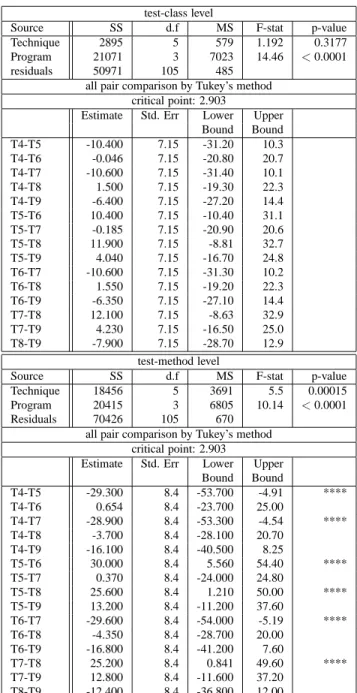
To determine whether the differences observed in the boxplots are statistically significant we performed an ANOVA and all-pairwise comparison using Tukey’s method [8], considering test-class level and test-method level independently, for all non-control techniques and all programs. Table 5 presents the results of these analyses.
Overall, the results indicate that there is a significant difference between techniques at the test-method level (p-value = 0.00015); but no significant difference between techniques at the test-class level (p-value = 0.317).
The all-pairwise comparison shows the following results regarding information types and information use:
Coverage information. The results indicate that there is no difference between block-level and method-level techniques at either test suite level, considering block-total versus method-block-total (T4 - T6) and block-addtl versus method-addtl (T5 - T7). Different levels of cov-erage information did not impact the effectiveness of prioritization; that is, there was no prioritization tech-nique granularity effect observed.
Use of Feedback. The results indicate a significant difference between techniques that use feedback and those that do not use feedback at the test-method level, namely block-total versus block-addtl (T4 - T5) and method-total versus method-addtl (T6 - T7). How-ever, there was no significant difference at the test-class level. Techniques that use feedback informa-tion provided a more significant improvement in rate of fault detection than those that did not, but only at the finer granularity test level.
Modification information. The results indicate no sig-nificant difference between techniques that use modi-fication information and those that do not use modifi-cation information at either test suite levels, namely method-total versus method-diff-total (T6 - T8) and method-addtl versus method-diff-addtl (T7 - T9).
4.5.3 RQ3: Test suite granularity effects
Our third research question considers the impact of test suite granularity, comparing test-class level to test-method level. The boxplots and the analysis related to our first re-search question suggest that there is a difference between the two levels of test suite granularity, thus we performed an ANOVA for non-control techniques and all programs comparing test-method level to test-class level. Figure 6 presents the results, which indicate that there is suggestive evidence that test suite granularity affected the rate of fault detection (p-value = 0.0437).
test-class level
Source SS d.f MS F-stat p-value Technique 2895 5 579 1.192 0.3177 Program 21071 3 7023 14.46 <0.0001 residuals 50971 105 485
all pair comparison by Tukey’s method critical point: 2.903
Estimate Std. Err Lower Upper Bound Bound T4-T5 -10.400 7.15 -31.20 10.3 T4-T6 -0.046 7.15 -20.80 20.7 T4-T7 -10.600 7.15 -31.40 10.1 T4-T8 1.500 7.15 -19.30 22.3 T4-T9 -6.400 7.15 -27.20 14.4 T5-T6 10.400 7.15 -10.40 31.1 T5-T7 -0.185 7.15 -20.90 20.6 T5-T8 11.900 7.15 -8.81 32.7 T5-T9 4.040 7.15 -16.70 24.8 T6-T7 -10.600 7.15 -31.30 10.2 T6-T8 1.550 7.15 -19.20 22.3 T6-T9 -6.350 7.15 -27.10 14.4 T7-T8 12.100 7.15 -8.63 32.9 T7-T9 4.230 7.15 -16.50 25.0 T8-T9 -7.900 7.15 -28.70 12.9 test-method level
Source SS d.f MS F-stat p-value Technique 18456 5 3691 5.5 0.00015 Program 20415 3 6805 10.14 <0.0001 Residuals 70426 105 670
all pair comparison by Tukey’s method critical point: 2.903
Estimate Std. Err Lower Upper Bound Bound T4-T5 -29.300 8.4 -53.700 -4.91 **** T4-T6 0.654 8.4 -23.700 25.00 T4-T7 -28.900 8.4 -53.300 -4.54 **** T4-T8 -3.700 8.4 -28.100 20.70 T4-T9 -16.100 8.4 -40.500 8.25 T5-T6 30.000 8.4 5.560 54.40 **** T5-T7 0.370 8.4 -24.000 24.80 T5-T8 25.600 8.4 1.210 50.00 **** T5-T9 13.200 8.4 -11.200 37.60 T6-T7 -29.600 8.4 -54.000 -5.19 **** T6-T8 -4.350 8.4 -28.700 20.00 T6-T9 -16.800 8.4 -41.200 7.60 T7-T8 25.200 8.4 0.841 49.60 **** T7-T9 12.800 8.4 -11.600 37.20 T8-T9 -12.400 8.4 -36.800 12.00
Table 5.ANOVA and Tukey’s method, all heuristics , all programs.
Source SS d.f MS F-stat p-value Suite 3408 1 3408 4.1047 0.0437 Residuals 234999 283 830
Table 6.ANOVA analysis, test-class level vs test-method level, all programs.
5
Discussion
Our results strongly support the conclusion that test case prioritization techniques can improve the rate of fault de-tection for JUnit test suites applied to Java systems. The prioritization techniques we examined outperformed both untreated and randomly ordered test suites, as a whole, at the test-method level. Overall, at the test-class level, priori-tization techniques did not improve effectiveness compared to untreated or randomly ordered test suites, but individual comparisons indicated that techniques using additional cov-erage information did improve the rate of fault detection.
We also observed that random test case orderings out-performed untreated test case orderings at both test suite levels. We conjecture that this difference is due to the con-struction of the JUnit tests supplied with the objects used in this study. It is typical in practice for developers to add new tests at the end of a test suite. Since newer test cases tend to exercise new code, we conjecture that these new test cases are more likely to be fault-revealing than previous test cases. Randomly ordered test cases redistribute fault-revealing test cases more evenly than original, untreated test case orders. Of course prioritization techniques, in turn, typically out-perform random orderings. The practical implication of this result, then, is that the worst thing JUnit users can do is not practice some form of prioritization.
We now consider whether the results we have observed are consistent with those from the previous studies with C programs and coverage- or requirements-based test suites. Both this study (at the test-method level) and previous stud-ies [13, 15, 24, 28] showed that prioritization techniques improved the rate of fault detection compared to both ran-dom and untreated orderings. Also, both this study and ear-lier studies found that techniques using additional coverage information were usually better than other techniques, for both fine and coarse granularity tests. There were sources of variance between the studies, however.
Regarding the impact of granularity, previous studies on C showed that statement-level techniques as a whole were better than function-level techniques. This study, however, found that block-level techniques were not significantly dif-ferent overall from method-level techniques. There are two possible reasons for this difference. First, this result may be due to the fact that the instrumentation granularity we used for Java programs differs from that used for C programs, as we explained in Section 4.2.1. Block-level instrumentation is not as sensitive as statement-level instrumentation since a block may combine a sequence of consecutive statements into a single unit in a control flow graph.
A second related factor that might account for this result is that the instrumentation difference between blocks and methods is not as pronounced in Java as is the difference between statements and functions in C. Java methods tend
to be more concise than C functions, possibly due to object-oriented language characteristics [20] and code refactoring [17], which tend to result in methods containing small num-bers of blocks. For example, constructors, “get” methods, and “set” methods frequently contain only one basic block. A study reported in [23] supports this interpretation, pro-viding evidence that the sizes of the methods called most frequently in object-oriented programs is between one and nine statements on average, which generally corresponds (in our measurements on our objects) to only one or two basic blocks.
Where test suite granularity effects are concerned, con-trary to the previous study [24], this study showed that fine granularity test suites (test-method level) were more sup-portive of prioritization than coarse granularity test suites (test-class level). Although some techniques (block-addtl and method-addtl) at the test-class level improved rate of fault detection, overall analysis showed that test-class level test suites did not support improvements in APFD. Since the scope of each test case in a test-class level test suite is limited to a specific class under test,4
one possible expla-nation for this result involves the fact that, in our objects, faults are located only in a few of the classes under test, and the number of faults in several cases is relatively small. The test-class level boxplots for the Ant program (Figure 4), which has a larger number of faults (21) overall, show a different trend from the other plots, supporting this conjec-ture.
6
Conclusions and Future Work
We have presented a study of prioritization techniques applied across four Java programs, to JUnit test suites pro-vided with those programs. Although several studies of test case prioritization have been conducted previously, those studies all focused on a single procedural language, C, and on only a few specific types of test suites. Our study, in con-trast, applied prioritization techniques to an object-oriented language (Java) tested under the JUnit testing framework, to investigate whether the results observed in previous studies generalize to other language and testing paradigms.
Our results regarding the effectiveness of prioritization techniques confirm several previous findings [13, 15, 24, 28], while also revealing some differences regarding prior-itization technique granularity effects and test suite granu-larity effects. As discussed in Section 5, these differences can be explained in relation to characteristics of the Java language and JUnit testing.
The results of our studies suggest several avenues for fu-ture work. First, we intend to perform additional studies us-ing larger Java programs and additional types of test suites,
4
This is true in the objects that we considered; in general, however, the scope of a unit test could be subject to a developers’ specific practices.
and a wider range and distribution of faults. Second, since our studies, unlike previous studies, did not find differences between prioritization technique granularity levels, it would be interesting to investigate what types of attributes caused this result through a further analysis of the relationship be-tween basic block size and method size, and the ratio of ex-ecution of simple methods to complex methods. Third, con-trary to our expectation, code modification information did not improve cost-effectiveness significantly. This result was also observed in C programs, and it is worth investigating what types of factors other than fault distribution in a code base could be involved in this outcome. Fourth, because our analysis revealed a sizable performance gap between priori-tization heuristics and optimal prioripriori-tization, we are investi-gating alternative techniques. One such alternative involves employing measures of static and dynamic dependencies in the code to estimate locations where faults can reside.
Through the results reported in this paper, and this future work, we hope to provide software practitioners, in partic-ular practitioners who use Java and the JUnit testing frame-work, with cost-effective techniques for improving regres-sion testing processes through test case prioritization.
Acknowledgements
This work was supported in part by NSF under Awards, CCR-0080900 and CCR-0306023 to Oregon State Univer-sity. Ziru Zhu helped prepare the JTopas object.
References
[1] http://www.junit.org. [2] http://sourceforge.net. [3] http://jakarta.apache.org. [4] http://ant.apache.org. [5] http://jakarta.apache.org/jmeter. [6] http://xml.apache.org/security. [7] http://jtopas.sourceforge.net/jtopas. [8] Splus statistics software.[9] T. Chen and M. Lau. Dividing strategies for the optimization of a test suite. Information Processing Letters, 60(3):135– 141, Mar. 1996.
[10] Y. Chen, D. Rosenblum, and K. Vo. TestTube: A system for selective regression testing. In Proc. Int’l. Conf. Softw. Eng., pages 211–220, May 1994.
[11] S. Elbaum, D. Gable, and G. Rothermel. Understanding and measuring the sources of variation in the prioritization of regression test suites. In Proc. Int’l. Softw. Metrics Symp., pages 169–179, Apr. 2001.
[12] S. Elbaum, P. Kallakuri, A. Malishevsky, G. Rothermel, and S. Kanduri. Understanding the effects of changes on the cost-effectiveness of regression testing techniques. J. Softw.
Testing, Verif., and Rel., 12(2), 2003.
[13] S. Elbaum, A. Malishevsky, and G. Rothermel. Prioritizing test cases for regression testing. In Proc. Int’l. Symp. Softw.
Testing and Anal., pages 102–112, Aug. 2000.
[14] S. Elbaum, A. Malishevsky, and G. Rothermel. Incorporat-ing varyIncorporat-ing test costs and fault severities into test case prior-itization. In Proc. Int’l. Conf. Softw. Eng., pages 329–338, May 2001.
[15] S. Elbaum, A. G. Malishevsky, and G. Rothermel. Test case prioritization: A family of empirical studies. IEEE Trans.
Softw. Eng., 28(2):159–182, Feb. 2002.
[16] S. Elbaum, G. Rothermel, S. Kanduri, and A. G. Mali-shevsky. Selecting a cost-effective test case prioritization technique. Technical Report 03-01-01, University of Ne-braska – Lincoln, Jan. 2003.
[17] M. Fowler. Refactoring: Improving the Design of Existing
Code. Addison-Wesley, 1999.
[18] M. J. Harrold, R. Gupta, and M. L. Soffa. A methodology for controlling the size of a test suite. ACM Trans. Softw.
Eng. and Meth., 2(3):270–285, July 1993.
[19] M. Hutchins, H. Foster, T. Goradia, and T. Ostrand. Ex-periments on the effectiveness of dataflow- and controlflow-based test adequacy criteria. In Proc. Int’l. Conf. Softw. Eng., pages 191–200, May 1994.
[20] K. Ishizaki, M. Kawahito, T. Yasue, M. Takeuchi, T. Oga-sawara, T. Suganuma, T. Onodera, H. Komatsu, and T. Nakatani. Design, implementation and evaluation of op-timisations in a just-in-time compiler. In ACM 1999 Java
grande conf., pages 119–128, June 1999.
[21] J. Kim and A. Porter. A histroy-based test prioritization tech-nique for regression testing in resource constrained environ-ments. In Proc. Int’l. Conf. Softw. Eng., May 2002. [22] J. Offutt, J. Pan, and J. M. Voas. Procedures for reducing the
size of coverage-based test sets. In Proc. Int’l. Conf. Testing
Comp. Softw., pages 111–123, June 1995.
[23] J. Power and J. Waldron. A method-level analysis of object-oriented techniques in Java applications. Technical Report NUM-CS-TR-2002-07, National University of Ireland, July 2002.
[24] G. Rothermel, S. Elbaum, A. Malishevsky, P. Kallakuri, and B. Davia. The impact of test suite granularity on the cost-effectiveness of regression testing. In Proc. Int’l. Conf.
Softw. Eng., May 2002.
[25] G. Rothermel, S. Elbaum, A. G. Malishevsky, P. Kallakuri, and X. Qiu. On test suite composition and cost-effective regression testing. Technical Report 03-60-04, Oregon State University, Nov. 2003.
[26] G. Rothermel and M. J. Harrold. A safe, efficient regres-sion test selection technique. ACM Trans. Softw. Eng. Meth., 6(2):173–210, Apr. 1997.
[27] G. Rothermel, R. Untch, C. Chu, and M. J. Harrold. Test case prioritization: an empirical study. In Proc. Int’l. Conf.
Softw. Maint., pages 179–188, Aug. 1999.
[28] G. Rothermel, R. Untch, C. Chu, and M. J. Harrold. Test case prioritization. IEEE Trans. Softw. Eng., 27(10), Oct. 2001.
[29] A. Srivastava and T. J. Effectively prioritizing tests in de-velopment environment. In Proc. Int’l. Symp. Softw. Testing
and Anal., July 2002.
[30] D. Wells. Extreme programming: A gentle introduction. http://www.extremeprogramming.org, Jan. 2003.
[31] W. Wong, J. Horgan, S. London, and H. Agrawal. A study of effective regression testing in practice. In Proc. Int’l. Symp.
Softw. Rel. Engr., pages 230–238, Nov. 1997.