INFORMATICA, 2015, Vol. 26, No. 1, 89–110 89 2015Vilnius University
DOI: http://dx.doi.org/10.15388/Informatica.2015.40
An Optimization Approach for Utilizing Cloud
Services for Mobile Devices in Cloud Environment
Chunlin LI
1,2∗, Layuan LI
21Department of Computer Science, Wuhan University of Technology,
Wuhan 430063, PR China
2The Key Laboratory of Embedded System and Service Computing, Ministry of Education
Tongji University, Shanghai 200092, PR China e-mail: [email protected], [email protected]
Received: January 2014; accepted: September 2014
Abstract.Mobile cloud computing has emerged aiming at assisting mobile devices in processing computationally or data intensive tasks using cloud resources. This paper presents an optimization approach for utilizing cloud services for mobile client in mobile cloud, which considers the benefit of both mobile device users and cloud datacenters. The mobile cloud service provisioning optimization is conducted in parallel under the deadline, budget and energy expenditure constraint. Mobile cloud provider runs multiple VMs to execute the jobs for mobile device users, the cloud providers want to maximize the revenue and minimize the electrical cost. The mobile device user gives the suitable payment to the cloud datacenter provider for available cloud resources for optimize the benefit. The paper proposes a distributed optimization algorithm for utilizing cloud services for mobile devices. The experiment is to test convergence of the proposed algorithm and also compare it with other related work. The experiments study the impacts of job arrival rate, deadline and mobility speeds on energy consumption ratio, execution success ratio, resource allocation efficiency and cost. The experiment shows that the proposed algorithm outperforms other related work in terms of some performance metrics such as allocation efficiency.
Key words:mobile cloud, cloud standards, mobile device, energy efficiency.
1. Introduction
Mobile devices are increasingly becoming the most effective and convenient communi-cation tools in our daily life. However, the mobile devices are facing many challenges in their limited resources (e.g., battery life, storage, and bandwidth) and communications (e.g., mobility and security), which significantly impede the improvement of service qual-ities. The application of cloud computing is not limited only to PC, but also to mobile devices and mobile terminals. With the rapid development of mobile Internet, cloud com-puting services providing for mobile phones and other mobile terminals have emerged. Currently, mobile devices are becoming the popular instrument for accessing the cloud environment. While roaming around with a mobile handheld device, a user can enjoy
the vast computation power and diverse capabilities with the support of the cloud envi-ronment. In mobile cloud environment, users access cloud services with mobile devices. Mobile cloud computing can enhance user experience because mobile devices have lim-ited computing power, storage space, and battery life. Storage and computing capabilities of mobile devices can be extended by utilizing cloud resources (Dinhet al., 2007).
Mobile cloud computing introduces a variety of benefits over traditional mobile ser-vices. With cloud computing, mobile applications can transfer some computation task to be executed on the cloud center. Many mobile applications are developed under mobile cloud computing concept including e-commerce, healthcare, and computer games. Cloud computing with mobile devices enables many new applications that were unavailable in the past. For example, a mobile cloud could be made of smart phones to process real-time data (e.g., video and audio feeds, GPS coordinates). Other mobile cloud applications might involve real time control/actuation in wireless powered sensor networks.
Mobile cloud computing has emerged aiming at assisting mobile devices in processing computationally or data intensive tasks using cloud resources. This paper presents an op-timization approach for utilizing cloud services for mobile client in mobile cloud, which considers the benefit of both mobile device users and cloud datacenters. The paper pro-poses a distributed optimization algorithm for utilizing cloud services for mobile devices. The experiment is to test convergence of the proposed algorithm and also compare it with other related work. The experiments study the impacts of job arrival rate, deadline and mobility speeds on energy consumption ratio, execution success ratio, resource allocation efficiency and cost. The experiment shows that the proposed algorithm outperforms other related work in terms of some performance metrics such as resource allocation efficiency. The rest of the paper is structured as followings. Section 2 discusses the related works. Section 3 presents an optimization approach for utilizing cloud services for mobile client in mobile cloud. Section 4 presents distributed optimization algorithm for utilizing cloud services for mobile devices. In Section 5 the experiments are conducted and discussed. Section 6 gives the conclusions to the paper.
2. Related Works and Motivations
Currently, many researches focused on cloud computing with mobile devices. Mobile cloud computing combines wireless access service and cloud computing to improve the performance of mobile applications. Ferber and Rauber (2012) propose a pipelining task concept on a single encrypted channel between a mobile device and a cloud resource to better use the 3G network connections. Barberaet al.(2012) study the mobile soft-ware/data backup of both mobile computation offloading and mobile softsoft-ware/data back-ups in real-life scenarios. Zhanget al.(2012) investigate the scheduling policy for col-laborative execution in mobile cloud computing. The design objective is to minimize the energy consumed by the mobile device, while meeting a time deadline. They formulate this minimum-energy task scheduling problem as a constrained shortest path problem on a directed acyclic graph, and adapt the canonical “LARAC” algorithm to solving this prob-lem approximately. Rahimiet al.(2013) study mobility-aware optimal service allocation
in mobile cloud computing. They propose a framework to model mobile applications as location-time workflows (LTW) of tasks, here user mobility patterns are translated to a mobile service usage patterns. Abolfazliet al.(2013) propose a market-oriented architec-ture based on SOA to stimulate publishing, discovering, and hosting services on nearby mobiles, which reduces long WAN latency and creates a business opportunity that encour-ages mobile owners to embrace service hosting. Group of mobile phones simulate a nearby cloud computing platform. Barbarossaet al.(2013) proposes joint allocation of compu-tation and communication resources in multiuser mobile cloud computing. They propose a method to jointly optimize the transmit power, the number of bits per symbol and the CPU cycles assigned to each application in order to minimize the power consumption at the mobile side.
Leeet al.(2013) propose a collaborative framework that lets the mobile device par-ticipate in the computation of Cloud Computing system by dynamically partitioning the workload across the device and the system. The objective is to mitigate the deterioration of network performance and improve the overall system performance. Parket al.(2012) study mobile devices as resources in mobile cloud environments. They propose a resource allo-cation technique which offers reliable resource alloallo-cation considering the availability of mobile resources and movement reliability of mobile resources. Shirazet al.(2014) study runtime partitioning of elastic mobile applications for mobile cloud computing. They in-vestigate the overhead of runtime application partitioning on SMD by analyzing additional resources utilization on SMD in the mechanism of runtime application profiling and parti-tioning. Geet al.(2012) propose a game-theoretic approach to optimize the overall energy in a mobile cloud computing system. They formulate the energy minimization problem as a congestion game, where each mobile device is a player and the strategy is to select one of the servers to offload the computation while minimizing the overall energy consump-tion. Wanget al.(2013) consider a mobile cloud computing (MCC) interaction system consisting of multiple mobile devices and the cloud computing facilities. They provide a nested two stage game formulation for the MCC interaction system. In the first stage, each mobile device determines the portion of its service requests for remote processing in the cloud. In the second stage, the cloud computing facilities allocate a portion of its total resources for service request processing depending on the request arrival rate from all the mobile devices.
Zhanget al.(2013) model the resource allocation process of a mobile cloud comput-ing system as an auction mechanism with premium and discount factors. The premium and discount factors indicate complementary and substitutable relations among cloud resources provided by the service provider. Makriset al.(2012) propose a deployment scheme to offload expensive computational tasks from thin, mobile devices to the cloud datacenter, so that the proposed method prolongs battery life for mobile devices; mean-while provide rich user experiences for such mobile applications. Shirazet al.(2013a) analyzes the impact of VM deployment and management on the execution time of ap-plication in mobile cloud computing. They investigate VM deployment and management for application processing in simulation environment by using CloudSim. Hussain and Hussain (2011) discuss and formalize the issue of cloud service selection in general and
propose a multi-criteria cloud service selection methodology, they consider cost, pricing policy, performance etc as multiple criteria.
Shirazet al.(2013b) propose distributed application processing frameworks in smart mobile devices for mobile cloud computing. The author reviews existing Distributed Ap-plication Processing Frameworks (DAPFs) for smart mobile devices in mobile cloud com-puting domain. The objective is to highlight issues and challenges to existing DAPFs in developing, implementing, and executing computational intensive mobile applications within mobile cloud. Gkatzikis and Koutsopoulos (2013) advocate the need for novel cloud architectures and migration mechanisms that effectively bring the computing power of the cloud closer to the mobile user. They consider a cloud computing architecture that consists of a back-end cloud and a local cloud, which is attached to wireless access infras-tructure. Luet al.(2013) introduce the concept of an Internet-based Virtual Computing Environment (iVCE), which aims to provide Cloud services by a dynamic combination of data centers and other multi-scale computing resources on the Internet. Liet al.(2009) propose Armada, an efficient range query processing scheme to support delay-bounded single-attribute and multiple-attribute range queries. Bessiset al.(2013) propose a model for supporting the decision making process of the cloud policy for the deployment of virtual machines in cloud environments. They explore two configurations, the static case and the dynamic case to study deployment of virtual machines. Choiet al.(2013) study proposes a method of designing a scheme for applying MapReduce of the FP-Growth algorithm.
Our previous work (Li and Li, 2014) focuses on batch processing applications for mobile cloud computing environment. The mobile device’s user requirements arrive in batches into the mobile cloud systems. For example, mobile device’s users submit batch jobs (e.g., financial analytics, scientific simulations) to mobile cloud system for fast pro-cessing. The paper of Li and Li (2014) proposes a phased scheduling for batch processing applications in mobile cloud, which is divided into mobile device’s batch application op-timization and mobile device’s job level opop-timization. The formulation model and method of this paper is different from Li and Li (2014).
Li and Li (2012) is oriented to SaaS cloud, it combines three perspectives: SaaS user, SaaS provider and cloud resource providers, Li and Li (2012) presents an efficient cloud resource provisioning algorithm, which is beneficial for SaaS users, SaaS provider and cloud resource provider. This paper presents an optimization approach for utilizing cloud services for mobile client in mobile cloud. It focus on mobile cloud service provisioning. The research object and formulation model of this paper is different from Li and Li (2012).
3. An Optimization Approach for Utilizing Cloud Services for Mobile Devices 3.1. Problem Description
The proposed mobile cloud system includes mobile devices, cloud data center and mo-bile cloud proxy. The momo-bile cloud users run the interactive application on their devices.
Table 1
The description of notations. Notations Meanings
Cjcpu The maximum capacity of CPU of cloud providerj Cjram The maximum capacity of memory of cloud providerj
edji Energy dissipation of cloud resourcejfor provisioning VM for mobile device useri
ecj Energy consumption rate of cloud resourcejfor provisioning VM vcpuij CPU of cloud resourcejrequired by a VM for mobile device useri vramij Memory of cloud resourcejrequired by a VM for mobile device useri
ucpuij Payment of mobile device userito the cloud resourcejfor CPU required by a VM uramij Payment of mobile device userito the cloud resourcejfor memory required by a VM pcpuj The price of CPU of cloud resourcej
pramj The price of memory of the cloud resourcej Bi The expense budget of mobile device useri
EBj Upper limit of energy expenditure of cloud providerj
pej Electricity price
Ti Time limits given by mobile device userito complete all jobs
ecostj The payment for the electricity usage of cloud providerj ein Energy dissipation caused by mobile device user’snth job
erni Energy consumption rate for the mobile device userito complete nth job Ei Energy limit of mobile device useri
Wireless access points provide radio resource (i.e., bandwidth), while data centers pro-vide computing resources (e.g., CPU, memory, and storage) to support different mobile applications. Mobile device can access the Internet through an access point (AP) that is either Wireless Local Area Network (WLAN) or cellular 3G network. The mobile cloud proxy is responsible for managing all communications between the mobile device and the cloud datacenter. The notations used in sections are listed in Table 1.
Letvijcpu,vramij denote the amount of CPU and memory network required by a VM for mobile deviceifrom cloud providerj. VM can be expressed asvm= {vcpuij , vramij }. Let S= {s1, s2, . . . , sj}denote the set of cloud providers. Each cloud provider supplies a pool of resources to host VM for the mobile device application. The cloud provider supply CPU capacity expressed in MHz, the memory capacity expressed in megabytes. The process-ing power of a cloud resource providersj is measured by the average CPU speed.Cjcpu, Cjram denote the maximum capacity of CPU and memory, which cloud providersj can
support VM for the mobile device.B=(b1, b2, . . . , bi) denote the set of mobile devices.
The cloud provider provides the VMs for executing mobile device user’s applications. A mobile device estimates its energy consumption rateerl for executing the application
setA= {A1, A2, . . . , Ai}, and the energy consumption constraint isCl.
Energy consumption rate of each mobile device in the mobile cloud is measured by Joule per unit time. Leteni be energy exhausted by mobile device useri’snth job,tinis the
The energy consumption rate of the cloud datacenter is denoted byerni, which can be written aseni =er.tin. Service provisioning in mobile cloud computing is to maximize
the mobile cloud utility is subject to the resource constraints of cloud datacenter and QoS constraints of mobile device users. The service provisioning for mobile client in mobile cloud is formulated as the follows:
MaxUMCC s.t.Bi>X j (ucpuij +uramij ), Ti> X n tin, Cjcpu>X i vijcpu, ecostj6EBj, Cjram>X i vijram. (3.1)
The service provisioning in mobile cloud computing aims to maximizeUmccsubject to the constraints.vcpuij is CPU required by a VM for mobile device userifrom the mobile
cloud providerj,vramij is the memory required by a VM for mobile device userifrom the mobile cloud providerj. The constraint implies that the provisioned CPU does not exceed the total capacityCcpuj of mobile cloud providerj, the provisioned memory units do not
exceed the total resourceCjramof mobile cloud providerj. Also there are some constraints
related with mobile device user. Mobile device user should complete all jobs under the deadline and the budget. Mobile device user needs to complete jobs in the deadline,Ti,
while the cost cannot exceed the budgetBi.ucpuij , uramij are the payments of the mobile
device userito the cloud datacenter providerj for CPU and memory required by a VM respectively.Bi is the budget of mobile device useri. For the mobile cloud datacenter
providers, cloud datacenter providers can’t pay for the electricity cost more thanEBj,
which is the electricity expenditure of mobile cloud datacenter providers.
MaxUMCC= Bi−X j ucpuij +uramij + Ei− N X n=1 eni !
+X ucpuij logvijcpu+uramij logvijram
+ Ti−X n tin +(EBj−ecostj) s.t.Bi>X j
ucpuij +uramij , Cjcpu>X
i vcpuij , Cjram>X i vijram, Ti> X n tin, ecostj6EBj (3.2)
Mobile cloud utility functions are maximized with specific parameter constraints of mobile cloud provider and mobile device user.ucpuij logvijcpu+uramij logvramij is the revenue of cloud providerj obtained from mobile device useri.(Ei−PNn=1eni)represents
re-maining energy of mobile device users. We can apply the Lagrangian method to above problem. Let us consider the Lagrangian form of service provisioning optimization in mobile cloud: L = (EBj−ecostj)+ Ti− X n tin
+X ucpuij logvijcpu+uramij logvijram
+ Bi−X j ucpuij +uramij + Ei− N X n=1 ein ! +λ Cjcpu−X i vcpuij +β Cjram−X i vramij +ω Bi− X j ucpuij +uramij +ρ Ti−X n tin +θ (EBj−ecostj). (3.3)
Since the Lagrangian is separable,MaxUMCCcan be decomposed into the subprob-lemsPmdandPcpwhich are separately conducted by mobile device user and cloud data-center provider as follows:
MaxPcp=MaxX(EBj−ecostj)+ u
cpu ij logv cpu ij +u ram ij logvramij s.t.ecostj6EBj, Cjcpu> X i vcpuij , Cjram>X i vijram, (3.4) MaxPmd=Max ( (Bi− X j ucpuij +uramij + Ei− N X n=1 eni ! + Ti− X n tin !) , s.t.Ti>X n tiv, Bi >X j ucpuij +uramij . (3.5)
Problem Pcp is conducted by the mobile cloud provider, different mobile cloud providers provision optimal resource allocation to run VMs for mobile device users. The objective of mobile cloud providers is to maximize the revenue and minimize electrical costecostjunder the constraints of electrical expenditure and physical resource capacity.
EBj−ecostj represents the surplus of cloud provider which is obtained by electrical
ex-penditure subtracting actual cost for running VMs. The mobile device user pays the cloud datacenter provider for available cloud resources to run VMs. Mobile device useri
sub-mits the paymentucpuij ,uramij to cloud datacenter providerj for CPU and memory required by VMs.Bi−P
j(u
cpu
ij +uramij )represents the surpluses of mobile device user’s budget.
ProblemPmdis conducted by mobile device users; the mobile device user gives the unique optimal payment to cloud datacenter provider under the deadline constraint to maximize
the mobile device user’s QoS satisfaction.Ti−Pntinrepresents the deadline subtracting
actual processing time.(Ei−PNn=1eni)is remaining energy of mobile device users. So,
the objective of problemPmd is to save the energy and the cost, and complete task for mobile device user as soon as possible.
3.2. Solution for Mobile Cloud Optimization Problem
In mobile device user optimization problem, the mobile device user gives the unique opti-mal payment to the cloud datacenter provider under the deadline, budget and energy con-straint to maximize the mobile device user’s satisfaction. Mobile device user optimization problem is written as follows.
MaxPmd=Max ( Bi− X j ucpuij +uramij + Ei− N X n=1 eni ! + Ti− X n tin ) , s.t.Ti>X n tin, Bi >X j ucpuij +uramij .
ucpu= [ucpu1 , . . . , ucpuj ]represents all payments of mobile device users for cloud datacen-ter providerj’s CPU,uram= [uram1 , . . . , uramj ]represents all payments of mobile device users for cloud datacenter providerj’s memory. Letfi=Pj(u
cpu
ij +u
ram
ij ),fiis the total
payment of theith mobile device user.N mobile device users compete for cloud datacen-ter provider’s resources with finite capacity. The cloud datacendatacen-ter resource is provisioned using a market mechanism, where the cloud datacenter resource allocation depends on the relative payments of the mobile device users.sqni is the storage requirement ofith mobile
device user’snth job, andcqni is the processor requirement ofith mobile device user’snth job.qin=sqni +cqin,qinis total service requirement ofith mobile device user’snth job. Letpjcpudenote the price of CPU of cloud datacenter resourcej,pjramdenote the price of
memory of the cloud datacenter resourcej.pcpu=(p1cpu, p2cpu, . . . , pcpuj )denote the set of CPU prices of cloud datacenter providers,pram=(pram1 , pram2 , . . . , pjram)denote the set of memory prices of cloud datacenter providers. Theith mobile device user receives the cloud resources proportional to the payment. Letvijcpu,vijram be the fraction of CPU
and memory provisioned to mobile device useriby cloud datacenter providerj.
vramij =Cramj q n iuramij pjram , v cpu ij =C cpu j qinucpuij pcpuj .
The problem of mobile device user can be reformulated as
MaxPmd=Max ( Bi− X j ucpuij +uramij + Ti− X n qn ipjram Cjramuramij + qinpcpuj Cjcpuucpuij + Ei− N X n=1 er qn ipramj Cjramuramij + qinpjcpu Cjcpuucpuij ) ,
s.t.Bi>X
j
ucpuij +uramij , Ti>X
n
tin. (3.6)
We take derivative and second derivative ofPmdwith respect touramij :
Pmd′′ uramij = −X q n ipjram Cjram(uramij )3− X er q n ipjram Cjram(uramij )3
Pmd′′ (uramij ) <0is negative. The extreme point is the unique value minimizing the mobile
device user’s payment under the deadline and the budget. The Lagrangian for the mobile device user’s utility isLmd(uramij , ucpuij ).
Lmd = Ei− N X n=1 er qn ip ram j Cjramuramij + qinpcpuj Ccpuj ucpuij ! + Ti−X n qn ipramj Cjramuramij + qinpcpuj Cjcpuucpuij + Bi− X j ucpuij +uramij +η Bi− X j ucpuij +uramij +ψ Ti− X n qn ipjram Cjramuramij + qinpcpuj Cjcpuucpuij , (3.7)
whereη,ψ is the Lagrangian constant. From Karush–Kuhn–Tucker theorem we know that the optimal solution is given∂Lmd(uramij , ucpuij )/∂ucpuij =0forη,ψ >0.
∂Lmd ucpuij = X n qn ip cpu j Cjcpu(ucpuij )2 −1+X n er qn ip cpu j Cjcpu(ucpuij )2 −η+ψX n qn ip cpu j Cjcpu(ucpuij )2 . Let∂Lmd(uramij , u cpu ij )/∂u cpu ij =0to obtain ucpuij = (1+er+ψ)qn ip cpu j (1+η)Cjcpu 1/2 . (3.8)
Using this result in the constraint equation, we can determineθ=(1+er+ψ)(1+η) as
(θ )−1/2= Ti PN n=1 qn ip cpu j Cjcpu 1/2.
We obtainucpuij ∗ ucpuij ∗= qn ip cpu j Cjcpu 1/2PNn=1 qnipcpuj Cjcpu 1/2 Ti . (3.9)
It means that mobile device useriwants to payucpuij ∗ to cloud datacenter resourcej
for CPU to run VMs under the deadline and the budget.
Using the similar method, we can solve optimal paymenturamij ∗ of cloud datacenter providerj.
Let∂Lmd(uramij , ucpuij )/∂uramij =0to obtain
uramij ∗= qn ipramj Cjram 1/2PNn=1 q n ipjram Cjram 1/2 Ti . (3.10)
It means that mobile device useripayuramij ∗to cloud datacenter resourcejfor memory
to run VMs under the deadline and the budget.
A mobile cloud provider run multiple VMs to execute the jobs for mobile device users, the cloud datacenter providers pay for the electrical cost depending on the electricity pricepej. The cloud datacenter provider optimization aims to maximize the revenue for provisioning VMs to mobile device users and minimize the electrical cost. The revenue optimization of cloud datacenter provider is to maximize the benefit functionPcpwithout exceeding the electrical expenditure of cloud provider and physical resource capacity
MaxPcp=Max X
(EBj−ecostj)+ ucpuij logvcpuij +uramij logvramij
s.t.ecostj6EBj, Cjcpu> X i vcpuij , Cramj >X i vramij .
For the mobile cloud provider’s optimization problem, the mobile cloud provider aims to maximize their revenue and minimize the electrical cost for provisioning VMs to mobile device user. The revenue of cloud datacenter provider is affected by the payments of mo-bile device users and the cost of the electricity. The cloud datacenter provider’ revenue in-creases when provisioned resources for running VMs increase, payments increase, and the electricity cost decreases.P
(ucpuij logvijcpu+uramij logvramij )presents the revenue obtained
by cloud providerj from mobile device users. The objective of mobile cloud datacenter
providers is to maximize the revenue and minimize electrical costecostj.EBj−ecostj
represents the electrical expenditure subtracting actual cost for running VMs. Mobile de-vice user adaptively adjusts cloud resource demand based on the cloud datacenter’s re-source supply conditions, while the mobile cloud provider adaptively provisions cloud resource for the mobile device user. The interaction between mobile device user demand and the supply of cloud datacenter is controlled through price setspjcpu,pjram, which are
optimization problem, different mobile cloud providers compute optimal resource alloca-tion for maximizing the benefit under the limit of energy expenditure
ecostj=pej N
X
i=1
edji, (3.11)
pej denote electricity price. The energy consumption rate of cloud providerj for hosting VMs to mobile device users is denoted asecj. The energy cost of mobile cloud provider
for hosting VMs can’t exceedEBj. The electrical usage of mobile cloud providerj for
providing VM to mobile devicei can be presented as edji =ecj(vramij +vcpuij ). Mobile
cloud provider’s optimization can be presented as
MaxPcp = Max X (EBj−pejecj N X i=1 vijcpu+vramij
+ ucpuij logvijcpu+uramij logvijram
. (3.12)
We take derivative and second derivative with respect tovijcpu:
Pcp′ vijcpu =u cpu ij vijcpu −pejecj, P ′ cp v cpu ij = − u cpu ij (vcpuij )2
Pcp′′(vcpuij ) <0is negative due to0< vijcpu. The extreme point is the unique value for mobile
cloud provider’ optimization. The Lagrangian forPcpis
Lcp =Max EBj−pejecj N X i=1 vcpuij +vijram
+X ucpuij logvijcpu+uramij logvijram
+ξ Cjram−X i vramij +κ Cjcpu−X i vcpuij +α EBj−pejecj N X i=1 vijcpu+vijram , (3.13)
whereα,ξ,κ is the Lagrangian constant. From Karush–Kuhn–Tucker theorem we know
that the optimal solution is given∂L(vcpuij )/∂vcpuij =0
vijcpu=
ucpuij
pejecj(1+α) .
Using this result in the constraint equation, we can determineγ=1+αasγ= P
ucpuij
We obtain vcpuij ∗= u cpu ij EBj pejecjPucpuij . (3.14)
It means that cloud datacenter providers allocate optimal CPUvcpuij ∗for hosting VM for mobile deviceiwhile maximizing its own profit.
Using the similar method, we can solve memory allocation optimizationvramij ∗of cloud datacenter providerj. vramij ∗= u ram ij EBj pejecjPuramij (3.15)
It means that cloud datacenter providers allocate optimal memoryvramij ∗ for hosting
VM for mobile device useri.
4. Optimization Algorithm for Utilizing Cloud Services for Mobile Devices
The distributed optimization algorithm for utilizing cloud services for mobile devices (Al-gorithm 1) is executed by mobile device users and the cloud datacenter providers. In mo-bile device optimization problem, the momo-bile device user gives the unique optimal pay-ment to the cloud datacenter provider under the deadline, the budget and energy constraint to maximize the mobile device user’s satisfaction. In mobile device user optimization problem, mobile cloud provider runs multiple VMs to execute the jobs for mobile device users, the cloud datacenter providers pay for the electrical cost.
5. Experiments
5.1. Environment Description
We simulate a mobile cloud environment with a 2 dimension area of500m×500m to study mobile device’s behavior. Each mobile device in the simulated environment has a maximal radio range of 100 m, and moves following a random walking mobility model. The average speed of each mobile device is 5 meters per second. Each mobile device’s battery capacity is initialized with a random value in the range of[700,800], and reduced automatically by a random value in the range of[0,5]in each iteration. The initial price of electrical energy for cloud datacenter is set from 1 to 100 dollars. The initial price of VM is set from 10 to 500 dollars.
There are 40 mobile devices and 12 cloud resource provider, all of which contribute resources to the mobile cloud environment. Wi-Fi interfaces operate at a rate of 11 Mb/s. All Ethernet interfaces operate at a rate of 10 Gb/s. Energy consumption is represented
Algorithm 1Optimization Algorithm for Utilizing Cloud Services for Mobile Devices (OAUCS)
cloud datacenter provider
Input:new pricepcpuj (n),pramj (n)from cloud datacenter provider
Step 1: Calculatesucpuij ∗(n+1)to cloud datacenter resourcejfor needed CPU to run VMs
for mobile device user, and maximize the mobile device user’s benefit function
Pmd
ucpuij ∗(n+1)=MaxPmd(ucpuij , uramij ); Step 2: IfBi>Pj(u
cpu
ij +u
ram
ij )
Then Return paymentucpuij ∗(n+1)to cloud datacenter resourcej;
Else Return Null;
Step 3: Calculates optimal paymenturamij ∗(n+1)to cloud datacenter resourcej for needed memory
uramij ∗(n+1)=MaxPmd(ucpuij , uramij );
Step 4: IfBi>P
j(u
cpu
ij +uramij )
Then Returnuramij ∗(n+1) to cloud datacenter resourcej;
Else Return Null
Output:ucpuij ∗(n+1),uijram∗(n+1)to cloud datacenter resourcej. mobile device user
Input:optimal paymentsucpuij (n),uramij (n)from mobile device useri
Step 1: Calculatesvcpu(n+ij 1)∗to host VM for mobile device useri, and maximize the
cloud datacenter provider’s benefit functionPcp
vcpu(n+ij 1)∗=MaxPcp(vijcpu, vijram;
Step 2 Computes new price of CPU
pcpu(n+j 1)=max{ε, pjcpu(n)+η(P
iv cpu ij p cpu(n) j −C cpu j )};
//η >0is a small step size parameter,nis iteration number
Step 3: Return CPU pricepcpu(n+j 1)to all mobile device users; Step 4: Calculatesvramij (n+1)∗to host VM for mobile device useri
vram(n+ij 1)∗=MaxPcp(vramij , v
cpu
ij );
Step 5: Computes new price of the memory
pram(n+j 1)=max{ε, pramj (n)+η(P
ivijramp ram(n)
j −Cjram)};
//η >0is a small step size parameter,nis iteration number
Step 6: Return memory pricepramj (n+1)to all mobile device users;
Table 2 Simulation parameters.
Simulation parameter Value
Total number of mobile device users 40 Total number of cloud providers 12
Mobility model Random-walking mobility
Average speed of mobile device 5 m/s
Transmission range [10 m, 250 m]
Total number of nodes 30
Traffic type CBR Initial price of VM [10,500] Deadline [100 ms, 400 ms] Expense budget [100,1500] Electrical energy [0.1,1.0] Bandwidth [100 kbps, 1000 kbps] Computing power [100,1000] RAM [100 MB, 2000 MB] Energy price [1,100]
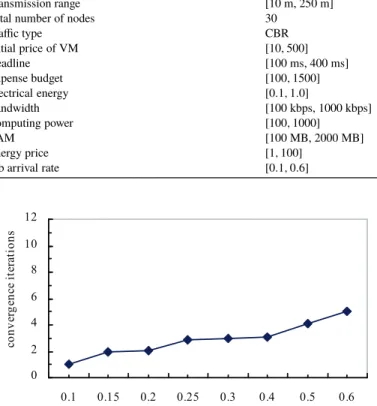
Job arrival rate [0.1,0.6]
=
=
2-D " V G X !D !"D&! D&!F D&" D&"F D&U D&V D&F D&G
2(3 .,,$*.4 ,.-+ '( ) * +, % +) '+ $ -+ ,. -$ ( ) /
Fig. 1. Convergence iterations under various job arrival rate.
as a percentage of the total energy required to meet all job deadlines. Jobs arrive at each cloud nodesi,i=1,2, . . . , naccording to a Poisson process with rateα. The energy cost
can be expressed in the dollar that can be defined as unit energy processing cost. The initial price of energy is set from 10 to 500 cloud dollars. The deadlines of mobile device user are chosen from 100 ms to 400 ms. The budgets of mobile device users are set from 100 to 1500 dollars. Simulation parameters are listed in Table 2.
5.2. Convergence of the Algorithm
The experiment is to test convergence of optimization algorithm for utilizing cloud ser-vices for mobile deser-vices (OAUCS). Convergence iterations are tested under varying job arrival rate(a). In Fig. 1, when job arrival rate is low(a=0.1), the convergence itera-tion ofOAUCSis one. When job arrival rate increases to 0.25, the convergence iterations
Algorithm 2MuSIC algorithm
Step 1: computing the center of mobilitylcmuk of each useruk
Step 2: uses the service selection functionFindservice Condidoteservice=Findservice(W (uk), lcmuk)
Step 3:Util0=ComputeFmobile(Condidoteservice) Step 4: Fori=1to maxiter do
Step 5: Condidoteservice=Findservice(W (uk), lukcm) Step 6: Util1=ComputeFmobile(Condidoteservice) Step 7: 1=Util0−Util1
Step 8: If1 >0 Step 9: Util0=Util1 Step 10: End IF Step 11: End For
ReturnCondidoteservice,Util0
ofOAUCS is three. When job arrival rate increases to 0.5, the convergence iterations ofOAUCSis four. When job arrival rate increases to 0.6, the convergence iterations of OAUCS increase to five. As the demand of cloud datacenter resource is more than the supply, the price of the cloud resources increases. When job arrival rate increases quickly, the cloud resource supply is not enough to be allocated to mobile device user, the price of the cloud datacenter resource will increase, and some mobile device users will not afford the cloud resources.
5.3. Comparison Experiment
The next experiments aimed at comparing our distributed optimization algorithm for uti-lizing cloud services for mobile devices (OAUCS) with mobility-aware optimal service allocation in mobile cloud computing (MuSIC) proposed by Rahimiet al.(2013). Rahimi et al.(2013) developMuSIC(Mobility-Aware Service Allocation on Cloud), an efficient heuristic for tiered-cloud resource allocation which takes into consideration user mobility information. TheMuSICalgorithm is a greedy heuristic that generates a near-optimal so-lution to the tiered cloud resource allocation problem using a simulated annealing-based approach.MuSICuses simulated annealing as the core approach in selecting and refining service selection; custom policies have been designed to make it efficient for the 2-tiered cloud architecture with mobile applications. Given a cloud service set,MuSICstarts by computing the center of mobility of each user by LTWs (location-time workflows). The general goal is to select services near that location.MuSICthen uses the service selection function that returns the list of services near the user center of mobility, which can realize the LTW and satisfy the required constraints. The pseudo code for theMuSICalgorithm is shown in Algorithm 2.
To evaluate the performance of our optimization algorithm for utilizing cloud services for mobile devices (OAUCS) against mobility-aware optimal service allocation in mobile
+ M+ Y+ S+ '+ !++ !++ M++ MH+ "++ "H+ Y++ \%8/9=.% B;@C %J %< 4 $= 1 . @ 4 << %@ @ 28 $= 1 T ]Z[X# ^4#)X
Fig. 2. Execution success ratio under various deadline.
+ M+ Y+ S+ '+ !++ !++ M++ MH+ "++ "H+ Y++ %. %2 ? D < 1 . @4 ; & $= 1 . 2 8$ =1 T ]Z[X# ^4#)X
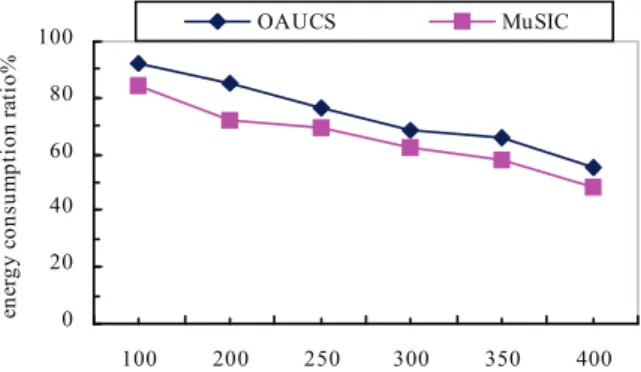
Fig. 3. Energy consumption ratio under various deadline.
cloud computing (MuSIC) (Rahimiet al., 2013), we adopt the metrics: energy consump-tion ratio, execuconsump-tion success ratio, resource allocaconsump-tion efficiency and cost. The experiments study the impacts of deadline, mobility speeds, and the node number on performance met-rics.
How the deadline effects on energy consumption ratio, execution success ratio, re-source allocation efficiency and cost were illustrated in Figs. 2–5 respectively. Figure 2 is to show the effect of the deadline on execution success ratio. When the deadline is low, the execution success ratios ofMuSICandOAUCSare low. When increasing deadline, execu-tion success ratios of two algorithms become higher. Because under low deadline, some jobs of mobile device user can’t be completed on time. When deadline is 200(T=200),
execution success ratio ofMuSICfalls to 60%, execution success ratio ofOAUCSfalls to 73%. Figure 3 shows the energy consumption ratio varies under different deadlines. From the results in Fig. 9, when the deadline is low, there is intensive demand for the cloud resources in short time, some mobile device user need choose more energy exhausting re-source to process the jobs, energy consumption ratio is high. However, when the deadline changes to higher, it is likely that mobile device user’s jobs can be completed before the deadline, so mobile device user considers using the energy saving resources to complete
+ M+ Y+ S+ '+ !++ !++ M++ MH+ "++ "H+ Y++ \%8/9=.% B;@C %J %< 4 $= 1 . @ 4 << %@ @ 28 $= 1 T ]Z[X# ^4#)X
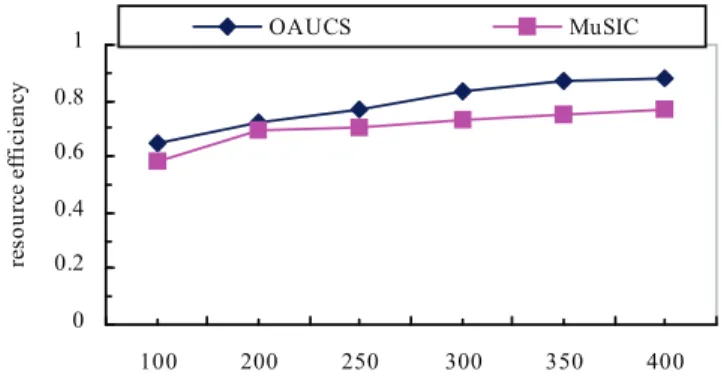
Fig. 4. Allocation efficiency under various deadline.
+ M+ Y+ S+ '+ !++ !++ M++ MH+ "++ "H+ Y++ %. %2 ? D < 1 . @4 ; & $= 1 . 2 8$ =1 T ]Z[X# ^4#)X
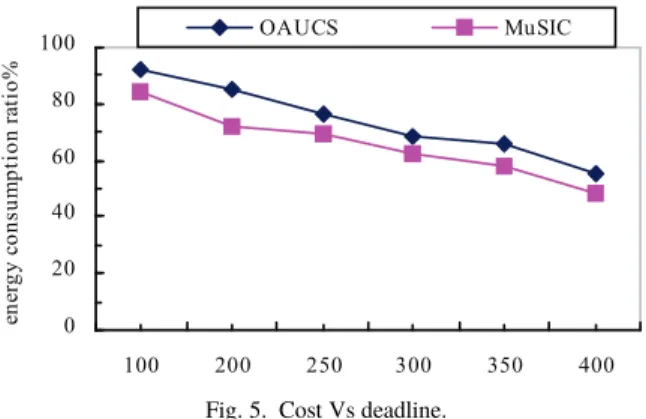
Fig. 5. Cost Vs deadline.
jobs to maximize the benefit, energy consumption ratio is low. When the deadline is 250, energy consumption ratio ofMuSICis 67%; energy consumption ratio ofOAUCSis 73%. Compared withMuSIC,OAUCSconsume more energy. For the resource allocation effi-ciency under different deadline constraints, from the results in Fig. 4, when increasing the deadlines, the impact on the resource allocation efficiency is obvious. A larger deadline values brings out higher resource allocation efficiency. When the deadline is 400, the allo-cation efficiency ofOAUCSis 20% higher thanMuSIC. Under the same deadline,OAUCS has higher resource allocation efficiency thanMuSIC. Figure 5 represents the impact of different deadline constraint on the renting cost. When the deadlines are small,OAUCS spends more payment for obtaining cloud resources to complete jobs, because the mobile cloud user need buy expensive cloud service from cloud datacenter provider. When the deadline is 400, the cost ofOAUCSis 27% less than the deadline is 200. When increasing deadline byT =400, the cost ofMuSICis as much as 39% more thanOAUCS. When
T =400, the cost ofMuSICdecreases to nearly 34% compared withT =100.
In Figs. 6–7, we study the impact of the different average speeds of mobile cloud users on allocation efficiency and execution success ratio. Figures 8 and 9 are to measure the effect of different cloud resource nodes on execution success ratio and allocation efficiency
# #$% #$" #$& #$' ! ! ( ' !# !% !( !' %# 26M/./;: 3L++- 12W34 + N + 8 7 ;/ 6 0 3 7 8 8 + 3 3 5 , ;/ 6 <=>?@ A7@B?
Fig. 6. Execution success ratio Vs. the mobility speeds.
# #$% #$" #$& #$' ! ! ( ' !# !% !( !' %# 26M/./;: 3L++- 12W34 ,. .6 8, ;/ 6 0 + 99 /8 /+ 0 8: + <=>?@ A7@B?
Fig. 7. Allocation efficiency Vs. the mobility speeds.
respectively. Figure 6 shows how the execution success ratio is affected by mobility speed. The execution success ratio ofOAUCSandMuSICdecreases when the mobility speed increases. Whens=20, execution success ratio ofOAUCSis as much as 35% lower than that bys=1. Under the same mobility speeds=20,OAUCShas 17% less execution success ratio thanMuSIC. This is becauseMuSICis the tiered-cloud resource allocation which takes into consideration user mobility information.OAUCSdo not take into account the movement characteristics of the mobile device. Figure 7 shows the effect of mobility speed on the allocation efficiency. When the mobility speed increases to 15, the allocation efficiency ofOAUCSis as much as 24% less than that withs=1. The allocation efficiency is larger when the mobility speed is smaller. When the mobility speed increases, some mobile cloud users’ requirements can’t be processed on time. The allocation efficiency ofOAUCSdecreases slowly thanMuSICwhen the mobility speed increases. When the mobility speed is 20, the allocation efficiency ofMuSICdecreases to 51%, the allocation efficiency ofOAUCSdecreases to 64%. Figure 8 shows when the number of cloud resource node increases to 10(N=10), execution success ratio ofOAUCSis as much as 21% less than that withN =2. The execution success ratio is larger when the number of cloud resource node is smaller. The execution success ratio ofOAUCS decreases slowly than MuSICwhen the number of cloud resource node increases. When the number of cloud resource node is 12, the execution success ratio ofMuSICdecreases to 65%, the execution success ratio ofOAUCSdecreases to 73%. Considering allocation efficiency, as shown
# #$% #$" #$& #$' ! !## %## %(# )## )(# "## 5+ 36 7 58 + +9 9/ 8/ +0 8: <=>?@ A7@B?
Fig. 8. Execution success ratio vs. number of cloud resource nodes.
# !## %## )## "## (## &## !## %## %(# )## )(# "## 86 3; 1 -6 .. ,5 34 +5 <=>?@ A7@B?
Fig. 9. Allocation efficiency vs. number of cloud resource nodes.
in Fig. 9, when cloud resource node increases, allocation efficiency deteriorates. When the number of cloud resource nodes is 10, the allocation efficiency ofOAUCSis as 31% less thanN=2. When the number of cloud resource node is 12, allocation efficiency of OAUCSdecreases to 69%, resource allocation efficiency ofMuSICdecreases to 51%.
6. Conclusions
This paper presents an optimization approach for utilizing cloud services for mobile client in mobile cloud. Mobile cloud service provisioning optimization considers the benefit of both mobile device users and cloud datacenters. The paper proposes a distributed op-timization algorithm for utilizing cloud services for mobile devices. Firstly, the experi-ment is to test convergence of the proposed algorithm. Secondly, the experiexperi-ments aim to compare proposed optimization algorithm for utilizing cloud services for mobile devices with mobility-aware optimal service allocation in mobile cloud (MuSIC). The experiments study the impacts of job arrival rate, deadline, mobility speeds, and the node number on energy consumption ratio, execution success ratio, resource allocation efficiency and cost. The experiment shows that our algorithm outperformsMuSICin terms of some perfor-mance metrics such as allocation efficiency.
Acknowledgements.The authors thank the editors and the anonymous reviewers for their helpful comments and suggestions. The work was supported by the National Natural Sci-ence Foundation (NSF) under grants (Nos. 61472294, 61171075), Key Natural SciSci-ence Foundation of Hubei Province (No. 2014CFA050), Applied Basic Research Project of WuHan, National Key Basic Research Program of China (973 Program) under Grant No.2011CB302601, Program for the High-end Talents of Hubei Province, and Open Fund of the State Key Laboratory of Software Development Environment (SKLSDE). Any opin-ions, findings, and conclusions are those of the authors and do not necessarily reflect the views of the above agencies.
References
Abolfazli, S., Sanaei, Z., Shiraz, M., Gani, A. (2012). MOMCC: market-oriented architecture for mobile cloud computing based on service oriented architecture. In:1st IEEE International Conference on Communications in China Workshops (ICCC). IEEE Press, New York, pp. 8–13.
Barbarossa, S., Sardellitti, S., Di Lorenzo, P. (2013). Joint allocation of computation and communication re-sources in multiuser mobile cloud computing. In:Signal Processing Advances in Wireless Communications (SPAWC), 2013 IEEE 14th Workshop on. IEEE Press, New York, pp 26–30.
Barbera, M.V., Kosta. S., Mei, A., Stefa, J. (2012). To offload or not to offload? The bandwidth and energy costs of mobile cloud computing. In:INFOCOM, 2013 Proceedings IEEE. IEEE Press, New York, pp. 1285–1293. Bessis, N., Sotiriadis, S., Xhafa, F., Asimakopoulou, E. (2013). Cloud scheduling optimization: a reactive model
to enable dynamic deployment of virtual machines instantiations.Informatica, 24(3), 357–380.
Choi, J., Choi, C., Yim, K., Kim, J., Kim, P. (2013). Intelligent reconfigurable method of cloud computing resources for multimedia data delivery.Informatica, 24(3), 381–394.
Dinh, H.T., Lee, C., Niyato, D., Wang, P. (2013). A survey of mobile cloud computing: architecture, applications, and approaches.Wireless Communications and Mobile Computing, 13(18), 1587–1611.
Ferber, M., Rauber, T. (2012). Mobile cloud computing in 3G cellular networks using pipelined tasks. In:
ESOCC’12 Proceedings of the First European Conference on Service-Oriented and Cloud Computing, pp. 192–199.
Ge, Y., Zhang, Y., Qiu, Q., Lu, Y.-H. (2012). A game theoretic resource allocation for overall energy minimiza-tion in mobile cloud computing system. In:Proceedings of the 2012 ACM/IEEE International Symposium on Low Power Electronics and Design. ACM, New York, pp. 279–284.
Gkatzikis, L., Koutsopoulos, I. (2013). Migrate or not? Exploiting dynamic task migration in mobile cloud computing systems.IEEE Wireless Communications Magazine, 20(3), 24–32.
Hussain, F.K., Hussain, O.K. (2011). Towards multi-criteria cloud service selection. In:2011 Fifth International Conference on Innovative Mobile and Internet Services in Ubiquitous Computing (IMIS). IEEE Press, New York, pp. 44–48.
Lee, W., Lee, S.K., Yoo, S., Kim, H. (2013). A collaborative framework of enabling device participation in mo-bile cloud computing. In:Mobile and Ubiquitous Systems: Computing, Networking, and Services. Springer, Berlin, pp. 37–49.
Li, C., Li, L. (2012). Optimal resource provisioning for cloud computing environment.Journal of Supercom-puting, 62(2), 989–1022.
Li, C., Li, L. (2014). Phased scheduling for resource-constrained mobile devices in mobile cloud computing.
Wireless Personal Communications, 77(4), 2817–2837.
Li, D., Cao, J., Lu, X., Chen, K.C.C. (2009). Efficient range query processing in peer-to-peer systems.IEEE Transactions on Knowledge and Data Engineering, 21(1), 78–91.
Lu, X., Wang, H., Wang, J., Xu, J., Li, D. (2013). Internet-based virtual computing environment: beyond the datacenter as a computer.Future Generation Computer Systems, 29, 309–322.
Makris, P., Skoutas, D.N., Skianis, C. (2012). On networking and computing environments’ integration: a novel mobile cloud resources provisioning approach. In:2012 International Conference on Telecommunications and Multimedia (TEMU). IEEE Press, New York, pp. 71–76.
Park, J.S., Yu, H.C., Lee, E.Y. (2012). Resource allocation techniques based on availability and movement relia-bility for mobile cloud computing. In:Distributed Computing and Internet Technology. Springer, Heidelberg, pp. 263–264.
Rahimi, M.R., Venkatasubramanian, N., Vasilakos, A.V. (2013). MuSIC: mobility-aware optimal service al-location in mobile cloud computing. In:2013 IEEE Sixth International Conference on Cloud Computing (CLOUD). IEEE Press, New York, pp. 75–82.
Shiraz, M., Abolfazli, S., Sanaei, Z., Gani, A. (2013). A study on virtual machine deployment for application outsourcing in mobile cloud computing.The Journal of Supercomputing, 63(3), 946–964.
Shiraz, M., Gani, A., Khokhar, R.H., Buyya, R. (2013). A review on distributed application processing frame-works in smart mobile devices for mobile cloud computing.IEEE Communications Surveys & Tutorials, 15(3), 1294–1313.
Shiraz, M., Ahmed, E., Gani, A., Han, Q. (2014) Investigation on runtime partitioning of elastic mobile appli-cations for mobile cloud computing.The Journal of Supercomputing, 67(1), 84–103.
Wang, Y., Lin, X., Pedram, M. (2013). A nested two stage game-based optimization framework in mobile cloud computing system. In:2013 IEEE 7th International Symposium on Service Oriented System Engineering (SOSE), pp. 494–502.
Zhang, W., Wen, Y., Wu, D.O. (2013). Energy-efficient scheduling policy for collaborative execution in mobile cloud computing. In:INFOCOM, 2013 Proceedings IEEE. IEEE Press, New York, pp. 190–194. Zhang, Y., Niyato, D., Wang, P. (2013). An auction mechanism for resource allocation in mobile cloud computing
systems. In:Wireless Algorithms, Systems, and Applications. Springer, Berlin, pp. 76–87.
C. Li received the ME in computer science from Wuhan Transportation University in 2000, and PhD degree in Computer Software and Theory from Huazhong University of Science and Technology in 2003. She now is a professor of Computer Science in Wuhan University of Technology. Her research interests include cloud computing, grid comput-ing, and distributed computing. She has published over 15 papers in international journals. L. Lireceived the BE degree in Communication Engineering from Harbin Institute of Military Engineering, China in 1970 and the ME degree in Communication and Electrical Systems from Huazhong University of Science and Technology, China in 1982. Since 1982, he has been with the Wuhan University of Technology, China, where he is currently a Professor and PhD tutor of Computer Science, and Editor in Chief of the Journal of WUT. He is Director of International Society of High-Technology and Paper Reviewer of IEEE INFOCOM, ICCC and ISRSDC. His research interests include high speed computer networks, protocol engineering and image processing. Professor Li has published over 150 technical papers and is the author of six books. He also was awarded the National Special Prize by the Chinese Government in 1993.
Debesų paslaugų mobiliesiems įrenginiams optimizavimas
Chunlin LI, Layuan LIMobilioji debesų kompiuterija atsirado siekiant padėti mobiliesiems įrenginiams atlikti daug skai-čiavimų arba duomenų reikalaujančius uždavinius naudojant debesų išteklius. Šiame darbe prista-tome debesų paslaugų mobiliajam klientui mobiliajame debesyje optimizavimo būdą, kuris įvertiną naudą mobiliųjų įrenginių naudotojams ir debesų duomenų centrams. Mobiliųjų debesų paslau-gų optimizavimas atliekamas įvertinant termino, biudžeto ir energijos išlaidų apribojimus. Šiame straipsnyje siūlome paskirstytą debesų paslaugų mobiliesiems įrenginiams optimizavimo algoritmą. Eksperimentu ištyrėme pasiūlyto algoritmo konvergavimą ir atlikome palyginimą su susijusiais dar-bais. Eksperimento rezultatai rodo, kad pasiūlytas algoritmas pranoksta kitus kai kuriais rodikliais, pavyzdžiui, paskirstymo efektyvumą.