Classification, labelling and packaging
according to CLP
Studiedag LAB 3th October 2013
Dr Saskia Walraedt
Sr Advisor
Projectleider VLARIP
Content
Introduction to CLP
General principles on classification
of mixtures
Using harmonised classification
and labelling
Action plan
Abbreviations
ATE : acute toxicity estimate
ATP: adaptation to technical progress C&L: classification and labelling
CLP : classification, labelling and packaging CMR : carcinogenic, mutagenic, reprotoxic DPD : Dangerous product directive
DSD : dangerous substance directive DU : downstream user
EC: European Commission
ECHA : European Chemicals Agency GCL : generic concentration limit GHS: Globally Harmonised System LC: lethal concentration
MS : member states
NOEC : no observed effect concentration OJ: official journal
RAC : Risk Assessment Committee
REACH : registration, evaluation, authorisation and restriction of chemicals SCL : specific concentration limit
STOT SE : specific target organ toxicity single exposure STOT RE : specific target organ toxicity repeated exposure
CLP – the basics
•
European implementation of the Globally Harmonised
System (GHS), developed by UN
•
But also EU specific
• List of EU harmonised classifications (annex VI)
• Notification of dangerous mixtures to national anti-poison centres
• Notification of the classification & labeling of substances to ECHA for the C&L inventory
•
Regular updates via ATP
• Extension of the Annex VI list
GHS (VN) CLP (EU )
Binding? no yes, EU regulation
Classification yes yes GHS + EUH
Labelling yes yes
SDS yes no, REACH
Packaging no yes
Notification poison centres no yes
Notification C&L no yes
GHS vs CLP
CLP - a living regulation
•
Extension of Annex VI list of harmonised classifications
•
1
steATP to CLP : inclusion of 30st en31st ATP to DSD
Consolidated version:
http://ecb.jrc.ec.europa.eu/classification-labelling/clp/
•
3
eATP
•
First new harmonised classifications added
•
http://eur-lex.europa.eu/LexUriServ/LexUriServ.do?uri=OJ:L:2012:179:
0003:0010:NL:PDF
•
5
eATP
•
Notification to WTO
•
expected Q2 2013
•
EiF 20 d after publication in OJ
•
The provisions will apply from 1
stJanuary 2015.
CLP- a living regulation
•
Adoption to the biannual revision of GHS
•
2
deATP (regulation 286/2010)
•
Adoption to 3th revision of GHS
•
4
eATP (regulation
487/2013)
•
Adoption
to 4th revision GHS
Adaptation to revisions of GHS
•
New classifications
•
New test methods
•
Changes to H statements
•
Changes to P statements
8
Impact on own classifications, labelling, SDS,
software….
* Indien al op de martkt met EU-etiket voor de deadline M E N G S E LS S T O F F E N indeling volgens CLP optie indeling volgens EU 67/548
verplicht indeling volgens
EU 67/548 verplicht
indeling volgens CLP verplicht* indeling volgens EU 67/548 verplicht*
indeling volgens CLP verplicht
indeling volgens EU 1999/45
verplicht
indeling volgens CLP optie
indeling volgens EU 1999/45 verplicht
indeling volgens CLP verplicht
* Zowel indeling volgens CLP als volgens EU 67/548 te vermelden in SDS
M E N G S E LS S T O F F E N etikettering volgens EU 67/548 verplicht
etikettering volgens CLP verplicht
etikettering volgens EU 67/548 optie* etikettering volgens CLP verplicht etikettering volgens EU 1999/45 verplicht etikettering volgens CLP verplicht etikettering volgens EU67/548 of CLP
(afh. van de indeling)
1 etiket!
etikettering volgens EU67/548 of CLP
(afh. van de indeling)
1 etiket! etikettering volgens EU 67/548 optie*
overgangsbepalingen CLP mbt indeling
overgangsbepalingen CLP mbt etikettering
CLP for mixtures – where to start
10 1/6/2015 Re- formula-tion and appro-vals Finali-sing C&L, modif. SDS Notifica-tion poison centres Label-ling and packa-ging knowled -ge CLP? CLP C&L ingre-dients Estima-ting C&L own mixtureCollecting
data
Verification
against
criteria
classification
Labelling
Packaging
Notification
poison centre
Notification
C&L
CLP – how it works
Collecting data for own mixtures
•
Fysical properties : classification on mixtures
•
Human tox : no animal testing for C&L!
•
aquatoxicity : based on aquatox data of ingredients
12
Original concentration of a substance Max deviation
< of = 2,5% ca 30%
2,5 < C < of = 10% ca 20%
10 < C < of = 25% ca 10%
DATA
• Use available data
ANNEX VI
• Check Annex VI tabel 3.1 for harmonised C&L
Conversio n table
• Use the conversion table
(annex VII) for each substance not on annex VI and for which no data are available
DATA
• Use available information on the mixture
• Use data of comparable mixtures
Componente n
• Use information on C&L of substances to classify the mixture
Conversie-tabel
• Use conversion table (annex VII) on DPD classification of the mixture till 1/6/2015
13
Fysische gevaren
DPD
Explosive Oxidising
Flammable, highly flammable, extremely flammable
CLP
Explosive
Flammable gas
Chem unstable gases Aerosols Oxidising gas Pressurised gas Flammable liquid Flammable solid Self react Pyroforic liq Pyroforic solid Self heating Water reacting Oxidising liquid Oxidising solid Organic peroxides Metal corrosives 14 CLP :
No 1-to-1 conversion possible Physical state important
Flammable Liquids
15 °C flashpoint CLP DSD/DPD 21 23 55 60 Cat. 2 Vp < 23 °C & Tk > 35°C Cat. 1 Vp < 23 °C & Tk < 35°C Cat. 3 23 °C < Vp < 60°C Cat. 4 60 °C < Vp < 93°C 93 GHSdanger warning warning
F+, ,R12
Vp <0 & Tk < 35°C R10
Humane tox
DPD
Harmful, toxic, very toxic
Corrosive
Irritant
Sensitizer
CMR
CLP
Acute tox oral
Acute tox dermal
Acute tox inhalation
Skin corr or irr
Eye damage or irr
Resp sensitiser
Skin sensitiser
CMR
STOT SE
STOT RE
Asp tox
16 CLP New classesNew concept for calcution acute tox of mixtures based on ATE More stringent
Acute toxicity estimate : ATE
•
ATE = acute toxicity estimate
•
To calculate acute tox of mixtures
•
If available ATE = LC50
•
If LC50 not available and only category known, use ATE of
table 3,1,2
17
18
•
When data available on all substances
ATE mix = 100 / (∑ Ci / ATEi)
met
Ci = concentration of substance i (% w/w of % v/v)
i = the individual substances 1 to n
n = number of substances
ATEi = acute toxicity estimate for substancei
19
n ATEi
Ci
ATEmix
100
(Formule 3.1.3.6.1.)
nAcute toxicity for mixtures
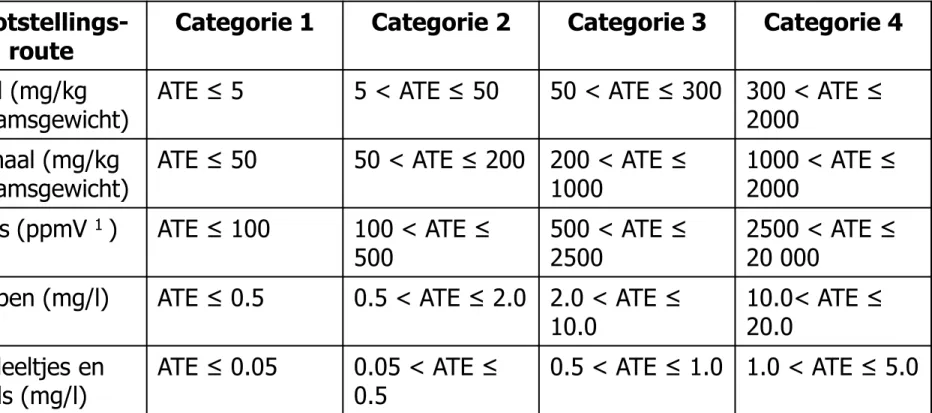
Tabel 3.1.1 : determining acute tox category
20
Blootstellings-route Categorie 1 Categorie 2 Categorie 3 Categorie 4
Oraal (mg/kg
lichaamsgewicht) ATE ≤ 5 5 < ATE ≤ 50 50 < ATE ≤ 300 300 < ATE ≤ 2000 Dermaal (mg/kg
lichaamsgewicht) ATE ≤ 50 50 < ATE ≤ 200 200 < ATE ≤ 1000 1000 < ATE ≤ 2000 Gases (ppmV 1 ) ATE ≤ 100 100 < ATE ≤
500 500 < ATE ≤ 2500 2500 < ATE ≤ 20 000 Dampen (mg/l) ATE ≤ 0.5 0.5 < ATE ≤ 2.0 2.0 < ATE ≤
10.0 10.0< ATE ≤ 20.0 Stofdeeltjes en
•
If acute tox is not known for all substances
Substance with unknown acute tox ≤ 10 %
Formule 3.1.3.6.1.
Substance with unknown acute tox > 10 %
ATE mix = (100 – (∑Cunknown if > 10 %) ) / (∑ Ci / ATEi)
21 n
Acute toxicity
Generic concentration limits (GCL)
22
DPD DPD Conc
limit
CLP CLP conc. limit
Corr C, R34 10% Skin corr 1B en 1C 5%
Corr C, R35 5% Skin corr 1A 3%
Irr Xi, R38 20% Skin irr cat. 2 10%
Irr XI, R36 20% Eye irr 2A 10%
Irr Xi, R 41 10% Eye dam 1 3%
Repr R60 of R61 0,5% Repr 1 0,3%
environment
DPD
Aq tox acute
Aq tox chronic
Ozone depletion
CLP
Aq Tox Acute
Aq tox Chronic
Ozone depletion
23New calculation rules
New concept of M-factor for class 1
substances
Use of EC50 and NOEC values
Annex VI : for which substances?
•
Only for substances or groups of substances
•
Group 1
:
•
CMR cat 1A,1B or 2
•
respiratory sensitisers cat 1
•
When EU considers that harmonisation is required
•
To be submitted by the MS (or industry)
Annex VI : for which substances?
•
Group 2:
•
Voor plant protection products and biocides
•
Only to be submitted by MS
Specific concentration limits (SCL)
•
In annex VI or
•
Determined by registrant, importer or DU based on data
•
To be indicated in section 3 of SDS
•
Always check first if SCL available
•
Priority : SCL > GCL, indepent of SCL value higher or lower
27 opleiding REACH en CLP
ATP’s adapting Annex VI
28 Registry of Intentions Public consultati on RAC advise EC decision ATP in OJ Follow up as soon as substance on RoIImpact own business? Reformulation required?
To be adopted even if still on DPD ! (before 6/2015)
CLP for mixtures – where to start
29 1/6/2015 Re- formula-tion and appro-vals Finali-sing C&L, modif. SDS Notifica-tion poison centres Label-ling and packa-ging knowled -ge CLP? CLP C&L ingre-dients Estima-ting C&L own mixtureGEVAARLIJK VOOR HET AQUATISCH MILIEU GHS09
CLP pictograms
30h EXPLOSIEF GHS01 ONTVLAMBAAR GHS02 OXIDEREND GHS03 CORROSIEF GHS05 GIFTIG GHS06!
IRRITEREND, SENSIBILISEREND, SCHADELIJK GHS07 LANGE TERMIJN GEZONDHEIDSGEVAARLIJK GHS08GASSEN ONDER DRUK GHS04
http://www.unece.org/trans/danger/publi/
ghs/pictograms.html
Labelling
31 Hazard statements Precautionary statements Max 6 statements How to select?• Use priority guidelines ECHA guidance
• Avoid duplicates
• Consider at least 1 P statement per hazard
• Selling to industrial users/ professional/consumers?
Multiple languages OK but keep it readable!
CLP for mixtures – where to start
33 1/6/2015 Re- formula-tion and appro-vals Finali-sing C&L, modif. SDS Notifica-tion poison centres Label-ling and packa-ging knowled -ge CLP? CLP C&L ingre-dients Estima-ting C&L own mixtureNotification to Be poison centre
1.
According EU directives and regulations
• Gevaarlijke preparaten (KB 11/01/1993 - vervangen door KB van 17/07/2002) art. 17 DPD
• CLP (art 45)
• Pesticides (KB 28/02/1994) • Biocides (KB 5/09/2001)
2.
Additional nationale regulations
• Cosmetics (KB 15/10/1997)
Melding anti-gifcentrum :
http://www.poisoncentre.be/rubrique.php?id_rubrique=9
0&lang=nl
Opleidingscyclus CLP voor experten 2013 pag. 35CLP for mixtures – where to start
36 1/6/2015 Re- formula-tion and appro-vals Finali-sing C&L, modif. SDS Notifica-tion poison centres Label-ling and packa-ging knowled -ge CLP? CLP C&L ingre-dients Estima-ting C&L own mixtureLogistics
•
Consumer market ? Other packaging may be required!
•
New software labelling?
•
New color printer or preprinted label?
•
Warehouse organisation :
• Mixtures which were previously not classified may become CLP classified!
• E.g. flammables, irritating…
•
Packaging requirements
• For consumer products : tactile warnings and child proof caps?
• If ADR labelling required :
• Inner label : CLP, outer label : ADR and CLP optionally
• Single packaging : CLP picto may be omitted if = ADR labels
CLP for mixtures – a team effort
38
EHS – classification impact? IT dept – software impact?
Logistics dpt – labelling and packaging impact?
R&D dpt – reformulation required? Marketing/sales dpt – commercial impact?
Conversion to CLP
•
CLP training, build a CLP team
•
Allow time
•
Plan budget
•
Discuss with suppliers (of mixtures)
•
Inform internally (sales, purchasing, production,
warehouse…) and externally (customers and
suppliers)
More info on ECHA website
40 Opleidingscyclus CLP voor experten 2013
ECHA guidance
• http://echa.europa.eu/web/guest/guidance-documents/guidance-on-clp
41 Opleidingscyclus CLP voor experten 2013
Usefull links
•
http://www.unece.org/trans/danger/publi/ghs/ghs_welcome_e.html
•
http://ec.europa.eu/enterprise/reach/ghs/index_en.htm
•
http://ecb.jrc.ec.europa.eu/classification-labelling/
•
http://www.ghs-helpdesk.nl/
•
http://ec.europa.eu/enterprise/sectors/chemicals/documents/classific
ation/index_en.htm
•
http://www.napofilm.net/en/napos-films
•
http://www.youtube.com/watch?v=PjJiLPeeFsE
•
http://www.youtube.com/watch?v=BrcrICA5XIs&feature=related
42
Belgian helpdesk CLP
•
Federale overheidsdienst (FOD) Volksgezondheid,
Veiligheid van de Voedselketen en Leefmilieu
Eurostation II
Victor Hortaplein, 40 bus 10
1060 Brussel
Contact Center : +32 (0)2 524.97.97
E-mail : [email protected]
•
http://www.health.belgium.be/eportal/Environment/Chemi
calsubstances/index.htm
43Conclusions
Follow up on the adaptation of other legislations,
i.e. SEVESO, VLAREM…
Make an action plan for the conversion of own
production to CLP
Regular changes to the classification of mixtures
possible, even before switching to CLP
new data from the REACH registrations of the substances new harmonised classifications
Disclaimer
Alle gegevens op dit document worden door essenscia vzw/essenscia vlaanderen met de grootste zorgvuldigheid samengesteld. Voor deze informatie worden enkel betrouwbare bronnen aangewend. Ondermeer door de snelle evolutie van de behandelde materie blijft de mogelijkheid bestaan dat de gegevens toch niet volledig accuraat zijn, daarom wijst essenscia vzw/essenscia vlaanderen elke aansprakelijkheid voor fouten of onvolkomenheden af.