Title:
Routing Protocols for WBAN
Authors:
Luis and Kirmat
Abstract:
The emergence of wireless body area network (WBAN) technology has brought hope and
dawn to solve the problems of population aging, various chronic diseases, and medical facility
shortage. The increasing demand for real-time applications in such networks stimulates many
research activities.
Our aim is to provide a tutorial to introduce WBAN routing
proto-cols. We
classify, and compare the advantages and disadvantages of various routing
proto-cols.
We also address Emergency health issues and suggest how it can be improved.
1.
INTRODUCTION
The increase in average lifespan and health cost in many developed nations are
catalysts to innovation in health care. These factors along with the advances in
minia-turization of electronic devices, sensing, battery and wireless communication
technol-ogies have led to the development of Wireless Body Area Networks (WBANs).
WBANs consist of smart miniaturized devices (motes) that are able to sense, process
and communicate. They are designed such that they can be worn or implanted, and
monitor physiological signals and transmit these to specialized medical servers
with-out much interference to the daily rwith-outine of the patient. [4] [5]
A WBAN consists of several sensors and possibly actuators equipped with a radio
interface. Each WBAN has a sink or personal server such as a PDA, that receives all
information from the sensors and provides an interface towards other networks or
medical staff. Connecting health monitoring sensors wirelessly improves comfort for
patients but induces a number of technical challenges like coping with mobility and
the need for increased reliability [6].
An important requirement in WBANs is the energy efficiency of the system. The
sensors placed on the body only have limited battery capacity or can scavenge only a
limited amount of energy from their environment. Consequently, in order to increase
the lifetime of the network, energy efficient measures needs to be taken. From that
point of view, several researchers are developing low power sensors and radios.
An-other possibility is the design of optimized network protocols to lower the energy
consumption while satisfying the other requirements [7].
A Wireless Body Area Network consists of small, intelligent devices attached on
or implanted in the body which are capable of establishing a wireless communication
link. These devices provide continuous health monitoring and real-time feedback to
the user or medical personnel. Furthermore, the measurements can be recorded over a
longer period of time, improving the quality of the measured data [3]. Generally
speaking, two types of devices can be distinguished: sensors and actuators. The
sen-sors are used to measure certain parameters of the human body, either externally or
internally. Examples include measuring the heartbeat, body temperature or recording
a prolonged electrocardiogram (ECG). The actuators (or actors) on the other hand
take some specific actions according to the data they receive from the sensors or
through interaction with the user. E.g., an actuator equipped with a built-in reservoir
and pump administers the correct dose of insulin to give to diabetics based on the
glu-cose level measurements. Interaction with the user or other persons is usually handled
by a personal device, e.g. a PDA or a smart phone which acts as a sink for data of the
wireless devices. In order to realize communication between these devices, techniques
from Wireless Sensor Networks (WSNs) and ad hoc networks could be used.
Howev-er, because of the typical properties of a WBAN, current protocols designed for these
networks are not always well suited to support a WBAN.
2.
WBAN ARCHITECTURE
The WBAN technology is the consequence of the existing WSN technology. A
number of tiny wireless sensors, strategically placed on the human body, create a
wireless body area network that can monitor various vital signs, providing real-time
feedback to the user and medical personnel. In a WBAN, each medical sensor
moni-tors different vital signs such as temperature, blood pressure, or ECG. The system
consists of multiple sensor nodes that monitor body motion and heart activity, a
net-work coordinator, and a personal server running on a personal digital assistant or a
personal computer [8].
Figure 1 shows secure 3-level WBAN architecture for medical and non-medical
applications. Level 1 contains in-body and on-body BAN Nodes (BNs) such as
Electrocardiogram (ECG) – used to monitor electrical activity of heart, Oxygen
saturation sensor (SpO2) –used to measure the level of oxygen, and
Electromyogra-phy (EMG) – used to monitor muscle activity [9].
Level 2 contains a BAN Network Coordinator (BNC) that gathers patient’s
vital information from the BNs and communicates with the base-station. Level 3
contains a number of remote base-stations that keep patient’s
medical/non-medical records and provides relevant (diagnostic) recommendations. The traffic is
categorized into on demand, emergency, and normal traffic. On-demand traffic is
initiated by the BNC to acquire certain information. Emergency traffic is initiated by
the BNs when they exceed a predefined threshold. Normal traffic is the data traffic in
a normal condition with no time critical and on-demand events [11].
Figure 1: Secure 3-Level WBAN Architecture For Medical And Non-Medical Applications
The normal data is collected and processed by the BNC. The BNC contains a
wakeup circuit, a main radio, and a security circuit, all of them connected to a data
interface. The wakeup circuit is used to accommodate on-demand and emergency
traffic. The security circuit is used to prevent malicious interaction with a WBAN
[10], [14], [13].
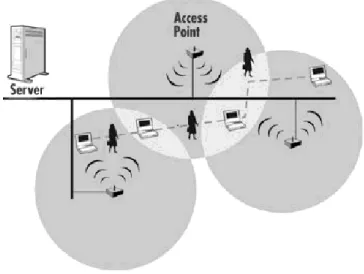
Figure 1-3:
Microcells and Roaming
3.
MAC PROTOCOLS FOR WBAN
MAC protocols used in WBAN must be low power consuming, accurate and with less latency. The most important thing is the protocol should give good performance on varying traffic load. Some popu-lar protocols for WBAN are TMAC, SMAC, ZigBee MAC and Baseline MAC [4].
A. TMAC:
It is a duty-cycling protocol. In this protocol the node is awaken for a particular period that is called active time. Duty cycle changes according to the information traffic load of the network. When traffic load is high than the duty cycle becomes large so that nodes can handle high traffic load. When traffic load is low then duty cycle is adjusted to small value so that nodes can save their power reducing the problem of idle listening. TMAC protocol is able to handle varying load with low power consump-tion.
B. SMAC:
SMAC protocol is similar to TMAC but only difference is its fixed duty cycle. This protocol is the previous version. This protocol is not efficient in handling continuously varying data rates in WBAN.
C. ZigBee MAC:
ZigBee MAC protocol can use two schemes- CSMA/CA or TDMA. While using CSMA/CA mechanism this protocol gives average performance but using TDMA mechanism (applying Guaran-teed Time Slot or GTS) it reduces the power consumption up to a great extent. At high rates the data loss becomes high in TDMA mechanism so it is best when there is less no of nodes or low traffic load.
D. Baseline MAC:
This MAC protocol uses CSMA/CA scheme. The performance of Baseline MAC in terms of en-ergy consumption is not average but throughput is average.
4.
LITERATURE SURVEY
In [13] (2012) proposed a reliable topology design and provisioning approach for Wireless Body Area Networks (named RTDP-WBAN) that takes into account the mobility of the patient while guaranteeing a reliable data delivery required to support healthcare applications’ needs. To do so, they first proposed a 3D coordinate system able to calculate the coordinates of relay-sensor nodes in differ-ent body postures and movemdiffer-ents. This system uses a 3D-model of a standard human body and a spe-cific set of node positions with stable communication links, forming a virtual backbone. Next, they investigated the optimal relay nodes positioning jointly with the reliable and cost-effective data routing for different body postures and movements. Therefore, they use an Integer Linear Programming (ILP) model, that is able to find the optimal number and locations of relay nodes and calculate the optimal
data routing from sensors and relays towards the sink, minimizing both the network setup cost and the energy consumption. They solved the model in dynamic WBAN (Stand, Sit and Walk) scenarios, and compare its performance to other relaying approaches.
In [14] (2013) presented an analytically discussion about energy efficiency of Medium Ac-cess Control (MAC) protocols for Wireless Body Area Sensor Networks (WBASNs). For this purpose, different energy efficient MAC protocols with their respective energy optimization techniques; Low Power Listening (LPL), Scheduled Contention and Time Division Multiple Access (TDMA), are elabo-rated. They also analytically compared path loss models for In-body, On-body and Off-body communi-cations in WBASNs. These three path loss scenarios are simulated in MATLAB and results shown that path loss is more in In-body communication because of less energy level to take care of tissues and organs located inside human body. Secondly, power model for WBASNs of Carrier Sense Multiple Access with Collision Avoidance (CSMA/CA) and beacon mode is also presented. The results shown that power of CSMA/CA mode is less as compared to beacon mode. Finally, they suggested that hybrid mode is more useful to achieve optimization in power consumption, which consequently results in high energy efficiency.
In [15] (2014) proposed a mechanism to route data in WBANs with minimum path-loss over the link; and in which the merits of single-hop and multi-hop are utilized. The proposed scheme uses a cost function to select the most appropriate route to sink. This cost function is calculated based on their distance from the sink as well as their residual energy. Nodes with lesser value of cost function are elected as parent node. Other nodes become children of that parent node and forward their data to par-ent node. Two of the eight nodes forward their data directly to sink as they are placed near the sink; and will serve as the parent nodes. The channel for wearable BAN can be basically described by path loss models with two parameters of frequency and distance. It is calculated from its distance to sink with constant frequency 2.4GHz. The results shows that proposed routing scheme has considerably en-hanced the network stability time and in terms of cross-layer application, it has reduced the path-loss to a significantly low-level
5.
CONCLUSION
The increasing use of wireless networks and the constant miniaturization of electrical devices has em-powered the development of Wireless Body Area Net- works (WBANs). In these networks various sensors are attached on clothing or on the body or even implanted under the skin. The wireless nature of the network and the wide variety of sensors power numerous new, practical and innovative applica-tions to improve health care and the Quality of Life. The sensors of a WBAN measure for example the heartbeat, the body temperature or record a prolonged electrocardiogram. In this survey, we have re-viewed the current research on Wireless Body Area Networks. In particular, this work presents an overview of the research on the human body, MAC-protocols in WBAN, challenges in WBAN and also describes the various applications in WBAN.
6.
References
1. T. Jamal and P. Mendes, “Relay Selection Approaches for Wireless Cooperative Networks”,
in Proc. of IEEE WiMob, Niagara Falls, Canada, Oct. 2010.
2. T. Jamal and P. Mendes, “Cooperative relaying in user-centric networking under interference
conditions”, in Proc. of IEEE Communications Magazine, vol. 52, no. 12, pp. 18–24, Dec 2014.
3. T. Jamal, and SA Butt, "Malicious Node Analysis in MANETS", in Proc. of International Journal of Information Technology, PP. 1-9, Springer Publisher, Apr. 2018.
4. T. Jamal, "Cooperative MAC for Wireless Network", In Proc. of 1st MAP Tele Workshop, Porto, Portugal, 2010.
5. T. Jamal, and SA Butt, “Cooperative Cloudlet for Pervasive Networks”, in Proc. of Asia
Pa-cific Journal of Multidisciplinary Research, Vol. 5, No. 3, PP. 42-26, Aug 2017.
6. SA Butt, and T. Jamal, “Frequent Change Request from User to Handle Cost on Project in
Ag-ile Model”, in Proc. of Asia Pacific Journal of Multidisciplinary Research 5 (2), 26-42, 2017. 7. SA Butt, and T. Jamal, “Study of Black Hole Attack in AODV”, in Proc. of International
Journal of Future Generation Communication and Networking, Vol. 10, No.9, pp. 37-48, 2017.
8. T. Jamal, and SA Butt, “Low-Energy Adaptive Clustering Hierarchy (LEACH) Enhancement
for Military Security Operations”, In Proc. Of Journal of Basic and Applied Scientific Re-search, ISSN 2090-4304, 2017.
9. SA Butt and MA Azad, "A multivariant secure framework for smart mobile health applica-tion", in Transactions on Emerging Telecommunications Technologies, Aug. 2019.
10. S. A. Butt and M. Shoaib, "IoT Smart Health Security Threats," in proc. of 19th International Conference on Computational Science and Its Applications (ICCSA), Saint Petersburg, Rus-sia, 2019, pp. 26- 31. doi: 10.1109/ICCSA.2019.000-8.
11. SA Butt and T. Jamal, "Predictive Variables for Agile Development Merging Cloud
Compu-ting Services", in Proc. of IEEE Access, Volume 7, 2019. DOI:
10.1109/ACCESS.2019.2929169.
12. A Khalid and S Gochhait, “Agile Scrum Issues at Large-Scale Distributed Projects: Scrum Project Development At Large”, in International Journal of Software Innovation (IJSI), Vol 8, Issue 2, Pages: 85-94, IGI Global 2020.
13. S Gochhait, SA Butt and A Ali, “Cloud Enhances Agile Software Development” Book Chap-ter in Cloud Computing Applications and Techniques for E -Commerce, Pages: 28-49, IGI Global, 2020.
14. Z. Haider, and K. Ullah, "DoS Attacks at Cooperative MAC", in Proc. of ArXiv, arXiv:1812.04935 [cs.NI], Dec. 2018.