Exploring and Prediction Movement Patterns in
Large Networks
Thesis submitted in accordance with the requirements of
the University of Liverpool for the degree of Doctor in Philosophy
by
Mohammed AL-Zeyadi
Notations viii Declaration ix Abstract x Acknowledgements xi 1 Introduction 1 1.1 Research Motivation . . . 3 1.2 Formal Definitions . . . 4
1.3 Research Issues and Question . . . 5
1.4 Research Methodology . . . 6
1.5 Contributions . . . 9
1.6 Organization of the Thesis . . . 9
1.7 Published Work . . . 11
1.8 Summary . . . 13
2 Literature Review 14 2.1 Data Mining in Social Networks . . . 15
2.1.1 Frequent Pattern Mining . . . 17
2.1.2 Movement Pattern Mining . . . 18
2.2 Prediction Modeling in Networks . . . 19
2.2.1 Link Prediction in Networks . . . 20
2.2.2 Recommendation in Network . . . 22
2.3 Processing Large Networks . . . 24
2.3.1 Challenges of Parallel Algorithm Design . . . 25
2.3.2 Principles of Share Memory Systems . . . 26 i
2.3.5 Hadoop/MapReduce . . . 28
2.4 Frequent Pattern Mining using Parallel and Distributed Algorithms 30 2.5 Summary and Conclusions . . . 32
3 Evaluation Data 33 3.1 Network Formalism . . . 34
3.2 GB Cattle Tracking System (CTS) Database . . . 36
3.2.1 Data Preprocessing . . . 38
3.2.2 Network Data Generation . . . 42
3.3 Jiayuan Social Network . . . 43
3.4 Simulated Data . . . 45
3.5 Summary . . . 46
4 Movement Pattern Mining 48 4.1 Movement Pattern Formalism . . . 49
4.2 Movement Pattern Mining . . . 51
4.2.1 Apriori Movement Pattern Mining Algorithm . . . 52
4.2.2 Shape Movement Pattern Mining Algorithm . . . 57
4.3 Experiments and Evaluation . . . 63
4.3.1 Effect of Selected Support Threshold . . . 63
4.3.2 Effect of Size of FETs . . . 65
4.3.3 Effect of Number of FETs . . . 69
4.4 Summary . . . 71
5 Movement Pattern Mining Using Big Data Facilities 73 5.1 The ShaMP Shared Memory System . . . 75
5.2 The ShaMP Distributed Memory System . . . 78
5.3 The ShaMP Hadoop/MapReduce System . . . 82
5.4 Experiments and Evaluation . . . 86
5.4.1 Evaluation Results Using CTS Data . . . 86
5.4.2 Evaluation Results Using Artificial Data . . . 87
5.5 Summary and Conclusions . . . 89
6 The Application Of Movement Patterns 91 6.1 Global Movement Pattern Prediction . . . 92
6.1.1 The Global Movement Pattern Prediction Mechanism . . . . 93
6.1.2 The Accuracy Of Movement Pattern Prediction . . . 94
6.2 Local Movement Pattern Prediction . . . 97
6.2.1 The Recommendation Based on Movement Patterns Algo-rithm (RecoMP) . . . 100
6.2.2 The Recommendation Based on Collaborative Filtering Al-gorithm (RecoCF) . . . 103
6.2.3 Evaluation . . . 104 ii
7 Conclusion And Future Vision 115
7.1 Summary And Main Findings . . . 116 7.2 Research Contributions . . . 119 7.3 Future Vision . . . 119
Bibliography 121
List of Figures
2.1 The Hadoop/MapReduce job execution flow.[27] . . . 29
3.1 Example network (V ={φ1, φ2, . . . , φ5} and E ={1, 2, . . . , 9}). . . . 35
3.2 The geographic distribution of holding areas of different type for the CTS database in 2006 . . . 39 3.3 The distribution values for the county attribute before preprocessing
(sender and receiver counties, 2006 data). . . 40 3.4 The distribution values for the county attribute after preprocessing
(sender and receiver counties, 2006 data). . . 41 3.5 Male and Female Normal Distribution. . . 45
4.1 FET dataset, presented in tabular form, for the network given in Figure 3.1. . . 51 4.2 The set of frequent MPs (M) extracted from the data listed in Figure
3.1 using σ = 35%. . . 51 4.3 Working example illustrating the operation of the AMP algorithm (σ=
35%). . . 56 4.4 The 27 different shapes when |AV|= 2 and |AE|= 2, as in the case of
the example network given in Figure 3.1. . . 58 4.5 Working example illustrating the operation of the ShaMP Algorithm
(σ= 35%). . . 62 4.6 Runtimes (secs.), using ShaMP and AMP, applied to the CTS network
datasets, and a range of σ values. . . 66 4.7 Number of Movement Pattern, using ShaMP and AMP, applied to the
CTS network datasets, and a range of σ values. . . 67 iv
5.1 Working example illustrating the operation of ShaMP DMS as imple-mented using MPJ express (σ= 35%). . . 77 5.2 Worked example illustrating the operation ShaMP DMS as
imple-mented using MPJ express (σ= 35%). . . 80 5.3 Working example illustrating the operation of the ShaMP HMS
imple-mented on the top of Hadoop with (σ= 35%). . . 84 5.4 Runtime comparison between ShaMP SMS, ShaMP DMS and ShaMP
HMS using CTS network data. . . 87 5.5 Runtime (minutes) comparison between ShaMP DMS and ShaMP
SMS using artificial data sets. . . 89
List of Tables
1.1 Thesis structure. . . 10
3.1 CTS Database Location Table Attributes and Value Types . . . 37 3.2 CTS Database Animal Table Attributes and value types . . . 37 3.3 CTS FET data Location Attributes and Value Types the set (AV) . . 43 3.4 CTS FET data Edge Attributes and Value Types (the set (AE) . . . . 43 3.5 Summary of the CTS FET Datasets . . . 43 3.6 Jiayuan SN Vertex Attributes and Value Types (the set AV) . . . 44 3.7 Jiayuan SN Edge Attributes and Value Types (the set AE) . . . 44
4.1 Recorded Runtimes (seconds) using a range of values for σ and the CTS network data . . . 64 4.2 Number of frequent MPs discovered using a range of values for σ and
the CTS network data . . . 64 v
. . . 67 4.4 Recorded Runtimes (seconds) using artificial datasets featuring
in-creasing numbers of FETs and the AMP algorithm . . . 70 4.5 Recorded Runtimes (seconds) using artificial datasets featuring
in-creasing numbers of FETs and the ShaMP algorithm . . . 70
5.1 Runtime comparison between ShaMP SMS, ShaMP DMS and ShaMP HMS using artificial data sets. . . 88
6.1 Accuracy of proposed prediction mechanism using MPs generated from the 2003 CTS data set. . . 96 6.2 Accuracy of proposed prediction mechanism using MPs generated from
the 2004 CTS data set. . . 96 6.3 Accuracy of proposed prediction mechanism using MPs generated from
the 2005 CTS data set. . . 96 6.4 Accuracy of proposed prediction mechanism using MPs generated from
the 2006 CTS data set. . . 96 6.5 Comparative performance of RecoMP and RecoCF over 50 randomly
selected users . . . 107 6.6 TCV results using the RecoMP algorithm . . . 108 6.7 TCV results using the RecoCF algorithm . . . 108 6.8 The accuracy of RecoMPA with respect to a range ofσ values (ranging
from 1.0 to 7.5 increasing in steps of 2.5) over 50 randomly selected users. . . 109 6.8 The accuracy of RecoMPA with respect to a range ofσ values (ranging
from 1.0 to 7.5 increasing in steps of 2.5) over 50 randomly selected users (cont.). . . 110
users (cont.). . . 111 6.8 The accuracy of RecoMPA with respect to a range ofσ values (ranging
from 1.0 to 7.5 increasing in steps of 2.5) over 50 randomly selected users (cont.). . . 112 6.8 The accuracy of RecoMPA with respect to a range ofσ values (ranging
from 1.0 to 7.5 increasing in steps of 2.5) over 50 randomly selected users (cont.). . . 113
The following abbreviations are found throughout this thesis:
List Of Abbreviations:
AE Edge attribute set
AV Vertex attribute set
D Dataset
E Edge Attribute set
F From Attribute set
F ET A From, Edge, To tuple describing a MP
G Graph
M P Movemnet Pattern
M P M Movement Pattern Mining
T To Attribute set
VE Set of edge attribute values
VV Set of vertex attribute values
I hereby certify that this dissertation constitutes my own product, that where the language of others is set forth, quotation marks so indicate, and that appropriate credit is given where I have used the language, ideas, expressions or writings of another. I declare that the dissertation describes original work that has not previously been presented for the award of any other degree of any institution.
Signed, Moahmmed Al-Zeyadi
In the era of Big Data the prevalence of networks of all kinds has grown dramati-cally, and analysing (mining) such networks to support decision-making processes has become an extremely important subject for research, typically with a view to some social and/or economic gain. This thesis describes research work within the theme of Movement Pattern Mining (MPM) as applied to large network data. MPM is a type of frequent pattern mining that provides observation into how information is exchanged between objects in large networks. In the context of the work described in this thesis, the focus is on how the concept of Movement Pat-terns (MPs) can be extracted from large networks efficiently and effectively, and how such movement patterns can best be utilised so as to predict future move-ment. The work describes how, by utilising big data facilities like Share/Distribute Memory Systems and Hadoop/MapReduce, novel data mining based techniques can be used, not only to extract MPs from large networks, but also how they can be utilised for prediction purposes. To this end, the works in this thesis are divided into two parts. The first part is concerned with an investigation of an efficient mechanism for MPM. The second part is concerned with the utilisation of the extracted MPs in the context of prediction. For evaluation purposes, two large network datasets were used: The Great Britain Cattle Tracking System database and the Jiayuan Social Network. The evaluation indicates that an efficient and effective mechanism for identifying and extracting MPs form large networks, and subsequently using then MPs for prediction purposes, has been established.
First and foremost, I would like to express my sincere gratitude to my wonderful supervisor Prof. Frans Coenen, for the continuous support of my PhD study and related research, patience, motivation, and immense knowledge. His guidance helped me through of my research and whilst writing this thesis. I could not have imagined having a better advisor and mentor for my PhD study. I also would like to express my appreciation for my second supervisor, Dr. Alexei Lisitsa, for his support, suggestions and valuable comments.
My thanks also go to Mr. David Shield. David has been very helpful in providing technical support, many times, during my research work. Also, I would like to thank my colleague Dr. Muhammad Tufail for his valuable suggestions.
I also would like to extend my gratitude and appreciation to the Ministry of Higher Education and Scientific Research in Iraq and The University of Al-Qadisiyah for the financial support they have given me the opportunity to under-take this PhD programme of research.
Last but not the least, I would like to thank my parents and all my family members. They helped me to pass through the challenging time of my life. With-out their continuous encouragement and help, I would never have been able to reach the place where I am standing!
1
Introduction
Over the last decade “big network analysis” has attracted considerable attention because of the large amount of network data that is increasingly generated by a great variety of application domains: social networks [67], computer networks [20], Peer-to-Peer Networks [26], road traffic networks [36] and so on. Networks, by definition, facilitate the exchanging of information between objects. Networks can feature the virtual exchange of information as in the case of friendship commu-nications in social networks; or can be physical networks, as in the case of trans-portation networks, where the information is goods moved between geographic locations. Whatever the case, such networks can be represented as graphs where the vertices represent senders and/or receivers of information, and the edges repre-sent the information (traffic) flow. The analysis of such networks can take different forms, for example, we might wish to identify communities [83] or “influencers” [47] within such networks. In this thesis, the focus is on the analysis of how information moves through networks. More specifically the identification of the “movement patterns” that may exist in such networks; and how such patterns, when discovered, can be deployed.
Regardless of the nature of the analysis to be conducted, as the size of the networks we wish to analyse continues to increase, the established (traditional) analysis techniques have become increasingly unsuitable. One solution is to adopt
a “big data” solution. Big data tools have shown to have great potential with respect to many real-world fields of application such as manufacturing, healthcare, finance, insurance, and retail. The work presented in this thesis is also directed at large networks; and, in the context of information movement patterns, examines how the tools of big data can be utilised with respect to movement analysis. Two specific tools are considered: Hadoop (comprised of MapReduce and the Hadoop Distributed File System) and the Message Pass Interface (MPI).
From the foregoing, the central research theme of this thesis is the discovery of movement patterns in large networks and their subsequent utilisation. Movement Patterns, as defined in this thesis, are three-part patterns, describing information flow, that occur frequently in a given network. The three parts comprise of From, Edge and To parts; in this thesis, the acronym FET is used to describe this data format. Each part in turn consists of a set of one or more attribute values. As such movement patterns, as conceived of in this thesis, can be thought of as a special form of a frequent itemset as popularised in the work on Frequent Pattern Mining (FPM) originating in the early 1990s [6].
The main distinction between movement patterns and traditional frequent patterns is that movement patterns are more prescriptive, as will become clear later in this thesis. Note that the term “movement pattern” as used in this thesis should not be confused with the way the term is used in the context of video surveillance of individuals, animals or road traffic.
The rest of this introductory chapter is organized as follows. In Section 1.1 the motivation for the research is discussed. Section 1.3 presents the research question and associated issues. The adopted research methodology is then presented in Section 1.4, together with the criteria used to evaluate the research outcomes and whether the achieved results are accurate and obtained in an efficacy and effective manner. The research contribution is presented in Section 1.5 followed
by the organization of the thesis in Section1.6. The details of publications that have resulted from the work are given in Section 1.7. Finally, in Section 1.8, the chapter is concluded with a brief summary and a “look ahead”.
1.1
Research Motivation
In the era of big data the prevalence of networks of all kinds has grown dramati-cally, and analysing (mining) such networks to support decision-making processes has become an extremely important subject for research, typically with a view to some social and/or economic gain. The challenge of analysing networks is how to process such networks so as to extract meaningful information (knowledge) in an efficient and effective manner. The basic motivation for the research presented in this thesis is the demand for knowledge relating to the behavior of traffic in large networks. Thus the need for techniques to predict the nature of “traffic” movements in networks. In particular the usage of the concept of movement pat-terns describing the traffic (communication) between vertices (nodes) in networks. Two examples domains where movement patterns are relevant, and those used as a focus with respect to the work presented in this thesis, are: (i) the GB cattle movement database and (ii) the Chinese Jiayuan Social Network. It is suggested that movement patterns extracted from the GB cattle movement network will pro-vide significant knowledge for policy and decision makers who wish to monitor and address issues such as the future expectation of cattle movement; for example in the context of cattle disease. In the case of the Chinese Jiayuan Social Network, traffic movement patterns can be used to periodically make recommendations to existing and new users.
Given the increasing size of the networks that we wish to process alternative techniques to established mechanisms are required. Thus the motivation for the
research presented in this thesis is not only the desire to analyse traffic movement in networks but to do this in the context of large networks. More specifically the need to utilize big data techniques so that large networks can be analysed in this manner. Both the GB cattle movement and the Chinese Jiayuan Social Network are examples of large networks.
1.2
Formal Definitions
Regardless of the precise nature of a network, the networks considered in this thesis adhere to the formalism presented in this section. Any given network G
is defined in terms of a tuple of the form hV, Ei, where V is a set of vertices and E is a set of edges [33]. The vertices can represent individuals (as in the case of the Jiayuan Social Network), inanimate entities (as in the case of, say, computer networks) or locations (as in the case of CTS networks). The edges then indicate connections between vertices (virtual or actual). These edges might be indicative of some relationship, such as a friend relationship, as in the case of social networks; or a “hard” connection as in the case of a wired computer network or a road traffic network. There is a slightly different in interpretation between the terminology of Networks and Graphs. The term network is typically used in the case of transporting/sending “things” along the links between nodes, whether those things are physical objects (road networks and rail networks) or information (computer networks and social networks). However, in Graphs, the edges typically represent types of relationships between the vertices, for instance as in case of “interest graphs” [80] where the vertices are people and topics, and each edge links a person to a topic that they are interested in.
A Movement Pattern (MP) is defined as a form of Knowledge extracted from a given networkGand this knowledge is represented as a tuple of the form hF, E, Ti
whereF,E andT are sets of attribute values. The minimum number of attribute values in each part must be at least one; none of the sets can be empty.
1.3
Research Issues and Question
From the foregoing, the central research question that this thesis seeks to address is:
“How can the concept of movement patterns, as envisaged in this thesis, be efficiently and effectively extracted from large networks, and how can those
movement patterns best be utilised”
The provision of an answer to the above necessitates the resolution of a number of subsidiary questions, as follows:
1. What is the most appropriate mechanism for preprocessing and representing large network data so that movement patterns can be extracted?
2. Given a solution to (1) what are the most appropriate mechanisms whereby movement patterns can be mined (learnt/extracted) from network data. 3. Following on from (2), given mechanisms for mining movement patterns from
network data how can these mechanisms be scaled up to address movement pattern mining from very large networks.
4. Once we have a collection of movement patterns how can they best be applied to previously unseen network data and how do we know whether the manner in which movement patterns are applied produces the correct results?
The following section provides a description of the broad research methodology adopted to address the above research question and the associated subsidiary questions.
1.4
Research Methodology
The broad adopted research methodology was to focus on a specific primary, real-life, application domain, and then support this with a secondary application do-main. The selected primary application domain was the Great Britain (GB) cattle movement database, whilst the selected secondary domain was the Chinese Jiayuan Social Network. The GB cattle movement database is maintained by the Depart-ment for EnvironDepart-ment, Food and Rural Affairs (DEFRA) and it records all cattle that are moved between pairs of locations in GB. The locations can be viewed as network vertices and the cattle movement in terms of edges connecting vertices. The domain was selected because: (i) it exemplified a large network, (ii) it had not been significantly studied previously and (iii) it had a clear application for the concept of movement patterns in that they could be used to predict how cattle moved round related networks to support (say) bovine disease spread studies. The Jiayuan Social Network was selected, again because it was an exemplar of a large network, but more importantly, because it provided an alternative application of the movement pattern idea, as envisioned in this thesis, allowing more extensive investigation of the movement pattern concept.
To provide an answer to the first subsidiary question, “What is the most
ap-propriate mechanism for preprocessing and representing large network data?” it
was decided to investigate solutions to the second subsidiary question, “what are
the most appropriate mechanisms whereby movement patterns can be mined?” and
noted, movement patterns can be viewed as a special form of Frequent Itemset Mining (FIM) as popularised in association rule mining [6], the start point for pro-viding an answer to the second subsubsidiary question was to look at existing FIM algorithms and attempt to adapt these, more specifically to look at the Apriori algorithm [6]. A frequently cited disadvantage of FPM is the significant compu-tation time required to generate large numbers of patterns (many of which may not be relevant). The anticipation was that any adapted FIM algorithm would display the same disadvantage. Whatever the case an initial Apriori-based Move-ment Pattern Mining (MPM) algorithm would provide a benchmark with which to compare further algorithms. The fundamental idea behind the anticipated further algorithms was to utilise the known “shape” of the desired movement patterns, in that they would have three parts, to influence the MPM.
Once a number of MPM algorithms had been established, the next stage was to consider how these algorithms might be scaled up given a very large net-work, too large to be effectively processed using a single computer, to provide a solution to the third subsidiary question. Some form of distributed computing was envisioned. To this end a number of approaches were available but three obvious candidates, because of the frequency with which they are cited in the literature, were: (i) Hadoop/MapReduce [91], (ii) Shared Memory Systems and (iii) Distributed Memory Systems. It was thus decided that the operation of the identified algorithms would be considered in terms of these three frameworks (Hadoop/MapReduce, MPI, OpenMP).
Consideration was then given to how movement patterns, once identified could be applied. This was done by considering a number of application scenarios in the context of the identified primary and secondary application domains. The scenarios were as follows:
• Given a collection of holding areas similar to those feature in the cattle movement database what traffic might we expect (predict).
• Given a Social Network Data, such as the Jiayuan, how might movement patterns be used to make recommendations.
The second part of the fourth subsidiary question was “ how do we know whether the manner in which movement patterns are applied produces the correct
results?”. The answer to this question clearly depends on the nature of the
ap-plication to which movement patterns are applied, in other words, the nature of the above-listed scenarios. Part of the research was therefore directed at devising mechanism to determine whether the right predictions (Scenario 1) or the right recommendations (Scenario 2) were being made. A number of additional criteria were also devised for measuring the overall success of the research work conducted and presented in this thesis, as follows:
• Generality: Any proposed MPM should be generic, it should operate with respect to networks of various kinds (large or small) and in the context of a variety of application domains.
• efficiency: The manner in which any proposed movement patterns are mined and applied should be as efficient as possible. In other words, the runtime and storage required for mining movement patterns should be min-imised, as should the runtime and storage requirements for applying move-ment patterns. In other words, the memory heap size and runtime in second were considered as an important factor to measure the efficiency of any pro-posed movement pattern algorithm.
• effectiveness: Clearly any proposed MPM or movement pattern applica-tion should be effective in that the correct movement patterns should be discovered and they should be applied in the appropriate manner.
1.5
Contributions
The main contributions of the research work presented in this thesis are the move-ment pattern concept and how such patterns can be extracted and applied in the context of large networks. To the best knowledge of the authors there has been very little (no?) work on movement patterns as conceptualised in this thesis. The more specific contributions can be itemized as follows:
1. The Apriori-based Movement Pattern (AMP) algorithm. 2. The Shape-based Movement Pattern (ShaMP) algorithm.
3. Three big data variations of the ShaMP algorithm based on distribution/shared memory system techniques and Hadoop/MapReduce, with a comparison of their operation.
4. A mechanism for applying MPs to predict traffic in networks.
5. The RecoMP recommender system, which utilises MPs so as to provide rec-ommendations in the context of Social Networks.
6. A mechanism for evaluating the effectiveness of the use of movement patterns in the context of prediction.
7. A mechanism for evaluating the effectiveness of the use of movement patterns in the context of recommendation.
1.6
Organization of the Thesis
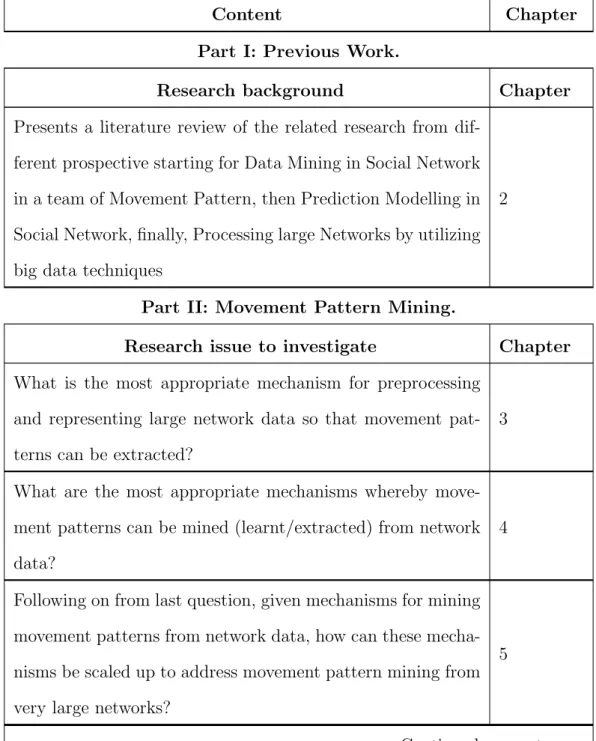
The remainder of thesis is organized into three main parts: (i) Previous work (Chapter 2), (ii) Pattern mining methods for large networks (Chapters 3, 4 and 5) and (iii) Movement pattern application mechanisms (Chapter 6).
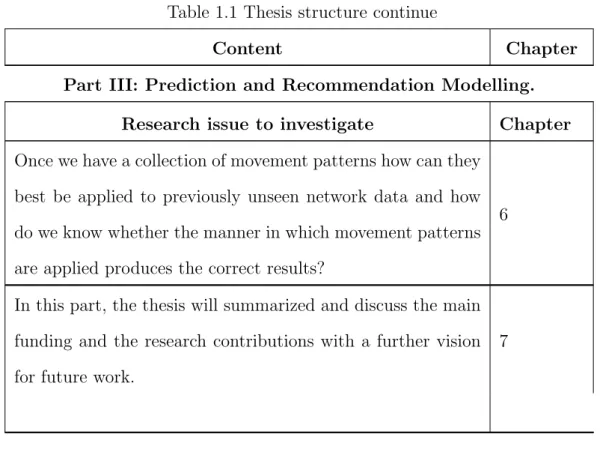
The connection between each part and the subsidiary research questions iden-tified in Section 1.3 is presented in Table 1.1. The last, Chapter 7, of the thesis provides a summary of the work presented, the main findings in relation to the research question and associated subsidiary questions identified above, and some ideas for future work.
Table 1.1: Thesis structure.
Content Chapter
Part I: Previous Work.
Research background Chapter
Presents a literature review of the related research from dif-ferent prospective starting for Data Mining in Social Network in a team of Movement Pattern, then Prediction Modelling in Social Network, finally, Processing large Networks by utilizing big data techniques
2
Part II: Movement Pattern Mining.
Research issue to investigate Chapter
What is the most appropriate mechanism for preprocessing and representing large network data so that movement pat-terns can be extracted?
3
What are the most appropriate mechanisms whereby move-ment patterns can be mined (learnt/extracted) from network data?
4
Following on from last question, given mechanisms for mining movement patterns from network data, how can these mecha-nisms be scaled up to address movement pattern mining from very large networks?
5
Table 1.1 Thesis structure continue
Content Chapter
Part III: Prediction and Recommendation Modelling.
Research issue to investigate Chapter
Once we have a collection of movement patterns how can they best be applied to previously unseen network data and how do we know whether the manner in which movement patterns are applied produces the correct results?
6
In this part, the thesis will summarized and discuss the main funding and the research contributions with a further vision for future work.
7
1.7
Published Work
The main contributions of this thesis have been published in three conference papers. These papers are itemized below.
1. Al-Zeyadi M., Coenen, F. and Lisitsa, A (2017). “Mining Frequent
Move-ment Patterns in Large Networks: A Parallel Approach Using Shapes”. In:
Bramer M. and Petridis M. (Eds), Research and Development in Intelligent Systems XXXIII, Proc. AI’2017, Springer, pp53-67. Conference paper that presented the Shape-based Movement Pattern (ShaMP) algorithm, an algo-rithm for extracting Movement Patterns (MPs) from network data that can later be used (say) for prediction purposes. The principal advantage offered
by the ShaMP algorithm is that it lends itself to parallelisation so that very large networks can be processed. The concept of MPs is fully described to-gether with the realisation of the ShaMP algorithm. The algorithm is evalu-ated by comparing its operation with a benchmark Apriori-based approach, the Apriori-based Movement Pattern (AMP) algorithm, using large social networks generated from the Cattle Tracking Systems (CTS) in operation in Great Britain (GB) and artificial networks.
2. Al-Zeyadi M., Coenen, F. and Lisitsa, A (2017). “On the mining and usage
of Movement Patterns in large traffic networks”. Proceedings of the IEEE
International Conference on Big Data and Smart Computing (BigComp), pp. 135-142. This conference paper investigated the efficiency of the ShaMP al-gorithm when implemented using Hadoop/MapReduce and Massage Passing Interface (MPI). The paper also presented a prediction mechanism whereby the identified MPs can be used to predict the nature of movement in a pre-viously unseen network.
3. Al-Zeyadi M., Coenen, F. and Lisitsa, A (2017). “User-to-User Recom-mendation using The Concept of Movement Patterns: A Study Using a
Dating Social Network”. Proceeding of the international joint conference
on knowledge discovery, knowledge engineering and knowledge management (IC3K). This conference paper makes the observation that the MP concept can equally well be applied in the context of recommender systems, more specifically recommender systems embedded into Social Networks (SNs). The idea was to conceive of a SN as a collection of vertices, each repre-senting an individual, the interchange of messages between vertices can then be considered to represent the traffic (edges) between vertices. Frequently occurring MPs can then be extracted and used to generate recommendations (to existing users and new users).
1.8
Summary
In summary, this chapter has provided an overview and background for the re-search described in the reminder of this thesis, including details concerning the motivation for the work and the research question and subsidiary questions. It has also provided a brief description of the formalism of network and movement patterns; as well as the research evaluation criteria and the contributions of the work. In the following chapter a literature review, intended to provide more de-tail regarding the background concerning the research described in this thesis, is presented.
2
Literature Review
Real-world networks often involved millions of nodes and connections between them. Given the large amounts of interconnected data available, the challenge is the extraction of useful knowledge from this data in a manner that is both efficient and effective. The work presented in this thesis considers one aspect of this chal-lenge, the extraction of patterns from this data, specifically movement patterns. This chapter provides a review of existing work in this field, and other background material, so as to contextualise the work presented later in this thesis and to pro-vide the reader with necessary background knowledge. The chapter is dipro-vided into three main sections. The first section, Section 2.1, discusses social network mining and places the idea of Movement Pattern Mining (MPM) in this context. The main motivation for the concept of movement patterns, as espoused in this thesis, is to predict future movement (traffic) in a current network, or movement in a related network. The second section, Section 2.2, therefore discusses the nature of prediction in networks, including related work on link prediction and prediction in the context of recommender systems. The third section, Section 2.3, reviews the big data and related techniques that were adopted with respect to the work presented later in this thesis, particularly the Hadoop/MapReduce and Massage Passing Interface as used in Distributed Memory Systems so as to process large data collections. The chapter is concluded with a summary in Section 2.5.
2.1
Data Mining in Social Networks
We live in the era of the big data connected the world in which virtual networks are intertwined with our daily lives. The prevalence of such networks, of all kinds, has grown dramatically. The most common examples of virtual networks include: social networks [67], computer networks [20] and Peer-to-Peer Networks [26]. An-other example of a virtual network and one used with respect to the evaluation reported on later in this thesis is social networks. However, networks can also be physical, the best examples are transportation networks (road, shipping, air, train) [36]. A specific example of a physical (transportation) network is the cat-tle movement network also used for evaluation purposes with respect to the work reported on later in this thesis.
Despite variability in semantics, the general theory of networks is the same. They share a common structure whereby entities (vertices or nodes) are linked through a specific relationship (edges or links). The entities can represent indi-viduals (as in the case of social networks), inanimate entities (as in the case of computer networks) or locations (as in the case of distribution and road traffic networks). The edges then represent some relationship between these entities. Thus a network, represented in terms of vertices (nodes) and edges (links), can be considered to be a form of a graphG(V, E) where V is the set of vertices and E is the set of edges. The total number of verticesn in a graph is thenn =|V|and the total number of edges ism =|E|. We can identify two types of edges: (i) directed and (ii) undirected. Directed edges, as the name suggests, imply a direction with respect to the relationship they represent, in other words, a direction associated with (say) the flow of information or the traffic they represent. A good example is the who-follows-whom relation found in the Twitter social network where the edge direction indicates the follower and the followee. An undirected edge does not have a specific direction associated with the relation represented. In this case,
we can think of the flow of information or traffic as being reciprocal. For example, the messages exchanged using the Facebook social media network. Such reciprocal flow can, of course, be represented by two opposing directed edges. In the case of the example networks used for evaluation purposes with respect to the work presented in this thesis the cattle movement network featured directed edges (in-dicating the sender and receiver), while the social network features undirected or, to be exact, reciprocal edges.
Coinciding with the growth in networks of all kinds, there is a corresponding desire to analyse (mine) such networks and extract valuable, but hidden, knowl-edge, from them. Network Mining (NM) is the process of representing, analysing, and extracting actionable information (such as patterns) from network data where the typically objective is with respect to some social and/or commercial gain. NM has been investigated in the context of various application domains including: (i) how law enforcement and intelligence agencies fight organized crime, such as nar-cotics and money laundering [95] and terrorism [48], and (ii) in commerce so as to increase sales of products and services by exploiting the relationship between existing and potential customers [45]. Similarly, a variety of tools and methods have been proposed to maintain, manipulate and visualise network data to support NM, and research and business network understanding. Examples of such tools include: Ctoscape [79], Gephi [15], and JUNG [69].
NM is a branch of the more general domain of Data Mining (DM). Data Mining is an important element of the current Big Data trend and encompasses a wide range of techniques for extracting useful knowledge from data, such as trends, patterns and rules [42]. The research described in this thesis is directed at the provision of a particular form of NM, directed at the extraction and usage of Movement Patterns (MPs) from network data. We refer to this as Movement Pattern Mining (MPM). The concept of MPM, as conceived of in this thesis, and to the best knowledge of the author, has not been previously addressed in
the literature. However, pattern mining, in general, has been extensively studied within the context of DM. More specifically the MPM concept has parallels with the concept of Frequent Pattern Mining (FPM) found in DM. FPM is therefore discussed in more detail in the following sub-section. The idea of MPM is then discussed further in Sub-section 2.1.2.
2.1.1
Frequent Pattern Mining
Frequent Patterns (FPs) play an important role with respect to many data mining applications [4] with the goal of discovering knowledge in the form of repeated patterns [9]. Many researchers hold the view that frequent pattern identification is a fundamental intermediate step with respect to a variety of problems [3]. FPs are of particular interest with respect to the work presented in this thesis because, as already noted above, the idea of movement patterns shares some similarities with the idea of frequent patterns.
Frequent Pattern Mining (FPM) is typically directed at Boolean (binary or zero-one) valued data. The main objective of frequent pattern mining is to discover sets of attributes that occur together frequently. The first frequent pattern mining algorithm was presented by Agrawal et al. in 1993 [6]; this was the catalyst for a wide range of follow-on research. Indeed it can be argued that the research on movement patterns considered in this thesis can be traced back to this early work on FPM.
FPM entails some frequently quoted disadvantages as follows:
1. The computation time required to generate large numbers of patterns is substantial given a large data set [9].
2. The size of the output (the frequent patterns) may be larger than the size of the input [71, 84].
3. Many of the patterns identified may not be relevant in the sense that they are sub/super sets of other patterns [4].
These are all issues which are equally valid in the context of MPM and which are returned to later in this thesis.
Movement patterns, as envisioned in this thesis, can be regarded as a special form of a frequent pattern in that, in the abstract, they can be thought of as three-part frequent patterns comprised of a “sender”, “movement” and “receiver” part. In other words, the movement patterns considered in this thesis are more prescriptive than standard FPs.
Given that the MPM concept as presented in this thesis shares similarities with the concept of FPM it was decided, within the context of the proposed research methodology, that a good benchmark MPM algorithm would be one founded on the Apriori algorithm cited above, namely the AMP algorithm pre-sented later in this thesis in Chapter 4.
2.1.2
Movement Pattern Mining
The term movement pattern is encountered in various contexts in the literature, with respect to a number of different application domains, and with differing definitions of what a movement pattern is. Of note is the usage of the term with respect to various forms of video analysis. One example is in the context of surveillance and security where the “pattern of movement” of video objects is tracked across video data; for example, with respect to people, animals, and traffic [16, 28, 34, 93]. Another application domain where the term movement pattern is
used is in the context of video event recognition [30]. A further example is with respect to simulations of animal behavior. For example in [87] what are referred to as “movement patterns” are extracted from video data and used to drive a multi-agent based simulation.
The movement patterns, as conceived of in this thesis, and as will become clearer later in the thesis, are different from the movement patterns found in video data analysis as described above. The movement patterns central to the work presented in this thesis can be thought of as network movement patterns as opposed to video movement patterns. In other words, patterns that describe how traffic or information moves (flows) round a network. To the best knowledge of the authors, there has been no previous work on movement patterns as conceived in this thesis.
2.2
Prediction Modeling in Networks
As noted earlier, the motivation for the MPM idea is to use such patterns to pre-dict movements in future renditions of the same network to that from which the patterns were mined, or on closely related networks. There is existing reported work on prediction in the context networks. Popular examples include: (i) the prediction of disease spread in a human contact networks using metrics such as the degree of distribution, clustering and path length [8], (ii) prediction in the context of best viral marketing strategies by identifying “networks of influencers” [77], (iii) link prediction of various kinds [63] and (iv) the building of effective recommendation systems based on vector and edge weightings in dating networks [104]. All four examples, in one form or another, are potential applications for the work on MPs presented in this thesis. The last two are considered as exem-plar applications with respect to the work presented in this thesis and thus are
considered in further detail below (Sub-sections 2.2.1 and 2.2.2).
2.2.1
Link Prediction in Networks
Link Prediction (LP) can be define as the process of predicting links between pairs of vertices in a graph [17]. LP has recently received increased attention in both the physical and computer science communities. The idea is, given a new vertex x, to predict the existing vertices to which a new vertex will be linked. The idea of LP has some overlap with the problem of inferring missing links in incomplete graphs [46]. The goal of LP can be related to one of the applications which motivated the work on MPM and at which the MPM concept is directed; although the MPM concept is not just directed at whether a link exists, but also at the nature of the link. A further distinction between the work on LP and missing link resolution, and the work presented in this thesis, is that the first two are typically conducted according to graph structure, dynamic in the case of link prediction [17] and static in the case of missing link resolution [46], rather than using the concept of MPs. Whatever the case, because of the similarity with respect to the desired end goal of the proposed MPM, LP is discussed in some further detail in this subsection.
According to the survey conducted by the athores in [63] LP algorithms can be categorised as follows:
• Similarity Based Algorithms: LP algorithms in this category are the simplest and founded on the idea of a similarity score, Sxy, where x is a new vertex andy is an existing vertex, according to the linked node pairings that already exist in a given network [56, 63]. If the similarity score is high then a link is suggested. Many algorithm have been proposed that adopt this approach. There are many variations of the basic similarity based link prediction algorithm which can be classified into three groups according to
the nature of the similarity indices: (i) Local Similarity Indices, (ii) Global Similarity Indices and (iii) Quasi-Local Indices. Examples of the first in-clude: (i) Common Neighbours (CN) [25], (ii) Salton Index [24], Jaccard Index [64], (iii) SrensenIndex [59], (iv) Hub Promoted Index [17], (v) Hub Depressed Index [63], (vi) Leicht Holme Newman Index [53], (vii) Preferen-tial Attachment Index [66], (viii) Adamic Adar Index [1],(ix)Leicht-Holme-Newman Index [53] and (x) Resource Allocation Index [62]. Examples of the second include: (i) Katz Index [44], (ii) Leicht Holme Newman Index [53], (iii) Average Commute Time [31], (iv) Cosine based on L+ [31], (v)Random Walk with Restart [85], (vi) SimRank [41] and (vii) Matrix Forest Index [21]; while examples of the third include: (i) Local Path Index [61, 105], (ii) Local Random Walk [61] and (iii) Superposed Random Walk [60].
• Maximum Likelihood Methods: The algorithms in this category, instead of using some form of indexing, consider the organisation and structure of a given network expressed in terms of rules and parameters, which are then used to indicate the likelihood of a link with respect to a new node [78]. A disadvantage of the Maximum Likelihood approach is that it tends to be very time consuming and thus not applicable to Big Networks [63].
• Probabilistic Models: In this last category, the prediction of missing links is conducted by abstracting the underling structure from a given network so that a model is learned. A variety of models have been proposed, but from the literature the following three main models can be identified [63]: (i) the Probabilistic Relational Model [32], (ii) the Probabilistic Entity Relationship Model [40] and (iii) the Stochastic Relational Model [99].
The proposed MP approach, bearing in mind that we are not only interested simply in link prediction but also in the nature of the predicted links, does not fit well into any of these categories. The last category, the Probabilistic Model
category, is arguably the most suited. The idea is to use identified MPs to predict the traffic (movement) in future incarnations of a given network, or closely related networks. More specifically, in the context of the cattle movement prediction scenario considered as an exemplar application in this thesis.
2.2.2
Recommendation in Network
Recommender systems are used extensively in the retail sector to recommend po-tential purchases (products and services) to customers. They operate by process-ing previous customer purchase data to make recommendations. Recommender systems have been found to provide a significant impact with respect to improv-ing user satisfaction in online retail settimprov-ings [82, 90]. Broadly, recommendation systems can be categorised as being either: (i) Item-to-Item or (ii) User-to-User. The main difference is that User-to-User recommendation systems need to make reciprocal recommendations while Item-to-Item systems do not; User-to-User rec-ommendation system needs to satisfy both parties [72]. Well known examples of Item-to-Item recommendation systems are those embedded in Amazon, Netflix and Spotify [7, 58]; we are all familiar with the “users who bought X also bought Y” mantra. Well known examples of User-to-User recommendation systems are those embedded in Facebook and Linkedin; the “people you might know” mantra! Another example application domain and that of interest with respect to this thesis, where User-to-User recommendation features, is Dating Social Networks (DSNs).
DSNs have become an important platform for people looking for potential partners online. In a large dating network, finding potential partners is time consuming, therefore many DSNs give compatible partner suggestions; in the same manner as more general recommender systems, see for example [76]. Developing a recommender system for a DSN is more challenging because the recommender
system must satisfy the preferences of pairs of users [73] as opposed to single users; DSN recommender systems thus fall into the User-to-User categorisation of recommender systems. Later in this thesis, to illustrate the utility of the MPM concept, a dating recommendation system is proposed that can be embedded into DSNs. The idea is to conceive of a DSN as a collection of vertices, each representing an individual, and the interchange of messages between vertices as representing the traffic (edges) between vertices. Frequently occurring MPs can then be extracted and used to generate recommendations (to existing users and new users).
There has been much work directed at DSN recommendation. Of key concern is the quality of the recommended matches; poor quality matching will result in people looking elsewhere. The context of matching is typically done using either: (i) user profiles, (ii) expressed preferences or (iii) user behaviour. For example, in [50] the authors propose a way of modelling both the duality of user simi-larity to each other and preferences towards other users, by using split-complex numbers. The authors demonstrated firstly that their unified representation was capable of modelling both notions of relations between users in a joint expression and secondly that their system could be applied in the context of recommending potential partners. In [94] the authors introduced a recommendation system that made use of profiles and references and provided a list of recommendations that a user might be compatible with by computing a reciprocal score that measured the compatibility between a user and each potential dating candidate. In [86], the authors proposed a DSN recommendation framework founded on a Latent Dirichlet Allocation (LDA) model that learns user preferences from observed user messaging behaviour and user profile features. Whatever the case, the majority of User-to-User DSN recommendation systems are founded on (graph based) Col-laborative Filtering (CF) algorithms [49, 86] that focuses on user behaviour. The intuition is that user behaviour is a much better indicator for recommendations than user profiles or expressed preferences [49]. Examples, where CF filtering has
been used in the context of DSNs, can be found in [19, 51]. Given the popularity, and claimed benefits, of the CF approach this is the approach with which the proposed MP based RecoMP algorithm is compared later in this thesis. For the purpose of the evaluation the authors developed a bespoke CF based DSN recom-mendation algorithm called RecoCF, this is described in further detail in Chapter 6. The distinguishing feature between the above DSN recommender systems and the RecoMP based system proposed in this thesis is the MP concept. To the best of the author’s knowledge, there has been no work directed at user-to-user recommendation using MPs as presented in this thesis.
2.3
Processing Large Networks
As mentioned earlier, one of the research issues considered in this thesis is how to process large networks (in terms of both vertices and edges). In general, the challenges of processing large networks is two-fold. Firstly, network sizes have increased exponentially comparing to the available memory of a single computer. Secondly, the computation time required to process a given large network has also dramatically increased. The essential key tool for addressing these two challenges is “computational parallelism”, where multiple computer resources are used si-multaneously to solve a specific computational problem [14]. Processing large networks by applying computational parallelism tools offer two advantages. First, operations on a given large network become computationally tractable whereas it would not be possible to apply the same operations on a single machine. Second, computational parallelism gives an enormous speed up opportunities. Therefore, computational parallelism is seen as a key technology for addressing the two chal-lenges identified above. The usage of such tools in the context of MPM, is reported on later in this thesis. This section, therefore, presents two mechanisms whereby
computational parallelism can be achieved. Namely, the Shared Memory mecha-nism as used with respect to OpenMP and the Distributed Memory mechamecha-nism as used with respect to (i) Massage Pass Interface (MPI) and (ii) Hadoop/MapRe-duce. The objective of this section is thus to provide the reader with some neces-sary background concerning these approaches so that material presented later in the thesis can be readily understood.
The remainder of this section is organised as follows. The generic challenges of parallel algorithm design are considered in Sub-section 2.3.1, the principle of shared memory systems is discussed in Sub-section 2.3.2 with a focus on OpenMP as an example of a particular API to support the idea of shared memory system. The principle of distributed memory systems is then discussed in Sub-section 2.3.3 with a focus on two particular APIs to support the idea of Distributed Memory Systems, namely: the Message Passing Interface (MPI) API (Sub-section 2.3.4) and MapReduce coupled with Haddoop (Sub-section 2.3.5). The relevance of these APIs, is that these were adopted with respect to work presented later in the thesis.
2.3.1
Challenges of Parallel Algorithm Design
The design of a parallel algorithm involves a number of challenges, in addition to those associated with the design of more standard serial algorithms, namely: memory scalability, work partitioning, and load balancing. Memory scalability is fundamental when working with Big Data. However, as the number of processes increases, the memory required by each process decreases as indicated by the following Scalability Equation [9]:
Θ n p +O(p) (2.1)
where: (i)n is the size of input dataset, (ii) pis the number of processes executed in parallel and (iii) BigO and Θ are symbols used in complexity theory, computer science and mathematics, to describe the asymptotic behaviour of functions (they indicate how fast a function grows or declines). Also by defination, any fucation
f(x) isO(g)x)) if some constantc×g(x) is greater than or equal tof(x);|f(x)| ≤
c|g(x)| while x > k. Whereas a fucation f(x) is Θ(g(x)) if some constant c1 ×
g(x) is less than or equal to f(x) and some constant c2 × g(x) is greater than or
equal f(x);c1.|g(x)|6|f(x)|6c2.|g(x)|while x > k.
In the case of the movement patterns of interest with respect to this thesis, the real challenge is the distribution of the data and the data mining task across the available processes. Data partitioning has to be undertaken in such way that the data is distributed equally in manageable chunks. Work partitioning is concerned with dividing a given problem (the data mining task) into a set of independent tasks, where each task addresses part of the problem. Ideally, all tasks should be executed concurrently and thus they need to be independent. There are two fundamental data partitioning models that can be adapted: the shared memory model and the distributed memory model. Each is discussed in further detail in the following two sub-sections.
2.3.2
Principles of Share Memory Systems
A Shared Memory System is a Memory Model in which a single memory space is shared by all processes. The shared memory model is fast becoming a key model for designing parallel algorithms due to the increase in multi-core workstations. An issue with shared memory systems is when two processes attempted to write to the same memory location at the same time thus resulting in what is called a
race condition. Also, there can be delay when a process running on one physical
the context of this thesis the shared memory concept has been implemented using Omp4j1; which is an open-source OpenMP preprocessor for Java that provides
high scalability.
2.3.3
Principles of Distributed Memory Systems
A Distributed Memory System (DMS) consists of multiple independent processing units where each process has an associated local memory space and all processes are connected by a general interconnected network. The nature of DMS makes large computing processing possible. However, communication between processing nodes requires a message-passing model that entails explicit use of send/receive primitives [74]. There are several APIs that may be used in the context of DMS. However, in the context of this thesis, two widely used DMS have been used
Message Passing andHadoop/MapReduce. These are therefore further considered
in the following two sub-sections.
2.3.4
Message Passing
Message Passing is a distribute programming API that provides (at a minimum) a send and a receive functions. Processes typically identify each other by “ranks” in the range 0,1, . . . ,p−1, wherepis the number of processes [18]. Massage Passing is a very powerful and versatile form of API for developing parallel programs. there are a number of Message Passing implementations, but typical such APIs also provide a wide variety of additional functions. For example, there may be functions for various “collective” communications, such as “broadcast” or “reduction” [18]. The most widely used Message Passing API is the Message Passing Interface (MPI) which defines a library of functions that can be called from C, C++, Fortran and
Java programs to create parallel programs. There are several well-tested and efficient implementations of MPI, including some that are free or in the public domain; examples include: MPICH [38], MPICH-G2cite [43] and G-JavaMPI[22]. However, in the context of the research presented in this thesis MPJ Express has been used; this is an implementation of MPI in the Java programming language [12]. MPJ has two ways of configuring the same code; Multicore configuration and Cluster configuration. In the context of the work presented later in the thesis both the Multicore configuration (using a single multicore machine) and Cluster configuration (using a Linux cluster) are considered.
2.3.5
Hadoop/MapReduce
MapReduce is a programming model for processing large datasets, introduced by Google, to support distributed computing [27]. Hadoop [91] is an open source implementation of the MapReduce architecture that allows for the distributed processing of large data sets across a cluster of computers. At a high level, the MapReduce architecture comprises a master node and a number of worker nodes as shown in Figure 2.1. The master node is responsible for assigning scheduled tasks for execution by the worker nodes. To design an algorithm using MapReduce the user needs to create both a Map and a Reduce functions; the main computation functions in a MapReduce framework. When a MapReduce “job” is initialized, the master node first calls a “map” function; a function to filter, sort and produce a set of intermediate key/value pairs (such as sorting students by first name into queues, one queue for each name). And then schedules a set of “reduce” tasks that perform a summary operation by aggregate the values associated with keys (such as counting the number of students in each queue, yielding name frequencies). The significant benefit of MapReduce is to allow the processing of large datasets that can not fit into the memory associated with a single process. This is done
by loading the data file to be processed into a distributed file system whereby the data is divided into small chunks or blocks. Figure 2.1 shows the flow of job executing using Hadoop/MapReduce, once the data has been uploaded into the Hadoop Distributed File System (HDFS) [29], the map function reads, in parallel, all the blocks in the file system and produces a set of intermediate key/value pairs. To this end, the MapReduce library collects all intermediate values related to the same intermediate key produced by the Map function and sends them to the reduce function for further processing.
Figure 2.1: The Hadoop/MapReduce job execution flow.[27]
Given the above, MapReduce offers a number advantages:
1. Users are free from manually distributing the data across cluster machines because MapReduce does this automatically.
2. Since the MapReduce library is designed to help process very large amounts of data using hundreds or thousands of machines, the library tolerates ma-chine failures “gracefully”.
3. Total “throughput” is enhanced by re-assigning unfinished tasks of slower nodes to idle nodes (assuming a heterogeneous cluster).
The development of Hadoop/MapReduce have motivated many data mining re-searchers to improve the efficiency of existing data mining algorithms. For ex-ample in the case of Frequent Pattern Mining (see following section), which has similarities with the MPM proposed in this thesis, examples can be found in [29, 57, 68, 81, 97, 98].
2.4
Frequent Pattern Mining using Parallel and
Distributed Algorithms
This section discusses recent research on Frequent Pattern Mining (FPM) based on the parallel computing concept. In [13, 89] the efficiency of FPM was improved by utilizing multi-core CPUs. In [98] the authors proposed an improvement on the Apriori algorithm based on Hadoop/MapReduce. Even though the proposed method used state-of-the-art parallel computing, like any other apriori-based al-gorithms, it suffered from a large number of candidates being produced which led to an increase in the number of times that the database of interest needed to be scanned. The well known FP-growth FPM algorithm was parallaized using the MapReduce architecture in [54], the proposed Parallel FP-growth algorithm (the PFP algorithm) was founded on the idea of dividing the dataset into sub-sets so that the tasks can be distributed between computing nodes independently. However, the PFP algorithm was unable to cope with big data because of the large number of data transmissions between computing nodes. The authors in [92] proposed an Improved Parallel FP-growth (IPFP) based on Hadoop/MapReduce. IPFP demonstrated a better efficacy compared to PFP, but IPFP also suffered from network transmission problems with big data.
The authors in [68] introduced two algorithms: Dist-Eclat based on the Eclat algorithm [101] and BigFIM based on Apriori [6]. The proposed algorithms both
used Hadoop/Mapreduce technology to implement FPM over a large dataset. The Dist-Eclat algorithm focused on performance by using a simple load balancing scheme, while the BigFIM algorithm focused on running large datasets. During the process, DisEclat generated Tid-Lists; however, when the dataset to be processed is too large the generated Tid-Lists would override the memory size. Therefore, BigFIM, based on a hybrid method of Apriori and Eclat, was proposed to solve the issue of memory overriding. BigFIM operated using a three step process. During the first step, BigFIM used an Apriori-based method to extract frequent itemsets of length k. After computing the k−pref ixes, the second step was to compute the possible extensions. During the last step, BigFIM switched to Eclat, and then utilizes “diff set” operations to mine the subtrees from which frequent itemsets are generated in a depth-first manner. With respect to the performance, and compared to [54], the proposed two algorithms were faster. However, BigFIM still had a memory shortage problem and high communication costs with poor computing performance.
The authors in [55] proposed Sequence-Growth, a distributed FIM algorithm, based on Hadoop/MapReduce technology. The algorithm constructs a tree, us-ing lexicographical orderus-ing, to implement FPM without requirus-ing an exhaustive search of the databases. The algorithm is able to process up to 20 Million trans-actions within 24000 seconds of runtime.
In [96] the authors proposed a new approach (FiDoop-DP) for mining frequent patterns in large transaction datasets based on the Parallel FP-Growth Algorithm discussed in [54] and a novel data partitioning scheme. The proposed approach showed significant performance improvement in the runtime over the existing Par-allel FP-Growth Algorithm by up to 31% with an average of 18%. The FiDoop-DP approach, focussed on distributing a large dataset across data nodes in a Hadoop cluster by partition transactions with high similarity together, and grouping highly correlated frequent items into a list.
The MPM parallel computation algorithms presented in this thesis are, in part, influenced by the previous work, described above, on parallel computation in the context of FPM.
2.5
Summary and Conclusions
This chapter has provided a review of the existing work relevant to this thesis and has provided details concerning the distributed systems technology referred to later in the work. More specifically this chapter has reviewed some previous work on network mining and data mining. In the context of the later, work on frequent pattern mining was considered in some detail because of its similarity with the proposed MPM. Previous work on link prediction and recommender sys-tems was also considered because these are applications similar to those addressed later in this thesis. To provide a fuller understanding of the MPM approaches using distributed memory systems, also presented later in the thesis background information concerning well known parallel approaches was also presented, namely Shared/Distributed Memory Systems and Hadopp/MapReduce. In the next chap-ter, Chapter 3, the evaluation data sets referenced later in the thesis are considered in detail.
3
Evaluation Data
The idea of networks have become widespread since the rapid development of Web 2.0 [10] which has facilitated, amongst other things, the concept of social networks. Well, known examples include Facebook, Twiter, and Linkedln, where users are encouraged to link to friends, followers, and contacts to form a “social network” through direct and indirect connections to others. From a sociological perspective, the term social network has a much broader meaning beyond digital and online networks to include physical social networks representing face-to-face relationships, political associations and connections, and even co-authoring net-works across academic communities. However, netnet-works do not necessarily have to be social networks, the concept can be extended further to: computer networks; distribution networks; road, rail, and air travel networks; and so on. The work presented in the thesis considers networks in the terms of this widest possible context.
This chapter describes the particular network datasets used to drive the work presented in the thesis and consequently used for evaluating the Movement Pattern Mining (MPM) and application algorithms developed. A formalism defining the networks considered in this thesis is presented in Section 3.1. The datasets used with respect to the work presented in the thesis were drawn from three sources: (i) the GB Cattle Tracking System (CTS) operated by the UK Department for
Environment, Food and Rural Affairs (DEFRA), (ii) the Chinese Jiayuan Social Network and (iii) a synthetic data generator. The first was selected because of its size and because it represented an interesting application domain entailing networks different to the social network studies that featured in much previous work on network analysis. The second was selected because it represented a more “traditional” kind of social network. Both data sets represented real examples of networks where the movement pattern concept could offer genuine benefits. The third source was used to generate artificial network data sets where the parameters could be controlled and hence the effect of changes to these parameters, with respect to the proposed algorithms, could be analysed (not possible with the real data sets). These three data sources are considered in further detail in Sections 3.2, 3.3 and 3.4 below. The chapter is concluded with a summary in Section 3.5.
3.1
Network Formalism
Regardless of the precise nature of a network, the networks considered in this thesis adhere to the formalism presented in this section. Any given network G
is defined in terms of a tuple of the form hV, Ei, where V is a set of vertices and E is a set of edges [33]. The vertices can represent individuals (as in the case of the Jiayuan Social Network), inanimate entities (as in the case of, say, computer networks) or locations (as in the case of CTS networks). The edges then indicate connections between vertices (virtual or actual). These edges might be indicative of some relationship, such as a friend relationship, as in the case of social networks; or a “hard” connection as in the case of a wired computer network or a road traffic network. In this thesis the way that edges are conceived includes the potential for them to have attributes of some kind; for example: (i) the number of messages sent from one individual to another in a social network, (ii) the volume of data exchanges between two computers in a computer network,
(iii) the quantity of goods sent in a distribution network or (iv) the amount of traffic flow from one location to another in a road traffic network. As such edges are directed (not necessarily the case in other forms of network), consequently vertices can be “sender” (from) vertices or “receiver” (to) vertices. In many cases, vertices will be both senders and receivers. Thus the set of (from) vertices and the set of (to) vertices are not necessarily disjoint; vertices can represent senders and receivers simultaneously.
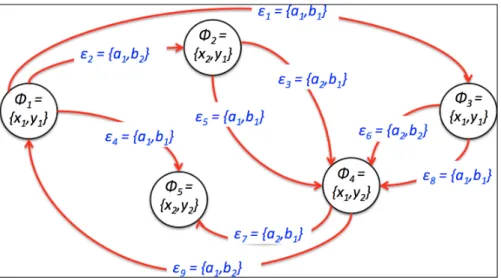
Figure 3.1: Example network (V ={φ1, φ2, . . . , φ5}and E ={1, 2, . . . , 9}).
An example network is given in Figure 3.1 where V = {φ1, φ2, . . . , φ5} and
E ={1, 2, . . . , 9}. Note that some of the vertices featured are both sender (from)
and receiver (to) vertices. Note also that some vertices in the figure are connected by more than one edge. This may simply indicate traffic flow in both directions as in the case the Jiayuan Social Network or it may indicate different types of traffic flow. The work presented in this thesis is not just concerned with traffic flow in a binary context (whether it exists or does not exist), but also in terms of the nature of the traffic flow. Thus where vertices in the figure are connected by more than one edge this might indicate different kinds of traffic flow. For example, in a distribution network, two edges connecting one vertex to another might indicate the dispatch of two different commodities.
Thus, from the foregoing, edges and vertices have sets of attributes associated with them,AE andAV respectively. The nature of these attribute sets will depend on the application domain, however, each attribute (where it exists) will have two or more values associated with it; if an attribute has only one value it will be a constant and thus not play any part in any form of MPM. Where necessary, in the remainder of this thesis, we will indicate a particular valuej belonging to attribute
i using the notationvij.
Given a network dataset of some form, the idea was to represent this in a canonical manner. The selected formalism was in terms of “From-Edge-To” tuples, hF, E, Ti, where F and T comprise attribute values associated with the set AV, and E comprises attribute values associated with the set AE. We refer to such tuples as “FETs”, from the acronym FET (From-Edge-To). A network D
thus comprises a set of fets {F1, F2, . . .}. We refer to such a database as a “FET
database”.
3.2
GB Cattle Tracking System (CTS) Database
The GB Cattle Tracking System (CTS) database records all the movements of cattle registered within or imported into Great Britain (GB). The database is administered by the Department for Environment, Food, Rural Affairs (DEFRA). The CTS database comprises a number of tables, the most significant of which are the animal, location and movement tables.
Each record in the CTS database describes the transportation of a single animal in terms of: (i) the nature of the animal being transported (bread, gender, dairy or beef, and so on), (ii) the sender location and (iii) the receiver location. The locations represent “holding areas” such as farms, markets, and slaughterhouses. Holding areas are identified by an ID number and geographic Cartesian coordinates
![Figure 2.1: The Hadoop/MapReduce job execution flow.[27]](https://thumb-us.123doks.com/thumbv2/123dok_us/9319079.2810506/41.893.272.654.443.740/figure-the-hadoop-mapreduce-job-execution-flow.webp)