04 August 2020
Repository ISTITUZIONALE
Automated Knowledge Base Quality Assessment and Validation based on Evolution Analysis / Rashid, MOHAMMAD RIFAT AHMMAD. - (2018 Sep 24).
Original
Automated Knowledge Base Quality Assessment and Validation based on Evolution Analysis
Publisher:
Published
DOI:10.6092/polito/porto/2713858 Terms of use:
Altro tipo di accesso
Publisher copyright
(Article begins on next page)
This article is made available under terms and conditions as specified in the corresponding bibliographic description in the repository
Availability:
This version is available at: 11583/2713858 since: 2018-09-25T12:14:53Z Politecnico di Torino
Doctoral Dissertation
Doctoral Program in Energy Engineering (30thcycle)
Automated Knowledge Base Quality
Assessment and Validation based on
Evolution Analysis
By
Mohammad Rifat Ahmmad Rashid
******Supervisor(s): Prof. Marco Torchiano Doctoral Examination Committee:
Prof. Mario Piattini, Referee, Universidad de Castilla-La Mancha, Spain Dr. Anastasia Dimou, Referee, RUG - Universiteit Gent, Belgium Dr. Giuseppe Rizzo, Istituto Superiore Mario Boella, Italy
Prof. Fulvio Corno, Politecnico di Torino, Italy Prof. Maurizio Morisio, Politecnico di Torino, Italy
Politecnico di Torino 2018
I hereby declare that, the contents and organization of this dissertation constitute my own original work and does not compromise in any way the rights of third parties, including those relating to the security of personal data.
Mohammad Rifat Ahmmad Rashid 2018
* This dissertation is presented in partial fulfillment of the requirements forPh.D. degreein the Graduate School of Politecnico di Torino (ScuDo).
I would like to dedicate this thesis to my loving parents and my sister Farhana Rashid for being my source of motivation and inspiration. I could not have asked for
better sister.
With this thesis, my Ph.D. journey is reaching the end. I would like to thank all of the people who contributed in some way during this journey. First and foremost, I would like to thank my supervisor Prof. Marco Torchiano for his support and confidence in me. I am grateful for all the support and the valuable discussions and advices, and the chance to deal with situations which I though beyond my capabilities at the time. Then, I would like to thank my advisor, Dr. Giuseppe Rizzo, your open mind, pragmatism, and valuable feedback helped me to grow both intellectually and personally.
I am also grateful to Prof. Maurizio Morisio for his availability and for sharing his experience. I also appreciated the precious help in technical subjects and the hints to deal with the bureaucratic issues received by Luca Ardito.
I would like to express sincere gratitude to all the colleagues of the SoftEng group. First of all, thanks to Cristhian Figueroa, Iacopo Vagliano, and Oscar Ro-driguez for the encouragement and suggestions that motivated me a lot in these years. Indeed, I would like to mention all the mates who made the atmosphere in the Lab 1 more pleasant: Erion Çano, Riccardo Coppola, Diego Monti, Francesco Strada, Amirhosein Toosi and Alysson Dos Santos. A very special thanks to Diego Monti for his help during my thesis writing and the bureaucratic procedures.
An outstanding experience was the research visiting at the Universidad Politéc-nica de Madrid, in Spain. I would like to thank all the colleagues of the Ontology Engineering Group, in particular, Prof Oscar Corcho, who supervised me, Nanadan Mihindukulasooriya for the useful discussions, and for the results reached through our joint effort.
Also, I would like to thank TIM (formerly Telecom Italia) for granting me the scholarship, without which pursuing a PhD would be more difficult. I express my
v
gratitude to Marco Marengo and JOL Mobile team for cooperative work conducted together.
Most importantly, thank you to my mother, father, and sisters. Thank you for teaching me the real values of life. Specially thanks to my sister Farhana Rashid for your unconditional support. I have never known a day apart from your love, and that is a priceless gift to me. I hope my life and my choices have honored you.
In recent years, numerous efforts have been put towards sharing Knowledge Bases (KB) in the Linked Open Data (LOD) cloud. These KBs are being used for various tasks, including performing data analytics or building question answering systems. Such KBs evolve continuously: their data (instances) and schemas can be updated, extended, revised and refactored. However, unlike in more controlled types of knowl-edge bases, the evolution of KBs exposed in the LOD cloud is usually unrestrained, what may cause data to suffer from a variety of quality issues, both at a semantic level and at a pragmatic level. This situation affects negatively data stakeholders – consumers, curators, etc. –. Data quality is commonly related to the perception of thefitness for use, for a certain application or use case. Therefore, ensuring the quality of the data of a knowledge base that evolves is vital. Since data is derived from autonomous, evolving, and increasingly large data providers, it is impractical to do manual data curation, and at the same time, it is very challenging to do a continuous automatic assessment of data quality. Ensuring the quality of a KB is a non-trivial task since they are based on a combination of structured information supported by models, ontologies, and vocabularies, as well as queryable endpoints, links, and mappings. Thus, in this thesis, we explored two main areas in assessing KB quality: (i) quality assessment using KB evolution analysis, and (ii) validation using machine learning models.
The evolution of a KB can be analyzed using fine-grained “change” detection at low-level or using “dynamics” of a dataset at high-level. In this thesis we present a novel knowledge base quality assessment approach using evolution analysis. The proposed approach uses data profiling on consecutive knowledge base releases to compute quality measures that allow detecting quality issues. However, the first step in building the quality assessment approach was to identify the quality characteristics. Using high-level change detection as measurement functions, in this thesis we present four quality characteristics: Persistency, Historical Persistency, Consistency,
vii
and Completeness. Persistency and historical persistency measures concern the degree of changes and lifespan of any entity type. Consistency and completeness measures identify properties with incomplete information and contradictory facts. The approach has been assessed both quantitatively and qualitatively on a series of releases from two knowledge bases, eleven releases of DBpedia and eight releases of 3cixty Nice.
However, high-level changes, being coarse-grained, cannot capture all possible quality issues. In this context, we present a validation strategy whose rationale is twofold. First, using manual validation from qualitative analysis to identify causes of quality issues. Then, use RDF data profiling information to generate integrity constraints. The validation approach relies on the idea of inducing RDF shape by exploiting SHACL constraint components. In particular, this approach will learn, what are the integrity constraints that can be applied to a large KB by instructing a process of statistical analysis, which is followed by a learning model. We illustrate the performance of our validation approach by using five learning models over three sub-tasks, namely minimum cardinality, maximum cardinality and range constraint.
The techniques of quality assessment and validation developed during this work are automatic and can be applied to different knowledge bases independently of the domain. Furthermore, the measures are based on simple statistical operations that make the solution both flexible and scalable.
Contents
List of Figures xii
List of Tables xiv
1 Introduction 1
1.1 Problem statement . . . 3
1.1.1 Identification of quality issues for evolving KBs . . . 3
1.1.2 Identification of logical or formal contradiction . . . 5
1.2 Research Questions and Contributions . . . 6
1.2.1 KB evolution-based quality assessment . . . 6
1.2.2 Validation approaches leveraging on quality characteristics and integrity constraints. . . 8
1.3 Thesis structure . . . 9
2 Background 11 2.1 Resource Description Framework (RDF) . . . 12
2.2 RDF Related Core Technologies . . . 13
2.3 Shapes Constraint Language (SHACL) . . . 15
2.4 Knowledge Bases and Their Evolution . . . 18
2.4.1 Use Cases: 3cixty and DBpedia . . . 19
Contents ix
2.5 Data Quality Standards . . . 22
2.6 Data Quality Issues in Evolving KB . . . 24
2.7 Gold Standard Creation . . . 28
2.8 Learning Models . . . 29
3 State of the Art 31 3.1 Linked Data Dynamics . . . 31
3.2 Knowledge Base Quality Assessment . . . 33
3.3 Knowledge Base Validation . . . 38
3.4 Summary . . . 41
4 Evolution Analysis and Quality Characteristics 43 4.1 Evolution Analysis . . . 43
4.2 Dynamic Features . . . 44
4.3 Evolution-based Quality Characteristics and Measures . . . 45
4.3.1 Basic Measure Elements . . . 46
4.3.2 Persistency . . . 48 4.3.3 Historical Persistency . . . 48 4.3.4 Consistency . . . 49 4.3.5 Completeness . . . 51 4.4 Summary . . . 52 5 RDF Shape Induction 53 5.1 SHACL Constraints Components and Shape Induction . . . 55
5.1.1 Cardinality constraints . . . 57
5.1.2 Range constraints . . . 59
5.1.3 String based constraints . . . 60
6 Evolution-based Quality Assessment and Validation Approach 63
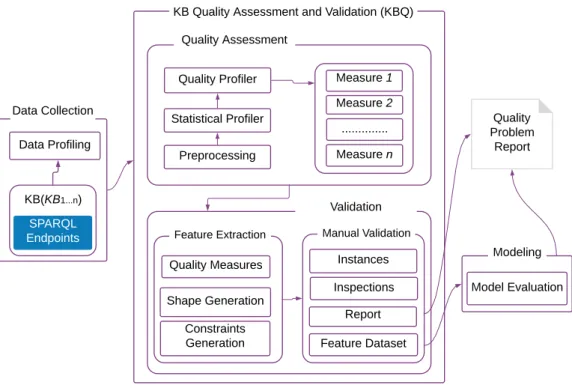
6.1 Data Collection . . . 65
6.2 Quality Evaluation . . . 66
6.3 Validation Process . . . 68
6.3.1 Feature Extraction . . . 68
6.3.2 Manual Validation and Gold Standard Creation . . . 70
6.4 Modeling and Quality Problem Report . . . 71
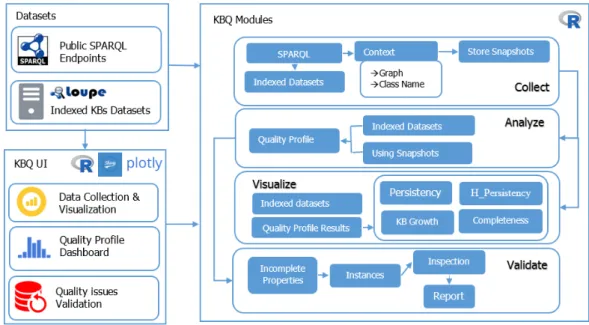
6.5 KBQ : A proof-of-concept . . . 72 6.6 Summary . . . 74 7 Experimental Results 75 7.1 Experimental Settings . . . 75 7.2 Quantitative Analysis . . . 78 7.2.1 Persistency . . . 78 7.2.2 Historical Persistency . . . 83 7.2.3 Consistency . . . 84 7.2.4 Completeness . . . 87
7.3 Qualitative Analysis using Manual Validation . . . 92
7.3.1 Persistency & Historical Persistency . . . 94
7.3.2 Consistency . . . 96
7.3.3 Completeness . . . 97
7.4 Validation using Integrity Constraints . . . 100
7.4.1 Feature Extraction . . . 100
7.4.2 Model Preparation . . . 105
7.4.3 Model Evaluation . . . 109
Contents xi
8.1 Evolution Analysis to Drive Quality Assessment . . . 111
8.2 Modeling Performance . . . 114
8.3 Frequency of Knowledge Base Changes . . . 115
8.4 Quality Assessment of Literal Values . . . 116
8.5 Lifespan Analysis of Evolving KBs . . . 117
8.6 Limitations . . . 121
9 Conclusions and Future Work 123 9.1 Summary of Contributions . . . 124
9.2 Future Work . . . 127
References 130
Appendix A User Interfaces for the KBQ Tool and Data Extraction REST
APIs 140
List of Figures
1.1 The process flow of our data-driven procedure for quality assessment
and validation. . . 9
1.2 Overview of the thesis structure. . . 10
2.1 Use cases of Knowledge Base evolution. . . 21
2.2 Example of inconsistent Wikipedia data (December 2016). . . 25
2.3 Example of incomplete Wikipedia data (December 2016). . . 26
2.4 Example of a 3cixty Nice KB resource that unexpectedly disappeared from the release of 2016-06-15 to the other 2016-09-09. . . 27
5.1 Workflow of profiling based RDF Shape induction. . . 56
6.1 ISO/IEC 25024 Data Life Cycle (DLC) [1] with proposed quality assessment approach. The box highlight the components that are added as improvements to the DLC. . . 64
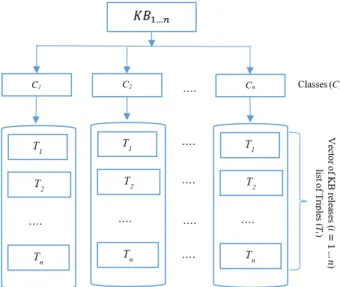
6.2 Proposed Quality Assessment and Validation Workflow. . . 65
6.3 Intermediary data structure that is used as input for the Evaluation Process. . . 66
6.4 High level architecture of the KBQ tool. . . 72
7.1 Structure of input module. . . 76
7.2 Variation of instances of 3cixty classeslode:Event and dul:Place over 8 releases. . . 80
List of Figures xiii
7.3 3cixty KB lode:Event class 50 snapshots of entity count. . . 81
7.4 DBpedia 10 Classes instance variation over 11 releases. . . 84
7.5 DBpediafoaf:Personclass property frequencies distribution. . . 85
7.6 3cixtylode:Eventcompleteness measure results . . . 87
7.7 3cixtydul:Placecompleteness measure results . . . 89
7.8 foaf:Personclassdbo:titleproperty string length box plot. . . 106
8.1 Summary of the main results of the Quality Assessment and Valida-tion Approach. . . 112
8.2 3cixty two classes KB growth measure . . . 119
8.3 DBpedia 10 classes KB growth measure . . . 121
A.1 Home page of the KBQ-Tool. . . 141
A.2 Example of inconsistent Wikipedia data. . . 142
A.3 Scheduler Architecture. . . 143
List of Tables
1.1 Summary of the two analysis type features. . . 3
2.1 Common Prefixes used over the thesis. . . 12
2.2 Integrity constraints components from the SHACL presentation. . . 18
2.3 Statistics of the English DBpedia KB updates on the three releases of 201504, 201510 and 201604. . . 21
2.4 Measurement terminology . . . 23
3.1 Summary of Linked Data Quality Assessment Approaches. . . 39
4.1 Quality characteristics with corresponding quality dimensions and dynamic features. . . 46
4.2 Categories of change behaviour. . . 47
5.1 Minimum and maximum cardinality levels. . . 58
5.2 Objects Type. . . 60
5.3 Minimum and maximum String length levels. . . 61
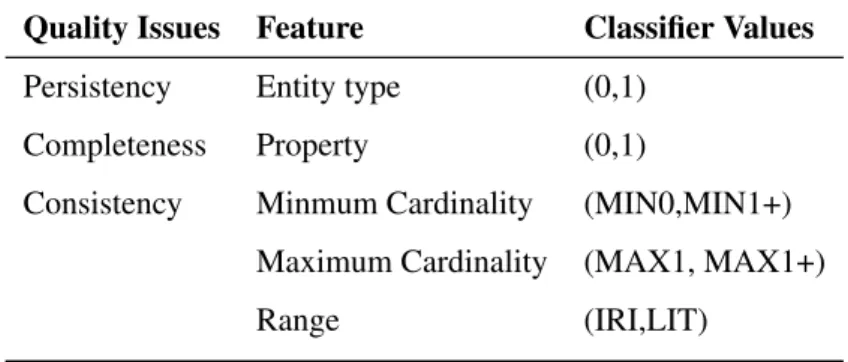
6.1 Features based on the quality issues. . . 69
7.1 DBpedia 10 Classes entity count (all classes havedbo: prefix except the last one). . . 77
7.2 3cixty KB Dataset Summary. . . 77
List of Tables xv
7.4 Verification conditions of the quality measures . . . 79
7.5 DBpedia Persistency and Historical Persistency . . . 82
7.6 Properties for the DBpedia classes and Consistency measures. Re-sults are based on Version 201604 with threshold T=100. . . 86
7.7 Completeness measure of 3cixty Nicelode:Eventclass. . . 88
7.8 Completeness measure of 3cixty Nicelode:Event class properties from periodic snapshots. . . 88
7.9 Completeness measure of 3cixty Nicedul:Placeclass. . . 89
7.10 DBpedia 10 class Completeness measure results based on release 201510 and 201604. . . 90
7.11 Completeness measure of DBpedia KBfoaf:Personclass. . . 90
7.12 Spanish DBpediadbo:Placeclass completeness measure based on release 201604 and 201610. . . 91
7.13 Selected classes and properties for manual evaluation. . . 93
7.14 Summary of manual validation results . . . 94
7.15 Cardinality Counts fordbo:Person-dbo:deathDate. . . 101
7.16 Cardinality Counts fordbo:Sport/dbo:union. . . 101
7.17 dbo:Sport/dbo:union30 statistical measures (p1 to p30) from raw cardinality estimation. . . 103
7.18 Object node type information. . . 104
7.19 Classes ofdbo:Person-dbp:birthPlaceobjects. . . 104
7.20 Datatypes ofdbp:Person-dbp:deathDateliterals. . . 104
7.21 Frequency distribution offoaf:Person/dbo:Titleproperty. . . 105
7.22 Frequency distribution offoaf:Person/dbo:BirthNameproperty. . . . 105
7.23 DBpedia and 3cixty Nice distribution of cardinality constraints. . . . 107
7.24 Baseline accuracy (using ZeroR) for 3cixty KB and DBpedia KB. . 108
7.25 Classifier accuracy for the DBpedia KB and 3cixty KB . . . 108
7.27 Integrity Constraints performance measure for English DBpedia. . . 110 7.28 Integrity Constraints performance measure for Spanish DBpedia. . . 110 8.1 A sample of 6 subjects and objects ofbnfIdproperty . . . 117 8.2 DBpedia 10 class Summary . . . 120 A.1 Hedaer details of the CSV file. . . 141
Chapter 1
Introduction
The Linked Data approach consists in exposing and connecting data from different sources on the Web by the means of semantic web technologies. Tim Berners-Lee1 refers to linked open data as a distributed model for the Semantic Web that allows any data provider to publish its data publicly, in a machine readable format, and to meaningfully link them with other information sources over the Web. This is leading to the creation of the Linked Open Data (LOD)2cloud consisting of several Knowledge Bases (KBs) that make available billions of RDF3triples from different domains such as Geography, Government, Life Sciences, Media, Publication, Social Networking, and User generated data [2].
Such KBs evolve over time: their data instances and schemes can be updated, ex-tended, revised and refactored [3]. However, unlike what happens in more controlled types of knowledge bases, the evolution of KBs exposed in the LOD cloud is usually unrestrained, which may cause data to suffer from a variety of quality issues, both at a semantic level and at a data instance level. By considering the aggregated measure of conformance, the empirical study carried out by Debattistaet al.[4] shows that datasets published in the LOD cloud have reasonable quality. Nevertheless, it also pointed out that significant issues remain concerning individual quality metrics, such as data provenance and licensing. We can explore certain quality issues by looking at individual metrics, for example quality issues in the data collection or integration processes.
1http://www.w3.org/DesignIssues/LinkedData.html 2http://lod-cloud.net
Data quality relates to the perception of the “fitness for use” in a given context [5]. In this thesis, we consideredquality assessmentas the process of statistically assess-ing the evolvassess-ing KB resources to identify anomalies that can affect the knowledge base exploitation and any application usage. Furthermore, we use the termvalidation to indicate the principal mean of evaluating the performance of quality assessment procedure. Also,validationapproaches allow the data stakeholders, such as con-sumer and curator, to monitor the results thoroughly and provide feedback regarding the ability to identify possible issues.
Ensuring the data quality of a knowledge base that evolves over time is vi-tal. Since data is derived from autonomous, evolving, and increasingly large data providers, it is impractical to perform manual data curation tasks, and at the same time, it is very challenging to perform a continuous automatic assessment of data quality. In this context, KB evolution can be analyzed using fine-grained “change” detection at low-level or using “dynamics” of a dataset at high-level. Fine-grained changes of KB sources are analyzed with regard to their sets of triples, set of entities, or schema signatures [6–8]. For example, fine-grained analysis at the triple level between two snapshots of a KB can detect which triples from the previous snapshot have been preserved in the later snapshot. Moreover, fine-grained analysis can detect which triples have been deleted, or which ones have been added [2]. The dynamic feature of a dataset give insights into how it behaves and evolves over a certain period [7]. Ellefi et al. [9] explored the dynamic features considering the use cases presented by Käferet al.[10].KB evolution analysisusing dynamic feature help to understand the changes applied to an entire KB or parts of it. It has multiple dimension regarding the dataset update behavior, such as frequency of change, change patterns, change impacts, and causes of change. More specifically, using dynamicity of a dataset, we can capture those changes that happen often; or changes that the curator wants to highlight because they are useful or interesting for a specific domain or application; or changes that indicate an abnormal situation or type of evolution [7, 8]. Table 1.1 summarizes the features of the two types of analysis.
One of the common tasks for data quality assessment is to perform a detailed data analysis with data profiling [11]. Data profiling is usually defined as the process of examining data to collect statistics and provide relevant metadata about the data [12]. Based on data profiling we can thoroughly examine and understand a KB, its structure, and its properties before usage. For example, the DBpedia KB [13] has
1.1 Problem statement 3
Table 1.1 Summary of the two analysis type features.
Analysis level Detail Volume Stakeholder
Low-level fine-grained Large Data end-user
High-level coarse-grained Small Data Curator
been already available for a long time, with various versions that have been released periodically. Along with each release, the DBpedia KB implemented changes at both the instance and schema level. The changes at the schema level involve classes, properties, axioms, and mappings to other ontologies [14]. Instance level changes include resource typing, property values, or identifying links between resources. Based on the data profiling information we can detect changes between various releases. Thus, in this thesis, we investigate the following research areas:
• KB evolution analysis using data profiling to identify quality issues.
• Validation based on integrity constraints using data profiling information and learning models.
1.1
Problem statement
In this thesis, we argue that evolving KBs suffers from issues such as erroneous instances that get removed or that are added with wrong semantics. Such a phe-nomenon affects data stakeholders, such as consumers and curators, negatively. Our work explores two main challenges of evolving KBs: (i)identification of quality issues due to unrestrained KB evolution, and(ii)identification of logical or formal contradiction, which we outline in this section.
1.1.1
Identification of quality issues for evolving KBs
Assessing the quality of an evolving knowledge base is a challenging task, as it often requires to identify correct quality assessment procedures. Also, the quality assessment process is affected by the evolution of data instances, ontologies and vocabularies, and queryable endpoints. Furthermore, the KB evolution can directly
impact the data integration tasks (e.g., synchronization, data linking or fusion), that may lead to incomplete or incorrect results [15]. For example, DBpedia collects data from semi-structured sources which is created in a crowdsourcing effort (i.e., Wikipedia). This extracted data might have quality problems because it is either mapped incorrectly or the source information itself is incorrect.
KB evolution can be explored based on simple changes at low-level and complex changes at high-level [8]. In particular, performing a fine-grained analysis based on low-level changes means substantial data processing challenges. On the contrary, a coarse-grained analysis using high-level changes can help to obtain an approximate indication of the quality a data curator can expect. However, high-level change detection at the instance level, being coarse-grained, cannot capture all possible quality issues.
In general, low-level changes are easy to define and have several interesting prop-erties [8]. Low-level change detection compares the current with the previous dataset version and returns the delta containing the added or deleted entities. For example, two DBpedia versions – 201510 and 201604 – have the propertydbo:areaTotalin the domain ofdbo:Place(the prefix dbo: present as an alias for the DBpedia ontology namespace: <http://dbpedia.org/ontology/>). Low-level changes can help to detect added or deleted instances fordbo:Placeentity type. One of the main requirements for quality assessment would be to identify the completeness ofdbo: Placeentity type with each KB releases. Low-level changes can help only to detect missing entities with each KB release. Such as those entities missing in the 201604 version (e.g. dbr:A_Rúa, dbr:Sandiás,dbr:Coles_Qurense)4. Furthermore, these instances are automatically extracted from Wikipedia Infobox keys. We track the Wikipedia page from which DBpedia statements were extracted. These instances are present in the Wikipedia Infobox as Keys but missing in the DBpedia 201604 release. Thus, for a large volume of the dataset, it is a tedious, time-consuming, and error-prone task to generate such quality assessment manually.
The representation of changes at low-level leads to syntactic and semantic deltas [16] from which it is more difficult to get insights to complex changes or changes intended by a human user. On the contrary, high-level changes can capture the changes that indicate an abnormal situation and generates results that are
intu-4Here the prefix dbr: present as an alias for the DBpedia resources namespace: <http://dbpedia.org/resource/>
1.1 Problem statement 5
itive enough for the human user. High-level changes from the data can be detected using statistical profiling. For example, total entity count ofdbo:Placetype for two DBpedia versions – 201510 and 201604 – is 1,122,785 and 925,383 where the entity count of 201604 is lower than 201510. This could indicate an imbalance in the data extraction process without fine-grain analysis. However, high-level changes require a fixed set of requirements to understand underlying changes happening in the dataset. For example, assuming that the schema of a KB remains unchanged, a set of low-level changes from data correspond to one high-level change.
1.1.2
Identification of logical or formal contradiction
A data quality analysis using high-level change detection may lead to increasing the number of false positives if the version of a KB is deployed with design issues, such as incorrect mappings. Furthermore, without proper data management, the dataset in an evolving KB may contain consistency issues [17]. Another issue of unrestrained KB evolution is the unavailability of explicit schema information that precisely defines the types of entities and their properties [7]. In general, RDF has proven to be a good model for data integration, and there are several applications using RDF either for data storage or as an interoperability layer [8]. However, unavailability of schema information remains as one of the drawbacks of the RDF data model.
In particular, a knowledge base is defined to be consistent if it does not contain conflicting or contradictory data [18]. When a schema is available with integrity constraints, the data usually goes through a validation process that verifies the compliance against those constraints. Those integrity constraints encapsulate the consistency requirements of data in order to fit for a set of use cases. For example, in a relational database, the integrity constraints are expressed in a data definition language (DDL), and the database management system (DBMS) ensures that any data inserted into the entire database will not lead to any inconsistency. In this context, various research endeavors focus on validation of RDF data to identify any logical or formal contradiction [19].
Validation of RDF data is not done in the same manner as traditional database management systems due to several reasons. One of the key reason is the lack of a language for expressing constraints or having generic models suitable for wider use and not for specific use cases. For example, in DBpedia KB [13] (version 2016-04),
a person should have exactly one value for the "dbo:birthDate" property or the values of the "dbo:height" property should always be a positive number. The instances of the Person class have more than 13,000 associated properties (including dbo, DBpedia ontology properties and dbp, auto-generated properties from Wikipedia infobox keys). Furthermore, ontologies are usually designed for entailment purposes rather than for assessment and their representation often lacks the granular information needed for validating constraints in the data. Taking into account ontology evolution and data quality, in the empirical study presented by Mihindukulasooriyaet al.[20] explicitly pointed out that changes in the ontology depend on the development process and the community involved in the creation of the knowledge base. They also pointed out the drawbacks of finding practical guidelines and best practices for ontology evolution. This lead to the need for automatic consistency analysis for evolving KBs.
1.2
Research Questions and Contributions
This thesis is based on the conference and journal publications presented in Ap-pendix B, in which I have been an author or a contributor. In this section, we outline the key research questions (RQ) that address the aforementioned problems along with our contributions towards each of them.
1.2.1
KB evolution-based quality assessment
We address the challenges of quality assessment for evolving KB using dynamic features from data profiling. We propose a KB quality assessment approach using quality measures that are computed using KB evolution analysis. Based on the high-level change detection, we aim to analyze quality issues in any knowledge base. The main hypothesis that has guided our investigation is:
Dynamic features from data profiling can help to identify quality issues.
We divide this research goal into two research questions:
RQ1: How can we identify quality issues with respect to KB evolution?
In response to this question, we explored the guidelines from two data quality standards, namely ISO/IEC 25024 [1] and W3C DQV [21]. We also explored
1.2 Research Questions and Contributions 7
the comprehensive survey presented by Zaveriet al.[22] on linked open data quality. We propose four quality characteristics based on change detection of a KB over various releases. We use basic statistics (i.e., counts, and diffs) over entities from various KB releases to measure the quality characteristics. More specifically, measurement functions are built using entity count and the amount of changes between pairs of KB releases. Our proposed evaluation-based quality characteristics (RQ1) and approach (RQ2) are presented in a paper entitled "A Quality Assessment Approach for Evolving Knowledge Bases", accepted for publication in the Semantic Web Journal (SWJ) [2]. Furthermore, details on quality assessment and validation approach for specific use cases are presented in a paper entitled "Automated Quality Assessment and Validation for Evolving Knowledge Bases", under review for publication in theJournal of Web Semantics[23]. We report the conceptualization of KB evolution analysis
and details of evolution-based quality characteristics in Chapter 4.
RQ2: Which quality assessment approach can be defined on top of the the evolution-based quality characteristics?
To address this question, we present a quality assessment approach for ana-lyzing quality issues using dynamic features over different KB releases. The main idea behind our quality assessment approach based on the fact that it is not sufficient to identify what is changed, but how to interact with changes and evolving attributes of a KB. Using data profiling, we explored dynamic features on the class level and the property level. We thus evaluate a KB using proposed four evolution-based quality characteristics. For validation, we further explored data profiling information to generate SHACL based integrity constraints for consistency checks. In particular, we learn what are the integrity constraints that can be applicable in a large KB by instructing a process of statistical analysis that is followed by a learning model.
We created KBQ, a tool that automates the detection and report generation of quality issues for evolving knowledge bases. Evolution-based quality assessment approach presented in [2], and details about the KBQ-tool has been published in a paper entitled "KBQ - A Tool for Knowledge Base Quality Assessment Using Evolution Analysis" in the K-CAP workshops of Machine Reading [24]. We provide the detailed explanation of the evolution-based quality assessment approach in Chapter 6.
1.2.2
Validation approaches leveraging on quality
characteris-tics and integrity constraints.
To validate the quality assessment results, in Chapter 6, we present an experimental analysis that is based on a quantitative, qualitative and constraints-based validation approach. We propose RDF shape induction approach to address the challenges of logical or formal contradiction identification in an evolving KB. Regarding the constraints-based validation approach, we derived the following hypothesis:
Learning models can be used for validation using data profiling information as predictive features.
We present this research goal into the following research question:
RQ3: Which approaches can be used to validate a KB evolution based quality assessment approach?
In order to validate the proposed quality characteristics, we performed both quan-titative and qualitative analysis. In particular, quanquan-titative analysis is performed using quality characteristics which are introduced in Chapter 4. Further, we performed qualitative analysis using manual validation to compute precision by examining the results from the quantitative analysis. In Chapter 7, we report about the experimenta-tion of this approach on two KBs: DBpedia [13] (encyclopedic data) and 3cixty [25] (contextual tourist and cultural data). We illustrate the quantitative and qualitative analysis results based on the work presented in [2].
Furthermore, we have introduced an RDF validation approach that relies on SHACL based integrity constraints using Shape induction in Chapter 5. Based on the results from qualitative analysis, we have performed the RDF validation using the dataset from the 3cixty KB and the DBpedia KB. In Chapter 7, we reported the learning model performance of RDF Shape validation approach based on the work presented in [26].
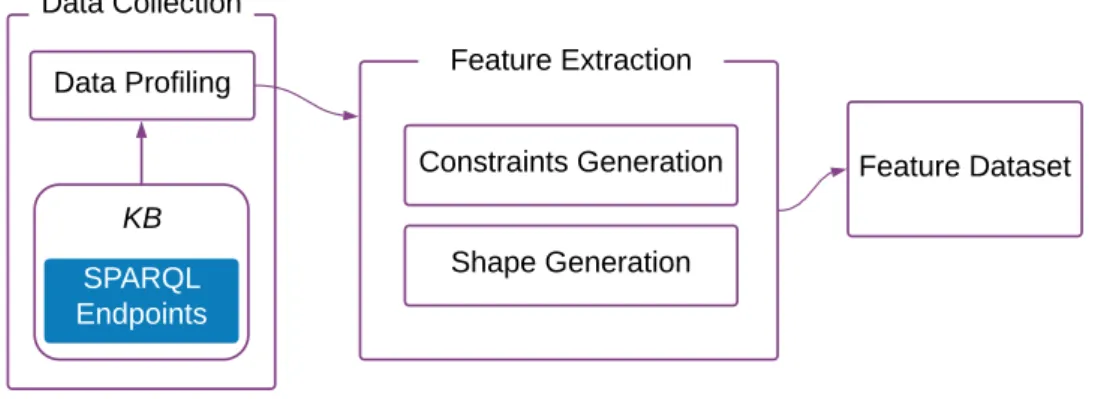
Based on the data profiling information, we present a set of features taking into account inconsistency issues. We applied these features in the learning model to create RDF Shapes. The core concepts regarding RDF Shape induction for creating integrity constraints have been published in the paper entitled "RDF Shape Induction using Knowledge Base Profilings" in Proceedings of SAC2018: Symposium on
1.3 Thesis structure 9
Applied Computing 2018[26]. The details of the RDF Shape induction process using SHACL representation of cardinality, range, and string constraints presented in Chapter 5. We chose cardinality constraints to identify any logical contradiction due to wrong mappings in a evolving KB. Similarly, using range constraints values, we explored if there are any type mismatch due to inconsistent KB updates. In Figure 1.1, we present the process flow of our validation approaches that is divided into
three main steps:
(i) KB evolution analysis:The target entity types for validation tasks are selected based on the results from the evolution-based quality characteristics.
(ii) Quality Assessment and Validation approach: Using the information from KB evolution analysis and statistical profiler, we perform quality assessment and RDF Shape induction for validation task.
(iii) Evaluation: We perform evaluation using quantitative, qualitative, and constraints based validation. Furthermore, we apply various learning models to assess the constraints based feature dataset for a given class and formulate a RDF Shape.
Fig. 1.1 The process flow of our data-driven procedure for quality assessment and validation.
1.3
Thesis structure
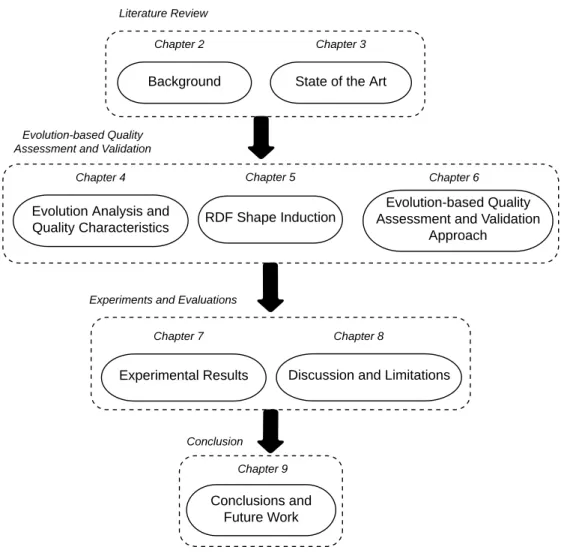
As illustrated in Figure 1.2, this thesis is divided into nine chapters, as follows: Chapter 2 presents background and motivational examples that demonstrate impor-tant aspects of our quality assessment and validation approach; Chapter 3 provides an overview of the state-of-the-art which is part of this thesis, focusing on Linked
Background State of the Art
Evolution Analysis and
Quality Characteristics RDF Shape Induction
Evolution-based Quality Assessment and Validation
Approach
Experimental Results Discussion and Limitations
Conclusions and Future Work
Chapter 2 Chapter 3
Chapter 4 Chapter 5 Chapter 6
Chapter 7 Chapter 8
Chapter 9 Conclusion Experiments and Evaluations Evolution-based Quality
Assessment and Validation
Literature Review
Fig. 1.2 Overview of the thesis structure.
data dynamics, Knowledge Base quality assessment and Knowledge Base validation approaches. Chapter 4 contains the definition of the proposed evolution-based quality characteristics and measurement functions. Chapter 5 describes the process of RDF Shape Induction using SHACL based constraints. Chapter 6 outlines our data driven quality assessment and validation approach; Chapter 7 presents an experimental analysis based on two KBs, namely DBpedia and 3cixty. Furthermore, we considered both English and Spanish versions of the DBpedia KB. Chapter 8 discusses the initial hypothesis, the research questions and insights gathered from the experimentation. Finally, Chapter 9 summarizes the main findings and outlines the future research activities.
Chapter 2
Background
In the following chapter we give an overview of the technical foundations and the background for the reader to understand the work presented in this thesis. The key conceptual definitions are mainly based on [19]1.
In section 2.1 we introduce the reader with the basic concepts of Resource Description Framework (RDF). Section 2.2 gives an overview of RDF related core technologies. An overview of Shapes Constraint Language (SHACL) presented in Section 2.3. Furthermore, Section 2.4 presents the definition of RDF Knowledge base and their evolution. Section 2.4.1 presents an description of the two main KBs namely, 3cxity and DBpedia used in our experimental analysis. A brief overview of data quality standards are presented in Section 2.5. Moreover, Section 2.6 describes the quality issues present in a KB due to evolution. The details of the quality issues are based on the work presented in [2]. Section 2.7 outlines the gold standard creation strategies. Finally, Section 2.8 present an overview of machine learning approaches used in this thesis.
1Standard components of the RDF framework and definitions for them are taken from this book as they follow the defined standards and are widely used. Examples for each component are provided by the author.
Table 2.1 Common Prefixes used over the thesis.
Prefix Namespace
dbo DBpedia ontology: <http://dbpedia.org/ontology/> dbr DBpedia resources:<http://dbpedia.org/resource/>
foaf FOAF Vocabulary Specification: <http://xmlns.com/foaf/0.1/> wikipedia-en English Wikipedia: <https://en.wikipedia.org/wiki/>
lode 3cixty event type: <http://linkedevents.org/ontology>
dul 3cixty place type:
<http://www.ontologydesignpatterns.org/ont/dul/DUL.owl>
2.1
Resource Description Framework (RDF)
Resource Description Framework (RDF)2is a graph-based data model. RDF datasets produced by different data sources and can be integrated with other data using semantic web technologies. Data integration using RDF is faster and more robust than traditional solutions [19]. The RDF data model is based on the concept of triples. Each triple consists of a subject, a predicate, and an object. RDF triples are usually depicted as a directed arc connecting two nodes (subject and object) by an edge (predicate). An RDF triple asserted means that some relationship, indicated by the predicate, holds between the resources denoted by the subject and object. This is known as an RDF statement. The predicate is an IRI [19] that denotes a property.
Most RDF formats include some mechanism called prefix declaration which enables to simplify writing long IRIs declaring prefix labels. A prefix label associates an alias with an IRI and enables the definition of prefixed names. A prefixed name contains a prefix label and a local part separated by “:” and represents the IRI formed by concatenating the IRI associated with the prefix label and the local part. For example, if ex is declared as a prefix label to represent <http://example.org/>, then ex:rifat is a prefixed name that represents <http://example.org/rifat>. Table 2.1 reports the common prefixes used over the thesis.
An RDF statement can be thought of as a binary relation identified by the property between the subject and object. RDF support other serialization formats like Turtle
3, Trig4and JSON-LD5. Turtle allows an RDF graph to be completely written in a
2https://www.w3.org/RDF 3https://www.w3.org/TR/turtle/ 4https://www.w3.org/TR/trig/ 5https://www.w3.org/TR/json-ld/
2.2 RDF Related Core Technologies 13
compact and natural text form, with abbreviations for common usage patterns and data types. The code in 2.1 represents an RDF graph in Turtle. The first three lines are prefix declarations, and the rest represents a sequence of RDF triples separated by dots. There are three kinds of nodes: IRIs, literals, and blank nodes.
Listing 2.1 Simple RDF file in Turtle @ p r e f i x ex : < http :/ / e x a m p l e. org/> @ p r e f i x s c h e m a : < http :/ /s c h e m a . org/> @ p r e f i x dbr : < http :/ /d b p e d i a . org/r e s o u r c e/> ex : e r i o n s c h e m a : k n o w s ex : r i f a t . ex : r i f a t s c h e m a : k n o w s ex : d i e g o . ex : r i f a t s c h e m a : name " R a s h i d " . ex : r i f a t s c h e m a : b i r t h D a t e " 1987 -08 -01 "^^ xsd :date . ex : r i f a t s c h e m a : b i r t h P l a c e dbr : K h u l n a . ex : e r i o n s c h e m a : k n o w s ex : d i e g o . ex : e r i o n s c h e m a : k n o w s ex : r i f a t . ex : e r i o n s c h e m a : b i r t h P l a c e dbr : T i r a n a .
IRI6An IRI (Internationalized Resource Identifier) refers to a resource (the refer-ent). A resource can be any thing. IRIs can appear as subjects, predicates and objects. In Turtle, IRIs are enclosed by < and >. For example, an IRI can be <http://example.org/rifat>.
LiteralsA literal denotes resources which have an associated value, for example, an integer or string value. Literals can only appear as objects in triples.
Blank NodeA blank node refers to local identifiers which do not identify any
specific resources. It can be used as subjects or objects of triples. They specify that something with the given relationship exists, without explicitly naming it.
2.2
RDF Related Core Technologies
RDF was designed to used as a central piece for knowledge representation in the Web. The goal is that agents can automatically infer new knowledge in the form of
new RDF statements from existing RDF graphs. To that end, several technologies were proposed to increase RDF expressiveness. In this context, various technologies were proposed to support RDF representation. There are three concepts that are commonly utilized in RDF: SPARQL, RDF Schema and OWL.
SPARQL (SPARQL Protocol and RDF Query Language)7 is an RDF query
language which is able to retrieve and manipulate data stored in RDF. SPARQL is based on the notion of Basic Graph Patterns which are sets of triple patterns. A triple pattern is an extension of an RDF triple where some of the elements can be variables which are denoted by a question mark. For example, the following SPARQL query in 2.2 retrieves the nodes ?s whose birth place is dbr:Khulna and the nodes ?o that are known by them.
Listing 2.2 Simple SPARQL Query. @ p r e f i x s c h e m a : < http :/ /s c h e m a . org/> @ p r e f i x dbr : < http :/ /d b p e d i a . org/r e s o u r c e/> S E L E C T ? s ? o W H E R E { ? s s c h e m a : b i r t h P l a c e dbr : K h u l n a . ? s s c h e m a : k n o w s ? o }
RDF Schema8provides a data-modelling vocabulary for RDF data. It is a semantic extension of RDF which provides mechanisms to describe groups of resources and relationships between them. It defines a set of common classes and properties. The main classes defined in RDFS are:
• rdfs:Resource: the class of everything; • rdfs:Class: the class of all classes;
• rdfs:Literal: the class of all literal values; • rdfs:Datatype: the class of all datatypes; • rdf:Property:the class of all properties. 7https://www.w3.org/TR/rdf-sparql-query/ 8https://www.w3.org/TR/rdf-schema/
2.3 Shapes Constraint Language (SHACL) 15
OWL (Web Ontology Language)9defines a vocabulary for expressing ontologies
based on description logics. OWL has several syntaxes: an RDF-based syntax, functional-style Syntax, manchester syntax, and a formally defined meaning. An ontology can be defined as a vocabulary of terms, usually about a specific domain and shared by a community of users. Ontologies specify the definitions of terms by describing their relationships with other terms in the ontology. The main concepts in OWL are as follows.
• Classeswhich represent sets of individuals. Classes can be subclasses of other classes, with two special classes: owl:Thingthat represents the set of all individuals andowl:Nothingthat represents the empty set.
• Individualswhich are elements in the domain. Individuals can be mem-bers of an OWL class.
• Properties which represent relationships. Properties are classified as datatype properties, object properties and annotation properties. Datatype properties relate an individual with a data value such as a string or integer. Object properties relate an individual with another individual, and Annotation properties encode information about the ontology itself (such as the author or the creation date of an ontology).
• Constructors which allow to define complex concepts from other con-cepts using expressions.
2.3
Shapes Constraint Language (SHACL)
Shapes Constraint Language (SHACL) has been developed by the W3C RDF Data Shapes Working Group10, which was initiated in 2014 with the goal to introduce a language for imposing structural constraints on RDF graphs. SHACL structures are motivated by other constraints based languages such as SPIN11, some parts from OSLC resource shapes12 and Shape Expression(ShEx)13. More specifically, SHACL is inspired by SPIN. The SPIN modeling vocabulary based on RDF properties and
9https://www.w3.org/OWL/
10https://www.w3.org/2014/data-shapes 11http://spinrdf.org/spin.html
12http://open-services.net/resources/ 13https://www.w3.org/2001/sw/wiki/ShEx
classes using SPARQL to specify rules and logical constraints. In the beginning, the main motivation of this initiative is to combine all the constraint languages into SHACL. However, due to core difference of representation, ShEx is not completely converged with SHACL.
SHACL is divided into two parts: (i)SHACL Core describes a core RDF vo-cabulary to define common shapes and constraints; and(ii)extension mechanism regarding SPARQL and has been called: SHACL-SPARQL. In this thesis, we ex-plored the SHACL Core for RDF validation process. More specifically, we looked at SHACL Shape for a specific class to identify constraints components. In SHACL, a Shape is defined as the collection of targets and constraints components. Further-more, targets specify which nodes in the data graph must conform to a shape and constraints components determine how to validate a node. In this context,Shapes graphrepresent an RDF graph that contains shapes, andData graphrepresents an RDF graph that contains data to be validated. Furthermore, SHACL defines two types of Shapes: (i) Node shapespresents the constraints information about a given focus node; and(ii) Property shapespresent constraints about a property and values of a path for a node.
For example, let us consider a Person Shape which is based on only name and email. Person name has an ”xsd:string” type and email addresses are presented with IRI. In this account, we present a Person SHACL Shape graph in 2.3.
Listing 2.3 A simple example of Person SHACL Shape Graph @ p r e f i x : < http :/ / e x a m p l e. org/> @ p r e f i x sh : < http :/ /www . w3 . org/ns/s h a c l# > . @ p r e f i x xsd : < http :/ /www . w3 . org/2001/X M L S c h e m a# > . @ s c h e m a s c h e m a : < http :/ /s c h e m a . org/> . : P e r s o n S h a p e a sh : N o d e S h a p e ; sh : t a r g e t N o d e : rifat , : erion , : d i a g o ; st : t a r g e t C l a s s : P e r s o n ; sh : p r o p e r t y [ sh :path s c h e m a : name ; sh : m i n C o u n t 1; sh : m a x C o u n t 1: sh : d a t a t y p e xsd : s t r i n g ; ];
2.3 Shapes Constraint Language (SHACL) 17 sh : p r o p e r t y [ sh :path s c h e m a : e m a i l ; sh : m a x C o u n t 1; sh : m i n C o u n t 1; sh : n o d e K i n d sh : IRI ; ].
SHACL specify targets using nodes, that must be validated against the shape. There are several types of targets in SHACL:
targetNode directly point to a node. In 2.3, targetNodes are :rifat, :erion and :diago.
targetClass consider all nodes that have a give type. Such as in Shape graph of
person in 2.3 targetClass is presented as :Person.
targetProperty defines all nodes that have a given property. It is based on sh:property which is associated with shape property constraint and sh:path identifies the path. An example of property shape present in 2.4.
Listing 2.4 An example of Property Shape @ p r e f i x : < http :/ / e x a m p l e. org/> @ p r e f i x sh : < http :/ /www . w3 . org/ns/s h a c l# > . @ p r e f i x xsd : < http :/ /www . w3 . org/2001/X M L S c h e m a# > . @ s c h e m a s c h e m a : < http :/ /s c h e m a . org/> . : P e r s o n S h a p e a sh : N o d e S h a p e ; sh : p r o p e r t y [ sh :path s c h e m a : e m a i l ; sh : m a x C o u n t 1; sh : m i n C o u n t 1; sh : n o d e K i n d sh : IRI ; ].
target node used for SPARQL based general mechanisms.
SHACL shapes uses collection of constraints that nodes must satisfy. Table 2.2 present a list of integrity constraints from the SHACL presentation. In the validation task, a SHACL based approach checks each constraint and reports error for each
unsatisfied constraints. From the SHACL report, if no error found, then we can assume that the RDF graph has been validated. For example, following RDF data graph conforms to the shape graph presented in 2.3. Here target property :rifat passed as it meets the constraints of :name and :email. On the other hand, target property :erion fails as the sh:nodeKind is IRI but it is defined as string in the data graph. # P a s s e d as : P e r s o n S h a p e : r i f a t s c h e m a : name " M o h a m m a d R a s h i d "; s c h e m a : e m a i l < m a i l t o : r i f a t @ g m a i l . com > # F a i l s as : P e r s o n S h a p e : e r i o n s c h e m a : name " e r i o n cano "; s c h e m a : e m a i l " e r i o n @ g m a i l . org "
Table 2.2 Integrity constraints components from the SHACL presentation. Constraints Type Example
Cardinality minCount, maxCount Types of values class, datatype, nodeKind
Values node, in, hasValue
Range of values minInclusive, maxInclusive, minExclusive, maxExclusive String based minLength, maxLength, pattern, languagesIn, uniqueLanguage Logical constraints not, and, or, xone
Closed shapes closed, ignoredProperties
Property pair constraints equals, disjoint, lessThan, lessThanOrEquals Other constraints name, value, defaultValue
2.4
Knowledge Bases and Their Evolution
A Knowledge Base (KB) is a technology used to store both complex structured and unstructured information’s representing domain knowledge[27]. An RDF KB is a well-defined RDF dataset that consists of RDF statements (triples) of the form (subject,predicate,object). Considering description logic (DL), a knowledge base is the equivalent of a theory in first-order logic or an ontology in OWL. A DL
2.4 Knowledge Bases and Their Evolution 19
knowledge base is based on a set of terminological axioms (TBox) and assertions axioms (ABox) [28]. Axioms are statements that are asserted to be true in the domain being described14. In the LOD cloud, KBs are created in various ways and depend on specific domain [29]. For example, proprietary and curated KB like 3cixty [30] or the crowd-based KB like Freebase [31] and Wikidata [27]. Furthermore, KB can be based on data extracted from large-scale, semi-structured sources such as DBpedia [32] using Wikipedia.
2.4.1
Use Cases: 3cixty and DBpedia
In our approach we explored two KBs as use cases namely, 3cixty Nice KB and DBpedia KB. We selected 3cixty Nice KB and DBpedia KB according to: (i) popularity and representativeness in their domain: DBpedia for the encyclopedic domain, 3cixty Nice for the tourist and cultural domain;(ii)heterogeneity in terms of content being hosted such as periodic extraction of various event information extracted by 3cixty Nice KB,(iii)diversity in the update strategy: incremental and usually as batch for DBpedia, continuous update for 3cixty. More in detail:
• DBpedia15 is among the most popular knowledge bases in the LOD cloud. This knowledge base is the output of the DBpedia project that was initiated by researchers from the Free University of Berlin and the University of Leipzig, in collaboration with OpenLink Software. DBpedia is roughly updated every year since the first public release in 2007. DBpedia is created from automatically extracted structured information contained in Wikipedia, such as infobox tables categorization information, geo-coordinates, and external links.
• 3cixty Niceis a knowledge base that describes cultural and tourist informa-tion. This knowledge base was initially developed within the 3cixty project16, which aimed to develop a semantic web platform to build real-world and comprehensive knowledge bases in the domain of culture and tourism for a few cities. The entire approach has been tested first in the occasion of the Expo Milano 2015 [25], where a specific knowledge base for the city of Milan was developed, and has now been refined with the development of knowledge bases 14https://www.w3.org/TR/2002/WD-owl-semantics-20021108/syntax.html 15http://wiki.dbpedia.org
for the cities of Nice, London, Singapore, and Madeira island. They contain descriptions of events, places (sights and businesses), transportation facilities and social activities, collected from numerous static, near- and real-time local and global data providers, including Expo Milano 2015 official services in the case of Milan, and numerous social media platforms. The generation of each city-driven 3cixty KB follows a strict data integration pipeline, that ranges from the definition of the data model, the selection of the primary sources used to populate the knowledge base, till the data reconciliation used for generating the final stream of cleaned data that is then presented to the users via multi-platform user interfaces. The quality of the data is today enforced through a continuous integration system that only verifies the integrity of the data semantics [30].
2.4.2
Knowledge Base Evolution
Knowledge bases are nowadays essential components for any task that requires automation with some degrees of intelligence. Furthermore, KBs are performing an important role in the organizations data management and in supporting data integration. Stakeholders – curator, consumer, etc. – in various domains routinely need to combine and compare statistical indicators for various applications. The majority of the knowledge bases are domain specific and maintained by small groups of knowledge engineers. Moreover, updating the knowledge bases become very cost intensive as data sources evolves and need to consolidate those changes with each release. Within the context of KB evolution, aspects of the KB evolution managements are becoming increasingly important to produce the data consistent and usable.
For example, Wikipedia has grown into one of the central hubs of knowledge sources, and it is maintained by thousands of contributors. DBpedia is a crowd-sourced knowledge base and extracts structured information from various Wikimedia projects. Table 2.3 illustrates the overall statistics of English DBpedia17 on three different releases. With each DBpedia release, the raw infobox statements grow about 4.2%. Furthermore, millions of triples have been included with each version
2.4 Knowledge Bases and Their Evolution 21
Table 2.3 Statistics of the English DBpedia KB updates on the three releases of 201504, 201510 and 201604.
Features 201504 201510 201604
Localiced Instances 4,305,028 4,641,890 4,678,230
Canonicalized Instances 4,305,028 4,641,890 4,678,230
Mapping based Properties 1,353 1,369 1,379
Mapping based Statements 32,143,157 37,852,643 37,549,405
Raw Infobox Properties 58,780 60,461 2,062
Raw Infobox Statements 73,686,499 78,498,880 30,024,092
Type Statements 34,911,097 36,583,668 36,704,825
of DBpedia released. For any data stakeholder managing, this exponential growth of information is a challenging task.
Figure 2.1 illustrates common use cases [10] of knowledge base evolution. These use cases are explained in detail below.
Fig. 2.1 Use cases of Knowledge Base evolution.
• Dataset Synchronization:In any KB, large quantity of data needs to be repli-cated and maintained at external sources. Furthermore, these data sources need to be in periodic synchronization with the original data sources [10].
• Link maintenance: In a KB, data is made of statements that link between resources. Due to KB updates, often resources are erroneously removed or change semantics, without taking the necessary steps to update their depen-dent resources. Thus, it creates the need to take appropriate action for link maintenance.
• Vocabulary evolution:Ontologies, vocabularies, and data schemata in a KB are often inconsistent and lack metadata information. Due to ontology evolution, it is difficult to find practical guidelines and best practices [20].
• Versioning:It is relevant for ontologies, vocabularies, and data schemata in a KB, whose semantics may change over time to reflect usage [10]. Within this context, KB evolution analysis can show how changes propagate and help to design a stable versioning methodology.
• Smart Cashing: Query optimization and live querying approaches need a smart cashing approach for dereferencing and sources discovery. KB evolution analysis can help to identify which sources can be cached to save time and resources, how long cached data can be expected to remain valid, and whether there are dependencies in the cache [10].
• Data Quality:One of the key use case is to ensure a good quality of data in a KB. Since data instances are often derived from autonomous, evolving, and increasingly large data providers, it is impractical to do manual data curation, and at the same time, it is very challenging to do the continuous automatic assessment of data quality. In this context, using the KB evolution analysis, we can explore the data quality issues.
2.5
Data Quality Standards
Data quality can be defined as the degree to which a set of characteristics of data fulfills requirements [1]. Based on user requirements, poor data quality can be defined as the degree to which a set of characteristics of data does not fulfill the requirements [33]. The definition of our proposed quality characteristics started with the exploration of two data quality standard reference frameworks: ISO/IEC 25012 [1] and W3C DQV [21].
2.5 Data Quality Standards 23
Table 2.4 Measurement terminology
Definition ISO 25012 W3C DQV
Category of quality attributes Characteristic Dimension
Variable to which a value is assigned as the result of a measurement function applied to two or more measure elements
Measure Metric
Variable defined in terms of an attribute and the elements for quantify the measure-ment method
Measure Element
-Quality measurement results that that char-acterize a quality feature
Numerical Value Observation
Set of operations having the object of de-termining a value of a measure
Measurement Measurement
ISO/IEC 25012 [1] defines a general data quality model for data retained in structured format within a computer system. This model defines the quality of a data product as the degree to which data satisfies the requirements set by the product owner organization. The W3C Data on the Web Best Practices Working Group has been chartered to create a vocabulary for expressing data quality1. The Data Quality Vocabulary (DQV) is an extension of the DCAT vocabulary18. It covers the quality of the data, how frequently it is updated, whether it accepts user corrections, and persistence commitments.
Besides, to further compare our proposed quality characteristics19 we explored the foundational work on the linked data quality by Zaveriet al.[22]. They surveyed existing literature and identified a total of 26 different data quality dimensions (criteria) applicable to linked data quality assessment.
Since the measurement terminology suggested in these two standards differs, we briefly summarize the one adopted in this paper and the relative mappings in Table 2.4.
18https://www.w3.org/TR/vocab-dcat/
19In our work we will identify the quality aspects using the term quality characteristics from ISO-25012 [1] that corresponds to the term quality dimension from DQV [21].
2.6
Data Quality Issues in Evolving KB
A data quality issue is a set of anomalies that can affect the knowledge base exploita-tion and any applicaexploita-tion usage [34]. We can identify quality issues through data quality measurement. A data quality characteristic analyzes quality issues by using a set of measurement functions that help to assess the issues present in the data [35]. In this thesis, we focused on three main quality issues of a knowledge base:(i)Lack of consistency,(ii)Lack of completeness, and(iii)Lack of persistency.
Lack of consistencywhen a KB is inconsistent with the reality it represents. In particular, inconsistency relates to the presence of unexpected properties.
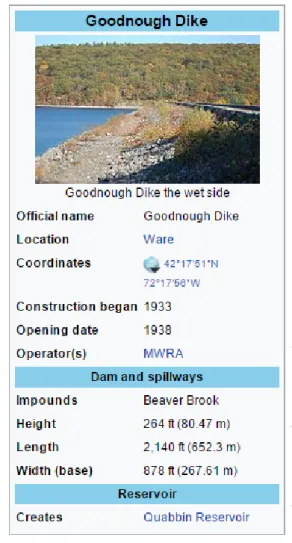
As an example, let us consider DBpedia version 201510 where we can find the resource of typefoaf:Person dbpedia:X. Henry Goodnoughthat represent an entity. While we find (as expected) adbo:birthDateproperty for the entity, we unexpectedly find the propertydbo:Infrastructure/length. This is a clear inconsistency: in fact, if we look at the ontology, we can check that the latter property can be used for a resource of typedbo:Infrastructure, not for a person.
To better understand where the problem lies, we need to look at the correspond-ing Wikipedia page wikipedia-en:X._Henry_Goodnough20. Even though the page reports the information about an engineer who graduated from Harvard, it contains an info-box, shown in Figure 2.2, that refers to a dam, the Goodnough Dike. The inconsistency issue derives from the data present in the source page that resulted into the resource being typed both as a person and as a piece of infrastructure. We can expect such kind of structure to be fairly rare – in fact the case we described is the only case of a person with adbo:Infrastructure/lengthproperty – and can be potentially detected by looking at the frequency of the predicates within a type of resource. For instance, considering DBpedia version 2016-04, for the resources of typefoaf:Personthere are 1035 distinct predicates, among which 142 occur only once. Such anomalous predicates suggests the presence of consistency issues that can be located either in the original data source or – i.e. Wikipedia for this case – or in the lack of filtering in the data extraction procedure.
Lack of completeness relates to the resources or properties missing from a
knowledge base. This happens when information is missing from one version of the 20https://en.wikipedia.org/wiki/X._Henry_Goodnough
2.6 Data Quality Issues in Evolving KB 25
Fig. 2.2 Example of inconsistent Wikipedia data (December 2016).
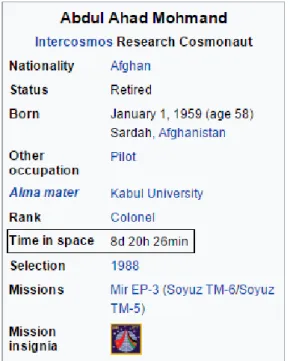
KB because it has been removed at given point during KB’s evolution21. In general, causes of completeness issues are linked to errors in the data extraction pipeline. Such as missing instances in a KB that are auto generated from data sources. As an example, let us consider a DBpedia resourcedbpedia:Abdul_Ahad_Mohmaof type dbo:Person/Astronauts22. When looking at the source Wikipedia page
wikipedia-21Of course it is possible the item was never present in the KB at any time during its evolution, though this kind of mistake is not detectable just by looking at the evolution of the KB.
en:Abdul_Ahad_Mohman23, we observe that the infobox shown in Figure 2.3 re-ports a “Time in space” datum. The DBpedia ontology includes adbo:Astronaut/ TimeInSpaceand several other astronauts have that property, but the resource we consider is missing it.
Fig. 2.3 Example of incomplete Wikipedia data (December 2016).
While it is generally difficult to spot that kind of incompleteness, for the case under consideration it is easier because that property was present for the resource present in the previous version of DBpedia, i.e. the 2015-10 release. That is an incompleteness introduced by the evolution of the knowledge base. It can be spotted by looking at the frequency of predicates inside a resource type. In particular, in the release of 2016-04 there are 419 occurrences of thedbo:Astronaut/TimeInSpace predicate over 634 astronaut resources (66%), while in the previous version there were 465 out of 650 astronauts (72%). Such a significant variation suggests the presence of a major problem in the data extraction procedure applied to the original source, i.e. Wikipedia.
Lack of persistencyrelates to unwanted removal of persistent resources that were present in a previous KB release but they disappeared. This happens when information has been removed. As an example let us consider a 3cixty Nice
2.6 Data Quality Issues in Evolving KB 27
source of typelode:Event that has as the label “Modéliser, piloter et valoriser les actifs des collectivités et d’un terrritoire grâce aux maquettes numériques: retours d’expériences et bonnes pratiques”24. This resource happened to be part of the 3cixty Nice KB since it has been created the first time, but in a release it got removed even though, according to the experts curating the KB, it should not have been removed.
Fig. 2.4 Example of a 3cixty Nice KB resource that unexpectedly disappeared from the release of 2016-06-15 to the other 2016-09-09.
This issue can be spotted by looking at the total frequency of entities of a given resource type. For example,lode:Eventtype two releases – 06-15 and 2016-09-09 – total entity count 2,182 and 689. In particular in the investigated example we have observed an (unexpected) drop of resources of the typeeventbetween the previous release dated as 2016-06-15 and the considered released from 2016-09-09. Such count drop actually indicates a problem in the processing and integration of the primary sources that feed the KB.
Such problems are generally complex to be traced manually because they require a per-resource check over different releases. When possible, a detailed, low-level and automated analysis is computationally expensive and might result into a huge number of fine-grained issue notifications. Such amount of information might cause an information overload for the user of the notifications. However, provided they are filtered, such low-level notifications can be useful to KB end-users to assess the suitability for their purposes.
Such a problem is generally complex to be traced manually because it requires a per-resource check over the different releases. It can, instead, be spotted by looking at the total frequency of entities of a given resource type.
2.7
Gold Standard Creation
KBs may contain errors, thus the profiling results cannot be considered as a gold standard. To instruct and verify the performance of the modeling process, the feature datasets are further validated by a human annotator. More specifically, to reduce the wrong annotations a manual validation is performed by a human annotator. There are different strategies to evaluate a dataset. In the following, we present three common strategies when dealing with a knowledge base [29]:
(i) Silver Standard: this strategy is based on the assumption that the given KB is already of reasonable quality. The silver standard method is usually applied to measure the performance of knowledge graph by analyzing how well relations in a knowledge graph can be replicated. Although this strategy is suitable for large-scale data, it can produce less reliable results [36, 37].
(ii) Gold standard: this strategy is based on turning the observations in a set of gold data points by human annotators. In this context, gold standard is indeed suitable for our approach since we can obtain gold insights of the completeness measurement results, however very expensive if the annotation load is large.
(iii) Partial gold standard: in this strategy, a small subset of external graphs, entities or relations are selected as validation criteria and they, then, are manually labeled [36]. This helps reducing the number of candidates that an annotator will process.
2.8 Learning Models 29
2.8
Learning Models
One of the goals of this thesis is to validate the RDF KBs using integrity constraints in predictive settings. In this context, we present our approach as a classification problem. Typically a classification learning model maps observations (samples) to a set of possible categories (classes) [38]. For example, the minimum cardinality value of an entity type is an observation for its relevant attributes (features). For selecting a suitable learning model for our problem, we investigated the following research question: "Which learning model is the most adequate for consistency analysis using data profiling information as predictive features?". In order to answer this question, we evaluate the performance of predictive features using five classical learning models. These learning models are chosen considering five popular categories of machine learning algorithms [38]: (i)Neural Networks,(ii)Bayesian,(iii)Instance Based,(iv)Support Vector Machine, and(v)Ensemble. Following we present details of five well-known learning models.
Multilayer Perceptron[39]: a feed forward Neural Network consisting of at least three layers of neurons with a non-linear activation function: one for inputs, one for outputs and one or more hidden layers. Training is carried out through back propagation.
Naive Bayes [40]: is a simple probabilistic classifier. The core concept is based on the Bayes theorem [40]. Generally, naive bayes classifiers are based on the assumption that features are independent with each other.
k-Nearest Neighbors (k-NN) [41]: is an instance-based learning algorithm. It lo-cates thek-nearest instances to the input instance and determines its class by identifying the single most frequent class label. It is generally considered not tolerant to noise and missing values. Nevertheless, it is highly accurate, insen-sitive to outliers and works well with both nominal and numerical features.
Support Vector Machines (SVM) [42]: it conceptually implements the following
idea: input vectors are non-linearly mapped to a very high dimensional feature space. In this feature space a linear decision surface is constructed. Special properties of the decision surface ensures high generalization ability of the classifier.
![Figure 2.1 illustrates common use cases [10] of knowledge base evolution. These use cases are explained in detail below.](https://thumb-us.123doks.com/thumbv2/123dok_us/9305090.2809168/38.892.198.699.225.475/figure-illustrates-common-cases-knowledge-evolution-cases-explained.webp)
![Fig. 6.1 ISO/IEC 25024 Data Life Cycle (DLC) [1] with proposed quality assessment approach](https://thumb-us.123doks.com/thumbv2/123dok_us/9305090.2809168/81.892.158.730.185.384/fig-data-life-cycle-proposed-quality-assessment-approach.webp)