DEPARTMENT OF PHILOSOPHY,
LINGUISTICS AND THEORY OF SCIENCE
FAST VISUAL GROUNDING IN
INTERACTION
Bringing few-shot learning with neural networks to an
interactive robot
José Miguel Cano Santín
Master’s Thesis: 30 credits
Programme: Master’s Programme in Language Technology
Level: Advanced level
Semester and year: Spring, 2019
Supervisor Simon Dobnik, Mehdi Ghanimifard
Examiner Aarne Ranta
Report number (number will be provided by the administrators)
Keywords Grounding, object learning, interactive learning, transfer learning, neural networks
Abstract
A big challenge for the development situated agents is that they need to be capable of grounding real objects of their enviroment to representations with semantic meaning, so they can be comunicated to human agents using the human language. de Graaf (2016) developed the KILLE framework, which is a static camera-based robot capable of learning objects and spatial relations from very few samples using image processing algorithms suitable for learning from few samples. However, this framework has a major shortcoming: the time needed to recognise an object increased greatly as the system learned more objects, which motivates us to design a more efficient object recognition module.
The following project researches a way to improve object recognition of the same robot framework using a neural network approach suitable for learning from very few image samples: Matching Networks (Vinyals et al., 2016). Our work also investigates how transfer learning form large datasets could be used to improve the object recognition performance and to make learning faster, which are very important features for a robot that interacts online with humans.
Therefore, we evaluate the performance of our situated agent with transfer learning from pre-trained models and different conversational strategies with a human tutor. Results show that the robot system is capable of training models really fast and gets very good object recognition performance for small domains.
Preface
It is a fact that my fascination for robotics development has been one of the main reasons why I have choosen to work in this field for my master’s thesis in the MLT programme. Robots have always attracted me since I was a child watching and reading all kind of science-fiction and fantasy movies and books. It is not the only one, however, but my choice has also been driven by the interest in developing my knowledge in machine learning and dialogue systems. I have enjoyed working in this project, I have learned a lot from the challenges I had and I have seen how much I have still to learn in the future.
I would like to acknowledge in the first place all the help and support that my supervisors Simon Dobnik and Mehdi Ghanimifard have provided me during all this thesis period. Without their hard work and enthusiasm, I am quite sure this thesis would not be half as good as it is.
I am also very grateful to my dear family and all my amazing friends, no matter if they are living five minutes from my house or in the other side of Europe. Without their all support, their music, the interminable talks and their lovely beings in general I would not have been here for sure.
I would also like to thank all my colleagues in the MLT programme for these two wonderful years we have spent together and all the support we have provided each other and the nice moments we had. We made it, my friends.
Contents
1 Introduction . . . 1
1.1 Visual grounding: lexical semantics . . . 2
2 Background . . . 3
2.1 The KILLE framework . . . 3
2.2 One-shot learning . . . 3
2.3 Interactive strategies for situated learning . . . 4
3 Materials and methods . . . 5
3.1 The robot scenario . . . 5
3.2 Neural network model . . . 7
3.2.1 Image encoder: transfer learning . . . 7
3.2.2 Object classification: matching networks . . . 8
3.3 SOTA dataset . . . 11
3.4 Training strategies: implementing Matching Networks to a robot framework . . . 11
3.4.1 Original training strategy . . . 11
3.4.2 Training strategy in our robot scenario . . . 13
3.5 Learning objects through interaction . . . 15
4 Experiments and discussion . . . 19
4.1 Experiment 1: System validation . . . 19
4.2 Experiment 2: Transfer Learning and Training Strategy . . . 20
4.3 Experiment 3: Baseline evaluation . . . 22
4.4 Experiment 4: Building a support set with images from another domain . . . 23
4.5 Experiment 5: Learning new classes of objects . . . 25
5 Conclusions and further work . . . 27
References . . . 29
6 Appendices . . . 31
6.1 Robot implementation . . . 31
6.1.1 dialogue.py . . . 31
6.1.3 recognise.py . . . 31 6.2 SOTA dataset collection . . . 32
1
Introduction
Situated agents such as robots, since they are embodied physically, need to engage in dialogue. This includes interacting with objects and, foremost, humans, with whom robots need to be able to dialogue in order to provide a good user experience. To fulfill both requisites, these agents need to ground real world objects and entities that they see with their cameras to human language.
These systems need not only to link entities with language, but to be also capable of continuously learning new ones, that is, to learn new objects while they are interacting with humans (Skočaj et al., 2010). Children are able to learn to ground real objects to their language capabilities, for instance a child can generalise the concept of a giraffe from seeing a single picture (Vinyals et al., 2016). It would be also ideal, then, if situated agents were capable of learning from one or very few samples. That is why we introduce as the main contribution of this work the implementation of one-shot learning techniques with neural networks and pre-trained convolutional neural network (CNN) for image encoding in a robot framework.
KILLE (Kinect Is Learning LanguagE) is a robot framework for grounded learning of language developed by de Graaf (2016). Vinyals et al. (2016) introduced Matching Networks: a neural network approach for rapid and efficient one-shot learning. In our work, we develop and test a system that integrates and improves both approaches.
Our implemented neural network aim to address three main research questions. Firstly, we want to see if robots are able to learn objects from very few samples and in a fast way using neural networks. That is to say, to have models which can be perform fast learning and do not require of large collections of samples to be reliable (Vinyals et al., 2016). Secondly, in the same way we aim to investigate how existant external collections of image captions such as ImageNet (Russakovsky et al., 2015) or MSCOCO (Lin et al., 2014) can be utilised to train models and how to transfer and take advantage of the knowledge of this pre-training to make easier for a robot system to learn to recognise the objects perceived by its camera. Finally, we want to research how interaction of a situated agent with a human tutor can make object learning more efficient.
The first two research questions have been raised in the master’s thesis by de Graaf (2016), who developed the setup of the robot that we use for this project and its first implementation in an interactive scenario with object recognition and spatial relations grounding. We take the development of the KILLE robot framework and explore to what degree few-shot neural network techniques can be used in a situated agent framework. An additional contribution of this project is the creation of a small dataset of images taken with our camera that we haved called SOTA (Small Objects daTAset). This small sized dataset currently consists of 400 images distributed equally into 20 categories of objects, which makes it suitable for few-shot learning tasks. In this project, it is used to train and evaluate our robot neural network models. We have decided to publish it as it can be used for further improvement of this robot framework and it could be ported to any other image recognition system.
The following thesis is divided into five sections, including this introduction to the project. Section 2 provides an explanation of the works that serve as background for this one. Section 3 describes the hardware setup of our robot and the different modules that constitute its software. Section 4 contains a description of experiments, results and discussion. Finally, Section 5 summarises our work and suggests possible future improvements for this robot framework.
A short paper directly related to this work has been published in The 23rd Workshop on the Semantics and Pragmatics of Dialogue (SemDial) in September 2019 (Cano et al., 2019).
1.1
Visual grounding: lexical semantics
Interactive robots such as the one in this work need to ground the information about their enviroment, which they perceive with their sensors, to meaningful symbols (e.g. visual and auditive information) such as humans connect their enviroment to language symbols.
Harnad (1990) defines grounding as connecting symbolic descriptions of the real world to semantically interpretable symbol descriptions: object and entity names (de Graaf, 2016). How humans connect language with spacial perception and actions has been studied from both linguistics (lexical semantics) and psychology (perception and cognition). Understanding how language and vision connects can help us to understand how humans ground entities, spatial relations and actions into their cognition and, consequently, how technology can benefit from it.
Visual grounding is also of interest also for computational systems (language modelling) and robotics as well. That is, developing ”trainable systems that can learn domain specific rules of language generation from examples” (Roy, 2002), which could be images, video, sound, etc. A situated agent which can interact with the world and ground its enviroment into human language is a very useful tool.
For instance, navigation systems providing directions, working robots developing tasks or interactive toys for kids can benefit a lot of that capacity of interacting with their enviroment and being able to communicate to humans what they are actually perceiving. However, to have this ability to communicate they need to be capable first of grounding what they see into human language.
Such agents also need to deal with a constantly changing world. From a visual grounding perspective: unseen objects and entities, differents shapes and volumes, movemement (related to spatial relations) and the same language change are a few examples of new inputs which the robot needs to be able to deal with.
Our robot system is situated in the field of visual grounding as we have developed a system that uses neural network techniques to ground the objects that sorround the robot (e.g. an apple, a shoe or a chair) into their semantic symbols. Therefore, our situated agent can communicate to a human what it is seeing at that moment.
It is important to consider as well how humans call objects and, therefore, how visual grounding models should call them (Ordonez et al., 2013). In the same way language symbols may be connected to each other in some way. That is, ”object categories form a semantic hierarchy consisting of many levels of abstraction” (Deng et al., 2012).
For instance, abootis partially ashoe, and both objects share visual and also conceptual characteristics. In the same way, although you can sayhorse, a horse is also anequine, a mammal, ananimal, etc. In both examples all the possible subcategories share a lot of features that makes them be part of a supercategory, but conceptually humans differentiate them using characteristics which are not always visual (e.g. texture, flavour or how can you interact with it). Although this is outside the range of our work, it is also worth considering how humans conceptualise what they perceive and how they ground it in language by relating new objects to what they already know.
2
Background
2.1
The KILLE framework
The starting idea and basis of our robot setup is the KILLE (Kinect Is Learning LanguagE) system (de Graaf, 2016). This system consists of ”a non-mobile table-top robot connecting Kinect sensors with image pro-cessing and classification and a spoken dialogue system” (Dobnik & de Graaf, 2017a, p. 1). Our project uses the same framework in investiagtion of a new research question, namely the one-shot learning with neural networks.
In the original KILLE system, object recognition was based on fixed features processed with the SIFT (Scale-Invariant Feature Transform) algorithm (Lowe, 1999), which was chosen because it provided good recognition perfomance with few samples (de Graaf, 2016). The SIFT algorithm works by selecting key-points from smoothed images taken with the camera of the robot. Those keykey-points represent sudden changes in colour (e.g. line and corner detection). Those SIFT keypoints are then stored in a database and compared with the current frame of the camera when the system is asked to recognise an object.
However, one of the main shortcomings of the SIFT algorithm that (de Graaf, 2016) remarks is that the computing time to recognise an object increases a lot when more objects and categories are added, since it has to compare the current frame of the camera with more images. Therefore, (de Graaf, 2016) remarks two possible improvements to its system related to replace the SIFT algorithm with neural network models. In the first place, replacing the features learned with SIFT with convolutional neural network (CNN) en-coders would solve the issues in time performance with more image samples. CNNs learn the features of the images from scratch, but once these are learned after training a CNN model for image encoding, they can be quickly applied to encode an image as a vector of a fixed size.
In the second place, neural network models could also allow another improvement: transfer learning (Dobnik & de Graaf, 2017a). That is, pre-training a model offline on a large corpus and use the knowledge about encoding the relevant image features that has learned in this pre-training in our robot system online. These two points will be further explained in Section 3.
2.2
One-shot learning
Deep learning techniques have provided very important advances in the area of language and vision, spe-cially during the last ten years. For instance, very deep convolutional neural networks achieved significant improvement in image classification (Simonyan & Zisserman, 2014). However, neural networks are also ”notorious for requiring large datasets” (Vinyals et al., 2016, p. 1) and, consequently, also taking very long time to train effective models.
According to (Cai et al., 2018), research on one-shot learning techniques has taken mainly four different paths. Probably the most evident one is data augmentation, which aims to address the issue of having few data by applying automatic creation of images transformed from the ones in the dataset. That is, generating more images from the original ones by applying one or more transformations such as vertical and horitzontal translation, rotation or color and contrast changes (Dosovitskiy et al., 2014). Data augmentation alleviate overfitting with few data, but does not solve the problem of needing long training times (Vinyals et al., 2016).
(Cai et al., 2018, p. 2). For instance, an image classification model pre-trained on a large dataset of images could help to learn novel categories from very few instances of those categories by reusing the same model, either by using the same model or fine-tuning on the images from the new category (Wang & Hebert, 2016). Thirdly, research on few-shot learning has also attempted to ”create a low-dimensional embedding space, where the transformed representations are more discriminative” (Cai et al., 2018, p. 2). The embedding spaces built in these techniques are quite close to the ones built in nearest neighbour machine learning tech-niques (Vinyals et al., 2016) such as the KNN algorithm. They are low-dimensional in terms of the images features they work with, and therefore they are suitable for one-shot learning scenarios. After building these embedding spaces, these algorithms classify images by applying comparison methods such as nearest neighbour rules (Koch et al., 2015) or matching with cosine similarity (Vinyals et al., 2016).
Finally, meta-learning aims to acquire continuous knowledge across all tasks that are trained. That is, it approaches rapid learning by acquiring knowledge ”within a task, for example, when learning to accurately classify within a particular dataset. This learning is guided by knowledge accrued more gradually across tasks” (Santoro et al., 2016, p. 1-2). That is to say, the system is learning how to learn for new tasks. In our research we focus on two of these directions. Firstly, we use transfer learning so our robot object recognition system can take advantage of image classifiers pre-trained on large datasets such as ImageNet (Russakovsky et al., 2015) to classify the objects in our robot domain. Secondly, we base our image classi-fication neural network on a low-dimensional embedding space algorithm: the Matching Networks (Vinyals et al., 2016).
2.3
Interactive strategies for situated learning
Situated robotic agents need to continuously acquire new knowledge to ground the objects of their sorround-ing enviroment so they can be described to humans. Such knowledge could be acquired on their own (e.g. by training an image classification model). Another and maybe more effective strategy is to learn interacting with other situated agents or humans (Skočaj et al., 2010).
Skočaj et al. (2009) proposed a systematic way of classifying learning strategies of a robot interacting with a human tutor. Their strategies assume the existance of a learning algorithm in the dialogue agent (for instance, our image classification model with neural networks), but they are agnostic to which one is being used as long as it fulfills certain basic requisites. Firstly, it needs to be incremental, so must be able to acquire new knowledge constantly. The system should be able tounlearnso it can forget or correct wrongly classified samples or treat them as negative examples. Finally, it is supposed to have certain level of self-understandingso it is able to ”estimate whether its current knowledge suffices to interpret the current scene, or it should ask the tutor for help” (Skočaj et al., 2009, p. 3).
Dialogue strategies in our robot implementation focus on strategies for acquiring knowledge incrementally and self-understanding, but other such as unlearning could be also implemented in the Python script that controls the interaction strategies (Section 3.5).
The Kille framework (Dobnik & de Graaf, 2017a) also worked on implementing interaction strategies for situated agents with a human tutor. Their dialogues use two main user-initiated strategies for learning objects and spatial relations incrementally: direct instructions (This is a cup,The book is to the right of the mug) and querying about an object which is being observed (What is this?). They also implemented the capability to make the system unlearn objects (Forget a book,That is not what I said).
Regarding the capability of the robots tounlearn, the work by Schütte et al. (2015) focuses on reformulation strategies for referring expressions. These strategies are able to deal with situations in which the robot
has provided incorrect references to the physical objects. For example, when a robot classifies an object incorrectly or provides a wrong spatial relation (e.g. saying that an object is to the left when it is above).
3
Materials and methods
3.1
The robot scenario
Our situated agent setup is based on the KILLE framework (de Graaf, 2016). This setup consists of a stationary Microsoft’s Kinect v1 RGB-D (red, green, blue and depth) sensor (Figure 1) connected to an Ubuntu 16.04 system. The sensor is supported by theFreenect drivers1 integrated in the Robot Operating System (ROS) framework (Quigley et al., 2009), which allows Kinect to be used on any personal computer. However, since it is an old version of Kinect and drivers have not been updated since the ROS Kinetic version, this camera hardware does not support Ubuntu versions newer than 16.04.
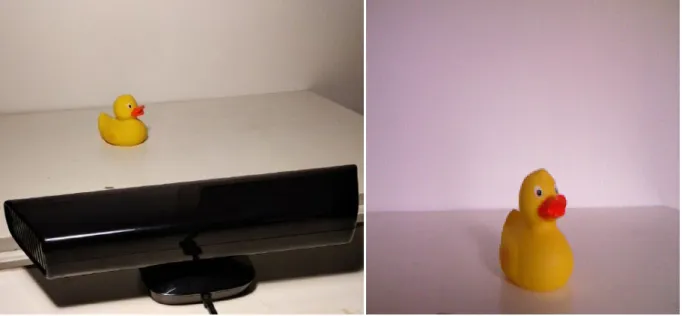
In front of this stationary sensor a small object is presented for the system to recognise, as shown in Fig-ure 2. This system lacks of any mobility by itself, but it could be extended with other modules that control movement or other RGB sensors. This is due to the fact that our implementation just controls the RGB sensor through ROS, the object recognition and the human interaction (dialogue) with the robot. Therefore, it could potentially be implemented as another module in a movable robot which uses ROS, as far as it has an RGB camera. This potential portability to other hardware systems is one of the main benefits of using the ROS framework for this project.
This project does not use the camera depth sensor, but only the RGB one. The KILLE robot (de Graaf, 2016) uses the depth sensor to remove the background (everything more than 100 cm from the camera position) and foreground (less than 70 cm, which is also the minimum distance of the depth sensor for perceiving objects) of the images taken by the camera, so just the object appears on the final image with a white background, as shown in Figure 3. This is an easy way to get attention over the objects, so the background does not interfere in the recognition process.
However, using the depth sensor filter has some shortcomings. Firstly, since the the laser emitter and the camera of the depth sensor are separated about 7 cm from each other (Figure 1), the infrared image which represents the depth and the RGB image have a small deviation. Consequently, the final image with the removed background tends to cut one side of the objects. This issue can be addressed by moving the background filter image a few centimeters to get acceptable results as in Figure 3, but it is not perfect and the cutting is a lot worse with smaller objects.
Another issue of the background filtering related to the size of the objects is given by the limitation on the distance at which the objects can be relative to the camera. Since we can only place objects at 70 to 100 cm from the camera, this makes very small objects (e.g. a pen or a clothespin) very difficult to recognise as they are seen from far. Big objects (e.g. a chair or a big box) would be also impossible to be seen entirely by the camera with the background filtering. This background filtering distance can be changed since the depth sensor can perceive objects up to 300 centimeters of the camera, but extending it would also make more difficult to separate the object of interest from the background objects in certain enviroments (e.g. small rooms).
Our implementation is not making use of the background filtering because of the shortcomings detailed above, specially the problems that has with seeing small objects from too far, which combined with the depth sensor deviation makes almost impossible for the camera to see these small objects. However, the depth sensor filter is implemented in our system but deactivated, so it would only take editing some few lines to enable it.
1
Figure 1: The Microsoft’s Kinect v1 RGB-D sensor2. (1) is the 3D depth sensor which consists of the infrared laser projector (left) and the infrared camera (right). (2) is the RGB sensor, (3) is a microphone array and (4) is a tilt motor.
Figure 2: The robot setup (left) and what the robot is seeing with its RGB sensor (right).
Figure 3: The input from the depth sensor (left), the input from the RGB camera (center) and the RGB with the filtered background (right). Since the glass support is not detected by the camera, only the object appears in the final image.
2
Our implementation consists of three Python scripts which act as different modules: one (dialogue.py) controls the dialogue management; the second (matchingnets.py) contains the neural network model for online training and some functions to collect and encode the images that will be used in that session; and the last one (recognise.py) acts mainly as a bridge that communicates the actions prompted by the dialogue management and runs the neural network model for object recognition. For processing the images inputs from Kinect to be able to use them on the Python script, we use the Open Source Computer Vision (OpenCV) library (Bradski & Kaehler, 2008) , ”which is a popular library for computer vision including real-time machine learning applications” (Dobnik & de Graaf, 2017b, p. 3).
We have set up a public GitHub3 repository so anyone can have access to the code of this project and the published dataset (for the dataset, see Section 3.3).
3.2
Neural network model
Our deep neural network model is implemented inside the scriptmatchingnets.pyand it consists of two independent modules: a deep convolutional image encoder and the image classification layers.
3.2.1 Image encoder: transfer learning
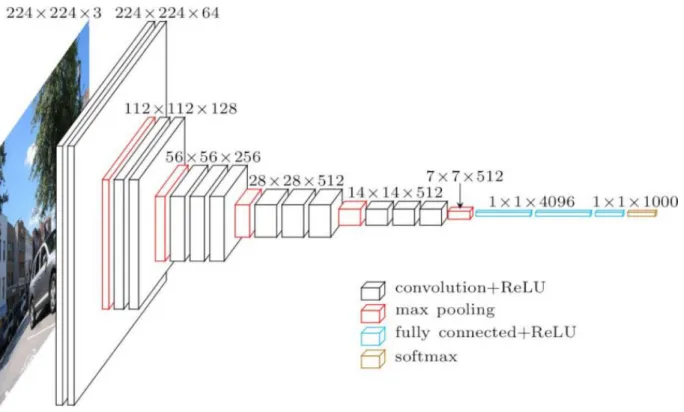
For the image encoding module, we utilise the VGG16 (Simonyan & Zisserman, 2014), one of the first very deep convolutional neural network (CNN) architectures. As they demonstrate, these deep CNNs are very accurate for ”classification and localisation tasks” (Simonyan & Zisserman, 2014, p. 1). VGG16 encoding layers consist of stacks of convolutional layers which ”use filters with a very small receptive field: 3 x 3”, followed by max-pooling layers (Simonyan & Zisserman, 2014, p. 2), as shown in Figure 4.
In our system we use VGG16 as it is implemented in Keras4, a library for machine learning with neural networks for Python. The same library has available for downloading and using a VGG16 model already pre-trained on the full ImageNet dataset (Russakovsky et al., 2015). For this project, we are only interested in using the CNN and max-pooling layers pre-trained for image encoding. That is, we only use the layers which encode the visual features of the images which are then applied in the second module of our neural network (Section 3.2.2).
One of the contributions of this project is the usage of learning transferred from a large dataset of images for classification such as ImageNet (Russakovsky et al., 2015) in a robot framework. That is, we use the CNN layers of the VGG16 model specified above so we do not need to train a new CNN model for image encoding, because we can reuse the knowledge that the model has learned from being trained on a large dataset to encode the images that our robot is using. The question we try to answer here is if this background knowledge trained on pictures taken by humans would be useful for the system to discriminate objects selected in our scenario.
(Yosinski et al., 2014) points out that the benefit of using a pre-trained networks decreases when the task or the data employed in the pre-training stage is very different from the target task, although they found that initializing a target task even with ”features transferred from distant tasks are better than random weights” and that transferred features help improve performance ”even after substantial fine-tuning on a new task, which could be a generally useful technique for improving deep neural network performance” (Yosinski et al., 2014, p. 8).
3https://github.com/jcanosan/Interactive-robot-with-neural-networks 4
Figure 4: The complete VGG16 neural network5. In our implementation we only use the image encoder layers (black and red ones) pre-trained on ImageNet.
The task of both the pre-trained VGG16 model and the neural network that we use in our robot is the classification of a target image. In the same way, both the image data of ImageNet and the images taken by our robot are similar in a way that all of them are prepared for singe object classification, even if they reflect different objects and situations. Therefore, since the task is the same and the data is quite similar, the impact of the transferred knowledge in our system is expected to be positive.5
In Section 4 we will discuss the impact on our system performance of using this knowledge transferred from a large dataset.
3.2.2 Object classification: matching networks
Matching Networks (Vinyals et al., 2016) is a neural network algorithm designed for one-shot learning and image and text classification. Its principal advantage is the capability to rapidly learn objects from few observations. That is to say, it is an image classification algorithm which can be trained on one or few image samples and achieve reliable performance (Vinyals et al., 2016).
As the main contribution of our work, we present our implementation of Matching Networks in a robot scenario with interactive grounding. This algorithm has been evaluated in standard image classification sets (Omniglot (Lake et al., 2015) and ImageNet (Russakovsky et al., 2015)) to compare its performance with different baseline algorithms for image classification (Vinyals et al., 2016). As its capacity to learn visual objects fast from very few samples is demonstrated as reliable in the original paper, we considered this algorithm as a possible candidate to be ported to a robot scenario in online interaction with a human tutor.
5
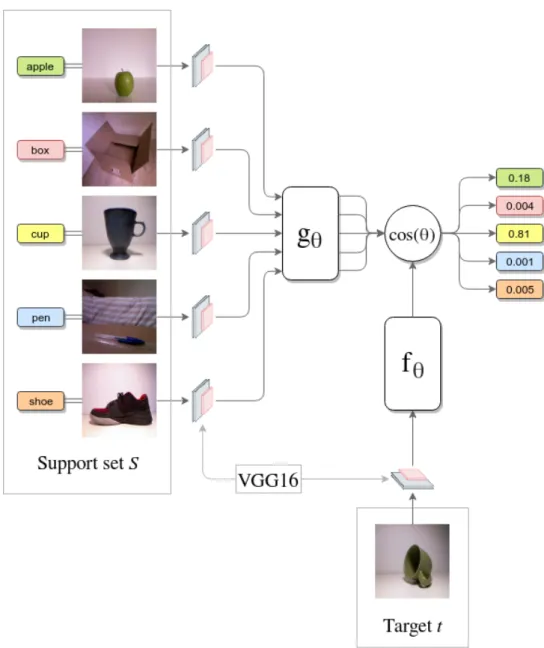
Figure 5: Example diagram of our neural network model for a 1-shot learning task of 5 labelled categories. The five labelled images of the support set (S) are encoded by the VGG16 convolutional layers and the embeddings processed by the g function to learn the dependency of the features between the images of
S. In a similar way, the unlabelled target image (t) is also encoded and embedded by its own functionf. With both embedding functions, the matching network computes the cosine similarity between thetand the different images ofSand outputs the similarity scores for the different labels ofS. That is, how similar ist
with the different categories. In the example above, we can see that the output scores reflect thatthas a lot more similarity with the image labelled ascupinS, which makes this an example of a correct classification.
Our matching network version is implemented through TensorFlow6, a Python library for machine learning and dataflow. We could have used Keras as we did in the image encoder module because it is more simple to build a neural network in that package. However, TensorFlow has two main advantages identified during the first steps of this project: it is more customizable and it performs faster.
As shown in Figure 5, the Matching Networks algorithm works by comparing an unlabelled target image (t) with the labelled images of a support set (S) to determine how similar istto the images of the different
6
categories ofS. It is one-shot since the Matching Networks are able to learn the features of the different categories ofSfrom even one single image sample per category, although we will discuss in Section 4 if it is reliable enough with one image per category or if we need more.
In each training instance our model takes a support setS withklabelled images (each one with a size of 224x224 pixels) of each of thencategories of objects and a target imaget, which is not labelled but pertains to one of the categories ofS. All the images are encoded through the VGG16 module described earlier (Section3.2.1 and passed to our matching network module.
The first main difference between the (Vinyals et al., 2016) Matching Networks and our own adaptation is that the original one does not treat the image encoding layers as a separated module, but as a part of the entire matching network algorithm. Our modular setup has the advantage of allowing us to train each module independently of each other, which allows us to use pre-trained VGG16 as we described in Section 3.2.1, instead of having to train the CNNs along with the matching networks. It also allows our implementation to potentially use any image encoder algorithm with our matching network module.
The input of this module takes the encoded images ofSandtand performs two operations on these images. Firstly, it learns the dependency of the features between the images and classes of the entireSset through the embedding functiong. In the same way, the target imagetis also embedded throught its own function
f.
In these embedding functions our model presents significant differences compared to the original work. (Vinyals et al., 2016) use a Bi-directional Long-Short Term Memory (BiLSTM) as thegfunction to learn those dependencies of the images and categories ofS, and forta normal Long-Short Term Memory (LSTM) as thef function with ”read-attention over the whole setS” (Vinyals et al., 2016, p. 3).
Both LSTM and BiLSTM assume a specific order over the categories of theS set which is not discussed in the paper. LSTMs encode ordered sequences and this is beneficial to get dependencies in texts, in which order matters as well. However, for an image classification task that does not seem important since the categories and images do not seem to need any specific order to be classified. Therefore, we thought that a more simple solution would be enough to get reliable results, so we only concatenate the images vectors to learn the embedding functions, but the order of categories is random.
After obtaining the output from the embedding functions, the model computes the cosine similarity of the features of the targettand the features of the images inS. By computing the cosine similarity, the model is able to learn the relevant dependencies of features ofS (g) andt(f) when training and, therefore, making the cosine similarity function more effective in further epochs.
Once the cosine similarities have been calculated, similarity scores are computed over thencategories so we get one score per each of the categories inS. These results are computed through a Softmax function so they are normalised and may be presented as a probability distribution in which all the scores add to 1. These scores give us the likelihoods of the targettbelonging to the categories of the images inS.
3.3
SOTA dataset
One of the contributions of our work is the creation and publication of the SOTA image dataset (Small Objects daTAset). This consists of a small collection of 400 images with a size of 224x224 each, which is the image size that VGG16 uses by default. As shown in Figure 6, each image depicts a single small object with more or less details in the background, so we have more varied situations in our domain. In general, since we are not using the background filtering in our implementation, it is intended that the object
Figure 6: Five samples from different categories of the SOTA dataset.
The images in SOTA are distributed equally over 20 categories: apple, banana, book, boot, bottle, box, clothespin, cup, desk lamp,glass, laptop, marker, pen,rubber duck, screwdriver,shoe,spoon, stuffed toy, thermosandtoilet tissue.
As images are classified in categories, this dataset is suitable for evaluation of few-shot learning tasks. However, it could be expanded or utilised alongside with a larger corpus for single object classification tasks.
As stated in Section 3.1 the SOTA dataset is published in the GitHub repository for this project.
3.4
Training strategies: implementing Matching Networks to a robot framework
Matching Networks are capable of learning objects by being trained fast on very few image samples (Vinyals et al., 2016). However, one of the main potential shortcomings that we saw earlier when studying the original Matching Networks is that is that they need to be previously trained, including the CNNs. For this reason, we have chosen to separate the image encoding layers from the matching network layers, as explained in Section 3.2.2.
This makes our implementation a lot faster faster when learning objects online since we do not need to train the VGG16 encoder. Instead, encoding the images with the pre-trained VGG16 module takes about 2.5 seconds for 200 images, as demonstrated in the experiments in Sections 4.2 and 4.3. However, we have to point out that those times have been measured when running the neural network on a graphics card (Nvidia 1050Ti), but we have also observed that it takes longer to encode the images when running on a CPU (about 20 to 25 seconds for the same number of images). To avoid these longer encoding times when interacting online with a robot, in our setup we encode the images once when starting the robot interaction process and then we save the encoded images. Therefore, we do not need to encode again all the images of the support set incrementally to retrain our matching network module in the same session, just the new images that come from the camera when interacting, which are encoded almost instanly since they are never more that one at the same time.
In this section we will detail and compare the two different interaction strategies: the original strategy used in (Vinyals et al., 2016) and the one designed for this robot.
3.4.1 Original training strategy
In the original paper, Vinyals et al. (2016) designed a training strategy for their Matching Networks in which they pre-train the neural network on different small batches ofncategories withkimages each, and then they use that pre-trained model to classify images on a new batch of different categories (although they need to have the always the same number of categories and images), effectively learning new categories using knowledge transferred from other categories.
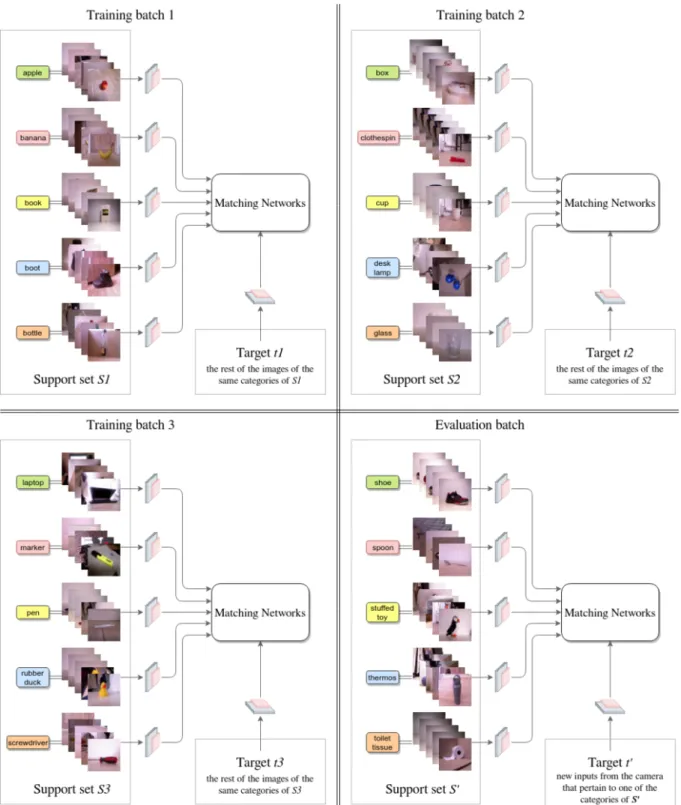
Figure 7: Training strategy for the matching networks as it is in (Vinyals et al., 2016). We train the matching networks on three different batches of labels and use another one with different labels for evaluation on the new inputs of the robot.
This is more clearly explained with an example, which is illustrated in Figure 7. If we want to train a model using their strategy for classifying five categories we should take a dataset, for instance our SOTA dataset. Then we would separate the 20 categories of SOTA into batches of five categories and takekimages per category (e.g. one image) and train the model using the first five categories. That is, we train a model on a support set (S1) of five categories with one image per category. However, instead of stopping here, we can
model which has been trained on three different batches of categories. The target images (t) for the different training rounds are the rest of the images of the same categories labelled (in this example, 15 images per category since the SOTA categories have 20 images each).
• 1st batch (S1,t1):apple,banana,book,bootandbottle. • 2nd batch (S2,t2):box,clothespin,cup,desk lampandglass. • 3rd batch (S3,t3):laptop,marker,pen,rubber duck,screwdriver.
• Evaluation batch (S0,t0):shoe,spoon,stuffed toy,thermosandtoilet tissue.
Instead of using the last of the batches (S0) to continue training the model, it is used for classification. That is to say, we take the model pre-trained on the first three batches, build anS0with the test batch (it needs to be of the same size of the other support sets used for training the model) and use thisS0to classify unlabelled target images that pertain to the four batch. Therefore, we are not training the model again on the test batch
S0, but using the knowledge acquired fromS1,S2andS3to build the embeddings ofS0 directly when we try to recognise a target image that pertains to one of the categories ofS0.
Still, we need to point out that it is necessary a dataset much larger than SOTA to train effective models with this level of transferred learning. That is, we are transferring knowledge totally from totally different categories as we do in the VGG16 module, which is pre-trained on ImageNet.
The training strategy of (Vinyals et al. 2016) implies that we need different models for each possible size of the support setS. In a trained matching network model the size of S is fixed, meaning that no more categories or images can be added to that model. For instance, if we train a model for anSof five categories and one image per category, we cannot use this model to classify with anSof six categories or three images per category. We would need to pre-train another matching network model on that new size ofSto have this option.
3.4.2 Training strategy in our robot scenario
For simplicity and to avoid pre-training a lot of models on large datasets, which would take a lot of time, in our robot setup we use a simpler strategy, but faster to train and reliable enough to evaluate the performance of the matching network for our robot scenario. Also, this training strategy does not require a big dataset of images to perform reliably.
We have to take into account that the strategy used in (Vinyals et al., 2016) is also training the CNN encoding layers along with the Matching Networks, which increases training time. As we are using the CNN layers of a pre-trained VGG16 model with the learning transferred from a large corpus, we are able to skip the training time of the CNNs when learning objects online with the robot and then we only need to train the matching network module, which is more convenient in a robot scenario since it makes possible to train the model online while interacting because it is fast enough, as we will see in Section 4.
We have divided our strategy in two phases: training and prediction. The two phases are illustrated in Figure 8.
In the training phase, we build a support setS with a few (k) images of each labelled class (n). Then, we build a target settwith the same images that we used to buildS, and use it as a target to train our model. Then, we are usingSas both support set and target in the training phase.
Figure 8: Training strategy for the matching networks in our robot scenario. We train the matching networks with the same support set (S) that we use for the prediction phase.
In the prediction phase, we use as support set the same images that we used asSfor training, and classify the targett, which is a new input from the camera taken when the user requests the system to recognise an object which should belong to one of the categories ofS.
This training of the matching network is performed online every time the robot needs tolearn a new category orupdateits knowledge of one of the already learned categories.
Tolearn a new category, the system takes the images taken from the camera of the new category and includes them in theS set. For instance, if we had a model trained on anSof five categories and five images per category and the robot is trying to learn a new category, it would add five images of the new category toS
and train a new model on the newSwhich now has of six categories. If there are not enough images in the dataset of images taken by the camera to learn a new category (that is, at least five images), the robot will ask the user for more samples of that category instead of learning it, as it is explained in Section 3.5. Toupdate (or improve) the knowledge of an already known category, the system will include in theS set the new image taken by the camera and train the model with the newS. This update ofS is performed when the user presents an object to the robot, when it assigns an object the wrong category when it tries to recognise the object or when the robot is not confident enough that an objects pertains to a category, even if it has recognised the category of the object correctly. This is further explained in Section 3.5.
With few images and categories training is really fast, as demonstrated in experiments (Section 4). However, asSgrows, so does training time. In interactive learning with a robot, it is expected that the system would need to constantly learn new objects and categories. Therefore, having to wait for retraining the model every time we change the size ofSis not good from a user perspective.
In further work, a possible way to avoid that could be to configure the system so it only trains a model when the user is not interacting. However, a more effective way of skipping the time that takes the online training
phase would be implementing transfer to different categories, as it is done in the strategy by Vinyals et al. (2016) explained above. That is, splitting some training offline on a large dataset and then doing recognition comparing a new targett image taken with the camera and a support setS built with the images of the objects that were taken earlier with the camera. ThisSwould be the objects that the robot already knows, and thetimage the object that is trying to recognise (which should belong to one if the categories inS). With effectively pre-trained matching network models in large datasets, we could skip the online training phase and take full advantage of that transferred learning in our neural network.
We will compare and discuss the impact of using both training strategies for our matching network in Section 4.2.
3.5
Learning objects through interaction
Robotic systems need to acquire constantly new knowledge about their environment and the objects present in it. In grounding, interacting with a human tutor can benefit a system a lot because the conversational partner is able to control how the information is presented to the system by their context (Skočaj et al., 2010). Also, the human can controlwhenthe system should improve. In the context of our situated system, that ishowthe support dataset should be built andwhenthe matching network should be trained to improve object recognition.
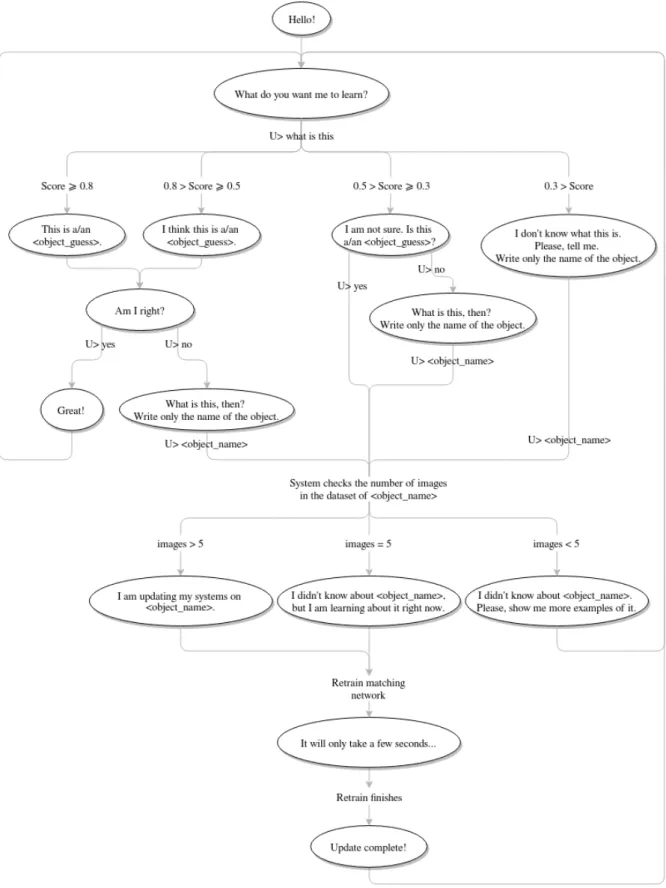
Dialogue management in our robot is implemented in a very simple way in the Python scriptdialogue.py. It supports text inputs and outputs and it is state-based, as shown in Figures 9 and 10. User inputs are con-troled by Python defaultraw inputfunctions, while system outputs are Python prints on screen.
The KILLE robot (de Graaf, 2016) used for dialogue management theOpenDialtoolkit (Lison, 2014), a Java voice-based free and open dialogue management system connected to ROS through a custom module calledROSDial. This library has not been implemented in our work as we do not require a sophistication of a full dialogue manager to implement in our experimental system. However, the dialogue rules we have could be integrated with the dialogue management in a complete system.
Our situated dialogue system uses two major dialogue strategies to learn objects, which are based on the original KILLE framework (de Graaf, 2016).
Firstly, Figure 9 shows that the human tutor can present the object (e.g. This is an apple), in which case it saves the image of the mentioned object in the dataset. After that, the system checks if there are enough instances of that category in the stored image dataset to train the system reliably.
If the number of images equals the threshold of five images (this chosen threshold will be further discussed in the experiments of Section 4), the systemlearns the new category(e.g. I am learning apple), or if there are more than five images itupdatesits knowledge of the object (e.g. I am updating my systems on apple), as explained earlier in Section 3.4. If there are less than 5 images in the dataset, the system requests the human tutor to show it more instances about that category (e.g. Please, show me more examples of apple). Secondly, the robot can also handle that the user queries it about an object, as shown in Figure 10 (What is this?).
In this case, the robot attempts to recognise the object presented and answer the question. Depending on the certainty of this guess (that is to say, the classification confidence score retrieved when recognising the target image from the camera with the matching network), the system prompts one between four possible answers. Such answer strategies for continuous learning of a robot are based on the work of (Skočaj et al., 2009), who propose dialogue strategies which depend on the recognition confidence score that can be used
Figure 9: Interaction diagram for when the user presents an object (This is a/an [...]). User utterances are marked withU>.
on object classification tasks (see Section 2.3).
Based on that proposal, we have devised four possible system answers to the user-initiated query based on the confidence score of the category with the highest score. If that score is equal or higher than 0.8, such recognition has a very high confidence, and therefore the system answer communicates this confidence in its prediction (e.g. This is an apple). If the score goes from 0.5 to 0.8, then the ”recognition confidence is relatively high, however the robot is not certain about its current interpretation” (Skočaj et al., 2009, p. 4) and the system communicates the lack of confidence (e.g. I think this is an apple).
As can be observed in Figure 10, both strategies leave the user the option to unlearn (Skočaj et al., 2009), that is, if the recognition the system has made of the object presented is wrong, having the possibility to correct it and, therefore, it will take an image of the object that it tried to recognise, assign it the correct label and attempt toupdatethe system knowledge with the taken image in the correct category of the support set. Even with high confidence scores, this recognition may be wrong with categories which are visually very close (e.g. boot vs. shoe, orpen vs. marker). If the recognition is right, in both cases the system considers that it does not need to update the support set of images or to retrain the matching network model. It takes the image of the object that is seeing and saves it into the dataset.
Figure 10: Interaction diagram for the user queryWhat is this?. User utterances are marked withU>.
cates doubt about the recognised category and ask the user directly for clarification (e.g. I am not sure. Is this an apple?). Here the user can say that the recognition is correct or amend the category with the right one, as it is done when having more confidence. However, in both cases the system attempts toupdatethe support set and retrain the model.
Lastly, if the confidence score is lower than 0.3, that means that the robot has not managed to classify the object correctly, and therefore it does not specify any category in its answer (I don’t know what is this. Please, tell me.). In this case, all the scores for all the categories tend to be very close and therefore the recognition is not reliable. The system needs to query the user about the correct name of the object. Once the robot has the right category, it attempts toupdateits support set and retrain the matching network.
As shown in Figure 10, in all of the cases described above that end up in updating the support set and the matching network, the system always checks if it has enough images to learn about the category specified by the user (as it is done in the first interaction strategy of Figure 9). It could be, therefore, that the user asks about an object whose category the robot has not learned beforehand (for instance, because the user did not know). Then, the system would tell the user that it did not know about that object if it does not have five or more images of the object in the dataset (e.g.I didn’t know about apple. Please, show me more examples of it.); tell the user that it did not know, but willlearn the new category in case it has five images of that category in the dataset (e.g. I didn’t know about apple, but I am learning about it right now.); orupdateits knowledge of the category if the robot already had the category in its support set (e.g. I am updating my systems on apple.).
4
Experiments and discussion
4.1
Experiment 1: System validation
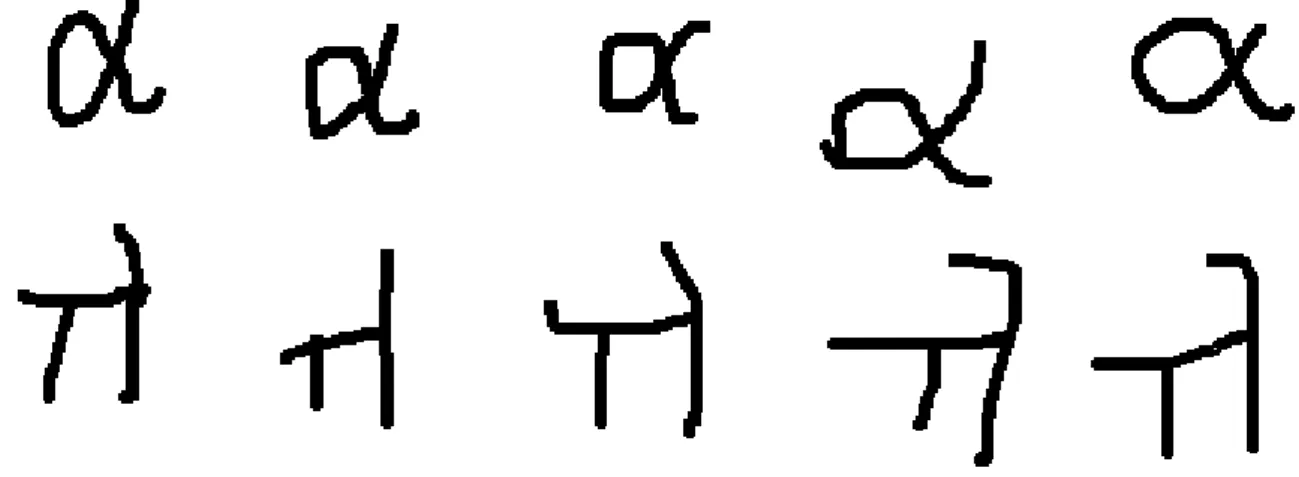
For this first evaluation of our model we use the Omniglot dataset (Lake et al., 2015), which consists of 1623 grayscale images that represent characters from 50 different alphabets (Figure 11). Each of the categories in this dataset contains 20 images of the same character hand drawn by different people, which makes this dataset ideal for evaluating few-shot learning tasks.
The main objective of this experiment is to compare our matching network performance on Omniglot with the model in (Vinyals et al., 2016). It is expected that both models have a similar performance since our matching network is built taking the former as a reference. Additionally, we want to evaluate the general performance on this dataset and the impact on performance and the time taken for training our matching network with different number of labels (5-way and 20-way) and images per label (1-shot, 5-shot and 10-shot).
Since the images in Omniglot are grayscale, deep neural networks such as VGG16 pre-trained on colour images are not suitable for this dataset. Therefore, we have built a simple CNN encoder similar to the one used in (Vinyals et al., 2016, p. 6): ”consisting of a stack of modules, each of which is a 3 × 3 convolution with 64 filters followed by batch normalisation, a Relu non-linearity and 2 × 2 max-pooling. We resized all the images to 28 × 28 so that, when we stack 4 modules, the resulting feature map is 1 × 1 × 64, resulting in our embedding functionf(x)”. For training this encoder, we use all the images from the Omniglotbackground split (19280 images divided in 964 different characters, each one being a category). After training the encoder, we take the resulting pre-trained CNN layers to encode the images (similar to what it is done in the robot setup with the VGG16 CNN layers). For testing the matching network, we use the Omniglotevaluationsplit, which consists of 659 different characters that are not in thebackgroundsplit, so we know for sure that the few-shot learned categories have never been seen by any of the modules of our network.
We use the training strategy that we use in our robot for this experiment (defined in Section 3.4.2). From the evaluationsplit, a support set (S) is taken to train the matching network layers as both support and target.S
hasnlabels (5-way or 20-way) andkimages per each label (1-shot, 5-shot or 10-shot), as seen in Table 1. The rest of the images of the same labels are taken as target (t) to evaluate the classification process (that
Model Metric 5-way 20-way
1-shot 5-shot 10-shot 1-shot 5-shot 10-shot
Accuracy 96.0% 99.0% 99.0% 71.0% 93.0% 98.0%
MN (ours) Encode time 0.94s 0.86s 0.98s 0.83s 0.81s 0.82s
Training time 1.40s 3.77s 6.76s 3.25s 11.81s 22.59s
Vinyals et al. (2016) Accuracy 98.1% 98.9% 93.8% 98.7%
Table 1: Omniglot experiments. The first column on the left marks which version of the Matching Networks (MN) are the results from: the one in (Vinyals et al., 2016, p. 5) or ours.
is, 10 images per label).
We show in Table 1 the results of the experiment. Accuracy is almost the same across the different number of shots in 5-way, but with more categories it is more clear that (Vinyals et al., 2016) matching network performs better. However, we do not know which categories of the Omniglotevaluationdataset they used to evaluate their models and we have observed that evaluating different categories changes the results a lot, specially for 1-shot.
We can also observe that having at least 5 images clearly helps the model perform way better, but it also increases the training time significantly, specially as more labels are added to the model. It is also clear that the encoding of the images is really fast.
4.2
Experiment 2: Transfer Learning and Training Strategy
In the second experiment we use miniImageNet, an ImageNet split of 60,000 images distributed equally in 100 categories (600 per category), which makes this dataset more suitable for ”rapid prototyping and experimentation” (Vinyals et al., 2016, p. 6) than the full dataset. Since the categories used in (Vinyals et al., 2016) were not released with their dataset, our splits are the ones proposed in (Ravi & Larochelle, 2017)7. These 100 categories are divided into three splits: 64 for training (trainsplit), 16 for validation (val) and 20 for testing (test).
In this experiment we will evaluate two different VGG16 encoders.
Firstly, we pre-train a VGG16 encoder with all the images from miniImageNet train+val splits (48000 images in all, 80 categories). We have performed this pre-training in 100 epochs and with a batch size of 64 images. Then, we save the encoding layers for encoding the images later. This setting replicates the pre-training of the encoder layers that Vinyals et al. (2016) perform in their experiments, so we can compare our results with the performance of their model.
Secondly, we take the VGG16 CNN model already pre-trained on the entire ImageNet, which is the same model downloaded from Keras and that we use for in the robot enviroment (as explained in Section 3.2.1). In this setting, we are using transferred weights from a dataset which is much larger than miniImageNet, so we can compare how much it benefits from having an encoder pre-trained on a large dataset.
In this experiment we are also evaluating the two training strategies described in Section 3.4 in our matching network: the original one (Vinyals et al., 2016), and the one designed for our robot.
7
Figure 12: Ten samples from two labels of the miniImageNet dataset.
Firstly, we replicate the strategy of (Vinyals et al., 2016). As explained in Section 3.4.1: we takekimages (1-shot, 5-shot or 10-shot) ofncategories (5-way or 20-way) of thetrain+val split of miniImageNet to build the support set (S) that we use to train the matching network. We use the rest of the images of the same categories as target (t) for training the matching network. We then retrain our model on a different batch ofncategories andkimages per category. We do the same continuous training until we have trained our model on all the categories of the miniImageNettrain+val.
After training, we evaluate the classification on a support set of the same size built with the test split of miniImageNet, which are completely new categories not seen during the training stage. The rest of the images of the same categories of thetest split (590 images per category) are used as target to measure the classification accuracy.
Secondly, we use the same training strategy that we use in our robot enviroment as described in Section 3.4.2. In the training phase, we build a support set (S) from thetestcategories which haskimages (1-shot, 5-shot or 10-shot) ofncategories (5-way or 20-way) and train our matching network usingSas both support and target. After that, in the evaluation phase we take the sameSas support set and measure the accuracy of the model using as target for classifying the rest of the images of the samencategories (590 per category) that we used to buildS.
Comparing these two training strategies we can check if it is really necessary to train our matching network to differentiate the labels that we want to classify, or if we can pre-train it in other labels and transfer this knowledge to classify thetestlabels.
Therefore, we have four different settings for this experiment:
• VGG16 pre-trained by us on miniImageNet train+val and using the training strategy in (Vinyals et al., 2016).
• VGG16 pre-trained on the entire ImageNet (Keras model) and using the training strategy in (Vinyals et al., 2016).
• VGG16 pre-trained by us on miniImageNettrain+valand using our training strategy. • VGG16 pre-trained on the entire ImageNet (Keras model) and using our training strategy.
VGG16 set Training Metric 5-way 20-way
strategy 1-shot 5-shot 10-shot 1-shot 5-shot 10-shot
miniImageNet Vinyals Acc 20.2% 22.2% 24.6% 7.7% 9.8% 11.4%
ImageNet Vinyals Acc 29.7% 44.1% 43.9% 12.3% 25.1% 27.2%
miniImageNet Ours Acc 35.1% 48.0% 49.8% 13.4% 22.4% 26.9%
ImageNet Ours Acc 75.8% 89.8% 98.8% 52.5% 74.2% 82.6%
All All Enc time 1.20s 1.56s 2.02s 1.34s 2.11s 2.42s
All Vinyals Train time 241s 296s 343s 202s 260s 313s
All Ours Train time 1.41s 4.06s 7.50s 3.50s 13.70s 24.50s
Vinyals et al. (2016) Acc 46.6% 60%
Table 2: The first column at the left specifies the dataset in which the VGG16 encoding layers are trained. The second one specifies the training strategy, whereVinyalsis the one used in (Vinyals et al., 2016) (de-scribed in Section 3.4.1) andoursis the one used in our robot enviroment (Section 3.4.2). We also keep track in the last rows of the time that the system needs to encode the images and to train the matching network. Finally, in the bottom we show the results reported in (Vinyals et al., 2016) for comparison.
pre-trained on the largest dataset (ImageNet) and the training strategy used in our robot, which is higher than the results in (Vinyals et al., 2016). However, we cannot compare with more categories since (Vinyals et al., 2016) does not show results for 20-way models.
Additionally, it is clear that for our model, our training strategy demonstrates to be more effective in perfor-mance than the Vinyals one. However, that is expected because Vinyals strategy uses learning transferred from other categories to evaluate new ones, while our strategy trains a model on the same categories that we are using in evaluation. However, since training is demonstrated to be fast with our strategy (as shown in Ta-ble 2) and performance is also much better, our strategy is more convenient for our robot object recognition module.
We can also observe in Table 2 that the models that we have trained and that use (Vinyals et al., 2016) training strategy (the first two rows) perform worse in our model than in the one in the original paper, even with the weights trained on the entire ImageNet. Since the difference between both Matching Networks is that we have simplified the embedding functions by removing the BiLSTM (in thegfunction forSset) and the LSTM (in thef function fortset), we can hypothesise that the drop in performance is probably caused by this difference.
However, it is also a possibility that the drop in perfomance is caused by the fact that we do not know what training parameters are used to train the original model, since (Vinyals et al., 2016) does not report them. For instance, what loss function, optimizer, learning rate, number of epochs or batch size are used for training their matching network model.
It is also clear that having VGG16 pre-trained on the largest dataset (ImageNet) is better in order to take full advantage of learning transferred from another dataset. No matter the training strategy that we use, accuracy improves a lot in all the cases in which the image encoder is trained on ImageNet.
4.3
Experiment 3: Baseline evaluation
In this experiment we use images from the robot’s camera (SOTA dataset, described in Section 3.3) with which we can simulate object recognition of the robot without any interaction strategy which therefore serves
VGG16 set Metric 5-way 20-way
1-shot 5-shot 10-shot 1-shot 5-shot 10-shot
Accuracy 38.0% 56.0% 56.0% 9.0% 13.5% 22.5%
SOTA Encode time 1.11s 1.51s 2.12s 1.45s 1.94s 2.57s Training time 1.45s 4.03s 7.07s 3.15s 12.46s 26.13s Accuracy 66.0% 90.0% 94.0% 41.5% 71.0% 86.5%
ImageNet Encode time 1.12s 1.63s 2.15s 1.41s 1.93s 2.39s
Training time 1.43s 3.57s 7.27s 3.26 12.15s 25.99s
Table 3: Experiments on SOTA. The first column on the left marks the dataset used to train the VGG16 encoding layers.
We use two differently trained VGG16 encoding layers in this experiment. Firstly, we take the SOTA dataset (400 images) and pre-train VGG16 with it. Secondly, we compare it with the encoder pre-trained on ImageNet to observe how is the robot benefitted from being trained on a large dataset instead of using the same images of its domain for training the encoding layers.
For both settings we use the same training strategy. That is, the one used in our robot enviroment (Sec-tion 3.4). As in the previous experiments, we take a support set (S) withnlabels (5-way or 20-way) andk
images per label (1-shot, 5-shot or 10-shot) and use it as support and target sets for training, and as support set for the evaluation phase. As the target set for evaluating the model, we take the remaining 10 images per category. That is, the ones that have not been used to train the model.
Results in Table 3 show that, even with the VGG16 pre-trained on the same images that we use to evaluate the model, it still performs much better when it is pre-trained in a large dataset. Therefore, we can definitely conclude that it is clearly beneficial to have the transfer learning from large datasets in the image encoder module, even more than having an image encoder specialised in our domain. However, it is also worth noting that SOTA is too small to train an effective image encoder on it.
This experiment is also useful to measure the baseline performance of our model in the robot domain, since all the images in SOTA were taken with the robot camera. Although 1-shot per category would be an ideal setting in terms of the time performance, results demonstrate that we need more images per category to achieve good recognition performance. As we see these results and the ones in the experiments in Sections 4.1 and 4.2, five images per category seems the optimal setting for achieving good performance with reasonable training times. Therefore, it is the one that we use for our robot.
We have to remark that in this experiment we have not applied any selection of the support dataset. That is, we have taken images from SOTA at random to buildS with them (but a fixed selection of images so we can reproduce the experiment with the sameS). Different selections of a support set might improve or worsen the performance of the system.
We also did not test the perfomance on the same or different objects of the same category (de Graaf (2016) does it). Maybe for each object of a category in the dataset it is only needed one image sample in the support set, but in the case of our SOTA dataset some categories only have very few different objects, and we would need at least five different objects per category to run that experiment. It would be worth comparing the performance on a dataset where there were images of different objects of the same categories. Implementing a way to control the selection of the support set would be a great asset for our robot.
4.4
Experiment 4: Building a support set with images from another domain
In this experiment we investigate how well our matching network is performing when taking images from another domain. These images from the same labels but taken with other cameras (e.g. images from online datasets taken in different situations and eviroments). The objective is to demonstrate that our framework can benefit from taking images of the same categories but from other domains and pre-training our model on these.
We have collected a small dataset, which we will call SOTA-external, with images extracted from the In-ternet, specially from ImageNet or Flickr. These images depict an object of the same 20 labels available in our SOTA dataset, so we can build a support set with up to five images per label (100 images overall). Due to copyright issues, SOTA-external cannot be published.
In this experiment we keep the VGG16 weights trained on the entire ImageNet, since we have demonstrated that this is the most favorable setup. The focus here is in the building of the support dataset and the training strategy itself.
We have devised two different training strategies for this experiment. Firstly, we build a support set (S) with the images from SOTA-external and useS as both support and target to train our matching network. In the second scenario, the support set for training is the same SOTA-external data, but the target set are the images from SOTA. For evaluation, the support set is always SOTA-external and the target are the images from the SOTA dataset because those are the objects that our robot is trying to recognise and are taken with its camera.
These two scenarios are performed to test if it is sufficient to train our model using the data from another domain, or if it is better to have images from our domain to compare them with the ones from the SOTA-external. These results will be compared with the baseline established in the previous experiment.
As shown in Table 4, performance with few categories is almost equal in both settings, but with more categories it is clear that using the images from our robot domain (SOTA) astfor training is clearly better than using the images from the Internet domain (SOTA-external). Comparing the performance of the second setting with the baseline results (Table 3), the performance of the second setting is better than the baseline (except in 5-way 5-shot).
It seems possible to use images from other domains as support set in our robot scenario without having images that could be used as target to train. Although there is a gap in performance, the system still performs acceptably. However, the first scenario is only a baseline: it performs well but also shows that domain adaptation is necessary. That is, the robot must learn a locally adapted model. The second scenario shows that transferred learning from another domain helps in comparison to domain-specific learning only. For instance, if there is a scenario with a new room in a house in which the robot has not been trained (e.g.
Train support set Train target set Metric 5-way 20-way
1-shot 5-shot 1-shot 5-shot
Internet data Internet data Accuracy 71.1% 91.1% 39.4% 60.0%
Internet data SOTA Accuracy 75.6% 86.7% 53.3% 73.9%
Table 4: Experiments with images from another domain. The first row shows the accuracy of the model trained using the SOTA-external dataset as both support and target set, while the second row shows the model trained using SOTA-external as support and our dataset as target.
the kitchen), the robot could have pre-learned categories for common objects in the kitchen (e.g. plate, spoon, cup, glass, etc.). Then, we can improve this knowledge with new images and labels taken in the actual scenario with the user’s robot camera.
However, it is worth remarking that these experiments have been performed with handpicked images that show one or two objects of the same category as the ones available in SOTA. In a real scenario with a robot, selecting the images from another domain as support data would require a labeled corpus that contains the same kind of images (such as ImageNet).
External corpora may be useful also to learn new categories, since we can complement the inputs from the robot camera with images extracted from another domain to learn new categories efficiently from the first input.
4.5
Experiment 5: Learning new classes of objects
The objective of this experiment is to test how the system learns new labels. That is, we want to know how many images are needed for our robot to recognise efficiently a new label and therefore what are the implications of learning new labels for modelling interaction strategies of a robot.
We have designed a simulation of this learning process for each of the labels in SOTA, as shown in Figure 13. We simulate the learning process by training matching networks on 19 labels with five images each, which represent the categories that the robot already knows, and then adding the remaining label in SOTA to the support set which is learned from 1 to 5 images and represents a newly learned category.
For instance, for the first columnapplewe train a matching network model on a support setSbuilt with the other 19 labels of SOTA plus the 1-shot learnedapple. We also train four more models with 2-shot, 3-shot, 4-shot and 5-shot learnedapple. Sis also used as target for training, as it is done our robot training strategy (Section 3.4.2).
In the evaluation phase we take the sameSset and test the recognition accuracy ofappleon the remaining 15 images of the same labelapplefor each of the models, which are thetimages for the model to classify. We repeat that same procedure until we have the five models evaluated for each new label.
Figure 13 shows that four to five images are necessary for most of the labels to have a reliable object recognition. Also, some labels are clearly easier to learn than others. For instance,bottle,box,clothespin andmarkerdo not reach more than 40% accuracy in the best case, whileapple,bookandstuffed toydid not need more than three images to get to about 80% accuracy.
Perhaps needing 4 or 5 images for most of the newly learned labels for an effective learning might be due also to the negative effect of not balancing the support set, since all the other labels have 5 images each. Further work should validate what happens if we increase to 10 shots and try more unbalanced sets.


![Figure 9: Interaction diagram for when the user presents an object (This is a/an [...])](https://thumb-us.123doks.com/thumbv2/123dok_us/1985520.2794869/22.892.180.714.100.650/figure-interaction-diagram-user-presents-object.webp)