XXVII Ciclo
Methods and Techniques for Enhancing Physical
Security of Critical Infrastructures
Author:
Dr. Annarita Drago
Supervisors:
Prof. Valeria Vittorini
Dr. Concetta Pragliola
Coordinator:
Prof. Franco Garofalo
A thesis submitted in fulllment of the requirements for the degree of Doctor of Philosophy
Dipartimento di Ingegneria Elettrica e delle Tecnologie dell'Informazione
March 2015
stand the problems and you don't understand the technology."
Abstract
Dipartimento di Ingegneria Elettrica e delle Tecnologie dell'Informazione Doctor of Philosophy
Methods and Techniques for Enhancing Physical Security of Critical Infrastructures
one of the primary matters for the development of modern societies. Water, power, banking, transportation and communication systems are only a few examples of essential infrastructures to daily human activities and their protection is a concept relating to the preparedness and response to serious incidents that could threaten them. The term protection is a broader concept in which three main aspects can be individuated: safety, security, and emergency. The safety aspects are out of the scope of this thesis, indeed, the focus is on security. In particular, this investigation will address the concerns of security tied to physical and human factors without considering those related to the cyber ones. This is because the present work is born in the railway context, where the attention is usually oriented to the physical aspects of security since, until now, a common practice has been to realize dedi-cated connections and isolated networks. With respect to the emergency aspects, only the advantages that a security solution can induce will considered. Physi-cal security is one of the most fundamental aspect of the protection. It concerns the use of physical controls for protecting premises, sites, facilities, buildings or other physical assets belonging to the critical sectors. The application of physical security is the process of using layers of physical protective measures to prevent unauthorized access or harm. This harm can involve terrorism, theft, destruction, sabotage, vandalism, espionage, and similar. A crucial element which contributes to improve the protection of critical infrastructures seamlessly is the technology. Thanks to fast technological progress, it is possible to build complex surveillance systems able to integrate heterogeneous sources which can monitor environments potentially at risk. In this way, resilience may be accomplished, for example, through hardening the system by adding redundancy and robustness. However, for enhancing signicantly the protection level, integration of dierent technolo-gies is not enough, but a collaborative approach is essential. A strong protection calls for interoperability not only among ICT systems, but also among dierent operators, organizations, companies, and any other entity belonging to the public security sector. Nevertheless, the security designer must determine how best to combine elements like fences, barriers, sensors, procedures, security systems, and security personnel into a Physical Security System (PPS) that can achieve the protection objectives. For this reason, another important element is to conduct a systematic evaluation in which quantitative and/or qualitative techniques are
in asset protection for a given threat. The original contribution of this thesis is to provide methods for enhancing eectiveness and reliability of integrated secu-rity systems in order to guarantee an adequate protection level. To achieve the desired level of protection, a two phase approach is proposed combining proactive and reactive strategies. The rst one involves the vulnerability assessment based on quantitative methods and the second one introduces an interoperability frame-work. Specically, this thesis is the result of research funded by Ansaldo STS, a leader company in railway industry, and carried out also thanks to involvement in research projects about security theme (such as SECUR-ED and METRIP).
Contents
Abstract iii List of Figures ix List of Tables xi Acronym xiii Introduction 1 1 Physical Protection 5 1.1 Physical Security . . . 71.2 The Vulnerability Problem . . . 9
1.2.1 Vulnerability Assessment . . . 10
1.2.2 Evaluating Physical Protection Systems . . . 12
1.2.2.1 EASI . . . 14
1.2.2.2 SAVI. . . 14
1.2.2.3 ASSESS . . . 14
1.2.2.4 ISEM . . . 15
1.2.2.5 SAPE . . . 15
1.3 Technological Tools for Physical Security . . . 16
1.3.1 Security Monitoring. . . 18
1.3.1.1 Video Surveillance . . . 18
1.3.1.2 Intrusion Detection and Access Control. . . 20
1.3.1.3 Audio Surveillance . . . 20
1.3.1.4 CBRNe Sensors . . . 21
1.3.2 PSIM Systems. . . 21
1.4 Railway Domain . . . 23
1.5 Thesis Contribution . . . 26
2 A Model-Driven Approach to Vulnerability Evaluation 29 2.1 Aims, Scope and Hypotheses . . . 30
2.2 Background . . . 31
2.2.1 The METRIP project . . . 31
2.2.2 Model-Driven Engineering . . . 32
2.2.3 Bayesian Networks . . . 34
2.3 Vulnerability Evaluation Process. . . 35
2.4 CIP_VAM Language . . . 37
2.4.1 CIP_VAM Domain Model . . . 38
2.4.2 CIP_VAM Prole . . . 43
2.5 Deriving the Vulnerability Model . . . 49
2.5.1 BN Structure . . . 50
2.5.2 Conditional Probability Table . . . 52
2.5.3 Model Transformation . . . 54
3 An Innovative Interoperability Framework for PSIM Systems 67 3.1 Context: the Secur-ED Project . . . 68
3.1.1 Design Principles . . . 69
3.1.1.1 Security Technologies and Integration . . . 69
3.1.1.2 Interoperability . . . 69
3.1.1.3 Open Standard . . . 70
3.1.1.4 Event Orientation . . . 70
3.1.1.5 Scalability, Modularity & Reusability . . . 70
3.2 Interoperability Framework . . . 71
3.2.1 Implementation Principles . . . 73
3.3 Experimentation on Field: Enabling the System-of-Systems . . . 75
3.3.1 A Real Usage Scenario . . . 79
4 Application to the Mass-Transit Domain 83 4.1 Case Study . . . 83 4.2 Architectural Approach . . . 84 4.3 Analysis Approach . . . 87 4.3.1 Infrastructure Model . . . 89 4.3.2 Attack Model . . . 91 4.3.3 Protection Model . . . 93 4.3.4 Vulnerability Analysis . . . 97 4.3.4.1 Scenario 1 . . . 97 4.3.4.2 Scenario 2 . . . 101 Conclusions 107 A CIP_VAM Library 109 Bibliography 115
List of Figures
1.1 Aspects of protection . . . 6
1.2 General architecture of an integrated security system . . . 17
1.3 Key capabilities of a PSIM system [1] . . . 22
1.4 Railway network in EU countries in 2014 [2]. . . 24
2.1 The vulnerability evaluation process . . . 36
2.2 CIP_VAM domain model . . . 38
2.3 CIP_VAM domain model: infrastructure . . . 40
2.4 CIP_VAM domain model: attack . . . 41
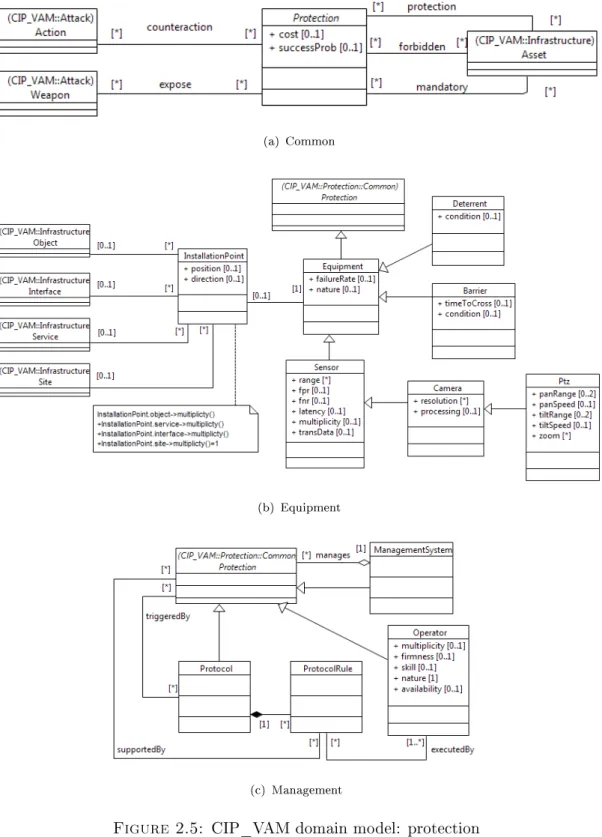
2.5 CIP_VAM domain model: protection . . . 44
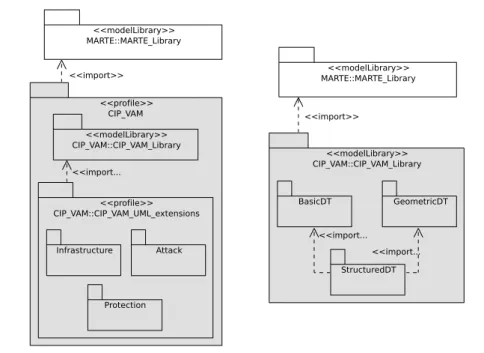
2.6 CIP_VAM UML prole: overview. . . 45
2.7 The CIP_VAM Library . . . 46
2.8 The CIP_VAM UML extension . . . 47
2.9 General structure of BN . . . 50
2.10 CPT for attack nodes . . . 52
2.11 CPT for protection nodes . . . 53
2.12 CPT for eect nodes . . . 53
2.13 CPT for eect nodes with dependency by protection. . . 53
2.14 CPT for activation nodes of a protocol . . . 54
2.15 CPT for execution nodes of a protocol . . . 54
2.16 CPT for infrastructure nodes . . . 55
2.17 Metamodel of BN . . . 55
2.18 Transformation for Attack . . . 57
2.19 Transformation for Infrastructure . . . 59
2.20 Transformation for Protection . . . 60
2.21 triggeredBy pattern transformation for Protocol . . . 63
2.22 Transformation for Protocol . . . 65
2.23 Transformation for Decision Node . . . 66
3.1 General paradigm of a security architecture . . . 72
3.2 Class diagram of event broker . . . 74
3.3 Extension for alert CAP . . . 75
3.4 Interaction for notication message . . . 75 ix
3.5 The Secur-ED Architecture . . . 76
3.6 Hardware architecture in Milan Demonstration . . . 78
3.7 Events in the tracking scenario . . . 81
3.8 Suspicious detected event . . . 81
4.1 Hardware architecture for depot scenario . . . 86
4.2 Intrusion and tracking scenario . . . 87
4.3 CBRNe and on-board monitoring scenario . . . 88
4.4 Infrastructure model . . . 91
4.5 Scenario 1: Attack model. . . 92
4.6 Scenario 2: Attack model. . . 93
4.7 Protection systems of Protection model . . . 94
4.8 Protocols of Protection model . . . 95
4.9 Clusters of thermal and PTZ cameras . . . 96
4.10 BN Attack Scenario 1 . . . 98
4.11 Study 1: thermal fnr VS PTZ fnr . . . 100
4.12 Study 2: PTZ availability VS catching success probability . . . 100
4.13 Study 3: SO availability VS SG availability . . . 101
4.14 BN Attack Scenario 2 . . . 102
4.15 Study 1: OEVD fnr VS CBRNe fnr . . . 103
List of Tables
1.1 VCA features for security . . . 19
3.1 System capabilities related to phases of the scenarios . . . 79
4.1 Model parameters . . . 90
Acronym
ACS Access Control System
ASSESS Analytic System and Software for Evaluating Safeguards and Security ATL ATLAS Transformation Language
BN Bayesian Network
CBRNE Chemical, Biological, Radiological, Nuclear and high-yield Explosives CAP Common Alerting Protocol
CCTV Closed Circuit TeleVision CI Critical Infrastructure
CIP Critical Infrastructure Protection
CMS Crisis Management System
CPT Conditional Probability Table
DoD Department of Defense
DSML Domain Specic Modeling Language
EASI Estimated of Adversary Sequence Interruption EDA Event Driven Architecture
FP Framework Programme
ICT Information & Communication Technology IDS Intrusion Detection System
ISEM Insider Safeguards Eectiveness Model MDE Model Driven Engineering
METRIP MEthodological Tool for Railway Infrastructure Protection xiii
OASIS Organization for the Advancement of Structured Information Standard PPS Protection Physical System
PSIM Physical Security Information Management
PTZ Pan Tilt Zoom
RIS Railway Infrastructure System
SAPE Systematic Analysis of Physical Protection Eectiveness SAVI Systematic Analysis of Vulnerability to Intrusion
SECUR-ED SECured Urban Transportation - European Demonstration SIEM Security Information and Event Management
SMS Security Management System SOA Service Oriented Architecture SOAP Simple Object Access Protocol
VMS Video Management System
UML Unied Modeling Language
UMT Urban Mass Transportation
URN Uniform Resource Name
VA Vulnerability Assessment
VAM Vulnerability Analysis and Modeling VCA Video Content Analysis
WS Web Service
WSDL Web Service Description Language XML eXtensible Markup Language
Introduction
Security of contemporary society is a primary concern broadly discussed in recent years, especially in connection with the spread of international terrorism which still represents a complicated issue to contain or, at least, to mitigate. This has contributed to generate a considerable feeling of being unsafe among the popula-tion, since their lives are strictly dependent on the use of complex infrastructures dened as "critical". They allow to simplify and accelerate the main human ac-tivities and, for this reason, they are often the target of criminal, vandalistic and terroristic actions. At this aim, the European Union has established legislative in-struments (e.g. the directive 2008/114/EC [3] establishes a procedure for identify-ing and designatidentify-ing European Critical Infrastructures and a common approach for assessing the need to improve their protection) and nancial ones (e.g the Secure Societies-Protecting freedom and security of Europe and its citizens programme in HORIZON 2020) in order to protect critical infrastructures. In particular, the European Parliament denes a critical infrastructure as an asset, system or part thereof located in Member States which is essential for the maintenance of vital societal functions, health, safety, security, economic or social well-being of peo-ple, and the disruption or destruction of which would have a signicant impact in a Member State as a result of the failure to maintain those functions. From this denition, the key role and the importance that these infrastructures have in the current society comes to light, and consequently the need for enhancing their security is felt. Even if the responsibility to dene objectives is a task of the In-stitutions, the fulllment of measures for reducing vulnerability of strategic assets depends mainly on the eort and actions of the dierent authorities and organi-zations involved, belonging to both public and private sectors. It is clear that, in order to meet this need, a multidisciplinary research is necessary to develop and
implement new technological solutions able to provide a proper reaction against the main threats for citizens' global security, respecting the people's basic rights. The work described in this thesis takes up the challenge of deal with the issues described above, trying to combine research and technology as a result of joint sup-port of University and Company in order to encourage innovation, also through technology transfer processes between academic and manufacturing community. Specically, this thesis is the result of research funded by Ansaldo STS, an in-ternational railway transportation leader in the eld of signaling and integrated transport systems for passenger trac and freight operation, and carried out also thanks to involvement in research projects about security theme (such as SECUR-ED1 and METRIP2). In this perspective, the area of interest of this work is the critical infrastructure protection, focusing on physical security.
The physical protection of CIs requires the development of innovative approaches for identication, detection and mitigation of threats, vulnerabilities and risks. Hence, it represents an area in which practical needs (e.g., coming from end-users), technological resources (e.g., belonging to physical security market) and scientic research (e.g., evaluation of eectiveness of physical protection system) converge all together. In such context, the thesis concerns two aspects of the protection that together can contribute to enhance the eectiveness of the protection: i) an architectural approach which enables the interoperability of security systems and involved organizations; and ii) an analytical approach for evaluating the eective-ness of the overall protection system. At this aim, this thesis is structured as follows:
• Chapter 1 provides an overview of the physical security and the main open
issues. In particular, it addresses the aspects consisting of the architecture and analysis of the Physical Protection Systems. The chapter also describes the railway domain, the application eld of this work.
• Chapter 2 presents a methodology for the vulnerability assessment of a PPS
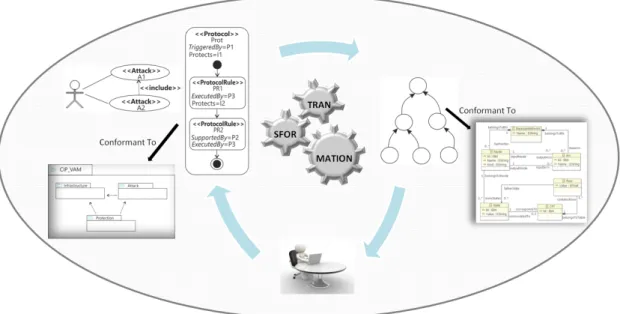
that has been partially supported by the METRIP project. It concerns a MDE approach in which an UML prole, a vulnerability model, and the model transformations have been dened.
1http://www.secur-ed.eu/ 2http://metrip.unicampus.it/
• Chapter 3 reports the experience with the concrete application of a
System-of-Systems conducted in the SECUR-ED project. In particular, an innova-tive interoperability framework, which represents a technological approach for improving physical protection, will be presented.
• Chapter 4 deals with a case study, performed on a real metro system, where
both the approaches included in the previous chapters will be applied, in order to show that vulnerability analysis and security management are the two sides of the same coin.
Chapter 1
Physical Protection
In the last years, research on Critical Infrastructure Protection (CIP) has become one of the primary matters for the development of modern societies. Water, power, banking, transportation and communication systems are only a few examples of essential infrastructures to daily human activities and their protection is a concept relating to the preparedness and response to serious incidents that could threaten them. Moreover, the last traumatic events have given still more prominence to protection of CIs. A recent work [4] presents a comprehensive literature review of signicant extreme events that occurred in the past two decades which exposes an insucient preparedness and maturity in case of serious events.
The Council of the European Union states, protection means all activities aimed at ensuring the functionality, continuity and integrity of critical infrastructures in order to deter, mitigate and neutralize a threat, risk or vulnerability [3].
As reected in this denition, the term protection is a broader concept in which three main aspects can be individuate: safety, security, and emergency. Safety involves the safeguard or protection against events or situations generally unin-tentional such as malfunctioning or faults of systems, accidents caused by human carelessness, inattentiveness, lack of training, and so on. Instead, security refers to the safeguard or protection of people and assets against attacks, assaults, and damages carried out voluntarily by individual or organizations in order to harm. This includes civil disturbances, sabotage, theft of critical property or information, pilferage, extortion or other intentional attacks on assets by a human. Emergency
refers to all those activities which have to be undertaken when safety and/or security fail and consequently require intervention of rescue teams such as rst responders, civil protection, re brigade, and so on. Thus, it regards the contain-ment of hazard and minimization of damages. The relationships between these aspects are depicted in gure 1.1.
Figure 1.1: Aspects of protection
Often the binomial safety-security is used indiscriminately, but, as highlighted, the two terms dier in the triggering events of a disaster. For in-depth analysis, in [5] the authors explain how to avoid ambiguities in the terms security and safety. On the contrary, the emergency does not focus on the origin of crisis, but manages its consequences. Furthermore, security can aect safety; for example, a disgruntled employee can sabotage critical equipment causing a disaster which can appear at a rst glance like a lack of safety measures.
The safety aspects are out of the scope of this thesis, indeed, the focus is on the security. Nevertheless, this investigation will address the concerns of security tied to physical and human factors without considering those related to the cyber ones. This is because the present work is born in the railway context, where the attention is usually oriented to the physical aspects of security since, until now, a common practice has been to realize dedicated connections and isolated networks. With respect to the emergency aspects, only the advantages that a security solution can induce will considered.
A security threat is always attributable to a location (within a bus, a station plat-form, etc.) at a given moment (when there is a crowd, after a football game, etc.) and involves someone (criminal, bomber, suicidal person, etc.) and/or something harmful (bomb, gun, toxic gas, re, knife, etc.). In order to face such critical
situations the security strategies that can be adopted are fundamentally three: proactive (stop the event before it occurs), reactive (act to limit the impact of the event, if the previous strategy fails), and forensic (get information to put the system back in operation). Obviously, from a security perspective, the best is to be as proactive as possible (stopping terrorists before they burst their bomb is preferable than nding the culprits), but it is very hard to meet this objective from a technological point of view. Using disparate technologies surely will help to have a reactive behavior to threats, while the proactive eect will be strictly limited to the motivations inciting an attacker. Generally, a proactive approach involves assessment methodologies, more or less detailed and complex, able to analyze or prove the protection levels of an infrastructure. Eventually, the forensic strategies can help to understand the dynamics of a successful attack in order to discover where and why the system failed. In addition, they allow to gather important information useful for facing future threats.
1.1 Physical Security
Physical security is one of the most fundamental aspect of the protection. It con-cerns the use of physical controls for protecting premises, sites, facilities, buildings or other physical assets belonging to the critical sectors. The application of physi-cal security is the process of using layers of physiphysi-cal protective measures to prevent unauthorized access or harm. This harm can involve terrorism, theft, destruction, sabotage, vandalism, espionage, and similar.
The choice among the physical security measures to be adopted depends greatly on what assets need to be protected, where they are located, and what threats, vulnerabilities, and risks pertain to them. Thus, applying an appropriate level of protection requires a specic understanding of environment under consideration as well as the threats to which is exposed. In order to accomplish this, it is clear that an eective design have to be carried out. So, an eective design involves the use of multiple layers of interdependent systems and covers all the means and technologies for perimeter, external and internal protection such as barrier, light-ing, dierent kinds of sensors, closed-circuit television, access control, and people. In this phase the choice of technological security systems and the adoption of
architectures for integrating such systems play an important role, since they are eective means that contribute to increase resilience of a CI, providing early warn-ing of threats and improvwarn-ing the response to eventual disasters.
However, the activities tied to security design are very dicult considered the com-plexity and interconnectedness of current infrastructures, the lack of standards in physical security matters, the diversity of threats, and the dierent local regula-tions. Furthermore, the cost of physical security is not insignicant. Reaching an appropriate balance between adequate levels of protection and the cost of the systems enabling physical protection can be hard. Too little security leaves vul-nerabilities in place, increasing risks. Too much security may mitigate threats and vulnerabilities and reduce risks, but leads to unnecessary expenditures. Inecient application of security controls (spending more than you need for a physical secu-rity service or product) may use scarce resources that otherwise would be available for additional protective measures [6]. Consequently, a trade-o between costs and eective protection based on their contributions to risk reduction is necessary. Translating strategic security objectives into wise choices is a challenging design problem both when designing a new physical security system and when upgrading to an existing system. In the context of infrastructure resilience and protection some considerations have been made for guaranteeing a certain risk level.
A crucial element which contributes to improve the protection of critical infras-tructures seamlessly is the technology. Thanks to the fast technological progress, it is possible to build complex surveillance systems able to integrate heterogeneous sources which can monitor environments potentially at risk. In this way, resilience may be accomplished, for example, through hardening the system by adding re-dundancy and robustness. However, for enhancing signicantly the protection level, integration of dierent technologies is not enough, but a collaborative ap-proach is essential. A strong protection calls for interoperability not only among ICT systems, but also among dierent operators, organizations, companies, and any other entity belonging to the public security sector. This lead to look into System-of-Systems approaches, whose issues are still subject matter for discussion, since they are systems evolving continuously and quickly [7]. All this makes up the tools for managing the complexity of the protection and for reducing the in-tervention times lending support to crisis management with a better promptness. Nevertheless, the designer must determine how best to combine elements like
fences, barriers, sensors, procedures, security systems, and security personnel into a Physical Security System (PPS) that can achieve the protection objectives. For this reason, another important element is to conduct a systematic evaluation in which quantitative and/or qualitative techniques are used to predict overall sys-tem eectiveness, by identifying exploitable weaknesses in asset protection for a dened threat. A typical weakness of the PPS is quite the lack of a global and integrated vulnerability evaluation. Traditionally, their eectiveness evaluation was due to judgments of experts because of the lack of scientic methods able to provide systematic and objective estimates. On the contrary, an accurate vulnera-bility assessment can produce results for establishing the requirements during the design of the PPS and, in addition, it can also support the decisions regarding protection system upgrades. [8].
1.2 The Vulnerability Problem
Eective protection demands the availability of proper methodologies and tools to evaluate the vulnerability of the assets, and the ability of the adopted protection systems to meet its objectives.
The vulnerability is a very complex concept which has more interpretations in research literature. An accurate disquisition about the term "vulnerability" can be found in [9], where the author exposes the meaning of the concept in dierent scientic research communities. Some interesting denitions for the context of this work are Vulnerability is emerging as a multi-dimensional concept involving at least exposure - the degree to which a human group or ecosystem comes into contact with particular stresses; sensitivity - the degree to which an exposure unit is aected by exposure to any set of stresses; and resilience - the ability of the exposure unit to resist or recover from the damage associated with the convergence of multiple stresses or vulnerability is an incapacity to anticipate, cope with, re-sist to, adapt to and recover from hazards. In [10], vulnerability is dened as the susceptibility to physical injury or threat. For Haims[11], vulnerability is the manifestation of the inherent states of the system (e.g. physical, technical, orga-nizational, cultural) that can be exploited by an adversary to harm or damage the
system. Therefore, the vulnerability concept implies the possibility that a trau-matic event causes probable harms.
Several protective factors exist for preventing, limiting and modulating the risk that such vulnerabilities can induce. The term vulnerability is sometime confused with risk. In general terms, the risk can be considered as a cumulative index which expresses the likelihood of the occurrence of an undesirable event and of the potential damages to the environment, permanent or long-term. Actually, the vulnerability can be considered as an internal risk factor of a system or a subject that is exposed to a threat and it corresponds to its intrinsic predisposition to be aected to damage[12]. Then, reducing vulnerability can reduce risk and conse-quently increase resilience which in turn may reduce the consequences of a disaster.
1.2.1 Vulnerability Assessment
The Vulnerability Assessment (VA) is a proactive strategy for improving infras-tructure security and it is able to provide essential information that may be used in the Risk Assessment process. Risk Assessment requires a suitable understanding of both threats and vulnerabilities. Both of them should be identied, but gener-ally the threats often remain out of control, while vulnerabilities may be corrected through security countermeasures. This means it is very hard to stop the eorts of an international terrorist group in advance, but it is possible to strengthen the security in the weak points of an infrastructure.
One of the most delicate task is to evaluate risk and vulnerability. In this per-spective the analysis can be both quantitative and qualitative. In a quantitative analysis, an adequate quantity of numerical data is necessary for calculating the risk of an attack in terms of probability. Very often such data are not available and thus a qualitative analysis may be better suited. These kinds of methods require generally less eort and, in certain cases, can be also used in support of quantitative methods.
Given the broad spectrum of existing critical infrastructures, some methodologies either quantitative or qualitative have emerged in academic literature but, in prac-tice, the most used methods are qualitative. [13] provides a state of the art of risk
methodologies; certain methods include both risk analysis and vulnerability anal-ysis, while others are more suited to specic systems or a specic need. Generally, existing quantitative methodologies focus on one kind of critical infrastructure such as telecommunications (in [14] is possible to nd an overview of approaches for evaluating network vulnerabilities), critical information systems ( [15] proposes a methodology for a supervisory control and data acquisition (SCADA) system), water system (in [16] a parametric-system method based on background value is used for the quantitative assessment of each subsystem and of the integrated water resources system), and so on. Finally, in [17], Ezell et al. provide a description of the probabilistic techniques widely used to carry out risk and vulnerability anal-ysis.
A well-known formula used in risk analysis eld is the following[18]:
Risk=T hreat·V ulnerability·Consequence (1.1) that is, risk represents the expected consequences of attacks, taking into account the likelihood that attacks occur and that they are successful, if attempted. In spite of its simplicity, this formula needs the evaluation of three parameters whose value is hard to compute especially in quantitative terms.
A quantitative denition of the vulnerability is given by Lewis [19], who denes it as "a conditional probability", that is the probability that an asset suers damages if an attack occurs or, in probabilistic terms:
V ulnerability=P(attack results in damage|attack occurs) (1.2)
Note that the measure specied above does not include magnitude of the damage. This measure assumes a representation of vulnerability in which there is either a successful attack with damage or no success with no damage [18].
Traditionally, the literature exhibits two distinct research branches for addressing vulnerability evaluation: threat-driven and asset-driven.
The threat-driven approaches are suitable for analyzing the initiating events that are well understood and whose rate of occurrence can be reliably deducted from historical data. The main disadvantage of these approach is that they ultimately
fail to consider emerging or unrecognized threats devised by an innovative ad-versary [20]. A recent threat-driven approach can be found in [21]. This paper presents an asset vulnerability model based on his earlier work in game theory and designed to provide a strategic risk measure which is predicated on the probability of failure of an attacker.
Asset-driven approaches search for sensitive points that attackers can exploit to kill a lot of people and damage environmental assets. Thus, they focus on nding and mitigating vulnerabilities regardless of whether a specic kind of event has occurred. In other word, these methods estimate the consequences and probabil-ity of success of an attacker for an exhaustive set of plausible scenarios, without considering their occurrence probability [22].
Other approaches that does not belong to these two categories exist and they can be found in [21].
Up to now, a little attention has been devoted to approaches which integrate more aspects. In [8], Garcia considers both of them, but the attacks are considered form an high level of detail. An interesting work moving towards this direction is [23], where the authors present a novel attack tree paradigm, called attack countermea-sure tree, which takes into account attacks as well as countermeacountermea-sures (in the form of detection and mitigation events). Again, [24] provides an intuitive and visual representation of interactions between an attacker and a defender of a system, as well as the evolution of the security mechanisms and vulnerabilities of a system. Finally, many studies on vulnerability assessment focus on modelling of the CIs' interdependencies. In these works, typically, the adopted approaches aim to un-derstand structural vulnerabilities through "what-if" analysis and simulations in order to asses and mitigate the risk of domino eects and multiple disruptions, and to provide a support to decision-makers. For example, a popular work is [25], where the authors explore the challenges and complexities of the interdependencies making an analysis with respect to dierent dimensions.
1.2.2 Evaluating Physical Protection Systems
A Physical Protection System (PPS) involves systems, procedures and people for the protection of assets and facilities from malevolent human attacks [26]. The
capability of a PPS to withstand a possible attack and prevent an attacker from achieving his objectives is generally specied as PPS eectiveness. Thus, with re-spect to the protection measures, assessing the vulnerability corresponds to eval-uate the eectiveness of the protection systems. The PPS can be considered to be eective only when it contributes to decrease the risk to an acceptable level. Quantitative techniques are recommended for facilities with high-consequence loss assets [8]. In this perspective, Hennessey et al. [27] express the vulnerability term as
V = 1−PE PE =PD ·(PI·PN) PD =PS·PA (1.3) where:
• PE (Probability of eectiveness) is the probability that the physical protec-tion system is eective;
• PD (Probability of detection) is calculated through the PS and PA values and it represents the probability that an attacker has been detected;
• PS (Probability of sensing) is the probability that a sensing system detects the attack;
• PA (Probability of assessment) is the probability that a security operator at the control room correctly assess the situation and react accordingly;
• PI (Probability of interruption) is the probability that the reaction to the attack takes place in time in order to neutralize it;
• PN (Probability of neutralization) is the probability that the reaction suc-cessfully neutralizes the threat.
There are many quantitative tools that can help the analyst to evaluate the ef-fectiveness of a PPS. For giving an idea, in the following an overview of the most frequently used techniques for a quantitative evaluation of the eectiveness of a PPS [28] [26] will be briey described. Furthermore, other approaches concerning the evaluation of a PPS face the problem from a point of view of optimization for optimally locating the physical protection components in order to balance cost and performance (e.g. see [29] and [30]).
1.2.2.1 EASI
The Estimated of Adversary Sequence Interruption (EASI) is an easy-to-use method developed to evaluate PPS performance at nuclear facilities under conditions of threat and system operation [31]. It is a pathway analysis combined with com-puter modeling techniques. The method consists of a probabilistic analysis of the interactions of detection, assessment, communications, delay, and response time. The results of the analysis are expressed in terms of the probability that the PPS can respond in time to stop specic action sequences of an attacker. The basic principle of this method is that attacks on nuclear facilities can only be averted after the prompt notication and response of the guard force which is presumed to be adequate. This involves the proper use of alarm systems to be considered in the evaluation.
1.2.2.2 SAVI
The Systematic Analysis of Vulnerability to Intrusion (SAVI) method evaluates the vulnerability of a PPS. Features of this method include analysis of all adver-sary paths, a safeguards-component catalog with a detection/delay performance database, results in graphic form, and path-upgrade recommendations [32]. Thus, the method enables to analyze all the possible paths of an attack and evaluate the most vulnerable paths including the position of a critical detection point along each path. It uses a multi-path model, called Adversary Sequence Diagram (ASD), where the facilities and the paths connecting them are represented. Since this ASD model is too simple, often it causes inaccuracies (i.e the distance needed to cross an area is considered equal when using the ASD, regardless of the particular route). 1.2.2.3 ASSESS
Developed under the sponsorship of the Department of Energy, the Analytic Sys-tem and Software for Evaluating Safeguards and Security (ASSESS) is an analyti-cal tool with the aim to conduct an integrated evaluation of safeguards systems at facilities handling facilities. This method is a standard procedure in the USA for
evaluating the PPS of nuclear facilities, airports and other important buildings. In particular, it focuses on the threat of theft/diversion of special nuclear material by insiders, outsiders, and a special form of insider/outsider collusion [? ]. As the previous method, it uses a multi-path model, and, substantially, it is an en-hanced version of SAVI with additional insider attack analysis and neutralization modules.
1.2.2.4 ISEM
The Insider Safeguards Eectiveness Model [33] is a stochastic, discrete event, monte-carlo simulation model which simulates the interaction of a group of insiders (guards or other employees who have authorized access to the facility) with the facility's safeguards system. The methodology provides a structure through which an analyst may choose guard tactics to complement the other portions of the safeguards system in combating the perceived threat. It is not dependent on the specic eectiveness model employed nor on the assumption that the adversary is an insider. The eectiveness of guard tactics is demonstrated by computing the eectiveness measure of a range of guard tactics employed in spite of a number of distinct insider paths through the facility.
1.2.2.5 SAPE
Systematic Analysis of Physical Protection Eectiveness [34] is the most recent method that presents an intuitive technique for the VA of a PPS. As the previous techniques, it deals with a pathway analysis in order to determine the ordered series of a potential adversary's actions (called an adversary path) and to calculate the probability that a response force will stop this adversary before his/her task is completed. Nevertheless, unlike the previous ones, the use of a two dimensional (2D) map of a facility as a model for a PPS is suggested as an alternative approach to the adversary sequence diagram. Compared to an ASD it has two advantages: providing an intuitive bird's eye views of a PPS, and representing relative positions between protection elements in a realistic way.
1.3 Technological Tools for Physical Security
In the past decade, the security landscape has dramatically changed with the in-troduction of several new security technologies to deter, detect and react to more disparate attacks. Organizations are constantly introducing new technologies and upgrading existing ones in order to ensure the security of their most valuable as-sets such as people, infrastructure, and property. Typical systems include access control systems, CCTV systems, intrusion detection systems, reghting systems, CBRNe sensors, content video analytics, intelligent sound detection, perimeter in-truder detection, and so on [35].
Redundancy and diversity of sensing technology is essential to build eective surveillance systems, but this increases the number of sensing devices and, conse-quently, of the alarms to be managed. So, the integration of such security systems has been one of the primary requirements in the scenario of the physical security. However, regarding the information integration and management, the industry is still underdeveloped. In fact, potential capabilities of traditional systems are limited by their low abilities in data analysis and interpretation, resulting in an inadequate prevention and real-time reaction.
In practical applications, each monitoring system is managed by means of an ad-hoc software platform. The traditional surveillance solutions include, for example, VMS (Video Management System), ACS (Access Control System), etc. They provide an overview of the installed devices (with a related report of diagnostic, warning, and alert messages) and a set of basic functionalities (e.g. for data acqui-sition, control, conguration, and rules setting). In this way, each event is handled separately without an eective information sharing, resulting in a very fragmented approach to the physical security [1]. Furthermore, the separated use of multiple systems can even complicate the security management. For example, take a hu-man operator at the control center: in case of attack he may be inundated of alert messages, coming from multiple separated interfaces, one for each manage-ment system of the single technology. Hence, industrial needs require supporting platforms capable of integrating monitoring components with data processing sub-systems, with also nal consumers of produced warnings.
A well-designed integrated security system allows the full control of a CI, unify-ing alarm signalunify-ing, management and control procedures, optimizunify-ing the human
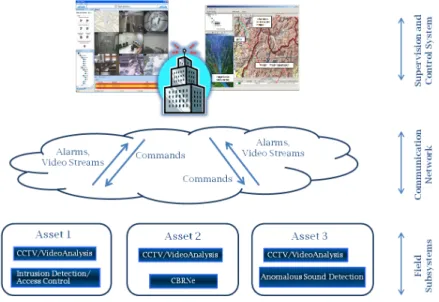
resource necessary. The general architecture (Figure1.2) is composed by three fun-damental components: eld subsystems, communication network, and supervision and control system [36].
Figure 1.2: General architecture of an integrated security system
The dierent subsystems are distributed within the infrastructure and are able to send alarms and video streams to the supervision and control system through the communication network. The supervision and control system is in charge of analyzing and possibly elaborating data in order to support the decision making. In addition, if anything it can send commands to eld subsystems still through the communication network.
When the emergencies occur, one of the fundamental task is to get the right information in order to allocate the right resources. Quick collaboration between local, state, and, in some instances, federal agencies is critical to saving lives and critical assets. Therefore, security systems must be tightly integrated with policies, procedures, and protocols to empower decision makers to quickly make the proper decision [37]. Security ocials need a solution that overcomes the technology integration, multiple involved operators, and real-time collaboration challenges, so that all sorts of data are translated to relevant information that may be shared promptly to support organizations in detecting, analyzing, diagnosing, and resolving situations. New management technologies, like physical security information management (PSIM), are enabling these requirements.
1.3.1 Security Monitoring
Investments in security monitoring are likely to increase. Even if the human ob-servers theoretically oer the greatest security, they are not enough since it is necessary to take account the drawbacks of human inattention and limited senses. The ability to continuously monitor the environment, to detect abnormal condi-tions, and to capture information of interest, all in real-time, gives the opportunity to reduce inspection costs while providing for increased security to the public. Generally, security monitoring requires several sensor devices that are based on more or less sophisticated technologies, basically according to the application need. The strong need to have surveillance systems more and more intelligent has re-sulted in a new generation of sensors, smart sensors.
The fundamental dierence between a traditional sensor and smart sensor is the latter's exible communication and information processing capability. Each sen-sor has an on-board microprocessen-sor that can be used for digital signal processing, self-identication, self-adaptation and self-diagnostics functions. Furthermore, all smart sensor platforms use wireless communication technology [38]. Actually, in the last years, the scientic community distinguishes between the concepts of "smart" and "intelligent", pointing out that the former is related to technological aspects while the latter to functional ones [39].
Thanks to the technological progress in the miniaturization techniques, the size of sensors has decreased over time as well as their costs. This allowed to build more complex systems for disparate applications able to implement eective protection strategies. Thus, modern surveillance systems integrate heterogeneous security systems equipped with smart sensors. In the following, the most relevant systems in security eld are presented.
1.3.1.1 Video Surveillance
Cameras are the most widespread devices in the surveillance eld and their level of maturity is getting higher both in indoor and outdoor applications. Monitor-ing through video streams of a Closed-Circuit Television (CCTV) system allows a quick recognition of a situation in order to prevent or detect possible malevolent intents, as well as to conduct post incident analysis. The main characteristics of a
camera are type of acquisition (color, thermal or infrared), resolution (standard or megapixel), eld of view (xed or variable), physical transmission interface (wired or wireless), and signal processing technology (analog or digital).
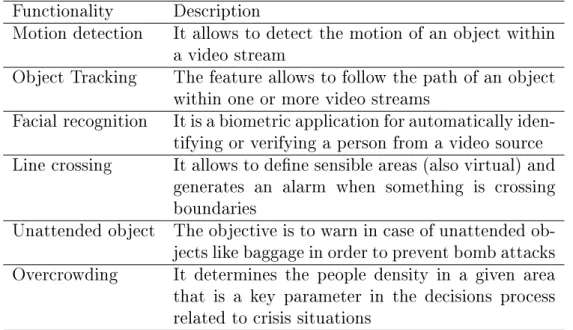
Video surveillance is a eld whose development keeps abreast of technology evolu-tion. Indeed, cameras are equipped more and more with special features and often the CCTV system is combined with a Video Content Analysis (VCA) system. VCA is the capability of automatically analyzing video to detect and determine temporal and spatial events. This technical capability is used in a wide range of domains including transport, safety, security, health-care, retail, automotive, home automation and entertainment. Many dierent functionalities, more or less com-plex, can be implemented in VCA. Relating to the complexity of the algorithm, it can be hosted on the camera (using on board processing units) or on a dedicated server. Table 1.1 lists some features of interest for security.
Functionality Description
Motion detection It allows to detect the motion of an object within a video stream
Object Tracking The feature allows to follow the path of an object within one or more video streams
Facial recognition It is a biometric application for automatically iden-tifying or verifying a person from a video source Line crossing It allows to dene sensible areas (also virtual) and
generates an alarm when something is crossing boundaries
Unattended object The objective is to warn in case of unattended ob-jects like baggage in order to prevent bomb attacks Overcrowding It determines the people density in a given area that is a key parameter in the decisions process related to crisis situations
Table 1.1: VCA features for security
Despite the continuous enhancement in this eld, VCA still presents several limits. Their eectiveness may be reduced by multiple factors such as the diculty of mod-eling complex behaviors (i.e. isolating individual people in crowds is hard [40]), the sensitivity to changes of lighting conditions, the presence of reective surfaces in the scene, etc. In addition, VCA is often topic of debate for ethical issues (e.g. facial recognition in public transportation is not allowed in all countries).
1.3.1.2 Intrusion Detection and Access Control
Intrusion detection and access control belong to two diverse typology of systems but are closely connected between them.
Intrusion Detection System (IDS) groups several devices able to detect unautho-rized access of people into sensible areas. It involves magnetic contacts, volumetric sensors, glass break detectors, etc. However, in order to dierentiate the accesses unauthorized from the authorized ones an Access Control System (ACS) is re-quired. ACS is based on three main concepts: possess (e.g. a card), knowledge (e.g a pin) and biometric feature (e.g ngerprint).
According to the required protection level or the permit level assigned, ACS can manage more combinations of entry to or exit from secured areas. ACS is con-stantly incorporating improvements in communications and security technologies; nevertheless, each technology has a certain level of vulnerability to be considered. For this reason, hybrid approaches which combine technologies based on the three concepts above are preferred.
1.3.1.3 Audio Surveillance
An emergent security solution is the audio surveillance. By combining audio sen-sors with advanced algorithms, this kind of technological tool is able to recognize automatically abnormal or unexpected noises such as scream, glass breaks, explo-sions, and shots.
This security system is particularly useful in situations of inadequate or absent visibility; in this case, the sound constitutes an essential information source for discriminating between suspicious events. In addition, this approach is especially advantageous if compared to other systems (e.g VCA systems) since it is indepen-dent from lighting conditions and it has low computational needs.
In contrast, their eectiveness decreases in areas where the noise is very high. De-spite of this, adopting adaptive frameworks is possible to detect atypical situations under adverse conditions containing highly nonstationary background noise (e.g see [41]).
1.3.1.4 CBRNe Sensors
CBRNe systems are a good security solution for environmental monitoring and are very specic technologies for particular threats. CBRNe is the term for protective measures taken against chemical, biological, radiological, nuclear and explosive attacks. So, it is clear they constitute a powerful countermeasure against attacks where weapons of mass destruction are expected.
This technology allows an eective identication of bombs, drugs, metallic and nonmetallic weapons and explosives at long distance. Actually, unlike to radio-logical and explosive sensors, chemical ones have still some problems about the coverage range. For overcoming this restriction, often these tools dedicated to explosive detection are combined with the deployment of dog patrols [42]. Un-fortunately, the cost of this technology is rather high so it is essential to balance the security needs with budgetary constraints. In practice, this limits the number of checkpoints for dangerous substances detection; thus, their locations must be evaluated accurately. Furthermore, the current solutions for CBRNE for people scanning are not directly suitable to all situation due to their excessive processing time (let consider the mass-transit system where this is not compatible with the crowd ows) [43].
1.3.2 PSIM Systems
Given the proliferation of the variety of interconnected systems, the willingness to develop an open system architecture with the backdrop of interoperability, and driven from needs to include other value-added functionality, PSIM solutions have been developed. Born initially as a physical security integration enhance-ment, PSIM is rapidly evolving to encompass information management systems insomuch as it draws the attention of government agencies and businesses from a wide range of markets [44].
It is a software platform that collects, correlates and manages information from disparate security devices and information systems into one common situation pic-ture in order to empower personnel to identify and proactively resolve situations. The key element is its ability to integrate dierent complex subsystems easily, as
well as its interoperability with third-party applications and legacy security sys-tems without being locked-in to any specic vendor. Many security benets hail from adoption of PSIM solutions, like better situation awareness, decrease of reac-tion times to events, driven management of the procedural acreac-tions in case of crisis situations, support to post event analysis, etc. For this reason, they are assuming a strategic role for properly responding to any kind of emergency and are essential to respond and deal with the wide range of potential security risks. In detail, in order to provide a complete Situation Assessment and Situation Management this new generation of systems should fulll ve key capabilities [45] shown in gure 1.3:
Figure 1.3: Key capabilities of a PSIM system [1]
1. Gathering: the system gathers data from a wide range of disparate devices and subsystems;
2. Analysis: the gathered data should be analyzed in order to recognize the situation and to give the right priority to a possible emergency;
3. Conrmation: the system shows the situation to the security operator in a clear and concise way enabling an accurate and quick conrmation of the appeared alarms;
4. Resolution: the PSIM system should clearly present to the security operator the steps of the procedure to carry out for managing the situation in real time;
5. Reporting: all activities should be recorded for supporting the post-event investigative analysis.
PSIM is analogous to SIEM (Security Information and Event Management) soft-ware. Basically, it does for physical security what SIEM does for cyber security, simplifying the surveillance activities, while improving security and reducing time, cost and eort that physical security requires [46].
1.4 Railway Domain
Railroads and mass-transit systems are critical transportation assets and are inte-gral to the economy and welfare of the nations. They are able to connect dierent cities or dierent areas of a city providing not only the passenger transport but also the freight transport.
Passenger rail service, especially the commuter and underground ones, concen-trates large numbers of people on trains and their location in the urban envi-ronment oers the attacker easy access to the train to launch an attack, with multiple escape routes that allow them to blend into the surrounding population after the attack has been completed. In addition, the railroads also carefully serve the movement of hazardous freight daily. Movement of hazardous materials not only represents a potential for signicant negative consequences to the community and environments through which they are moved, but can cause serious economic damages to the railroads in case of accidental or deliberate release. In particular, railroad infrastructure is grown in the course of time in term of sizes, capabilities and service oering. Just to give an idea, Figure 1.4shows the Istat data (kilome-ters of railway network per 100km2 of area) related to the overall railway and the
electried double-track network in the EU member states in 2014. On one hand this has contributed to the onset of new and unexpected vulnerabilities and on the other hand this has made the consequences potentially more serious in case of attacks. At the same time, they are often the target of criminal and vandalistic actions.
Figure 1.4: Railway network in EU countries in 2014 [2].
Following September 11th, 2001 and the Madrid (March 11th, 2004) and London (July 7th and 21st, 2005) terrorist attacks, the authorities operating in the trans-portation sector have increasingly intensied the eorts for improving security and an increasing number of studies and research work have been performed in this domain. Several EU Research actions have already been carried out or are in progress allowing clarifying the background and potential proposals for actions in the area of transportation security. The following are examples of FP7 projects:
• The COUNTERACT project [47], completed in March 2009, was set up to
improve security against terrorist attacks aimed at public passenger trans-port, inter-modal freight transtrans-port, production of energy and transmission infrastructure. This project focused on the protection of critical transport infrastructures, public transport passengers and goods.
• The MODSAFE project [48], completed at in August 2012, has addressed
schemes in the European Urban Guided Transport sector. It have also ad-dressed security requirements in their relations to the global safety objective of the project, like ensuring the protection of persons and the system from criminal acts.
• The DEMASST project [49], ended in May 2010, aimed to provide a
roadmap for the development and integration of System-of-Systems solu-tions. It provided a structured approach on identifying the main security gaps and the most promising integrated solutions, using suciently mature technologies, for lling them.
• The PROTECTRAIL project [50] ended in May 2014, whose objective was
to integrate the growing inux of security technologies into rail operations and make them interoperable to improve security.
• The SecureStation project [51] ran from June 2011 until May 2014, dealt
with the passenger station and terminal resilience to terrorist attacks and safety incidents through technologies and methodologies enabling design to reduce the impact of blast, re and the dispersion of toxic agents on passen-gers, sta and infrastructure.
Although the rail industry and government have taken signicant steps to enhance rail network security further improvements are still necessary. In this scenario, all the actors in charge of such infrastructures share a common mission: to guarantee an accessible and exible service which is reliable and secure at the same time. At this aim, adopting adequate methodologies of analysis, design strategies, and technologies is the cornerstone of the protection.
The railway system needs to be equipped with complex and integrated protec-tion systems, to avoid criminal attacks and/or to reduce their impact. Innova-tive systems in security surveillance integrate heterogeneous sensors [52, 53]; the events should be correlated [54] in order to increase the reliability of these tech-nologies, avoiding the generation of unnecessary warnings and better supporting decisions [55].
Also such protection systems need to be adequately designed since the prelimi-nary phases of the life cycle in order to obtain the best trade-o between costs and eective protection. This implies an accurate assessment through apposite
methodologies able to evaluate the eectiveness of protection systems. In this perspective, both quantitative and qualitative methodologies can be used. For ex-ample, in [56] a qualitative methods are used for assessing terrorism risk in railway domain. The method is based on threat that is how terrorists have attacked in the past and the many dierent ways in which they might attack in the future. On the contrary, Sapori at al. [57] proposes the implementation of risk-based methodolo-gies in use by process engineering to achieve a quantitative assessment of security management systems and applies it to railway context. The rst steps show how to analyze the system and how to integrate technological, human and procedural aspects by ow charts. The next steps describe how to manage threats, vulnerabil-ity and criticalvulnerabil-ity of CI subsystems and how to identify causes and consequences through fault trees and event trees, and nally how to calculate the residual risk for security management system.
1.5 Thesis Contribution
The original contribution of this thesis is to provide methods for enhancing ef-fectiveness and reliability of integrated security systems in order to guarantee an adequate protection level. To achieve the desired level of protection, a two phase approach is proposed combining proactive and reactive strategies. The rst in-volves a vulnerability assessment of a PPS based on quantitative methods while the second introduces an interoperability framework for improving reaction to at-tacks. The overall approach will be applicable to the design phase of a PPS as well as to the evaluation phase of an existing PPS in order to determine the changes to be made for achieving the desired level of security. The pivotal points on which this thesis is founded are mainly two:
• dening and developing an interoperability framework for improving
eec-tiveness and exibility of a PSIM system;
• dening a methodology for evaluating vulnerabilities of a PPS system.
These are two complementary approaches that converge towards the same objec-tive. The rst approach provides a tool for integrating and making interoperable
dierent security systems and security management systems in order to counteract the attacks. However, hardening of all potential targets against all possible forms of attack is cost prohibitive. For this reason, the second approach aims to as-sign condence levels to protection of assets derived from an accurate quantitative evaluation of vulnerability of the PPS.
Chapter 2
A Model-Driven Approach to
Vulnerability Evaluation
As said in the section 1.2.2, a PPS involves systems, procedures and people for protecting assets and facilities from malevolent human attacks. The need to have an interoperability context interconnecting heterogeneous monitoring systems, se-curity systems and sese-curity operators, has conducted towards the adoption of new category of management systems known as PSIM. Such systems collect and correlate events from security devices and information systems enabling situation awareness and management reporting. Nevertheless, eective protection calls for the availability of proper methodologies and tools to evaluate the vulnerability of critical assets and the ability of the adopted protection system to meet its ob-jectives. In the context of security information management, the vulnerability is often dened as a weakness that can be exploited by a threat. This denition is widely used in risk assessment methodologies designed to be qualitative and based on the work of skilled security analysts. In fact, vulnerability is commonly quali-tatively evaluated, also relying on the availability of historical data related to past threat events. On the contrary, eective protection needs to an accurate quanti-tative evaluation of vulnerability able to produce scientic and rigorous measures. In the eld of physical security few eorts have been made to the development of approaches for the quantitative analysis of vulnerability. The objective of this chapter is to propose a model-driven approach in order to evaluate quantitatively
the vulnerability of CIs through the eectiveness evaluation of the whole PPS. In particular, the proposed methodology is based on a MDE approach that con-siders the three aspects of the matter of interest: infrastructure, attack, and pro-tection. Hence, this modeling approach evaluates the vulnerability of an asset with respect to the threats and specic protection systems applied. The approach denes a UML prole for Vulnerability Analysis and Modeling for Critical Infras-tructure Protection (CIP_VAM) and the automated generation of quantitative vulnerability models from UML annotated artifacts.
2.1 Aims, Scope and Hypotheses
This work contemplates security aspects of CIs considering situations where the perpetrators exploit vulnerable elements of the civilian infrastructure for the pur-pose of indiscriminate murder or criminal activities.
Vulnerabilities may be associated with physical (e.g., a broken fence), cyber (e.g., lack of a rewall), or human (e.g., untrained guards) factors. For this reason, security of critical infrastructures is often considered a faceted and multi-disciplinary problem that requires an integrated approach [5860]. Nevertheless, as outlined in the chapter 1, this work considers the concerns of security tied to physical and human factors without considering those related to the cyber ones. In the physical security eld, the vulnerabilities identication and evaluation are necessary activities in order to restrict as possible as the consequences originat-ing from voluntary actions. Nevertheless, these are dicult tasks that must be adapted to the application domain and the current needs of the organizations. The environment of the critical infrastructures is strongly distributed in the space and the eect of this is to have likely weaknesses distributed along the whole system1. In eect, a vulnerability is a weak spot that might be exploited to launch an attack and accordingly it is strictly related to the capacity of counteract threats that take place in that moment. Furthermore, not all weakness aect the system's vulner-ability equally and so each of them contributes to it in a dierent measure. This measure reects the likelihood of the weakness of being exploited during attacks.
To be more precise we can consider the vulnerability as specic to an asset due to the its attractiveness from an attacker's point of view, physically distributed and aected by circumstances also seemingly independent, and variable because it changes and spreads in the course of the time according to what happens. In particular, for a given asset the variability of vulnerability is due not only to the typology of attack and the set of protection systems used, but also to the actions undertaken to contain propagation of the eects. Vulnerabilities to a specic at-tack are indications of the practicality of an atat-tack, assuming security measures are in place.
There have been few attempts to combine more factors that contribute to vulnera-bility. This investigation aims at propose a comprehensive approach that includes environmental, physical, human, and organizational variables in addition to op-erational measurements of protection components which can help to enhance the understanding of vulnerability regarding to the main threats. The assessment of overall vulnerability requires the consideration of all protective interventions, both active and passive.
Specically, the focus is on quantitative methods since they allow to obtain a measure for evaluating the protection of an asset in a more rigorous way and then how notable is the risk in case of attacks considering the applied choices. Hence, here the denition introduced by Lewis in [19] is adopted, where vulnerability is the conditional probability that the asset is damaged, given that an attack or incident occurs(see the formula 1.2 in the section 1.2.1).
2.2 Background
2.2.1 The METRIP project
METRIP2 was an European project under the Programme Prevention, Prepared-ness and Consequence Management of Terrorism and other Security related Risks
coordinated by AnsaldoSTS. Its general objective was the development of method-ological tools for increasing the physical protection of railway infrastructure sys-tems with a focus on urban mass transportation. At this aim, METRIP dened a decision making system for supporting the design and evaluation of physical protection systems. The decision making system is intended to: (i) suggest the types and disposition of devices that maximize protection eectiveness; and (ii) help evaluate the eectiveness of a given PPS against attacks. The approach adopted within the METRIP project combines Model-Driven Engineering (MDE) techniques, optimization models and formal quantitative models to carry out a vul-nerability analysis of the critical assets of a Railway Infrastructure System (RIS) against various classes of attacks, and evaluate dierent solutions in the design of protection systems.
2.2.2 Model-Driven Engineering
Model-driven engineering (MDE) is a software development methodology which focuses on creating and exploiting domain models (they are representations of knowledge and activities that govern a particular application domain), rather than on the computing (i.e. algorithmic) concepts. MDE is a promising approach to address platform complexity and the inability of third-generation languages to alleviate this complexity and express domain concepts eectively combining the following [61]:
• Domain Specic Modeling Languages (DSML)s whose type systems
formal-ize the application structure, behavior, and requirements within particular domains. DSMLs are described using metamodels, which dene the relation-ships among concepts in a given domain, specifying the key semantics and constraints associated with these domain concepts. In this way, for build-ing applications, developers use the elements captured by metamodels and express design intent declaratively rather than imperatively.
• Transformation engines and generators that analyze certain aspects of
mod-els and then synthesize various types of artifacts, such as source code, simu-lation inputs, XML deployment descriptions or alternative model represen-tations. The ability to synthesize artifacts from models helps ensure the consistency between application and analysis information associated with functional requirements captured by models.
So, MDE focuses on developing domain models and it is very appealing in indus-trial settings. It allows for a high level of abstraction as well as the denition of modeling paradigms that are eective from the modeller's point of view, since they are based on the domain knowledge.
DSML and UML proles
DSMLs are small and well focused on domain scope, they simplify the design process, tracing recurring design patterns in the application domain, and promote communication by standardizing the terminology and the best practices to be used in the specic application domain. A key category of support for domain-specic modeling is represented by UML proles. UML proling is actually a lightweight meta-modeling technique to extend UML [62]. It is a powerful mean to dene DSMLs [63] which exploits two main advantages within a Model-Driven Engineer-ing context with respect to the development of ad-hoc DSMLs: i) a UML prole is eective from the modeler's perspective, as it captures and easily replicates the modeler's architectural knowledge of a specic domain at dierent levels; ii) a UML prole allows for the adoption of available and standard techniques and tools which maybe easily integrated into existing production systems. In addition, the usage of a modeling language based on few and well specied domain-related concepts supports the denition of model transformations so allowing the devel-opment of a complete model-driven design methodology. A UML Prole is just an extension of the UML, dened in terms of stereotypes or concepts in the target domain that will be added to UML and tags, the attributes of the stereotypes.
![Figure 1.3: Key capabilities of a PSIM system [1]](https://thumb-us.123doks.com/thumbv2/123dok_us/9019580.2799786/38.893.228.607.456.734/figure-key-capabilities-of-a-psim-system.webp)
![Figure 1.4: Railway network in EU countries in 2014 [2].](https://thumb-us.123doks.com/thumbv2/123dok_us/9019580.2799786/40.893.139.648.163.647/figure-railway-network-in-countries-in.webp)