Embedded Real-Time Object Detection for a UAV Warning System
Nils Tijtgat
1, Wiebe Van Ranst
2, Bruno Volckaert
1, Toon Goedem´e
2and Filip De Turck
1 1Universiteit Gent
Technologiepark-Zwijnaarde 15, 9052 Gent, Belgium
[email protected], [email protected], [email protected] 2
KU Leuven
Technologiecampus DE NAYER, KU Leuven, Jan de Nayerlaan 5, 2860 Sint-Katelijne-Waver, Belgium
[email protected], [email protected]Abstract
In this paper, we demonstrate and evaluate a method to
perform real-time object detection on-board a UAV using
the state of the artYOLOv2 object detection algorithm run-ning on anNVIDIAJetsonTX2, anGPUplatform targeted at power constrained mobile applications that use neural networks under the hood. This, as a result of comparing several cutting edge object detection algorithms. Multiple evaluations we present provide insights that help choose the optimal object detection configuration given certain frame rate and detection accuracy requirements. We propose how this setup running on-board aUAV can be used to process a video feed during emergencies in real-time, and feed a decision support warning system using the generated de-tections.
1. Introduction
Unmanned Aerial Vehicles (UAVs) have recently evolved
from nice to have gadgets to full-fledged industrial
grade workhorses in many domains. Precision
agricul-ture [2] [23], industrial inspection [15] and package delivery
service of the future [8] are only a few examples of the many
domains whereUAVs can prove their worth.UAVsales have
as such immensely increased these past few years, and re-ports indicate this growth will continue well into the second
decade of this century [7]. This fast growing market has
sparked investments and advancements inUAVtechnology,
and economy of scale has brought the cost down. Recent consumer devices display an impressive set of
specifica-tions and features at an affordable price. Industrial UAVs
are meanwhile equipped with high-resolution sensor arrays to perform a very diverse set of applications, and are rugged
enough for all-weather outdoor operation. Parallel toUAV
technology advancing, small form factor computing boards for embedded applications have become integrated
power-houses that enable edge computing on mobile devices. Run-ning convolutional neural networks on embedded systems has become a reality. Combining the technological
novel-ties from both the UAV and embedded computing domain
allows for some very interesting new approaches, which we will apply in this paper from an emergency operation
man-agement perspective. UAVs can provide invaluable visual
information during incidents and help rescue workers and coordinators better tackle the situation at hand. Aerial im-agery can indicate possible entry-points during a fire, help locate missing persons during a search & rescue operation, locate possible dangerous containers on-site, etc. This is the issue we will address in this paper: how can we perform
ac-curate real-time object detection on-board aUAV, and
inte-grate that into an emergency situation warning system? We
specifically chooseUAVon-board object detection, as a
ro-bust wireless link during an emergency is not always guar-anteed, or the link lacks the bandwidth or availability to reli-ably support a video stream. As features and application
do-main evolve at high pace, the major currentUAVtechnology
Achilles’ heel remains the limited flight time. Even though lithium-ion battery technology is rapidly advancing, future technological improvements promise evolution rather than revolution when it comes to maximum energy capacity. Pe-ripheral hardware weight and power consumption on-board
our UAV should therefore always be carefully considered
and kept as low as possible, limiting the available perfor-mance for our object detection algorithm.
2. Approach
The context in which we report the findings of this paper,
is that of a UAV platform capable of arriving at an
emer-gency scene on very short notice to provide increased situa-tional awareness for emergency response coordination. The
UAV could be stationed on top of the fire station or a
re-gional launch site and depart as soon as a distress call rolls in. Using a combination of a ‘straight as the crow flies’
path and predefined paths at specific heights to avoid known
obstacles in the area, the UAV can ignore traffic and
au-tonomously arrive on scene faster than emergency respon-ders can. Once on-site, it helps decision makers assess the situation more efficiently and coordinate the operation with
greater ease as would normally be the case. TheUAVshould
have a high degree of autonomy and accept high level com-mands to perform in-depth inspections of the area (includ-ing e.g. captur(includ-ing additional imagery of heavily impacted areas, monitoring operational progress). An on-board high resolution optical camera offers decision makers a thorough view on the situation. To assist operators even more dur-ing stressful situations (where information overload can oc-cur at any given time), an automated decision support sys-tem notifies of ongoing relevant events. As an example: if a rescue worker approaches a dangerous situation (high pressure gas pipe, burning gas tank) a warning is generated to alert those involved of the potentially imminent danger. One vital module of this decision support system, is the ob-ject detection algorithm that looks for predefined items and passes this detection on to the decision engine. In this en-gine, the location of the detected object is estimated so that reasoning can take place in correlation with different ob-jects present (distance of a fire truck to a burning barrel for instance). This paper focuses on the on-board object detec-tion algorithm and integradetec-tion with risk assessment. People, emergency responders, vehicles, dangerous goods contain-ers, gas tanks, are some examples of the predefined objects we want our model to detect.
3. Related work
3.1. Object Detection
Traditionally, before the rise of convolutional neural
net-works (CNN), object detection (and by extension person
detection), was done using hand crafted features. The
Vi-ola and Jones [27] face detector proved that is was
possi-ble to get really good performance for face detection using integral images in combination with an AdaBoost classi-fier. Other detectors like Histograms of Oriented Gradients
(HOG) [3], Internal Channel Features (ICF) [5], Aggregated
Channel Features (ACF) [4] and Deformable Parts Model
(DPM) [6] make use of histograms of oriented gradients
which have proven to get really good results for pedestrian detection and object detection in general. These detectors use features that are engineered and use classical machine
learning approaches like decision trees / AdaBoost (ACF,
ICF, V&J) or support vector machines (SVMs) (HOG,DPM).
They generally use a sliding window approach, which eval-uates a fixed size window at all positions in the image at different scales to get detection results for the entire image. Many of these methods can easily run in real-time on
embedded platforms as was demonstrated by [9] for use on
drones. For some time now however, deep learning meth-ods offer better accuracy at the cost of speed. Until recently it was not feasible to get them to run real-time on embedded platforms as the neural nets they are built on require a lot of
GPUcomputational power. Recent developments have
im-proved this, as deep learning methods are now catching up in terms of speed. In what follows, we will analyze the
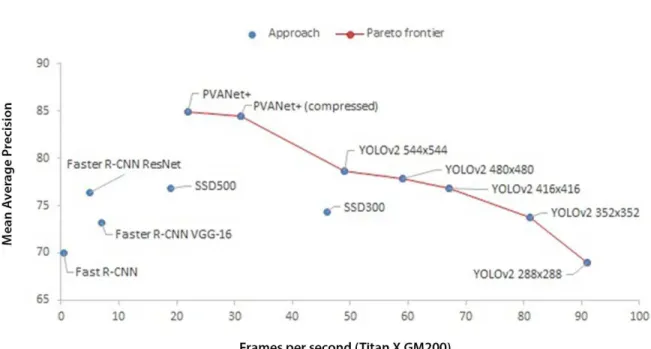
ac-Figure 1. Comparison of different object detection algorithms tested on Pascal VOC2007 data (trained on VOC2007 and VOC2012). Image courteously provided by AlexeyAB from his darknet GitHub repository (https://github.com/AlexeyAB/darknet).
curacy/speed trade-off of both of these methods. We
com-pare the ACF hand crafted features detector which is still
close to state of the art, to theYOLOv2 and TinyYOLO
de-tector that offer a good trade-off in terms of accuracy/speed on the deep learning side.
Deep convolutional neural networks form the current cutting edge technology when it comes to object detection.
Recent literature provides ample examples ofCNNs being
used for a wide range of detection tasks [12,22,24,14].
Only a selection of the proposed approaches qualifies as a real-time algorithm, a crucial requirement for our application. These are mostly single stage methods, as a two stage approach is computationally expensive. A first
single stage approach is SSD [14]. It is surpassed in most
of its configurations however byYOLOv2 [20] proposed by
Redmon & Farhadi in both detection speed and detection
accuracy. YOLOv2 is the successor of YOLO [19] and
runs on the open source C Darknet neural net [18] by the
same authors. A very interesting extra model running on
this same underlying Darknet neural net is the TinyYOLO
detector. It has a slightly lower detection accuracy, but
the attainable frame rate is 4 times higher than YOLOv2
can achieve1. Single stage detectors often struggle to keep
detection accuracy up to par when compared with two stage
approaches, but Ren et al. [21] prove recent advances can
even outperform the latter.
Looking at otherCNNs that were designed with an
embed-ded application in mind, we find LCDet [26] among others.
Inspired by theYOLOarchitecture, LCDet presents a
Ten-sorFlow [1] implementation focused on keeping the
neu-ral net small: it features a 4-fold reduced memory usage and improved performance with only a minor drop in de-tection accuracy. The paper presents a benchmark where LCDet proves to be more accurate than the first generation
YOLO, but the authors stateYOLOv2 should empirically be
more accurate than LCDet. Another approach to greatly
re-duce theCNNfootprint is SqueezeDet [28], mainly focusing
on autonomous driving. A final proposal by Kim et al. to implement lightweight neural networks for real-time object
detection is PVANET+ [11]. Figure1is a graphical
com-parison of most of the previously mentioned models that plots the frame rate versus the mean average precision. The frame rates indicated are attained using a powerful Titan X
(GM200)GPUand far greater than we will be able to attain,
but still provide a great comparison between the algorithms.
3.2. Embedded platform
When it comes to choosing aUAVon-board embedded
sys-tem for image detection, Hulens et al. [10] present a
sur-vey of different platforms with their respective computing power and influence on system battery life. The paper
men-tions the Jetson TK1 (predecessor of our Jetson TX2) and
rates itsCPUperformance below average. This makes
per-1https://pjreddie.com/darknet/yolo/
fect sense: the Jetson is a powerful GPU embedded
plat-form and the benchmarking algorithm used is CPU-based.
The main algorithm we will be running isGPUbased. The
paper hence does not directly show us what GPUplatform
to choose, but the ideas and effects on battery lifetime of different embedded platforms remain valid and relevant.
3.3. Object positioning algorithm
Once our embedded system has detected objects of interest, we determine their position to feed this information to the decision support system. Preferably we want a solution that doesn’t require a complex on-board setup (LiDAR or other expensive and/or heavy imaging system) to minimize cost
and maximize flight time. Tijtgat et al. [25] present a
solu-tion that matches this requirement and provides a posisolu-tional
accuracy of<1.5m. The work presented in [13] proposes
a vision-based UAV approach and landing scenario. This
could serve as inspiration, with the limiting factor that the
UAVwould have to hover over the detected object’s location
to determine its position.
4. Architecture
The current architecture is the result of a set of design de-cisions upon which we will elaborate in the following
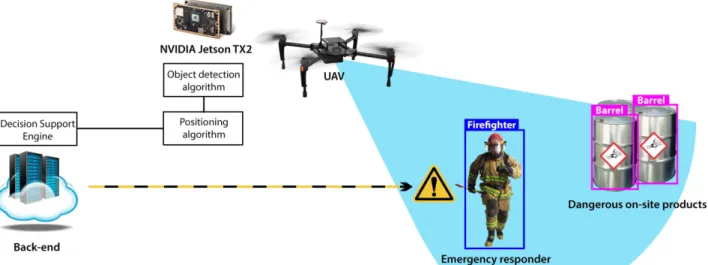
sub-sections. As an example, Figure2 illustrates what the
ar-chitecture looks like for our use case. An autonomousUAV
captures video data that the on-board hardware processes. In the example, a ’Firefighter’ and two ’Barrel’ instances are detected and their position is calculated. This informa-tion is relayed to the decision support system, that gener-ates an alert if the firefighter gets too close to the dangerous products.
4.1. Object detection algorithm
The object detection algorithm we choose will have a major influence on the performance and battery life of our applica-tion. Many recent implementations are available, each
hav-ing their merit. We compare the YOLOv2 [20], TinyYOLO
andACF [4] algorithms because of their excellent balance
between frame rate and detection accuracy. BothYOLO
al-gorithms run in the same Darknet framework, which allows us to easily run two different configurations and compare
results. ForACFwe use our own C++ implementation and
also evaluate an experimentalGPUport.
4.2. GPU implementation of ACF
In order to evaluate the performance of theACFdetector on
an embedded GPU platform like the Jetson TX2, we also
evaluate an embeddedGPU implementation of theACF
de-tector. Porting the detector toGPUconsists of two different
stages: first we calculate the ACFfeatures, after which we
evaluate these features using a decision tree that was learned by the AdaBoost algorithm. Fast real-time performance is a requirement, so only evaluation time is important. Training
Figure 2. System architecture of a UAV-based decision support system for emergency response
To calculate the differentACF features onGPUwe use the
NVIDIAperformance primitives (NPP) library that contains many standard image processing functions like color con-version, gradient calculation, rescaling etc. In fact, most of
the operations used to calculateACFfeatures can be found
in this library. To calculate the HoG from the gradient for
histogram binning, we created our ownCUDA
implementa-tion.
We tried many different approaches for the evaluation. An obvious place where parallelism can be found in the
ACFalgorithm is in the sliding window stage. Many
win-dows (one window for every position in the image) have to be evaluated. As there are no data dependencies between windows, this can easily be done in parallel. We call this approach the window parallel approach.
Another place where we find parallelism in the algo-rithm, is in the evaluation of different decision trees for each
window. ACFuses a series of weak classifier to create one
strong classifier that outputs a score that is the sum of all the previous weak classifiers. The big advantage of this scheme is that it is not required to evaluate every classifier for each window. From the moment we determine that the first weak classifiers return a weak score for a window, we can rule out the window and stop evaluation early. This speeds up the
evaluation tremendously. OnGPUhowever, stopping early
with the evaluation of decision trees creates control diver-gence, and reading many sparsely populated values from memory also gives disappointing memory performance on an already memory bound problem.
To get rid of the control divergence we can also evaluate decision trees in parallel. We call this the stage parallel ap-proach, as we evaluate weak classifiers in parallel. We take
groups of k(for instancek = 128) decision trees,
evalu-ate them in parallel, calculevalu-ate the global score (sum of all
k classifiers) and if we are still above the predetermined
threshold launch the next batch ofkclassifiers.
In the end we choose a hybrid implementation inspired
by [17] (for Viola and Jones classifiers) that uses both of
these approaches. We first evaluate each window in the im-age in a window parallel approach, after which we use dy-namic parallelism to launch additional kernels that take a
stage parallel approach. The results of ourGPU
implemen-tation can be found in section5.3.
4.3. Embedded GPU processing platform
SinceYOLOv2 heavily relies on theCUDAtoolkit, we need
to find a powerful GPU platform that is both constrained
in weight, dimensions and power consumption. Modern
desktop GPUs require big amounts of power to run under
full load (NVIDIA GTX1080Ti has aTDPof 250W) but
de-liver high amounts of floating point operations per second (TFLOPS) in exchange (11.3TFLOPSin the example of the
GTX1080Ti). While the raw power of this type ofGPU is
perfect during the offline and unconstrained training phase, it is clear that we need a completely different approach to meet our requirements (minimal power consumption, lim-ited onboard processing power, minimal weight) for the
in-ference phase on-board theUAV.
To determine if weight or power consumption should be the key parameter to consider when choosing our embedded
platform, let’s have a look at equation (1)2. This equation
describes the power P (in Watts) required to hover an air-craft of mass m (in kg) with a propeller of radius r (in
me-ters). K depends on the air density Qairas defined in
equa-tion (2) and g is the gravitaequa-tional acceleraequa-tion with a
con-ventional standard value of exactly 9.80665 m/s2. At 20◦C
and a pressure of 1atm, K has a value of 0.363562254. P=K· (m·g) 3/2 r (1) K= r 1 2π·Qair (2) 2http://www.starlino.com/power2thrust.html
As an example, a commercially readily-available DJI Phantom 4 weighs in at 1380g total takeoff weight and has a propeller radius of 12cm. According to equation (1), it requires just over 150.83W of power divided over its four propellers to hover. This theoretical result does not take into account the power required to operate the flight con-troller and other on-board electronics and sensors. It’s clear
that the m3/2
factor in (1) progressively penalizes every bit of added weight. Adding 100g of weight (+7.2%) to previous example increases the power required by 16.69W (11.1%). The weight of most relevant embedded computing platforms ranges from 40g (Raspberry Pi 3) to about 180g (Intel NUC Board NUC5I3MYBE).
Let’s have a look at the power consumption of embedded computing platforms to determine if this influences the
to-talUAVpower consumption more than adding extra weight
or not. Typical computing platforms intended for embed-ded applications tend to not use more than 15W under load (Intel NUC Board NUC5I3MYBE for instance), many even settle with a lot less (RaspBerry Pi 3 under load uses about 6.7W). Taking into account the previous thoughts and the
fact that we need as muchCUDApower as we can get in an
embedded package, the choice for theNVIDIAJetsonTX2
was quickly made. At 85 grams (without expansion board
or cooling fan) it presents 256CUDAcores (1.5TFLOPS) and
runs at either 7.5W (peak efficiency) or 15W (peak per-formance). It is twice as efficient as its predecessor (Jet-son TX1) and features specifications that are currently un-matched in developer boards.
4.4. Decision support system
The automated decision support system’s role is to decrease the information load decision makers and actors on scene face during emergencies. In stressful and volatile situations details are easily overlooked, or there simply isn’t enough time to assess the full context of the incident. The deci-sion support system can provide helpful insights based on
information gathered by theUAVor other data sources. An
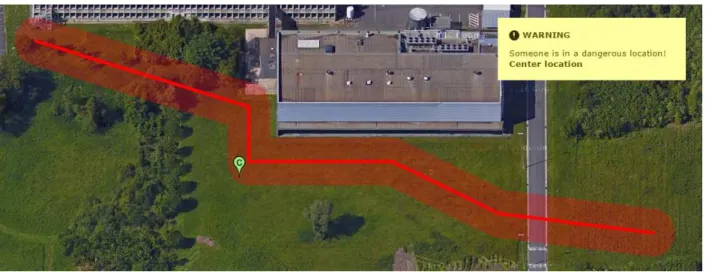
example of how this could look like can be found in
Fig-ure3. The bold red line represents an underground gas pipe,
the location of which can be acquired from an online API, or an offline cached database. A slightly transparent red area represents a security perimeter around the gas pipe that should be kept clear during incidents and the green marker represents an emergency responder, located by the detection
setup running on our autonomous UAV. The event-based
decision support engine reasons that a person is inside a re-stricted area and generates a warning to notify whoever is coordinating the operation of this incident. Many other in-cidents can be defined and processed in the same fashion:
the UAV could autonomously search for wounded persons
in the area, track the location of rescue workers and rescue vehicles on site etc. An evaluation of the decision support system is out of the scope of this paper, in what follows we focus on achieving a real-time object detection on-board the UAV.
5. Evaluation
As the viewpoint of a low-altitude UAV distinctly differs
from a traditional ground perspective, it makes sense to
evaluate the differentYOLOconfigurations using
appropri-ate image and video mappropri-aterial. The UAV123 data set [16]
provides exactly that. 123 partially annotated (only one person is annotated, we filter out sequences where multiple people are visible to calculate precision) video sequences in
16:9 format (1280x720) captured from a UAV provide the
perfect benchmark material. The following subsections dis-cuss the various parameters we have analyzed.
5.1. Input resolution
The input resolution of the Darknet neural networkYOLOv2
uses defaults to 416x416. Every image subject to training or inference is resized to this raster. Increasing these
Figure 4. Input resolution compared to accuracy
sions will increase the time required for inference, but also results in a greater detection accuracy. This allows us to de-fine either a low frame rate, high accuracy system, a high frame rate, lower accuracy system or anything in between, depending on the application. As every image or video frame needs to be resized to the defined input resolution, the dimensions of the input frame relative to the raster will
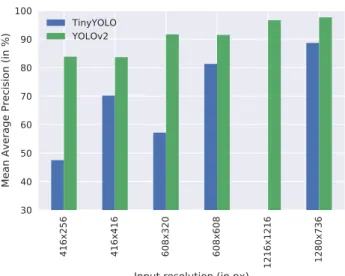
have a major impact on the attainable frame rate. Figure4
illustrates the increasing detection accuracy with increasing
input resolution. From the figure, it follows that forYOLOv2
the accuracy goes up only marginally if the width is main-tained, but the height increased to form a square input raster. This can be explained by the fact that the source images are all in 16:9 format. Resizing a rectangular image to a square
raster introduces irrelevant information (YOLOv2 does not
crop while resizing) that doesn’t help detection accuracy.
This deduction is not valid for TinyYOLO however, as a
rectangular input resolution of 416x256 or 608x320 gravely harms the mAP.
Increasing the detection accuracy by means of a larger
input raster comes at a hefty price as Figure 5 illustrates.
Comparing the lowest accuracy (83.67% @ 416x256) to
the best value (97.67% @ 1216x1216), we see theYOLOv2
frame rate drop from 6fps to 0.497fps, a 12-fold decrease.
The JetsonTX2’s limited memory prevented us from
run-ning TinyYOLO at a 1216x1216 resolution, but looking
at the other results we see a comparable decrease from 11.80fps (416x256) to 1.67fps (1280x736).
Combining results from both previous plots yields an in-teresting conclusion: the frame rate difference between an input resolution of 608x320 and 416x416 is smaller than be-tween 608x320 and 608x608, while the detection accuracy of 608x320 over 416x416 is greatly increased and there is almost no difference between 608x320 and 608x608. As
such, when configuring aYOLOv2 detector it is advised to
set the aspect ratio of the input raster to that of the images or video stream the network will process, in order to obtain
Figure 5. Influence of input resolution on detection frame rate
an optimal frame rate and detection accuracy. In the case
for TinyYOLO, a rectangular input raster should be chosen.
5.2. Video input dimensions
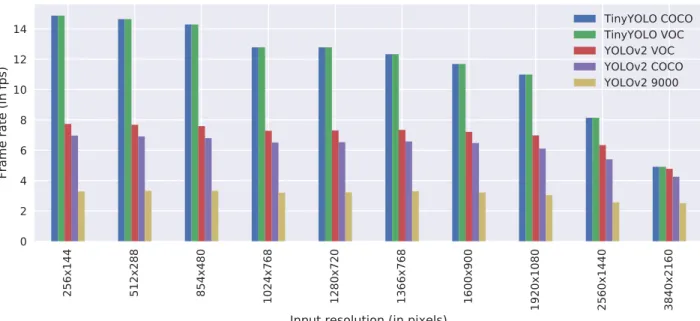
To evaluate the exact effects the input video dimensions
have on the frame rate, we chose a NASA 4K video3
(3480x2160, 24 frames per second, 20.71Mbps bit rate, Public Domain Mark 1.0) named ’Red Lettuce’, as it dis-plays multiple categories we can detect using the default
COCOandVOCtrained models forYOLOv2 and TinyYOLO.
We have subsequently downscaled this video to other 16:9
formats using ffmpeg and let bothYOLOv2 and TinyYOLO
process this batch. The input resolution was configured at
416x416 for every run. Figure6illustrates the results of this
evaluation.
A first obvious conclusion we can draw, is that the frame rate goes down as the input video resolution goes up. This
effect is not the same for YOLOv2 and TinyYOLO
how-ever: TinyYOLOis affected by this in a greater way. The
TinyYOLO COCOframe rate drops from 14.87fps (256x144)
to 4.91fps (3840x2160) a 66.98% decrease, whileYOLOv2
COCOgoes from 6.97fps (256x144) to 4.25fps,
represent-ing a 39.02% decrease. A second observation shows that the inference time greatly depends on the model size.
Com-paring the VOC(20 categories), COCO(80 categories) and
YOLO9000 (9142 categories) models forYOLOv2, we see
that as the amount of detectable categories increases, more time is required to perform the detection. As the amount of detectable categories in our use case will be well below 100, this will not pose a major influence.
5.3. ACF compared to Yolo
To see howYOLOcompares to traditional detection
meth-ods, we compare the different configurations ofYOLOand
3https://archive.org/details/ NASA-Ultra-High-Definition
Figure 6. Influence of video dimensions on detection frame rate 0 20 40 60 80 100 Recall (%) 0 20 40 60 80 100 Precision (%) yolo 416x416 (ap = 73.74%) yolo 416x256 (ap = 74.01%) yolo 608x608 (ap = 85.94%) yolo 608x320 (ap = 86.2%) yolo 1216x1216 (ap = 97.71%) yolo 1280x736 (ap = 98.19%) tiny 416x416 (ap = 57.94%) tiny 416x256 (ap = 35.6%) tiny 608x608 (ap = 73.22%) tiny 608x320 (ap = 47.3%) tiny 1280x736 (ap = 78.91%) acf min 100 (ap = 62.43%) acf min 60 (ap = 77.48%) acf min 40 (ap = 79.77%) acf min 20 (ap = 78.35%)
PR Curves of different runs (Tiny yolo vs. Normal)
Figure 7. Comparison of theACFdetector toYOLO
TinyYOLOin this section to the aggregate channel features
(ACF) detector proposed by Doll´ar et al. [4]. We used our
own implementation ofACFwhich was ported from Matlab
to C++ for better performance. We also created an
experi-mentalGPUimplementation of theACFdetector which can
currently only evaluate features at a single layer in the fea-ture pyramid, but can still give us an idea about how well
ACFwould scale toGPU.
The results in terms of detection accuracy can be seen in
Figure7. ACF (evaluated with a minimum detection scale
of 20 pixels) shows similar performance to TinyYOLO
eval-uated at a resolution of 1280x736 pixels andYOLOv2 using
an input resolution that lies between 416x256 and 608x320 pixels.
Figure8compares the speed of different detectors. The
CPU multi scale ACF detector with minimum detection
height of 100px is about as fast asYOLOv2 with a
resolu-yolov2 416x256 resolu-yolov2 416x416 resolu-yolov2 608x320 resolu-yolov2 608x608
yolov2 1216x1216 yolov2 1280x736 tiny 416x256 tiny 416x416 tiny 608x320 tiny 608x608 tiny 1280x736
acf cpu multi min 100 acf cpu multi min 60 acf cpu multi min 40 acf cpu multi min 20 acf gpu one scale acf cpu one scale 0.0 2.5 5.0 7.5 10.0 12.5 15.0 17.5 Detection speed (fps)
Comparison of different detectors
Figure 8. Comparison of different detectors in terms of speed
tion of 608x608. Looking at the accuracy of both detectors,
it follows that YOLOv2 outperforms ACF with an average
accuracy of85.9%vs. 62.4%suggesting that at least
com-pared to the CPUversion ofACF,YOLOv2 performs better
at the same frame rate. Also note that theYOLO608x320
variant attains about the same accuracy and is faster. Low-ering the minimum height to 40px gives us the best
ac-curacy for the ACF detector (ap = 79.7%), the closest
corresponding YOLO detectors are YOLOv2 608x320 and
YOLOv2 416x256 with an average precision of86.2%and
74.0%respectively. TheACFdetector reaches a mean frame
rate of 0.54 fps while theYOLOdetectors reach a frame rate
Figure 9. Mean Average Precision vs. frame rate for the discussed object detection algorithms running on anNVIDIAJetsonTX2
yolo 416x416 yolo 416x256
yolo 608x320 tiny 608x608
tiny 1280x736 acf one scale 117 (no results)
acf min 100 (no results) acf min 40
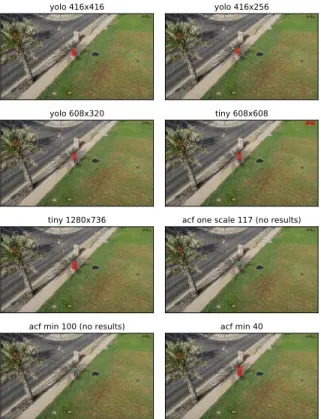
Figure 10. Visual comparison a selection of detector on a single frame of the UAV123 dataset.
Previous results did not run on aGPU, which is a really
pow-erful component on the JetsonTX2 when compared with the
ARM CPU. To get equivalent results asYOLOv2, aGPU ACF
implementation would need a speedup of at least10×
com-pared toCPU. Comparing the one scale implementation of
ACFsuggests that with the current implementation we can
get a speedup of2.5×. The biggest bottleneck here is the
traversal of decision trees, which is a memory bound
prob-lem and thus hard to speed up onGPU. An additional speed
increase inACFcould consist of the addition of scene
con-straints by using the height and orientation of the drone, and assuming a flat surface underneath. We can vastly nar-row down the amount of scales that need to be searched
and thus speed up the detector even more. Figure7shows
the accuracy of theACFdetector at one scale, where we set
the scale to 117 pixels (the average height of a person in
the UAV123 dataset). The poor performance shows that it
is indeed necessary to detect on multiple scales when
us-ing the ACF detection. Alternatively, with the knowledge
of the earlier drone measurements we can greatly increase this accuracy by detecting on the correct scale. Of the
cur-rently evaluated detectors, the YOLOv2 detector seems to
bring the best accuracy combined with the highest frame
rate. Figure10shows a visual comparison of a selection of
the evaluated detectors.
6. Conclusion
We have presented and evaluated our approach for a
real-time object detection system on-board an autonomousUAV.
Multiple configurations are available, depending on the frame rate and detection accuracy the final application re-quires. The presented evaluations can help configure future applications and demonstrate what is currently feasible us-ing off-the-shelf hardware. The modern, neural net based
YOLOv2 algorithm attains higher frame rates and detection
accuracy results than leading CPU based algorithms.
Fig-ure 9 presents a concluding view of how the different
al-gorithms perform under varying conditions on an NVIDIA
JetsonTX2, comparable to how Figure1did for several
References
[1] M. Abadi, A. Agarwal, P. Barham, E. Brevdo, Z. Chen, C. Citro, G. S. Corrado, A. Davis, J. Dean, M. Devin, et al. Tensorflow: Large-scale machine learning on heterogeneous distributed systems.arXiv:1603.04467, 2016.
[2] S. Candiago, F. Remondino, M. De Giglio, M. Dubbini, and M. Gattelli. Evaluating multispectral images and vegetation indices for precision farming applications from uav images. Remote Sensing, 7(4):4026–4047, 2015.
[3] N. Dalal and B. Triggs. Histograms of oriented gradients for human detection. InComputer Vision and Pattern Recogni-tion, 2005. CVPR 2005. IEEE Computer Society Conference on, volume 1, pages 886–893. IEEE, 2005.
[4] P. Doll´ar, R. Appel, S. Belongie, and P. Perona. Fast feature pyramids for object detection.IEEE Transactions on Pattern Analysis and Machine Intelligence, 2014.
[5] P. Doll´ar, Z. Tu, P. Perona, and S. Belongie. Integral channel features. 2009.
[6] P. Felzenszwalb, D. McAllester, and D. Ramanan. A dis-criminatively trained, multiscale, deformable part model. InComputer Vision and Pattern Recognition, 2008. CVPR 2008. IEEE Conference on, pages 1–8. IEEE, 2008. [7] A. Glaser. Dji is running away with the drone
mar-ket. https://www.recode.net/2017/4/14/14690576/drone-market-share-growth-charts-dji-forecast, 2017. [Online; ac-cessed 14-04-2017].
[8] I. Hong, M. Kuby, and A. Murray. A deviation flow refu-eling location model for continuous space: A commercial drone delivery system for urban areas. InAdvances in Geo-computation, pages 125–132. Springer, 2017.
[9] D. Hulens and T. Goedem´e. Autonomous flying cameraman with embedded person detection and tracking while applying cinematographic rules. InProceedings CRV 2017, 2017. [10] D. Hulens, J. Verbeke, and T. Goedem´e. Choosing the best
embedded processing platform for on-board uav image pro-cessing. InVISIGRAPP, pages 455–472. Springer, 2015. [11] K.-H. Kim, S. Hong, B. Roh, Y. Cheon, and M. Park. Pvanet:
Deep but lightweight neural networks for real-time object de-tection.arXiv preprint arXiv:1608.08021, 2016.
[12] A. Krizhevsky, I. Sutskever, and G. E. Hinton. Imagenet classification with deep convolutional neural networks. In Advances in neural information processing systems, pages 1097–1105, 2012.
[13] S. Lange, N. Sunderhauf, and P. Protzel. A vision based on-board approach for landing and position control of an au-tonomous multirotor uav in gps-denied environments. In Advanced Robotics, 2009. ICAR 2009. International Confer-ence on, pages 1–6. IEEE, 2009.
[14] W. Liu, D. Anguelov, D. Erhan, C. Szegedy, S. Reed, C.-Y. Fu, and A. C. Berg. Ssd: Single shot multibox detector. arXiv preprint arXiv:1512.02325, 2015.
[15] L. F. Luque-Vega, B. Castillo-Toledo, A. Loukianov, and L. E. Gonzalez-Jimenez. Power line inspection via an un-manned aerial system based on the quadrotor helicopter. In MELECON, 2014 17th IEEE, pages 393–397. IEEE, 2014. [16] M. Mueller, N. Smith, and B. Ghanem. A benchmark and
simulator for uav tracking. InEuropean Conference on Com-puter Vision, pages 445–461. Springer, 2016.
[17] A. Obukhov. Haar classifiers for object detection with cuda. GPU Computing Gems Emerald Edition, pages 517–544, 2011.
[18] J. Redmon. Darknet: Open source neural networks in c. h ttp://pjreddie. com/darknet, 2016, 2013.
[19] J. Redmon, S. Divvala, R. Girshick, and A. Farhadi. You only look once: Unified, real-time object detection. In Pro-ceedings of the IEEE Conference on Computer Vision and Pattern Recognition, pages 779–788, 2016.
[20] J. Redmon and A. Farhadi. Yolo9000: better, faster, stronger. arXiv preprint arXiv:1612.08242, 2016.
[21] J. Ren, X. Chen, J. Liu, W. Sun, J. Pang, Q. Yan, Y.-W. Tai, and L. Xu. Accurate single stage detector using recurrent rolling convolution.arXiv:1704.05776, 2017.
[22] S. Ren, K. He, R. Girshick, and J. Sun. Faster r-cnn: Towards real-time object detection with region proposal networks. In Advances in neural information processing systems, 2015. [23] G. Sona, D. Passoni, L. Pinto, D. Pagliari, D. Masseroni,
B. Ortuani, and A. Facchi. Uav multispectral survey to map soil and crop for precision farming applications.Internation Archives Of The Photogrammetry, Remote Sensing And Spa-tial Information Sciences, 41:1023–1029, 2016.
[24] C. Szegedy, S. Reed, D. Erhan, D. Anguelov, and S. Ioffe. Scalable, high-quality object detection. arXiv preprint arXiv:1412.1441, 2014.
[25] N. Tijtgat, B. Volckaert, and F. De Turck. Real-time haz-ard symbol detection and localization using uav imagery. In2017 IEEE 86th Vehicular Technology Conference (VTC-Fall), pages 1469–1474. IEEE, 2017.
[26] S. Tripathi, G. Dane, B. Kang, V. Bhaskaran, and T. Nguyen. Lcdet: Low-complexity fully-convolutional neural networks for object detection in embedded systems. arXiv preprint arXiv:1705.05922, 2017.
[27] P. Viola, M. J. Jones, and D. Snow. Detecting pedestrians using patterns of motion and appearance. Innull, page 734. IEEE, 2003.
[28] B. Wu, F. Iandola, P. H. Jin, and K. Keutzer. Squeezedet: Unified, small, low power fully convolutional neural net-works for real-time object detection for autonomous driving. arXiv preprint arXiv:1612.01051, 2016.