Cost-Efficient NFV-Enabled Mobile Edge-Cloud for
Low Latency Mobile Applications
Binxu Yang, Wei Koong Chai,
Member, IEEE,
Zichuan Xu,
Member, IEEE,
Konstantinos V. Katsaros,
Member, IEEE,
and George Pavlou,
Fellow, IEEE
Abstract—Mobile edge-cloud (MEC) aims to support low la-tency mobile services by bringing remote cloud services nearer to mobile users. However, in order to deal with dynamic workloads, MEC is deployed in a large number of fixed-location micro-clouds, leading to resource wastage during stable/low work-load periods. Limiting the number of micro-clouds improves resource utilization and saves operational costs, but faces service performance degradations due to insufficient physical capacity during peak time from nearby micro-clouds. To efficiently support services with low latency requirement under varying workload conditions, we adopt the emerging Network Function Virtualization (NFV)-enabled MEC, which offers new flexibility in hosting MEC services in any virtualized network node, e.g., access points, routers, etc. This flexibility overcomes the limitations imposed by fixed-location solutions, providing new freedom in terms of MEC service-hosting locations. In this paper, we address the questions onwhereandwhento allocate resources as well as how many resources to be allocated among NFV-enabled MECs, such that both the low latency requirements of mobile services and MEC cost efficiency are achieved. We propose a dynamic resource allocation framework that consists of a fast heuristic-based incremental allocation mechanism that dynamically performs resource allocation and a reoptimization algorithm that periodically adjusts allocation to maintain a near-optimal MEC operational cost over time. We show through ex-tensive simulations that our flexible framework always manages to allocate sufficient resources in time to guarantee continuous satisfaction of applications’ low latency requirements. At the same time, our proposal saves up to 33% of cost in comparison to existing fixed-location MEC solutions.
Index Terms—Mobile edge-cloud, low latency applications, dynamic resource allocation, approximation algorithm.
I. INTRODUCTION
O
VER the last decade, advances in wireless access tech-nologies (e.g., WiFi and LTE) have enabled an explosion of resource-hungry mobile applications, challenging current mobile devices’ processing ability. In particular, mobile mul-timedia services with stringent latency requirements (in the order of hundreds of milliseconds [1]), such as augmented reality (AR), high-definition video streaming, gaming and face recognition, are computationally expensive for today’s mobile devices; resulting in fast exhaustion of battery lifeB. Yang and G. Pavlou are with the Department of Electronic and Electrical Engineering, University College London, London, WC1E 7JE, U.K. (e-mails: [email protected], [email protected]).
Z. Xu is with the School of Software, Dalian University of Technology, Dalian, Liaoning, China, 116620 (e-mails: [email protected]).
W. K. Chai is with the Department of Computing and Infor-matics, Bournemouth University, Dorset, BH12 5BB, U.K. (e-mail: [email protected]).
K. V. Katsaros is with Intracom Telecom, Athens, Greece. (e-mail: [email protected]).
and long processing delays [2]. Conventional cloud solutions [3], where users exploit preallocated service instances from data center-based clouds to process computationally expensive tasks, address the issue of computational resources, but suffer from long network latencies [4]. On the other hand, mobile edge-cloud (MEC) (also known ascloudlet[4],fog computing [5], Telco cloud [6], follow-me cloud [7]) mitigates the long network latency issue by deploying dedicated micro-clouds along with service instances at network locations that are closer to users, e.g., access points (APs), routers, etc.
However, since the micro-clouds are deployed at fixed locations and have limited physical resources (especially com-pared to data center-based clouds), they are deployed to large number of APs with MEC service instances in each micro-cloud [8]. This achieves low latency at the expense of significant operational costs due to break of data center (DC) consolidation [2], [3]. Limiting the number of micro-clouds can save operational costs, but faces challenges in dynamically supporting low latency services with limited resources at static network locations. For instance, current resource allocation techniques to deal with workload elasticity, such as auto-scaling [9], [10], could only scale up to the physical capacity limit of micro-clouds. Subsequently, if there is no micro-cloud in the vicinity of the overloaded one that can provide more computational resources for load balancing, users’ tasks would accumulate, leading to the violation of the required service response time (e.g., time spent in network and edge clouds).
Recently, Network Function Virtualization (NFV) was pro-posed to facilitate network function deployment for Internet service providers (ISPs) [11]. It decouples network functions from the underlying hardware and implements them as soft-ware in virtual machines (VMs) hosted in commodity servers. The advent of NFV promotes the emerging concept of NFV-enabled MEC (e.g., [12], [13]) whereby services can be hosted at any network location that has virtualized resources, e.g., provided by commodity servers. Such NFV-enabled MEC model enables real-time instantiation (e.g., VM instantiation time for Unikernel [14] and ClickOS [15] are in the order of tens of milliseconds) of MEC at new network locations to host edge services, and also allows MEC to scale up/down computational resources to accommodate user demand varia-tions. As a result, the MEC can be dynamically instantiated at network locations that efficiently utilize ISPs’ virtual network infrastructures and thereby maintaining low operational costs overtime. However, such flexibility in resource allocation faces challenges in:
amount of resources and the corresponding network paths to mobile users such that the resulting network access latencies are within the network latency requirements and the ISPs’ virtualized network resources are optimally utilized.
• Determining the appropriate time instanceto perform dy-namic resource allocation in order to avoid computation congestion at VMs due to peak load [16].
• Performing resource allocation in a timely manner such that the time spent in deriving a resource allocation decision does not affect low latency MEC services. In this work, we take into account the flexibility afforded by NFV along with the abovementioned challenges, and study the problem of dynamic resource allocation in MEC, aiming at minimizing operational costs while satisfying users’ low latency service response time requirements.
For the above problem, we propose a novel dynamic resource allocation framework for NFV-enabled MEC that consists of an online heuristic-based incremental allocation mechanism and a global resource reoptimization algorithm to address the trade-off between cost efficiency and low latency requirement. In particular, our online heuristic-based incremental allocation mechanism aims to efficiently allocate resources to tackle local MEC computation congestion due to (sudden) increase of workload in a timely manner. It consists of (1) an initial offline MEC resource allocation based on expected workload that achieves the desired service response time with the minimum required computational resources, (2) an auto-scaling and load balancing (ALB) mechanism that accommodates workload variations, (3) a capacity violation detection (CVD) mechanism that derives the projected time when ALB fails to cope with service elasticity and (4) a network latency constraint greedy (NLCG) algorithm of polynomial complexity to derive a new NFV-enabled node as MEC service-hosting node which supports the stringent latency requirement. Since our online allocation mechanism computes local MEC resource allocation, we also design a set cover partition approximation (SCPA) algorithm that operates in parallel with NLCG togloballyreoptimize the locations and allocated resources while achieving a guaranteed operational cost. Given user demands, this cost is no more than ln(N) times of optimal MEC operational cost, whereN is the largest number of APs that are served by a MEC service-hosting node among all instantiated MECs.
To demonstrate the effectiveness of our proposed frame-work, we carry out an extensive set of simulations with realistic three-layer cellular network setup [17]. We use real mobility traces from [18] to show the cost reduction brought by NFV-enabled flexible MEC instantiation compared to fixed-location MEC. Further, we conduct an in-depth cost efficiency impact factor analysis to give detailed insights into the design of online MEC resource allocation framework under various network topologies, latency requirements and server capaci-ties.
Our study here is based on our preliminary work in [19]. The main contributions of this study are as follows.
1) We formulate and solve the dynamic MEC resource allocation problem as an integer linear programming
(ILP) problem taking into account the flexibility in the determination of MEC locations enabled by NFV (see Section III-B) and the trade-off between service response time and operational costs. To the best of our knowledge, this is the first study focusing on the dynamic MEC resource allocation taking into account the possibility of NFV-enabled MEC service instantiations.
2) We design a dynamic resource allocation framework consisting of a fast heuristic-based incremental alloca-tion mechanism and a SCPA reoptimizaalloca-tion algorithm for low-cost MEC resource allocation framework (see Section IV). Both NLCG and SCPA algorithms are general in nature and applicable to any online edge cloud systems (e.g., for different hosted services, edge cloud capacities and VM technologies). In addition, we mathematically prove that given user demands, our SCPA algorithm results in no more thanln(N)times of optimal MEC operational cost in polynomial time. 3) We demonstrate the effectiveness of our framework (see
Section V) through extensive simulations. We show that our framework achieves 33% cost reduction compared to fixed-location MEC overprovisioning solutions. Further, our in-depth impact factor analysis shows that SCPA achieves cost efficiency within 20% of the lower bound of the optimal solution, under different network size, ser-vices’ latency requirements and MEC server capacities.
II. RELATEDWORK
Cost efficiency in cloud computing is an important topic that has received wide attention. One branch of studies in this regard focuses on energy efficiency in DCs [3], [20]. In partic-ular, various dynamic workload-to-VM placement algorithms have been proposed to minimize system operational costs by minimizing the number of active physical machines. However, these work do not consider the deadlines of computational tasks, which is a key requirement for low latency services. In addition, DCs are considered to be rich in terms of com-putational resources at a single location, whereas MECs are distributed and have limited computational resources. Thus, these solutions are not suitable for our problem.
Early work targeting specifically MEC focused on offload-ing technologies [4], [21] which later shifted to problems on dynamic state migration between micro-clouds [8], [22] whereby the investigations focused on the decision on whether and where to migrate user states in VMs due to user mobility. More recently, the research focus in MEC further shifted to resource allocation and micro-cloud placement. These work can be categorized into offline (e.g., static) and online (e.g., dy-namic) problems. Specifically, [17], [23], [24] consider static network planning problems in metropolitan area networks where the authors investigated the optimal static placement of micro-clouds with objectives such as minimizing the system costs or the end-to-end latencies. For instance, [23], [24] formulated the static micro-cloud placement problem into a
K-median problem such that the average end-to-end latency of all users is minimized. In addition, they proposed an online user request assignment algorithm that dynamically
decides the routes between users and the K micro-clouds. Similar to [23], [24], work in [17] studied a static micro-cloud placement problem while additionally taking potential migrations into account. The authors also investigated the dynamic routing problem given the derived initial micro-cloud locations. Nonetheless, these early work related to the placement of micro-clouds did not consider the possibility of flexible MEC service instantiations enabled by NFV. Clearly, the performance improvement achieved through online routing and load balancing [25] is limited by the fixed number and locations of micro-clouds. Finally, [13] considered flexible micro-cloud instantiations where content distribution network providers dynamically discover edge locations in different ISP networks to improve the performance and reduce MEC costs. Nevertheless, application latency requirements are ignored. Moreover, this investigation looked into a different resource allocation granularity whereby the allocation is performed at autonomous system level.
Online resource allocation proposals are mainly investigated either in the form of online admission control problem or the online service placement problem in MEC. [26], [27] and [28] considered a resource-constrained MEC scenario where they devised online resource allocation schemes to determine how much resources to allocate to each user or which users to serve. In particular, they considered a set of pre-determined micro-cloud locations that have fixed amount of overall resources to be allocated. In contrast, our proposal can be seen as an alternative solution to their problem, as we increase the overall allocated resources at new network locations (rather than selecting which users to serve) such that all users can be served.
Apart from offloading computational tasks to fixed network locations (e.g., our approach), computational tasks can also be offloaded to nearby mobile devices, known as mobile ad-hoc clouds [29]. The primary advantage of using mobile ad-hoc clouds is to exploit its intrinsic mobility to enable a flexible on-demand resource provisioning by scheduling devices to move to certain geographic locations [29]. However, unlike conventional mobile edge clouds where clouds are fixed and managed by cloud operators, the discovery and management of dynamic mobile ad-hoc clouds would introduce extra system complexity. In addition, the fully distributed cloud architecture would result in a worse cost efficiency than our approach due to the complete break of DC consolidation [2].
III. SYSTEMMODEL ANDPROBLEMFORMULATION
A. System Model
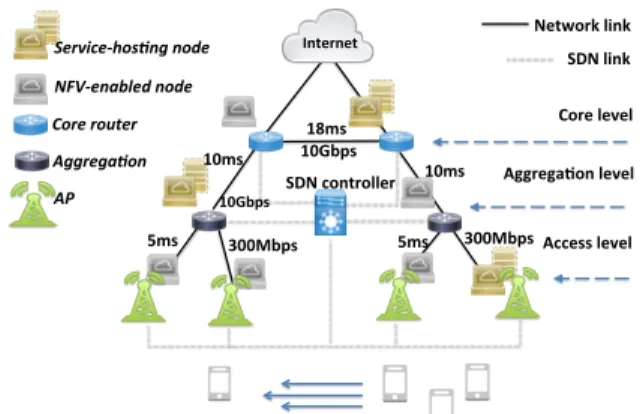
We consider a typical three-layer hierarchical wireless metropolitan area network [17] that consists of APs, aggre-gation nodes and metropolitan level mobile core network nodes (illustrated in Fig. 1). Each AP is connected to a single aggregation node which is connected to one mobile core node. Furthermore, the connectivity between mobile core nodes depends on the actual mobile core network’s topology. For most of real-world topologies, a mobile core node has at least one network link towards other mobile core nodes (e.g., a topology example is shown in Fig. 2). We use G= (V, E)
Internet SDN controller Network link SDN link 18ms 5ms 5ms 10ms 10ms 300Mbps 300Mbps 10Gbps 10Gbps NFV-enabled node Service-hos4ng node AP Core router Aggrega4on Core level Aggrega@on level Access level
Fig. 1: (Color Online) Hierarchical MEC system model.
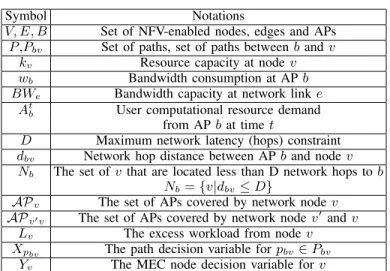
to denote this network, where V is the set of network nodes and E is the set of links. Further, let B denote the set of APs,b∈B, which is a subset of network nodes (B⊂V). We consider that each network node is equipped with a commodity server [11], which has limited computational resources, kv (e.g., CPU1) to host application service providers’ services as software via VMs. Such support of MEC services with NFV-enabled nodes necessitates NFV commodity servers to be active (e.g., active servers are shown in Fig. 1 as service-hosting nodes) and hence, incurs operational costs (e.g., energy consumption) [3]. For the rest of paper, we consider MEC nodes to be any NFV-enabled network nodes on which MEC services can be hosted with allocated VMs.
Given the NFV-enabled MEC, mobile users upload raw files at discrete time,t∈T, through their associated APs to MEC nodes for processing rather than executing service instances locally in their mobile devices. The user requests from an AP are served by VMs at a single MEC node through the same path, pbv ∈Pbv, between AP band node v (v is the selected node to host the required service)2, where P is the set of paths between pair of nodes in V andPbv ⊆P. We useAtb to denote the total load incurred by mobile users at AP, b at timet, which results in bandwidth consumption,wt
b, of flows departing from AP b. At the same time, user flows consume computational resources from MEC nodes, which depend on the AP-to-MEC assignment.
We consider stateless mobile services (e.g., AR, etc.) to be pre-installed as software into NFV-enabled nodes [1], [30]. That is, user requests can be seamlessly served by VMs at different MEC node without requiring service state migration since the services are stateless. In addition, NFV-enabled nodes that are not serving as MEC nodes can instantiate VMs to support stateless MEC services in a timely manner. This is due to the latest advances in VM technology such as Unikernel [14] and ClickOS [15], whereby the VM instantiation time could be reduced to tens of milliseconds (e.g., 30ms 3). We summarize the notations used in this paper in Table I.
1We only consider CPU as computational resources in this work. 2Multiple network paths betweenbandvcould exist due to connectivity
between mobile core nodes (see Fig. 2).
3Unikernel, designed for edge computing environment, achieves 30ms by
TABLE I: Notations
Symbol Notations
V, E, B Set of NFV-enabled nodes, edges and APs
P,Pbv Set of paths, set of paths betweenbandv
kv Resource capacity at nodev
wb Bandwidth consumption at APb
BWe Bandwidth capacity at network linke
At
b User computational resource demand
from APbat timet
D Maximum network latency (hops) constraint
dbv Network hop distance between APband nodev
Nb The set ofvthat are located less than D network hops tob
Nb={v|dbv≤D}
APv The set of APs covered by network nodev
APv0v The set of APs covered by network nodev0 andv
Lv The excess workload from nodev
Xpbv The path decision variable forpbv∈Pbv
Yv The MEC node decision variable forv
B. Problem Definition
Given the abovementioned system model and the flexible instantiation of MEC nodes, we consider the MEC opera-tional cost minimization problem for stateless low latency mobile services, whereby the network locations that host MEC services and the corresponding network paths can be dynamically controlled to efficiently utilize ISPs’ resources. To better illustrate this scenario, an example is given in Fig. 2. We can see that two MEC nodes are instantiated among all NFV-enabled nodes together with its selected network paths at t0. In contrast, only one MEC node is instantiated for operational cost minimization at t1 in response to the decreased demands from APs. Meanwhile, the network paths are accordingly changed att1.
In this work, we aim to concurrently answer four pri-mary questions: given a time varying workload, resource-constrained distributed NFV-enabled network nodes and ca-pacitated network links, (1) where and (2) when to allocate resources, (3) how many resources to be allocated among NFV-enabled nodes and (4) which network paths to use (e.g., between APs and MECs) such that the low latency requirements of mobile services are always satisfied while incurring the least operational cost. Without loss of generality, we assume in this work that all NFV-enabled commodity servers are identical (e.g., same specifications) and incur equal operational cost. Therefore, the operational cost minimization objective is equivalent to the minimization of number of active commodity servers (MEC node) [3].
We use ILP to formulate the problem with two binary decision variables,YvtandXptbv, which represent respectively the location of MEC service (i.e., Yvt = 1 if at time t, v is chosen as the location of a MEC service and Yt
v = 0 otherwise) and the path between b and v (i.e., Xt
pbv = 1 if
pbv is chosen;Xptbv = 0otherwise). The objective function of the ILP is to minimize the number of selected MEC nodes, that is, the sum of Yv, v∈V at every discrete time instance4,
t∈T.
4Note that by fixingT ={t
0}, the problem is reduced to a static placement
problem mentioned in Section I.
AP AP AP AP AP AP AP AP t t MEC MEC MEC
Traffic flow Alterna/ve flow path
Decreased APs’ demand from t to t1
Fig. 2: (Color Online) Example of MEC operational cost minimization problem.
To satisfy the service latency requirement, we first decom-pose the request response time into the following:
1) Network access time – represents the time a MEC ser-vice request spent during network transmissions, which highly depends on the selection of network path,Xt
pbv, between an AP and the selected MEC node. To model such delay, we assume that as long as the capacities of the constituent links in the selected network path are not violated by MEC flows, we can represent access delay as a function of network hops. Hence, in order to achieve a required network access time, both link capacity and the number of network hops that the request traverses need to be constrained.
2) Service processing time – refers to the time a VM uses to serve a request. We assume that as long as there is an available resource unit, and the request rate is lower than service rate, the processing delay is bounded and can be represented by a mean expected value that depends on the actual VM technology. To satisfy the processing time, we constrain the aggregated resource demands from APs that are served by MEC node at time
t to be no more than its physical capacity limit. This ensures a fixed service time at all time by allocating a dedicated resource unit for each request.
The ILP problem is formulated as below:
minX v∈V Yvt,∀t∈T, (1) Subject to X b∈B X v∈V X pbv(e)∈Pbv(e) wtbXpt bv(e)≤BWe,∀e∈E,∀t∈T, (2) X pbv∈Pbv X v∈Nb Xpbvt = 1,∀b∈B,∀t∈T, (3) X pbv∈Pbv X b∈B AtbXpt bv−kvY t v ≤0,∀v∈V,∀t∈T, (4) Yvt∈ {0,1},∀v∈V,∀t∈T, (5) Xpt bv ∈ {0,1},∀pbv∈Pbv,∀t∈T, (6) Constraint (2) guarantees that for all edges, the aggregated bandwidth consumption is less than the link capacity,BWe, at
every time instance, where Pbv(e) denotes all paths between
b and v that traverse edge, e; Constraint (3) guarantees that flows from the same bare assigned to the same MEC nodev
where v is selected from the set of network locations Nb =
{v|dbv ≤ D} that are within the network latency constraint denoted as D; Constraint (4) guarantees that the aggregated demands from APs at time t, P
pbv∈Pbv
P
b∈B
At
bXpbvt , served by the selected MECvis no more than its physical capacity limit
kv and Constraints (5)-(6) limit the decision variables to be either 0 or 1.
Our problem stated above is NP-hard. A relaxed version of our problem (i.e., without the bandwidth capacity constraints (2)) can be obtained from the capacitated set covering problem (CSCP)5. Since CSCP problem has been shown to be NP-hard [31], our problem is NP-hard too.
IV. DYNAMICRESOURCEALLOCATIONFRAMEWORK FOR
NFV-ENABLEDMEC A. Overview
Our problem aims at deriving the optimal MEC locations, amount of resources and network paths to MECs in face of dy-namic workloads to satisfy services’ low latency requirements while minimizing the overall operational costs incurred within the time period, T. Offline solutions (e.g., overprovisioning) only solve the latency aspect of the problem while ignoring the possible high costs incurred due to inefficient resource utilization. Existing dynamic solutions are either based on local search or global optimization. The former derives the resource allocation in a timely manner by targeting specific network areas suffering from resource exhaustion which how-ever often results in sub-optimal allocations. On the other hand, the latter takes demands across the whole network and is generally able to obtain better results at the cost of running time due to the large scale input from the entire network. Note that such long running time is not tolerable to online MEC as it would affect the performance of low latency services. To overcome the abovementioned issues suffered by most conventional approaches, we propose a novel dynamic optimization framework for NFV-enabled MEC that leverages both the local resource allocation and global re-allocation of resources to achieve a balanced trade-off between resource allocation optimality and algorithm’s running time.
Fig. 3 presents the overview of our dynamic resource allocation framework.
1) Heuristic-based incremental allocation mechanism(see the right-side of Fig. 3) follows the local search principle and aims at deriving the minimum required resources for MEC in a timely manner in response to temporary workload increase. The basic idea is to first provision NFV-enabled MEC with the minimum (optimal) number of MECs to satisfy the average user demands. Then, it
5In a capacitated set cover instance, we are given a universe X of n
elements and a collectionSofmsubsets ofXwith elements having demand
d:X 7→R+ and sets having suppliess:S 7→R+, each subset has an associated cost; the objective is to pick the collection of setsS0∈ Sof least
total cost, such that each element e ∈ X is contained in at least one set
S∈ S0while the supply of each set inS0is not violated [31].
exploits conventional techniques for coping with (minor) service elasticity (i.e., ALB) to maintain the overall number of MECs at a relatively low level. At the same time, we detect the time point when these mitigation tools will reach their limits (i.e., this implies that the existing MECs have been fully utilized) and cause the MEC system to violate the service response time re-quirement of the considered service(s). In such event, the allocation of a new MEC node (e.g., within the network latency constraints of APs that overloaded one of the existing MECs) will be chosen from the neighbouring network nodes of the overloaded MEC nodes (e.g., not searching the entire network), and activated in time before service quality degrades. By limiting the search scope to within the overloaded network area for the new MEC node, we significantly reduce the algorithm’s running time and avoid service response time violations due to computation congestion at MECs. However, the heuristic-based incremental allocation solution has a ma-jor disadvantage due to the fact that it only incrementally adds MEC nodes to the existing MEC nodes that are previously allocated. As a result, the MEC resource allocation may gradually deviate from the optimum over time due to its lack of consideration for global workload variations.
2) SCPA global reoptimization (see the left-side of Fig. 3) aims to overcome the disadvantages of heuristic-based incremental allocation by adjusting the allocated re-sources at a coarse-grained time granularity to a near-optimal state. SCPA is periodically performed in a less frequent manner. It takes the resulting MEC nodes from the incremental solution and globally adjusts the resource allocation to maintain low MEC operational costs6 within a bounded resulting operational cost. Next, we elaborate on how these two approaches jointly solve the MEC operational cost minimization problem while always conforming to the latency constraint. Our framework follows the procedure below.
1) We derive the initial optimal static MEC placement (i.e., the number of MECs is minimized) in an offline fashion by solving the static version of the problem7 at timet
0 using CPLEX [32].
2) We leverage conventional ALB mechanisms to cope with service elasticity based on the initial or most current placement and allocation such that the service process-ing time is guaranteed (i.e., no computation congestion at MECs) and the overall MEC number (e.g., operational cost) is kept low.
3) When the workload approaches the cloud capacity threshold, the system triggers the CVD mechanism based on the projected workload over a time window ∆t =t0−t where t0 is the prediction time slot. Note that ∆t will be selected according to the size of MEC network and the hosted mobile applications in MECs.
6We do not consider migration costs as applications are stateless. 7For large scale problem, we solve the relaxed version of our problem, and
Yes No Periodic Reoptimization SCPA Algorithm Initial Offline Allocation MEC Operational Cost Minimization MEC Capacity Violation? Heuristic-based Incremental Allocation SCPA Global Reoptimization
Auto-scaling Load Balancing NLCG Heuristic No Yes More resources to guarantee processing time?
Fig. 3: (Color Online) Dynamic resource allocation framework overview.
4) If it is detected that the ALB’s limit will be reached within the coming time horizon, ∆t, our NLCG algo-rithm is invoked to derive the desired new MEC node allocation based on the previous allocation solution. By appropriately deriving the NLCG start time, we mini-mize the added MECs in face of dynamic workloads. 5) A global reoptimization algorithm is performed
periodi-cally to adjust the MEC locations of theentirenetwork, allocation of MEC nodes and the corresponding network paths such that given a certain user demands, the MEC operational cost is bounded.
B. Heuristic-based Incremental Allocation Mechanism In the following, we detail every component of our heuristic-based incremental allocation mechanism.
1) Static Offline Resource Allocation: We first derive the minimum required number of MEC nodes, its network loca-tions, amount of allocated resources and AP-to-MEC network paths with CPLEX to support the low latency requirement given the average / expected user demands. We highlight that the offline resource allocation takes place at the network plan-ning stage which does not impose any optimization execution time constraints. However, when the input size to CPLEX is extremely large (e.g., more than 300 network nodes), a relaxed version 8 of the MEC operational cost minimization problem is solved to get a feasible solution within polynomial time.
2) Auto-Scaling and Load Balancing (ALB): Auto-scaling and load balancing are two current existing cloud comput-ing elastic techniques to accommodate dynamic workload
8We relax the routing decision variable (i.e., from integer to linear
pro-gramming).
Algorithm 1 Capacity Violation Detection (CVD)
Input: G(V, E), B,predicted workloadAt0, v0, kv0 Output: Future timet0 and extra loadLv0 or no NLCG
1: if current MEC nodes cannot accommodateAt0 then 2: Derive new AP-to-MEC assignments and resource
allocation withV ALB
3: ifV ALB cannot handleAt0 then
4: DeriveLv0 byAt 0
, the new assignments and
5: capacities of MEC nodes
6: Trigger NLCG algorithmreturnt0, Lv0 7: else
8: PerformALB 9: end if
10: end if
variations. We adopt a reactive auto-scaling solution that is triggered once a specific capacity threshold is reached. However, auto-scaling incurs additional VM reconfiguration delays which could affect service response time. This effect can be mitigated by setting a smaller auto-scaling threshold to invoke the auto-scaling mechanism in advance. Alternatively, proactive auto-scaling [33] can be applied to mitigate such auto-scaling overheads.
For load balancing, we adopt a proximity-aware solution [10] that considers both the residual capacity in MEC nodes and the topological proximity between MEC nodes and APs. Specifically, a flow from an AP to the overloaded MEC node will only be redirected when the newly chosen MEC node,
v, is within the network latency cover, Nb, and the residual capacity is sufficient to accommodate the redirected load. By doing so, the network latency and MEC processing time are always bounded after load balancing.
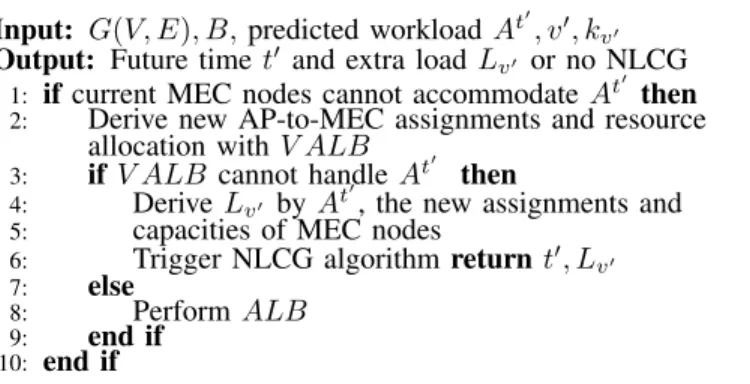
3) Capacity Violation Detection (CVD) Mechanism: ALB have their limits, after which further increase in the request rate will incur increasing queuing delays at MEC nodes and lead to potential latency violations. The core idea of the CVD mechanism is to identify the time when such limitations will be reached so as to allow the system to pro-actively allocate new MEC node(s). Algorithm 1 presents the pseudocode of the CVD mechanism.
For CVD, we first assume that the workload can be reasonably predicted (e.g., perfect prediction). In practice, prediction algorithms predict workloads based on historical workload data. Algorithms such as generalized autoregressive conditional heteroscedasticity model [9] and various more [33] can be accommodated into CVD. We note that prediction techniques are not the main focus of this work. Given the current MEC node locations, resource utilization level and AP-to-MEC assignment, we predict over the time window∆t
the aggregated workload P
pbv0∈Pbv0 P b∈B At0 bX t pbv0 atv 0 (i.e., v0
is the MEC node that invokes the detection) and check if the predicted workload results in a capacity violation at v0
(Line 1 in Algorithm 1). If the current state is predicted to be insufficient to accommodate the projected workload, we then estimate the future system state by virtually running ALB on the current system state with the projected workload.
The virtual ALB (VALB) aims to fully exploit computa-tional resources provided by MEC nodes located in different network locations before triggering NLCG. It checks if load
Algorithm 2 Network Latency Constraint Greedy (NLCG)
Input: G(V, E), B represents APs, existing MEC nodes Vs, latency constraint D, overloaded MEC node v0, excess flowLv0, predicted workloadAt
0
Output: newly selected MEC node(s) and the corresponding routes
1: New MEC node initializationvbmax← ∅
2: Find the set of APs, APv0, located in the distance cover
of overloaded MEC nodev0
3: For each network nodev∈V\Vs, find the APs,APv0v ,
that are located both in the cover ofv andv0 4: for allb∈ APv0 do
5: for all v∈Nb andv not inVsdo
6: ifv can accommodate excess flow Lv0 and
|APv0v| ≥ |APv0v bmax| then 7: vbmax←v 8: end if 9: end for 10: end for
11: ifno MEC foundvbmax==∅then
12: vbmax←argmax(|APv0v|)
13: trigger NLCG again with newly derived excess flow
Lv0 =Lv0−kvbmax 14: end if
15: Find network routes for the newly allocated MEC node(s)
Xt0 ←M inM axF aireness(vbmax,APv0vbmax) 16: UpdateYt0 withV
s←Vs∪vbmax
17: returnMEC node locationsYt0 and routingsXt0
(e.g., offloading tasks from the same AP) from v0 could be redirected to other MEC nodes while still conforming to the response time requirements of these flows. If virtual load balancing fails, virtual auto-scaling will be triggered to check if it can accommodate additional workloads by invoking auto-scaling. If this fails again, it means ALB will reach its limit within the projected time horizon and the overloaded MEC needs more computational resources to guarantee the service performance. Then, CVD records the excess load that cannot be served byv0 as Lv0 = P pbv0∈Pbv0 P b∈B At0 bXt 0 pbv0−kv0Y t v0 and
triggers the online NLCG heuristic. It is worth mentioning that VALB is running as a real-time simulation where no actual ALB and any network configurations take place.
4) Network Latency Constraint Greedy Heuristic: The NLCG algorithm simultaneously determines the new place-ment of MEC node(s), the required resources and the corre-sponding routes. The idea of NLCG (Algorithm 2) is to search for a new MEC node located within the applications’ network latency constraints that can accommodate the excess flow,Lv0,
from the overloaded MEC node v0 within the projected time. At the same time, the newly selected MEC node needs to satisfy as many flows (e.g., flows from APs served by other MEC nodes) as possible without violating network access delay to increase potential gain via load balancing to the new MEC node.
Specifically, NLCG first derives, for each network node other than existing MEC node v ∈ Vs, the number of APs covered by both the overloaded MEC node v0 and v. To this end, NLCG finds the set of APs, denoted by APv0 =
{b|dbv0 ≤ D, b ∈ B}, within the latency coverage of the
overloaded MEC,v0 (Line 2 in Algorithm 2). Next, it adds all
Algorithm 3 Set Cover Partition Approximation (SCPA)
Input: G(V, E), B represents APs
Output: MEC nodes and the corresponding routes
1: Vs← ∅whereVsis the set of MEC nodes
2: while Vs is not a feasible solution do
3: Selectv∈V that maximizes the increase of newly covered APs inVs
4: Store newly covered APs byv into APv
5: Vs←Vs∪v
6: end while 7: for all v∈Vs do
8: fv←G.f ractionalM axF low(v,APv)
9: Construct subgraphsGv(Vv, Ev)with edges and nodes traversed byfv
10: Gv.partition(APv)[35] finds the unsplittable flows between APs inAPv andv
11: end for
12: Superimpose paths found in each subgraph Gv
13: return MEC node locations and routings
APs that are located within the distance cover of bothv0andv
into APv0v={b|dbv ≤D, dbv0 ≤D, b∈B} (Line 3). Then,
for each AP within the distance coverb∈ APv0 of overloaded
MECv0, NLCG searches the potential MEC nodev from the candidate setNb={v|dbv ≤D, v∈V}, and greedily chooses the node vbmax that has the highest APv0v and can support excess loadLv0 (Line 4-10). If no viablevbmax can be found,
NLCG assigns thevthat has the largestAPv0vasvbmax(Line
11-12). This means that there is no single node location that can host all the excess flowsLv0 fromv0. In this case, NLCG
will be triggered again with a reduced Lv0 = Lv0 −kv
bmax to find the next location to add (Line 13). NLCG then directs flows inAPv0 previously served byv0 tovb
max and solve the routing problem using min-max fairness [34] (Line 15).
Upon completion of NLCG, VM instantiation will start at NFV-enabled servers that have been selected to serve as MEC nodes. This instantiation process needs to accomplish before application workloadAt0 arrives so that application’s response time will not be affected by VM instantiation. In other words, the overall time of VM instantiation and NLCG running time needs to be smaller than CVD’s detection interval. In our framework, since CVD interval (e.g., on the order of minutes [9]) is not on the same order as VM instantiation time (e.g., on the order of tens of milliseconds [14], [15]), the abovementioned condition can be achieved if NLCG’s running time is fast. We will evaluate NLCG’s running time and heuristic’s resulting application response time in Section V.
C. Set Cover Partition Approximation (SCPA) Global Reopti-mization Algorithm
To complement our incremental allocation mechanism, we devise the SCPA reoptimization algorithm (see Algorithm 3) with guaranteed performance bounds where an approximation ratio is derived to indicate how far the obtained solution is from the optimal solution. The SCPA algorithm first finds the locations and resources of MEC nodes by solving a CSCP with each MEC node being assigned a subset of demand nodes (e.g., APs) without considering the capacity constraint of each link in the network. Clearly, this solution does not
represent a feasible solution to our original problem, as the network link capacity constraint and AP-to-MEC paths are not incorporated. To obtain a feasible solution, SCPA then applies a graph partition technique to find the routes between each AP and MEC node that are assigned such that the link capacity constraint is satisfied. Specifically, we decompose the original MEC operational cost minimization problem into a CSCP and a set of single-source unsplittable flow problem (SSUFP)9. The solution to the CSCP gives MEC node allocation and the corresponding AP assignment, while the solution to each SSUFP derives the specific path between each MEC node and its assigned AP.
MEC node selection: We first show how the MEC node allocation for delay-sensitive applications without bandwidth constraints is transformed into a CSCP problem. To this end, we consider each network node v∈V as a set in the CSCP problem, and its computational capacity represents the supply of the set. An APbdenotes an element in the CSCP problem, and it can be covered by v if the network latency constraint is satisfied with dbv ≤ D. The number of requests at AP b denotes the demand of its corresponding element in the CSCP problem. Without loss of generality, we assume that the total demand of all APs can be fulfilled by the total resources available in the network. Then, the MEC node allocation without bandwidth constraints but with latency constraints becomes finding a capacitated set cover for the CSCP problem. LetVsbe such a feasible solution to the CSCP problem, which can be found by utilizing the algorithm due to [36]. Each network node in v ∈Vs is selected to serve as a MEC node, and the APs,APv, that are within its range in terms of network latency, will be covered by the MEC node allocated at v. The procedures of finding each MEC node v∈Vs is described in Algorithm 3 (Line 2-5), whereby the basic idea is to find a network node at each iteration that covers the most of APs until all APs are assigned to one of the selected network node inVs .
Network path selection: Next, we proceed to find the paths between each of the selected MEC nodev∈Vsand its covered APs, APv, where the bandwidth resource constraint of each link in G is taken into account. We first get a fractional maximum flow fv10 for each MEC node v ∈ Vs and its assigned APs inAPv(Line 8). Based onfv, we construct|Vs| subgraphs Gv(Vv, Ev) by including v, its assigned APv, all other intermediate network nodes (Vv) that connect v and its
APv, and the links (Ev) traversed byfv(Line 9). We then find SSUFP in the constructed subgraph for each selected network node v ∈ Vs, by using the algorithm PARTITION described [35] (Line 10). The basic idea of algorithmPARTITION is to further partition each subgraph into εsubgraphs by including APs that have demands in the same demand interval and the corresponding fractional paths fromfv. Then, in order to find
9In a single-source unsplittable flow instance (SSUFP), we are given a
networkG= (V, E), a source vertexs, a set ofkcommodities with sinks
t1, ..., tk and the associated real-valued demandsρ1, ..., ρk. The objective is to route the demandρi of each commodityialong a singles−tiflow path so that the total flow routed across any edgeeis bounded by the edge capacityBWe.
10Note that maximum flow is a common problem where many different
solutions can be applied (e.g., augmenting path algorithms [37]).
a feasible unsplittable path for all APs in each new subgraph, PARTITION updates edge capacities in each newly obtained subgraph by rounding up APs’ demand to the upper bound of its demand interval (i.e., this leads to the increase of edge capacity in subgraphs). Next, PARTITION iteratively applies augmenting path algorithm to find a feasible (e.g., conforms to augmented link capacities) unsplittable path for each AP. Finally, we superimpose unsplittable flows’ solutions of each subgraphGv to obtain the complete network paths (Line 12) for all APs. However, PARTITION violates at most (4 +ε) relative edge capacity for any ε > 0, where n12ξ−1 6 ε
andξrepresents the number of partition intervals in algorithm PARTITION.
D. SCPA Algorithm Analysis
In this section, we derive the performance bounds of our SCPA global reoptimization algorithm detailed in Section IV-C. For this purpose, we will first re-state the following Theorems 1 and 2 given in [36] and [35] respectively.
Theorem 1. [36]: Given a CSCP, there exists a greedy algorithm that finds a ln(N) approximation solution within running time ofO(|V|), where N gives the largest number of APs served by a MEC node inVs.
Theorem 2. [35]: Given an UFP, algorithm PARTITION finds a(4 +ε)approximation for relative congestion for anyε >0. The running time of the algorithm isO(T1(|V|,|E|)+|V||E|+
|E|ε), where T1(|V|,|E|) is the time to solve a fractional maximum flow problem.
Using the above, we can state the following theorem for our global reoptimization algorithm:
Theorem 3. Given a NFV-enabled network environment,
G(V, E), where network node v ∈ V has virtual compu-tational resources kv, network edge e ∈ E has bandwidth
BWe, and APs b ∈ B, B ⊆V has user demands Ab, there is a fast approximation algorithm for the delay-guaranteed cost minimization problem that delivers a feasible solution with a cost no more than ln(N) times of the optimal cost inO(|V|+|Vs|(T1(|V|,|E|) +|V||E|+|E|ε))time, whereN gives the largest number of APs served by a MEC node inVs,
|Vs|gives the number of resulting MEC nodes andT1(|V|,|E|) is the time to solve a fractional maximum flow problem. Proof. We begin by showing that the approximation ratio of our proposed SCPA algorithm is ln(N) times the optimal solution. Let C∗ and C0∗ be the optimal solutions to our problem with and without capacity constraints of network links.
The approximation solution to CSCP (Theorem 1) gives the lower bound of our original problem, i.e., C0∗ ≤ C∗. Specifically, in the aforementioned SCPA algorithm, the first step is to find the MEC node locations and the assignment of APs to the selected MEC nodes, which are given by solving the CSCP problem. Such node locations determine the resulting cost of both CSCP and our original problem defined in Section III-B. However, CSCP does not answer through which paths the APs and MEC nodes are connected and the network
bandwidth capacity constraints are ignored, which is a special case of our original problem. Hence, the solution to CSCP is the lower bound to the original problem.
Denote by C0 and C the solutions of the first (node selection) and second (path selection) steps of the proposed SCPA algorithm. Clearly, we have C0 = C, because in the second step no network nodes are included or removed. We thus have
C=C0
≤C0∗·ln(N), since Theorem 1
≤C∗·ln(N).
This means that the approximation ratio of the proposed algorithm is ln(N).
We then show that feasible unsplittable paths between MEC nodes and the APs assigned to each MEC node can be found in polynomial time and the resulting edge congestion is no more than(4 +ε)|Vs|times edge capacity.
The idea of showing the bound of edge congestion is by considering the worst-case where the edge that has the maximum flow in a subgraph Gv overlaps with all edges from other subgraphs that also have the maximum flow. This situation could occur as we partition the original graph into
|Vs| subgraphs after we solve CSCP, and an edge from the original graphGcan be shared by many subgraphs. According to Theorem 2, the relative edge congestion is at most(4+ε)in a subgraphGv. Hence, the worst-case relative edge congestion in the original graph is at most(4+ε)|Vs|since an edge inGv can overlap with at most |Vs| edges when it is superimposed with other edges.
We have now shown that there is a set of unsplittable flows for each subgraphGvobtained from the solution to CSCP and each edge has a congestion no more than(4+)|Vs|. However, the edge congestion could violate the bandwidth constraint (2). This can be solved by setting the subgraph edge capacity by
BWe
(4+ε)|Vs|. Then, the edge capacity at all edges can be satisfied. Thus, the solution of the proposed SCPA algorithm satisfies all constraints and there is a feasible solution of paths for the lower bound (e.g., CSCP) of the original problem. This means that the approximation ratio of CSCP is the approximation ratio of the original problem.
Finally, we derive the running time of the proposed SCPA algorithm based on the running time from [35], where they showed solving a SSUFP requires a running time in
O(T1(|V|,|E|) +|V||E|+|E|ε). More specifically, since our problem consists of solving a CSCP and|Vs|SSUFP, we derive the running time by adding the running time of solving each subproblem. Therefore, the running time in our problem is
O(|V|+|Vs|(T1(|V|,|E|) +|V||E|+ε|E|)). V. PERFORMANCEEVALUATION
In this section, we evaluate the efficiency of our proposed framework in terms of service response time (i.e., round-trip time and processing delay at VMs) and cost efficiency under different MEC settings (e.g., network size, application latency requirement and server capacity). We first show in Section V-A that our dynamic resource allocation framework
achieves the low latency requirement of the application while resulting in lower operational costs compared to existing approaches. We then focus on the performance analysis of the SCPA reoptimization algorithm in Section V-B. We compare SCPA’s results against optimal and heuristic-based incremental allocation and show how close our SCPA algorithm can drive MEC systems back to the optimal state.
We clarify the schemes that will be compared against as follows:
1) Overprovisioning – We first solve the MEC placement and allocation at the peak workload with CPLEX in an offline manner and then, for each chosen location, we overprovision VMs with the maximum possible physical capacity to serve user requests, i.e., ALB and new MEC instantiation are never needed in this case.
2) ALB– We implement the initial solution from the static allocation problem at t = 0. The network performs ALB on the initial MEC locations (fixed locations) when needed.
3) Heuristic – Our proposed heuristic-based incremental allocation including NLCG algorithm, ALB and CVD (see the right-side of Fig. 3).
4) Heuristic+Reoptimization – Our proposed dynamic framework in full, combining heuristic-based incremen-tal allocation and periodic SCPA global reoptimization that performs every 30 minutes.
A. Service Latency and Operational Costs
We use packet-level simulations to examine detailed MEC service latencies and operational costs. To this end, we create a realistic online NFV-enabled MEC simulation environment with OMNeT++ [38] complemented with an OpenFlow exten-sion module provided by [39]. We implemented our dynamic resource allocation framework that operates as part of the centralized software-defined networking (SDN) controller. The controller connects to each network node through a dedicated network link (see Fig. 1), and dynamically carries out network configuration during MEC node instantiations.
We create a three-layer metropolitan wireless network shown in Fig. 1, consisting of APs, aggregation nodes and mobile core network nodes. In this network, the APs are deployed over an area of 46km2where the deployment density is 0.65 APs per km2. We further consider 1,800 mobile users moving following the mobility traces of a fleet of taxis operating in San Francisco [18]. Accordingly, we set up 30 APs, 5 aggregation nodes and 5 core network nodes (e.g, set according to part of Paris’ core network model [40]) for the considered number of users and area where each network node is equipped with a cluster of commodity servers. In terms of server size, we follow [26] such that each network node has 21 servers and each server has 2.1GHz CPU of 18 cores. Moreover, we consider an AR application [30] where users upload street views captured by their mobile devices for annotations (e.g., building name, available parking places, etc.) computed by MEC. Such application requires a service response time of 480ms [1] and generates upload frames of size 0.5MB at 0.3FPS [30] which requires 230ms for a VM
TABLE II: Performance comparison with realistic topology.
Latency Maximum Number of Cost
Requirement Latency MEC nodes saving(%)
(start)−→(end) Overprovision Succeed 480ms 3−→3 0% ALB Fail 132s 2−→2 42.6% Heuristic Succeed 480ms 2−→3 33.6% Heuristic+ Succeed 480ms 2−→3 33.6% Reoptimization
of 600MHz CPU to process [30]. For simplicity, we assume homogeneous frame size and upload rate for all users. In terms of network latency constraint, we set a maximum of 4 network hops11 from AP to MEC node [41].
Given the aforementioned setup, we first derive the initial MEC node locations, resources needed and the corresponding network paths by CPLEX solver in an offline manner. Two MEC nodes are selected among all NFV-enabled nodes (the “Number of MEC nodes, (start)−→(end)” column in Table II shows this number). Then, we execute our simulations for a duration of 1 hour from the abovementioned initial state, during which we gradually increase the AR application work-load from 0.3FPS to the peak workwork-load at 3.0FPS in steps of 0.1FPS every 400s. We set a threshold-based VM auto-scaling mechanism for our packet-level simulation. Whenever VM load reaches a threshold of 80%, auto-scaling mecha-nism is triggered with a VM instantiation time of 100ms, This is set according to a realistic NFV commodity servers’ instantiation time following [14]. In addition, we set the workload prediction time window, ∆t = 400s [9] for the NLCG algorithm, and consider a 100% prediction accuracy. This assumption has been largely adopted in the design of online resource allocation algorithms [3], [17], [24]. On the other hand, an inaccurate workload prediction would result in overprovisioning or underprovisioning of MEC resources in practice, which leads to poor cost efficiency and long processing delay respectively. Many existing work such as [42] have studied the impact of prediction inaccuracy and the compensation techniques (e.g., [42] proposed a method to minimize the impact of prediction inaccuracy, in which they minimized the underprovisioning-caused latency violations less than 2% of all requests). Therefore, our evaluation focuses on the proposed algorithms.
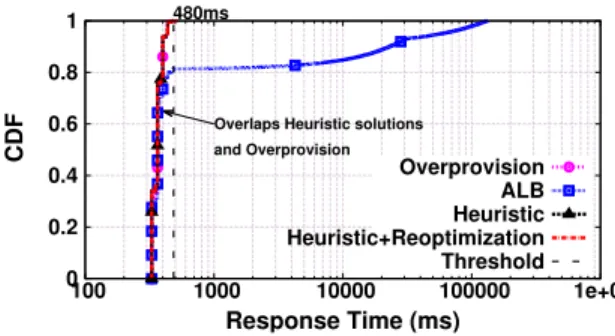
Now, we compare our solution against existing solutions in terms of service latency and operational costs. Table II shows our results with respect to satisfaction of the response time requirement, number of resulting MEC nodes (i.e., operational costs) at the start and end of the simulation and the cost savings over time in comparison to theOverprovisionscheme. From the table, we can see that only the costly Overprovision and our solutions (Heuristic and Heuristic+Reoptimization), manage to satisfy the delay requirement of the considered AR application. In addition, ALBresults in the lowest number of MEC nodes at the end of the simulations, but it comes with delay penalties due to computation congestion at the two initial MEC nodes. Our solutions have all increased the resulting
11According to [41], when maximum number of network hops are no more
than 4, MEC always outperforms DC-based cloud in terms of latency.
0 0.2 0.4 0.6 0.8 1 100 1000 10000 100000 1e+06 CDF Response Time (ms) 480ms
Overlaps Heuristic solutions and Overprovision Overprovision ALB Heuristic Heuristic+Reoptimization Threshold
Fig. 4: (Color Online) Response time.
number of MEC nodes by 1 in response to the increased workload. When we compare the costs over time against Overprovision, ALBachieves a saving of 42.6%. In contrast, our Heuristic and Heuristic+Reoptimization lead to a more modest saving (i.e., 33.6% in both cases), but achieves the latency requirement by increasing the overall computational resources through the new allocation of MEC nodes. Such saving is achieved by minimizing the number of required MEC node instantiations whereby the CVD mechanism derives the time instance when the resources of MECs will be fully utilized and cannot accommodate more workloads. However, due to the packet-level simulator’s limitation, only a small topology is evaluated, whereby the performance improvement ofHeuristic+Reoptimizationcannot be revealed (e.g., identical results of cost saving in Table II).
In addition, we observe from the cumulative distribution function (CDF) of response time in Fig. 4 that the resulting response time of our solutions overlap with that of Overpro-vision. This further shows the seamless transition to the new system state, andHeuristicapproach is fast enough to get VMs ready before workload arrives. On the other hand,ALBfails to conform to the latency requirement with 20% (see Fig. 4) of the overall requests exceed the latency threshold (maximum latency at 132s) due to insufficient physical capacity in the fixed limited number of MECs.
Our detailed packet-level simulator allows us to track and examine each and every individual request and response packet in the system. The tradeoff to this is the scalability of the simulator which constrained us to smaller scale simulations. To more comprehensively evaluate our solution, we further evaluate our framework, specifically on the benefits brought by our global re-optimization algorithm, SCPA, with larger network topologies in the next section. Also, we thoroughly investigate the impact of different network sizes, network hop constraints and MEC service-hosting servers’ sizes to our solution.
B. System Cost Optimality
We proceed to evaluate the improvements provided by SCPA via flow-level simulations with large network topolo-gies, and investigate by how much SCPA can drive the NFV-enabled MEC back to the optimal state. To this end, we compare the resulting MEC operational cost of Heuris-tic+Reoptimizationagainst Heuristicand lower bound of
op-timal solution12 denoted byOP TLB under different network sizes, latency requirements and physical capacities of NFV-enabled servers. Furthermore, in order to present SCPA reopti-mization’s optimality difference toOP TLB in a more intuitive way and take into account MECs’ resource utilization level, we introduce two metrics: cost efficiency andcost efficiency gap. The cost efficiency,Cef f, quantifies the number of mobile users per MEC node who achieve the required service response time.
Cost efficiency,Cef f =
N busers
|Vs|
(7) whereN busers is the total number of users who receive their services within the services’ latency requirements.
Cost efficiency gap shows how close the resulting cost efficiency of our solutions (i.e.,Heuristic+Reoptimizationand Heuristic) is to the OP TLB, that is, the smaller this gap is, the more cost-efficient the solution is. More specifically, this metric is derived as the normalized difference between cost efficiency of our solutions and that of OP TLB.
Cost efficiency gap,Gapef f =
Cef fOP TLB−Cef f COP TLB ef f (8) whereCOP TLB
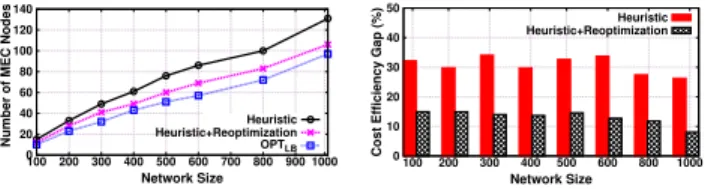
ef f denotes the cost efficiency ofOP TLB. 1) Impact of Network Size: We adopt GT-ITM [43] to generate synthetic network topologies where the probability of having an edge between two nodes is 0.2 with edge capacities uniformly distributed between 300Mbps and 10Gbps. Other setup / parameters related to the application, workload and server capacity remain the same as previously described (see Section V-A). We plot in Fig. 5(a) the average number of MEC nodes in function of different network sizes ranging from 100 nodes to 1000 nodes for Heuristic,Heuristic+Reoptimization and OP TLB. It must be stressed that the average number of MEC nodes at each network size (e.g., 100 to 1000 nodes) is the average number of MEC nodes of 4 simulations with different service latency requirements (e.g., maximum number of hops from 1 to 4 hops). By doing so, the impact of a specific latency requirement to the MEC node number is reduced, and hence Fig. 5(a) can reflect the impact of network sizes to MEC node number in a more accurate way.
From Fig. 5(a), we see that the Heuristic+Reoptimization solution achieves lower operational costs (i.e., lower number of resulting MEC nodes) for all network sizes compared to Heuristic. The resulting MEC operational cost of our Heuris-tic+Reoptimizationalso closely follows that of OP TLB. The relative poorer performance achieved by Heuristic is due to its local search nature where the search of a new MEC node is triggered by overloaded existing MEC nodes and carried
12SuchOP T
LBis solved by relaxing both the edge capacity constraint and the routing decision variableXp(i.e., from integer to linear programming). Note that this is a conservative estimation of the optimal solution, which is smaller than the optimal value. In addition, due to the complexity in deriving theOP TLBsolutions for large size networks (e.g., larger than 300 nodes), we stop the CPLEX solver when the optimality gap reaches 5% to avoid long execution time. 0 20 40 60 80 100 120 140 100 200 300 400 500 600 700 800 900 1000
Number of MEC Nodes
Network Size Heuristic Heuristic+Reoptimization OPTLB
(a) Average costs for each network size over different latency require-ments. 0 10 20 30 40 50 100 200 300 400 500 600 800 1000
Cost Efficiency Gap (%)
Network Size Heuristic Heuristic+Reoptimization
(b) Cost efficiency gap toOP TLB.
Fig. 5: (Color Online) Impact of network sizes to costs.
0 10 20 30 40 50 60 70 0 1 2 3 4 ∞
Cost Efficiency Gap (%)
Maximum Number of Network Hops Heuristic Heuristic+Reoptimization
Fig. 6: (Color Online) Cost efficiency gap toOP TLB. out in the vicinity of these affected nodes. As a result, the optimal MEC location that may benefit the maximum num-ber of users could potentially be omitted during Heuristic’s search process, leading to a relatively lower cost efficiency. In contrast,Heuristic+Reoptimization utilizes resources more efficiently by searching the optimal MEC locations over the entire network.
We show in Fig. 5(b) the cost efficiency gap toOP TLB for Heuristic+Reoptimization andHeuristic. We see that Heuris-tic’s cost efficiency gap to OP TLB is always above 25%, whereasHeuristic+Reoptimizationcan improve nearly 20% of Heuristic’s cost efficiency due to the global search. In addition, Heuristic+Reoptimization consistently achieves an efficiency gap below 15% for any network sizes (see Fig. 5(b)). In par-ticular, we observe thatHeuristic+Reoptimization’s efficiency gap does not increase with network size, which justifies the theoretical performance bound ln(N), whereby N represents the largest number of APs served by a MEC node, which is independent to the size of network.
2) Impact of Latency Requirements: The latency require-ment can be interpreted as the maximum tolerable number of network hops between APs and MEC nodes. It directly affects the number of APs that a NFV network node can cover (i.e., serving the APs without violating latency requirements). This, in turn, affects the required MEC nodes to cover all APs in the proposed algorithms. To show the impact of this factor, we vary the maximum tolerable number of network hops from 1 to 4, which reflects latency requirements of different nature such as extremely strict network latencies (e.g., 10ms network delay) to loose latencies (e.g., 150ms network latency). We show, with Fig. 6, both Heuristic and Heuristic+Reoptimization’s cost efficiency gap ratio for each of considered latency requirement. Note that the cost efficiency gap at each latency requirement in Fig. 6 is the average of that of all network sizes (e.g., 100 to 1000).
out-performsHeuristicfor each latency requirement, and it always achieves an efficiency gap below 20%. In particular, when the maximum network hop is set to zero, both Heuristicand Heurisitc+Reoptimization achieve an optimal operational cost where the efficiency gap equals to zero. This is due to the fact that the extreme low latency constraint (e.g., 0 hop) restricts all APs to be served as MEC nodes, which makes the resulting number of MEC nodes identical for any MEC allocation algorithms that conforms to the network latency constraint. Similarly, when we look at the other extreme case where the latency constraint is extremely loose (see ∞ in Fig. 6) and the physical NFV servers have infinite capacity, only one MEC node is required inHeuristic,Heurisitc+Reoptimization and OP TLB (e.g., this leads to 0% cost efficiency gap). From the above two cases, we observe that the selection of MEC resource allocation algorithm does not play a critical role in the resulting MEC operational cost when latency is either extremely loose or strict. However, when the latency requirement is between the two extremes cases, it significantly affects the cost efficiency. For instance, when the latency requirement is set to 1, 2, 3 and 4 network hops, we observe from Fig. 6 that the cost efficiency gap of both Heuristicand Heurisitc+Reoptimizationfirst increases and then decreases as the maximum tolerable network hops increase. The increase of cost efficiency gap at network hop 1 and 2 compared to 0 hop is due to the enlarged search space for MEC nodes inHeuristicandHeurisitc+Reoptimization. Such search space enlargement increases the chance of selecting less optimal MEC nodes where MECs’ resource utilization is poorer com-pared to MECs derived by OP TLB. On the other hand, the decrease of efficiency gap at 3 and 4 network hops is the consequence of improved MEC utilization compared to cases with 1 and 2 network hops. Specifically, due to the relaxed latency constraint, a MEC node can serve a larger number of users without violating the network latency requirement, and hence achieve a better resource utilization compared to strict latency requirements. In particular, the relaxed latency constraint at 4 network hops results in a situation where the number of served users in each MEC reaches servers’ physical capacity limits, that is, the resource utilization at each derived MEC is almost 100%. Knowing that an optimal MEC resource allocation achieves the least number of MEC also by fully utilizing MECs’ resources. Therefore, the fully utilized MEC nodes at 4 network hops achieve a very close cost toOP TLB. Similarly, when the latency becomes even less strict (e.g.,
∞), the allocated resources at MECs will reach the servers’ physical capacity limits and result in the same operational cost as OP TLB (see ∞in Fig. 6). Clearly, there is an inter-correlation between applications’ latency requirement and the server capacity, which we elaborate in the next subsection.
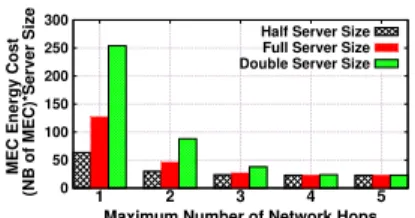
3) Impact of Physical Capacities: Next, we evaluate the impact of servers’ physical capacities to Heurisitc+Reoptimization’s MEC costs. To this end, we consider three NFV-enabled servers sizes, namely, FULL (i.e., the considered server size (see Section V-A)), HALF (i.e., half ofFULLsize),DOUBLE (i.e., two times theFULL size) [17], [26]. Furthermore, servers of different sizes result in different energy consumption, which can be estimated
0 50 100 150 200 250 300 1 2 3 4 5
MEC Energy Cost
(NB of MEC)*Server Size
Maximum Number of Network Hops
Half Server Size Full Server Size Double Server Size
Fig. 7: (Color Online) Heuristic+Reoptimization’s average cost for each latency constraint over different network sizes.
0 100 200 300 400 500 600 700 100 200 300 400 500 600 700 800 900 1000 Time (seconds) Network Size Heuristic Heuristic+Reoptimization
Fig. 8: (Color Online) Algorithm running time comparison. based on the server size and resource utilization [3]. We take a simplistic assumption in our evaluation whereby the energy consumption is proportional to the server size. That is, we consider HALF size servers consume half of FULL size servers’ energy and correspondingly, DOUBLE size servers consume double the amount of energy of FULLsize servers. We plot in Fig. 7 the average energy cost incurred by Heurisitc+Reoptimization under different network latency requirements for each of the abovementioned server sizes. We observe that simulations with DOUBLE server size result in higher costs than HALF and FULL server when network latency requirement is extremely low (e.g., 1 network hop). This is due to the inter-correlation between the two impact factors: latency requirement and server size. More specifically, when network latency requirement is extremely low, the latency requirement impact factor dominates the MEC node searching process leading to almost the same number and placement of resulting MEC nodes for HALF, FULL and DOUBLE size servers. However, the per MEC energy consumption of DOUBLE size server is significantly more than that ofHALF andFULLsize which results in the overall higher costs (see Fig. 7). In contrast, when the latency requirement becomes less strict (e.g., network hops 3 and 4), DOUBLE size servers’ energy cost decreases drastically as a consequence of decreased number of required servers and better resource utilization compared to that of strict latency requirements (i.e., each server supports a larger number of users within its network latency constraint). At the same time, we see from Fig. 7 that the resulting cost of the 3 server sizes converges to the same level after 3 network hops. For each server size, more users are served per MEC after the relaxation of latency requirements, and hence all MECs are almost fully utilized. As a consequence, the overall number of MEC nodes with full-size servers is half of that of half-size case and double of double-size case. Given the simplified energy cost assumption, our dynamic resource allocation