R E V I E W : E C O L O G Y
Biodiversity and Ecosystem Functioning:
Current Knowledge and Future Challenges
M. Loreau,1* S. Naeem,2P. Inchausti,1J. Bengtsson,3J. P. Grime,4A. Hector,5D. U. Hooper,6M. A. Huston,7D. Raffaelli,8B. Schmid,9D. Tilman,10D. A. Wardle4
The ecological consequences of biodiversity loss have aroused considerable interest and controversy during the past decade. Major advances have been made in describing the relationship between species diversity and ecosystem processes, in identifying functionally important species, and in revealing underlying mechanisms. There is, however, uncertainty as to how results obtained in recent experiments scale up to landscape and regional levels and generalize across ecosystem types and processes. Larger numbers of species are probably needed to reduce temporal variability in ecosystem processes in changing environments. A major future challenge is to determine how biodiversity dynamics, ecosystem processes, and abiotic factors interact.
T
he relationship between biodiversity and ecosystem functioning has emerged as a central issue in ecological and environmental sciences during the last de-cade. Increasing domination of ecosystems by humans is steadily transforming them into depauperate systems (1,2). Because ecosys-tems collectively determine the biogeochemi-cal processes that regulate the Earth system, the potential ecological consequences of biodiversity loss have aroused considerable interest (3–9).Recent experimental and theoretical work in this area has also led to animated debates and controversies (10–14). Human impacts on the environment from local to global scales cause not only a general de-cline in diversity, but also predictable func-tional shifts as sets of species with partic-ular traits are replaced by other sets with different traits (15,16). This has resulted in
the current debate in which scientists dis-agree about the relative importance of func-tional substitutions and declining species richness as determinants of changes in eco-system functioning. Comparative studies have begun to reveal the extent to which functional substitutions alter ecosystem properties such as productivity, decompo-sition rates, nutrient cycling, and resistance and resilience to perturbations (17,18). On the other hand, a new wave of experimental studies has manipulated species richness by using synthesized model ecosystems in both terrestrial and aquatic environments (19–25). Both approaches suggest that a large pool of species is required to sustain the assembly and functioning of ecosys-tems in landscapes subject to increasingly intensive land use. It is not yet clear, how-ever, whether this dependence on diversity arises from the need for recruitment of a few key species from within the regional species pool or is due to the need for a rich assortment of complementary species with-in particular ecosystems.
In this article, we seek to set a common framework to understand these issues, to move beyond past differences of opinion, and to define new perspectives, after a recent conference held in Paris. We do not attempt to comprehensively review these issues, ele-ments of which can be found elsewhere (3– 9). Rather, we focus on major regions where recent advances have been made.
Experimentally Altered Diversity
Although the first study that experimentally manipulated diversity did so across several trophic levels (19), later studies focused mainly on effects of plant taxonomic diversi-ty and plant functional-group diversidiversi-ty on
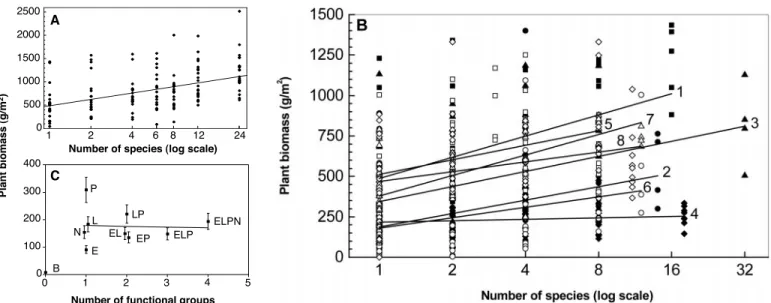
primary production in grassland ecosystems (20–23). Because plants, as primary produc-ers, represent the basal component of most ecosystems, they represented the logical place to begin detailed studies. Several, al-though not all, experiments using randomly assembled communities found that primary production exhibits a positive relationship with plant species and functional-group di-versity (Fig. 1).
These results attracted a great deal of interest, not only because they were novel, but also because they seemed counter to pat-terns often observed in nature, where the most productive ecosystems are typically characterized by low species diversity (26, 27). The controversy over the interpretation of these results started with the realization that they can be generated by different mech-anisms. The mechanisms discussed so far may be grouped into two main classes. First are local deterministic processes, such as niche differentiation and facilitation, which increase the performance of communities above that expected from the performance of individual species grown alone. We will sub-sume them here under the term “complemen-tarity” for convenience’s sake. Second are local and regional stochastic processes in-volved in community assembly, which are mimicked in experiments by random sam-pling from a species pool. Random samsam-pling coupled with local dominance of highly pro-ductive species can also lead to increased average primary production with increasing diversity, because plots that include many species have a higher probability of contain-ing highly productive species (10, 11, 28). Two issues are involved in this controversy: Are stochastic community assembly process-es relevant? And what is the relative impor-tance of the two classes of mechanisms?
There are diverging views on the rele-vance of the sampling component of biodi-versity effects. As sampling processes were not an explicit part of the initial hypotheses, they have been viewed by some as “hidden treatments” (10), whereas others have viewed them as the simplest possible mechanism linking diversity and ecosystem functioning (28). This debate should be resolved through increasing knowledge about the patterns and processes of biodiversity loss in nature, which are still poorly known overall. If dom-1Laboratoire d’Ecologie, UMR 7625, Ecole Normale
Supe´rieure, 46 rue d’Ulm, F–75230 Paris Cedex 05, France.2Department of Zoology, University of
Wash-ington, 24 Kincaid Hall, Box 351800, Seattle, WA 98195–1800, USA.3Department of Ecology and Crop
Production Science, Swedish University of Agricultural Sciences, Box 7043, SE–750 07 Uppsala, Sweden.
4Department of Animal and Plant Sciences, University
of Sheffield, Sheffield, S10 2TN, UK.5NERC Centre for
Population Biology, Imperial College at Silwood Park, Ascot, Berks, SL5 7PY, UK.6Department of Biology,
Western Washington University, 516 High Street, Bellingham, WA 98225–9160, USA.7Environmental
Sciences Division, Oak Ridge National Laboratory, Oak Ridge, TN 37831–6400, USA.8Environment
De-partment, University of York, York, YO10 5DD, UK.
9Institut fu¨r Umweltwissenschaften, Universita¨t
Zu¨-rich, Winterthurerstrasse 190, CH–8057 Zu¨Zu¨-rich, Swit-zerland.10Department of Ecology, Evolution and
Be-havior, University of Minnesota, St. Paul, MN 55108, USA.
*To whom correspondence should be addressed. E-mail: [email protected]
inant species control ecosystem processes and mostly rare species go extinct, the vagar-ies of community assembly or disassembly may have little relevance. But environmental changes and landscape fragmentation could prevent recruitment of appropriate dominants (29). Also, climate change could lead to grad-ual losses of species as abiotic conditions begin to exceed species’ tolerance limits. Such losses could be random with respect to species effects on any given ecosystem pro-cess, leading to patterns of process response to changes in diversity similar to those ob-served in randomly assembled communities. It should be emphasized that recent experi-ments were not intended to reproduce any particular sequence of species loss; they re-flect potential patterns, unaffected by corre-lations between diversity loss and composi-tional changes, rather than actual predictions of functional consequences of biodiversity loss under specific global change scenarios.
Recent experiments were also not de-signed to investigate detailed underlying mechanisms. Assessing the relative impor-tance of complementarity and sampling ef-fects has been done so far indirectly, by using comparisons between the performances of mixtures and monocultures (14,23,30, 31). Furthermore, it is becoming clear that complementarity and sampling are not mutu-ally exclusive mechanisms as previously thought. Communities with more species have a greater probability of containing a higher phenotypic trait diversity. Dominance that is brought about by ecological “selec-tion” of species with particular traits and complementarity among species with
differ-ent traits are two ways by which this pheno-typic diversity maps onto ecosystem process-es (6). Thprocess-ese two mechanisms, however, may be viewed as two poles on a continuum from pure dominance to pure complementarity. In-termediate scenarios involve complementar-ity among particular sets of species or func-tional groups, or dominance of particular sub-sets of complementary species (Fig. 2). Any bias in community assembly that leads to correlations between diversity and communi-ty composition may involve both dominance and complementarity.
Rigorously testing the hypothesis that there
is a minimum subset of complementary spe-cies that is sufficient to explain diversity effects will often be difficult because it would ideally require testing, with replication, the performance of all species combinations at all diversity levels. Re-analysis of data from pre-viously published experiments suggests sig-nificant effects of species richness on plant biomass even after controlling for the strong effects of certain species, such as legumes (30,31). Although these new results present-ed at the Paris conference will nepresent-ed to be critically evaluated, they suggest that comple-mentarity does occur among at least several Fig. 1.Responses of total (A) or aboveground (BandC) plant biomass (in
grams per meter squared) to experimental manipulations of plant species richness (A and B) or functional-group richness (C) in grasslands in Minnesota (A) (31), across Europe (B) (23), and in California (C) (22). Points in (A) and (B) are data for individual plots. In (B) different regression slopes are shown for the eight sites to focus on between-location differences rather then the general log-linear relationship
re-ported elsewhere (23). Filled squares and line 1, Germany; filled circles and line 2, Portugal; filled triangles and line 3, Switzerland; solid dia-monds and line 4, Greece; open squares and line 5, Ireland; open circles and line 6, Sweden; open diamonds and line 7, Sheffield (UK); open diamonds and line 8, Silwood Park (UK). Symbols in (C) correspond to functional groups and their combinations: B, bare ground; E, early-season annuals; L, late-season annuals; P, perennial bunchgrasses; N, N fixers.
Fig. 2. Hypothesized mecha-nisms involved in biodiversity experiments using synthetic communities. Sampling effects are involved in community as-sembly, such that communi-ties that have more species have a greater probability of containing a higher pheno-typic trait diversity. Pheno-typic diversity then maps onto ecosystem processes through two main mecha-nisms: dominance of species with particular traits, and complementarity among spe-cies with different traits. In-termediate scenarios involve complementarity among par-ticular species or functional groups or, equivalently, dom-inance of particular subsets of complementary species.
species belonging to different functional groups in these experiments. No clear evi-dence, however, has been provided so far for complementarity among a large number of species, although complementarity among rare species would be difficult to detect. With our knowledge now, we cannot reject the hypothesis that a few dominant species suf-fice to provide the functional diversity that is necessary to explain the level of primary production observed in grassland ecosystems at the small spatial and temporal scales con-sidered in recent experiments.
Future experiments should strive to over-come the limitations that led to the recent controversy. Greater attention should be paid to what individual species do in these exper-iments. One option for assembly experiments is to have carefully balanced designs to allow contrasts between plots with and without par-ticular species or subsets of species. Another option is to include manipulations of even-ness within a level of species richeven-ness, which could provide an alternative to methods based
on comparisons with monocultures, to sepa-rate dominance and complementarity effects. There is also a great need for other approach-es based on “natural” ecosystems, such as removal experiments (32) and comparative approaches that control for variation of fac-tors other than diversity (33).
Biodiversity as Insurance
Even when high diversity is not critical for maintaining ecosystem processes under con-stant or benign environmental conditions, it might nevertheless be important for maintaing them under changmaintaing conditions. The in-surance hypothesis (34) and related hypoth-eses (35–40) propose that biodiversity pro-vides an “insurance” or a buffer, against en-vironmental fluctuations, because different species respond differently to these fluctua-tions, leading to more predictable aggregate community or ecosystem properties. In this hypothesis, species that are functionally re-dundant for an ecosystem process at a given time are no longer redundant through time.
In a way, this is the old stability-versus-complexity debate resurfacing in a new form (7). Several problems, however, have confused this historical controversy: (i) The general concept of “stability” actually cov-ers a wide array of different properties (41); (ii) the relationship between these proper-ties and diversity may change across eco-logical levels of organization such that large variability at the population level may not imply large variability of ecosystem processes (38, 41); and (iii) stability has been approached mainly within a determin-istic, equilibrium theoretical framework. Recent theoretical work has attempted to remove these obstacles and has provided support for the insurance hypothesis. As diversity increases, the variability of indi-vidual populations may increase as a result of the destabilizing influence of strong spe-cies interactions internal to the system, but the variability of aggregate ecosystem properties often decreases because of the stabilizing influence of asynchronous
spe-cies responses to intrinsic or extrinsic en-vironmental fluctuations (34–40). What re-mains unclear, however, is whether this stabilizing effect saturates at low or high diversity, which depends on model condi-tions (5, 9,34,38, 39).
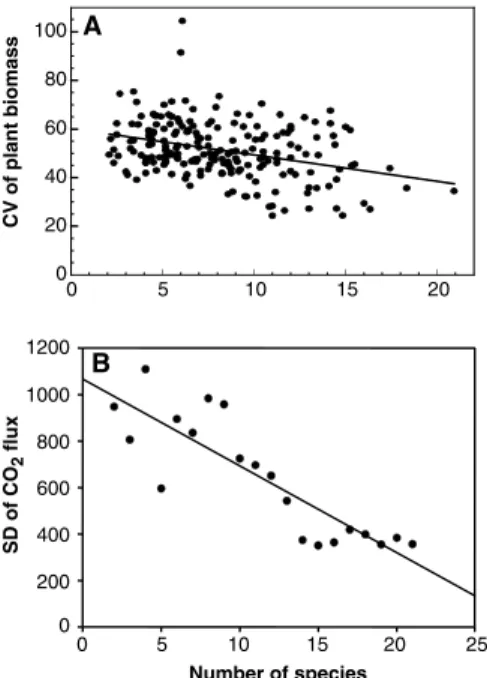
Whereas experimental work has played a leading role regarding short-term effects of biodiversity on ecosystem functioning, theory has been prominent in the diversity-stability debate, both historically and re-cently. A number of empirical and experi-mental studies have shown decreased vari-ability of ecosystem processes as diversity increases (Fig. 3). These studies, however, have been based either on diversity gradi-ents established naturally or after other treatments (36, 38), or on microcosm ex-periments in which variability among rep-licates was also considered (24,25), which does not fully preclude alternative interpre-tations (10,13). Experiments in which both diversity and environmental fluctuations are controlled are now needed to perform rigorous tests of the insurance hypothesis.
Theory too should evolve to provide bet-ter guidance for experiments. Most of the classical equilibrium approaches may be in-adequate to understand stability properties such as resilience and resistance at the eco-system level. New approaches should be de-veloped that take into account the dynamics of diversity and the potential for adaptation through phenotypic plasticity, evolutionary changes, and species replacement.
From Experiments to Patterns
The relationship between productivity and diversity has long been studied from an angle different from that in recent experi-mental studies. It is often, although not always, described by a hump-shaped curve, in which diversity is considered a function of productivity (Fig. 4A) (26, 27). These curves have typically been obtained by us-ing correlations across different sites or nutrient addition treatments. Some compar-ative approaches have also suggested neg-Fig. 3.Observed decreases in variability of
eco-system processes as species richness increases. Interpretation of these patterns, however, is complicated by the correlation of additional factors with species richness. (A) Adjusted co-efficient of temporal variation of annual total plant biomass (in grams per meter squared) over 11 years for plots differing in number of species in experimental and natural grasslands in Minnesota (38). The correlation of variations in soil nitrogen with species richness in these plots precludes the interpretation of increased stability as a pure diversity effect (10), al-though the diversity effect remained significant even after controlling for potentially confound-ing variables (36). (B) Standard deviation of CO2 flux (in microliters per 18 hours) from
microbial microcosms (24). In these data, tem-poral variability in response to diversity is con-founded with between-replicate variability.
Productivity
Soil and climate effects
Diversity
Diversity
Productivity
Favorable soil and climate
Unfavorable soil and climate
A B
Fig. 4.Hypothesized relation-ships between (A) diversity-productivity patterns driven by environmental conditions across sites, and (B) the local effect of species diversity on productivity. (A) Compara-tive data often indicate a uni-modal relationship between diversity and productivity driven by changes in environ-mental conditions. (B) Exper-imental variation in species richness under a specific set of environmental conditions
produces a pattern of decreasing between-replicate variance and increasing mean response with increasing diversity, as indicated by the thin, curved regression lines through the scatter of response values (shaded areas).
ative relationships between plant species evenness and rates of various ecosystem processes (42). The differences between these large-scale, observational approaches and the small-scale, experimental ap-proaches have also generated debate (12). How can these results be reconciled?
The two approaches examine different caus-al relationships under different sets of condi-tions. The classical approach attempts to iden-tify the causes of spatial variation in diversity across environmental gradients. Variation in di-versity is often correlated with productivity, but also with many other factors that influence pro-ductivity, such as soil fertility, climate, distur-bance regime, or herbivory. The recent experi-mental approach examines whether diversity alone has a local effect on productivity within each site, when all these other factors are held constant. The two approaches can be reconciled by considering that spatial patterns reveal cor-relations between diversity and productivity driven by environmental factors, whereas small-scale experiments reveal the effects of species properties and diversity on productivity that are detected after the effects of other envi-ronmental factors have been removed (Fig. 4B) (6).
Whether biodiversity loss will affect large-scale patterns of productivity hinges on the shape and steepness of the local depen-dence of productivity on diversity. Generally speaking, the relative effects of individual species and species richness may be expected to be greatest at small-to-intermediate spatial scales, but these biological factors should be less important as predictors of ecosystem pro-cesses at regional scales, where environmen-tal heterogeneity is greater. Whereas diversi-ty was manipulated as the independent vari-able in recent experiments, at large scales species diversity itself is a dynamical variable and adjusts to changes in environmental con-ditions. Abiotic factors then tend to be the main drivers of variations in ecosystem pro-cesses across environmental gradients (43).
Diversity loss at regional scales and dis-persal limitations due to landscape fragmen-tation, however, will very likely feed back and reduce the pool of potential colonists at local scales and hence the potential for local compositional adjustments to environmental changes. Species-area relations imply that the long-term maintenance of a given level of diversity at local scales requires a much high-er divhigh-ersity at regional scales (44). One of the most potent effects of declining diversity could be the decline in the rate at which appropriate potential dominants are recruited during ecosystem assembly (29).
To understand and predict changes in biodiversity and ecosystem processes at large scales, therefore, we need to move beyond unidirectional causality approaches in which diversity is either cause or effect, and address
feedbacks among biodiversity changes, eco-system functioning, and environmental fac-tors. Relationships between local, landscape, and regional scales also require particular attention.
Generalizing Across Ecosystems
Most of the recent experiments that found significant effects of species diversity have concerned effects of plant diversity on prima-ry production and nutrient retention in tem-perate grasslands, both of which are under direct plant control. These and other experi-ments have often failed to detect significant effects on below-ground decomposition pro-cesses (19, 45), perhaps because these pro-cesses are under microbial control. This ques-tions whether results obtained on primary production in grasslands can be generalized to other processes and ecosystems.
Plants can affect soil processes either di-rectly, by stimulating or inhibiting decompo-sition rates, or indirectly, through increased primary production, by enhancing decompo-sition fluxes. Although some experiments found positive effects of plant diversity on soil microbial processes (46), experiments using litter addition, cotton strips, or litter mixing often showed variable and weak ef-fects of plant diversity on decomposition rates (45). Current evidence suggests that properties of individual plant species are more important than plant diversity in gov-erning soil process rates. This conclusion is echoed by theoretical work predicting that plant chemical quality diversity should de-crease or not affect long-term nutrient recy-cling efficiency and productivity (47). In contrast, increased primary production gener-ated by higher plant diversity is expected to stimulate secondary productivity. More gen-erally, diversity changes at one trophic level may lead to a variety of potential responses for processes at higher trophic levels (48).
Species diversity in consumer trophic levels can also have complex effects on production at these and lower levels. Complementarity and sampling effects should tend to improve re-source exploitation just as in plants. This should lead to higher secondary productivity if bottom-up control prevails, as in plant-decomposer in-teractions (47). Enhanced resource exploita-tion, however, can lead to overexploitaexploita-tion, and thus decreased productivity, if top-down con-trol is important, as might be the case with herbivores and predators. There have been few experiments to test these hypotheses. Recent microcosm experiments found significant ef-fects of bacterial diversity on bacterial and algal biomasses (49) and of diversity of leaf-eating insects on decomposition rates (50), but others suggested that individual species and functional composition were the most important factors (51–53). The functional role of diversity in mutualistic interactions has also been poorly
studied despite their importance in the mainte-nance of ecosystem processes, as shown by one experiment on mycorrhizal fungal diversity (54). Although there is a clear case for incor-porating multiple trophic levels into studies of biodiversity-ecosystem functioning relation-ships, logistical constraints, such as the high mobility of herbivores and carnivores and the difficulty of taxonomic identification of decom-posers, partly explains why so few studies have done so as yet. Of particular importance are the vast areas of biodiversity that involve small organisms such as viruses, bacteria, archaea, protists, and microarthropods, which drive the bulk of ecosystem processes. For example, chemical transformations in the nitrogen cycle are predominantly driven by prokaryotic organ-isms, as is decomposition of organic matter. Modern molecular tools are beginning to make possible the integration of microbial diversity into studies of ecosystem processes.
There is also a need to extend our current knowledge to ecosystem types other than temperate grasslands, such as forest, freshwa-ter, and marine (55) ecosystems. Top-down control is often thought to be more common in freshwater than in terrestrial ecosystems (56); significant differences might then be expected between ecosystem types just as between trophic levels. Generally speaking, differences in coexistence mechanisms may lead to differences in biodiversity effects on ecosystem functioning. For example, in dis-turbance-driven systems, the colonization ability and growth rate of individual species, rather than niche complementarity, might drive ecosystem processes.
Conclusions
Significant advances in science occur when observational, experimental, and theoreti-cal studies coincide. Recent work has done this to some extent for studies of the effects of diversity on productivity and temporal stability at local scales, although much ad-ditional work is still needed, in particular to apply results to larger spatial scales. There is consensus that at least some minimum number of species is essential for ecosys-tem functioning under constant conditions and that a larger number of species is prob-ably essential for maintaining the stability of ecosystem processes in changing envi-ronments. Determining which species have a significant impact on which processes in which ecosystems, however, remains an open empirical question.
There are many reasons—including aes-thetic, cultural, and economic—why we may wish to conserve biodiversity. From a strictly functional point of view, species matter so far as their individual traits and interactions con-tribute to maintain the functioning and stabil-ity of ecosystems and biogeochemical cycles. Although species richness is easier to
mea-sure, a more predictive science might be achieved if appropriate functional classifica-tions were devised (26,27,57,58). Specific knowledge of functional types may be critical to predict ecosystem responses under differ-ent global change scenarios, or where man-agement priorities seek to manipulate species composition directly, for example, in com-plex agroecosystems, forestry, or ecosystem restoration with particular functional goals in mind.
The traditional approach in community ecology has considered species diversity as a dependent variable controlled by abiotic con-ditions and ecosystem-level constraints. The traditional approach in ecosystem ecology has primarily focused on dominant species as biotic controllers of ecosystem processes. Re-cent approaches have broadened the perspec-tives of both subdisciplines by assessing the role of biodiversity as a potential modulator of processes. In reality, there are mutual in-teractions among biodiversity changes, eco-system functioning, and abiotic factors. Inte-grating these interactions into a single, uni-fied picture, both theoretically and experi-mentally, and across ecosystem types and processes, is a major challenge which may help bring about a true synthesis of commu-nity and ecosystem ecology.
References and Notes
1. P. M. Vitousek, H. A. Mooney, J. Lubchenco, J. M. Melillo,Science277, 494 (1997).
2. O. E. Salaet al.,Science287, 1770 (2000). 3.Biodiversity and Ecosystem Function, E.-D. Schulze,
H. A. Mooney, Eds. (Springer Verlag, Berlin, 1993).
4. F. Schla¨pfer, B. Schmid,Ecol. Appl.9, 893 (1999). 5. M. W. Schwartzet al.,Oecologia122, 297 (2000). 6. M. Loreau,Oikos91, 3 (2000).
7. K. S. McCann,Nature405, 228 (2000). 8. F. S. Chapin IIIet al.,Nature405, 234 (2000). 9. K. L. Cottingham, B. L. Brown, J. T. Lennon,Ecol. Lett.
4, 72 (2001).
10. M. A. Huston,Oecologia110, 449 (1997). 11. L. W. Aarssen, D. Tilman,Oikos80, 183 (1997). 12. D. Tilmanet al.,Science278, 1865 (1997). 13. D. A. Wardle, S. Naeem, S. Li,Nature394, 30 (1998). 14. M. A. Hustonet al.,Science289, 1255a (2000). 15. D. McCollin, L. Moore, T. Sparks,Biol. Conserv.92,
249 (2000).
16. J. P. Grimeet al.,Science289, 762 (2000). 17. C. W. MacGillivrayet al.,Funct. Ecol.9, 640 (1995). 18. J. P. Grimeet al.,Oikos79, 259 (1997).
19. S. Naeem, L. J. Thompson, S. P. Lawler, J. H. Lawton, R. M. Woodfin,Nature368, 734 (1994).
20. D. Tilman, D. Wedin, J. Knops, Nature 379, 718 (1996).
21. D. Tilmanet al.,Science277, 1300 (1997). 22. D. U. Hooper, P. M. Vitousek, Science277, 1302
(1997).
23. A. Hectoret al.,Science286, 1123 (1999). 24. J. McGrady-Steed, P. M. Harris, P. J. Morin,Nature
390, 162 (1997).
25. S. Naeem, S. Li,Nature390, 507 (1997). 26. M. A. Huston,Biological Diversity(Cambridge Univ.
Press, Cambridge, 1994).
27. J. P. Grime,Plant Strategies, Vegetation Processes and Ecosystem Properties ( Wiley, New York, 2nd ed., 2001).
28. D. Tilman, C. Lehman, K. Thompson,Proc. Natl. Acad. Sci. U.S.A.94, 1857 (1997).
29. J. P. Grime,J. Ecol.86, 902 (1998). 30. M. Loreau, A. Hector,Nature412, 72.
31. D. Tilman, inEcology: Achievement and Challenge, M. C. Press, N. J. Huntly, S. A. Levin, Eds. (British Ecological Society Symp. Vol. Ser. 41, Blackwell Sci-ence, Oxford, 2001), pp. 183–207.
32. D. A. Wardleet al.,Ecol. Monogr.69, 535 (1999). 33. A. Y. Troumbis, D. Memtsas,Oecologia 125, 101
(2000).
34. S. Yachi, M. Loreau,Proc. Natl. Acad. Sci. U.S.A.96, 1463 (1999).
35. S. J. McNaughton,Am. Nat.111, 515 (1977). 36. D. Tilman,Ecology77, 350 (1996). 37. D. F. Doaket al.,Am. Nat.151, 264 (1998). 38. D. Tilman,Ecology80, 1455 (1999).
39. C. L. Lehman, D. Tilman,Am. Nat.156, 534 (2000). 40. A. R. Ives, J. L. Klug, K. Gross,Ecol. Lett.3, 399 (2000). 41. S. L. Pimm,Nature307, 321 (1984).
42. D. A. Wardle, O. Zackrisson, G. Ho¨rnberg, C. Gallet,
Science277, 1296 (1997).
43. M. Loreau,Proc. Natl. Acad. Sci. U.S.A. 95, 5632 (1998).
44. D. Tilman,Science286, 1099 (1999).
45. D. A. Wardle, K. I. Bonner, K. S. Nicholson,Oikos79, 247 (1997).
46. A. Stephan, A. H. Meyer, B. Schmid,J. Ecol.88, 988 (2000).
47. M. Loreau, Proc. R. Soc. London Ser. B 268, 303 (2001).
48. N. M. Haddad, D. Tilman, J. Haarstad, M. Ritchie, J. M. H. Knops,Am. Nat.158, 17 (2001). 49. S. Naeem, D. R. Hahn, G. Schuurman,Nature403,
762 (2000).
50. M. Jonsson, B. Malmqvist,Oikos89, 519 (2000). 51. J. Mikola, H. Seta¨la¨,Oikos83, 180 (1998). 52. J. Laakso, H. Seta¨la¨,Oikos87, 57 (1999). 53. J. Norberg,Oecologia122: 264 (2000). 54. M. van der Heijdenet al.,Nature396, 69 (1998). 55. M. C. Emmerson, M. Solan, D. M. Paterson, D.
Raf-faelli,Nature411, 73 (2001). 56. D. R. Strong,Ecology73, 747 (1992).
57. S. Lavorel, S. McIntyre, J. Landsberg, T. D. A. Forbes,
Trends Ecol. Evol.12, 474 (1997).
58. F. D. Hulot, G. Lacroix, F. Lescher-Moutoue´, M. Loreau,
Nature405, 340 (2000).
59. The conference “Biodiversity and ecosystem func-tioning: Synthesis and perspectives” was held from 6 to 9 December 2000 as a contribution to the Inter-national Geosphere-Biosphere Programme–Global Change and Terrestrial Ecosystems (IGBP-GCTE) Fo-cus 4 and Diversitas Core Programme Element 1. We gratefully acknowledge financial support by the Eu-ropean Science Foundation, the Centre National de la Recherche Scientifique (France), and the U.S. Nation-al Science Foundation. We thank Nation-all other conference participants for stimulating discussions.