Table of Contents
Curriculum Development for Polytechnics...1
Foreword...1
Preface...2
1. Technical Education in India...2
1.1 Introduction...2
1.2 Organisational Structure...4
1.3 Examination and Certification...7
1.4 Accreditation...8
2. Technical Education in Response to Future Manpower Requirements...8
2.1. Introduction...8
2.2 Pattern of Technical Manpower...9
2.3 Education and Training Needs...12
2.4 Planning Considerations...12
2.5 Educational Implications...13
3. Curriculum − An Overview...14
3.1 Introduction...14
3.2 Concept of Curriculum...14
3.3 Characteristics of Curriculum for Technical Education Programmes...15
3.4 Curriculum Development Stages...17
4. Need Analysis Stage...18
4.1 Introduction...18
4.2 Focus of Conducting Need Analysis Surveys...18
4.3 Identifying Emerging Areas of Employment...20
4.4 Assessing Current and Future Manpower Needs...20
4.5 Approaches of Manpower Forecasts:...20
4.6 Tools Used for Conducting Need Analysis Surveys...21
4.7 Conducting an Interview...23
4.8 Observation...24
5. Curriculum Design...25
5.1 Introduction...25
5.2 Expectations of World of Work from Technical Manpower...26
5.3 Curriculum Design Models...27
5.4 Curriculum Design Process...30
5.5 Curriculum Structure...39
5.6 Introducing Flexibility in Programme Offerings with Specific Reference to Polytechnic Education...40
5.7 Norms And Standards...45
6. Curriculum Implementation...55
6.1 Concept...55
6.2 Advantages of Adopting Systematic Approach for Curriculum Implementation...56
6.3 Guidelines for the Implementation Phase...57
6.4 Faculty Development for Effective Curriculum Implementation...59
6.5 Appropriate Instructional Material for Effective Curriculum Implementation...62
6.6 Appropriate Instructional Strategy...63
6.7 Student Evaluation...63
6.8 Strategies for Improving the Curriculum During Implementation Stage...79
7. Industry − Institute Interaction...80
7.1 Introduction...80
7.2 Present Practices of Education − Work Linkages...81
7.3 Suggestions for Establishing Desired Linkages...81
7.4 Mechanism for Promoting Industry−Institute Interaction...87
8. Curriculum Evaluation...88
8.1 Introduction...88
8.2 Concept of Curriculum Evaluation...89
8.3 Models for Curriculum Evaluation...90
8.4 Methodology of Curriculum Evaluation...91
8.5 Problems in Curriculum Evaluation...98
8.6 Essential Requirements for Conducting Curriculum Evaluation...98
8.7 Time Frame for Curriculum Evaluation...99
Table of Contents
Curriculum Development for Polytechnics9.1 Introduction...100
9.2 Users of Information...100
9.3 Data Base to be Generated at Different Levels...101
10. Academic Planning...104
10.1 Introduction...104
10.2 Aspects of Academic Planning...105
11. Glossary of Terms Used...108
Curriculum Development for Polytechnics
Mittal LN Anand YK Singla PK Gupta AB Gupta SK Thukral TN Faculty ofCurriculum Development Centre TTTI, Chandigarh
TECHNICAL TEACHERS' TRAINING INSTITUTE CHANDIGARH (INDIA) January, 1999
First Edition − 1999
© TTTI Chandigarh − 160 019
No part of this Publication can be reproduced in any form or by any means without the prior written permission of the Institute.
Price: Rs. 120/−
Printed at:
Monica Printers Pvt. Ltd.,
332, Industrial Area, Phase−II, Panchkula − 134 109 Phone: 574131, Tel/Fax: 570402
Foreword
Curriculum Development Centre of this Institute was established in 1971 and has since then been very active for providing assistance to the Directorates/Boards of Technical Education in meeting their curriculum
development needs. Over the years, the Institute has been instrumental in formulating norms and standards for the polytechnics, conducting competency profile studies of diploma engineers, identification of institutions and programmes, undertaking projects for design/revision of curricula in engineering and technology and other vocational disciplines by using a systematic approach. The Centre has also promoted innovations like introduction of Multi−Point Entry and Credit System in some of the selected polytechnics of the region so as to provide flexibility in programme offering.
There was no appropriate instructional material in the field of curriculum development which may be suitable for technical education system. Keeping this in view, the faculty of curriculum development centre of this institute has brought out this publication to provide basic material for understanding various stages of curriculum development viz design, implementation and evaluation. Every effort has been made to make the text as simple as possible for easy understanding.
It is hoped that this publication will be very useful for the technical teachers and officials of Directorate/Board of Technical Education in the country. Suggestions for improving this publication are most welcome.
January, 1999 Chandigarh
Dr. S.K. Bhattacharya Principal Technical Teachers' Training Institute Sector 26, Chandigarh − 160 019 (India)
Preface
This publication has been developed by the faculty of Curriculum Development Centre of Technical Teachers' Training Institute, Chandigarh with a view to:
1. Creating understanding regarding various aspects of curriculum development 2. Creating awareness amongst technical teachers regarding domains of learning for developing desired competencies in the students
3. Appraising the teachers regarding various stage of curriculum development and the role of the institutions in effective curriculum processes viz planning, designing, implementation and evaluation
4. Educating and training the teachers in the process of curriculum development, instructional strategies and evaluation techniques leading to effective curriculum implementation and evaluation
5. Creating awareness regarding networking between the institutions and the world of work for work integrated learning and sharing physical and human resources for effective curriculum processes
6. Creating understanding regarding curriculum evaluation strategies for bringing about modifications in the curriculum
7. Discussing various aspects of academic planning at institute and department levels
This book has been written keeping in view the applied aspects. Effort has been made to use simple language so that teachers are able to derive maximum benefit and make teaching−learning process meaningful.
Suggestions for further improvement are most welcome.
The authors are grateful to Professor KB Raina, Professor MM Malhotra, Professor TR Ramanna, and Late Professor AL Jain former professors of Curriculum Development Centre and former Principal, Professor PD Kulkarni for their valuable contribution in the field of curriculum development.
The authors are also grateful to Dr SK Bhattacharya, Principal, TTTI, Chandigarh for his encouragement in bringing out this publication.
January, 1999 Chandigarh
Dr LN Mittal Professor and Head Curriculum Development Centre Technical Teachers' Training Institute, Sector 26, Chandigarh 160 019
1. Technical Education in India
1.1 Introduction
Technical education is one of the most significant component of the human resource development spectrum with great potential for adding value to products and services, for contributing to the national economy and for improving the quality of life of the people. In recognition of the importance of this sector, successive Five Year Plans laid great emphasis on the development of technical education.
Technical education in India can be considered essentially operating at three levels, namely: Certificate level training in various trades; Diploma level education and training in a variety of engineering/technological and other vocational disciplines; and undergraduate and post−graduate education in a number of
The first level of technical education at the certificate level produces skilled workers for industry. Such training is offered by the Industrial Training Institutes (ITIs). The entry to such training is possible after general school education of 10 years in a majority of cases, though in some trades, students who have completed 8 years of schooling are also admitted. This training scheme is looked after by the Ministry of Labour at the Centre and certification is done by the Directorate General of Employment and Training (DGE&T) at the national level. Directorates of industrial training at the state level look after the operation and administration of the scheme. Certificate level training is also supplemented by +2 vocational courses, under the 10+2 pattern of education. In addition to engineering trades, vocational courses are offered in the major areas of agriculture, business, commerce, health, paramedical, home science and humanities. The National Council for Vocational Training at the national level and the Directorates of Vocational Education at the state level look after the planning and operation of this scheme.
The second level of technical education is the diploma programmes offered at the polytechnics and aimed at producing diploma engineers, who are mainly responsible for managing shop−floor operations. Admission to such programmes is available after 10 years of schooling. Diploma programmes are classified under the following three categories:
(a) Diploma programmes in engineering and technology like: civil engineering, electrical engineering, mechanical engineering, electronics and communication engineering, production engineering, leather technology, textile technology, plastic technology etc.
(b) Diploma programmes in other vocational fields like: modern office practice, garment fabrication, beauty culture, library science, medical laboratory technology etc
(c) Diploma programmes in applied arts/crafts like: interior design, architectural assistantship, commercial practice etc.
The above programmes are offered essentially through one of the following modes: − Fixed and linear modes (Full time programmes)
− Multipoint Entry and Credit System (MPECS)
Duration of full time programmes is generally three years after 10+. In some cases, like modern office practice, computer engineering etc., All India Council for Technical Education (AICTE) has raised the entry qualification from 10+ to 10+2. Some of the diploma programmes in vocational disciplines are of 2 years duration also.
A few polytechnics offer diploma programmes on sandwich pattern. In sandwich programme, industrial training is interlaced in between academic studies. The duration of these programmes is generally three and half years with two semesters of training in industry.
Some polytechnics situated in industrial belts or big towns offer part time diploma programmes to facilitate continuing education of working craftsmen or for those engaged in industry/field having 10+ qualification. These programmes are of four year duration. Classes are held during evenings for about 15 hours of contact per week. A small percentage of polytechnics also offer post diploma/advanced diploma programmes in specialized areas. The duration of these programmes is one and half years and two years respectively after a diploma programme.
The products of this level are employed in wide ranging functional areas such as drafting, estimating,
production, construction, erection, inspection, quality control, marketing and servicing etc. While the planning, promotion and control of this sector of technical education rests with the All India Council for Technical Education and the Bureau of technical education in the Ministry of Human Resource Development at the national level, it is essentially operated at the state level by the Directorates of Technical Education and the State Boards of Technical Education.
The third level of technical education at the under−graduate and post−graduate levels is available in
engineering colleges and institutes of technology, producing professional engineers. The programmes offered in broad−based and diversified disciplines at the under−graduate level are of 4 years duration after higher secondary education i.e 10+2 years of schooling. Programmes at this level are affiliated to different universities, which come under the purview of University Grants Commission or are offered by deemed technological universities/institutes.
In addition to the formal system of acquiring certificate, diploma, degree and higher qualifications, a non formal system of education run by professional bodies like Institution of Engineers, Institute of Electronics and Telecommunication Engineering, Computer Society of India etc also provide opportunities to specific target population for acquiring these qualifications.
The technical education system in the country is diagramatically represented by a skeletal structure which is shown in Figure 1.1
1.2 Organisational Structure
Education is a state subject. It is managed by national and state level bodies for meeting present and future demands of the country and states respectively. According to AICTE, technical education includes areas of engineering and technology, architecture, town and country planning, pharmacy, hotel management and catering technology etc.
The organisational structure of technical education at national and state levels is briefly discribed below:
1.2.1 At National Level
a) All India Council for Technical Education (AICTE)
At the national level, All India Council for Technical Education (AICTE) is the apex body established by the Act of Parliament in 1987 as a statutory body for providing leadership in planning, promoting and regulating technical education in the country. The functions of AICTE are:
− Assessment of technical manpower needs − present and future − Reconciliation of differing perceptions of needs at different levels − Providing match between demand and supply
− Coordination and integration of technical and management education development plans at Central/Regional level
− Effective quality improvements through scientific curriculum processes, instructional material development and teacher training
− Formulation and periodic review of norms and standards for programmes, resources, staff etc
− Formulating guidelines for promoting innovation, research and development − Toning up management structures and granting autonomy to institutions − Formulating guidelines for grants and funding of priority areas
− Establishing mechanisms for enforcing maintenance of norms and standards − Accreditation and recognition of institutions and programmes
Figure 1.1: Technical Education System in India ITI Industrial Training Institute
VS Vocational School
P Polytechnic
C/SSS College/Senior Secondary School
EC/IT Engineering College/Institute of Technology Entrance Test
The AICTE, assisted by its Boards and Regional Committees have been vested with statutory powers by an Act of Parliament, to ensure pursuance of its policies more vigorously.
b) All India Boards of AICTE
AICTE has presently several All India Boards of Technical Studies. Some of those are listed below: − All India Board of Architecture Education
− All India Board of Computer Science, Engineering, Technology and Applications − All India Board of Hotel Management and Catering Technology
− All India Board of Management Studies − All India Board of Pharmaceutical Education − All India Board of Technician Education
− All India Board of Under−graduate Studies in Engineering − All India Board of Post−graduate Education and Research − All India Board of Town and Country Planning Education − All India Board of Vocational Education
Each of the above Boards takes care of planning, promoting and regulating education in the respective areas. The main functions of the respective Boards are:
− Assessment of manpower needs in the country
− Development of educational plans to train manpower in the respective areas
− Preparation of guidelines for states and union territories for improvement and development of respective areas
− Design and periodic review of model curricula in existing and emerging areas − Formulation and periodic review of norms and standards
− Promotion of quality improvement, innovation, research and development in the respective areas
− Promoting autonomy to institutions − Identifying priority areas for funding
− Monitoring and evaluation in the respective areas c) Coordination Committee/Regional Committee of AICTE:
AICTE has set up a coordinating committee which acts as executive body of the council and discharges functions on its behalf on urgent and important matters. It has also set up seven regional committees for performing the general functions as assigned to AICTE and to supervise the work of technical institutions in the region in co−operation with state governments. Some of the major functions of regional committees are:
− to survey facilities for technical education in all the states and union territories in the region − to promote liaison between technical institutions and industry
− to review critically academic aspects of training
− to render advice and guidance to technical institutions within the region in respect of finance and other matters
− to make recommendations to AICTE for the expansion of technical education through provision of facilities in respect of diploma, undergraduate and post graduate courses
As state engineering colleges are affiliated to universities, these institutions follow the norms and standards laid down by the UGC and the AICTE. To coordinate policies for the growth and development of technical education at degree and post−graduate level, UGC accepts the policies of the AICTE for the matters connected with technical education. Chairman UGC is a member of the AICTE.
The National Technical Manpower Information System (NTMIS) at the national level, with its lead centre located at Institute of Applied Manpower Research (IAMR) and nodal centres in the states, supply data needed by the AICTE in manpower assessment and planning.
d) Bureau of Technical Education
The Bureau of technical education in the Ministry of Human Resource Development, Government of India has dual role to play. The first and foremost role is of advisory nature regarding proper growth and development of technical education in the country. This department takes care of the policies of Government and financing the AICTE and represents on its various Boards. The other important role is executive in nature and relates to the processing, implementation, monitoring, controlling and evaluation of programmes and projects in central institutes, centrally sponsored schemes.
1.2.2 At State Level
a) State Departments of Technical Education
The state departments of technical education are responsible for planning, management, administration and funding of technical education in the state. However, providing policy directions, setting norms and standards, initiating schemes for quality improvement and coordinated integrated development fall under the purview of AICTE/department of technical education.
b) State Directorates of Technical Education
Each state has a State Directorate of Technical Education which undertakes the following broad functions: − Identification of state manpower needs and programmes
− Preparation of plans for starting new programmes under the policies laid down by the AICTE
− Working out resource requirement and planning for infrastructure development − Development of human, physical and instructional resources
− Introduction of innovations and developments
− Formative and summative evaluation of institutions and programmes
In some of the states, polytechnics and engineering colleges are under the administrative control of State Directorates of Technical Education. Engineering colleges are affiliated to universities for conduct of examinations and award of degrees and polytechnics are affiliated to State Boards of Technical Education. c) State Boards of Technical Education
State Boards of Technical Education are generally functioning as part of state directorates of technical education. Their main functions are:
− Design and review of curricula
− Lay down norms and standards for technical education − Conduct examinations
− Award for various diploma, post−diploma and advanced −diploma programmes − Maintenance of quality of education and training imparted in polytechnics
1.3 Examination and Certification
a) For the polytechnics, state boards of technical education lay down curricula, conduct examinations and award diplomas, post−diplomas and advanced diplomas for various programmes offered by the polytechnics. b) All the state engineering colleges are affiliated to state universities which conduct examinations and award Bachelor's and Post−graduate degrees for various programmes in engineering and technology.
c) Regional engineering colleges (RECs) are affiliated to state universities for the conduct of examinations and award of Bachelor's and post−graduate degrees for various programmes offered by these colleges d) Indian Institutes of Technology (IITs) are deemed universities. These institutes conduct their own examinations and are empowered by an Act of Parliament to award their own bachelor, post−graduate and doctoral degrees.
In addition to IITs, there are some selected institutions which have the status of deemed university. These institutes conduct their own examinations and award bachelor and post−graduate degrees.
e) ITIs come under the control of the DGE&T. All examinations and certification for ITI trade courses is done by the DGE&T.
1.4 Accreditation
At present, accreditation of institutions and programmes is being done by special committees appointed by AICTE/Regional Committees from time to time. A National Accreditation Board under the AICTE has also been set up for accreditation of institutions and programmes.
After this brief introduction of technical education system, next chapter deals with various aspects of technical education in response to future manpower requirement.
2. Technical Education in Response to Future Manpower Requirements
2.1. Introduction
Every country develops its own system of education taking into account its unique socio−economic and cultural identities and also to meet the challenges of times so as to ensure that the fruits of change reach all sections of society.
The National Policy of Education − 1968 marked a significant step in the history of education in post
independent India. It aimed to promote national progress, a sense of common citizenship and culture and to strengthen national integration. It laid stress on the need for a radical reconstruction of education system, to improve the quality at all stages and gave much greater attention to science and technology, the cultivation of moral values and a closer relation between education and the life of people.
National Policy on Education − 1986 laid great emphasis on quality improvement, expansion of technical education facilities in new and emerging areas of technology and making technical education accessible to special sectors of population consisting of rural population, working population, women, handicapped and other weaker sections of society.
Government of India, since 60's initiated number of steps to revamp technical education with a view to make it relevant to the requirements of world of work based on the recommendations of various seminars and
symposia at national and state levels and that of task groups set up by the Ministry of Human Resource Development.
Direct central assistance was provided to technical institutes at all levels to remove obsolescence in the equipment and information resources and develop infrastructure in emerging areas of technology not covered under state plans.
Setting up of quality improvement centres in some selected institutions was also a step to promote continuing education of teachers, development of curriculum and production of appropriate instructional resources. Establishment of Technical Teachers' Training Institutes (TTTIs) with a view to improve the quality of polytechnic education by means of training teachers, designing curricula, preparation of instructional resources, rendering extension and consultancy services and undertaking R&D projects leading to quality improvement in the polytechnics.
In 1994, the Government of India launched the project of strengthening technician education* in India with the assistance of World Bank as important follow up of the National Policy of Education − 1986. The project aimed at:
a) Capacity Improvement − by expanding and diversifying programmes in the polytechnics; establishing continuing education centres, strengthening community polytechnics etc. b) Quality improvement − through modernizing laboratories and workshops, intensifying teacher training, updating curricula etc.
c) Efficiency Improvement − by way of strengthening structures like Directorates/State Boards of Technical Education, promoting industry−institute interaction, encouraging internal
* The term technician education is being used for polytechnic education. In the Indian Context, the term technician is generally used for craftsmen. To avoid this confusion and to provide polytechnic passouts a distinct identity, it may be worthwhile to designate such persons as diploma engineers or technician engineers.
With the opening of Indian economy since 1991, multi−nationals and other foreign investors started entering in the industrial scenario leading to changed manpower requirement. Also, the Indian industry and service sector are becoming quality conscious to compete in the national and international market. Hence the
manpower requirements at different levels would undergo a tremendous change. Policy formulators related to human resource development have to ponder over again and carefully devise strategies to meet the changing manpower requirements.
2.2 Pattern of Technical Manpower
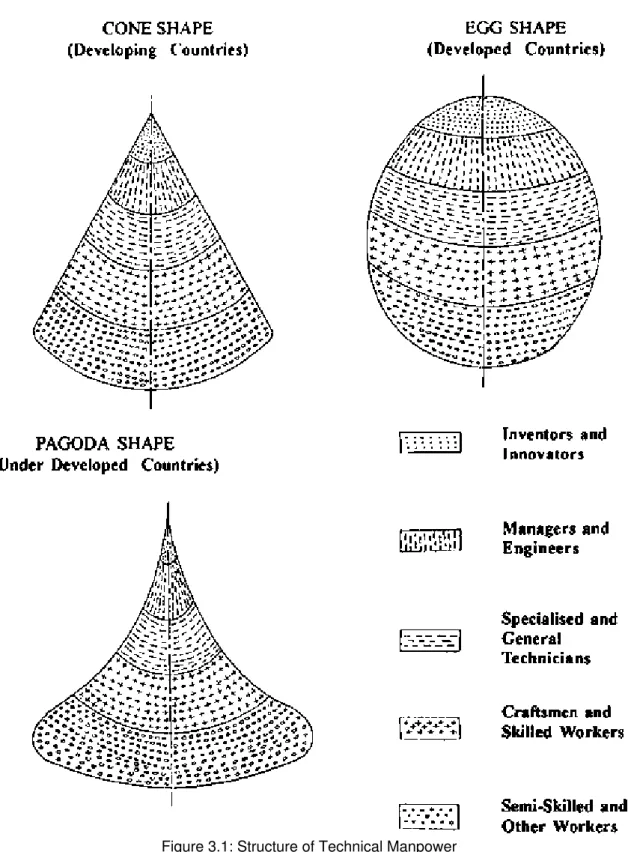
Technical manpower requirements in terms of number and type is dependent on the state of development in a particular country. This has been shown in figure 2.1 which provides comparative number of different type of manpower required for an under developed, developing and developed countries. An analysis of employment pattern in an underdeveloped country indicates 'Pagoda Shape' structure of technical manpower in which semiskilled, skilled workers, diploma engineers/technician engineers requirement is much larger as compared to graduate engineers and innovators.
In the case of a developing country, cone shaped structure provides an idea of proportionate changes in the type of manpower required. Here innovators, engineers and technician engineers proportion is comparatively larger than underdeveloped countries.
While in a developed country, number of innovators, managers and technician engineers is still greater as compared to developing country.
Figure 3.1: Structure of Technical Manpower
In India, we are at an intermediatory stage between a developed and developing country. Hence the technical manpower requirement can be predicted in the following proportion:
− Innovators 9 to 10
percent
− Engineers 12 to 15
percent − Technician Engineers/Diploma Engineers 20 to 25
percent − Skilled and semi skilled workers 40 to 50
In industrial restructuring, technology advancement is one of the major dimensions. It helps in increasing production efficiency and at the same time help in generating new technology and industry.
In order to achieve this, technologies are to be acquired, utilised, diffused, adapted, improved and developed. For doing this, appropriate human resources with the required capabilities* are to be made available. For human resource development, these capabilities can be identified as:
a) Acquisitive Capability
The capability to acquire technologies depends on the ability to search for, assess and transfer technologies for effective functioning in various functional areas like: R&D, design and drawing, planning, shop−floor management, quality control operations, repair and maintenance, marketing and sales etc.
b) Adaptive Capability
This relates to the ability to modify existing production process or product design so that the process is better adapted to local factors and the product reflects local market preferences. c) Operative Capability
This involves production know how, knowledge of codes and standards production management, production engineering, diagnostic skills, communication techniques and interpersonal skills.
d) Innovative Capability
This involves the ability to anticipate future demands and to develop new designs, processes and technologies.
* Abstract from "Study in Human Resource Development − Its Technological Dimensions" − Economic and Social Commission for Asia and the Pacific Inter−Government meeting report − 1986. (Figure 2.1 has also been taken from this study).
In future, a strong R&D infrastructure, development of high quality scientists and engineers to undertake R&D work for promoting innovations and new technologies will be required.
The category of technical manpower is also dependent on the nature of technology involved. Some technologies will need a strong base of sciences. In the case of some other technologies, the requirement may be a strong practice base.
In order to achieve competitiveness with advanced countries, human resource development policies have to be changed. The curricula are to be made dynamic to take into account changes in technologies by
introducing electives. Development of learning−to−learn skills, problem − solving skills, interpersonal and communication skills, competency in making use of computers for various engineering applications will be called for.
The basic formal education acquired by an individual in any category of manpower spectrum will become obsolete over a period of time due to changes in technologies. Continuing education for all categories of manpower will be required, if industrial restructuring is to be successful. This would mean that institutions should have to offer courses on short term and long term, formal and informal basis to update the available work force.
The new technologies of significance to industrial restructuring have close association with basic scientific knowledge and cognitive abilities. In other words, the adoption and development of such technologies will require greater generic skills which are normally acquired through higher levels of formal education.
In future, knowledge−skill profile of technical manpower will change; greater number of appropriately trained manpower will be required for infrastructure and service sector and information technology.
The capabilities such as innovative, acquisitive, adaptive and operative will be needed in the top, middle and operative levels of manpower.
2.3 Education and Training Needs
In order to boost up economic development and improve productivity, India, like many other developing countries has adopted the policy of globalisation. The new policy is expected to create a congenial environment, which will lead to setting up of new industries both by foreign and domestic investors. It has been assumed that the open market policy will also compel the existing Indian industry to take steps to modernize their infrastructure and improve productivity so that they can survive in the competitive market. The new industries and modernization of existing industry will invariably use new technology based on micro electronics and will need technical human resource to possess knowledge of handling computer softwares, information technology tools and ability to handle sophisticated equipment like robotics, computer aided design and manufacturing techniques and high order cognitive abilities for reasoning and innovation.
2.3.1 Training Needs for Organised Sector
Keeping in view high degree of competition in the national and international market due to dual criteria of cost and quality, it is imperative that high degree of automation has got to be adopted on the shop floor. The technical manpower at different level has to be well versed with information technology tools like MS Office, MS Project, Auto CAD, CAD−CAM Packages in addition to the use of Fax, modem and scanners etc. Therefore, technical manpower at different level will have to undergo sufficient training in electronics and computer applications so as to face the challenge of technology upgradation on the shop floor.
It will also be desirable to have strong foundation for applied sciences, engineering sciences and
mathematical tools, so that technical human resource is able to adopt, adapt and innovate technologies for industrial development.
For organised sector, it will be essential to offer broad based programmes, so that technical human resource at different levels can be made to work in any functional areas, may it be R&D, design, planning,
manufacturing, quality control operation, maintenance, marketing and sales and general administration. It should be understood that this sector of employment will require technical human resource of all categories with different capabilities as stated in section 2.2
2.3.2 Training Needs for Un−organised Sector
Unorganised sector primarily deals with serving the community to provide repair and maintenance and other services as per felt needs, may these be repair of auto vehicles, electronic equipment, electrical gadgets, dress making, reprographic services, house keeping, photography/videography, shoe making, plumbing and allied services and building services.
Indian educational system so far has been planned and organised primarily to cater to the needs of organised sector. It mainly provides wage employment opportunities. Though efforts are on to promote vocational education to cater to the needs of unorganised sector and provide opportunities of self employment. India is fast developing and the hand skill are being replaced by machines. Also, the society has already started demanding high quality services. In the times to come, India will need highly skilled work force as well as technician engineers, who have diagnostic capabilities and are able to provide repair and maintenance services of first order to the community. For this purpose, the existing paper pencil type of training will be changed to. more skill oriented training making use of sophisticated equipment and machines, aided by computer know how to discharge above functions. In fact, in the times to come, these technically trained people will have much greater demand than those required in the organised sector.
2.4 Planning Considerations
The whole exercise of manpower planning is dependent on the demand and supply of technical manpower possessing specific knowledge, skills and other competencies to meet the short and long term employment needs.
While ascertaining manpower needs, the focus is generally on manufacturing sector, which provides only a part of employment opportunities. In the times to come, plenty of jobs will be available in the tertiary sector i.e. service sector which primarily deals with repair and maintenance; construction, commercial, transportation, banking, defence, education and social sectors of employment.
If the requirement of manpower in a particular occupation is quite large, then starting full time programmes may be viable. When the employment opportunities are of short range nature, then including such
technologies in the existing programmes or offering continuing education programmes to upgrade knowledge and skills of working people can be another viable proposition.
Before proposing new institution and the programmes, it is essential to look into feasibility considerations which include availability of financial resources, societal requirements for growth and development, climatic conditions, availability of technically qualified persons for recruitment as faculty and Conducive environment for networking and sharing resources.
Another factor which should be considered is the optimum utilisation of resources so that infrastructure created is usable for implementing various programmes and the faculty should also have opportunities of horizontal and vertical mobility from one department to another by offering programmes in a flexible multi−point entry and credit system.
2.5 Educational Implications
Following are some of the implications of future technical manpower development: (1) Offering Programmes on Cooperative Education Basis
In the fast changing technological scenario at work places, it would be practically impossible to keep pace with the developments of technology by adding more and more infrastructure in the technical institutes. It would be desirable that in the times to come, specific group of industries will be called upon to collaborate with a technical institute in the design of
curriculum and its implementation. A plan of mutual collaboration has got to be worked out for sharing physical, human and informational resources for mutual benefit. Involvement of students to undertake minor and major project assignments in cooperative organizations should form essential component of curricula without increasing the duration of programmes. (2) Flexibility in Programme Offering
Keeping in view varied requirement of technical manpower development through formal and non−formal programme, the design of the programmes will have to be flexible to provide entry of students from different streams and levels of education. To accommodate different pace of learning, vertical and horizontal mobility of manpower, multipoint entry and credit system will have to be introduced. Electives will have to be offered in last two semesters to take care of technology upgradation.
(3) Teaching−Learning Process and Preparation of Learning Resources
The present system of teaching−learning in the majority of technical institutions is highly teacher centred. The shift must take place to make teaching − learning process more student centred by way of tutorial assignments, well planned laboratory and workshop experiences and learning through project assignments. This will indeed require extensive training of teachers. Preparation of appropriate learning resources will be an important educational implication.
(4) Training the Faculty
Because of high degree of automation on the shop−floor, use of computer in productivity, automation and management has become essential. Teachers are supposed to be computer friendly for making use of computer software packages like CAD−CAM, Auto CAD, MS Office, MS Project, use of Fax, Modem, Scanners etc. A deliberate Scanners, Modem programme of action to train teachers in computer applications will be the need of the day. In addition to above, industrial training of teachers in emerging areas of technology, educational
technology, curriculum development, entrepreneurship development will be called for. (5) Examination System
Teaching−learning process in any institute will depend on the type of examination System. The thrust of today's examination system is primarily on memory oriented learning.
Examination of students should focus on development of competencies. The present paper and pencil type examination may have to be substituted by well organized objective type questions, short answer questions, project oriented examination followed by viva voce examination by experts from industry and faculty of technical institute.
To conclude, there is need to revamp technical education at different levels for meeting the challenges of technology development at work places.
3. Curriculum − An Overview
3.1 Introduction
In the history of technical education, development of curriculum on scientific basis is relatively new. There are a few countries in which curriculum development activity for technical and vocational education is carried out systematically on regular basis. There is need to look curriculum development in the context of
socio−economic developments in a particular country, which keep on changing from time to time. Thus, curriculum development needs a scientific approach for taking into account present and future
socio−technological development scenario.
It has been experienced the term 'curriculum' is not understood properly by majority of teachers and administrators. Mostly, the term curriculum and syllabus are used interchangeably. Hence, it is important to define both the terms, for facilitating clear understanding between the two.
3.2 Concept of Curriculum
Many authors have defined curriculum in varying contexts. A review of literature produced by various writers reveals marked differences in the way each perceives and defines the term curriculum.
Taba Hilda (1962) stated that a curriculum usually contains a statement of aims and objectives, it indicates some selection and organization of content, it either implies or manifests certain pattern of learning and teaching, because the objectives demand them or because the content organization requires them. Finally, it includes a programme of evaluation of the outcomes.
Saylor (1966) stated that curriculum encompasses all learning opportunities provided by the school. Johnson (1967) described the term curriculum as "structured series of intended learning outcomes". Burns and Brooks (1970) stated that a curriculum is a plan for arrangement of information and experiences which educator consider necessary for children to cope successfully in life. It is further stated that curriculum is defined as everything that is planned to happen to a learner with a view to enhancing, investigating or modifying predetermined behaviour.
Jenkins David et. al., (1976) expressed that a curriculum is the formation and implementation of an educational proposal, to be taught and learned within a school or other institution, accepts responsibility at three levels, its rationale, its actual implementation and its effects.
Rubin (1977) stated curriculum to encompass the total impact of the school environment on the learner. Lawton Danis et. al., (1978) defined curriculum as all the learning which is planned and guided by the school, whether it is carried out in groups or individually, inside or outside the school. He divides the curriculum into four aspects: curriculum objectives; knowledge; learning experiences; and curriculum evaluation.
Doll (1978) expressed that curriculum emphasizes guided, pre−selected experiences to which children and youth should be exposed; plans for learning; ends and outcomes of being educated and system for achieving educational production.
Harris et. al., (1978) stated that the term curriculum is used in a broad sense to include the totality of what is to be taught in school, the relationship between subjects, teaching materials, teaching methods, technological and other aids and organization of teaching learning.
Tanner Daniel (1980) stated that curriculum is planned action for instruction.
Burshoff (1981) stated that curriculum is an education project defining goals, aims and objectives of an educational action; ways, means, activities employed to achieve these goals; method and instruments required to evaluate the success of the action.
According to UNESCO, curriculum is an organized programme of both theoretical and practical studies, the successful completion of which is considered necessary to achieve specified educational goals corresponding to different levels of knowledge and qualification.
A publication of CPSC (1982) stated that curriculum of a course has been defined as an educational programme designed and implemented to achieve specified educational objectives.
Choate, Joyce (1987) stated that the curriculum is that set of courses and instructional experiences afforded to students.
Taking above into consideration, curriculum is viewed as a plan of intents about the learning outcomes, the processes (instructional and managerial) and resources in terms of physical, human, financial, informational etc. designed and implemented to attain the specified goals of an educational programme for specified learners.
In other words we can say that curriculum is a written document of an educational programme which states educational objectives, details out integrated sequence of curriculum areas(subjects) and detailed contents, recommends learning experiences to be given to students and methodology of student evaluation for achieving the objectives in a stipulated period for a specific group of learners.
The term 'syllabus' is only a part of curriculum which means what is to be taught i.e. detailed contents comprising of concepts, principles, procedures and practices to be taught to students, where as curriculum is a broad term which not only contains syllabus but the complete plan of action of teaching−learning, including student evaluation directed to achieve defined objectives in a stipulated time frame.
From above, it is clear that curriculum of a programme is an important document based on which entire teaching−learning process is planned to prepare suitable technical human resource. Curriculum is important for the learner to understand the scope of study; for the teacher to know what and how to teach and select appropriate learning experiences to be given to student for developing desired competencies in them, industry to understand the type of manpower and competencies possessed by the pass outs from a programme and to facilitate Universities/State governments/Directorate of Technical Education for planning physical, human, informational and financial resources for effective implementation of the curriculum. It also facilitates the Universities/State Board of Technical Education to conduct examinations as per laid table of specifications for achieving desired levels of competencies.
3.3 Characteristics of Curriculum for Technical Education Programmes
The curriculum for technical education has some special characteristics. These are briefly described below: a) Data Based
The curriculum for technical education should be based on long and short range manpower requirement. Decisions about whether or not to offer a curriculum should be based upon related data. Curriculum contents can not be worked out until the characteristics of students and the nature of occupation for which they are trained is clearly known.
Hence, for taking appropriate curriculum decisions, following type of information will be quite useful:
− Employment opportunities
− Present and future technology development trends − Activity/competency profile of specific target group − Existing facilities of technical education
− Availability of appropriate environment for effective implementation of curriculum
− Availability of appropriate human resources and instructional resources etc b) Dynamic
The curriculum of technical education has to keep pace with technology development at work places. Hence, curriculum for technical programme should be dynamic, making provisions for bringing modifications from time to time.
c) Fully Articulated
It is essential that there should be integrated sequence of organized learning experiences to be given in a logical and chronological order of learning so as to achieve desired objectives in stipulated time for a specific target group of learner.
Curriculum articulation may involve the resolution of content conflicts across different areas or development of a logical instructional flow from one semester to other. Articulation may extend to determine the ways and means the co−curricular activities lend support to the rest of curriculum.
d) Realistic
The curriculum of technical education cannot operate in vacuum. If the students are to be prepared for employment, the curriculum should focus on development of job related
competencies. Contents should clearly specify knowledge and skill profile of technical human resource so as to enable the teachers to provide appropriate learning experiences to
students. Hands on experiences in laboratory, workshop or in industry provide the student with a relevant means of transferring knowledge, skills and attitudes to the world of work. Curriculum should be realistic so that it is possible to implement in a given situation. e) Student Oriented
The aim of technical education curriculum is to develop specific competencies for gainful employment and hence students are required to learn by doing practical work in laboratories, workshops and in the industry. It is therefore, essential that curriculum should emphasize on student centred learning approaches.
f) Explicit Outcome
Not only the curriculum for technical education be relevant to the world of work, it must be able to communicate the desired outcome to both the teachers and students. Broadly stated goals are an important part of curriculum. Although, it is recognised that it is difficult to state all curricular outcomes in specific measurable terms, many of these outcomes may be written down in such a manner that broad curricular goals are made more quantifiable. This is perhaps the most commanding reason for ensuring that the curriculum outcomes are clear and precise.
g) Future Oriented
Technical educators particularly are very much concerned about the future. What
technological changes might affect the students? What type of laboratories will be needed twenty years from now? What sort of continuing education will be needed by the students undergoing education now? These and other questions which are often raised by technical teachers who think in futuristic terms. Persons responsible for contemporary technical
curriculum need to ensure that ongoing curricula are considered in relation to what will or may occur in the future. As decisions are being made about curriculum content and structure, thought should be given to the future results that might come from those decisions. Any curriculum that hopes to be relevant tomorrow must be relevant to tomorrow's as well as today's needs. The extent to which a curriculum is successful in the times to come will be largely dependent upon the future−oriented perspective associated with it.
3.4 Curriculum Development Stages
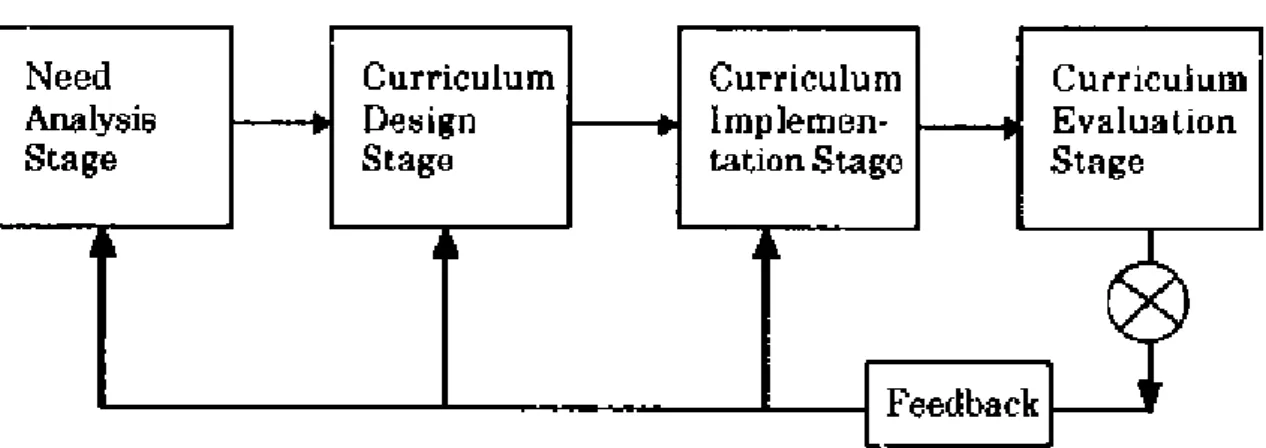
After understanding the characteristics of curriculum it is important to know the stages of curriculum development process. Curriculum development comprises of the following four stages.
a) Need analysis stage b) Curriculum design stage
c) Curriculum implementation stage d) Curriculum evaluation stage
Figure 3.1: Stages of Curriculum Development A brief description of the scope of each of above stages is given below:
a) Need Analysis Stage
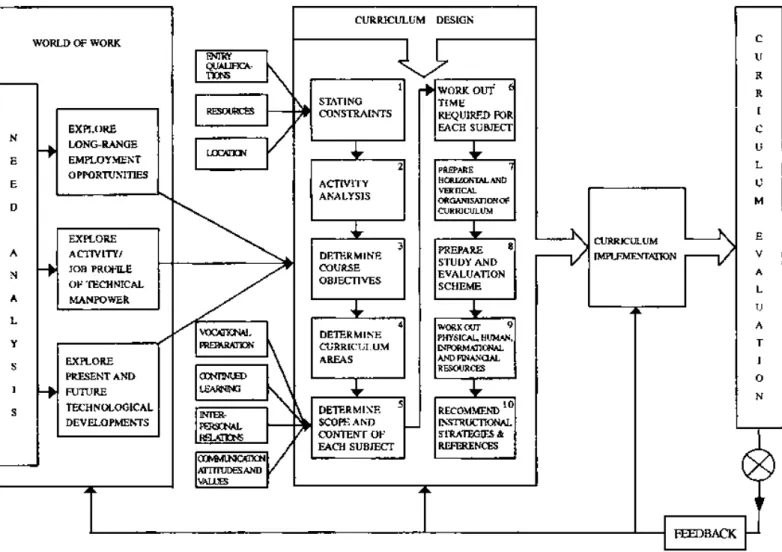
This stage deals with diagnosis of needs which involves conducting market surveys for determining employment opportunities for specific target group, technology development at work places and competency profile of technical manpower, keeping in view the present and future employment trends. This also includes determination of the strengths and weaknesses of the system of technical education.
b) Curriculum Design Stage
The curriculum design stage involves devising or planning the intents of the curriculum. At this stage, decisions regarding curriculum objectives for specified target group are spelled out. From these objectives, curriculum areas (subjects) are identified. Detailed contents are worked out to match the competency profile of specific target group. Alter working put time requirement for imparting desired knowledge, skills and attitudes, study and evaluation scheme is worked out, selection of appropriate methods and media for various curriculum areas is also detailed out. At this stage resources required (i.e. physical, human and informational) for effective implementation of curriculum are also spelled out. c) Curriculum Implementation Stage
Once the curriculum document is ready it will call for development of appropriate resources for the successful implementation of curriculum. This stage deals with harnessing of resources and their utilisation for providing appropriate learning experiences to students for developing desired competencies in them.
Networking with industry and other organizations for sharing resources is one of the important considerations for effective implementation of curriculum.
d) Curriculum Evaluation Stage
Evaluation is considered in two stages. The first stage is monitoring during implementation stage. During this stage, corrective measures are taken to improve teaching−learning process. Once the system has undergone corrective process for some time and got improved, a summative evaluation is undertaken for making changes at different stages for increasing the effectiveness and bringing improvement in the curriculum and the processes at different stages.
In the over view only a brief description of each of curriculum development stages has been given. Each of the above stages are discussed in detail in the chapters to follow.
4. Need Analysis Stage
4.1 Introduction
First stage in curriculum development process is the need analysis stage. At this stage, the need and demand of manpower and their profile is determined. Need ascertains the requirement of industry and service sector for manpower in the occupation under consideration and the demand gives idea about the probable response of the people to the programme. Programmes with long term demand should be generally initiated. The survey of industry helps to provide parameters or information on employment opportunities and activity profile of technical manpower which forms the basis to determine the boundaries of knowledge and skills to be imparted.
Therefore, need analysis is done with a view to determine:
− long range and short range employment opportunities for a specific target group − technology development at work places
− competency profile of technical manpower, keeping in view the present and future employment trends
4.2 Focus of Conducting Need Analysis Surveys
It has been experienced that surveys are generally focused on manufacturing sector, which indeed form a small part of employment opportunities of technical manpower. It would be worthwhile to take into account technical manpower requirement in primary, secondary and tertiary sectors of economy.
Primary sector deals with mineral and mines, agriculture and agro−based products.
Secondary sector deals with manufacturing/construction industry which include boards and corporations; construction industry: mechanical, electrical, textile, electronics, computer, leather and leather goods, chemicals, plastics and other process industry.
Tertiary sector deals with repair and maintenance services, health and paramedical services, commercial services, communication services, transportation services, educational services, travel and tourism, defence services etc.
Depending on the type of programme, above sectors of employment, on selective basis, be explored for determining employment potential, present and future technology development trends and competency profile of manpower.
Literature search from various agencies like: Five year plan documents at national and state levels, information available with National Technical Manpower Information System and State Industrial Policy documents can also serve a useful guide for providing projections about future manpower requirements. While exploring world of work, it is essential to take care of manpower development requirement in different functional areas like: design and drawing, planning, shop−floor/production, quality control, repair and
maintenance, inventory control, marketing and sales etc., so that the product of technical and vocational education is prepared to perform these function after little training.
Further, technical manpower at different levels has to possess different types of competencies in terms of knowledge, skills and attitudes. It is important to understand various domains of learning viz.
occupational/vocational preparation, continued learning, human relations and personal development for ascertaining competency profile of such manpower. A brief description of each of these domains is given below:
a) Occupational/Vocational Preparation Domain
This domain deals with imparting appropriate of knowledge, skills and attitudes for meeting the present and future technological requirement of different functional areas in the world of work.
Imparting appropriate knowledge and skills will vary from level of programme being offered. This domain will include following broad aspects:
− Skills of reading and interpreting drawing − Estimating and costing skills
− Knowledge of materials, specifications and testing procedure
− Knowledge of construction/manufacture/erection installation techniques − Knowledge of national and international codes
− Diagnostic/repair and maintenance skills
− Competency of using computers for various engineering applications − Marketing and sales techniques
− Basic management skills
− Knowledge of important provisions concerning industrial legislation − Stress management, time management, safety management, pollution control, labour management techniques, etc.
b) Continued Learning Domain
This domain includes developing life long learning abilities such as independent study skills, information storage and retrieval skills, generic skills of problem−solving.
c) Human Relations Domain
A technical person has to work in a team. He/she has to understand the importance of working in a team; dealing with seniors; pears and juniors; values and attitudes; helping in distress; listening skills; verbal and written communication skills; report writing skills; motivational skills; initiative and leadership qualities etc. Curriculum should contain learning experience through curricular and co−curricular activities for developing interpersonal and communication skills, which are so essential component of technical human resources development.
d) Personal Development Domain
This domain includes personality traits like: physique, proper attitudes, values, discipline, commitment, dignity of labour, communication, self expression, sense of responsibility, coping with stress, time management and associated skills. It will be worthwhile to include
It should be well understood that all categories of technical manpower do need education and training in all the four domains but extent of coverage will vary for different levels of manpower and functional expectation.
4.3 Identifying Emerging Areas of Employment
The curriculum planner must be able to project into the future regarding employment trends. Although any long range projections have the risk of being inaccurate, efforts must still be made to identify emerging occupations. Furthermore, the development of vocational and technical programmes should not be based solely upon the current employment opportunities, since the time span between the original programme concept and the first student graduate may take three to four years or more.
Even with future uncertainties, selected elements of socio−economic areas can be studied to help predict employment opportunities. For example, if the population is on the increase, certain services like hospitals, utilities, food services, housing services will expand, which may generate increased employment
opportunities. Close contact with confederation of industry, chambers of commerce and industry etc. be maintained, since one of their efforts focuses upon attracting new business to the community. Other people to maintain contact can be business leaders and those individuals holding leadership positions.
In addition to identifying emerging areas of employment, one must also be alert to the areas that are tending to experience a decrease in employment.
4.4 Assessing Current and Future Manpower Needs
A curriculum planner must be open−minded in undertaking job of assessing manpower supply and demand. The first problem faced by curriculum planners is that accurate and guaranteed approaches in projecting precise labour demands do not exist. Demands projected beyond four to five years may often lead to
inaccurate decision making and will result in developing inappropriate curricula. However, this situation should not stop curriculum planners from assessing future technical and vocational manpower demands as best as they can with the information that is available.
4.5 Approaches of Manpower Forecasts:
Some of the important approaches include: employer surveys, extrapolation, the econometric approach and job vacancy which may be of great help in taking decisions regarding manpower forecasting. These
approaches are briefly discussed below: (1) Employer Survey Approach
Probably the most widely used approaches in assessing labour demand data is through what many educators refer to as employer surveys. This approach basically involves contacting the employer in order to assess the current and projected manpower needs. The strength of this approach is in the collection of meaningful data. Curriculum planners using the employer survey approach must also be aware of certain limitations. Employers may be reluctant to share employment data with strangers. Thus, when using this approach, it is helpful to contact employers before the actual personal interview to make them aware of why information is needed and how it will be used. Industrial associations/chambers can also be helpful in obtaining desired information. Data should be collected regarding current and projected manpower needs and the instrument used should
accomplish both purposes. Several approaches may be used in the collection of data from employers. Mailed questionnaires, personal interviews, observations etc. constitute most common approaches.
(2) Extrapolation Approach
This approach of projecting future manpower needs is based on the assumption that past and current trends will give an indication as to what will happen in the future. The strength of this approach is that it is relatively easy to perform and can be done in a short time. Additionally, the cost of extrapolation is quite low.
The econometric approach of manpower forecasting appears to be the most sophisticated approached for manpower forecasting in use. The projections are developed in a series of five steps, each of which is based on separate model. These are as follows:
(a) Labour force projection: based on future age, sex, racial composition and migration of population
(b) Aggregate economic projections: projects the Gross National Product (GNP) and major categories of demand and income
(c) Industry output projection: Industry output projections are estimated using input output data associated with the expected GNP
(d) Industry employment projections: given the final output expected from the identified industrial sectors, estimates are then made of the occupational structures needed in the industries required to produce that output
(e) Occupational employment projections: an industry − occupational matrix is developed showing the distribution of employment, which will be helpful to project the manpower needs
Curriculum planners may find implications for using this approach at the local level because some of the data may be available at the state and regional levels. As with other labour demand forecasts, the econometric technique has several limitations. Among the major drawbacks are that economic activity fluctuates widely and can greatly influence the manpower needs, thus projections can be inaccurate. Other limitation centres around the unpredictable rate of technological advances and the attempt to predict the educational
requirements for occupations that now are few in number but in future may represent a sizeable share of workforce.
(4) Job Vacancy Approach
This approach to manpower forecasting is based on current job vacancies. Job vacancy approach depends heavily upon information obtained and compiled by employment exchanges. The strength of this approach is that immediate needs of an area can be quickly ascertained. Furthermore, curriculum planners can easily rank job vacancies by priority of importance of number of vacancies. Job vacancy as a means of forecasting manpower needs does have some limitations. First, are the vacancies of long range nature or seasonal jobs? Curriculum planner must take above aspect into consideration. When a particular vacancy remains vacant for quite some time, it is essential to enquire the type of qualification and experience desired for the fulfilment of such vacancies.
The above manpower demand approaches may help curriculum planners to choose one or more approaches for collecting relevant information. The selection of approach depends upon the purpose, resources and the time available to the planner. All four approaches have distinct advantages and limitations.
4.6 Tools Used for Conducting Need Analysis Surveys
Different tools and techniques are used for collecting information regarding employment opportunities, competency profile and type of present and future technology trends etc. The conventional tools used for collecting such information are questionnaire, conducting interviews and observation.
a) Using a Questionnaire
A questionnaire is used when factual information is desired. Questionnaires administered personally to groups of individuals have number of advantages. It provides an opportunity to establish rapport, explain the purpose of the study and explain the meaning of items that may not be clear. Availability of high number of
respondents in one place makes possible an economy in time and expense and provides a high proportion of viable responses. However, when desired information cannot always be collected personally, in such cases, mailed questionnaire may be useful. It should be understood that filling out lengthy questionnaires takes great deal of time and effort, results in low response. Poor quality of questionnaires also is one of the reason for small feedback.
Unless one is dealing with a group of respondents who have a genuine interest in the problem under investigation, know the sender, or have some common bond of loyalty, the rate of return is generally disappointing and provides a flimsy basis for generalization.
But still, properly constructed questionnaire has unique advantages and serves as a most appropriate and useful data gathering device.
Questionnaire can be: − Closed form − Open form
Questionnaires that call for short, check−mark responses are known as the restricted or closed form type. Here respondents mark a yes or no, write a short response, or check an item from a list of suggested responses. For certain type of information the closed−form questionnaire is entirely satisfactory. It is easy to fill out, takes little time, keeps the respondent on the subject, is relatively objective, and is fairly easy to tabulate and analyse.
The open form or unrestricted questionnaire calls for a free response in the respondent's own words. For Example:
Why did you choose to join the polytechnic?
Not that no clues are given. The open form probably provides for greater depth of response. But because it requires greater effort on the part of the respondent, returns are often meagre. Also, the open form item can sometimes be difficult to interpret, tabulate and summarize.
Many questionnaires include both open and closed type items. Each type has its merits and limitations and the researcher must decide which type is more likely to supply the wanted information.
b) Guidelines for Constructing a Questionnaire
Following guidelines may help in better understanding of the questionnaire and greater response: i) Define or qualify terms that could easily be misinterpreted
ii) Be careful in using descriptive objectives and adverbs that have no agreed upon meaning. Words like frequently, occasionally, rarely etc. do not have same meaning to different persons iii) Avoid using double negatives
iv) Be careful of inadequate alternatives
v) Avoid the double barrelled questions, make only one query in a statement vi) Underline a word if you wish to indicate special emphasis
vii) When asking for ratings or comparisons, a point of reference is necessary viii) Avoid unwanted assumptions
ix) Phrase questions so that they are appropriate for all respondents x) Design questionnaire that will give a complete response
xi) Provide for the systematic quantification of responses c) Characteristics of a Good Questionnaire
i) It deals with a significant topic, one the respondent will recognize as important enough to warrant spending his or her time on. The significance should be clearly and carefully stated
on the questionnaire, or in the letter that accompanies it.
ii) It seeks only that information which cannot be obtained from other sources. iii) It is as short as possible, and only long enough to get the essential data. Long questionnaires frequently find their way into the waste−basket.
iv) It is attractive in appearance, neatly arranged, and clearly duplicated or printed.
v) Directions for a good questionnaire are clear and complete. Important terms are defined. Each question deals with a single idea and is worded as simply and clearly as possible. The categories provide an opportunity for easy, accurate, and unambiguous responses.
vi) The questions are objective with no leading suggestions as to the responses desired. vii) Questions are presented in good psychological order, proceeding from general to more specific responses. This order helps respondents to organize their own thinking so that their answers are logical and objective. It may be proper to present questions that create a favourable attitude before proceeding to those that may be a bit delicate or intimate. If possible, annoying or embarrassing questions should be avoided.
viii) It is easy to tabulate and interpret. It is advisable to pre−construct a tabulation sheet, anticipating how the data will be tabulated and interpreted, before the final form of the questionnaire is decided upon. This working backward from a visualization of the final analysis of data is an important step for avoiding ambiguity in questionnaire form. If the computer tabulation is to be used, it is important to designate code numbers for all possible responses to permit easy transference to a computer format.
d) Validity and Reliability of the Questionnaire
All too rarely do questionnaire designers deals consciously with the degree of validity or reliability of their instrument. Perhaps this is one reason why so many questionnaires are lacking in these qualities. It must be recognized, however, that questionnaires, unlike psychological tests and inventories, have a very limited purpose. They are often one−time data−gathering devices with a very short life, administered to a limited population. There are, however, ways to improve both validity and reliability of questionnaires.
Basic to the validity of a questionnaire is asking the right questions, phrased in the least ambiguous way. In other words, do the items sample a significant aspect of the purpose of the investigation?
The meaning of all terms must be clearly defined so that they have the same meaning to all respondents. Researchers need all the help they can get; suggestions from colleagues and experts in the field of inquiry may reveal ambiguities that can be removed or items that do not contribute to a questionnaire's purpose. The panel of experts may rate the instrument in terms of how effectively it samples significant aspects of its purpose, providing estimates of content validity.
It is possible to estimate the predictive validity of some types of questionnaires by follow−up observations of respondent behaviour at the present time or at some time in the future. In some situations, overt behaviour can be observed without invading the privacy of respondents. A comparison of questionnaire responses with voting data on a campus or community election may provide a basis for estimating predictive validity. Reliability of questionnaires may be inferred by a second administration of the instrument, comparing the responses with those of the first. Reliability may also be estimated by comparing responses of an alternate form with the original form.
4.7 Conducting an Interview
The interview is in a sense an oral questionnaire. Instead of writing the response, the subject or interviewee gives the needed information orally and face−to−face.
With a skilful interviewer, the interview is often superior to other data−gathering devices. One reason is that people are usually more willing to talk than to write. After the interviewer gains rapport or establishes a