Pamukkale Univ Muh Bilim Derg, 23(5), 519-526, 2017
Pamukkale Üniversitesi Mühendislik Bilimleri Dergisi
Pamukkale University Journal of Engineering Sciences
519
An adaptive extended fuzzy function state-observer based control with
unknown control direction
Uyarlamalı genişletilmiş bulanık fonksiyon durum gözetleyici temelli
bilinmeyen yönlü kontrol
Selami BEYHAN1*
1Deparment of Electrical and Electronics Engineering, Engineering Faculty, Pamukkale University, Denizli, Turkey. [email protected]
Received/Geliş Tarihi: 23.03.2016, Accepted/Kabul Tarihi: 16.05.2016
* Corresponding author/Yazışılan Yazar Research Article/doi: 10.5505/pajes.2016.06887 Araştırma Makalesi
Abstract Öz
In this paper, a novel adaptive extended fuzzy function state observer-based controller is proposed to control a class of unknown or uncertain nonlinear systems. The controller uses Nussbaum-gain technique from literature to prevent controller singularity with unknown control direction and the controller degree of freedom is increased. A state observer which employs the adaptive extended fuzzy function system to approximate a nonlinear system dynamics and estimates the unmeasurable state. The stability of closed-loop control system are shown using Lyapunov stability criterion and Nussbaum function property. The proposed and conventional fuzzy system based controllers are designed to control an inverted pendulum in simulation and a flexible-joint manipulator in real-time experiment. The integral of absoulte error (IAE) of tracking, integral of squared error (ISE) of tracking and integral of required absolute control signal (IAU) performances are compared in applications. The aim of the paper is not only to improve the tracking performances, but also to implement the adaptive extended fuzzy function based controller to a real-time system and conduct the tracking with unknown control direction.
Bu çalışmada, uyarlamalı genişletilmiş bulanık fonksyion durum gözetleyici temelli denetleyici, doğrusal olmayan bilinmeyen ve belirsiz sistemlerin kontrolü için önerilmiştir. Nussbaum-Kazanç tekniği kullanarak bilinmeyen kontrol işareti yönündeki tekil durum engellenerek denetleyicinin serbestlik derecesi artırılmıştır. Uyarlamalı genişletilmiş bulanık fonksiyon ile bilinmeyen sistem dinamikleri yaklaşıklanmakta ve ölçülemeyen durumlar gözetlenmektedir. Kapalı çevrim kontrol sistemindeki sinyallerin sınırlılığı Lyapunov kararlılık kriteri ve Nussbaum fonksiyon özellikleri ile gösterilmiştir. Önerilen ve literatürde bilinen bulanık sistem temelli denetleyiciler ters sarkaç sistemine benzetim ortamında, esnek bağlantılı robot koluna ise gerçek zamanlı olarak uygulanmıştır. İzleme hatası için mutlak hata toplamı (IAE), karesel hatanın toplamı (IAE) ve gerekli kontrol işaretinin toplamı (IAU) performansları kullanarak tasarlanan denetleyiciler karşılaştırılmıştır. Çalışmanın amacı sadece izleme performansını artırmak değil, uyarlamalı genişletilmiş bulanık fonksiyon gözetleyici temelli denetleyiciyi gerçek zamanlı sisteme uygulamak ve bilinmeyen kontrol işareti yönünde denetlemeyi sağlamaktır.
Keywords: Extended fuzzy functions, Adaptive observer-based control, Nussbaum gain technique, Inverted pendulum, Flexible-joint manipulator
Anahtar kelimeler: Genişletilmiş bulanık fonksiyon, Uyarlamalı gözetleyici temelli kontrol, Nussbaum-kazanç tekniği, Ters sarkaç, Esnek bağlantılı robot kolu
1
Introduction
Flexible mechanical systems are difficult to control since external disturbances cause variations on the system dynamics. These variations damage the performance of the control and lead to large tracking errors or damaging vibrations. Flexible link and joint manipulators with low stiffness coefficients are easily yawned under load change such that it brings extra-uncertainty and compliance problem compared to rigid manipulators. Therefore, in order to achieve high a performance in the control of the flexible systems, designed controllers must compensate for the effect of the uncertainty. Thus, robust and high-performance controllers are in demand for flexible systems. Experimental flexible systems are introduced in literature [1]-[3] and some proposed controllers are offline-trained compensator [4], wavelet transformation-based iterative controller [5], minimum-time controller transformation-based on linear programming [6] and an extended observer-based controller [7].
Fuzzy system based adaptive state observer control of a uncertain or unknown nonlinear system has been one of the active research areas in the control field. Based on universal approximation property [8]-[11], adaptive fuzzy and neural systems have been used to approximate the dynamics of the
unknown nonlinear systems. Using the approximate dynamics, adaptive fuzzy or neural observers can be used to estimate the unavailable states [12],[13]. Then, the estimated states and approximated dynamics are employed to design a feedback control rule which drives the system to desired states. However, the control law is designed using the estimated tracking error dynamics. The question arises as how to find the update rules of the adaptive system parameters using measured and/or estimated signals. In the early papers, the filtering of the observation errors, which results the filtering of the regressor functions is used to enforce the SPR (Strict Positive Real) condition to design a stable controller that satisfies Meyer-Kalman-Yokubovic Lemma [14]. In [15],[16], the state estimation error is filtered and then used for the adaptation of parameters. In [17], the output observation error is only filtered to enforce SPR condition then utilized to design controller in [18],[19]. In [20], the output control error is filtered to design the update rules and instead of adaptive observers, high-gain or sliding-mode observer-based controllers are proposed. Due to the singularity problem of the control law, adaptive indirect controller is not preferable for the control of all nonlinear systems. Generally, a nonlinear system is assumed to be affine in Brunovsky form 𝑥(𝑛)= 𝑓(𝑥) + 𝑔(𝑥)𝑢 with a relative degree of 2. However, in the
Pamukkale Univ Muh Bilim Derg, 23(5), 519-526, 2017 S. Beyhan
520 indirect adaptive controller design, there must be an additional
assumption for 𝑔̂(𝑥) function not to be zero which results relative degree 1 [21]. Therefore, some of the authors prefer direct adaptive controller which essentially approximates the controller dynamics [20] and some employ Nussbaum functions in indirect adaptive control [22]-[25] for unknown controller direction.
Fuzzy function model is an another reasoning scheme and representation of the fuzzy rules. General fuzzy function model is constructed with scalar inputs and their fuzzy membership values. Both are functioned in the fuzzy regressor matrix. The first fuzzy function least-squares model (FF-LSE) was shown to provide %10 better performance than standard LSE [26]. The applications of FF-LSE based models are given for regression, system identification [26]-[30] and pattern classification [31],[32]. A comparative work about rule based structures is given in [33] and a literature survey paper of the FF model with comparison to the other fuzzy systems is given in [34]. In addition, the fuzzy function model is extended using the type-2 fuzzy modeling concept [35]. Following to the above developments, fuzzy function-based auto regressive with exogenous-input (FF-ARX) regressor models that structures the input measurements as scalars and also other ARX terms located in regression matrix in [27]. Consequently, known ARX linear modeling and fuzzy system nonlinear modeling abilities are unified to get better identification performance. Finally, the a highly efficient FFARX model, which was introduced in study [27], is utilized for adaptive system identification and its convergence properties is detailed in [28].
In literature, adaptive fuzzy or neural-network observer-based controllers with Nussbaum functions (AFOBC) have been developed with various modifications for different applications. Based on the review of relevant literature, those controllers have the following advantages:
(i) They employ the fuzzy modeling to approximate unknown system dynamics in adaptive control, (ii) The velocity measurement is not needed for reference
tracking,
(iii) (iii) Nussbaum function property is used to get rid of singularity problem. These are the main motivations to follow the literature works. In this paper, recently developed extended fuzzy function system [28] based indirect adaptive controller (EFFOBC) is designed instead of using classical fuzzy system or neural-network. In simulation and real-time experiment, proposed EFFOBC controller and classical AFOBC are compared in terms of design conditions and performances where the improved and not improved tracking performances are shown in tracking results. Second contribution can be considered that to the best knowledge of the author, adaptive fuzzy function model and Nussbaum-gain techniques are first time used in the real time control experiment.
The remainder of the present paper is organised as follows. The theory of extended fuzzy function based regression and adaptive fuzzy function observer-based controller with Nussbaum functions are explained in Section 2. The numerical simulations including inverted pendulum control comparisons are given in Section 3. In Section 4, a flexible-joint manipulator is controlled via proposed and conventional adaptive controllers. Finally, the paper is concluded in Section 5.
2
Adaptive extended fuzzy function state
observer-based control
In this section, fuzzy function regression, Nussbaum functions and adaptive observer-based controller methods will be explained.
2.1 Nussbaum functions
Definition 1[22] If a function has the followin properties, then it is called Nussbaum-type function N(ζ):
lim 𝑧→∞𝑠𝑢𝑝 1 𝑧∫ 𝑧 0 𝑁(𝜁)𝑑𝜁 = +∞, lim 𝑧→∞𝑖𝑛𝑓 1 𝑧∫ 𝑧 0 𝑁(𝜁)𝑑𝜁 = −∞. (1)
The Nussbaum functions are 𝜁2cos(𝜁), 𝑒𝜁2
cos(𝜋2𝜁) and 𝜁2sin(𝜁)
known in literature.
Lemma 1[23] Let smooth functions V(t), ζ(t) are defined on
[0, tf) with V(t) > 0, ∀ t ∈ [0, tf), and N(ζ) be an even, smooth
and Nussbaum-type function. If the following inequality holds:
𝑉(𝑡) ≤ 𝑐0+ 𝑒−𝑐1𝑡∫ 𝑡 0 𝑔(𝑥(𝜏))𝑁(𝜁)𝜁̇𝑒𝑐1𝜏𝑑𝜏 + 𝑒−𝑐1𝑡∫ 𝑡 0 𝜁̇𝑒𝑐1𝑡)𝑑𝜏, (2) Where 𝑐1 is a positive constant and 𝑐0 is a constant. The 𝑔(𝑥(𝜏))
is a time-varying parameter that it takes values in the known closed intervals 𝐼: = [𝐼−, 𝐼+] with 0 ∉ 𝐼, then 𝑉(𝑡), 𝜁(𝑡) ∫0𝑡𝑔(𝑥(𝜏))𝑁(𝜁)𝜁̇𝑑𝜏 are to be bounded on [0, 𝑡𝑓).
The result given in Lemma 1 will be used to demonstrate the boundedness of the closed loop control signals such as states, tracking error, Nussbaum variables and functions. In this study, we use 𝑒𝜁2
cos(𝜋2𝜁) type Nussbaum function. 2.2 Extended fuzzy function modeling
Recently, fuzzy function based models have been used for accurate classification and regression problems due to its ease construction and high approximation capability. A simple FF-LSE model can be built by determining the parameters using only LSE and FCM clustering methods [26]. For that reason, FF-LSE model can be easily constructed and applied without much knowledge about the modeling of fuzzy systems. At first, FCM clustering is used to cluster the measured inputs and the cluster centers are used to design fuzzy systems. The measured inputs and fuzzy membership values are used in the fuzzy regression matrix. Then, the conventional LSE is applied to estimate the FF-LSE model parameters. The FF-LSE modeling is given as,
Y = 𝜃̂𝜓 + 𝜀 (3)
Where, Y is the measured system output, 𝜽̂ is the vector of parameters, 𝜓 is the regression matrix. The residual 𝜺 is the modeling error. The FF-LSE model regression matrix 𝜓 is designed as 𝜓 = [1, X, b] where X = [𝑢(1), 𝑢(2), . . . , 𝑢(𝑁)]𝑇 is a 𝑁 samples input and b is its normalized fuzzy memberships. The FF-LSE model is designed as in the following items [26]:
Implement the FCM clustering algorithm and calculate the optimal membership𝜇𝑖𝑗(𝑘) values of the
measurement inputs (𝜇𝑖𝑗(𝑘) are determined from
FCM). After that determine a threshold value alpha cut (𝛼) to disregard harmonics obtained via FCM [26],
Pamukkale Univ Muh Bilim Derg, 23(5), 519-526, 2017 S. Beyhan
521 that increases the effect of the input values on the
parameter estimation.
𝜇𝑖𝑗(𝑘) = (
𝑢𝑖𝑗(𝑘) if𝑢𝑖𝑗(𝑘) ≥ 𝛼
𝛼 if𝑢𝑖𝑗(𝑘) < 𝛼 (4)
Then, the fuzzy membership values 𝜇𝑖𝑗(𝑘) are normalized as, 𝛾𝑖𝑗(𝑘) =
𝜇𝑖𝑗(𝑘) ∑𝐶
𝑖=1𝜇𝑖𝑗(𝑥𝑗(𝑘)) (5)
Where the 𝐶 parameter is the predefined number of the input clusters, here the indeces 𝑖 and 𝑗 are used for centers and inputs, respectively.
Finally, fuzzy least-squares matrix 𝜓 = [1, X, b]is designed utilizing the measurement inputs and normalized fuzzy membership values, design. The fuzzy basis function matrix b = [𝛾𝑖𝑗|𝑖 = 1, . . . , 𝐶; 𝑗 = 1, . . . , 𝑁] includes the normalized fuzzy membership values w.r.t. all cluster centers. Applying the one-step LSE method, the 𝜃̂ parameters are calculated as,
𝜃̂ = (𝜓𝑇𝜓)−1(𝜓𝑇𝑌) (6)
Where Y is the measured output of the system. A known superiority of the least-squares estimation is the one step ahead modeling that provides the optimum parameters from the measured input and output data. In fact, it provides a linear estimation in nonlinear feature space for FF-LSE modeling. Therefore, there is not required a nonlinear optimization method and resultingly there is no local minima problem when the model parameters is estimated.
The above procedure is given for the offline FF-LSE modeling, then FF-LSE modeling was enhanced via augmenting the auto-regressive with exogenous input model (ARX) and constructed different FF-ARX membership functions [27]. Following that using gradient-descent and recursive-least-squares modeling with adaptive learning rates, one of the superior membership functions in [27] is designed for online system identification and high performance of the online function approximation was obtained for different benchmark systems [28]. In this study, we apply the following fuzzy function model for online system identification in indirect adaptive control of nonlinear systems with unknown control direction. The regressor vector of the applied fuzzy function is given as,
𝜓 = [𝑢(𝑘). . . 𝑢(𝑘 − 𝑛) 𝑦(𝑘 − 1). . . 𝑦(𝑘 − 𝑚) b(𝑢) b(𝑦)], (7) Where 𝑢(𝑘). . . 𝑢(𝑘 − 𝑛) are the delayed inputs of the system,
𝑦(𝑘 − 1). . . 𝑢(𝑘 − 𝑚) are the delayed outputs of the system,
b(𝑢) and b(𝑦) vectors are fuzzy basis functions which are normalized and filtered by alpha-cut.
2.3 Controller design
Consider a single-input single-output 𝑛th order nonlinear system of the form,
𝑥̇1 = 𝑥2, 𝑥̇2 = 𝑥3, ⋮ 𝑥̇𝑛 = 𝑓(𝑥) + 𝑔(𝑥)𝑢 + 𝑑, 𝑦 = 𝑥1, (8)
Where 𝑢 ∈ ℝ is the control signal, and 𝒙 = [𝑥1, 𝑥2, … , 𝑥𝑛]𝑇∈ ℝ𝑛
is the state vector, respectively. The 𝑓(𝑥) and 𝑔(𝑥) are nonlinear and bounded smooth functions of the states, and 𝑑 is the unknown external sturbance to the system. In order to design, a state observer based fuzzy function indirect adaptive control, the nonlinear system is represented as
𝑥̇ = 𝐴𝑥 + 𝐵[𝑓(𝑥) + 𝑔(𝑥)𝑢 + 𝑑], 𝑦 = 𝐶𝑇𝑥, (9) Where, 𝐴 = [ 0 1 0 0 0 0 0 1 0 0 0 0 0 0 1 0 0 0 0 0 ]𝑛×𝑛 𝐵 = [ 0 0 ⋮ 1 ] 𝑛×1 𝐶 = [ 1 0 ⋮ 0 ] 𝑛×1 𝑇 (10)
When the system dynamics (9) are known, a controller is designed to produce a control signal so that the nonlinear system can track a predefined reference signal
𝑦𝑟= [𝑦𝑟, 𝑦̇𝑟, , 𝑦𝑟(𝑛−1)]. The ouput tracking error is described as 𝑒 = 𝑦 − 𝑦𝑟, and the tracking error vector. It is defined with its 𝑛 − 1 derivative forms is written as 𝑒 = [𝑒, 𝑒̇, , 𝑒(𝑛−1)]. The
conventional feedback linearization controller [10],[11],[14],[15] is described to remove the nonlinearity terms of the input-affine nonlinear system (8),
𝑢∗= 1
𝑔(𝑥)[−𝑓(𝑥) + 𝑦𝑟(𝑛)− 𝐾𝑐𝑇𝑒], (11)
Where 𝐾𝑐= [𝜆1….𝑐 𝜆𝑛𝑐]𝑇 when 𝑑 = 0. Substituting (11) into (8),
then a closed loop control system dynamics is governed by,
𝑒(𝑛)+ 𝜆 𝑛
𝑐𝑒(𝑛−1)+ ⋯ + 𝜆
1
𝑐𝑒 = 0, (12)
Where the constants 𝜆𝑖, 𝑖 = 1,2, . . . , 𝑛 are suitably selected
parameters to make 𝐴 − 𝐵𝐾𝑐𝑇 polynomial strictly Hurwitz.
Then, we have lim𝑡→∞𝒆(𝑡) = 0, where it results that the system
output tracks asymptotically to the defined reference signal. The 𝑓(𝑥) and 𝑔(𝑥) nonlinear system functions of the system are not known and approximated adaptively by the designed fuzzy function models. Using 𝑒 = 𝑦 − 𝑦𝑟, tracking error dynamics are
obtained as,
𝑒̇ = 𝐴𝑒 + 𝐵[𝑓(𝑥) + 𝑔(𝑥)𝑢 − 𝑦𝑟(𝑛)], 𝑒𝑡 = 𝐶𝑇𝑒.
(13) Where 𝑦𝑟= 𝐴𝑦𝑟+ 𝐵𝑦𝑟(𝑛). In adaptive fuzzy function
observer-based control design, the tracking problem is converted to design a state observer of tracking error such that the state observer essentially estimates the tracking error [15]. The state observer is given as,
𝑒̂̇ = (𝐴 − 𝐵𝐾𝑐𝑇)𝑒̂ + 𝐾𝑜(𝑒𝑡− 𝑒̂𝑜),
𝑒̂𝑜 = 𝐶𝑇𝑒̂, (14)
With the observer feedback-gain vector 𝐾𝑜= [𝜆10, … , 𝜆𝑛0]𝑇∈ ℝ𝑛
and 𝑒̂ = 𝑥 − 𝑦𝑟= [𝑒̂, 𝑒̂̇, … , 𝑒̂(𝑛)] ∈ ℝ𝑛. In state observer design,
the couple (𝐶, 𝐴) must be observable. The 𝐾𝑜 can be chosen so
that the 𝐴𝑜= 𝐴 − 𝐾𝑜𝐶𝑇polynomial of theobserver is strictly
Hurwitz. The observer error dynamics 𝑒̃ = 𝑒 − 𝑒̂ is derived as,
Pamukkale Univ Muh Bilim Derg, 23(5), 519-526, 2017 S. Beyhan
522 Using 𝑓(𝑥) = 𝑓∗(𝑥) + 𝜀
𝑓 where 𝑓∗(𝑥) = 𝜃𝑓𝑇∗𝜓(𝑥) is the optimal
approximation of the function with minimum approximation error 𝜀𝑓. For the 𝑔(𝑥) function part of the system, instead of
approximating the 𝑔(𝑥) function, we approximate 1/𝑔(𝑥)
function using Nussbaum functions not to reduce degree of freedom when unknown control direction exists. In both cases,
𝑔(𝑥) function approximation causes a modeling error as given in (15).
To design a state observer-based stable indirect adaptive controller, the transfer function of the linearized nonlinear dynamics must to satisfy the SPR condition [14]. In order to satisfy SPR condition, the fuzzy basis functions are filtered in [12],[15]. However, the filtering the large dimesioned fuzzy regressor vector is not feasible in real time applications, therefore the filtering of estimation error is proposed in [11],[18]. Therefore, same approach is used to obtain a suitable SPR transfer function here. The proposed filter is,
𝐿(𝑠) = ( 𝜌
𝑠 + 𝜌)𝑛, (16)
Where the filter design parameter is chosen 𝜌 > 0, 𝑠 is the Laplace parameter and 𝑛 is the system order. Using the filter above, the observer error dynamics are filtered as,
𝑒̃̇𝒄 = 𝐴𝑐𝑒̃𝑐+ 𝐵[𝐾𝑐𝑇𝑒̂
𝑐− 𝑦𝑟(𝑛)+ 𝜃𝑓∗𝑇𝜓𝑐(𝑥) + 𝑔̃(𝑥)𝑢 + 𝜀𝑐], (17)
Where,
𝜀𝑐= 𝜀𝑓+ 𝑑 + 𝜃̃𝑓𝑇𝜓(𝑥) + 𝑔̃(𝑥)𝑢 − 𝐿(𝑠)[𝜃̃𝑓𝑇𝜓𝑐(𝑥) + 𝑔̃(𝑥)𝑢] and 𝐴𝑐= 𝐴 − 𝐾𝑜𝐶𝑇, 𝐵𝑐= [1, 𝑏1, … , 𝑏𝑚]𝑇 and 𝑪𝑐= [1 0 … 0].
From [9], the 𝜃𝑓∗𝑇 is the estimated optimal parameter vector
which is given as
𝜃𝑓∗= argmin𝜃𝑓 [sup𝑥∈ℝ𝑛|(𝑓̂(𝑥, 𝜃̂𝑓) − 𝑓(𝑥))|]. (18)
Assumption 1[15] The following closed-loop signals are assumed to be bounded which are the unknown external disturbance as |𝑑(𝑡)| < 𝑑∗, the 𝑓(𝑥) function approximationerror as |𝜀
𝑓| < 𝜀𝑓∗,
the optimal estimated parameter vector as ||𝜃∗|| < 𝑀 𝑓.
Therefore, the filtered uncertainty of the approximation is bounded as |𝜀𝑐| < 𝜀𝑐∗.
The given assumption is reasonable to limit system uncertainties in closed-loop control dynamics. The universal approximation theory permits to bound approximation error since the disturbance has a bound. The approximation error between filtered signal and real signals are bounded at the moment since the parameter vectors are bounded.
Theorem 1For the system (8), under Assumption 1 and Definition 1, an adaptive fuzzy function state observer-based controller is designed as,
𝑢 = 𝑁(𝜁)[−𝑓̂(𝑥) + 𝐾𝑐𝑇𝑒̂ − 𝑦𝑟(𝑛)] + 𝜈, (19)
With parameter adaptation laws,
𝜃̇𝒇 = 𝛾𝑓𝑒̃𝑐𝜓(𝑥),
𝜁̇ = 𝑒̃𝑐𝐾𝑐𝑇𝑒̂ + 𝑒𝑐𝜃̂𝑓𝑇𝜓(𝑥) − 𝑦𝑟(𝑛)𝑒𝑐,
(20) and robustness input,
𝜈 = −𝜅sign(𝑒𝑐), (21)
Where 𝜅 > 𝜀∗/𝜀
𝑔𝐿, such that thenonlinear system (8) tracks the
reference signal 𝑦𝑟 and the closed-loop signals in the remain
bounded.
Proof:The candidate Lyapunov function is selected as,
𝑉 =1 2 𝑒̃𝑐𝑇𝑃𝑒̃𝑐+ 1 2𝛾𝑓𝜃̃𝑓 𝑇𝜃̃ 𝑓. (22)
For a system with SPR transfer function [14] there exist
𝑃 = 𝑃𝑇> 0 ∈ ℝ𝑛×𝑛 matrix with given 𝑄 = 𝑄𝑇> 0 which
satisfying Lyapunov equation,
𝐴𝑇𝑃 + 𝑃𝐴 = −𝑄,
𝑃𝐵 = 𝐶. (23)
Differentiating the Lyapunov function w.r.t. to time,
𝑉̇ =1 2𝑒̃̇𝑐𝑇𝑃𝑒̃𝑐+ 1 2𝑒̃𝑐𝑇𝑃𝑒̃̇𝑐+ 1 𝛾𝑓𝜃̃̇𝑓 𝑇𝜃̃ 𝑓 (24)
and substituting the observer error dynamics (17) in (24) yields 𝑉̇ =1 2𝑒̃𝑐𝑇(𝐴𝑐𝑇𝑃 + 𝑃𝐴𝑐)𝑒̃𝑐+ 1 𝛾𝑓𝜃̃̇𝑓 𝑇𝜃̃ 𝑓+ 𝑒̃𝑐𝑇𝑃𝐵𝑐𝐾𝑐𝑇𝑒̃𝑐 −𝑒𝑐𝑇𝑃𝐵𝑐𝑦𝑟(𝑛)+ 𝑒̃𝑐𝑇𝑃𝐵𝑐𝜃𝑓∗𝑇𝜓𝑐(𝑥) + 𝑒̃𝑐𝑇𝑃𝐵𝑐𝑔̃(𝑥)𝑢 + 𝑒̃𝑐𝑇𝑃𝐵𝑐𝜀𝑐, (25) According to (22) and using 𝜃̃𝑓= 𝜃𝑓∗− 𝜃̂𝑓 and 𝜃̃̇𝑓= −𝜃̂̇𝑓,
Lyapunov function derivative is
𝑉̇ = −1 2𝑒̃𝑐𝑇𝑄𝑒̃𝑐+ 1 𝛾𝑓𝜃̃̇𝑓 𝑇𝜃̃ 𝑓+ 𝑒𝑐𝑇𝜃̃𝑓𝑇𝜓𝑐(𝑥) + 𝑒𝑐𝑇𝐾𝑐𝑇𝑒𝑐 −𝑒𝑐𝑇𝑦𝑟(𝑛)+ 𝑒𝑐𝑇𝜃̂𝑓𝑇𝜓𝑐(𝑥) + 𝑒𝑐𝑇𝑔̃(𝑥)𝑢 + 𝑒𝑐𝑇𝜀𝑐, (26)
From the parameter adaptation law [𝛾1
𝑓𝜃̃̇𝑓
𝑇+ 𝑒
𝑐𝑇𝜓𝑐 (𝑥)]𝜃̃𝑓= 0.
Substituting the control signal 𝑢,
𝑉̇ = −1
2𝑒̃𝑐𝑇𝑄𝑒̃𝑐+ 𝑒𝑐𝑇𝐾𝑐𝑇𝑒̃𝑐− 𝑒𝑐𝑇𝑦𝑟(𝑛)+
+𝑒𝑐𝑇𝑔̃(𝑥)(𝑁(𝜁)[−𝑓̂(𝑥) + 𝐾𝑐𝑇𝑒 − 𝑦𝑟(𝑛)] + 𝜈) + 𝑒̃𝑐𝜀𝑐,
(27) and definition of 𝜁 and 𝜈 variables, we obtain
𝑉̇ = −1
2𝑒̃𝑐𝑇𝑄𝑒̃𝑐+ [𝑔̃(𝒙)𝑁(𝜁) + 1]𝜁̇ + 𝒆̃𝒄𝑔̃(𝒙)𝜈 + 𝑒̃𝑐𝜀𝑐, = −1
2𝑒̃𝑐𝑇𝑄𝑒̃𝑐+ [𝑔̃(𝒙)𝑁(𝜁) + 1]𝜁̇.
(28) Using the minimum eigenvalue of 𝑄, 𝛼 = 𝜆𝑚𝑖𝑛(𝑄),
𝑉̇ ≤ −𝛼𝑉 + [𝑔̃(𝑥)𝑁(𝜁) + 1]𝜁̇, (29) and multiplying the both side of (29) by 𝑒𝛼𝑡,
𝑑
𝑑𝑡(𝑉(𝑡)𝑒𝛼𝑡) ≤ 𝑒𝛼𝑡[𝑔̃(𝑥)𝑁(𝜁) + 1]𝜁̇. (30)
After the integration of the (30),
0 ≤ 𝑉(𝑡) ≤ 𝑒−𝛼𝑡𝑉(0) + 𝑒−𝛼𝑡∫𝑡
0 [𝑔̃(𝑥)𝑁(𝜁) + 1]𝑒
𝛼𝜏𝜁̇𝑑𝜏. (31)
According to the Lemma 1 and (31), it can be concluded that the chosen Lyapunov scalar function 𝑉(𝑡) and the parameter 𝜁 are bounded. By the definition of 𝑉(𝑡) function, the observation
Pamukkale Univ Muh Bilim Derg, 23(5), 519-526, 2017 S. Beyhan
523 error 𝑒 and 𝜃̃𝑓 parameter error are bounded and resultingly, the
tracking error and states are bounded.
Definition 1. [36] A 𝜓(x) is a fuzzy basis vector which is excited persistently, if 𝜅 > 0 and 𝑇0> 0 constants exist such that
∫ 𝑡+𝑇0 𝑡
𝝍(𝒙(𝜏))𝝍𝑇(𝒙(𝜏))𝑑𝜏 ≥ 𝜅𝐼 ∀𝑡 ≥ 𝑡
0. (32)
The persistent excitation is satisfied at the same time for EFF system due to Gaussian membership functions and 𝛼 > 0
constant (4).
3
Numerical simulations
The proposed (EFFOBC) controller and conventional (AFOBC) [10] have first been designed and applied to control an inverted pendulum. The inverted pendulum is well known highly nonlinear and originally unstable system without any control input. The following equations of inverted pendulum motion can be derived as summing the forces acting on the pendulum system: 𝑥̇1(𝑡) = 𝑥2(𝑡) 𝑥̇2(𝑡) = 1 (𝑚 + 𝑀)[ 𝐹 − 𝑏𝑥2(𝑡) − 𝑚𝑙𝑥̇4(𝑡)cos𝑥3(𝑡) +𝑚𝑙𝑥42(𝑡)sin𝑥3(𝑡) ] (33)
Where, 𝑥1 is the position of the pendulum and 𝑥2 is the
pendulum angular velocity. The controllers are designed by assuming the mathematical model of the pendulum is unknown. The experiments are performed using a 4th Runge-Kutta integration routine and the sampling period is selected as
10−3 seconds. The initial parameters of fuzzy systems are
determined as linearly-spaced from the interval [0,1], Gaussian membership functions are utilized with constant centers and standard deviations. The centers are selected as linearly-spaced between [−1,1] that are the min-max values of the position, respectively, and standard deviation is selected as 0.1. The variable of Nussbaum function is designed as zero. The filter parameter of the observer is chosen as 10. The adaptive controller feedback constants are 𝐾𝑐= [100,20] and observer
gains are chosen as 𝐾𝑜= [400,40]. The number of the centers
for input and output memberships are selected as 𝑅 = 10
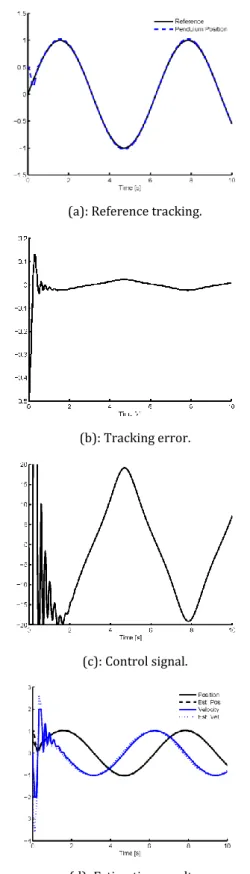
which is corresponding to the number of the rules. The 𝛼 value of equation (4) is chosen as 0.05. These parameters are selected via grid search of relevant intervals. The numerical simulations are given Figure 1 using EFFOBC controller.
The proposed EFFOBC and AFOBC [10] are initialized with same parameters and fair comparisons are made to show accuracy of the proposed controller. There is another work which proposes a new SPR filter based adaptive fuzzy control (AFSPR) control includes pendulum tracking performances. It must be noted that the initial parameters or other parameters of AFSPR are not same with EFFOBC. However, in order to assest the accuracy of pendulum tracking, the same performances are given and compared in Table 1. In order to indicate a qualitative comparison between controllers, integral of absolute (output-tracking) error (IAE), integral of squared error (ISE) and Integral Absolute input (IAU) criteria are used to compare the designed controllers [11]. In fact from the literature, it is known that the fuzzy function modeling itself improves the function approximation capability %10 better than classical fuzzy model [26],[28],[33]. However, the fuzzy function modeling inside indirect adaptive control (EFFOBC)
provides approximately %10 better IAE and ISE performances than classical indirect adaptive fuzzy control (AFOBC) which partly supports the previously obtained literature results. The reason to be indicated that the controller parameters and observer performance predominantly affect the tracking performance than the identification performance.
(a): Reference tracking.
(b): Tracking error.
(c): Control signal.
(d): Estimation results. Figure 1: EFFOBC simulation results.
Pamukkale Univ Muh Bilim Derg, 23(5), 519-526, 2017 S. Beyhan
524 Figure 1(a)(b)(c) present reference tracking, tracking error and
control signal which are generated by EFFOBC controller for pendulum control, respectively. Figure 1(d) shows the pendulum estimation results which are used in the feedback control where the accurate estimations are obtained in a short time using adaptive observer.
Table 1: Simulation performances.
Model/RMSE IAE ISE IAU
EFFOBC 0.179 0.24 106.2
AFOBC [10] 0.201 0.26 106.7
AFSPR [11] 0.527 0.38 107.1
4
Experimental verifications
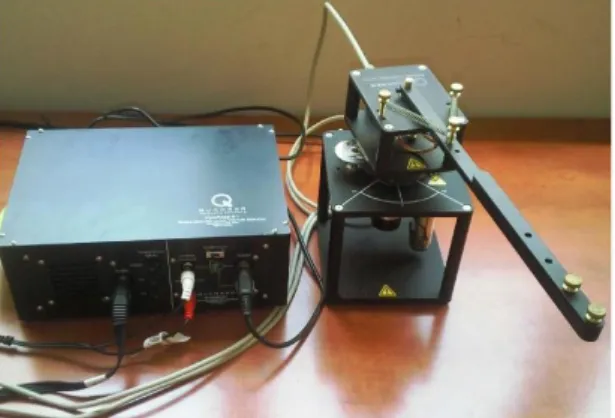
In order to illustrate the capability of designed controllers EFFOBC and AFOBC, flexible-joint manipulator (FJM) [3] has been controlled in real-time experiments. The manipulator is shown in Figure 2. Its approximate mathematical model [3] is,
𝑥̈(𝑡) = −𝐵𝑒𝑞 𝐽𝑒𝑞𝑥̇(𝑡) + 𝐾𝑠 𝐽𝑒𝑞𝜃̇(𝑡) + 1 𝐽𝑒𝑞𝑢(𝑡) 𝜃̈(𝑡) =𝐵𝑒𝑞 𝐽𝑒𝑞𝑥̇(𝑡) − 𝐾𝑠( 𝐽𝑙+ 𝐽𝑒𝑞 𝐽𝑙𝐽𝑒𝑞 )𝜃̇(𝑡) − 1 𝐽𝑒𝑞𝑢(𝑡) (34)
Where 𝑥(𝑡) is the angle of the servomotor and 𝑥̇(𝑡) is the velocity, respectively. Then, 𝜃(𝑡) and 𝜃̇(𝑡) are the position and the velocity of the manipulator, respectively. The numerical values and definitions of the parameters are as follows.
𝐵𝑒𝑞= 0.004N. m/(rad/s) is the damping coefficient, 𝐽𝑒𝑞= 2.08 × 10⁻³kg. m2 is the inertia of the motor, 𝐾𝑠= 1.248N. m/rad is the stiffness coefficient. Finally,
𝐽𝑙= 1.9 × 10⁻³kg. m2 is the inertia moment of the arm. The
flexible joint manipulator is a well-known experimental system which is utilized to test different control methods [6],[7]. The above system model is derived based on the constant end-effector mass assumption. However, we can add an external mass to the end of manipulator to carry a varying payload. Therefore, the robot manipulator dynamics must be modified by adding a 𝑚𝑎𝑑𝑑𝑔𝐿𝑠𝑖𝑛(𝜃)/𝐽𝑒𝑞 term for model-based
controllers such that linear controllers with constant parameters are not suitable for this experiment. However, the effect of payload variation is not required to be elaborated separately due to the nature of adaptive controller capability. In this experiment, the input-output function relation is assumed to be between the position of payload and the input-voltage applied to the servomotor of manipulator.
Figure 2: Flexible-joint manipulator.
The flexible-joint manipulator is controlled to track the time-varying reference signals. The experiments are performed same as using a fourth-order Runge-Kutta integration routine and the sampling period is selected as 10−3 seconds. The
extended fuzzy function system parameters are initialized between linearly-spaced [−1,1], Gaussian membership functions are utilized with constant centers and standard deviations. The centers are linearly-spaced between [−0.7,0.7]
that are the min-max values of the position, respectively, and standard deviation is selected as 0.1. The variable of Nussbaum function is initialized as zero. The filter parameter of the observer is selected as 5. The adaptive controller feedback constants are 𝐾𝑐= [30,11] to locate closed-loop poles at −5
and −6. Then, the observer gains are chosen as 𝐾𝑜= [800,60]
to locate observer poles at −20 and −40. Using these constants and initial parameters, the adaptation of parameters is continued and manipulator is positioned to the different-type of signal references. The number of the centers for input and output memberships are selected as 𝐶 = 10 which is corresponding to the number of the rules. The 𝛼 value of equation (4) is chosen as 0.05. These parameters are selected via grid search of relevant intervals. The same initial parameters are utilized in conventional AFOBC design for fair comparisons.
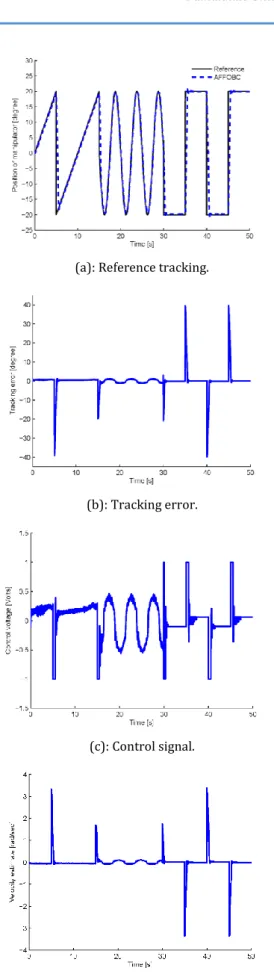
The experiment results are shown in Figure 3. Figure 3(a) represents the manipulator positions such that very accurate tracking is obtained for all references. The tracking errors seen in Figure 3(b) are very small except the reference signal changes sharply. The generated control signal is given in Figure 3(c) such that it is employed to produce control signal in feedback control law. There exist small experimental noises in the control signal. Finally, Figure 3(d) indicates the estimated velocity of the manipulator The real-time control comparisons are given in Table 2 which includes IAE, ISE and IAU performances. From the real-time experiments, there are obtained %7 RMSE performance improvement and %7 IAU performance declension. It can be explained as due to the linear input-output terms of the regressor vector cause fast parameter adaptations and sharp input changes.
Table 2: Real-time control performances.
Model IAE ISE IAU
EFFOBC 0.6463 0.4177 24.19
AFOBC 0.6951 0.4831 23.21
5
Conclusion
In this paper, an adaptive extended fuzzy function state observer-based controller (EFFOBC) was proposed for a class of nonlinear unknown systems. The proposed EFFOBC and conventional AFOBC were designed to control an inverted pendulum in simulation and a flexible-joint manipulator in real-time experiment. In numerical simulation using EFFOBC with selected optimal parameters, %10 IAE performance improvement was provided. In real time experiment, RMSE of tracking was improved %7 compared to conventional AFOBC. More importantly, due to the employed Nussbaum-gain technique, it is possible to position the payload at all angles of the flexible manipulator with unknown system dynamics. The application results are compatible with the theory explained in the paper and it can be concluded that the proposed controller methodology can be used to control flexible systems to a satisfactory level of tracking performance.
Pamukkale Univ Muh Bilim Derg, 23(5), 519-526, 2017 S. Beyhan
525 (a): Reference tracking.
(b): Tracking error.
(c): Control signal.
(d): Estimation results. Figure 3: Real-time EFFOBC control.
6
Acknowledgement
This paper is partly supported by Pamukkale University Scientific Research Projects Council under grant number
2013BSP008.
7
References
[1] Landau ID, Rey D, Karimi A, Voda A, Franco A. “A flexible transmission system as a benchmark for robust digital control”. European Journal of Control, 1(2), 77-96, 1995. [2] Moberg S, Öhr J, Gunnarsson S. “A benchmark problem for
robust control of a multivariable nonlinear exible manipulator”. 17th IFAC World Congress, Seoul,
South Korea, 6-11 July 2008.
[3] Quanser Inc. Rotary Flexible Joint User Manual, 2012. [4] Jayawardene TSS, Nakamura M, Goto S. “Accurate control
position of belt drives under acceleration and velocity constraints”. International Journal of Control, Automation, and Systems, 1(3), 474-483, 2003.
[5] Kune-Shiang T, Jian-Shiang C. “Toward the iterative learning control for belt-driven system using wavelet transformation”. Journal of Sound and Vibration, 286(4-5), 781-798, 2005.
[6] ConsoliniL, Gerelli O, Guarino Lo Bianco C, Piazzi A. “Flexible joints control: A minimum-time feed-forward technique”. Mechatronics, 19(3), 348-356, 2009.
[7] Talole SE, Kolhe JP, Phadke SB. “Extended-state-observer-based control of exible-joint system with experimental validation”. IEEE Transactions on Industrial Electronics, 57(4), 1411-1419, 2010.
[8] Wang LX, Mendel JM. “Fuzzy basis functions, universal approximation, and orthogonal least-squares learning”.
IEEE Transactions on Neural Networks, 3(5), 807-814, 1992.
[9] Park JH, Park GT. “Robust adaptive fuzzy controller for non-a_ne nonlinear systems with dynamic rule activation”. International Journal of Robust and Nonlinear Control, 13(2), 117-139, 2003.
[10] Shaocheng T, Shuai S, Yongming L. “Adaptive fuzzy decentralized control for stochastic large-scale nonlinear systems with unknown dead-zone and unmodeled dynamics”. Neurocomputing, 135, 367-377, 2014. [11] Boulkroune A, Bounar N, M'Saad M, Farza M. “Indirect
adaptive fuzzy control scheme based on observer for nonlinear systems: A novel SPR-filter approach”.
Neurocomputing, 135, 378-387, 2014.
[12] Young HK., FL. Lewis, and CT. Abdallah, “A dynamic recurrent neural-network-based adaptive observer for a class of nonlinear systems”. Automatica, 33(8), 1539-1543, 1997.
[13] Park JH, Yoon PS, Park GT. “Robust adaptive observer using fuzzy systems for uncertain nonlinear systems”.
10th IEEE International Conference on Fuzzy Systems,
2-5 December 2001.
[14] Ionnou PA, Sun J. Robust Adaptive Control. Englewood Clifs, New Jersey, USA, Prentice-Hall, 1996.
[15] Yih-Guang L, Tsu-Tian L, Wei-Yen W. “Observer-based adaptive fuzzy-neural control for unknown nonlinear dynamical systems”. IEEE Transactions on Systems, Man, and Cybernetics, Part B: Cybernetics, 29(5), 583-591, 1999. [16] Shaocheng T, Han-Xiong L, Wei W. “Observer-based adaptive fuzzy control for SISO nonlinear systems”. Fuzzy Sets and Systems, 148(3), 355-376, 2004.
Pamukkale Univ Muh Bilim Derg, 23(5), 519-526, 2017 S. Beyhan
526 [17] Park JH, Seo SJ, Park GT. “Robust adaptive fuzzy controller
for nonlinear system using estimation of bounds for approximation errors”. Fuzzy Sets and Systems, 133(1), 19-36, 2003.
[18] Jang-Hyun P, Gwi-Tae P, Seong-Hwan K, Chae-Joo M. “Output-feedback control of uncertain nonlinear systems using a self-structuring adaptive fuzzy observer”. Fuzzy Sets and Systems, 151(1), 21-42, 2005.
[19] Chung-Chun K, Ti-Hung C. “Observer-based indirect adaptive fuzzy sliding mode control with state variable Filters for unknown nonlinear dynamical systems”.
Fuzzy Sets and Systems, 155(2), 292-308, 2005.
[20] Boulkroune A, M. Tadjine, M. M'Saad, and M. Farza. “How to design a fuzzy adaptive controller based on observers for uncertain a_ne nonlinear systems”. Fuzzy Sets and Systems, 159(8), 926-948, 2008.
[21] Qi R.., Mietek AB. “Stable indirect adaptive control based on discrete-time TS fuzzy model”. Fuzzy Sets and Systems, 159(8), 900-925, 2008.
[22] Nussbaum RD. “Some remarks on the conjecture on the parameter adaptive control”. Systems and Control Letters, 3, 243-246, 1983.
[23] Ge SS, Hong F, Lee TH. “Adaptive neural control of nonlinear time-delay systems with unknown virtual control coefficients”. IEEE Transactions on Systems, Man, and Cybernetics, Part B: Cybernetics, 34(1), 499-516, 2004. [24] Zhaoxu Y, Shugang L, Hongbin D. “Razumikhin-nussbaum-lemma-based adaptive neural control for uncertain stochastic pure-feedback nonlinear systems with time-varying delays”. International Journal of Robust and Nonlinear Control, 23(11), 1214-1239, 2013.
[25] Wang T., S. Tong, and Y. Li. “Robust adaptive fuzzy output feedback control for stochastic nonlinear systems with unknown control direction”. Neurocomputing, 106, 31-41, 2013.
[26] Türkşen IB. “Fuzzy functions with LSE”. Applied Soft Computing, 8(3), 1178-1188, 2008.
[27] Beyhan S, Alcı M. “Fuzzy functions based ARX model and new fuzzy basis function models for nonlinear system identi_cation”. Applied Soft Computing, 10(2), 439-444, 2010.
[28] Beyhan S, Alcı M. “Extended fuzzy function model with stable learning methods for online system identification”.
International Journal of Adaptive Control and Signal Processing, 25(2), 168-182, 2011.
[29] Fazel Z. M. H., Zarinbal M, N. Ghanbari, I.B. Turksen. “A new fuzzy functions model tuned by hybridizing imperialist competitive algorithm and simulated annealing. Application: Stock price prediction”. Information Sciences, 222, 213-228, 2013.
[30] Alcı M., S. Beyhan, “Fuzzy Functions with function expansion model for nonlinear system identification”.
International Journal of Intelligent Automation & Soft Computing, 23(1), 87-94, 2017.
[31] Çelikyılmaz A., IB. Türkşen, R. Aktaş, M. M. Doğanay, N. B. Ceylan, “A new classifier design with fuzzy functions”. In Rough Sets, Fuzzy Sets, Data Mining and Granular Computing, volume 4482 of Lecture Notes in Computer Science, pages 136-143. Springer Berlin/Heidelberg, 2007.
[32] Çelikyılmaz A, Türkşen IB, Aktaş R, Doganay MM, Ceylan NB. “Increasing accuracy of two-class pattern recognition with enhanced fuzzy functions”. Expert Systems with Applications, 36(2), 1337-1354, 2009.
[33] Türkşen IB., Çelikyılmaz A. “Comparison of fuzzy functions with fuzzy rule base approaches”. International Journal of Fuzzy Systems, 8(3), 137-149, 2006.
[34] Türkşen IB. “Review of fuzzy system models with an emphasis on fuzzy functions”. Transactions of the Institute of Measurement and Control, 31(1), 7-31, 2009.
[35] Zarandi MHF., M. Zarinbal, A. Zarinbal, IB. Turksen., M. Izadi, “Using type-2 fuzzy function for diagnosing brain tumors based on image processing approach”.
International Conference on In Fuzzy Systems, Barcelona, Spain, 18-23 July 2010.
[36] Yong-Tae K., Z. Z. Bien, “Robust adaptive fuzzy control in the presence of external disturbance and approximation error”. Fuzzy Sets and Systems, 148(3), 377-393, 2004.