Open Source vs Closed Source Software: Public
Policies in the Software Market
∗
Stefano Comino
†Fabio M. Manenti
‡June 2003
Abstract
This paper analyses the impact of public policies supporting open source software (OSS). Users can be divided between those who know about the existence of OSS, the ”informed” adopters, and the ”unin-formed” ones; the presence of uniformed users yields to market fail-ures that justify government intervention. We study three policies: i)
mandatory adoption, when government forces public agencies, schools and universities to adopt OSS,ii)information campaign, when the gov-ernment informs the uninformed users about the existence and the char-acteristics of OSS and, iii) subsidisation, when consumers are payed a subsidy when adopting OSS. We show that the second policy enhances welfare, the third is always welfare decreasing while mandatory adop-tion can be either good or bad for society depending on the number of informed and uninformed adopters. We extend the model to the pres-ence of network effects and we show that strong externalities require ”drastic” policies.
J.E.L. codes: O38, L51, L63.
Keywords: software market, open source software, mandatory adop-tion, information campaign, subsidisaadop-tion, network externalities.
∗We wish to thank Ines Macho-Stadler and David Perez-Castrillo for useful comments. †Dipartimento di Scienze Economiche ”M. Fanno”, Universit`a di Padova, Via del Santo 33, 35123 PADOVA (Italy), Tel. (39) 49 8274053, email: [email protected]
‡Corresponding author: Dipartimento di Scienze Economiche ”M. Fanno”, Universit`a di Padova, Via del Santo 33, 35123 PADOVA (Italy), Tel. (39) 49 8274238, email:
1
Introduction
Open source software is currently one of the most debated phenomena in the software industry, both theoretically and empirically. At the most basic level, the term open source software simply means software for which the source code is open and available. The source code is the program in which a software is originally written. A software is said ”open” when its source code can be read (seen) and written (modified) by everybody. Availability implies that anybody can acquire the code either free of charge or for a nominal fee (usually media and shipping charges or online connection charges).1
In recent years, the growth and development of the open source movement has been boosted by the Internet: today, making a source code available can be as simple as posting it on the World Wide Web or in an online newsgroup. Furthermore, making the software open is also extremely simple, i.e. place no restrictions on how the software is actually used or by whom.
Typically, open source software has been extremely successful in those seg-ments of the market where the potential purchasers are ”sophisticated users”, i.e. system and server administrators or more generally those that are expe-rienced in handling computers and that, for this reason, are well aware of all various packages available. Just to take a relevant example, the open source software Apache is currently the most popular software for web servers; its market share is about 60% of the total, more than two times larger than Microsoft, its ”closed source” commercial rival.2 Other examples of well
es-tablished open source softwares are Sendmail, the dominant messaging service program for routing and handling email by email servers and Linux, an oper-ating system which is probably the best-known example of the emerging open source software movement, which has a current market share of about 30%.3
Open source software has recently attracted a great amount of attention. Many researchers have focused on explaining where contributors find their mo-tivations to develop new software or to improve the existing one, provided that open source software and its further developments are usually made available at zero price. Any software improvement is a costly activity, and supplying it for free does not reflect these costs; other benefits related to career concerns and/or ego gratification must be taken into account when analysing moti-vations for open source software developers. Lerner and Tirole (2002) and
1All the details related to the open source software movement can be found at the web sitewww.opensource.org/.
2Since 2000 Netcraft.com is counting the active web servers. See
www.netcraft.com.
3There are many others very well known open source software packages such as the programming language PERL, the standard for secure communications over the Internet OpenSSL, the world famous browser Mozilla or the database MySQL.
Lakhani and von Hippel (2000) go in this direction. A different explanation has been offered by Raymond (1999) which stresses on the idea that open source is a form of gift economy based on altruistic motives.4
The open source software is attracting a lot of attention not just in the computing and in the academic communities but, recently, also in the political arena. Many governments around the world are actually supporting open source software or are in the process of supporting it, thus tilting the playing field towards open source.5
Various rationales have been put forward to justify active government poli-cies. Supporters of such interventions argue that open source is technically superior with respect to the closed one, that it is more stable and secure since it allows adopters to check and fix on their own any possible bug and to opti-mise systems against viruses. Moreover, the possibility of accessing the source code, allows adopters to tailor the software to their specific needs. Also, from a more dynamic perspective, some argue that open source software provides a better ”environment” to spur innovation. The availability of the source code makes it easier for software developers to improve upon the already existing programs.
Even though it is not our aim to discuss and evaluate the alleged superiority of open source, we observe that this cannot be considered as a justification for active policy interventions. After all, absent market failures, the market is the natural place where different products compete. If it is technically superior, then more consumers will decide to adopt the open source software rather than the closed source alternative and the market will standardise on the open source without any external intervention. From an economic point of view, governments should intervene only when market forces do not yield a socially efficient allocation.
We believe that an important aspect that has to be taken into account to understand the software market and its possible failures relates to the presence of different typologies of users. As pointed out above, the open source soft-ware has been particularly successful in those segments of the market where the potential demand is made of sophisticated users. On the contrary, in the mass-diffusion segments, where the demand typically comes from less sophis-ticated consumers who are generally not informed about the existence and/or the characteristics of the various packages, open source softwares have hardly
4The organisational literature surrounding open source is now quite well developed. A part from the mentioned papers based on the altruistic/ego gratification motives, others strands of literature focus on different motivations for open source software developers. A complete survey of this literature can be found in Casadesus-Masanell and Ghemawat (2003). 5A clear, non technical and comprehensive discussion of government policies towards open source software is in Hahn (2002).
gained relevant market shares. Many open source packages that have been developed to target the mass-diffusion segments have failed in this scope. The typical example is OpenOffice, a suite which has been created in direct compe-tition with Microsoft Office in the market for office applications. According to a recent review by the Washington Post, OpenOffice has not gained a significant share of the market in spite of the fact that its performances are comparable with those of the rival software6 and that it is supplied for free.
The presence of a large fraction of unsophisticated or ”uninformed” users, especially in the mass-diffusion segments, is somehow intrinsic in the software industry. While closed source software is produced and sold by commercial firms who have strong incentives to advertise their products and to inform potential adopters about their packages’ features, the open source software is usually distributed by individual developers or by news groups, who have different motivations rather than profit maximisation.
Starting from this simple observation, the aim of this paper is to study the effects on social welfare of the various forms of interventions that have been envisaged by many governments around the world. The analysis moves from a recent contribution by Schmidt and Schnitzer (2002); the set up is based on a very simple static model in which two software products are offered. The closed source software is supplied by a commercial firm, while the open source is sold at marginal cost by a fringe of independent developers.
Absent quality differences between products, we assume that potential adopters can be segmented into two distinct categories: the informed users who know about the existence of both the closed and the open source software and the uninformed ones who ignore the existence and/or characteristics of the open source alternative. Clearly, competition between open and closed source software occurs only in the market for informed users and we model it according to a standard Hotelling-like framework.
In the first part of the paper we look at the pure market equilibrium, that is the equilibrium when the government does not intervene; from this analysis we are able to characterise the presence of market failures. The remaining sections of the paper are devoted to present the impact on social welfare of the most commonly proposed government policies intended to correct these market failures. We show that while welfare increases when the government supports open source software through an information campaign aimed at
6Rob Pegoraro in an article appeared in the Washington Post (”The office suite and lets you see past Redmond, Washington Post, May 12, 2002, p.H07”) states that ”After using the Windows version of OpenOffice for the past week and a half, I can attest that it either matches or beats Microsoft Office in features and ease of use, at the cost of slower performance on older computers and the occasional slight garbling of complicated Microsoft Office documents.”
informing the uninformed users about the existence of the open source software, a more intrusive and direct policy in support of the open source based on direct subsidisation of those who adopt this software always harms society. Finally, when the policy consists of mandating public agencies, bureaus, public schools or universities to adopt open source software then welfare may increase or not according on how the market is segmented between informed and uninformed users.
In the last section of the paper we extend the model by introducing network externalities, a commonly recognised feature of software markets. Our main message is that when network effects are pervasive enough, the policies work only if they are sufficiently ”drastic” and induce the market to standardise on one of the two products. Perfect standardisation allows network effects to be at their maximum level, thus increasing welfare.
Our analysis is essentially static: it does not contemplate neither R&D activity from software producers nor firms’ entry and compatibility strategies, which have both dynamic nature.7 In particular, one of the reasons that has been put forward to justify government intervention in favor of the open source movement is that open source developers have more incentives to innovate than those working for a commercial producer. This is a very interesting and controversial issue: both Smith (2002) and Schmidt and Schnitzer (2002) contrast this argument and argue that it is the marketplace rather than the policy arena to provide the right incentives to ensure continuous innovation.
Bessen (2002) argues in favor of open source; he contends that open source addresses market failures associated with incomplete contracts and asymmetric information: the government should remove the impediments it has imposed to developers through software patents, which tilt the market in favor of pro-prietary developers.
As it is clear from this concise discussion, the issue of government inter-vention in the software market is still very much debated. The vast majority of the literature does not provide a sufficiently developed analytical frame-work able to analyse the complex intricacies of the various issues at stake; our contribution is a first, although simple, effort to try to fill this gap.
1.1
Government policies towards open source
To understand current governments thinking on open source it is useful to survey the major public initiatives to support open source software (OSS here-after).8
7Note that in this static framework, the main and only characteristic of open source software is that it is offered free of charge.
Governments are great purchasers of computer software. As reported in Evans and Reddy (2002), the US government alone spent $3.7 billion on soft-ware in 2000. A first and direct public intervention in the softsoft-ware market is therefore very simple: whatever its merits and characteristics, mandate adop-tion of OSS in public administraadop-tion and at schools or universities.
Many governments have already decided to support OSS in this way: in Latin America, the Brazilian government passed a legislation that mandates OSS to be adopted in municipal governments; in Germany, the Bundestag mandated all public administrations servers to run Linux. In other countries, pending legislations are waiting for parliamentary approval: in Europe, the French parliament is actually discussing a bill that forbids to use anything but OSS. In Italy too a similar legislation is currently under discussion.
Other governments, such as Germany and Singapore, have also adopted a different approach. Singapore is offering tax breaks to companies that use the open source Linux operating system instead of Windows; in Germany, an agreement has been reached between the government and IBM that offers discounts on IBM machines with preinstalled Linux. In both these examples, the adoption of OSS rather than the commercial alternative is subsidised either through a tax saving or a hardware discount.
A third policy, certainly less intrusive than the first two and for this rea-son also very popular around the world, is based on supporting OSS through promotional campaigns. In the US, many public education consortiums are promoting OSS. Just to take an example, in North Mississippi, in August 2002 the local Education Consortium has adopted a pilot program called ”freedom to learn” aimed at campaigning OSS in public schools: students will be intro-duced to OSS through 2002 and 2003 school years. It must be noted that all the initiatives based on mandating public schools to adopt OSS also fall in this third category: by using OSS at schools, students learn about OSS and this certainly constitutes a form of promotional campaign. In Spain, the parlia-ment is discussing a bill which requires regional governparlia-ments to take initiatives to promote open source products.
Following these examples, it is possible to distinguish the various public initiatives towards OSS in the following three broad categories: i) mandatory adoption, ii) subsidisation and iii) information campaign.
2
The model
2.1
Firm’s behavior
Competition occurs between a closed source software (CSS hereafter) and an open source software. CSS is supplied by a single commercial firm while OSS is offered by a fringe of independent developers.
The two products are horizontally differentiated and we model competition using a standard Hotelling framework; the two products are located at the extremes of a unit length segment: CSS at 0 and OSS at 1.
Open source software is sold at marginal cost while CSS is priced atpby its producer. We assume zero marginal production cost for the two products and that the commercial vendor is not able to discriminate consumers according to their location or to their typology and it therefore charges only one price.
2.2
Consumers
There are two typologies of consumers: a) the ”informed” users, i.e. those who know about the existence of both CSS and OSS and that take their adoption de-cision comparing the utility given by each alternative, andb) the ”uniformed” users, i.e. those who ignore the existence of OSS and therefore when taking their adoption decision consider only the closed source software.
We assume for simplicity that the population of consumers is of mass 1: a portion η are the uninformed and the remaining 1 −η are the informed ones. Irrespectively on their type, consumers are uniformly distributed on a unit length segment. A consumer located at x∈ [0,1] gets a net utility from buying the closed source software of
Uc =v−tx−p, (1)
where v is the gross utility from adopting the software, t is a transportation cost andp is the price charged by the CSS producer. t may be interpreted in many ways: the cost of learning how to use the software, the installation cost or the cost of adapting other software applications.
Similarly, the consumer’s net utility from adopting OSS is
3
Pure market equilibrium, market failures and
government policies
In order to highlight the presence and the characteristics of market failures, and therefore the scope for a possible government intervention, we need to determine the pure market equilibrium, that is, the outcome that arises when no public policy is in place; we then compare this equilibrium with the social optimum. Let us start with the pure market equilibrium.9
3.1
Pure market equilibrium
The two software packages compete only in the market of the informed users. In this case, given the price p charged by the producer of the closed source, the indifferent consumer is the one who gets the same net utility from the two versions of the software. Formally, the indifferent consumer is located at xi,
wherexi solves the following:10
v−tx−p=v−t(1−x) ⇒ xi = t−p
2t . (3)
Uninformed users ignore that an open source software is available and con-front the utility that they receive when adopting CSS with the zero utility of not buying any software. Therefore the indifferent uniformed consumer is the one located atxu, where xu is the solution of:11
v−tx−p= 0 ⇒ xu = v−p
t . (4)
Given xi,xu and the distribution of consumers among informed and
unin-formed types, the profits for the CSS producer are
π=p((1−η)xi+ηxu). (5)
From the first order condition it is easy to derive the profit maximising price:12
p∗ = t(1−η) + 2ηv
2(1 +η) . (6)
9The presence of market failures drives our model away from Evans (2002), where it is claimed that the market is ”per-se” efficient.
10The subscriptistays for ”informed”. 11The subscriptustays for ”uninformed”. 12The second order condition is
d2π dp2 =−
1 +η t <0, which is clearly always satisfied.
Given its inability to price discriminate, the firm charges a price p∗ which
is a weighted average between the optimal prices that it would charge if it were able to discriminate consumers according to their typology; formally, it is easy to rewrite expression (6) as follows:
p∗ = (1−η) (1−η) + 2ηp ∗ i + 2η (1−η) + 2ηp ∗ u, (7) wherep∗
i = 2t and p∗u = v2 are the optimal prices that the firm would charge to
the informed and uninformed consumer respectively and where the weights of these two prices depend on the distribution of consumers in the two segments of the market. Clearly, the larger (resp. smaller) the mass of uninformed consumers (ηhigh/resp. low), the closer p∗ is top∗
u (resp. p∗i). In other words, when settingp∗ the closed source software producer cares more of one segment
of the market or the other depending on its relative magnitude.
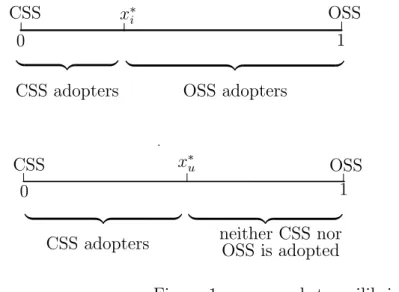
Equilibrium market shares are obtained by replacing expression (7) intoxi and xu:13 x∗ i = t+ 3η t−2vη 4t(1 +η) , (8) x∗ u = 2v−t+η t 2t(1 +η) . (9) Figure 1 gives a graphical representation of the pure market equilibrium.
CSS adopters OSS adopters
CSS adopters OSS CSS OSS CSS x∗ i | {z } | {z } | {z } Informed consumers Uniformed consumers x∗ u | {z } neither CSS nor OSS is adopted 0 0 1 1
Figure 1: pure market equilibrium
13Note that we need to impose restrictions on the parameters in order to ensure the
It is worth noting that in the segment of the informed consumers, OSS market share is larger than that of CSS. This is an obvious consequence of the fact that the former is given away for free, while the latter is priced atp∗ >0. In the segment of uninformed users, CSS is adopted by all those consumers who are located to the left of x∗u. Consumers located further away from the CSS do not adopt any software at all.
Finally, having defined the equilibrium market allocations and the price, we can derive the consumers surplus of uninformed and informed consumers respectively: Su =η Z x∗u 0 (v−tµ−p∗)dµ, (10) Si = (1−η) " Z x∗i 0 (v−tµ−p∗)dµ+ Z 1 x∗i (v−t(1−µ))dµ # . (11)
Total welfare is defined as the sum of consumers surplus and firm’s profit:
W =Su+Si +π.
3.2
First and second best allocations
Let us now consider the socially optimal solution, namely the allocation that a welfare maximising planner would obtain by assigning consumers with one of the two software packages.
All through the paper we assume that v > 2t; this condition ensures that it is efficient to assign each informed consumer with one of the two softwares (either OSS or CSS). It is worth distinguishing between two cases: second best and first best.
3.2.1 Second best
We define second best as the welfare maximising allocation under the con-straint that uninformed consumers can only adopt CSS; this is equivalent to say that the regulator decides ”who is going to adopt and what” but she takes as given the distribution of consumers between informed and uninformed.
In this case, given that the two softwares have the same gross valuation,
v, the social optimum requires the minimization of the transportation costs in the segment of informed consumers; conversely, in the segment of uninformed consumers, the social surplus is maximised when all the individuals for which the gross valuation v is larger than the transportation cost adopt the closed source software.
Remark 1 (Second best allocation). The second best is achieved when i) the informed consumers adopt CSS for x ≤ 1/2 and OSS otherwise and ii) the uniformed consumers adopt the CSS for x≤min{v/t,1}.
3.2.2 First best
By first best we mean the situation in which the planner can also determine the typology of the consumers. This amounts to say that the government is also able to decide the distribution of consumers between informed and uninformed.
Remark 2 (First best allocation). The first best is achieved when i) all con-sumers are informed (η = 0) and ii) those located at x≤1/2 adopt CSS and OSS otherwise.
By choosing η = 0, the planner is able to replicate any possible allocation that it can be obtained whenη >0. Therefore, when there are no uninformed consumers, the social welfare is at least as large as when η > 0. Moreover, it is socially optimal to allocate all the (informed) consumers in a way that minimises the transportation costs. As for the second best, this occurs when consumers are equally split between the two products: those to the left of 1/2 adopt CSS, while the remaining adopt OSS. Clearly, the second best allocation converges to the first best as η goes to zero: welfare tends to increase the smaller the mass of uninformed consumers.
3.2.3 Market failures
Market failures can be easily determined by simple comparison of the social optimum with the pure market equilibrium given in expressions (8) and (9); our set-up encompasses three different failures, which are summarised in the following remarks.
Remark 3(Market failure 1). Too few informed consumers adopt CSS:x∗i <1/2.
As already discussed, in the segment of informed consumers, social opti-mality would require to split consumers equally between the two products in order to minimise transportation costs. However, market forces do not yield this outcome: since CSS is supplied at p∗, while OSS is available for free, the latter is adopted by ”too many” informed consumers.
Remark 4 (Market failure 2). Conditional on the presence of uninformed con-sumers,η >0, too few adopt CSS, x∗u < min{v/t,1}.
Remark 5 (Market failure 3). Uninformed consumers do not make social op-timal adoption decisions.
Failures 2 and 3 are related to the monopolistic segment of the industry, that is that of uninformed consumers. As in a standard monopoly setting, a too little amount of CSS is sold: there is a deadweight loss due to the presence of a monopolistic producer (market failure 2). Furthermore also those consumers who would have optimally adopted OSS either do not buy any software at all or do adopt the wrong one. This means that due to their ignorance about the existence of OSS, some uninformed consumers do not make the socially optimal adoption decision (market failure 3).
3.3
Government policies towards OSS
As we have neatly discussed in the introduction, government policies towards OSS may take essentially three forms. On the one side, governments may force agencies, schools or universities to adopt OSS. Alternatively, a less intrusive policy may be based on informing people about the existence and charac-teristics of OSS. Finally, the government can subsidise the adoption of the software open source through monetary incentives. We define the first policy asmandatory adoption, the second as information campaign and the third as
subsidisation.
Clearly, the government may actually decide to undertake a sort of ”policy mix” by combining two or more of these policies. Furthermore, also without an explicit policy mix, both subsidisation and mandatory adoption have intrinsi-cally an informative nature. Never the less, the aim of the paper is to study each policy in isolation from the others, in order to disentangle their ”true” welfare effect. The evaluation of a policy mix is therefore a simple combination of the results that we obtain for each policy and it can be easily derived.
The first two policies have the effect of changing the masses of consumers belonging to the two typologies of informed and uninformed, while the third one has the effect of increasing consumers valuation for OSS. Formally, we model these policies in the following way:
1. mandatory adoption: the government randomly selects an amount β of consumers and forces them to adopt OSS. As a consequence, the mass of informed consumers reduces to (1 − β) (1 − η), while the mass of uninformed consumers reduces to (1−β)η.
2. information campaign: the government informs a share α of the unin-formed consumers about the existence and characteristics of the OSS. As a consequence, the mass of uninformed consumers becomes η−α, while that of the informed ones increases to 1−η+α.
3. subsidisation: the government pays a subsidy s to every individual who adopts OSS. Therefore, the gross consumer’s valuation of OSS becomes
v +s.
4
Mandatory adoption
The first policy that we analyse is mandatory adoption. With this policy the government forces some or all the public agencies, universities and schools to adopt OSS. More precisely, we consider the case in which the government imposes to these consumers either to adopt OSS or not to adopt any software at all.14
It is realistic to assume that, as for the closed source producer, also the regulator ignores the location (i.e. the preferences) of each consumer and also that she cannot distinguish between informed and uninformed users. As a consequence, with this policy the government randomly extracts an amount
β ∈ (0,1) of consumers from the entire population and forces them to adopt OSS. The mass of informed consumers reduces to (1−η) (1−β), that of unin-formed consumers reducesη(1−β), while β represents the mass of mandated consumers.
Clearly, this policy has the effect of reducing the mass of potential CSS adopters. However, the proportion of informed to uninformed consumers re-mains unchanged. This fact implies that the weights in expression (7) do not change and that the policy does not alter the equilibrium price p∗ nor the equilibrium indifferent consumers defined in expressions (8) and (9).
The impact of the mandatory adoption on total welfare is summarised in the following Proposition.
Proposition 1. Only if the mass of uniformed consumers is sufficiently large,
it is optimal to mandate the adoption of the open source software. Formally there exists a unique η¯∈(0,1) such that:
dW
dβ >0 if and only if η >η.¯
14Mandated consumers adopt OSS only if v−t(1−x)≥0, while they do not adopt any software ifv−t(1−x)<0.
The effect of the policy on the surplus of the various agents can be eas-ily understood. Since the mass of CSS potential adopters reduces, profits for the commercial firm decline. Conversely, the effect on consumers’ surpluses depends on the typology of users. Given thatp∗ does not change, the surplus of those consumers who are not mandated to adopt OSS is not altered. The informed consumers who are now mandated to adopt OSS are, overall, worse-off: those who shift from CSS to OSS as a consequence of the policy obtain a strictly smaller level of utility, while those who were already adopting the OSS are not affected by the policy. On the contrary, the impact on the uninformed consumers who are now mandated by the government depends on their loca-tion: while the policy harms those uninformed that have strong preferences towards CSS (formally, those located closed to the origin in figure 1b), the uniformed that without the policy were not buying any software are clearly better-off. On average, the latter positive effect dominates the former.
From this discussion, it is clear that only the uniformed users who are man-dated by the government to adopt OSS may benefit from the policy. There-fore, according to Proposition 1, mandatory adoption is welfare increasing only when the mass of uninformed users is sufficiently large.15
In terms of market failures, since x∗i and x∗u remain unchanged, the policy does not affect market failures 1 and 2: the allocation of informed consumers does not minimise the transportation costs and there is still the deadweight loss in the segment of uninformed users. On the contrary, mandatory adoption has a positive effect on type 3 market failure since some uninformed consumers that previously were not adopting any software, now buy OSS, while others efficiently move from CSS to OSS.
5
Information campaign
Through an information campaign, some uninformed consumers receive in-formation about the existence and the characteristics of OSS. Formally, this policy consists in moving a fraction α ∈ [0, η] of consumers from the unin-formed to the inunin-formed segment of the market. As a consequence, the mass of consumers that remain uninformed reduces to η−α, while that of informed becomes 1−η+α. In our analysis we assume that the government implements such a policy at no cost.
15This result contrasts with Schmidt and Schnitzer (2003) where mandatory adoption always hurts society; this is due to the strong assumption that while the firm is not able to discriminate between informed and uninformed consumers, the government actually dis-criminates consumers and selects only the informed ones when mandating the adoption of the open source software.
The study of this case closely resembles the one conducted when present-ing the pure market equilibrium. However, as the proportion of informed to uninformed consumers changes, the optimal price charged by the commercial producer is also altered. As it is shown in the appendix:16
dp∗
dα >0 if and only if t > v.
Consider the expression of the pure market optimal price (7). Since the information campaign increases the proportion of informed users, then the optimal price converges towardsp∗i. It is easy to verify that when t > v, then
p∗i > p∗u and therefore in this case the optimal price increases withα.
The next Proposition characterises the effect on total welfare of the infor-mation campaign:
Proposition 2. Supporting the open source software through a costless
infor-mation campaign always increases welfare: dW
dα >0 ∀ α ∈[0, η].
As in the case of mandatory adoption, the effect of the policy on producer surplus is straightforward: since the policy shrinks the captive market of un-informed users, it undoubtedly harms the firm.
To understand the effect of the information campaign on consumer’s surplus we need to distinguish between two cases depending on whether the price charged for the closed source software decreases (this happens whent ≤v) or increases (t > v) with α. Suppose thatp∗ decreases withα; in this case all the consumers are better-off. More precisely, while the informed consumers who adopt CSS benefit from a lower price, the policy does not have any impact on those who adopt OSS. Uninformed consumers who adopt CSS benefit from a reduction in p∗ while those who do not adopt any software are unaffected. Finally, all the uninformed consumers who become informed as a consequence of the campaign, are better-off. If they adopt CSS they are charged a lower price, while if they adopt OSS they benefit from a choice that was not available before.
From this discussion it is clear that when the policy induces the firm to charge a lower price, the information campaign makes the market working bet-ter in all respects; each market failure is lessened by the policy: it increases
16In the proof of Proposition 2, we show that the firm’s optimal price in this case is:
p∗= t(1−η+α) + 2v(η−α)
2 (1 +η−α) . (12)
the share of consumers having adopted CSS both in the segment of informed and in the segment of uniformed consumers (failures 1 and 2) and, obviously, it induces some previously uninformed users to take a more appropriate deci-sion (failure 3). Therefore, it should not be a surprise that the total welfare increases withα.
However, as stated by Proposition 2, the information campaign always increases welfare, also when it induces an increase in the price of the closed source software. In this case, market failures 1 and 2 become more severe but these negative effects are still dominated by the positive effect on market failure 3. In other words, the fact that an additional fraction α of consumers is now able to make a more informed adoption decision makes the proposed policy always welfare enhancing.
6
Subsidisation
We end this first part of the paper with the analysis of the last policy: gov-ernment subsidisation of OSS.
We model this policy by assuming that the government pays a monetary transfer s to each individual who adopt the open source software; formally, this amounts to assuming that the gross utility from adopting OSS becomes
v+s. Moreover, we also assume that the cost of the subsidy is entirely borne by the society through lump sum taxation.17 The following proposition can be
easily proved:
Proposition 3. Subsidising the open source software always reduces welfare:
dW ds <0.
The policy clearly induces the CSS producer to charge a different price for its product. Nevertheless, to get more intuition of Proposition 3, consider first what happens if p∗ does not change. The utility of all those consumers who adopt OSS increases of an amount s. However, this positive effect is exactly offset by the increase in government expenditures and, therefore, for these consumers there is no net welfare effect. Similarly, also for those consumers who adopt CSS there is no effect on social welfare: their utility does not change nor the government pays any subsidy to them. On the contrary, for those consumers who move from CSS to OSS as a consequence of the policy, the net effect on welfare is strictly negative. The increase in the utility of these consumers does not compensate the increase in government expenditure.
Without subsidies, CSS is their preferred software, and when moving to OSS they get higher utility but the increase is certainly smaller thans.
Finally, the policy obviously hurts the producer of the closed source soft-ware; it is possible to show that the firm has to cut its price in order to protect its market. While consumers benefit from this price decrease, the overall wel-fare effect of a subsidy is negative.
In terms of market failures, while subsidising OSS does not impact type 3 market failure, it mitigates failure 2 and it worsens failure 1. Given that the subsidy induces the commercial software producer to lower its price then the deadweight loss in the uninformed segment is reduced. However, it is possible to verify that the reduction in p∗ does not entirely compensate the subsidy payed to OSS adopters and, as a consequence, OSS market shares enlarges. This clearly accentuates market failure 1.
7
Public policies with network externalities
A relevant feature of software markets is the presence of network externalities: the individual benefit from adopting a certain software is positively affected by the number of other individuals having adopted the same software or a compat-ible one. This effect lies on the simple observation that the more widespread a package, the easier is to exchange files and information with other users and, therefore, the higher the utility from adopting that particular software.18
It is interesting to extend our analysis by introducing network externalities into the model and to verify how our results change when these effects are taken into account. The simplest way to model network effects at the individual level is to introduce an additive term in the utility functions (1) and (2):19
Uc =v+θNc−tx−p, Uo =v+θNo−t(1−x).
where Ni represents the number of consumers adopting software i = open, closed and θ ≥ 0 measures the strength of network effects:20 the greater θ,
the larger the individual utility from joining a network with other Ni users.
The analysis goes in the same way as in the previous section: we start by
18Despite the relevance of network externalities has been commonly accepted in software markets, there are only few econometric papers that try to prove empirically the role of network effects in the software industry. These works mainly focus on the spreadsheets segment of the market; see Gandal (1994) and Brynjolfsson and Kemerer (1996).
19We follow a standard way to model network externalities, see Shy (2001).
20We are also assuming that closed and open source software are incompatible. This amounts to saying that network externalities are based only on the number of users adopting the same software. The case of compatible software is less relevant in practice and also of less theoretical interest.
characterising the socially optimal allocation and we use this as a reference point for the following discussion.
The most interesting case is when network effects are not too strong; in this case it is possible to prove the following proposition:
Proposition 4 (Second best with network effects). With low network
externalities, θ≤ t−v
2 , the second best is achieved when i) informed consumers
adopt CSS for
x≤xsbi = 2θ (t−2θ η (1−η)−vη)−t
2
2 [2θ (t−θ η (1−η))−t2] , (13)
and OSS otherwise and ii) uninformed users adopt CSS for x≤xsbu = (θ (1−η) +v) (2θ (1−η)−t)
2θ (t−θ η (1−η))−t2 . (14)
From Proposition 4 an interesting consequence follows immediately:
Corollary 1. Second best CSS market shares increase with the strength of
network effects:
dxsbi dθ >0,
dxsbu dθ >0.
This corollary has a clear explanation. In the second best scenario, the planner takes the mass of uninformed consumers as given; therefore, since these consumers can only be assigned with CSS, the closed source software has a larger potential installed base. A software with a wider installed base induces larger network effects which translate into higher welfare levels: with network externalities, the government tends to prefer CSS to OSS and this preference is stronger the larger the externalities. According with Corollary 1, the stronger the network externalities, the larger the socially efficient closed source software market share.
Corollary 1 provides also the intuition for what happens when θ is large. When network effects are very strong, the second best requires standardisation towards CSS.21
Unfortunately, even in this extremely simplified framework, we are not able to formally characterise the impact of the various policies on social welfare. For this reason, we proceed as follows; in the first part, we restrict the analysis
21Note that the first best is achieved whenη = 0 and, forθlarge, with full standardisation towards either CSS or OSS. Indeed, in the first best scenario the potential installed base of the two softwares is the same: 1. However, this is a trivial result, which is also of little empirical evidence given that network effects do not have such a pervasive role.
to a neighborhood of θ = 0; this allows us to evaluate analytically how the effectiveness of the policies changes with small network effects. In the last part of the paper we extend the model to the analysis of larger values ofθ through numerical simulations.
7.1
A local analysis
A first and insightful discussion about the effectiveness of the proposed govern-ment policies in the presence of network externalities can be conducted locally, by analysing the model in a neighborhood ofθ = 0. Formally, we consider the derivatives with respect toθ of the previous policies and we evaluate their sign atθ approaching zero: signd dWdi /dθ
θ→0, where i=β, α and s; when the
sign is positive, the externality reinforces the impact of the policy when this has a positive impact, and it makes it less damaging when it has a negative welfare effect.
Since the role of network effects is similar in all the three policies presented in this paper, we focus only on the case of mandatory adoption.22
Proposition 5. The presence of small network effects, makes the policy more
effective (or, equivalently, makes it less damaging) if there are few uninformed users; with larger shares of uninformed consumers, this happens only if the government mandates a sufficiently large number of consumers to adopt OSS; formally: d( dW dβ) dθ θ→0
> 0 if i) η < 0.139 and ii) if η > 0.37 provided that β >βˆ, with βˆ∈(0,1).
From the analysis of the second best, we know that with network exter-nalities, welfare increases as long as the market tips towards standardisation on one software: in this case network effects, and therefore the welfare, are at their maximum level.
Whenηis small, the vast majority of consumers is informed and since OSS is provided for free, it gains a larger users’ installed base than CSS. By man-dating additional consumers to adopt OSS, the government tilts the market even further towards open source software; this reinforces the positive welfare effect of a larger installed base and improves the performance of the policy. Therefore, as stated in Proposition 5, whenη is small the presence of network effects makes mandatory adoption more effective (or less damaging in case the policy has an overall negative effect on welfare) in enhancing social welfare. On the contrary, when the number of uninformed consumers is large enough,
22The analyses of the information campaign and of the subsidisation policy go exactly in the same way and we make them available on request.
then OSS can no longer enjoy of a larger installed base. As a consequence, the presence of network effects improves the effectiveness of the policy only if the government is able to influence the adoption decision of a great amount of consumers thus making OSS the software with the largest installed base.
Similar arguments can be applied when the government acts via an infor-mation campaign or through subsidisation.
7.2
Some simulations
The main message emerging from the previous section is that the presence of network effects makes the policies in support of OSS more effective (or less damaging) when the open source software has the largest installed base or when it is able to gain it thanks to the policies themselves. However, this analysis does not allow us to fully appreciate the role of network effects, that is to discuss whether the various policies increase or decrease welfare in the presence of network externalities. In this final section we provide a more global analysis on the role of network effects; we do so by resorting to numerical simulations.
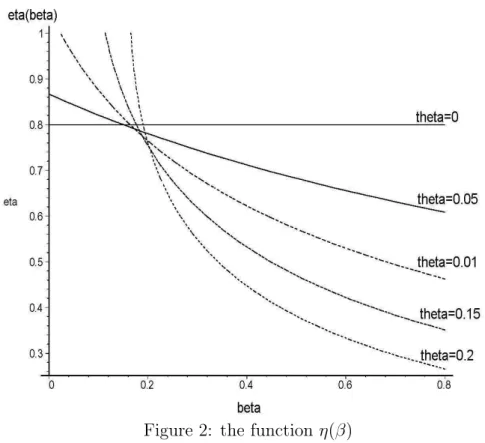
Consider the case of mandatory adoption. Figure 2 plots different cut-off functions η(β): these functions give for any value of β the corresponding value of η such that dW/dβ > 0 for η > η(β). The plot given in figure 2 has been drawn for v = 1 and t = 1.3 and for five values of the externality:
θ= 0,0.05,0.1,0.15,0.2.23
When θ = 0, η(β) is constant: η(β) = η ≈ 0.8; as we already know from Proposition 1, the policy increases social welfare if and only ifη > η. Figure 2 shows that for larger values ofθ, the cut-off function η(β) becomes negatively sloped.
This implies that i) when the policy mandates few consumers, i.e. β close to the origin, then the policy has a positive welfare effect only if there are few uninformed consumers, fewer than without network effects (η > η(β)> η) and thatii) when the policy mandates a large number of users to adopt OSS, then it is good for society also if there are many uninformed users (η < η(β)< η).
Moreover, since η(β) becomes steeper as θ increases, impacts i) and ii) become more relevant as the externalities gets stronger.
23These are reasonable values of the parameters; we have run a complete scan of the parameters space and we have obtained plots with the same characteristics.
Figure 2: the function η(β)
From this analysis we conclude that with significant network externalities, the impact on social welfare of a policy based on mandatory adoption depends on the amount of consumers that the government is able influence. Given that with network externalities welfare tends to be maximised when there is standardisation towards one software, then mandatory adoption is more likely to be welfare increasing when the government is able to mandate the adoption of a large number of consumers, thus tilting the market towards OSS.
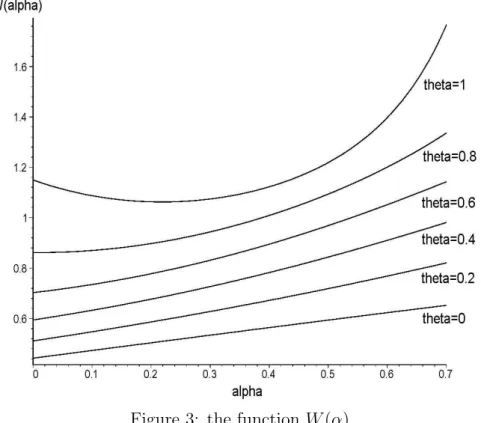
Similar conclusions can be derived in case of an information campaign. From Proposition 2 we know that without network externalities this policy al-ways improves social welfare. This remains true also for small values ofθ. How-ever, with stronger network effects things may change radically. In Figure 3 we plot different welfare functions W(α) for five values of θ = 0,0.2,0.4,0.6,0.8 and 1.24
24Again, we have plotted these functions for v = 1 and t = 1.3; furthermore, we have assumedη = 0.5. Similar results are obtained with different values.
Figure 3: the function W(α)
As expected, W(α) shifts upwards as θ enlarges: for given α, welfare is higher the stronger the externality. As shown in the figure, for low values of
θ, W(α) is always positively sloped. However, when θ is large (i.e. θ = 1),
W(α) becomes U-shaped: for low values of α the information campaign re-duces welfare. Again, the intuition for this result relies on the presence of network externalities. When θ is large, welfare tends to be maximised when there is one software that prevails on the other. However the presence of a suf-ficiently large mass of uninformed consumers makes CSS the software with the largest installed base; this implies that market forces themselves move towards standardisation on CSS and this is efficient in terms of welfare. Therefore, in this case, informing few consumers (α low) about the existence of OSS can only induce a deterioration in the level of welfare. Some of these consumers are induced to shift to OSS but they do not internalise the negative effect that this decision produces on those consumers who continue to adopt CSS.
On the contrary, as in the case of mandatory adoption, the information campaign has a positive effect on welfare when the government informs many consumers (α large) since in this case the regulator helps the market to stan-dardise on OSS.
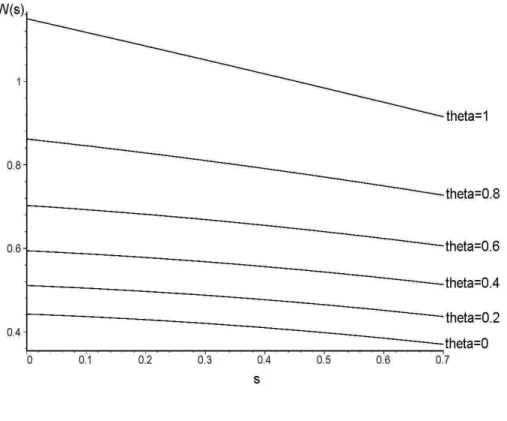
Figure 4: the function W(s)
Finally, consider the case of a public subsidy payed to OSS adopters. Figure 4 shows total welfare as a function of the subsidy when θ = 0,0.2,0.4,0.6,0.8 and 1.25
Again, as θ gets larger, W(s) shifts upwards. In this case W(s) is always negatively sloped irrespective on the strength of network effects: subsidising OSS always harms society.
8
Conclusion
In this paper we have analysed the impact on social welfare of the three most popular government policies in support of the open source software that have been proposed in many countries. The analysis has been conducted using a
25Again, we have plotted these functions for v = 1 and t= 1.3 and η = 0.5 but similar plots can be obtained with different parameters’ values.
static model in which an open source and a closed source/commercial software compete. According to the observation of what happens in the reality, we divide consumers according to their knowledge of the open source: the more experienced consumers usually know the existence and the characteristics of the software open source while the others, less experienced users, may ignore it; in the first case they are said ”informed”, while they are ”uninformed” otherwise. Competition occurs only in the segment of informed consumers.
We have shown that while the promotion of OSS through public subsidies paid to OSS adopters always induces a decline in the level of social welfare, implementing a less intrusive policy such as information campaign may actually increase welfare. Finally, the policy aimed at mandating OSS adoption in public agencies, schools and universities improves welfare only if the market is characterised by a large mass of uniformed consumers.
In the last part of the paper, we have extended the model in order to con-sider the case of network externalities, a situation which is extremely relevant in the software market. As expected, with significant network effects manda-tory adoption and information campaign increases welfare only when they are ”drastic”: when the government is able to influence a large mass of consumers then the market tilts towards the open source software and network effects are at the maximum level thus pushing welfare up. On the contrary, subsidisation always lower social welfare no matter the magnitude of network externalities.
References
Bessen, J. (2002). What Good is Free Software? in Hahn (2002).
Brynjolfsson, E. and Kemerer, C. (1995). Network Externalities in Micro-computer Software: An Econometric Analysis of the Spreadsheet Market. MIT Center for Information Systems Research, working paper no. 265. Casadesus-Masanell, R. and Ghemawat, P. (2003). Linux vs. Windows:
Mod-eling Competition between Open-Source and Closed Software. Harvard Business School, mimeo.
Evans, D. S. (2002). Politics and Programming: Government Preferences for Promoting Open Source Software. in Hahn (2002).
Evans, D. S. and Reddy, B. (2002). Government Preferences for Promoting Open-Source Software: a Solution in Search of a Problem. N.E.R.A. working paper.
Gandal, N. (1994). Hedonic Price Indexes for Spreadsheets and an Empirical Test of the Network Externalities Hypothesis. RAND Journal of Eco-nomics, 25:160–170.
Hahn, R. W. (2002). Government Policy toward Open Source Software. AEI-Brooking Joint Center for Regulatory Studies, Washington D.C.
Lakhani, K. R. and von Hippel, E. How Open Source Software Works: ”Free” User-to-Assistance.
Lerner, J. and Tirole, J. (2002). Some Simple Economics of Open Source.
Journal of Industrial Economics, 50:197–234.
Raymond, E. (1999). The Cathedral and the Bazaar: Musings on Linux and Open Source from an Accidental Revolutionary. Sebastapol: CA: O’Reilly and Associates.
Schmidt, K. and Schnitzer, M. (2003). Public Subsidies for Open Source? Some Economic Policy Issues of the Software Market. CEPR Discussion Paper, No. 3793.
Shy, O. (2001). The Economics of Network Industries. Cambridge University Press.
Smith, B. L. (2002). The Future of Software: Enabling the Marketplace to Decide. in Hahn (2002).
Appendix
Pure market equilibrium: restrictions on the parameters. In order to ensure the existence of the model, we need to check when the parameters satisfy the following conditions:
0≤x∗i ≤1, 0≤x∗u ≤1, Uc∗ =v −tx∗i −p∗ ≥0.
wherep∗, x∗i and x∗u are given in expressions (7), (8) and (9).
The first two conditions guarantee that at the market equilibrium the indif-ferent consumers lie on the [0,1] segment; the third condition ensures that the indifferent informed consumer gets non negative utility.
From the first condition derives that:
v ≤ t(1 + 3η)
2η ,
while from the second one:
t(1−η)
2 ≤v ≤
t(3 +η) 2 .
Finally, the indifferent informed consumer enjoys a non negative utility if:
v ≥ t(3 +η)
2(2 +η).
Putting all these conditions together it is easy to verify that the model exists for:
v ∈(v, v), where v = t(3 +η)
2(2 +η), and v =
t(3 +η) 2 .
Proof of Proposition 1. When the government extracts β consumers form the entire population and forces them to adopt OSS, firm’s equilibrium profits are simply (1−β) times the profits given in (5):
π = (1−β)p (1−η)t−p 2t +η v−p t .
and firm’s optimal price is the same as in the pure market equilibrium. More-over, the range of existence of the model is the same as in the pure market equilibrium case.
Two cases must be considered: i) the gross utility v is not big enough and among the mandated consumers, only those located ”non too far” from the
right end of the segment adopt OSS, and ii) v is so high that, irrespective of their location, all the selected consumers buy the OSS. Formally: i)v < t
such that only those located in (t−tv,1) adopt OSS, and ii)v ≥ t. Note that
t ∈(v, v) so that case i) is defined only for v ∈ (v, t) while case ii) is defined forv ∈(t, v).
The net consumer surplus of the informed, the uninformed and the mandated consumers are respectively:
Si = (1−η)(1−β) " Z x∗i 0 (v−tµ−p∗)dµ+ Z 1 x∗i (v−t(1−µ)) dµ # , Su =η(1−β) Z x∗u 0 (v−tµ−p∗)dµ, Sm =β Z 1 max{0,t−tv} (v−t(1−µ))dµ.
where in the expression for Sm we have incorporated the two possible cases i)
and ii). Let us prove the proposition for casei); the proof for case ii) goes in the same way and it is omitted for brevity.26
In this case, total welfare which is defined as the sum of consumers’ and pro-ducer’s surplus, W =Si+Su+Sm+π, is:
W = ((4(1−β)η
2+ 8(η+β))v2+t(1−β)(1−η)(4(3η+ 4)v−t(3η+ 5)))
16(1 +η)t .
Differentiating this expression with respect to β:
dW dβ =
−(3t2−12vt+ 4v2)η2−2t(t−2v)η−16vt+ 8v2+ 5t2
16 (1 +η)t .
The sign of this expression is given by the sign of the numerator which is a parabola inη, with η ∈ (0,1). It is easy to verify that at the extremes η = 0 and η= 1: sign dW dβ sign η=0 =sign{8v2−16vt+ 5t2}, sign dW dβ η=1 =sign{4v2}.
From simple inspection, it is immediate to check that at η = 0, dW/dβ < 0 for anyv ∈ (v, t) while at η = 1, dW/dβ > 0. This is sufficient to prove that there exists a unique value ¯η ∈ (0,1) such that dW/dβ < 0 for η < η¯ and
dW/dβ >0 otherwise.
Proof of Proposition 2. Firm’s profits are: π =p (1−η+α)t−p 2t + (η+α) v−p t .
Solving the first order condition, firm’s optimal price is:27
p∗ = t(1−η+α) + 2v(η−α)
2 (1 +η−α) . (15) Unlike for the case of mandatory adoption, with an information campaign firm’s optimal price changes with respect to the pure market case: we need to find the new range of parameters for the existence of the model. It is possible to show that in this case, the model exists for v ∈ [v, v], where v = 2(2+ηt(3+η−−α)α),
v = t(3+η2−α).
Replacing (15) into the expressions for the indifferent consumers (3) and (4) and into the consumers surpluses given in (10) and(11), we finally derive the total welfare: W =4 (α−η) (α−2−η)v 2−4t η−4−α−6ηα+ 3η2+ 3α2 v+t2(1−η+α) (3α−3η−5) 16t(1 +η−α) . (16)
Differentiate with respect toα and get:
dW dα =
(3t2+ 4v2 −12vt) (α−η) (α−2−η) + 8v2+ 7t2−20vt
16t(1 +η−α)2 . (17) This function decreases with alpha; to see this, take the second order derivative
d2W dα2 =
(v−t)2 2t(1 +η−α)3,
which is always negative forα ∈(0, η): dW/dα is monotonically decreasing in
α. In order to verify that the welfare increases with α it is enough to show that dW/dα >0 at α=η. From expression (17):
dW dα α=η = 20vt−8v 2−7t2 16t .
The sign of this expression is given by the sign of the numerator which is concave in v. It is easy to verify that the numerator is positive at v =v and atv =v, which is sufficient to guarantee that it is positive for any admissible value ofv.
27The second order condition is d2π dp2 =−
1+η−α
Proof of Proposition 3. Consider the market for the informed consumers. When the government pays a subsidys to all those individuals who adopt OSS, the indifferent consumer is located at xi, wherexi solves the following condition:
v −p−txi =v+s−t(1−xi),=⇒x∗i =
t−p−s
2t . (18)
The location of the indifferent uniformed consumer does not change with re-spect the pure market equilibrium and it is defined in (4). Firm’s profits are therefore: π=p (1−η)t−p−s 2t +η v−p t .
Solving the first order condition, the optimal price is:28
p∗ = (t−s) (1−η) + 2η v 2 + 2η .
Replacing this price into the expressions for the indifferent consumers (18) and (4) and into the consumers surpluses given in (11) and (10), we can derive the welfare as a function of the policy parameter s. Moreover it is possible to verify that:
dW ds =−
(1−η) (s+t(1−η) + 7sη+ 2η v) 8t(1 +η) <0.
Proof of Proposition 4. In the second best scenario the planner takesηas given and chooses the allocation (xi, xu) in order to maximise total welfare; denoting
with GSi and GSu the gross surplus of informed and uninformed consumers
respectively, the second best allocation can be derived by solving the following maximisation problem: maxxi,xuW(xi, xu) = GSi+GSu, where: GSi = (1−η) Z xi 0 (v+θ((1−η)xi+ηxu)−tµ)dµ+ Z 1 xi (v+θ(1−η)(1−xi)−t(1−µ))dµ ,
28The second order condition is d2π dp2 =−
1+η
t <0 and it is always satisfied. Moreover, the
model exists forv∈[v, v], where in this case:
v= (t−s)(3 +η) 2(2 +η) , v=
t(3 +η)−s(1−η)
GSu=η Z xu 0 (v+θ((1−η)xi+η(xu))−tµ)dµ .
Total welfare in terms of xi and xu is therefore:
W(xi, xu) = 2θ(1−η)2−t(1−η)xi2+ t(1−η)−2θ (1 +xu)η2−(2 +xu)η+ 1 xi + 1−2η+η2+xu2η2 θ+ vxu− t 2xu 2+ t 2−v η+v−t 2. (19)
Let us defineθ = t−2v; in what follows we characterise the second best allocation forθ < θ. W(xi, xu) is concave forθ < t2
1−√2η2−2η+1 η(1−η) , with t 2 1−√2η2−2η+1 η(1−η) < θ. 29
Differentiating expression (19) the second best allocation can be easily derived:
xsbi = 2θ (−2θ η (1−η) +t−vη)−t
2
2 [2θ (−θ η (1−η) +t)−t2] ,
xsbu = (θ (1−η) +v) (2θ (1−η)−t) 2θ (−θ η (1−η) +t)−t2 .
To complete the proof, we need to verify that 0 ≤ xsb
i , xsbu ≤ 1. By simple
algebraic manipulation, one can note that: i) a sufficient condition forxsbi ≥0 is thatθ < min{ t 2(1−η), t 2η}; sinceθ < min{ t 2(1−η), t 2η}, thenx sb i ≥0;ii)xsbi ≤1 for θ ≤ t2 2(t+vη), with θ < t2 2(t+vη); iii) x sb u ≥ 0 for θ ≤ t 2(1−η), with θ < t 2(1−η)
and finally; iv) xsbu ≤1 for
2 (1−η)θ2+ (2v(1−η)−t(3−η))θ+t(t−v)≥0.
This last expression decreases with η.30 It is possible to verify that for any
θ ≤ θ, the above inequality holds at η = 1, which is enough to prove that
xsb
i ≤1. This completes the proof.
Proof of Corollary 1. Taking the derivative of (13) with respect to θ it follows that: sign dxsb i dθ =sign{η −2 (1−η) (t+η v)θ2+ 2t2(1−η)θ+vt2}.
29Proof available on request.
30More precisely, it decreases withη forθ > t−2v
2 ; given thatv > t/2,
t−2v
2 <0 and this expression is decreasing withη for anyθ≥0.
The above expression is a concave function of θ, it is positive at θ = 0 and at θ = 2(t+vη)t2 > θ. Therefore, xsbi increases with θ for any θ ≤ θ. Similarly, taking the derivative of (14) with respect toθ and rearranging it follows that:
sign dxsb u dθ =sign{2 (2v−t)η3−4 (v−t)η2+ (2v−5t)η+ 2t θ2 −4t (t−v)η2−(2t−v)η+t θ+t2(t(1−η) + 2η v)}.
This expression does not have real roots in θ and it is always positive for
θ≤θ.
Proof of Proposition 5. 31In order to prove the proposition, we need to deter-mine the market equilibrium. We focus on the case with v > tso that all the consumers that are mandated by the government do actually adopt OSS. A similar reasoning applies for v < t.
With network effects the location of the indifferent informed and uninformed consumers are obtained by solving the following system of equations:
v+θ(xi(1−η)(1−β) +xuη(1−β))−txi−p=v+θ((1−xi)(1−η)(1−β) +β)−t(1−xi),
v+θ(xi(1−η)(1−β) +xuη(1−β))−txu−p= 0
where the first equation defines the indifferent informed consumer while the second one the indifferent uninformed consumer. Let the locations of the indifferent informed/uninformed consumer when the firm charges the pricep,
x∗∗i (p) and x∗∗u (p), be solution to this system of equation,32 then the firm sets pto maximize its profit:
π=p(1−β)((1−η)x∗∗i (p) +ηx∗∗u (p)).
From the first order condition:33
p∗ = t (1−η)
2
+η β (1−η)+ (1−η)vη (1−β)θ−t2(1−η)−2η tv −2t(1 +η) + 2θ η (1−β) (1−η) . The equilibrium indifferent consumers x∗∗i and x∗∗u can be obtained replacing this expression into x∗∗i (p) and x∗∗u (p). Equilibrium profits and the surplus enjoyed by informed and uniformed consumers are respectively:
π=p∗(1−β)((1−η)x∗∗i +ηx∗∗u ), 31This is a sketch of the proof. Full details are available on request. 32For the sake of brevity, we omit to presentx∗∗
i andx∗∗u and we make them available on
request.
33Note that in Proposition 5 we restrict our analysis in a neighborhood of θ= 0. In this case, the second order condition ddp2π2
θ=0=−
(1−β)(1+η)
Si = (1−η)(1−β) " Z x∗∗i 0 (v+θ((1−η)(1−β)x∗∗i +η(1−β)x∗∗u )−p∗−tµ) dµ + Z 1 x∗∗ i (v+θ((1−η)(1−β)(1−x∗∗i ) +β)−t(1−µ))dµ # , Su=η(1−β) " Z x∗∗u 0 (v+θ((1−η)(1−β)x∗∗i +η(1−β)(x∗∗u ))−p∗−tµ)dµ # ,
while the net consumer surplus of those who are mandated to adopt OSS is:
Sm=β Z 1 0 (v+θ((1−η)(1−β)(1−x∗∗i ) +β)−tµ)dµ .
Total welfare is: W =Si+Su+Sm+π.
We can now prove the proposition. By differentiating twice the equilibrium welfare function, it is possible to show that:
sign ddWdβ dθ θ→0 =sign{Aβ−B}, (20) where A = 4t2 1 +η 3 + 3η2+η 8 +η2+ 2t 5η2v(η−1) + 3vη 1−η3 + 4v2η2 3η2+ 2η+ 3 and B = 2 2t2 + 6v2−3tvη4+ 8v2+ 4tv+ 7t2η3+ −10tv+ 5t2+ 12v2η2+ 3 4tv−5t2η−t2.
The termAis always positive; therefore d(
dW dβ) dθ θ→0 >0 if and only ifβ > BA ≡βb.
Next, we need to verify when βb∈ (0,1); we do so by using the fact that the
model is defined for v ∈(t, v), where v = t(3+η)2 .34
It is possible to prove that β <b 1 if and only if v < t(5η
2+22η+5)
6η(1−η) ; since v < t(5η6η(12+22η+5)−η) , then β <b 1. Moreover, β >b 0 if and only if v >
e v, where e v = t η(5−2η+3η2)−6+√(1−η)(η(39η2+89η+80)+48)(1+η)2
4η(η(2+3η)+3) . It can be verified that
34Remember that we are analysing the model in a neighborhood of θ = 0: the model exists for anyv∈(t,t(3+2η),) as in caseii) in the proof of Proposition 1.
e
v < tfor η >0.37, while v >ev for η >0.139.
Summing up, we have proved that i) β <b 0, and therefore expression (20) is
always positive, forη <0.139, andii) βb∈(0,1), and therefore (20) is positive
for β > βb, when η > 0.37. Finally, when η ∈ (0.139,0.37), β <b 0 for any
v ∈(t,ev) and βb∈ (0,1) for any v ∈ ( e
v, v). Therefore, in the former case (20) is always positive, while in the latter it is positive provided thatβ >βb.