
Bulletin of the Marine Geology, Vol. 28, No. 1, June 2013, pp. 43 to 50
Characteristic of Shale Gas Reservoir Using LMR (Lambda-Mu-Rho)
Inversion: Case Study Barnett Shale, Fort Worth Basin Texas, USA
Karakteristik “Shale Gas” Reservoir Menggunakan Inversi LMR
(Lambda-Mu-Rho) : Studi Kasus Serpih Barnett, Cekungan Fort Worth, Texas, USA
Hagayudha Timotius1*, Awali Priyono1 and Yulinar Firdaus21Geophysical Engineering, Bandung Institute of Technology 2Marine Geological Institute
Email: *[email protected]
(Received 21 January 2013; in revised form 1 May 2013; accepted 14 May 2013)
AB STR AC T : The decreasing of fossil fuel reserves in the conventional reservoir has made geologists and geophysicists to explore alternative energy source that could answer energy needs in the future. Therefore the exploration of oil and gas that is still trapped in the source rock (shale) is needed, and one of them still developed in shale gas.
The method of Amplitude Versus Offset (AVO) Inversion is used for Lambda-Mu-Rho attributes, that is expected to assess values of physical parameters of shale. Fort Worth Basin is chosen to be a study area because, the Barnett Shale Formation has proven contains of oil and gas. This study using synthetic seismic data, based on geological model and well log data obtained from Vermylen (2012). It is expected from the study of Barnett Shale that related to shale gas development could be applied.
Keyword: Shale gas, Barnett Shale, Fort Worth Basin, AVO Inversion, Lambda-mu-rho attributes
AB ST RAK : Penurunan cadangan bahan bakar fosil pada reservoar konvensional membuat ahli geologi dan geofisika mengeksplorasi sumber energi alternatif guna menjawab kebutuhan energi di masa depan. Oleh karena itu dibutuhkan eksplorasi minyak dan gas yang masih terperangkap dalam batuan induk (serpih), dan salah satunya yang dikembangkan saat ini adalah “shale gas”. Penggunaan metode inversi Amplitudo Versus Offset (AVO) untuk atribut Lambda-Mu-Rho diharapkan dapat menghasilkan nilai-nilai parameter “fisis shale”. Cekungan Fort Worth dipilih sebagai lokasi penelitian ini karena terdapat Formasi “Barnett Shale” yang telah terbukti mengandung minyak dan gas. Penelitian ini menggunakan data seismik sintetik berdasarkan model geologi serta data sumur yang diperoleh dari Vermylen (2012). Diharapkan dari penelitian tentang Barnett Shale yang berkaitan dengan pengembangan shale gas dapat diaplikasikan.
Kata kunci: “Shale gas”, “Barnett Shale”, Cekungan Fort Worth, Inversi AVO, atribut Lambda-Mu-Rho INTRODUCTION
Production of oil and gas from conventional reservoirs has decreasing, and this problems have push geologists and geophysicists to find oil and gas. The solution is not derived from conventional reservoirs, but from trapped in its own source rock (shale gas)
Shale gas become famous around the world because relatively, this reservoir still unexploited except in the United States of America. Beside that, this reservoir contains big amount of oil and gas around the world. Indonesia has shale gas predicted reserves about 574 TCF. Compared to other natural gas such as CBM (453,3 TCF) and conventional gas (153 TCF), it is clear that shale gas play an important role in IndonesiaÊs future energy. Therefore, this reservoir is very interesting to be studied. However, because there are no
seismic and well log data yet in Indonesia, the study directed to Barnett Shale in United States of America.
Barnett Shale is chosen to be the topic for this study, because this reservoir has proven reserve of oil and gas in The United States of America. Perez (2012) has stated that crossplot between lambda-rho vs. mu-rho is the best for separate lithology between shale and limestone. Based on Koesoemadinata et al (2011), shale lithology could be interpreted using Young Modulus and PoissonÊs Ratio for determining optimum brittleness of shale which can be used to map prosperous zone. This paper described the workflow for physical properties determination of Barnett Shale based on 2D synthetic seismic data. In order to acquire reliable reservoir characterization, three main steps need to be taken namely: conducting accurate seismic
inversion QC to obtain relevant reservoir parameters, lambda-mu-rho transforms from seismic inversion volume to relate reservoir parameters to the seismic parameters, and mapping the parameters in 2D space. Area of Study
The study area is located at Fort Worth Basin, Texas, United States of America with total area of 77.000 km2, and the source rock in this basin is Barnett Shale (Mappel, 1979). According to Jarvie et al (2007), the TOC of this reservoir is prospective to generate hydrocarbons which is measured between 2,4-5,1%. The basin is bounded to the east by the Ouachita fold and thrust belt, to the north by basement uplift arches, to the west by the Bend arch, and to the south by the Llano uplift. The basin was formed during the late Paleozoic
Ouachita orogeny, a thrust-fold deformation sequence related to the formation of Pangaea. Structural features within the basin itself include the Mineral Wells fault in the northeast, a basement fault that was periodically reactivated during the late Paleozoic. Minor normal-faults and graben blocks, present throughout the basin, locally impact basin structure and lithology (Vermylen et al, 2012).
METHODS
Accoustic impedance fails to detect hydrocarbons, because P-wave tends to travel along rock matrix than fluids, plus the S-wave which is sensitive to the existence of hydrocarbon is not taken into account. To overcome this problem, Goodway et. al (1997) has developed new eastic parameters which directly determine the physical properties of target zone, the lambda-rho and mu-rho. These parameters developed using three elastic parameters generated from the results of AVO Inversion that is Zp, Zs and density. Lambda () and mu () are lame parameters that associated with compressibility and rigidity. This study is directed to analyze whether this elastic parameter could be used to identify prospective zone.
Figure 1. Fort Worth Basin Border with Barnett Shale extent marked with blue territory (modified from Bruner and Smosna, 2011)
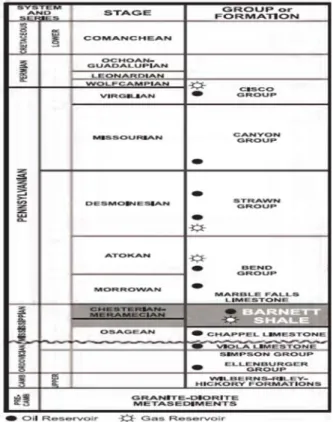
Figure 2. Stratigraphy section of Fort Worth Basin (Vermylen et al, 2012)
Data and Model Design
This study using synthetic seismic data with geological model and well log data obtained from Vermylen et al (2012).
Petrophysical Analysis
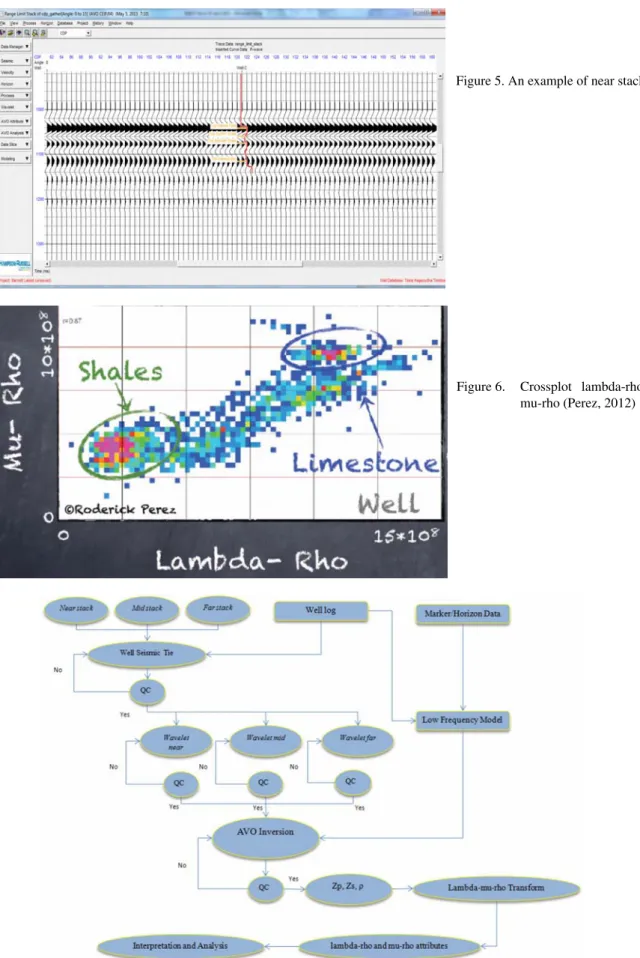
In this study, the well used for the inversion is only one well (Well C) that contains Vp, Vs and density log. According to Perez (2012), the best parameter to separate shale with limestone lithology is through crossplot between lambda-rho vs. mu-rho attributes. Based on well data in Figures 4 and 5, the crossplot of lambda-rho vs. mu-rho attributes has been made. The result is there is no enough amount of data that can be used to separate lithology and for sensitivity analysis as shown in Figure 6.
AVO Inversion
The AVO Inversion was a model based inversion using low frequency model as starting model, with high cut filter set at 15 Hz, which was built using well log interpolation based on interpreted horizon guided by marker data. The inversion algorithm was performed to extract three attributes: acoustic impedance, shear impedance and density. Figure 7 shows the flowchart of the inversion.
RESULTS
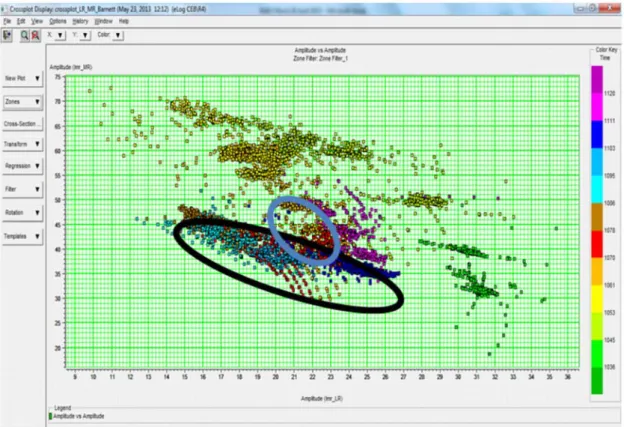
LMR Attribute Analysis Acoustic impedance, shear impedance and density obtained from the inversion process shows that Barnett Shale has lower acoustic and shear impedance than Marble Falls Limestone. The crossplot between lambda-rho and mu-rho volume was transformed from those three elastic parameters shows that Barnett Shale has lower value of lambda-rho and mu-rho relative to Marble Falls Limestone and Ellenburger Dolomite (Figure 10).
From Figure 10, it could be figured out that Barnett Shale has lower lambda-rho and mu-rho value than Marble Falls Limestone and Ellenburger Dolomite. Also it could be seen that Duffer Shale is more elastic than Barnett Shale, indicated by bigger lambda-rho and mu-rho value. Gargouri (2012) stated that mineralogy plays an important role in here. If the silica in shale is plenty, then the shale has less elasticity (more brittle). This means that Barnett Shale has more silica content than Duffer Shale.
Figure 3. Well log (Vermylen et al, 2012)
Figure 5. An example of near stack.
Figure 6. Crossplot lambda-rho vs. mu-rho (Perez, 2012)
Figure 8. Acoustic impedance (Zp) volume and Barnett Shale highlighted with black line
Young Modulus and Poisson Ratio Analysis
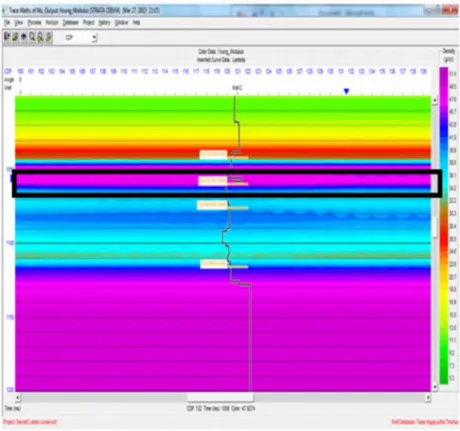
From lambda-rho and mu-rho attributes, Young Modulus and Poisson Ratio could be carried on. Koesoemadinata et al (2011) stated that the best way to determine prospective zone is by marking the highest Young Modulus value and the lowest Poisson Ratio value at the same time. From Figures 11 and 12, it could be seen that the highest value of Young Modulus and the lowest value of Poisson Ratio in Barnett Shale interval is located on 1080-1085 ms.
It could be shown that based on Young Modulus and Poisson Ratio, the prospective zone of shale gas could be determined and also by using lambda-rho and mu-rho attributes, lithology separation and detecting gas zone in Barnett Shale could be done perfectly. DISCUSSION
Perez (2012) has stated that crossplot between lambda-rho vs. mu-rho is the best for separate lithology between shale and limestone. As well as this study can generate interval depth of prospective zone using Young Modulus and Poisson Ratio. For more reliable results, it is recommended to use real seismic data and also more complete well log data, such as that carried out by Perez (2012), that using LMR cluster analysis to isolate brittle/ductile zones.
CONCLUSIONS
From this study it could be conluded that Lambda-rho and mu-Lambda-rho attributes is effective for separating lithology for shale and limestone. Barnett Shale has more silica than Duffer Shale, indicated by Duffer Shale which has higher rigidity indicated by higher mu-rho value than Barnett Shale. The prospective zone in Barnett Shale interval could be determined at TWT 1080-1085 ms where Poisson Ratio at minimum value and Young Modulus at maximum value.
REFERENCES
[1] Bruner, Kathy, R., and Smosna, R., 2011, A Comparative Study of the Mississippian Barnett Shale, Fort Worth Basin, and Devonian Marcellus Shale, Appalachian Basin, Technical Report DOE/NETL-2011/1478, National Energy Technology Laboratory (NETL) for The United States Department of Energy.
[2] Gargouri, M., 2012, Multicomponent 3D Seismic Interpretation of the Marcellus Shale Bradford County, Pennsylvania, Thesis of Faculty of the Department of Earth & Atmospheric Sciences, University of Houston. [3] Goodway, B., Chen, T., and Downtown, J.,
1997, Improved AVO fluid detection and Figure 10. Lambda-rho vs mu-rho volume crossplot with Barnett Shale highlited with black line and Duffer Shale
Figure 11. Young Modulus volume with highest value interval highlighted with black line
lithology discrimination using Lame petrophysical parameters; „lr‰, „‰, & „l/ fluid stack‰ from P and S inversions, CSEG meeting abstracts, p. 148-151.
[4] Jarvie, D.M., Hill, R.J., Ruble, T.E., and Pollastro, R.M., 2007, Unconventional shale-gas systems: the Mississippian Barnett Shale of norh-central Texas as one model for thermogenic shale-gas assessment, American Association Petroleum Geologists Bulletin, 91, p.475-499.
[5] Koesoemadinata, A., El-Kaseeh, G., Banik, N., Dai, J., Egan, M., Gonzalez, A., and Tamulonis, K., 2011, Seismic reservoir characterization in
Marcellus Shale, SEG San Antonio 2011 Annual Meeting.
[6] Mappel, W., 1979, Paleotectonic investigations of the Mississippian System, United States Geological Survey, paper 1017
[7] Perez, R., 2012, Application of LMR and Clustering Analysis in Unconventional Reservoirs, Search and Discovery Article #40879, Posted at February 2012.
[8] Vermylen, J.P., 2012, Geomechanical Studies of The Barnett Shale, Texas, USA, Dissertation, SRB Volume 125, Department of Geophysics, Stanford University, United States of America.


![Mutations in zinc finger 407 [ZNF407] cause a unique autosomal recessive cognitive impairment syndrome](data:image/gif;base64,R0lGODlhAQABAIAAAP///wAAACH5BAEAAAAALAAAAAABAAEAAAICRAEAOw==)