Politecnico di Torino
Porto Institutional Repository
[Article] A multi-criteria fuzzy method for selecting the location of a solid
waste disposal facility
Original Citation:
A.C. Cagliano; M.T. Pilloni; C. Rafele (2014). A multi-criteria fuzzy method for selecting the location of a solid waste disposal facility. In: INTERNATIONAL JOURNAL OF MANAGEMENT AND DECISION MAKING, vol. 13 n. 3, pp. 221-249. - ISSN 1462-4621
Availability:
This version is available at :http://porto.polito.it/2519298/since: February 2016
Publisher:
Inderscience Publisher Enterprises Ltd
Published version:
DOI:10.1504/IJMDM.2014.063568
Terms of use:
This article is made available under terms and conditions applicable to Open Access Policy Article ("Public - All rights reserved") , as described athttp://porto.polito.it/terms_and_conditions. html
Porto, the institutional repository of the Politecnico di Torino, is provided by the University Library and the IT-Services. The aim is to enable open access to all the world. Pleaseshare with ushow this access benefits you. Your story matters.
A multicriteria fuzzy method for selecting the location of a
solid waste disposal facility
Anna Corinna Cagliano(corresponding author)1 Maria Teresa Pilloni2
Carlo Rafele3
1 Department of Management and Production Engineering
Politecnico di Torino corso Duca degli Abruzzi 24 10129 Torino, Italy
e-mail: [email protected]
2 Department of Mechanical, Chemical and Material Engineering
The University of Cagliari Via Marengo 3
09123 Cagliari, Italy
e-mail: [email protected]
3 Department of Management and Production Engineering
Politecnico di Torino corso Duca degli Abruzzi 24 10129 Torino, Italy
e-mail: [email protected]
Anna Corinna Cagliano earned her Ph.D. in Industrial Production Systems Engineering from Politecnico di Torino (Italy). She is currently a Post-doc Research Assistant at the same University. Her main research interests are logistics, supply chain management, and facility planning in manufacturing and service sectors.
Maria Teresa Pilloni is Associate Professor of Industrial Facilities at The University of Cagliari (Italy). Her main research interests are planning and design of industrial and service facilities, with particular reference to feasibility analysis, location selection, and economic evaluations, facility maintenance, and assessment of the technical and economic performances of production systems.
Carlo Rafele is Full Professor of Industrial Facilities and Logistics at Politecnico di Torino (Italy). His main research interests are logistics, supply chain management, project management, and facility planning in several manufacturing and service sectors. He previously worked for a contractor of automated systems.
A multicriteria fuzzy method for selecting the location of a
solid waste disposal facility
Abstract
Facility location is a multicriteria decision process that has important operational and economic impacts and that typically involves uncertainty and vagueness of evaluations. A fuzzy-based method supporting preliminary decision-making about siting solid waste incinerators is proposed building on a structured classification of criteria for location selection developed from the existing literature. The application to a case study revealed the advantages of the methodology. The work intends to provide a general and comprehensive taxonomy of decision criteria that may be adapted to various facility location problems together with a fuzzy inference process that is useful for companies and public administration institutions looking for rigorous but relatively simple decision-making tools in uncertain environments. Future research will compare the developed method with the most common tools for making location decisions. The approach will be then extended to different kinds of facilities.
Keywords: strategic planning, facility design, facility location selection, multicriteria decision-making, facility location criteria, fuzzy logic, waste disposal facilities
1. Introduction
Selecting the location of a facility is a crucial decision for both manufacturing and service organisations because it directly impacts operational and economic performances. An inappropriate location may lead to high production and transportation costs, lack of skilled labour, inadequate supplies, and scarce competitiveness and profitability (Kaboli et al., 2007).
Since such long term strategic choice (Kodali and Routroy, 2006; Najdawi et al., 2008) requires satisfying multiple and sometimes conflicting goals simultaneously, it can be made through a multicriteria decision process. In particular, this process may be classified as either macro-location analysis, that is evaluation of alternative regions, sub-regions, and communities, or micro-location analysis, meaning assessment of specific sites within a selected area (Chuang, 2001; Kahraman et al., 2003).
There are some issues to consider when determining the suitability of alternative locations for hosting a facility. First, not only quantitative but also qualitative data are involved. Second, available information may be scarce and incomplete (Au et al., 2006; Ertuğrul and Karakaşoğlu, 2008). Third, decision-makers usually form their judgments according to subjective intuitions, which are vague and uncertain in nature (Ekmekçioğlu et al., 2010; Wong et al., 2006). Thus, assessments tend to be made in a linguistic form rather than in a numerical one. To this end, fuzzy set theory (Zadeh, 1965) may be used to translate verbal expressions into numbers and to quantitatively deal with the imprecision in evaluating both the ratings of alternatives against selection criteria and the importance of each criterion.
The literature highlights a lack of evaluation frameworks that detail and classify the criteria for assessing potential location solutions they rely on. Also, in many works such
criteria are very application specific, so that there is a need for comprehensive taxonomies of aspects influencing facility location decisions. Additionally, fuzzy decision-making is often characterised by mathematical procedures that require a deep knowledge of fuzzy set theory and of the associated inference processes, making their application difficult for those users that approach such notions for the first time. Finally, in several contributions about facility location the heterogeneous points of view of the stakeholders are combined together by aggregating the criteria weights and ratings assigned by each decision-maker. This practice does not lead to a result that appropriately takes into account the multiple perspectives on the problem.
The present work focuses on the micro-location analysis of solid waste disposal facilities and puts forward a multicriteria fuzzy method built on a structured and complete classification of the most relevant aspects suggested by literature to evaluate possible sites for an incinerator. The methodology is intended to support the first phases of a facility location problem, characterised by scarce and imprecise information, particularly when the decision-makers are little familiar with fuzzy logic. The decision processes of the stakeholders are kept separate in order to properly reflect the different opinions and importance of such people.
The paper is organised as follows. Section 2 discusses relevant literature, while Section 3 presents the proposed method and Section 4 applies it to the location of a municipal solid waste (MSW) incinerator. Benefits and limitations of the approach as well as future research directions are detailed in Section 5 and conclusions given in Section 6.
2. Literature review
A very rich literature on fuzzy decision-making has been developed. For the purpose of this research, the reviewed contributions are divided into three streams. First, an overview of works about fuzzy multicriteria decision-making is given. Second, fuzzy approaches applied to the facility location selection problem are presented. Finally, methods for choosing the location of waste processing facilities are discussed, also including main non-fuzzy applications.
2.1 Fuzzy decision-making approaches
The literature concerning multicriteria decision methods based on fuzzy set theory is really wide and characterised by both theoretical and practical contributions. The theoretical papers describe several methodologies for deepening and improving fuzzy multicriteria decision approaches. The practical papers include a large variety of applications, ranging from power plants to socio-economic investigations.
2.1.1 Theoretical contributions
As far as the theoretical contributions are concerned, Rodríguez and others (2009) are interested in how bipolar multicriteria decision-making can be modelled and stress the relationship between dual concepts and fuzzy sets. Mohammadpour and others (2008) propose fuzzy outranking to solve multicriteria decision-making problems structured according to hierarchical alternatives. Chen and others (2006) address group decision-making about performance assessment by means of linguistic terms and present a multi-person verbal model that focuses on decision-makers’ behaviours. In particular, a procedure to quantify the effects of decision-makers’ behaviours on the weights of verbal terms is presented. Peneva and Popchev (2008) analyse the properties of
aggregated fuzzy relations obtained by combining single fuzzy relations and the effects of criteria weights when weighting both coefficients and functions in the aggregation procedure. The same authors (2006) prove the dependence of aggregated relations on the properties of the individual relations forming them. Moreover, Ekel and others (2009) consider a generic consensus scheme, meaning a dynamic and iterative process employed by experts to discuss a multicriteria decision problem. They demonstrate its usefulness by applying it to a multicriteria group decision problem generated by adopting the Balanced Scorecard methodology for enterprise strategy planning. According to the same authors, the advantage of using fuzzy set theory for solving multiperson multicriteria decision problems lies in the fact that it can provide the degree of flexibility that is needed to adequately deal with the uncertain factors characterising such problems. Another contribution to theoretical studies is reported in Ekel and others (2008), who apply the Bellman–Zadeh approach to decision-making in a fuzzy environment in order to analyse multicriteria optimisation models under deterministic information. ‹X, M› models are applied to problems in which the solution consequences cannot be estimated on the basis of a single criterion. Also, the authors propose a general scheme of multicriteria decision-making under information uncertainty which includes the definition and analysis of the so-called ‹X, R› models as a means of contracting decision uncertainty regions. ‹X, R› models employ fuzzy preference relations as optimality criteria and apply to problems that may be solved on the basis of either a single criterion or a number of criteria. Theoretical in nature is also the paper by Boucher and Gogus (2002), which introduces, besides the direct numerical assessment and linguistic variables, a third elicitation procedure, the fuzzy spatial instrument. According to it, the decision maker is given a line and asked to represent his level of
preference by positioning a pointer along the line. Such approach partially relieves the need for giving strictly numerical judgments and does not require the assessment of individual membership functions as in the case of linguistic variables. Moreover, the authors show how the use of fuzzy instruments introduces some level of imprecision in the decision-making process due to their peculiar characteristics.
2.1.2 Practical contributions
Numerous applications of fuzzy multicriteria decision methods have been presented in literature.
The papers that are analysed in this section rely on several approaches. Many of them are based on techniques of fuzzy preference relations and on the application of generalised algorithms of discrete optimisation either founded on or compared with the Bellman-Zadeh approach. Other works solve multicriteria group decision problems by applying the Balanced Scorecard methodology or found their models on norm and t-conorms compositions of fuzzy relations. Very frequently adopted techniques are also fuzzy TOPSIS, fuzzy PROMETHEE, and fuzzy Analytic Hierarchy Process (AHP). Some authors combine these techniques with the classical multicriteria methods, like for example Electre and AHP, often making comparisons between them.
The spectrum of the problems solved by fuzzy multicriteria decision-making methods is so wide that it is very difficult to list all of them. However, it is possible to identify the main application fields. Among the most relevant areas highlighted by the performed literature review the following ones can be mentioned:
Energy power systems: capacitors placement problems (Araújo et al., 2011),
energy transmission and distribution optimisation (Ekel et al., 1999) energy planning (Beccali et al., 1998; Kaya et al., 2011), selection of alternative
energy sources (Barin et al., 2010), selection of trigeneration systems (Nieto Morote et al., 2011), design and control of power systems (Ekel and Popov, 1995), and selection of renewable energy alternatives (Kahraman et al., 2009).
Facility location selection: see Section 2.2.
Supply chain management problems: selection of suppliers and logistic
service providers (Gunasekaran et al., 2006; Gupta et al., 2012; Kaharaman et al., 2003a; Keskin et al., 2010; Lima Jr. et al., 2013; Noorul Haq and Kannan, 2007; Reza Gholamian et al., 2006; Serhat and Kahraman, 2013), selection of contractors (Singh and Tiong, 2005), logistic costs minimisation (He et al., 2012), and key success factors in original brand manufacturing (Lee et al., 2008).
Environmental engineering problems: forest planning (Kangas et al., 2006),
post-earthquake land use (Opricovic and Tzeng, 2003), evaluation of the environmental impact of urban road networks (Klungboonkrong and Taylor, 1998), evaluation of drinking water treatment technologies (Chowdhury and Husain, 2006), selection of water disinfection processes (Chowdhury and Champagne, 2008), and selection of solid waste management methods (Ojo and Anyata, 2009).
Transportation: bus transportation network modifications (Dubois, 1978) and
evaluation of sustainable transportation systems (Awasthi et al., 2011).
Robotics: robot selection (Dev Anandet al., 2008; Liang and Wang, 1993)
and robot path planning (Li et al., 2004).
Financial decision support systems and pricing decisions (Chiang and Hung,
2010; Hung et al., 2008; Yu et al., 2009).
Construction safety assessment (Hongyan and Feng, 2006).
Human resource management: human resource selection (Kelemenis et al.,
2011; Polychroniou and Giannikos, 2009) and employee performance evaluation(Beheshti and Lollar, 2008).
Process management: quality performance assessment (Chan et al., 2002) and
agility evaluation for implementing mass customisation strategies (Mishra et al., 2013).
Project evaluation (Lai et al., 2010). Risk-benefit analysis (Perçin, 2008).
2.2 Fuzzy-based methods for facility location selection
Fuzzy-based decision-making tools for facility location selection are derived from non-fuzzy ones where numerical evaluations are made by using non-fuzzy logic. Many papers either are focused on a single decision-maker or combine the weights and the ratings assigned by each decision-maker to the selection criteria to obtain average assessments. Among others, Chou and Chang (2009) propose a fuzzy multiple criteria decision-making model for selecting the best location for a distribution centre from the point of view of one manufacturer. Criteria specific for this kind of problem are introduced and the weights of criteria as well as the scores of alternatives for each criterion are expressed by triangular fuzzy numbers. Kahraman and others (2003b) compare four different fuzzy multi-attribute group decision-making solutions to solve the facility location problem by aggregating the judgments of the individual decision-makers. Some contributions consider the perspective of each decision-maker separately. For instance,
Ishii and others (2007) develop a fuzzy optimisation model evaluating a satisfaction degree that takes into account the distance from a facility of each individual customer together with his preference for the site located in an urban area.
Also, fuzzy logic is integrated with classical decision-making methods. Bashiri and Hosseininezhad (2009), Kaboli and others (2007), Kannan and others (2008), and Vahidnia and others (2009) apply the fuzzy AHP to facility siting. Chu (2002) and Yong (2006) present fuzzy TOPSIS approaches. Ertuğrul and Karakaşoğlu (2008) compare the fuzzy AHP and the fuzzy TOPSIS methodologies for the purpose of locating a textile plant. Anagnostopoulos and others (2008) and Dheena and Mohanraj (2011) focus on the location of distribution centers. The first work extends the approach of fuzzy TOPSIS to compare an alternative to the ideal and anti-ideal solutions in terms of not only distance but also similarity. The second contribution makes use of fuzzy similarity measures in fuzzy TOPSIS to enhance accuracy. Finally, Au and others (2006) develop a neural network trained by the results of the application of fuzzy AHP to calculate a suitability index for each alternative site for clothing plants.
2.3 Methods for selecting the location of waste processing facilities
The problem of either recycling or disposing of municipal and industrial waste has recently grown and many authors have worked out methodologies for identifying the sites where such waste can be processed.
As far as municipal waste is concerned, several authors employ Analytic Network Process (ANP) and AHP methods (Aragonés-Beltrán et al., 2010; Banar et al., 2007; Tuzkaya et al., 2008). Fuzzy AHP is also applied to calculate the weights of the evaluation criteria in fuzzy TOPSIS methods (Ekmekçioğlu et al., 2010). Multicriteria decision analysis is sometimes combined with Geographic Information Systems (GISs)
(Chang et al., 2008; Şener et al., 2011). Finally, fuzzy inference can be the base of intelligence systems supporting siting decisions (Al-Jarrah and Abu-Qdais, 2006). Focusing on industrial waste, ELECTRE methods and multicriteria decision analysis integrated with GISs are among the most applied approaches (Achillas et al., 2010; Banias et al., 2010; Sauri-Riancho et al. 2011).
Some considerations originate from the analysis of mainstream literature. First of all, fuzzy decision-making is a very well established stream of research and a lot of applications to different domains have been proposed. Many of them develop advanced mathematical procedures that are scarcely suitable to users that do approach fuzzy set theory for the first time.
This is true also when it comes to fuzzy decision-making systems for the facility location problem. Additionally, the literature on this topic presents several studies that either are limited to a discussion of decision-making procedures, without detailing the evaluation criteria they rely on, or introduce criteria that are highly application specific and do not provide a general and comprehensive classification of the aspects based on which potential locations should be assessed and ranked. However, when siting either a manufacturing or a service plant, the ability to include in the evaluation all the relevant perspectives on the problem directly affects the effectiveness of the location decision. Finally, from a methodological point of view, a significant number of fuzzy-based approaches to facility location selection aggregate the weights and ratings assigned to the criteria by each decision-maker to obtain single average values of weight and rating as if only one representative decision-maker was considered. Also, combining single assessments implies a certain degree of consensus among decision-makers with respect
to each of the criteria (Chou et al., 2008; Chu, 2002; Ekmekçioğlu et al., 2010; Ertuğrul and Karakaşoğlu, 2008; Kahraman et al., 2003b). In this case, how the final decision is influenced by the different stakeholders’ perspectives and their diverse degree of information is not completely captured.
In order to contribute to overcome the identified gaps, the present work develops a fuzzy method that relies on an ordered and complete taxonomy of the characteristics determining the suitability of alternative sites in the field of waste disposal plants. First, the framework aims to provide an in-depth classification of location criteria to guide the definition of location selection problems about incinerators. Also, such classification can be easily modified to accommodate siting decisions about different kinds of plant. Second, the proposed methodology is intended to be a tool for those situations when the scarce availability of information requires a fuzzy approach but the decision-makers are either little or not familiar with fuzzy principles and rules. That could be for instance the case of location decisions taken by public administration bodies. To this end, a standard fuzzy decision-making model is adopted. Finally, by not aggregating the weights and ratings assigned by individual decision-makers, the framework keeps the decision process of each stakeholder separate so that the best solution is determined by taking into account each point of view as much as possible and consensus among decision-makers is not assumed.
3. The proposed method for selecting the location of a solid waste
disposal facility
The developed method focuses on the micro-location problem because macro-location choices strictly depend on the economic and political strategies of the geographical area under investigation and a detailed classification of decision criteria would be poorly general. Also, fuzzy logic is adopted because it is able to model the uncertainty and vagueness of human reasoning (Metaxiotis et al., 2004) and to give a reliable solution even when data are still scarce and incomplete, like in the first stages of a facility location problem.
Based on Nguyen and Sugeno (1998) and Zimmermann (1987), the proposed method is made up of the following steps:
Definition of location criteria and related weights.
Definition of the linguistic terms for evaluating criteria and of the inference engine.
Fuzzification of variables.
Application of the inference engine.
Defuzzification of results.
Analysis of results.
Each step will be discussed in the following sections.
3.1 Location criteria and weights
3.1.1 Conceptual framework to derive criteria
The first step in a facility location problem is the definition of the criteria to assess the suitability of the candidate solutions. Such task is here completed by relying on a
conceptual framework that can be applied to a variety of facility siting decisions. Such framework is composed of two phases: definition of criteria and identification of indicators to assess the performance of a potential location against the criteria.
The criteria definition phase starts with the selection and analysis of literature contributions about the location of manufacturing and service facilities. These works include journal papers, conference papers, and books and are mainly case studies, although theoretical investigations on the factors influencing and being influenced by the location of a plant revealed to be useful in order to build a comprehensive classification of criteria. Additionally, a review of literature about waste management and the siting of incinerators and landfills allowed understanding the characteristics, requirements, and constraints that impact the selection of appropriate places for the facilities associated with such kinds of services. Single location criteria are then drawn from literature works, either directly or indirectly through an inference process. Based on this analysis, the key factors to take into account when locating a plant are identified and organised in a number of general classes. Broadly speaking, there are basic aspects that enable a preliminary screening among candidate locations. For instance, the lack of skilled labour, energy resources or infrastructures makes a site hardly suitable to host a business. Once locations satisfy these constraints, the technical and economic feasibility of erecting a facility should be assessed. Moreover, the impacts on the environment and the local population should be understood. The next step is assigning to each class detailed selection criteria derived from literature. Some of them are common to the location of any kind of plant (e.g. cost of land, construction costs, and site dimensions), while others are specifically related to the type of facility at issue (e.g. polluting emissions and the impact of the facility on the surrounding environment in case of an
incinerator). Finally, the completeness and consistency of the classification of criteria is checked by a panel of academic and professional experts in the fields of facility design and management, who will suggest possible refinements.
Each criterion is represented by one or more indicators. In order to identify them, the measurable aspects related to that criterion are to be defined and subsequently translated in either qualitative or quantitative variables, according to the nature of available information. The variables are used to create performance indicators: in case of a criterion encompasses multiple and/or conflicting aspects, two or even three metrics may be identified. Again, a literature review may guide this task. The panel of experts previously mentioned will check the completeness and consistency of the set of indicators and propose desirable refinements to either their definition or their calculation procedure.
According to the described conceptual framework, this work provides a set of criteria which cover the main aspects determining the site of a MSW disposal facility. The criteria are grouped in five classes:
Constraints: requirements that an alternative should meet at least at a minimum
level in order to be considered as feasible. They are applied to select the locations that are then compared based on the following classes of criteria.
Cost criteria: they directly affect the economic return of the investment and the
facility operating costs.
Technical criteria: they are related to the characteristics of the site and of the
facility at issue.
Environmental criteria: they are related to the environmental characteristics of
Social criteria: they are associated with the impact on people of the
establishment of a waste disposal facility near residential areas. They may also influence the facility location selection because of political and economic reasons related to the local social context.
The criteria belonging to each class are evaluated by indicators that are heterogeneous in nature and whose assessment may be sometimes difficult.
3.1.2 Constraints
Several issues might be considered according to the investigated context: availability of resources, environmental impact, regulatory restrictions, other existing facilities, threats to the facility boundaries such as for military installations, etc. This work addresses the following aspects:
Energy Source Availability (ESA) (Aragonés-Beltrán et al., 2010; Yang and Lee,
1997). It is assessed by a binary indicator that equals 1 if there are energy sources near a candidate location and 0 otherwise.
Water Source Availability (WSA)(Aragonés-Beltrán et al., 2010; Yang and Lee,
1997). It is measured in the same way as ESA.
Waste Treatment Easiness (WTE) (Aragonés-Beltrán et al., 2010).Possibility of
easily treating the slag originated from the waste combustion process (ash, powder, and heavy slag). It is estimated as the ratio between a constant C, which depends on the kind of slag, and the distance of a candidate incinerator location from the site of slag treatment.
Labour Availability (LA) (Wong et al., 2006; Yong, 2006). It is assessed by a
binary indicator that equals 1 if there is appropriate local manpower for operating the facility and 0 otherwise.
Road Availability (ROA) (Ekmekçioğlu et al., 2010; Vahidnia et al., 2009).
Availability of an appropriate road network near the facility location. It is measured in the same way as LA.
Proximity to Residential Areas (PRA) (Aragonés-Beltrán et al., 2010). The
associated indicator equals 0 if there are residential areas close to a candidate site, 0.5 if they are approximately near it, and 1 if they are far from it.
3.1.3 Cost criteria
Cost criteria are divided into three main groups also including financial incentives, which reduce the amount of the initial investment.
1. Investment costs:
Cost of Land (COL) (Monte, 2009; Tuzkaya et al., 2008).
Construction Cost (COC) (Banar at al., 2007). It includes the costs of
excavations and foundations.
Cost of Equipment (COEQ) (Monte, 2009). It includes the costs of
combustion furnaces, heat exchangers, filters, etc.
Cost of Connection to the Road Network (CCRN) (Monte, 2009).
Cost of Connection to Utilities Networks (CCUN) (Monte, 2009). Itincludes
the costs of the connection to the electrical, water, gas, sewerage networks, etc.
2. Operational costs:
Cost of Energy (COE) (Yang and Lee, 1997). Cost of Water (COW) (Yang and Lee, 1997).
Cost of Waste Treatment (CWT) (Quina et al., 2008). Cost of processing the
slag originated from waste combustion. It also includes the cost of transporting slag to landfills or specific treatment plants.
Cost of Labour (CL) (Chou and Chang, 2009; Wong et al., 2006). Cost of Input Transportation(CIT) (Chuang, 2001).
Cost of Output Provision (COP) (Banar et al., 2007). Cost of providing
customers with the service produced by the facility at issue. 3. Financial incentives
Public Funding (PF) (Tchobanoglous and Kreith, 2002).
The indicators assessing investment and operational costs are defined for each candidate location as the ratio between the cost for this alternative and the maximum cost among all the alternatives. Such a definition allows easily identifying the cost-effective sites whose associated ratios will be low. Public funding is evaluated by two indicators. PF1
equals 1 if public funding is available for a candidate location and 0 otherwise. PF2 is
the ratio between the amount of public funding and the total cost of the incinerator.
3.1.4 Technical criteria
Technical criteria are related to the site characteristics and the level of polluting emissions by the waste disposal facility.
1. Site criteria:
Site Dimensions (SD) (Au et al., 2006; Tuzkaya et al., 2008). The dimensions
of the incinerator site should allow future expansion and, at the same time, not cause high buying and maintenance costs. This criterion is assessed by two indicators respectively measuring the ratio between the minimum length
required for the site and the length of an alternative site and the ratio between the minimum width required for the site and the width of an alternative site.
Dangerous Areas near the Facility (DA) (Safari et al., 2010). A dangerous
area has geological features that are undesirable for a facility, such as the possibility of earthquakes, landslides or flooding. The present criterion is measured by three indicators. DA1 equals 1 if there are dangerous areas near
or inside an alternative location and 0 otherwise. DA2 is the ratio between the
dimensions of a dangerous area associated with an alternative site and the total dimensions of this site. DA3 is the ratio between the dimensions of the
area needing to be reclaimed associated with a candidate site and the total dimensions of the site at issue.
Interdicted Areas near the Facility (IA) (Ekmekçioğlu et al., 2010). It is
essential to understand the mutual influence that may exist between the incinerator and possible off-limits areas nearby, such as military ones. The criterion is measured by the ratio between the dimensions of the interdicted area associated with an alternative location and the total dimensions of this location.
2. Criteria related to polluting emissions:
Polluting Emissions (PE) (Yang and Lee, 1997). It assesses the degree of
polluting emissions from the incinerator. People do not tolerate a facility near their home or work places that could produce dangerous pollutants, even within the limits allowed by law.This may lead to increased costs for keeping the level of emissions low and for creating public awareness. The adopted
indicator equals 0 if a low level of polluting emissions is associated with a candidate location, 0.5 if such level is medium, and 1 if it is high.
3.1.5 Environmental criteria
The environmental criteria are divided into four groups representing the major factors that may impact on the location of a waste disposal facility.
1. Climate: the climate can be exploited in order to reduce energy costs or limit the environmental impact of a facility.
Wind (W) (Nas et al., 2010). It plays an important role because it can disperse
emissions and may be used to produce energy.This criterion is measured by the average percentage of windy days in a year for an alternative location calculated over the last three years.
Rainfall (R) (Farahani and Asgari, 2007). Frequent rain may disperse harmful
emissions and the associated water may be used by the operational processes taking place in the facility. It is assessed by the ratio between the average millimetres of rain for an alternative location, calculated over the last three years, and the total number of days in a year.
Sun (S) (Farahani and Asgari, 2007). It may be used to produce energy for
the operational processes taking place in the facility. The associated indicator equals 1 if solar energy can be exploited for operational purposes in an alternative location and 0 otherwise.
2. Facility impact:
Facility Impact (FIM) (Aragonés-Beltrán et al., 2010; Tuzkaya et al., 2008).
environment: it may cause pollution, noise, traffic, or may negatively influence the view of the landscape. Such criterion is particularly important when the facility is located near residential areas and when no similar plants have been built in the same area before. It is evaluated by a percentage assessing the degree of impact of the facility.
3. Protected areas and geological instability:
Protected Areas (PA) (Aragonés-Beltrán et al., 2010; Tuzkaya et al., 2008).
The incinerator should be placed at a safe distance from protected natural areas in order to reduce the risk of environmental disasters. The criterion is measured by two indicators. PA1 assesses the percentage of the area of an
alternative site that cannot be used because of the existence of a protected zone. PA2 is the ratio between the minimum allowed distance of the facility
from protected areas and the distance of an alternative site from a given protected area.
Geological Instability (GI) (Şener et al., 2011). It is measured by two
indicators. GI1 equals 1 if an alternative location may be affected by
geological instability and 0 otherwise. GI2 is defined as 1 divided by the
average number of days in a year when events related to geological instability affect an alternative location. Such average value is calculated over the last ten years given the low frequency of occurrence of geological events.
4. Presence of other facilities: other facilities located in the same area, especially similar to the one at issue, reduce the possibility of opposition from the local population, which is notoriously strong for waste treatment plants.
Other Facilities (OF) (Kahraman et al., 2003b). It is assessed as the
percentage of area already covered by other facilities within a significant distance from an alternative location.
3.1.6 Social criteria
Social criteria are about residential areas near the facility site as well as the number of people and the political situation in such areas, the last aspect being crucial in the case of waste processing facilities. Previous works suggest the following four criteria:
Residential Areas (RA) (Rahardyan et al., 2004). Residential areas near the
site of an incinerator may cause opposition to its establishment. The criterion is measured by three indicators. RA1 is defined as 1 divided by the distance
between the centre of gravity of a given residential area and an alternative location. RA2 is 1 divided by the distance between an alternative site and the
nearest residential area. RA3 is 1 divided by the population within a given
distance from an alternative location. Such distance depends on both the kind of facility and the type of emissions produced.
House Prices (HP) (Tuzkaya et al., 2008). A waste disposal facility may
change the value of the houses in the surrounding areas depending on how the local population reacts to it. The criterion is assessed for each alternative location as the difference between the price of houses after the establishment of the facility and their price before such establishment divided by the price before the establishment.
Political Environment (PLE) (Chou and Chang, 2009). A favourable
environment will stimulate the support by the local political class that, in turn, might reduce the opposition by the population and increase the chances of
benefitting from economic or tax incentives. The criterion is measured by a binary indicator that equals 1 in case of a good political environment and 0 otherwise.
Social Incentives (SI) (Au et al., 2006). An incinerator located in a particular
area improves the infrastructures or gives job opportunities, thus the government might be willing to grant incentives to its construction. Sometimes these incentives also assume the form of reduction in the MSW disposal fee or of low energy fees consequent to waste thermo-utilisation. The criterion is evaluated by a binary indicator that equals 1 when social incentives are available for an alternative location and 0 otherwise.
3.1.7 Weights of criteria
Weights in the form of crisp numbers between 0 and 1 are assigned by each decision-maker to the criteria based on his opinion about their relative importance in the choice of the facility location. In particular, a weight is assigned to each single indicator associated with cost, technical, environmental, and social criteria. Crisp weights are chosen because they allow avoiding complicate aggregations of fuzzy numbers (Chu, 2002). Moreover, crisp weights in the interval [0, 1] help improving the classification accuracy of a fuzzy model (Rasmani and Shen, 2004).
3.2 Definition of linguistic term sets and of the inference engine
First of all, the indicators defined in Section 3.1 are named ‘variables’ because they represent the input variables to the fuzzy system. For each of them, the linguistic terms used in its assessment (term set) are defined. The cardinality of a linguistic term set should be able to appropriately represent the granularity of uncertainty affecting the judgements experts give about a phenomenon. Usually, odd values ranging from three
to thirteen are used, although the most recurrent number of terms ranges from three to nine, because human beings can reasonably keep in mind a quite limited number of items simultaneously. In general, the cardinality of a term set should be small enough so that it does not impose useless precision on the users and, at the same time, large enough to allow a correct discrimination among assessments (Herrera et al., 2000; Herrera and Martinez, 2001; Peláez and Doña, 2003). The present method proposes term sets with cardinality values from three to five because in the first stages of a facility location choice the decision-makers have a considerable level of uncertainty on the characteristics of alternative locations due to a still limited availability of information about them. Additionally, less than three terms make a variable poorly sensitive to changes while many terms make it unstable (Mamdani and Gaines, 1981). Only two terms are associated with the variables defined by a [Yes, No] sentence type. For example, the term set for the input variable COL may be [Very low; Low; Normal; High; Very high], while the term set for the variables PE and OF may be [Low, Medium, High]. The term set for the output variable Facility Location Suitability (FLS), which assesses the degree of adequacy of each alternative site to host the incinerator, may be again [Very low; Low; Normal; High; Very high].
The inference engine is defined based on Kandel (1992). This is the set of linguistic rules establishing the relationships between the input and the output of a fuzzy system, or, in other terms, between the values of the variables associated with the criteria for a given alternative location and the value of the variable assessing the degree of adequacy of that alternative to host the facility.The formulation of these rules cannot be general: they should be developed for each single application according to its characteristics and the needs of the stakeholders. For this purpose, historical data, empirical observations,
and interviews with experts can be used. In the proposed method each rule is of a Multiple Inputs - Single Output (MISO) type and is expressed as:
IF x1 is A1AND x2 is A2…AND xi is Ai OR…OR xn is An THEN y is B (1) where x1, x2, …, xi,…xn are the variables associated with the location criteria, A1, A2,..., Ai,…, An their linguistic values, y the variable FLS, and B its linguistic assessment corresponding to the values of the input variables.The part of the rule before the THEN operator is named antecedent, while the part after it is named consequent.
The number of rules in a fuzzy system depends on the number of linguistic terms evaluating the associated variables. Since here the variables do not have all the same number of terms, the total number of rules rN is given by the following equation
(Mastino, 2005): 1 N 1 i ) 1 i (M N r
(2)being N the number of input variables and Mi the number of terms of the ith variable.
Therefore, the greater the number of the input variables and of the corresponding linguistic terms, the greater the number of rules and, consequently, the higher the complexity of associating each antecedent of a rule in the fuzzy system to the correct value of the consequent. In order to facilitate the connection between antecedents and consequents, this method relies on the rule value (Mastino, 2005). The rule value defines a numerical value for the antecedent of each rule and is calculated as:
i N s 1 i i k w *t k 1,...,r R
(3)where s is the number of input variables in the antecedent of the rule k,wi the weight of
the ith input variable, and
ti a number that represents the term expressing the ith variable (ti = 1 if the variable i is evaluated by the first linguistic term in its term set, ti = 2 if the
variable i is evaluated by the second linguistic term, and so on).
The difference between the maximum and minimum rule value is then calculated and this quantity is divided by the number m of terms assessing the output variable:
I maxk
Rk mmink
Rk (4) The resulting quantity I is used to calculate the range of values of the antecedents to beassociated with each term assessing the output variable. In particular, the interval of values of the antecedents Zj associated with the term j of the output variable is given by
(Mastino, 2005):
Zj
min
Rk (j1)*I;min
Rk j*I
j1,...,m (5)3.3 Fuzzification of variables
The third step of the method aims to define a membership function for each linguistic term assessing a variable and, after that, to determine the corresponding fuzzy values for the variable values associated with the alternative locations by decision-makers.
Normal fuzzy sets are used (Zimmermann, 1987) and the identification of membership functions follows a different procedure according to the nature of variables.
The linguistic terms assessing easily quantifiable variables, such as for instance COL, COE, and COW, are represented by trapezoidal and triangular fuzzy numbers because they provide computational efficiency and easiness of data acquisition (Zimmermann, 1996). In particular, triangular fuzzy numbers are used to define intermediate terms,
while trapezoidal fuzzy numbers are used to represent extreme terms in the set. Membership functions are determined by applying the direct estimation technique (Kuncheva, 2000) and by averaging the outcomes of interviews to a panel of experts about thevalues representative of each linguistic term.
Scarcely quantifiable variables are those variables whose values are difficult to be estimated accurately, especially in the first stages of a facility location decision. Examples of such variables are R and FIM. The linguistic terms assessing scarcely quantifiable variables are represented by trapezoidal fuzzy numbers. This choice is due to the fact that defining good values for these terms is not easy, so it is convenient to have a wide range of input values associated with the maximum output value of a membership function. Moreover, the parameters of the membership functions are no longer determined based on expert judgements but the following procedure is applied. First, the extreme values corresponding to the maximum of the membership function associated with a linguistic term, that is the intermediate parameters of the trapezoidal number, are defined. The extreme parameters of the membership function are then set equal to the intermediate parameters of the membership functions of the previous and following term in the evaluation scale of a variable. Minor adjustments to some extreme parameters may be required in order to have gradual variations in the output of each fuzzy number.
The linguistic terms assessing binary variables, such as for instance ESA, DA1, GI1, and
SI, are represented by trapezoidal fuzzy numbers.The negative term is quantified by a fuzzy number having the maximum of its membership function in 0. The positive term is quantified by a fuzzy numberhaving the maximum of its membership function for all the values of the universe of discourse different from 0.
3.4 Application of the inference engine and defuzzification of results
Each decision-maker assigns the weights to the variables and their ratings for each alternative location.The feasible alternatives are then identified as the ones that satisfy the constraint criteria at least at a minimum level.
After that, the implementation of the inference engine for every single decision-maker can be summarized by the following steps:
1) The fuzzy values of the variables associated with each feasible location trigger some decision rules of the system defined in Section 3.2. The firing level for each active rule is calculated according to the Mamdani system (Mamdani and Assilian, 1975), being it more intuitive and widespread accepted than other methods. The Mamdani system is based on the following assumptions:
Use of the MIN function for AND operations.
Use of the MAX function for OR operations.
Use of the MIN function for implications.
Use of the MAX function for aggregations.
Use of the Centre of Gravity defuzzification method.
2) The firing level of each rule is combined with the membership functions that express the linguistic terms assessing the corresponding consequent variable, thus obtaining a new membership function that is the output of the application of
the rule. By adopting the Mamdani system, this membership function is
calculated by seeking the minimum value between the firing level of the antecedent and the membership function of the linguistic term assessing the consequent.
3) The outcomes of the different rules of the inference system are aggregated using the union operator. According to the Mamdani system, the MAX operator is adopted in order to perform the union of fuzzy numbers. A new membership function is obtained that represents the result of the whole inference process, that is the fuzzy number providingthe evaluation of an alternative location based on the values of the variables associated with the criteria.
Out of the inference process, a set of fuzzy numbers assessing the suitability of the feasible alternative locations to house the incinerator is available for each decision- maker.
Defuzzification is then carried out to transform such numbers into crisp values. The Mamdani system suggests applying the Centre of Gravity method (Sugeno, 1985). The value provided by defuzzification is the centroid of the area bounded by the membership function of the fuzzy number and its abscissa. Let μ(y) be a continuous membership function. The crisp number out of the defuzzification process can be computed as per Equation (6).
Y Y COG dy ) y ( ydy ) y ( y (6)In this way, the appropriateness of each possible site is expressed by a single number that enables to easily create a ranking among the alternatives.
3.5 Analysis of results
After defuzzification, alternatives are classified from the best to the worst onefor each decision-maker. The robustness of these rankings is investigated through a sensitivity
analysis by changing the weights of the variables associated with the criteria and/or their ratings assigned by the decision-makers.
4. Case study
The proposed method is used to analyse possible locations for a MSW incinerator in Northern Italy.
A preliminary investigation of the potentially suitable areas identified fifteen candidate sites. Subsequently, a committee of twenty decision-makers, including citizens, local authorities, and environmental organisations representatives, undertook a micro-location analysis of these alternatives. According to the procedure detailed in Sections 3.1, 3.2, 3.3, 3.4, and 3.5, first, the Constraints criteria were applied and ten out of the fifteen eligible locations were considered feasible. In this paper, they are identified by the letters of the English alphabet from A to J.
Such locations were then evaluated against Cost, Technical, Environmental, and Social criteria. The complete description of the case study is available from the authors. In this section relevant outputs are provided together with the discussion of results.
The decision-makers, based on their knowledge and experience, assigned the weights to the variables associated with the location criteria and established a set of rules governing the inference process. Following some examples of rules that were defined:
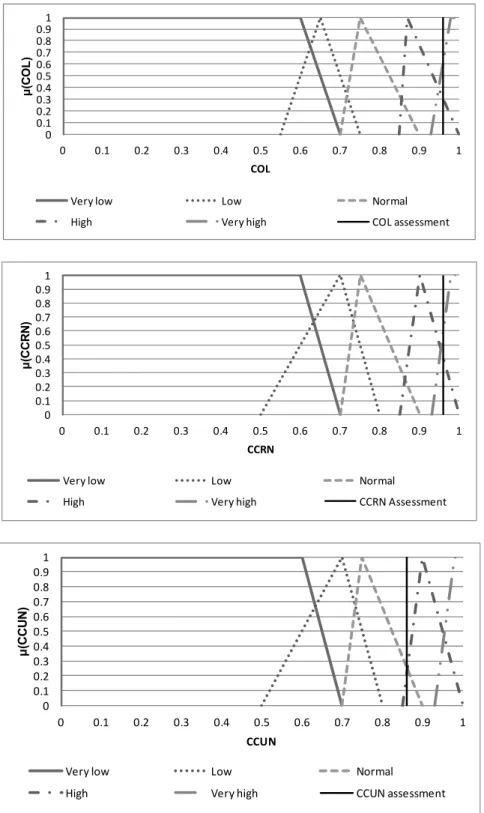
IF COL is Very High AND CCRN is High AND CCUN is High THAN FLS is Low
(7)
IF PLE is No OR SI is No THAN FLS is Low (8)
The input variables were evaluated by the decision-makers and the inference engine applied. Again for the sake of clarification, the inference process is detailed for rule (7).
A decision-maker assessed COL, CCRN, and CCUN for one candidate site as in Figure 1. Normalised cost values between 0 and 1 were used. By applying the Mamdani system, the firing level of the rule will be the minimum value among the antecedents, that is the minimum value among 0.2, 0.4, and 0.6.
Take in Figure 1 about here
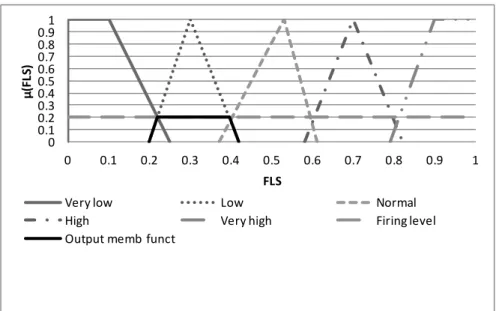
According to the procedure detailed in Section 3.4, the firing level of the rule is combined with the membership functions of the consequent, thus determining the membership function out of the inference process (Figure 2).
Take in Figure 2 about here
The outcomes of the rules for each decision-maker were combined in order to determine his evaluation of each potential location. The decision-makers’ rankings of sites were finally subjected to sensitivity analysis as the weights of criteria change.
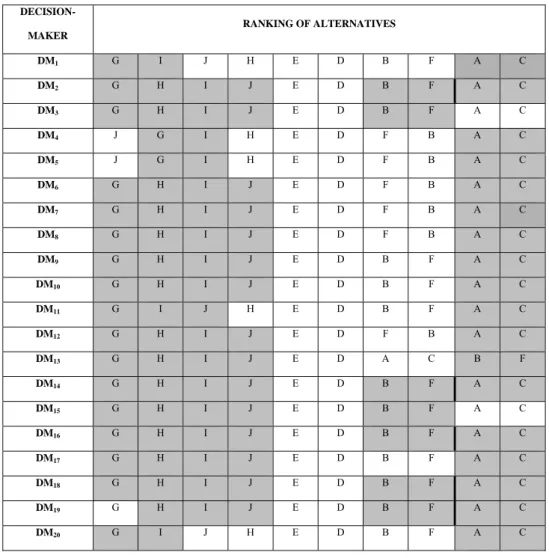
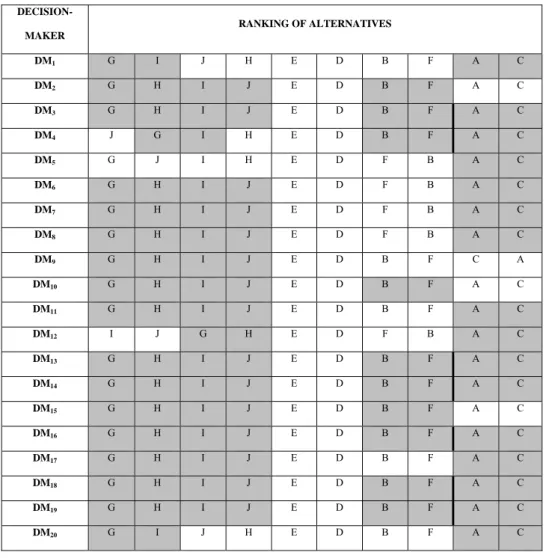
All the computations were performed by using the software MATLABby MathWorks. Table 1 presents the rankings of the alternatives, from the best to the worst one, for the twenty decision-makers. Gray-coloured consecutive cells identify alternatives with the same degree of suitability and thick right cell borders separate groups of alternatives with adjacent positions in the classification.
Take in Table 1 about here
The rankings show a general consistency of the results. The alternative locations G, H, I, and J are always in the top positions, whereas A and C are the least suitable sites. Also the intermediate positions slightly differ among the rankings. Depending on the knowledge of each decision-maker, the values he provided allowed a different degree of discrimination among the candidate sites. For example, the decision-maker 1’s ranking contains only two pairs of alternatives with the same degree of suitability, while the
decision-maker 18’s ranking presents a limited discrimination among the possible locations.
4.1 Sensitivity analysis of results
Given the impact of a waste disposal facility on the local population, the sensitivity study was performed by modifying the weights of the variables RA1 and RA2 related to
the distance between the incinerator and the residential areas nearby. In particular, variations of ± 5% and ±10% in the weights of these variables were considered.
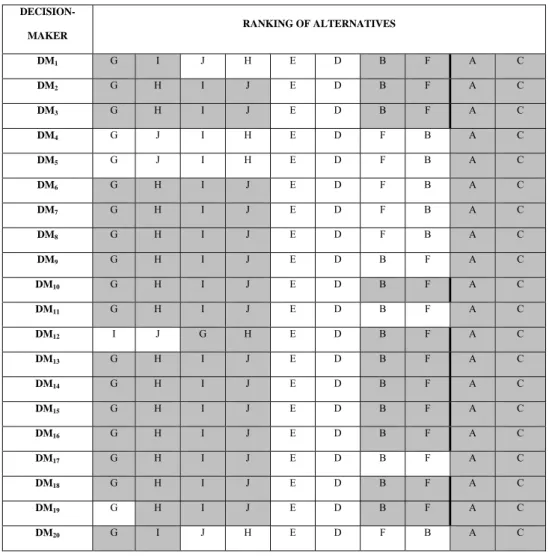
With an increase of 5% in the weights, the alternatives G, H, I, and J are still in the first positions of all the decision-makers’ rankings and the alternatives A and C in the last ones (Table 2).Also the order of the intermediate positions does not differ significantly from the base case. However, the ability to discriminate among the alternatives is slightly higher: the rankings of the decision-makers 4 and 5 only present two alternatives with the same degree of suitability.
Take in Table 2 about here
With an increase of 10% in the weights the top positions of the rankings, the intermediate, and the final ones are not changed compared to the base case, except for some inversions in the order of alternatives depending on the particular decision-maker and his knowledge (Table 3).
Take in Table 3 about here The remaining sensitivity tests yielded similar results.
The alternatives G, H, I, and J resulted to be the best ones and therefore worthy of further analysisin order to determine which of them could actually host the incinerator. Thealternatives A and C were rejected.
5. Discussion
The present work puts forward a fuzzy multicriteria method for choosing the site of a MSW disposal facility based on a structured taxonomy of criteria taken from the existing literature.
The application of the method to a real case of an incinerator revealed several benefits. From a conceptual perspective, by providing a comprehensive set of assessment criteria the proposed approach focuses the decision-makers’ attention on all the important evaluation parameters, preventing neglecting some of them. This is of great value when locating a facility because limiting the analysis to few aspects results in sub-optimal decisions that might compromise the success of the associated business. In the first stages of the decision-making process, the impacts that a plant could have on the local social, economic, and environmental context might not be clear. Relying on a classification of criteria that covers a wide range of aspects helps to identify the consequences that a business activity may have in a given place. Moreover, thanks to its organisation in categories and related detailed criteria, the structured classification approach offers a methodology to address plant location problems in a systematic way, thus contributing to an effective decision-making. Additionally, the developed approach does not only include influence areas to be considered but takes one step further by specifying indicators to assess them. Such metrics can constitute a guide for defining additional indicators, if needed. Also, they may be applied when complete information is available and crisp numerical evaluations can be performed. Finally, many of the defined criteria are general in nature and can be directly implemented in location decisions about facilities other than incinerators, while the remaining criteria can be easily accommodated for different applications.
The value given by the completeness of the proposed classification approach, together with the possibility to adapt it to different facility location decisions, is enhanced by the use of a standard fuzzy model. The developed method can be applied by a great variety of decision-makers with heterogeneous skills and backgrounds by acquiring basic concepts of fuzzy inference. In this way, it can be an interesting approach for companies and public administration institutions that often face facility location problems in uncertain environments with a limited amount of information available and are looking for structured but quite straightforward decision tools. Also, such organisations could apply the same scheme, that is a comprehensive classification of criteria to assess alternatives through a fuzzy inference process, to different kinds of decision-making problems. Also, in the proposed fuzzy method the weights and ratings assigned by individual decision-makers to criteria are not aggregated to form average assessments so that the process provides one ranking of the alternative locations for each decision-maker. This allows finding solutions that adequately take into account all the points of view on the problem and are not based on the assumption of a certain degree of consensus about decision-makers.
From a practical perspective, the system of inference rules evaluating all the possible implications between inputs and outputs reduces the possibility to voluntarily direct the outcome towards an alternative. Moreover, the proposed approach makes it possible to analyse multiple scenarios by just changing the weights and the ratings assigned to the variables associated with the location criteria. New variables and decision rules can be
added to the framework without redesigning the entire decision-making system, thus ensuring a good flexibility of the method. Finally, fuzzy logic allows properly including the imprecision and vagueness of information in the decision-making process, enabling
to address complex problems. The proposed approach makes the final orders of the alternatives not be over-affected by small discrepancies in the ratings of the criteria assigned by different decision-makers. Also, small variations in the ratings of a same location related to different criteria may not unduly influence the final ranking, although an important role is played by the weights given to those criteria.
Unlike other methods, the proposed one requires limited time and effort, because, for example, it does not include pairwise comparisons between alternatives and criteria. However, the presented methodology implies the knowledge of fuzzy logic, although limited to basic notions. Additionally, it is helpful to achieve an initial differentiation among alternative locations but it should be followed by more in-depth technical and economic investigations on those alternatives in the first places of the final rankings. Finally, the developed approach requires a validation in order to uncover weaknesses and foster its refinement.
Therefore, future research will focus on testing the method in multiple cases and comparing it with well-established decision-making tools. The integration with such tools will be also investigated. Furthermore, the methodological steps of the proposed framework will be adapted to different kinds of facilities.
6. Conclusions
This work enriches the literature on fuzzy multicriteria methods for locating waste disposal facilities by developing an approach that provides a well-structured and comprehensive taxonomy of decision criteria.
The first application revealed that working with a general classification of criteria allows identifying and focusing on all the important aspects influencing the selection of
a site. Also, the criteria and the associated performance indicators may be adapted to different facility location problems. Finally, using a standard fuzzy model facilitate an easy application of the approach by those decision-makers that do not have a deep knowledge about fuzzy set theory. Thus, the proposed decision-making methodology can be valuable for a preliminary selection of the potentially suitable sites for a facility.
References
Achillas, Ch., Vlachokostas, Ch., Moussiopoulos, N. and Banias, G. (2010) ‘Decision support system for the optimal location of electrical and electronic waste treatment plants: A case study in Greece’, Waste Management, Vol.30, No.5, pp.870-879.
Al-Jarrah, O. and Abu-Qdais, H. (2006) ‘Municipal solid waste landfill siting using intelligent system’, Waste Management, Vol.26, No.3, pp.299-306.
Anagnostopoulos, K., Doukas, H. and Psarras, J. (2008) ‘A linguistic multicriteria analysis system combining fuzzy sets theory, ideal and anti-ideal points for location site selection’, Expert Systems with Applications, Vol.35, No.4, pp. 2041-2048.
Aragonés-Beltrán, P., Pastor-Ferrando, J.P., García-García, F. and Pascual-Agulló, A. (2010) ‘An Analytic Network Process approach for siting a municipal solid waste plant in the Metropolitan Area of Valencia (Spain)’, Journal of Environmental Management,
Vol.91, No.5, pp.1071-1086.
Araújo, W.J., Ekel, P.Ya, Falcão Filho, R.P., Kokshenev, I.V. and Schuffner, H.S. (2011) ‘Multicriteria Decision Making for Reactive Power Compensation in
Distribution Systems’, in Proceedings of the European Computing Conference
Au, K.F., Wong, W.K. and Zeng, X.H. (2006) ‘Decision model for country site selection of overseas clothing plants’, The International Journal of Advanced Manufacturing Technology, Vol.29, No.3/4, pp.408-417.
Awasthi, A., Chauhan, S.S. and Omrani, H. (2011) ‘Application of fuzzy TOPSIS in evaluating sustainable transportation systems’, Expert Systems with Applications,
Vol.38, No.10, pp. 12270-12280.
Banar, M., Kose, B.M., Ozkan, A. and Poyraz Acar, I. (2007) ‘Choosing a municipal landfill site by analytic network process’, Environmental Geology, Vol.52, No.4,
pp.747-751.
Banias, G., Achillas, C., Vlachokostas, C., Moussiopoulos, N. and Tarsenis, S. (2010) ‘Assessing multiple criteria for the optimal location of a construction and demolition waste management facility’, Building and Environment, Vol.45, No.10, pp.2317-2326.
Barin, A., Canha, L.N., Magnago, K.F., Da Rosa Abaide, A. (2010) ‘Selection of alternative energy sources by using a multicriteria analysis for distributed generation system management: The AHP method and the fuzzy logic’, Controle y Automacao,
Vol. 21, No. 5, pp. 477-486.
Bashiri, M. and Hosseininezhad, S.J. (2009) ‘A fuzzy group decision support system for multifacility location problems’, TheInternational Journal of Advanced Manufacturing Technology, Vol.42, No.5/6, pp.533-543.
Beccali, M., Cellura, M. and Ardente, D. (1998) ‘Decision making in energy planning: the ELECTRE multicriteria analysis approach compared to a fuzzy-sets methodology’,
Beheshti, H.M. and Lollar J.G. (2008) ‘Fuzzy logic and performance evaluation: discussion and application’, International Journal of Productivity and Performance Management, Vol. 57, No.3, pp. 237-246.
Boucher, T.O. and Gogus, O. (2002) ‘Reliability, Validity, and Imprecision in Fuzzy
Multicriteria Decision-Making’, IEEE Transactions on Systems, Man, and
Cybernetics—Part C: Applications and Reviews, Vol. 32, No.3, pp. 190 – 202.
Chan, D.C.K., Yung, K.L. and Ip, A.W.H. (2002) ‘An application of fuzzy sets to process performance evaluation’, Integrated Manufacturing Systems, Vol.13, No.4, pp.
237-246.
Chang, N-B., Parvathinathan, G. and Breeden, J.B. (2008) ‘Combining GIS with fuzzy multicriteria decision-making for landfill siting in a fast-growing urban region’, Journal of Environmental Management, Vol.87, No.1, pp.139-153.
Chen, K-H., Chan, C-C. and Shiu, Y-M. (2006) ‘Performance measurement using linguistic terms in group decision-making’, International Journal of Management and Decision Making, Vol.7, No.4, pp. 438-453.
Chiang, Y-H. and Hung, C-Y. (2010) ‘Trade credit evaluation for Taiwan's broadband communications equipment manufacturers’, International Journal of Management and Decision Making, Vol.11, No.1, pp. 37 - 54.
Chou, C-C. and Chang, P-C. (2009) ‘A Fuzzy Multiple Criteria Decision Making Model for Selecting the Distribution Center Location in China: A Taiwanese Manufacturer’s Perspective’, in Smith, M.J. and Salvendy, G. (Eds.): Human Interface and the Management of Information. Information and Interaction, Springer-Verlag Berlin,
Chou, S-Y., Chang, Y-H. and Shen C-Y (2008) ‘A fuzzy simple additive weighting system under group decision-making for facility location selection with objective/subjective attributes’, European Journal of Operational Research, Vol.189,
No 1, pp. 132 - 145.
Chowdhury, S. and Champagne, P. (2008) ‘Selecting water disinfection processes using fuzzy synthetic evaluation technique’, Water Quality Research Journal of Canada, Vol.
43, No.1, pp. 1-10.
Chowdhury, S. and Husain, T. (2006) ‘Evaluation of drinking water treatment
technology: An entropy-based fuzzy application’, Journal of Environmental
Engineering, Vol.132, No.10, pp. 1264-1271.
Chu, T-C. (2002) ‘Selecting Plant Location via a Fuzzy TOPSIS Approach’, The International Journal of Advanced Manufacturing Technology, Vol.20, No.11,
pp.859-864.
Chuang, P.-T. (2001) ‘Combining the Analytic Hierarchy Process and Quality Function
Deployment for a Location Decision from a Requirement Perspective’, The
International Journal of Advanced Manufacturing Technology, Vol.18, No.11,
pp.842-849.
Dev Anand, M., Selvaraj, T., Kumanan, S. and Austin Johnny, M. (2008) ‘Application of multicriteria decision making for selection of robotic system using fuzzy analytic hierarchy process’, International Journal of Management and Decision Making, Vol.9,
No.1, pp. 75-98.
Dheena, P. and Mohanraj, G. (2011) ‘Multicriteria decision-making combining fuzzy set theory, ideal and anti-ideal points for location site selection’, Expert Systems with Applications, Vol.38, No.10, pp. 13260-13265.
Dubois, D. (1978) ‘An application of Fuzzy Sets Theory to Bus Transportation Network
Modification’, in Proceedings of the Joint Automation Control Conference,
Philadelphia, PA.
Ekel, P.Ya., Martini, J.S.C. and Palhares, R.M. (2008) ‘Multicriteria analysis in
decision making under information uncertainty’, Applied Mathematics and
Computation, Vol.200, No.2, pp. 501-516.
Ekel, P. and Popov, V. (1995) ‘Fuzzy set theory and problems of the design and control of power systems and subsystems’, in Proceedings of the 4th IEEE Conference on Control Applications, Albany, NY, 28-29 September, pp. 46-51.
Ekel, P., Queiroz, J., Parreiras, R. and Palhares, R. (2009) ‘Fuzzy set based models and methods of multicriteria group decision making’, Nonlinear Analysis: Theory, Methods & Applications, Vol.71, No.12, pp. 409-419.
Ekel, P.Ya., Terra, L.D.B. and Junges, M.F.D. (1999) ‘Methods of Multicriteria Decision Making in Fuzzy Environment and Their Applications to Transmission and Distribution Problems’, in Proceedings of the IEEE Transmission and Distribution Conference, New Orleans, LA, 11-16 April, pp. 765-770.
Ekmekçioğlu, M., Kaya, T. and Kahraman, C. (2010) ‘Fuzzy multicriteria disposal method and site selection for municipal solid waste’, Waste Management, Vol.30,
No.8/9, pp.1729-1736.
Ertuğrul, İ. and Karakaşoğlu, N. (2008) ‘Comparison of fuzzy AHP and fuzzy TOPSIS methods for facility location selection’, The International Journal of Advanced Manufacturing Technology, Vol.39, No.7/8, pp.783-795.
Farahani, R.Z. and Asgari, N. (2007) ‘Combination of MCDM and covering techniques in a hierarchical model for facility location: A case study’, European Journal of Operational Research, Vol.176, No.3, pp.1839-1858.
Gunasekaran, N., Rathesh, S., Arunachalam, S. and Koh, S.C.L. (2006) ‘Optimizing supply chain management using fuzzy approach’, Journal of Manufacturing Technology Management, Vol. 17, No. 6, pp.737-749.
Gupta, R., Sachdeva, A. and Bhardwaj, A. (2012) ‘Selection of logistic service provider using fuzzy PROMETHEE for a cement industry’, Journal of Manufacturing Technology Management, Vol. 23, No. 7, pp. 899-921.
He, T., Ho, W., Ka Man, C.L. and Xu, X. (2012) ‘A fuzzy AHP based integer linear programming model for the multi-criteria transhipment problem’, The International Journal of Logistics Management, Vol. 23, No. 1, pp.159-179.
Herrera, F., Herrera-Viedma, E. and Martínez, L. (2000) ‘A fusion approach for managing multi-granularity linguistic term sets in decision making’, Fuzzy Sets and Systems, Vol.114, No. 1, pp.43-58.
Herrera, F. and Martínez, L. (2001) ‘A Model Based on Linguistic 2-Tuples for Dealing with Multigranular Hierarchical Linguistic Contexts in Multi-Expert Decision-Making’,
IEEE Transactions On Systems, Man, And Cybernetics—Part B: Cybernetics, Vol. 31,
No. 2, pp.227-234.
Hongyan, L. and Feng, K. (2006) ‘A fuzzy multicriteria group decision making method with probability for construction safety evaluation’, in Proceedings of the ISDA 2006: Sixth International Conference on Intelligent Systems Design and Applications, Vol. 1,