C
ASTLE
-
Cooperation Among SMEs Toward Logistic Excellence
EU Best Practices Guide
on Training for SME’s and Logistic Demand and Supply Business
Networking
EU Best Practices Guide on Training for SME’s and Logistic Demand and Supply Business Networking
This book was compiled from contributions of all CASTLE partners and is published by the Stuttgart Region Economic Development Corporation (WRS) Content:
Anneliese Heitzinger - Development Agency of Carinthia (EAK) Piotr Nowak - Institute of Logistics and Warehousing (ILIM) Regina Pethö - Pannon Business Network Association (PBN) Editing and Design:
Ingrid Eibner - Stuttgart Region Economic Development Corporation (WRS) Cover Photo by Pedro Ribeiro Simões (altered)
WRS - Stuttgart Region Economic Development Corporation (Wirtschaftsförderung Region Stuttgart GmbH)
Friedrichstr. 10 70174 Stuttgart Germany Contact: Holger Bach E-mail: [email protected] Internet: http://wrs.region-stuttgart.de
Contents
CASTLE Working Groups
Introduction 1
Logistics Training for SMEs 3
1. Introduction 3
2. Selected best practices 4
3. Technical and organizational implementation of Best Practices 16
4. Financial and legal framework of Best Practices 17 5. Critical success factors 18
6. Monitoring of results – project indicators 20
7. Concrete results achieved 22
8. Lessons learnt 24
9. Stakeholders of presented Best Practice initiatives (Public’s role) 25 Logistics Demand Business Networking Best Practice Guide 27 1. Best practices overview 27
2. Cooperational issues 31
3. Problems, critical success factors, lessons learned 35
4. Concrete results of analyzed best practices 37
5. Contacts and other interesting information 39
Logistics Supply Business Networking Best Practice Guide 41 1. Introduction 41
2. Selected best practises 46
3. Technical and organizational implementation of best practices 51
4. Financial and legal framework of identified BP 52 5. Critical success factors 53
6. Monitoring of results 53
7. Concrete results achieved 53
8. Lessons learnt 53
9. Stakeholders of presented Best Practice initiatives (Public’s role) 54 Conclusions 55
CASTLE Working Groups
LP Alberto Preti Institute for Transport and Logistics Foundation LP Marco Mobrici Institute for Transport and Logistics Foundation
PP02 Graziana Galati Emilia-Romagna Region
PP02 Aki Ishiwa Emilia-Romagna Region
PP03 Piotr Nowak Institute of Logistics and Warehousing
PP03 Marcin Hajdul Institute of Logistics and Warehousing
PP03 Wiktor Zuchowski Institute of Logistics and Warehousing
PP04 Anna Maciołek Wielkopolska Marshall Office
PP04 Karolina Atraszkiewicz Wielkopolska Marshall Office PP05 Kostas Strataridakis Region of Crete
PP06 Holger Bach Stuttgart Region Economic Development Corp.
PP06 Martin Brandt KLOK on behalf of Stuttgart Region Economic Dev. Corp.
PP06 Ingrid Eibner Stuttgart Region Economic Development Corp
PP07 Stane Božičnik University of Maribor
PP07 Tomislav Letnik University of Maribor
PP07 Katja Hanzic University of Maribor
PP08 Manuel Irún Fundacion Comunidad Valenciana Región Europea
PP09 Udo Tarmann Development Agency of Carinthia
PP09 Hans Schuschnig Land Kärnten on behalf of Development Agency of Carinthia
PP09 Anneliese Heitzinger Development Agency of Carinthia / Quantum GmbH
PP10 Regina Pethő Pannon Business Network Association
1
Introduction
The „EU Best Practices Guide on Training for SME’s and Logistic Demand and Supply Business Networking“ comprises a selection of best practices about a wide scope of initiatives in logistics made in work package 3 of the CASTLE project. Component 3 targets are the identification, analysis, transfer and exchange of policy best practices for SMEs logistics, with specific target on clustering, networking and cooperation in logistics. It’s goal is to improve policy making with 2 complementary viewpoints, as both can be a concrete input for policy makers to innovate and improve their policies: 1) transfer of best logistics policies for SMEs; 2) transfer of best cases of SMEs cooperation in logistics.
These 2 views are targeted to the following policy areas:
1. strengthening the logistics supply and the logistics industry, 2. improving the logistics demand in the production systems, 3. strengthening the logistics training.
The book has the aim to consolidate the relevant information obtained on the occasion of the EU-survey of best practices from regions outside the CASTLE partnership in three above mentioned areas. Selection of best practices was made on the basis of the CASTLE “consolidation of the best practices on EU level - methodological document”. Following steps were carried out according to this menthodology:
▪ Desk work / internet research in order to identify Best Practices (BPs), ▪ Selection of 10 most suitable BPs,
▪ Getting in contact with the relevant experts of each BP in order to fill in the standardized CASTLE questionnaire (template),
▪ Description of 10 BPs on the basis of the questionnaires filled in by BP experts and consolidation in the present BP-guide,
▪ Selection of 3 BPs for site visits and planning of visits.
The methodological document of activity 3.6 plans the consolidation of best practices in regions outside partnership by means of 3 joint European surveys and 9 on site visits. All together the 30 best in 3 thematic areas were identified by defining:
1. Implementation steps 2. Critical success factors 3. Concrete results 4. Lessons learnt 5. Public’s role
2
The best practice consolidation should support the exchange of know-how between regions in order to strengthen logistics training and cooperation for SMEs systems and thus increase regional competitiveness and sustainable development. Best practice consolidation should:
1. Help policy makers to improve their capacity of building logistics policies, support regional economic competitiveness and logistics environmental sustainability (win-win policies).
2. Create a logistics culture, through the transfer and the exchange of best practices; create new knowledge and skills for logistics improvement.
3. Network public & private bodies in the field of logistics and business competitiveness as basis for policy making (LoCC concept).
3
Logistics Training for SMEs
1. Introduction
The lack of logistics innovation is also due to the lack of adequate logistics training systems. Being aware of this, logistics training is one of the main factors in which all the CASTLE partner regions are interested and try to do efforts with the aim to support a better qualification of human resources within the logistics sector. Therefore the project CASTLE was also born to answer regional needs to improve SMEs logistics policies and especially logistics training and education for SMEs systems.
The present document has the aim to consolidate the relevant information obtained on the occasion of the EU-survey of best practices from regions outside the CASTLE partnership in the fields of logistics training. On the basis of the CASTLE “consolidation of the best practices on EU level - methodological document” (Output 3.6) project partner 09 – Development Agency of Carinthia - carried out the whole survey by rea -lising the following steps:
▪ Desk work / internet research in order to identify Best Practices (BPs), ▪ Selection of 10 most suitable BPs,
▪ Getting in contact with the relevant experts of each BP in order to fill in the standardized CASTLE questionnaire (template),
▪ Description of 10 BPs on the basis of the questionnaires filled in by BP experts and consolida-tion in the present BP-guide,
▪ Selection of 3 BPs for site visits and planning of visits.
The best practice consolidation should support the exchange of know-how between regions in order to strengthen logistics training for SMEs systems and thus increase regional competitiveness and sustainable development. As further steps the know-how on analysed Best Practices will be presented on the one hand within the International Castle Forums and on the other hand all project partner regions will organise lo-gistic Forums in their regions in order to make the knowledge relating to the identified Best Practices also accessible to regional decision/policy makers, logistics key players and companies.
The Best Practice examples within the fields of logistics training range from logistics educational offers of specialised universities and universities of applied sciences addressing especially logistic professionals (e.g. cooperation of Dresden International University and University of Technology Dresden, University of Applied Sciences at the FH bfi Vienna, Danube University Krems) to practices with special support of SMEs by offering and initiating innovative logistic solutions (e.g. Automotive Academy Styria, Strengthening of Knowledge Management, INVALL Innovation Value Added Logistics Limburg, Update Logistics, The Stairway) and electronic logistic platforms (INeS Danube, ELAbestLog, Stairway Interactive) and include – among others - also results of excellent EU-projects in this field. They all have in common the aim to increase logistic SMEs` competitiveness by strengthening logistic skills.
4
2.
Selected best practices
The description of the 10 European best practices identified and selected in the fields of logistics trai -ning can be found in the following. Described practices are located in Austria, Germany, Belgium, the Netherlands and Great Britain and include two European projects.
2.1
Automotive Academy Styria - AAS (Region of Styria)
Responsible body: ACstyria Autocluster GmbH – automobile cluster of Styria Location: Region of Styria / Austria
Project theme: Platform for comprehensive automotive training customised to needs of
partner companies
Public`s role: Financing
Project duration: AAS was founded in 2007, ongoing
Emanating of the „platform on professional qualifications”, organised by Styria’s automobile cluster (ACstyria Autocluster GmbH) as a professional contact for all educational issues, the Automotive Academy Styria AAS was founded in 2007. AAS was set up and implemented as a platform for industry-specific trai -ning especially for the areas automotive technology and automotive business in Styria/Austria. In addition a networking and coordination of existing automotive learning opportunities is ensured. AAS also offers central trend monitoring, specific surveys of demand as well as innovative impulses for a low-cost and ef -ficient occupational training policy.
The ACstyria Autocluster GmbH, founded in 1995, represents one of the strongest economic clusters in Styria with 180 partner companies (45.000 employees).
Basic elements of this project:
▪ AAS is the first and only institution in Austria, which offers a comprehensive automotive training sy -stem that is specifically geared towards the requirements of partner companies.
▪ The offered training is broken down into three sector-specific areas (automotive technology, business and periphery) as well as into three “training levels“ (basic, medium and premium).
▪ AAS offers an independent Automotive Academy Styria Certificate based on international quality crite -ria (EQF European Qualifications Framework).
▪ AAS offers open courses and comprehensive training courses as well as in-house company training. ▪ In many cases AAS acts as a training broker and works closely together with external educational insti
5 ▪ In the frame of the Summer Academy Automotive Academy Styria establishes itself as in international
automotive training centre.
▪ Participants profit by long-term utilisation of synergies and knowledge transfer through integration of affiliated companies with training centres.
Role of the public:
Basically all public bodies involved give financial support and thus make this specialized vocational training possible. The Regional Government of Styria supports also the building of co-operations with other public bodies.
2.2
Update Logistics (Region of North Rhine-Westphalia)
„Logistics improves vocational education efforts“
Responsible body: DiaLog Gesellschaft für Service und Kommunikation mbH Location: Region Nordrhein-Westfalen (North Rhine-Westphalia), Germany
Project theme: Alternative, innovative form of vocational logistics training in selected regions Public`s role: Funding
Project duration: from 01.01.08, ongoing
(The preceding project “LEA! Logistik erweitert Ausbildung!” - “logistics improves education” ran from 16.02.04 to 30.11.06)
The project was developed within the structural funds programme JOBSTARTER - focusing on structural improvements of training in selected regions - and initiated by the Association of Freight Forwarders and Logistics Operators. The aim was to motivate logistics companies to offer more training positions and thus giving companies support to cover their demand for qualified staff in the fields of logistics and contributing to secure the competitiveness of the logistics industry.
The legal basis in Germany is the dual system of initial vocational training and company-based continuing vocational training. Specifically in the logistics industry, there is a big proportion of small enterprises that offer specialist services. Vocational training asks for a broad scope of tasks the trainee has to pass through while completing his dual education. Especially small enterprises are not able to offer this broad scope of tasks. By combining two companies working in different areas of activity within logistics, this obstacle can be overcome. As shared training is a complex procedure that involves consider-able administrative know-how, companies can become members of training association LEA! undertak-ing administrative issues. The basic elements of this project were developed within the preceding project “LEA! Logistik erweitert Ausbildung!” (“logistics upgrades education”) and advanced within “Update Logistics”:
▪ Shared training (Verbundausbildung): Basis of the project is the idea to offer „cooperative company training” enabling also little companies to participate and to offer training possibilities. These com-panies sometimes cannot cover the wide scope of logistic activities necessary to provide satisfactory training. Therefore the training takes place in two companies (training network) keeping the quality of the training high and using synergies.
6
▪ Training association “Ausbildungsverein LEA!”: A special association was founded undertaking all ad -ministrative issues, if required. The training companies have the option to be only responsible for the on-the-job-training. Apprenticeship contracts are concluded by the association.
▪ Support of logistics companies and forwarders: Depending on the experience the training company already has acquired, the project offers tailored support, ranging from information on administrative aspects of formal training to pre-selection of applicants or to creating direct relations between compa-nies and local schools.
Role of the public:
▪ The Federal Institute for Vocational Education and Training (Bundesinstitut für Berufsbildung BIBB) acting on behalf of the German Federal Ministry of Education and Research (BMBF) is responsible for the programme JOBSTARTER.
▪ The project was funded by the BMBF and the European Social Fund.
2.3
INeS Danube - Inland Navigation eLearning System for the
Danube region (EU)
Responsible body: via donau- Österreichische Wasserstraßen-Gesellschaft mbH (coordination) Location: INeS Danube is available for free at www.ines-danube.info
Project theme: Logistics e-learning platform Public`s role:
-Project duration: 01/06/2008 – 31/07/2010 (eWITA project)
Launch of the platform INeS Danube (and INeS RMS) in June 2010.
INeS Danube is an e-learning platform open to all interested parties for free. It provides a modern form of education in the fields of logistics on inland waterways in the Danube region with particular reference to intermodality. The platform caters to the needs of different target groups, whether pupils or students of educational institutions focusing on logistics, practitioners like shipping companies or the manufacturing industry.
INeS Danube has been created within the EWITA project – European Web Platforms and Training Concepts for Intermodal Inland Waterway Transport (Marco Polo II-Programme) and is (together with INeS RMS, the platform for the Rhine-Maas-Schelde region), a follow up of INeS – Inland Navigation eLearning System, developed within the eWIT project - Web-based Intermodal Inland Waterway Transport Training for Europe (Marco Polo-I-Programme). The concept developed within eWIT was substantially updated and extended with respect to learning levels, content, tools and languages.
The developing period of the platforms was characterised by high participation of partners from indus-try and educational institutes having signed a letter of commitment stating their support by testing the e-learning platform, giving feedback, communicating their needs and requirements, testing the platform prototypes, using one of the platforms in their company disseminating information on the project across their specific network.
7 For the successful realisation five different roles were defined: Platform Coordinator, Content Partners
(updating the existing content, translating), Didactical Partners, Multimedia Partners and Technical Partner (technical setup and maintenance).
Basic elements of this project:
▪ The learning platform is divided into six thematic chapters: Waterways, Inland Vessels, Ports & Terminals, River Information Services (RIS), Market & Organisation, Intermodal IWT.
▪ Learning content is accessible in English, German, Romanian and/or Dutch for free. ▪ INeS Danube provides content for the specific learning levels of its users:
▪ The basic course.
▪ Target groups such as ports, manufacturing industry and shipping companies find a selection of content relevant to its profession.
▪ Specific information can be accessed by clicking on a topic list.
▪ Educational institutions/experts can create individual courses within specific learning groups. Role of the public:
Marco Polo is a programme for the economy and public bodies are not allowed to be direct partner. The project coordinator via donau – Österreichische Wasserstraßen Gesellschaft mbH is a subsidiary company of the Austrian Ministry of Transport, Innovation and Technology. The technical partner of INeS Danube is the University of Applied Sciences Upper Austria.
2.4
Logistics Management at the DIU Dresden International University
(Region of Saxony)
Responsible body: The Dresden International University DIU is responsible to organize the programme, the academic responsibility lies with the University of Technology Dresden TUD.
Location: City of Dresden, Region of Saxony, Germany Project theme: Postgraduate logistics programme
Public`s role: PPP of private university and state university Project duration: ongoing since 2004
The postgraduate programme “Logistics Management” is offered as a part-time study in German language for German specialists and executives and as a full-time study in English language for foreign students. The MBA programme “Logistics Management” is intended for candidates with a strong inter-est in understan-ding logistics and operations – in either manufacturing or service industries.
8
Admission requirements are
▪ a Master’s / Bachelor’s Degree (4 years degree) preferably in Economics or Business Administration (equal to 240 ECTS) or
▪ a Master’s / Bachelor´s Degree preferably in Economics or Business Administration (equal to 180 ECTS) and additional studies, examinations in one of the named field of studies equal to 60 ECTS and
▪ usually 2 years of work experience in the fields of Logistics, Production, Sales, Controlling or IT Basic elements of this project:
▪ The part-time master programme lasts for 24 months and is conducted in German language. ▪ The full-time master programme lasts for 18 months and is conducted in English language.
▪ Both programmes are structured modularly. The concept covers 40% economic basics and 60% logi -stics specific content. The programme includes six compulsory modules:
▪ Module 1 – Strategic and Operational Management ▪ Module 2 – Controlling and Financial Management ▪ Module 3 – Project Management
▪ Module 4 – Supply Chain Management I ▪ Module 5 – Supply Chain Management II ▪ Module 6 – Applied Logistics Management
▪ Since January 2008 this programme is the first and the only one in Germany which is accredited by the European Logistics Association (ELA) according to the Strategic Level introduced by the ELA. ▪ Since December 2009 the programme is also accredited by ZEvA (Zentrale Evaluations- und
Akkreditierungsagentur). Role of the public:
The whole initiative is a public private partnership: The Dresden International University DIU as a Private University can offer part-time programs which cannot be done by the University of Technology TUD as state university itself. The TUD as a state university has the academic leadership for the pro-gramme and awards the academic degree “Master of Business Administration in Logistics Management”.
9
2.5
Skills for Logistics: The Stairway and Stairway Interactive (England)
Responsible body: Skills for Logistics
Region: England, United Kingdom
Project theme: Career framework for the logistics sector and software management tool Publics role: Funding and monitoring
Project duration: Ongoing
Skills for Logistics, the Sector Skills Council for the UK´s freight logistics industries, identified that a signi -ficant barrier for aspiring entrants to the sector was the lack of a clear career path for logistics employees at all levels.
Based on wide consultation with employers of all sizes across the sector and around the UK Skills for Logistics developed a web-based and hard copy sector specific career and competency framework for the logistics sector, known as “The Professional Development Stairway” (The Stairway). It spans from unskilled entry level (step 1) through to the level of director of a global logistics concern (step 12) and applies across the whole logistics sector. The steps are clustered into operative, manage-ment and senior management zo -nes. The Stairway is a full competency framework with some 470 competences covering 34 different roles. It comprises the three main skill types found in different pro-portions in all job roles: Craft Skills (needed to carry out the role e.g. driving skills or load planning skills), Core Skills (necessary to ensure that the craft skills are applied properly in the workplace e.g. customer service skills, communication skills, interpersonal skills) and Specific Skills (necessary to work effectively in specific supply chains e.g. food handling and tem -perature controlled environments in the food supply chain).
The Professional Development Stairway is available free of charge.
This framework has been operationalised into the software management tool Stairway Interactive that enab -les employers, employees and stakeholders to plan and map career progression. It provides the foundation on which to base structured continuous professional development programmes. Stairway Interactive provi -des a way to map job functions to the sector approved profiles which are underpinned by national standards. Users can enter their current qualifications and training experience and identify skills gaps and training needs and indicate the most relevant qualifications and providers. Stairway In-teractive has been piloted with a number of small and large sector companies. This has resulted in a number of changes being made to the tool that are currently being uploaded. Employers will be in-volved in a user group to ensure that the tool continues to reflect the needs of the sector.
Basic elements of this project:
▪ For companies: A fully integrated development tool that companies in the logistics sector can use to support all human resources related functions and ongoing development / upskilling of their staff. ▪ For individuals: A clear link between job competences and progress, signposting to development op
-portunities and a full record of achievements gained. Role of the public:
Skills for Logistics is registered as a Charity in England & Wales, partially publicly funded and licensed by the UK Government.
10
2.6
The INNVALL-project - Innovation Value Added Logistics (Province of
Limburg)
Responsible body: Fontys ILEC - International Logistics Expertise Centre Region: Province of Limburg, The Netherlands
Project theme: Knowledge transfer from the University to SMEs Publics role: Subsidize and initiate the project
Project duration: 2008 - 2010
The INNVALL project is based on the request of SMEs being operative in the logistics sector. The aim of INNVALL is to support SMEs to innovate and renew their logistics activities and services in such a way, that they can add a relevant value to the today’s and future international supply chains.
Main participants in the project:
▪ Fontys ILEC in Venlo - International Logistics Expertise Centre of Fontys University of Professional Education - is part of the Fontys institute „Technology and Logistics“ and operates as an intermediary between business and University. ILEC offers:
▪ Research and consultancy services. Each consultant has graduated in a Logistic subject and/or is experienced in logistics practice.
▪ Logistics training:
▪ „Compact- course logistics management“, taking 1 year and offered for professionals.
▪ International Logistics and International Supply Chain Management master courses, taking one year and offered partly in the Netherlands (Fontys University of Applied Sciences in Venlo) and partly in the United Kingdom (University of Plymouth).
▪ Syntens Consultants in Roermond: Syntens is an innovation network for SMEs. They connect supply and demand of knowledge between SMEs and knowledge institutes.
▪ In the first part of the project in total 13 SMEs are participating. Basic elements of this project:
▪ The main focus of the INNVALL-project is on:
▪ Transferring logistics and supply chain knowledge from the University to SMEs by the use of workshops, innovation sessions, courses, trainings and excursions,
▪ Gain new knowledge on project relevant topics (Value Added Services and Logistics, Port-2-port and port-2-business communication in the Hinterland-connections and Modal-Shift/Intermodal transportation) by means of desk-research and expert interviews,
▪ Develop and publicize procedures and tools to also support SMEs, which were not initiators of the project.
11 ▪ Fontys ILEC has a leading and executing role.
▪ Syntens role is executing and advisory to the other parties involved. Role of the public:
The Netherlands Department of Commerce subsidizes the project. Public institutes try to stimulate Universities and companies in the fields of logistics and supply chain management. Other public insti-tutes involved were town, district and province offices. They had a supporting role.
2.7
Strengthening of Knowledge Management Practice in logistic SME
(Region of Bremen)
Responsible body: ISL - Institute of Shipping Economics and Logistics (Institut für Seeverkehrswirtschaft und Logistik)
Region: Region of Bremen, Germany
Project theme: Development and implementation of Knowledge Management techniques in
logistic SMEs
Publics role: Funding, initiating, dissemination of results Project duration: 10/2006 – 12/2008
The project was run within the initiative „Fit by Knowledge - Knowledge Solutions for medium-sized businesses” of the Federal Ministry of Economics and Technology (BMWi) and carried out by the ISL Institute of Shipping Economics and Logistics, department of Logistics Systems. The aim was to foster the utilisation and the transfer of innovative methods and tools in the fields of knowledge management in logistic SMEs.
The initial situation was characterised by the nonexistence of recorded use of holistic knowledge manage -ment methods. There existed only rudi-mental practices in some logistic companies. This absence of good practices was an obstacle to the circulation of knowledge management. Furthermore it was realised, that recommendations developed in big enterprises or by scientists very often are classified as too abstract by SMEs. In these cases a translation of the methods in concrete and understandable recommendations is needed.
Basic steps of this project:
▪ Step 1: Development and implementation of concrete knowledge management concepts in 4 pilot SMEs and thus creation of Good Practice.
▪ Step 2: Systematic processing of results and development of industry specific reference models based on the Good Practices developed.
▪ Step 3: As logistics is a typical “networking industry” (cooperated added value) it was important to check, if there was a need for knowledge management activities across companies along the supply chain and how they could be implemented in a reasonable way.
Bachelor Master Admission procedure: Interview, MC test (BA, IT
applications, English) Written application, MC test, structured interview Admission requirements: School-leaving exams (Austrian and
foreign equivalent), completed secondary vocational school or apprenticeship (additional exams in German, English and mathematics required)
Completion of a law /social / Engineering studies / business / geography / industrial logistics degree (in Austria or equivalent degree abroad; proven qualifications in logistics, transport, traffic (4 ECTS), business administration (10 ECTS), law studies (4 ECTS), IT (4 ECTS), English (8 ECTS, native speakers are exempt)
Duration of studies: 6 semesters 3 semesters
Number of study places: 15 part-time per year 50 full-time per year 33 part-time per year
Study periods: Three evenings a week and Saturdays
(part-time), Mon-Fri (full-time) Three evenings a week and Saturdays Tuition fees: € 363.36 per semester € 363.36 per semester
12
▪ Step 5: Organisation of workshops with representatives of additional logistic SMEs in order to present results and enable an intensive exchange of experiences with the pilot companies. More than 90 companies could be reached until now.
Role of the public:
The project was funded by the German Federal Ministry of Economics and Technology (BMWi). Public institutions, especially the BMWi undertook to disseminate project content and results in other German regions.
2.8
LOGT - Logistics and Transport Management (Region of Vienna)
Responsible body: University of applied sciences at the bfi Berufsförderungsinstitut Vienna
Region: Region of Vienna, Austria
Project theme: Career parallel study programme Publics role: State university
Project duration: ongoing since 2002/2003
The FH bfi Vienna (university of applied sciences at the bfi Berufsförderungsinstitut Vienna) is offering the programme Logistics and Transport Management LOGT in the form of a career-parallel study programme on two levels. The bachelor programme is provided full-time and time, the master programme part-time. Courses are held in German language.
Students apply for the programmes and have to pass a selection process (interview, test). The best students are invited to take part.
The FH bfi Vienna has been awarded the ECTS-Label and the Diploma Supplement Label by the EU. With these EU-labels, the FH bfi Vienna reaffirms its quality in Austria and is one of only 10 tertiary education institutions being awarded both labels.
Bachelor Master Admission procedure: Interview, MC test (BA, IT
applications, English) Written application, MC test, structured interview Admission requirements: School-leaving exams (Austrian and
foreign equivalent), completed secondary vocational school or apprenticeship (additional exams in German, English and mathematics required)
Completion of a law /social / Engineering studies / business / geography / industrial logistics degree (in Austria or equivalent degree abroad; proven qualifications in logistics, transport, traffic (4 ECTS), business administration (10 ECTS), law studies (4 ECTS), IT (4 ECTS), English (8 ECTS, native speakers are exempt)
Duration of studies: 6 semesters 3 semesters
Number of study places: 15 part-time per year 50 full-time per year 33 part-time per year
Study periods: Three evenings a week and Saturdays
(part-time), Mon-Fri (full-time) Three evenings a week and Saturdays Tuition fees: € 363.36 per semester € 363.36 per semester
13 Role of the public:
The non-profit company Fachhochschule of bfi Wien Gesellschaft m.b.H. acts as the course-providing body.
2.9
Danube Professional Logistics & Supply Chain Management
(Region of Lower Austria)
Responsible body: Danube University Krems – the University for Continuing Education Region: Krems, Region of Lower Austria, Austria
Project theme: Bilingual university logistics programme Publics role: Funding and sustaining
Project duration: ongoing since 2004
Danube University Krems is a State University specialized on studies for further education. The university programme „Danube Professional Logistics & Supply Chain Management“ offers general-management-know-how and current methods and techniques of logistics for industries, trade, logistics-service and infra -structure. Especially the part-time courses are targeted to the needs of working logisticians.
The programme is broken up into seven general-management modules and four concentrated modules in German/English (bilingual) language. Building on the first year (general management modules), the branch-oriented second year offers know-how in the areas of strategic logistic management, global logistics, and supply-chain-flow. The essential concepts of the second year are that logistics is embedded in the entire business leadership and business strategies and logistical concepts are connected.
The programme is accredited by the FiBAA Foundation for International Business Administration Accreditation1.
1The Foundation for International Business Administration Accreditation is an international accreditation agency mainly active in
Europe. It aids higher education institutions in the further development of their Bachelor-, Master-, and PhD programmes. This is achieved through an intensive accreditation process involving the higher education institution. On the one hand this process aims at quality improvement, on the other it aims at the accreditation of the programme. This quality process comprises the consultation to quality management, the appraisal of the program concerning its structure and contents as well as the fulfilment of the requirements which are needed in order to bestow the FIBAA-quality seal.
14
Basic elements of this project:
▪ Academics and equally qualified logisticians with multiple years of job experience are defined as target group.
▪ There are two possible certificates/degrees depending on number of terms and modules selected: ▪ Master of Business Administration – MBA: 4 terms part-time (3 terms full-time), 11 modules each
6-7 days.
▪ Advanced Logistics Manager: 2 terms, part time, 1 Module Basics, 3 Specialization Modules each 6-7 days.
▪ The full-time master programme lasts for 18 months and is conducted in English language. The part-time master programme lasts for 24 months and is conducted in German language. The advanced Logistics Manager lasts for 12 months.
▪ All programmes are structured modularly. The concept covers 40% economic basics and 60% lo-gistics specific content.
Role of the public:
The Danube University Krems is sustained by the Republic of Austria and the regional Government of Lower Austria.
2.10
ELAbestLog – virtual logistics platform (Belgium)
Responsible body: European Logistics Association ELA
Region: Internet platform
Project theme: Information platform in the fields of logistic knowledge Project duration: Ongoing
The BestLog (Best Practices in Logistics) project was a research project initiated by the EU Commission and financed within the 6th Framework Programme. The BestLog project started in 2006 and ended at the beginning of 2010. BestLog presented case studies and provided databases containing comprehensive information on many relevant logistics topics including Logistics Education, Logistics Media and Logistics Awards. It included a database containing offers of European logistics education.
BestLog is continued by ELAbestlog from 1st March 2010 on. The European Logistics Association ELA, one of BestLog´s former project partners, took over the methodology and outcome of the Best-Log project in order to assure the continuation of this work.
ELAbestLog is therefore the implementation of BestLog offering a comprehensive logistic information bank. The main aim of this platform is to enable Logistics and Supply Chain players in Europe to learn more about best practice and to foster the exchange of experience. Due to the fact that the platform already consists of a European network of professionals coming out of the national member organisations of the European Logistics Association ELA more than 50.000 logistics professionals are already included.
15 Detailed content of the platform:
▪ A comprehensive information bank with ▪ Best Practice case studies,
▪ a Logistic Educational Directory with over 800 courses listed, ▪ a Logistic Media Directory with 166 media links listed, ▪ a Logistic Award Directory with 53 awards listed, ▪ Best Practice Tools.
▪ A range of forums and blogs.
▪ A shop, where you can purchase at preferred prices books, event tickets, educational credits, market research studies, tools.
▪ Invitations to ELAbestLog organised workshops, trainings and events. ▪ Useful links.
▪ Certification labels and a logistics glossary are in preparation.
Any company, institute and individual not being a member of an ELA National Member Association may join the ELAbestLog Community by paying a small community fee. The entry to ELAbestLog is free of charge for any company and institution that is a member of an ELA National Member Association. Role of the public:
No. title of the Best Practice start of project project end of
1. Automotive Academy Styria AAS 2007 ongoing
2. Update Logistics 2008 ongoing
3. INeS Danube – Inland Navigation eLearning System for the Da-nube region 06/2008 Platform 07/2010 ongoing 4. Logistics Management at the DIU Dresden International University 2004 ongoing 5. Skills for Logistics: Stairway and Stairway Interactive - ongoing 6. INNVALL – Innovation Value Added Logistics Limburg 2008 Follow-ups 2010 ongoing 7. Strengthening of Knowledge Management Practice in logistic SMEs 10/2006 dissemination of 12/2008
results ongoing 8. LOGT – Logistics and Transport Management 2002/2003 ongoing 9. Danube Professional Logistics & Supply Chain Management 2004 ongoing
10. ELAbestLog - ongoing
16
3.
Technical and organizational implementation of Best Practices
Due to the big variety of selected Best Practices the steps of project implementation cannot be integrated into one standard scheme.
Four of the ten examples are results of the sustainable development or update of a successful predecessor-project. Two of these predecessor projects have been developed within the frame of a EU-project (Marco Polo Programme and 6th Framework Programme), thereof one has also been further developed within a EU-follow-up-project (Marco Polo). All projects are characterised by continuous development from project start till the end of the project, in many cases even after official end of the project.
Programmes of Universities and Universities of Applied Sciences have been developed according to legal requirements relating to the development of curricula and accreditation process. During phase of project development intensive needs analyses and direct contact with potential users/participants – in one case in -cluding even the testing of prototypes - played a big role in order to assure the involvement of companies and meeting of their needs. Three of the Best Practices carried out pilots with a certain number of sector companies.
In one case a special association was set up offering project related services in order to support partici-pating companies especially in administrative issues. The development of Good Practice and systematic processing of results and development of industry specific reference models based on the Good Practices developed played a crucial role in one project.
Including follow-up projects and dissemination activities - reaching additional SMEs - all projects are still ongoing:
17
4.
Financial and legal framework of Best Practices
In principle financing of the Best Practice examples is divided between public and private resources. Considering different project phases and different types of projects public financing is more or less predo -minant:
▪ Public funding (regional governments, national/federal ministries/departments etc.) - often on the oc -casion of regional/national programmes - is predominant especially during the phase of project deve -lopment and in pilot phases.
▪ After the pilot period some of the projects are offered on the open market and services rendered are financed by participating SMEs themselves or companies are asked to purchase licences or pay a kind of fee (private financing).
▪ In case of educational offers of State Universities and Universities of Applied Sciences public funding is predominant, although educational programmes are partly financed by tuition fees of participants, which should cover (partly) variable costs (mixture of public and private financing).
▪ In the case of both electronic platforms the development of the platform and the first filling with con -tents took place within the framework of a European programme and therefore was financed partly or in one case even by 100% out of public EC funds. In both cases projects are remaining operative after the official end of the EU-project. On the one hand the use of the e-learning platform is for free on the other hand the use of the information platform depends on the payment of a small community fee or on a membership in certain national associations.
▪ The development of certain frameworks, tools etc. is very often financed under regular tasks of the project administrating companies, irrespective if they are private or public companies.
In no case the entire budget necessary for project development and implementation came only from private sources.
From a legal point of view projects were developed within existing (private limited) companies, (University) institutes, charities, associations, with private or public ownership or on the base of project specific working agreements. Only in one case a new – project specific – association was founded.
Type of Best Practice Critical success factors
Alternative, innovative training solutions and spe-cific logistics training offers especially for working peo-ple / logistic SMEs
• Constant and intensive needs-analyses
• Considering of feedback of participants and related companies
• Intensive preparation of the project
• Personal support of the heads of participating companies
• Selection of appropriate candidates that have a clear understanding of the concept and the implications
• Willingness of the participating companies to give away critical data like earnings, costs and names of suppliers and customers.
• Awareness raising of staff members in order to avoid fears and resistance to innovation and implementation of new tools
• Identification of the problem to be solved by employees
Electronic logistics know-ledge/learning platforms
• High participation of educational institutions and practitioners during developing period (e.g. letter of commitment stating their support)
• The availability of an open source learning management system
• Project partners that are accustomed to work with such a system
• Flexibility of e-learning
• Getting the product to market
• Promoting and selling the tool to potential customers
• Ongoing review to ensure that the tool is reflective of the sector needs
• Existence of a European network of professionals/potential users
• Network of participating partners in the phase of project development
Logistic educational offers of Universities and Univer-sities of Applied Sciences
• Cross-linking of management know-how and logistic know-how
• Focus on Supply Chain Management being part of companies’ strategies
• Taking into consideration the situation on the economy/labour market (logistics and transport industry are pro-cyclical sectors of the economy)
• Dedicated teachers/lectures
• Committed students
• Experience for many years in the fields of Master of Business Admini-stration
18
5.
Critical success factors
As critical success factors differ in case of different projects, projects have been grouped into 3 main groups. The main critical success factors for each group are gathered in the table below:
Within the group “Alternative, innovative training solutions and specific logistics training offers especially for working people / logistic SMEs” a good and intensive preparation of the project plays a crucial role including awareness raising of staff members in order to avoid fears and resistance to innovation and im-plementation of new tools. Constant and intensive needs-analyses as well as permanent consideration of the feedback of participants and related companies are of big importance especially in the case of specific training courses. In one case the personal support of the heads of the participating companies as well as the selection of appropriate candidates that have a clear understanding of the concept was stressed. As critical
19 company data is important to make a based on facts analysis, the willingness of the participating companies
to give away critical data like earnings, costs and names of suppliers and customers could be of big impor -tance for the success of the project results.
Within the group of projects relating to „Electronic logistics knowledge/learning platforms“ big impor-tance was given to high participation of practitioners during the developing period (e.g. letter of commit -ment stating their support). In case of the electronic learning platform also the participation of educational institutions during the development of the project was stressed and the flexibility of the e-learning system in order to ensure that the tool is reflective of the sector needs, which should be based on continuous review. The availability of an open source learning management system and project partners that are accustomed to work with such a system are also crucial. After implementation of an electronic platform it is important to get the product to market by promoting and/or selling the tool to potential customers. In one case the existence of a European network of professionals/potential users has been stated as a big advantage in this context.
Due to their specific characteristics “Logistic educational offers of Universities and Universities of Applied Sciences” compose a separate group of projects. Of big importance is the cross-linking of management know-how and logistic know-how as well as the focus on Supply Chain Management being part of compa -nies’ strategies. The critical external (success) factor is the economy/labour market: Logistics and transport industry are pro-cyclical sectors of the economy and therefore the demand for graduates of the programme is dependent of the general economic background.
20
6.
Monitoring of results – project indicators
Regular and systematic monitoring provides information to the project management for corrective action and justification accurately timed. Monitoring of the work progress and the project results is very closely linked to the definition of indicators and measurement of their achievement.
The types of monitoring/indicators used by project managers and project responsible parties differ in case of different projects and can be taken from the table below for each group of Best Practice examples. The aim of the project monitoring is to manage the projects effectively and to the best advantage of the target groups and to find out if and how objectives are being met. In some cased it is important to under -stand the situation before the project was initiated in order to have a point of comparison and to be able to monitor the changes that occur on the occasion of the project.
Usually day-by-day project monitoring is conducted by the project responsible or project implementing parties themselves (internal monitoring). European projects financed within EU-programmes have to be monitored and controlled by additional auditors (external monitoring).
In case of projects bases on a partnership of several partners implementing the project together, discus-sions and periodical joint meetings take place. Some of the best practices are monitored by a Board of Directors.
As most of the projects are financed and/or initiated by public institutions, public authorities are also inte -rested in project progress and results. The elaboration of detailed project plans as well as periodical reports is necessary.
In case of training courses/programmes participants are asked to give their feedback in order to evalu-ate the lecturers’ performance and the contents offered. Of importance is also the evaluation by an external peer review as well as the satisfaction of participants and participating companies financing their staff ’s training. The Number of applications but also the number of degrees/certificates and edu-cation dropout plays a big role when evaluating the performance of a training offer.
Type of Best Practice Monitoring/Indicators
Alternative, innovative training solutions and spe-cific logistics training offers especially for working peo-ple / logistic SMEs
• Use-of-potential-analysis
• Comparison of processes before and after the project, e.g.: Number of errors
Average of working hours per day Customer satisfaction
Satisfaction of members of staff
• Number of cooperation and interchange between SMEs, Universities and public institutions
• Number of trainings based on individual and common demand of the SMEs
• Number of follow-up projects
• Number of companies willing to participate
• Number of education dropout
• Number of training places
• Constant feedback from participants and managers of partner companies
• Number of participants in courses
• Number of companies reached
• Project plans for the financial monitoring of public (funding) authorities
Electronic logistics knowl-edge/learning platforms
• Statistic of access
• Number of registered users
• Regular meetings and discussions
• Project plans
• Constant monitoring by the Board of Directors
• Regular reports for certain authorities
• Support from sector companies in development and promotion
Logistic educational offers of Universities and Univer-sities of Applied Sciences
• Number of degrees/certificates
• Demand (number of applications) for the programmes
• Top rating in diverse rankings
• Quality management system on the basis of a detailed process description
• Evaluation of the lecturers’ performance by the participants (per course)
• Evaluation of the participants groups’ performance by the lecturers
• Evaluation of the programme by an external peer review
• (Permanent) feedback of companies
• External examinations (for reaccreditation) of the programmes
• Demand and acceptance analysis concerning the performance of the graduates in the working environment
• Analysis of the graduates’ satisfaction with their education
• Feedback-talks between participants and lecturers
• Examination boards
Best Practice Results achieved
Automotive Academy Styria AAS Companies can support education and training of their employees and workers and benefit from the knowledge offered within the customised, high quality trainings. Latest Research & Development news get spread among companies as AAS also offers trend moni-toring and surveys of demand.
The independent Automotive Academy Styria certificate - based on international criteria – enables course participants to prove their qualifications.
AAS offers about 60 training courses and programmes per year reaching 85 % of partner companies of the ACstyria Autocluster.
Update Logistics The urgent need of companies for qualified staff in the fields of logistics could be satisfied.
Also very small, highly specialised companies could be motivated to offer training places and it became possible to raise the number of training places in the fields of logistics.
INeS Danube – Inland Navigation eLearning System for the Danube region
The result is a logistic e-learning platform providing a modern form of education in the fields of logistics on inland waterways in the Danube region. Learning content is prepared for the specific learn-ing levels of the users.
Learning content is accessible for free in English, German, Roma-nian and/or Dutch language.
Logistics Management at the DIU
Dresden International University The programme enables participants to achieve in-depth knowledge and understanding of advanced logistics, operations, manufacturing, distribution and supply chain management issues, concepts, tools and applications.
The programme is accredited by the European Logistics Association ELA and graduates can obtain the Europe-wide accepted ELA cer-tificate.
22
7.
Concrete results achieved
Best Practice Results achieved
Skills for Logistics: Stairway and
Stairway Interactive The Stairway is a web-based and hard copy sector specific compe-tency framework for the logistics sector with 470 competences cov-ering 34 different logistic job roles. It is available free of charge. The Stairway Interactive is an online skills development tool. It sup-ports personnel recruitment, training and development and enables companies to measure performance improvement. Working to-gether employers and employees can identify skills gaps, carry out training needs analyses and can get links to internal and external learning resources.
INNVALL – Innovation Value
Added Logistics Limburg As a result of the project a lot of knowledge and expertise for par-ticipating SMEs is gained in the fields of logistics, supporting SMEs to innovate their logistics activities and enabling them to add a value to their supply chains. This knowledge is not only available for the participating SMEs, but - due to follow up projects and dissemina-tion activities – also for all other interested companies and parties.
Strengthening of Knowledge
Man-agement Practice in logistic SMEs The main results of the project are: • Good Practice examples in the fields of knowledge management especially for logistic SMEs and - based on this - industry specific reference models, which have been elaborated in order to trans-fer solutions.
• Approaches for company-wide knowledge management and improved transferability to specific situations of individual SMEs.
• Awareness raising of the importance of knowledge management within logistic SMEs.
LOGT – Logistics and Transport
Management Specific Bachelor (part-time and full-time) and Master (part-time) study programmes, which were nominated as the best Austrian Lo-gistic programmes in the fields of Universities of Applied Sciences by the “Industriemagazin” (“industry magazine”) having interro-gated 900 human relations and 5.000 general managers.
Danube Professional Logistics &
Supply Chain Management Offer of a bilingual university logistics programme focusing on fur-ther education and targeting professionals with multiple years of job experience.
ELAbestLog European electronic platform especially for logistic issues offering –
among others - a logistic educational directory and information on best practice cases.
24
8.
Lessons learnt
The lessons learnt are tied to project implementing/organising parties and can be summarised with the following phrases:
▪ Permanent evaluation and corresponding adjustment of the trainings’ content is essential. ▪ The willingness to cooperate does not mean that you already cooperate!
▪ Knowledge Management is of big importance to strengthen competitiveness of SMEs in a sustainable way.
▪ Relating to Knowledge Management it is important to focus first on individuals and not on the orga -nization.
▪ Implementing innovative tools it is important to take care of the business culture of the enterprise. ▪ Standardised solutions should not be transferred without further reflection, but adapted according to
specific needs of a company.
▪ In case of offered training courses the critical success factor is the economy/labour market. ▪ Logistics and transport industry are pro-cyclical sectors of the economy.
▪ Stakeholders and participants need to be constantly reminded of the advantages of the training. ▪ Financial support always needs to be looked for creatively.
▪ Marketing is essential.
▪ Politicians need success stories of the project as often as possible. ▪ Cooperating companies first have to trust each other.
▪ Regular supervision to avoid dissatisfaction of the partners and the trainees is essential. ▪ Focus on administrative issues like the project management is one basis for success.
25
9.
Stakeholders of presented Best Practice initiatives (Public’s role)
The public sector - Regional Governments, National/Federal Ministries, Federal Institutes, State Universities, Universities of Applied Sciences, European Institutes etc. – is/was involved in almost every Best Practice example undertaking mainly the following tasks (importance in this order):
▪ Financing of the project especially by giving initial funding for pilots, ▪ Initiating the project in the frame of special support programmes, ▪ Giving administrative support,
▪ Undertaking dissemination of results and marketing activities.
Project coordinators /bodies responsible for the project are originated in both - the public and the private – sectors. Private project coordinators are in 3 cases employer-led organisations, in one case a European umbrella organisation of non public national members. Nevertheless in some cases public coordinators are legally organised as private companies being subsidiaries of the public sector.
In most cases public bodies give only financial support and thus make the project possible. Public bodies have the aim to invest in the future of their region.
Supporting companies have donated resources in terms of time and employees in the phase of devel-opment and implementation in most of the projects. They communicate their specific needs regarding to project contents and are prepared to test prototypes and give relevant feedback.
No. Title of the practice Company
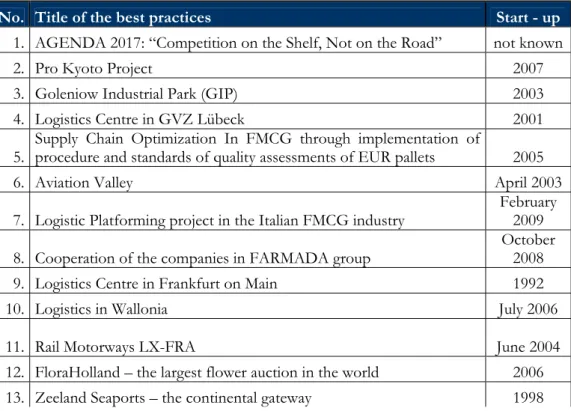
1. AGENDA 2017: “Competition on the Shelf, Not on the Road” Mars Deutschland
2. Pro Kyoto Project Inditex
3. Goleniow Industrial Park (GIP) Goleniow Municipality 4. Logistics Centre in GVZ Lübeck GVZ Lübeck
5. Supply Chain Optimization In FMCG through implementation ofprocedure and standards of quality assessments of EUR pallets Makro Cash & Carry and Auchan 6. Aviation Valley Aviation Cluster in Rzeszow 7. Logistic Platforming project in the Italian FMCG industry Ecr 2009
8. Cooperation of the companies in FARMADA group Farmada Transport 9. Logistics Centre in Frankfurt on Main Infraserv Logistics GmbH 10. Logistics in Wallonia Logistics in Wallonia Cluster 11. Modal shift of long distance freight road transport in Luxembourg Lorry Rail
12. FloraHolland – the largest flower auction in the world FloraHolland 13. Zeeland Seaports – the continental gateway Zeeland Seaports
Table 1. List of the selected best practices. Source: own study Institute of Logistics and Warehousing
27
Logistics Demand Business Networking Best Practice Guide
1.
Best practices overview
1.1
Best practices analyzed in the report.
1.2
Precise theme issue tackled by the practices
All of the mentioned projects concentrate on developing of the logistics processes, especially improving logistics chains, information flow between market players. Some of them, want to attract new investors to the region which has a growth potential and perfect logistics localization (intersection of the transportation corridors etc.). The main aims of the practices are:
▪ Reduction of the greenhouse gases generated by transportation,
▪ Development of the logistics infrastructure by using authority and EU funds,
▪ Elimination the technical and organizational problems which appear during the transport process or-ganization,
▪ Reduction of logistics costs as well as improving the logistics operations and level of customer ser-vice,
▪ Stimulation of the companies to develop innovative projects and attracting potential logistics inve-stors,
▪ Reduction of road congestion,
▪ Efficient utilization of the resources (IT, people, logistics), ▪ Stimulate cooperation in business processes organisation.
No. Company
City
Country
1. Mars Deutschland Verden Germany
2. Inditex Arteixo (A Coruña) Spain
3. Goleniow Municipality Goleniow Poland
4. GVZ Lübeck Lübeck Germany
5. Makro Cash & Carry and Auchan Poznan Poland
6. Aviation Cluster in Rzeszow Rzeszow Poland
7. Ecr 2009 Milan Italy
8. Farmada Transport Torun Poland
9. Infraserv Logistics GmbH Frankfurt on Main Germany
10. Logistics in Wallonia Cluster Wallonia Belgium
11. Lorry Rail Bettembourg Luxembourg
12. FloraHolland Aasmeer, Naaldwijk, Rinjsburg, Venlo, Bleiswijk, The Netherlands 13. Zeeland Seaports Vlissingen and Terneuzen The Netherlands
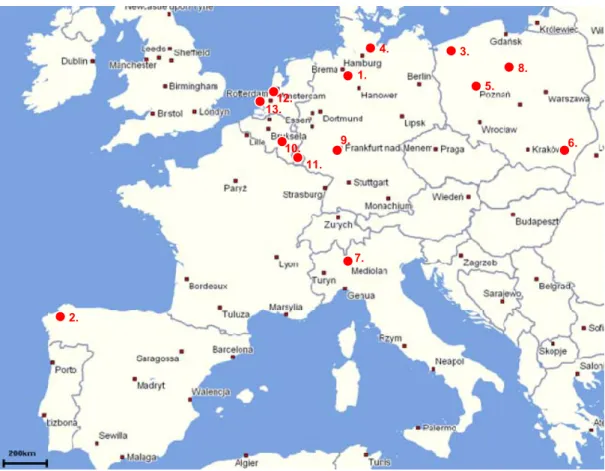
Table 2. List of the best practices with their localisations. Source: own study Institute of Logistics and Warehousing Figure 1. Localisations of the best practices. Source: own study Institute of Logistics and Warehousing.
1. 2. 3. 4. 5. 6. 7. 8. 9. 10. 11. 12. 13. 28
1.3
Location of the practices
The initiatives are located in the whole Europe. Detailed figure with marked localizations of the practices , as well as the list with marked names of the best practices and locations is presented below.
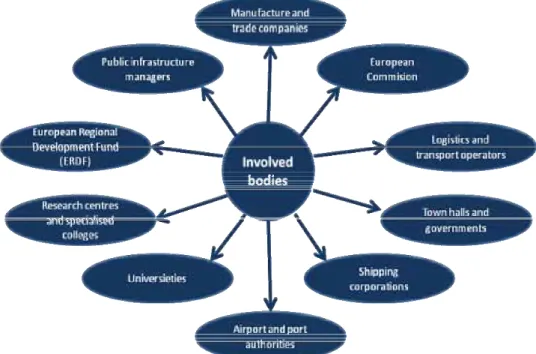
Figure 2. List of the bodies involved in the selected projects. Source: own study Institute of Logistics and Warehousing
29
1.4
Bodies involved in best practices
Depending on the project, different bodies was involved. Almost in each case, manufacture or trade compa -nies were involved These partners, usually created a supply or distribution chain with the major body, who was responsible for the whole best practice, and was a main beneficiary of the project. Very often research centers, specialized colleges and universities were also involved in the initiative, by using experience and knowledge to create a more reliable, comprehensive and effective solution. The major role of the European Commission was to financially subsidize and develop a new project and initiatives. Another bodies involved in the practices were logistics and transport operators, shipping corporations, public infrastructure mana -gers as well as town halls and governments. A number of the sites have been built on the basis of Public Private Partnership.
Matrix of all bodies involved in selected best practices is presented on the figure below.
1.5
Financial issues - budget of the best practices
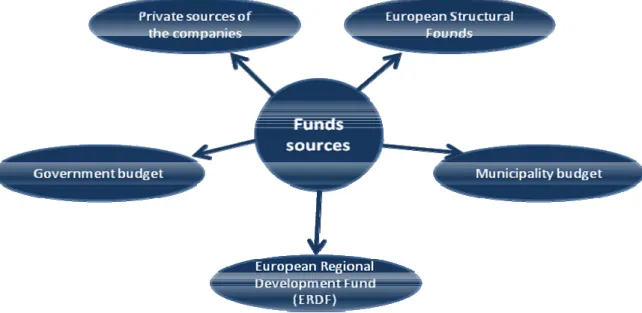
In each case, source of the funds was different. In some cases, like for example project “Mars: Agenda 2017”, the entire budget came from the private sources. On the other hand, development of the “Aviation Cluster in Rzeszow” or the ‘Rail motorways’ in Luxembourg and France are co-financed two sources of private and public. We have got also practice like “Logistic Platforming project”, which is whole financed from the members fees. Funds are usually used to buy a new logistics equipment, train a personnel or deve -lop a IT solution in order to cope with organizational bottlenecks and problems with data exchanging bet-ween cooperated companies. Basically, all funds sources can be divided in two group: money which come from the public funds, like European Structural Funds, budget of the Municipalities, European Regional Development Fund (ERDF) or Government budget, and funds which came from the private sources of the companies. Almost in each case, projects are co-financed by private and public sources.
Figure 3. Sources of financing the best practice projects. Source: own study Institute of Logistics and Warehousing
30
All sources of funds are presented below:
1.6
Legal framework of the practices
Some of the practices are based on an international agreement linked for example to the United Nations Framework Convention on Climate Change. Some of the projects, like for example “Industrial Park in Goleniow” is managed by Municipality of Goleniow and all activities are conducted under regulations of Polish Self-government Law.
Very unusual is example of “Logistics Centre in Lübeck”. The management board of the logistics centre consciously decided not to adopt the formula of a private company in order to have better access to funds, particularly those available from the EU. The logistics centre does not conduct any operating activity and does not have any income. The activity of the management board of the association is financed exclusively from membership fees.
“Makro Cash and Carry Polska S.A”. and “Auchan Polska Sp. z o.o” did not sign any agreement either. Some of the companies, like “Infraserv Logistics”, set up a subsidiary company, in order to implement the pro -ject resolutions. Although, the most of the practices are based on the agreement between involved bodies. Such kind a situation we have in case of ERC Milan, Farmada, Mars Deutschland and Logistics in Wallonia. Agreement ensures security, that secret data belonging to the enterprises will be used only to realization on the project goals.
In the case of ‘Rail Motorways’ between Luxembourg and France a company has been created to operate the site. All founders (both public and private) are now stakeholders of the company.
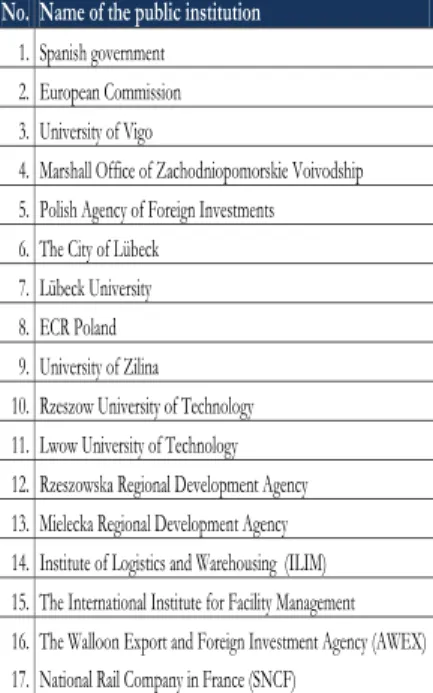
No. Name of the public institution
1. Spanish government 2. European Commission 3. University of Vigo
4. Marshall Office of Zachodniopomorskie Voivodship 5. Polish Agency of Foreign Investments 6. The City of Lübeck
7. Lübeck University 8. ECR Poland 9. University of Zilina 10.Rzeszow University of Technology 11.Lwow University of Technology 12.Rzeszowska Regional Development Agency 13.Mielecka Regional Development Agency 14.Institute of Logistics and Warehousing (ILIM) 15.The International Institute for Facility Management 16.The Walloon Export and Foreign Investment Agency (AWEX) 17. National Rail Company in France (SNCF)
Table 3. List of the public institutions involved in the best practices
Source: own study Institute of Logistics and Warehousing
31
2.
Cooperational issues
2.1
Public role in analysed best practices
Public role in analysed best practices Different initiatives have different public role. The major public role was to:
▪ Promote solution which save the petrol, like for example using bio-diesel or zero – emissions electric vehicles in order to reduce greenhouse gases generated by transportation,
▪ Strengthen cooperation between market players, in particular collaboration between logistics service providers and trade and production companies in area of transportation and warehousing,
▪ Improve the quality of pallets using in supply and distribution chains, by creating and implementing procedures and standards of quality assessments of EUR pallets,
▪ Support rationalization of specific transport processes and logistics actions that lead to the improve -ment of SMEs competitiveness and environ-ment protection by creating an European logistics coordi -nator network using specific IT tools,
▪ Identify the potential logistics investors, and stimulate them to develop innovative projects which for they can get financing by the Government, Municipality or European Structural funds.