A Novel Back-Off Algorithm for the
Integration Between Dynamic Optimization
and Scheduling of Batch Processes Under
Uncertainty
by
Yael Izamal Valdez Navarro
A thesis
presented to the University of Waterloo in fulfillment of the
thesis requirement for the degree of Master of Applied Science
in
Chemical Engineering
Waterloo, Ontario, Canada, 2019
Author's Declaration
I hereby declare that I am the sole author of this thesis. This is a true copy of the thesis, including any required final revisions, as accepted by my examiners.
Statement of Contributions
The content in Chapter 3 of this thesis has been published to Industrial & Engineering Chemistry Research (I&EC) Journal on November 22, 2019. Valdez-Navarro YI, Ricardez-Sandoval LA. A Novel Back-off Algorithm for Integration of Scheduling and Control of Batch Processes under Uncertainty. Ind Eng Chem Res. November 2019:acs.iecr.9b04963. doi:10.1021/acs.iecr.9b04963. That manuscript was written entirely by myself, and was edited by my supervisor, Luis Ricardez-Sandoval. Adapted with permission from Industrial & Engineering Chemistry Research. Copyright 2019, American Chemical Society.
The work in Chapter 4 of this thesis has been partially presented at the 12th IFAC Symposium on Dynamics and Control of Process Systems, including Biosystems (DYCOPS-CAB,2019). Valdez-Navarro YI, Ricardez-Sandoval LA. Integration between Dynamic Optimization and Scheduling of Batch Processes under Uncertainty: A Back-off Approach. 12th IFAC Symp Dyn Control Process Syst Incl Biosyst. 2019;52(1):1-6. doi:10.1016/j.ifacol.2019.06.137. That article was written entirely by myself, and was edited by my supervisor, Luis Ricardez-Sandoval. Permission to use the content for a thesis is granted according to IFAC’s Copyright Transfer and Conditions (© 2019, IFAC)
Abstract
Smarter manufacturing decisions need to be made in order to meet the increasing demand of specialty products. Batch processes are ideal in this context, as their flexibility is an attractive property to meet changing market conditions. Scheduling and control are key in the enterprise wide optimization problem, their connection links decisions that occur at the management and production level. This motivates a rethinking of the sequential-based decision making, commonly found in operations management. An integrated decision approach has been shown to provide better quality solutions. Integrated methods are generally casted as mixed-integer dynamic optimization problems (MIDO), which may become computationally intractable for large-scale applications. Moreover, the presence of uncertainty can cause deviation from nominal plant operation. Efforts from the process systems engineering (PSE) community aim to tackle this challenging problem; however, there is still a gap in the literature for integrated methods between the scheduling and control that account for parameter uncertainty.
A novel decomposition algorithm for the integration of scheduling and control of multiproduct, multiunit batch processes under stochastic parameter uncertainty is presented in this thesis. This iterative algorithm solves a scheduling and dynamic optimization problem around a nominal point while approximating uncertainty through back-off terms, embedded in the process constraints. Monte Carlo simulations are performed to propagate uncertainty and to evaluate dynamic feasibility; statistical information is drawn from these simulations to update the back-off terms. Convergence of the algorithm results in a set of scheduling and control decisions that aim to keep the plant dynamically feasible under the effect of uncertainty up to a user-defined tolerance criterion. The performance of the back-off approach is gauged against a fully-integrated approach, with multiscenario-based uncertainty. This integrated method serves as a benchmark, both in solution quality and computational efficiency. Results show that the proposed decomposition algorithm remains computationally attractive, without compromising the quality of the solution. Important interactions between scheduling, control and uncertainty are observed, thus justifying the need for their integration.
Acknowledgments
First, I would like to deeply thank my supervisor, Prof. Luis Ricardez-Sandoval, who supported me with his insightful ideas, his patience and guidance through my Master’s degree. And most importantly, the genuine interest he shows everyone in this research group by giving time to every concern that we have, however minute they may be.
I would like to extend my thanks to my Thesis committee, Professor Budman and Professor Erenay. I am grateful for the financial support CONACYT provided, which without it, the opportunity for a Master’s degree would not have happened.
To every member of our research group, a sincere thank you is needed for the fun experiences we’ve had together.
To everyone in my family, who have always unconditionally given me support when I most needed it. Finally, to the love of my life and wife, Cathy, a thesis-long acknowledgement would be needed to express my gratitude for the time we’ve spent together, thanks.
Table of Contents
Author's Declaration ... ii
Statement of Contributions ... iii
Abstract ... iv
Acknowledgments... v
List of Figures ... viii
List of Tables ... ix
List of Acronyms ... x
List of symbols ... xi
Indexes ... xi
Sets ... xi
Variables ... xii
Parameters ... xiii
Chapter 1: Introduction ... 1
1.1
Research Objectives ... 3
1.2
Structure of Thesis ... 4
Chapter 2: Literature Review ... 6
2.1 Enterprise Wide Optimization ... 6
2.2 Sequential vs Integrated Approach ... 8
2.3 Scheduling... 10
2.3.1 Time Representation ... 10
2.3.2 Process Representation ... 12
2.4 Dynamic Optimization ... 13
2.5 Integration of Scheduling & Control ... 13
2.6 Model Parameter Uncertainty ... 16
2.7 Generalized Disjunctive Programing ... 18
2.8 Chapter Summary ... 19
Chapter 3: Multi-Scenario Integrated Approach... 21
3.1 General Scheduling & Control Formulation under Uncertainty ... 21
3.4 Task-Dependent Disjunctive Decisions ... 26
3.5 Multi-Scenario Uncertainty ... 27
3.6 Model Convergence ... 28
3.7 Chapter Summary ... 29
Chapter 4: Back-Off Decomposition Algorithm... 30
4.1 Initialize Variables ... 31
4.2 Scheduling... 32
4.3 Dynamic Optimization ... 33
4.4 Monte Carlo Simulations ... 34
4.5 Update back-off terms... 36
4.6 Convergence Criterion ... 36
4.7 Chapter Summary ... 37
Chapter 5: Case Study & Results ... 39
5.1 Flowshop Batch Plant ... 39
5.2 Results ... 44
Scenario 1: Nominal Conditions ... 45
Scenario 2: Uncertainty in the Distillation Unit ... 49
Scenario 3: Uncertainty in the Reactor and Distillation Units ... 54
Chapter 6: Conclusions ... 61
6.1 Summary of Contributions ... 61
6.2 Recommendations and Research Opportunities ... 63
Bibliography ... 65
Appendix A. Optimization Formulations for the Case Study ... 78
A.1 Integrated Approach ... 78
List of Figures
Figure 1: Layers in decision hierarchy in EWO ... 7
Figure 2: Visual representation of the multi-scenario integrated algorithm. ... 25
Figure 3:Illustrative definition of a scenario, for simplicity, connections to consequent
realizations of uncertainty are represented by three dots. ... 27
Figure 4: Flowchart of the decomposition back-off algorithm ... 31
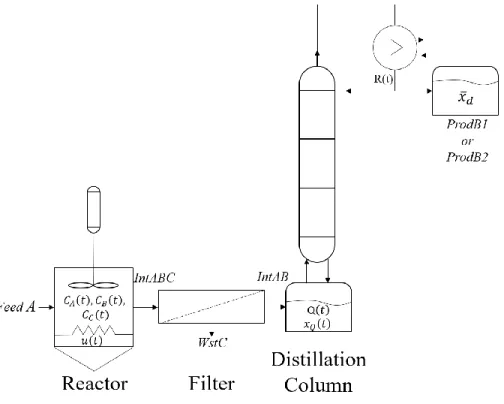
Figure 5: Process flow chart of case study... 39
Figure 6: STN representation of the proposed case-study ... 40
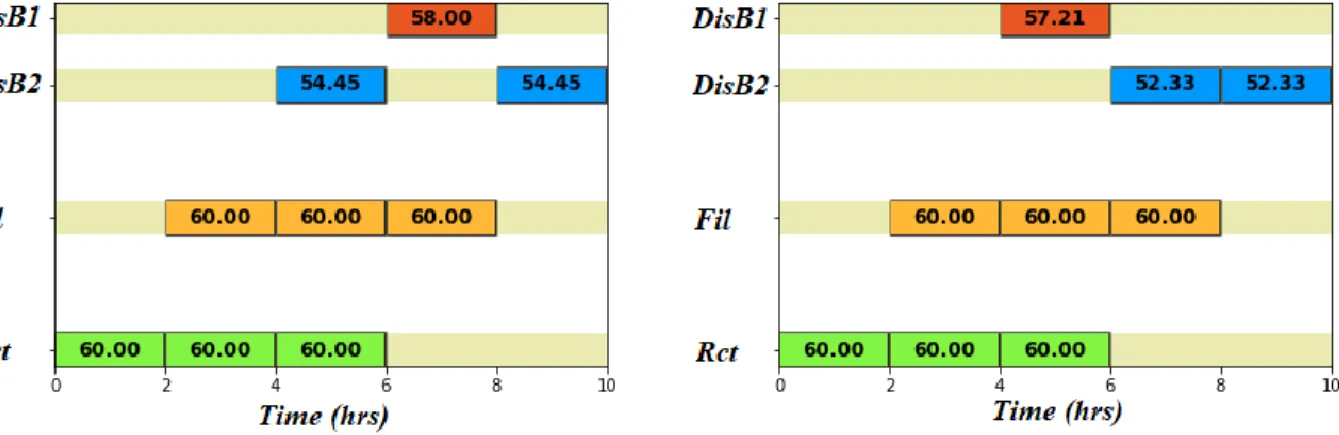
Figure 7: Scenario 1: Schedules for the back-off decomposition (left) and SBB-BARON
integrated approach (right) ... 47
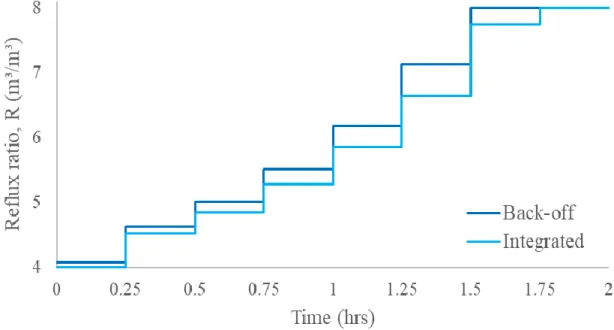
Figure 8: Resulting reflux ratio control profiles for the manufacturing of ProdB2, considering the
nominal case for the integrated (SBB, DICOPT), and back-off approach ... 48
Figure 9: Output distributions of the operational constraint when subject to uncertainty when
considering (top) no back-off, (bottom) λ=3. Dotted line represents the required purity
constraint on both products ... 50
Figure 10: Reflux ratio control profiles for maintaining ProdB2 on spec when considering an
integrated approach and different lambda multipliers for the back-off terms ... 52
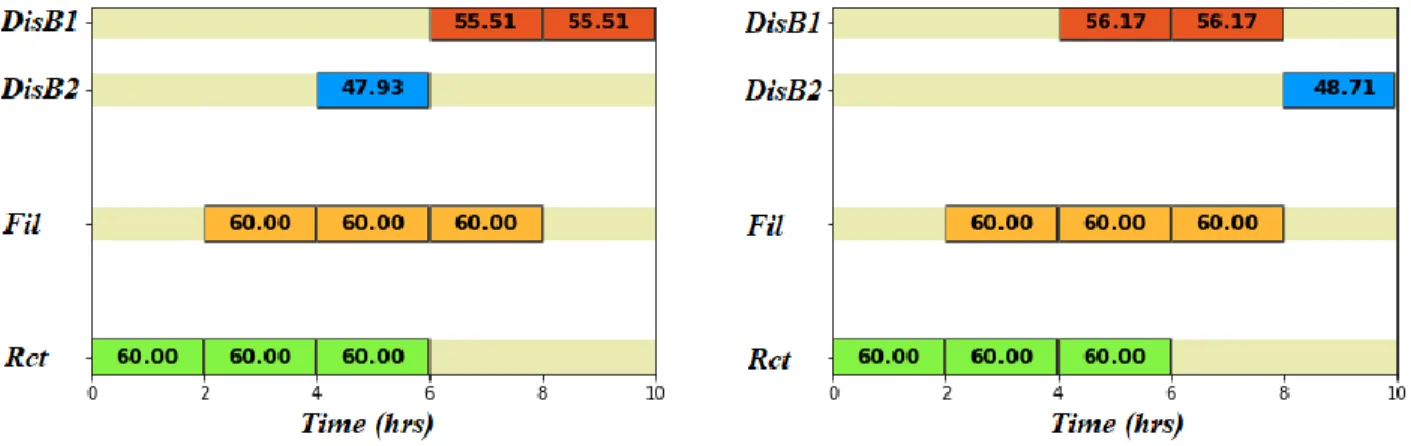
Figure 11: Resulting schedules for the integrated (Left) and back-off decomposition (Right),
considering λ=3, when subjected to the effects of a normal probability distribution in a
single uncertain parameter ... 53
Figure 12: Output distributions of purity for ProdB2 when subjected to the effects of two
uncertain parameters which follow a uniform distribution. Images correspond to the specific
case of λ=3 for i=0 (Left) and i=5 (Right) ... 57
Figure 13: Uncertain parameter non-gaussian distributions ... 57
Figure 14: Schedule comparison between different lambda multipliers, λ=1 (Left) and λ=3
(Right), when considering a non-gaussian distribution ... 59
Figure 15: Resulting control decisions when subject to non-gaussian distribution for the back-off
approach, when considering different lambda multipliers. ... 60
List of Tables
Table 1: Overview of integration of scheduling and control, for both continuous and batch
processes when considering deterministic and uncertain realizations in the process
parameters ... 16
Table 2: Comparison between the integrated and decomposition approach when considering a
nominal realization in the uncertain parameters ... 46
Table 3: Comparison of problem size between integrated and back-off approach when
considering one stochastic parameter in the process model ... 49
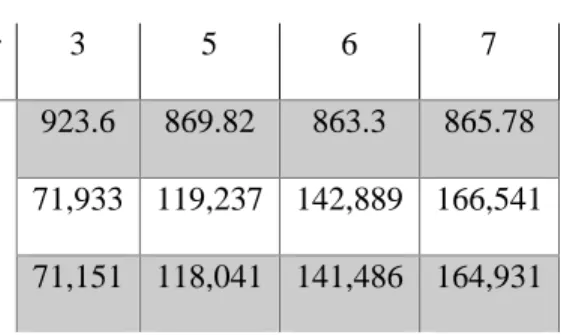
Table 4: Comparison in solution quality and computational cost for integrated and back-off
methodology when considering one uncertain parameter ... 51
Table 5: Objective function change when considering additional realizations in the additional
reactor uncertain parameter and nineteen realizations in α ... 55
Table 6: Problem size comparison for the integrated and back-off approach, when considering a
uniform distribution and two uncertain parameters ... 55
Table 7: Overall process revenue of the batch plant for integrated and back-off approach, when
subject to two uncertain parameters which follow a uniform distribution ... 56
Table 8: Model size comparison for the integrated and back-off approach. 19 discrete realizations
for the integrated problem were considered for both uncertain parameters. ... 58
Table 9: Results comparison between integrated and back-off approach when considering
List of Acronyms
CHR Convex hull relaxation
DAE Differential-algebraic equations
GDP Generalized disjunctive programming
MC Monte-Carlo
MIDO Mixed-integer dynamic optimization
MILP Mixed integer linear programming
MINLP Mixed Integer non-linear programming
MLDO Mixed logic dynamic optimization
NLP Non-linear programming
PSE Process systems engineering
List of symbols
Indexes
𝑖 Back-off algorithm master outer-loop index 𝑗 Task index
𝑘 Unit index
𝑙 Mechanistic unit model index 𝑚 Equality constraint index
𝑛 Back-off algorithm inner-loop index 𝑝 Inequality constraint index
𝑠 Material state index 𝑡 Time index
µ Tray index 𝛾 Product index
𝜈 Unit-specific stochastic parameter index
𝜑 Multi-scenario uncertain parameters combination index
Sets
𝒈𝒄𝒓𝒊𝒕 Matrix storing simulation information 𝑱 Set of total tasks
𝑱𝒌 Set of tasks that can be performed in a unit 𝑲𝒋 Set of units that can perform a task
𝑲 Set of total units 𝑺 Set of total states
𝑺𝑫 Set of scheduling decisions 𝑺𝒋 Set of states that feed into a task 𝑺
̅𝒋 Set of states produced by a task 𝑻𝒔 Set of tasks consuming a material state 𝑻
̅𝒔 Set of tasks producing a material state 𝜟 Set of scenarios
𝜣𝒏𝒐𝒎 Set of deterministic parameters 𝜣𝒖𝒏𝒄 Set of uncertain parameters
𝜣 Set of deterministic and uncertain parameters
Variables
𝑏𝑝,𝑡,𝑖 Back-off term for constraint p at time t for iteration i 𝑩𝒋,𝒌,𝒕 Batch size variable for task j performed in unit k at time t
𝑪𝑨 Concentration of species A 𝑪𝑩 Concentration of species B 𝑪𝑪 Concentration of species C
𝑫 Extraction flow variable
𝑫𝒕𝒐𝒕𝜸 Total accumulated distillate for product𝜸 𝑭 Processing costs
𝒇𝒍 Vector of mechanistic unit models of size l 𝒈𝒑 Vector of inequality constraints of size p 𝒉𝒎 Vector of equality constraints of size m
𝑳 Returning flow variable 𝑸 Reboiler material variable 𝑹 Reflux ratio
𝑺𝒄𝒉𝒆𝒒 Vector of additional scheduling equality constraints 𝑺𝒄𝒉𝒊𝒏𝒆𝒒 Vector of additional scheduling inequality constraints
𝑆𝑠,𝑡 Material variable for state s at time t 𝒖 Control trajectory profiles
𝑽 Vapor flow
𝑊𝑗,𝑘,𝑡 Binary assignment variable for task j performed in unit k at time t 𝑌𝑘,𝑗,𝑡 Boolean logical disjunctive indicator variable
𝒙 Model state variables
𝒙̇ Model state variables’ derivatives 𝒙µ Liquid concentration in a tray
𝒙𝑸 Concentration of species B in reboiler 𝒙𝒅 Concentration of species B in distillate 𝒙
̅𝒅𝛄 Product purity variable 𝒚µ Vapor concentration in a tray
𝒛𝒅𝒚𝒏 Objective function of dynamic optimization problem 𝒛𝒔𝒄𝒉𝒆𝒅 Objective function of scheduling problem
𝝆𝒊𝒏 Proportion of material input 𝝆𝒐𝒖𝒕 Proportion of material output
𝜳 Overall net cost function
Parameters
𝐵𝑗,𝑘𝑚𝑎𝑥 Upper limit on batch size 𝐵𝑗,𝑘𝑚𝑖𝑛 Lower limit on batch size
𝐻 Scheduling makespan
𝑀𝐶 Total number of Monte Carlo simulations 𝑁𝐿 Total number of mechanistic unit equations 𝑁𝑃 Total number of inequality constraints 𝑁𝑐𝑡𝑟𝑙 Total number of control variables
𝛷𝑘 Total number of parameter realizations for a given unit 𝑁𝑘 Total number of uncertain parameters for a unit 𝑁𝑚 Total number of equality constraints
𝑁𝑛𝑜𝑚 Total number of deterministic parameters 𝑁𝑠𝑐𝑛 Total number of scenarios
𝑁𝑠𝑡 Total number of model states
𝑁𝑢𝑛𝑐 Total number of uncertain parameters
𝑃𝐷𝐹𝑘,𝜈 Probability density function for an uncertain parameter 𝑝𝑑 Column price factor
𝑝𝑓 Filter unit price factor 𝑝𝑟 Reactor unit price factor 𝑇𝑜𝑝0
𝑗 Task initiation indicator 𝑇𝑜𝑝𝑗 𝑓 Task completion indicator
𝑇𝑜𝑙 Back-off algorithm convergence tolerance 𝑢𝑚𝑎𝑥 Upper bound on control variables
𝑢𝑚𝑖𝑛 Lower bound on control variables 𝑥̅𝑑∗γ Product purity set-point
𝛽 Kinetic reaction parameter
𝜃𝑘,𝜈 Unit-specific stochastic uncertain parameter
𝜃𝑛𝑘,𝜈 Random realization of a stochastic uncertain parameter 𝜆 Back-off term multiplier
𝜈 Unit-specific stochastic parameter index 𝜏𝑗 Task fulfilment time
τj,s Processing time for task output to a state
𝜑 Multi-scenario uncertain parameters combination index 𝜔𝛿 Weight of scenario
Chapter 1: Introduction
As global competitiveness increases, industries are driven to meet increasingly restrictive constraints, such as product quality, environmental, or productivity restrictions. When facing a highly volatile and uncertain market, industries seek to operate under robust, optimal manufacturing conditions. For this purpose, batch processes are typically used in conditions where varying product properties and manufacturing flexibility is required1. Optimization is then performed to improve the overall efficiency and revenue of the plant while
assuring a set of process constraints are met. It has been shown that there are extensive benefits to consider model-based optimization of chemical production plants, such as an overall increase in profitability or more attractive operative decisions.
Traditionally, the layers in enterprise-wide optimization (i.e. supply chain management, production planning, scheduling, control, process dynamics, and design) have been considered separately, i.e. a set of sequential problems are solved one after the other. However, it has been shown that this approach although computationally attractive, may result in suboptimal or even infeasible solutions, as it ignores important interactions co-dependent between layers2. Consequently, the process systems engineering (PSE)
community has focused on the development of solution approaches, which can be categorized into integrated and decomposition algorithms, providing high-quality solutions by considering key linking variables between the different layers. The merit of considering reliable first principles models for flexibility and resilience of a process was discussed in Morari and Grossmann3. In that work, case-studies
where common rules of thumb for the design of chemical plants fail to provide attractive solutions have been presented. Particularly for the case of large-scale plants, it is not always intuitive the identification of the worst-case condition for operation, which may highly depend on design considerations and would also affect upper manufacturing layers such as scheduling and planning decisions. Therefore, it is of interest to consider comprehensive approaches that combine process control and optimization decisions to identify optimal and controllable design and operation management policies for chemical processes4 The general
multiple layers, regardless of their complexity. A decomposition-based approach seeks to identify complicating variables so as to effectively generate master and primal problems, with the goal of reducing the computational burden of the algorithm 5.
Despite the advances in computer science, obtaining a computationally tractable, globally optimal solution to the integrated problem of large-scalemulti-unit, multi-product batch plants is still an open challenge, as it often requires the specification of nonconvex mixed-integer dynamic optimization (MIDO) formulations6.
As a result, studies that seek to address the integration problem seek to optimize only for a particular combination of the manufacturing layers. A review of the state-of-the-art techniques are presented in several papers 7–9.
In addition of the beforementioned challenges, many of the methods proposed in the literature assume process model parameters to be deterministic in nature; however, this assumption does not hold when considering a real process, as uncertainty has been shown to have important effects on process operation. This is even more stressed when considering the existence of substantial interactions between layers; therefore uncertainty may propagate between them, turning a previously obtained optimal production sequence into a sub-optimal or infeasible operation10. Efficient robust methods must, therefore, be
developed in order to incorporate uncertainty on the already computationally taxing integrated methods.
Notable contributions that seek to fill that purpose are presented, particularly in the area of integration of design and control 11–13. A review of challenges in this field are presented in several papers 4,11,14. However,
there is still a gap in the literature regarding integrated methods for scheduling and control when considering model uncertainty. Scheduling and control are key aspects to consider in the enterprise wide optimization problem, their importance stems from the fact that their connection links decisions that occur at the management and production level. Consequently, this thesis develops two distinct methods for considering scheduling and control decisions, the multi-scenario integrated approach and the back-off method, which are expanded upon on the following chapters.
1.1
Research Objectives
The aim of this study is to expand upon the literature by presenting a novel back-off decomposition methodology for the integration of scheduling and control of multi-unit, multi-product batch plants, subject to the effects of stochastic-based process uncertainty.
This thesis explores two different approaches for optimization under uncertainty, an integrated multi-scenario-based approach and a new decomposition-based back-off method. The multi-scenario approach, optimizes an integrated scheduling and control problem for a discrete number of scenarios, so that all realizations considered are accommodated by the solution. The back-off method has the purpose of converging to a robust solution by iteratively solving a decomposition of the scheduling and control problems, stochastic simulations are performed to generate back-off terms. These back-off terms are incorporated into the process operational constraints to approximate the effect of fully stochastic uncertain model parameters.
The novelty of this work is that the proposed back-off algorithm avoids the solution of a computationally expensive stochastic Mixed Logic Dynamic Optimization (MLDO) problem by decomposing scheduling and control decisions. The quality of the obtained solution is validated against a fully integrated problem. The presented methods consider the full non-linear dynamic models, along with parameter uncertainty. Multiple distributions in the uncertain parameters and their effects on the solution were explored in this research. To the authors’ knowledge, this is the first study that presents a back-off decomposition algorithm for scheduling and control of batch plants. Previously published works on batch plant scheduling and open-loop optimization have rarely considered stochastic-based parameter uncertainty.
A novel feature of the current work is that the proposed decomposition method is to be compared against a fully integrated problem, obtained from a large scale multi-scenario-based MLDO formulation. The expected contribution is to provide an algorithm capable of obtaining a computationally tractable solution,
while retaining its quality. Both, the proposed back-off and fully integrated methods are to be tested on a multi-product, multi-unit batch plant, subject to operational constraints and model parameter uncertainty.
1.2
Structure of Thesis
This thesis is organized into the following chapters:
Chapter 2: This chapter presents a general review of the current state of the art in the integration of scheduling and control, highlighting the different approaches, their advantages, disadvantages and areas for research interest. This latter section emphasizes the contributions made by the presented study. A special focus is placed on methods that incorporate process uncertainty into their optimization framework. Introductory concepts to process scheduling, dynamic optimization and Generalized Disjunctive Programming are also presented in this chapter for completeness.
Chapter 3: In order to gauge the performance of the decomposition algorithm, a simultaneous based approach for the integration of scheduling and control of batch plants is presented. The conceptual definition of a general scheduling and control problem under stochastic uncertainty is presented, outlining limitations and challenges involved with obtaining a globally optimal solution of the problem. Subsequently, the conceptual formulation of the multi-scenario-based optimization problem is described. The content in this chapter has been published to Industrial & Engineering Chemistry Research (I&EC) Journal15.
Chapter 4: In this section, the back-off decomposition algorithm is presented. The conceptual formulation is explained and a general flowchart of the algorithm is presented, highlighting the definition of the linking variables, assumptions, and characteristics for convergence. This work has been partially presented at the 12th IFAC Symposium on Dynamics and Control of Process Systems, including Biosystems (DYCOPS-CAB,2019)16.
Chapter 5: This chapter presents the case study and results used to assess the performance of the methods covered in this thesis. A detailed overview of the batch plant is provided. Moreover, this section will discuss
and the effects of uncertainty upon them. For illustrative purposes both global and local solvers are implemented for the solution of the resulting optimization problems.
Chapter 6: This section summarizes the key outcomes obtained from the present study and suggest future improvements that can be explored for the present methodology. Furthermore, possible research opportunities in the area of integrated plant operations are provided.
Chapter 2: Literature Review
As mentioned in the previous chapter, methodologies that seek to integrate model-based optimization with scheduling are of high interest to the PSE community due to their benefits upon performance. As such, this chapter presents the current state-of-the-art approaches to accomplish that goal. Furthermore, special emphasis is given to those methods that have incorporated uncertainty into the problem, as it has been shown that their effects have a significant impact upon the performance of chemical manufacturing plants.
The difficulty in determining optimal scheduling and control decisions for a process can vary greatly depending on the approach that is followed. Two common methods (i.e. sequential method and the integrated method) are explained in this section, and the contributions of relevant works are summarized.
A focus on studies that have considered a multi-scenario and stochastic based approaches to the uncertainty is given, highlighting their differences, benefits and limitations for their application to the integration of scheduling and control. With this information, the scope of the presented study and its contribution to the literature is exemplified.
2.1 Enterprise Wide Optimization
Uncertain market conditions, continuous process improvement, consideration of environmental constraints and a significant increase in competition are some of the justifications that have pushed the industries and the PSE community to develop novel robust methods that meet the increasingly restrictive constraints upon operations. In consequence, the combined efforts of industries and academia aim to solve the beforementioned challenges through the development of Enterprise Wide Optimization, providing software and computational tools that can serve as means for the maximization of process profitability, responsiveness to demands and optimal assignation of assets17.
Enterprise-wide optimization combines the knowledge from PSE and operations research. The main purpose of it is to obtain a set of decisions that result in optimal operations in a company. A key major
feature of enterprise-wide optimization is the emphasis on maintaining the full non-linear models for the description of the mechanistic manufacturing layers (i.e. control/dynamic optimization and the processes)1.
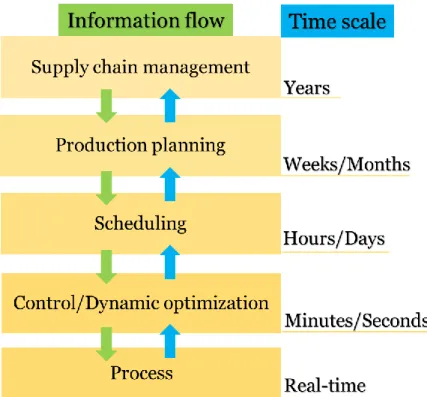
As shown in Figure 1, the classic top-to-bottom decision-making hierarchy consists of six decision layers, i.e. supply chain management, planning, scheduling, control/real time optimization and the process 14.
As shown in Figure 1, typically information flow goes top-to-bottom, while the time scale and frequency of the decisions increase accordingly18. At the top, supply chain management, planning and scheduling are
long-term decisions. The two layers at the bottom can be considered as short-term decisions.
A brief explanation of the production layers is expanded upon in this section, as defined by Shobrys and White19.
• Supply chain management define desired changes to the current overall business. Typical decisions
found in this layer might relate to contracts, selection of raw material providers, production and distribution capacity. The extension of this layer may encompass global or nation-wide markets.
• Planning is used to create distribution, sales and inventory plans based on customer and market
information, thereby setting a target for operating performance. This layer encompasses individual sites, however, industries with multiple manufacturing plants can incorporate regional planning to coordinate activities.
• Scheduling assigns limited resources (process units, materials, utilities, etc.) in a given production
facility to create manufacturing sequences for products based on a demand. Typical decisions made in this layer are the time an operation should be initialized, its duration, the equipment which will process said operation and its corresponding amount of material.
• Control/Dynamic optimization involves the manipulation of state variables to reject a form of
process disturbances and to meet key manufacturing and product constraints while ensuring that those decisions do not violate the set bounds on the manipulated variables. It may be responsible for keeping an economic production through the determination of optimal operating set-points.
• The process itself is governed by mechanistic models, which are formulated by initially making
educated assumptions on the properties of the system in question. The result is the formulation of highly detailed physical and mathematical models to replicate the dynamic behavior of the real phenomenon.
2.2 Sequential vs Integrated Approach
Traditionally, the layers in enterprise-wide optimization have been considered separately, such that a sequential problem is solved for each layer, one after the other. Although this approach is computationally attractive, it has been shown that it may result in suboptimal or even infeasible solutions, as it ignores
the development of integrated solution approaches that can provide high-quality solutions by considering key linking variables between the different layers2,9,14. The basic idea in the integrated approach is to
formulate a single comprehensive model, where decisions encompass multiple layers, regardless of their complexity. Decisions made at each one of these levels differ in terms of time horizon, complexity and objectives. Significant efforts have been done to develop methods that seek to integrate multiple decision layers, recognizing the inherent interconnectivity between them 18,20. Accordingly, different methodologies
can be categorized into two main solution approaches to the complex integrated problem: a simultaneous, fully integrated approach and a decomposition-based approach.
Advantages of the simultaneous decision-approach include the avoidance of infeasibilities or sub-optimal solutions by solving a sparse system. However, a challenge attributed to this methodology comes from addressing the differing time scales of the different models considered in the integrated problem. This previous consideration results in highly complex large-scale optimization problem, which may become computationally intractable18. On the other hand, decomposition-based approaches are often developed with
the purpose to address the previous challenges. Generally, these methods aim to identify key complicating variables, exploiting certain problem properties to effectively generate a master and primal optimization problem. The purpose is to reduce the computational effort of solving a complex integrated problem without compromising on solution quality21.
Despite these efforts, obtaining a computationally tractable, globally optimal solution to the integrated problem of large-scale multi-unit, multi-product batch plants is currently an open challenge, as it often requires the specification of nonconvex mixed-integer dynamic optimization (MIDO) formulations 6,22–24.
As a result, studies that aim to address the integration problem seek to optimize only for a particular combination of the manufacturing layers. More recently however, contributions have been made toward the consideration of multiple layers, mainly design, scheduling and control 25–28 or planning, scheduling and
control 29–31. The integration of planning, scheduling, and control results in complex large-scale MINLPs.
intractable for large-scale applications30. Obtaining solutions to tackle such problems typically require the
specification of key linking variables, such that a decomposition framework can be implemented31. A recent
contribution which presents a comprehensive review of state-of-the-art integrative techniques is presented by Burnak et al.20, additional assessment of different integration methods are presented elsewhere 7–9,20,32,33.
2.3 Scheduling
In this thesis, the main focus of the decision-making hierarchy is given to scheduling and dynamic optimization. For that end, a brief, introductory explanation to process scheduling is provided.
Scheduling is an important class of optimization problem in the PSE community. In general, they are formulated to determine when, where and how to produce a set of given products subject to particular constraints, such as a make-span or time horizon, consideration of limited resources, capacity or specific manufacturing sequences34. Scheduling problems can generally be considered combinatorial in nature due
to the discrete decisions involved (i.e. assignment and allocation constraints); hence, they may be challenging from the computational complexity point of view35. For this reason, the need to develop
efficient solution methods is apparent. Significant efforts have been done to accomplish this goal35–37.
Scheduling models for the representation of a chemical production plant can have multiple structures. Common classifications include, but are not limited to: time-representation and process-representation 36.
Each of these categories can have significant effects on both computational performance and solution quality of the schedules. In this section, a brief review on important concepts and solution approaches developed for optimal process scheduling is presented.
2.3.1 Time Representation
Time representation is a key classification used to describe a scheduling model. There exist two main categories for approaching the discretization of time in a scheduling formulation, they are the discrete and continuous time representations.
The discrete time representation partitions the scheduling horizon into a known and equidistant number of periods, defining a common time grid for all variables and constraints that may be encountered in a scheduling problem, i.e. assignation of tasks/equipment material balance constraints, etc. The start or end of an event can occur only on a period as determined by the discretization. Moreover, processing times are assumed to be constant and generally, are integer multiples of the unit slot duration 35,38 . An important
feature of the discrete-time representation is its ease of modeling and interoperability. Moreover, a very fine discretization allows for a high degree of flexibility in the quality solutions. However, a small discretization in turn will require larger number of variables, resulting in larger problem, which may become intractable for large-scale applications or minute discretization periods38.
The second representation is referred to as the continuous time approach, which as its name implies, introduces a time grid where events (scheduling decisions) can occur at arbitrary time points in a given horizon. The scheduling horizon is then partitioned into periods of unequal and unknown length and tasks can have variable processing times. Often, the continuous time representation requires fewer grid discretizations when compared to the discrete time approach. Continuous-time representation can be further classified into global grid, which adopt a unique time grid for all processes35 and unit-specific time
representation, which considers multiple asynchronized time grids for every unit, allowing different tasks to start at different moments in different units for the same event point39. Since the timing and duration of
events is not defined a priori a smaller optimization problem may result, owing to the fact that no fine discretization is required. Therefore, accurate processing times can be obtained without increasing the size of the problem. However, this formulation may become more challenging to model, leading to a complicated model structure when compared against a discrete-time formulation35,38, particularly for
large-scale applications. Although efforts have been made to extend algorithms for their application to large-large-scale scheduling of industrial plants34,40–43.
As per the discussion above, each representation has their own advantages and disadvantages. It is noted that in reality their computational performances are highly problem dependent. Although industry practitioners seem to have mainly adopted the practical discrete-time representation38,44.
2.3.2 Process Representation
The second method for representing scheduling models is through process representation. In this case, the methods can be divided into two categories45:
- Sequential processes: Where multiple products are manufactured using one processing sequence. For this type of process, it is not necessary to consider mass balances explicitly.
- Network processes: This corresponds to a more general case where materials can merge and/or split; therefore, mass balance constraints are required. Two well-known formulations are expanded upon on the section below.
o State-Task Network (STN): Originally formulated by Kondili et al.46 as a general
framework for representing processes. The STN of a chemical plant can be visualized as a graph with two types of connecting nodes; circles, which represent state nodes (i.e. materials, intermediates or products). Rectangles, which represent task nodes (i.e. equipment operations). The fraction of a state consumed or produced by a task, if not equal to one, is given beside the arch linking the corresponding state and task nodes.
o Resource-Task Network (RTN): Originally formulated by Pantelides47 as an extension to
STN. The main feature is that equipment, storage, material and utilities are represented in a unified fashion, and are denominated as resources that can be consumed by tasks.
An in-depth discussion on computational performance of both representations, advantages and disadvantages can be found elsewhere45,48.
2.4 Dynamic Optimization
Dynamic optimization problems arise in many areas of PSE such as batch plant optimization, optimal grade transition, optimal process control and parameter estimation. It can be defined as an optimization problem, which requires the solution of a system whose behavior is dictated by a set of differential-algebraic-equations, usually in the domain of space or time. These types of systems usually require the definition of an initial value or boundary value problem. The algebraic equations are typically derived from mechanistic equations, where the degrees of freedom available to the system are control and time-independent variables.
The solution of these dynamic optimization problems is formally explored by applying concepts from optimal control theory, however this is only viable for relatively simple problems, for larger more complex systems efficient numerical methods are required. For the purpose of this thesis, the direct transcription approach is preferred. This numerical approach deals with the full discretization of state equations and control paths. A common discretization method is orthogonal collocation on finite elements, a method that has attractive properties, such as, a numerically stable behavior on stiff problems (A-stable) and can handle non-smooth events the boundaries between elements. The resulting discretized set of equations and constraints may be solved with a commercial NLP solver. Extended information on convergence properties, stability and how to exploit the resulting structure of the large NLP problem for good quality and efficient solution may be found elsewhere49.
2.5 Integration of Scheduling & Control
A traditional approach to solve the problem of scheduling and control is to consider them separately. However, it has been shown there exists key linking variables that interconnect information between the scheduling and control layer. In consequence, to obtain an economically and operationally attractive solution one must consider this problem in an integrated fashion 50. Consequently, a single optimization
formulation that can solve the beforementioned problem simultaneously is desirable. A number of major advantages of the integrated approach are noted by Engell and Harjunkoski14.
• Reduce maintenance needs and improve equipment life-time.
• Improve the feasibility of schedules for operation.
• Exploit the degrees of freedom of control in plant designs.
• Use more precise and timely information in scheduling.
Although the integrated approach is attractive for the quality of the obtained solution, it has been shown that methods which implement this approach found difficulties on the computational cost22. This is mainly
because a fully integrated simultaneous approach requires the specification of a sparse MIDO problem23,51.
Complexities appear with the combination of integer scheduling decisions with highly non-linear dynamic models. A trend is then to develop decomposition based-approaches to improve performance. Nystrom et al.52 originally proposed an iterative method to solve the integrated problem, sharing key information
between layers; Terrazas- Moreno et al.53 presented a Lagrangean-based decomposition approach for the
integration of scheduling and control. Solution to this problem was obtained by iterating between a primal control problem and a master scheduling problem More recently, Generalized Benders Decomposition algorithms were explored by Yisu et al.54 and Chu and You5, effectively lowering computational time while
maintaining solution quality. Recent state-of-the-art approaches focus on the development of surrogate55
and multi-parametric26,56 approaches for the solution of the integrated problem. A recent study by Simkoff
and Baldea57 solved the integrated problem through a novel implementation of complementarity constraints,
fully incorporating control decisions into the scheduling model.
Integrated methodologies for scheduling and control were originally applied to case studies that dealt with optimal grade transition of continuous processes. For instance, Nystrom et al.52 proposed a decoupling
method for polymerization processes and parallel polymerization lines with multiple units58.
Flores-Tlacuahuac and Grossmann 51,59 tested their approach on cyclic productions with CSTR and PFR reactors;
Terrazas-Moreno et al.60 solved the integration of cyclic scheduling and control of two polymerization
systems. Zhuge and Ierapetritou61 explore two case studies, a CSTR and an isothermal tubular reactor when
mainly applied to continuous processes, rather than batch processes. This is mainly due to modelling and solution complexities54.
As stated earlier, a key objective of the integrated method is to be flexible to changing market conditions and customer requirements. Consequently, dynamic batch processing provides additional transient operating freedom, that can stretch the limits of profitability under strict market, facility, and time constraints62. Hence, batch processes are typically used in conditions where changing product properties
and manufacturing flexibility is required63. In addition, batch processes are able to handle unpredictable
events from external markets. For the reasons discussed above, this thesis will focus on the development of methods for the integration of scheduling and control of multi-purpose batch plants.
Among the first contributions to this area of research was the work by Bhatia and Biegler62, which
considered the effect of incorporating the non-linear process models to enrich a special formulation of a scheduling problem. That study showcased the merit of considering the optimization of batch plants. Mishra et al.22 performed a comparison between a fully integrated and a recipe-based approach, which considered
fixed control decisions. That study highlighted the merit of considering a fully integrated simultaneous approach, but also outlines the challenges of solving a complex MINLP.
Subsequently progress in this area is observed in the works by Nie et al.54,64 and Chu and You21, which
showcase a trend for the development of tailored decomposition-based algorithms to solve the complex integrated problem. A study by Capón-García et al.65 considers full process dynamics, comparing a nominal
indirect and direct approach for a multiproduct single stage batch plant. More recently, Zhuge and Ierapetritou66 developed a method for integration of scheduling and control of batch processes, through the
2.6 Model Parameter Uncertainty
In addition of the challenges mentioned above, many of the methods proposed in the literature assume perfect knowledge of the process model parameters; however, this assumption does not hold when considering a real process, as uncertainty has been shown to have important effects on process operation.
This is even more stressed when considering the existence of substantial interactions between layers; thus uncertainty may propagate between them, turning a previously obtained optimal production sequences into sub-optimal or infeasible solutions when implemented online 10. Therefore, there is a need to develop
efficient robust methods that incorporate uncertainty on the already computationally taxing integrated methods. Also, scheduling and control approaches that deal with uncertain process operations and
disturbances in real-time have been reported in the literature29,30,67,68. Other notable contributions that seek
to incorporate uncertainty have been presented, particularly in the area of integration of design and control under uncertainty 12,69–72. However, there is still a gap in the literature regarding integrated methods for
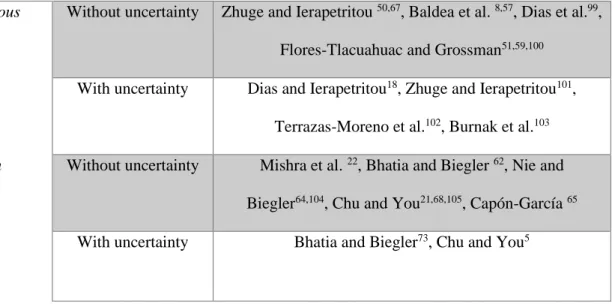
scheduling and control of batch processes when considering model parameter uncertainty, as indicated in Table 1: Overview of integration of scheduling and control, for both continuous and batch processes when considering deterministic and uncertain realizations in the model parameters
Plant type Approach Author(s)
Continuous Without uncertainty Zhuge and Ierapetritou 50,67, Baldea et al. 8,57, Dias et al.99,
Flores-Tlacuahuac and Grossman51,59,100
With uncertainty Dias and Ierapetritou18, Zhuge and Ierapetritou101,
Terrazas-Moreno et al.102, Burnak et al.103
Batch Without uncertainty Mishra et al. 22, Bhatia and Biegler 62, Nie and
Biegler64,104, Chu and You21,68,105, Capón-García 65
.
An early work on the consideration of model parameter uncertainty for the solution of scheduling and control of batch plant was provided by Bhatia and Biegler 73, who formulated a dynamic optimization
problem, where an economic objective function was subject to a dynamic high-fidelity model of the process described by differential algebraic system of equations. Those authors proposed a solution strategy based on discretizing the process model by orthogonal collocation over finite elements. Chu & You 5 presented a
two-stage Generalized Benders Decomposition algorithm for considering uncertainty in the scheduling of sequential batch plants. This thesis has the goal of filling the gap in the literature by considering the effect of fully-stochastic uncertain parameters on scheduling and control decisions.
The multi-scenario approach considers multiple different realizations of the process disturbance or parameter uncertainty in the optimization problem. A simple implementation of the multi-scenario approach considers every scenario simultaneously. The work by Chu and You5 solved the integrated problem with
the goal to maximize the overall profit on average over all possible scenarios under discrete realizations in the uncertain parameters. It is considered that as the number of realizations grow, the problem becomes increasingly difficult to solve.
The second method developed in this thesis, the back-off method, is discussed next. The concept of the back-off framework was originally proposed and expanded upon by Perkins and co-workers74–77. Our
research group has recently developed different implementations of the back-off method for the purpose of design and control under uncertainty69,78. The key idea in the back-off approach is to move away in a
systematic, iterative fashion from a nominal operating point, which has the properties of being economically attractive but dynamically infeasible in the presence of uncertainty. Convergence of the algorithm results in a set of decisions that most surely remain dynamically feasible in the presence of stochastic uncertainty. The work proposed by Koller & Ricardez-Sandoval 27 successfully implemented the back-off method for
production of multiple products was used in that work to illustrate the main features of their back-off method. This research expands upon that work to consider the simultaneous scheduling and control of multiple units subject to stochastic realizations in the uncertain parameters.
2.7 Generalized Disjunctive Programing
A recent method for consideration of scheduling and control decisions simultaneously is a logical based reformulation of the problem. For this reason, a general overview of Generalized Disjunctive Programming (GDP) is presented next.
The precursor to GDP was presented in a previous study by Balas79 where they presented a series of linear
programming problems that define disjunctions, which are a type of constraints that allow a logical exclusive OR decisions to be performed, meaning that from a given set of constraints only a certain subset may be enforced. Raman and Grossmann80 expanded upon that work by generalizing the solution algorithm
of mixed-integer type problems when considering logical disjunctions and prepositions. Several case studies were considered in that study, including a job-shop scheduling formulation. A comprehensive formulation was presented in a study by Grossmann and Ruiz81. The framework is named Generalized
disjunctive programming and allows for the representation of a mixture of logical or algebraic constraints. Boolean and continuous type variables may be specified, such that the resulting problem can have MINLP characteristics. GDPs are often reformulated by using either the Big-M or the Convex Hull relaxations, Grossmann and Ruiz81 compare the quality, size and tightness of the resulting continuous reformulations.
In a work by Trespalacios and Grossmann82, an alternative formulation to the Big-M relaxation was
presented. The method assigns more than one big-M term to each constraint involved in their respective disjunction thus resulting in a tighter relaxation. Generally, algorithms employed to solve the resulting MINLP problem assume the function to be convex in nature. A solution algorithm for nonconvex GDP problems was explored by Lee and Grossmann83, where a lower bound for a global optimum solution may
be found initially with the solution from a local optimizer. Recently, Ruiz and Grossmann84 presented a
review for the challenge of finding a global optimal solution to highly non-convex disjunctive formulations.
Some of the efforts by the PSE community to solve the integrated problem by considering logical disjunctions have been presented. A study that developed a general framework for the consideration of disjunctive decisions was presented by Oldenburg and Marquardt85, addressing the modeling and optimal
control of hybrid systems that can be described by systems of ordinary differential equations (ODEs). Flores-Tlacuahuac and Biegler86 presented a MIDO problem for the integration of design and control. Issues
such as computational efficiency, quality and different solution characteristics from different GDP formulations were explored in that study. A work by Nie and Biegler64 presented a formulation that
considers operating modes for an equipment as logical disjunctions, solving an integrated scheduling and control problem for multi-purpose batch plants.
2.8 Chapter Summary
In this chapter a comprehensive review of the literature is provided. A common approach to enterprise-wide optimization is the sequential approach, while this method is computationally attractive, it ignores important interactions between the production layer. This consideration may result in sub-optimal or even infeasible solutions. Thus, there is a trend towards implementing an integrated approach to process optimization. This results in much more attractive solutions, with increased plant profitability and optimal operation. However, this method typically results in the definition of a large scale MINLP, which are complex to solve. For this purpose, studies have been focused on the development of decomposition-based approaches. Moreover, a more realistic approach is to consider the effects of uncertainty, which is shown to have significant effect on the optimality of a solution. To that end, different methods have been developed to account for model parameter uncertainty. Often, stochastic uncertain parameter descriptions are not considered in previous publications due to their associated computational challenges. Instead, a small number of discrete realizations in the uncertain parameters have been considered in previous studies leading
to the formulation of multi-scenario-based optimization frameworks. A gap in the literature is then noted, in the area of integration of scheduling and control of batch processes under stochastic-based uncertainty. To the author’s knowledge, the combination of these aspects has not been previously addressed. This thesis serves the purpose of filling that gap in the literature, by presenting a novel back-off approach which is gauged in performance against an integrated method.
Chapter 3: Multi-Scenario Integrated Approach
In this section, fully integrated scheduling and dynamic optimization algorithm for product, multi-unit batch processes is presented, based upon the methodology originally proposed by Nie & Biegler64. An
expansion upon that work is presented by accounting for interactions when considering multi-scenario-based model parameter uncertainty. The main purpose of this method is to use it as a benchmark for the decomposition back-off approach, both in computational efficiency and solution quality.
3.1 General Scheduling & Control Formulation under Uncertainty
The mathematical conceptual formulation of the optimization problem that considers the integration of scheduling and control under the effects of stochastic-based parameter uncertainty is presented in this section. The following considerations have been made to define the scope of the integration of scheduling and control problem addressed in this work.
Consider a multi-product, multi-unit batch plant described by a total of 𝑁𝐿 mechanistic unit models (𝒇𝒍), 𝑁𝑚 equality (𝒉𝒎) and 𝑁𝑃 inequality constraints (𝒈𝒑) affected by a set (𝜣), which includes deterministic parameters known a priori (𝜣𝒏𝒐𝒎∈ ℝ1×𝑁𝑛𝑜𝑚) and stochastic-based uncertain parameters (𝜣𝒖𝒏𝒄∈ ℝ1×𝑁𝑢𝑛𝑐). Each parameter 𝜽𝒌,𝝂 in 𝜣
𝒖𝒏𝒄 is described by a user-defined probability density function (PDF) over an event space Ω, i.e. 𝜣𝒖𝒏𝒄= {𝜽𝒌,𝝂|𝜽𝒌,𝝂= 𝑷𝑫𝑭𝒌,𝝂(𝜴), ∀𝑘 ∈ 𝑲, 𝜈 ∈ 1,2 … , 𝑁𝑘}, where 𝑲 is the set of units comprising the batch plant and 𝑁𝑘 is the total number of uncertain parameters considered for unit k. The plant is assumed to operate within a fixed makespan (𝐻), fixed task processing times, no pre-emptive operation, instant material transfer and unlimited intermediate storage. The aim is to seek for a set of scheduling decisions (SD) and optimal control trajectory profiles (𝒖), which result in the assignment of tasks, batch sizes and operating cost for each unit, such that an objective function (z) is optimized (e.g. maximization of profits) and constraints maintain dynamic operability in the presence of stochastic realizations in the uncertain parameters. This problem can be conceptually formulated as follows:
max {𝒖,𝑺𝑫} 𝒛(𝒙(𝑡), 𝒙̇(𝑡), 𝒖(𝑡), 𝜣, 𝑺𝑫) (1) 𝑠. 𝑡. 𝒇𝒍(𝒙(𝑡), 𝒙̇(𝑡), 𝒖(𝑡), 𝜣, 𝑺 𝑫) = 0; ∀𝑡, 𝑙 ∈ 1,2 … , 𝑁𝐿 𝒈𝒑(𝒙(𝑡), 𝒙̇(𝑡), 𝒖(𝑡), 𝜣, 𝑺𝑫) <= 0; ∀𝑡, 𝑝 ∈ 1,2 … , 𝑁𝑃 𝒉𝒎(𝒙(𝑡), 𝒙̇(𝑡), 𝒖(𝑡), 𝜣, 𝑺𝑫) = 0; ∀𝑡, 𝑚 ∈ 1,2 … , 𝑁𝑚 𝑢𝑚𝑖𝑛≤ 𝒖(𝑡) ≤ 𝑢𝑚𝑎𝑥; ∀𝑡 𝜣 = {𝛩𝑛𝑜𝑚, 𝛩𝑢𝑛𝑐} 𝒕 ∈ [0, 𝐻]
where 𝒙(𝒕) ∈ ℝ1×𝑁𝑠𝑡 represent the system’s states and their derivatives 𝒙̇(𝒕) ∈ ℝ1×𝑁𝑠𝑡, where 𝑁
𝑠𝑡 is the total number of model states; control variables 𝒖(𝒕) ∈ ℝ1×𝑁𝑐𝑡𝑟𝑙 and 𝑁
𝑐𝑡𝑟𝑙 is the total amount of control inputs available for each unit; 𝑺𝑫 is a set of decisions that results in a production schedule, e.g. assignment variables, operational costs or batch sizes. Problem (1) is challenging to solve, i.e. to ensure dynamic feasibility, an infinitely dimensional search space in a continuous time domain would need to be explored, resulting from treating uncertain process parameters as randomly distributed variables. This problem can be casted as a stochastic MIDO, which may be reformulated as a stochastic Mixed Integer Non-Linear Programming (MINLP) problem by discretizing the time domain49. Problem complexity still remains since
dynamic and integer dependent decisions have to be determined over a discretized time horizon for every possible realization of the uncertain parameters.
In this study, two methods are presented which circumvent the complications arising with problem (1). The first algorithm, explored in this chapter, aims to solve a fully integrated MINLP, but relaxes the assumption of stochastic-based representation of the uncertain model parameters by proposing multi-scenario-based descriptions for the uncertain parameters. The second algorithm, explored in the next chapter, decomposes the problem by searching for scheduling and control decisions in an iterative fashion thus avoiding the need
to solve an expensive MINLP. A key feature of the later approach is the consideration of back-off terms, which are used to approximate process variability due to the effect of stochastic realizations in the uncertain parameters. The goal of the proposed back-off algorithm is to search for a set of scheduling and control decisions that most surely remain dynamically feasible in the presence of stochastic-based uncertainty.
3.2 Multi-Scenario Approach: Problem Definition
For the challenges mentioned in the previous section, the original consideration of stochastic-based uncertainty is reconsidered. In its stead, a multi-scenario-based representation is adopted to solve the fully integrated problem, this section will expand upon the definition, assumptions and characteristics of the subsequent approach.
The State-Task-Network representation (STN), adopted from Kondili, et al.46 and Shah et al.87 is considered
to describe a multi-unit multi-product batch plant. STN is considered here due to its wide applicability for solving scheduling problems in chemical batch plants. This formulation, in combination with task-dependent disjunctive decisions, enable detailed scheduling and dynamic optimization modeling of flowshop batch plants, i.e.
max/min {𝒖,𝑺𝑫} 𝒛(𝒙(𝑡), 𝒙̇(𝑡), 𝒖(𝑡), 𝜣, 𝑺𝑫, 𝜔𝛿) (2a) 𝑠. 𝑡. ∑ ∑ 𝑊𝑗,𝑘,𝑡′ ≤ 1 𝑡−𝜏𝑗+1 𝑡′=𝑡 ∀𝑘, 𝑡 𝑗∈𝐽𝑘 (2b) 𝑊𝑗,𝑘,𝑡𝐵𝑗,𝑘𝑚𝑖𝑛 ≤ 𝐵𝑗,𝑘,𝑡≤ 𝑊𝑗,𝑘,𝑡𝐵𝑗,𝑘𝑚𝑎𝑥 ∀𝑗, 𝑘 ∈ 𝐾𝑗, 𝑡 (2c) 𝑆𝑠,𝑡= 𝑆𝑠,𝑡−1+ ∑ ∑ 𝜔𝛿𝜌𝑜𝑢𝑡𝑗,𝑠,𝑡,𝛿 𝛿∈𝛥 ∑ 𝐵𝑗,𝑘,𝑡−τj,s 𝑘∈𝐾𝑗 − 𝑗∈𝑇̅𝑠 ∑ ∑ 𝜔𝛿 𝛿∈𝛥 𝜌𝑖𝑛𝑗,𝑠,𝑡,𝛿 ∑ 𝐵𝑗,𝑘,𝑡 𝑘∈𝐾𝑗 𝑗∈𝑇𝑠 ∀𝑠, 𝑡 (2𝑑) 𝑺𝒄𝒉𝒆𝒒(𝒙(𝑡), 𝒙̇(𝑡), 𝒖(𝑡), 𝜣, 𝑺𝑫) = 0 (2𝑒) 𝑺𝒄𝒉𝒊𝒏𝒆𝒒(𝒙(𝑡), 𝒙̇(𝑡), 𝒖(𝑡), 𝜣, 𝑺𝑫) ≤ 0 (2𝑓)
[ 𝑌𝑗,𝑘,𝑡 = 𝑇𝑟𝑢𝑒 𝑊𝑗,𝑘,𝑡= 1 ℎ𝑘,𝑗,𝛿𝑚 (𝑥𝑗,𝑘,𝑡,𝛿(𝜏𝑗), 𝑥̇𝑗,𝑘,𝑡,𝛿(𝜏𝑗), 𝑢𝑗,𝑘,𝑡(𝜏𝑗), 𝛩, 𝑆𝐷) = 0 ∀𝑚, 𝛿 ∈ 𝛥 𝑔𝑘,𝑗,𝛿𝑝 (𝑥𝑗,𝑘,𝑡,𝛿(𝜏𝑗), 𝑥̇𝑗,𝑘,𝑡,𝛿(𝜏𝑗), 𝑢𝑗,𝑘,𝑡(𝜏𝑗), 𝛩, 𝑆𝐷) ≤ 0 ∀𝑝, 𝛿 ∈ 𝛥 𝑢𝑚𝑖𝑛≤ 𝑢𝑘,𝑗,𝑡(𝜏𝑗) ≤ 𝑢𝑚𝑎𝑥 𝜌𝑖𝑛𝑗,𝑠,𝑡,𝛿(𝑥𝑗,𝑘,𝑡,𝛿(𝜏 𝑗), 𝑥̇ 𝑗,𝑘,𝑡,𝛿(𝜏𝑗), 𝑢𝑗,𝑘,𝑡(𝜏𝑗), 𝛩) ∀𝑠 ∈ 𝑆𝑗, 𝛿 ∈ 𝛥 𝜌𝑜𝑢𝑡𝑗,𝑠,𝑡,𝛿(𝑥𝑗,𝑘,𝑡,𝛿(𝜏 𝑗), 𝑥̇ 𝑗,𝑘,𝑡,𝛿(𝜏𝑗), 𝑢𝑗,𝑘,𝑡(𝜏𝑗), 𝛩) ∀𝑠 ∈ 𝑆̅𝑗, 𝛿 ∈ 𝛥 𝐹𝑘,𝑡,𝛿 = 𝐹𝑗,𝑘,𝑡,𝛿(𝑢𝑗,𝑘,𝑡, 𝜏𝑗, 𝐵𝑗,𝑘,𝑡, 𝑥𝑗,𝑘,𝑡,𝛿(𝑇𝑜𝑝𝑓 𝑗 )) ∀𝛿 ∈ 𝛥 ] ⋁ [ 𝑌𝑗,𝑘,𝑡 = 𝐹𝑎𝑙𝑠𝑒 𝑊𝑗,𝑘,𝑡 = 0 𝜌𝑖𝑛𝑗,𝑠,𝑡,𝛿 = 0 ∀𝑠 ∈ 𝑆𝑗, 𝛿 ∈ 𝛥 𝜌𝑜𝑢𝑡𝑗,𝑠,𝑡,𝛿 = 0 ∀𝑠 ∈ 𝑆̅𝑗, 𝛿 ∈ 𝛥 𝐹𝑘,𝑡,𝛿 = 0 ∀𝛿 ∈ 𝛥 ] ∀𝑡, 𝑗 ∈ 𝑱𝒌, 𝑘 ∈ 𝑲 (2g) 𝑡 ∈ [0, 𝐻], 𝜟 = {𝛿1, 𝛿2… 𝛿𝑁𝑠𝑐𝑛}, 𝜣 = {𝛩𝑛𝑜𝑚, 𝛩𝑢𝑛𝑐}, 𝑌𝑗,𝑘,𝑡∈ {𝑇𝑟𝑢𝑒, 𝐹𝑎𝑙𝑠𝑒}, 𝜏 𝑗 ∈ [𝑇 𝑜𝑝𝑗0, 𝑇𝑜𝑝𝑗𝑓] ∀𝑗 ∈ 𝐽 (2h) Equation (2a) states the objective function of the integrated formulation; that is, the optimization of a function dependent on mechanistic states (𝑥), its derivatives (𝑥̇), control actions (𝑢), model parameters (𝛩) and scheduling decisions, which include assignment variables, batch sizes and production costs (𝑺𝑫= {𝑊𝑗,𝑘,𝑡, 𝐵𝑗,𝑘,𝑡, 𝐹𝑘,𝑡,𝛿}). Relevant sets are denoted as𝑲 (available units), 𝑱𝒌 (tasks that can be performed in
unit k), 𝑲𝒋 (units capable of performing task j), 𝑻̅𝒔 (tasks producing s), 𝑻𝒔(tasks consuming s) and Δ (total scenarios). The time required to produce material s from task j is assumed fixed and denoted as τj,s. Note that task fulfilment time is defined as τj, and is composed of two indicators, a task initiation (𝑇𝑜𝑝0
𝑗
) and
completion time (𝑇𝑜𝑝𝑗𝑓).
3.3 Unified Time-Grid
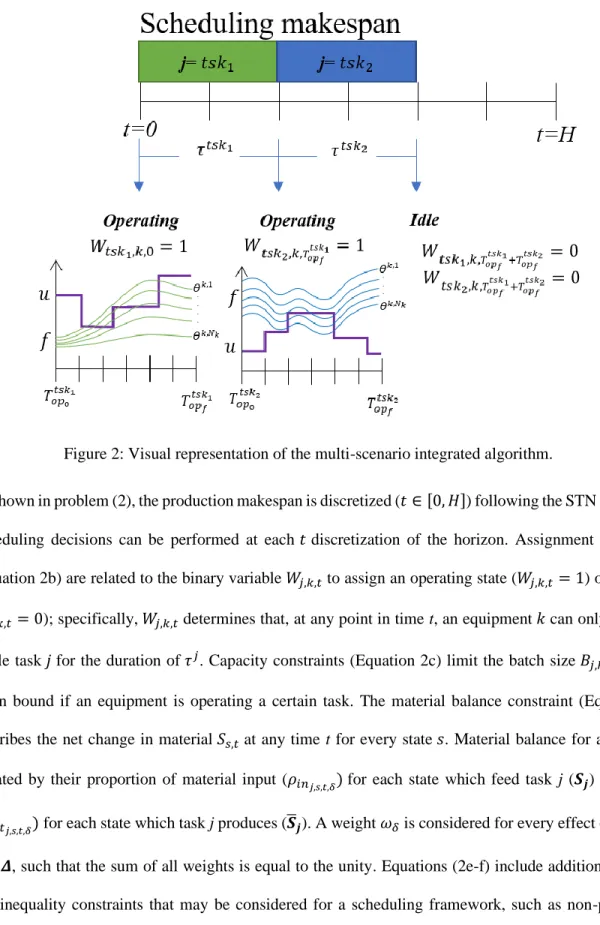
The multi-scenario integrated algorithm seeks to tie the scheduling model with the process dynamics, with the aim to perform simultaneous scheduling and control. A time grid that showcases the main structure of the proposed integrated approach is shown in Figure 2.
As shown in problem (2), the production makespan is discretized (𝑡 ∈ [0, 𝐻]) following the STN framework. Scheduling decisions can be performed at each 𝑡 discretization of the horizon. Assignment constraints (Equation 2b) are related to the binary variable 𝑊𝑗,𝑘,𝑡 to assign an operating state (𝑊𝑗,𝑘,𝑡= 1) or idle state (𝑊𝑗,𝑘,𝑡= 0); specifically, 𝑊𝑗,𝑘,𝑡 determines that, at any point in time t, an equipment 𝑘 can only operate a single task 𝑗 for the duration of 𝜏𝑗. Capacity constraints (Equation 2c) limit the batch size 𝐵
𝑗,𝑘,𝑡 within a given bound if an equipment is operating a certain task. The material balance constraint (Equation 2d) describes the net change in material 𝑆𝑠,𝑡 at any time t for every state 𝑠. Material balance for any state is dictated by their proportion of material input (𝜌𝑖𝑛𝑗,𝑠,𝑡,𝛿) for each state which feed task j (𝑺𝒋) and output (𝜌𝑜𝑢𝑡𝑗,𝑠,𝑡,𝛿) for each state which task j produces (𝑺̅𝒋). A weight 𝜔𝛿 is considered for every effect of scenario 𝛿 in 𝜟, such that the sum of all weights is equal to the unity. Equations (2e-f) include additional equality and inequality constraints that may be considered for a scheduling framework, such as non-preemptive operation, product demands, state capacity, etc.
3.4 Task-Dependent Disjunctive Decisions
Moreover, at each 𝑡 discretization, an exclusive task and unit-dependent logical disjunctive decision is performed, as shown in Equation (2g). The latter aims to engage the non-linear dynamic equations with the multi-period scheduling constraints. These logical selective decisions typically found in Generalized Disjunctive Programming (GDP) are posed by implementing different relaxation methods 81. Therefore, a
GDP modeling strategy is followed to recast the optimization problem into a logic-based model, offering a robust modeling method for cases where exclusive constraints have to be enforced. This means that task and unit assignment can be simultaneously considered by the scheduling and dynamic constraints.
In the embedded dynamic optimization problem, mechanistic process models are affected by the selection of the scheduling tasks, e.g. manufacture products A, B or C. The relationship between scheduling and process dynamics are reflected as a possible variation of product and task-specific operational constraints or model parameters. This co-dependence justifies the reason for the integration of transient mechanistic unit models and scheduling. As described earlier, the STN formulation regards different operating configurations as alternating tasks that may be assigned to a unit, as shown in Figure 2. Therefore, the total logical disjunctions of a unit comprise the different tasks (dynamics) that the unit may perform; this information is described in the set 𝑱𝒌, such that, a unit will have as much disjunctions as elements in 𝑱𝒌. If the disjunction indicator variable is active (i.e. 𝑌𝑗,𝑘,𝑡= 𝑇𝑟𝑢𝑒), an operating state is considered, thus the mechanistic task-dependent process equations and constraints (i.e. ℎ𝑗,𝑘,𝛿𝑚 and 𝑔𝑗,𝑘,𝛿𝑝 ) are enforced. Control
trajectories 𝑢𝑗,𝑘,𝑡 are obtained while maintaining the control variable within pre-specified bounds. Moreover, proportion of material input and output are calculated based on initial and final conditions, respectively. Operating cost (𝐹𝑘,𝑡,𝛿) is a key variable in the formulation that depends on control profiles, operating time of the current active equipment performing a given task 𝜏𝑗, batch size 𝐵𝑗,𝑘,𝑡, or ending
conditions of mechanistic state variables 𝑥𝑗,𝑘,𝑡,𝛿(𝑇𝑜𝑝𝑓 𝑗 ).