Investigating Multi-Modal
Features for Continuous Affect
Recognition Using Visual Sensing
Haolin Wei, B.Sc. (hons)
A dissertation submitted in fulfilment of the requirements for the award of
Doctor of Philosophy (Ph.D.)
to the
Dublin City University
School of Electronic Engineering
Supervisors:
Prof. Noel E. O’Connor
Dr. David S. Monaghan
Declaration
I hereby certify that this material, which I now submit for assessment on the pro-gramme of study leading to the award of Doctor of Philosophy is entirely my own work, that I have exercised reasonable care to ensure that the work is original, and does not to the best of my knowledge breach any law of copyright, and has not been taken from the work of others save and to the extent that such work has been cited and acknowledged within the text of my work.
Signed:
ID No: 57106126 Date:
Abstract
Emotion plays an essential role in human cognition, perception and rational decision-making. In the information age, people spend more time then ever before interacting with computers, however current technologies such as Artificial Intelligence (AI) and Human-Computer Interaction (HCI) have largely ignored the implicit information of a user’s emotional state leading to an often frustrating and cold user experience. To bridge this gap between human and computer, the field of affective computing has become a popular research topic. Affective computing is an interdisciplinary field encompassing computer, social, cognitive, psychology and neural science. This thesis focuses on human affect recognition, which is one of the most commonly investigated areas in affective computing. Although from a psychology point of view, emotion is usually defined differently from affect, for this thesis the terms emotion, affect,
emotional state and affective state are used interchangeably.
Both visual and vocal cues have been used in previous research to recognise a human’s affective states. For visual cues, information from the face is often used. Although these systems achieved good performance under laboratory settings, it has proved a challenging task to translate these to unconstrained environments due to variations in head pose and lighting conditions. Since a human face is a three-dimensional (3D) object whose 2D projection is sensitive to the aforementioned variations, recent trends have shifted towards using 3D facial information to im-prove the accuracy and robustness of the systems. However these systems are still focused on recognising deliberately displayed affective states, mainly prototypical expressions of six basic emotions (happiness, sadness, fear, anger, surprise and dis-gust). To our best knowledge, no research has been conducted towards continuous recognition of spontaneous affective states using 3D facial information.
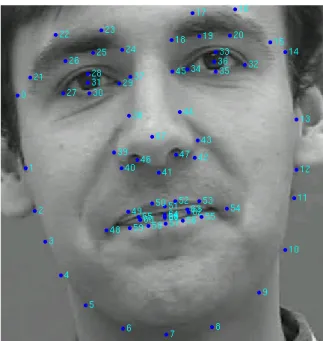
The main goal of this thesis is to investigate the use of 2D (colour) and 3D (depth) facial information to recognise spontaneous affective states continuously. Due to a lack of an existing continuous annotated spontaneous data set, which contains both colour and depth information, such a data set was created. To better understand the processes in affect recognition and to compare results of the proposed methods, a baseline system was implemented. Then the use of colour and depth information for affect recognition were examined separately. For colour information, an investigation was carried out to explore the performance of various state-of-art 2D facial features using different publicly available data sets as well as the captured data set. Experiments were also carried out to study if it is possible to predict a human’s affective state using 2D features extracted from individual facial parts (E.g. eyes and mouth). For depth information, a number of histogram based features were used and their performance was evaluated. Finally a multi-modal affect recognition framework utilising both colour and depth information is proposed and its performance was evaluated using the captured data set.
Acknowledgements
Firstly, I would like to greatly thank my supervisors Prof. Noel E. O’Connor, Dr Gabriel Miro Muntean, Dr Patricia Scanlan and Dr David Monaghan for all their guidance and support during my time pursing this interesting yet challenging research project.
Thanks to all the current and past members of Insight who offered advice and support. I would particularly like to thank Dr Kevin McGuinness, Dr Philip Kelly, Marc Gowing, Edmond Mitchell, Dr Dian Zhang, Jinlin Guo and Dr Feiyan Hu for their help on every step of my research. Lastly, I would like to thank my wife, Lingge Li and my parents for their understanding and support.
This work is co-funded by Bell Labs Ireland and the Irish Research Council under the Enterprise Partnership scheme. The research is also supported in part by the European Commission under the Contract FP7-ICT-287723 REVERIE and European Union’s Horizon 2020 Framework Programme under Grant Agreement no. 643491.
Contents
Abstract i
Acknowledgements ii
List of Figures viii
List of Tables xii
List of Publications xv 1 Introduction 1 1.1 Motivation . . . 1 1.2 Research Objectives . . . 5 1.3 Research Contributions . . . 6 1.4 Thesis Outline . . . 7
2 Related Work and Background 9 2.1 Introduction . . . 9 2.2 Emotion Models . . . 9 2.2.1 Categorical Model . . . 10 2.2.2 Dimensional Model . . . 11 2.2.3 Appraisal Model . . . 13 2.2.4 Discussion . . . 15
2.3 Emotion and Affect Datasets . . . 15
2.3.2 Modalities and Cues . . . 17
2.3.3 Annotating Affect Data . . . 23
2.3.4 Existing Datasets . . . 29
2.3.5 Discussion . . . 35
2.4 Affect Recognition . . . 35
2.4.1 Feature Extraction . . . 36
2.4.2 Machine Learning for Affect Recognition . . . 45
2.4.3 Multi-Modal Fusion . . . 53
2.4.4 Performance Evaluation . . . 53
2.4.5 Discussion . . . 55
2.5 Baseline Systems . . . 57
2.6 Conclusion . . . 58
3 Multi-Modal Dataset Collection and Annotation 60 3.1 Introduction . . . 60
3.2 Dataset Construction . . . 61
3.2.1 Participants and Environment . . . 61
3.2.2 Procedure . . . 61
3.2.3 Elicitation of Affective States . . . 62
3.3 Multi-Modal Recording Setup . . . 63
3.3.1 Sensors and Software . . . 63
3.4 Annotations . . . 64 3.4.1 Segmentation . . . 64 3.4.2 Annotation Guidelines . . . 66 3.4.3 Post-processing . . . 67 3.5 Statistical Analysis . . . 67 3.6 Conclusion . . . 71
4.1 Introduction . . . 73
4.2 Experiment 1: Configuration of histogram-based features . . . 75
4.2.1 Data Pre-processing . . . 76
4.2.2 Experimental Procedure . . . 77
4.2.3 Experimental Results and Analysis . . . 78
4.3 Experiment 2: Annotation Delay . . . 82
4.3.1 Experimental Procedure . . . 82
4.3.2 Experimental Results and Analysis . . . 83
4.4 Experiment 3: The effect of post-processing . . . 83
4.4.1 Experimental Procedure . . . 88
4.4.2 Experimental Results and Analysis . . . 88
4.5 Experiment 4: Generalisation across datasets . . . 91
4.5.1 Experimental Procedure . . . 91
4.5.2 Experiment Results and Analysis . . . 92
4.6 Experiment 5: Affect Recognition using Convolutional Neural Network 95 4.6.1 Data Pre-processing . . . 96
4.6.2 Experimental Procedure . . . 97
4.6.3 Experimental Results and Analysis . . . 98
4.7 Conclusion . . . 101
5 Multi-Modal Affect Recognition 103 5.1 Introduction . . . 103
5.2 Face Detection using Depth Data . . . 105
5.2.1 Data Collection and Annotation . . . 107
5.2.2 Data Pre-processing . . . 107
5.2.3 Experimental Procedure . . . 108
5.2.4 Experimental Results and Analysis . . . 108
5.3.1 Data Pre-processing . . . 112
5.3.2 Experimental Procedure . . . 112
5.3.3 Experiment Results and Analysis . . . 113
5.4 A Multi-Modal Framework . . . 117
5.4.1 Experiment 1: Feature-Level Fusion . . . 118
5.4.2 Experiment 2: Decision-Level Fusion . . . 119
5.5 Conclusion . . . 121
6 Conclusion 124 6.1 Overview . . . 124
6.2 Thesis Summary . . . 124
6.3 Analysis and Discussion of Research Objectives . . . 128
6.4 Further Work . . . 130
Appendix 133 A Baseline System Implementation 133 A.1 Introduction . . . 133
A.2 Comparison of Existing Systems . . . 133
A.3 Baseline System Implementation . . . 137
A.3.1 Feature Extraction . . . 137
A.3.2 Affect Prediction . . . 144
A.3.3 Fusion . . . 149
A.4 Experiments and Results . . . 150
A.4.1 Optimising Cluster Size . . . 150
A.4.2 Optimising Kernel Width . . . 153
A.4.3 Optimising Hyperparameters . . . 153
A.4.4 Results Comparison . . . 153
B Head Nod and Shake Detection 156
B.1 Introduction . . . 156
B.2 Head Pose Estimation . . . 158
B.3 Head Nod and Shake Detection . . . 160
B.4 Recognition Results . . . 162
List of Figures
2.1 Facial expressions of the six basic emotions - happiness, sadness, fear,
anger, surprise and disgust . . . 10
2.2 Circumplex model of affect . . . 12
2.3 Structure of the OCC model . . . 14
2.4 Overview of modalities and cues used in affective computing . . . 18
2.5 The AUs of FACS . . . 19
2.6 Example of facial AUs and their combinations . . . 19
2.7 GSR Sensor . . . 23
2.8 EMG Sensor . . . 24
2.9 The Microsoft Band 2 . . . 24
2.10 Screenshot of ELAN interface including the menu bar, the media player control, the tiers, and a number of viewers. . . 26
2.11 ANVIL’s graphical user interface. . . 27
2.12 Feeltrace graphical user interface . . . 28
2.13 Gtrace graphical user interface . . . 28
2.14 ANNEMO: web-based annotation of affective and social behaviours . 29 2.15 Overview of A Typical Affect Recognition System . . . 36
2.16 Sample Landmarks (TalkingFaceVideo, 2002) . . . 39
2.17 Data points and hyperplanes (Cortes and Vapnik, 1995) . . . 47
2.18 Support Vector Machine for Regression . . . 48
2.19 A 2-layer Neural Network . . . 49
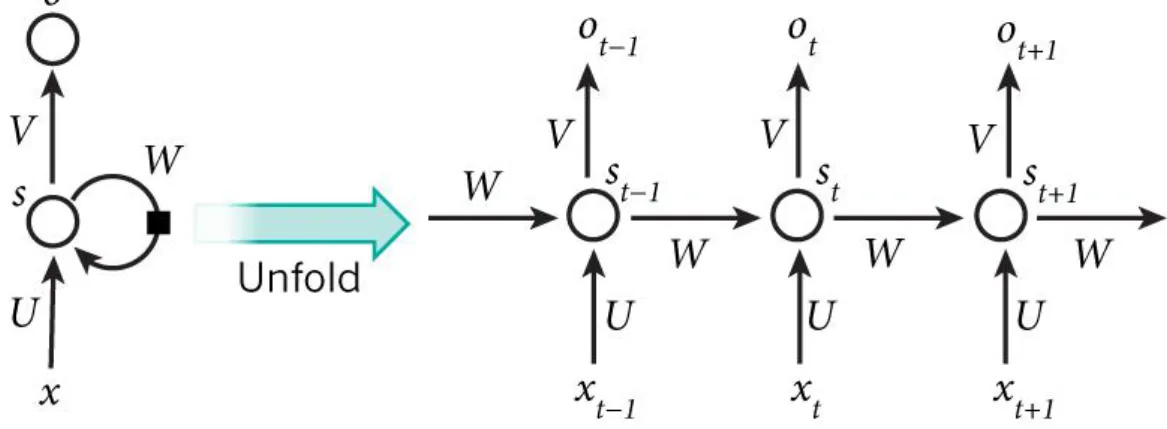
2.21 An RNN and its unfolded representation. x: input, o:output, V, W,
U: weight matrix . . . 52
3.1 Plan-view of capture environment layout . . . 63
3.2 Overview of the Multi-Station Capture System . . . 65
3.3 Sample data from the dataset . . . 65
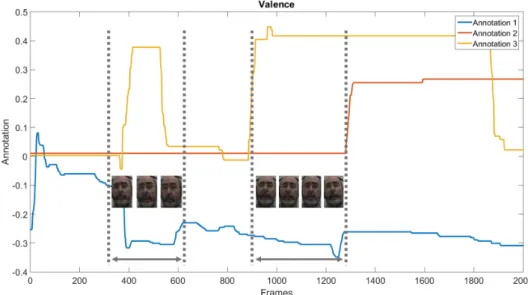
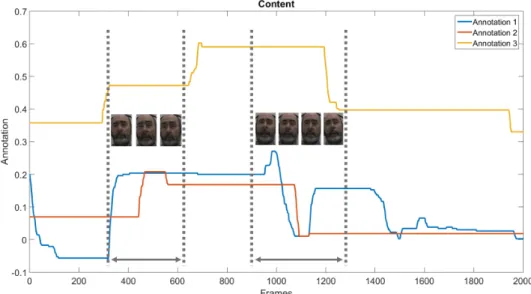
3.4 Annotation comparison for different annotators on arousal dimension 69 3.5 Annotation comparison for different annotators on valence dimension 70 3.6 Annotation comparison for different annotators on agreement dimension 70 3.7 Annotation comparison for different annotators on content dimension 71 4.1 Overview of pre-processing steps . . . 76
4.2 Comparison of the performance of different block size configurations in terms of CC score on Arousal and Valence dimensions . . . 81
4.3 Comparison of the performance of different block size configurations in terms of CC score on Arousal and Valence dimensions . . . 85
4.4 Plot of arousal delay for static features . . . 86
4.5 Plot of arousal delay for dynamic features . . . 86
4.6 Plot of valence delay for static features . . . 87
4.7 Plot of valence delay for dynamic features . . . 87
4.8 Plot of post processed prediction on arousal dimension using LBP-TOP features . . . 89
4.9 Plot of post processed prediction on valence dimension using LPQ-TOP features . . . 90
4.10 Facial Part . . . 97
5.1 Comparison between colour and depth image under different lighting conditions. (a) and (b) shows the colour image with light on and off.
(c) shows the depth image with light off . . . 104
5.2 Samples of extracted depth image and the corresponding colour image.107 5.3 Pre processing steps . . . 109
5.4 Visualisation of learned HOG detector . . . 110
5.5 Example detection results using 8 bit depth image . . . 111
5.6 Overview of pre-processing steps . . . 112
5.7 Data obtain from HD webcam and Kinect. Left: Colour image. Right: Depth Image . . . 116
5.8 Comparison between colour and depth predictions on arousal dimension117 5.9 Comparison between colour and depth predictions on valence dimension117 5.10 Overview of feature-level and decision-level multi-modal system . . . 118
I Overview of the baseline system . . . 138
II Baseline system feature set (Nicolleet al., 2012) . . . 138
III Effects of varying each of the first four shape parametersXi (Baggio, 2012) . . . 140
IV Appearance Model (Matthews and Baker, 2004) . . . 142
V Comparison of delay probability between baseline paper (left) and our implementation (right) . . . 147
VI The affect value distribution for the first two clusters (60 clusters in total) of each dimension for dynamic shape features . . . 151
I System Overview . . . 159
II Yaw, Pitch and Roll . . . 160
III (a) Typical Nod Sequence. (b) Typical Shake Sequence. . . 160
IV (a) Transition of nodHMM’s hidden states. (b) Transition of shakeHMM’s hidden states. (c) Transition of otherHMM’s hidden states . . . 162
List of Tables
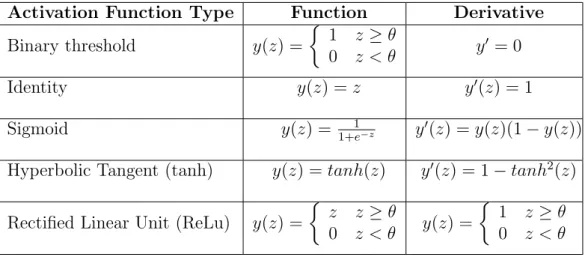
2.1 Comparison of datasets for human affect recognition. 2D: Colour in-formation. 3D: Colour and depth inin-formation. A: Audio inin-formation. B: Biomedical information. C:Continuous annotation. D: Discrete annotation . . . 31 2.2 Commonly used activation functions and their corresponding derivatives 49 2.3 State-of-the-art recognition results in terms of CC score on the
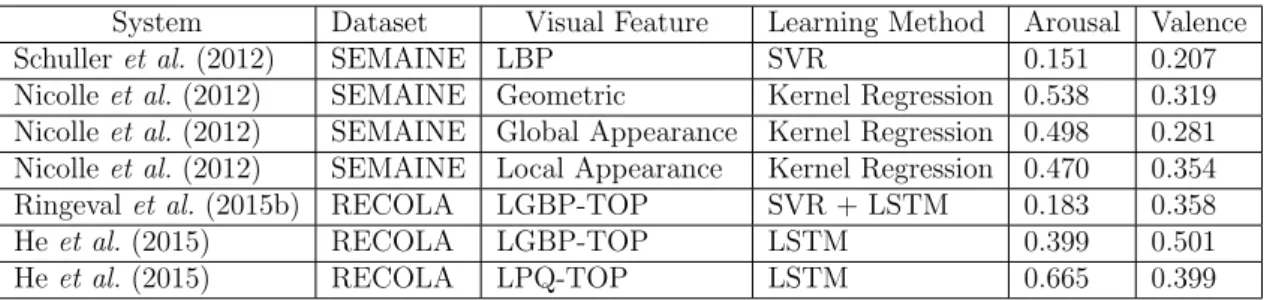
de-velopment partition of different datasets. . . 58 3.1 Statistics of the annotations . . . 69 4.1 Histogram-based features and corresponding datasets that used to
evaluate their performance . . . 74 4.2 Configuration for different histogram-based features . . . 77 4.3 Original number of features and reduced number of features for
dif-ferent block sizes . . . 78 4.4 Results on development partition for different block sizes. The best
results in different metrics are highlighted in bold. . . 79 4.5 Computation time in seconds for histogram-based features with
dif-ferent block size configurations. The LBP, LPQ and LGBP features are computed per frame. The LBP-TOP, LPQ-TOP and LGBP-TOP features are computed every 5 frames. . . 82 4.6 Results on development partition for different block sizes with shifted
4.7 Original and post processed result on the development partition of AVEC 2015 dataset . . . 89 4.8 Comparison with selected baseline results on the development set on
arousal dimension . . . 90 4.9 Comparison with selected baseline results on the development set on
valence dimension . . . 90 4.10 Recognition result for different histogram-based features on AVEC
2012 development partition . . . 92 4.11 Recognition result for different histogram features on DCU
develop-ment partition . . . 93 4.12 Recognition result for different histogram features on AVEC 2012
development partition with delay compensation . . . 94 4.13 Recognition result for different histogram features on DCU
develop-ment partition with delay compensation . . . 94 4.14 Recognition result on AVEC 2012 development partition after
post-processing . . . 95 4.15 Recognition result on DCU development partition after post-processing 95 4.16 CC score without annotation delay using CNN . . . 99 4.17 CC score with annotation delay using CNN . . . 100 4.18 Results comparison between histogram-based features and facial parts
in terms of CC score . . . 101 5.1 Face detection results using depth images . . . 110 5.2 Original number of features and reduced number of features for
dif-ferent block sizes . . . 113 5.3 Results on development partition for different block sizes. The best
5.4 Results on development partition for different block sizes with shifted label . . . 115 5.5 Results on development partition after post-processing steps . . . 115 5.6 Comparison between single modality and feature-level fusion on
de-velopment partition . . . 120 5.7 Comparison between linear regression and LSTM recognition results
on development partition . . . 121 5.8 Recognition results comparison between single modality, feature-level
and decision-level fusion on test partition. FL : Feature Level Fusion, LR : Linear Regression . . . 121 I AVEC 2012 Audio Low-Level Descriptors (LLD) Schuller et al.(2012) 134 II Set of all 42 functionals. 1Not applied to delta coefficient contours.
2For delta coefficients the mean of only positive values is applied, other wise the arithmetic mean is applied. 3Not applied to voicing related LLD Schuller et al. (2012) . . . 135 III Pearson’s correlation score for different systems tested on AVEC 2012
development database . . . 137 IV Scale size for different local patch. PL: Periorbital Lines, GL:
Glabel-lar Lines, NL: Nasolabial Folds, SL: Smile Lines . . . 143 V Average label variance for each affect dimension with different cluster
sizes using dynamic shape features . . . 152 VI Comparison between result reported in the paper and the
implemen-tation. Left: results reported in original paper. Right: results from our implementation . . . 154 I Recognition Results for Training set . . . 162 II Recognition Results for Testing set . . . 162
List of Publications
• Kuijk, F., Apostolakis, K.C., Daras, P., Ravenet, B., Wei, H., & Monaghan, D.S.(2015 June). Autonomous agents and avatars in REVERIE’s virtual envi-ronment. In Proceedings of the the 20th International Conference on 3D Web Technology (pp. 279-287). ACM.
• Wei, H., Monaghan, D.S., OConnor, N.E., & Scanlon, P. (2014, September). A new multi-modal dataset for human affect analysis. In International Work-shop on Human Behavior Understanding (pp. 42-51). Springer International Publishing.
• OConnor, N.E., Alexiadis, D., Apostolakis, K., Daras, P., Izquierdo, E., Li, Y., Monaghan, D.S., Rivera, F., Stevens, C., Van Broeck, S. and Wall, J., & Wei, H. (2014, January). Tools for user interaction in immersive environments. In International Conference on Multimedia Modeling (pp. 382-385). Springer International Publishing.
• Li, Y., Wei, H., Monaghan, D.S., & OConnor, N.E. (2014, January). A low-cost head and eye tracking system for realistic eye movements in virtual avatars. In International Conference on Multimedia Modeling (pp. 461-472). Springer International Publishing.
• Wei, H., Scanlon, P., Li, Y., Monaghan, D.S., & O’Connor, N.E. (2013, July). Real-time head nod and shake detection for continuous human affect
recogni-tion. In2013 14th International Workshop on Image Analysis for Multimedia Interactive Services (WIAMIS) (pp. 1-4). IEEE.
Chapter 1
Introduction
1.1
Motivation
In most parts of the world digital devices such as computers and mobile phones have become ubiquitous. We use them in work, communication, shopping and entertain-ment. This growing ubiquity has led to a focus on human-centred design. One of the key components of human-centred design is human computer interaction (HCI). Recent years have witnessed a trend away from traditional HCI such as mouse and keyboard to a more user-centred design such as the use of hand gestures and voice commands. However, these designs still ignore the user’s emotional states, which is a fundamental component of human-to-human communication. As a result, such interaction not only filters out a large amount of information available in the interac-tion process, but also means that the interacinterac-tion experience is frequently perceived as cold, impersonal and frustrating (Zeng et al., 2009).
In addition to HCI scenarios, systems that can sense people’s emotional states are also potentially beneficial for customer services, call centres, e-learning, intelligent autonomous vehicles, games and other entertainment. For example: an autonomous monitoring system in an e-learning environment could provide live feedback to the lecturer on the status of the students; an automatic call centre could decide when
to pass the customer to human operators (Lee and Narayanan, 2005) and an in-telligent vehicle could monitor the tiredness or mood of the driver to potentially avoid collisions (Ji et al., 2006). Other important applications of automatic affect recognition are in more traditional/theoretical affect-related research such as psy-chology, behavioural science and neuroscience, where such systems could improve the reliability of measurements in subjective human trials and speed up currently time-consuming manual processing of human affective behaviour data (Ekman and Rosenberg, 1997).
Given the practical and theoretical importance of this field, a significant body of research in the past 40 years has been conducted towards automatic affect recog-nition. Williams and Stevens (1972) presented the first attempt to identify and measure parameters from speech signals that reflect a speaker’s emotional states. Suwa et al. (1978) showed an early attempt to analyse facial expressions automati-cally by tracking the motion of twenty identified points on the face. With advances in machine learning, Kobayashi and Hara (1991) proposed to recognise the six basic emotions (happiness, sadness, fear, disgust, anger and surprise) from face images using a neural network. The study carried out by Dellaert et al. (1996) compared multiple pattern recognition techniques to recognise a subset of the basic emotions (happiness, sadness, anger and fear) from speech. Motivated by the limitations of using only visual or vocal cues, Chen et al. (1998) demonstrated one of the first attempts at using both audio and visual modalities for emotion recognition and showed an improvement in overall recognition accuracy of the six basic emotions. Traditionally, facial information used in affect recognition has been based on 2D data (colour pixel information) which is usually limited by head pose and illumi-nation changes. In order to tackle these problems 3D data can be used. An early attempt at recognising the six basic emotions from static 3D facial data was carried out by Wanget al.(2006), where the authors showed improved results compared to the use of static 2D facial data. More recently, Tsalakanidou and Malassiotis (2009)
presented a system that uses dynamic 3D facial data for affect recognition.
Although a seminal study by Ambady and Rosenthal (1992) suggested that vi-sual cues from the face and body are both important for judging people’s emotional state, the existing literature on automatic affect recognition did not focus on the information carried by the body until 2004 (Camurriet al., 2004). Since then, a num-ber of researchers have attempted to combine facial expressions and body gestures for affect recognition (Gunes and Piccardi, 2007; Karpouzis et al., 2007). Inter-est in detecting emotions from physiological signals emerged from the well known work of Picardet al. (2001) where the authors use four physiological sensors includ-ing electromyogram (EMG), photoplethysmography (PPG), galvanic skin response (GSR) and respiration sensors to recognise eight emotional states (neutral, anger, hatred, grief, platonic love, romantic love, joy and reverence). Since then a number of approaches have also been proposed for other types of sensors such as Electroen-cephalographic (EEG) (Takahashi, 2004; Nakasoneet al., 2005) and thermal infrared cameras (Tsiamyrtzis et al., 2007).
As can be seen, most of early research on automatic affect recognition has fo-cused mainly on recognising discrete emotional states, however, a number of re-searchers have shown that a single label (or small number of discrete classes) may not reflect the subtle and complex affective states that occur in everyday inter-actions (Russel, 1980). Hence, the recent trend has shifted towards the use of a dimensional description of human affect, where an affective state is represented by a number of latent dimensions (Russel, 1980). Two of the most commonly used dimensions are valence and arousal, where valence reflects how a person feels, from positive (e.g. happy and joy) to negative (e.g. anger and fear) and arousal reflects how likely a person is to take an action, from active to passive. Considering auto-matic dimensional affect recognition, early attempts usually simplify the problem to a two-class (positive-negative or active-passive) or a four-class (positive-active, positive-passive, negative-active, negative-passive) valence-arousal related
classifi-cation problem (Fragopanagos and Taylor, 2005; Caridakis et al., 2008; Glowinski
et al., 2008; Schulleret al., 2011). Since 2011, a number of researchers have started to treat the automatic dimensional affect recognition problem as a regression problem. For instance, Nicolaou et al. (2011) presented one of the first attempts to continu-ously recognise spontaneous affect in the valance-arousal parameter space using both visual and vocal cues. The current focus in automatic affect recognition research is to continuously recognise the spontaneous affective state using multi-modal cues in this dimensional space (Schuller et al., 2012; Valstar et al., 2013, 2014; Ringeval
et al., 2015b).
While the current approaches in continuous spontaneous affect recognition have proven to be highly successful using data captured in controlled laboratory settings, little work have been done on using data from an unconstrained environment (e.g. with diverse illumination conditions and backgrounds). This forms the motivation in this thesis for the investigation of different approaches that meet the requirements of real-world applications.
Firstly, when using descriptors to represent different affective states, these de-scriptors should be invariant to any change of the captured subject. For example when a person’s face is only partially visible due to being covered by hair or look-ing away from the camera, the affect recognition system should still give a correct prediction of a person’s affective state.
Secondly, due to the variety of environments that might be encountered in prac-tice, there are situations where a colour image is not clearly visible (e.g. under ex-treme low-light conditions). The affect recognition system should be able to adapt to the environment and use additional modalities to provide a correct prediction.
These two requirements motivated the main goal of this thesis, which is to inves-tigate how visual cues could be used for continuous spontaneous affect recognition. The visual cues consist of colour information which can be captured by a traditional camera, and depth information which can be obtained using a depth sensor. This
thesis focuses on the visual cues from the human face since the face is a crucial modality in conveying human expressions. Facial expressions could indicate a per-son’s affective state, intentions and ultimately, elicit other people’s response. For instance, Segal (2008) suggested that it is possible to infer other people’s affective state just by looking at the individual’s face, without any complementary informa-tion such as voice or gesture, indicating that the face could be the most effective communication tool.
1.2
Research Objectives
There are several research objectives identified in this thesis when using visual cues for continuous spontaneous affect recognition. The initial research objective is to thoroughly investigate the performance of popular low-level appearance features for continuous affect recognition. In particular, this thesis focuses on histogram-based features since they are one of the most commonly used appearance features for continuous affect recognition. To accomplish this objective, experiments are carried out to select the best configurations for different histogram-based features using a publicly available dataset. Then using the best configurations, different histogram-based features are extracted and evaluated on other datasets in order to study which features give the best performance for continuous affect recognition across different capture settings.
The next research objective is to study if individual facial parts such as mouth, and eyes could be used to recognise affective state. The motivation behind this research objective is that most of the existing approaches use features extracted based on the entire face image. However one limitation of this approach is that it might not generalise well for situations such as partial occlusions. If it is possible to recognise affective state from individual facial parts, this should increase the robustness of the system to partial occlusions.
Another research objective is to investigate if features extracted from low cost depth sensors could be used for continuous affect recognition. To accomplish this objective, a face detection algorithm based on a depth image is first proposed. Then the histogram-based features are applied to the data captured by the depth sensor and their performance is evaluated.
The final research objective is to investigate if the use of both colour and depth features lead to a significant increase in performance in affect recognition. With fea-tures from different modalities, the issue of fusion is a crucial consideration. In this context both feature-level fusion and decision-level fusion need to be investigated.
1.3
Research Contributions
The main scientific contributions provided by this thesis are summarised as:
• Designing and developing a novel data capture platform for collecting synchro-nised video, depth and audio streams.
• To the best of my knowledge, I captured one of the first spontaneous and con-tinuously annotated multi-modal dataset based on human interaction during a debate.
• Thoroughly investigating the histogram-based appearance features for contin-uous affect recognition.
• Proposing automatically generated appearance features from facial parts for continuous affect recognition.
• Extending the low level appearance features to the depth modality for contin-uous affect recognition.
• Developing a multi-modal framework for continuous affect recognition using colour and depth information.
1.4
Thesis Outline
The remainder of this thesis is structured as follows:
In Chapter 2, the relevant technical background and in particular the limitations of the current affect recognition systems are reviewed. First, different affect models used to represent a human’s affective state are introduced. Next, an overview of the existing datasets used for affect recognition including how these datasets were captured and annotated are examined. Then different features from video and depth modalities used for affect recognition are explored before reviewing machine learning techniques. Finally, the performance evaluation metrics used for affect recognition are discussed.
In Chapter 3, the steps of designing and developing a multi-modal data capture platform that could collect synchronised colour, depth and audio streams are first described. Then a detailed description is given on how this platform can be used to construct a three-way debate affect dataset. The processes for segmentation and annotation of the dataset are then presented, and finally a statistical analysis of the dataset is performed to demonstrate its value as a research tool.
In Chapter 4, a thorough investigation of which histogram based features from the colour modality give the best affect recognition results is carried out. In par-ticular, the first set of experiments concentrate on evaluating the performance of hand-crafted low-level appearance features extracted from an entire face region, while the second set of experiments focus on automatically generated features from individual facial parts. These experiments are carried out using different datasets including two publicly available datasets, along with the dataset captured in the previous Chapter.
In Chapter 5, a face detector that using depth images is first proposed. Then the depth face detector is used to extract the face region from the depth data captured in Chapter 3. The histogram-based features are applied to the depth data,
and their performance is examined. Various experiments are performed to study how predictions from the video and depth modalities could be fused. Specifically, early fusion and late fusion methods are evaluated. Finally, a multi-modal affect recognition framework which can be used in real world settings is proposed.
In Chapter 6, outcomes of the research work to date are presented and further work directions are proposed.
Chapter 2
Related Work and Background
2.1
Introduction
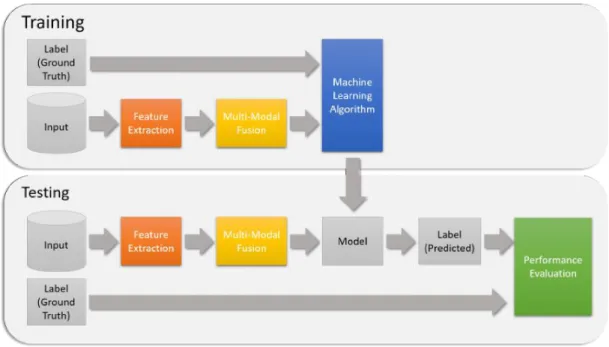
In this chapter an overview of the background literature essential to understanding the core work carried out in this thesis are given. In section 2.2, various compu-tational models for human emotional processes are introduced. Their advantages and disadvantages are discussed. In section 2.3, a review of the currently available datasets for affect recognition is given. In section 2.4, the current state-of-the-art techniques used in affect recognition are explored. First, different features used for 2D and 3D signals are examined, followed by a review of the machine learning tech-niques that will later be employed for the work carried out in this thesis. Finally, the performance evaluation metrics commonly used in affect recognition are explained.
2.2
Emotion Models
There has been a long debate on the nature and the causal generation of emotion by psychologists since the latter third of the nineteenth century when psychology began to form as an independent academic discipline (Calvoet al., 2014). Driven by the needs for basic emotion and cognition research, various computational emotion
models have been proposed along with the theories. These computational models have bridged the gap between psychology and computer science. Currently there are three commonly used models in affective computing. This section briefly introduces these models. A more detailed discussion on each of these models can be found in Fox (2008) and Scherer et al. (2010).
2.2.1
Categorical Model
Influenced by Darwin’s evolutionary view of emotions (Darwin, 1872), the discrete categorical emotion model suggests that there are a set of basic emotions that drive the motives of human beings (Tomkins, 1962, 1963). Most of the categorical models describe emotions using a list of affective-related keywords. By showing subjects still photographs of acted facial expressions, Ekman (1971) concluded that six ba-sic emotions can be universally recognised. These emotions are happiness, sadness, fear, anger, disgust, and surprise (See Figure 2.1 for an example of each emotion). Sometimes, an additional neutral label is also added resulting in seven basic emo-tions. Although the number of basic emotions varies from 2 to 18 depending on different theories (James, 1884; Izard, 1971; Frijda and Swagerman, 1987; Ortony and Turner, 1990; Wierzbicka, 1992), there has been considerable agreement on Ekman’s six basic emotion categories.
Figure 2.1: Facial expressions of the six basic emotions - happiness, sadness, fear, anger, surprise and disgust (Ekman and Friesen, 1976)
However, a number of psychology researchers suggest that it is necessary to go beyond discrete emotions. For instance, Baron-Cohenet al. (2004) argues that it is important to include cognitive mental states such as agreement, interest, thinking
and concentrating in addition to the basic emotions, as they occur more often in ev-eryday interaction compared to the basic emotions. To date, the discrete categorical model has been the most commonly adopted approach in automatic affect recogni-tion research. The advantage of the category representarecogni-tion is that people use these words in daily life to describe observed emotions, which makes this scheme intuitive to use and understand. However, there are two main drawbacks of the categorical model: (a) it can not reflect the change in intensity of people’s affective state contin-uously, for example people may have different levels of happiness from pleasure, joy to ecstasy; (b) it fails to express subtle or blended affective states like depression, contempt and embarrassment that could occur in a natural communication setting.
2.2.2
Dimensional Model
The dimensional model is an alternative approach to the categorical description of human affect. It is based on the pioneering work of Wundt (1905). They argued that feelings can be described by the dimensions of strain-relaxation,arousing-inhibition
and pleasantness-unpleasantness. Similarly, the study carried out by Osgood et al.
(1975) on affective meaning suggested that three key dimensions namely evaluation
(good or bad), potency (strong or weak) and activity (active or passive) exist in almost every language/culture community. The dimensional model assumes that affective states are not independent from one another; instead, they are related to one another by the most fundamental affective feelings called core affect (Russell and Barrett, 1999). Typically, two to four dimensions are usually used to represent core affect. One of the most widely used dimensional models is the valence-arousal model proposed by Russel (1980). The model is usually represented by a circular configuration called Circumplex of Affect where each axis indicates one core affect, and different emotional labels could be plotted at various positions on the two-dimensional plane (See Figure 2.2). The valence dimension reflects how people feel,
from positive (e.g. happy and joy) to negative (e.g. anger and fear). The arousal dimension reflects how likely a person is to take an action: low arousal indicates less energy to take an action, high arousal indicates more energy to take an action.
Figure 2.2: A graphical representation of the circumplex model of affect with the horizontal axis representing the valence dimension and the vertical axis representing the arousal dimension (Russel, 1980)
As the two-dimensional model cannot easily differentiate some affective states that share similar values for valence and arousal (e.g. anger and fear, which both result in high arousal and negative valence), a third dimension called dominance could be added. The dominance dimension reflects how much a person feels in control (e.g. anger indicates high dominance and fear indicates low dominance). This model is usually referred to as the PAD emotion space for pleasure, arousal and dominance (Mehrabian, 1995) or asemotional primitives (Espinosaet al., 2010). The study carried out by Fontaineet al.(2007) suggested to also include expectation (the degree of anticipating) as a fourth dimension to distinguish better emotions such as surprise from other affective states. Compared to the categorical model, the dimensional model is able to offer more flexibility when analysing emotions. However, as pointed out by Russel (1980), the dimensional approach is only useful
to characterize core affect instead of complete emotions since complete emotions
only fall into certain regions of the space defined by the core affect dimensions. For example when the valence-arousal dimensional model is used, fear and anger could share identical core affects. Even when the four-dimensional model is used, it is still difficult to differentiate emotions such as shame, guilt and embarrassment (Fontaine
et al., 2007). Another challenge of using the dimensional approach is the annotation delay when continuously annotating data for scientific experiments. This delay is mainly caused by the reaction time between an annotator perceiving the affective state, then giving the corresponding evaluation scores. The use of such delayed ground truth could lower the performance of the affect recognition system.
2.2.3
Appraisal Model
The appraisal models or componential appraisal models are based on the pioneering work of Arnold (1960) and Lazarus (1966) where emotion is mainly seen as de-termined by appraisal, and it is generated through continuous, recursive subjective evaluation of both people’s potential and the status of their environment. For exam-ple, a farmer who sees an approaching bear will react differently from a hunter (e.g. fear vs. excitement) based on the evaluation of individual’s potential. The same farmer who sees a bear in a zoo will also react differently to when he sees the bear in the wild, based on the evaluation of the environment (e.g. interest vs. fear). One of the most widely used appraisal models is the OCC model developed by Ortony, Collins and Clore (1988), which describes the cognitive structure of emotions. The OCC model proposed a hierarchy that classifies 22 emotions along with three main branches as shown in Figure 2.3. The three branches are (1) emotions concerning consequences of events (e.g. pleased and displeased), (2) actions of agents (e.g. ap-proving and disapap-proving), and (3) aspects of objects (e.g. liking and disliking). Each emotion is then treated as a valenced (positive or negative) reaction in terms
of one of the three main branches as described in Ortony et al.(1988). In addition, some subsequent branches could combine together to form compound emotions.
Figure 2.3: Structure of the OCC model (Ortony et al., 1988)
The advantage of the appraisal model is that it does not limit affective states to a fixed number of discrete categories or a set of affect dimensions. In contrast, it focuses on the variability of affective states as a result of change in all rele-vant contributing factors including cognition, motivation, physiological reactions,
motor expressions and feelings (Gunes, 2010; Calvo et al., 2014). This makes it possible to differentiate and model the full-blown emotion space. However, the
ap-praisal model requirescomplex, multi-componential and sophisticated measurements of change. How to use it in automatic affect recognition with such a framework remains an open research question (Gunes, 2010).
2.2.4
Discussion
While the discrete categorical model has been one of the most widely used ap-proaches in affective computing, the recent trend has started to shift towards the use of dimensional models (Schulleret al., 2011, 2012; Valstaret al., 2013; Ringeval
et al., 2015b). As suggested by Schuller et al. (2012), the dimensional model has shown the ability to encode small differences in affect over time, and to distinguish better between subtly different affective states compared to the limited categorical approach, while at the same time providing an easy-to-implement framework com-pared to the intractable appraisal model. As a result, the dimensional approach was used for the automatic affect recognition research described in this thesis. In addition, continuously annotated arousal and valence dimensions are chosen for this research due to their widespread use in current affect recognition research (Metalli-nou et al., 2013; Schuller et al., 2011, 2012; Ringeval et al., 2015b).
2.3
Emotion and Affect Datasets
Affect recognition requires rich sets of labelled (Ringevalet al., 2013) and application specific data (Afzal and Robinson, 2009; Cowie et al., 2010a). Only with such data is it possible to start to train a computer to recognise affect. This section briefly introduce various techniques used to construct an affect dataset, including how affective states can be elicited, what modalities are usually captured and how data is annotated. Finally a comparison of existing datasets is presented.
2.3.1
Eliciting Affective State
As Ringeval et al. (2013) suggested, in general, there are three types of interaction behaviour that have been used to elicit human affect. The first is posed behaviour, where the participant is asked to perform a certain affective state such as happy and sad. The second is induced behaviour, where the participant is put in a controlled environment to elicit a certain affective state. The induced affective behaviours are usually captured in two scenarios: Human Computer Interaction (HCI) or the use of a video kiosk. HCI scenarios include Wizard of Oz scenarios (Batliner et al., 2004; Douglas-Cowie et al., 2007) and computer-based dialogue systems (Lee and Narayanan, 2005). In particular, the Wizard of Oz scenario captures participants’ reaction while interacting with a computer system that participants believe to be autonomous, but which is actually being operated by an unseen human being. The video kiosk scenario recodes participants’ reaction while they are watching emotion-inducing videos. The third type is spontaneous behaviour, which appears in a real-life setting through human-human interactions such as face-to-face interviews (Bartlettet al., 2005), phone conversations (Devillers and Vasilescu, 2004), meetings (Burger et al., 2002) and debates (Grimm et al., 2008).
Among all three types of interaction scenarios, the posed affect is the easiest to design and capture. However, it has been proven that the affective states elicited from a real-life context are more subtle than the posed ones, as in the posed sce-nario people tend to exaggerate the affective state they are displaying (Gunes and Schuller, 2013). The induced affective state could provide a natural emotional re-sponse. However, it is usually not suitable in terms of covering the full range and complexities of affective states, as the interaction is restricted to a specific context (McKeownet al., 2012; Ringevalet al., 2013). Finally the spontaneous affective state is the hardest to capture, as true affective states are relatively rare, short lived, and filled with subtle context-based changes (Gunes and Schuller, 2013). Furthermore,
informing a participant that they are being recorded could lead to a change in nat-ural behaviours. However, not informing participants that they are being recorded raises potential ethical issues. In order to ethically capture spontaneous affective state, various techniques have been developed. For example, in Zhang et al. (2013) the authors use a series of activities such as, listening to a joke or experiencing harsh insults from the experimenter to try to elicit a target emotional state, while the au-thors in Ringevalet al.(2013) use survival task techniques where group discussion is promoted by asking participants to reach a consensus on how to survive in a disaster scenario.
2.3.2
Modalities and Cues
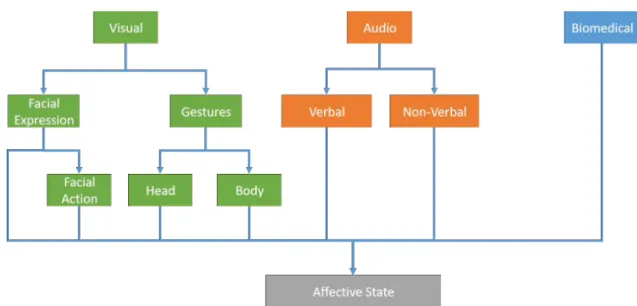
In affective computing, a modality is usually defined as the single independent com-munication channel of sensory information between a human and a computer (Kar-rayet al., 2008). Based on the nature of different modalities, they are usually divided into three categories: Visual Modality,Audio Modality andBiomedical Modality. An overview of different types of modalities and cues can be seen in Figure 2.4. Whilst this thesis focuses on the visual modality, for completeness, we discuss all three modalities in the following subsections.
2.3.2.1 Visual Modality
The visual modality has been the most widely used modality in the literature for capturing affective states. Usually two types of cues from visual signals are used for automatic affect recognition, namely facial expressions and gestures.
Most of the vision-based affect recognition studies have been focused on facial expression analysis, due to the importance of the face in emotion expression and perception. A facial expression usually refers to one or more motions or positions of the muscles under the skin of the face. There are two main trends in the recent
Figure 2.4: Overview of modalities and cues used in affective com-puting
research on how facial expressions can be used: i) facial expressions are mapped directly to selected emotion models, ii) facial actions are detected first, then mapped to selected emotion models. These two trends are directly derived from the two main approaches used for facial expression measurement in psychological research: message and sign judgement (Cohn, 2006). Message judgement is used to interpret what underlies a displayed facial expression, while sign judgement is used to describe the actual facial behaviour. For example, a wide-eyed expression can be judged as surprise in message judgement terms and in sign judgement terms it could be described as eyebrows raised, eyes widened and mouth open. To label different facial actions, the Facial Action Coding System (FACS) developed by Ekman and Friesen (1976) is widely used. The FACS consists of 44 Action Units (AUs) that in turn represent the movement of individual or groups of facial muscles as shown in Figure 2.5 and Figure 2.6. Compared to the message judgement approach, the sign judgement approach is more robust to context-dependent or culture-specific expressions (Baltrusaitis et al., 2011). However, labelling facial actions requires experienced annotators and is a time-consuming process.
Figure 2.5: Left: Relation between muscular anatomy and muscular action. Right: The AUs of FACS. The small circles represent fixed points towards which skin is pulled along the line during activation while the number in the circle represents the AU. Both images come from Ekman and Friesen (1978)
Figure 2.6: Example of facial AUs and their combinations (Pantic and Bartlett, 2007)
used to interpret emotional states. Early research has been focused on mapping body gestures to discrete emotion categories. For instance, a study carried by Dar-win (1998) suggested that when people are angry, a number of cues could be observed including i) whole body trembles, ii) head is erect, iii) chest is well expanded, iv) feet are firmly on the ground and v) elbows are squared. The work reported by Wallbott (1998) found that certain distinctive features exist in body movement that can be used to classify specific emotions. For example, erect body posture is rare when ex-periencing shame, sadness or boredom, lifting shoulders is typical for elated joy and anger, and a head moving downward is most typical when expressing disgust. Coul-son (2004) showed that recognition results from body gestures could be as significant as the voice modality and facial expression in some cases. Good recognition results for discrete emotions from body information are also reported by Van den Stock
et al. (2007). Recently, the trend has shifted towards using gestures to interpret dimensional affective state. By investigating the emotional and communicative sig-nificance of head gestures in a naturalistic dataset, Cowie et al.(2010b) found that head nods carry informations on both arousal and valence dimensions, while head shakes are good indicators on the arousal dimension. Gunes and Pantic (2010) ex-plored the use of conversational head movement for continuous affect prediction and suggested that head gestures can be used to predict the arousal, valence, dominance and expectation dimensions. Nicolaou et al. (2011) on the other hand investigated the use of shoulder gestures for dimensional and continuous affect recognition and found shoulder gestures outperformed vocal cues on valence prediction, and achieved similar performance on the arousal dimension compared to facial cues.
The visual modality is usually captured with a conventional 2D camera. It works by projecting a 3D scene onto a 2D image plane and the captured image is usually referred to as a colour image. However, during this process the distance (range/depth) information is lost. More recently, the trend has shifted to also include 3D cameras to record distance information along with the colour information. The
image that contains distance information is often referred as the depth image or range image.
2.3.2.2 Audio Modality
Audio is another commonly used modality in automatic affect recognition research. There are mainly two types of cues from the audio modality that can be used to capture different affective states, namely verbal cues and non-verbal cues.
Verbal cues refer to the linguistic content of the speech. Researchers have shown it is possible to interpret a speaker’s affective state through the words he/she used. For instance, Whissell (2009) revised the Dictionary of Affect in Language (DAL) which includes 8,472 words with a 2D rating in the arousal/valence space. Studies carried out by W¨ollmeret al.(2010) suggested words such asagain,angry and very
are correlated with the arousal dimension, while good, great and totally are more correlated with the valence dimension.
Non-verbal cues refer to the non-linguistic part of the communication. Research in psychology and psycholinguistics has shown that acoustic and prosodic features can be used to encode the affective states of a speaker. For instance, acoustic parameters such as mean of the fundamental frequency (F0), mean intensity, speech range and high-frequency energy are positively correlated with the arousal dimension (Huttar, 1968; Scherer and Oshinsky, 1977), while prosodic features such as pause duration, pausing and breathing rate are indicative of excitement (Trouvain and Barry, 2000). Other non-verbal cues such as sighs and gasps can also convey emotion information. Sighs usually arise from a negative affective state, such as boredom or dissatisfaction, or at the end of some negative situation as relief, while gasps could occur from an emotion of surprise, shock or disgust (Nicolaou, 2009).
Research has shown that non-verbal cues are good at predicting the arousal dimension, while verbal cues are good at predicting the valence dimension. However, current research in automatic affect recognition mainly focuses on using non-verbal
cues, since verbal cues are usually language dependent and it is difficult to anticipate a person’s word choice for expressing different emotional states.
The audio modality is usually captured with a microphone. When capturing multi-people interactions, an additional headphone is usually worn by each partici-pant to prevent the microphone capturing other participartici-pants’ voice during conver-sations.
2.3.2.3 Biomedical Modality
Biomedical signals are multichannel recordings of physiological activities of organ-isms. A number of studies have shown that biomedical signals could reflect people’s affective states. For example, Galvanic Skin Response (GSR) provides a measure-ment of skin conductance (See Figure 2.7). It is positively correlated with a person’s overall arousal or stress level (Ekman et al., 1983; Levenson, 1992) and it can be used to distinguish emotional states such as fear and anger (Ax, 1953). Heart rate sensors measure heart beat per minute, which increases with negative emotions such as anxiety and fear (Chanel et al., 2007). Respiration rate describes how deep and fast a person is breathing. Irregular and quick breathing usually indicates more aroused emotions such as anger or fear (Chanel et al., 2007). Electromyography (EMG) measures muscle electrical activity when at rest and during contraction (See Figure 2.8). It is correlated with negatively valenced emotions (Lang, 1995).
Compared to sensors used to capture visual and audio modalities, biomedical sensors are usually perceived as being inconvenient to set up and wear, since these sensors usually require multiple wires connected to different parts of human body and the participant usually cannot move freely during the capture. More recently such issues have been addressed by developing wearable sensors that are wireless and miniaturized. For example, Microsoft Band is a wrist worn sensor that can detect both heart rate, GSR and skin temperature in real time (See Figure 2.9). However, as suggested by Gunes and Schuller (2013) obtaining accurate measurement from
biomedical sensors is still affected by human physical activities such as walking and running.
Figure 2.7: GSR Sensor (EHealth, 2013)
2.3.3
Annotating Affect Data
The process of annotating affect data is usually defined based on two criteria, i) the emotion model used to represent the data (Section 2.2) and ii) the method used to elicit emotions (Section 2.3.1). As discussed earlier, since the use of an appraisal model remains an open research question in automatic affect recognition, this section only focuses on how to use categorical and dimensional emotion models to annotate data.
For posed behaviours, a categorical model is commonly used. Usually there is no additional annotation step involved since posed behaviours are produced by the subject upon request. For induced and spontaneous behaviours, both categorical and dimensional emotion models are commonly used.
When using a categorical model approach, discrete emotion categories are used directly to annotate different emotional states. The six basic emotion categories developed by Ekman (1971) are the most widely used labels in automatic affect recognition research. In addition to the basic emotions, some datasets also include
Figure 2.8: EMG Sensor (EHealth, 2013)
labels to indicate people’s cognitive states such as interest, puzzled, bored and frus-tration (Chen, 2000; Gunes and Piccardi, 2006).
When using a dimensional approach, both discrete and continuous labels can be used. For discrete labels, researchers have been using different intensity levels: either a set of words (e.g., negative, positive and neutral), or a ten-point Likert scale (e.g., 0-9 where 0 means a low value on the selected dimension), or an arbitrary range (e.g., integer value between -50 and +50). On the other hand, continuous labels usually use a real number between a predefined range (e.g., -1 to 1) to indicate various affective states along different dimensions (McKeown et al., 2012; Ringeval
et al., 2013).
There are two possible approaches when it comes to annotating the data, sub-jective assessment (self assessment) and obsub-jective assessment. These methods can be used independently or used together. Subjective assessment asks participants to rate their own response to different stimuli through a recall process, while objective assessment requires external observers (human raters or annotators) to estimate the emotional state expressed by the subjects. In the affective computing field, recent research trends have been focused on recognising labels from objective assessment as shown in (Schuller et al., 2011, 2012; Ringevalet al., 2015b). One of the main chal-lenges of objective assessment is to obtain high inter-observer agreement when multi-ple annotators are annotating the same data (Gunes and Schuller, 2013), especially when the continuous dimensional approach is adopted, since different annotators can annotate a different intensity for the same emotional state. To date, researchers have mostly chosen to take the average value among different annotations as the ground truth. Other methods, that take into account agreement and correlation measures have also been proposed. For instance, Nicolaou et al. (2011) measured the inter-observer correlation of each individual annotator and used it to calculate a weighted average as the final ground truth. Overall, as suggested by Gunes and Schuller (2013), obtaining reliable ground truth from both discrete and continuous
dimensional annotations remains a challenging issue in affective computing.
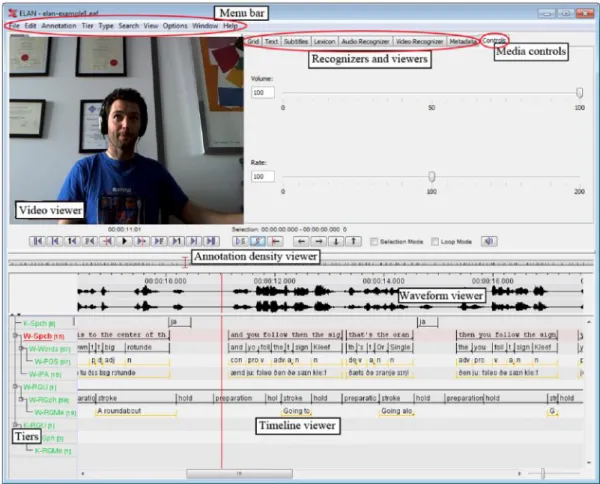
Numerous tools with different functionalities have been developed to ease the an-notation process. The European distributed corpora project Linguistic ANnotator (ELAN) (Brugman and Russel, 2004) is an annotation tool that allows users to cre-ate, edit, visualise and search annotations for video and audio data. It runs on all major operating system and is available in a number of different interface languages. In addition, it supports annotation on multiple levels such as word or sentence. The annotations can be created on multiple layers, called tiers, which can be hierarchi-cally interconnected. ELAN was originally designed for the analysis of languages, sign languages, and gestures, but it had been used extensively in affect research (Valstar and Pantic, 2010).
Figure 2.10: Screenshot of ELAN interface including the menu bar, the media player control, the tiers, and a number of viewers.
(ANVIL) which was introduced by Kipp (2001). ANVIL is designed to facilitate an-notation of audio-visual material. It supports multiple layers of anan-notation such as words, dialogue acts, postures shifts and gestures. It enables users to create their own coding scheme and review the colour-coded multi-layer annotation in a time-aligned fashion (See Figure 2.11). The tool is constantly updated. The latest ver-sion, ANVIL 5, now supports additional features such as 3D Motion capture player, subdivision track type, time point track type, histogram, Kappa coding agreement analysis, transition diagrams, association analysis and annotation management soft-ware. For more details the reader is referred to Kipp (2010).
Figure 2.11: ANVIL’s graphical user interface.
The FEELtrace annotation tool was developed to enable annotators to track affective state via vocal and visual cues over continuous traces in dimensional space (Cowie et al., 2000). The FEELtrace tool allows the annotator to watch the audio-visual recording and rate the perceived emotional state by moving the mouse pointer within the 2-dimensional valence-arousal space (See Figure 2.12). The value of the affective states has been confined to [-1, 1] where -1 represents very negative
(valence) or very passive (arousal) and 1 represents very positive (valence) or very active (arousal). More recently, the General trace (Gtrace) annotation tool has been introduced to replace the FEELtrace tool with the ability to let people use their own dimensions and scales (Cowie and Sawey, 2011). The Gtrace tool lets the user annotate each dimension by moving the mouse cursor from left to right (See Figure 2.13).
Figure 2.12: Feeltrace graphical user interface. Cursor colour changes from red/orange at the left hand end of the arc, to yellow be-side the active/passive axis, to bright green on the negative/positive axis, to bluegreen at the right hand end of the arc (Cowie et al., 2000).
Figure 2.13: Gtrace graphical user interface (Cowie and Sawey, 2011)
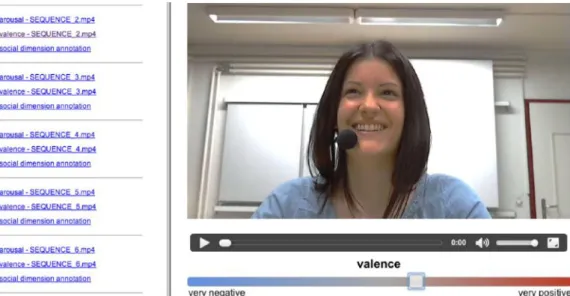
has also been developed to enable remote annotation (Ringeval et al., 2013). The arousal and valence dimensions are annotated using a slider with values from -1 to 1. An additional five dimensions (agreement, dominance, engagement, performance and support) can be annotated using a 7-Likert scale. The timestamps from the local machine are recorded when the slider value changes to avoid data transmission delays.
Figure 2.14: ANNEMO: web-based annotation of affective and social behaviours (Ringeval et al., 2013).
2.3.4
Existing Datasets
As discussed in Section 2.2, early research in affective computing field was mainly focused on using a categorical model with posed behaviours, so that the datasets captured in the early years only consist of acted affective behaviours. However, increasing evidence suggests that posed behaviours differ in visual appearance, au-dio profile and duration of behaviour compared to spontaneous behaviours (Zeng
et al., 2009). For instance, Whissell (1989) suggests that the choice of words and timing used in spoken language differ in posed and spontaneous behaviours. Cohn and Schmidt (2004) and Valstar et al. (2007) find that different types of spon-taneous smiles exhibit smaller amplitude and longer duration compared to posed
ones. These findings motivated several efforts toward capturing datasets consisting of spontaneous affective states that could be used for training and testing automatic affect recognition systems. Table 2.1 lists some representative and publicly available affect datasets that are reported in the literature. Since this thesis focuses on recog-nising affective state from the visual modality, only datasets with visual information are reviewed. For emotional speech datasets the reader is referred to Zeng et al.
(2009), El Ayadiet al. (2011) and Koolagudi and Rao (2012) for more details. For datasets concerning posed affective behaviours, the following datasets should be noted. The Cohn-Kanade (CK) dataset (Kanade et al., 2000) is the most widely used dataset for facial expression recognition. It includes 97 adults across 3 races. In total, 486 video sequences are captured where each sequence consists of a different number of frames (from 9 to 60 frames). The dataset was extended by (Luceyet al., 2010) to include an additional 26 subjects and 107 sequences. All sequences are fully FACS coded and labelled with categorical emotion labels (angry, contempt, disgust, fear, happy, sadness and surprise). The MMI dataset (Pantic et al., 2005) is one of the first on-line accessible and searchable facial expression datasets. Originally, it only contained posed facial expressions, but was expanded by Valstar and Pantic (2010) to also include induced facial behaviours. The original MMI dataset consists of 19 subjects across 3 raters. In total, 600 frontal and 140 dual-view static images are captured along with 30 profile-view and 750 dual-view video sequences. The ‘dual-view’ capture refers to the capture of frontal and profile views at the same time. The extended MMI dataset adds an additional 25 subjects, where each subject was recorded for 5 minutes. All data in the MMI dataset is FACS coded. The six basic emotions are used to label the posed facial expressions, while only a subset (happiness, disgust and surprise) is used to label the induced ones. The FABO dataset developed by Gunes and Piccardi (2006) is one of the first datasets that contains videos of both facial expressions and body gestures. In total, 23 subjects were recorded, where each subject was asked to perform a set of pre-defined facial
Table 2.1: Comparison of datasets for human affect recognition. 2D: Colour information. 3D: Colour and depth information. A: Audio information. B: Biomedical information. C:Continuous annotation. D: Discrete annotation
dataset Elicitation
Method Modality Emotion Model Labelling Environment Cohn-Kanade
(Kanadeet al., 2000) Posed 2D Categorical N/A Controlled MMI
(Panticet al., 2005)
Posed
Induced 2D Categorical Objective Controlled UT Dallas
(O’Tooleet al., 2005) Induced 2D Categorical Objective Controlled BU-3DFE
(Yinet al., 2006) Posed 3D Categorical N/A Controlled FABO
(Gunes and Piccardi, 2006) Posed 2D Categorical N/A Controlled SAL
(Douglas-Cowieet al., 2007) Induced 2D/A Dimensional (C) Objective Controlled BU-4DFE
(Yinet al., 2008) Posed 3D Categorical N/A Controlled Bosphorus
(Savranet al., 2008) Posed 3D Categorical N/A Controlled Vera am Mittag
(Grimmet al., 2008) Spontaneous 2D/A
Categorical
Dimensional (C) Subjective Controlled BIWI 3D
(Fanelliet al., 2010) Posed 3D/A Categorical Subjective Controlled Cam3D
(Mahmoudet al.(2011) Induced 3D/A Categorical Objective Controlled ICT-3DRFE
(Stratouet al., 2012) Posed 3D Categorical N/A Controlled SEMAINE
(McKeownet al., 2012) Induced 2D/A
Categorical
Dimensional (C) Objective Controlled MAHNOB-HCI
(Soleymaniet al., 2012) Induced 2D/A/B
Categorical
Dimensional (D) Subjective Controlled DEAP
(Koelstraet al., 2012) Induced 2D/B Dimensional (D) Subjective Controlled BP4D-Spontaneous
(Zhanget al., 2013) Induced 3D Categorical Subjective Controlled AViD
(Valstaret al.(2013) Induced 2D/A Dimensional (C) Objective Uncontrolled RECOLA
(Ringevalet al., 2013) Spontaneous 2D/A/B
Categorical Dimensional (C)
Subjective
expressions and body gestures. The labels include six basic emotions and four non-basic affective states (uncertainty, anxiety, boredom, and neutral). The BU-3DFE dataset (Yinet al., 2006) is one of the first publicly available facial expression datasets that contains both colour and depth information. The dataset was captured using a 3D scanner and was labelled using seven basic categorical (six basic emotions and neutral) emotions. Each expression includes four different intensity levels (low, middle, high and highest) except for the neutral expression. The dataset includes 100 subjects and a total of 2,500 3D facial expression models. However, due to the speed limitation of the 3D scanner used during the capture, the BU-3DFE only consists of static 3D information. This issue was addressed by the development of BU-4DFE dataset (Yin et al., 2008) which contains 3D dynamic facial sequences. The dataset consists of 101 subjects where each subject is asked to perform six basic expressions, resulting in a total of 606 3D dynamic sequences. Different from aforementioned 3D datasets, both the Bosphours and the ICT-3DRFE datasets capture AU related expressions (see Figure 2.6 for some examples) in addition to the basic emotions. In particular, the Bosphorus 3D face dataset (Savran et al., 2008) consists of 105 subjects performing 34 facial expressions under various head poses (13 yaw, pitch and cross rotations) and different face occlusions (hand, hair and eyeglasses), while the ICT-3DEFE dataset (Stratou et al., 2012) includes 23 subjects and 15 expressions captured under different illumination conditions. The BIWI 3D (Fanelli et al., 2010) dataset is the first dataset that contains both audio and 3D facial information captured in an affective communication setting. During the capture, each participant is asked to first read a sentence from text in neutral expression, and then repeat the same sentence after watching a clip extracted from a feature film where the sentence is acted by professional actors. This results in 1109 sentences spoken by 14 native English speakers.
Considering induced affective behaviours, the UT Dallas dataset (O’Toole et al., 2005) is one of the first publicly available datasets that features induced emotions.
Different emotional states are elicited by asking participates to watch different video clips. The data is then labelled using 10 discrete emotion categories (6 basic emo-tions, puzzlement, laughter, boredom and disbelief). The SAL (Douglas-Cowieet al., 2007) dataset is the first multi-modal dataset that was annotated continuously us-ing the dimensional approach (arousal and valence). The SAL data consists of recordings of human-computer conversations elicited through a Sensitive Artificial Listener (SAL) interface. The interface is build around four personalities (happy, gloomy, angry and pragmatic) where each personality is represented by an avatar. The idea is that each avatar draws the participant into their own emotional state through a set of predefined responses. In total, 4 subjects and over 4 hours of data was captured. The SEMAINE dataset (McKeown et al., 2012) also uses the same SAL induction technique, but differs in recording quality, size and annotation in-formation. It includes 20 participants and over 6 hours of data was captured. It is annotated continuously on five dimensions including valence, arousal, dominance, expectation and intensity, where the intensity is used to indicate “how far the person is from a state of pure, cool rationality”. In addition it also includes labels on basic emotions (i.e. fear, anger and happiness), epistemic states (i.e. certain/not certain, agreeing/not agreeing and interest/not interest), interaction process analysis (i.e. shows solidarity, shows antagonism and shows tension) and validity (i.e. breakdown of engagement and anomalous simulation). It has been used for the first and second Audio/Visual Emotion Challenge (AVEC 2011, 2012) (Schuller et al., 2011, 2012).
The Cam3D dataset Mahmoud et al. (2011) is the first induced dataset that contains both 3D and audio information. The data is induced through human-computer and human-human interactions. In total 16 participants were captured and 108 segments of natural complex mental states were extracted. The segments were labelled in terms of agreeing, bored, disagreeing, disgusted, excited, happy, interested, neutral, sad, surprise, thinking and unsure. The MAHNOB-HCI (Soley-mani et al., 2012) and DEAP (Koelstra et al., 2012) datasets are two of the first