Support for Flexible and Transparent
Distributed Computing
Hao Liu
A dissertation submitted in partial fulfillment of the requirements for the degree of
Doctor of Philosophy of the
University of London.
Department of Computer Science University College London
2 I, Hao Liu, confirm that the work presented in this thesis is my own. Where information has been derived from other sources, I confirm that this has been indicated in the thesis.
Abstract
Modern distributed computing developed from the traditional supercomputing community rooted firmly in the culture of batch management. Therefore, the field has been dominated by queuing-based resource managers and work flow based job submission environments where static resource demands needed be determined and reserved prior to launching executions. This has made it difficult to support resource environments (e.g. Grid, Cloud) where the available resources as well as the resource requirements of applications may be both dynamic and unpredictable. This thesis introduces a flexible execution model where the compute capacity can be adapted to fit the needs of applications as they change during execution. Resource provision in this model is based on a fine-grained, self-service approach instead of the traditional one-time, system-level model. The thesis introduces a middleware based Application Agent (AA) that provides a platform for the applications to dynamically interact and negotiate resources with the underlying resource infrastructure.
We also consider the issue of transparency, i.e., hiding the provision and management of the dis-tributed environment. This is the key to attracting public to use the technology. The AA not only replaces user-controlled process of preparing and executing an application with a transparent software-controlled process, it also hides the complexity of selecting right resources to ensure execution QoS. This service is provided by an On-line Feedback-based Automatic Resource Configuration (OAC) mechanism coop-erating with the flexible execution model. The AA constantly monitors utility-based feedbacks from the application during execution and thus is able to learn its behaviour and resource characteristics. This allows it to automatically compose the most efficient execution environment on the fly and satisfy any execution requirements defined by users. Two policies are introduced to supervise the information learn-ing and resource tunlearn-ing in the OAC. The Utility Classification policy classifies hosts accordlearn-ing to their historical performance contributions to the application. According to this classification, the AA chooses high utility hosts and withdraws low utility hosts to configure an optimum environment. The Desired Processing Power Estimation (DPPE) policy dynamically configures the execution environment accord-ing to the estimated desired total processaccord-ing power needed to satisfy users’ execution requirements.
Through the introducing of flexibility and transparency, a user is able to run a dynamic/normal distributed application anywhere with optimised execution performance, without managing distributed resources. Based on the standalone model, the thesis further introduces a federated resource negotiation framework as a step forward towards an autonomous multi-user distributed computing world.
Acknowledgements
Pursuing a PhD project is like climbing a high peak, step by step, accompanied with happiness, bitter-ness, hardships, frustration, encouragement and trust and with so many people’s kind help. At this point, I would like to express my deepest gratitude to all those who gave me the possibility to complete this thesis.
This work would never have been possible without the guidance of my supervisor Søren-Aksel Sørensen to whom I am deeply indebted. I would like to thank him for providing research resources, technical discussions, stimulating suggestions and encouragement in all the time of research for and writing of this thesis. His wide knowledge in various fields and logical thinking have been of great value for me. I am also deeply grateful to my supervisor David S. Rosenblum, for his constructive comments, and for his important administrative support throughout this work.
It has been a great honour working with people who sit in the corner of the 7th floor. The discussions with them have always enhanced my research and clarified my questions. I would like to acknowledge Amril Nazir for his significant suggestions for research methodology as well as the help during software implementing and paper producing. I would like to thank Clovis Chapman for the discussions of grid scheduling and Kalman filter as well as the help in thesis writing. I would also like to thank Mohamed Ahmed particularly for identifying the potential for the use of reinforcement learning.
I would like to thank all the members of the computer cluster group, and particularly Tristan Clark, for providing computational resources and technical support during the experiments in the thesis. I would also like to thank all the other departmental support staff for their various help during the time of my PhD study.
I have enjoyed working as a teaching assistant with many lecturers, particularly Philip Treleaven, discussions with whom had a great enlightenment to me for both my research and life. The work with them had also allowed me to discuss my research with undergraduate and master students, who gave me innovative suggestions. Thanks go to all of them.
Finally, I would like to express my gratitude to many anonymous people, who provided great open source software, answered my technical questions, reviewed my work through the Internet.
I dedicate this thesis to my mum, my dad, and my wife, without whose constant encouragement, un-conditional love and support I would not have been able to undertake this endeavour.
List of Abbreviations
AA Application Agent
AppLes Application-Level Scheduling
ART Automatic Resource Tuner
AU Average Utility
BSP Bulk Synchronous Parallel
CFD Computational Fluid Dynamics
DAG Directed Acyclic Graph
DPPE Desired Processing Power Estimation
DRM Distributed Resource Manager
DRMAA Distributed Resource Management Application API
DT Domain Tree
ESD Execution Satisfaction Degree
FLOPS Floating point Operations Per Second
GARA Globus Architecture for Reservation and Allocation
GRAM Globus Resource Allocation Manager
GSI Globus Security Infrastructure
HEP High Energy Physics
JSDL Job Specification Description Language
LComm Local Communication
MDS Monitoring and Discovery Service
MPI Message Passing Interface
MPP Massively Parallel Processing
MU Marginal Utility
NAT Network Address Translation
NWS Network Weather Service
OAC Online Feedback-based Automatic Resource Configuration
PBS Portable Batch Queuing System
PMWComm Process Management and Wide-area Communication
PSA Parameter Sweep Application
List of Abbreviations 6
QoS Quality of Service
RAS Resource Acquisition Server
RC Resource Configuration
RD Resource Discoverer
RTT Round-Trip Time
SGE Sun Grid Engine
SLA Service Level Agreement
SP Selection Probability
SPEC Standard Performance Evaluation Corporation
SPMD Single Process, Multiple Data
UD/UT/UC unit data/unit time/unit cost
UPID Unique Process ID
Contents
1 Introduction 15
1.1 Problem Statement . . . 15
1.2 Research Scope . . . 17
1.2.1 Distributed Memory System . . . 17
1.2.2 Computational Distributed Application . . . 17
1.2.3 User-Level Middleware . . . 18
1.2.4 Dynamic Applications . . . 18
1.3 Research Contribution . . . 18
1.4 Thesis Outline . . . 20
2 Background 22 2.1 Distributed Resource Infrastructure . . . 22
2.1.1 Supercomputer . . . 22
2.1.2 Cluster Computing . . . 23
2.1.3 Grid Computing . . . 24
2.1.4 Cloud Computing . . . 26
2.2 Distributed Applications . . . 27
2.2.1 Embarrassingly Parallel Computation . . . 27
2.2.2 Parallel Computation . . . 27
2.2.3 Workflow . . . 28
2.2.4 Dynamic Applications . . . 29
2.3 Distributed Application Execution . . . 30
2.4 Chapter Summary . . . 32
3 Motivation and Requirements 33 3.1 Flexible Execution . . . 34
3.1.1 On-line Resource Allocation . . . 34
3.1.2 Dynamic Load Balancing . . . 35
3.2 Providing Resource Management Transparency . . . 37
3.2.1 Application Frameworks . . . 37
Contents 8
3.3 Chapter Summary . . . 41
4 Model Design 42 4.1 Application Agent (AA) Layer . . . 43
4.2 Application Layer . . . 44
4.2.1 Distributed Object Graphs . . . 45
4.2.2 Load Balancing . . . 46
4.2.3 Master-Worker (Task-based) . . . 47
4.2.4 Developing Adaptive Applications . . . 49
4.3 Transparent Resource Management . . . 49
4.4 Chapter Summary . . . 50
5 Application Agent 51 5.1 Overview . . . 52
5.2 Application Programming Interface . . . 53
5.3 Architecture . . . 54
5.3.1 Unique Process ID (UPID) . . . 54
5.3.2 LComm . . . 56
5.3.3 PMWComm . . . 56
5.3.4 Resource Discoverer (RD) . . . 60
5.3.5 Information Record and Synchronization . . . 61
5.4 Implementation . . . 62
5.4.1 PVM Implementation . . . 64
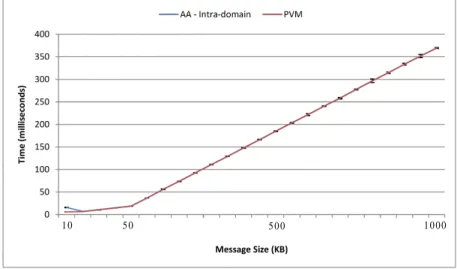
5.5 Evaluation . . . 65
5.5.1 Basic Performance Test . . . 65
5.5.2 Feasibility Test . . . 67
5.5.3 Flexible Execution VS Static Execution . . . 69
5.6 Chapter Summary . . . 71
6 Automatic Resource Configuration and the Utility Classification Policy 73 6.1 Execution Satisfaction Degree . . . 74
6.2 Online Feedback-based Automatic Resource Configuration . . . 76
6.2.1 Implementation . . . 77
6.3 The Utility Classification Policy . . . 80
6.3.1 The Policy . . . 81
6.3.2 Policy Evaluation . . . 84
6.4 Experiment I - Two Dimension Heat Equation . . . 85
6.4.1 Simulation Setup . . . 85
6.4.2 Simulation Validation . . . 86
Contents 9
6.4.4 Experiment I.1 - Homogenous Environment . . . 88
6.4.5 Experiment I.2 - Heterogeneous Environment . . . 90
6.4.6 Experiment I.3 - Heterogeneous Environment with Cross-domain Delay . . . 92
6.4.7 Experiment I.4 - Dynamic Resource Environment . . . 94
6.5 Experiment II - Economy-based Task Farming . . . 95
6.5.1 Experimental Setup . . . 95
6.5.2 Experiment II.1 . . . 97
6.5.3 Experiment II.2 - Small Grain Size . . . 101
6.6 The Utility Classification Policy Summary . . . 103
7 Automatic Resource Configuration and the DPPE Policy 105 7.1 The DPPE Policy . . . 105
7.1.1 Applying Kalman Filter . . . 106
7.1.2 The Policy . . . 108
7.1.3 Experiment I - Mandelbrot . . . 108
7.1.4 Experiment II - Bulk Synchronous Parallel . . . 111
7.1.5 Policy Summary . . . 113
7.2 OAC Related Work . . . 114
7.2.1 Control Theory and Reinforcement Learning . . . 114
7.2.2 Feedback-based Scheduling . . . 115
7.2.3 Performance Measurement and Tuning . . . 115
7.3 Chapter 6 & Chapter 7 Summary . . . 116
8 Federated Resource Negotiation 118 8.1 Framework . . . 119
8.1.1 Negotiation Policies . . . 120
8.2 Using the Federated Negotiation to Improve Multiple Application Satisfactions . . . 121
8.2.1 Experiment . . . 121
8.3 Chapter Summary . . . 123
9 Conclusion 124 9.1 Contributions . . . 124
9.1.1 The Two-layer Model and the Application Agent . . . 125
9.1.2 Online Automatic Resource Configuration and Two Tuning Policies . . . 126
9.1.3 Federated Resource Negotiation . . . 126
9.2 Discussion of Adaptive Application Related Work . . . 126
9.3 Future Directions . . . 128
9.3.1 Development of the Application Agent . . . 128
9.3.2 OAC Investigation . . . 132
Contents 10
Appendices 132
A Condor and SGE Systems 133
A.1 Condor . . . 133
A.1.1 Run Applications in Condor . . . 133
A.2 Sun Grid Engine . . . 135
A.2.1 Run Applications in SGE . . . 135
B Application Agent (AA) User Manual 137 B.1 Feature . . . 137
B.2 Installation . . . 137
B.3 Run . . . 138
B.4 AA Console . . . 139
B.5 Main API . . . 140
C Simulating the 2D Heat Equation Experiment 143 C.1 Simulation . . . 144
D Lunar Surface Temperature Mapping 145 D.1 A Little Experiment Background . . . 145
D.2 Mathematical Algorithms . . . 145
D.2.1 Surface Temperature . . . 146
D.2.2 Heat Conduction . . . 146
D.2.3 Energy Flux Fraction . . . 147
D.3 Application Development . . . 148
D.3.1 Load Balancing . . . 148
D.3.2 ESD Report . . . 149
D.4 Application Execution . . . 149
D.4.1 From the User’s Point of View . . . 149
D.4.2 Under the Hood . . . 149
List of Figures
2.1 Distributed application types. . . 27
2.2 A one-dimensional finite difference parallel application . . . 28
2.3 A dynamic application example . . . 30
2.4 Resource reservation with backfilling scheduling. . . 31
2.5 The long tail problem . . . 31
3.1 Unstructured communication pattern . . . 37
3.2 Steps in AppLes methodology . . . 39
4.1 Traditional distribution computing model VS Proposed distributed computing model . . 43
4.2 An overview of the two-layer model. . . 44
4.3 Distributed automata graph . . . 45
4.4 The CFD-OG model. . . 45
4.5 Master-worker paradigm . . . 48
4.6 An overview of the online feedback-based automatic resource configuration. . . 50
5.1 AA Daemons . . . 53
5.2 Unique Process Identifier . . . 55
5.3 UPID examples . . . 56
5.4 Local communication performed by the LComm implemented by PVM or MPI. . . 56
5.5 Cross-domain communication . . . 58
5.6 The process addition is achieved by PMWComms . . . 58
5.7 Place multiple PMWComms to connect multiple domains . . . 59
5.8 A Domain Tree. . . 59
5.9 How the AA works with DRMs. . . 61
5.10 Information is synchronized hierarchically. . . 62
5.11 The implementation of the AA. . . 63
5.12 The process of obtaining a resource. . . 64
5.13 AA basic performance test . . . 66
5.14 The AA deploys an application in the Condor and HPC cluster from a laptop. . . 69
5.15 The dynamic change of the AA virtual machine . . . 70
List of Figures 12
6.1 The plots of ESD functions. . . 76
6.2 How the AA performs the OAC. . . 77
6.3 The Automatic Resource Tuner (ART) daemon . . . 78
6.4 The automatic resource configuration: application code structure. . . 79
6.5 A WWG testbed composed of 11 types of resources. [BM02] . . . 81
6.6 2D heat equation computation. . . 86
6.7 The grid cells are distributed into 3 hosts . . . 87
6.8 Simulation validation. . . 87
6.9 The filtered ESD is much smoother. . . 88
6.10 Results of experiment I.1 - homogeneous environment, QoS = 0.8 iterations/UT . . . 88
6.11 Results of experiment I.1 - homogeneous environment, QoS = 1.0 iterations/UT . . . 90
6.12 Results of experiment I.2 - heterogeneous environment, QoS = 0.8 iterations/UT . . . 91
6.13 Results of experiment I.3, central locus = cluster E . . . 92
6.14 Results of experiment I.3, central locus = cluster D . . . 94
6.15 Results of experiment I.4 - dynamic environment, QoS = 0.8 iterations/UT . . . 94
6.16 Simulated parameter sweep computation . . . 96
6.17 Define the ESD based on the deadline QoS requirement . . . 98
6.18 The historical AU of type 5∼9 in the first execution of test 2. . . 99
6.19 First execution in Experiment II.1 . . . 101
6.20 Second execution in Experiment II.1 . . . 103
6.21 First execution in Experiment II.2 . . . 104
7.1 A histogram of observedΦnoise. . . 107
7.2 Satisfying the 300 seconds deadline. . . 110
7.3 Satisfying the 600 seconds deadline. . . 111
7.4 Resource usage comparison between automatic and manual resource selection . . . 111
7.5 The BSP master-worker model . . . 112
7.6 Resource configuration for the BSP application. QoS = 0.03iterations/second . . . 114
8.1 A multi-AA distributed computing world . . . 119
8.2 The federated resource negotiation . . . 120
8.3 An experiment of the federated resource negotiation. . . 122
9.1 The two-layer model in the future. . . 131
C.1 Object-oriented 2D heat equation experiment simulation framework . . . 144
D.1 Temperature mapping application execution speed . . . 150
D.2 The number of resource configured during the temperature mapping execution. . . 150
List of Tables
5.1 A domain table . . . 62
5.2 A host table . . . 63
5.3 Flexible execution VS static execution . . . 69
6.1 Simulated resource environment for experiment I.1∼I.4. . . 89
6.2 Simulated resource environment composed of 10 heterogeneous hosts. . . 96
6.3 Test results in experiment II.1 . . . 98
6.4 Comparing the Utility Classification with the DBC algorithms . . . 102
6.5 Test results in experiment II.2. . . 102
7.1 Summary of three actions: addition, releasing, and replacing. . . 109
7.2 Comparison of two OAC polices . . . 117
8.1 An example of the AA-World table . . . 119
List of Algorithms
1 Generalized Master-Worker algorithm. . . 48
2 Algorithm to find the connection route in a DT. . . 60
3 A local load balancing algorithm . . . 67
4 AU Update . . . 83
5 Selection Probability (SP) Calculation . . . 83
6 Tuning Algorithm . . . 84
Chapter 1
Introduction
In recent years, the way computers are used has changed significantly. The emergence of small elec-tronic devices with excellent display capabilities and graphical user interfaces has completed the natural evolution towards an interactive information society that was started by the desktop computer. Users now expect such personal devices to perform tasks that are well beyond their processing or storage capa-bilities and the idea of a portable, handheld “supercomputer” no longer seems a science fiction concept. At the same time the supercomputer concept has changed significantly. By connecting hundreds of read-ily available workstations it is now possible to generate virtual computers with processing or storage capabilities that rival those of the high cost, dedicated supercomputer. The advent of high-speed net-works has enabled the integration of computational resources which are geographically distributed and administered at different domains. Such distributed systems, normally managed byDistributed Resource Mangers(DRMs) and resource co-allocators [CFK99], provide users with simple access to a distributed set of computational resources to run resource hungry applications.
The computer revolution has not only increased our expectations regarding the power of personal processing devices, it has also changed the way we operate these devices. The age where users were prepared to formulate a problem, submit it and wait long periods of time for answers is long gone. The user of today expects not only to receive continuous updates regarding the progress of an application but also to steer its progress and these expectations remove some of the traditional assumptions about high performance applications, namely that they are repetitive, predictable and that their results are not urgently needed.
1.1
Problem Statement
To run an application in a distributed system, users are currently required to submit it to the DRMs. They will in turn schedule resources, deploy application components and start executions on behalf of users. In most systems, jobs are submitted to a batch queue where they will sit for some unknown length of time until the required combination of resource becomes available. Or users can request a reservation. Advance Reservation [Fos99] reserves the required resources in the future time slot and fixes the start time for the job. In order to be effective, detailed knowledge is required to predict the execution time and perform more efficient scheduling by using other approaches such as backfilling
1.1. Problem Statement 16 [LZ07]. The job execution model is a classic batch processing environment: users submit jobs and wait for results. Jobs are set up in advance so they can be run to completion without human interaction. It is perfectly suitable for supporting the embarrassingly parallel workload or batch jobs where tasks are independent of each other. Some examples include large scale face recognition that involves comparing thousands of input faces with similarly large number of faces, computer simulations comparing many independent scenarios, genetic algorithms and other evolutionary computation metaheuristics, etc.
This model requires an execution plan prepared before commencing the execution. For example, how many resources are needed to run the job, what kinds of resources are capable and how long the execution is going to take? Such information can be extremely hard to provide with any accuracy, espe-cially if the application or the resource environment is dynamic. For example, during execution dynamic applications may significant change the structure and size of the datasets they handle as well as the way they process the data and as a consequence their resource requirements may change significantly if they are to meet specific performance benchmarks. CFD-OG (Computational Fluid Dynamics using Object Graphs) [LNS08, NLS07] is one of the examples in that respect. Such applications do not fit within the batch processing model because their behaviour is unpredictable. Furthermore, the assumption that the resource remains static over long periods of time is unsustainable. New resources may unexpectedly become available and resources may suddenly fail during the execution. This is common in the cur-rent grid system [KF98]. An advanced resource allocation plan could be ruined or better choice could be available. Moreover, since resource allocation is statically performed before starting execution, a job that needs multiple resources could have to wait a long time to have enough resources available to run. This weak point is especially prominent when supporting effective, high performance, interactive applications where users require results to be seen in a very short time. For example, some form of visualization for a simulated system.
One solution to the above problems is to make the execution environment more flexible. A flexible execution environment should be able to adapt to changes to the resource situation rather than relying on a static plan based on according outdated information. The execution should be able to introduce more resources if the current allocation is insufficient or replace resources when a more suitable variety becomes available. In this way, execution can be started quickly as long as the minimum resource requirements are met. Resource provision can then be justified according to the needs of the application and the status of the resource pool. For example, if the processing requirements suddenly rise due to steering by a user, the system can respond by immediately allocating more resources to the application to maintain specific performance requirements, such as smooth time progression of execution [LNS07].
In addition to the flexibility requirements, The modern processing environment also needs to be transparent - the user should not need to worry about technical details. In distributed computing, trans-parency is defined as hiding the distributed nature of the execution of an application from its users so that the application appears and functions as a local desktop application. Current distributed computing support provides some transparency, e.g. resource allocation transparency so the users of a distributed system do not have to be aware of the identity of a resource or where it is physically located. However,
1.2. Research Scope 17 it lacks sufficient resource selection transparency, i.e. users will still need to identify the quantity and quality the resources they reserve. Users must write a work flow description and submit it to the system via some specified interface. Therefore users must be aware of the performance characteristics of the available resources either based on queries to a resource information system (a system provides users resource information such as processor architecture, CPU load, operating system) or through their own experience, and be able to use this information to calculate the number and types of resources they need to perform the execution. Users are also required to be familiar with the various job description lan-guages and submission commands. Many users, especially those who do not have a computer science background will not possess such knowledge.
In a high transparency computing environment, users should not be aware of specific services like grid portals but be able simply to run a distributed application as easily as starting a “helloworld” pro-gram on their local machine. Users should also be able to interact with the application anytime they want and have no awareness of how the underlying distributed computing environment is dynamically configured. From the user’s point of view, a distributed application should behave exactly like a lo-cal desktop application, and the lolo-cal computer should act like a virtual supercomputer to support such massive computation.
Our mission is therefore to address these problems and to introduceflexibilityand hightransparency into distributed computing. The discrete, user-controlled stages of preparing and executing a distributed application should be replaced with an end-to-end software-controlled and flexible process.
1.2
Research Scope
1.2.1
Distributed Memory System
Main memory in a distributed system is either shared memory (shared between all processing elements in a single address space), or distributed memory (in which each processing element has its own local address space). In this thesis we focus on distributed memory systems like clusters and computational grids where each computational entity (host) controls its own local memory and entities communicate with each other by message passing.
1.2.2
Computational Distributed Application
There are two main reasons for using distributed systems and distributed computing. First, the very na-ture of the application may require the use of a communication network that connects several computers. For example, a MVC (Model - View - Controller) application in which the user interface, functional process logic (“business rules”), computer data storage and data access are developed and maintained as independent modules, most often on separate platforms. Second, there are many cases in which the use of a single computer would be possible in principle, but the use of a distributed system is beneficial for practical reasons. For example, it may be more cost-efficient to obtain the desired level of performance by using a cluster of several low-end computers, in comparison with a single high-end computer. The thesis focuses on the second case, particularly the problem that requires a great number of computer processing cycles to improve the turnaround time, speed, or cost of execution.
1.3. Research Contribution 18
1.2.3
User-Level Middleware
Distributed computing involves the integration and collaborative use of computers, networks and scien-tific software owned and managed by multiple organizations. For this purpose, distributed computing middleware implements protocols and algorithms with the aim to allow users easy access to distributed resources. According to Buyya et al. [RS05], the middleware can be divided into two types. 1. In-frastructure middleware offers services such as job scheduling, allocation of resources, storage access, information registration and discovery, security, and aspects of QoS such as resource reservation. These services abstract the complexity and heterogeneity of the physical resources by providing a consistent method for accessing distributed resources. 2. User-level middleware utilizes the interfaces provided by the low-level middleware to provide higher level abstractions and services to individual applications. These include application development environments, programming tools and resource brokers for man-aging resources and scheduling application tasks for execution on global resources. Here, we focus on the user-level middleware that operates within the context of existing resource infrastructure middleware, which is represented by DRMs such as Condor [TWML02] and the Sun Grid Engine [Gen01].
1.2.4
Dynamic Applications
Distributed applications can be classified by their resource request behaviours to be either static applica-tions whose resource requirements do not change during execuapplica-tions, or dynamic applicaapplica-tions that may require very different resource support level during their executions (see details in Section 2.2). Al-though our model is designed to support all types of applications, dynamic applications, especially those which have specific execution QoS requirements are the ones supposed to benefit most from our flexible execution model.
1.3
Research Contribution
The goal of this thesis is to use user-level middleware incorporating a new set of algorithms to construct a distributed execution model that is flexible, adaptive, and transparent. In this model, users can easily ex-ecute both static and dynamic distributed applications with satisfactory execution performance, without considering how to manage the underlying distributed resources.
It makes the following contributions:
• Two-layer Model: Instead of using centrally managed DRMs to control the execution, we design a two-layer model to support the flexible and transparent requirements. The lower layer takes charge of constructing an exclusive execution environment as required; while the upper layer, the application, is responsible for making the best use of the provided execution environment. This design allows application programmers and users to be insulated from the resource management issues and also provides the possibility to manage the execution environment in a self-service basis during the execution.
• Application Agent (AA): The Application Agent (AA), which is the lower layer, is a middleware that cooperates with existing DRMs to dynamically create an exclusive execution environment to
1.3. Research Contribution 19 run a distributed application. It supports dynamic resource addition and release during the exe-cution. By using the AA, users are able to invoke an application in their local machines and the execution is transparently performed on remote wide-area resources. We provide the architecture of the AA in the thesis as well as an implementation based on PVM [GBD+94]. This
implemen-tation is used to demonstrate, through experiment, that the performance can be enhanced through the flexible execution.
• On-line Automatic Resource Configuration: Automatic resource selection is used to provide the high-transparency of distributed computing. We propose a novel On-line Feedback-based Au-tomatic Resource Configuration (OAC) approach based on the AA framework to configure the execution environment without the guidance of users or the application. By learning the applica-tion execuapplica-tion behaviour and resource characteristics according to feedback from the applicaapplica-tion, the AA uses the acquired knowledge to select effective resources on the fly to satisfy the execution requirements (e.g. a deadline, a speed, or a budget). The approach differs from other automatic re-source selection approaches in that the AA does not require prior rere-source/application knowledge and the configuration process is dynamically achieved according to application’s requirements. We introduce the Execution Satisfaction Degree (ESD), a measure of the relative satisfaction of execution QoS requirements, for reporting the execution feedbacks. In this thesis we propose two policies - theUtility Classificationand theDesired Processing Power Estimation (DPPE)- to supervise information learning and resource tuning in the OAC.
• The Utilities Classification Policy: The Utility Classification policy embedded in the OAC classi-fies hosts according to their historical performance contributions to the application. According to this classification, the AA chooses high utility hosts and withdraws low utility hosts to configure an optimum environment to satisfy user’s QoS requirements. An important feature of the policy is that it does not require users to provide any information regarding applications nor resources in advance. This unique feature helps users who do not have a parallel computing background to execute distributed applications very easily. Moreover, the classification can be used to guide either manual or automatic resource selection in future executions.
• The Desired Processing Power Estimation (DPPE) Policy: The DPPE policy embedded in the OAC dynamically configures the execution environment using the least amount of resources ac-cording to the estimated desired total processing power needed to satisfy users’ execution re-quirements. Its quick tuning process makes it suitable to support short running applications. It is especially useful to satisfy deadline-constrain job execution without the need for the users to provide information such as estimated job length in advance.
• Federated Resource Negotiation: Based on the flexibility and transparency of the standalone ex-ecution model, resources can be more effectively used among multiple AA-enabled applications in a federated way. We introduce a federated resource negotiation framework where an application is allowed to ask peer applications to donate resources in order to maintain certain performance.
1.4. Thesis Outline 20 We demonstrate the effectiveness of the framework by using it to improve the application satisfac-tions under a competitive resource environment. The framework points towards an autonomous multi-user distributed computing world.
The contributions are partly based on the following original publications:
1. Liu, H. & Sørenson, S.-A., On-line Feedback-based Automatic Resource Configuration for Dis-tributed Applications,Cluster Computing: the Journal of Networks, Software Tools and Applica-tions, Accepted, 2010, DOI 10.1007/s10586-010-0123-x
2. Liu, H.; Sørenson, S.-A. & Nazir, A., On-line Automatic Resource Configuration for Distributed Applications,2nd IEEE International Workshop on Internet and Distributed Computing Systems, 2009
3. Liu, H.; Sørenson, S.-A. & Nazir, A., On-line Automatic Resource Selection in Distributed Com-puting,Cluster Computing and Workshops, 2009. CLUSTER ’09. IEEE International Conference on, 2009, 1-9
4. Liu, H.; Sørensen, S.-A. & Nazir, A., A Lightweight Approach of Automatic Resource Configura-tion in Distributed Computing,High Performance Computing and Communications, 2009. HPCC ’09. 11th IEEE International Conference on, 2009, 506-511
5. Liu, H.; Nazir, A. & Søensen, S.-A., A Software Framework to Support Adaptive Applications in Distributed/Parallel Computing, High Performance Computing and Communications, 2009. HPCC ’09. 11th IEEE International Conference on, 2009, 563-570
6. Liu, H.; Nazir, A. & Søensen, S.-A., Preliminary Resource Management for Dynamic Parallel Applications in the Grid,GridNets, 2008, 70-80
7. Liu, H.; Nazir, A. & Sørenson, S.-A., Resource Management Support for Smooth Application Execution in a Dynamic and Competitive Environment,SKG ’07: Proceedings of the Third Inter-national Conference on Semantics, Knowledge and Grid, IEEE Computer Society, 2007, 438-441
1.4
Thesis Outline
The outline of thesis is as follows:
Chapter 2 introduces the research background including distributed computing concept, common distributed infrastructure, distributed applications, and the way to run applications on the distributed infrastructure.
Chapter 3 introduces what motivated us to produce the thesis. We investigate the limitation of current distributed computing model for supporting required flexibility and transparency, as well as the necessity to introduce a new distributed computing model by providing new middleware and algorithms. Chapter 4 introduces the design of a two-layer flexible and transparent distributed computing model. We present the description of components (Applications, the Application Agent, and DRMs) in the model and how they interact with each other.
1.4. Thesis Outline 21 Chapter 5 introduces the Application Agent software. We present how the AA provides flexible execution services, such as dynamic resource allocation, “run applications anywhere” and wide-area computing. A C++ and PVM implementation is introduced. An experiment with Mandelbrot compu-tation is presented to demonstrate the effectiveness of the flexible execution model supported by the AA.
Chapter 6 introduces the on-line automatic resource configuration approach with the help of the AA. Section 6.1 and 6.2 introduce its concept and framework. The rest of Chapter 6 introduces the Utility Classification policy and two simulation-based experiments.
Chapter 7 continues introducing the OAC approach by introducing the DPPE policy and two exper-iments for the validation. The rest of the chapter discusses OAC related work and comparison of the two policies.
(A more complex experiment (Lunar Surface Temperature Mapping) that evaluates the combined contributions of Chapter 4∼7 is given in Appendix D.)
Chapter 8 introduces the federated resource negotiation framework. An experiment that aims to improve application satisfactions under a competitive resource environment is presented to show the effectiveness of the framework.
Chapter 2
Background
In this chapter, we introduce the research background, including a brief history of distributed resource in-frastructure, common distributed application types and the way to run applications in current distributed computing.
2.1
Distributed Resource Infrastructure
From the middle of the 20th century, unprecedented complex scientific research such as High Energy Physics (HEP) has been looking for extremely large amount of computing resources. Supercomputers have traditionally been used to provide such immense processing capability, but in recent years, it has been more feasible to build “supercomputers” by connecting hundreds of cheap workstations to generate high processing capability. The first example was the Beowulf [SSB+95] which was a supercomputer-like system created from a collection of a number of desktop PCs connected by a high-speed network. The advent of high-speed networks has also enabled the integration of resources which are geographi-cally distributed and administered at different domains. In late 1990s, Foster and Kesselman proposed the plug in the wall approach known today as grid computing [KF98], which aimed to make global geo-graphically dispersed computer power as easy to access as an electric power grid. In the last two years, a new word “Cloud Computing” [Gru08] has been introduced to refer to a technology providing elastic and often virtualized distributed resources over the Internet.
2.1.1
Supercomputer
Supercomputers introduced in the 1960s were designed primarily by Seymour Cray, who was called “the father of supercomputing”. Today, supercomputers are typically one-of-a-kind custom designs produced by “traditional” companies such as Cray, IBM and Hewlett-Packard.
In early days, most supercomputers were dedicated to running a vector processor, such the well-known Cray-1 installed in 1970s. Vector processing, normally with instruction pipeline, are designed to efficiently handle arithmetic operations on elements of arrays by performing operations on multiple data elements simultaneously. This is in contrast to a scalar processor which handles one element at a time using multiple instructions. Such machines are especially useful in high-performance scientific computing, where matrix and vector arithmetic are quite common. The Cray Y-MP and the Convex C3880 are two examples of vector processors used today.
2.1. Distributed Resource Infrastructure 23 Recently, supercomputers are more commonly designed by massively parallel processing (MPP). Today’s most powerful supercomputer are all MPP systems, such as Earth Simulator, Blue Gene, ASCI White, ASCI red, ASCI Purple, and ASCI Thor’s Hammer. A MPP supercomputer is a distributed mem-ory computer system which consists of many individual homogenous nodes, each of which is essentially an independent computer in itself, and in turn consists of at least one processor, its own memory, and a link to the network that connects all the nodes together. Node communicate by passing messages, using standards such as Message Passing Interface (MPI) [mpi]. The cumulative output of the many constituent CPUs can result in large total peak FLOPS (Floating point Operations Per Second) numbers. Today, as the cost of commodity computers continues to drop, supercomputers are now highly-tuned computer clusters using commodity processors (COTS) combined with custom interconnects. Clustering can provide significant performance benefits versus price. For example, the System X was a supercom-puter assembled by Virginia Tech in the summer of 2003, that was originally composed of 1,100 Apple Power Mac G5 computers. System X ran at 12.25 Teraflops, (20.24 peak), and was ranked #280 in the July 2008 edition of the TOP500 list of the world’s most powerful supercomputers. System X was constructed with a relatively low budget of just $5.2 million, in the span of only three months, thanks in large part to using off-the-shelf G5 computers. By comparison, the Earth Simulator, the fastest super-computer at the time, cost approximately $400 million to build. Clusters now have become the low-cost and standard platforms for distributed computing.
2.1.2
Cluster Computing
A computer cluster is composed of multiple computing nodes working together closely so that in many respects they form a single computer to process computational jobs. Clusters are increasingly built by assembling the same or similar type of commodity machines that have one or several CPUs and CPU cores. Clusters are used in computational science typically when the tasks of a job are relatively independent of each other so that they can be farmed out to different nodes of the cluster. In some cases, tasks of a job may need to be processed in a parallel manner, where tasks may be required to interact with each other during the execution. Specialist interfaces exists for the parallel jobs such as the Parallel Virtual Machine (PVM) [GBD+94] and MPI, which enable the communication among tasks in a distributed memory environment.
The process of allocating jobs to individual nodes of a cluster is handled by a Distributed Resource Manager (DRM). The DRM allocates a task to a node using some resource allocation policy that may take into account node availability, user priority, job waiting time, etc. Examples of popular resource managers include Condor [TWML02], the Sun Grid Engine (SGE) [Gen01] and the Portable Batch Queuing System (PBS) [BHL+99]. They typically provide submission and monitor interface enabling
users to specify jobs to be executed and keep track of the progress of execution. A job will be specified by a job description including a collection of resource requirement, such as processor architecture, memory size and operating system type; the files required for the execution, such as the executables and data files; and the execution parameters such as arguments, and environment variables. The DRMs match the requirements with the characteristics of available resources and allocate the eligible resources to run the
2.1. Distributed Resource Infrastructure 24 job.
DRMs also provide resource information interface, proving users with the means to obtain resource information that contains the resource availability, processor architecture, CPU load, operation system, etc.
Two DRMs, Condor and SGE, will be regularly referred to throughout the thesis as primary exam-ples of DRM system. More details of the two systems can be found in Appendix A.
2.1.3
Grid Computing
The ancestor of the Grid is Metacomputing. The initial idea of Metacomputing was to interconnect supercomputer centers in order to achieve superior processing resources. One of the first infrastructures in this area, named Information Wide Area Year (I-WAY), was demonstrated at Supercomputing 1995 [iwa95]. This project strongly influenced the subsequent Grid computing activities. In late 90s, inspired by the pervasiveness, reliability, and ease of use of the electricity grid, Foster et al [KF98, Fos02], who lead the project I-WAY, began exploring the design and development of an analogous computational power grid for wide-area distributed computing.
Since grid computing is still emerging, the concept of it is evolving. The definition given by Foster is widely accepted and referred: grid computing strives to aggregate diverse, heterogeneous, geograph-ically distributed and multiple-domain resource sharing and problem solving. The resources that grid computing is attempting to integrate are various. They include supercomputers, workstations, databases, storages, networks, software, special equipments, and even people. In this thesis, grid computing refers to large-scale geographically distributed, heterogeneous computational resources that may be from mul-tiple clusters or administrative domains. In this case, grid computing can be seen as multi-cluster com-puting or wide-area distributed comcom-puting.
A typical grid computing architecture [CFK+98, Fel03] includes a meta-scheduler connecting a
number of geographically distributed clusters that are managed by local DRMs. The meta-scheduler (e.g. GridWay [grib], GridSAM [gria]) optimizes computational workloads by combining an organization’s multiple DRMs into a single aggregated view, allowing jobs to be directed to the best location (cluster) for execution. It integrates computational resources into a global infrastructures in such as manner that users no longer need to be aware of which resources are used to executing their jobs. Existing grid infrastructures are such as e-protein project [epr], eMinerals [BDCT05], and the Tera Grid [Bec05]. E-protein used the JYDE system [SSM+05, MSSJ05] to harness over 500 CPUs from 3 independent Linux
clusters from University College London and Imperial College. And eMinerals leverages three Linux clusters located in Bath, Cambridge and UCL, a 40 node PBS cluster in Cambridge, two IBM pSeries parallel computers located in Reading, a Condor cluster that consists of more than 1000 Windows hosts in UCL, and a Apple XServ which is a 5 node cluster running Mac OSX.
One of main purpose of grid computing is to introduce common interfaces and standards that elim-inate the heterogeneity from the resource access in different domains. Several grid middleware sytems therefore have been developed to resolve the differences that exist between submission, monitoring and query interfaces of the various DRMs. The Globus Toolkit [FK99, ea03, CFK+98] developed by the
2.1. Distributed Resource Infrastructure 25 Globus Alliance provides a number of components to standardize various aspects of remote interactions with DRMs. It provides a platform-independent job submission interface, the Globus Resource Allo-cation Manager (GRAM), which cooperates underlying DRMs to integrate the job submission method; a security framework, the Grid Security Infrastructure (GSI) and a resource information mechanism the Monitoring and Discovery Service (MDS). Interactions with the various components of the Globus toolkit are mapped to local management system specific calls and support is provided for a wide range of DRMs, including Condor, SGE and PBS. Similarly, GridSAM provides a common job submission and monitoring interface to multiple underlying DRAMs. As a Web Service based submission service, it im-plements the Job Submission Description Language (JSDL) [AA05] and a collection of DRM plug-ins that map JSDL requests and monitoring calls to system-specific calls.
In addition, grid computing is introducing a set of new open standards and protocols (e.g. Open Grid Services Architecture (OGSA), Web Services Resource Framework (WSRF), etc.) as a mean of facili-tating interpretability between independent systems. More information can be found in [ogf, FKNT02]. Although the grid originally was considered one of the most promising approaches to harnessing wide area distributed resources, it has a lot of unique characteristics which make the computing in the grid environments difficult. The grand challenge imposed are such as resource heterogeneity, resource dynamics, resource co-allocation/domain autonomy, resource access security, etc. We introduce three challenges related to this thesis:
• Resource HeterogeneityResources in the grid are usually heterogeneous in that these resources may have different hardware, such as instruction set, computer architectures, number of proces-sor, physical memory size, CPU speed and so on, and also different software, such as different operation systems, file systems, and so on. The heterogeneity results in differing capability of processing jobs. The heterogeneity makes the execution performance difficult to access. Standard performance measures such as wall clock and cumulative CPU time do not separate application code and computing platform performance. Thus a resource which has a high SPEC (Standard Performance Evaluation Corporation) rank does not necessarily provide high performance to a specific application. In some case, we need to run the application on the resource to test its actual performance rather than only rely on the resource characteristics provided by resource information system such as MDS [CFFK01] and Network Weather Service (NWS)[WSH99].
• Resource Dynamic BehaviourIn traditional parallel computing environments, such as a cluster, the pool of resources is assumed to be fixed or stable. In a grid, dynamics exists in both the net-works and computational resources. First, a network shared by many applications cannot provide guaranteed bandwidth. This is particularly true when wide-area networks such as the Internet are involved. Second, both the availability and capability of computational resources will exhibit dy-namic behaviour. On one hand new resources may join the grid, and on the other hand, resources may become unavailable due to failure or usages from owners (non-dedicated). The capability of resources may vary over time due to the contention among many parties who share the resources. These challenges pose significant obstacles on the application execution in the grid.
2.1. Distributed Resource Infrastructure 26
• Resource Co-allocationThe large number of resources available in computational grids leads users to want to execute applications that are distributed across multiple domains; such as running a large simulation on 2 or more clusters. The difficulty with this is that different clusters may have different scheduling systems without any mechanisms to guarantee that an application obtains simultaneous access to the multiple resources. To address this problem, a co-allocator is used to coordinate with local DRMs and bring up the distributed pieces of the application. The Globus Resource Allocation Broker (GRAB) [CFK99] and DUROC [CFK99] (in Globus Toolkit 2.4) were designed for this purpose. An important issue in the resource co-allocation is that the required resources have to be available at the same time otherwise the computation cannot proceed. Globus has been using advanced reservation to guarantee the availability of multiple resources to the applications during specified time period [Fos99], in order to escape un-predicted waits.
2.1.4
Cloud Computing
Cloud computing [Dan08, clo09], evolved from grid computing, is a style of computing in which dy-namically scalable and often virtualised resources are provided as a service over the Internet. Users need not have knowledge of, expertise in, or control over the technology infrastructure “in the cloud” that supports them. Besides virtualisation, Cloud computing has three features that distinguishing it from other distributed computing types:
Elasticon-demand provisioning of resources on a fine-grained, self-service basis. The elastic nature is interesting to some traditional cluster computing customers who have workloads that have tremendous spikes and valleys. When these people need computing resources, they need a lot of it (hundreds, po-tentially thousands of cores). But their workloads (often CPU-intensive models) do not need to run all the time (like a webserver, or mailserver, or a CFD (Computational Fluid Dynamics) visualization). The self-service nature of cloud computing allows them to create elastic environments that expand and con-tract based on the workload and target performance parameters. This feature is similar to our flexible execution idea, where resources are provided dynamically according to the demand of the applications as well as the availability of resource. However we focus on high performance applications like CFD, while industry Clouds (e.g. Amazon EC2 [ama]) aims at enterprise applications like SAP, oracle databases, and other business applications. In addition, we focus on constructing a lightweight virtual machine that abstract over the communication mechanisms of computer clusters, while Cloud computing focuses on hardware visualization which hides the physical characteristics of a computing platform from users, instead showing another abstract scalable computing platform.
Device and location independenceenable users to access systems transparently such as using a web browser regardless of their location or what device they are using, e.g., PC, mobile. As infrastruc-ture is off-site (typically provided by a third-party) and accessed via the Internet the users can connect resources from anywhere. This feature is like our “transparency” idea which enables users to run an application anywhere without worrying about underlying resource management aspects.
Costis greatly reduced and capital expenditure is converted to operational expenditure. This lowers barriers to entry, as infrastructure is typically provided by a third-party and does not need to be purchased
2.2. Distributed Applications 27
(a) Embarrassingly parallel computation. (b) Parallel computation. (c) Workflow.
Figure 2.1: Distributed application types.
for one-time or infrequent intensive computing tasks. Pricing on autility computingbasis is fine-grained with usage-based options and minimal or no IT skills are required for implementation.
2.2
Distributed Applications
The application running on the distributed computing infrastructure is different from a desktop appli-cation in that it is typically composed of a number of processes that run simultaneously on multiple computational resources with more or less communication in order to solve a big problem. The ap-plications, sometimes called jobs, can be classified by their communication structures into three types: embarrassingly parallel computation, parallel computation and workflow. They can also be classified by their resource requirements to be static and dynamic applications.
2.2.1
Embarrassingly Parallel Computation
In so-called embarrassingly parallel problems, a computation consists of a number of tasks that can execute independently, without communication. Embarrassingly parallel computations can immediately be divided into independent parts which multiple processors can work on simultaneously. Once the work has been allocated, no communication is required between the processors, so a speedup ofnis possible, givennprocessors. Often the problem can be divided into many more parts than there are processors available to work on the parts, so the maximum speedup possible via parallel implementation is constrained by the number of processors.
An example is the Parameter Sweep Application (PSA), in which the same computation must be performed using a range of different input parameters. The parameter values are read from a set of input files, and the results of the different computations are written to an output file. See Figure 2.1(a).
Since tasks are independent of each other and normally do not need user intervention, they are perfectly suitable for current DRMs that are based on queuing system. Various scheduling algorithms can be applied to optimize performance (Minimum Completion Time) for this computation. Popular scheduling algorithms [IK77, DA06, MYWWSZ00] include FCFS, Min-min, Min-max and Sufferage.
2.2.2
Parallel Computation
A parallel computation (Figure 2.1(b)) normally means its tasks must be running simultaneously. It can take a number of forms, depending on the application and the software that supports it. We define the
par-2.2. Distributed Applications 28 X 0 X 1 X 2 X 3 X 4 X 5 X 6 X 7 X 1 X 2 X 3 X 4 X 5 X 6 X 7 X 0 X 4 "LEFT" "RIG H T"
Figure 2.2: A dimensional finite difference parallel application. From top to bottom: the one-dimensional vectorX, whereN = 8; the application structure, showing the 8 processes, each encapsu-lating a single data value and communicating to its left and right neighbours processes; and the structure of a single process, showing its two inports and outports. [Fos95]
allel application as a collection of closely related processes, normally executing the same code, perform computations on different portions of the workload, usually involving the periodic exchange of interme-diate results by communication [GBD+94]. It is also called array processing or loosely synchronous
computation.
One typical example is the finite differences computation [Fos95]. Here we consider a one-dimensional finite difference problem, in which we have a vectorX(0) of sizeN and must compute
X(T), where
0< i < N−1,0≤t < T :Xit+1= (Xit−1+ 2Xit+Xit+1)/4.
That is, we must repeatedly update each element ofX, with no element being updated in stept+ 1until its neighbours have been updated in stept.
A parallel application for this problem has an SPMD (Single Process, Multiple Data) structure. It hasN processes, one for each point in X. The ithprocess is given the value and is responsible for
computing, inT steps, the valuesXi(1),Xi(2)... Xi(T). Hence, as in Figure 2.2, at each iterationt, for any processPi, it performs computation and communication according to:
1. sends its dataXi(t)to its left and right processPi−1andPi+1.
2. receivesXi(−t)1andXi(+1t) from its its left and right processPi−1andPi+1.
3. uses these values to computeXi(t+1).
Since all the processes are closely related, they have to be scheduled to suitable resources simulta-neously. This may results in long time waiting for multiple resource allocation.
2.2.3
Workflow
A workflow [GF04] can be described by an acyclic graph, where nodes of the graph represent tasks to be performed and edges represent dependencies between tasks. The Directed Acyclic Graph (DAG) can be used to represent a workflow application which is composed of a set of tasks where the input, output, or execution of one or more processes is dependent on one or more other processes. See Figure 2.1(c).
Traditionally, a workflow is represented by a simple script written in Python or Perl or even Matlab. It is often submitted as a “batch” job to a mainframe without user intervention. Condor introduced a meta-scheduler DAGMan [Con] to submit workflows. DAGMan submits the jobs to Condor in an order
2.2. Distributed Applications 29 represented by a DAG and processes the results. An input file defined prior to submission describes the DAG, and a Condor submit description file for each program in the DAG.
The grid workflow engine provides a negotiation mechanism that allows users to negotiate with services providers/resources owners on a certain service agreement with the requested Quality of Ser-vice (QoS). Examples of workflow management engines include Business Process Execution Language (BPEL) [EBC+05] and Vienna Grid Environment (VGE) [BBES05]. The BPEL is currently the standard that supports QoS constrain expression that uses heuristic for scheduling workflow applications.
One limitation with a workflow application is the inflexibility it introduces. The execution must follows the order of workflow therefore all the related resources must be available in a scheduled stage. We propose an alternative flexibletask-basedmodel where a master application controls when to run the tasks according to their dependencies. Details can be found in Chapter 4.
2.2.4
Dynamic Applications
Most of distributed applications can be seen as static applications, i.e. their resource requirements do not change during their executions. However, many other scientific applications, such as in astrophysics, mineralogy and oceanography, have several distinctive characteristics that differ from traditional appli-cations. They allow significant changes to be made to the structure of the datasets themselves when necessary. Some of the computations may generate additional work during the earlier iterations, while work may be reduced in the later iterations. Consequently they may require resources dynamically during executions to meet their performance requirements. These applications are called dynamic appli-cations, evolving appliappli-cations, or scalable applications. Computational Fluid Dynamics (CFD) is one of the examples in that respect.
CFD is one of the branches of fluid mechanics that uses numerical methods and algorithms to solve and analyze problems that involve fluid flows. One method to compute a continuous fluid is to discretize the spatial domain into small cells to form a volume mesh or grid, and then apply a suitable algorithm to solve the equations of motion. The approach assumes that the values of physical attributes are the same throughout a volume. If scientists need a higher resolution of the result they need to replace a volume element with a number of smaller ones. Since the physical conditions change very rapidly, high resolution is needed dynamically to represent the flux (amount per time unit per surface unit) of all the physical attributes with sufficient accuracy. Or users can interactively steer the resolution of visualization. Consequently the whole volume grid is changing constantly, which may lead to dynamic resource requirements (Figure 2.3).
The application therefore may have to demand additional resources (processors) to maintain the required performance such as a certain execution time progression. Likewise, the application may want to release redundant allocated resources when low resolution is acceptable. The dynamic resource re-quirements on the fly is a challenge for current distributed environment, because there is no well-defined interface for applications to communicate with the infrastructure to add/release resources at run-time. Moreover, the unpredictable resource requirement is hardly applicable to the current distributed comput-ing model, which needs the knowledge of application execution behaviour and resource requirements
2.3. Distributed Application Execution 30
Figure 2.3: A series of slides of the flow across a hump. The grid structure is constantly changing at run-time to adjust the reasonable resolution. The resource requirements in the last slide are around 120 times those in the first slide. [NLS07]
prior to the execution.
2.3
Distributed Application Execution
To execute an application in a current common distributed environment i.e. cluster computing and grid computing, the most common way is to submit the job via grid infrastructure such as a DRM or meta-scheduler, which will schedule eligible resources, deploy the application components (processes and data) and start the execution. To submit a job, users need to write a job description (e.g. JSDL [AA05], classAd [Con] and SGE script [Sge]) and submit it via a grid portal (e.g. a command line interface or a graphical user interface) to request an execution. Once a job is submitted, the resource management is fully controlled by the DRM systems in a central system-level basis and users cannot interfere the resource allocation, job deployment and job startup. Job submission details in the referred Condor and SGE systems can be found in Appendix A.
For most systems, jobs are submitted to a batch queue where they will sit for some unknown length of time, according to the availability of resource and scheduling policies in DRMs. Specially, for the parallel jobs that requires multiple resources, the executions normally have to wait for a longer time since the execution cannot start until all the required resources are allocated. This limitation is one of the reasons that we introduce the flexible execution where no rigid resource requirements are needed to perform the execution.
Alternatively, users can request a reservation to run a job. Advance reservation (AR) [Fos99] is a process of requesting resources for use at a specific time in the future. Globus Architecture for Reserva-tion and AllocaReserva-tion (GARA) [Fos99] was the initial work on AR that defines a basic architecture. AR’s objective is to guarantee the availability of resources to users and applications at specific times in the future. It is specially used for co-allocating resources in multiple resource domains, as well as solving the parallel job starving problem: the serial jobs in and out of the execution slots fast enough that there are never enough free slots at any given scheduling interval to satisfy the demands of pending parallel jobs that need multiple slots in order to execute, which results in the larger parallel jobs languishing or “starving” in the pending list for very long periods of time. In a busy environment, resource reservation
2.3. Distributed Application Execution 31
Figure 2.4: Resource reservation with backfilling scheduling.
Figure 2.5: The long tail problem. An experiment of annotating the human proteome. This is the throughput per hour measured by number of sequences annotated per hourly interval. [LRK+06]
helps DRMs to schedule big parallel jobs sooner. However, since reserved resources remain idle until the big job starts by default, it greatly degrades the utilization of resources. Backfill scheduling [LZ07] is therefore introduced to allow the reserved job slots to be used by small jobs that can run and finish before the big job starts (Figure 2.4). In order to be effective detailed knowledge with respect to the predicted execution time of each job is required.
The static with advanced reservation type execution has a few rigid conditions: (1) it assumes prior knowledge such resource requirements or execution time prior to executions - users must provide such knowledge to request or reserve a resource allocation; (2) it assumes that reserved resources would not be subject to failure and are to start on time as specified by the user; and (3) for parallel applications, it waits for all the required resources to be available and allocates them at one time. These conditions make it difficult to adapt to the current distributed computing where dynamics is a prominent characteristic.
Firstly, for dynamic applications involving user interaction like computational steering applications, the limitation of condition (1) cannot be ignored. Acquiring prior knowledge of resource requirement
2.4. Chapter Summary 32 and task execution time is not always possible for computational steering applications as the execution behaviour change at run-time. Hence, it is not possible to acquire knowledge to reserve resources in advance.
Secondly, due to the dynamics nature of resource environment, the availability of reserved resource is hard to be guaranteed. Even if resources can be guaranteed upon initial application start-up, the resource dynamic nature necessitates a constant evaluation of the application needs and resources’ avail-ability, and an efficient reallocation strategy. The advance reservations employ re-evaluation of resources with the time constraints when there has been a time conflict or a contract violation, until an optimal agreement is reached. The re-evaluation process is very costly and time consuming, particularly with the restrictions and policies imposed at external domains. In systems with a large number of nodes, the probability of failure significantly increases. This can cause considerable performance degradation for resource allocation. Hence, the management system scales badly when the number of sites and nodes increase.
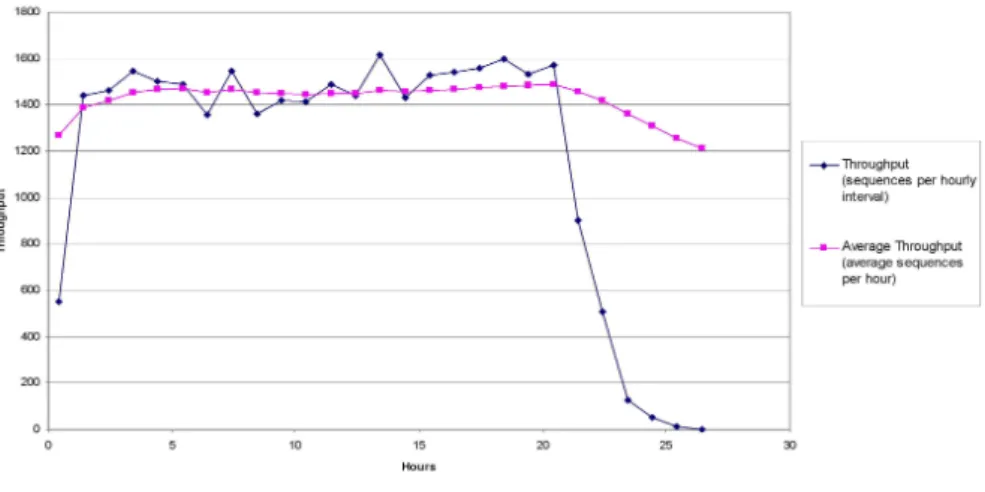
Thirdly, in a dynamic resource environment, more suitable resources could become available after the resource allocation. Users may want to change to use these resources to improve the execution performance, rather than statically stick to the pre-allocated resources. For example, in Figure 2.5 we can observe the throughput decreases rapidly in the long tails phase at the end of the execution. When the number of nodes exceeds the number of jobs that are left to run, the system should use the fastest processors to maintain high throughput. However the system has lack of adaptivity to migrate jobs from pre-allocated processors to idle faster processors.
Fourthly, since resource allocation is statically performed before starting execution, a job that needs multiple resources (especially resource co-allocation in multiple domains) could have to wait a long time to have enough resources available to run. This weak point is specially prominent when supporting interactive applications where users require results to be seen in a very short time. For example, a graphics rendering application that waits for user input to select an image to render. The rendering may require a immediate burst of computation to produce the image on-line.
2.4
Chapter Summary
In this chapter, we have provided an overview of distributed computing. Current distributed computing was developed from the traditional supercomputing community. Nowadays it is still rooted firmly in the 1970th supercomputer culture with its batch management. This is reflected by dominated queuing system-based DRMs, batch-type applications, and the static job submission approach. Many limitations are inherited from the batch computing culture. The limitations make the computing model more suited to support traditional “batch computing” or “high throughput computing” where users are not sensitive about the execution response, rather than effective, high performance computing, especially the inter-active applications in dynamic resource environments. The static and rigid job submission approach also lowers the usability of distributed computing since users must know the steps to submit a job for execution.