CellSs: a Programming Model for the Cell BE Architecture
Pieter Bellens, Josep M. Perez, Rosa M. Badia and Jesus Labarta
∗Barcelona Supercomputing Center and UPC
Building Nexus II, Jordi Girona 29,
Barcelona (SPAIN)
{
pieter.bellens, josep.m.perez, rosa.m.badia, jesus.labarta
}
@bsc.es
Abstract
In this work we present Cell superscalar (CellSs) which ad-dresses the automatic exploitation of the functional paral-lelism of a sequential program through the different pro-cessing elements of the Cell BE architecture. The focus in on the simplicity and flexibility of the programming model. Based on a simple annotation of the source code, a source to source compiler generates the necessary code and a run-time library exploits the existing parallelism by building at runtime a task dependency graph. The runtime takes care of the task scheduling and data handling between the differ-ent processors of this heterogeneous architecture. Besides, a locality-aware task scheduling has been implemented to re-duce the overhead of data transfers. The approach has been implemented and tested with a set of examples and the re-sults obtained since now are promising.
1
Introduction and Motivation
The design of processors has reached a technological limita-tion in the recent years. Designing more performance pro-cessors is every time more and more difficult, mainly due to power usage and heat generation. Manufacturers are cur-rently building chips with multiple processors [Geer 2005]. Although in most cases each of the processors in these multi-core chips are slower than its contemporary single-multi-core, overall they improve the performance and are more energy efficient. Examples of these chips are several dual-core pro-cessors like the AMD Opteron or Atlon, the Intel Smithfield or Montecito, or the IBM Power4 or Power5. More challeng-ing architectures are for example the Cell processor designed by IBM, Sony and Toshiba, with nine cores (and heteroge-neous) or the Niagara with eight cores, each of them being able to handle four threads.
With the appearance of these multi-core architectures, the developers are faced with the challenge of adapting their
ap-∗Permission to make digital or hard copies of all or part of this work for
personal or classroom use is granted without fee provided that copies are not made or distributed for profit or commercial advantage and that copies bear this notice and the full citation on the first page. To copy otherwise, to republish, to post on servers or to redistribute to lists, requires prior specific permission and/or a fee. SC2006 November 2006, Tampa, Florida, USA. 0-7695-2700-0/06/$20.00 c2006 IEEE.
plications to be able to use threads that can make use of all the hardware possibilities.
The first generation of the Cell Broadband Engine (BE)TM[Pham and al. 2005] includes a 64-bit multithreaded
PowerPCR processor element (PPE) and eight synergistic processor elements (SPEs), connected by an internal high-bandwidth Element Interconnect Bus (EIB). The PPE has two levels of on-chip cache and also supports IBM’s VMX to accelerate multimedia applications by using VMX SIMD units.
However, the main computing power of the Cell BE is pro-vided by the eight SPEs. The SPE is a processor designed to accelerate media and streaming workloads. The local ory of the SPEs is not coherent with the PPE main mem-ory, and data transfers to and from the SPE local memo-ries must be explicitly managed by using a DMA engine. Most SPE instructions operate in a SIMD fashion on 128 bits representing, for example, two 64-bit double-precision floating-point numbers or long integers, or four 32-bit single-precision floating-point numbers or integers, etc. The 128-bits operands are stored in a 128-bit register file. The mem-ory instructions also addresses 128-bit operands that must be aligned at addresses multiple of 16 bytes. Data is transferred by DMA to the SPE local memory in units of 128 bytes, en-abling up to 16 concurrent DMA requests of up to 16KB of data.
The Octopiler compiler [Eichenberger et al. 2006] imple-ments techniques for optimizing the execution of scalar code in SIMD units, subword optimization and other techniques. For example, it implements Auto-SIMDization, which is the process of extracting SIMD parallelism from scalar loops. This feature generates vector instructions from scalar source code for the SPEs and VMX units of the PPE. It is also able to overlap data transfers with computation, to allow the SPEs to process data that exceeds the local memory capacity. To our knowledge, this is also the only approach presented that allows a higher level programming model in a Cell BE based architecture. Besides the other lower level optimiza-tions, this compiler also enables the OpenMP programming model. This approach provides the programmers with the abstraction of a single shared-memory address space. Us-ing the OpenMP directives, the programmers can specify re-gions of code that can be executed in parallel. From a single body program, the compiler duplicates the necessary code
and adds the required additional code to manage the coordi-nation of the parallelization and generates the corresponding binaries for the PPE and SPE cores. The PPE uses asyn-chronous signals to inform each SPE that work is available or that it should terminate. The SPEs use a mailbox to up-date the PPE on the status of their execution. The compiler implements a software cache mechanism to allow reuse of temporary buffers in the local memory, and therefore there is no need for DMA transfers for all accesses to shared mem-ory. Other features, like code partitioning has also being im-plemented, to allow applications that do not fit in the local SPE memory.
Although the OpenMP model has been demonstrated to be powerful and valid and has a growing community of users [cOMPunity 2006], we consider that other higher pro-gramming models must be offered to the Cell BE architec-ture programming communities that enable to exploit the heterogeneous and parallel characteristics of this architec-ture.
With this goal, in this paper we present the Cell Superscalar framework (CellSs), which is based in a source to source compiler and a runtime library. The supported programming model allows the programmers to write sequential applica-tions and the framework is able to exploit the existing con-currency and to use the different components of the Cell BE (PPE and SPEs) by means of a automatic paralleliza-tion at execuparalleliza-tion time. The only requirement we place on the programmer is that annotations (somehow similar to the OpenMP ones) are written before the declaration of some of the functions used in the application. The similarity with the Octopiler approach is that an annotation (or directive) before a piece of code indicates that this part of code will be exe-cuted in the SPEs. Therefore, similar techniques are applied to separate this part of code from the main code and genera-tion of a manager program to be run in the SPEs that is able to call the annotated code. However, an annotation before a function does not indicate that this is a parallel region. It just indicates that it is a function that can be run in the SPE. To be able to exploit the parallelism, the CellSs runtime builds a data dependency graph where each node represents an in-stance of an annotated function and edges between nodes denote data dependencies. From this graph, the runtime is able to schedule for execution independent nodes to differ-ent SPEs at the same time. Techniques imported from the computer architecture area like the data dependency analy-sis, data renaming and data locality exploitation are applied to increase the performance of the application.
We would like to emphasize that OpenMP explicitly speci-fies what is parallel and what is not, while with CellSs what is specified are functions that are candidates to be run in parallel. The runtime will determine, based on the data de-pendencies, which functions can be run in parallel with oth-ers and which not. Therefore, CellSs provides programmoth-ers with a more flexible programming model with an adaptive
parallelism level depending on the application input data. In this work we focus on offering tools that enable a flexible and high-level programming model for the Cell BE, while we will rely on the Octopiler [Eichenberger et al. 2006] or other that may appear for the code SIMDization and other lower level code optimizations.
The structure of the paper is the following: section 2 de-scribes an overview of the system, section 3 dede-scribes the source to source compiler of the CellSs framework and sec-tion 4 the features implemented in the runtime library. Sec-tion 5 presents some experimental results and tracefiles of real executions. In section 6 we review some proposals re-lated with this work. Finally, section 7 concludes the paper.
2
General Structure and
Architec-ture
The main objective of the environment described in this pa-per is to provide the users with an easy to use programming methodology which at the same time is able to produce bi-naries that take benefit of the Cell BE architecture. The pre-decessor of the infrastructure used in the work presented in this paper is the GRID superscalar environment [Badia et al. 2003; GS 2006]. In this work, a superscalar processor is compared to a computational Grid: the processor functional units are Grid computer resources, the data that is stored in registers corresponds to files in the Grid and the assembly instructions to large (in terms of CPU time) simulations or calculations. In superscalar processors a sequential assem-bly code is automatically parallelized and non-dependent in-structions are concurrently executed in different functional units. GRID superscalar is able to do a similar job with large sequential applications composed of coarse grain tasks, by concurrently executing non-dependent application tasks in different computing resources in a Grid. While the first gen-eration of GRID superscalar was based on code gengen-eration and the only data dependencies that were taken into account were the ones defined by those parameters that are files, the version under development [Perez et al. 2006] is based on a source to source compiler, is able to tackle almost all type of data dependencies and besides the exploitation of the concur-rency in the remote resources in a Grid, further paralleliza-tion is achieved in the local client through the use of threads. Cell superscalar is based is this second version of GRID su-perscalar. The system is composed of two key components: a source to source compiler and a runtime library.
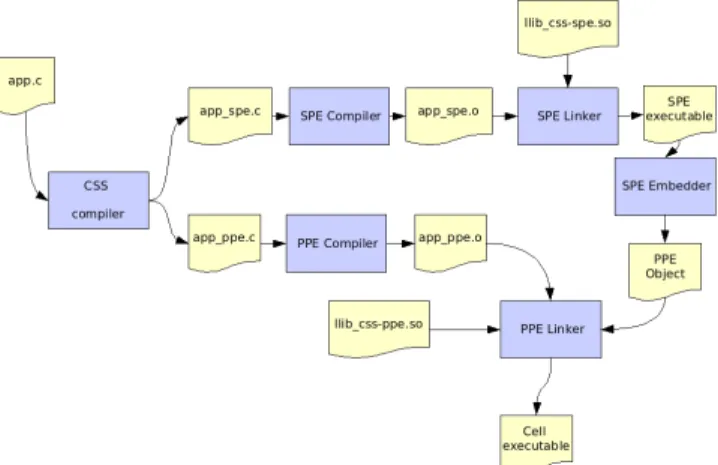
Figure 1 shows the process flow that a user application will follow in order to be able to generate an executable for the Cell BE. Given a sequential application in C language, with CellSs annotations (section 3 describes the annotations syn-tax) the source to source compiler is used to generate two
different C files. The first file corresponds to the main pro-gram of the application, and should be compiled with a PPE compiler to generate a PPE object. The second file corre-sponds to the code that will be executed under request of the main program in the SPEs. This file must be compiled with an SPE compiler to obtain a SPE object, that will be linked with the SPE libraries to obtain a SPE executable. However, in order to be able to execute this program, it must be embed-ded in the PPE binary executed in the PPE. For this reason, the PPE embedder is used to generate a PPE object, which is then used with the other PPE objects and PPE libraries as inputs to the PPE linker, which finally generates the Cell executable.
Besides the CellSs compiler, the rest of the process is the same that must be followed to generate binaries for the Cell BE.
Figure 1: Steps to generate a Cell executable
The main program binary is normally started from the com-mand line and starts its execution in the PPE. At the begin-ning of this program the activity of the SPEs is initiated by uploading the SPE binary in the memory of each SPE used. These programs will remain idle until the main program ap-plication starts spawning work to them. Whenever the main program runs into a piece of work that can be spawned in an SPE (from here one, a task), a request to the runtime li-brary is issued. The runtime will create a node representing this task in a task graph, and will look for dependencies with other tasks issued before, adding edges between them. If the current task is ready for execution (no dependencies with other tasks exists) and there are SPEs available, the runtime will make a request to an SPE to execute this task. The cor-responding data transfers are done by the runtime using the DMA engines. The call to the runtime is not blocking and therefore, if the task is not ready or all the SPEs are busy, the system will continue with the execution of the main program. It is important to emphasize that all this (task submission, data dependence analysis, data transfer) is transparent to the user code, which is basically a sequential application with
user annotations that indicates which parts of the code will be run in the SPE. The system can dynamically change the number of SPEs used by the application, taking into account the maximum concurrency of the application at each stage.
3
Compiler
The current version of the CellSs environment is based on source to source C compiler that is able to process user an-notations in the code. What is required from the user is to indicate those parts of the code that are to be executed in the SPEs. Since the PPE is slower than the SPEs, the candidates to be annotated are the CPU consuming parts of the applica-tion.
The current version of the source to source compiler supports the following features:
1. Provide the ability of specifying that a function is a task to be executed in the SPEs.
2. Provide the ability of specifying function parameter di-rections.
3. Provide the ability of specifying parameters that are ar-rays and their lengths.
What is to say, the compiler supports the annotation of parts of code encapsulated in a function (or procedure), that have scalar parameters or arrays. The user must indicate the di-rection of the parameters (input, output or input/output) in order to allow the runtime to find the data dependencies. Figure 2 shows an example of code with annotations. Let’s assumearray opis a computation intensive function in a user application. The annotation is indicating that this func-tion can be executed in the SPEs and the direcfunc-tion of the pa-rameters. The function has four input parameters, namely:a,
b,index iandindex j; and an output parameter,c. The ({ }) after the parameter names (a,bandc) indicate that those parameters are arrays. In this example, the user is not pro-viding the size of the input or output arrays since it is already specified in the function interface. An equivalent annotation, from the compiler point of view is shown in Figure 3, where the size of the arrays is specified. As it can be seen, the an-notation of the code is very simple. It can be easily used to annotated any kind of software. The only limitation to the functions to be annotated is on the type of the parameters: structures containing pointers (like trees or graphs) are not supported, since the renaming of this type of structures will be very costly.
From the annotated source code, the CellSs compiler is able to generate two different sets of files: the main program of the application to be executed in the PPE and the tasks code to be executed in the SPEs. In the main program files, the compiler inserts the following code:
#pragma css task input(a{}, b{}, index i,\
index j) output(c{})
void array op(float a[N], float b[N], float c[N], int index i, int index j);
main(){
...
array op(A, B, C, i, j); ...
}
Figure 2: Example of annotated code in CellSs
• Calls to CellSs runtime initializing and finalizing func-tions.
• Calls for registering the annotated functions. This cre-ates a table of functions that can be later indexed by the SPE generated code.
• Substitutes the original calls to annotated functions by calls to theExecutefunction from the CellSs runtime
Besides, the original code of the annotated tasks can be elim-inated, since it is not going to be executed in the PPE and therefore is not necessary in this binary. Figure 4 shows an example of generated code for the PPE for example of fig-ure 3.
The compiler generates an adapter for each of the annotated tasks. These adapters can then be called (under request of the PPE program) from the SPE main program (tasks program), which is hard-coded in the CellSs SPE runtime library. Fig-ure 5 shows an example of the generated code for the SPEs for the example of Figure 3.
The current implementation of this compiler is based on the Mercurium compiler [Gonzalez et al. 2004]. This compiler was originally designed for OpenMP but since its infrastruc-ture is quite general it has been reasonable easy to port it to enable Cell superscalar.
#pragma css task input(a{N}, b{N}, index i,\
index j) output(c{N})
void array op(float *a, float *b, float *c, int index i, int index j);
main(){
...
array op(A, B, C, i, j); ...
}
Figure 3: Another example of annotated code in CellSs
main(){
...
CellSs RegisterLocalFunction ("array op"); Execute ("array op", 5, IN DIR, ARRAY T,
1, A, N, FLOAT T, IN DIR, ARRAY T, 1, B, N, FLOAT T, OUT DIR, ARRAY T, 1, C, N, FLOAT T,IN DIR, INT T, 0, i, IN DIR, INT T, O, j);
...
}
Figure 4: Example of generated code for the PPE
void css array op adapter (int *params, char *data buffer)
{
array op adapter(data buffer[params[0]], data buffer[params[2]],
data buffer[params[4]], data buffer[params[6]], data buffer[params[8]]);
}
Figure 5: Example of generated code for the SPE
4
Runtime
As it has been mentioned before, CellSs environment shares most of the GRID superscalar next generation version in-frastructure. Besides the compiler, the other important piece which is shared is the runtime library. Although a rough overview of what the runtime is able to do will be described in this section, the reader is referred to [Perez et al. 2006] for a deeper explanation. The most important change in the orig-inal user code that the CellSs compiler inserts are the calls to
theExecutefunction whenever a call to an annotated
func-tion appears.
At runtime, these calls to theExecutefunction will be the responsible for the intended behavior of the application in the Cell BE processor. At each call to Execute, the runtime will do the following actions:
• Addition of a node in a task graph that represents the called task.
• Data dependency analysis of the new task with other previously called tasks. The data dependency analysis is based on the assumption that two parameters are the same if they have the same address. The system looks for RaW, WaR and WaW data dependencies1.
• Parameters renaming: similarly to register renaming, a technique from the superscalar processor area, we do renaming of the output and input/output parameters.
1RaW, WaR and WaW stand for Read after Write, Write after Read, and
For every function call that has a parameter that will be written, instead of writing to the original parameter location, a new memory location will be used, that is, a new instance of that parameter will be created and it will replace the original one, becoming a renaming of the original parameter location. This allows to execute that function call independently from any previous function call that would write or read that parameter. This tech-nique allows to effectively remove all WaW and WaR dependencies by using additional storage, greatly sim-plifying the dependency graph and thus improving the chances to extract more parallelism.
• Additionally, under certain conditions, the task maybe submitted for execution. This process is described in the next paragraph.
During the execution of the application the runtime main-tains a list of ready tasks. A task is labeled as ready when-ever no data dependencies exist between other tasks and this or whenever all the data dependencies have been solved (i.e., the predecessor tasks have finished their execution). The task dependency graph and the ready list are updated each time a new task appears (when calling theExecutefunction) and each time a task finish. When a task finishes, the runtime is notified (section 4.1 specifies how this is implemented for the Cell processor case) and the task graph will be checked to establish which data dependencies have been satisfied and add those tasks that now have all data dependencies solved to the ready list.
Given a list of ready tasks and a list of available resources, the runtime will choose the best matching between tasks and resources and will submit the tasks for execution. By task
submission it is meant to perform all the necessary actions in
order to execute that task: parameters transfer and request for task execution. Section 4.1 describes how this is performed for the Cell BE processor case. This resource selection is tailored to exploit the data locality between the tasks. In this sense, the runtime will try to assign tasks that have a data dependency to the same resource. Then, the data which is shared between both tasks is kept in the resource, reducing the application time devoted to data transfer. Section 4.2 de-scribes how this is implemented for the Cell BE processor case.
Finally, the runtime has been provided with a tracing capa-bility. When running an application, a post-mortem trace-file can be optionally generated. This tracetrace-file can be after-words analyzed with the performance analysis toolset Par-aver [Labarta et al. 1996]. Section 4.3 describes this feature.
4.1
Middleware for Cell
CellSs applications are composed of two type of binaries: the main program, which will be run in the PPE and the tasks
program, which will run in the SPE. These binaries are ob-tained by compilation of the files generated by the CellSs compiler with the CellSs runtime libraries as described in section 2.
When starting the main program in the PPE, the tasks pro-gram will be launched in each of SPEs used for this execu-tion. The tasks programs will wait for requests from the main program.
To be able to execute the annotated functions is the slave SPEs, the runtime should be able to: prepare all the neces-sary data to be transferred to the SPEs, request the SPE to start a task and, synchronize with the SPEs to know when a task finishes.
When the scheduling policy selects a task from the ready list and an SPE as resource for executing this task it builds a data structure, the task control buffer, which stores all the infor-mation required by the SPE to locate the necessary data for the task. The task control buffer contains information such as: task type identifier, location of each of the parameters and control information.
The task type identifier is just an identifier that allows the SPE to know which is the task between all the annotated that have to be executed. Regarding the input parameters, it may happen that some of them are already located in the local memory of the SPE (as a result of a previous execution) or it may be that they are in the main memory and therefore should be DMAed in before executing the task. Regarding the output parameters, it may be that some of them must be kept in the local memory after task execution or it may be that some of them must be copied back to the main memory when the task finishes (this operation will be done by DMA also). All this information is stored in the fields of the task
control buffer.
The request from the main program to execute a task in a given SPE is done through a mailbox structure. One entry of this mailbox exists for each of the SPEs. When there is a task ready for execution for a given SPE, the main program places in the corresponding entry the request, the address of the task control buffer and the size of this buffer.
The behavior of the tasks program run in the SPE, is the fol-lowing: if the tasks program is idle, it polls its corresponding entry of the mailbox until a task request is detected. Then, it DMAs in the task control buffer. From this buffer is able to understand where it is all the data that is required for the re-quested task, even if it is in the main memory and should be DMAed in to the local memory, or even it is already in the local memory. Once all the necessary input data has been DMAed in, the task is executed in the SPE by calling the an-notated task through the generated adapter. When the task is finished, the tasks program DMAs out some of the output data, according to the task control buffer and keeps in local memory the rest of data.
Besides, the task control buffer may contain instructions to compact the data located in the local memory. Since some of the data located in the local memory is kept from task to task and other is not, the local memory can suffer from fragmentation. The CellSs PPE runtime library keeps a map of the SPEs local memories and implements a compaction policy to reduce the fragmentation level.
Regarding the requirement in the SPEs of data alignment, the tasks program takes care of this by aligning all data in positions multiple of 16 bytes.
Regarding the synchronization between the PPE and the SPE, two different options have been implemented and tested. The first implementation is based on a MUTEX mechanism provided by the IBM CBE SDK [IBM 2006]. However, when we tested this version, it turn out that the main program was missing some of the SPE callbacks to indicate that the task has finished. This was considered a bug of the IBM CBE SDK and a bug was reported. How-ever, in the meanwhile we need a working version. Then, a second synchronization mechanism was implemented using event signaling.
The tasks communicate with the main program when a task execution is finished, and after all output data has been DMAed out. Whenever possible we try to avoid the copy back to memory of the output arguments. Different types of synchronization have been evaluated. One is based on writ-ing an event identifier in the mailbox. The task then signals the main program using an SPE intrinsic (spu hcmpeq). An-other option we considered is to use conditional variables or to do polling on the mailboxes or memory. The current im-plementation is based on the latter scenario: we reserve a location in main memory for each SPE to write its events to. Writing to or reading from these positions, both from the SPE or PPE is much more efficient than using the other methods.
The garbage collection of the task control buffers, as all the rest of data structures, is handled by the C++ libraries. The implementation described in this section is based on the SPE Threads provided with the Cell BE system libraries.
4.2
Locality Exploitation
As described above, when executing the main program in the PPE, the CellSs runtime builds a task data dependency directed graph where each node is an instance of the anno-tated functions. If two tasks are linked with an edge in this graph it means that at least one result of the source node is used as input by the sink node.
The objective is to reduce the amount of data that is trans-ferred between the PPE and the SPEs and between the SPEs. The current CellSs implementation is able to keep the re-sults of a computation in the SPE instead of transferring them
back to the main memory. Then, if the task or tasks that need this result are scheduled in the same SPE, no data transfers are required. A locality aware scheduling policy has been implemented in the CellSs PPE library to tackle this prob-lem.
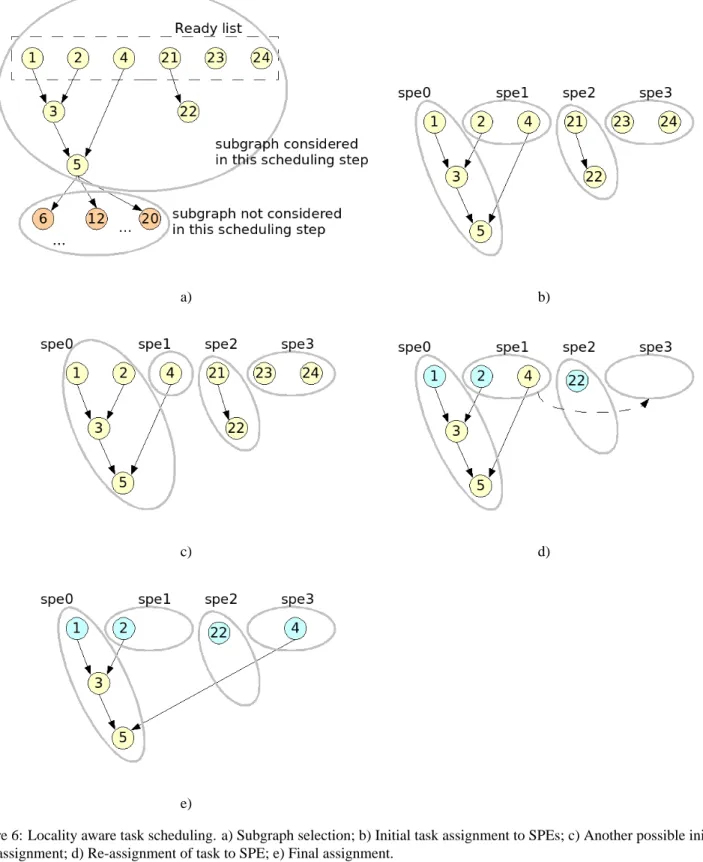
At given moments of the execution (scheduling step), the policy considers the subgraph composed of the tasks in the ready list and the subsets of nodes in the task dependency graph which are connected to the ready nodes up to a given depth. This subgraph is then partitioned in as many groups as available SPEs, guided by the parental relations of the nodes. In this sense, the policy will try to group source with sink nodes, trying to reduce the number of transfers but also not reducing the concurrency of the execution. Each partition is then initially assigned to one SPE. The tasks in a parti-tion were initially sent for execuparti-tion independently although to reduce the synchronization overhead, the current version is sending clusters of tasks for execution to the SPEs. The static scheduling can be dynamically changed to solve work-load unbalance, at a cost of a data transfer in some cases. This will happen when it is detected that a SPE is idle and there are no tasks left in its corresponding partition, while other SPEs has ready tasks waiting for execution in their partition. Some of the tasks will then be reassigned dynami-cally to other partitions. This algorithm resembles the dom-inant sequence clustering algorithm (DSC) [Yang and Gera-soulis 1991], but the algorithm we have implement is more dynamic and adds work stealing.
Figure 6 shows an example of behavior. At a given point in the execution of an application, a task graph has been gen-erated by the CellSs runtime (figure 6.a). Each node in the graph represent a call to a annotated function in the original code, and the edges are added by the CellSs runtime when-ever a data dependency exist between them. The number indicated in the node reflects the creation order of the graph (for example, the first annotated function that was called by the application is represented by node 1 and the node labeled with a 5 represents the fifth call to an annotated function). The tasks that do not have data dependencies with other tasks are included in the ready list.
At this scheduling step, the subgraph considered for partition consist of: tasks in the ready list, and successors of these tasks until depth 2 (i.e., direct successors, and direct succes-sors of its successucces-sors). Consider that we have 4 SPEs avail-able for the execution of this application. The subgraph is then partitioned in 4, and one partition is assigned to each SPE. A possible partition is shown in figure 6.b). Then, the scheduler will select one task from each partition to be spawned in each SPE. For some partitions, the selection is obvious, as for thespe0partition, where only task 1 is in the
ready list. In other cases, the decision will be based on the
length of the longest path from the node to the leaves of the task graph (i.e., for partitionspe1task 2 will be selected). Finally, in other cases, as for partitionspe3the scheduling
will just pick the first node in alphabetical order (task 23). Each time a task finishes, the CellSs runtime will be noti-fied. After identifying the SPE that is idle, the scheduler will select another ready task from the partition and spawn it for execution in the SPE. The CellSs runtime will control the required data transfers in each case. For example, for this partition, when task 1 and task 2 have finished, task 3 will be spawned for execution. The task control buffer will indi-cate that the data obtained by task 1 is already in the SPE0 local memory, although the data generated by task 2 will be DMAed from main memory2.
Another possible partition is the one described in figure 6.c). In terms of data transfers, figure 6.c) is better since the data transfer of the result generated by task 2 can be kept in the local memory of SPE0, and therefore whenever task 3 is ex-ecuted, no input data transfers will be required. However, in terms of execution time may be inferior, since task 1 and task 2 cannot be executed at the same time in a single SPE and therefore these two tasks will be serialized.
Figure 6.d describes the dynamic behavior of the scheduling policy. The nodes in light blue (darker color when printed in b&w), represent tasks that are currently being executed in the corresponding SPE. The nodes that have disappeared from the graph represent tasks that have finished their exe-cution. As it can be observed, partitionspe3is now empty, and therefore an SPE will be idle. In this situation the policy will try to balance the workload by stealing ready tasks from other partitions. In this case, task 4 from partitionspe1is ready for execution and waiting. The scheduling policy se-lects this node and move it to partitionspe3, and task 4 is started immediately (see figure 6.e). In some cases this may require some data transfers from a local memory of an SPE to another. The policy will take these transfers into account trying to minimize them.
4.3
Tracing
A tracing mechanism has been implemented in the CellSs runtime which generates Paraver [Labarta et al. 1996] con-forming post-mortem tracefiles of the applications. A Par-aver tracefile is a collection of records ordered by time where information about the events and states that the application has passed through is stored. These traces can then analyzed with the Paraver graphical user interface which allows per-formance analysis at different levels (i.e., task level, thread level), filtering and composing functions that allow different views of the application and a set of modules to calculate various statistics.
Although Paraver has its own tracing packages for MPI,
2The kernel version available at BSC when writing this version of the
paper does not support direct DMA transfers between SPEs. For this reason, a data transfer from SPE1 to main memory and a data transfer from main memory to SPE0 will be required for this case.
OpenMP and other programming models, in this case a Tracing Component has been embedded in the CellSs run-time. The Tracing Component records events as they are signaled throughout the library. For example, it records when the main program enters or exits any function of the CellSs API (as for example CellSs On, CellSs Off, CellSs RegisterLocalFunction), it records when an anno-tated function is called in the main program (and therefore a node is added to the graph), when a task is started or fin-ished, etc.
The traces obtained will allow to analyze the behavior of the CellSs runtime and of the application in general. This tracing capability can be enabled or disabled by the user.
5
Examples and Results
Since now we have measured and analyzed the behavior of three examples: a block matrix multiplication (matmul), an exact implementation of the travel salesman problem (TSP) and a block matrix Cholesky factorization (cholesky). The examples generate different levels of difficulty for the CellSs runtime scheduler: while the TSP generates a em-barrassingly parallel graph (all tasks instances are data in-dependent between them) and the matrix multiply generates a relatively easy to schedule graph and the Cholesky factor-ization generates a much more connected data dependence graph which is more challenging for the CellSs scheduler.
5.1
Performance Analysis
The first tests were performed with the matrix multiply ex-ample. As it has been mentioned before, in this example the elements of the matrices are blocks, i.e, each element of the matrices is itself a smaller matrix. In this case, the blocks of data we used are blocks of 64×64 single-precision floats, while the matrices are of 16×16 blocks. This schema gen-erates 4096 tasks, each of them performing a 64×64 matrix multiplication. This 4096 tasks are organized in groups of 16 dependent tasks, where each task reads the result of the pre-vious one. Thus, we expected that this organization was an easy to schedule graph for the locality aware task scheduler. By using the tracing mechanism we were able to tune the initial results. For example, by means of the analysis of the trace files, we were able to observe that while the sched-uler was working as expected the synchronization mecha-nism was reducing the performance of the application. Each time an SPE signals an event to the PPE resulted in a high time penalty. Initially we were able to reduce this overhead by reducing the number of signals an SPE sends to the PPE to the minimum. We have considered different synchroniza-tion mechanisms, as described before in secsynchroniza-tion 4.1.
Us-a) b)
c) d)
e)
Figure 6: Locality aware task scheduling. a) Subgraph selection; b) Initial task assignment to SPEs; c) Another possible initial task assignment; d) Re-assignment of task to SPE; e) Final assignment.
ing the tracing mechanism and Paraver we have been able to analyse the behavior of the applications in each case and to decide which is the mechanism with less overhead.
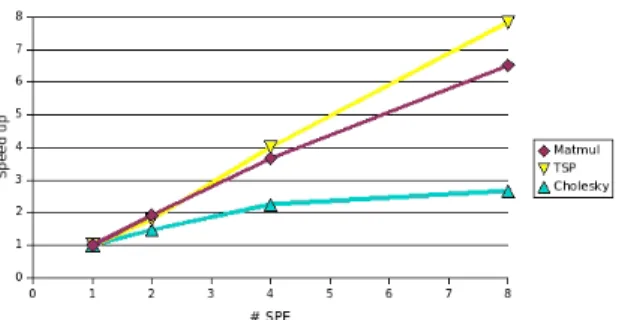
Figure 7 shows a sample plot of the visualization with Par-aver of a tracefile. The x-axis represents the timeline and each line in the y-axis represent a thread. The PPE executes two threads: the Master thread and the Helper thread. While the Master thread executes the main program application and the runtime features, the Helper thread is in charge of hearing to the SPE threads. Each SPE executes a single thread (SPU threadi). In the plot, the dark blue indicates that the thread is busy and the light blue that the thread is idle. This plot is from an execution where the SPEs where signaling two events per task to the PPE. It can be easily observed that the threads run in the PPE are much more busy than the threads run in the SPEs. This situation improved a lot when we re-duced the number of signals generated by the SPEs. This is just a simple example of how the trace file generation and analysis is worthwhile, at least for development purposes. The final results for the matrix multiply example are shown in figure 8, where we can see that this examples scales al-most perfectly. The figure presents the performance results obtained when running with 1, 2, 4 and 8 SPEs scaled to the case when 1 SPE is used.
Figure 7: Sample generated tracefile
5.2
Execution Results
The TSP example performs an exhaustive search to find the optimum solution to this traditional problem. The scheme of the implemented algorithm is recursive, but the recursion is composed of two parts: the part that it is execution in the PPE and the part that is executed in the SPE. The level of re-cursion at which this decomposition is performed determines the number and size of tasks executed in the SPEs: at earlier levels a small number of coarse grain tasks are generated, and at later levels a larger number of fine grain tasks are ob-tained. The algorithm passes as arguments to the SPE tasks, a vector with the partial path solution built until the moment. As expected, since all tasks are independent between them, the execution scale perfectly with the number of processors (see figure 8).
The Cholesky factorization is implemented as the matrix multiply with matrices of blocks. The block-size is again 64
×64 single-precision floats, and the matrices are of 11×11
blocks, resulting in 705 tasks. The challenge of the Cholesky example is two-fold: first, these 705 tasks compose a highly connected dependency graph, and second, there are up to six different tasks of different grain-level. We consider that the results obtained for this example (figure 8) are reasonable taking into account the above mentioned reasons.
6
Related Work
The closer work to the one presented in this paper, as it has been indicated in the introduction of this paper, is the work being done at IBM with the Octopiler compiler [Eichen-berger et al. 2006]. However the IBM approach is focused to OpenMP and we see CellSs as an alternative programming model to OpenMP, probably more flexible, which can be used in a different range of applications, whether OpenMP is mostly focused to the parallelization of fine grain numeri-cal loops. Besides, CellSs will rely on the IBM compiler or others that offer similar features for the automatic vectoriza-tion of the SPE code (Auto-SIMDizavectoriza-tion).
Some similarities can be found with Thread-Level Specula-tion, specially with the work proposed by [Zhai et al. 2002]. This work tries to solve the performance limitation intro-duced by the forwarding of scalar values between threads. In this approach, the compiler inserts explicit synchroniza-tion primitives (wait and signal) to communicate scalars that are used by multiple threads. These synchronization points define dependencies between the threads that remind of the data-dependency analysis performed by CellSs, although in the former approach the problem is tackled at compile time and in the CellSs at execution time.
At the architectural level, Cell BE architecture can be com-pared with SMPs. However, in the latter architecture, the threads share the memory space, and therefore data can be easily shared although it should exist a synchronization mechanism to avoid conflicts. As it has been seen, the Cell BE SPEs have a local memory and data must be copied there by DMA before performing any calculation with them. This
Figure 8: Results obtained for the evaluated examples. Speed up is measured against the execution with 1 SPE
is one of the fundamental characteristics of the Cell BE ar-chitecture that makes its programming a challenge.
Another architecture that have similarities with the Cell BE is the one of the graphics processors (GPU). The latest series of these type of hardware presents a large amount of potential parallelism, with up to 6 vertex processors and up to 16 pixel processors. Although these processors are initially very spe-cialized, due to their excellent performance/cost ratio, dif-ferent approaches to use them for other fields of application rather than graphical applications have been presented [Ga-loppo et al. 2005; Fan et al. 2004; Harris et al. 2003]. GPUs can be programmed by means of Cg [Mark et al. 2003], a C-like high-level language. However, to be able to use the GPUs for general-purpose computation, there are some re-quirements that must be meet, as for example the fact that the data structure must be arranged in arrays in order to be stored in the specific structures of the GPU. This is easy for applications dealing with matrices or arrays, but it is more difficult to accommodate data structures such as binary trees and in general programs that use pointers. Another limitation is that the computation may be inefficient in cases where the program control flow is complex. To the knowledge of the authors there are no approached to hide these complexities to the programmers with environments equivalent to CellSs.
7
Conclusions
This paper presents CellSs, an alternative to traditional par-allel programming models. The objective is to be able to of-fer a simple and flexible programming model for parallel and heterogeneous architectures. Following CellSs paradigm, in-put applications can be written as sequential programs. This paradigm is currently customized for the Cell BE architec-ture. The runtime builds a task dependency graph of the calls to functions that are annotated in the user code and schedules these calls in the SPEs, handling all data transfers from and to the SPEs. Besides, a locality-aware scheduling algorithm has been implemented to reduces the amount of data that is transferred to and from the SPEs.
The initial results are promising but there is a lot of work left, as for example: new annotations to be taken into ac-count by the source to source compiler, improvement in the scheduling and data handling, and improvement of the syn-chronization mechanism between the PPE and the SPEs.
Although the approach presented in this paper is focused to the Cell BE architecture we consider that CellSs is enough generic to be used, after tailoring of the middleware, with other multicore architectures.
8
Acknowledgments
This work has been partially supported by the CICYT un-der contract TIN2004-07739-CO2-01 and by the BSC-IBM Master R&D Collaboration agreement.
References
BADIA, R. M., LABARTA, J., SIRVENT, R., P ´EREZ, J. M., CELA, J. M.,ANDGRIMA, R. 2003. Programming grid applications with GRID superscalar. Journal of Grid
Com-puting 1, 2, 151–170.
COMPUNITY, 2006. The community of OpenMP users, researchers, tool developers and provider website. http://www.compunity.org/.
EICHENBERGER, A., O’BRIEN, J. K., O’BRIEN, K. M., WU, P., CHEN, T., ODEN, P. H., PRENER, D. A., SHEP
-HERD, J. C., SO, B., SURA, Z., WANG, A., ZHANG, T., ZHAO, P., GSCHWIND, M. K., ARCHAMBAULT, R., GAO, Y., ,ANDKOO, R. 2006. Using advanced compiler technology to exploit the performance of the cell broad-band engineTMarchitecture. IBM System Journal 45, 1,
59–84.
FAN, Z., QIU, F., KAUFMAN, A.,ANDYOAKUM-STOVER, S. 2004. GPU cluster for high performance computing. In Proceedings of SC’04, –.
GALOPPO, N., GOVINDARAJU, N. K., HENSON, M.,AND
MANOCHA, D. 2005. Lu-gpu: Efficient algorithms for solving dense linear systems on graphics hardware. In
Proceedings of SC’05, –.
GEER, D. 2005. Chip makers turn to multicore processors.
Computer 38, 7, 11–13.
GONZALEZ, M., BALART, J., DURAN, A., MARTORELL, X., AND AYGUADE´, E. 2004. Nanos mercurium: a re-search compiler for OpenMP. In Proceedings of the
Eu-ropean Workshop on OpenMP, –.
GS, 2006. GRID superscalar homepage. http://www.bsc.es/grid/grid superscalar/.
HARRIS, M. J., III, W. V. B., SCHEUERMANN, T., AND
LASTRA, A. 2003. Simulation of cloud dynamics on graphics hardware. In Proceedings of the ACM
SIG-GRAPH/EUROGRAPHICS conference on Graphics hard-ware, 92–101.
HENNESSY, J. L., PATTERSON, D. A., AND GOLDBERG, D. 2002. Computer Architecture: A Quantitative
Ap-proach. Morgan Kaufmann.
IBM, 2006. PowerPC hosted environment for the cell broadband engine version 1.0.1.
http://www.bsc.es/projects/deepcomputing/linuxoncell/-cellsimulator/ppc-cellsimulator-sdk1.0.1.html.
LABARTA, J., GIRONA, S., PILLET, V., CORTES, T.,AND
GREGORIS, L. 1996. DiP: A parallel program devel-opment environment. In Proceedings of the 2nd
Interna-tional EuroPar Conference (EuroPar 96), –.
MARK, W. R., GLANVILLE, R. S., AKELEY, K., AND
KILGARD, M. J. 2003. Cg: a system for program-ming graphics hardware in a c-like language. ACM Trans.
Graph 3, 22, 896–907.
PEREZ, J. M., BADIA, R. M., AND LABARTA, J. 2006. Scalar-aware grid superscalar. DAC tech-nical report UPC-DAC-RR-CAP-2006-12, Universitat Polit`ecnica de Catalunya, Computer Architecture Depart-ment, www.ac.upc.edu.
PHAM, D.,AND AL. 2005. The design and implementation of a first-generation cell processor. In Proceedings of the
2005 IEEE International Solid-State Circuits Conference (ISSCC), 184–185.
YANG, T., AND GERASOULIS, A. 1991. A fast static scheduling algorithm for DAGs on an unbounded num-ber of processors. In Proceedings of the 1991 ACM/IEEE
conference on Supercomputing, –.
ZHAI, A., COLOHAN, C., STEFFAN, J. G.,ANDMOWRY, T. C. 2002. Compiler optimization of scalar value com-munication between speculative threads. In Proceedings