Bayesian Analysis of Spatial Point Patterns
by
Thomas J. Leininger
Department of Statistical Science Duke University
Date:
Approved:
Alan E. Gelfand, Supervisor
Robert L. Wolpert
Merlise A. Clyde
James S. Clark
Dissertation submitted in partial fulfillment of the requirements for the degree of Doctor of Philosophy in the Department of Statistical Science
in the Graduate School of Duke University 2014
Abstract
Bayesian Analysis of Spatial Point Patterns
byThomas J. Leininger
Department of Statistical Science Duke University
Date:
Approved:
Alan E. Gelfand, Supervisor
Robert L. Wolpert
Merlise A. Clyde
James S. Clark
An abstract of a dissertation submitted in partial fulfillment of the requirements for the degree of Doctor of Philosophy in the Department of Statistical Science
in the Graduate School of Duke University 2014
Copyright c 2014 by Thomas J. Leininger All rights reserved except the rights granted by the Creative Commons Attribution-Noncommercial Licence
Abstract
We explore the posterior inference available for Bayesian spatial point process mod-els. In the literature, discussion of such models is usually focused on model fitting and rejecting complete spatial randomness, with model diagnostics and posterior in-ference often left as an afterthought. Posterior predictive point patterns are shown to be useful in performing model diagnostics and model selection, as well as providing a wide array of posterior model summaries. We prescribe Bayesian residuals and methods for cross-validation and model selection for Poisson processes, log-Gaussian Cox processes, Gibbs processes, and cluster processes. These novel approaches are demonstrated using existing datasets and simulation studies.
Contents
Abstract iv
List of Tables ix
List of Figures x
List of Abbreviations and Symbols xv
Acknowledgements xvi
1 Introduction 1
1.1 Point patterns . . . 2
1.2 Frequentist Inference for Spatial Point Processes . . . 7
1.3 Bayesian Inference for Spatial Point Processes . . . 9
1.4 Contributions to Spatial Point Process Analysis . . . 10
2 Bayesian Point Pattern Analysis 13 2.1 Homogeneous Poisson Processes . . . 14
2.1.1 Japanese Pines Data . . . 15
2.1.2 Posterior Analysis for HPPs . . . 16
2.1.3 Homogeneous F-,G-, and K-functions . . . 19
2.1.4 F-,G-, andK-functions for Japanese Pines Data . . . 29
2.2 Nonhomogeneous Poisson Processes . . . 30
2.2.1 NHPP Model and Duke Forest Data . . . 31
2.2.3 Domain-level Inference . . . 34
2.2.4 Point-level Inference . . . 36
2.2.5 Block-level Inference . . . 38
2.2.6 InhomogeneousK-function . . . 39
2.2.7 InhomogeneousK-function for Duke Forest Data . . . 43
2.3 Log-Gaussian Cox Processes . . . 44
2.3.1 LGCP Model . . . 45
2.3.2 Elliptical Slice Sampling for LGCPs . . . 49
2.3.3 Posterior Inference for LGCPs . . . 51
2.3.4 Domain-level Inference . . . 51
2.3.5 Point-level Inference . . . 53
2.3.6 Block-level Inference . . . 55
2.3.7 InhomogeneousK-function for Duke Forest Data . . . 56
2.4 Summary . . . 57
3 Model Diagnostics and Model Choice 59 3.1 Residual Diagnostics . . . 59
3.1.1 Monte Carlo Residual Test . . . 64
3.2 Cross-validation for Point Patterns . . . 69
3.3 Model Selection for Point Patterns . . . 72
3.4 Simulation Study . . . 80
3.5 Summary . . . 84
4 Analysis of Complex Spatial Point Processes 86 4.1 Gibbs Processes . . . 88
4.1.1 Model Fitting for Gibbs processes . . . 90
4.1.3 Swedish Pines Data . . . 96
4.2 Cluster Processes . . . 103
4.2.1 Common Cluster Processes . . . 103
4.2.2 Poisson-Gamma Processes . . . 105
4.2.3 Simulation Study . . . 108
4.2.4 Redwood Data . . . 114
4.3 Other Point Processes . . . 118
5 Discussion 125 A Formulas for F-, G-, and K-functions 128 A.1 Standard Empirical Estimates . . . 128
A.2 Proposed Bayesian F-, G-, andK-functions . . . 129
B Simulation Study Plots from Chapter 3 131
C MCMC Algorithm for the Poisson-Gamma Model 138
Bibliography 141
List of Tables
3.1 Coverage of the various innovations and residuals in the Monte Carlo
test targeting a 90% coverage rate. . . 65
3.2 Coverage of the 90% credible intervals for the innovations and residuals
in the Monte Carlo test for thinning levels p = 0.5,0.8 and q = 0.05.
The coverage on the training dataset is given before the forward slash
and the coverage on the test dataset is given after the forward slash. . 72
4.1 RPS scores for the HPP and Strauss models on the Swedish pines
data. The coverage of the 90% intervals are given in parentheses. . . 98
4.2 The posterior p-values for the posterior predictive variance metrics
using random boxes of varying sizeq|D|. . . 102
4.3 Number of times (out of 10) having best RPS score on a simulated
dataset under each type of data-generating process, with E[n]≈100. 110
4.4 Number of times (out of 10) having best RPS score on a simulated
List of Figures
1.1 Examples of point patterns exhibiting (a) CSR, (b) regularity, and (c)
clustering. . . 4
2.1 Plots of (a) the Japanese pines data and (b) the prior and posterior
distributions for λ. The vertical line in (b) denotes the MLE ˆλ= 2.001. 16
2.2 (a) The posterior distribution for N(D), (b) the subset A ⊂ D of
interest, and (c) the posterior distribution forN(A). The solid vertical
lines in (a) and (c) represent the posterior mean and 95% credible
intervals and the dashed lines represent the observed values. . . 18
2.3 Posterior estimates for (a) F(d), (b) G(d), and (c) K(d) under the
HPP model for the Japanese black pines data. The theoretical forms
use the MLE for ˆλ and the empirical estimates are the standard
non-parametric estimates. The shaded area represents the 95% pointwise
credible intervals forK(d). . . 30
2.4 (a) The locations of 530 American sweetgum trees in a tract of Duke
forest and (b) the elevation in meters over the same region. . . 31
2.5 Posterior distributions for the parameters of the NHPP model. The
posterior mean is marked by the solid vertical line and the 95% credible
intervals are marked by the dashed lines. . . 33
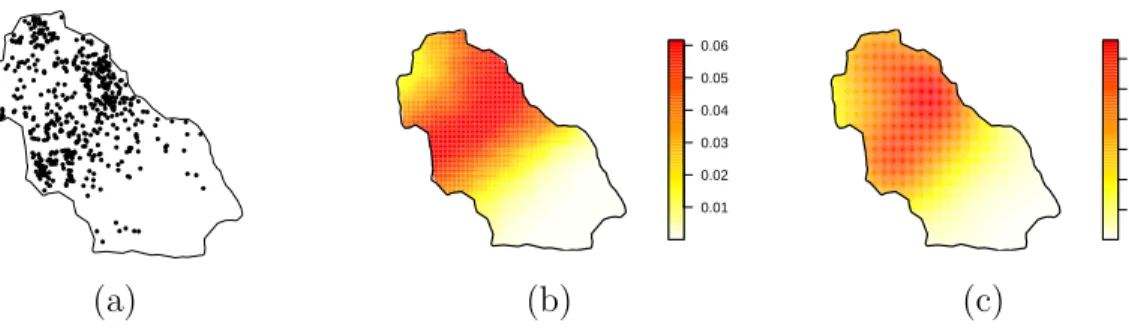
2.6 (a) The Duke forest data, (b) the posterior mean of the intensity
surface for the NHPP model, and (c) the kernel intensity estimate. . 34
2.7 The posterior distributions for (a) λ(D) and (b) N(D) in the Duke
forest NHPP model. . . 36
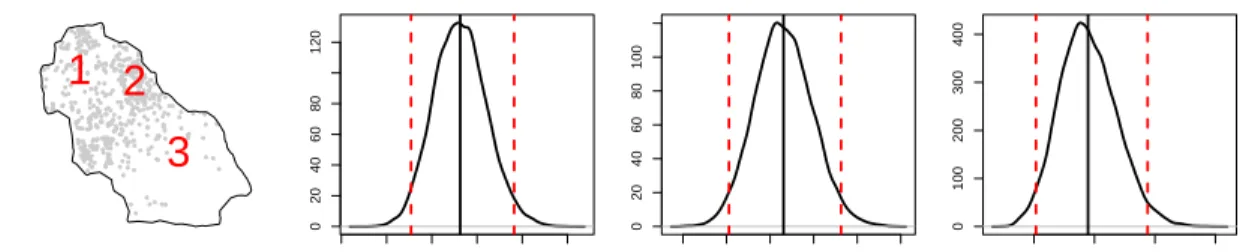
2.8 The posterior distributions for λ(s) at three points in Duke forest.
The solid vertical lines represent the posterior means and the dashed
2.9 The posterior distributions forγ(s, s0) at three points in Duke forest. The locations of the three points are given in Figure 2.8. The solid vertical lines represent the posterior means and the dashed vertical
lines represent the 95% credible intervals. . . 37
2.10 The posterior distributions for N(A), N(B), and N(A)N(B) under
the NHPP model for the Duke forest data. The solid lines give the posterior means, the dashed lines give the 95% credible intervals, and
the dotted lines give the observed values. . . 38
2.11 The posterior distributions for the inhomogeneous K-function under
the NHPP model for the Duke forest data. The theoretical and
em-pirical estimates, as computed in spatstat, are also given. . . 44
2.12 Posterior distributions for the parameters of the LGCP model. The posterior mean is marked by the solid vertical line and the 95% credible
intervals are marked by the dashed lines. The HPP MLE ˆλ is given
by the dotted line. . . 52
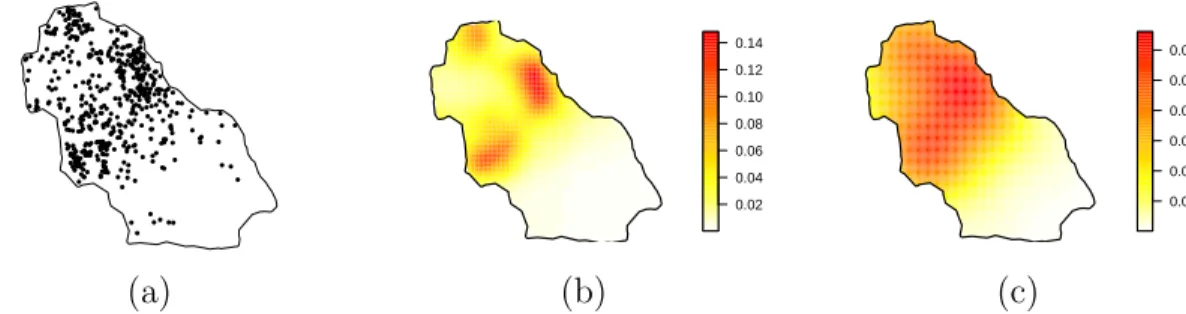
2.13 (a) The posterior mean ofλ(s) for the LGCP model and (b) the kernel
intensity estimate for the Duke forest data. . . 52
2.14 The posterior distributions for (a) λ(D) and (b) N(D) in the Duke
forest LGCP model. The observed value ofn = 530 is denoted by the
dotted line. . . 53
2.15 The posterior distributions for λ(s) at three points in Duke forest
under the LGCP model. . . 54
2.16 The posterior distributions for the second-order intensity ρ(2)(s, s0)
and the PCF ˜g(s, s0) at each combination of the three points in Duke
forest used in Figure 2.15. . . 56
2.17 The posterior distributions for N(A), N(B), and N(A)N(B) under
the LGCP model for the Duke forest data. The solid lines, dashed lines, and dotted lines represent the posterior means, 95% credible
intervals, and observed values, respectively. . . 57
2.18 The posterior distribution for the inhomogeneous K-function under
the LGCP model for the Duke forest data. The theoretical and
em-pirical estimates, as computed in spatstat, are also given. . . 57
3.1 The raw, inverseλ, and Pearson residuals for D, A, and B under the
NHPP model for the Duke forest data, with regionsAandB as shown
in Figures 2.10 and 2.17. The dashed lines indicate the 95% credible
3.2 The raw, inverseλ, and Pearson residuals for D, A, and B under the
LGCP model for the Duke forest data, with regionsAandB as shown
in Figures 2.10 and 2.17. The dashed lines indicate the 95% credible
intervals, with 0 marked by a solid line. . . 63
3.3 Posterior mean of the smoothed raw innovation fields for the (a) NHPP
and (b) LGCP models and posterior coverage plots for the smoothed raw innovation fields for the (c) NHPP and (d) LGCP models. The coverage plots describe whether a pointwise credible interval (CI)
con-tains 0 or whether the interval is completely above or below 0. . . 67
3.4 The (a) training and (b) test data for the p = 0.5 cross-validation
data, along with the posterior means forλtrain(s) under the (c) NHPP
model and (d) LGCP model. Sincep= 0.5,λtrain(s) =λtest(s). . . . . 73
3.5 Ranked probability scores for the NHPP model (solid black line) and
the three LGCP models (dashed lines) fitted to the Duke forest test
data for three cross-validation sets withp= 0.5. . . 78
3.6 90% predictive interval coverage for the NHPP model (solid black line)
and the three LGCP models (dashed lines) fitted to the Duke forest
for three cross-validation sets with p = 0.5. The black dotted line
indicates the 90% nominal level. . . 79
3.7 The relative RPS for the simulated HPP data with E[n] = 100. The
models are labeled as (A) HPP, (B) NHPP, (C) LGCP with
exponen-tial covariance, (D) LGCP with Mat´ern (ν = 3/2) covariance, and (E)
LGCP with Gaussian covariance. . . 82
3.8 The relative RPS for the simulated LGCP (exponential covariance)
data withE[n]≈ 100 (top row) and E[n]≈ 1000 (bottom row). The
model labels are the same as those used in Figure 3.7. . . 83
4.1 Plots of Messor ant nests (inhibitive), redwood seedlings (clustered),
and simulated homogeneous Poisson point patterns (completely
spa-tially random). . . 87
4.2 Variance metrics for simulated HPP(λ = 100) data with E[n] ≈
100,1000. The top row shows the results when fitting the HPP model
to the HPP data and the second row shows the results using the Strauss model. The dashed line indicates the observed variance metrics. 96
4.3 Variance metrics for simulated Strauss(β = 250, γ = 0.05, R = 0.05)
data with E[n] ≈ 100,1000. The top row shows the results when
fitting the HPP model to the Strauss data and the second row shows the results using the Strauss model. The dashed line indicates the
observed variance metrics. . . 97
4.4 Plots of (a) the Swedish pines data, (b) profile pseudolikelihood for
the Strauss model as a function of R, and (c) the (sorted) nearest
neighbor distances. The dashed line in (b) indicates the profile
max-imum pseudolikelihood estimate ˆR = 0.72. The dashed lines in (c)
indicate the candidateR values of 0.25, 0.45, 0.55, and 0.72. . . 98
4.5 Plots of (a) the Swedish pines data with subregion Alabeled and the
posterior distributions for (b–c) n and N(A) under the HPP model,
and (d–f) γ, n, and N(A) under the Strauss(R=0.72) model. The
solid and dashed lines indicate the posterior means and 95% credi-ble intervals, respectively, and the dotted lines indicate the observed
values. . . 100
4.6 Plots of theF-, G-, and K-functions for the Strauss model with R=
0.72. The theoretical forms use the MLE for ˆλ and the empirical
estimates are the standard nonparametric estimates. The shaded area
in (c) represents the 95% pointwise credible intervals for K(d). . . 100
4.7 Plots of the variance of box counts for the HPP and Strauss (R= 0.72)
model. The dashed lines indicate the observed variance, while the histogram and gray lines indicate predictive values under the model. . 101
4.8 Relative RPS at each value of q for simulated HPP data with E[n] =
100, 1000. The LGCP (top row) and PGP (bottom row) models are
compared to the HPP model, with the horizontal line at 1 indicating
equivalent performance. . . 111
4.9 Relative RPS at each value ofqfor simulated LGCP data withE[n] =
100, 1000. The HPP (top row) and PGP (bottom row) models are
compared to the LGCP model, with the horizontal line at 1 indicating
equivalent performance. . . 112
4.10 Relative RPS at each value of q for simulated PGP data with E[n] =
100, 1000. The HPP (top row) and LGCP (bottom row) models are
compared to the PGP model, with the horizontal line at 1 indicating
4.11 The posterior mean intensity for the three models fit to the first
cross-validation set from the redwood tree data for p = 0.75. The circles
denoted points in the training data and the x’s represent the test data. 115 4.12 The average RPS and coverage for each model over 10 rounds of
cross-validation. The solid line is the HPP model, the dashed line is the LGCP model, and the dotted line is the PGP model. . . 116 4.13 Ranked probability scores for test data in four cross-validation sets of
the redwood data for p= 0.5, 0.75. The solid line is the HPP model,
the dashed line is the LGCP model, the dotted line is the PGP model. 117
4.14 The modified redwood seedling dataset (n = 152), which was
con-structed by improving the clustering and randomly adding 90 data points to the clusters of the original dataset in Figure 4.14. . . 118 4.15 The average RPS and coverage for each model over 10 rounds of
cross-validation for the modified redwood data. The solid line is the HPP model, the dashed line is the LGCP model, and the dotted line is the PGP model. . . 118 B.1 The RPS and coverage results for the simulated HPP data. All the
models perform fairly similarly to the HPP model. The coverage
rel-ative RPS plots show more variability as q gets larger. The coverage
levels are all close to the nominal 90% level, though with more
vari-ability in the E[n] = 100 case. . . 133
B.2 The RPS and coverage results for the simulated NHPP data. The HPP performs poorly, but the other models perform similarly. For
E[n] ≈ 1000, the LGCP models outperform the true NHPP model
both in RPS and coverage, and the NHPP coverage is largely inade-quate despite being the true underlying model. . . 134 B.3 The RPS and coverage results for the simulated LGCP (Exponential
covariance) data. The HPP and NHPP models performed worse than
the LGCP models, especially for E[n] ≈1000. The LGCP models all
performed very similarly, with the coverage levels sometimes dropping
close to 50%. . . 135
B.4 The RPS and coverage results for the simulated LGCP (Mat´ern ν =
3/2 covariance) data. The results are similar to Figure B.3. . . 136
B.5 The RPS and coverage results for the simulated LGCP (Gaussian covariance) data. The results are similar to Figure B.3. . . 137
List of Abbreviations and Symbols
Symbols
N(A) The number of points falling in a set A
|A| The size of a set A
λ(s) The intensity function at a location s∈D
γ(s, s0) The second-order moment measure, evaluated at s and s0
˜
g(s, s0) The pair correlation function, evaluated at s and s0
Abbreviations
CSR Complete spatial randomness
HPP Homogeneous Poisson process
GP Gaussian process
LGCP Log-Gaussian Cox process
MCMC Markov chain Monte Carlo
MLE Maximum likelihood estimate
MPLE Maximum pseudolikelihood estimate
NHPP Nonhomogeneous Poisson process
PCF Pair correlation function
PGP Poisson-gamma process
RPS Ranked probability score
Acknowledgements
First, I would like to thank my advisor, Alan Gelfand, for his dedication to my re-search and to my development as a statistician. He has provided wonderful guidance and constant encouragement over the last four years. I would also like to thank the rest of my committee, Robert Wolpert, Merlise Clyde, and Jim Clark for their time and feedback. I am also thankful for the chance to work on other projects with David Holland, Jenica Allen, and John Silander, Jr.
I am very grateful to the faculty, students, and staff who all contribute to the great environment in the department. I am thankful to have so many great fellow students who have carried me through measure theory, pulled the occasional prank on me, and provided a great source of friendship over the years.
I would like to thank my parents for their support and encouragement over my lifetime and all 20+ years of school. I would also like to thank my son, Dane, for always putting a smile on my face and providing me with fun-filled escapes from writing my dissertation. Lastly, and most importantly, I would like to thank my wife, Alyse, for her constant support and encouragement and for patiently waiting all this time for me to finally have a real job and a decent income.
This work was supported by NIH award 2R01-ES014843-04A1. I am also grateful to the International Society for Bayesian Analysis, American Statistical Association, Duke University Graduate School, and Duke University Department of Statistical Science for conference travel support.
1
Introduction
As discussed in Banerjee et al. (2014), spatial data sets are generally classified into three categories: point-referenced data, areal data, and point pattern data. The first class, point-referenced data, refers to situations where the outcome of interest
y(s) varies continuously over locationss within some regionD. Data is collected at a
finite set of locations, from which the continuous surface is then estimated. Examples of such data include estimating pollution or temperature levels across some region, such as the United States, or collecting house price information to understand the average house price in some city, state, etc. The region of interest is generally taken
to be some subset ofR2 orR3, though higher dimensions or more abstract spaces can
be employed. Models for such data, often termed geostatistical models due to their use in many geological applications, generally employ Gaussian processes or splines as a flexible model for the continuous response surface.
Areal data differs from point-referenced data in that the spatial locations are discrete partitions of the region of interest or points on a lattice. For example, the data could consist of grayscale levels at each pixel of an image or cancer incidence
locations, though the definition of closeness must be defined for each application. Generally a local structure is defined, often employing Markov random fields, to account for the spatial correlation.
Point pattern data, the subject of this work, describes data in which random events are observed over some domain, with the number and locations of these events being random. Analysis of this category of data involves understanding the under-lying process generating these events, which includes learning whether events (also called points) are more likely to occur in certain regions of the domain and whether the existence of an event affects the locations of subsequent events. For example, a point pattern may consist of the locations of trees in a forest or the locations of fast food locations in a city. There may be extra information attached to the event, such as the type of tree or the diameter of the tree, which can enrich the analysis.
The first two classes of spatial data problems are well-studied, but the com-plexities introduced in point pattern analysis leave many open problems, such as model diagnostics and model selection for point patterns. This thesis will explore some of these issues and suggest some methods for analyzing point pattern models and enriching the inference available from these models, primarily from a Bayesian perspective.
1.1
Point patterns
Before describing our contributions, some notation and theoretical development will be given. Many resources can provide a lengthier and more rigorous devel-opment of point pattern theory and related topics; see, e.g., Cressie (1993); Banerjee et al. (2014); Gelfand et al. (2010); Illian et al. (2008); Diggle (1983); Møller and Waagepetersen (2007); Daley and Vere-Jones (1998).
As previously described, a point pattern is a collection of points or events observed over some region, with the locations and number of events both being random. Point
patterns can represent cancer cases in a region, trees in a forest, or crimes in a city. Point pattern analysis is concerned with understanding the underlying process generating the events. This involves learning about the number of events expected to occur, how likely points are to occur over different areas of the domain, and whether event locations are independent of each other. A point process will denote the underlying process which generates the observed point patterns.
The locations of the points in the point pattern will be denoted by si and the
domain of interest will be denoted byD. The collection of points makes up the point
pattern, S, with S ={si}ni=1, where n ≡N(D) is the number of points observed in
D. In general, the number of points in any set A ⊆ D will be denoted by N(A).
The treatment here will generally take D to be a subset of R2, though other forms
for D are common. Time series point patterns will often use D≡ (0, T) ⊂R+ and
spatiotemporal point patterns will takeD⊂R2×
R+. Ang et al. (2012) model crimes
on the streets in Chicago, where D is taken to be the linear network of streets in a
neighborhood of Chicago.
The least complex point patterns exhibit complete spatial randomness (CSR),
a property under which point locations occur independently and uniformly over D.
Complete spatial randomness implies that points occur with equal likelihood over
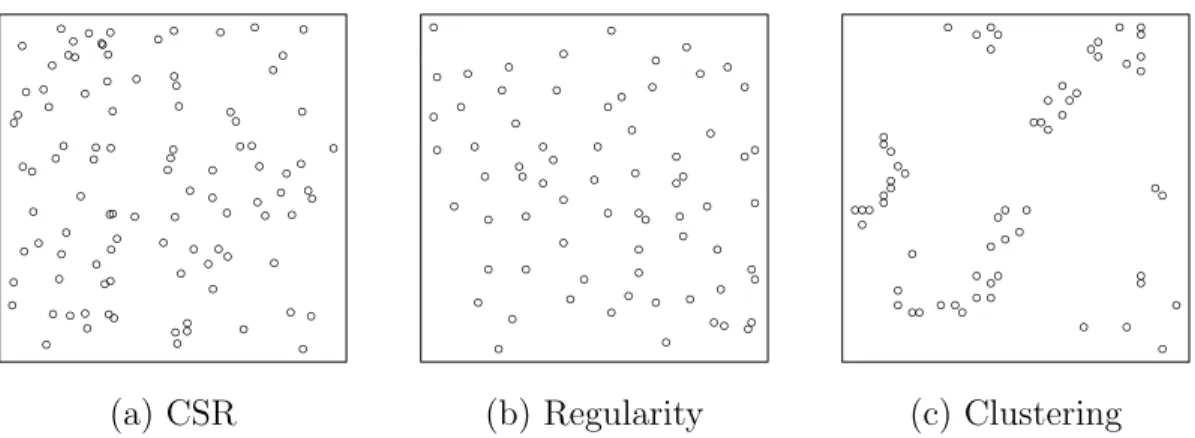
each region in D and that the points do not cluster nor repel each other. Figure 1.1
shows an example of a point pattern which exhibits CSR and two examples which violate CSR due to regularity and clustering. The clustered point pattern in 1.1c is easily distinguished from the point pattern exhibiting CSR in 1.1a. The regular point pattern in 1.1b is harder to distinguish from 1.1a, especially for untrained eyes. The main difference is that, under CSR, points will sometimes randomly occur very close to each other, while under regularity, such occurrences are rare.
Building a probabilistic model for a point pattern S requires specifying
● ● ● ● ● ● ● ● ● ● ● ● ● ● ● ● ● ● ● ● ● ● ● ● ● ● ● ● ● ● ● ● ● ● ● ● ● ● ● ● ● ● ● ● ● ● ● ● ● ● ● ● ● ● ● ● ● ● ● ● ● ● ● ● ● ● ● ● ● ● ● ● ● ● ● ● ● ● ● ● ● ● ● ● ● ● ● ● ● ● ● ● ● ● ● ● ● ● ● ● ● ● ● ● ● ● ● ● ● ● ● ● ● ● ● ● ● ● ● ● ● ● ● ● ● ● ● ● ● ● ● ● ● ● ● ● ● ● ● ● ● ● ● ● ● ● ● ● ● ● ● ● ● ● ● ● ● ● ● ● ● ● ● ● ● ●● ● ● ● ● ● ●● ● ● ●● ● ● ● ● ● ● ● ● ● ● ●●● ● ● ● ●● ●● ● ●● ●● ● ●● ● ● ● ●● ● ● ● ● ●● ●● ●● ● ● ● ● ● ● ●● ● ● ● ●
(a) CSR (b) Regularity (c) Clustering
Figure 1.1: Examples of point patterns exhibiting (a) CSR, (b) regularity, and (c)
clustering.
cover the set {0,1, . . . ,∞} and is usually taken to be the Poisson distribution. The
distribution for the locations of the points must have a valid densityfθ
n for anynand
point process parameters θ. Since the points are unordered and, for now, unlabeled,
the location density fθ
n(s1, s2, . . . , sn) must be symmetric in its inputs. Combining
these two pieces, the density forS, fS, will take the form
fS(S;θ) = Pr
N(D) =n|θn!fnθ(s1, s2, . . . , sn), (1.1)
where the factorial n! comes from the exchangeability of the events s within S.
Under CSR, the location density fθ
n is uniform and points occur independently,
leading to fθ n(s1, s2, . . . , sn) = Q if1θ(si) = Q i1/|D|= |D|
−n, where |A| denotes the
size of a set A. Complete spatial randomness impliesstationarity, which means that
fθ
n(s1, . . . , sn) = fnθ(s1 +h, . . . , sn +h) for all n, s ∈ D ⊆ Rd and h ∈ Rd. One
implication of stationarity is that the first-order trend is constant.
The homogeneous Poisson process (HPP) is a point process that is built upon
CSR. HPPs have a single parameter λ which relates to the total number of points
expected to be observed inD. The key property of the homogeneous Poisson process
is that for any regionA ⊆D, the number of points expected inA, denoted byN(A),
number of points observed inD, has expectationλ|D|. The independence of locations
arising CSR property of HPPs implies that for two disjoint subsets, A, B ⊂ D, the
number of points occurring inAandB are independent Poisson variables, again with
expectations λ|A| and λ|B|, respectively. The HPP is clearly a stationary process,
though other stationary processes do exist.
The likelihood for a homogeneous Poisson process is composed of the two pieces
discussed previously. The random number of events observed, n, is modeled as a
Poisson random variable with expectationλ|D|. The random locations of these points
given n are distributed independently over D with density fθ
n(s1, . . . , sn) = |D|−n.
Combining these two pieces with (1.1) gives the HPP likelihood function
fS(S;λ) = e−λ|D|(λ|D|)n n! × n! |D|n =e −λ|D| λn. (1.2)
The parameter λfrom above is called the intensity and controls the rate at which
events occur. The intensity can be written more generally as a functionλ(s) for any
location s ∈ D, where regions with higher λ(s) have a higher expected number of
events. The general definition for the intensity function is that the intensity λ(s) is
the function satisfying E[N(A)] = RAλ(s)ds for any subset A ⊆ D. The intensity
can equivalently be defined asλ(s)≡lim|∂s|→0E
N(∂s)/|∂s|. The intensity function
may not always be tractable, e.g., as in Gibbs processes, which will be discussed later. Relaxing the homogeneous Poisson process to have a spatially varying intensity
λ(s) results in the nonhomogeneous Poisson process (NHPP), also called the
inho-mogeneous Poisson process. Under the NHPP model, which is no longer stationary,
the quantity N(A) is distributed as Poisson(λ(A)) where λ(A) ≡ R
Aλ(s)ds. As
before, N(A) and N(B) are still independent, conditional on λ(s), if A and B are
disjoint subsets of D. The spatially varying intensity may include a regression
λ, whereas nowθ may be comprised ofλ0, severalβk, and possibly other parameters.
Therefore, λ(s) implicitly depends on θ, so we will generally write λ(s) but could
more explicitly write λθ(s) instead.
The location density for an NHPP is easily developed first from considering a
single point s∗. The likelihood of the location of s∗ is relative to the height of λ(s)
at each s ∈ D. Therefore, λ(s) can be seen as the unnormalized location density,
implying that f1θ(s∗) = λ(s∗)/λ(D), where λ(D) = RDλ(s)ds is the normalizing
constant. Since the NHPP still preserves independence among the locations of its
points, fθ n(s1, s2, . . . , sn) = Q si∈S λ(si)/λ(D)
. Using this and the fact that N(D)
is distributed as Poisson(λ(D)), the NHPP likelihood builds on (1.2) to become
fS(S;θ) = exp{−λθ(D)} λθ(D)n n! ×n! Y si∈S λθ(s i) λθ(D) = exp{−λ θ(D)}Y si∈S λθ(si) (1.3)
Continuing to relax the assumptions of the Poisson process results in more com-plex, and perhaps more useful, point processes. For example, a Cox process results
by taking the inhomogeneous Poisson process and letting λ(s) be a realization of a
random process. Gibbs processes, cluster processes, and others result when a de-pendence structure is introduced among the points. For example, saplings tend to cluster around the parent tree, resulting in a cluster process. Of course, some pro-cesses may exhibit both a nonconstant intensity as well as a dependence structure among the points, though it is known to be difficult to clearly separate these two influences, as noted in, e.g., Baddeley et al. (2000).
Point processes can be characterized by moment measures, with the intensity
function λ(s) defining the first-order moment measure of a point process. The
second-order moment measure γ(s, s0), also called the second-order intensity,
ad-dresses the covariance structure, just as a Gaussian process used in a geostatistical
satisfy-ing E[N(A)N(B)] = RARBγ(s, s0)ds0ds, which provides a sense of the covariation
between two sets A, B ⊆ D. The pair correlation function (PCF), also called the
reweighted second-order intensity, provides a standardized version of the second-order measure, which is useful in assessing the range of correlation in point patterns (see, e.g., Illian et al., 2008, p. 220). The PCF is defined as ˜g(s, s0) =γ(s, s0)/(λ(s)λ(s0)).
Many processes have closed forms for γ(s, s0) and ˜g(s, s0), but they will not be given
here.
1.2
Frequentist Inference for Spatial Point Processes
We shall primarily operate within the Bayesian paradigm but it will be useful to briefly highlight a few aspects of frequentist inference for point patterns. As dis-cussed in Møller and Waagepetersen (2007), maximum likelihood estimates (MLEs) are not always computationally feasible for point patterns. For example, Gibbs pro-cesses (see Section 4.1), have unknown normalizing constants, though path sampling (Gelman and Meng, 1998) and MCMC methods (Ogata and Tanemura, 1981) have developed to achieve MLE estimates. The MLEs of spatial point processes do not enjoy the usual asymptotic properties, making them less dominant over other meth-ods. See Møller and Waagepetersen (2007, 2003) and references therein for a more thorough discussion of maximum likelihood estimates for point processes. In some cases, however, the MLE is simple to obtain. For example, the MLE does exist for
the intensity parameter λ of an HPP, and is simply ˆλ=n/|D|.
Since point process MLEs do not enjoy the usual asymptotic theoretical support for MLEs (Baddeley and Turner, 2000), other estimation methods enjoy wide use. For some point processes, minimum contrast estimates provide robust, computationally-efficient estimates through matching higher-order properties of the process to the
observed data. Let T(r;θ) be some summary statistic of the point process with
to be the pairwise correlation function or the K-function, which will be introduced
in Chapter 2. If the PCF ˜g(s, s0) is just a function of the distance r = ||s−s0||
and then we can take T(r;theta) to be the PCF evaluated atr. Then the minimum
contrast estimate ˆθ is the parameter (or set of parameters) θ which minimize
Z rmax
rmin
ˆ
T(r)q−T(r;θ)qpdr, (1.4)
where p, q > 0 and 0 ≤rmin < rmax specifies a reasonable range of values for r. See
Waagepetersen (2007) for further discussion.
For processes with a likelihood containing an intractable normalizing constant, such as Gibbs processes, the pseudolikelihood is often employed because it removes the need to estimate the normalizing constant. Besag (1977) defines the point process pseudolikelihood to be P L(θ;S) = exp − Z D λθ(s;S)ds Y si∈S λθ(si;S), (1.5)
whereλθ(s;S) is the (Papangelou) conditional intensity of at s∈D and depends on
process parameters θ. The conditional intensity is defined as
λθ(s;S) = fθ(S∪ {s}) fθ(S) s 6∈S, and fθ(S) fθ(S\ {s}) s ∈S, (1.6)
where fθ is the location density and S\ {s} denotes S with the singleton point
s removed. For Poisson processes, where point locations occur independently, the
conditional intensity is equal to the intensity, orλθ(s;S) =λθ(s). For processes with
a second-order dependence, the conditional intensity will differ from the intensity according to the nature of interactions among points specified by the process. For
example, in a cluster process, λθ(s;S) may be larger than λθ(s) ifs is close to some
of the points inS.
The real benefit to using the pseudolikelihood is that the normalizing constant cancels out in the fraction in (1.6) when computing the conditional intensity. This is because both the numerator and denominator have the same intractable normalizing
constant because the parameters in fθ are the same. The point process model can
then be written as a generalized linear model and fit using a Berman-Turner device (Berman and Turner, 1992; Baddeley and Turner, 2000). The fitted model param-eters are the maximum pseudolikelihood estimates (MPLEs). Baddeley and Turner (2000) notes that MPLEs are consistent and asymptotically normal under suitable conditions. Huang and Ogata (1999) suggest obtaining the MPLEs and then taking a single Newton-Raphson step toward maximizing the likelihood.
1.3
Bayesian Inference for Spatial Point Processes
In brief, Bayesian modeling seeks to take prior belief about model parameters θ,
quantified by a prior distributionπ(θ), and combine this prior belief with the observed
datayto provide an updated belief aboutθ. This updated belief, called the posterior
distribution π(θ|y), is a probability distribution which accounts for the information
about θ in both the prior and the data using Bayes rule. The posterior distribution
is calculated as
π(θ|y) = Rp(y|θ)π(θ)
Θp(y|θ)π(θ)
, (1.7)
where p(y|θ) is the data model, which is equivalent to the likelihood L(θ;y), and θ
can take on values over some domain Θ. Though the integral in the denominator is generally intractable, methods such as Gibbs sampling and the Metropolis-Hastings
chain Monte Carlo (MCMC). More development on the basics of Bayesian inference is given in, e.g., Gelman et al. (2013).
Bayesian modeling can be challenging for spatial point processes, due to the same issues with an intractable normalizing constant in the point process likelihood as dis-cussed above, but also due to poor mixing properties and inefficiency when applying standard MCMC algorithms. Fortunately, most point process models have at least one working method for obtaining posterior distributions for the model parameters, often involving an advanced MCMC algorithm. These methods will not be discussed here, but rather presented as they are used in the ensuing chapters.
Our focus will be less on how to fit Bayesian models and more on what to
do once we’ve fit them. We will often use the Bayesian framework to generate
posterior predictive distributions of point patterns. The posterior predictive
dis-tribution takes the posterior disdis-tribution π(θ|y) and generates simulated data y∗
using the model. The posterior predictive distribution is written as p(y∗|y) where
p(y∗|y) = RΘp(y∗|θ)π(θ|y)dθ. Drawing from the posterior predictive distributions
provides replicatesy∗ which are directly comparable to the original data y.
1.4
Contributions to Spatial Point Process Analysis
Typical point pattern analysis usually begins by exploring whether such a point pattern exhibits complete spatial randomness (i.e., whether the point pattern arose from an HPP). Complete spatial randomness is violated if events exhibit a depen-dence structure and/or they occur with nonconstant intensity. Once CSR has been rejected for a given point pattern, however, the next model chosen should similarly be subjected to scrutiny and compared with other valid models. This second set of analyses is usually not carried out quite as thoroughly as the initial analysis which rejected CSR.
The gap in analysis here is more attributable to a lack of powerful diagnostic and comparison methods than to a lack of effort. Testing goodness of fit is not straight-forward for point patterns, nor is there a widely applicable, easy-to-use method for model selection. The challenge with point patterns, as shall be presented in this work, is that a point pattern contains limited information about the process which generated it. For example, learning about intensity function is difficult because the smoothness in the intensity estimate is largely determined by the imposed model, since the data provide little indication of the smoothness of the original process. The user must either have prior knowledge of the smoothness or must employ some metric to choose an optimal smoothness parameter, as is done in kernel density estimation. Chapter 2 describes point pattern analysis for Poisson processes and log-Gaussian Cox processes. Details about fitting Bayesian models for each are given, followed by a discussion of many posterior summaries which can be generated for a richer analysis of the posterior distribution. Much of this relies on generating posterior predictive point patterns from the posterior distributions of the model parameters to create
model-based summaries of interest. Obtaining model-based estimates of theF-, G-,
and K-functions are discussed and compared to the usual nonparametric estimates.
Chapter 3 builds on the model-based summaries of Chapter 2 to discuss ideas for model diagnostics based on the posterior predictive point patterns. The proposed
predictive residuals are shown to illuminate regions ofDwhere the model fits poorly
and, if the regions are substantial enough, can indicate overall lack of fit. For models that seem to adequately fit the data, a similar approach allows us to apply proper scoring rules to compare models. Cross-validation ideas presented herein allow for model comparison on data not used to fit the model. A large simulation study illuminates the extent of learning available when comparing point process models.
Chapter 4 extends the ideas of Chapters 2 and 3 to more complex processes, such as Gibbs processes and cluster processes. First, adaptations for Gibbs processes
are presented to overcome the inherent dependence structure among points. Since cross-validation is not viable for Gibbs processes, posterior predictive checks (Gelman et al., 1996) are utilized to determine model fit. The discussion then moves on to cluster processes, for which the methods of Chapter 3 apply. Ideas are then given for other complex point processes, with some discussion of posterior inference and model assessment.
Finally, Chapter 5 will summarize the work presented herein and discuss potential paths for future research and improvement of these methods.
2
Bayesian Point Pattern Analysis
This chapter details Bayesian model-fitting for many standard point processes and introduces methods for extensive posterior inference. Beginning with homogeneous point processes, we illustrate how the posterior distribution for the model provides a rich variety of options for posterior inference using posterior predictive point pat-terns. Later in the chapter, models for nonhomogeneous point processes will be introduced and these posterior inference methods will naturally lead themselves to further analysis.
The goal with our posterior inference is to provide model-based inference of
pos-terior quantities of interest. For example, Ripley’s K-function (Ripley, 1976; Dixon,
2002) is a common exploratory tool in point pattern analysis which describes the
expected number of points within a distance d of a typical point in the point
pat-tern. It is commonly used to criticize the CSR hypothesis by comparing the observed
distribution of the K-function to its theoretical distribution under CSR. The usual
K-function estimate employs a nonparametric estimate of the intensity surface, but
we will take a model-based approach and use our posterior draws for the intensity surface instead. Our methods will demonstrate how to provide a whole posterior
distribution for theK-function, so that a comparison to the theoretical value can be done with a knowledge of the uncertainty involved.
2.1
Homogeneous Poisson Processes
As noted in the previous chapter, the most basic point process is a homogeneous Poisson process (HPP). This process implies that events occur independently over
the domain with constant intensity. This model has a single parameter λ which
defines the number of events in any region A ⊆ D to be distributed as N(A) ∼
Poisson(λ|A|). With one parameter, fitting an HPP model is very simple. From a
frequentist perspective, the maximum likelihood estimate (MLE) is just the number
of observed events divided by the area of D, or ˆλ = n/|D|. This is easily derived
from the HPP likelihood, given in (1.2).
A Bayesian model requires a prior distribution for λ. The gamma distribution, a
flexible distribution over R+, provides a conjugate prior for λ. Taking the prior for
λ to be
λ∼Gamma(aλ, bλ), (2.1)
with prior expectation E[λ] =aλ/bλ, the posterior is given by
λ|S∼Gamma(aλ+n, bλ+|D|). (2.2)
Since the posterior distribution for λ has a closed form, there is no need for
MCMC. With little prior knowledge about the process, one could also use the Jeffreys
prior, which would set the prior forλasp(λ)∝1/λ. The Jeffreys prior results in the
posterior Gamma(n,|D|). We imagine that informative prior knowledge is generally
available, whether it be an expected number of trees per hectare or cancer cases per geographic region.
Other prior distributions for λ, such as the log-normal distribution, may also
algo-rithm. In fact, one could alternatively reparameterize fromλto exp{β0}and employ
a prior on β0 that takes values over R. For example, a normal prior could be used
for β0, which induces a log-normal prior for λ. No matter the prior for λ, we can
easily obtain posterior draws for λ and use them in posterior analysis.
2.1.1 Japanese Pines Data
To illustrate the HPP model, we turn to a well-studied dataset consisting of the
locations of 65 black pine saplings in a 5.7m × 5.7m square patch of forest. This
dataset was first studied by Numata (1961) but has seen several follow-up analyses (Diggle, 1983; Ogata and Tanemura, 1981; Baddeley and Turner, 2000). A plot of the data is given in Figure 2.1a. The data seem to be evenly spread over the domain, suggesting that a homogeneous intensity is reasonable.
To fit the HPP model, we use a gamma prior forλas suggested in (2.1). The prior
distribution forλcan then be specified directly or can be induced by first specifying a
prior over the expected number of trees E[N(D)] = λ|D|. Suppose our prior belief is
that the expected number of trees in the region is about 70 trees with a prior variance
of 100. This puts most of the prior mass for E[N(D)] between about 45 trees and
95 trees. Using a gamma distribution for E[N(D)], the expected value and variance
choices imply that E[N(D)] ∼Gamma(49, 0.7). Since E[N(D)] = λ(D) = λ|D| for
an HPP, this prior for the expected number of trees can be easily converted into a
prior for λ itself. The prior λ|D| ∼ Gamma(49, 0.7) implies the prior distribution
for λ isλ ∼ Gamma(aλ = 49, bλ = 0.7|D| = 22.743). This gives a prior mean for λ
of 2.154 with variance of 0.095.
This prior for λprovides the posterior distribution forλ as Gamma(114, 55.233),
with posterior mean E[λ|S] = 2.064. The prior and posterior distributions for λ for
● ● ● ● ● ● ● ● ● ● ● ● ● ● ● ● ● ● ● ● ●●● ● ● ● ● ●● ● ●● ● ● ● ● ● ● ●● ● ● ● ● ● ● ● ● ● ● ● ● ● ●● ● ● ● ● ● ● ● ● ● ● 0 1 2 3 4 5 0 1 2 3 4 5 1.0 1.5 2.0 2.5 3.0 3.5 0.0 0.5 1.0 1.5 2.0 dgamma(xseq, a.lam, b .lam) Prior Posterior (a) (b)
Figure 2.1: Plots of (a) the Japanese pines data and (b) the prior and posterior
distributions forλ. The vertical line in (b) denotes the MLE ˆλ = 2.001.
MLE ˆλ= 2.001. For any subregion of interest A⊆D, the posterior distribution for
λ(A) is λ(A)∼Gamma(aλ+n,(bλ+|D|)/|A|).
2.1.2 Posterior Analysis for HPPs
We now show that the Bayesian modeling framework lends itself naturally to a rich class of posterior model summaries. Not only do we have posterior draws of our parameters, which we can use to recreate the intensity surface, but we can also use these posterior draws to simulate posterior predictive point patterns, denoted by
{Sl∗}L
l=1. The posterior predictive point patterns will reflect our uncertainty in our
model parameters and will be helpful in summarizing the model’s fit to the data. In Chapter 3, we will discuss model diagnostics and model selection for point process models.
The first basic question that might be asked after fitting the model is how many
points should be expected in the domain D. As noted previously, the expected
number of points in D, denoted by E[N(D)] (or, equivalently, E[n]), is given by the
quantityλ(D), which is equal toλ|D|for an HPP. The posterior distribution ofλ(D)
is Gamma(aλ+n,(bλ+|D|)/|D|) distribution with posterior mean|D|(aλ+n)/(bλ+
specification, this distribution can in general be approximated using the posterior
draws for λ and multiplying them each by |D|.
A more useful answer to this question, however, can be given by finding the
posterior predictive distribution of N(D) itself, rather than the posterior for its
ex-pected value. Denoting the posterior draws ofλby{λ(l)}L
l=1, the posterior predictive
draws for N(D), which we’ll denote by N(l)(D), can be easily simulated from the
model. For an HPP model this only requires drawing N(l)(D) ∼ Poisson(λ(l)|D|)
for l = 1, . . . , L. L should be a large number to fully capture the variability in the
parameters and the point process itself. We will generally take L to be 1000, but
since the MCMC chain will be run for much longer than 1000 iterations, we can take
the λ(l) draws from the posterior to actually be thinned samples from the MCMC
chain.
The expected value of the N(l)(D) is
E[N(D)|S] as desired, but one can now
also provide credible intervals to quantify the posterior variability of N(D). Figure
2.2a shows the posterior distribution for the number of points in D, constructed
using the N(l)(D) draws. We see that the mean number of points in the predictive
point patterns is 67.16, which is close to the theoretical value of 67.06 and the
observed n = 65, with a 95% credible interval of (48, 88). With a full posterior
distribution, other potential summaries of interest can also be calculated, such as
P r[N(D)≥70] = 0.415.
Figure 2.2b shows a subregionAfor which we might want to know the distribution
of the number of points. Again, we could either look at the posterior distribution of
λ(A), which gives the expected number of points in A, or of N(A), the number of
points itself. We prefer to look at the posterior distribution of N(A) as it is more
tangible, though the posterior ofλ(A) has a nice closed form as given above. Posterior
draws for N(A) are drawn from N(l)(A)∼Poisson(λ(l)|A|) as shown previously. The
40 50 60 70 80 90 100 0.00 0.01 0.02 0.03 0.04 ● ● ● ● ● ● ● ● ● ● ● ● ● ● ● ● ● ● ● ● ●●● ● ● ● ● ●● ● ●● ● ● ● ● ● ● ●● ● ● ● ● ● ● ● ● ● ● ● ● ● ●● ● ● ● ● ● ● ● ● ● ● 0 1 2 3 4 5 0 1 2 3 4 5 A 0 5 10 15 0.00 0.05 0.10 0.15 (a) (b) (c)
Figure 2.2: (a) The posterior distribution for N(D), (b) the subset A ⊂ D of
interest, and (c) the posterior distribution for N(A). The solid vertical lines in (a)
and (c) represent the posterior mean and 95% credible intervals and the dashed lines represent the observed values.
a posterior mean of 8.21 with a 95% credible interval of (3, 14). The observed N(A)
is 9, so our posterior interval seems reasonable.
The posterior distribution of the second-order intensity γ(s, s0) is also available
to us. For an HPP, γ(s, s0) =λ2 due to the independence among the points. Draws
from this posterior distribution are obtained by simply squaring the draws of the
intensity, λ(l). The pairwise correlation function ˜g(s, s0) is equal to 1 for an HPP,
again because of the independence, but a posterior distribution for the PCF could be obtained for more complex point patterns, as will be shown later. For two
sub-regions A, B ⊆ D, we can also obtain the posterior distribution of [N(A)N(B)].
Draws from this distribution are obtained by first taking draws from the
poste-rior distributions for N(A) and N(B) as described above and then multiplying the
draws from each: N(l)(A)×N(l)(B). In fact, the posterior distribution any
func-tion of subsets A1, . . . , Ak is available to us, whether it is [N(A1)N(A2). . . N(Ak)]
2.1.3 Homogeneous F-, G-, and K-functions
So far, we have been calculating these posterior quantities of interest without much theoretical justification. The main theoretical tool we can employ here is Campbell’s
Theorem (see, e.g., Banerjee et al., 2014), which gives the expectation of a D
-measurable function g of points in a point patternS. Campbell’s Theorem gives the
equality E h X si∈S g(si) i = Z D g(s)λ(s)ds. (2.3)
For a feature of interest, say g(s) = 1(s ∈ A) for some set B ⊂ D, Campbell’s
Theorem says thatP
si∈S1(si ∈A) is an unbiased estimator for
R
D1(s∈A)λ(s)ds=
R
Aλ(s)ds = λ(A), which is just the expected number of points falling in a region
A. All that is required is to choose an appropriate function g such that the
right-hand side gives a quantity of interest, then the left-right-hand side becomes the unbiased estimate of the quantity of interest. This theorem is typically used to construct
estimators as functions of the observed point pattern S. However, this theorem is
also useful when applied to posterior predictive point patterns, as we will now discuss.
With the posterior draws for λ, posterior predictive point patterns are trivially
generated by first drawing the number of points n(l) ≡ N(l)(D) in the posterior
predictive point pattern Sl∗ from n(l) ∼ Poisson(λ(l)|D|). The locations of each
s∗li ∈Sl∗ are then randomly generated with uniform probability over D. For irregular
D, the location sampling can be performed by repeatedly drawing points within a
bounding box for D, retaining any points which fall inside D also, and continuing
untiln(l) locations have been sampled.
These posterior predictive point patterns provide an alternate, more general,
method for constructing the posterior distributions ofN(D) andN(A). For each Sl∗,
points inside Agives N(l)(A). Previously, we simply drew N(l)(D) andN(l)(A) from
their marginal (Poisson) distribution. The two methods are comparable, though this counting method using posterior predictive point patterns will also work for more complex point patterns, such as those with spatially varying intensities and
second-order dependence. Each N(l)(A), for example, then takes the form of a sum
which becomes the inside part of the expectation on the left-hand side (2.3). Each
of these has expectation RD1(s∈ A)λ(l)(s)ds =λ(l)(A) using Campbell’s Theorem.
Integrating over our posterior samples, we find that the expected value of the left
side E[N(A)|S] is equal to E[λ(A)|S] as expected. Though the result may not be
surprising, we see how Campbell’s Theorem begins to prove useful in conjunction with these posterior predictive point patterns.
Campbell’s Theorem also has a bivariate form for a (D×D)-measurable function
g of two points inS: E h X si, sj∈S i6=j g(si, sj) i = Z D Z D g(s, s0)γ(s, s0)ds ds0, (2.4)
where γ(s, s0) is the second-order intensity defined previously. The bivariate form is
useful for exploring second-order properties of a point process. Another useful result is the Georgii-Nguyen-Zessin (GNZ) formula (Georgii, 1976; Nguyen and Zessin, 1979), which gives the equality
E X si∈S g(si, S\{si}) =E Z D g(s, S)λ(s;S)ds , (2.5)
whereλ(s;S) is the Papangelou conditional intensity andgis a non-negative function.
We can now use these results to obtain inference for the homogeneous F-, G-,
and K-functions. These three functions are standard procedures in point pattern
complete spatial randomness is a reasonable assumption for the current dataset. If
CSR seems reasonable, an HPP model is employed. Otherwise, the F-, G-, and
K-functions provide insight into whether the points appear to be more clustered or
dispersed than would be expected under CSR. Typically, nonparametric empirical estimates of these functions are used, but we demonstrate how to use these theoretical tools along with Monte Carlo integration to provide model-based expectations and posterior distributions for these functions.
The F-function, denoted byF(d), is the cumulative distribution function (CDF)
of the nearest neighbor distance d from a random point inD to an event in S. It is
often called the “empty space function” because it measures the gaps or empty space
in the point pattern. Under CSR, F(d) = 1−exp(−λπd2). The usual estimator for
F(d) is obtained by randomly sampling a large number of points uniformly over D,
call this set of pointsT ={tj}Jj=1, and calculating the proportion oftj having a point
of S within distance d.
The G-function, denoted by G(d), is the CDF of the nearest neighbor distance
from one observed event to another. Under CSR, G(d) = F(d) = 1−exp(−λπd2).
Using the notation of Banerjee et al. (2014), define N(s, d, S) to be the number of
events in S\s inside a ball of radius d centered around an arbitrary observed event
s, where S\s denotes the point pattern S with the event at s removed. In this
notation, we can express G(d) as P r[N(s, d, S)>0].
The K-function, also called Ripley’sK-function, gives a scale-free description of
the expected number of points within distance d of an arbitrary event in S (Ripley,
1976; Dixon, 2002). For a first-order stationary process, meaning that the intensity is
constant over D, the K-function is equal to E[N(s, d, S)]/λ. Dividing by λ adjusts
for the overall intensity of the HPP and allows K(d) to be scale-free. Under CSR,
Appendix A contains the standard empirical estimators for these functions. These estimators also include an edge correction to compensate for the bias in the naive estimators. The bias arises because these point patterns are only observed over
some finite domainD, but could potentially exist on a much larger, possibly infinite,
domain (such as R2). Looking at K(d), for example, when counting the number of
neighbors within distance d of some point si ∈ S, it will often be the case that si
is close to the boundary of S. When that happens, si may have neighbors that are
outside of D yet are within distance d of si. These neighbors were not observed
and therefore we have no idea of knowing how many there might be. The edge corrections proposed in the literature address this bias by adjusting the estimates
to handle points near the boundary of D differently. For example, the “reduced
sample” or border correction estimates these functions using only the points in D
that are at least distance d from the boundary of D. Since the remaining points
are far enough from the edge of D, their d-close neighbors will all be observed.
This correction provides an unbiased estimate though it sacrifices useful information. Other approaches adjust differently and are able to retain more of the data.
As noted previously, typical point pattern analysis involves obtaining the em-pirical estimate of these three functions, as well as other similar functions such the
J-function, etc. Typically this is done as an exploratory analysis, investigating what
second-order trends are suggested by the data. We now present methods for obtain-ingmodel-based posterior estimates of these functions. In the following development,
these functions describe a posteriori features of our model as opposed to just
high-lighting trends in the data.
For some models, such as the HPP model, the theoretical forms for the F-, G
-and K-functions are known and the posterior mean for model parameters, such as
λ for the HPP, could be used as plug-in estimates. However, our method employs
uncertainty in the posterior. Further, our method will generalize to other models
without requiring that the theoretical forms ofF(d), G(d), etc., be known.
We first begin by developing a model-based summary of G(d). We have been
somewhat relaxed in our notation thus far by assuming that each si in S is within
D. In order to think correctly about edge effects, however, we will assume that the
point pattern might have points outside ofD and the notation will explicitly restrict
S toDwhen desired for the rest of this section. It is often the case thatDrepresents
an observation window inside which events of interest are recorded, yet these events exist as part of a much larger point pattern. A common example of this is recording tree locations within some small subset of a large forest.
Let ND(si, d, S) ≡ N(si, d, S∩D) denote the number of points in S ∩D that
are d-close to si. Referring to the discussion above about edge corrections, we only
know quantities such as ND(si, d, S) but we would like to adjust this quantity to be
unbiased for N(si, d, S).
Recalling thatG(d) can be written as P r[N(s, d, S)>0], consider the calculation
ES X si∈S∩D 1(ND(si, d, S)>0) =EN(D)ES|N(D) X si∈S∩D 1(ND(si, d, S)>0) =EN(D) X si∈S∩D ES|N(D)1(N(si, d, S)>0) =EN(D) N(D)P r[ND(s, d, S)>0] =λ(D)P r[ND(s, d, S)>0]. (2.6)
We can adjust the left-hand side of (2.6) and consider the quantity
ES
X
si∈S∩D
1(ND(si, d, S)>0)
which has expected value ES X si∈S∩D 1(ND(si, d, S)>0) N(D) =EN(D) 1 N(D) X si∈S∩D ES|N(D)1(ND(si, d, S)>0) =EN(D) P r[ND(s, d, S)>0] =P r[ND(s, d, S)>0]. (2.8)
The quantity P r[ND(s, d, S) >0] is close to G(d). In fact, removing the
expec-tation from the left-hand side of (2.7) gives a naive estimator forG(d). However, we
are still only estimating P r[ND(s, d, S) > 0], i.e., the probability that the count is
greater than 0 under the restriction of S toD. Evidently,P r[N(s, d, S)>0] applies
to the countable point pattern S over R2 but we can only make the previous
calcu-lations by restriction to a bounded setD. Of courseND(s, d, S)≤N(s, d, S) for any
s and any S, so G(d) =P r[N(s, d, S)>0]≥P r[ND(s, d, S)>0] which clarifies the
need for edge correction.
The edge correction for the usual empirical estimate considers summing over only
those si ∈ S∩D such that cd(si) ⊂ D, where cd(si) is the interior of the circle of
radius d atsi. This is also often written as only considering those si ∈ S∩D with
bi ≤ d, where bi is the distance from si to the nearest boundary of D. The edge
correction is needed because when cd(si)∩DC 6= ∅, or equivalently bi > d, si may
have a d-close neighbor just outside of D that we didn’t observe.
In this spirit, suppose we look at
ES " X si∈S∩D 1(ND(si, d, S)>0, cd(si)⊂D) N(D) # . (2.9)
Note that the sum in the numerator of (2.9) is less than that in the numerator of (2.7). Now the expectation in (2.9) is
ES " X si∈S∩D 1(ND(si, d, S)>0, cd(si)⊂D) N(D) # =P r[ND(s, d, S)>0, cd(s)⊂D]. (2.10)
Again, this describes the probability that, for a randomS, and a randoms∈S with
cd(s)⊂D, there is at least one s0 ∈(S\{s})∩D incd(s).
Let ˜G(d) = P r[ND(s, d, S)>0|cd(s)⊂D]. The usual empirical estimate obtains
an estimate of this probability and calls it ˆG(d). For us, we would say that ˜G(d) =
G(d) for small values of d, such that it is possible for cd(s) ⊂ D. The empirical
estimate will have a denominator decreasing in d, eventually becoming 0 when d is
too big, but this degenerate case is usually handling by defining ˆG(d) = 1 for such
cases.
We can easily create a Monte Carlo estimate of (2.10), so if we estimateP r[cd(s)⊂
D], the ratio will provide a Monte Carlo estimate of ˜G(d), an edge-corrected
esti-mate. Since our estimate ofP r[cd(s)⊂D] will be less than 1, we will increase (2.11),
which makes sense given that P r[ND(s, d, S) > 0, cd(s) ⊂ D] ≤ P r[ND(s, d, S) >
0] ≤ P r[N(s, d, S) > 0] = G(d). Our estimate for P r[cd(s) ⊂ D] will be based on
the equality ES X si∈S∩D 1(cd(si)⊂D) N(D) =P r[cd(s)⊂D], (2.11)
and the left-hand side of (2.11) naturally invites a Monte Carlo integration using our posterior predictive point patterns.
In summary, we will construct ˜G(d) = P r[ND(s, d, S) > 0|cd(s) ⊂ D] using
Monte Carlo integration with our posterior predictive point patterns (which we have
P r[ND(s, d, S)>0, cd(s)⊂D]≈ 1 L L X l=1 P s∗li1(N(s ∗ li, d, S ∗ l)>0, cd(s∗li)⊂D) N(l)(D) (2.12) P r[cd(s)⊂D]≈ 1 L L X l=1 P s∗li1(cd(s ∗ li)⊂D) N(l)(D) (2.13) ⇒G˜(d)≈ 1 L PL l=1 P s∗li1(N(s ∗ li, d, Sl∗)>0, cd(s∗li)⊂D) N(l)(D) 1 L PL l=1 P s∗li1(cd(s ∗ li)⊂D) N(l)(D) . (2.14)
TheF-function is very similar to theG-function, so we can use a similar argument
to construct our posterior estimate of F(d), or rather ˜F(d) = P r[ND(t, d, S) >
0|cd(t)⊂D] for any random locationt∈D. The only difference here is that we will
look at the grid pointstlinT and the distance to their nearest neighbors in eachSl∗.
The posterior estimate for ˜F(d) is then constructed as
˜ F(d)≈ 1 L PL l=1 PJ j=11(N(tj, d, S ∗ l)>0, cd(tj)⊂D) J 1 L PL l=1 PJ j=11(cd(tj)⊂D) J = 1 L PL l=1 PJ j=11(N(tj, d, Sl∗)>0, cd(tj)⊂D) Pj j=11(cd(tj)⊂D) . (2.15)
Turning now toK(d), we consider the term ES Psi∈S∩DND(si, d, S)
. Following a similar argument to our calculation in (2.6), we get
ES X si∈S∩D ND(si, d, S) =λ(D)ES ND(s, d, S) . (2.16)
As before, we can adjust (2.16) to get ES X si∈S∩D ND(si, d, S) N(D) =ES ND(s, d, S) . (2.17) If we call END(s, d, S)
=λKD(d), we have an immediate Monte Carlo
integra-tion for KD(d), i.e.,
KD(d)≈ 1 L L X l=1 " P s∗liN(s ∗ li, d, S ∗ l) λ(l)N(l)(D) # (2.18)
using the posterior draws λ(l) and posterior point patterns S∗
l, each drawn from an
HPP(λ(l)).
Again, we see the need for edge correction. We are estimatingKD(d) rather than
K(d). In fact, since, again ND(s, d, S)≤N(s, d, S), we see that KD(d)≤K(d).
Now consider that P
si∈S∩DND(si, d, S) = P
si∈S∩D P
j6=i1(sj ∈ cd(si) ∩ D).
Given si, E1(cd(si)∩D) = P r[cd(si)∩D]. We want P r[cd(si)], but again we are
restricted to only observingS∩D, so we can only observe1(sj ∈cd(si)∩D). Instead,
note that
P r[cd(si)] =P r[cd(si)∩D]/P r[D|cd(si)]. (2.19)
The denominator provides the appropriate inflation of the probability to give us
P r[cd(si)].
In the literature, the empirical estimators employ an edge-correction factorwsi,sj
which is similar to P r[D|cd(si)]. The adjustment wsi,sj proposed in Ripley (1977)
calculates, for a given sj, the proportion of the circumference of the circle centered
atsi with radius||si−sj||which is contained in D. In other words,wsi,sj is a rough
approximation to P r[D|c||si−sj||(si)]. Exact expressions for wsi,sj are available for
D of special shape (in 2 dim, essentially a circle; see Illian et al., Appendix B). Yet
|D∩cd(si)|/|cd(si)|, the proportion of cd(si) that is inside D. To handle arbitrary
regions D, we must perform a Monte Carlo integration for each si ∈ S ∩D, to
perform a Monte Carlo integration, i.e., draw points uniformly in cd(si) and obtain
the proportion which also fall in D. This proportion is the Monte Carlo estimate
˜
wsi ≈ |D∩cd(si)|/|cd(si)| = |D∩cd(si)|/(πd
2), which can be approximated within
arbitrary precision.
The resulting edge-adjusted estimator for N(s, d, S) would become
X si∈S∩D P j6=i1(sj ∈cd(si)∩D) ˜ wsiN(D) (2.20)
which, with posterior predictive patterns Sl∗, would yield a Monte Carlo estimator
for ES " X si∈S∩D P j6=i1(sj ∈cd(si)∩D) N(D)P r[D|cd(si)] # =ES " X si∈S∩D ND(si, d, S) N(D)P r[D|cd(si)] # =ES ND(s, d, S) P r[D|cd(s)] . (2.21)
Given s, we can think of ND(s, d, S) as the number of successes in N(s, d, S)
Bernoulli trials with success probabilityP r[D|cd(s)]. So,
END(s, d, S)|N(s, d, S), P r[D|cd(s)] =N(s, d, S)P r[D|cd(s)] (2.22) orE ND(s, d, S) P r[D|cd(s)] |N(s, d, S), P r[D|cd(s)] =N(s, d, S). (2.23) Hence E ND(s, d, S) P r[D|cd(s)] =E E ND(s, d, S) P r[D|cd(s)] |N(s, d, S), P r[D|cd(s)] =EN(s, d, S). (2.24)
As above, since we want EN(s, d, S)/λ, we will put λ(l) in the denominator of
“finite”K-functionKfin(d) in (3.5.7) in Illian et al. Our resulting posterior estimator for K(d) is ˜ K(d)≈ 1 L L X l=1 X s∗li∈S∗l∩D P j6=i1(s ∗ lj ∈cd(s∗li)∩D) ˜ ws∗ liλ (l)N(l)(D) , (2.25) where ˜ws∗
li is estimated through a Monte Carlo integration.
The form of the K-function also allows a posterior distribution due to the single
Monte Carlo integration taking place outside the ratio. By removing the averaging overl = 1, . . . , L, we also obtain the posterior draws forK(d), which we will denote
by ˜Kl(d) and calculate as ˜ Kl(d) = X s∗li∈S∗l∩D P j6=i1(s ∗ lj ∈cd(s∗li)∩D) ˜ ws∗ liλ (l)N(l)(D) . (2.26)
This approach for generating posterior samples of the K-function is valid for any
point process with a constant intensity of a known form, such as an HPP. For a process where the intensity function is not known, such as a Strauss process, then another approach must be taken. This is one area of ongoing research.
2.1.4 F-, G-, and K-functions for Japanese Pines Data
Figure 2.3 shows the posterior estimates for ˜F(d), ˜G(d), and K(d) using the HPP
model for the black pines data from Figure 2.1a. The empirical F(d), G(d), or K(d)
functions represent the standard nonparametric empirical estimates with appropriate
edge corrections. The theoretical F(d) and G(d) represent the theoretical values
using ˆλ = n/|D| and the theoretical K(d) is equal to πd2. For F(d) and G(d),
the posterior estimates ˜F(d) and ˜G(d) are given using equations (2.15) and (2.11),
respectively, in combination with the posterior predictive point patterns. Figure
2.3c shows the posterior mean for K(d) using equation (2.25) and a 95% pointwise