Research Article Open Access
Changing Student Nurses Values, Attitudes, and Behaviours: A Meta
Ethnography of Enrichment Activities
Melanie Stephens*
School of Nursing, Midwifery, Social Work and Social Science, University of Salford, England
Abstract
Objective: The process of changing student nurses attitudes, values, and behaviours so that they become
congruent with the profession are neither easy nor successful in all cases. This paper will clearly highlight to the reader the conditions necessary in order to both optimise teaching activities and measure the degree of change in the affective domain of student nurses.
Method: The aim of the meta-ethnography was to analyse and synthesize literature on the impact of four
undergraduate pre-registration programme enrichment activities (Inter-professional learning, International placements, simulation, and blended learning) on the affective domain development of student nurses. A systematic search of the
literature identified qualitative studies using explicit criteria. Key concepts were identified and translated across the studies, by using a recognised framework that measured changes in values and attitudes: compliance, identification, and internalisation, from the collective views of the participants. The findings created a line of argument synthesis from
the developed tables and mind maps.
Results: Data were synthesised from twenty nine papers, across seven countries, with more than 755 student
nurse participants. Reciprocal translation highlighted teaching activities that created significant modification in affective
domain development, resulting in the internalisation of learning, were those that introduced the nursing students to a new patient, personal or professional culture via an international placement or an inter-professional training programme.
Conclusion: The final synthesis presents conclusions not evident in the primary studies. To develop students so
they have attitudes and values congruent with the profession, academics and registered practitioners need to focus on creating enrichment activities alongside the regular curriculum that are: based on cultural issues that challenge beliefs and assumptions, either immersive or repeated for more than 6 weeks, based around or in clinical practice, and
provide regular opportunities for premise reflection with experienced staff.
*Corresponding author: Melanie Stephens, Senior Lecturer in Adult Nursing, School of Nursing, Midwifery, Social Work and Social Science, University of Salford, Fredrick Road Campus, Salford, Greater Manchester, M6 6PU, England, Tel: 00 44 (161) 295 2877; E-mail: [email protected]
Received October 29, 2015; Accepted December 04, 2015; Published December 12, 2015
Citation: Stephens M (2015) Changing Student Nurses Values, Attitudes, and Behaviours: A Meta Ethnography of Enrichment Activities. J Nurs Care 5: 320. doi:10.4172/2167-1168.1000320
Copyright: © 2015 Stephens M. This is an open-access article distributed under the terms of the Creative Commons Attribution License, which permits unrestricted use, distribution, and reproduction in any medium, provided the original author and source are credited.
Keywords:
Nurses; Values, Attitudes; Behaviours; Enrichment; Metaethnography; Immersive; Premise reflection
Objective
High profile publications in the United Kingdom have brought to the spotlight the lack of registered nurses displaying professional values, attitudes, and behaviour [1-3]. In response to these inquiries the government has called upon Higher Education Institutions to address this deficit in the pre-registration nursing curricula.
Attitudes and values of nursing have been clearly defined in the literature with reference to nurses demonstrating behaviours such as empathy, dedication, tact, commitment, compassion, care, competence, communication, courage, and humility [4]. Promoting these values, attitudes, and behaviours are important as caring is the central tenant of nursing [5], society demands it [6], and regular assessment of values, attitudes, and behaviour is essential in helping students develop clinical and professional competence. Nonetheless, educators and practitioners often find it hard to both teach and assess behaviour, values, and attitudes due to the difficulties in developing activities that address affective domain development and measuring the effect scientifically [7].
A way around this issue can be through the introduction and application of a theoretical framework that assesses changes in values, attitudes, and behaviour. One such framework is that of Epstein in 1977 that characterised a three stage process to measure changes in values and attitudes of people. Stage 1. Compliance, where a student would assume or conform to an accepted professional attitude or behaviour not because he or she believes in it, but because he or she wants to gain approval or avoid punishment from an external source. Stage 2. Identification, where the student will assume a different behaviour and attitude because he or she wants to maintain a satisfying relationship with an individual or group. Stage 3. Internalisation, where a student nurse will embrace new values and attitudes because the change is
inherently rewarding and is harmonious with their value system. This change is due to the content of the change and not to satisfy others. However for new values to remain the internalisation stage has to be reached or the student reverts back to previously held beliefs. By applying this framework to students’ self-reported changes in their attitudes and values after an enrichment activity, educationalists are able to apply a measurement and demonstrate learning in the affective domain.
The next focus for educational institutions of nursing, is therefore to create learning environments that develop student nurses attitudes, emotions, and feelings, so that students can receive, respond, value, organise, and characterise both their own and others reactions [8]. Although many educational institutions utilise Bloom’s taxonomy to develop nursing programmes in order to develop learning in the affective domain, Bloom’s model offers no suggestion of the teaching strategies that facilitate changes in the values and attitudes of students. However in the United States of America, enrichment activities have been developed into an organisational model in order to facilitate this. The purpose is to infuse high end learning strategies into existing
programmes to promote excellence, enhance self-confidence, and nurture creativity [9]. The Enrichment Triad Model consists of three types of interrelated forms of enrichment activities integrated into the regular curriculum (Table 1). The activities are to be based upon topics not ordinarily covered in the regular curriculum, and expose students to new topics and areas of study, helping them to learn how to learn and solve real problems.
The model has yet to be used in nurse education in the USA and other countries. However it could be suggested that many activities offered to undergraduate pre-registration nursing students within the UK provide a form of Type I and II enrichment to their studies. Four common activities that could be considered enrichment in nurse education include: 1. International placements - students having a clinical placement overseas (Type II). 2. Inter-professional learning (IPL) - events when two or more professionals learn with, from, and about each other, to enhance patient care (Centre for Advances in Inter-professional Education, 1997) (Type I and II). 3. Simulation, a technique that replaces real clinical nursing experiences with guided experiences using manikins (Type I and II). 4. Blended learning - the use of digital media to supplement part of the delivery or instruction, of an educational program (Type I and II).
Although quantitative research has explored the impact of these activities on student values the change in attitudes and values is often short lived [10-13] and there is a lack of comparative qualitative synthesis that examines the impact of the four enrichment activities on the affective domain development of undergraduate student nurses. A qualitative review approach that examines the collective views of students, their personal experiences in relation to the impact of the activities on the affective domain of learning, using a structured framework could offer a deeper understanding [14,15]. The aim therefore of this meta ethnography is to analyse and synthesize literature on the impact of four undergraduate pre-registration programme enrichment activities (Inter-professional learning, International placements, simulation and blended learning) on the affective domain development of student nurses.
Method
Study design
The Noblit and Hare in 1988 meta-ethnography approach was taken to synthesize data from the studies collated. This is a seven-step process which includes: getting started, deciding what is relevant to the initial interest, reading the studies, determining how the studies are related, translating the studies into one another, synthesising translations, and expressing the synthesis. This strategy was primarily developed to coalesce findings from ethnographic research in the field of education, and has been used effectively as a method to synthesize and interpret differently findings from existing qualitative studies [16].
When examining the personal experiences of learning activities on students in relation to the impact on the affective domain of learning, qualitative data allows for deeper understanding [14]. As qualitative research is first and foremost concerned with how people view and comprehend their social world, it offers explanations for findings that
are not synonymous and can illuminate relationships found in the data collected [17]. Although the subject of debate amongst researchers, critical appraisal of qualitative research is becoming more evident and recognised as important with meta-ethnography as most popular [18]. A meta-ethnography is a mode of analysis that translates existing studies into one another and creates new lines of argument to bring about original and fresh interpretations. This is in contrast to other forms of qualitative work such as a literature review which describes and summarises, but fails to amass themes and translate them into new perspectives and understanding [19].
Therefore in order to conduct a meaningful analysis of the findings from the original data, this meta-ethnography focuses on existing studies that explored the impact of 4 undergraduate pre-registration programme enrichment activities: IPL, International placements, high fidelity simulation and blended learning on the affective domain development of student nurses. The purpose of this type of interpretation of the literature using a meta ethnographic approach is to bring about further understanding of the key approaches required in the delivery of nurse education to promote learning in the affective domain by exploring the views of the students themselves, who will be the future deliverers of care and may be used to inform the implementation of future nursing activities and programmes.
Steps 1 and 2: ‘Getting started and deciding what is relevant to the initial interest’ Search and appraisal.
The search focussed on literature that evaluated the impact of undergraduate pre-registration programme enrichment activities on the affective domain development of student nurses. This meant locating relevant studies that reported student nurse’s perceptions of a change in their values, attitudes, and beliefs after undertaking an enrichment activity, not the views of academics or clinicians. Comprehensive literature searches using keywords and synonyms under the themes of enrichment, student nurses and affective domain were conducted (Table 2).
The literature searches were conducted across several databases, Cinahl, Eric, Medline, Scopus, Web of Science, Science Direct, and Academic Search Premier, to increase the search scope and rigour. Although not limited by date, only studies written in English were retrieved, resulting in 4741 citations; reduced to 2305 on removal of duplicates. To minimise the limitation that important pieces of work could be overlooked as a result of descriptive titles not accurately reflecting the focus of a study, the search was supplemented with citation searching of the retrieved papers, which uncovered a further three relevant citations.
Whilst it is recommended that researchers should try to locate all known studies on an intervention for a qualitative synthesis [20], others advocate sampling studies until data saturation is achieved, although there is little direction on how this can be achieved. In order to answer the initial research question posed, key inclusion criteria were applied; the population was undergraduate pre-registration nursing students; the findings explored their evaluations and perceptions of the activity on attitudes and values (affective domain), the methodology was qualitative or mixed methods, but if mixed methods at least one
Type Enrichment Activities
Type I General exploratory experiences designed to expose students to topics and areas of study not ordinarily covered in the regular curriculum
Type II Group training in thinking and feeling processes, learning how to learn, written, oral and visual communication skills.
Type III First hand projects or investigations intended to solve real problems (a real problem must have a personal frame of reference, does not have an existing or unique solution, it brings about change and or contributes something new). Table 1: Level and type of enrichment activities (Renzulli, 2008, p37).
component of data collection allowed for open ended questions to be answered.
On screening, the papers exposed a diversity of enrichment activities including clinical placement, mentors, preceptors, reflection, portfolios, IPL, international placements, blended learning and simulation. Further inclusion criteria were then applied so that the papers included were those that focused on 4 key enrichment activities; IPL, international placements, blended learning and simulation. A date limitation was also applied to papers that had been published in the last ten years. This resulted in a total of thirty seven papers being taking forward for critical appraisal.
Data analysis
Quality assessments of included studies are not considered necessary within meta ethnography [16,21]. Although readers are often interested in the detail explaining the range and quality of papers and how findings add to the synthesis [15]. For this reason a critical appraisal tool developed by the Critical Appraisal Skills Programme
in 2013, a UK based Critical Appraisal Skills Training Company that provides free online tools to aid practitioners in reading research for trustworthiness, results, and relevance, was used to examine the quality of studies and reaffirm the inclusion criteria, resulting in the exclusion of a further eight studies. This approach was used to ensure that the papers included would contribute to the synthesis. For example, one paper was excluded as it was a module evaluation and not the students’ evaluations of a given activity [13]. Three papers were excluded because the participants were not student nurses [22,23]. The author’s own work was excluded on the grounds that the work focused on the tool used rather than the development of the student nurses attitudes and values [24]. Two papers [25,26] failed to highlight the analysis approach or the position of the researcher, as these aspects should be clearly reported in qualitative studies. In total twenty nine papers were taken forward within the synthesis. The studies shared a common ground as their methodological approaches were classified as qualitative and an international perspective was captured, with papers from the UK (n=15), US (n=8), Europe (n=2), Australia (n=2), Canada (n=1) and Japan (n=1) (Table 3).
Themes Enrichment Student Nurses Affective domain
Keywords (synonyms)
Enrichment Triad Model Higher Education Creativity Creative productivity Talent development Differentiated learning Qualitative differentiation Differential education Universities Teaching Students nursing Students Student Nursing education Education professional Diploma programs Education nursing Education Distance Curriculum Baccalaureate nurses Degree nurses Affective domain Resilience Competence Personal autonomy Professional autonomy Morale Mindfulness Helplessness, learned Emotions Educational measurement Behaviour Attitude Psychological Adaptive Table 2: Keywords and synonyms.
Source paper (n=29) of student nurse participants and data Demographics (country of origin, no collection methods)
Enrichment and Type (Renzulli, 2008)
Outcome in the affective domain (change in attitudes, emotions and feelings) Bernal CM, Gilbert L, Kelly A, and
Smith AM in 2011
UK [33]
23 u/g students (unclear number of student nurses)
Open ended Questionnaire
International IPL Type II
Perspective transformation, Culture shock of difference, Development of cultural humility, Professional growth, Heightened self-awareness
Bradley P, Cooper S, and Duncan F
in 2009 UK [10]
30 u/g students (19 student nurses) Focus groups
Observations, Attitudinal scale pre and post activity
IPL Simulation Type I
Understanding of professional roles, tribal affiliations and
preconceptions
Chaffe E, Cullen M, Dean M, Haines C,
Hollinshead M, et al. in 2013 UK [38] 23 u/g students (17 student nurses)Focus Groups IPLType II Student realisation, Seeing the learning, Self-awareness, Group dynamics
Clark Callister L, and Harmer Cox A in 2006 USA
20 u/g students (3 student nurses) Semi structured interviews Analysis of journals
International Type II
Heightened self-awareness, Perspective transformation, Culture shock of difference, Development of cultural competence, Move beyond knowing to understanding
Dillon PM, Noble KA, and Kaplan L in 2009 USA [25]
40 u/g students (31 student nurses)
Open ended questionnaire
Attitudinal scale to collaboration
IPL Simulation Type I
Understanding and valuing other’s roles
Fisher KL, and Koren A in 2007 USA
[49] 28 student nurses Focus Groups Blended LearningType I Displaying a positive professional image, Enhancing communication skills
Holland A, Smith F, McCrossan G, Adamson E, Watt S, et al. in 2013 UK [50] 36 student nurses Focus Groups Blended Learning Simulation Type I
Understanding own role
Ireland J, Martindale S, Johnson N,
Adams D, Eboh W in 2009 UK
47 student nurses Phase 1: Questionnaire (36) Phase 2: Focus Group (7)
Phase 3: Semi structured interview (4)
Blended Learning Type I No effect on affective domain Jacobsen F, Fink AM, Marcussen
V, Larsen K, and BaeK Hansen T in 2009 Denmark [11]
12u/g (6 who were student nurses
Focus Group with students IPL Type II
Self-awareness, Role identity
‘Friendship potential’, Therapeutic professional relationships
Keogh J and Russel-Roberts E in
2009 UK / Germany [34] 7 student nursesInterviews InternationalType II
Cultural Awareness, Redefine own nursing practice,
Self-awareness in relation to communication strategies, Change in personal values and attitudes, Culture shock of difference
Kwekkeboom KL, Vahl C, and Eland J in 2006 USA [41]
52 student nurses
Quiz , Attitudinal Scale, Likert scale, Journal analysis
IPL
Type I Role identity, Therapeutic relationships
Leighton K, and Dubas J in 2009 USA [42]
16 student nurses
Open ended questions on the course
evaluation
Simulation
Type I Role identity, Developing cultural and spiritual awareness, Enhancing communication skills Maltby HJ, and Abrams S in 2009
USA [32] 17 student nursesData from student journals International Type II Beginning to see, Thinking about seeing, Wanting to see the seen, Transformed by the seen Mather C, and Marlow A in 2012
USA [46] Participant’s numbers not made clear.Student evaluations, Questionnaires, surveys, emails
Blended Learning
Type I Developing critical reasoning and critical thinking skills, Community of practice McCallum J, Ness V, and Price T in
2011 UK 5 student nursesCommunication text from second life
scenario, semi structured interview
Simulation/Blended Learning
Type I No effect on affective domain development
Moreland SS, Lemieux ML, and Myers A in 2012 USA [43]
14 student nurses
Knowledge instrument, Self-efficacy
instrument Recorded Debrief
Simulation
Type I Moving from doing to being a nurse
Morgan DA in 2012 UK [37] 10 student nurses
Semi structured interviews International Type II
Intuitive understanding and inner voice, Self-awareness, Being a nurse, Developing cultural awareness Enhancing communication skills
Morison S, and Jenkins J in 2007
UK [40]
171 u/g students (unclear number of student nurses)
34 item Questionnaire with 5, open ended
questions at end.
IPL Type I
Professional identity
Develop strategies to work with other professions Professional behaviour
Orr F, Kellehear K, Armari E, Pearson
A, and Holmes D in 2013 Australia
[45]
76 student nurses
Evaluation using 5 open ended questions SimulationType II
Changed my thinking – personal insight Empathy
Deeper understanding Reilly A, and Spratt C in 2007
Australia [48] 20 student nursesFocus groups SimulationType I Transferring learning
Reising DL, Carr DE, Shea RA and
King JM in 2011 USA [49] 4 student nursesClosed and Open ended questionnaire IPL/SimulationType I TrustProfessional identity
Schwind J, Zanchetta M, Aksenchuk
K, and Gorospe F in 2013 Canada [38]
4 registered nurses reflecting on
international placement during u/g pre-registration programme
Stories, memory box, metaphor, drawing and
creative writing
International Type II
Increased self-awareness and knowing of personal assets, talents strengths and potentials.
Spiritual and philosophical values affirmed and expanded impacting on direction and depth of nursing
practice
Respect and the value of relationships
Increased sensitivity and tuning in to able to negotiate needs of patients
Sims D in 2011 UK [36] 25 student nurses
Survey and semi structured interview IPLType II
Meeting between culture and self, less boundaried
Knowing how to know who – networking abilities Critical self-reflection
Acculturation Empathy
Developing into professional adulthood Cultural literacy
Stephens M, Robinson L, and McGrath D in 2013UK [46]
41 u/g students (unclear number of student nurses)
Evaluation- open ended questions
Virtual Learning Environment metrics Wiki as a product to facilitate learning
IPL/Blended Learning Type I
Professional identity
Respect and the value of relationships
Develop strategies to work with other professions
Stephens M, and Hennefer D in 2013
UK [46] 10 student nursesFocus Groups
International/Blended Learning
Type I
Cultural awareness and understanding, Community of practice
Strickland K, Gray C, and Hill G in
2012 UK 71 nursing studentsQuestionnaire Blended Learning Type I No effect on affective domain development Tew J, Holley T, and Caplen P in
2012 UK [41] 69 u/g students (25 student nurses)open ended Questionnaires - IPL/Blended Learning Type I Challenged attitudes and preconceptions, Development of therapeutic relationship, Empathy Change ways approach nursing care
Wotton K, Davis J, Button D, and Kelton M in 2010 Australia
Opportunistic sample of 300 student nurses, but data does not provide total number of students who completed the evaluation Questionnaire using Likert and open ended responses
Simulation
Type I Developing reasoning and thinking skills Table 3: Key features of the included studies.
Step 3: ‘Reading the studies’
The process of synthesis began with becoming familiar with both the subject matter and facets of the studies [27], organising the studies by words or phrases found in the text. The reading of the studies initially focused upon the four key areas; IPL (n=6), simulation (n=5), international placements (n=5) and blended learning (n=4), although nine studies used more than one enrichment activity and made this single approach more complicated. The studies were also classified as either those using qualitative methods (n=12), mixed methods (n=10), evaluation using a clear research process (n=4) and evaluation (n=3).
From rereading the studies it was noted that the activities had key characteristics in relation to preparation, delivery, and support. Twenty papers referred to developing the educational activity in line with pedagogical methods, which involved the students as an active participant in the learning process, in order to transform the capabilities of those involved. Alongside the activity fifteen papers described how the academic offered support for the learning, frequently noted as facilitative and Socratic in nature. The role of the student in the learning process was considered important (n=29) and students also learnt about their role in clinical practice from participating in the activities as they were based upon realism. The effect of the enrichment activity on the participating students was reported in twenty nine papers and included terms such as: confidence, autonomy, advocacy, leadership, resilience, change, respect, relationships, stress, emotional, fun, and anxiety.
An important factor in all of the papers was for the activity to have created learning in the affective domain, an emotional response was required from the student which could be negative or positive.Twenty four studies reported that students understanding the importance of the activity and that it was clear and purposeful. Debrief, clinical supervision, and reflection was important components within eighteen studies; again the realism of the activity and how it relates to clinical practice was visible as a theme in twenty six papers. Length of time over which the activity spanned was crucial to make a lasting impact on changing a student’s attitudes, values, and habits (Table 4).
Step 4: ‘Determining how the studies are related’
Once the initial characteristics of the enrichment activities were identified, it was important to develop this into a more comprehensive list. This was in order to make a ‘preliminary assumption’ about the relationships between the studies. A limitation of data extraction from primary papers in this way is that the data printed in a nursing journal has been selected by the original researcher to present to the readers, within a limited amount of words. This clearly affects both the reporting and richness of data available in order to develop the synthesis [28]. Indeed within this Meta ethnography the synthesis of the participant’s experiences is not truly indicative of the entirety of the activities they were actually involved in [15]. Not all the data collected in the twenty nine studies is presented in the articles retrieved. Despite this limitation
an advantage of retrieving student’s comments from a collection of existing primary data is that the findings can offer fresh insight into new social phenomena, which may have not been recognised by the original researchers [27]. Nine key characteristics emerged (Table 4) and these were tracked and explored across all papers.
Step 5: ‘Translating studies into one another’
The nine characteristics of enrichment activities were directly compared and contrasted in order to interpret a more encompassing classification. By ‘treating the accounts as analogies’ [27] it became apparent for example that many of the activities were based upon cultural encounters (patient, personal or professional).
Step 6: ‘Synthesising translations’
It was particularly useful at this step to consider the characteristics of enrichment activities alongside the stages of affective domain development: compliance, identification, and internalisation [29]. Student quotations were extracted from the original papers and a judgment was made about the level of change in student’s values, attitudes and beliefs. For example internalisation had been achieved when the student reported a change in values and attitudes that were harmonious and inherently rewarding with their value system.
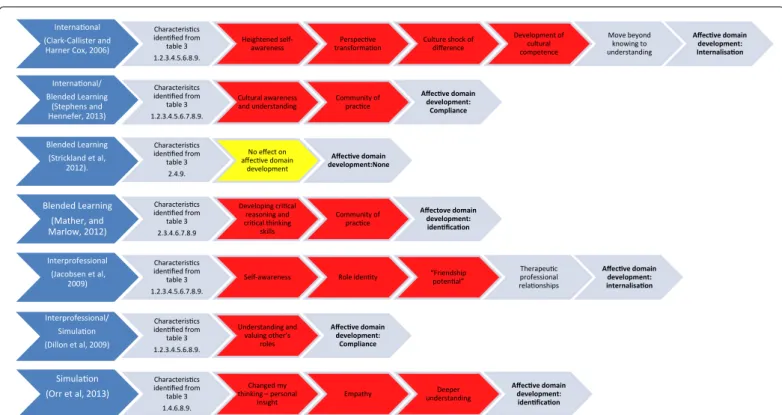
Reciprocal translation was achieved through plotting in a theoretical map; the characteristics of the enrichment activity from Table 4; words from student quotes in the articles and the judgement about the level of change in student’s values, attitudes, and beliefs (Figure 1). This mapping facilitated a line of argument synthesis comparable to the illuminating analysis in a primary piece of research, in this case difficult to define and impossible to reduce to a mechanistic task [16].
Four dependent variables were exposed that had an influence on the affective domain development (a change in values, attitudes, and beliefs), predominantly at internalisation stage:
• Activity is based around a new cultural encounter (IPL,
International, or both)
• Activity is immersive for over two weeks or repeated frequently over six weeks
• Activity is real and based in clinical practice
• Facilitated student self-evaluation, using either debriefs,
reflections or clinical supervision.
These variables were then visually mapped to aid interpretation [30], and to provide an equally effective method of qualitative analysis [31], providing a clear line of argument synthesis (Table 1) (Figures 1 and 2).
Step 6: Synthesizing translations
The activity is based around a new cultural encounter: The activities that created the most significant modification in affective domain development, resulting in the internalisation of learning, and are considered by Epstein to be permanent, were those that introduced the nursing students to a new patient, personal, or professional culture via an international placement or an inter-professional training programme [32-38]. Nursing students recognised that the cultural experience not only had changed how they practised as a nurse, but how they identified themselves as nurses.
‘You can’t have a profound life experience like I have and not have it change you. It changed how I practice my profession. It changed my life.’
’I want to learn the Healer’s Art, and my journey has just begun.’
Enrichment activity characteristics
1. Transformational, experiential, immersion, complexity, and active learning
2. Facilitative and Socratic pedagogical methods
3. Student identity in practice and role in learning process and practice
4. Effect on student: Confidence, autonomy, advocacy, leadership, resilience, change, respect, relationships, stress, emotional, fun, anxiety
5. Clear introduction and purpose to the activity, value of it to the learner
6. Reflection, debrief, and supervision
7. Peer support, peer feedback
8. Realistically links theory to professional role in clinical practice
9. Length of time of activity
Table 4: The nine key characteristics of the activities that emerged from reading the studies.
In some studies, particularly a 2 week inter-professional international placement, students reflected on moving from finding the experience overwhelming to adopting new values and beliefs from
the experience. Similarly the impact of cultural differences on affective domain development was the same for students experiencing nursing in European countries.
International (Clark-Callister and
Harner Cox, 2006)
Characteristics identified from
table 3 1.2.3.4.5.6.8.9.
Heightened
self-awareness transformaPerspective tion Culture shock of difference
Development of cultural competence Move beyond knowing to understanding Affective domain development: Internalisation International/ Blended Learning (Stephens and Hennefer, 2013) Characterisitcs identified from
table 3 1.2.3.4.5.6.7.8.9.
Cultural awareness
and understanding Community of practice
Affective domain development: Compliance Blended Learning (Strickland et al, 2012). Characteristics identified from
table 3 2.4.9. No effect on affective domain development Affective domain development:None Blended Learning (Mather, and Marlow, 2012) Characteristics identified from table 3 2.3.4.6.7.8.9
Developing critical reasoning and critical thinking
skills Community of practice Affectove domain development: identification Interprofessional (Jacobsen et al, 2009) Characteristics identified from
table 3 1.2.3.4.5.6.7.8.9.
Self-awareness Role identity “Friendship potential” Therapeuprofessional tic relationships Affective domain development: internalisation Interprofessional/ Simulation (Dillon et al, 2009) Characteristics identified from
table 3 1.2.3.4.5.6.8.9. Understanding and valuing other’s roles Affective domain development: Compliance Simulation (Orr et al, 2013) Characteristics identified from table 3 1.4.6.8.9. Changed my thinking – personal insight Empathy Deeper understanding Affective domain development: identification
Figure 1: Theoretical map of the characteristics of the enrichment activity from Table 3; words from student quotes in the articles; and the judgement about the level of
change in student’s values, attitude and beliefs.
*Reader please note chevrons coloured in red highlight that these values, attitudes and beliefs can revert to previously held attitudes and values as they are extrinsically motivated, i.e., satisfying a source or relationship.
No effect on affective domain development Blended learning only
Compliance occurs (satifies source or relationship) Blended Learning only
Simulation only IPL only Blended Learning and IPL Blended Learning and Simulation
Identification occurs (satisfies source or relationship) Simulation only
IPL only Blended Learning and IPL Blended Learning and Simulation
Internalisation (embrace new values and attitudes)
IPL only International only IPL and International
Figure 2: Mind Map of the Line of argument synthesis.
1 Day or 1 event Total immersion or repeated over 6 weeks
Time
Self–Evaluation
‘The shock of difference was something that affected the majority of students – if not all of them – deeply.’
‘…the culture and practices in India are so different to those of the UK which for a long time I found very overwhelming.’
‘I have been able to identify the common values held by other students and professions and see that although we all work in different settings many of our aims and beliefs are similar in nature.’ [33]
‘I simply found it meaningful, because you get a new horizon…’ ‘...one understands the healthcare system in Germany better, [you] can look at it critically and compare.’ [34]
Affective domain development at the identification stage was found not only in IPL [39,40], but also simulation activities that explored cultural emotive topics such as dealing with death and dying [41-43] and auditory hallucinations [44]. Similarly blended learning used to connect students on an international placement with those remaining on home soil [45] or across placements [46] created the same outcome. The impact of a simulated life programme enabled student nurses to think differently, but only into identification not internalisation.
‘I think nursing has a whole other dimension … as much as it’s the drug calculations and stuff… that it’s also doing what the patient wants. They don’t always want to be resuscitated. Sometimes being a nurse is just
doing nothing. We’re advocating for them in ways they can’t.’ [43].
Simulated routine nursing care [26] demonstrated the development of the student affective domain to identification level, but no further, as students reconsidered the importance of communication, but they did not pick up on the simulated patient’s concerns. On analysis the activity could be argued as one that is not considered a new cultural encounter as it is based around the task of communication, but if it was to be repeated and based upon ethnic groups it would allow for internalisation.
At the heart of each activity was that the student’s own values and beliefs about nursing, themselves and other professionals were called in to question and constantly compared and reflected upon, to help them learn and understand about themselves and about others.
The activity was immersive or repeated frequently over 6 weeks.
Affective domain development at the internalisation stage occurred when students were totally immersed in the activity [11,32-34,36,37] or the activity was repeated frequently over 6 weeks [38]. Benefits of the length of the programme on the professional identity of student’s demonstrated self-reflection had occurred and that new values and attitudes had developed as a consequence [35].
“All the time you are in your comfort zone you are less likely to learn… Once you become qualified it is a real mistake to retreat into the comfy arms of those professional bodies” [35]
Findings reported that the regular weekly sessions enabled the students to “see the learning” as one student reported in a focus group how in relation to knowing one’s own clinical and professional skills and traits that they had become more self-aware [38].
“I think it is finding out I’m more of a reflector and being at peace with that as well as opposed to before, I used to think I’m not being proactive.”
[38].
Compliance stage occurred in IPL and simulation activities that were mainly based on 1 event [10,25,47,48] with the authors acknowledging early progressive attitudes, weakening rapidly if not repeated. However
activities incorporating blended learning were available for use over longer periods of time (4 weeks to a whole course), yet still only led to compliance stage development [46,49-51]. Limitations of these studies are the dependency on variables such as student motivation and accessibility of the tools to further develop learning. Similarly limitations in Wooton et al.’s in 2010 study may have been due to the data collection methods used by the researchers and the inclusion of only three open ended questions that did not explore affective domain development in any great depth.
The activity was based in clinical practice
All studies that aided development of the affective domain to the stage of internalisation were situated in clinical practice, be that home or abroad. Being in clinical practice enabled students to be immersed and exposed to different cultures which are often hard to teach in a classroom [32]. However, evidence indicated that being based in clinical practice alone was not sufficient to progress affective domain development past the identification stage. This reinforced that factors such as the knowledge, reflective skills, and motivation of both mentors and educators may not always aid student development to the internalisation stage [46]. Development of the affective domain to the identification stage was also reached in the classroom when activities were based upon the realities of nursing practice [39-45].
Facilitating student self-evaluationusing debriefs reflections and clinical supervision.
Affective domain development at internalisation stage was measured in activities that also incorporated educator led active sessions through the use of debriefs, reflections or clinical supervision. The purpose of which was to enable the students to make sense of what they were seeing and experiencing [33].
“Clinical supervision helped express thought and feelings on what were observed. Never having had it before was an insight and helpful.” [33].
Supervision was reported to be best when flexible, so as the student develops and becomes more self-aware they may seek supervision more or less, creating mutual exploration of values and needs.
“It should not become oppressing; one should have the possibility to enfold oneself…” [29]
Some studies at both the identification stage and compliance stage included debrief, reflection, and supervision. The differences where, that the event was either a one off activity and the purpose of the reflection was focused on skill development using simulation [47], retention and support of students in clinical practice [46] and attitudes to palliative care [47], rather than to develop changes in cultural competence.
Step 7: Expressing the synthesis
The aim of the meta-ethnography was to analyse and synthesize literature on the impact of four undergraduate pre-registration programme enrichment activities (Inter-professional learning, International placements, simulation and blended learning) on the affective domain development of student nurses. This was grounded by reporting on the experiences of nursing students from across twenty nine studies.
Development of the affective domain involves cultivating positive attitudes, emotions and feelings, so that students can receive, respond, value, organise and characterise both their own and others reactions in line with their profession [8]. So that during their day to day work they demonstrate empathy, dedication, tact, commitment, compassion,
care, competence, communication, courage, and humility [4]. Ensuring thatType I, II and III enrichment activities are based around cultural encounters are methods that can help do this, as these experiences confirm, explain, alter, and even contradict a student’s philosophies [52]. However affective domain development is a three stage process and to achieve internalisation requires activities that cause conflict between the students’ current values, attitudes, and beliefs creating tension and anxiety, otherwise known as cognitive dissonance [53]. Internalisation was prevalent in students who had experienced an international or inter-professional encounter. The students who chose to participate in these activities reported a need to resolve the tension between their original beliefs and those causing distress and therefore a change in attitudes and values occurred [33].
Cultural encounters in the literature are often limited to discussions in regards to patients and their significant others [54], yet the definition of culture is far more reaching than this relating to a persons or groups customs, norms, values, and behaviour. Yetthis too is an inadequate description, as culture can include an individual’s perception and understanding of the world, an individual’s values, beliefs and societal practices, the aesthetic aspects of life and society’s morality, beliefs, social norms and behaviours [55]. Other cultures within health and social care that students are exposed to can include: occupational cultures, inter-professional cultures, nursing cultures, and organisational cultures [56] Participants in the studies who embraced new values reflected on being transformed from what they had experienced learning from, with, and about other cultures [32,33,38]. Yet it is worthy to note that other students who experienced IPL or IPL and simulation activities, assumed a behaviour or attitude at the compliance and identification stage which reverted quite quickly to previous held beliefs [10,48].
Reflection which explores one’s identity, values, and beliefs and compares similarities and differences is essential [57]. It becomes imperative that in order to do this reflection and debriefs are constructively aligned with the cultural encounter [58]. For example Sims in 2011 and Jacobsen et al in 2009 report that where internalisation occurred in the students they had interviewed, participants reported how the reflective sessions with academics clarified the effect of their efforts and created ‘acculturation’ into a way of thinking, be that of inter-professional working or providing culturally sensitive care. However it is worthy to note that many of the studies reported the use of debrief, reflection, or supervision, after the activity so other factors were intrinsic to enable movement from compliance and identification to internalisation.
In order to ensure that the new values and attitudes did not return to previously held assumptions at the compliance and identification stage, activities need to be repeated frequently [22,36,44,37]. New habits need repetition if they are to be conditioned into the student’s way of being [59]. Students who participated in activities that were either immersive in a clinical practice setting or attended sessions weekly for more than 6 weeks, recognised that the length of the experience conditioned them into new ways of thinking. This links to these activities being classified as transformational learning experiences. It is recognised that these types of learning environments lead to development of the student, however it is also acknowledged that for a learning experience to create transformation of values, beliefs, and assumptions critical reflection and reflective discourse is necessary [60]. A significant finding from the synthesis is the type of reflection conducted to enable movement to internalisation should be that of premise reflection. This involves the academic helping the student to examine their assumptions, values and beliefs about an experience and this can be about self, cultural systems in which they live, the workplace, decision making processes and feelings.
The restructuring of the participants’ values and beliefs through premise reflection was evident in the articles where internalisation had occurred, statements relate to the opening of hearts and minds, becoming self-aware, seeing the learning, and the bridging of theory to practice [11,32-38]. Therefore one can elucidate both cognitive and affective domain development occurred. However other activities should not be dismissed, especially those at identification level as the participants reported that the activities created a change in their understanding, thinking, and empathy, for patients who hear voices or who are at the end of life [41-44]. It would have been interesting to observe the outcome of these emotive activities on affective domain development, if repeated over time.
Conclusion
Research in this field is not evolving; new studies appear to repeat what has gone before without building on the theories and lessons learnt, with only three papers within the synthesis citing each other’s work. This meta-ethnography draws together evidence from a variety of enrichment activities, deployed using different methods across different countries and systematically extracted data to generate theoretical arguments that extend current knowledge and understanding of student nurse enrichment activity. The findings highlight that educational activities, based on cultural encounters within real clinical situations, that are repeated over time and enable the student to evaluate and reflect on their own learning directly influence affective domain development. The best way in achieving affective domain development at the internalisation stage is to implement IPL programmes or international placements that are scaffold with premise reflection. However simulation and blended learning can impact on affective domain development to compliance and identification level and if they were to be repeated more frequently, internalisation may occur.
Affective domain development is imperative to nurse education as the values, attitudes and behaviours of nursing originate from it, professional qualities impact patient care and quality care is intrinsically linked with the culture and values of an organisation [1]. To capture the effect of the activities on the affective domain development, one would collect data from qualitative narratives using a variety of methods from semi structured interviews, written reflections, focus groups, stories, structured diaries and even patient feedback.
Further Research
This Meta ethnography only explored Type I and II enrichment activities in the areas of IPL, international placements, simulation and blended learning. Further research is needed in relation to the impact of other activities from those highlighted when applying the inclusion and exclusion criteria. Further work is also needed to conduct a study on the impact of Type III enrichment activities on the affective domain. References
1. Francis R (2013) Report of the Mid Staffordshire NHS Foundation Trust Public
Inquiry. The Stationary Office: London.
2. Keogh B (2013) Review into the quality of care and treatment provided by 14
hospital trusts in England: overview report.
3. Berwick D (2013) A promise to learn - a commitment to act. Improving the Safety of Patients in England. Crown: London.
4. Gunther M, Alligood MR (2002) A discipline-specific determination of high quality nursing care. J Adv Nurs 38: 353-359.
5. Shields L (2014) The core business of caring: a nursing oxymoron? Collegian
6. Griffiths J, Speed S, Horne M, Keeley P (2012) ‘A caring professional attitude’:
what service users and carers seek in graduate nurses and the challenge for educators. Nurse Education Today 32: 121–127.
7. McCrae N (2012) Whither nursing models? The value of nursing theory in the context of evidence-based practice and multidisciplinary health care. J Adv
Nurs 68: 222-229.
8. Bloom BS, Mesia BB, Krathwohl DR (1964) Taxonomy of Educational Objectives. New York. David McKay.
9. Renzulli JS, Reiss SM (2008) The Enriching Curriculum for all students. 2nd Edition. Corwin Press: California.
10. Bradley P, Cooper S, Duncan F (2009) A mixed-methods study of
inter-professional learning of resuscitation skills. Med Educ 43: 912-922. 11. Jacobsen F, Fink AM, Marcussen V, Larsen K, BæK Hansen T (2009)
Inter-professional undergraduate clinical learning: Results from a three year project in a Danish Inter-professional Training Unit. Journal of Inter-professional Care 23: 30-40.
12. Cook NF, McAloon T, O’Neill P, Beggs R (2012) Impact of a web based
interactive simulation game (PULSE) on nursing students’ experience and
performance in life support training - A pilot study. Nurse Education Today 32: 714-720.
13. Aponte J (2012) Cultural competency in baccalaureate US nursing education: hybrid course. Holist Nurs Pract 26: 243-258.
14. Strike K, Posner G (1983) Types of synthesis and their criteria. In S. Ward, & L. Reed (Eds.), Knowledge structure and use. Temple University Press:
Philadelphia.
15. Atkins S, Lewin S, Smith H, Engel M, Fretheim A, et al. (2008) Conducting
a meta-ethnography of qualitative literature: lessons learnt. BMC Med Res
Methodol 8: 21.
16. Britten N, Campbell R, Pope C, Donovan J, Morgan M, Pill R (2002) Using meta
ethnography to synthesize qualitative research: a worked example. Journal of
Health Service Research Policy 7: 209-215.
17. Dixon-Woods M, Argawal S, Young B, Jones D, Sutton A (2004) Integrative approaches to qualitative and quantitative evidence. Health Development
Agency: London.
18. Ring N, Richie K, Mandava L, Jepson R (2011) A guide to synthesising qualitative
research for researchers undertaking health technology assessments and systematic reviews. NHS Quality Improvement: Scotland.
19. Aveyard H (2014) Doing a literature review in health and social care: a practical guide. Third Edition. Open University Press, McGraw Hill Education: Maidenhead
20. Walsh D, Downe S (2005) Meta-synthesis method for qualitative research: a
literature review. J Adv Nurs 50: 204-211.
21. Pound P, Britten N, Morgan M, Yardley L, Pope C, Daker-White G, Campbell
R (2005). Resisting medicines: a synthesis of qualitative studies of medicine
taking. Social Science and Medicine 61: 133–55.
22. Wellard SJ, Heggen KM (2010) Are laboratories useful fiction? A comparison
of Norwegian and Australian undergraduate nursing skills laboratories. Nursing Health Science 12: 39–44.
23. Gum LF, Richards JN, Walters L, Forgan J, Lopriore M, et al. (2013) Immersing undergraduates into an inter-professional longitudinal rural placement. Rural and Remote Health 13: 1-12.
24. Stephens M, Hennefer D, Keegan H (2011) The use of weblogs for students on
an international placement. Journal of Nursing Education 50.
25. Dillon PM, Noble KA, Kaplan (2009) Simulation as a means to foster
collaborative interdisciplinary education. Nursing Education Perspectives 30: 87-90.
26. Chan EA (2014) Cue-responding during simulated routine nursing care: a
mixed method study. Nurse Educ Today 34: 1057-1061.
27. Noblit GW, Hare RD (1988) Meta-ethnography: Synthesizing qualitative
studies. In Qualitative research methods series 11. Sage: London.
28. Corden A, Sainsbury R (2006) Using verbatim quotations in reporting qualitative
social research: researchers’ views. Social Policy Research Unit: York. 29. Epstein R (1977) Evaluating the effective domain of student learning. National
League for Nursing: Evaluation of Students in Baccalaureate Nursing Programs. NLN: New York.
30. Buzan T (2003) The Mind Map Book. BBC Books: London.
31. Tattersall C, Powell J, Stroud J, Pringle J (2011) Mind mapping in qualitative
research. Nurs Times 107: 20-22.
32. Maltby HJ, Abrams S (2009) Seeing with new eyes: the meaning of an
immersion experience in Bangladesh for undergraduate senior nursing
students. Int J Nurs Educ Scholarsh 6: Article 33.
33. Bernal CM, Gilbert L, Kelly A, Smith AM (2011) A passage to interprofessional learning: the benefits to students from an educational visit to India. Nurse Educ
Pract 11: 406-410.
34. Keogh J, Russel-Roberts E (2009) Exchange programmes and student mobility: meeting student’s expectations or an expensive holiday? Nurse Educ
Today 29: 108-116.
35. Sims D (2011) Achieving collaborative competence through inter-professional education. Lessons learned from joint training in learning disability nursing and social work. Social Work Education 30: 98-112.
36. Morgan DA (2012) Student nurse perceptions of risk in relation to international placements: a phenomenological research study. Nurse Educ Today 32: 956-960.
37. Schwind J, Zanchetta M, Aksenchuk K, Gorospe F (2013) Nursing students’ international placement experience: an arts-informed Narrative Inquiry. Reflective Practice 14: 705-716.
38. Chaffe E, Cullen M, Dean M, Haines C, Hollinshead M, et al. (2013) Inter-professional working in practice – Educating for the future: The development of the Salford Collaborative Learning in Practice Model. University of Salford: Salford.
39. Morison S, Jenkins J (2007) Sustained effects of inter-professional shared learning on student attitudes to communication and team working depend on shared learning opportunities on clinical placement as well as in the classroom. Medical teacher 29: 464-470.
40. Tew J, Holley T, Caplen P (2012) Dialogue and challenge: involving service users and carers in small group learning with social work and nursing students. Social Work Education 31: 316-330.
41. Kwekkeboom KL, Vahl C, Eland J (2006) Impact of a volunteer companion
program on nursing students’ knowledge and concerns related to palliative care. J Palliat Med 9: 90-99.
42. Leighton K, Dubas J (2009) Simulated Death. An Innovative Approach to
Teaching End-of-Life Care. Clinical Simulation in Nursing 5: 223-230 43. Moreland SS, Lemieux ML, Myers A (2012) End-of-life care and the use of
simulation in a baccalaureate nursing program. Int J Nurs Educ Scholarsh 9. 44. Orr F, Kellehear K, Armari E, Pearson A, and Holmes D (2013) The distress
of voice-hearing: The use of simulation for awareness, understanding and communication skill development in undergraduate nursing education. Nurse Education in Practice 13: 529-535.
45. Stephens M, Hennefer D (2013) Internationalising the nursing curriculum using
a Community of Inquiry Framework and blended learning. Nurse Educ Pract
13: 170-175.
46. Mather C, Marlow A (2012) Audio teleconferencing: creative use of a forgotten innovation. Contemp Nurse 41: 177-183.
47. Reilly A, Spratt C (2007) The perceptions of undergraduate student nurses
of high-fidelity simulation-based learning: a case report from the University of
Tasmania. Nurse Educ Today 27: 542-550.
48. Reising DL, Carr DE, Shea RA, King JM (2011) Comparison of communication
outcomes in traditional versus simulation strategies in nursing and medical students. Nurs Educ Perspect 32: 323-327.
49. Fisher KL, Koren A (2007) Palm Perspectives: The Use of Personal Digital
Assistants in Nursing Clinical Education- A Qualitative Study. Online Journal of Nursing Informatics 11.
50. Holland A, Smith F, McCrossan G, Adamson E, Watt S, et al. (2013) Online video in clinical skills education of oral medication administration for undergraduate
student nurses: A mixed methods, prospective cohort study. Nurse Education
Today 33: 663-670.
51. Stephens M, Robinson L, McGrath D (2013) Extending inter-professional
learning through the use of a multi-disciplinary Wiki. Nurse Educ Pract 13: 492-498.
52. Campinha-Bacote J (2011) Delivering patient-centered care in the midst of a
cultural conflict: the role of cultural competence. Online J Issues Nurs 16: 5.
53. Festinger L (1957) A Theory of Cognitive Dissonance. California: Stanford University Press.
54. Kersey-Matusiak G (2013) Delivering Culturally Competent Nursing Care.
Springer Publishing: New York.
55. Gorton V (2009) Nursing as a global healthcare activity. In (Eds) Hall C, Ritchie
D. (2009) What is Nursing? Sage: Exeter.
56. Goodman B, Clemlow R (2010) Nursing and Collaborative Practice. Learning
Matters: Exeter.
57. Jeffreys M (2008) Dynamics of diversity: becoming better nurses through diversity awareness. Imprint 55: 36-41.
58. Biggs J (1996) Enhancing teaching through constructive alignment. Higher Education 32: 1-18
59. Sparrow T, Knight A (2006) Applied EI: The Importance of Attitudes in
Developing Emotional Intelligence. John Wiley and Sons: Chichester. 60. Feinstein BC (2004) Learning and transformation in the context of Hawaiian
traditional ecological knowledge. Adult Education Quarterly 54: 105-120.
Citation: Stephens M (2015) Changing Student Nurses Values, Attitudes, and Behaviours: A Meta Ethnography of Enrichment Activities. J Nurs Care 5: 320. doi:10.4172/2167-1168.1000320
OMICS International: Publication Benefits & Features Unique features:
• Increased global visibility of articles through worldwide distribution and indexing • Showcasing recent research output in a timely and updated manner • Special issues on the current trends of scientific research Special features:
• 700 Open Access Journals • 50,000 editorial team • Rapid review process
• Quality and quick editorial, review and publication processing
• Indexing at PubMed (partial), Scopus, EBSCO, Index Copernicus and Google Scholar etc • Sharing Option: Social Networking Enabled
• Authors, Reviewers and Editors rewarded with online Scientific Credits • Better discount for your subsequent articles