DOCUMENT ID: 32702-01-1250-01 LAST REVISED: May 2001
Copyright © 1989-2001 by Sybase, Inc. All rights reserved.
This publication pertains to Sybase database management software and to any subsequent release until otherwise indicated in new editions or technical notes. Information in this document is subject to change without notice. The software described herein is furnished under a license agreement, and it may be used or copied only in accordance with the terms of that agreement.
To order additional documents, U.S. and Canadian customers should call Customer Fulfillment at (800) 685-8225, fax (617) 229-9845. Customers in other countries with a U.S. license agreement may contact Customer Fulfillment via the above fax number. All other international customers should contact their Sybase subsidiary or local distributor. Upgrades are provided only at regularly scheduled software release dates. No part of this publication may be reproduced, transmitted, or translated in any form or by any means, electronic, mechanical, manual, optical, or otherwise, without the prior written permission of Sybase, Inc.
Sybase, the Sybase logo, ADA Workbench, Adaptable Windowing Environment, Adaptive Component Architecture, Adaptive Server, Adaptive Server Anywhere, Adaptive Server Enterprise, Adaptive Server Enterprise Monitor, Adaptive Server Enterprise Replication, Adaptive Server Everywhere, Adaptive Server IQ, Adaptive Warehouse, AnswerBase, Anywhere Studio, Application Manager, AppModeler, APT Workbench, APT-Build, APT-Edit, APT-Execute, APT-FORMS, APT-Translator, APT-Library, Backup Server, ClearConnect, Client-Library, Client Services, Data Pipeline, Data Workbench, DataArchitect, Database Analyzer, DataExpress, DataServer, DataWindow, DB-Library, dbQueue, Developers Workbench, Direct Connect Anywhere, DirectConnect, Distribution Director, E-Anywhere, E-Whatever, Embedded SQL, EMS, Enterprise Application Studio, Enterprise Client/Server, Enterprise Connect, Enterprise Data Studio, Enterprise Manager, Enterprise SQL Server Manager, Enterprise Work Architecture, Enterprise Work Designer, Enterprise Work Modeler, EWA, Financial Fusion, Financial Fusion Server, Gateway Manager, ImpactNow, InfoMaker, Information Anywhere, Information Everywhere, InformationConnect, InternetBuilder, iScript, Jaguar CTS, jConnect for JDBC, KnowledgeBase, MainframeConnect, Maintenance Express, MAP, MDI Access Server, MDI Database Gateway, media.splash, MetaWorks, MySupport, Net-Gateway, Net-Library, ObjectConnect, ObjectCycle, OmniConnect, OmniSQL Access Module, OmniSQL Toolkit, Open Client, Open ClientConnect, Open Client/Server, Open Client/Server Interfaces, Open Gateway, Open Server, Open ServerConnect, Open Solutions, Optima++, PB-Gen, PC APT Execute, PC DB-Net, PC Net Library, Power++, power.stop, PowerAMC, PowerBuilder, PowerBuilder Foundation Class Library, PowerDesigner, PowerDimensions, PowerDynamo, PowerJ, PowerScript, PowerSite, PowerSocket, Powersoft, PowerStage, PowerStudio, PowerTips, Powersoft Portfolio, Powersoft Professional, PowerWare Desktop, PowerWare Enterprise, ProcessAnalyst, Report Workbench, Report-Execute, Replication Agent, Replication Driver, Replication Server, Replication Server Manager, Replication Toolkit, Resource Manager, RW-DisplayLib, RW-Library, S-Designor, SDF, Secure SQL Server, Secure SQL Toolset, Security Guardian, SKILS, smart.partners, smart.parts, smart.script, SQL Advantage, SQL Anywhere, SQL Anywhere Studio, SQL Code Checker, SQL Debug, SQL Edit, SQL Edit/TPU, SQL Everywhere, SQL Modeler, SQL Remote, SQL Server, SQL Server Manager, SQL SMART, SQL Toolset, SQL Server/CFT, SQL Server/DBM, SQL Server SNMP SubAgent, SQL Station, SQLJ, STEP, SupportNow, Sybase Central, Sybase Client/Server Interfaces, Sybase Financial Server, Sybase Gateways, Sybase MPP, Sybase SQL Desktop, Sybase SQL Lifecycle, Sybase SQL Workgroup, Sybase User Workbench, SybaseWare, Syber Financial, SyberAssist, SyBooks, System 10, System 11, System XI (logo), SystemTools, Tabular Data Stream, Transact-SQL, Translation Toolkit, UNIBOM, Unilib, Uninull, Unisep, Unistring, URK Runtime Kit for UniCode, Viewer, Visual Components, VisualSpeller, VisualWriter, VQL, WarehouseArchitect, Warehouse Control Center, Warehouse Studio, Warehouse WORKS, Watcom, Watcom SQL, Watcom SQL Server, Web Deployment Kit, Web.PB, Web.SQL, WebSights, WebViewer, WorkGroup SQL Server, XA-Library, XA-Server and XP Server are trademarks of Sybase, Inc. 3/01
Unicode and the Unicode Logo are registered trademarks of Unicode, Inc.
All other company and product names used herein may be trademarks or registered trademarks of their respective companies. Use, duplication, or disclosure by the government is subject to the restrictions set forth in subparagraph (c)(1)(ii) of DFARS 52.227-7013 for the DOD and as set forth in FAR 52.227-19(a)-(d) for civilian agencies.
About This Book ... vii
CHAPTER 1 Introduction ... 1
New features in Adaptive Server Enterprise 12.5 ... 3
Who can use Component Integration Services ... 4
Steps needed to use Component Integration Services ... 5
CHAPTER 2 Understanding Component Integration Services ... 7
Basic concepts ... 8
Access methods ... 8
Server classes ... 8
Object types ... 9
Interface to remote servers ... 10
Proxy tables ... 13
Using the create table command... 13
Using the create existing table command ... 14
Using the create proxy_table command ... 16
Remote Procedures as proxy tables ... 16
New server limits ... 20
Cascading proxy tables ... 24
Proxy databases ... 25
Contents
Remote servers ... 40
Defining remote servers ... 40
Connection management ... 42
LDAP directory services ... 43
Secure communication with SSL... 43
Security issues ... 44
Remote server logins ... 44
Mapping of external logins ... 45
Remote server connection failover... 47
Remote server capabilities ... 47
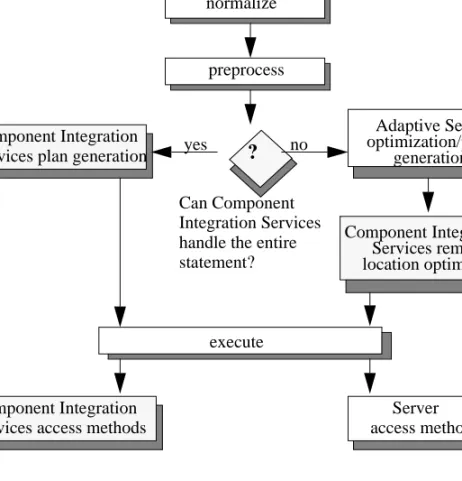
Query processing ... 49
Processing steps ... 49
Query plan execution ... 57
Passthrough mode ... 61
Quoted identifier support ... 65
auto identity option ... 66
Triggers ... 66
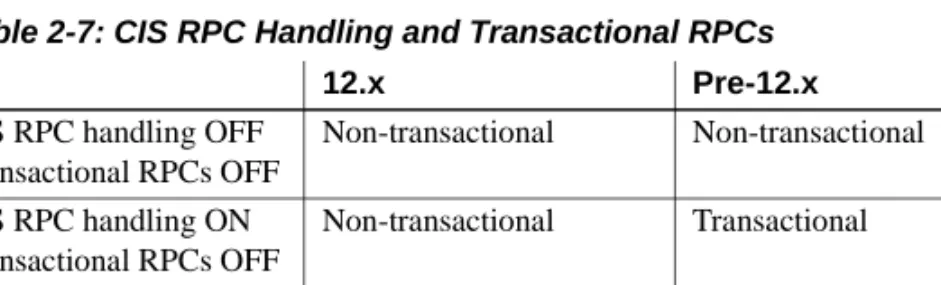
RPC handling and Component Integration Services... 67
Site handler and outbound RPCs... 67
Component Integration Services and outbound RPCs... 68
Text parameters for RPCs... 69
Text parameter support for XJS/390 ... 71
Transaction management ... 72
Two-phase commit ... 72
Pre-12.x servers ... 75
Transactional RPCs ... 76
Restrictions on transaction management ... 76
Using update statistics ... 78
Finding index names ... 78
Java in the database ... 80
@@textsize ... 80
@@stringsize ... 80
Constraints on Java class columns ... 81
Error messages ... 81
SQLJ in Adaptive Server Enterprise... 81
Datatypes ... 85
Unicode support ... 85
Datatype conversions... 87
text and image datatypes ... 88
Fine-grained access control ... 93
The select into command ... 94
select into syntax... 95
Execute immediate... 96
Using sp_configure... 97
Global variables for status ... 101
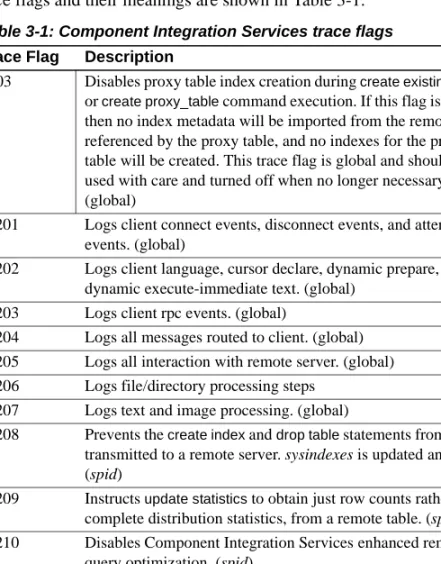
CHAPTER 3 SQL reference ... 103 dbcc commands ... 104 dbcc options ... 104 Trace flags... 105 Transact-SQL commands ... 107 alter database ... 108 alter table ... 110 begin transaction... 115 case... 118 close... 120 commit transaction ... 121 connect to...disconnect ... 123 create database ... 125
create existing table ... 127
create index... 136 create proxy_table... 138 create table ... 140 create trigger ... 145 deallocate cursor ... 147 declare cursor ... 148 delete ... 149 drop database ... 152 drop index ... 153 drop table ... 155 execute... 157 fetch ... 158 Functions... 160 insert ... 165 open ... 167
Contents
A P P E N D I X A Tutorial ... 191
Getting Started with Component Integration Services ... 191
Adding a Remote Server ... 191
Mapping Remote Objects to Local Proxy Tables ... 193
Join Between Two Remote Tables... 196
A P P E N D I X B Troubleshooting ... 201
Problems Accessing Component Integration Services ... 201
Problems Using Component Integration Services ... 202
Unable to Access Remote Server ... 202
Unable to Access Remote Object ... 205
Problem Retrieving Data From Remote Objects ... 206
Audience
This book is written for Sybase® Adaptive Server™ Enterprise System Administrators, database administrators, and users.
How to use this book
This guide will assist you in configuring and using Component Integration Services. The book includes the following chapters:
• Chapter 1, “Introduction,” provides an overview of Component Integration Services.
• Chapter 2, “Understanding Component Integration Services,” provides a framework for understanding how Component Integration works. This chapter includes both basic concepts and in-depth topics. • Chapter 3, “SQL Reference,” describes the Component Integration
Services server classes required to access remote databases. • Appendix A, “Tutorial,” includes a tutorial designed to help new
users get Component Integration Services up and running.
• Appendix B, “Troubleshooting,” provides troubleshooting tips if you encounter a problem with Component Integration Services.
A more recent version of the release bulletin may be available on the World Wide Web. To check for critical product or document information that was added after the release of the product CD, use the Sybase Technical Library.
• The Installation Guide for your platform – describes installation, upgrade, and configuration procedures for all Adaptive Server and related Sybase products.
• Configuring Adaptive Server Enterprise for your platform – provides instructions for performing specific configuration tasks for Adaptive Server.
• What’s New in Adaptive Server Enterprise? – describes the new features in Adaptive Server version 12.5, the system changes added to support those features, and the changes that may affect your existing applications. • Transact-SQL User’s Guide – documents Transact-SQL, Sybase’s
enhanced version of the relational database language. This manual serves as a textbook for beginning users of the database management system. This manual also contains descriptions of the pubs2 and pubs3 sample databases.
• System Administration Guide – provides in-depth information about administering servers and databases. This manual includes instructions and guidelines for managing physical resources, security, user and system databases, and specifying character conversion, international language, and sort order settings.
• Reference Manual – contains detailed information about all Transact-SQL commands, functions, procedures, and datatypes. This manual also contains a list of the Transact-SQL reserved words and definitions of system tables.
• Performance and Tuning Guide – explains how to tune Adaptive Server for maximum performance. This manual includes information about database design issues that affect performance, query optimization, how to tune Adaptive Server for very large databases, disk and cache issues, and the effects of locking and cursors on performance.
• The Utility Guide – documents the Adaptive Server utility programs, such as isql and bcp, which are executed at the operating system level.
• The Quick Reference Guide – provides a comprehensive listing of the names and syntax for commands, functions, system procedures, extended system procedures, datatypes, and utilities in a pocket-sized book. Available only in print version.
• The System Tables Diagram – illustrates system tables and their entity relationships in a poster format. Available only in print version. • Error Messages and Troubleshooting Guide – explains how to resolve
frequently occurring error messages and describes solutions to system problems frequently encountered by users.
• Component Integration Services User’s Guide – explains how to use the Adaptive Server Component Integration Services feature to connect remote Sybase and non-Sybase databases.
• Java in Adaptive Server Enterprise – describes how to install and use Java classes as datatypes, functions, and stored procedures in the Adaptive Server database.
• Using Sybase Failover in a High Availability System – provides
instructions for using Sybase’s Failover to configure an Adaptive Server as a companion server in a high availability system.
• Using Adaptive Server Distributed Transaction Management Features – explains how to configure, use, and troubleshoot Adaptive Server DTM features in distributed transaction processing environments.
• EJB Server User’s Guide – explains how to use EJB Server to deploy and execute Enterprise JavaBeans in Adaptive Server.
• XA Interface Integration Guide for CICS, Encina, and TUXEDO – provides instructions for using Sybase’s DTM XA interface with X/Open XA transaction managers.
• Glossary – defines technical terms used in the Adaptive Server documentation.
• Sybase jConnect for JDBC Programmer’s Reference – describes the jConnect for JDBC product and explains how to use it to access data stored in relational database management systems.
• Monitor Client Library Programmer’s Guide – describes how to write Monitor Client Library applications that access Adaptive Server performance data.
Other sources of information
Use the SyBooks™ and SyBooks-on-the-Web online resources to learn more about your product:
• SyBooks documentation is on the CD that comes with your software. The DynaText browser, also included on the CD, allows you to access technical information about your product in an easy-to-use format. Refer to Installing SyBooks in your documentation package for instructions on installing and starting SyBooks.
• SyBooks-on-the-Web is an HTML version of SyBooks that you can access using a standard Web browser.
To use SyBooks-on-the-Web, go to http://www.sybase.com, and choose Documentation.
Conventions
What you type to the computer screen is shown as: Enter text in an entry field
Computer output is shown as: CIS returns results.
Command arguments you replace with a non-generic value are shown in italics:
If you need help
Each Sybase installation that has purchased a support contract has one or more designated people who are authorized to contact Sybase Technical Support. If you cannot resolve a problem using the manuals or online help, ask a designated person at your site to contact Sybase Technical Support.
Component Integration Services is a feature that extends Adaptive Server capabilities and provides enhanced interoperability.
Component Integration Services provides both location transparency and functional compensation.
Location transparency means that Component Integration Services allows Adaptive Server to present a uniform view of enterprise data to client applications. Enterprise-wide data from heterogeneous sources can be accessed as if it were local.
Functional compensation allows Component Integration Services to emulate all features of the Transact-SQL language, and interact with a data source only when actual data is needed. With this capability, the full range and power of Transact-SQL can be applied to any data source, whether the data source provides support for a particular feature of Transact-SQL or not. Examples of this capability are built-in functions and Java functions. Component Integration Services allows statements to use these functions even though the data on which these functions may operate is derived from external sources that cannot support the functions. Component Integration Services together with Adaptive Server
Anywhere, Adaptive Server IQ and various DirectConnect interfaces, extends the reach of Adaptive Server Enterprise by enabling transparent access to database management systems anywhere in the enterprise. This transparent, extended reach of Adaptive Serve Enterprise makes it easy for Enterprise Portal components to:
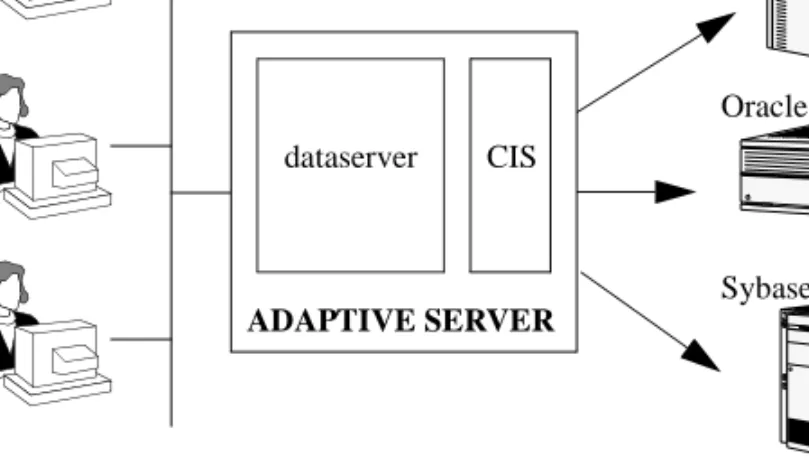
Component Integration Services allows users to access both Sybase and non-Sybase databases on different servers. These external data sources include host data files and tables, views and RPCs (remote procedure calls) in database systems such as Adaptive Server, Oracle, and DB2, as shown in Figure 1-1.
Figure 1-1: Component Integration Services connects to multiple vendor databases
Using Component Integration Services, you can:
• Access tables in remote servers as if the tables were local.
• Perform joins between tables in multiple remote, heterogeneous servers. For example, it is possible to join tables between an Oracle database management system (DBMS) and an Adaptive Server, and between tables in multiple Adaptive Servers.
• Transfer the contents of one table into a new table on any supported remote server by means of a select into statement.
• Maintain referential integrity across heterogeneous data sources.
• Access native remote server capabilities using the Component Integration Services passthrough mode.
DB2 in NY
Oracle in London
Sybase in Tokyo
ADAPTIVE SERVER
New features in Adaptive Server Enterprise 12.5
Component Integration Services is fully compatible with the new features of Adaptive Server Enterprise version 12.5.
There are also many new or enhanced features in Component Integration Services.
• Distributed Query Optimization Enhancements • Distributed Transaction Management Enhancements • Enhanced Data Access via File System
• Login name/password mapping to remote systems • XNL - Extensible new limits
• Unicode support - new datatypes for support of Unicode character set • LDAP
• SSL
• Union in views
• Administration and Diagnostic Enhancements • Cascading Proxy Support
• Quoted Identifier Support
• Enhanced Full Text Search Capabilities • select into existing tables
• Enhancements to Proxy Table Support for Remote Procedures • Proxy Database Support
Who can use Component Integration Services
Who can use Component Integration Services
Component Integration Services can be used by anyone who needs to access multiple data sources or legacy data. It can also be used by anyone who needs to migrate data from one server to another.
A single server is often used to access data on multiple external servers. Component Integration Services manages the data regardless of the location of the external servers. Data management is transparent to the client application. Component Integration Services, in combination with EnterpriseConnect™ and MainframeConnect™ products, provides transparent access to a wide variety of data sources, including:
• Oracle • Informix
• IBM databases including: • DB2 for MVS • DB2/400 • DB2/2
• DB2 for VM (SQL/DS) • Microsoft SQL Server • Adaptive Server Enterprise • Adaptive Server Anywhere™ • Adaptive Server IQ™ • Mainframe data, including:
• ADABAS
• IDMS
• IMS
• VSAM
The list of certified and supported sources and front-end tools is increasing. For current information on all data sources, versions supported, and products required for support, please call the Sybase FAX on Demand at 1-800-423-8737. Request the “Partner Certification Report.”
Steps needed to use Component Integration Services
To get Component Integration Services running:
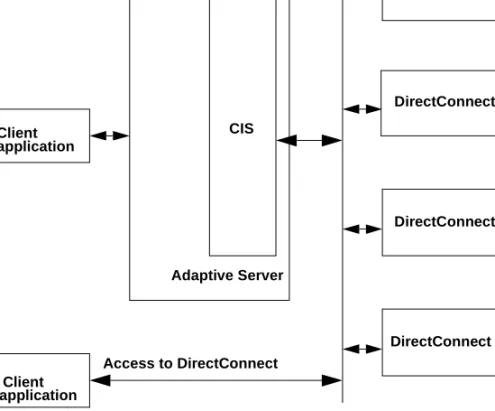
• Install DirectConnect server(s) or gateways for the external data sources you choose to access (Oracle, DB2, Informix).
• Configure the server to access remote objects as described in Chapter 2, “Understanding Component Integration Services.”
Integration Services
This chapter explains how to use Component Integration Services. It is intended to help you understand how Adaptive Server works with the Component Integration Services option configured. The chapter includes the following topics:
Name Page
Basic concepts 8
Proxy tables 13
Proxy databases 25
File system access 32
Remote servers 40
Query processing 49 RPC handling and Component Integration Services 67 Transaction management 72 Java in the database 80 select into syntax 94 Configuration and tuning 97
Basic concepts
Basic concepts
The ability to access remote (or external) tables as if they were local is a hallmark of Component Integration Services. Component Integration Services presents tables to a client application as if all the data in the tables were stored locally. Remote tables are mapped to local proxy tables which hold metadata. Internally, when a query involving remote tables is executed, the storage location is determined, and the remote location is accessed so that data can be retrieved.
The access method used to retrieve remote data is determined by two attributes of the external object:
• The server class associated with the remote object • The object type
To achieve location transparency, tables must first be mapped to their corresponding external locations.
Access methods
Access methods form the interface between the server and an external object. For each server class, there are separate access methods that handle all interaction between Adaptive Server and remote servers of the same class and object type.
Server classes
A server class must be assigned to each server when it is added by means of the system procedure sp_addserver. Server classes determine the access method used to interact with the remote server. The server classes are:
• ASEnterprise – Used if the server is an Adaptive Server Enterprise version 11.5 or later. This is the default server class.
• ASAnywhere – Used if the server is an Adaptive Server Anywhere version 6.0 or later.
• sql_server – indicates that the server is a Sybase SQL Server™ . Component Integration Services determines whether the Sybase server is a release 10.0 or later server (supports cursors and dynamic SQL) or a pre-release 10.0 server (does not support cursors or dynamic SQL).
• local – the local server. There can be only one.
• direct_connect – indicates that the server is an Open Server™ application that conforms to the interface requirements of a DirectConnect™ server. For access to Microsoft SQL Server a DirectConnect must be used. • access_server – a synonym for server class direct_connect for
compatibility with previous releases.
• db2 – indicates that the server is a gateway to DB2 or DB2-compatible databases. This class is provided only for backward compatibility. The preferred class is direct_connect.
• sds – indicates that the server conforms to the interface requirements of a Specialty Data Store.
Object types
The server presents a number of object types to client applications as if they were local tables. Supported object types are:
• table – The object in a remote server of any class is a relational table. This is the default type.
• view – The object in a remote server of any class is a view. Component Integration Services treats views as if they were local tables without any indexes.
Basic concepts
Interface to remote servers
The interface between the server and remote servers is handled by the Open Client software, Client-Library™. The Client-Library features that are used to implement the interface are dependent upon the class of server with which Component Integration Services is interacting.
For example, if the server class is direct_connect (access_server), a number of features such as cursor and dynamic requests are used. These features are not used by a server of class db2.
Before the server can interact with a remote server, you need to configure the following:
• Remote server addition to directory services • Remote server definition
• Remote server login information • Remote object definition
Directory services Before accessing remote tables with Component Integration Services, you must either have access to LDAP directory services, or an interfaces file (sql.ini file on Windows NT). For information on setting up directory services, see the configuration documentation for your platform. You may wish to refer to Appendix A which serves as a basic tutorial for Component Integration Services users.
Remote server definition
Remote servers are defined by means of the stored procedure sp_addserver. This procedure is documented in the Adaptive Server Reference Manual. When using release 12.0 or greater you must name the local server.
Logging into remote servers
Once the remote server has been configured, login information must be provided. By default, the server uses the names and passwords of its clients whenever it connects to a remote server on behalf of those clients. However, this default can be overridden by the use of the stored procedure
sp_addexternlogin. This procedure allows a system administrator to define the name and password for each user who connects to a remote server. Using connect to server_name, you can verify that the server configuration is correct. This command establishes a passthrough mode connection to the remote server. Passthrough mode allows clients to communicate with remote servers in native syntax. This passthrough mode remains in effect until you issue a disconnect command.
Defining remote
objects Once a remote server has been properly configured, objects in that remote server cannot be accessed as tables until a mapping between them and a local object (proxy table) has been established.
You can create new tables on remote servers, and you can define the schema for an existing object in a remote server. The procedures for both are similar. You can use one of two methods for defining the storage location of remote objects:
1 Define the storage location of individual objects 2 Define the default location of all objects in a database
Defining the storage location of individual objects
Defining individual object storage locations is done by means of the system procedure sp_addobjectdef or the use of the at pathname syntax. This procedure allows you to associate a remote object with a local proxy table name. The remote object may or may not exist before you do the mapping. Complete syntax for sp_addobjectdef is provided in the Adaptive Server Reference Manual.
An easier method for defining storage locations is with the create proxy_table command.
create proxy_table <table_name> [external file] at "pathname"
Creating proxy tables
Once you have defined the storage location, you can create the table as a new or existing object. If the table does not already exist at the remote location, use the create table syntax. If it already exists, use the create existing table
Basic concepts
The create proxy_table command is easier to use than create existing table. Proxy tables can also be created using the Adaptive Server Enterprise system administration tool, Sybase Central.
Once the object has been created, either as a new or an existing object, the remote object can be queried by using its local name.
Proxy tables
Proxy tables are the key to location transparency. A proxy table is a local table containing metadata which points to a remote or external table. The remote table is mapped to the proxy table to make it appear as if it were a local table. There are three ways to create proxy tables:
• The create table command allows the creation of new external tables with the following syntax:
create table table_name (column_list) [ [ external {table | file}] at “pathname” ]]
create table allows external object type table and file.
• The create existing table command is used to map existing remote tables. It provides datatype conversion and allows the user to specify which columns are to be mapped with the following syntax:
create existing table table_name (column_list) [ on segment_name ]
[[external {table | procedure | file}] at pathname]
create existing table allows external object type table, procedure and file. • The create proxy_table command creates proxy tables which
automatically inherit all the columns, column names and datatypes of the external table using the following syntax:
create proxy_table table_name [ external type ] at pathname
create proxy table allows external object type table, file and directory. Complete syntax for these commands are found in Chapter 3 of this book.
Proxy tables
Using the create existing table command
The create existing table command allows the definition of existing tables (proxy tables). The syntax for this option is similar to the create table command and reads as follows:
create existing table table_name (column_list) [ on segment_name ]
[[external {table | procedure | file}] at pathname]
The action taken by the server when it receives this command is quite different from the action it takes when it receives the create table command, however. In this case, a new table is not created at the remote location; instead, the table mapping is checked, and the existence of the underlying object is verified. If the object does not exist (either host data file or remote server object), the command is rejected with an error message.
If the object does exist, its attributes are obtained and used to update system tables sysobjects, syscolumns, and sysindexes.
• The nature of the existing object is determined.
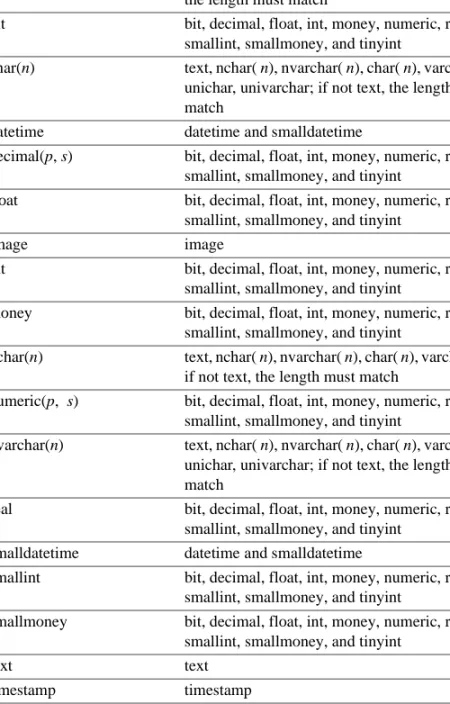
• For remote server objects (other than RPCs), column attributes found for the table or view are compared with those defined in the column_list. Column names must match identically (although case is ignored), column types and lengths must match, or at least be convertible, and the NULL attributes of the columns must match.
• Index information from the host data file or remote server table is extracted and used to create rows for the system table sysindexes. This defines indexes and keys in server terms and enables the query optimizer to consider any indexes that may exist on this table.
• The on segment_name clause is processed locally and is not passed to a remote server.
After successfully defining an existing table, issue an update statistics command for the table.This allows the query optimizer to make intelligent choices regarding index selection and join order.
Datatype Conversions
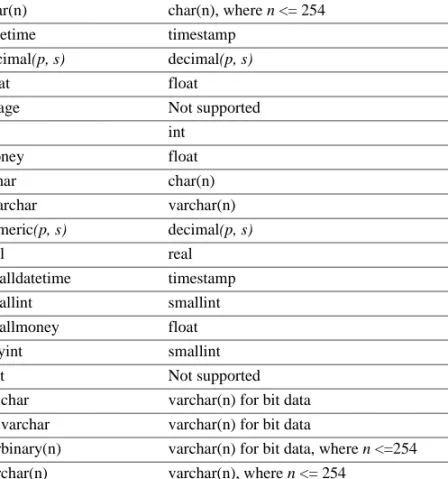
When you use the create table or create existing table commands, you must specify all datatypes, using recognized Adaptive Server datatypes. If the remote server tables reside on a class of server that is heterogeneous, the datatypes of the remote table are converted into the specified Adaptive Server types automatically when the data is retrieved. If the conversion cannot be made, the create table or create existing table commands do not allow the table to be created or defined.
Example of Remote Table Definition
The following example illustrates the steps necessary to define the remote Adaptive Server table, authors, starting with the server definition: 1 Define a server named SYBASE. Its server class is sql_server, and its
name in the interfaces file is SYBASE:
exec sp_addserver SYBASE, sql_server, SYBASE
2 Define a remote login alias. This step is optional. User “sa” is known to remote server SYBASE as user “sa,” password “timothy”:
exec sp_addexternlogin SYBASE, sa, sa, timothy 3 Define the remote authors table:
create existing table authors (
au_id id not null,
au_lname varchar(40) not null, au_fname varchar(20) not null,
phone char(12) not null,
address varchar(40) null,
Proxy tables
Using the create proxy_table command
create proxy_table is a variant of the create existing table command. Use create proxy_table to create a proxy table, but (unlike create existing table) you do not specify a column list. CIS derives the column list from the metadata it obtains from the remote table.
The create proxy_table command creates proxy tables which automatically inherit all the columns, column names and datatypes of the external table using the following syntax:
create proxy_table table_name [ external type ] at pathname
create proxy table allows external object type table, file and directory.The location information provided by the at keyword specifies the pathname to the remote object.
External type can be one of the following:
• external table specifies that the object is a remote table or view. external table is the default, so this clause is optional.
• external directory specifies that the object is a directory with a path similar to the following: “/tmp/directory_name [;R]”. The option “R” indicates recursive
• external file specifies that the object is a file with a path similar to: “/tmp/filename”
Remote Procedures as proxy tables
An optional clause may be added to the create existing table statement to indicate the remote object is actually a stored (or other) procedure instead of a table. Without this clause, the remote object is assumed to be a table or view:
create existing table t1 (
column_1int, column_2int )
EXTERNAL PROCEDURE AT "SERVER_A.mydb.dbo.p1" In the case where the remote object is type procedure, several processing differences occur:
• A column list must be provided which matches the description of the remote procedure’s result set. This column list is the responsibility of the user, and no verification of its accuracy is provided.
• Column names beginning with underscore (‘_’) can be used to specify parameters, which are not part of the remote procedure’s result set. These columns are referred to as parameter columns. For example:
create existing table rpc1 ( a int, b int, c int, _p1 int null, _p2 int null ) external procedure at “SYBASE.sybsystemprocs.dbo.myproc” select a, b, c from t1 where _p1 = 10 and _p2 = 20
• In this example, the parameter columns _p1 and _p2 are not expected in the result set, but can be referenced in the query. CIS passes the search arguments to the remote procedure via parameters, using the names @p1 and @p2.
• If a parameter column is included in the select list, its value is equivalent to the values specified for it in the where clause, if it was passed to the remote procedure as a parameter. If the parameter column did not appear in the where clause, or was not able to be passed to the remote procedure as a parameter, but was included in the select list, its value would be NULL.
• A parameter column can be passed to the remote procedure as a parameter if it is what the Adaptive Server Enterprise query processor considers to
Proxy tables
Allowing the definition of remote procedures as local tables gives CIS the ability to treat the result set of a remote procedure as a ‘virtual table,’ which can be sorted, joined with other tables, or inserted into another table via insert/select syntax. However, tables of this type are considered read only:
• You cannot issue a delete, update or insert command against a table of type procedure;
• You cannot issue a create index, truncate table or alter table command against tables of this type.
Component Integration Services users can map remote or external objects of the type rpc to local proxy tables. If a table is created in this way, it can be referenced only by the select and drop commands. The commands insert, delete, and update generate error messages, since the table is assumed to be read-only. Proxy definitions should only be created for procedures which return data.
If an object of the type rpc has been defined within the server, a query is not issued to the remote server on which the object resides. Instead, the server issues an RPC and treats the results from the RPC as a read-only table. Examples create existing table rtable
(col1 int, col2 datetime, col3 varchar(30) )
external procedure at “RMTSERVER...myproc “ select * from rtable
When this query is issued, the server sends the RPC named myproc to server RMTSERVER. Row results are treated like the results from any other table; they can be sorted, joined with other tables, grouped, inserted into another table, and so forth.
RPC parameters should represent arguments that restrict the result set. If the RPC is issued without parameters, the entire result set of the object is returned. If the RPC is issued with parameters, each parameter further limits the result set. For example, the following query:
select * from rtable where col1 = 10
results in a single parameter, named @col1, that is sent along with the RPC. Its value is 10.
Component Integration Services attempts to pass as many of the search arguments as possible to the remote server, but depending on the SQL statement being executed, Component Integration Services might perform the result set calculation itself. Each parameter represents a search for an exact match, for example, the = operator.
The following are rules which define the parameters sent to the RPC. If an RPC is used as a Component Integration Services object, these rules should be kept in mind during development.
• Component Integration Services sends = operators in the where clause as parameters. For example, the query:
select * from rpc1 where a = 3 and b = 2 results in Component Integration Services sending two parameters. Parameter a has a value of 3 and parameter b has a value of 2. The RPC is expected to return only result rows in which column a has a value of 3 and column b has a value of 2.
• Component Integration Services does not send any parameters for a where clause, or portion of a where clause, if there is not an exact search condition. For example:
select * from rpc1 where a = 3 or b = 2
Component Integration Services does not send parameters for a or b because of the or clause.
Another example:
select * from rpc1 where a = 2 and b < 3
Component Integration Services does not send parameters because there is nothing in the where clause representing an exact search condition. Component Integration Services performs the result set calculation
Proxy tables
New server limits
Limits on length of char, varchar, binary and varbinary datatypes - In version 12.5 as in prior releases of Adaptive Server Enterprise, a row cannot span page boundaries, therefore column size has been limited by row size. However, in version 12.5 of Adaptive Server Enterprise, configuration allows page sizes of 2K, 4K, 8K or 16K bytes. Also, the arbitrary limit of 255 bytes for char/binary columns has been removed. The version 12.5 supports extended sizes of char, varchar, binary and varbinary data types. The new limit depends on the page size of the server. For various page sizes, the new limits are as follows:
Table 2-1: New Limits
Note that these sizes are still approximate. The basic rule specifies that the limit is the maximum size that still allows a single row to fit on a page. These limits also vary depending on the locking scheme specified when the table is created. It is assumed that the bulk of proxy tables are created with the default locking scheme, which is all page locking.
• Limits on length of Transact-SQL variables and parameters - the size of char, varchar, binary and varbinary variables are extended to equal the maximum size of columns of the same datatype for a given server. This allows variables to be passed to stored procedures (or RPCs) whose length exceeds the current limit of 255 bytes.
• Limits on number of columns per table- the old limit of 250 are removed, and up to 1024 columns per table are allowed, as long as the columns can still fit on a page. Note that there is a limit of 254 variable length columns (null columns are also considered variable length).
• Limits on the width of an index - the total width of an index within Adaptive Server Enterprise can be larger than in prior releases, depending on server page size. In the following table, maximum index width is shown according to pagesize:
Table 2-2: Maximum Index Width
Pagesize Max. Column Size
2048 2048
4096 4096
8192 8192
16384 16384
Pagesize Index Width
2048 600
• Limits on the number of columns per index - the current limit of 31 columns per index are unchanged in version 12.5.
What these changes mean to CIS and remote servers CIS connects to is described in the following sections.
Remote server capabilities
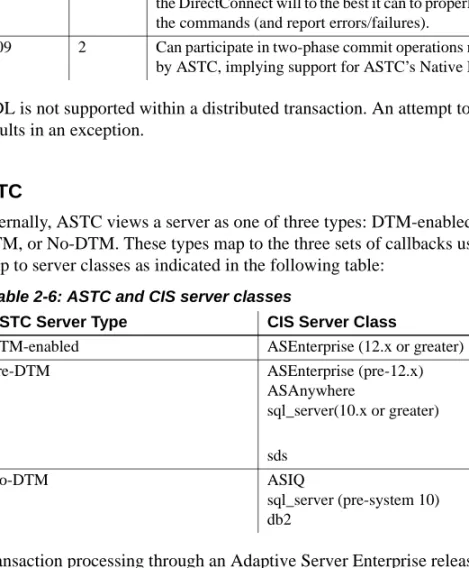
When communicating with a remote server, CIS needs to know the maximum length of a char/varchar column that can be supported by the DBMS. For connections to servers in classes ASEnterprise, ASAnywhere, ASIQ, sql_server and db2, the maximum size is determined based on known attributes of these servers (according to version).
For servers in class direct_connect and sds, this information is provided by an addition to the result set returned by the sp_capabilities RPC. A new capability is specified to allow the Direct Connect to indicate the maximum length of columns supported by the DBMS for which the Direct Connect is configured.
Additionally, it is necessary for the Direct Connect to know about the maximum length of char columns that can be supported by CIS. For this reason, changes to the existing RPC sp_thread_props are required:
sp_thread_props "maximum ASE column length", n
This RPC is sent to a Direct Connect after CIS has established a connection for the first time. The value of n is an integer indicating the maximum column size, in bytes, allowed by ASE/CIS.
8192 2600
16384 5300
Proxy tables
create existing proxy table
The create existing table command also allows columns to be specified with a length of greater than 255 bytes. This allows CIS to treat columns in remote databases as char, varchar, binary or varbinary that previously had to be treated as text or image columns.
There is still an opportunity for column size mismatch errors. For example, in the case where the remote database contains a table with a column length of 5000 bytes, and the Adaptive Server Enterprise processing the create existing table command only supports columns up to 1900 bytes, a size mismatch error would occur. In this case, it is necessary to re-specify the column as a text or image column.
In the case where the proxy table column size exceeds that of the corresponding column in the remote table, a size mismatch error is detected and the command is aborted.
create proxy_table
The create proxy_table command imports metadata from a remote server and converts column information into an internal create existing table command, with a column list derived from the imported metadata. When obtaining the column metadata, conversion from the remote DBMS type to internal Adaptive Server Enterprise types is required.
If the size of remote columns (char, varchar, binary or varbinary datatypes) exceeds 255 bytes but is still less than or equal to the maximum Adaptive Server Enterprise column size, then equivalent Adaptive Server Enterprise datatypes are used for the proxy table. However, if the size of a remote column exceeds the column size supported by Adaptive Server Enterprise, then CIS converts the corresponding proxy table column to text or image (as is the case with the current in-market implementation).
alter proxy table
If this command operates on a proxy table, it is first processed locally, then forwarded to the remote server for execution. If the remote execution fails, the local changes are backed out and the command is aborted.
The remote server must process the command appropriately, or raise an error. If an error is produced, the CIS side of the command is aborted and rolled back.
select, insert, delete, update
CIS handles large column values when proxy tables are involved in DML operations. CIS handles DML using one of several strategies:
• TDS Language commands - if the entire SQL statement can be forwarded to a remote server, then CIS does so using TDS Language commands generated by Ct-Library - ct_command (CS_LANG_CMD).
The text of the language buffer may contain data for long char or binary values that exceeds 255 bytes, and remote servers must handle parsing of these command buffers.
• TDS Dynamic commands - if CIS cannot forward the entire SQL statement to a remote server (i.e. CIS is forced to provide functional compensation for the statement), then an insert, update or delete may be handled by using TDS Dynamic commands, with parameters as needed, using the Ct-Library function ct_dynamic (CS_PREPARE_CMD, CS_EXECUTE_CMD, CS_DEALLOC_CMD).
The parameters for the dynamic command may be CS_LONGCHAR_TYPE or CS_LONGBINARY_TYPE.
• TDS Cursor commands - Ct-Library cursor operations can be used to handle proxy table operations for select, update and delete if functional compensation has to be performed. For example, if updating a proxy table and there are multiple tables in the from clause, CIS may have to fetch rows from multiple data sources, and for each qualifying row, apply the update to the target table. In this case, CIS uses ct_cursor
({CS_DECLARE_CMD, CS_OPEN_CMD,
CS_CURSOR_UPDATE_CMD, CS_CLOSE_CMD, CS_DEALLOC_CMD}).
After a cursor is prepared, parameters are specified. These parameters may now include those of type CS_LONGCHAR or CS_LONGBINARY.
Proxy tables
RPC handling
RPCs sent to remote servers can contain parameters of types CS_LONGCHAR and CS_LONGBINARY. The CIS command cis_rpc_handling supports these new types.
Note that sending long parameters to pre-12.5 servers is not allowed, as prior versions of Adaptive Server Enterprise do not support CS_LONGCHAR or CS_LONGBINARY data. CIS examines TDS capabilities for the remote server prior to sending the RPC, and if the remote server cannot accept these datatypes, an error results.
Cascading proxy tables
Issues have arisen surrounding attempts to have a proxy table in one instance of CIS reference a proxy table in another instance. Version 12.5 addresses those issues, allowing cascading proxy table configurations between any number of instances of CIS.
There are obviously conditions where this can cause problems, such as circular references, or transactions in which the second proxy table references a local table on the same server as the first proxy table. In this case, application deadlocks can result that will not be detected by CIS. Configuring systems to avoid these potential pitfalls is left to the customer.
Proxy databases
There are two types of proxy databases: user and system proxy databases. This section describes the behavior of each.
User proxy databases
When a user proxy database is created, metadata for the proxy tables is imported automatically from the remote location which contains the actual tables. This metadata is then used to create proxy tables within the proxy database.
Proxy database creation is done through syntax which extends the create database command:
create database <dbname> [create database options]
[with default_location = ’pathname’] [for proxy_update]]
The use of the clause with default_location allows the database creator to specify the storage location of any new tables, and the location from which metadata may be imported for automatic proxy table creation if the for proxy_update clause is also specified. The for proxy_update clause establishes the database as a proxy database; the with default_location clause defines the location from which proxy tables are imported. Without the for proxy_update clause, the behavior of the with default_location clause is the same as that provided by the stored procedure sp_defaultloc - a default storage location is established for new and existing table creation, but automatic import of proxy table definitions is not done during the processing of the create database command.
Proxy databases
• owner - may be omitted. The name of the owner of objects to be referenced by proxy tables. This may be restrictive, so that if more than one user owns objects in dbname, specifying the owner will select only those objects owned by that user. Proxy tables must not be created for objects owned by other users.
If for proxy_update is specified with no default_location, an error is reported. When a proxy database is created (using the for proxy_update option), CIS functions are called upon to:
• Provide an estimate of the database size required to contain all proxy tables representing the actual tables/views found in the primary server’s database. This estimate is provided in terms of the number of database pages needed to contain all proxy tables and indexes. This size is used if no size is specified, and no database devices are specified.
Note: if the database is created with specific size specifications [on device_name = nn], or if a device name is specified with no size [on device_name], then the size requirements for the proxy database are not estimated; it is assumed in this case that the user or dba wants to override the default size calculated for the proxy database.
If you are importing metadata from another Adaptive Server, remote database users are imported before proxy tables are created. Each imported database user must have a corresponding system user name in syslogins.
• Create all proxy tables representing the actual tables/views found in the companion server’s database. Proxy tables are not created for system tables.
Note: Before the proxy tables are created, the quoted identifier state is turned on, and each table is created with quotes surrounding the table name and column name. This allows the creation of tables containing names that may be Sybase Transact-SQL reserved words. When all proxy tables are created, the quoted identifier state is restored to its original setting.
• grant all permissions on proxy tables to PUBLIC • add the GUEST user to the proxy database
• import database users from remote site (if Adaptive Server Enterprise) • grant create table permission to PUBLIC
• The database status is set to indicate that this database is a user proxy database. This is done by setting a status field in
master.dbo.sysdatabases.status3 (0x0001, DBT3_USER_PROXYDB). After the database has been created, it contains a proxy table for each table or view found in the default_location. Then the behavior for a user proxy database, is identical to prior database behavior. Users can create additional objects, such as procedure, views, rules, defaults, etc., and both DDL and DML statements that operate on proxy tables behave as documented in the
Component Integration Services User’s Guide.
The only exception to this is the alter database command. New syntax and capabilities of this command are described in the next section.
User Proxy Database Schema Synchronization
At times, it may be necessary for a DBA to force re-synchronization of the proxy tables contained within the proxy database. This can be done through the alter database command:
alter database <dbname> [alter database options] [for proxy_update]
If the for proxy_update clause is entered with no other options, the size of the database will not be extended; instead, the proxy tables, if any, are dropped from the proxy database and re-created from the metadata obtained from the pathname specified during create database ... with default_location = ’pathname’
If this command is used with other options to extend the size of the database, the proxy table synchronization is performed after the size extensions are made.
easy-Proxy databases
• Modification to the default location specified with the create database command is not allowed using alter database.
• Local tables cannot be created in the proxy database. create table commands result in the creation of proxy tables, and the actual table is created at the default location.
• The default location of the table may be specified in the create table command, using the at ’pathname’ syntax. If the pathname differs from the default location, then the alter database command will not
synchronize the metadata for this table.
• In order to change the default location, it is necessary to first drop the database then re-create it with a new pathname specified in the with default_location = ’pathname’ clause. If the location is changed using sp_defaultloc, then the new location is used to provide metadata synchronization, and proxy tables that were created with the prior location not be synchronized, and in fact may be dropped and replaced if the name conflicts with that of tables at the new location.
System proxy databases
System proxy databases are provided which behave like user proxy databases, with some notable enhancements and exceptions. These differences are described in this section. System proxy databases are only used in an HA configuration.
The purpose of providing system proxy databases is to allow customer-written applications to run on either node in a high-availability cluster. This does not imply ’single-system image’ capability; rather, it suggests an environment in which most user-written applications will be able to execute on either node in the cluster. This means that both databases and user-created objects should be visible to both nodes. To facilitate this capability, the notion of a system proxy database was introduced in version 12.0 of Adaptive Server Enterprise. A system proxy database has the same name as the database in the primary node which it references, and contains handling for the user-defined objects that are necessary to support the application: Proxy tables are created for each user table and view found in the primary database, and stored procedures are converted to RPCs and forwarded to the node referenced by the proxy database.
System proxy database creation
A system proxy database is created automatically under the following circumstances:
• The HA cluster is being configured through the use of the stored procedure sp_companion ServerName, ’configure’, with_proxydb
In this case, a system proxy database is created for each user database found in server indicated by ServerName.
• A create database command is issued in a server whose HA state is one of MODE_APNC, MODE_SNC or MODE_ASNC.
When the creation of the system proxy database is complete, CIS functions will then be called upon to:
• grant create table to public - this will allow table creation on the primary server to result in proxy table creation in the system proxy database.
Schema synchronization when current database has a system proxy database
In an HA cluster, some of the changes to a primary server’s database need to be forwarded to the companion server, in order to keep both serverssynchronized.
Several DDL commands, when executed within a database that has a system proxy database, will cause notification of the companion server and result in automatic synchronization of the resulting changes:
• create table and drop table - local operation executes, resulting in the local table being created or dropped. The command is then forwarded to the companion server, for execution in the system proxy database, so that a proxy table can be created or dropped
Proxy databases
• create table and drop table - local proxy table is created or dropped. The command is then forwarded to the primary server, so that a local table referenced by the proxy table can be created or dropped.
• create index and drop index - local operation on the proxy table executes, resulting in an index being created or dropped. The server owning the primary database is then notified, and an index is either created or dropped on the local table referenced by the proxy table
• create view and drop view - not allowed within a system proxy database. Error 12818 is produced (see below).
Stored procedure execution within a system proxy database
If a stored procedure request is encountered when the current database is a system proxy database, the stored procedure request is automatically converted to an RPC and sent to the server referenced by the system proxy’s default location.
Additional behavior of the system proxy database
Certain commands, when executed within a system proxy database, will be rejected with an error:
• create procedure and drop procedure • create view and drop view
• create trigger and drop trigger • create rule and drop rule • create default and drop default
The error generated in these cases is: Msg 12818, Severity 16: Cannot create an object of this type in system-created proxy database
DDL commands behavior affected by proxy databases
Some commands will be affected by the implementation of proxy databases, others will not. This section contains a list of DDL commands which are affected by system proxy databases.
• dump database - • dump transaction -
• load database - • load transaction - • create table - • create view - • create index - • create database - • drop table - • drop view - • drop index - • drop database -
All other DDL commands remain unaffected by the existence of system proxy databases.
File system access
File system access
Version 12.5 provides access to the file system through the SQL language. With file system access, you can create proxy tables that are mapped to file system directories, or to individual files.
These features are bundled as an option and must be purchased separately.
Directory access
A new class of proxy tables is allowed in version 12.5 that enables SQL access to file system directories and their underlying files. In order to create proxy tables mapped to directories or files, you must have “System Administrator” or “System Security Officer” privileges. The supported syntax is:
create proxy_table <table_name>
external directory at "directory pathname[;R]"
The directory pathname must reference a file system directory visible to and searchable by the Adaptive Server Enterprise process. A proxy table is created which maps column names to attributes of files that exist within the directory. If the ’;R’ (indicating "recursion") extension is added to the end of pathname, CIS includes entries in all subordinate directories. The following table contains a description of the proxy table columns that are created when this command successfully completes:
Table 2-3: Proxy table columns Column
Name Datatype Description
id numeric(24) Identity value consisting of values from st_dev and st_ino (See stat(2)). These two values are converted first to a single string (format: "%d%014ld"), and the string is then converted to a numeric value.
filename varchar(n) The name of the file within the directory specified in at ’pathname’, or within directories subordinate to pathname. While the length of pathname is limited to 255 bytes, the total length (n) of filename is system dependent, and specified by the definition of MAXNAMLEN. For Solaris systems, this value is 512 bytes; for most other systems this will be 255 bytes.
A proxy table that maps to a file system directory can support the following SQL commands:
• select - File attributes and content can be obtained from the proxy table
size int For regular files - specifies the number of bytes in the file. For directories - block special or character special, this is not defined.
filetype varchar(4) the file type - legal values are: FIFO, for pipe files; DIR for directories; CHRS for character special files; BLKS for block special files; REG for ordinary files; UNKN for all other file types. Links are automatically expanded, and will not appear as a separate file type.
access char(10) access permissions, presented in a more or less ’standard’ Unix format: "drwxrwxrwx" uid varchar(n) The name of the file owner. The value of n is
specified by the system definition L_cuserid, which is 9 on all systems except Compaq Tru64, where it is 64. This value is 0 on NT systems. gid varchar(n) The name of the owning group. The value of n
is specified by the system definition L_cuserid, which is 9 on all systems except Compaq Tru64, where it is 64. This value is 0 on NT systems. atime datetime Date/time file data was last accessed mtime datetime Date/time when file was last modified ctime datetime Date/time when file status was last changed content image The actual physical content of the file (for
regular files only). NULL if the file is not a regular file.
Column
File system access
• readtext - the contents of a file may be retrieved using the readtext command;
• writetext - the contents of a file may be modified using the writetext command;
No other SQL commands will operate on tables of this type.
Regular file content is available only if the Adaptive Server Enterprise process has sufficient privileges to access and read the file, and if the file type indicates an ’ordinary file.’ In all other cases, the content column will be null. For example:
select filename, size, content from directory_table where filename like ‘%.html’
returns the name, size and content of regular files with a suffix of ’.html’, if the Adaptive Server Enterprise process has access privileges to the file. Otherwise, the content column will be NULL.
The create proxy_table command fails if the pathname referenced by directory pathname is not a directory, or is not searchable by the Adaptive Server Enterprise process.
If traceflag 11206 is turned ON, then messages are written to the errorlog that contain information about the contents of the directories and the query processing steps needed to obtain that information.
Recursion through subordinate directories
If the "pathname" specified in the create proxy_table statement contains the ;R extension, CIS traverses all directories subordinate to pathname, returning information for the contents of each subordinate directory. When this is done, the filename returned by a query contains the complete name of the file relative to the pathname. In other words, all subordinate directory names appear in the filename. For example, if pathname specifies "/work;R":
create proxy_table d1 external directory at "/work;R" select filename, filetype from d1
returns values for files in subordinate directories as follows: Table 2-4: Values for files
Filename Filetype
dir1 DIR
File access
Another new class of proxy tables are allowed in version 12.5 that enables SQL access to individual files within a file system. The supported syntax is:
create proxy_table <table_name>
external file at " pathname" [column delimiter “<string>”]
When this command is used, a proxy table with one column (named ’record’, type varchar(255)) will be created. It is assumed in this case that the contents of the file are readable characters, and individual records within the file are separated by the newline (\n) character.
It is also possible to specify your own column names and datatypes, using the create [existing] table command:
create existing table fname ( column1 int null, column2 datetime null, column3 varchar(1024) null etc. etc.
) external file at "pathname" [column delimiter “<string>”]
Columns may be any datatype except text, image, or a Java ADT. The use of the existing keyword is optional, and has no effect on the processing of the statement. In all cases (create table, create existing table, create
proxy_table), if the file referenced by pathname does not exist, it is created. If it does exist, its contents are not overwritten. There is no difference in behavior
dir1/file2.c REG
dir2 DIR
dir2/file1.c REG
File system access
4 Records within the file are delimited by a newline character; 5 The maximum supported record size is 32767 bytes;
6 Individual columns, except for the last one, are delimited by the column delimiter string, which can be up to 16 bytes long; the default is a single tab character;
7 There is a correspondence between delimited values within each record of the file and the columns within the proxy table.
With proxy tables mapped to files, it is possible to:
1 Back-up database tables to the file system using either select/into or insert/select. When an insert statement is processed, each column is converted to characters in the default character set of the server. The results of the conversion are buffered, and all columns (except for the last) are delimited by a single tab. The last column is terminated by a newline. The buffer is then written to the file, representing a single row of data. 2 Provide a SQL alternative to using bcp in and bcp out. The use of a
select/into statement can easily back-up a table to a file, or copy a file’s contents into a table.
3 Query file content with the select statement, qualifying rows as needed with search arguments or functions. For example, it is possible to read the individual records within the Adaptive Server Enterprise errorlog file:
create proxy_table errorlog
external file at "/usr/sybase/ase12_5/install/errorlog" select record from errorlog where record like "%server%"
The query will return all rows from the file that match the like pattern. If the rows are longer than 255 bytes, they will be truncated. It is possible to specify longer rows:
create existing table errorlog (
record varchar(512) null )
external file at "/usr/Sybase/ase12_5/install/errorlog"
In this case, records up to 512 bytes in length will be returned. Again, since the proxy table contains only one column, the actual length of each column will be determined by the presence of a newline character.
Only the select, insert data access statements are supported for file access. update and delete will result in errors if the file proxy is the target of these commands.
When inserting values into a file, all datatypes are first converted to char values and then delimited by the column delimiter.
Important: truncate table sets the file size to 0.
Traceflag 11206 is also used to log message to the errorlog. These messages contain information about the stages of query processing that are involved with file access.
Security considerations
Only Adaptive Server Enterprise users with System Administrator (sa) or System Security Officer (sso) roles are allowed to create proxy tables that are mapped to files or directories. This requirement addresses the concerns over the security aspects of accessing file system data from within the Adaptive Server Enterprise server process (which may have root permission as it runs).
ANSI joins
ANSI joins are fully supported for remote data access. If a query cannot be translated, CIS will compensate functionally. The following rules apply to ANSI joins with remote data:
When the remote server supports only ANSI joins
All queries containing outer joins are converted to ANSI joins.