Publication Series of the University of Art and Design Helsinki A 98 www.taik.fi/bookshop
© Mariana Salgado
Graphic Design: Arja Karhumaa
ISBN 978-951-558-308-6 (book) ISBN 978-951-558-309-3 (pdf) ISSN 0782-1832
Gummerus Printing
Printed in Jyväskylä, Finland 2009
Designing
for an
Open
Museum
Mariana Salgado
An Exploration of Content Creation and Sharing through Interactive Pieces
4 5
This thesis describes how an interaction design approach is used to encourage museum community involvement in exhibitions. My hypothesis is that by making the commu-nity a part of exhibitions it is possible to broaden and update the perspectives and the discussion on what is exhibited, making content more accessible to a range of visitors and providing more opportunities for learning and engagement. The personal and crea-tive way that people relate to exhibited material makes the contribution of the mu-seum community valuable. Interaction designers have the possibility to plan from the beginning the way that the museum community could create content.
In order to work on these hypotheses, the main topics for my research are how to create design that encourages community participation in the museum and what to ex-pect from such participation. To tackle this issue, I created and participated in projects that attempted to encourage people to comment on an exhibition, whether in online or onsite formats through interactive pieces. Most of the material that this thesis deals with is firsthand, collected during exhibitions in different museums in Helsinki, Finland. The cases are Sound Trace (Äänijälki) in the Ateneum Museum in 2005, Conversational Map (Keskustelukartta) in Kunsthalle in 2006, and The Secret Life of Objects (Esineiden salatut elämät) in the Design Museum in 2008. The three cases are tightly bonded to my research; each case pointed me in new directions and posed questions that affected the design of the next case.
In parallel to the development of the projects I looked into the Museum Informatics field and Museum studies, participating in forums around these issues. Both Museum studies and Museum informatics have provided me with an understanding of the problematic from the museum point of view, which I link in this thesis with questions relevant to interaction designers.
My personal work as a design-researcher allowed me to examine the opportunities and constraints faced by interaction designers working as external collaborators at
mu-seums. Part of this study delves deeply into how this content becomes valuable to staff and visitors and how it reflects people’s experience of the exhibition.
In these case studies, I have designed interactive pieces and mechanisms geared to-wards involving the visitors, the staff and the designers or artists in the museum so that they create content that is later displayed in the museums. Participatory design approaches influenced the design of these pieces and facilitated the recognition of in-formal museum practices (sharing thoughts, feelings, jokes and questions) as well as more institutional practices (workshops, guided tours, and publications).
When examining the data, I adopted the concept of “ecology of participation” which allowed me to map the complexity of the design arena, thus making visible possibilities for intervention to interaction designers. The ecology-of-participation concept binds the interactive piece, the people, and the practices with the places. My hypothesis is that by examining the ecology of participation it is possible to support and make use of existing practices, places and different actors in the museum. This thesis emphasises that the quality of the contributions depends on the inclusion and connections within the different components of the ecology.
Finally, I offer recommendations on engaging the community in technically mediated exhibitions. These recommendations are intended to support the museum community as well as interaction designers by offering insight into involvement as a part of the whole museum experience. The recommendations for the museum are to listen to and trust the community by promoting community-created content, forming alliances with external partners, such as universities, for long-term collaborations, and taking risks. Designers involved in digital design projects in museums can work towards integrat-ing the groups in the ecology and nurturintegrat-ing content material. By dointegrat-ing so, designers perform different roles, including that of a facilitator or a gardener that is a key actor in the design of an open museum.
1. Introduction 12
1.1. Framing the Research Contribution 13
1.2 Establishing the Research Questions 15
1.3 Telling the Story of this Research 16
1.4 Presenting the Methods 18
1.4.1 Design Research Framework 19
1.4.2 Human-Centred Design 20
1.4.3 Accountabilities 21
1.5 Introducing the Chapters 22
2. Key Research Elements 24
2.1 Case Studies 25
2.2 Sound Trace (Äänijälki) 29
2.2.1 Goals 29
2.2.2 Accomplishments 31
2.2.3 Opportunity Knocks 31
2.3 Conversational Map (Keskustelukartta) 34
2.3.1 Goals 34
2.3.2 Accomplishments 36
2.3.3 Opportunity Knocks 37
2.4 The Secret Life of Objects (Esineiden Salatut Elämät) 38
2.4.1 Goals 39
2.4.2 Accomplishments 39
2.4.3 Opportunity Knocks 47
2.5 Understanding the Context, the Content and the Tools 49
2.5.1 Museums and Exhibition Venues 49
2.5.2 Community-Created Content 52
2.5.3 Technology 55
3 . The Concept of Ecology of Participation 60
3.1 Digging into Ecologies 61
3.1.1 Assemblies and Participative Platforms 62
3.1.2 Information Ecologies 63
3.1.3 Cultural Ecologies 63
3.1.4 Museums as Ecology 64
3.1.5 Product Ecology 65
3.1.6 Ecologies of Artefacts 65
3.2 Defining Ecology of Participation 66
3.2.1 Definition 67
3.2.2 Implementing the concept 70
3.2.3 Characteristics of the Ecology of Participation 72
3.3 Design Dimensions 73
3.3.1 Theme 74
3.3.2 Novelty 75
3.3.3 Presence 75
3.4 Participation and Involvement 78
3.4.1 This participation 82
4. Analysis of Community-Created Content 84
4.1 Presenting Community-Created Content in the
Light of the Hypotheses 85
4.2 New Vocabulary, New Aspects and New Resources
for Old and New Audiences 87
4.2.1 Vocabulary 89
4.2.2 Creative, Emotional and Personal Aspects 90
4.2.3 Multimedia resources 93
4.3. Engagement over a Period of Time 94
4.4. Learning by Doing and from Peers 95
4.5. Validation of Multiple Perspectives 98
4.5.1. Criteria for Selection 102
4.5.2 Validation 105
4.6. Dialogue and Exchange 106
4.6.1 Invitations 106
4.6.2 Authorship 110
4.6.3 Attitudes towards Audience Participation 111 4.6.4 Involvement within the Museum Community 115
5. Conclusions 118
5.1 Summary of the Contribution and Limitation of this Thesis 119
5.1.1 Sustainability Issues 120
5.1.2 Limitations 121
5.2 Recommendations to Museums 122
5.2.1 United We Stand, Divided We Fall 123 5.2.2 Promoting and Guiding Community-Created Content 124 5.2.3 Listen to and Trust the Community 125
5.2.4 Stick Your Neck Out 128
5.3 Design Sensitivities 128
5.3.1 Re-defining the Designer’s Role 129
5.3.2 In Constant Dialogue with the Community 130
5.3.3 Shaping Content Material 131
5.4 Broadening the Scope of the Contribution 132
5.5 Projections for the Future 133
5.6 Linking the Essay and the Articles 134
Group one 135 Group two 136 References 138 List of Figures 153 Compilation of Articles 155 Article 1: (A.1) 156
Salgado, M., & Kellokoski, A. (2005). Äänijälki: Opening dialogues for visually impaired inclusion in museums. In L. Ciolfi, M. Cooke, T. Hall, L. J. Bannon & S. Oliva. (Eds.) Proceedings of the International Workshop Re-Thinking Technology in Museums: Towards a new Understanding of the People’s Experience in Museums (pp.10-17). Limerick: Interaction Design Center. University of Limerick.
Article 2: (A.2) 166
Salgado M., & Díaz-Kommonen L. (2006). Visitors’ voices. In J. Trant and D. Bearman (Eds.). Proceedings of the Museums and the Web 2006. Toronto: Archives & Museum Informatics. Retrieved on May 19, 2009, from http://www.archimuse.com/mw2006/papers/salgado/salgado.html
Article 3: (A.3) 178
Salgado, M., Savolainen, J., Svinhufvud, L., Botero, A., Krafft, M., Kapanen, H., et al. (2008). Co-Designing participatory practices around a design museum exhibition. Proceedings of the 6th International Conference of Design History and Design Studies. Another Name for Design, Words of Creation (ICDHS 2008)(pp. 106-109). Osaka: Osaka University.
Article 4: (A.4) 185
Salgado, M. (2008). The Aesthetic of Participative Design Pieces: Two Case Studies in Museums. International Journal of the Inclusive Museum, 1(1), 105-110.
Article 5: (A.5) 196
Salgado, M., Saad-Sulonen, J. & Diaz, L. (2009). Using On-line Maps for Community-Generated Content in the Museums. In J. Trant & D. Bearman (Eds.). Proceedings of the Museums and the Web 2009. Toronto: Archives & Museum Informatics. Retrieved on May 19, 2009, from http://www.archimuse. com/mw2009/papers/salgado/salgado.html
Article 6: (A.6) 212
Salgado, M., Jauhiainen, T. & Diaz, L. (2009). Re-thinking an Annotation Tool for the Museum Community Generated Content. In Nordic Design Research conference (Nordes). Oslo, Norway: Nordic Design Research. Retrieved on October 21 , 2009, from http://ocs.sfu.ca/ nordes/index.php/nordes/2009/paper/view/207
10 11 Many people have helped me in creating this dissertation; I owe all of you
the most sincere and thankful credit. First of all I have a particular debt of gratitude to my supervisor Lily Díaz who from the beginning of my doctoral studies in Media Lab offered guidance, insights and support. I learned very much from her and her positive spirit. She has always provided me confi-dence with respect to my work. Secondly, Luigina Ciolfi, my external super-visor, has patiently and rigorously read the first drafts and provided sharp comments to improve it. Her work was of great value. Thanks Lui!
I am grateful to Angelina Russo and Susanna Pettersson, the pre-eval-uators, who provided critical and precise comments on the manuscript. I made corrections and additions following their valuable advice. My appre-ciation also goes to Palmyre Pierroux who kindly accepted the invitation to be the opponent for the defense.
This work was possible because Media Lab, in the University of Art and Design Helsinki, granted me with a three-year research position. I enjoy working and studying in this research community, especially the possibil-ity to get to know so many wonderful people. To Kari-Hans Kommonen I owe my being in the Lab in the first place, since he invited me to do my master’s thesis as part of a research project. It was excellent to listen to his visionary ideas; he was always a source of inspiration. I can never thank Andrea Botero enough, my dear friend. She was always there when I was in need of a book, an idea, time for reviewing chunks of text or a good laugh. Her generosity and her hard criticism have been important companions during this work. Gracias! During this time I have also had the pleasure to collaborate and make friends with Anna Salmi and Joanna Saad-Sulonen, with whom we have grown together as researchers. Sharing the workspace with Petri Lankoski was great luck. He has always been ready to help and give sensible comments. Kiitos Petri! Thanks to Andrew Paterson whose conversation has always been a creative stimulation. I enjoyed working and having dialogues with many of my other colleagues: Tommi Jauhiainen, Olga Goryunova, Hans Poldoja, Antti Raike, Heli Rantavuo, Koray Tahiro-glu, Jürgen Scheible, Mari Tammisari, Pipsa Asiala and Juhani Tenhunen. There were many people who made me feel at home and accompanied me
in many lunches and good talks: Mika Tuomola, Markku Reunanen, Anne Naukarinen, Kati Hyyppää, Blanca Acuña, Tarmo Toikkanen, Timo Laine, Miska Knapek, Teemu Leino nen, Sanna Marttila, Phillip Dean and Pekka Salonen. Thanks to all of you!
I want to express my gratitude towards all the people that made this col-laboration in museums possible and enjoyable. This study relies on their time and efforts. Sound Trace: Erica Othman; Conversational Map: Saara Suojoki and Taru Tappola; and The Secret Life of Objects: Leena Svinhufvud, Hanna Kapanen, Elina Eerola, Mirjam Krafft, Jukka Savolainen, Matti Luhtala, Merja Vilhunen, Marianne Aav, Harri Kivilinna, Mikko Laitinen, Ilpo Kari, Atte Timonen and Vennu Nivalainen. My heartfelt thanks to all the participants in the workshops, especially to the teachers Rody Van Ge-mert, Outi-Maria Takkinen and Nana Smulovitz-Mulyana.
Maria Koskijoki, Silvia Filippini-Fantoni, Satu Miettinen, Saila Pou-tiainen and Outi Turpeinen have kindly listened to my wonderings and pro-vided me with interesting viewpoints. I would like also to thank my friend Michail Galanakis who contributed by reading the manuscript, offering ideas and encouragement. Another good friend that provide practical ad-vice throughout the process was Paula Bello. Gracias! While I am grateful for the contribution of these colleagues, to the strength of this dissertation, the weaknesses are only my responsibility.
Jane Brodie did the first English revision and Cindy Kohtala was kind enough to do the English checking adjusting to my tight schedule at the end of this process. Arja Karhumaa gave this work its beautiful visual style and Sanna Tyyri-Pohjonen designed the publication details. Anna Arsniva helped me with planning the defense.
I wish to also thank all my good friends, neighbours and my immediate family who have always provided fun and affection. I thank my kids Alma and Eliel for lighting up my life as I worked. Thanks to my mother for her loving support and for transmitting a bit of her passion towards work. Above all, I thank my husband Timo Rantalaiho for his endless patience and love during the many years that it has taken to complete this project. This work is dedicated to you!
12 Chapter 1. Introduction Chapter 1. Introduction 13 1 Note that these
networks did not start in 2009 but their sites are constantly being updated, and their copyright is from this year.
1.1.
Framing the Research Contribution
This thesis intends to investigate how new technology can support people’s engagement in exhibitions. It does so by presenting and analysing three case studies that I created and in which I participated as interaction designer.
I acknowledge that Interaction Design is the principal field of this study because I designed interactive pieces that were set in exhibition venues, and through them I propose and analyse participation within the museum-com-munity. Furthermore, my personal background as industrial designer and my working experience in interior design have profoundly influenced my viewpoints. As I was not familiar with the discussions in the museum field at the beginning of this endeavour, I looked into the Museum Informatics, participating in forums and conferences around these issues (International Cultural Heritage Informatics Meeting (ICHIM), 2007; Archive & Museums Informatics, 2009; Museum Computer Network, 2009; Museum 3.0 Net-work, 20091). To complete this enquiry I have reviewed a bibliography
re-lated to Museum Studies. Both Museum Informatics and Museum Studies and have provided me with an understanding of the problematic from the museum point of view, which I intend to link in this thesis with questions relevant to interaction designers.
The main researchers in Interaction Design cover many different points of view such as embodied interaction (Dourish, 2004); digital design (Löw-gren & Stolterman, 2007); user experience design (Buxton, 2007; Goodwin & Cooper, 2009); user centred (Preece, Rogers & Sharp, 2007) and user in-terface design (Cooper, Reimann & Cronin, 2007). From this group of re-searchers the most important authors are Löwgren and Stolterman, because they examine the roles of the interaction designers and the design processes and thus serve as fruitful material to my analysis. However, they have not focused specifically on the possibilities that museums and exhibition venues bring nor use them to make field studies.
Only a few interaction design studies concentrate on museums, but they deal with different issues such as ubiquitous computing (Ciolfi, Bannon & Fernström, 2007, Bowers, et al., 2007), tangible user interaction (Wakkary & Hatala, 2006; Wakkary & Hatala, 2007), social media (Russo, Watkins, Kelly & Chan, 2006; Watkins & Russo, 2005; Watkins, 2007); three-dimensional graphics (MacColl, Millard, Randell & Steed, 2002; Chalmers, 2004; Díaz, Reunanen & Salmi, 2009), game design (Cabrera, et al., 2005; Klopfer, Perry, Squire, Jan & Steinkuehler, 2005; Dini, Paterno & Santoro, 2007; Edwards & Schaller, 2007; Goodlander, 2009; Botturi, Inversini & Di Maria, 2009) and social interaction (Aoki & Grinter, 2002; Vom Lehn, Heath & Hindmarsh,
1
Introduction
Museums must communicat
e or die.
For communication t
o occur both
the sender and the r
eceiver of the
message must shar
e the same concep
ts,
even the same passions. The t
ask for
museums and galler
ies is to find ways
of arousing and ins
tilling passions
and ways of explor
ing ideas that
people will find illuminating, using
the collections of t
he museum, and t
he
curiosity and exper
ience of actual and
potential visitors (Hooper
-Greenhill,
14 Chapter 1. Introduction Chapter 1. Introduction 15 2 In Chapter 3,
Section 3.4.1, I define the specific participation to which I am refer-ring.
2001; Galani & Chalmers, 2002; Chalmers & Galani, 2004). My contribu-tion concerns understanding the possibilities of designing for participacontribu-tion using new media tools in museums and exhibition venues2. Therefore, for
the purpose of this research social media and social interaction issues were the most relevant.
Many people actively participate in creating information using new media tools. In an array of fields, changes are taking place, and content is being produced and published by new creators. Research and development of dig-ital media tools support collaborative endeavours in both closed and open groups. All these developments demonstrate that technology is currently ready to enable opportunities for participation in co-creating or co-author-ing information.
Hence, it is relevant to ask what is going on in the museum milieu: how are museums giving voice to the members of their community and how are people reacting to the possibility of creating and sharing content in muse-ums and exhibition venues? There are many strategies for answering these questions, as an exhibition entails distinct moments to include people.
Visitors can be part of the design process by collaborating from the very beginning of the exhibition and its concept (Taxen, 2004; Friess, 2008) or by providing the objects that make up the exhibition. On many occasions, mu-seums have invited communities to contribute before opening the exhibition to the general public. For example, the Victoria & Albert Museum in England held an exhibition named People’s Show(Bath & North East Somerset, 2003) in which a group of visually impaired individuals chose objects from within the museum’s collection to be exhibited and brought some of their own. Recently, in Finland, the Helinä Rautavaara Museum invited teenagers to contribute their own objects, music, and ideas to the exhibition Live Your Life
(Helinä Rautavaara Museo, 2008). At the London Science Museum, visitors have been invited to bring their own toys (Simon, 2007).
Another way for visitors to participate is by making content that is later used to make the exhibition. An example of this type of participation was the case in which The Portrait Gallery of Canada invited people to make a portrait and made a collection out of the visitors’ contributions (Libraries and Archives Canada, 2008). In the same line Void Gallery has organised the event “today you are an artist” in which an artist and the public made the content material for an exhibition (Derry Journal, 2009). In the specific cases analysed in this thesis, museum staff, visitors and external collabora-tors commented on an exhibition’s content both online and at the museum during the time that the exhibition was on show. The museum community-created content has the role of being the interpretative material that helps to connect the visitors with the exhibition content.
1.2
Establishing the Research Questions
Departing from a set of hypotheses about the advantages that community-created content could have in exhibitions I pose my research questions.
The hypotheses are explored by analysing the content gathered during the case studies in Chapter 4. The following is the list of hypotheses:
• Community-created content (CCC) could serve to make content more ac-cessible to new audiences. People’s vocabulary and their personal narrative could bring different voices in comparison with the well-established inform-ative tone of the interpretinform-ative material in museums and exhibition venues. Therefore, if people could leave their own comment related to the pieces in the exhibition, these comments gathered and shared through interactive pieces could serve to make content more accessible to new audiences. • CCC could extend people’s engagement with the exhibition material over
a period of time. These comments created by people during the time of the exhibition could extend their engagement with the exhibition material over a period of time. People could go home and think about the exhibi-tion. Thereafter, they could share these thoughts online with other future visitors, for example.
• CCC could support the learning that takes place in the exhibition by en-gaging people actively. The possibility to leave a mark, their comment on the exhibition material, gives people a responsibility as well as provides them with the challenge to articulate a meaningful message to others. • CCC, once displayed, could validate multiple perspectives and generate
dis-cussion from the exhibited material. Visitors perceive their own personal thoughts as valid opinions, while they gain similar consideration from oth-ers in the exhibition. In parallel, opening one’s opinions to the public brings an instance of self-exposure to others’ considerations of private thoughts. • CCC could open possibilities for dialogue and exchange within the
muse-um community. For example, a visitor could leave a question that a person from the museum staff can answer later.
• CCC could help to identify and to integrate new members of the commu-nity and to understand their expectations related to museum and exhibi-tion venues.
16 Chapter 1. Introduction Chapter 1. Introduction 17 • CCC could bring complementary documentation and interpretative
mate-rial on the artefacts in the exhibition.
My main research question is how to create interactive design that encour-ages museum community participation in exhibitions. By setting this ques-tion I expect to give answers to the set of hypotheses menques-tioned above and understand the design potentials and considerations that the special context of museum and exhibition venues offer to interaction designers.
I created and participated in projects that encouraged people to comment on exhibitions, whether online or onsite formats, through interactive pieces. These three projects are the case studies that I analyse in this thesis. In these cases, I observe my own design process while implementing these projects, the collaboration with the museum staff, and the digital content gathered during the installation of the interactive pieces in the museums and exhibi-tion venue.
There were other cases in which visitors have had the opportunity to com-ment on exhibition material once the exhibition was on display and where those comments have been openly shared with other visitors (Fisher, Twiss-Garrity, & Sastre, et al., 2008; McLean, 2007; Parry, 2007; Samis, 2008b; Bernsley, 2008). I chose to concentrate on the ones in which I was involved as interaction design-researcher because in these cases, I was able to analyse both my own design process and the material collected. Additionally, I had access to all the documentation material and personal involvement with the real situation.
As part of this analysis I propose the concept of ecology of participation. This concept is intended as a tool for interaction designers planning for partici-pation in museums and exhibition venues as they can affect and plan the digital content from the beginning. I will demonstrate in Chapter 4 how this is possible.
1.3
Telling the Story of this Research
In this section I narrate the influences that have helped me to frame the re-search carried out through these three case studies: Sound Trace, Conversational Mapand The Secret Life of Objects. In Chapter 2 the design cases are presented more extensively. This section explains on a personal level what has made me become concerned with design for community participation in museums and exhibition venues. A historical review of the topic of visitor participation in museums can be found in “Surviving in Two-Way traffic” by McLean (2007).
However this is my personal path in the issues of participation and serves to sew together the three case studies in a chronological story.
In March of 2003 I conducted usability studies of the Digital Facsimile of the Map of Mexico 1550 (Díaz-Kommonen & Salgado, 2003) at the Museum of Cultures(The National Board of Antiquities, 2009) in Helsinki. As part of the testing sessions I interviewed visitors of the museum and special guests that worked in the cultural sector in Finland. The stories of these people about the map were rich in content and their perspectives varied. Through them, I started to contemplate the possibility of including these perspectives in a digital platform that would make it possible to share and document visi-tors’ comments during the course of the exhibition.
In 2005 I took part in the Dynamic Visual Design Seminar Two (Systems of Representations, 2005) in which, along with a group of students, I developed a concept for a participative audio guide for the visually impaired: Sound Trace (Äänijälki) (Article 1). Visually impaired visitors could touch certain works of art in the permanent exhibition of the Ateneum Art Museum and then record their comments. This museum houses the largest collections of art in Finland. The concept was that either online or onsite through a PDA (Personal Digital Assistant), any visitors to the museum could listen to the audio comments.
Later, in the International Workshop “Re-Thinking Technology in Museums: Towards a New Understanding of the People’s Experience in Museums” (Interac-tion Design Centre, 2005)I came across a project that I considered especially intriguing and inspiring. It was the case of the visitors’ board created in the exhibition Iron Ladies: Women in Thatcher’s Britain at the Women’s Library in London. In that exhibition, visitors answered the question, “What do the 1980’s mean to you?” Participants wrote ideas on small pieces of paper and placed their notes on a large board. The role of the board changed through-out the exhibition, and it eventually became one of the show’s central focus-es (Byatt, 2005). The fact that the answers to such a qufocus-estion were exhibited might have positively influenced the content gathered on the board: these comments were more thoughtful and valuable than those usually collected on visitors’ boards because they serve to depict the period of time in an crea-tive and personal way. I thought that gearing visitors’ boards to a digital format might offer certain advantages, and I was eager to explore them. At that time, I was not aware of how complex crafting museum community participation could be.
Soon thereafter, in November of 2005, I had the opportunity to install a short participative piece at a young biennale exhibition entitled Small Heaven in Kunsthalle (Taidehalli, 2009). The name of the installation was Conver-sational Map(Keskustelukartta), and it consisted of a piece in the
exhibi-18 Chapter 1. Introduction Chapter 1. Introduction 19 3 Media Lab
Hel-sinki is the school of digital design at the University of Art and Design Helsinki and soon, the new Aalto Uni-versity. The Lab provides educa-tion and research frameworks for studying digital media products, contents and technologies, their design, development and the effect they have on society. In this school I pursued my doctoral studies and I worked as research assistant during the time this research took place.
tion venue that displayed a map of the exhibition materials. The map could be navigated and annotated with ImaNote (2007), a software then being developed by the Systems of Representation Research Group. In my interac-tive piece, this software was used for the first time in an exhibition venue to gather visitors’ comments. For four days I was at the exhibition venue, trying to conceive along with the audience the possibilities for a digital board that could collect visitors’ comments (Article 2). Though short, the experience of being at the exhibition venue itself was intense. I could pinpoint the missed potentials of the interactive piece.
In 2007, I was invited to participate in a project at the Design Museum Helsinki. I hoped that since this time it was the museum that had taken the initiative to contact Media Lab Helsinki3 instead of the other way around,
there would be a good opportunity to collaborate with the staff and to enrich the concept of a digital visitors’ board. Out of this collaboration the project
The Secret Life of Objects (Esineiden Salatut Elämät) (Article 3) took shape. The educational experts from the staff of the museum, probably influenced by the current discussion on the advantages of social technology, were eager to experiment. Hence, I finally had the opportunity to design a digital board for comments before and during the planning of the exhibition itself. The exhibition was the result of this collaboration, and it took its name from our project: The Secret Life of Objects, an Interactive Map of Finnish Design. The digital comments were the central focus of the design and development of the exhibition concept.
There were other sources of inspiration, such asvisiting museums, pre-senting and discussing the projects in conferences and workshops, teaching, talking with colleagues and visitors, reading the literature in the field, and participating in online discussions.
1.4
Presenting the Methods
The research process entailed implementing the “designerly way” proposed by Cross (2007b), and hence the three case studies reiterated and dialogued with my reading and writing. Therefore, this thesis is drawn from articles that have been written from 2005 to 2009. It shows the conversations and questions that the production of each project has helped to re-frame. In ad-dition, each project has applied methods from the human-centred design framework.
Most of the material that this thesis deals with is firsthand: it is the ma-terial collected and experience lived during my personal association as an
interaction design researcher in the three cases in the museums and exhibi-tion venue. As Nelson and Stolterman (2003) propose, there is a distincexhibi-tion between “finding meaning in things that happen” and “making meaning by causing things to happen” (p. 49). In these cases I designed interactive pieces and their mechanisms of integration in the context in order to en-courage the visitors, staff and designers and artists to create content that could later be displayed.
In terms of bibliography, my process has been two-way. Literature has al-ways inspired me and given me tools to understand the material I have gath-ered in the case studies and, at the same time, the material coming from the case studies has led me to a certain bibliography. In New Strategies for Social Research, Layder (1996) presents the distinction between research that looks for “theory that fits the data” versus “find data that fits theory” (p. 45).
1.4.1 Design Research Framework
Design researchers have tried to understand and forge the relations between design and research in a variety of ways. For instance, Maarit Mäkelä and Sara Routarinne (2006, p. 13) have employed the term practice-led research
to refer to “research that evolves through the making of art and design”. Wolfgang Jonas (2007) has used the term research through design (RTD) for “research guided through design-process logic and design supported/driven by phases of scientific research and inquiry” (p. 203).
Nelson and Stolterman (2003) introduced the notion of the designerly way
as a form of reflective, abstract and action-oriented inquiry into the real (p. 9). They defined design as the ability “to imagine that-which-does-not-yet-exist” (ibid., p. 10), identifying the need for designers to incorporate the di-mensions of the true, the real and the ideal into their practices (ibid., p. 46). In this thesis, Nelson and Stolterman’s discussion serves as the basis for an open talk about the results, constraints and possibilities of my own case studies. In the tradition of interaction design, researchers have used a design-research framework to which Stolterman (2008) is one of the con-tributors.
Nigel Cross’s (2007a) definition of “designerly ways of knowing” posits the existence of a dialogue between the object of design and research, and this dialogue is what gradually improves solutions. Some other characteris-tics of the designer activities that Cross describes are helpful when it comes to understanding these projects that entailed interaction design in museums and exhibition venues.
Firstly, Cross (2007b) states that “the designer is constrained to produce a practicable result within a specific time limit” (p. 23). This was the case in
20 Chapter 1. Introduction Chapter 1. Introduction 21 these projects whether the time constraints were imposed by the study
pro-gramme as in the case of Sound Trace,or by the duration of the exhibition as in Conversational Mapand The Secret Life of Objects.
Secondly, Cross (2007b) states that designers need to cope with “ill-de-fined problems and define, redefine and change the problem-as-given in the light of the solution that emerges from their minds” (p. 24). One clear ex-ample of how the design problem was defined and redefined is manifest in the question of who should be included in designing participation in the form of digital comments in the exhibition. In the first case study (Sound Trace), the hypothesis was that the active participation of one specific group, the visually impaired, could encourage other visitors to engage with the art-work. In the second case study (Conversational Map), the premise was that a pluralistic view by all visitors could improve engagement. In the third case study (The Secret Life of Objects), I tried to include the staff, designers and artists involved in the exhibition as meaning-makers.
Thirdly, Cross (2007b) maintains that designing is a process of pattern synthesis in which the solution has to be actively constructed by the design-ers’ own efforts (p. 24). I think that during the development of these three cases a “solution” was being sought, and I consider each case a way to solve and clarify the opportunities missed in the previous case.
In design, the solution and the problem develop together(Cross, 2007a, p. 52).
Cross (2007b) explains that “a major part of the designer’s work is therefore concerned with the evaluation of design proposals” (p. 34). This is exactly how this work has evolved: through testing and evaluation. I identified the strengths and weaknesses of each case study, and on the basis of that analy-sis I developed the next case. Although the museums and exhibition venue and, subsequently, the collaborations with the staff and the design proposals differed, there is a narrative that entails the search for a better solution to the problem. Designers feel the need to “generate a variety of solutions pre-cisely as means of problem-analysis” (ibid., p. 35), and this is prepre-cisely what the three case studies proposed. The timeframe for implementation and col-laboration and communication strategies involved are “alternative solutions as means of understanding the ‘real nature’ of the problem” (Cross, 2007b, p. 36).
1.4.2 Human-Centred Design
Designerly ways of knowing have guided all phases of this research, and human-centred design activities are a crucial component prominent in
each of the case studies analysed. According to Krippendorff (2007), hu-man-centred design should acknowledge and support human conceptions and desires by “listening to how other people think (…) and by inviting the stakeholders of design to participate actively in the design process. So con-ceived, design is an essentially social activity, one that cannot be separated or abstracted from the context of people’s lives (…)” (p. 70-71). In the case studies there were several instances of listening to how other people think. Workshops, seminars, user studies and other time spent in the exhibitions talking with visitors and collaborating with staff allowed for understanding existing practices in these venues.
In the three case studies, design served to support already existing practices such as commenting, criticising, and recommending. In connection with
Conversational Map, we, Salgado and Díaz-Kommonen (2006) (Article 2), refer to these activities as an “interactive installation” to support visitors’ practices. These case studies used participatory design approaches to identify practices related to the museum and exhibition venues.
The Scandinavian tradition of participatory design includes the user in a series of activities such as role-playing, games, mock-ups and simulations (Hofmeester, 1999). Pelle Ehn (1992) characterises participatory design as a learning process in which designers and users learn from one another.
Given that participatory design is about building trust and relationships leading to fruitful collaboration, there can be no set of procedures that will be followed to the letter. However, it is important to have a plan as a guiding point and to help keep the activities focused (Cederman-Haysom & Brere-ton, 2008, p. 11).
In the case studies discussed in this thesis, these activities involved en-counters with staff, visitors, artists and designers. These enen-counters took the shape of workshops, observations, facilitations, casual conversation and in-terviews. Through these encounters I could motivate and facilitate people’s action of creating content.
1.4.3 Accountabilities
Though the same basic concerns were brought to bear in each, the collecting of community-created content during the course of exhibitions in three dif-ferent contexts, with three difdif-ferent scopes and three difdif-ferent teams, pro-duced a wealth of material for analysis and comparison.
On the basis of interviews with three experienced designers, Nigel Cross (2007a) has stated that the “problem framing arises from the requirements of the particular design situation, but is strongly influenced by personal motivations” (p. 94). Therefore, I want to take responsibility for my own
22 Chapter 1. Introduction Chapter 1. Introduction 23 5 See above,
Section 1.2.
4 See Chapter 5, Section 5.3.2. participation in this project and identify my personal motivations.
Dur-ing the preparation of this thesis, I was workDur-ing as an interaction design researcher; I was involved in implementing already existing tools, designing a new instance for the software in use, fostering collaboration with the mu-seum community, doing user studies, analysing the processes and results of gathering and sharing community-created content in the case studies and designing interactive pieces for the exhibitions.
Lucy Suchman (2000) identifies the need to recognise “the various forms of visible and invisible work that make up the production/use of technical systems, locating ourselves within that extended web of connections, and taking responsibility for our participation” (p. 10). In keeping with this log-ic, it is important to show an awareness of my participation in the project. I hoped that the content gathered through the participative pieces could ad-dress as big an audience as possible and that any obstacles in the implemen-tation in the museum context could be overcome.
I argue that through digital comments, museum community participation can provide more open interpretative material and make exhibitions into a more democratic venue where inclusion is not an isolated act but an intrin-sic part of the museum’s strategy to include community-created content. In terms of making museums more democratic, Lois H. Silverman (1993/2004) states that “(…) understanding the range of ways that people make mean-ing of objects and usmean-ing that broadened spectrum as the basis for museum programs and exhibits can open the door to more democratic practices in museums” (p. 237).
It is also relevant that I was not a member of the museums’ staff but an external collaborator. Sometimes, this afforded me a useful distance and perspective. Other times, my limited understanding of the dynamics of the institutions gave rise to confusion and curtailed opportunities for collabora-tion.4 Furthermore, there were no interaction designers working in the mu-seums or exhibition venue with which I collaborated, and the background of most of the staff differed from mine, mainly art historians or education experts. Understanding each other’s ways of thinking and operating was sometimes a challenge.
1.5
Introducing the Chapters
In Chapter 2 of this thesis I will introduce the elements that are part of this piece of research: the case studies, the museums and exhibition venues, the technology implemented, the digital comments and the concepts.
In Chapter 3 I present my search for a concept that could help interaction designers working with exhibitions to understand their roles and take advan-tage of possibilities that museums or exhibition venues offer. I go through a series of related terms that allows me to argue for the need of a new concept while thinking of the participation in exhibitions from an interaction de-signer point of view. I propose the concept of ecology of participation and I implement it in the analysis of my case studies.
In Chapter 4 I present my reflections, as interaction designer, on the mate-rial gathered using the interactive design pieces. The data analysis done in this chapter has the particular characteristic of being from the point of view of an interaction designer in order to give answer to the set of hypotheses5. I
have developed categories to classify the community-created content in or-der to make general interpretations that could serve to answer the questions posed.
In Chapter 5 I present the conclusions drawn from the analysis of the case studies, my own design process and the collaboration that took place during the time I spent in the museums and exhibition venue. Moreover, I intro-duce the compilation of articles that form part of this work.
In this chapter I presented the research contribution, the research questions, the story behind this research, and the methodology. Finally, I introduced briefly the rest of the chapters of this thesis. In the following chapter I will present the key elements of this research: my case studies, the museums and the exhibition venue, the technological arena and the museum community-created content.
24 Chapter 2. Key Research Elements Chapter 2. Key Research Elements 25
Museums, after all, are a medium – in their most common state a unique,
three-dimensional, multi-sensory, social medium, in which knowledge is giv
en in special form. However, they are also
themselves full of media. (…). We might even go as far as to say that media define
the museum (Parry, 2007, p. 11).
2
Key Research
Elements
This is a descriptive chapter that clarifies the key notions and concerns of the work. It is an initial analysis that introduces the concrete elements and concepts with which the thesis deals.
The first part of the chapter is dedicated to the case studies. I have pre-sented them briefly in the previous chapter, but in this chapter there is a detailed description of the goals, activities and opportunities related to each. The projects are first presented through a series of tables for quick compari-son: museums, exhibition, time, focus, access point, resources used, collabo-rations and quantity of comments gathered.
Subsequently, each project is described in detail following a set of categories for all (Goals, Accomplishments, Activities and Materials, and Opportunity Knocks). The second part of the chapter focuses on the other elements of this research: the context (the museum), the technology (digital technol-ogy), the content (digital comments) and the concepts (community-created content, interactive pieces, participation and ecology of participation). With this initial overview I introduce the deeper analysis for understanding par-ticipation in museums that is at the heart of the next chapter.
2.1
Case Studies
The time spent doing the projects was fun, stimulating and inspiring. A per-sonal and professional moment of joy occurred when substantial opportuni-ties knocked to further develop ideas in collaboration with visitors, artists, designers and museum staff. Museum staff always welcomed and encour-aged me to be in the museums and collaborate with people around.
The cases presented here follow a chronological order and also a hierarchi-cal one, since the last project, The Secret Life of Objects, is the one that took the longest time and offered me more possibilities for exploration. Nonethe-less, the other two, Sound Trace and Conversational Map, are important be-cause during the projects my awareness of issues concerning museum com-munity participation arose. I formed the idea that participation could have a meaningful role in the visit experience. At any rate, it is important to note that the last case, The Secret Life of Objects, has been the key project that gave shape to the questions with which this thesis deals.
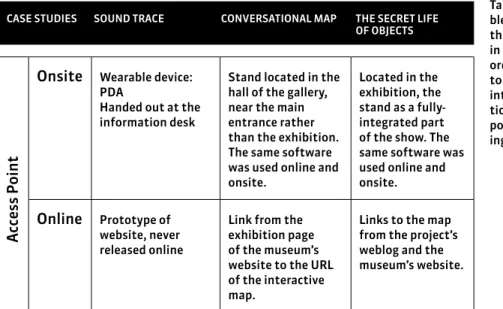
The following table presents the three projects in chronological order from left to right. In all these projects people from the museum community were leaving digital comments related to the exhibition material in an interactive piece. Each project was done in a different museum and in conjunction with an exhibition. In some cases people could comment on all the art or design
26 Chapter 2. Key Research Elements Chapter 2. Key Research Elements 27 The time spent on each project varied, as did the level of the museum’s involvement and the scale of its contribution. In these three cases, the time the project was installed in the gallery (onsite) and the length of the plan-ning phases are compared. The longer the participative pieces were in the exhibitions, the more data was gathered. A longer installation also meant more time for conversations and collaborations among the visitors, staff and artists/designers. The dates in the following table III represent my personal involvement with the project and not the life of the project. In the case of The Secret Life of Objects, the timeframe differs, since the project continued after the exhibition with the participation of other students at Media Lab. works in the exhibition, as in the case of Conversational Map, and in others,
only a few artworks could be commented upon.
CASE STUDIES SOUND TRACE
(2005) CONVERSATIONAL MAP (2006) THE SECRET LIFE OF OBJECTS (2008)
Museums Ateneum Art
Museum, The Finnish National Gallery
Kunsthalle Design Museum
Helsinki
Exhibition Permanent
Exhibition Young Artist Biennale: Small Heaven
The Secret Life of Objects, An Interactive Map of Finnish Design Art and design
pieces 5 artworks All the artworks in the exhibitions (installations, drawings, paintings and sculptures) Comments were made on 40 of a total of 50 objects
CASE STUDIES SOUND TRACE CONVERSATIONAL MAP THE SECRET LIFE OF OBJECTS
Access P
oint
Onsite Wearable device: PDA
Handed out at the information desk
Stand located in the hall of the gallery, near the main entrance rather than the exhibition. The same software was used online and onsite.
Located in the exhibition, the stand as a fully-integrated part of the show. The same software was used online and onsite.
Online Prototype of website, never released online
Link from the exhibition page of the museum’s website to the URL of the interactive map.
Links to the map from the project’s weblog and the museum’s website.
CASE STUDIES SOUND TRACE CONVERSATIONAL
MAP THE SECRET LIFE OF OBJECTS
T
ime
Project January 2005-
July 2006 November 2006 October 2007-June 2008
Onsite The project was not exhibited. The prototype was tested with two persons but it was not available for general use.
4 days in
November 2006 From 18 March, 2008 to 1 June, 2008 Quantity of comments The number is imprecise because the moment a comment began and ended was not marked. The comments came from 2 interviews held during 2 visits to the museum with a tour guide and the visually impaired person. 55 comments from visitors; 1 comment from a staff member 40 comments left by the exhibition educator and translated into 3 languages; 22 comments collected during workshops that contain audiovisual material or poems; 111 comments from visitors
Table III: This table presents the three projects in chronological order from left to right taking into consideration the time spent in each project and the time of each project in the museums and online. It also compares the quantity of comments col-lected in each project.
Table I: This ta-ble presents the three projects in chronological or-der from left to right taking into consideration the museums, the exhibition and the art and design pieces on which the com-munity created content.
The table below presents the points of access through which the museum community could reach the content and participate by leaving a comment. “Onsite” refers to the possibilities in the exhibition space and “online” to the Internet material available.
Table II: This ta-ble presents the three projects in chronological order from left to right taking into considera-tion the access point for creat-ing content.
28 Chapter 2. Key Research Elements Chapter 2. Key Research Elements 29 1 Further
information on this project can be found in Article 1.
2.2
Sound Trace (Äänijälki)
1How can a person blind from birth imagine the idea of figures? I think that the movement of his or her body, the presence of his or her hands in different places, the ongoing sensation of a body passing through fingers, give a notion of direction (Diderot, 1749/2004).
2.2.1 Goals
In the context of the art museum, the aim of this project was to design a participative audio tour and a website for visually impaired people and their community. We wanted to gather and shared digital comments (sound trac-es) online and onsite related to the pieces in the permanent exhibition and to navigating the physical premises. Our aim was that the website would contain all existing information on Finnish museums’ services for the visu-ally impaired, as well as audio traces connected to the exhibition they had left in the museum.
Sound Traceattempted to enhance accessibility and the visit experience at Finnish museums. At the same time, it intended to provide a platform for collaborative sound gathering. Visitors and pieces in the exhibition were to open up a pre-existing dialogue by making it audible. The Sound Trace project
CASE STUDIES SOUND TRACE CONVERSATIONAL
MAP THE SECRET LIFE OF OBJECTS
Collabor ations Mlab Team 3 students+ me + Technical support + Expert advice Technical support + me + Expert advice One student + one researcher + me + Technical support + Expert advice My
role Coordination design research Coordination design research + Facilitator in the exhibition
Coordination design research
Museum
Team One lecturer One lecturer and one marketing expert.
One lecturer and two workshop guides. We also collaborated with an architect, a curator, some guards, an archivist, a researcher and cleaning personnel. Table IV: This table presents the three projects in chronological order from left to right taking into consideration the collaboration among the team involved in each project.
The following table shows the team with which I collaborated on each project. As these configurations have influenced each case study, a detailed presentation is offered. As a design-researcher involved in the design of the interactive pieces and their strategies for use, as well as in the impact of the design proposal on the museum context, it is essential to describe one’s role in each endeavour. In The Secret Life of Objects there was a sound designer col-laborating with us who was neither from Media Lab nor from the museum. In parallel to the work related to the projects, I conducted interviews that related to the thesis’s broader research questions. As I did not review these interviews in depth, they are not presented as part of the research material, but they did help me to understand the contribution that I could make to the museum field of studies. I interviewed Maria Koskijoki, director of the Helinä Rautavaara Museum, and Dr. Outi Turpeinen, who is an artist and researcher in museum issues.
Fig. 1: Sound Trace: Visually impaired people could touch certain sculptures using gloves. Ateneum Art Museum.
30 Chapter 2. Key Research Elements Chapter 2. Key Research Elements 31 2 Anna Salmi,
Arto Kellokoski, Timo Londen and Mariana Salgado. 3 Demo Day is a bi-annual event in Media Lab Helsinki in which students demo their projects. External guests come to the event and try out the demos. 4 A walkthrough is like a rehearsal of a user test, in which any problems of the prototype can be detected and corrections can be made.
clarified the challenges and benefits that audio content made by the mu-seum community could bring to the mumu-seum, emphasising the possibilities for the visually impaired community.
2.2.2 Accomplishments
Before developing the concept we, the students participating in the project2,
made a field trip to IIRIS: the visually impaired service and activity centre in Helsinki. We visited the museum (Näkövammaisten Keskusliitto ry, 2009) and conducted interviews with various members of the staff. Furthermore, Anna Salmi and I invited a visually impaired person to come with us to visit the Post Museum Helsinki (Post Museum, 2009).
The group developed the concept behind the service. We also designed a prototype for a texture-touchable screen for a P.D.A. (Portable Digital As-sistant), a logo, and the layout for the website. For making the prototype, we used Apache web server, MySQL® Database, PHP programming server side and a simple Flash application on the client side (Article 1).
We tested our initial ideas for the interface during the Interface prototyp-ing workshop and in Demo Day3 2005. Later, to continue the evaluation of
the concept and to provide content for the service, we did two walkthroughs4
at the Ateneum Art Museum with a tour guide and a visually impaired per-son. As a result, several mistakes were found. To further develop the concept, we coordinated two workshops using participatory design approaches geared towards the visually impaired and their community. We reported on them in two articles and a poster presented in various forums (Salgado & Salmi, 2006; Salgado & Salmi, 2006 September 14; Salgado & Salmi, 2008).
These activities allowed the interaction designers involved in the project to collect research material and to enrich the dialogue about digital tools and the opportunities they present for enhancing the visit experience. Fur-thermore, though it was eventually deemed a mistake to mix audio tours with navigational guides, this proposal provided material for discussion. The collected data was audiovisual material, namely photos, videos, audio ma-terial, reports, scenarios and screenshots related to the activities the group had organised: workshops, interviews and visits to the cultural centre for the visually impaired, to museums and to relevant exhibitions.
2.2.3 Opportunity Knocks
The fact that the project never went beyond the development of the concept is a true missed opportunity. The lack of resources for developing the project prohibited further exploration. We applied for funding to continue working Fig. 2: Sound Trace. Testing the prototype in the museum. Ateneum Art Museum.
2005.
Fig. 3: Sound Trace: Three participants in the work-shop are building their ideal museum. Ateneum Art Museum. 2005.
Fig. 4: Sound Trace: Model made during the workshop in Ateneum Art Museum. 2005
32 Chapter 2. Key Research Elements Chapter 2. Key Research Elements 33 but did not succeed. Even today, four years after the start of the project, I
think it has interesting potential. Firstly, there is a growing interest in the use of audio material to deliver information in galleries; several researchers have used such material in museums as a way to explore different interfaces and devices: Tangible User Interfaces (TUI) (Wakkary & Hatala, 2007), audio in-stallations embedded in the galleries (Kortbek & Gronbaek, 2008), podcast-ing (Samis, 2008a 2008b, 2007), mobile devices (Walker, 2008) and props (Gottlieb & Simonsson, 2005). However, none of them have explored the
possibilities of including in their development a community of people with a disability. Other initiatives have contemplated the need to design audio systems for groups of visitors (Aoki & Grinter, 2002; Laurillau & Paternó, 2004; Kortbek & Gronbaek, 2008). Secondly, in recent years, research on museums has focused on visitor-created content using podcasting (Samis & Pau, 2009; Fisher et al., 2008) and audio files that could be recorded through a mobile phone and listened to on the website (Walker, 2008), which proved to be meaningful for visitors.
Fig. 5: Sound Trace: Clay sculptures that describe the characteristics of an ideal guide for the visually impaired made in the workshops. Ateneum Art Museum. 2005.
Fig. 6: Sound Trace: A participant in a walkthrough of the museum, touching the sculpture. Ateneum Art Museum. 2005.
34 Chapter 2. Key Research Elements Chapter 2. Key Research Elements 35 5 Further
information about the project can be found in Article 2. The Sound Traceproject served to raise our team’s awareness about how not
to be “intentionally blind” to the needs of the visually impaired community in designing audio information systems. Although an audio tour especially designed for them would require professional expertise for content, access to the same audio content as sighted visitors enjoy would be a starting point. This requires choosing an interface accessible to the visually impaired and inviting them to use it.
Furthermore, in the context of art museums where perception and inter-pretation of art is the main interest, the inclusion of the visually impaired community would be particularly significant. Thanks to their tactile percep-tion, the visually impaired have another “point of view” on artwork, and sharing that view with sighted people would be a way to create a bridge to this marginalised community.
While in the following cases I did not consider the inclusion of visually im-paired people, I realised that listening to other people’s personal comments could enrich the visit experience. On one hand, I understood that I wanted to focus my research on the possibilities for interaction designers to motivate and support an exchange of comments amongst people that do not know each other. On the other hand, the idea appeared that this exchange of personal comments could validate an emotional connection with art and design work.
2.3
Conversational Map (Keskustelukartta)
5Visitors are ready to make connections between the concepts and narratives they find at exhibitions and aspects of their own lives, memories and experi-ences (Sandell, 2007, p.109).
2.3.1 Goals
As Sandell (2007) has pointed out, visitors are eager to make connections. We wanted to use the digital board to expand the already existing dialogue between museum visitors and the exhibition.
Thus, the goal of Conversational Map was to test the concept of a participa-tive digital board for comments on an art exhibition. Most of the comments gathered in a common guest book respond to the question, “Did you like the exhibition?” Most answers are variations on a simple “Yes, I did” and “No, I didn’t.” We therefore did not want to call this device “a feedback board” or “a guest book” because the comments we hoped to collect were the reflec-tions, questions and memories that connect the visitors to the artwork.
Fig. 7: Conversational Map: Stand where people could leave their comments. Young Biennale: Small Heaven. Kunsthalle. 2005.
Fig. 8: Conversational Map: The map based on the artworks of the exhibition Young Biennale: Small Heaven. Kunsthalle. 2005.
36 Chapter 2. Key Research Elements Chapter 2. Key Research Elements 37 7 A detailed description and analysis of the comments can be found in Chapter 4. 6 Information on how this map was built can be found in Article 6. We also aimed to open a dialogue between visitors who were not at the
museum at the same time. We tried to collect digital comments about the works or the exhibition as a whole.
According to Terry Barret (2003), an expert in criticism and aesthetics, “when we interpret a work of art we engage meaningfully with the work of art, intellectually and emotionally. We perceive the work and very likely
receive the work – our version of it – and make a response to it, privately or publicly” (p. 17). Visitors in the museum interpret works of art or design and in this way they enact a dialogue with the collection. Our proposal includes making this dialogue public by sharing these interpretations. Visi-tors and pieces could open up a pre-existing dialogue. VisiVisi-tors enacted this dialogue by leaving text comments supported by any external link on the Internet. We imagined comments that could be linked to, for example, a piece of music.
2.3.2 Accomplishments
For Kunsthalle, a participative installation was set up in the main entrance hall, near the ticket office. It consisted of a keyboard and a mouse placed on the top of a white cube, a hidden computer, and a projector that cast images of the map on one wall (Fig. 7 & 8). There was also a stack of leaflets with a short description of the project and a link for accessing the digital board at home.
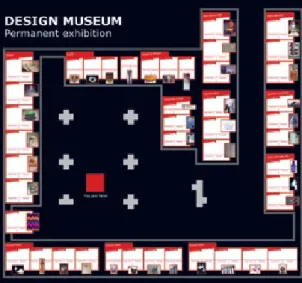
A two-dimensional compiled image of the exhibition was used to form a map of the exhibition6 (Fig. 8). Visitors could recognise the exhibition space
and the art pieces in it, since their positions were analogous to where they were in the real exhibition space.
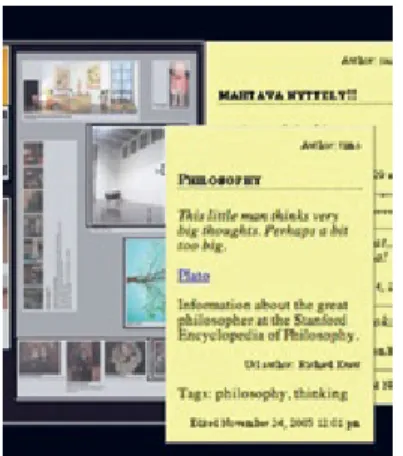
Conversational Mapbrought to the conversation the possibility of support-ing comments with links to external resources in the Internet. Inspired by the possibilities of the software ImaNote (Image Map Annotation Notebook) ( http://taik.fi/imanote/), digital comments took the shape of audiovisual material that related to the objects in the exhibition. Developed at the Media Lab, the software was used to navigate the map and to annotate the pieces in the exhibition. Due to the nature of this software, visitors’ comments took the form of text and could be complemented with external links. Although the primary purpose was not to test the software, some initial ideas for a new version of ImaNote came from the observations of how Conversation Map
operated at the museum (Article 6).
For most of the time the installation was in the museum, I was there, ex-plaining the project, inviting visitors to participate and helping them to leave comments, as well as talking to visitors and artists about the possibilities of
a digital board. The presence of a person performing these tasks at the stand seemed crucial to the number and variety of comments collected. Fifty-five comments were collected from visitors, and one comment from a museum staff member. Comments were varied in terms of content and length.7 Only
four comments had an external link to the Internet, and the visitors that added them had to be specifically encouraged to do so.
The data collected consists of the audiovisual documentation such as notes, audio material, content material created by visitors, photographs, map of the exhibition, and screen shots, of the interactive piece in the museum and the conversations with visitors about it. The core material consisted of the visitor-created content collected on the map of the exhibition and the notes taken about the conversations in the exhibition venue.
2.3.3 Opportunity Knocks
The primary opportunity missed in this project was not having planned how to involve the young artists and the staff of the exhibition venue. The “Con-versational Map” was simply placed in the exhibition with no explanation. During the days the stand was up, the artists, as well as the staff, were busy with workshops, and the exhibition venue was crowded. Therefore, they had neither the time nor inclination to post a comment on the map. A proper introduction to the staff and an invitation to leave comments could have improved the content gathered on the map. Comments from the staff and the artists could have been interesting points of departure and could have geared the discussion towards common concerns. Had I encouraged staff
Fig. 9: Conversational Map: Comment writ-ten by a visitor to the Young Biennale: Small Heaven. Kunsthalle. 2005.
38 Chapter 2. Key Research Elements Chapter 2. Key Research Elements 39 8 Article 5 (Salgado et al., 2009a) describes this project in detail. and artists to participate in the piece beforehand, it could have been more fertile and effective at the exhibition itself.
My experiences as an interior designer draw me to reflect on the possibili-ties of the stand. The stand was perceived as cold and impersonal; it was only redeemed by the human presence beside it. A cosy corner where visitors feel welcome and can sit down and relax while making a comment would be a better design solution.
From my experience I recommend a set of strategies for triggering visitors’ comments and focusing the comments by asking specific questions. The lack of focus did not seem to confuse visitors, but most of them looked for other visitors’ comments before leaving their own.
Although we did not get comments connected to external music as we would have liked, we received some comments with links to other visual and informative material that complement the content of the exhibition by trac-ing resources in the web. Visitors might have to be explicitly encouraged to make connections to other art forms, such as music.
The short period at the exhibition venue, only four days, did not allow in-depth exploration of the possibilities offered by online contributions. How-ever, these four days were days in which the institution organised special activities and were very productive: workshops, parties, talks, etc generated a good flow of people around the interactive piece and with it a good sample of comments.
In the context of a biennale of mostly young Finnish artists, the map could have been used as a tool for discussion between artist, visitors, art histo-rians, critics and staff. This idea of encouraging various persons from the community to leave their own comment in a common interactive piece was re-defined in the next project, The Secret Life of Objects. In that project I could take more time to motivate and facilitate the inclusion of more people such as the designers and museum’s guides.
2.4
The Secret Life of Objects (Esineiden Salatut Elämät)
8Can objects that were meaningful to some people (their previous owners, the curators who acquired them) evoke meaning for others, and so help them con-struct new ideas about the world, new knowledge? Objects do not in themselves carry meanings, but if a person has learnt about their context (or can be guided to interpret what they see) the object can provide a vivid impression, a new ex-perience for them as well (Keene, 2005, p. 69).
2.4.1 Goals
The aim of The Secret Life of Objects was to develop services for the permanent exhibition of the Design Museum Helsinki. My research goal was to further develop the concept of a participative digital board by co-designing practices and content material with the staff and the visitors. Digital content was re-defined to include material that came from workshops and events held in the museum in the form of images, videos, sounds and texts.
This material was included as links on the map of the exhibition; these links intended to encourage visitors to make comments on the exhibition. “Visitors could join conversations that had been started by participants in the workshops or events” (Article 3). We tried to demystify the role of the expert curator by presenting comments made by children and youngsters. In this project, there was a clear intention to elicit visitors’ creativity by show-ing multimedia artistic comments such as poems, videos and pieces of mu-sic. Furthermore, this project tried to show how, through digital technolo-gies, an intangible digital heritage such as recordings of poetry readings and children’s workshops could enrich the tangible, the design and art pieces in the exhibition.
2.4.2 Accomplishments
The Secret Life of Objects explored creative uses for the Museum’s collection through partnerships with artists, in this case, children and teenagers who play music and do creative writing. In line with Suzanne Keene (2005) who has supported creative uses of museum collections (p. 182), the participative digital board created as part of this project used the museum collection as a
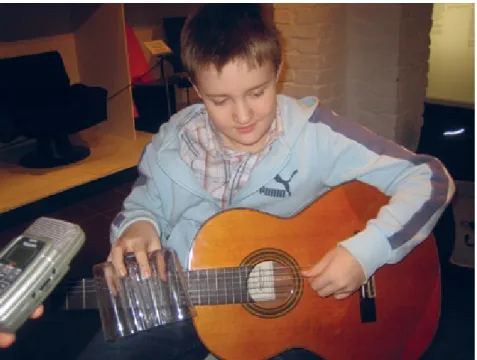
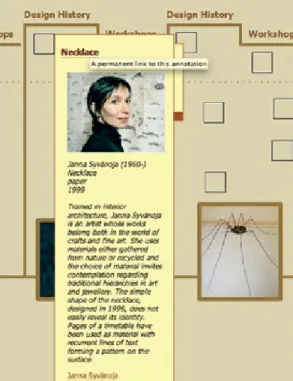
Fig. 10: The Secret Life of Objects: Link to audio material collected during the workshop Sound of Objects. Design Museum. 2008.