B-5039 8-98
Texas Agricultural Extension Service
The Texas A&M University System
S
UGGESTIONS
FOR
W
EED
C
ONTROL
IN
Suggestions for Weed Control in Cotton
Paul A. Baumann, Extension Weed SpecialistThe Texas A&M University System
Table Page 1 Winter Treatments . . . 4 2 Preplant . . . 5 3 Preplant Incorporated . . . 6 4 Preplant Incorporated/Preemergence . . . 8 5 Preemergence . . . 9 6 Postemergence Incorporated . . . 13 7 Postemergence or Post-Directed . . . 13 Table Page 8 Layby . . . 19 9 Preharvest . . . 20
10 Wick or Wiper Applications . . . 20
Herbicide Formulations and Manufacturers . . . 21
Sprayer Calibration . . . 22
The suggestions contained herein are based primarily on herbicide labels, research by the Texas Agricultural Experiment Station and demonstrations by the Texas Agricultural Extension Service. The use of product names is not intended as an endorsement of the product or of a specific manufacturer, nor is there any implication that other formulations containing the same active chemical are not equally as effective. Product names are included solely to aid readers in locating and identifying the herbicides suggested.
The information given herein is for educational purposes only. Reference to commercial products or trade names is made with the understanding that no discrimination is intended and no endorsement by the Cooperative Extension Service is implied.
This publication is no substitute for the herbicide product labels! It is intended to serve only as a guide for controlling weeds in cotton. Labeled rates and restrictions change constantly; therefore, consult the product label prior to use.
Weed control in cropland can be accomplished through the use of cultural, mechanical and chemical means. Judicious use of these individual methods or a combination of them can result in effective weed management without causing economic loss or adverse environmental effects. Deciding which practice to employ will depend largely on the weed(s) being controlled and the infestation level. Also, the crop being planted will play a major role in determining the timeliness of mechanical measures.
Considerations for cultural and mechanical weed control should include the following:
1. Remove light or spotty infestations of weeds by hand hoeing or spot cultivation to prevent spreading weed seed, rhizomes or roots. This is of particular importance with perennial weeds because of the way they propagate (by seed and root tissue). However, be careful when plowing perennial weeds so that you don’t spread plant parts to other areas of the field.
2. Use weed-free planting seed to protect against weed infestations in the row and the introduction of new weed species.
3. Thoroughly clean harvesting equipment before moving from one field to the next, or require it of the custom harvester before he enters your fields. 4. Use mechanical tillage to remove initial weed flushes prior to planting, thereby eliminating or at least reducing the potential for continued infestation.
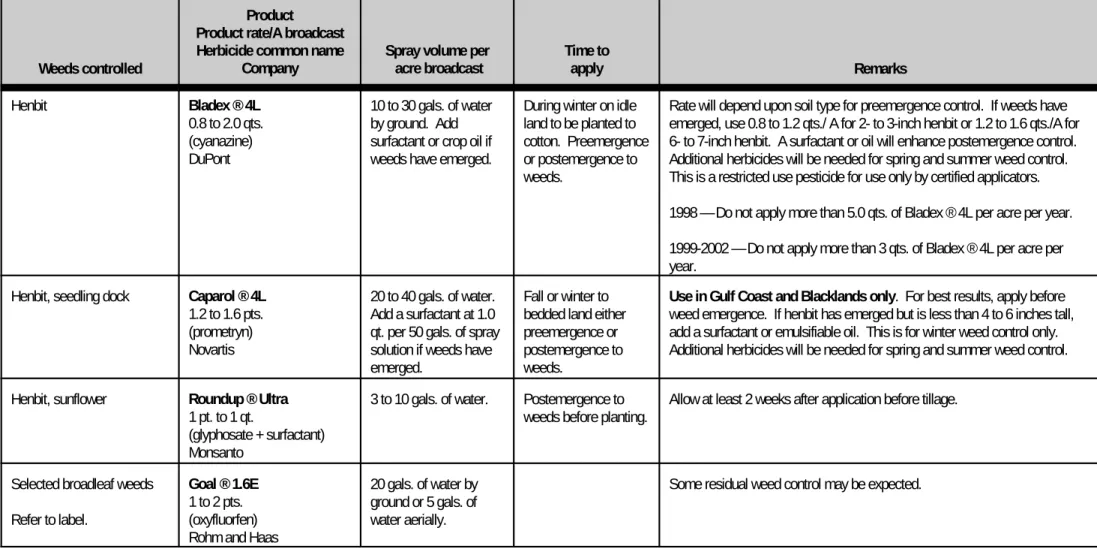
Table 1. Winter Weed Control Treatments
Weeds controlled
Product
Product rate/A broadcast Herbicide common name
Company Spray volume per acre broadcast Time toapply Remarks
Henbit Bladex ® 4L 0.8 to 2.0 qts. (cyanazine) DuPont 10 to 30 gals. of water by ground. Add surfactant or crop oil if weeds have emerged.
During winter on idle land to be planted to cotton. Preemergence or postemergence to weeds.
Rate will depend upon soil type for preemergence control. If weeds have emerged, use 0.8 to 1.2 qts./ A for 2- to 3-inch henbit or 1.2 to 1.6 qts./A for 6- to 7-inch henbit. A surfactant or oil will enhance postemergence control. Additional herbicides will be needed for spring and summer weed control. This is a restricted use pesticide for use only by certified applicators. 1998 — Do not apply more than 5.0 qts. of Bladex ® 4L per acre per year. 1999-2002 — Do not apply more than 3 qts. of Bladex ® 4L per acre per year.
Henbit, seedling dock Caparol ® 4L
1.2 to 1.6 pts. (prometryn) Novartis
20 to 40 gals. of water. Add a surfactant at 1.0 qt. per 50 gals. of spray solution if weeds have emerged.
Fall or winter to bedded land either preemergence or postemergence to weeds.
Use in Gulf Coast and Blacklands only. For best results, apply before weed emergence. If henbit has emerged but is less than 4 to 6 inches tall, add a surfactant or emulsifiable oil. This is for winter weed control only. Additional herbicides will be needed for spring and summer weed control. Henbit, sunflower Roundup ® Ultra
1 pt. to 1 qt.
(glyphosate + surfactant) Monsanto
3 to 10 gals. of water. Postemergence to
weeds before planting. Allow at least 2 weeks after application before tillage.
Selected broadleaf weeds Refer to label.
Goal ® 1.6E
1 to 2 pts. (oxyfluorfen) Rohm and Haas
20 gals. of water by ground or 5 gals. of water aerially.
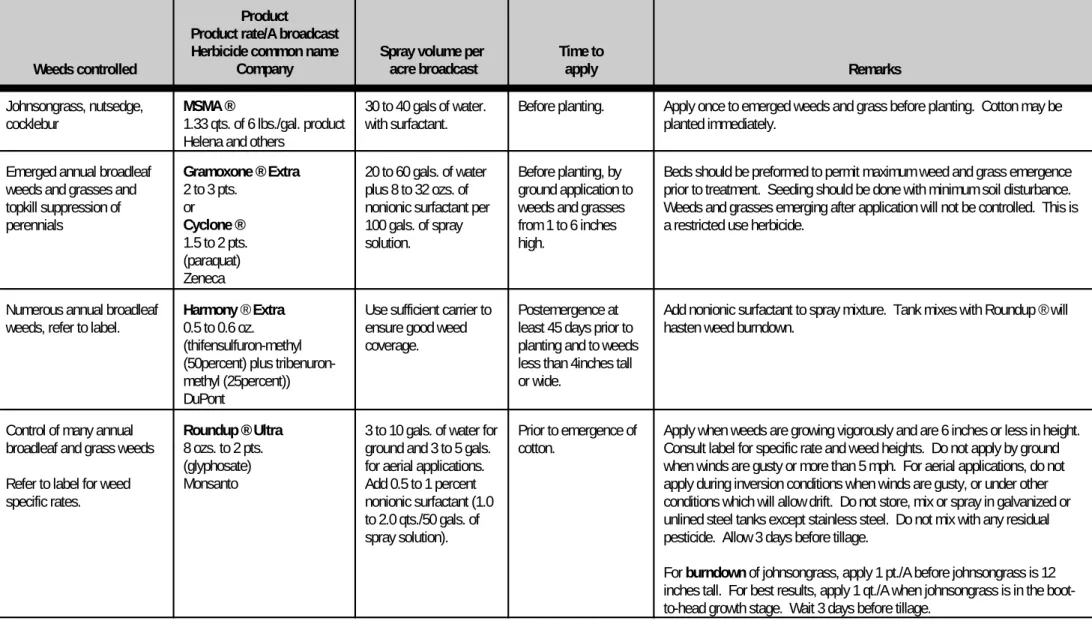
Table 2. Preplant
Weeds controlled
Product
Product rate/A broadcast Herbicide common name
Company Spray volume per acre broadcast Time toapply Remarks
Johnsongrass, nutsedge,
cocklebur MSMA ®1.33 qts. of 6 lbs./gal. product Helena and others
30 to 40 gals of water.
with surfactant. Before planting. Apply once to emerged weeds and grass before planting. Cotton may beplanted immediately. Emerged annual broadleaf
weeds and grasses and topkill suppression of perennials Gramoxone ® Extra 2 to 3 pts. or Cyclone ® 1.5 to 2 pts. (paraquat) Zeneca 20 to 60 gals. of water plus 8 to 32 ozs. of nonionic surfactant per 100 gals. of spray solution.
Before planting, by ground application to weeds and grasses from 1 to 6 inches high.
Beds should be preformed to permit maximum weed and grass emergence prior to treatment. Seeding should be done with minimum soil disturbance. Weeds and grasses emerging after application will not be controlled. This is a restricted use herbicide.
Numerous annual broadleaf
weeds, refer to label. Harmony 0.5 to 0.6 oz.® Extra (thifensulfuron-methyl (50percent) plus tribenuron-methyl (25percent)) DuPont
Use sufficient carrier to ensure good weed coverage.
Postemergence at least 45 days prior to planting and to weeds less than 4inches tall or wide.
Add nonionic surfactant to spray mixture. Tank mixes with Roundup ® will hasten weed burndown.
Control of many annual broadleaf and grass weeds Refer to label for weed specific rates.
Roundup ® Ultra
8 ozs. to 2 pts. (glyphosate) Monsanto
3 to 10 gals. of water for ground and 3 to 5 gals. for aerial applications. Add 0.5 to 1 percent nonionic surfactant (1.0 to 2.0 qts./50 gals. of spray solution).
Prior to emergence of
cotton. Apply when weeds are growing vigorously and are 6 inches or less in height. Consult label for specific rate and weed heights. Do not apply by ground when winds are gusty or more than 5 mph. For aerial applications, do not apply during inversion conditions when winds are gusty, or under other conditions which will allow drift. Do not store, mix or spray in galvanized or unlined steel tanks except stainless steel. Do not mix with any residual pesticide. Allow 3 days before tillage.
For burndown of johnsongrass, apply 1 pt./A before johnsongrass is 12 inches tall. For best results, apply 1 qt./A when johnsongrass is in the boot-to-head growth stage. Wait 3 days before tillage.
Table 2. Preplant (continued)
Weeds controlled
Product
Product rate/A broadcast Herbicide common name
Company Spray volume per acre broadcast Time toapply Remarks Perennials:
Control of many perennial weeds, such as:
Bahiagrass, bermudagrass, bindweed, curly dock, dallis-grass, fescues, hemp dog-bane, johnsongrass, milk-weed, silverleaf nightshade, swamp smartweed, torpedo-grass, vaseytorpedo-grass, wirestem muhly, Texas blueweed, clover (red and white), nutsedge (yellow & purple), perennial ryegrass, Canada thistle, horsenettle, woollyleaf bursage, fescue
Roundup ® Ultra
2.0 to 5.0 qts. (glyphosate) Monsanto
See label for rate on specific weeds.
10 to 40 gals. of water. Before planting or after
harvest. Apply when actively growing and when weeds have reached early head orearly bud growth stage. See label for exact growth stage and rate and water carrier volume per acre. If weeds have been mowed or tilled, do not treat until regrowth has reached recommended stage. Allow 7 days or more after application before tillage. Do not graze treated cotton fields or feed forage to livestock within 8 weeks of application.
Table 3. Preplant Incorporated
Weeds controlled
Product
Product rate/A broadcast Herbicide common name
Company Spray volume per acre broadcast Time toapply Remarks
Control of many annual grasses and small-seeded broadleaf weeds
Refer to label for weed specific rates Prowl ® 3.3EC 1.2 to 3.6 pts. (pendimethalin) American Cyanamid 10 gals. of water or more by ground. 5 gals. or more by air. May also be applied impregnated on dry bulk fertilizer and with liquid fertilizer.
Immediately before planting or up to 140 days prior to planting.
Within 7 days after application incorporate 1 to 2 inches deep with a disk harrow, bed conditioner, PTO-driven tiller, cultivator, hoe or rolling cultivator. If loss of crop occurs, cotton or soybeans may be replanted. Other crops can be rotated with cotton the following year. Do not feed forage or graze livestock in treated cotton fields.
Winter wheat or barley can be planted in the fall 4 months following application. Prowl ® may be applied at 1.2 to 3.6 pts./A and incorporated up to 60 days prior to planting for rhizome johnsongrass suppression.
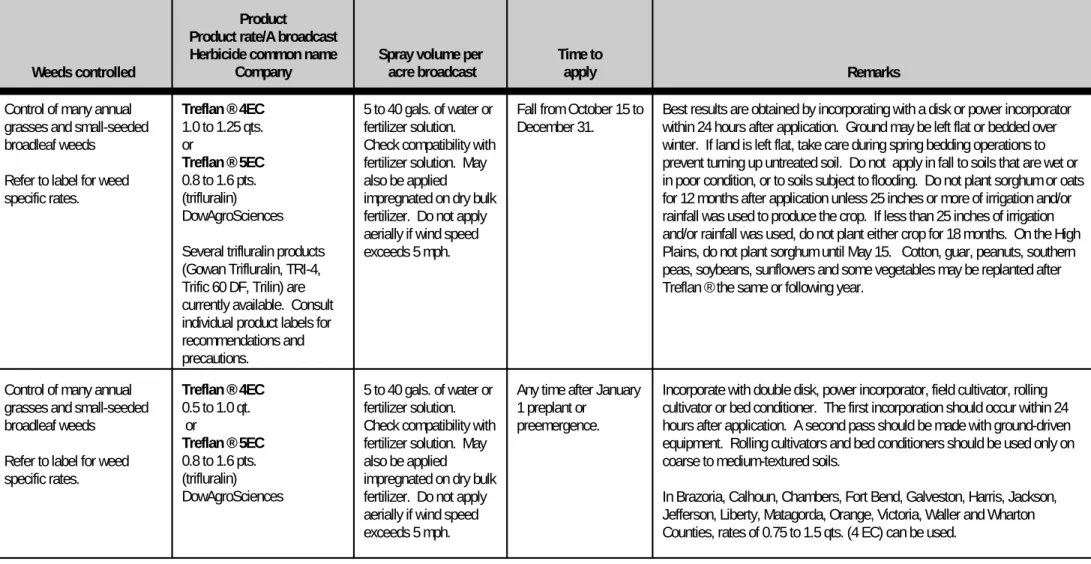
Table 3. Preplant Incorporated (continued)
Weeds controlled
Product
Product rate/A broadcast Herbicide common name
Company Spray volume per acre broadcast Time toapply Remarks
Control of many annual grasses and small-seeded broadleaf weeds
Refer to label for weed specific rates. Treflan ® 4EC 1.0 to 1.25 qts. or Treflan ® 5EC 0.8 to 1.6 pts. (trifluralin) DowAgroSciences Several trifluralin products (Gowan Trifluralin, TRI-4, Trific 60 DF, Trilin) are currently available. Consult individual product labels for recommendations and precautions.
5 to 40 gals. of water or fertilizer solution. Check compatibility with fertilizer solution. May also be applied impregnated on dry bulk fertilizer. Do not apply aerially if wind speed exceeds 5 mph.
Fall from October 15 to
December 31. Best results are obtained by incorporating with a disk or power incorporatorwithin 24 hours after application. Ground may be left flat or bedded over winter. If land is left flat, take care during spring bedding operations to prevent turning up untreated soil. Do not apply in fall to soils that are wet or in poor condition, or to soils subject to flooding. Do not plant sorghum or oats for 12 months after application unless 25 inches or more of irrigation and/or rainfall was used to produce the crop. If less than 25 inches of irrigation and/or rainfall was used, do not plant either crop for 18 months. On the High Plains, do not plant sorghum until May 15. Cotton, guar, peanuts, southern peas, soybeans, sunflowers and some vegetables may be replanted after Treflan ® the same or following year.
Control of many annual grasses and small-seeded broadleaf weeds
Refer to label for weed specific rates. Treflan ® 4EC 0.5 to 1.0 qt. or Treflan ® 5EC 0.8 to 1.6 pts. (trifluralin) DowAgroSciences 5 to 40 gals. of water or fertilizer solution. Check compatibility with fertilizer solution. May also be applied impregnated on dry bulk fertilizer. Do not apply aerially if wind speed exceeds 5 mph.
Any time after January 1 preplant or
preemergence.
Incorporate with double disk, power incorporator, field cultivator, rolling cultivator or bed conditioner. The first incorporation should occur within 24 hours after application. A second pass should be made with ground-driven equipment. Rolling cultivators and bed conditioners should be used only on coarse to medium-textured soils.
In Brazoria, Calhoun, Chambers, Fort Bend, Galveston, Harris, Jackson, Jefferson, Liberty, Matagorda, Orange, Victoria, Waller and Wharton Counties, rates of 0.75 to 1.5 qts. (4 EC) can be used.
Table 3. Preplant Incorporated (continued)
Weeds controlled
Product
Product rate/A broadcast Herbicide common name
Company Spray volume per acre broadcast Time toapply Remarks
Same as above plus
rhizome johnsongrass Treflan ® 4EC1.0 to 2.0 qts. or Treflan ® 5EC 1.6 to 3.2 pts. (trifluralin) DowAgroSciences 5 to 40 gals. of water or fertilizer solution. Check compatibility with fertilizer solution. May also be applied impregnated on dry bulk fertilizer. Do not apply aerially if wind speed exceeds 5 mph.
Fall or spring for 2
consecutive years. Work the soil deeply with a chisel plow or similar tool to bring rhizomes to thesurface. Chop the rhizomes by disking twice, cross-disking the second time. Apply double the normal rate of Treflan and incorporate by disking 4 to 6 inches deep at 4 to 6 miles per hour. Disk a second time at an angle to the first disking. Plant cotton after early season adverse weather conditions have passed. Cultivate during the season to control rhizome grass. Repeat the procedure the second year and plant either cotton or soybeans. Two years are required for satisfactory johnsongrass control. In the third year, plant only those crops for which these herbicides are registered as a preplant treatment.
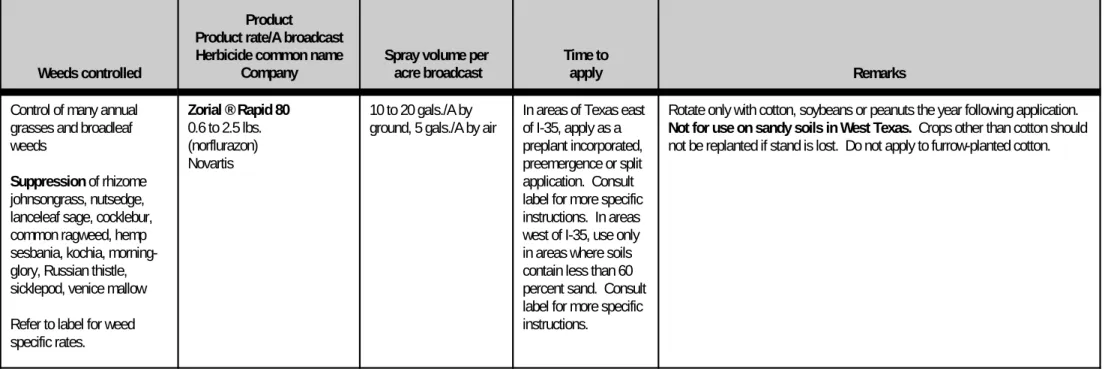
Table 4. Preplant Incorporated/Preemergence
Weeds controlled
Product
Product rate/A broadcast Herbicide common name
Company Spray volume per acre broadcast Time toapply Remarks
Control of many annual grasses and broadleaf weeds
Suppression of rhizome johnsongrass, nutsedge, lanceleaf sage, cocklebur, common ragweed, hemp sesbania, kochia, morning-glory, Russian thistle, sicklepod, venice mallow Refer to label for weed specific rates. Zorial ® Rapid 80 0.6 to 2.5 lbs. (norflurazon) Novartis 10 to 20 gals./A by
ground, 5 gals./A by air In areas of Texas eastof I-35, apply as a preplant incorporated, preemergence or split application. Consult label for more specific instructions. In areas west of I-35, use only in areas where soils contain less than 60 percent sand. Consult label for more specific instructions.
Rotate only with cotton, soybeans or peanuts the year following application.
Not for use on sandy soils in West Texas. Crops other than cotton should not be replanted if stand is lost. Do not apply to furrow-planted cotton.
Table 4. Preplant Incorporated/Preemergence (continued)
Weeds controlled
Product
Product rate/A broadcast Herbicide common name
Company Spray volume per acre broadcast Time toapply Remarks
Control of many annual grasses and broadleaf weeds
Refer to label for weed specific rates.
Treflan ® TR-10
5 to 20 lbs. (trifluralin) DowAgroSciences
Band or broadcast with properly calibrated granular applicator.
Refer to supplemental label for remarks concerning preplant and preemergence applications.
For use in conservation tillage cotton. Refer to supplemental label.
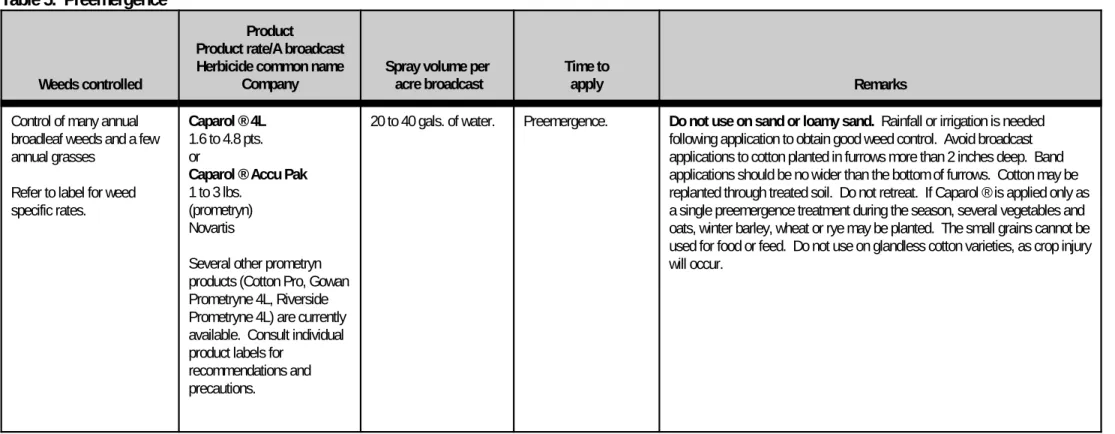
Table 5. Preemergence
Weeds controlled
Product
Product rate/A broadcast Herbicide common name
Company Spray volume per acre broadcast Time toapply Remarks
Control of many annual broadleaf weeds and a few annual grasses
Refer to label for weed specific rates.
Caparol ® 4L
1.6 to 4.8 pts. or
Caparol ® Accu Pak
1 to 3 lbs. (prometryn) Novartis
Several other prometryn products (Cotton Pro, Gowan Prometryne 4L, Riverside Prometryne 4L) are currently available. Consult individual product labels for
recommendations and precautions.
20 to 40 gals. of water. Preemergence. Do not use on sand or loamy sand. Rainfall or irrigation is needed following application to obtain good weed control. Avoid broadcast applications to cotton planted in furrows more than 2 inches deep. Band applications should be no wider than the bottom of furrows. Cotton may be replanted through treated soil. Do not retreat. If Caparol ® is applied only as a single preemergence treatment during the season, several vegetables and oats, winter barley, wheat or rye may be planted. The small grains cannot be used for food or feed. Do not use on glandless cotton varieties, as crop injury will occur.
Table 5. Preemergence (continued)
Weeds controlled
Product
Product rate/A broadcast Herbicide common name
Company Spray volume per acre broadcast Time toapply Remarks
Control of many annual grasses and some small-seeded broadleaf weeds
Dual ® 8E or Dual ® II 7.8E 1.5 to 2.0 pts. (metolachlor) Novartis Minimum of 10 gals. of
water or liquid fertilizer. Preplant incorporatedor preemergence. Do not apply on sand or loamy sand soils. Do not apply to furrow-plantedcotton. Apply preemergence or incorporate no more than 1 inch deep before, at or after planting. Plant cotton at least 1 inch deep on fine soils and 1.5 inches deep on medium or coarse soils. For best control of yellow nutsedge, apply preplant incorporated.
Control of many annual grasses and broadleaf weeds
Refer to label for weed specific rates. Dual ® 8E or Dual II ® 7.8 E 1.25 to 2.0 pts. (metolachlor) + Caparol ® 4L 1.6 to 4.8 pts. (prometryn)
Caparol ® Accu Pak
1.0 to 3.0 lbs. Novartis
Minimum of 10 gals. of
water. Preplant incorporatedor preemergence. Apply either preplant incorporated or preemergence using proceduressuggested for Dual ® alone. Choose rate according to soil type. Do not apply to sand or loamy sand soil. Do not use with glandless cotton varieties. Observe label precautions when applying over furrow-planted cotton. Test compatibility of Dual ® and Caparol ® in a jar before mixing in tank.
Table 5. Preemergence (continued)
Weeds controlled
Product
Product rate/A broadcast Herbicide common name
Company Spray volume per acre broadcast Time toapply Remarks
Control of many annual grasses and broadleaf weeds
Refer to label for weed specific rates.
Dual ® 8E or Dual II ® 7.8E
1.25 to 2.0 pts. (metolachlor) + Cotoran ® DF 1.2 to 2.4 lbs. or Cotoran ® 4L 2.0 to 4.0 pts. (fluometuron) or
Cotoran ® Accu Pak
1.2 to 2.4 lbs. Novartis
Minimum of 10 gals. of
water. Preemergence. Use in Gulf Coast, Rio Grande Valley and eastern Texas onlyapply on sand or loamy sand soils. Observe label precautions when applying. Do not to furrow-planted cotton. Test compatibility of Cotoran ® and Dual ® in a jar before mixing in tank.
Injury may occur on high pH or low organic matter soils.
Control of many annual grasses and broadleaf weeds
Refer to label for weed specific rates. Cotoran ® 4L 2.0 to 4.0 pts. or Cotoran ® DF 1.2 to 2.4 lbs. (fluometuron)
Cotoran ® Accu Pak
1.2 to 2.4 lbs. Novartis
Other fluometuron products available include Meturon ® 4L or DF and Riverside ® Fluometuron 4L or 80DF. Consult these product labels for recommendations and
25 to 40 gals. of water or liquid nitrogen solution. A suspendibility agent may be necessary. Preemergence or at planting following a preplant incorporated application of Prowl ® or Treflan ®.
Where dry weather conditions prevail, the herbicidal activity of Cotoran ® may be delayed or reduced. Do not plant crops other than cotton within 6 months of the last application. West Texas: Do not use on sand, loamy sand or fine sandy loam soils. Do not feed foliage from treated fields or gin trash to livestock.
Table 5. Preemergence (continued)
Weeds controlled
Product
Product rate/A broadcast Herbicide common name
Company Spray volume per acre broadcast Time toapply Remarks
Control of many annual grasses and broadleaf weeds
Refer to label for weed specific rates Karmex ® 80DF 1.0 to 2.0 lbs. (diuron) or Direx ® 4L 0.75 to 2.25 qts. (diuron) DuPont, Griffin
Other diuron products avai-lable include Drexel Diuron 4L or 80W, and Riverside Diuron 80DF. Consult these product labels for recommen-dations and precautions.
20 to 40 gals. of water by ground.
5 to 10 gals. aerially.
Preemergence. Use on sandy loam or heavier soils. Do not use with furrow-planted cotton. Cotton may be replanted through treated band or rework beds before planting. Do not retreat. If banded preemergence, any crop can be planted after 4 months. If broadcast preemergence or if banded preemergence followed by postemergence, only cotton, soybeans, corn or grain sorghum can be planted the next spring.
Direx ® or Karmex ® may be applied at 0.25 to 0.75 lb. preemergence following a preplant application of Treflan ® on heavy soils. See label for specific instructions.
Do not use on soils containing less than 1.0 percent organic matter.
For control of selected broadleaf weeds such as pigweed spp., lanceleaf sage, venice mallow and others
Refer to label for weed specific rates. Staple ® 0.6 to 0.9 oz. (Pyrithiobac) DuPont Use a minimum of 10 gals. of water for ground applications. Use a minimum of 3 gals. of water for aerial applications.
Preemergence. Refer to label for weed-specific application rates. Staple ® can be combined with diuron, flumeturon or prometryn products for expanded weed control. Refer to the Staple ® label for more information.
Control of many annual grasses and broadleaf weeds
Refer to label for weed specific rates.
Suppression of cocklebur, morningglory and nutsedge
Zorial ® 1.25 to 2.5 lbs. (norflurazon) Novartis 10 to 20 gals. of water by ground or 5 gals. aerially. 10 to 20 gals. of water by ground or 5 gals. aerially.
Use preplant incorporated, preemergence or as a split application in East Texas where 40 inches of rain annually is expected. In areas with less than 40 inches of rainfall, apply as a preplant incorporated or split application only.
Not for use in sandy soils in West Texas. Incorporate no deeper than 2 to 3 inches within 30 days of planting. Crops other than cotton should not be replanted if stand is lost. Rotate only with cotton, soybeans or peanuts the year following application.
Table 6. Postemergence Incorporated
Weeds controlled
Product
Product rate/A broadcast Herbicide common name
Company Spray volume per acre broadcast Time toapply Remarks
Control of many annual grasses and small-seeded broadleaf weeds
Refer to label for weed specific rates. Treflan 5 ® 0.8 to 1.6 pts. or Treflan ® 4EC 1.0 to 2.0 pts. (trifluralin) DowAgroSciences 5 to 40 gals. of water by ground or 5 gals. aerially.
From 4-true-leaf stage up until layby but not less than 90 days before harvest.
Apply as a directed spray. Drop nozzles are suggested if cotton foliage prevents uniform coverage of soil surface. Final beds should be established and free of clods and trash before application. Incorporate within 24 hours with one pass of a sweep-type or rolling cultivator. Treated soil should be thrown into the row. Wheat or barley can be planted in the fall.
Table 7. Postemergence or Post-Directed
Weeds controlled
Product
Product rate/A broadcast Herbicide common name
Company Spray volume per acre broadcast Time toapply Remarks
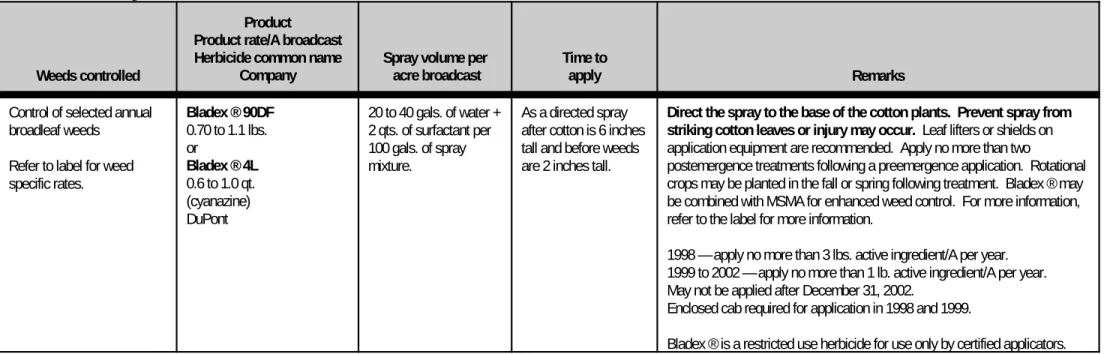
Control of selected annual broadleaf weeds
Refer to label for weed specific rates. Bladex ® 90DF 0.70 to 1.1 lbs. or Bladex ® 4L 0.6 to 1.0 qt. (cyanazine) DuPont 20 to 40 gals. of water + 2 qts. of surfactant per 100 gals. of spray mixture. As a directed spray after cotton is 6 inches tall and before weeds are 2 inches tall.
Direct the spray to the base of the cotton plants. Prevent spray from striking cotton leaves or injury may occur. Leaf lifters or shields on application equipment are recommended. Apply no more than two
postemergence treatments following a preemergence application. Rotational crops may be planted in the fall or spring following treatment. Bladex ® may be combined with MSMA for enhanced weed control. For more information, refer to the label for more information.
1998 — apply no more than 3 lbs. active ingredient/A per year. 1999 to 2002 — apply no more than 1 lb. active ingredient/A per year. May not be applied after December 31, 2002.
Enclosed cab required for application in 1998 and 1999.
Table 7. Postemergence or Post-Directed (continued)
Weeds controlled
Product
Product rate/A broadcast Herbicide common name
Company Spray volume per acre broadcast Time toapply Remarks
Control of selected annual broadleaf weeds
Refer to label for weed specific rates. Caparol ® 4L 1.0 pt. early 1.0 to 1.3 pts. late or Caparol ® AccuPak 0.6 lb. early 0.6 to 0.8 lb. late (prometryn) Novartis 20 to 40 gals. of water. When applied to emerged weeds, add 2 qts. of surfactant per 50 gals. of spray mix.
Early postemergence: 3- to 6-inch cotton. Late postemergence cotton at least 6 inches tall.
Apply as a directed spray being careful to avoid contact with cotton leaves. If applied when cotton is 3 to 6 inches tall, precision equipment with fenders should be used to avoid cotton damage. Do not apply to furrow-planted cotton until furrows are leveled (plowed in). Applications to cotton less than 10 inches tall should be made only when planted on the bed (not in a furrow). If only a single postemergence application is made, small grains and certain vegetables can be planted in the fall, but small grains cannot be grazed. If applied preemergence and postemergence or if multiple postemergence treatments were made, do not plant fall crops. Caparol ® may be combined with MSMA for enhanced weed control. Refer to the label for more information.
Control of selected annual broadleaf weeds
Refer to label for weed specific rates. Cotoran ® 4L 2.0 to 4.0 pts. or Cotoran ® 85DF 1.2 to 2.4 lbs. or Cotoran ® AccuPak 1.2 to 2.4 lbs. (fluometuron) Novartis 20 to 40 gals. of water. When applied to emerged weeds, add 1 qt. of surfactant per 50 gals. of spray mix.
Postemergence when cotton is at least 3 inches tall and weeds less than 2 inches.
Apply as directed, semi-directed or over-the-top spray. Use higher rate after weeds have emerged. Do not plant crops other than cotton within 6 months of last application. Do not feed foliage or gin trash to livestock. Caparol ® may be combined with MSMA for enhanced weed control. Refer to the label for more information.
West Texas: Do not use on sand, loamy sand or fine sandy loam soils.
Most seedling broadleaf weeds and some annual grasses
Refer to label for weed specific rates. Direx ® 4L 0.3 to 0.55 qt. Griffin or Karmex ® 80DF 0.25 to 0.5 lb. (diuron) DuPont 25 gals. of water + 1 pt.
surfactant. Postemergencedirected spray after cotton is 6 inches high, as needed up to two applications.
Spray young, actively growing weeds less than 2 inches tall, not drought-stressed weeds. Apply laterally, not over the top of cotton. Avoid contact with cotton leaves. Any crop may be planted 4 months after last application. If multiple applications are made, see label for rotational crops. Direx or Karmex may be combined with MSMA for enhanced weed control. Refer to label for more information.
Table 7. Postemergence or Post-Directed (continued)
Weeds controlled
Product
Product rate/A broadcast Herbicide common name
Company Spray volume per acre broadcast Time toapply Remarks
Control of many annual broadleaf weeds Refer to label for weed specific rates. Cobra ® 2E 12.5 ozs. (lactofen) Valent 10 to 30 gals. of water. Use surfactant (2 pts. per 100 gals. of water) or crop oil concentrate (0.5 - 1 pt./A). Spraying pressure should be kept at 20 to 30 PSI to reduce potential for spray mist getting on cotton foliage.
Postemergence directed only. Cotton must be 6 to 8 inches tall, or apply at layby.
Use as a directed spray only; use equipment designed to keep spray off cotton foliage while maintaining weed coverage. Susceptibility of individual weeds is variable; therefore, consult COBRA ® label for specific application recommendations regarding stage of growth.
Cobra ® may be used in combination with MSMA, Bladex ® and Karmex ® to aid in control of certain weeds. Consult specific product labels for
recommendations and precautions.
Cocklebur, johnsongrass, nutsedge, puncturevine, ragweed, sandbur, some annual grasses DSMA 4.0 qts. of 3.6 lbs./gal. product or MSMA 1.33 qts. of 6 lbs./gal. product 40 gals. of water + 1 to 2 pts. of surfactant per 50 gals. if not contained in the product.
Postemergence after cotton is 3 inches high and before first bloom.
Do not apply over the top or by plane. Apply as directed spray. Make a second application if necessary. Do not apply after first bloom. Apply to small broadleaves and grasses. Most effective at temperatures of about 70° F. Do not graze treated fields or feed foliage. Phytotoxic properties are quickly inactivated on contact with the soil.
Control of many annual broadleaf weeds Refer to label for weed specific rates. Staple ® 1.2 to 1.8 ozs. (pyrithiobac sodium) DuPont Postemergence to most weeds when they are 1 to 4 inches tall. Consult label for specific weed, timing, and application rates. Add nonionic surfactant or crop oil concentrate.
Primarily a broadleaf weed herbicide but can be tank-mixed with MSMA, DSMA or Assure II for grass control. Staple has soil residual activity for preemergence control of some weeds. Do not apply more than 2.4 ozs. of Staple per year, except in West Texas (west of Highway 83) where only 1.5 to 1.8 ozs. per year is allowed. Consult label.
Table 7. Postemergence or Post-Directed (continued)
Weeds controlled
Product
Product rate/A broadcast Herbicide common name
Company Spray volume per acre broadcast Time toapply Remarks
Control of many annual and perennial grass weeds only Refer to label for regional specifics on rates and weed treatment stages. Fusilade ® DX 2E 0.5 to 1.5 pts. (fluazifop-p-butyl) Zeneca 5 to 40 gals. of water + crop oil concentrate (1 qt./25 gals. of final spray volume) or nonionic surfactant (0.5 pt./25 gals. of final spray volume). Spray pressure of 30 to 60 PSI is suggested.
Postemergence over the top of cotton when grasses are actively growing. Apply when annual grasses are small (see label for size). Bermudagrass should be treated when no more than 3 inches tall or when runners are 6 to 12 inches. Rhizome johnsongrass should be 12 to 18 inches tall and before the boot stage.
Do not apply a total of more than 6.0 pts./A per season. Bermudagrass and rhizome johnsongrass may require two applications (see label). Higher rates or repeat applications are needed in West Texas on some grasses (see label). Where rainfall is adequate, soil residual may occur which will suppress new flushes of annual grasses. Do not plant rotational crops other than cotton or soybeans within 60 days after application. Avoid drift to grass type crops. Do not apply if rainfall is expected within 1 hour. Cultivation from 7 days before until 7 days after application may reduce control. Cultivation after 7 days will often assist grass control. When grasses are drought-stressed, control will be reduced. Do not use whirl chamber or flood-type nozzle tips.
Fusilade DX ® may be applied as a spot treatment, using a 1 percent solution (1 qt. per 25 gals. water). Add 1 pt. of nonionic surfactant to this mixture.
Control of many annual and perennial grass weeds only Refer to label for regional specifics on rates and weed treatment stages. Fusion ® 6 to 12 ozs. (Fluazifop-p-butyl + fenoxaprop-p-ethyl) Zeneca
Same as above. Postemergence over the top of cotton to actively growing grasses. Avoid application to stressed weeds. Fusion ® may be applied as a spot treatment; refer to label for specific recommendations.
Do not apply more than 24 ozs. per acre of Fusion ® to the same crop per year. Do not plant grass crops such as corn, sorghum or wheat within 60 days of last Fusion ® application. Fusion ® may be applied as a spot treatment using a 1 percent solution (1 qt. In 25 gals. Water). Add 8 ozs. of a nonionic surfactant to this mixture.
Table 7. Postemergence or Post-Directed (continued)
Weeds controlled
Product
Product rate/A broadcast Herbicide common name
Company Spray volume per acre broadcast Time toapply Remarks
Control of many annual and perennial grasses only Refer to label for weed specific rates. Select ® 2EC Annual grasses 6 to 8 ozs. Perennial grasses 8 to 16 ozs. (clethodim) Valent Minimum of 5 gals./A ground and 3 gals./A by air. Always add 1 percent v/v (4 qts./per 100 gals. of spray solution) crop oil concentrate. Not less than 1 pt./A of finished spray volume.
Postemergence over the top of actively growing grasses. Do not apply to plants under environmental stress or those exceeding
recommended growth stage on label. Treat rhizome johnsongrass from 12 to 18 inches tall. Treat bermudagrass up to 3 inches tall or up to 6-inch runners.
Do not cultivate treated grasses 7 days prior to or after herbicide application. Perennial grasses may require sequential applications. Consult label for recommendations specific to East and West Texas.
Select ® may be applied as a spot treatment by mixing 8 ozs. into 25 gals. of water for a 0.25 percent solution.
Select ® may be tank mixed with cotton insecticide Orthene ® 90S.
Control of many annual and perennial grasses only Weeds controlled may be area specific and rate specific; consult product label. Assure II ® 0.88EC 5 to 12 ozs. (quizalofop) DuPont Minimum of 10 gals. in area I, 15 gals., in area II; consult label. Always add 1 percent v/v (4 qts. per 100 gals. of spray solution) crop oil concentrate or 0.25 percent v/v (1 qt. per 100 gals. of spray solution) of a nonionic surfactant. Aerial: Minimum of 3 gals./A in Area I. Minimum of 5 gals./A Postemergence over the top of actively growing grasses. Do not apply to plants under environmental stress or those exceeding
recommended growth stage on label.
Do not cultivate treated grasses 7 days prior to or after herbicide application. Perennial grasses may require sequential applications. Consult label for recommendations specific to East and West Texas. Assure II ® may be applied as a spot treatment by mixing 12 ozs. of product into 25 gals. of water or a 0.375 percent solution. Refer to label for additional instructions.
Table 7. Postemergence or Post-Directed (continued)
Weeds controlled
Product
Product rate/A broadcast Herbicide common name
Company Spray volume per acre broadcast Time toapply Remarks
Control of many annual and perennial grasses only Refer to label for weed specific rates. Poast Plus ® 1E 12 to 48 ozs. (sethoxydim) BASF 5 to 20 gals. of water at a minimum pressure of 40 psi + 2 pts. of nonphytotoxic oil concentrate by ground. By air use a minimum of 5 gals. of water.
Postemergence over the top of actively growing grasses. See label for stages of various grasses.
Do not apply more than 7.5 pts./A in one season. Bermudagrass and rhizome johnsongrass may require two applications (see label). Do not apply to grasses under stress such as lack of moisture or herbicide injury, or unsatisfactory control will result. Cultivation no sooner than 7 days after application may aid season-long control. See label for rates for various grasses and growth stages. Poast Plus ® may be applied as a spot or small area treatment using a 1 percent solution. Refer to the label for more information.
Control of many annual and perennial grasses only Refer to label for weed specific rates
Goal ® 2 XL
1 to 2 pts. (oxyfluorfen) Rohm and Haas
20 to 40 gals. At 20 to 25 psi pressure. Add 2 to 4 pts. of nonionic surfactant per 100 gals. of spray solution. Two flat fan nozzles on each side of the row are suggested.
Postemergence as a directed spray to weeds not exceeding 4 true leaves. Succulent weeds in 2-to 3-leaf stage can usually be controlled at the low rate. Apply to cotton 6 to 8 inches tall.
Application in cotton less than 6 inches tall may result in severe crop injury. Precision ground spray equipment with fenders or shields should be used to avoid contact with foliage even in 6- to 8-inch cotton. Branch lifters may be necessary on cotton more than 8 inches tall. May be tank-mixed with MSMA.
Control of numerous grasses and broadleaf weeds
Suppression of some perennial weeds may be expected. Roundup ® Ultra 0.5 to 5 qts./A (glyphosate + surfactant) Monsanto 5 to 20 gals. of water by ground. 3 to 15 gals of water by air. Postemergence to actively growing weeds using shielded application equipment.
Use specifically designed equipment to allow for coverage of target weeds but prevent application or drift of herbicide onto crop. Follow other label precautions. Roundup ® Ultra may be applied as a spot treatment in a 1 to 2 percent solution (1 qt. per 25 gals. water). Refer to label for additional instructions.
Control of numerous grasses and broadleaf weeds Suppression of some perennial weeds may be expected
Roundup ® Ultra
0.5 to 1 qt./A
(glyphosate + surfactant) Monsanto
Same as above. Postemergence over the top of cotton no larger than 4-true leaf stage of growth; then you must apply the product post-directed.
USE ONLY ON ROUNDUP READY COTTON VARIETIES. No more than two over-the-top or two post-directed applications may be made in a growing season. Application for these timings may not exceed 1 qt./A. Roundup ® Ultra may be applied as a broadcast treatment to Roundup ® Ready Cotton after 20 percent boll crack. Refer to label for more specific information.
Table 7. Postemergence or Post-Directed (continued)
Weeds controlled
Product
Product rate/A broadcast Herbicide common name
Company Spray volume per acre broadcast Time toapply Remarks
Control of numerous broadleaf weeds
(No grass or sedge control)
Buctril ® 4EC
0.75 to 1.0 pt. (bromoxynil) Rhone-Poulenc
Apply in 10 to 20 gals. of water to ensure good coverage.
Postemergence over
the top of cotton. Use only on cotton that has been TOLERANCE TO BUCTRIL ® (BXN COTTONS).GENETICALLY MODIFIED FOR
Do note exceed 1 pt./acre per application or 3 pts./acre total per season. Do not apply within 75 days of harvest. To control grasses, Buctril ® may be applied 7 days prior to application of Assure ® II, Fusilade ® DX, Poast ® Plus, or Select ®. If the grass herbicides are applied first, wait 3 days to apply Buctril ® to avoid problems.
Table 8. Layby
Weeds controlled
Product
Product rate/A broadcast Herbicide common name
Company Spray volume per acre broadcast Time toapply Remarks
Annual broadleaf weeds Bladex ® 90DF
0.9 to 1.8 lbs. or Bladex ® 4L 0.6 to 1.0 qt. (cyanazine) DuPont 20 to 40 gals. of water + 2 qts. of surfactant per 100 gals. of spray solution. Postemergence as a directed spray after cotton is 12 inches tall.
Omit surfactant if no weeds are present at time of treatment. When applied prior to weed emergence, effectiveness depends on rainfall or irrigation. Bladex ® is a restricted use pesticide for use only by certified applicators.
Annual grasses and broadleaves such as cocklebur, pigweed, gumweed, morningglory, common lambsquarters, devilsclaw, pie melon
Caparol ® 4L 1.6 to 3.2 pts./A or Caparol ® AccuPak 1.0 to 2.0 lbs. (prometryn) 25 gals. of water + 1 pt.
of surfactant. Postemergence as adirected spray when cotton is at least 12 inches tall and weeds are less than 2 inches tall.
Omit surfactant if no weeds are present at treatment time. In High Plains, 1.6 to 2.4 pts./A of Caparol ® 4L is sufficient. Do not use in Rio Grande Valley. See Caparol ® preemergence for rotational crop suggestions.
Table 9. Preharvest
Weeds controlled
Product
Product rate/A broadcast Herbicide common name
Company Spray volume per acre broadcast Time toapply Remarks
Control of many annual and perennial grasses and broadleaf weeds
Also provides cotton regrowth inhibition
Roundup ® Ultra
Refer to label for weed control rates (glyphosate + surfactant) Monsanto 1 pt. to 2 qts. for cotton regrowth inhibition 10 to 20 gals. of water by ground or 3 to 15 gals. of water by air.
Apply after sufficient bolls have developed to produce the desired yield of cotton. Applications prior to this time could affect maximum yield potential.
Do not exceed 1 qt./A when applying aerially. For aerial applications, do not apply during inversion conditions, when winds are gusty, or under other conditions which allow drift. Do not apply by ground when winds are gusty or in excess of 5 mph. Do not apply to crops grown for seed. Allow at least 7 days between application and harvest. Do not feed or graze treated cotton seed forage or hay. This product may be combined with Def ® 6, Folex ®, or Prep ® to provide additional enhancement of cotton leaf drop.
On ROUNDUP READY COTTON VARIETIES, up to 2 qts. per acre may be applied once boll crack exceeds 20 percent.
Table 10. Wick or Wiper Applications
Weeds controlled
Product
Product rate/A broadcast Herbicide common name
Company Spray volume per acre broadcast Time toapply Remarks
Control of numerous annual and perennial grasses and broadleaf weeds.
Roundup ® Ultra
(glyphosate + surfactant) Monsanto
Mix 1.0 gal. of product in 2.0 gals. of water to prepare a 33 percent solution. Some wick applicators may require a less concentrated solution.
When weeds are a minimum of 6 inches above the crop. Better results are obtained when more of the weed is exposed. Do not wipe any closer than 2 inches above desirable vegetation as injury may result.
Keep wiper surface clean. Weeds not contacted by the herbicide will not be affected. Do not operate at speeds greater than 5 mph. As weed density increases, reduce speed. Wiping a second time in opposite directions may improve control. Do not use wiper when weeds are wet. Repeat treatment may be necessary. Oversaturation of wiper may cause dripping which will injure crop. Mix only enough solution for one day's operation. Drain and flush with water after use of applicators.
Herbicides, Formulations and Manufacturers
Trade Name
Common Name
Formulation
Manufacturer
Assure II ® Bladex ® 4L Bladex ® 90 DF Caparol ® 4L Caparol ® Accu-Pak Cobra ® Cotoran ® 4L Cotoran ® Accu-Pak Cotton Pro ® 4L Cyclone ® Direx ® 4L Dual ® 8E Dual ® II 7.8 E DSMA Fusilade ® DX 2E Goal ® 1.6E Gramoxone ® Extra Karmex ® 80 DF Meturon ® 4L MSMA Poast ® Plus Prowl ® 3.3 EC Roundup ® Select ® Treflan ® 4EC Treflan ® 5 Trific ® 60 DF Trifluralin ® Trilin ® AT Zorial ® Rapid 80 quizalofop cyanazine cyanazine prometryn prometryn lactofen fluometuron fluometuron prometryn paraquat diuron metolachlor metolachlor DSMA fluazifop oxyfluoren paraquat diuron fluometuron MSMA sethoxydim pendimethalin glyphosate clethodim trifluralin trifluralin trifluralin trifluralin trifluralin norflurazon 0.88 lb./gal. 4 lbs./gal. 90 percent 4 lbs./gal. 80 percent 2 lbs./gal. 4 lbs./gal. 85 percent 4 lbs./gal. 2 lbs./gal. 4 lbs./gal. 8 lbs./gal. 7.8 lbs./gal. 3.6 lbs./gal. 2 lbs./gal. 1.6 lbs./gal. 2.5 lbs./gal. 80 percent 4 lbs./gal. 4 or 6 lbs./gal. 1.0 lb./gal. 3.3 lbs./gal. 4 lbs. a.i. /gal. 2 lbs./gal. 4 lbs./gal. 5 lbs./gal. 60 percent 4 Ec 4 EC 80 percent DuPont DuPont DuPont Novartis Novartis Valent Novartis Novartis Griffin Zeneca Griffin Novartis Novartis Several Zeneca Rohm & Haas Zeneca DuPont Griffin Several BASF American Cyanamid Monsanto Valent Dow AgroSciences Dow AgroSciences Riverside Gowan Griffin Novartis
B oom Sprayer Calibration
1. Determine nozzle spacing.
2. Refer to table below for length of calibration course.
3. Mark off calibration course on actual area to be sprayed.
4. Record time required to drive calibration course at desired field gear and rpm to be used while spraying.
5. Park tractor, maintain rpm used to drive course, turn on sprayer, and set at proper pressure for desired nozzle tips.
6. Catch water from one nozzle for time equal to that required to drive calibration course.
7. Ounces of water caught = gallons per acre.
8. Divide gallons per acre into the number of gallons in spray tank to determine how many acres will be sprayed. Add appropriate
amount of herbicide for number of acres to be sprayed.
Chart for Nozzle Spacing and Length of Calibration Course
Nozzle Spacing (inches)
18
20
30
40
Length of Calibration Course*
(linear feet)
227
204
136
102
*To determine the calibration course for a nozzle spacing not listed, divide the spacing expressed in feet into 340 (340 sq. ft.
= 1/128 of an acre).