July 2016
Photo : Gr
Hidden in
plain sight
Poly-fluorinated chemicals (PFCs)
in the air of outdoor stores
2
Summary... 3
Per- and polyfluorinated chemicals (PFC) ... 4
Where did sampling take place?... 5
Findings of air testing in outdoor stores ... 5
Long-term air sampling (20 to 30 hours)... 7
Short-term air sampling (50 minutes)...10
Conclusion and recommendations... 10
Annexes... 12
References... 19
A recent investigation by Greenpeace* has found hazardous poly-fluorinated chemicals (PFCs1) in the indoor air of stores selling
outdoor gear in Europe and East Asia. Samples were taken in the flagship stores of the brands Mammut, The North Face, Norrona and Haglöfs and in non-branded outdoor stores. The results show that concentrations of PFCs in the air in outdoor stores in Europe were 20 to 60 times higher than air samples collected in Greenpeace’s office and storage rooms in Hamburg and up to 1000 times higher than urban outdoor air;2 concentrations
of PFCs in outdoor stores in Taiwan were in the same range as those in Europe. PFCs in significant concentrations were found in the flagship stores of all companies.
In previous reports, Greenpeace has found the presence of per and poly-PFCs3 in waterproof
outdoor gear including jackets and trousers, shoes, sleeping bags, backpacks, tents, in leather gloves, and in swimwear.4, 5, 6, 7, 8, 9,10
These studies investigated a range of PFCs, such as ionic per-fluorinated chemicals, as well as volatile per- and poly-fluorinated chemicals. In this study the air sampling found
volatile poly-fluorinated chemicals, mainly fluorotelomer alcohols (FTOH), which are becoming increasingly common as substitutes for ionic PFCs in outdoor clothes and readily evaporate into the air.
In the environment or after intake into the human body volatile PFCs such as FTOHs can be degraded to corresponding ionic PFCs. For example, 8:2 FTOH can degrade to PFOA, a toxic and carcinogenic substance which is classified as a substance of very high concern
(SVHC) under the EU’s REACH regulation.11
Summary
* Air sampling was conducted, in their respective jurisdictions, by Greenpeace Germany, Greenpeace Switzerland, Greenpeace Italy, Greenpeace Sweden, Greenpeace Norway and Greenpeace Taiwan.
4
There are different kinds of PFCs, which can be in ionic or volatile form, with both of these forms including long and short chain chemicals. In addition to outdoor gear, PFCs are used in many other industrial processes and consumer products, including carpets, textiles and leather products, due to their chemical properties such as their ability to repel both water and oil. They are also used in fire-fighting foams and paints. Many PFCs, especially ionic PFCs such as the long chained PFOS and PFOA, are highly persistent and do not readily break down once released to the environment, which has led to their presence throughout ecosystems, even in remote regions. Ionic PFCs have been reported in a wide range of both aquatic and terrestrial biota, due to their ability to bioaccumulate, as well as in human blood and milk of the general population in many countries around the world.12
Volatile PFCs such as FTOHs are generally used as precursors during manufacturing processes. However, volatile FTOHs can be transformed into ionic PFCs in the body,13,14 or in the
atmosphere,15,16 and can also be hazardous in
their own right.17
Studies show that certain PFCs such as PFOS and PFOA can cause adverse impacts both during development and during adulthood, in part due to their hormone disrupting properties, with impacts on the reproductive system and the immune system,18 as well as being potentially
carcinogenic in animal tests.19
PFOA and four other long chain PFCAs are also classified as substances of very high concern (SVHCs) within the EU under the REACH regulations.20 There is currently a proposal for
the marketing and use of PFOA to be restricted under REACH.21
Other shorter-chained alternatives to PFOA, such as PFHxA – a short chain equivalent to PFOA, are also persistent in the environment.22 Therefore,
the increased global production and use of these chemicals and their potential precursors that is currently taking place may lead to increasing widespread environmental and human exposure that will last for the foreseeable future. The global
Per- and polyfluorinated chemicals (PFC)
environmental levels of these short-chain PFCs would remain in the environment for decades, even if companies and authorities acted to restrict their use immediately. Due in part to their persistence and their bioavailability in the environment, short-chained PFCs are not a safe alternative.23
A recent Greenpeace report found traces of PFCs in snow samples from eight remote mountainous areas;24 they were present in the
snow that fell in the winter of 2014/2015, as well as in water from mountain lakes where these substances have accumulated over several years, in all but one of the areas visited. Both long chain and short chain PFCs were detected; samples from all sites contained short chain PFCs - increasingly used by many outdoor brands in the belief that they are less harmful, instead of long chain PFCs. A subsequent Greenpeace investigation showed that while PFOA and other long chain ionic PFCs are still being widely used in a range of products sold by outdoor brands, there is a shift in the type of PFCs being used towards short chain PFCs.25 In particular, the investigation
showed that volatile PFCs such as FTOHs are used in high concentrations, leading to considerably higher extractable concentrations in many final products.
Volatile PFCs such as FTOH, used in the production of textiles and which remain as residues in the clothes, are known to be released from products into the surrounding air and can be expected to be released from manufacturing facilities where the products are made. In addition to the tests for PFC residues, in 2013 Greenpeace also measured the levels of volatile PFCs, including FTOHs, released from products into the air within a test chamber, from a selection of jackets tested. The test chamber analyses show that these shorter chain compounds evaporate from clothing.26
So far, there have only been a few studies on the volatilization of PFCs from textiles. Some have already shown that there are higher concentrations of volatile PFCs in the air of stores selling outdoor clothing than in rooms without outdoor gear.27, 28, 29
The results from the investigations show significantly higher concentrations of certain PFCs in the indoor air of stores selling outdoor gear compared to the air from offices or clothing stores not selling outdoor products. PFCs in significant concentrations were found in the flagship stores of all companies.
Amongst the long-term samples, the highest PFC-concentrations were found in the German stores of the Swiss outdoor brand Mammut, followed by the Haglöfs store in Oslo.
The highest concentrations of PFCs were found in a short-term sample taken in a Mammut store in Berlin.
In general, the pattern of PFCs in the indoor air of the European stores is different from the pattern in stores in Taiwan. In Europe short chain PFCs such as 6:2 FTOH dominate, although long chain PFCs such as 8:2 FTOH are also present in most of the stores. In Taiwan the long chain PFCs dominate in 2 out of the 3 stores.
According to previous scientific studies, it is well known that volatile PFCs such as FTOH can be degraded to corresponding carbonic acids.31 Studies on professional ski waxers
show that exposure to 8:2 FTOH in indoor air results in the presence of PFOA in the blood of the waxers.32 PFOA is a toxic and
carcinogenic substance and is classified as a
substance of very high concern in Europe.33
In early 2016 Greenpeace* conducted air sampling in 30 indoor locations, including 13 outdoor stores in Europe and 3 in East Asia (Taiwan). The sampling took place in the flagship stores of the following brands: Mammut in Germany (2 stores in Berlin, 1 each in Wolfsburg and Hannover) and Switzerland (Zürich); The North Face in Germany (2 stores in Berlin) and Italy (Milan and Turin); and Haglöfs and Norrona stores in Sweden (Stockholm) and Norway (Oslo). In Taiwan (Taipei) sampling was conducted in three unbranded stores selling outdoor clothing and products, with samples in one of the stores taken on two separate floors. For comparison Greenpeace investigated the indoor air of its offices, seminar rooms and warehouses used to store outdoor gear,30 in
Hamburg and Taipei. In addition, air samples were taken in clothing stores that do not sell outdoor products in both Hamburg and Taipei.
Where possible, air samples were collected during closing hours over the weekend, with a sampling time of between 20 to 30 hours. In all The North Face stores and some Mammut, Haglöfs and Norrona stores, short-term samples were taken using a different sample collection method, with a duration of 50 minutes, during opening hours. In these cases the air exchange is usually higher than during closing hours, due to different ventilation conditions, for example open doors and windows or air conditioning systems.
Where did sampling
take place?
Findings of air testing
in outdoor stores
* Air sampling was conducted, in their respective jurisdictions, by Greenpeace Germany, Greenpeace Switzerland, Greenpeace Italy, Greenpeace Sweden, Greenpeace Norway and Greenpeace Taiwan.
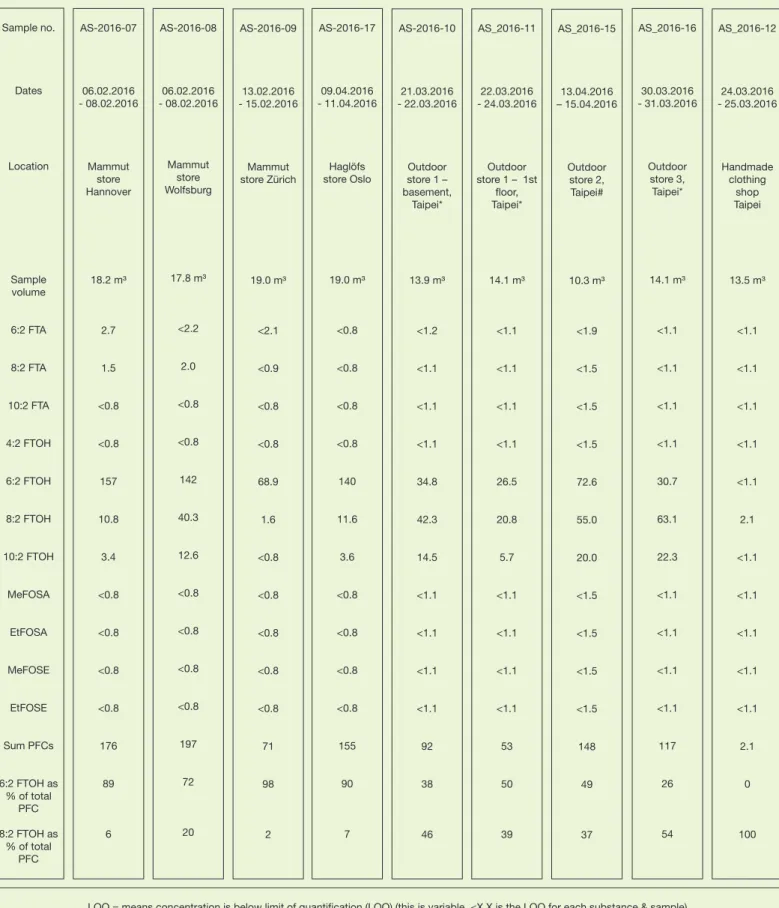
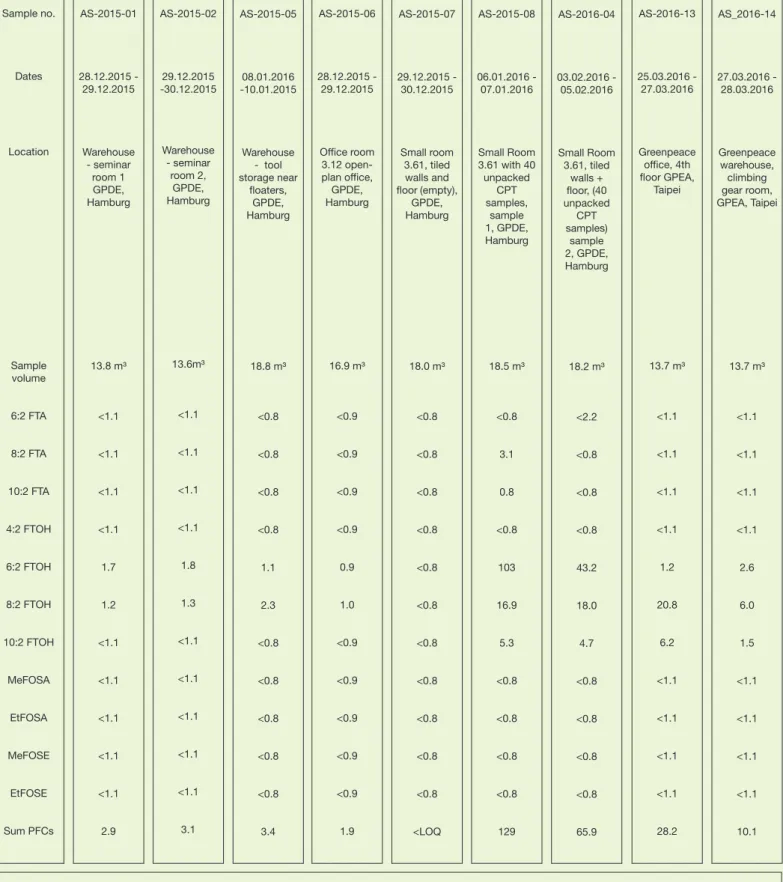
The results from the long-term samples are shown in Table 1 and Figure 1; the comparable samples in offices and storage rooms are shown in Table 2 and Figure 2. Long-term samples were taken in three Mammut stores in Germany, one Haglöfs store in Oslo and in the three outdoor stores in Taiwan. A sample was also taken in a clothing shop not selling outdoor clothes. The investigations show that for almost every air sample taken from outdoor stores there was significantly higher concentrations of volatile PFCs than in comparable samples of indoor air from offices and other rooms without a source of PFCs such as outdoor-gear. Total concentrations of PFCs found in the outdoor stores were between 53 ng/m³ and 197 ng/m³. The highest concentrations from the long-term samples were found in Mammut stores in the German cities of Wolfsburg (197 ng/m³) and Hannover (176 ng/m³). Samples from the Oslo store of the Swedish brand Haglöfs showed 155 ng/m³ of PFCs in indoor air and 71 ng/m³ was found in the Mammut store in Zürich.
Concentrations of PFCs in the European outdoor stores were about 20 to 60 times higher than in the corresponding reference samples and up to 1000 times higher than urban outdoor air.
The concentrations of PFCs in the
Greenpeace Germany offices were between the limit of quantification (LOQ) and 3.1 ng/ m³. In the warehouse, where waterproof and water-repellent gear is stored, concentrations of 3.4 ng/m³ were found (see Table 2).
In Taiwan, long-term sampling for PFCs was conducted in outdoor stores selling clothing and gear from different brands (see Table 1 and Figure 1), during both opening and closing hours in the week.
Total concentrations of volatile PFCs in these stores were between 53 and 148 ng/ m³, similar to the European samples. The reference samples from the Greenpeace East Asia offices showed levels of PFCs of 10.1 ng/m³ in the warehouse and 28.2 ng/ m³ in the office.34 Samples from a Taipei store
selling handmade clothes showed total PFC concentrations of 2.1ng/m³.
A significantly different pattern of PFC chemicals was found in the indoor air of the Taiwan stores compared to those in Europe. In the outdoor stores in Germany, Switzerland and Norway short chain fluorotelomer
alcohols (especially 6:2 FTOH) dominate, representing between 72-98% of the of the total concentrations of PFCs, with between 2-21% made up of long chain 8:2 FTOH and 8:2 FTA.
The long chain 10:2 FTOH was also found in two of the Mammut stores (Hannover and Wolfsburg) and the Haglöfs store in Oslo, at concentrations of between 3.4 and 12.6ng/m³. In contrast, 3 of the 4 samples from Taipei were dominated by the long chain PFCs 8:2 FTOH and 10:2 FTOH, which were present in all cases at 50% or more, and in in two cases represented about two thirds of the total volatile PFC concentrations.
Long term air sampling
for 20 to 30 hours
Long-term samples of 20 to 30 hours were not possible to take for all stores. In some European stores a short-term method of sampling over 50 minutes was undertaken (see Table 3 and Figure 2). Both long and short-term samples were taken in three outdoor stores: the Mammut stores in Hannover and Wolfsburg and the Haglöfs store in Oslo.
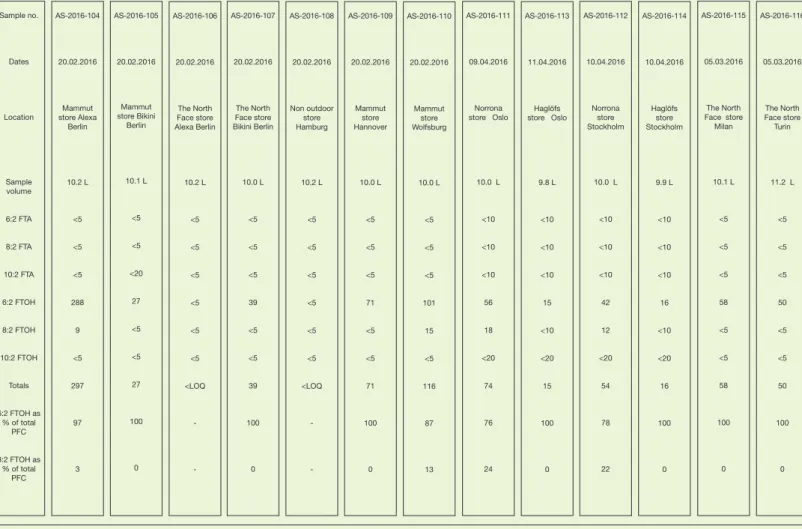
A different method was used for the short-term samples, which were collected during opening hours under normal ventilation conditions. Therefore, results from the short-term samples cannot be directly compared to those from the long-term samples. Short-term air samples were taken in four Mammut stores in Germany, four The North Face stores (two in Germany, two in Italy), as well as two Norrona and two Haglöfs stores in Norway and Sweden. A sample was also taken in a clothing shop not selling outdoor clothes. The results ranged from the limit of
quantification to concentrations of 297 ng/ m³ of PFCs, found in the Mammut store in Berlin (Alexa), the highest result of all the samples, both long and short-term. The next highest finding was for the Mammut store in Wolfsburg, at 116 ng/m³ PFCs
Indoor air in Norrona stores in Oslo and Stockholm contained 74 ng/m³ and 54 ng/ m³ PFCs, while in the Haglöfs stores in Oslo and Stockholm PFCs were detected at levels of 15 ng/m³ and 16 ng/m³. In The North Face flagship stores in Italy the concentration of PFCs were 58ng/m³ in Milan and 50ng/m³ in Turin.
PFCs were found in all the outdoor stores apart from The North Face Store in Berlin (Alexa) where no PFCs were detected above the limit of quantification, which was higher than for the long-term samples. PFCs were also not detected in the non-outdoor clothing store sample.
Short term air sampling
(50 minutes)
10
This air sampling investigation shows elevated levels of hazardous PFCs in the air of outdoor stores, which is likely to be the result of evaporation from outdoor gear and is having a significant impact on indoor air quality in outdoor stores.
Studies on the exposure to PFCs of professional ski waxers show that when exposed to poly-fluorinated substances such as 6:2 FTOH and 8:2 FTOH, the degradation products of these substances can be
detected in the blood of the ski waxers.35
While the concentrations of PFCs in the air in this case were much higher than the values found in outdoor stores such as the ones in this study, the exposure of customers and especially employees to hazardous PFCs in the air of outdoor stores cannot be ruled out. This exposure will not only be to volatile FTOHs in the air that they breathe but also to their degradation products, such as the corresponding perfluorinated carboxylic acids, including the toxic and carcinogenic PFOA, degraded from 8:2 FTOH, which are bound to airborne particulates.
The classification of PFOA as a substance of very high concern (SVHC) under REACH, restricting the use of PFOA is a first step, but does not go far enough. The substitution of PFOA with other PFCs such as FTOHs or other shorter chain PFCs will not protect employees and clients from these unwanted persistent chemicals in the air that they breathe.
The findings from these investigations on indoor air quality in stores selling outdoor clothing and gear justify the intensification of
Conclusions and
recommendations
scientific research on the impact on indoor air quality due to volatilization of certain PFCs from textiles. More importantly, they highlight the importance of immediate action to
eliminate the use of PFCs.
The avoidance of all PFCs, both long and short chain, is supported by more than 200 scientists from 38 countries who signed the ‘Madrid statement’ – which recommends avoiding the use of PFCs for the production of consumer products, including textiles, in line with the precautionary principle.36 There
can only be one conclusion – the elimination of ALL PFCs – from all outdoor products, is necessary.
Greenpeace demands that the whole group of PFCs should be regulated; PFCs are not safe chemicals and their use in all consumer products, including clothing and outdoor products, should be banned.
However, companies using PFCs in their products should not wait for regulators to restrict them. It is acknowledged that the use of PFCs for durable water repellency (DWR) and waterproof membranes in outdoor gear is difficult to substitute in textile manufacturing. Nevertheless, PFC-free materials are already available today that are suitable for outdoor clothing and gear applications.37
Since 2011, Greenpeace’s Detox My Fashion campaign has been working to ensure that hazardous chemicals are removed from the entire manufacturing supply chain of the textiles industry. Clothing companies that commit to Detox undertake to eliminate
hazardous chemicals – including all PFCs - from their production and products by 2020. More than 30 international fashion brands,38
sportswear brands and discounters 39 have
published credible Detox Commitments with Greenpeace, corresponding to about 15 percent of global textile production. Recently, Vaude, Paramo and Rotauf have joined the Detox Movement, the first outdoor brands to do so. They are demonstrating that producing PFC-free high performance gear is possible. Vaude has announced a timeline to eliminate all PFCs from its supply chain by 2018 and Paramo and Rotauf are already 100% PFC-free.
Greenpeace urges all outdoor brands to implement a Detox commitment and to set short-term deadlines for completely phasing out the use of all PFCs in all products and production processes. As global players, outdoor companies such as The North Face, Mammut, Haglöfs, Norrona and other companies have an opportunity and the responsibility to improve manufacturing practices in their supply chains.
These companies are prominent users of PFCs and need to take the lead on the elimination of all PFCs; this will send an important signal to the chemical industry and other innovators to increase their efforts on the further development of non-hazardous alternatives.
It’s time to act. It’s time to Detox!
12
Appendix 1: Comparison
with scientific studies
The findings are broadly comparable with the range of concentrations that have been reported in previous studies from ‘outdoor’ stores in Germany (Langer et al 2010:40 177
ng/m³ - 460 ng/m³; Schlummer et al. 2013:41
120 ng/m³ - 380 ng/m³). However, the
Greenpeace study shows a shift in the pattern of dominant PFCs from C8-PFCs to C6-PFCs, which were mainly found in samples from Europe, which differs from that reported by Langer and Schlummer. As mentioned above, samples collected in Taipei stores showed a similar pattern to that reported in the above studies, with C8 substances still dominating.
For almost all samples, the concentrations of PFCs in stores selling outdoor gear are considerably higher than those in the office and storage rooms tested for comparison purposes. In five of the six rooms that were tested, the concentrations for total PFCs were between the LOQ and 10 ng/m³, (with the one exception of the Taipei office where 28.2 ng/m³ was found).
Comparable studies that investigated the levels of PFCs in residences, offices and schools show similar concentrations, for example, Fromme gives a ‘typical‘
concentration of FTOHs as 12-13 ng/m3 with high values of 27-34. 42, 43, 44
Concentrations of PFCs in outdoor air are reported to be around 1000 times lower than this, ranging from considerably below <0.1 ng/m³ in air from the Atlantic to the Southern
Ocean,45 to just under 0.1 ng/m3 in German
urban outdoor air (see Table 3).46
Appendix 2: Testing
methodology
Method of air sampling for PFCs – long-term sampling
Samples were taken from 17 indoor locations in Germany, Switzerland, Norway and Taiwan. Air samples were collected using ISOLUTE ENV+SPE cartridges with a constant flow of ca. 9L/min over 20 to 30 hours; collection volume was between 11 and 19 m³.
The sampler (air sampling system APC PNA 384N) was placed – when possible - in the center of the room, with the height of air collection between 50 cm and 1,5 m. The sampling in stores took place over a weekend when the stores were closed. After sampling, cartridges were tightly wrapped with aluminium foil.
Cartridges were extracted using
ultrasonication with methyl tertiary butyl ether (MTBE). Instrumental separation and detection of the target analytes was carried out by GC–MS in selected ion-monitoring mode using positive chemical ionization. Appropriate quality control checks were employed. Field blank samples were also analysed to establish background levels, following the same steps but without flowing any air through the cartridge.
Method of air sampling for PFCs – short-term sampling
Samples were taken from 13 indoor locations in Germany, Italy, Norway and Sweden.
Air samples were collected with an air sampling system Holbach BiVOC2 using TENAX tubes with a constant flow of ca. 0.2 L/min over 50 minutes; collection volume was between 10 and 11 L.
The samplers were placed and carried in a PFC-free lined bag, with the tube opening reaching out at least 10 cm. The sampling was conducted while walking around in the store carrying the bag, with a height of air collection between 50 cm and 1 m. The people conducting the sampling were equipped with PFC-free clothing.
The sampling in stores took place during opening hours under usual business conditions.
After sampling, the tube was tightly closed with a metal screw cap and stored in a charcoal coated transportation bag. TENAX tubes were extracted using
thermodesorption. Instrumental separation and detection of the target analytes was carried out by GC–MS in selected ion-monitoring mode using positive chemical ionization, with quantification according DIN ISO 16000-6. Appropriate quality control checks were employed, including the use of field blanks, as described above
14 ` 300 225 150 75 0 ng/m3 10:2 FTOH 08:2 FTOH 06:2 FTOH 04:2 FTOH 10:2 FTA 08:2 FTA 06:2 FTA Mammut stor e Hannover Mammut stor e Wolfsbur n Mammut stor e Züich Haglöfs stor e Oslo Outdoor stor e, Taipei, B1 Outdoor stor e, Taipei, F1 Outdoor stor e 2, T aipei Outdoor stor e 3, T aipei Clothing stor e Taipei
Figure 1: Long-term samples of PFCs in outdoor stores in Europe and Taiwan, concentrations in ng/m³
Appendix 3: Figures and tables of results
300 225 150 75 0 ng/m3 10:2 FTOH 08:2 FTOH 06:2 FTOH 04:2 FTOH 10:2 FTA 08:2 FTA 06:2 FTA Warehouse room 1 GPDE Warehouse r oom 2 GPDE
Warehouse storage GPDEWarehouse storage GPTWOf fice r oom GPEA, 4F Office room GPDE, 3F Empty r oom GPDE, SM-0 Room (outdoor gear), GPDE
1
Room (outdoor gear), GPDE 2
Figure 2: Long-term samples for PFCs in seminar rooms, offices and storage rooms at Greenpeace Hamburg and Taipei, concentrations in ng/m³
` 300 225 150 75 0 ng/m3 10:2 FTOH 08:2 FTOH 06:2 FTOH 10:2 FTA 08:2 FTA 06:2 FTA
Mammut Alexa BerlinMammut Bikini Berlin
The North Face Alexa BerlinThe North Face Bikini Berli
n
Mammut HannoverMammut W
olfsbur g
Norrona Stockhol
m
Haglöfs Stockholm
The North Face MilanThe North Face Milan
Haglöfs Oslo
Norrona Oslo
Non outdoor sto re
16
`
Table 1: Results of air samples for PFCs from outdoor
stores in Europe and Taiwan and one non-outdoor clothing
store, long-term sampling, concentrations in ng/m³
Sample no. Dates Location Sample volume 6:2 FTA 8:2 FTA 10:2 FTA 4:2 FTOH 6:2 FTOH 8:2 FTOH 10:2 FTOH MeFOSA EtFOSA MeFOSE EtFOSE Sum PFCs 6:2 FTOH as % of total PFC 8:2 FTOH as % of total PFC AS-2016-07 06.02.2016 - 08.02.2016 Mammut store Hannover 18.2 m³ 2.7 1.5 <0.8 <0.8 157 10.8 3.4 <0.8 <0.8 <0.8 <0.8 176 89 6 AS-2016-08 06.02.2016 - 08.02.2016 Mammut store Wolfsburg 17.8 m³ <2.2 2.0 <0.8 <0.8 142 40.3 12.6 <0.8 <0.8 <0.8 <0.8 197 72 20 AS-2016-09 13.02.2016 - 15.02.2016 Mammut store Zürich 19.0 m³ <2.1 <0.9 <0.8 <0.8 68.9 1.6 <0.8 <0.8 <0.8 <0.8 <0.8 71 98 2 AS-2016-17 09.04.2016 - 11.04.2016 Haglöfs store Oslo 19.0 m³ <0.8 <0.8 <0.8 <0.8 140 11.6 3.6 <0.8 <0.8 <0.8 <0.8 155 90 7 AS-2016-10 21.03.2016 - 22.03.2016 Outdoor store 1 – basement, Taipei* 13.9 m³ <1.2 <1.1 <1.1 <1.1 34.8 42.3 14.5 <1.1 <1.1 <1.1 <1.1 92 38 46 AS_2016-11 22.03.2016 - 24.03.2016 Outdoor store 1 – 1st floor, Taipei* 14.1 m³ <1.1 <1.1 <1.1 <1.1 26.5 20.8 5.7 <1.1 <1.1 <1.1 <1.1 53 50 39 AS_2016-15 13.04.2016 – 15.04.2016 Outdoor store 2, Taipei# 10.3 m³ <1.9 <1.5 <1.5 <1.5 72.6 55.0 20.0 <1.5 <1.5 <1.5 <1.5 148 49 37 AS_2016-16 30.03.2016 - 31.03.2016 Outdoor store 3, Taipei* 14.1 m³ <1.1 <1.1 <1.1 <1.1 30.7 63.1 22.3 <1.1 <1.1 <1.1 <1.1 117 26 54 AS_2016-12 24.03.2016 - 25.03.2016 Handmade clothing shop Taipei 13.5 m³ <1.1 <1.1 <1.1 <1.1 <1.1 2.1 <1.1 <1.1 <1.1 <1.1 <1.1 2.1 0 100
LOQ = means concentration is below limit of quantification (LOQ) (this is variable, <X.X is the LOQ for each substance & sample) *Sampling took place during the week during both opening and closing times
#Sampling took place during opening times
` Sample no. Dates Location Sample volume 6:2 FTA 8:2 FTA 10:2 FTA 4:2 FTOH 6:2 FTOH 8:2 FTOH 10:2 FTOH MeFOSA EtFOSA MeFOSE EtFOSE Sum PFCs AS-2015-01 28.12.2015 - 29.12.2015 Warehouse - seminar room 1 GPDE, Hamburg 13.8 m³ <1.1 <1.1 <1.1 <1.1 1.7 1.2 <1.1 <1.1 <1.1 <1.1 <1.1 2.9 AS-2015-02 29.12.2015 -30.12.2015 Warehouse - seminar room 2, GPDE, Hamburg 13.6m³ <1.1 <1.1 <1.1 <1.1 1.8 1.3 <1.1 <1.1 <1.1 <1.1 <1.1 3.1 AS-2015-05 08.01.2016 -10.01.2015 Warehouse - tool storage near floaters, GPDE, Hamburg 18.8 m³ <0.8 <0.8 <0.8 <0.8 1.1 2.3 <0.8 <0.8 <0.8 <0.8 <0.8 3.4 AS-2015-06 28.12.2015 - 29.12.2015 Office room 3.12 open-plan office, GPDE, Hamburg 16.9 m³ <0.9 <0.9 <0.9 <0.9 0.9 1.0 <0.9 <0.9 <0.9 <0.9 <0.9 1.9 AS-2015-07 29.12.2015 - 30.12.2015 Small room 3.61, tiled walls and floor (empty), GPDE, Hamburg 18.0 m³ <0.8 <0.8 <0.8 <0.8 <0.8 <0.8 <0.8 <0.8 <0.8 <0.8 <0.8 <LOQ AS-2015-08 06.01.2016 - 07.01.2016 Small Room 3.61 with 40 unpacked CPT samples, sample 1, GPDE, Hamburg 18.5 m³ <0.8 3.1 0.8 <0.8 103 16.9 5.3 <0.8 <0.8 <0.8 <0.8 129 AS-2016-04 03.02.2016 - 05.02.2016 Small Room 3.61, tiled walls + floor, (40 unpacked CPT samples) sample 2, GPDE, Hamburg 18.2 m³ <2.2 <0.8 <0.8 <0.8 43.2 18.0 4.7 <0.8 <0.8 <0.8 <0.8 65.9 AS-2016-13 25.03.2016 - 27.03.2016 Greenpeace office, 4th floor GPEA, Taipei 13.7 m³ <1.1 <1.1 <1.1 <1.1 1.2 20.8 6.2 <1.1 <1.1 <1.1 <1.1 28.2 AS_2016-14 27.03.2016 - 28.03.2016 Greenpeace warehouse, climbing gear room, GPEA, Taipei 13.7 m³ <1.1 <1.1 <1.1 <1.1 2.6 6.0 1.5 <1.1 <1.1 <1.1 <1.1 10.1
<LOQ = means concentration is below limit of quantification (LOQ) (this is variable, <X.X is the LOQ for each substance & sample)
Table 2: Air sampling results
18 ` Sample no. Dates Location Sample volume 6:2 FTA 8:2 FTA 10:2 FTA 6:2 FTOH 8:2 FTOH 10:2 FTOH Totals 6:2 FTOH as % of total PFC 8:2 FTOH as % of total PFC AS-2016-104 20.02.2016 Mammut store Alexa Berlin 10.2 L <5 <5 <5 288 9 <5 297 97 3 AS-2016-105 20.02.2016 Mammut store Bikini Berlin 10.1 L <5 <5 <20 27 <5 <5 27 100 0 AS-2016-106 20.02.2016 The North Face store Alexa Berlin 10.2 L <5 <5 <5 <5 <5 <5 <LOQ -AS-2016-107 20.02.2016 The North Face store Bikini Berlin 10.0 L <5 <5 <5 39 <5 <5 39 100 0 AS-2016-108 20.02.2016 Non outdoor store Hamburg 10.2 L <5 <5 <5 <5 <5 <5 <LOQ -AS-2016-109 20.02.2016 Mammut store Hannover 10.0 L <5 <5 <5 71 <5 <5 71 100 0 AS-2016-110 20.02.2016 Mammut store Wolfsburg 10.0 L <5 <5 <5 101 15 <5 116 87 13 AS-2016-111 09.04.2016 Norrona store Oslo 10.0 L <10 <10 <10 56 18 <20 74 76 24 AS-2016-113 11.04.2016 Haglöfs store Oslo 9.8 L <10 <10 <10 15 <10 <20 15 100 0
<LOQ = means concentration is below limit of quantification (LOQ) (this is variable, <X.X is the LOQ for each substance & sample) AS-2016-112 10.04.2016 Norrona store Stockholm 10.0 L <10 <10 <10 42 12 <20 54 78 22 AS-2016-114 10.04.2016 Haglöfs store Stockholm 9.9 L <10 <10 <10 16 <10 <20 16 100 0 AS-2016-115 05.03.2016 The North Face store Milan 10.1 L <5 <5 <5 58 <5 <5 58 100 0 AS-2016-116 05.03.2016 The North Face store Turin 11.2 L <5 <5 <5 50 <5 <5 50 100 0
Table 3: Short-term air samples for PFCs, results from
outdoor stores in Europe, concentrations in ng/m³
References
01. PFCs refer here to per- and polyfluorinated chemicals (PFASs), and not to perfluorocarbons. This study investigated poly-flourinated chemicals and some per-FCs (eg MeFOSE) but mainly poly-fluorinated chemicals were found. PFASs are aliphatic substances containing one or more C carbons on which all H substituents present in the nonfluorinated analogues from which they are notionally derived have been replaced by F atoms, in such a manner that PFASs contain the perfluoroalkyl moiety –CnF2n+1: *Perfluoroalkyl substances refer to those aliphatic substances for which all hydrogen atoms attached to carbon atoms have been replaced by fluorine atoms. *Polyfluoroalkyl substances refer to those aliphatic substances for which all hydrogen atoms attached to at least one (but not all) carbon atoms have been replaced by fluorine atoms, in such a manner they contain the perfluoroalkyl moiety CnF2n+1
02. Dreyer A, Matthias V, Temme C, and Ebinghaus R, (2009). Annual Time Series of Air Concentrations of Polyfluorinated Compounds, Environ. Sci. Technol., 2009, 43 (11), pp 4029–4036, DOI: 10.1021/es900257w, Publication Date (Web): April 27, 2009, http://pubs.acs.org/doi/abs/10.1021/ es900257w
03. PFCs – see footnote 1 above. In this study both per- and polyfluorinated chemicals (PFASs) were found.
04. Greenpeace e.V. (2012). Chemistry for any weather, Greenpeace tests outdoor clothes for perfluorianted toxins, October 2012 http://www. greenpeace.org/romania/Global/romania/detox/ Chemistry%20for%20any%20weather.pdf 05. Greenpeace e.V. (2013a). Chemistry for any weather, Part II, Executive Summary, December 2013; http://m.greenpeace.org/italy/Global/italy/ report/2013/toxics/ExecSummary_Greenpeace%20 Outdoor%20Report%202013_1.pdf
06. Greenpeace e.V, (2013b), Gefährliche
Chemikalien in Bademoden (2013a), https://www. greenpeace.de/sites/www.greenpeace.de/files/ publications/factsheet_bademode_0.pdf
07. Greenpeace e.V. (2014). A red card for
sportswear brands, Greenpeace tests shoes in the prerun of World Champion Ship, May 2014 http://www.greenpeace.org/international/Global/ international/publications/toxics/2014/Detox-Football-Report.pdf
08. Greenpeace (2014). A Little Story About the Monsters In Your Closet, Publication - 14 January, 2014. http://www.greenpeace.org/international/en/ publications/Campaign-reports/Toxics-reports/A-Little-Story-About-the-Monsters-In-Your-Closet/ 09. Greenpeace (2014a). A Little Story about a Fashionable Lie - Hazardous chemicals in luxury branded clothing for children, 17 February, 2014. http://www.greenpeace.org/international/en/ publications/Campaign-reports/Toxics-reports/A-Little-Story-about-a-Fashionable-Lie/
10. Greenpeace (2016), Leaving Traces - The hidden hazardous chemicals in outdoor gear - Greenpeace product test 2016 http://www.greenpeace.org/ international/Global/international/publications/ detox/2016/Leaving-Traces.pdf
Technical Report: Leaving Traces – Per- and poly-fluorinated chemicals in branded waterproof clothing, footwear, hiking and camping equipment http://www.greenpeace.org/international/Global/ international/publications/detox/2016/Leaving-Traces-Technical%20-Report.pdf
11. ECHA (2013). Candidate List of Substances of Very High Concern for authorization. European Chemicals Agency, http://echa.europa.eu/ candidate-list-table
12. OECD (2013). Synthesis Paper On Per- and Polyfluorinated Chemicals (PFCs) http://www.oecd. org/env/ehs/risk-management/PFC_FINAL-Web.pdf 13.Frömel, T., & Knepper, T.P. (2010) Biodegradation of fluorinated alkyl substances. Reviews of
Environmental Contamination and Toxicology 208: 161–177
20
14. Nilsson H, Kärrman A, Rotander A, van Bavel B, Lindström G, Westberg H. (2012), Biotransformation of fluorotelomer compound to perfluorocarboxylates in humans
http://www.ncbi.nlm.nih.gov/pubmed/23138016 15. Gawor A, Shunthirasingham C, Hayward SJ, Lei YD, Gouin T, Mmereki BT, Masamba W, Ruepert, Castillo LE, Shoeib M, Lee SC & Harner T, Wania F (2014). Neutral polyfluoroalkyl substances in the global Atmosphere. Environ. Sci.: Processes Impacts, 2014, 16, 404
16. Young, C.J. & Mabury, S.A. (2010) Atmospheric perfluorinated acid precursors: chemistry,
occurrence and impacts. Reviews of Environmental Contamination and Toxicology (208): 1–109
17.Rand AA, Mabury SA. (2012). In vitro interactions of biological nucleophiles with fluorotelomer
unsaturated acids and aldehydes: fate and consequences. Environ Sci Technol. 2012 Jul 3;46(13):7398-406. doi: 10.1021/es3008485. Epub 2012 Jun 15. http://www.ncbi.nlm.nih.gov/ pubmed/22582947
18. Fei C, McLaughlin JK, Lipworth L, Olsen J (2009). Maternal levels of perfluorinated chemicals and subfecundity. Hum Reprod. 24(5):1200-5. Grandjean P, Andersen EW, Budtz-Jørgensen E, Nielsen F, Mølbak K, Weihe P, Heilmann C. (2012). Serum vaccine antibody concentrations in children exposed to perfluorinated compounds. JAMA. 307(4):391-7. There is growing evidence that PFOA in particular does other harm, and it is suspected of being an endocrine disruptor. Recent epidemiological studies have suggested an association between PFOA exposure and adiposity (Thorhallur 2012), diminished fertility (Fei 2009), immune disorders (Grandjean 2012) and thyroid diseases (Melzer 2010).
19. OECD (2013), op.cit. 20. ECHA (2013), op.cit.
21. ECHA (2014), Germany and Norway propose a restriction on Perfluorooctanoic acid (PFOA), its salts and PFOA -related substances; the proposal is for a restriction on the manufacturing, use and placing on the market of Perfluorooctanoic acid (PFOA) and its salts, including substances that may degrade to PFOA (PFOA-related substances), in concentrations equal to or greater than 2 ppb. http://echa.europa. eu/documents/10162/3b6926a2-64cb-4849-b9be-c226b56ae7fe
22. Wang, Z., Ian T. Cousins, I.T., Scheringer, A. (2013) Fluorinated alternatives to long-chain perfluoroalkyl carboxylic acids (PFCAs), perfluoroalkane sulfonic acids (PFSAs) and their potential precursors, Environment International 60 (2013) 242–248. http://www.greensciencepolicy.org/ wp-content/uploads/2014/10/Wang-etal.-2013.pdf 23.For more information see Greenpeace 2012, op.cit.
24. Greenpeace (2015) Footprints in the snow, Hazardous PFCs in remote locations around the globe. http://detox-outdoor.org/assets/uploads/ Report%20RAE/RAE_report_08_2015_english_final. pdf
25. Greenpeace e.V. (2016). Leaving Traces: the hidden hazardous chemicals in outdoor gear. Greenpeace product testing 2016, http://detox-outdoor.org/assets/uploads/Leaving%20Traces.%20 The%20hidden%20hazardous%20chemicals%20 in%20outdoor%20gear%20(2016).pdf
26. Greenpeace e.V. (2013). Chemistry for any weather, Part II, Executive Summary, December 2013; http://m.greenpeace.org/italy/Global/italy/ report/2013/toxics/ExecSummary_Greenpeace%20 Outdoor%20Report%202013_1.pdf and
Greenpeace e.V. (2013a). Chemie für Gipfelstürmer, December 2013; https://www.greenpeace.de/sites/ www.greenpeace.de/files/publications/20131212-greenpeace-outdoor-report-2013.pdf
27. Jahnke A, Huber S, Temme C, Kylin H, Berger U.: Development and application of a simplified sampling method for volatile polyfluorinated alkyl substances in indoor and environmental air, J. Chromatogr. 2007, A 1164. 1-9
28. Fromme H., Dreyer A., Dietrich S., Fernbacher L., Lahrz T., Völkel W., Neutral polyfluorinated compounds in indoor air in Germany – The LUPE 4 study, Chemosphere 139 (2015) 572–578
29. Schlummer M et al (2013), Detection of fluorotelomer alcohols in indoor environments and their relevance for human exposure, Environ Int. 2013 57-58:42-9.
30. Greenpeace’s policy is that any outdoor gear used by employees and activists should be 100% PFC free. However, the possibility that there are products containing PFCs in Greenpeace warehouses cannot be excluded, as they contain equipment purchased over many years by Greenpeace.
31. Himmelstein MW, Serex TL, Buck RC, Weinberg JT, Mawn MP, Russell MH (2011). 8:2 fluorotelomer alcohol: a one-day nose-only inhalation toxicokinetic study in the Sprague-Dawley rat with application to risk assessment. Toxicology. 2012 Jan 27;291(1-3):122-32. doi: 10.1016/j.tox.2011.11.005. Epub 2011 Nov 22. http://www.ncbi.nlm.nih.gov/
pubmed/22120539 Nillson H, Kärrman A, Rotander A, van Bavel B, Lindström G, Westberg H. (2013a), Biotransformation of fluorotelomer compound to perfluorocarboxylates in humans, Environ Int. 2013 Jan;51:8-12. doi: 10.1016/j.envint.2012.09.001. Epub 2012 Nov 6. http://www.ncbi.nlm.nih.gov/ pubmed/23138016 http://www.ncbi.nlm.nih.gov/ pubmed/23138016
32. Nilsson H, Kärrman A, Rotander A, van Bavel B, Lindström G, Westberg H (2013), Professional ski waxers’ exposure to PFAS and aerosol concentrations in gas phase and different particle size fractions.Environ Sci Process Impacts. 2013 Apr;15(4):814-22.
33. OECD (2013), op.cit.; ECHA (2013), op.cit. 34. These results are higher compared to the findings in the German offices. GPEA is currently investigating potential sources of PFCs.
35. Nilsson et.al. (2013), op.cit. and Nillson et.al. (2013a), op.cit. Himmelstein (2011), op.cit. 36. Madrid Statement (2015) http://
greensciencepolicy.org/madrid-statement/. The Madrid Statement is based on: M. Scheringer, X. Trier, I. Cousins, P. de Voogt, T. Fletcher e, Z. Wang, T. Webster: Helsingør Statement on poly and perfluorinated alkyl substances (PFASs),
Chemosphere, Volume 114, November 2014, Pages 337–339. ttp://www.sciencedirect.com/science/ article/pii/S004565351400678X
37. Some smaller outdoor companies such as Paramo, Pyua, Rotauf, Fjällräven and R’ADYS already have entire collections of functional weatherproof clothing that are PFC-free.
38. Greenpeace website, Detox Catwalk (2015). http://www.greenpeace.org/international/en/ campaigns/detox/fashion/detox-catwalk
39. Tchibo Detox commitment (2014): http://tchibo. com/cb/1053454/data/-/TchiboDETOXCommitment. pdf
40. Langer V, Dreyer A, Ebinghaus R (2010). Polyfluorinated compounds in residential and nonresidential indoor air. Environ Sci Technol 2010, 44:8075-8081.
41. Schlummer et al (2013). Op.Cit. 42. Fromme et al (2015). Op.Cit. 43. Schlummer et al (2013). Op.Cit. 44. Jahnke et al (2007). Op.Cit.
45. Wang Z, Xie Z, Mi W, Möller A, Wolschke H, Ebinghaus R: Neutral Poly/Per-Fluoroalkyl Substances in Air from the Atlantic to the Southern Ocean and in Antarctic Snow, Environ. Sci. Technol 2015. See Figure 4, values were considerably lower than 0.1ng/m3: “total concentrations of the 12 PFASs (ΣPFASs) in gas phase ranged from 2.8 to 68.8 pg m−3 (mean: 23.5 pg m−3)”.
22
Authors: Manfred Santen, Madeleine Cobbing, Kevin Brigden
Acknowledgements: Annekatrin Dreyer, Barbara Kafadaroglu (ALAB-Berlin), Ling-Yao
Chen, Giuseppe Ungherese, Julia Bangerter, Rosanna Endres.
G
Published by Greenpeace Germany Hongkongstraße 10 20457
Hamburg
Greenpeace is an independent global campaigning organisation that acts to change
attitudes and behaviour, to protect and conserve the environment and to promote
peace. greenpeace.de